Search Results: "anbe"

17 October 2020

Dirk Eddelbuettel: digest 0.6.26: Blake3 and Tuning

And a new version of digest is now on CRAN will go to Debian shortly. digest creates hash digests of arbitrary R objects (using the md5, sha-1, sha-256, sha-512, crc32, xxhash32, xxhash64, murmur32, spookyhash, and blake3 algorithms) permitting easy comparison of R language objects. It is a fairly widely-used package (currently listed at 896k monthly downloads, 279 direct reverse dependencies and 8057 indirect reverse dependencies, or just under half of CRAN) as many tasks may involve caching of objects for which it provides convenient general-purpose hash key generation. This release brings two nice contributed updates. Dirk Schumacher added support for blake3 (though we could probably push this a little harder for performance, help welcome). Winston Chang benchmarked and tuned some of the key base R parts of the package. Last but not least I flipped the vignette to the lovely minidown, updated the Travis CI setup using bspm (as previously blogged about in r4 #30), and added a package website using Matertial for MkDocs. My CRANberries provides the usual summary of changes to the previous version. For questions or comments use the issue tracker off the GitHub repo. If you like this or other open-source work I do, you can now sponsor me at GitHub. For the first year, GitHub will match your contributions.

This post by Dirk Eddelbuettel originated on his Thinking inside the box blog. Please report excessive re-aggregation in third-party for-profit settings.
15 October 2020

Dirk Eddelbuettel: dang 0.0.12: Two new functions

A new release of the dang package is now on CRAN, roughly one year after the last release. The dang package regroups a few functions of mine that had no other home as for example lsos() from a StackOverflow question from 2009 (!!) is one, this overbought/oversold price band plotter from an older blog post is another. More recently added were helpers for data.table to xts conversion and a git repo root finder. This release adds two functions. One was mentioned just days ago in a tweet by Nathan and is a reworked version of something Colin tweeted about a few weeks ago: a little data wrangling off the kewl rtweet to find maximally spammy accounts per search topic. In other words those who include more than N hashtags for given search term. The other is something I, if memory serves, picked up a while back on one of the lists: a base R function to identify non-ASCII characters in a file. It is a C function that is not directly exported by and hence no accessible, so we put it here (with credits, of course). I mentioned it yesterday when announcing tidyCpp as I this C function was the starting point for the new tidyCpp wrapper around some C API of R functions. The (very short) NEWS entry follows.

Changes in version 0.0.12 (2020-10-14)
  • New functions muteTweets and checkPackageAsciiCode.
  • Updated CI setup.

Courtesy of CRANberries, there is a comparison to the previous release. For questions or comments use the issue tracker off the GitHub repo. If you like this or other open-source work I do, you can now sponsor me at GitHub. For the first year, GitHub will match your contributions.

This post by Dirk Eddelbuettel originated on his Thinking inside the box blog. Please report excessive re-aggregation in third-party for-profit settings.

8 October 2020

Dirk Eddelbuettel: RcppSimdJson 0.1.2: Upstream update

A new RcppSimdJson release arrived on CRAN yesterday bringing along the simdjson 0.5.0 release that happened a few weeks. RcppSimdJson wraps the fantastic and genuinely impressive simdjson library by Daniel Lemire and collaborators. Via very clever algorithmic engineering to obtain largely branch-free code, coupled with modern C++ and newer compiler instructions, it results in parsing gigabytes of JSON parsed per second which is quite mindboggling. The best-case performance is faster than CPU speed as use of parallel SIMD instructions and careful branch avoidance can lead to less than one cpu cycle per byte parsed; see the video of the talk by Daniel Lemire at QCon (also voted best talk). Beside the upstream update, not too much happened to our package itself since 0.1.1 though Brandon did help one user to seriously speed up his JSON processing. The (this time very short) NEWS entry follows.

Changes in version 0.1.2 (2020-10-07)
  • Upgraded to simdjson 0.5.0 (Dirk #49)

Courtesy of my CRANberries, there is also a diffstat report for this release. For questions, suggestions, or issues please use the issue tracker at the GitHub repo. If you like this or other open-source work I do, you can now sponsor me at GitHub. For the first year, GitHub will match your contributions.

This post by Dirk Eddelbuettel originated on his Thinking inside the box blog. Please report excessive re-aggregation in third-party for-profit settings.

Dirk Eddelbuettel: littler 0.3.12: Exciting updates

max-heap image The thirteenth release of littler as a CRAN package became available today (after a three day rest at CRAN for no real reason), following in the fourteen-ish year history as a package started by Jeff in 2006, and joined by me a few weeks later. littler is the first command-line interface for R as it predates Rscript. It allows for piping as well for shebang scripting via #!, uses command-line arguments more consistently and still starts faster. It also always loaded the methods package which Rscript only started to do in recent years. littler lives on Linux and Unix, has its difficulties on macOS due to yet-another-braindeadedness there (who ever thought case-insensitive filesystems as a default where a good idea?) and simply does not exist on Windows (yet the build system could be extended see RInside for an existence proof, and volunteers are welcome!). See the FAQ vignette on how to add it to your PATH. A few examples are highlighted at the Github repo, as well as in the examples vignette. This release brings five new example scripts and command wrappers: A number of commands were also extended or updated (see below for more). We have a new and very slick documentation website once again utilising Material for MkDocs. Last but not least the two included vignettes now use minidown and the fabulous water css theme which reduced the file sizes of the two vignettes from, respectively, 884kb and 873kb to 47kb and 15kb. Yes, that is correct. That alone brought the package file size down from 641kb to 116kb. Incredible. The NEWS file entry is below.

Changes in littler version 0.3.12 (2020-10-04)
  • Changes in examples
    • Updates to scripts tt.r, cos.r, cow.r, c4r.r, com.r
    • New script installDeps.r to install dependencies
    • Several updates tp script check.r
    • New script installBSPM.r and installRSPM.r for binary package installation (Dirk and I aki in #81)
    • New script cranIncoming.r to check in Incoming
    • New script urlUpdate.r validates URLs as R does
  • Changes in package
    • Travis CI now uses BSPM
    • A package documentation website was added
    • Vignettes now use minidown resulting in much reduced filesizes: from over 800kb to under 50kb (Dirk in #83)

My CRANberries provides a comparison to the previous release. Full details for the littler release are provided as usual at the ChangeLog page, and now also on the new package docs website. The code is available via the GitHub repo, from tarballs and now of course also from its CRAN page and via install.packages("littler"). Binary packages are available directly in Debian as well as soon via Ubuntu binaries at CRAN thanks to the tireless Michael Rutter. Comments and suggestions are welcome at the GitHub repo. If you like this or other open-source work I do, you can now sponsor me at GitHub. For the first year, GitHub will match your contributions.

This post by Dirk Eddelbuettel originated on his Thinking inside the box blog. Please report excessive re-aggregation in third-party for-profit settings.

3 October 2020

Dirk Eddelbuettel: pinp 0.0.10: More Tweaks

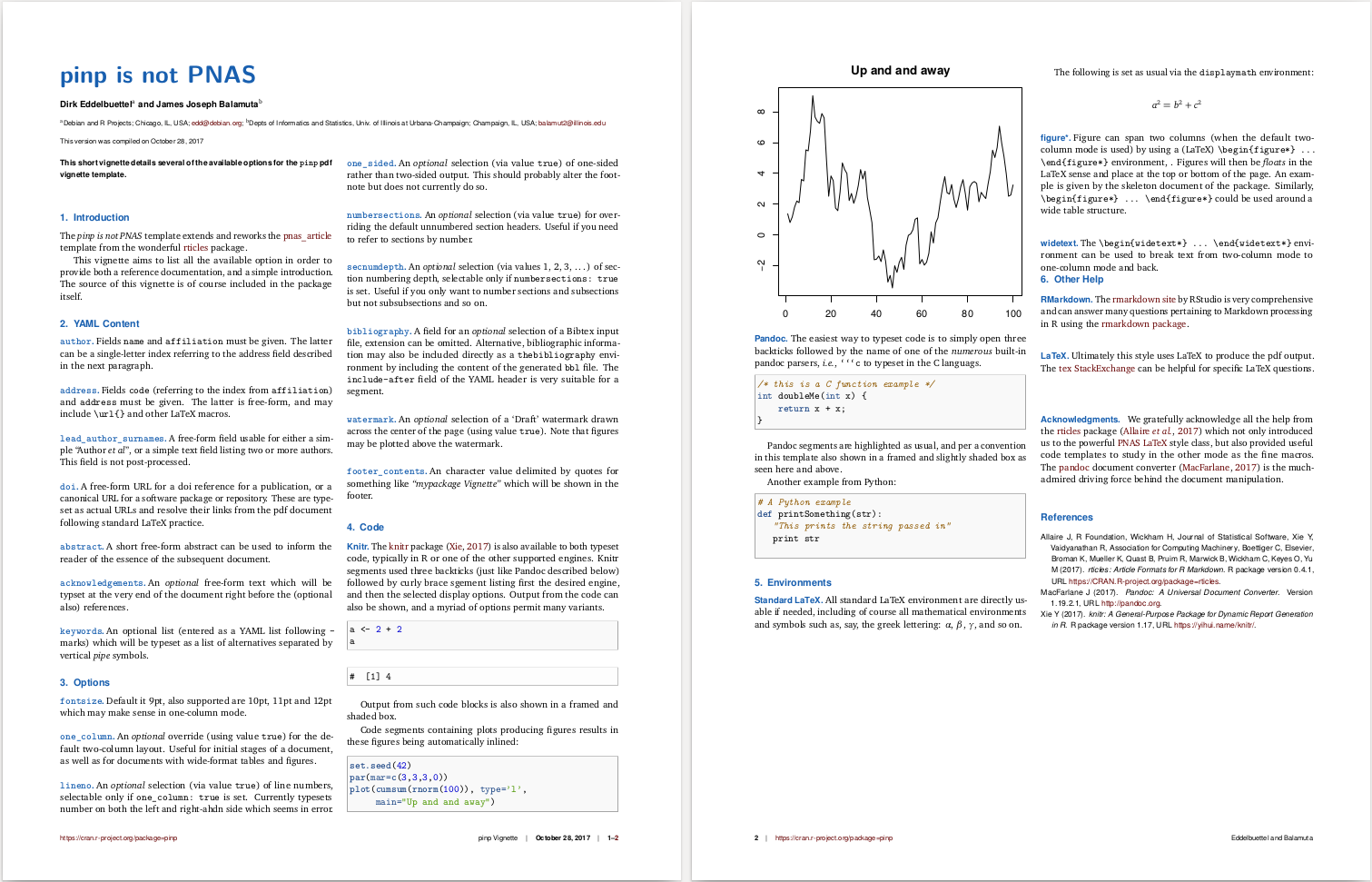
A new version of our pinp package arrived on CRAN two days ago, roughly one year after the previous release. The pinp package allows for snazzier one or two column Markdown-based pdf vignettes, and is now used by a few packages. A screenshot of the package vignette can be seen below. Additional screenshots are at the pinp page. pinp vignette This release adds another option for a customized date YAML variable suitable for e.g. a published at date thanks to Ilya Kashnitsky, has some tweaks to the README.md as well as support for pandoc columns mode (as a small extension of code from the nice repo by Grant McDermott). The NEWS entry for this release follows.

Changes in pinp version 0.0.10 (2020-10-01)
  • New document_date YAML variable to optionally set a 'Published at' or alike date (Ilya Kashnitsky in #85).
  • Small tweaks to README.md (Dirk)
  • Support pandoc columns mode (Dirk in #88)

Courtesy of my CRANberries, there is a comparison to the previous release. More information is on the tint page. For questions or comments use the issue tracker off the GitHub repo. If you like this or other open-source work I do, you can now sponsor me at GitHub. For the first year, GitHub will match your contributions.

This post by Dirk Eddelbuettel originated on his Thinking inside the box blog. Please report excessive re-aggregation in third-party for-profit settings.

27 September 2020

Dirk Eddelbuettel: pkgKitten 0.2.0: Now with tinytest and new docs

kitten A new release 0.2.0 of pkgKitten just hit on CRAN today, or about eleven months after the previous release. This release brings support for tinytest by having pkgKitten::kitten() automagically call tinytest::puppy() if the latter package is installed (and the user did not opt out of calling it). So your newly created minimal package now also uses a wonderful yet tiny testing framework. We also added a new documentation site using the previously tweeted-about wrapper for Material for MkDocs I really dig. And last but not least we switched to BSPM-based Continued Integration (which I wrote about yesterday in R4 #30) and fixed one bug regarding the default NAMESPACE file.

Changes in version 0.2.0 (2020-09-27)
  • Continuous Integration uses the updated BSPM-based script on Travis and with GitHub Actions (Dirk in #11 plus earlier commits).
  • A new default NAMESPACE file is now installed (Dirk in #12).
  • A package documentation website was added (Dirk in #13).
  • Call tinytest::puppy if installed and not opted out (Dirk in #14).

More details about the package are at the pkgKitten webpage, the (new) pkgKitten docs site, and the pkgKitten GitHub repo. Courtesy of my CRANberries site, there is also a diffstat report for this release. If you like this or other open-source work I do, you can now sponsor me at GitHub. For the first year, GitHub will match your contributions.

This post by Dirk Eddelbuettel originated on his Thinking inside the box blog. Please report excessive re-aggregation in third-party for-profit settings.

20 September 2020

Dirk Eddelbuettel: RcppSpdlog 0.0.2: New upstream, awesome new stopwatch

Following up on the initial RcppSpdlog 0.0.1 release earlier this week, we are pumped to announce release 0.0.2. It contains upstream version 1.8.0 for spdlog which utilizes (among other things) a new feature in the embedded fmt library, namely completely automated formatting of high resolution time stamps which allows for gems like this (taken from this file in the package and edited down for brevity):
    spdlog::stopwatch sw;                                   // instantiate a stop watch

    // some other code

    sp->info("Elapsed time:  ", sw);
What we see is all there is: One instantiates a stopwatch object, and simply references it. The rest, as they say, is magic. And we get tic / toc alike behaviour in modern C++ at essentially no cost us (as code authors). So nice. Output from the (included in the package) function exampleRsink() (again edited down just a little):
R> RcppSpdlog::exampleRsink()
[13:03:23.845114] [fromR] [I] [thread 793264] Welcome to spdlog!
[...]
[13:03:23.845205] [fromR] [I] [thread 793264] Elapsed time: 0.000103611
[...]
[13:03:23.845281] [fromR] [I] [thread 793264] Elapsed time: 0.00018203
R> 
We see that the two simple logging instances come 10 and 18 microseconds into the call. RcppSpdlog bundles spdlog, a wonderful header-only C++ logging library with all the bells and whistles you would want that was written by Gabi Melman, and also includes fmt by Victor Zverovic. The NEWS entry for this release follows.

Changes in RcppSpdlog version 0.0.2 (2020-09-17)
  • Upgraded to upstream release 1.8.0
  • Switched Travis CI to using BSPM, also test on macOS
  • Added 'stopwatch' use to main R sink example

Courtesy of my CRANberries, there is a diffstat report relative to previous release. More detailed information is on the RcppSpdlog page. The only sour grapes, again, are once more over the CRAN processing. And just how 0.0.1 was delayed for no good reason for three weeks, 0.0.2 was delayed by three days just because well that is how CRAN rules sometimes. I d be even more mad if I had an alternative but I don t. We remain grateful for all they do but they really could have let this one through even at one-day update delta. Ah well, now we re three days wiser and of course nothing changed in the package. If you like this or other open-source work I do, you can now sponsor me at GitHub. For the first year, GitHub will match your contributions.

This post by Dirk Eddelbuettel originated on his Thinking inside the box blog. Please report excessive re-aggregation in third-party for-profit settings.

6 September 2020

Dirk Eddelbuettel: inline 0.3.16: Now with system2()

A new minor release of the inline package just arrived on CRAN. inline facilitates writing code in-line in simple string expressions or short files. The package is mature and stable, and can be considered to be in maintenance mode: Rcpp used it extensively in the vrey early days before Rcpp Attributes provided an even better alternative. Seveal other package still rely on inline. One of these package is rstan, and Ben Goodrich updated our use of system() to system2() allowing for better error diagnostics. We also did a bit of standard maintenance to Travis CI and the README.md file. See below for a detailed list of changes extracted from the NEWS file.

Changes in inline version 0.3.16 (2020-09-06)
  • Maintenance updates to README.md standardizing badges (Dirk).
  • Maintenance update to Travis CI setup (Dirk).
  • Switch to using system2() for better error diagnostics (Ben Goodrich in #12).

Courtesy of CRANberries, there is a comparison to the previous release. If you like this or other open-source work I do, you can now sponsor me at GitHub. For the first year, GitHub will match your contributions.

This post by Dirk Eddelbuettel originated on his Thinking inside the box blog. Please report excessive re-aggregation in third-party for-profit settings.

4 September 2020

Dirk Eddelbuettel: nanotime 0.3.2: Tweaks

Another (minor) nanotime release, now at version 0.3.2. This release brings an endianness correction which was kindly contributed in a PR, switches to using the API header exported by RcppCCTZ, and tweaks test coverage a little with respect to r-devel. nanotime relies on the RcppCCTZ package for (efficient) high(er) resolution time parsing and formatting up to nanosecond resolution, and the bit64 package for the actual integer64 arithmetic. Initially implemented using the S3 system, it has benefitted greatly from work by co-author Leonardo who not only rejigged nanotime internals in S4 but also added new S4 types for periods, intervals and durations. The NEWS snippet adds full details.

Changes in version 0.3.2 (2020-09-03)
  • Correct for big endian (Elliott Sales de Andrade in #81).
  • Use the RcppCCTZ_API.h header (Dirk in #82).
  • Conditionally reduce test coverage (Dirk in #83).

Thanks to CRANberries there is also a diff to the previous version. More details and examples are at the nanotime page; code, issue tickets etc at the GitHub repository. If you like this or other open-source work I do, you can now sponsor me at GitHub. For the first year, GitHub will match your contributions.

This post by Dirk Eddelbuettel originated on his Thinking inside the box blog. Please report excessive re-aggregation in third-party for-profit settings.

3 September 2020

Dirk Eddelbuettel: RcppArmadillo 0.9.900.3.0

armadillo image Armadillo is a powerful and expressive C++ template library for linear algebra aiming towards a good balance between speed and ease of use with a syntax deliberately close to a Matlab. RcppArmadillo integrates this library with the R environment and language and is widely used by (currently) 769 other packages on CRAN. A few days ago, Conrad released a new minor version 9.900.3 of Armadillo which we packaged and tested as usual. Given the incremental release character, we only tested the release and not candidate release. No regressions were found, and, as usual, logs from reverse-depends runs are in the rcpp-logs repo. All changes in the new release are noted below.

Changes in RcppArmadillo version 0.9.900.3.0 (2020-09-02)
  • Upgraded to Armadillo release 9.900.3 (Nocturnal Misbehaviour)
    • More efficient code for initialising matrices with fill::zeros
    • Fixes for various error messages

Courtesy of CRANberries, there is a diffstat report relative to previous release. More detailed information is on the RcppArmadillo page. Questions, comments etc should go to the rcpp-devel mailing list off the R-Forge page. If you like this or other open-source work I do, you can now sponsor me at GitHub. For the first year, GitHub will match your contributions.

This post by Dirk Eddelbuettel originated on his Thinking inside the box blog. Please report excessive re-aggregation in third-party for-profit settings.

31 August 2020

Dirk Eddelbuettel: RcppCCTZ 0.2.9: API Header Added

A new minor release 0.2.9 of RcppCCTZ is now on CRAN. RcppCCTZ uses Rcpp to bring CCTZ to R. CCTZ is a C++ library for translating between absolute and civil times using the rules of a time zone. In fact, it is two libraries. One for dealing with civil time: human-readable dates and times, and one for converting between between absolute and civil times via time zones. And while CCTZ is made by Google(rs), it is not an official Google product. The RcppCCTZ page has a few usage examples and details. This package was the first CRAN package to use CCTZ; by now at least three others do using copies in their packages which remains less than ideal. This version adds a header file for the recently-exported three functions.

Changes in version 0.2.9 (2020-08-30)
  • Provide a header RcppCCZT_API.h for client packages.
  • Show a simple example of parsing a YYYYMMDD HHMMSS.FFFFFF date.

We also have a diff to the previous version thanks to CRANberries. More details are at the RcppCCTZ page; code, issue tickets etc at the GitHub repository. If you like this or other open-source work I do, you can now sponsor me at GitHub. For the first year, GitHub will match your contributions.

This post by Dirk Eddelbuettel originated on his Thinking inside the box blog. Please report excessive re-aggregation in third-party for-profit settings.

30 August 2020

Dirk Eddelbuettel: RcppSMC 0.2.2: Small updates

A new release 0.2.2 of the RcppSMC package arrived on CRAN earlier today (and once again as a very quick pretest-publish within minutes of submission). RcppSMC provides Rcpp-based bindings to R for the Sequential Monte Carlo Template Classes (SMCTC) by Adam Johansen described in his JSS article. Sequential Monte Carlo is also referred to as Particle Filter in some contexts. This releases contains two fixes from a while back that had not been released, a CRAN-requested update plus a few more minor polishes to make it pass R CMD check --as-cran as nicely as usual.

Changes in RcppSMC version 0.2.2 (2020-08-30)
  • Package helper files .editorconfig added (Adam in #43).
  • Change const correctness and add return (Leah in #44).
  • Updates to continuous integration and R versions used (Dirk)
  • Accomodate CRAN request, other updates to CRAN Policy (Dirk in #49 fixing #48).

Courtesy of CRANberries, there is a diffstat report for this release. More information is on the RcppSMC page. Issues and bugreports should go to the GitHub issue tracker. If you like this or other open-source work I do, you can now sponsor me at GitHub. For the first year, GitHub will match your contributions.

This post by Dirk Eddelbuettel originated on his Thinking inside the box blog. Please report excessive re-aggregation in third-party for-profit settings.

28 August 2020

Dirk Eddelbuettel: anytime 0.3.9: More Minor Maintenance

A new minor release of the anytime package arrived on CRAN yesterday. This is the twentieth release, but sadly we seem to be spinning our wheels just accomodating CRAN (which the two or three last releases focused on). Code and functionality remain mature and stable, of course. anytime is a very focused package aiming to do just one thing really well: to convert anything in integer, numeric, character, factor, ordered, format to either POSIXct or Date objects and to do so without requiring a format string as well as accomodating different formats in one input vector. See the anytime page, or the GitHub README.md for a few examples. This release once again has to play catchup with CRAN as r-devel now changes how tzone propagates when we do as.POSIXct(as.POSIXlt(Sys.time()) which is now no longer equal to as.POSIXct(Sys.time()) even for a fixed, stored Sys.time() call result. Probably for the better, but an issue for now so we effectively just reduced test coverage. Call it progress . The full list of changes follows.

Changes in anytime version 0.3.9 (2020-08-26)
  • Skip one test file that is impossible to run across different CRAN setups, and life is definitely too short for these games.
  • Change remaining http:// to https:// because, well, you know.

Courtesy of CRANberries, there is a comparison to the previous release. More information is on the anytime page. The issue tracker tracker off the GitHub repo can be use for questions and comments. If you like this or other open-source work I do, you can now sponsor me at GitHub. For the first year, GitHub will match your contributions.

This post by Dirk Eddelbuettel originated on his Thinking inside the box blog. Please report excessive re-aggregation in third-party for-profit settings.

11 August 2020

Dirk Eddelbuettel: RcppSimdJson 0.1.1: More Features

A first update following for the exciting RcppSimdJson 0.1.0 release last month is now on CRAN. Version 0.1.1 brings further enhancements such direct parsing of raw chars, working with compressed files as well as much expanded querying ability all thanks to Brendan, some improvements to our demos thanks to Daniel as well as a small fix via a one-liner borrowed from upstream for a reported UBSAN issue. RcppSimdJson wraps the fantastic and genuinely impressive simdjson library by Daniel Lemire and collaborators. Via very clever algorithmic engineering to obtain largely branch-free code, coupled with modern C++ and newer compiler instructions, it results in parsing gigabytes of JSON parsed per second which is quite mindboggling. The best-case performance is faster than CPU speed as use of parallel SIMD instructions and careful branch avoidance can lead to less than one cpu cycle use per byte parsed; see the video of the talk by Daniel Lemire at QCon (also voted best talk). The detailed list of changes follows.

Changes in version 0.1.1 (2020-08-10)
  • Corrected incorrect file deletion when mixing local and remote files (Brendan in #34) closing #33.
  • Added support for raw vectors, compressed files, and compressed downloads (Dirk and Brendan in #36, #39, and #45 closing #35 and addressing issues raised in #40 and #44).
  • Examples in two demos are now more self-sufficient (Daniel Lemire and Dirk in #42).
  • Expanded query functionality to include single, flat, and nested queries (Brendan in #45 closing #43).
  • Split error handling parameters from error_ok/on_error into parse_error_ok/on_parse_error and query_error_ok/on_query_error (Brendan in #45).
  • One-line upstream change to address sanitizer error on cast.

Courtesy of CRANberries, there is also a diffstat report for this release. For questions, suggestions, or issues please use the issue tracker at the GitHub repo. If you like this or other open-source work I do, you can now sponsor me at GitHub. For the first year, GitHub will match your contributions.

This post by Dirk Eddelbuettel originated on his Thinking inside the box blog. Please report excessive re-aggregation in third-party for-profit settings.

10 August 2020

Dirk Eddelbuettel: nanotime 0.3.1: Misc Build Fixes for Yuge New Features!

The nanotime 0.3.0 release four days ago was so exciting that we decided to do it again! Kidding aside, and fairly extensive tests notwithstanding we were bitten by a few build errors: who knew clang on macOS needed extra curlies to be happy, another manifestation of Solaris having no idea what a timezone setting America/New_York is, plus some extra pickyness from the SAN tests and whatnot. So Leonardo and I gave it some extra care over the weekend, uploaded it late yesterday and here we are with 0.3.1. Thanks again to CRAN for prompt processing even though they are clearly deluged shortly before their (brief) summer break. nanotime relies on the RcppCCTZ package for (efficient) high(er) resolution time parsing and formatting up to nanosecond resolution, and the bit64 package for the actual integer64 arithmetic. Initially implemented using the S3 system, it has benefitted greatly from work by Leonardo Silvestri who rejigged internals in S4 and now added new types for periods, intervals and durations. The NEWS snippet adds full details.

Changes in version 0.3.1 (2020-08-09)
  • Several small cleanups to ensure a more robust compilation (Leonardo and Dirk in #75 fixing #74).
  • Show Solaris some extra love by skipping tests and examples with a timezone (Dirk in #76).

Thanks to CRANberries there is also a diff to the previous version. More details and examples are at the nanotime page; code, issue tickets etc at the GitHub repository. If you like this or other open-source work I do, you can now sponsor me at GitHub. For the first year, GitHub will match your contributions.

This post by Dirk Eddelbuettel originated on his Thinking inside the box blog. Please report excessive re-aggregation in third-party for-profit settings.

8 August 2020

Dirk Eddelbuettel: RVowpalWabbit 0.0.15: Some More CRAN Build Issues

Another maintenance RVowpalWabbit package update brought us to version 0.0.15 earlier today. We attempted to fix one compilation error on Solaris, and addressed a few SAN/UBSAN issues with the gcc build. As noted before, there is a newer package rvw based on the excellent GSoC 2018 and beyond work by Ivan Pavlov (mentored by James and myself) so if you are into Vowpal Wabbit from R go check it out. CRANberries provides a summary of changes to the previous version. More information is on the RVowpalWabbit page. Issues and bugreports should go to the GitHub issue tracker. If you like this or other open-source work I do, you can now sponsor me at GitHub. For the first year, GitHub will match your contributions.

This post by Dirk Eddelbuettel originated on his Thinking inside the box blog. Please report excessive re-aggregation in third-party for-profit settings.

6 August 2020

Dirk Eddelbuettel: nanotime 0.3.0: Yuge New Features!

A fresh major release of the nanotime package for working with nanosecond timestamps is hitting CRAN mirrors right now. nanotime relies on the RcppCCTZ package for (efficient) high(er) resolution time parsing and formatting up to nanosecond resolution, and the bit64 package for the actual integer64 arithmetic. Initially implemented using the S3 system, it has benefitted greatly from work by Leonardo Silvestri who rejigged internals in S4 and now added new types for periods, intervals and durations. This is what is commonly called a big fucking deal!! So a really REALLY big thank you to my coauthor Leonardo for all these contributions. With all these Yuge changes patiently chisseled in by Leonardo, it took some time since the last release and a few more things piled up. Matt Dowle corrected something we borked for integration with the lovely and irreplacable data.table. We also switched to the awesome yet minimal tinytest package by Mark van der Loo, and last but not least we added the beginnings of a proper vignette currently at nine pages but far from complete. The NEWS snippet adds full details.

Changes in version 0.3.0 (2020-08-06)
  • Use tzstr= instead of tz= in call to RcppCCTZ::parseDouble()) (Matt Dowle in #49).
  • Add new comparison operators for nanotime and charcters (Dirk in #54 fixing #52).
  • Switch from RUnit to tinytest (Dirk in #55)
  • Substantial functionality extension in with new types nanoduration, nanoival and nanoperiod (Leonardo in #58, #60, #62, #63, #65, #67, #70 fixing #47, #51, #57, #61, #64 with assistance from Dirk).
  • A new (yet still draft-ish) vignette was added describing the four core types (Leonardo and Dirk in #71).
  • A required compilation flag for Windows was added (Leonardo in #72).
  • RcppCCTZ function are called in new 'non-throwing' variants to not trigger exeception errors (Leonardo in #73).

We also have a diff to the previous version thanks to CRANberries. More details and examples are at the nanotime page; code, issue tickets etc at the GitHub repository. If you like this or other open-source work I do, you can now sponsor me at GitHub. For the first year, GitHub will match your contributions.

This post by Dirk Eddelbuettel originated on his Thinking inside the box blog. Please report excessive re-aggregation in third-party for-profit settings.

5 August 2020

Dirk Eddelbuettel: RcppCCTZ 0.2.8: Minor API Extension

A new minor release 0.2.8 of RcppCCTZ is now on CRAN. RcppCCTZ uses Rcpp to bring CCTZ to R. CCTZ is a C++ library for translating between absolute and civil times using the rules of a time zone. In fact, it is two libraries. One for dealing with civil time: human-readable dates and times, and one for converting between between absolute and civil times via time zones. And while CCTZ is made by Google(rs), it is not an official Google product. The RcppCCTZ page has a few usage examples and details. This package was the first CRAN package to use CCTZ; by now at least three others do using copies in their packages which remains less than ideal. This version adds three no throw variants of three existing functions, contributed again by Leonardo. This will be used in an upcoming nanotime release which we are finalising now.

Changes in version 0.2.8 (2020-08-04)
  • Added three new nothrow variants (for win32) needed by the expanded nanotime package (Leonardo in #37)

We also have a diff to the previous version thanks to CRANberries. More details are at the RcppCCTZ page; code, issue tickets etc at the GitHub repository. If you like this or other open-source work I do, you can now sponsor me at GitHub. For the first year, GitHub will match your contributions.

This post by Dirk Eddelbuettel originated on his Thinking inside the box blog. Please report excessive re-aggregation in third-party for-profit settings.

28 July 2020

Dirk Eddelbuettel: ttdo 0.0.6: Bugfix

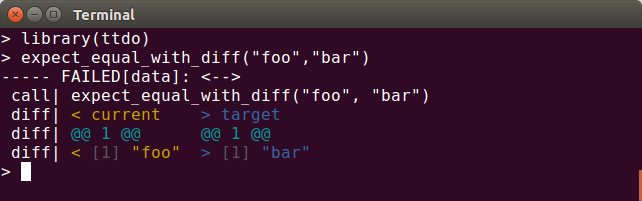
A bugfix release of our (still small) ttdo package arrived on CRAN overnight. As introduced last fall, the ttdo package extends the most excellent (and very minimal / zero depends) unit testing package tinytest by Mark van der Loo with the very clever and well-done diffobj package by Brodie Gaslam to give us test results with visual diffs: ttdo screenshot This release corrects a minor editing error spotted by the ever-vigilant John Blischak. The NEWS entry follow.

Changes in ttdo version 0.0.6 (2020-07-27)
  • Correct a minor editing mistake spotted by John Blischak.

CRANberries provides the usual summary of changes to the previous version. Please use the GitHub repo and its issues for any questions. If you like this or other open-source work I do, you can now sponsor me at GitHub. For the first year, GitHub will match your contributions.

This post by Dirk Eddelbuettel originated on his Thinking inside the box blog. Please report excessive re-aggregation in third-party for-profit settings.

24 July 2020

Dirk Eddelbuettel: anytime 0.3.8: Minor Maintenance

A new minor release of the anytime package arrived on CRAN overnight. This is the nineteenth release, and it comes just over six months after the previous release giving further indicating that we appear to have reached a nice level of stability. anytime is a very focused package aiming to do just one thing really well: to convert anything in integer, numeric, character, factor, ordered, format to either POSIXct or Date objects and to do so without requiring a format string. See the anytime page, or the GitHub README.md for a few examples. This release mostly plays games with CRAN. Given the lack of specification for setups on their end, reproducing test failures remains, to put it mildly, somewhat challenging . So we eventually gave up and weaponed up once more and now explicitly test for the one distribution where tests failed (when they clearly passed everywhere else). With that we now have three new logical predicates for various Linux distribution flavours, and if that dreaded one is seen in one test file the test is skipped. And with that we now score twelve out of twelve OKs. This being a game of cat and mouse, I am sure someone somewhere will soon invent a new test The full list of changes follows.

Changes in anytime version 0.3.8 (2020-07-23)
  • A small utility function was added to detect the Linux distribution used in order to fine-tune tests once more.
  • Travis now uses Ubuntu 'bionic' and R 4.0.*.

Courtesy of CRANberries, there is a comparison to the previous release. More information is on the anytime page. The issue tracker tracker off the GitHub repo can be use for questions and comments. If you like this or other open-source work I do, you can now sponsor me at GitHub. For the first year, GitHub will match your contributions.

This post by Dirk Eddelbuettel originated on his Thinking inside the box blog. Please report excessive re-aggregation in third-party for-profit settings.

Next.

Previous.