Search Results: "John Goerzen"

4 November 2008

John Goerzen: Why I Hope

And to all those who have wondered if America s beacon still burns as bright, tonight we proved once more that the true strength of our nation comes not from the might of our arms or the scale of our wealth, but from the enduring power of our ideals: democracy, liberty, opportunity and unyielding hope.

For that is the true genius of America: that America can change. Our union can be perfected.


-- Barack Obama, Nov. 4, 2008

3 November 2008

Russell Coker: Christian Principles in an Election Year

The National Council of Churches in the US [1] has produced some advice for Christian voters titled Christian Principles in an Election Year [2]. It starts by saying “Your church, your communion, and the National Council of Churches USA do not endorse any political party or any candidate” (which is in bold in their text) and then lists 10 issues that Christians should consider when voting. Here are the 10 section headings, the full article has a sentence or two explaining each one. I think that most good people (regardless of religion) will agree with all of this - maybe substitute “God” with the name of some other entity that has not been proven to exist or with “humanity”.

  1. War is contrary to the will of God.

  2. God calls us to live in communities shaped by peace and cooperation.

  3. God created us for each other, and thus our security depends on the well being of our global neighbors.

  4. God calls us to be advocates for those who are most vulnerable in our society.

  5. Each human being is created in the image of God and is of infinite worth.

  6. The earth belongs to God and is intrinsically good.

  7. Christians have a biblical mandate to welcome strangers.

  8. Those who follow Christ are called to heal the sick.

  9. Because of the transforming power of God s grace, all humans are called to be in right relationship with each other.

  10. Providing enriched learning environments for all of God s children is a moral imperative.

The Blogger Joy Reid [3] often uses the term “Matthew Christian” to refer to Christians who follow the book of Matthew and act in ways that would be considered to be good by most people regardless of belief. This is in stark contrast to some of the nasty people who call themselves Christian and who promote hatred, inequality, and war - such people give all Christians a bad reputation (see the comment section of any blog post concerning religion for examples). John Goerzen’s post titled Politics and the Church (which references the NCCUSA article [4]) is also worth reading. Interestingly his blog post had a Google advert for “Christian Masturbation” when I viewed it. John also has a good post explaning why he is voting for Obama - based on his Christian beliefs and “Traditional Values” [5].

2 November 2008

John Goerzen: What magazine to subscribe to?

A few years ago, I -- yes -- subscribed to a paper magazine (US News). I didn't continue my subscription because I stopped reading it. I stopped reading it because, frankly, there wasn't that much worth reading a week after I heard it on NPR.

I find I spend entirely too much time reading at a computer and far too little time reading elsewhere. I want to subscribe to a magazine that will actually be interesting. Thought-provoking. Challenging, even.

So here's what I'm considering, just looking at their websites:

The New Yorker

Seems to have articles with a lot of depth, some interesting fiction in each issue. I guess I'd call it literary. I like what they have to say and the intelligence behind it.

It seems I've got to love it for its use of diaeresis marks in print.

The others I'm looking at include The Atlantic Monthly, The New Republic, and The Nation. Of these, The Nation perhaps looks the most interesting. But I'm leaning towards The New Yorker right now.

Suggestions?

John Goerzen: Politics and the Church

My church is one in which politics are checked at the door. Some church members wear their politics on their yard, or on their blog -- and just about every opinion is represented in the church. But you rarely hear politics mentioned in church. When it is mentioned, it's issue-oriented rather than candidate-oriented or policy-oriented -- we'll hear updates on efforts to create a peace tax fund, for instance.

But today, hearing about politics is just about unavoidable.

The relationship between Christianity and government has been uneasy and troubled all the way back to the religion's founding. Many Christians, and I count myself in this, believe that our first loyalty is to Jesus, and on those grounds, refuse to say the pledge of allegiance. What, we wonder, would our word be worth if we were forced to disobey our government because of a law that was unjust or immoral? How could we even say the words "one nation, under God, with liberty and justice for all" when those words were written at a time when the KKK was active, lynchings were common, and are said today at a time when people treat Muslims and immigrants with modern disdain?

In short, we believe we are called to be citizens of a different kingdom first.

So, today, our pastor deliberately picked a difficult scripture passage for us: Romans 13:1-7, which reads, in part:

Everyone must submit himself to the governing authorities. . . The authorities that exist have been established by God. . . Consequently, he who rebels against the authority is rebelling against what God has instituted, and those who do so will bring judgment on themselves. For rulers hold no terror for those who do right, but for those who do wrong. . . Therefore, it is necessary to submit to the authorities, not only because of possible punishment but also because of conscience.


What an extraordinary set of statements. This was written during the time of the Roman Empire, which could hardly be said to have been a just and benign government. It's hard for me to imagine the Roman Legion being established by God.

In more modern times, it would seem to denounce the American revolution as a rebellion against authority and therefore a rebellion against God. It would also seem to denounce the protests that we see all over the world -- striking workers in France, human rights seekers in Burma, war protesters in the United States. Would it even have condemned the protests in the 1960s over civil rights in this country, or the protests against war today?

One commentator notes that "Paul is not stating that this will always be true but is describing the proper, ideal function of rulers. When civil rulers overstep their proper function, the Christian is to obey God rather than human authorities" -- a theme Paul mentioned more than once in Acts.

What relevance does this have for us today? It seems that we are to help our rulers act in a just way, even if we disagree with them -- no matter who wins the election. It is also a reminder that a superficial reading of the Bible, taken out of context and without a deep understanding to understand the author's point, can potentially lead to very strange conclusions.

The American National Council of Churches has issued a non-partisan voting guide, which we found in our bulletin today. It is an interesting read, and probably not what you think; it begins with, "War is contrary to the will of God." Thought-provoking stuff.

I find it interesting that there are a lot of people out there that say that religion is responsible for a lot of ill in this country, then proceed to hold pretty much the same opinions I do for pretty much the same reasons. I just point out that the Bible is deeper than intolerance and submission.

Clint Adams: Third-party affirmative action

I have no good reason to participate in a system I believe to be so flawed it should be replaced entirely. However, I am still going to vote, and since people have already threatened to pay me to vote for Obama, I have concocted this little solicitation scheme to justify my trip to the polls. I don't believe in the free market any more than I believe in the crap that is Keynesianism, so the following offsets will be subtracted from the final totals.
$0.00 Barr / Root
$0.00 Calero / Kennedy
$0.00 La Riva / Puryear
$0.00 McKinney / Clemente
$0.00 Nader / Gonzalez
$0.01 Obama / Biden
$1,000,001 McCain / Palin
Bribes will be kept anonymous, and should there be an inquest, I will deny all of this. Everything must be prepaid to count. Should there be any ties after the adjustments, decisions will be made through a game of mumblety-peg with an effeminate Texan. Whining and FUD about how not voting for one of the two mainstream parties causes simultaneously global warming and the heat death of the universe will be met with the skepticism appropriate for the PR drivel paid for by those two parties. If you want something inspirational instead, read John Goerzen.

1 November 2008

John Goerzen: Today

It's been a full day. We started with a visit to Tattered Rose antiques in Goessel. It's one of those places that is open only a few days each year. Jacob would normally be OK with going there, but he knew he would be visiting his Uncle Peter and Aunt Katherine later in the day, and although he knew we'd go to the antique store first, he was still very displeased when the car pulled up there instead of Peter and Katherine's place.

So we went in, and he was rather grumpy. Despite that, the owner came over and commented on him being one of the best behaved 2-year-olds that's ever been in her store. She gave him some wood pieces painted to look like watermelon slices, and box perfect for putting them in and shaking. Meanwhile, Terah and I browsed, and wound up walking out with an old "machine table" complete with flywheel for a sewing machine, and a German wall painting thingy. Not quite sure how to describe that.

Jacob said "ready go?" many times, and so we went home, dropped off the purchases, then took him to Peter and Katherine's place. He walked in, looked around, and made himself at home right away. "Candles - FIRE!" he exclaimed, as he saw some (unlit) candles within reach. Jacob spent the afternoon with them, and Terah and I drove up to Abilene.

We visited 4 or 5 different antique stores there. Lots of interesting things to look at, but we only wound up purchasing a wooden duck. Then dinner at the Brookville Hotel (fried chicken and excellent coleslaw), and back to pick up Jacob.

He was so excited he didn't take a nap, or sleep at all, even though it was well past his bedtime when we got there. We heard of him getting a ride behind a bicycle in a child trailer, shoving a big ball down the stairs and then watching as it bounces down, and watching Uncle Peter dunk a roll in his soup and copying him by dunking a roll in his water glass. But Jacob was "ready go" so we went on home.

He fell asleep about a minute before we got home. He stayed asleep while his car seat was unbuckled, while he was carried inside, while his diaper and clothes were changed, while he was laid down in his crib, and even while the vacuum cleaner was run right outside his door. A sure sign he had a fun day.

Asheesh Laroia: Mouse cursors

John Goerzen was surprised by a mouse pointer change. His mouse changed from X.org's class black mouse pointer to the new GNOME translucent set. Upset, he wrote:
I noticed that my beloved standard X11 cursors had been replaced by some ugly antialiased white cursor theme. I felt as if XP had inched closer to taking over my machine.
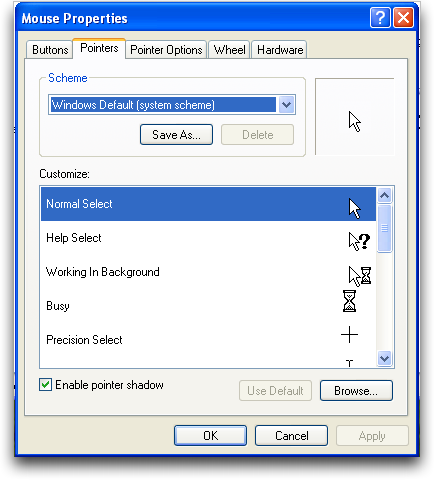
Windows users seem to place similar importance on that clicky thing. A recent PC Magazine article writes, "Few things are more important in Windows than the mouse pointers." Dave Taylor discussed mouse pointers once, showing this picture of Windows XP's mouse pointers: Windows XP's mouse pointer, then, doesn't look like the one John Goerzen got. They look like a bent version of the normal X11 pointers with inverted colors. Windows Vista's mouse cursors do look like GNOME's (via a BlogIsEverything post): For this reason, Windows Vista feels like a cheap knock-off of GNOME to me whenever I use it.

Christian Perrier: John Goerzen is my hero...

...for maintaining bacula and maintaining it well. I adopted Bacula as backup solution for my local machines, at home, after I went very close to a complete disaster on my home server, last summer. As of now, my home server and my laptop are now backed up with it. The backup is done on a dedicated disk of the server (until I setup a dedicated server, probably in the house's ceiling). And things are just...working. Of course, Bacula is a fairly compilcated beast but, well, as I managed to make it work, I consider that anybody can do it. This morning, I finally setup the bacula graphical console on my laptop. As the laptop is running unstable, with Bacula 2 packages, I indeed had to upgrade bacula packages on the server (which runs Etch, where Bacula version is 1.*). I just went to backports.org, found backported packages there, kindly prepared by John (and Rhonda, apparently). One "apt-get install -t etch-backports" after, I'm just running Bacula 2. John, you deserve a full tank of beers... I'll think about it next time I happen to come in the middle of Kansas..:-)

31 October 2008

John Goerzen: Biking in the dark, 45 degrees F

I've been telling people that I plan to keep bicycling into the winter. I think about half the people I've told to don't really believe it. And the last two weeks, I haven't been able to ride to work due to muddy roads and scheduling conflicts. But today I did.

I left while it was still dark and 45 degrees outside (7C for the Fahrenheit-impaired). I think that's the coldest bike ride for me yet. I wore my regular shorts, shoes, and socks. I had my regular shirt on, plus a long-sleeve thicker shirt on above it.

It was cold the first few minutes, but this was pretty much the right outfit. Once I got going and got some heat built up, I was doing fine. In fact, I had to unzip my outer layer because I was getting hot.

So. I figure that if I can do 45 with shorts, then I ought to be able to take on 20 with proper winter gear.

Either that, or I've now dug myself a nice big hole if I wimp out.

25 October 2008

John Goerzen: A Tale of Three Monitors

For quite a few years now, I've been using a Dell 2001FP 20" LCD. Aside from the fact that this is the monitor that has apparently placed me on Dell's "permanently harass with paper catalogs" list (BTW, USPS has sent them a nasty enforcement letter over that), and the fact that when it needed warranty repair, Dell didn't know how to do it because it wasn't connected to a Dell computer, it's been a good monitor.

With Terah's recent conversion to Linux, she needed a monitor. We decided she could use the 20" LCD, and I'd get a new monitor. I have a nice 24" HP LP2465 at work, 1920x1200, so I thought I'd hop on newegg and see what 24" monitors I could find.

I found a Samsung T240 over there. Apparently Samsung's premium "touch of color" line. I did some research. It got glowing reviews -- people seemed to think the display was brilliant, and the only problem was that its stand wasn't height-adjustable. It got rave reviews on Newegg. It was $400 after rebate. And it arrived here Thursday.

I opened up the box, and I have to tell you that it looks beautiful. The bezel is this reflective black with a hint of dark red at the bottom. I put it together, hooked it up, and...

Well, let's just say that "Touch of Color" isn't all that accurate. "Touch of Crap" is more like it.

As I write this, my Firefox window covers half the screen. The center part of it is this brilliant color. The lower part has the white faded to this sickening blue, and the bottom right corner has almost turned to a black-and-white image. While the top part of my screen simply is more contrasty, except for the very top of the screen, which has half an inch of brighter area than anywhere else.

In short, the viewing angle on here is so bad that sitting directly in front of the screen gives significant color variations. An xterm with a black background maximized to fill the screen has a black background some places and a gray background others. My solid midnightblue background looks more sky blue at some places and more... really dark blue... at others. And of course, moving my head slightly varies the color that I see. Also, on photos, there is very visible horizontal banding in them -- apparently some sort of dithering going on since this is only a 6-bit display. Ugh.

How on earth this monitor got glowing reviews, I have no idea. I learned a bit about LCD panel types. Apparently the T240 is a TN display. The horror. I'll never buy another one of those again.

The HP LP2465 that I have at work, and which is great with solid colors all across it, is an S-PVA. So I'm buying one of those for home. It's more expensive, but -- it's a good display.

I am still trying to figure out exactly who thinks this is a good monitor. I tried games on it. It was responsive, but again, colors were distorted due to viewing angle. And this distortion means it's completely useless for photo editing, where precise colors are important.

I bought it from Newegg, and their policy generally prohibits refunds on LCDs. I called them, explained the situation, and told them that I wanted to buy an HP LP2465 from them to replace it. After being on hold for a few minutes, they agreed to waive their policy -- and even the 15% restocking fee, once I placed the order for the HP monitor. Classy show, Newegg. That's the one bright spot in all this.

John Goerzen: Crazy Cursor Conspiracy Finally Fully Fixed

So lately I had the bad fortune to type in apt-get install gnome-control-center on my workstation. It pulled in probably a hundred dependencies, but I confirmed installing it, never really looking at that list.

The next day, I had a reason to reboot. When I logged back in, I noticed that my beloved standard X11 cursors had been replaced by some ugly antialiased white cursor theme. I felt as if XP had inched closer to taking over my machine.

I grepped all over $HOME for some indication of what happened. I played with the cursor settings in gnome-control-center's appearance thing, which didn't appear to have any effect. When I logged out, I noticed that the cursor was messed up in kdm of all things, and no amount of restarting it could fix it.

After some grepping in /etc, I realized that I could fix it with this command:

update-alternatives --config x-cursor-theme

And I set it back to /etc/X11/cursors/core.theme. Ahh, happiness restored.

I guess that'll teach me to install bits of gnome on my box. Maybe.

24 October 2008

John Goerzen: The End of an Era

I bought my first Apple hardware a number of years ago -- a 400MHz titanium Powerbook. The thing came with Mac OS X preloaded, but it was so slow that it was unusable. I put Debian on it, and was mostly happy with it -- until the titanium case started coming apart. Oh, and the small detail that the built-in wifi reception was so poor that I had to use a PCMCIA card to get a signal in some parts of my house.

But ever since then, we've always had some piece of Apple hardware in active use in our house.

About 7 years ago, my main workstation was a rapidly-aging 600MHz Alpha with -- gasp -- PCI video. It was OK for programming but really awfully slow at anything graphical. I was wanting to get into video editing, and we bought an 800 MHz iMac. The kind with the inverted-bowl base. A nice machine at the time. This was going to be my main workstation.

When it arrived at home, I unpacked it. Terah walked in and said, "Wow, my new computer is cute!" So it became *her* computer, and has been ever since.

It's rather old and is showing its age. Its wifi card died a couple of years ago. The 800MHz CPU is slow with today's websites.

So yesterday, we clicked on the apple and shutdown for the last time. It left her desk, replaced with a Linux desktop with a 20" 1600x1200 LCD (replacing the 15" 1024x768). I had assembled this Linux desktop out of spare parts in our basement, with a 4-year-old Athlon XP CPU. It's still faster than her Core 2 Duo work laptop running Vista, but that's another story.

I put Debian lenny on it. And I've got to say -- wow -- the utility of Debian as a desktop OS for the non-geeky has taken an incredible turn for the better in the last few years. Terah was fine with switching to Linux. I set it up for her -- Firefox for web, Thunderbird for mail, J-Pilot for syncing to her Palm, OpenOffice, gajim, etc.

Her concerns were: having Thunderbird make a nice "whoosh" sound when it successfully finished transmitting an email, having desktop gadgets (I installed screenlets, which I think she likes a lot), and.... I don't think I remember any others.

So now we both run Linux on our desktops.

Oh, and on her laptop, I poked around in the Vista control panels (I must have "authorized it to display this panel" a dozen times, stupid thing), and eventually found a box where I could optimize for visual effects or optimize for performance. I hit optimize for performance, and it transformed its interface into approximately Windows 2000 after a couple of seconds. I think that change made it a lot faster. It's now about as fast as the 25%-as-fast Linux box. I guess that's good for Vista.

20 October 2008

John Goerzen: Tabor's Centennial

You know you've got a bunch of Mennonites together when the pastor spontaneously asks the church to sing "Jesus Loves Me" while the children walk up for their children's story. And, without music, everybody spontaneously breaks into beautiful 4-part harmony. It must be genetic or something.

It was a day of beautiful singing of hymns a week ago for Tabor Mennonite Church's centennial. It's hard to write about that weekend, in fact -- it was such a nice experience.

Sunday ended with opening the box sealed in the church's cornerstone back in 1965 when the current building was built. Rudy Schmidt, the person that sealed it up back then, was on hand to open it back up. They took out the stone and removed the box. Before the box was opened, Rudy told a story:

Back in 1965, I was the one to solder this box shut. While I was doing this, all of a sudden I smelled burning from inside. I figured I must have caught something inside on fire. I asked Jake Koehn (another person on the building committee) what to do. Jake said, "Nobody will ever see it again, just put it in." So let's open it!


I think Rudy has been wondering all these years whether he set it on fire or not.

The box was opened, and other than a few scorch marks on an envelope, was completely intact and in good shape. There was a copy of a local newspaper from 1965 with a headline about Goldwater, copies of programs of dedication for the new building and parsonage, a Bible, copies of the church constitution, and all sorts of other interesting things. To that we will add a copy of our centennial book (which I helped develop), CDs with recordings of our centennial activities, programs from the centennial celebration, and photos of the weekend.

Earlier on Sunday, we had a long but good worship service with sermons from two former pastors. The choir sang, including a song commissioned for the occasion by Larry Nickel. We got applause after that one (which happens occasionally, but not regularly, in our church). All the living former pastors, and the widow of one of them, served communion as well.

The service ended with the congregation singing the "Mennonite Anthem". I think it was the most beautiful singing of that song I've ever heard. We had 352 people in church that day, and it seemed that not one person was going to let the moment go by without singing.

Saturday had started off with outdoor activities in the church park. There was old-fashioned soap making, remembering how church members used to store fat all year, then get together to make soap for use in their homes and to donate to the needy. There was rope making, wool spinning, and rides for the children. Under the tent, we had some great music the local Greenhorns band, and the former pastors all shared some memories and stories about their time here.

On Saturday evening, we had a meal and a drama -- and managed to somehow fit 321 people into the church basement for the meal. We think that's a record! The drama was written for the occasion by one of our members. John Gaeddert, a pastor here in the early 1970s, has become an expert wood carver in his spare time. He had carved a piece for us to celebrate the occasion, and presented it during the drama. That fit right in, because the drama was called "Bring Your Own Hedgepost" -- back in the early days of the church, each member was supposed to do just that so they would have a place to tie their horses.

Friday night was a lecture by James Juhnke about our first paster, P. H. Richert, who was pastor for nearly 40 years. Quite entertaining and interesting.

I think the highlight of the weekend for me was getting to talk to some of the former pastors I never knew well. I had a few minutes to chat with John Gaeddert. I introduced myself, and he said, "Oh! I don't think I've met you, but I've heard your name a few times this weekend. You're on the centennial committee, right?" Yes indeed. I was born after he left this church, but he knew my grandparents -- which means he also knows exactly where we live. John and his wife Mary are both such warm and friendly people that it feels like I've known them much longer than a few days!

I got to chat with Jim Schrag too. He was pastor at Tabor until I was about 5 or 6. He didn't remember me specifically, but he was also interesting to talk with. He was one of the people that worked on a detailed history book in 1983 for the church's 75th anniversary. He told me that he processed most of the black and white photos for that book in a darkroom in his basement. I hadn't known that -- and mentioned I had found all those photos in the church archives and had scanned them all in. Jim requested a copy.

Terah found Lenore Waltner, wife of former pastor James Waltner, who passed away about a year ago. James had started his career as a pastor at Tabor, and ended it at College Mennonite Church in Goshen, IN, where Terah grew up. So she knew him, but I didn't. Terah introduced herself to Lenore, who seemed quite excited to make this sort of family connection!

And Brenda Martin Hurst, another former pastor, found Terah and introduced herself. Terah said that Brenda said something like, "Hi, I'm Brenda, and I don't think I know you!" These pastors all want to get to know everybody, I think!

15 October 2008

John Goerzen: The Best Photo Printing Services

When I first got a digital SLR camera a few years ago, I spent some time evaluating photo printing options. I sent a set of test prints to several different companies, and wound up deciding to use Shutterfly for my photo printing.

It's been some time since then, so I figured it was about time to re-evaluate options.

There are three main things to consider when obtaining prints of photos: cost of prints, quality of prints at delivery, and longevity of prints. Many people look only at cost, and those that look past cost rarely look past quality at longevity. Longevity (or permanence) is, in my opinion, the most important factor to consider. But let's look at all of them.

Longevity

All color photo print technologies fade or otherwise degrade over time. There are several main things that can cause this: exposure to light, exposure to gases (especially ozone), and exposure to humidity. The impact of these different items varies by print technology, paper, and process.

Longevity: Traditional Photo Paper

Most services such as Shutterfly, Snapfish, Ofoto, as well as retailers such as Walmart, Target, and Walgreens print on traditional photo paper.

Historically, traditional photo paper has had terrible fading characteristics. Typically, old photos exposed to light -- for instance, hanging on a wall underneath a light bulb or in the sun -- will exhibit severe fade towards yellow or magenta. Modern papers are much better, but you will still not want to leave them directly in the sun or under lights.

Over at TPR, you can find several papers analyzing this. Perhaps the most interesting are test of digital prints and image permanence: comparing the technologies.

To attempt to summarize, what you see is that of the two common consumer-grade photo papers, Kodak Royal and Fuji Crystal Archive, the Fuji paper has better permanence. However, the pro-quality Kodak Professional Supra Endura is better than either of them by a significant margin. The photo papers didn't really have a problem with humidity, and not much of a problem with ozone.

Longevity: Inkjet

So what about inkjets and laser processes? The main thing I learned from my research is that there is a tremendous amount of variance here. When looking solely at top-quality inkjet papers and inks, they ranged everywhere from having little bits of them flake off after a few months to doing better than any of the photo papers. This variance occurred even with similar papers from the same manufacturer.

As far as light exposure is concerned, every inkjet paper tested by TPR did better than Kodak Royal. Some fared about the same as Fuji Crystal Archive. And some even beat out Kodak Supra Endura.

But look at the ozone exposure test and you see a far different picture. All of the photo papers did really well, though suprisingly Supra Endura was the worst of them (though the scale is so small here that the difference is pretty minimal).

Not one of the inkjet papers came even close to that, and some faded so fast that they couldn't even make it halfway through the test.

As far as humidity is concerned, it barely impacted the photo paper prints at all. Inkjet impacts were still mostly small, but also were mostly more impacted than the photo paper.

Longevity: Laser

And finally, how about laser prints. There was huge variety here. An HP printer they tested faded so fast it couldn't complete the light exposure test, while a Konica-Minolta fared better than Kodak Supra Endura in one test. In another light exposure test, they performed about the same as the photo papers. Ozone had little effect on the laser papers, except for the Dell test, which faded so fast they had to abort the test early. Humidity also had little effect on the laser prints.

Longevity: Other Examples

Brett Wilson did some interesting experiments with photos hung in front of a window as well. Wilhelm Imaging also has done some research in this area, though they are done using fluorescent lights only, which is prejudicial in favor of inkjet papers and against photo papers.

For the ultimate in longevity, true black and white photo paper is well-regarded.

TPR also has a report covering different lacquer and other finishes often applied to prints to improve their longevity.

Longevity: Conclusions

With the exact right combination of inkjet paper and ink, you can get a print that will last exceptionally long. Some inkjet paper and ink combinations have really poor longevity characteristics, however, as do the laser papers.

Photo papers, especially Kodak Supra Endura, but even Fuji Crystal Archive, will last quite awhile as well, and are probably the best storage if kept in dark conditions such as an album.

Print Quality

When looking at print quality, I'm concerned with correct color balance, saturation, cropping, consistency, sharpness, contract, and detail in both dark and light areas -- the typical things you'd look for.

Printing inkjet prints at home leaves all this up to your printer, inks, papers, and you, so we can't really compare meaningfully.

Back when I looked at it, Shutterfly and Ofoto did the best. Walmart, Walgreens, dotPhoto, and many of the other online sites were really too poor to even bother with. Ofoto had a bit of a yellow tint to it, while Shutterfly did pretty well.

Most of the reviews of the major sites I've seen lately rank Shutterfly or Snapfish at the top in terms of quality. Many also rank Ofoto/Kodak near the top.

Walmart and Walgreens produce consistently bad results, and I only use them if all that matters is speed. If you ever read a review where somebody says that they get good results from one of those places, find a review where somebody has a better idea what they're talking about.

Besides your mass-market sites like Shutterfly and Ofoto, there are also some slightly more expensive sites. The two best-known are mpix.com and adorama.com. Mpix is a division of Miller's Professional Imaging, a pro lab. Mpix is basically a website where you can submit photos in the way you would to one of these other sites, and they can do their thing. Their standard rate includes human color correction on every print, but they offer a cheaper rate if you don't need that. Their standard paper is Kodak Pro Supra Endura (the one that ranked highest in longevity tests), and the options go up from there. They also offer printing on true black and white paper, as well as wrap-around canvas and other such options.

I've sent some work their way and have been exceptionally happy with the result. Everything from the color of the prints down to the packaging shows extreme care and attention to detail. Among the reviews that cover mpix -- many don't -- it almost always comes out at the top of the pack, easily beating out Shutterfly and Snapfish. It can be more pricy (though sometimes actually cheaper, since shipping is flat-rate with them), though not significantly.

Adorama is also sometimes mentioned. Most people seem to prefer mpix over adorama, but some prefer adorama. It's a bit cheaper when you don't need color correction for some prints, but sometimes -- right now, for instance -- closes for weeks at a time to observe Jewish holidays. It didn't seem to be enough for me to bother.

Cost

Perhaps the easiest to figure out is cost, since websites typically list it right there for you.

High-quality inkjet prints are by far the most expensive option. I looked at 4x6 prints. Using the high-quality paper/ink combinations that did well in the TPR tests, and when buying supplies in bulk to get the best possible discount, it's still 25 cents or more for a single 4x6 print. That's with doing all the color work yourself, and not even figuring in the cost of the inevitable experimenting with getting the software set up right and the wasted prints when ink gets low. It also doesn't figure in the cost of the printer.

At mpix, if you do your own color correction, it's 19 cents per print, plus shipping. Prints are on Kodak Professional Supra Endura Shipping is a flat rate of $3 for 50 or fewer 4x6 or smaller prints, or a flat rate of $5.95 for USPS Priority Mail for anything else. They offer FedEx at an additional cost, which maxes out at a flat rate of $12.75 for overnight shipping. Some items such as framed canvas prints are more expensive.

Other options at an additional cost include color correction by a human, metallic paper, Ilford B&W paper, etc. There are also some more typical pro-lab options: red-eye removal by a human, custom retouching, etc.

At Shutterfly, a 4x6 print goes for 15 cents. You can get them as low as 10 cents if you buy a pre-paid plan of 600 prints for $60. Shipping varies based on the number of prints, starting at $1.79 for up to 10 prints, ranging up to $21 for 500 prints, with 3 cents per print after that. Priority and express mail is available at an additional charge. Shutterfly's standard paper is Fuji Crystal Archive.

At Snapfish, a 4x6 print goes for 9 cents. You can get them as low as 8 cents if you buy a pre-paid plan of 250 prints. Shipping at Snapfish follows a complicated formula, but is generally approximately the same as Shutterfly. Though if you print more than 595 prints, watch out for the 10 cents per print overage fee. They don't state what paper they use. Recent reports seem to suggest that it's Fuji Crystal Archive, but some reports claim it's Kodak Royal.

My Conclusions

I'm planning to switch most of my prints to mpix -- their higher quality and cheaper shipping offset their higher per-print cost for me. Also, I plan to try out Snapfish and see what sort of quality I get from them for things where quality isn't really that critical.

MJ Ray: Software in the Public Interest October 2008

The monthly IRC board meeting of Software in the Public Interest will take place later today, as announced by SPI’s secretary last week. While the announcement is back on time (yay!), the agenda isn’t (aww!). I’d be quite interested to learn how SPI is going to try to reduce the risk to its reserves, given the current slow decline of its primary bank which is not one of the first US banks getting bailed out. I think the best way for not-for-profits to avoid risking donations at the moment is to avoid having them in their bank accounts, in line with the Better Business Bureau standard that
“the charity’s unrestricted net assets available for use should not be more than three times the size of the past year’s expenses or three times the size of the current year’s budget, whichever is higher.”
Back in June 2005, SPI’s board of the time (Ian Jackson, John Goerzen, Jimmy Kaplowitz, David Graham, Bruce Perens, Benj. Mako Hill, Branden Robinson) decided to “remain noncompliant” with that standard and I fear that chicken could be coming home to roost now. I hope we don’t lose anything, but AIUI we’ve got nearly $150,000 in play. Update: Unlike its UK analogue, the Federal Deposit Insurance Corporation covers corporation accounts up to $250,000, so SPI is only risking temporary unavailability, not yet a risk of loss. Thanks to bd_ for pointing me to that.

10 October 2008

John Goerzen: One Hundred

Today, as I was riding my bicycle home from work, I noticed that the road maintainer had been by on the dirt and sand roads near our house. Unfortunately for me, he left a few sections of road with deep sand, and I almost wiped out several times. I ride a bike with narrow road tires that doesn't deal well with that.

But I'm not the first one to have a problem with roads.

A hundred years ago, the "brethren to the south" were having trouble getting to the community's main church, Alexanderwohl. Back in the days before paved roads, or heavy road-maintaining machinery, it took time and endurance to travel the distance even on good roads. A group of them started holding weekly Sunday Schools in local schoolhouses. Eventually, after much discussion, they decided to build a church, and it was completed in 1908 -- Tabor Mennonite, more than 4 miles from Alexanderwohl!

Tabor thrived over the years, though not without difficulty. Everything from how to shelter members' horses during services to what do to about the weighty social and political issues of the day were discussed and documented in church minutes. The church sent people out as missionaries, planted new churches, and supported several young pastors just starting out. In 1938, they expanded their building, and in 1965, replaced it entirely.

Tonight our weekend of centennial festivities began. It started with a prelude played on the church's first organ -- now about 90 years old if memory serves. Its current owner was tracked down, it was brought to the church, and still sounds wonderful. Tomorrow we will have music and activities outdoors under a tent, and all our living former pastors will be around, with a drama and meal in the evening. Then on Sunday, the big day with singing choirs (and a work commissioned for this occasion), each former pastor giving a short (we hope) message, a potluck (of course!), and the opening of the cornerstone.

It's been 6 years in the planning. I've spent the last couple of years collecting photos and other material for the archives and for the coffee table-style book we published for the centennial, and others have put in lots of hours too.

Sunday's worship service will conclude with singing the "Mennonite Anthem", also known as "606" from its number in an old hymnal. It will be a capella as is tradition for this piece. (Click for MP3 of a small choir singing it) It will be loud and beautiful, hundreds of voices joining in, a fitting way to mark this occasion.

What a wonderful thing we have been left by those that came before. And still, a responsibility for us as we look to the future. Rural churches are disappearing, and while Tabor is the rare rural church that is growing, still we hope that its location at the corner of two mostly dirt roads 4 miles from the nearest town (population 600) will not get in the way in years to come.

At the end of the events tonight, we were reminded of the favorite Bible verse of Rev. P. H. Richert, first pastor of Tabor, who served as pastor for almost 40 years:

the mountain of the LORD's temple will be established as chief among the mountains; it will be raised above the hills, and all nations will stream to it.


(Isaiah 2:2)

Somehow it seems improbable that dirt roads led to all this.

3 October 2008

John Goerzen: What Traditional Values Mean to Me

A comment on Facebook yesterday got me thinking what American "traditional values" are all about. We hear it a lot, and I suspect it means something different to different people.

Here's what it means to me.

It starts with an ethic fundamentally informed by the central tenets of Christianity -- which are also excellent standards of decency by secular standards. We are called to have a relentless drive to care for the repressed, poor, downtrodden. As Jesus said, "whatever you do to the least of these, so you do to me." It means extending the hand of friendship and compassion to all, in our own neighborhood and around the world. It means taking good care of the resources we have, acting responsibly, and affirming and supporting others so they can do the same. It means that, as our founding fathers emphasized, remembering that all people are created equal, are equally deserving of a good life, and deserve liberty and freedom. Finally, it means a constant realization that we are creating a human institution, and will always have an imperfect answer to these ideals, but that we can -- and must -- recognize our faults and strive to make things better.

How do these apply to our time?

We must start with the poor, the repressed, and habitually think of their situation in everything we do. That means remembering that when we drop a bomb in Afghanistan to kill a terrorist, we also usually kill 50 innocent bystanders, and devastate their families. It means remembering that illegal immigrants from Mexico come here because all they want is refuge from drug wars, food on the table, and a roof over their head. It means showing compassion in deportation proceedings: when illegal immigrant parents have a child born in the United States, the child is an American citizen and can't be deported, but deporting the parents will create an orphan. It means actively helping the repressed people of the world, whether they be in Sudan, Georgia, or AIDS victims in Africa, Muslims in New York. It means reducing taxes on the poor, giving them the skills and tools they need to make their way in life. It means caring for those with alcohol drug addictions, helping them to summon the strength to get past those problems, rather than locking them up or throwing them out on the street. In days past, this might have meant sharing firewood with the family down the road that was at risk of freezing in winter. Today it might mean assistance with winter heating bills.

Remembering that all people are created equal means that we must provide good education for everyone, whether they live in suburban California, inner city Detroit, or rural Appalachia. We owe quality health care to everyone; those without means to pay for health care, or to pay for a car to get to a clinic, should be treated with dignity and respect, and have equal access to medicine.

Remembering that all people are created equal also means that we must provide equal justice under law, and give everyone a fair trail. We must abandon the death penalty, because we have a shocking number of people on death row -- hugely disproportionately black and poor -- that have been shown innocent of their crimes thanks to advances in DNA testing. We must maintain the integrity of checks and balances in government, and support judicial oversight over search and seizure. We must avoid warrantless wiretapping because it subverts judicial oversight and corrupts our justice system by making the exercise of power secret. We must denounce torture, and refuse to employ it, because no human, being created equal, deserves to be treated in such a way -- and we have been applying it to innocent humans.

We owe the opportunity to grow up in a loving family, in a safe community, to every child. We must make sure that gangs no longer have the run of our streets, that drugs aren't displacing hard work as the currency of the community, and that adoption is inexpensive and practical for more families, rather than costing thousands of dollars. Doing so will help every child grow up knowing that they are valued, are important, rather than being unwanted and therefore abused or neglected.

Extending the hand of friendship and compassion to all starts with being a good example -- that shining city on a hill that Reagan talked about. We have to run an open, just, and fair society ourselves. We must not fear those that are different than us, just because they're different. We have to recognize that citizens of Iran, Russia, North Korea, Palestine, and the United States fundamentally are humans, created equal, seeking the same thing: a safe and secure future for themselves and their families. Being able to coexist peacefully means starting from that point, and being willing to talk to them, and yes, even their leaders, regardless of how distasteful they may be.

Acting responsibly with our resources starts at home -- things like not driving up credit card debt, not living outside our means. The same applies to government: massive deficits each year are exceptionally irresponsible and place us at great risk both at the present and in the future. We also have a duty to care for the planet and the environment in which we live, which means actively working to curb the things we do to harm the planet and cause global warming.

What about recognizing our faults? Perhaps the most patriotic duty asked of Americans is dissent. It is never easy, but is essential to keeping our democracy functioning. This country has a long history of successes, and also a long history of failures. We failed so many by keeping slavery legal for so long, and discrimination and lynching legal for even longer. We failed that Native Americans by forcing them from their lands and treating them with brutality. We have, to some extent, risen above these failures thanks to the ability to recognize them and try, to the best of our ability, to fix them. This is what the civil rights movement was about, and why we have a holiday for Martin Luther King, Jr. He spoke out against a society that said some couldn't eat in a restaurant because of the color of their skin, or who were repressed because of their economic status. He recognized that problem in America, and by speaking out against it, helped to change this country for the better.

Today we have to recognize the things we are doing wrong, and try to change them. We are torturing potentially innocent people. We are discriminating against Muslims and homosexuals in our midst. We are giving extraordinary power to big media companies through changes in copyright law, to big communications companies through failure to enact network neutrality laws. And we are labeling people that disagree with war as unpatriotic.

Notice some things I didn't mention, such as abortion. It's not really relevant, and the lines we are fed by both sides present us with this false pro choice vs. pro life debate. In reality, it seems to me that both sides want the best for the children: for every child to grow up in a loving family, where he or she is wanted. We all know from research that laws banning abortion do not actually reduce it. So we ought all to come together and try to make it more rare by providing more support to single parents, by making it easier to adopt children, by trying to make the perceived need for an abortion to go away.

So, in this election, I look at the candidates and it seems pretty clear which one is promoting traditional values and which one isn't. Obama is actively trying to reach across the aisle and find common ground. Even in his convention speech, he suggested ways to work together on abortion like I just mentioned. In the debate, he listened carefully to his opponent and acknowledged when he thought McCain was right. This is a necessary first step in working together to move forward. McCain subsequently released an ad mocking Obama for this.

What about caring for the poor? Again, Obama's tax policies, education policies, and health care policies take care of them far better than McCain's. About responsibility? McCain supported these deficit-busting budgets of the last 6 years, supported the oil-centric energy policies, and has been only lukewarm towards dealing with global warming. McCain and Palin mock Obama for trying to help poor Chicago neighborhoods 20 years ago, for being willing to just talk to our supposed enemies, for actually reaching across the aisle.

So yes, I am a values voter, and that's why I can't possibly do anything but vote for Obama.

2 October 2008

John Goerzen: VP interviews

What an interesting conversation with the vice presidential candidates here. Couric asks Biden and Palin the exact same questions. Biden gives well-thought-out answers to everything. And Palin? I'm not so sure.

25 September 2008

John Goerzen: New version of datapacker

I wrote before about datapacker, but I didn't really describe what it is or how it's different from other similar programs.

So, here's the basic problem the other day. I have a bunch of photos spanning nearly 20 years stored on my disk. I wanted to burn almost all of them to DVDs. I can craft rules with find(1) to select the photos I want, and then I need to split them up into individual DVDs. There are a number of tools that did that, but not quite powerful enough for what I want.

When you think about splitting things up like this, there are a lot of ways you can split things. Do you want to absolutely minimize the number of DVDs? Or do you keep things in a sorted order, and just start a new DVD when the first one fills up? Maybe you are adding an index to the first DVD, and need a different size for it.

Well, datapacker 1.0.1 can solve all of these problems. As its manpage states, "datapacker is a tool in the traditional Unix style; it can be used in pipes and call other tools." datapacker accepts lists of files to work on as command-line parameters, piped in from find, piped in from find -print0. It can also output its results in various parser-friendly formats, call other programs directly in a manner similar to find -exec, or create hardlink or symlink forests for ease of burning to DVD (or whatever you'll be doing with it).

So, what I did was this:


find Pictures -type f -and -not -iwholename "Pictures/2001/*.tif" -and \
-not -wholename "Pictures/Tabor/*" -print0 \
datapacker -0Dp -s 4g --sort -a hardlink -b ~/bins/%03d -


So I generate a list of photos to process with find. Then datapacker is told to read the list of files to process in a null-separated way (-0), generate bins that mimic the source directory structure (-D), organize into bins preserving order (-p), use a 4GB size per bin (-s 4g), sort the input prior to processing (--sort), create hardlinks for the files (-a hardlink), and then name the bins with a 3-digit number under ~/bins, and finally, read the list of files from stdin (-). By using --sort and -p, the output will be sorted by year (Pictures/2000, Pictures/2001, etc), so that photos from all years aren't all mixed in on the discs.

This generates 13 DVD-sized bins in a couple of seconds. A simple for loop then can use mkisofs or growisofs to burn them.

The datapacker manpage also contains an example for calling mkisofs directly for each bin, generating ISOs without even an intermediate hardlink forest.

So, when I wrote about datapacker last time, people asked how it differed from other tools. Many of them had different purposes in mind. So I'm not trying to say one tool or the other is better, just highlighting differences. Most of these appear to not have anything like datapacker --deep-links.

gaffiter: No xargs-convenient output, no option to pass results directly to shell commands. Far more complex source (1671 lines vs. 228 lines)

dirsplit: Park of mkisofs package. Uses a random iterative approach, few options.

packcd: Similar packing algorithm options, but few input/input options. No ability to read a large file list from stdin. Could have issues with command line length.

23 September 2008

John Goerzen: Jacob's Words

Here are some words and phrases we're hearing a lot lately. Along with a helpful translation guide.

shop baa: Shop Vac
shop baa hoesh: Shop Vac hose. We also get "see shop baa", "shop baa on", etc.
chain: train
chain veeoh: train video
tune vewwow: turn yellow (referring to a traffic light)
Hi Daddy!
Hi Mommy!
uhoh [item]: something bad happened to the item
wahdoh: water
spidoh: spider
spidoh buh: spider bug
cat Nash: the cat named Nash
teesh: taste (when he wants a bite of cake or something)
BIH teesh: BIG taste
tah corn: tall corn
baby
puppy
pa: grandpa
mama: grandma
mamapa: grandma and grandpa
ah housh: our house
fop: flop (onto a pillow)
ahh done: all done
fan
bubba: butterfly (he has a soft one he sleeps with). Or strawberry.
hoe: hold

Next.

Previous.