Search Results: "nate"

2 August 2010

Gunnar Wolf: We have released!

If you have seen me anywhere near my computer at DebConf, you probably have seen the face of a hurried, worried developer. Still, if you monitor my Debian-related activity, you will notice it is still quite low, even given my (much needed and very much enjoyed) vacations pre-DebConf. Yes, orga-team work is very time consuming, even if my role is far from central this year. And yes, DebCamp+DebConf are known for sucking time into social interaction, which is great but not so (formally) productive. And yes, I even took 1.5 days off to visit my family and a friend who live in the area... Still, I managed to release! \ / Release what? I have been working with Pooka for the last ~2 years on the Seminary on Collaborative Knowledge Construction. We assembled a group of ~10 speakers/authors, each of whom prepared a chapter for a book meant for publication. Pooka and me coordinated the work, which took a long time because it was also an interaction experiment (and because we both did it only in our free time). After the coordination work started fading, I took up the task of coming up with a way to translate it all into LaTeX (and fix a host of conversion bugs, and play with the available packages, and... Hey, I'm after all just a LaTeX newbie, and had to learn to tame the beast!), I stumbled upon that precious fact that makes so many projects release. I stumbled upon a deadline. We want to publish the book under the seal of IIEc-UNAM. Besides my workplace, it is a very well regarded university, and having its seal in our work is definitively a big plus. And the Publications Committee of my Institute is meeting this week - So I had to send our final manuscript by today. Having a deadline overlapping with DebConf sucks. But somehow, I managed to do the needed work to my complete satisfaction. The work is now in the Committee's hands, and I expect to have more news soon(ish). Oh, and where can you get our work? Well, if you register in our site, you will be able to read the whole contents. And once the book is approved and published, the whole work will be published online under a free (CC-BY-SA) license. BTW, that probably means I will have more time to fix my Debian bugs and pending stuff! \ /

John Goerzen: The Best Place of Ever

Jacob and Oliver have enjoyed our recent train trip, and our stay, from Kansas to New York City for Debconf. All told, that s a 40-hour trip, including the layover in Chicago. When we got on the train, in the middle of the night as usual, Jacob couldn t stop chattering about how great , fun , and exciting it is. He told us about all the lots of great things on the train, the fact that we were on a night train , and generally couldn t stop chattering. For an hour. At 3:30AM. This was a typical sight from Jacob: IMG_4284 It wasn t as relaxing as usual for Terah and me. Oliver is at the grabbing everything in sight stage. Which worked fine when Jacob was at the age, but with Jacob also along it was a bit more difficult to manage. I suspect that our next trip, when Oliver is a few months older, will go easier. A highlight for both boys, as usual, is the dining car. Oliver loves anything related to eating solid food it s still novel to him and Jacob loves anything relating to trains. What could go wrong? (Parents will probably identify the capability for two hyper-excited young boys to have plenty of things go wrong at a table in a restaurant here fortunately we didn t have anything go terribly wrong.) Oliver turned out to find the things outside the window to require intense concentration intense enough to stick out his tongue while he worked it all out. IMG_4296 And Jacob, of course, wanted to get the wrapper off his straw by himself. Which he can do, but takes a minute. IMG_4305 They also enjoyed the lounge car. IMG_4292 We were in a sleeper room on both trains. That was nice, and when we needed to go explore , we could. Jacob s favorite part of the trip was when I folded down the upper bunk during the day for him to play. I pointed out that it was like a train treehouse. His face sure lit up. He loved that he had his own window up there to look out of. He climbed up the ladder, and after awhile of playing, said, Dad, would you like to play with me up here? Of course I would it always makes me happy when he asks if I want to play with him. As I was playing with him, I asked him if he was having fun in his train treehouse. He gave me a sweet smile, and said, Dad, this is the best place of ever! IMG_4321 In Chicago, Jacob and I went outside and walked around. He enjoyed walking across the bridges over the canal by Union Station. I checked some work email when we got back, tried but failed to reach some local hams with my handheld, and then we got on the train for New York. The boys loved it too, and Jacob was very ready to be in New York when we got there. We got out at Penn Station which was, I think, pretty much what my mind had imagined of an underground station robbed of its former glory (especially having been in that part of Chicago Union Station). We found the connection to the 2 train uptown, bought some MetroCards for the subway, and got on. Jacob was very interested in the subway. He sat very, very still I thought he was scared but on asking him some questions, realized that he was just very interested and engrossed in it all. I had been trying out my HF antenna for my amateur radio setup a few days ago, and by some coincidence, kept making contact with people that grew up in New York. A guy from Fargo, ND a native of Brooklyn told me to make sure to get pretzels from a hot sauce vendor, Pastrami on rye or corned beef on rye from a Jewish deli (because they have the best meat), pizza from guys wearing red and white shirts, and don t be afraid of rats on the subway tracks, and that our boys will love to feed leftover bits of pretzels to pigeons and squirrels. He got so excited about NYC that he went on and on, saying, Man, you re making me hungry now. During times I m not at sessions at Debconf, we ve found some time to do some things as a family. We went to Grand Central Terminal, just to see it it is indeed still Grand. I knew there was a Jewish deli there, so I thought hey try out his advice. It was closed, and when I realized it was Saturday, I realized why. Oops. We hopped on another train to Brooklyn and checked out the New York Transit Museum, which is great and has a lot of exhibits about the history of the city s subway and bus systems. It s housed in a former subway station, and they have a lot of old subway cars down there dating back to 1905 most of which are open to go inside of. It s been nice to meet people at Debconf that I have only known via email or IRC. The organizers of this conference have done a fabulous job. I have every expectation that this will turn out to be the best conference I ve been to in at least 12 years this is my first Debconf. It doesn t skimp on the technical details, people are friendly, and there is a sense of common purpose. But just as important, while there is a set schedule, there is an easy way to add other ad-hoc sessions to the conference schedule. People can get together a group interested in a topic, and schedule an event about it for the next day very easily. I m quite impressed by that, and am looking forward to the virtualization discussion that grew out of a question to the mailing list. It was also neat to meet people that sort of knew our family from my blog posts. I had no idea that there were all that many people that actually read these things ;-) The Debconf kick-off was great. As I was walking across the campus of Columbia towards it, it was a nice temperature, with some light rain, and I heard bagpipes in the distance. Beautiful. And when I left after the evening sessions, I still heard bagpipes. So I went to check it out, and ran into Gabriella Coleman, one of the Debconf organizers and the person that gave the talk I just left on the way, with the same idea. The Columbia campus is beautiful and historic, and it is an excellent venue for the conference. New York is a great city and I m sure we ll be back. It is great to walk out of the hotel in the morning, buy a fresh peach or two from the street vendor 20 feet away, and then go buy a roll or two ($0.75 each) from the bakery down the street. I have been so missing rolls like that since we got back from Germany in March. These weren t quite like the German bakeries, but the closest I ve had to it. It is interesting to note how differently people from different places look at things. Terah has told several people how we live 6 miles from a town with 500 people in it, and people that stop to think about it realize how different it is from New York. It was a surprise to me to hear that some New Yorkers think of Columbia as country . It is beautifully landscaped, and feels different than the rest of the city. The numbers I ve seen suggest that a typical fall weekday has more people on the Columbia campus than in the entire county where we live. And that county is twice the size of New York City. That s not to say that there s anything wrong with New Yorkers thinking of it as country, any more than there is of me thinking of a town with 15,000 people as a pretty big town. It s a different perspective, and I enjoy different perspectives which is another thing I like about Debconf. There are so many people from all over the world there that different perspectives are inevitable.

Chris Lamb: Debian Live Studio

http://chris-lamb.co.uk/wp-content/2010/live_studio.png
Over the last couple of days I have been creating Debian Live Studio, a web-based service for creating Debian Live systems. After choosing between various options, you wait a few minutes and the server generates an ISO or USB stick image for download. I have a list of features I plan to implement but have put the service live so I can respond to feedback throughout DebConf. Please grab me. Regarding the current server infrastructure, I'm hosting this on a $15 virtual machine which will fill up in a few hours. If anyone can donate more serious hosting for this service please get in touch. You can check it out at: http://studio.debian.net.

Matt Zimmerman: DebConf 10: Day 1

This week, I am attending DebConf 10 at Columbia University in New York. The first day of DebConf is known as Debian Day. While most of DebConf is for the benefit of people involved in Debian itself, Debian Day is aimed at a wider audience, and invites the public to learn about, and interact with, the Debian project. These are the talks I attended. Debian Day Opening Plenary (Gabriella Coleman, Hans-Christoph Steiner) Hans-Christoph discussed Debian and free software from a big picture perspective: why software freedom matters, challenging the producer/consumer dichotomy, how the Debian ecosystem hangs together, and so on. Steps to adopting F/OSS in government (Andy Oram) Andy discussed FLOSS adoption in governments, drawing on examples from Peru, the city of Munich, the state of Massachusetts. He covered the reasons why this is valuable, the relationship between government transparency and software freedom, and practical advice for successful adoption and deployment. Pedagogical Freedom (panel, Jonah Bossewitch et al) The panelists discussed the use of technology in education, especially free software, some of the parallels between free software and education, and what these communities could learn from each other. This is a promising topic, though the perspectives seemed to be mostly from the education realm. There is much to be learned on both sides. Google Summer of Code 2010 at Debian (Obey Arthur Liu) This talk covered the student projects for this year s Summer of Code. Most of the students were in attendance, and presented their own work. They ranged from more specialized projects like the Hurd installer, to core infrastructure improvements like multi-arch in APT. Beyond Sharing: Open Source Design (Mushon Zer-Aviv) Mushon gave an excellent talk on open design. This is a subject I ve thought quite a bit about, and Asheesh validated many of my conclusions from a different angle. I ve added a new post to my todo list to go into more detail on this subject. Some points from his talk which resonated with me: How Government can Foster Freedom in Technology (Hon. Gale Brewer) Councillor Brewer paid a visit to DebConf to tell us about the work she is doing on the city council to promote better government through technology. Brewer seems to be a strong advocate of open data, saying essentially that all government data should be public. She summarized a bill to mandate that New York City government data be public, shared in raw form using open standards, and kept up to date. It sounded like a very strong move which would encourage third party innovation around the data. She also discussed the need for greater access to computers and Internet connectivity, particularly in educational settings, and a desire to to have all public hearings and meetings shared online. Why is GNU/Linux Like a Player Piano? (Jon Anderson Hall, Esq.) Jon is a very engaging speaker. He drew parallels between the development of player pianos, reproducing pianos, reed organs, pipe organs and free software. He even tied in Hedi Lamarr s work which led to spread spectrum wireless technology. To be quite honest, I did not find that these analogies taught me much about either free software or player pianos, but nonetheless, I couldn t help but take an interest in what he was saying and how he presented it. DebConf Opening Plenary (Gabriella Coleman) Biella and company explained all the ins and outs of the event: where to go, what to do (and not do), and most importantly, whom to thank for all of it. Now in its 11th year, DebConf is an impressively well-run conference. I m looking forward to the rest of the week!

31 July 2010

Tim Retout: Tea

I'm going insane in this country - the accents, the jaywalking, the food, the money, the poverty in the heart of Manhatten... suddenly I appreciate the UK much more. So I have purchased an electric kettle, and set it up in the Carman basement, for the moment. I have also splashed out on a teapot, and one mug. (So far I haven't found any other mugs in the place, so bear that in mind if you wish to join me - $2.49 from the homeware store across the street.) I have brought two boxes of Twinings tea from the UK, and in the unlikely event that it runs out there are some brand names I recognise in the Westfield Market. In the spirit of US philanthropy, I intend to donate this equipment for the betterment of Columbia University when I leave.

30 July 2010

Jaldhar Vyas: PreventaCamp Day 1

Debian Minix MOTD banner Actually I was at the venue on Tuesday for a little while but my name wasn't in the system either because I has given my name in Unicode or, more likely, I had forgotten to check the "reconfirm" box on the registration form. For some reason Columbia U's DHCP server makes Minix lock up on boot. Also I left my laptops AC adapter at home. Some kind souls lent me their European adapters but they didn't work. (I have a set of international converters. Also unfortunately at home.) So after about three hours, my battery ran out and I had to leave. So we will pretend that never happened and instead call today day 1. (Wednesday I had some unexpected family stuff to attend to so that doesn't count either.) Today I first concentrated on tracking down why the boot process was hanging. The culprit seems to be nonamed a daemon Minix runs to do DNS resolution/caching etc. I'm consulting with the Minix devs to see what can be done about this. I added the cool MOTD banner you see above (made by Osmo). And I ported some more GNU software to match the versions in Squeeze. Tomorrow, the biggies gcc and perl, and seeing if I can get a dpkg binary that doesn't segfault.

29 July 2010

Julien Danjou: Porting D-Bus to XCB: story of a failure

Even if I recently stated I lost some of my faith in XCB, I still sometimes hack things to add support for it. These last days, I've worked on a D-Bus port from Xlib to XCB. The port was quite straight forward, since there's only a little piece of D-Bus using X, which is dbus-launch. I though D-Bus was a good candidate, since it's part of the Freedesktop initiative. Therefore, I was expecting a warm welcome and some enthusiasm from a fellow project. My contribution got one useful review, and a cold reply from Thiago Macieira (a KDE/Qt/Nokia developer):

No, sorry, I don't agree.. I've just checked and my Solaris machine doesn't have XCB. Please do not remove the X11 code. You may add the XCB code, but you cannot remove the X11 code.

This is not really the kind of answer I expected, actually. I then reworked the code to please Thiago, and added some #ifdef to add XCB support to D-Bus, with a fallback to libx11 where XCB would not be available. Havoc Pennington replied:

Given that libX11 now uses xcb as backend, I don't understand the value of porting to use libxcb directly when there isn't an issue of round trips or other stuff. It will just make #ifdef hell, while the X11 API is an API that works on both xcb and non-xcb platforms. Maybe people should be thinking about porting xcb to non-Linux platforms? The X protocol should be the same on other UNiX, so xcb in theory ought to work fine if you just compiled it on Solaris/BSD, same as GTK or dbus or Qt would work fine.

The last part "Maybe people should be thinking about porting xcb to non-Linux platforms?" is still unclear to me, even though I asked Havoc to explain what he meant. Finally, Thiago refused to merge the patch:

[ ] thanks for the patch, but like Havoc I am unsure of the value. We can't drop the X11 codepaths now because too many systems exist without XCB. Adding the XCB codepaths only made it more complex, even though you did a good job.

I can't disagree with that conclusion: using both XCB and X11 make the code unreadable for little gain. That's why I did replace libx11 by XCB directly in the first version of the patch. On the other hand, D-Bus people does not seems to really care about making their software evolve in the right direction, even if that requires users to upgrade their systems. I think D-Bus using and depending on XCB would have been a good point to push adoption of XCB. Unfortunately, it seems you can't even rely of projects of the same initiative (i.e. Freedesktop) to work together to make things a little bit better. After 5 years of existence, XCB is still not so obvious to people, and making it adopt is going to be a challenge for the next years. The upside is that new X.org 7.6 will bring XCB with it, as part of the katamari.

28 July 2010

Raphaël Hertzog: Do You Want a Free Debian Book? Read on.

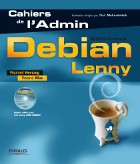
Cover of my French Debian BookWhile I have made good progress on many of my Debian goals for this year, it s not the case for the goal number #1: translating my Debian book into English. The picture on the left is the cover of the current French version based on Debian Lenny (450 pages). But the translation would be based on the next edition that we re currently preparing and it s based on Debian Squeeze of course! We have already translated the table of contents so that you can get an idea of what s in the book. Note that many parts of the book apply to Ubuntu as well. It s quite difficult for Roland and me to allocate several months of our life to such a huge task without any income in that period and without knowing if our book will sell enough to cover for the time invested. For those reasons, we re considering using a service like kickstarter.com or ulule.com or yooook.net to get this project funded. If you don t know those services, they allow you to present your project and to collect pledges so that you can safely complete your project. The money pledged is distributed only if the total amount pledged exceeds the minimal funding level (set by the project creator). Furthermore you can select nice rewards depending on the amount of money pledged. To make things even more exciting we are ready to publish the book under a DFSG-compatible license at the sole condition that we reach 25 000 of donations. That might look like a lot but in fact it s only 5 donated by 5000 persons and then everybody benefits! And for the authors, you have to remove ~10% of fees taken by the funding service (including card processing fees), 16.4% VAT, 9% social taxes and if you consider that the project represents a minimum of 6 months of work, that ends up to at most 2850 /month. We believe this to be reasonable. The next step for us is to pick the service to use and setup the fundraising. We need your input. Please answer a few questions by filling this form. In all cases, we will have those rewards and probably more: A few considerations about the various services: Kickstarter.com is a great service but it s restricted to US-residents so it s complicated for us to use that service since we re French (and live in France) and the supporters need to have an Amazon (payments) account. Ulule.com is open to anyone for project creation but uses a paypal API to deal with the pledge mechanism and thus imposes that all supporters have a paypal account. Is that requirement likely to scare you away? Yooook.net is specialized in liberation fundraising but the interface is not very polished, they don t offer (many) social features nor do they give a public listing of the projects hosted. The choice is difficult and thus we re seeking your feedback to make the right one, take a few minutes and answer our questions: click here to go to the form. Thank you for your help and please spread the word so that we get enough answers to have meaningful results. Update: it has been brought to my attention that kickstarter requires an Amazon (payments) account. I fixed my article and the form to document this. I have also been asked what license we re going to use. It s likely to be dual-licensed GPL2+ / CC-BY-SA 3.0. Flattr this Share/Bookmark 4 comments Support my work

Aigars Mahinovs: Debconf 10 arrival and first days

I had planned long for this Debconf and with the experience from the previous times I did all I could to reach one goal minimise stress. I think I got it right this time. First of all I got my company (Accenture) pay for the whole thing, so I did not have to worry about sponsorship queue (but instead I must gather and deliver them back some knowledge gained from the conference should be easy). I also managed to get a direct flight there is a weekly flight Tashkent-Riga-New York on Sundays and I got a ticket for that both ways. This took many hours off the travel time and reduced the stress a ton. Then I also did all the prudent travelling things: mostly reading the New York page on Wikitravel. This told me (among other things) what metro line to take to get the best view of the city. And for luggage I took a backpack (for the laptop and walking around) and a roller (for the clothes). I learned a lot from the Up in the air movie, it really teaches one how to take stress out of travel. This went very well in the beginning I took a bus to the airport early, checked in, breezed trough security and then waited and waited. The boarding only started half an hour after we were scheduled to depart. But I can not complain, because the flight attendant called my name (among a few others) just before boarding and changed my ticket I was bumped up to business class :) . It has been many years since I ve flown a regular (non-budget) airline and now first time ever in the business class! We got regular class meals, but at least we got to sit in the big chairs with lots of leg room. It was great! I bought a paper book (from Charles Stross) to read during the flight, because that is the only thing you can do during take-off and landing and I had some stuff to listen to in my iPhone. I tried sleeping and I think I managed to kill a couple hours that way too. It sure helped combat jet lag later on. When I arrived, I had my immigration and customs forms filled out. Latvia is on the USA Visa Waiver program, so I just had to fill out a form online prior to the trip to get a permission to enter USA. I only had one printout of the Waiver confirmation page and my airline took that before giving me a boarding pass, so I had no paper copy to give to the guy at the USA border, but he did not even ask for it he only took the two forms I filled out, scanned my passport, took my fingerprints (all fingers) and a photo. Then he gave me back the customs for (stamped) and I could go get my luggage. After that it was just a matter of walking trough customs and giving the customs official the pre-filled and stamped customs form. I was not stopped further. The AirTrain was a bit confusing you just get on the AirTrain and go where you need to go, you actually pay at the place where AirTrain connects to metro, so when you are coming from the airport you are actually paying ($5) when you are exiting the AirTrain system. There are plenty of AirTrain people that will give you an AirTrain ticked for $5 cash right there or you can use a machine to get it (where you can also pay with a card). The machines also take AmEx, but you must know the PIN code, if your don t know the PIN of you AmEx card (like I don t know the PIN of my corporate AmEx) you can only buy MetroCards at news stands, but there you will not find the unlimited ride tickets only 5 or 10 ride tickets are available. Next I screwed up a bit and thus got a bit lost in the New York metro system. The Wikitravel recommends to take the AirTrain to Jamaica station and from there take J or Z line into the city for the best views. I went to Jamaica and got into the first metro train that came on to the platform. Unfortunately, that was the E line train and it does not cross with J or Z lines after that, so I was stuck. To complicate the situation E line is under repair, so after a few stops the trains diverted to the F line and I had to scramble to figure out where to get out to get to the 1 line where Columbia University is. I ended up spending more than an hour in the metro, but I got there in the end. So I emerge from the 116th street metro station directly in front of the campus entrance gate and it starts raining. A thunderstorm swept across New York as soon as I stepped outside the metro station, so I took shelter a the side of the building. It kept raining. After a few minutes decided that I don t want to wait any more, so I put all my electronics into my backpack and went towards the dorm where my room was. The rain was warm, people around me were playing and running around in the wet grass, it was fun. The guard showed me where to go to check in. It was really simple sign here, here is you magnetic stripe key, have fun. And the room was just as spartan bed, desk, chair, closet, bathroom and a large fan under the window. The first night I did not know that I could actually turn that fan down, so I slept to the sound of full fan blasting, much like on the airplane. The dorm looks ancient it looks like it was build in the 60s and never changed since then. I mean, I ve lived in worse places, but people would at least change wall sockets or faucets or ceiling paint every other decade or so. The newest things here were the magnetic locks on the doors and a TV and a mini fridge in the hallway. After dropping my things I went off to the Mudd building across the campus to check in with people in the hacklab. It was just starting to take shape, but many great and familiar people were already there. It was like walking into a family home same warm welcome smiles and that great feel of belonging to the group. After I quick chat I went off downtown. The plan was that I left my old Canon 400D camera back at home and that I would buy a new Canon 550D here in New York on arrival. Unfortunately I underestimated the travel time on subway and by the time I got back downtown most shops where already closed. I got to checking out a Best Buy and was told there that they don t have 550D in stock. Next morning I went for a full scale search B&H Photo Video store, J&R Express, another BestBuy none of them had the Canon 550D (aka T2i) in stock in a body-only configuration. BestBuy had a few sets with the kit lens, but I did not want paying 100$ extra for something I already have. The last option was Adorama and I got lucky I nabbed the last 550D they had and it was body-only. Now I was back, with a camera in my hands and the Debconf10 could really begin!

27 July 2010

Daniel Baumann: The World's most powerful Wireless Network Card

About two weeks ago I got a Wifly-City G2000, the world's most powerful 802.11bg wireless network card. It features 2000mW which is 10 times more than the legally allowed limit of 200mW in Switzerland (or 2 times more than the allowed 1000mW in the USA, 5 times more than the allowed 400mW in Brazil, or 20 times more than the allowed 100mW in the EU). Contents The adapter is sold as a set named Wifly-City AVATAR-4PA with some accessories.
click on the images for full resolution The box prominelty lists Linux compatibility and contains the following part: The adapter has a Realtek 8187L chipset. This is particulary nice since there is no firmware needed for this chipset (therefore no questinable binary-only firmware blob). Also, it works out of the box with any Linux as of kernel version 2.6.30 and newer. I tested it on lenny with kernel backports, vanilla squeeze and vanilla sid. In all of these setups, it works out of the box without any configuration whatsoever - just plug it in and it works. I know that this is how it is supposed to be but still, I am always surprised again when things just work. For those who care, this is the output of dmesg when plugging in the card...
[...]
usb 1-1: new high speed USB device using ehci_hcd and address 6
usb 1-1: New USB device found, idVendor=0bda, idProduct=8187
usb 1-1: New USB device strings: Mfr=1, Product=2, SerialNumber=3
usb 1-1: Product: RTL8187_Wireless_LAN_Adapter
usb 1-1: Manufacturer: Manufacturer_Realtek_RTL8187_
usb 1-1: SerialNumber: xxxxxxxxxxxx
usb 1-1: configuration #1 chosen from 1 choice
phy1: Selected rate control algorithm 'minstrel'
phy1: hwaddr xx:xx:xx:xx:xx:xx, RTL8187vB (default) V1 + rtl8225z2, rfkill mask 2
rtl8187: Customer ID is 0xFF
Registered led device: rtl8187-phy1::tx
Registered led device: rtl8187-phy1::rx
rtl8187: wireless switch is on
usbcore: registered new interface driver rtl8187
ADDRCONF(NETDEV_UP): wlan1: link is not ready
wlan1: direct probe to AP xx:xx:xx:xx:xx:xx (try 1)
wlan1: direct probe responded
wlan1: authenticate with AP xx:xx:xx:xx:xx:xx (try 1)
wlan1: authenticated
wlan1: associate with AP xx:xx:xx:xx:xx:xx (try 1)
wlan1: RX AssocResp from xx:xx:xx:xx:xx:xx (capab=0x411 status=0 aid=5)
wlan1: associated
ADDRCONF(NETDEV_CHANGE): wlan1: link becomes ready
wlan1: no IPv6 routers present
[...]
...and this is the output of lsusb:
Bus 001 Device 006: ID 0bda:8187 Realtek Semiconductor Corp. RTL8187 Wireless Adapter
Special Offer I have played with the card for some time now and am really pleased with it. It works nicely with all the standard tools (aircrack-ng, kismet, etc.). The only bummer is that the card is quite expensive. Fortunately, we could arrange a good deal for Free Software people where the store selling it does not make any money on it: instead of 89 USD you can get it for 68 USD (including everything). If you are interested in getting one and you are comming to DebConf 10 in New York between 2010-07-25 and 2010-08-08, you can write an email to Ralph Amissah or speak to Ralph personally during the event. 1 I have no idea why they are shipping with a Y cable because the adapter does not need one. However, it does not disturb and in case I ever need an Y cable, I now have one :)

Steve Kemp: Sometimes you just wonder would other people like this?

Sometimes I write things that are for myself, and later decide to release on the off-chance other people might be interested. I've hated procmail for a long time, but it is extremely flexible, and for the longest time I figured since I'd got things working the way I wanted there was little point changing. When it comes to procmail there are few alternatives: Unfortunately both Exim and Email::Filter suffer from a lack of "pipe" support. To be more specific Exim filters and Email::Filter allow you to pipe an incoming message to an external program - but they regard that as the end of the delivery process. So, for example, you cannot receive a message (on STDIN), pipe it through crm114, then process that updated message. (i.e. The output of crm114). Maildrop does allow pipes, but suffers from other problems which makes me "not like it". My own approach is to have a simple mail-sieve command which is configured thusly:
set maildir=/home/steve/Maildir
set logfile=/home/.trash.d/mail-sieve.log
#
#  Null-senders
#
Return-Path: /<>/        save .Automated.bounces/
#
#  Spam filter
#
filter /usr/bin/crm -u /home/steve/.crm /usr/share/crm114/mailreaver.crm
#
#  Spam?
#
X-CRM114-Status: /SPAM/   save .CRM.Spam/
X-CRM114-Status: /Unsure/ save .CRM.Unsure/
#
#  People / Lists
#
From: /foo@example.com/  save .people.foo/
From: /bar@example.com/  save .people.bar/
..
..
#
#  Domains
#
To: /steve.org.uk$/               save .steve.org.uk/
To: /debian-administration.org$/  save .debian-administration.org.personal/
#
#  All done.
#
save .inbox.unfiled/
On the one hand this is simple, readable, and complete enough for myself. On the other hand if I were going to make it releasable I think I'd probably want to add both conditionals and the ability to match upon multiple header values. Getting there would probably involve something like this on the ~/.mail-filter side :
if ( ( From: /foo@example.com )  
     ( From: /bar@example.com ) )
 
   save .people.example.com/
   exit
 
# ps. remind me how much I hate parsers and lexers?
That starts to look very much like Exim's filter language, at which point I think "why should I bother". Pragmatically the simplest solution would be to add a "Filter" primitive to Email::Filter - and pretend I understood the nasty "Exit" settings. ObQuote: Andre, we don't use profanity or double negatives here at True Directions. - "But I'm a Cheerleader".

Wouter Verhelst: NBD: authentication and named exports

I just did some work on two NBD features: authentication and named exports. The first was written by Brad Allen back in 2008. I'd been thinking about an authentication scheme back at DebConf 8, and discussed it on the nbd-general mailinglist. Brad picked it up and ran with it, but it never got finished. Basically, what I did today was forward-port the code so that it would compile (and work) with today's version of the NBD utilities. I tested it and it works, but I'm not sure what to do with it. NBD is not encrypted; so there's no protection against TCP hijacking or some such. Oh well; I might still integrate it into nbd mainline. The second feature is something way more interesting. It had been on my long-term TODO list for quite a while, but I never sat down to implement it. Until today, that is. This patch has been compile-tested, but I haven't functionally tested it yet; I'll do that tomorrow. The main reason it took so long to implement, was that initial NBD handshake made that quite hard. Upon connecting, nbd-server as it currently exists will open the file or block device that it needs to export, and before nbd-client has sent anything sends information on that export (its size, whether or not it is read-only, etc) to the client. Unfortunately, this does mean that I cannot add new features to nbd-server while retaining full backwards compatibility if these features may involve changing what nbd-server sends during the initial handshake, as is the case here. This could be worked around by having the server first send information on a "default" export to the client, and then variate that if the client informs the server that it actually wants something else. But this would have been rather ugly, since it means that errors in open() or stat() calls for the initial "default" export would have to be non-fatal until the client actually tries to read or write to or from the device, at which point they would suddenly become fatal. This would open a can of worms near which I didn't want to tread. The way I fixed it in the end, however, is fairly simple. If names are used to specify an export, nbd-server can live with just one port to export all block devices that it supports, rather than needing many. As such, I can "reserve" one port for the new-style named exports. On this port, nbd-server would expect that clients send a name, and would not function correctly with clients that don't understand names. At the same time, nbd-server could still export the same block devices on other ports as well, using the old-style protocol, for clients that do not support named devices. This would of course require that both the client and the server know perfectly well what the port is, and that it does not change too easily. As such, I've just put in a request for an assigned port number over at IANA, so that I can be sure that the port will not change unexpectedly. This also means I won't make a public release with this change until the port number has been assigned, so that I don't need to support two 'default' nbd-server ports in the future (one "temporary" and one IANA-assigned port). For now, however, I think I'll go grab some food.

26 July 2010

Russell Coker: Creating a SE Linux Chroot environment

Why use a Chroot environment? A large part of the use of chroot environments is for the purpose of security, it used to be the only way of isolating a user from a section of the files on a server. In many of the cases where a chroot used to be used for security it is now common practice to use a virtual server. Also another thing to note is that SE Linux provides greater access restrictions to most daemons than a chroot environment would so in many case using SE Linux with a sensible policy is a better option than using a chroot environment to restrict a daemon. So it seems to me that the security benefits that can be obtained by using a chroot environment have been dramatically decreased over the last 5+ years. One significant benefit of a chroot environment is that of running multiple different versions of software on one system. If for example you have several daemons that won t run correctly on the same distribution and if you don t want to have separate virtual machines (either because you don t run a virtualisation technology or because the resources/expense of having multiple virtual servers is unacceptable) then running multiple chroot environments is a reasonable option. The Simplest Solution The simplest case is when all the chroot environments are equally trusted, that means among many other things that they all have the latest security patches applied. Then you can run them all with the same labels, so every file in the chroot environment will have the same label as it s counterpart in the real root this will mean that for example a user from the real root could run /chroot/bin/passwd and possibly get results you don t desire. But it s generally regarded that the correct thing to do is to have a chroot environment on a filesystem that s mounted nosuid which will deal with most instances of such problems. One thing to note however is that the nosuid mount option also prevents SE Linux domain transitions, so it s not such a good option when you use SE Linux as domain transitions are often used to reduce the privileges assigned to the process. There are two programs for labeling files in SE Linux, restorecon is the most commonly used one but there is also setfiles which although being the same executable (restorecon is a symlink to setfiles) has some different command-line options. The following command on a default configuration of a Debian/Lenny system will label a chroot environment under /chroot with the same labels as the main environment: setfiles -r /chroot /etc/selinux/default/contexts/files/file_contexts /chroot I am considering adding an option to support chroot environments to restorecon, if I do that then I will probably back-port it to Lenny, but that won t happen for a while. For a simple chroot once the filesystem is labelled it s ready to go, then you can start daemons in the chroot environment in the usual way. Less trusted Chroot environments A reasonably common case is where the chroot environment is not as trusted. One example is when you run an image of an old server in a chroot environment. A good way of dealing with this is to selectively label parts of the filesystem as required. The following shell code instructs semanage to add file contexts entries for a chroot environment that is used for the purpose of running Apache. Note that I have given specific labels to device nodes null and urandom and the socket file log in the /dev directory of the chroot environment (these are the only things that are really required under /dev), and I have also put in a rule to specify that no other files or devices under /dev should be labelled. If /dev is bind mounted to /chroot/dev then it s important to not relabel all the devices to avoid messing up the real root environment and it s impractical to put in a specific rule for every possible device node. Note that the following is for a RHEL4 chroot environment, other distributions will vary a little some of the file names. semanage -i << END
fcontext -a -t root_t -f -d /chroot
fcontext -a -t bin_t /chroot/bin.*
fcontext -a -t usr_t /chroot/usr.*
fcontext -a -t usr_t /chroot/opt.*
fcontext -a -f -d /chroot/dev
fcontext -a -f -s -t devlog_t /chroot/dev/log
fcontext -a -f -c -t null_device_t /chroot/dev/null
fcontext -a -f -c -t urandom_device_t /chroot/dev/urandom
fcontext -a -t "<<none>>" "/chroot/dev/.*"
fcontext -a -t "<<none>>" "/chroot/proc.*"
fcontext -a -t lib_t /chroot/lib.*
fcontext -a -t lib_t /chroot/usr/lib.*
fcontext -a -t bin_t /chroot/usr/bin.*
fcontext -a -t httpd_exec_t -d /chroot/usr/bin/httpd
fcontext -a -t var_t /chroot/var.*
fcontext -a -t var_lib_t /chroot/var/lib.*
fcontext -a -t httpd_var_lib_t /chroot/var/lib/php.*
fcontext -a -t var_log_t /chroot/var/log.*
fcontext -a -t var_log_t -f /chroot/var/log/horde.log.*
fcontext -a -t httpd_log_t /chroot/var/log/httpd.*
fcontext -a -t var_run_t /chroot/var/run.*
fcontext -a -t httpd_var_run_t -f /chroot/var/run/httpd.pid
fcontext -a -t httpd_sys_content_t /chroot/var/www.*
END
You could create a shell script to run the above commands multiple times for multiple separate Apache chroot environments. If there is a need to isolate the various Apache instances from each other (as opposed to just protecting the rest of the system from a rogue Apache process) then you could start each copy of Apache with a different MCS sensitivity label which will provide adequate isolation for most purposes as long as no sensitivity label dominates the low level of any of the others. If you do that then the semanage commands require the -r option to specify the range. You could have one chroot environment under /chroot-0 with the sensitivity label of s0:c0 for it s files and another under /chroot-1 with the sensitivity label of s0:c1 for it s files. To start one environment you would use a command such as the following: runcon -l s0:c0 setsid chroot /chroot-0 /usr/sbin/httpd

24 July 2010

Chris Lamb: Four men in a mine

kumbunterland posed this question in the park yesterday:
There are four men in a coal mine. This exit is narrow so that no more than 2 men can exit at the same time. In addition, there is only one torch and they can't leave the mine without it. Each man walks at a different speed. The first man takes one minute to exit the mine the bridge distance, the second takes two minutes, the third takes five, and the fourth takes eight minutes. If two men walk together they must walk at the slower speed. For example, if person #1 and person #3 go together, they will leave the mine in 5 minutes. Then, person #1 could return back to return the torch to the others (taking another one minute) so they can use it to exit again. The coal mine will collapse in exactly 15 minutes; you must find a way to allow all the men to leave the mine within this time.
Unfortunately, swi-prolog is broken on the N900, so I wasn't able to solve it right then:
solution(Men, Bound, Out) :-
    torchInside(Men, [], [], Log),
    totalDuration(Log, 0, Duration), Duration =< Bound,
    swritef(Out, '%w  (%w minutes)', [Log, Duration]).
% We use torch Inside,Outside  predicates like a state machine.
torchInside(A, B, Log, X) :-
    % Move two people from inside -> outside the mine
    combination(2, A, S), subtract(A, S, A1), append(S, B, B1),
    torchOutside(A1, B1, [S Log], X).
torchOutside([], _, Log, Log).
torchOutside(A, B, Log, X) :-
    % Move someone from outside -> inside the mine
    combination(1, B, S), subtract(B, S, B1), append(S, A, A1),
    torchInside(A1, B1, [S Log], X).
% Utilities:
totalDuration([], X, X).
totalDuration([H T], Acc, X) :-
    max_list(H, Max), NewAcc is Acc + Max,
    totalDuration(T, NewAcc, X).
combination(0, _, []).
combination(N, [H T], [H Comb]) :-
    N > 0, N1 is N - 1, combination(N1, T, Comb).
combination(N, [_ T], Comb) :-
    N > 0, combination(N, T, Comb).
?- solution([1, 2, 5, 8], 15, X).
X = "[[2, 1], [2], [5, 8], [1], [1, 2]]  (15 minutes)" ;
X = "[[1, 2], [1], [5, 8], [2], [1, 2]]  (15 minutes)" ;
false.
I'm fun at parties.

19 July 2010

Christian Perrier: Debian Installer final localization stats for upcoming squeeze beta1

After a quite long string freeze and last minute efforts by translators, I finally stopped the clock on Sunday July 11th for D-I localization update meant for the release of the beta1 version of debian-installer for squeeze. We finally have 65 supported languages. In a final effort, Belarusian, Ukrainian, Hungarian, Tagalog, Kurdish, Croatian and Macedonian were "rescued" and completed enough for being included in the release. Unfortunately, I had to deactivate Wolof, Serbian and Welsh because of lack of activity. For Serbian, this is very infortunate as new translators indeed tried to contact me with updates, which I missed and discovered only after it wasn't possible to revert the change. Good news are that Serbian is now already reactivated for the next release and we will even have both the Cyrillic and Latin versions of it. The mass upload of D-I packages happened mostly on Sunday 12th (you probably noticed that if you follow debian-devel-changes). It is already possible to test what will be D-I beta1: just go to the D-I development web page, then choose to download the daily built netboot image. Boot it with "install mirror/suite=unstable". This is not *exactly* what beta1 will give as this will install unstable and not testing, for non D-I packages...but I think that, until D-I packages migrate to testing, this is the best way to test beta1. The next step in D-I release preparation should be the mass migration to testing of most udeb packages.

18 July 2010

Gregor Herrmann: Let's freeze!

I spent the last two days at the BSP in Munich thanks to everyone for inviting & feeding me, & especially to Stefan for hosting me again!

Unfortunately the weather was not good enough for an excursion to a Biergarten but the local chefs at the LiMux office delighted us with self-made spaghetti salmone & self-rolled sushi, & we spent quite some time behind our laptops.

The main results can be seen on the wiki page; my personal conclusion is that the list of remaining RC bugs contains mostly "hard stuff" (e.g. architecture-, hardware-, or desktop-specific bugs). Probably some packages will need to be kicked out of squeeze & some bugs might get a squeeze-ignore tag ... To put it positively: I have a gut feeling that the freeze is getting closer :)

17 July 2010

John Goerzen: KD0MJT

Wow tonight was thrilling. It s hard to explain why, but it s pretty exciting to have a radio setup that is all wrong in so many ways work well enough for me to sit in my kitchen in Kansas and talk to someone in Indianapolis using only two-way HF radios. I recently passed my technician and general amateur radio exams. I ve been talking to some very nice people locally on the 2m band, which permits local (say, 100-200mi radius) communication. It s been fun, but Kansas is sparsely populated enough that sometimes there just isn t any activity. At all. Earlier this week, my Yaesu FT-857D and two antennas arrived. I tried it first on VHF, and had a nice chat with Kent (KB0RWI) a few miles away. But tonight was the big experiment. I bought a 20m dipole antenna. This is basically a 30-foot-long wire, connected to a balun and a coax feed line in the middle. You re supposed to put it at least 30 feet off the ground, and away from trees, houses, etc. You re supposed to have a nice RF ground for your transmitter, power supply, antenna tuner, and all that stuff. You re not supposed to just run the coax under that (until today, annoying) small hole in the seal under the kitchen storm door. You re supposed to have to have the correct connectors on your coax, instead of soldering an RG-8 PL-259 onto some RG-8X because you re new at this and didn t realize that you need to buy an adapter. And, I m really pretty sure that you re not supposed to have an aggressive outdoor cat complete with a full set of claws and teeth attack the coax RG-8X cable as it s being pulled through the grass. Fail to do any of these things, and the thing might not work well, or might not work at all, or for people that use old equipment, might burn out your radio or something. So anyway I got out the ladder today, and I got the antenna maybe 10-15 feet in the air. I have three trees in a row with the perfect separation to hang each end and the center balun from. So while Jacob went around playing with water and trying out the ladder on occasion (with my help), I used some string to hang the antenna. In the trees, not far from them. Near the house. Not 30ft off the ground. I strung the feed line into the house, set up all my equipment on our kitchen table, flipped the switch. And nothing. Just the occasional familiar whine while tuning. I tried the 20m band, then the 40m, then even 15, 12, and 10. No activity anywhere. So what was wrong? I improvised some grounding extracted the ground conductor from an old strip of AC house wiring, shoved it into the ground, and grounded the tuner and transmitter. No difference. I unplugged the coax, and tested it with my multimeter. It tested out OK. I plugged it back in and wiggled the connector. Turns out the connector isn t in great shape, but it had been working. I tried transmitting. The tuner made a whole bunch of alarming-sounding clicking noises (sounded like a symphony of relays), indicated SWR over 3, and the ammeter on my power supply went a bit nuts. Later I realized that I just wasn t giving the tuner enough time to tune up; with a few more seconds, it tuned up just fine on every frequency. (So yes, it was supposed to do that.) And, it turns out, that all I needed to do was wait a little while longer to hear some signals. Pretty soon I was finding stuff all over the 40m band. I heard a discussion from Chicago, another from Oklahoma City, some apparent broadcasters from Africa. I decided I would try and transmit. I was hearing one side of a discussion very clearly and decided I would wait for an opportunity to try to contact that person. I heard his callsign, K9RM. I looked it up, and realized he was near Indianapolis, where I had lived for awhile. Eventually he invited a station trying to get in to participate. And: KD0MJT (I announced my callsign, as a request to join the conversation) He said he only made out the 0, but eventually we were talking quite well. It was a brief conversation, but interesting; the person he was talking to was in Portland, and couldn t hear me (and I could barely hear him, but not loud enough to make out). That with no phone lines, no Internet provider needed, etc. And with a rig that is far from being at peak efficiency. I had no idea what to expect tonight and was surprised that just tossing an antenna up in a tree let me talk to someone in Indiana. That s 650 miles away. I wonder what I ll be able to do once I get things done the right way. This hobby is going to be fun. Many thanks to Mike_W for equipment suggestions, Kent and Dan from Newton ARC for encouragement and coming out to the house to test things, Kent for being my first ham radio contact ever (on 2m while I was using an old 1981 radio), Chuck (K9RM) for taking a few minutes to be my first HF contact, and my dad for helping plan out exterior wall penetration methods that will eliminate this coax under the kitchen door and lack of grounding business. Jacob, by the way, still loves his radios and is starting to take an interest in mine. It wouldn t shock me at all of he s one of these kids that gets his technician license in the 2nd grade or something. I think he and I can do this together for a long time.

15 July 2010

David Paleino: JOSM in Debian now supports OAuth authentication

Finally we have the same exact features as the upstream precompiled one. YAY! Here's the story. JOSM supports the OAuth authentication method since the SVN snapshot rev. 3094. At the time (the package was uploaded on Mar 18, 2010), we didn't have some needed dependencies in Debian for that. So I had to disable it, by patching the source code. In the meanwhile, I started filing RFP/ITPs, to fulfill the missing dependency chain. And it turned to be a long chain. Here it is: JOSM missing dependencies graph Looking at it now, that it's all done, it doesn't seem that long. However, I had to face the infamous Maven buildsystem, which I didn't know at all and pretended to download every dependency in a "local repository". Then I found the maven-debian-helper and maven-repo-helper packages, and started understanding it. Unfortunately, it seems that maven is only being used by CDBS people, so I had to override some debian/rules targets to get the work done with dh7. Once the chain was fulfilled... JOSM didn't even compile. Then I discovered that JOSM had code working with oauth-signpost 1.1, but 1.2 (which I uploaded to Debian) broke the API. So I had to port it to the new API, and I could finally upload it. Now we're at the end of this adventure. Debian JOSM users will have the choice of OAuth re-enabled, and I learned to master a new (to me) beast. Enjoy :)

Enrico Zini: On python, frameworks and TOOWTDI

On python, frameworks and TOOWTDI The Python world is ridden with frameworks, microframeworks, metaframeworks and their likes. They are often very clever things, but more often than not they are a tool of despair. A very peculiar thing about Python web frameworkish things is that there are so many of them. There's cherrypy (in its various API redesigns), fapws, gunicorn, bottle and flask, paste, werkzeug and flup, tornado, pylons, turbogears 1 and 2, django, repoze who, what and whatnot, all the myriad of rendering engines and buffet as a metathing on top of them, diesel, twisted, and I apologise if I don't spend my day listing and hyperlinking them all, I hope I made my point. Frameworks are supposed to standardise some aspects of programming; the nice thing about standards is that there are so many of them to choose from, and they all suck, so I'll make my own. But wasn't Python supposed to be the world of TIOOWTDI? Ok, everbody knows it isn't. Just in the standard library there are 2 implementations of pickle and 2 urllibs. But people like the TIOOWTDI idea. I believe the reason people like the TIOOWTDI idea is because it creates a framework. It standardises some aspects of programming, and defines building blocks that guarantee that people doing similar jobs will be using similar sets of components. Let's take for example the datetime module in the standard library. It is an embarassing example of a badly designed module, so embarassing that the standard library documentation continuously fails to document its fundamental design flaws and common work-arounds hoping that noone notices them, but as a consequence each poor soul starting to use it for nontrivial things has to google for hours in despair to rediscover in how many ways it's broken. But still, datetime works as a structure to hold those values that make a date, time, or full UTC timestamp. For that job it's become the standard, and as such it's an important component of the Python TIOOWTDI framework: one can use it to exchange datetimes among different libraries: for example ORMs are using it instead of rolling their own, which makes database programming so much easier when date/time is involved. Even if the implementation is far from perfect, once we apply TIOOWTDI to dates and timestamps, python code from different authors can exchange dates without worries. This is much better than having 3 different superior datetime libraries and having to convert date objects from one to another when passing values from a web form to an ORM. There is an often overlooked Python framework. The Pyton framework. It's called TIOOWTDI. All the micro-mini-midi-maxi-meta-frameworks that people scatter around, are, or should be, just experiments, proofs of concept, competing ideas waiting to be distilled in The Only One Way, bringing the Python experience one step forward. What is unfortunate is that this last distillation thing happens so rarely that people get used to the idea of having to use proof of concept code to get things done. Update: this post apparently wasn't very clear, so here is some clarification:

Rapha&#235;l Hertzog: Social Micropayment Can Foster Free Software, Discover Flattr

Social Micropayment Flattr LogoA social micropayment system allows you to donate a small amount of money (a few pennies/cents) to thank someone else for a good blog post, piece of music, or for a free software that you enjoy. That s what Flattr is all about. How Flattr works With Flattr, donating is as easy as a single click on a Flattr button that content providers (read free software developers ) embed on their websites. A Flattr button is very similar to a Digg button or other social buttons (you can look at the end of this blog post for a sample). The amount donated per flattr varies from month to month because you define a fixed amount of money to spend each month (minimum 2 ) and it s split evenly between all the things that you appreciated. You can flattr as much as you want, it won t cost you more. Support Free Software with Flattr Free Software lacks a good business model to fund the creation of software, yet someone has to pay the time spent in writing the code. Many projects have tried to ask for donations but the amount collected rarely covers more than the expenses for the website hosting. Flattr makes it so easy to donate that this is possibly about to change. Flattr users have to spend their monthly amount each month, otherwise it gets donated to charity. Thus if it takes off, most Flattr users will grow the habit of doing regular donations to projects that they use and appreciate. Bootstrapping the Process Flattr FLOSS LogoFlattr is a new service, not many projects are using it to accept donations and not many users are participating yet. But it s growing quickly on both sides. In order to help users who want to support Free Software with Flattr, I have started the Flattr Free and Open Source Software project. You can subscribe to a newsletter to receive a monthly reminder with recommendations of Free Software to Flattr. If you have more time, you can also browse public directories listing various Free Software projects using Flattr so that you can manually pick your favorites. To learn more about the Flattr FOSS project, click here. I also invite Free Software developers to setup Flattr on their websites, blogs, and to register those sites so that Flattr users can easily find them. To learn more about this, check out the Earn a Living With Free Software page. Share the News Flattr can change the situation of many small but popular free software projects struggling with a single developer who started it as a hobby and who can t afford to spend more free time on it. But this can only happen if lots of users start using Flattr to support the Free Software that they benefit from. So share the news, tell the friends, join Flattr FOSS and give some Flattr-love every month. Get Your Free Flattr Invite! Flattr is still in beta, but they like Free Software a lot and have offered 30 invites for the launch of Flattr FOSS. You can get yours by subscribing either to my main newsletter or to the Flattr FOSS one. Just reply to the welcome email you get after having subscribed and ask for your invite. Flattr this Share/Bookmark No comment Support my work

Next.

Previous.