Search Results: "ed"

14 May 2021

Junichi Uekawa: pomodoro timer in elisp.

pomodoro timer in elisp. I put up my current configuration here if you're interested. Not that I recommend this to anybody but this is tightly integrated with my daily notes taken in markdown format, so that I have a new entry for my notes every pomodoro. I don't time my break time because my water heater takes 5 minutes to boil and that's a good enough timer for me. I tried using notifications-notify to make sound but it turned out some environments I use don't forward this correctly, maybe someone already could have done the integration with OSC9/OSC777 to make sound work but not quite sure, so I make sound via sshing to my local raspberry pi and making it trigger chrome cast commands in my room to play sound.

Jelmer Vernooij: Ognibuild

The Debian Janitor is an automated system that commits fixes for (minor) issues in Debian packages that can be fixed by software. It gradually started proposing merges in early December. The first set of changes sent out ran lintian-brush on sid packages maintained in Git. This post is part of a series about the progress of the Janitor. The FOSS world uses a wide variety of different build tools; given a git repository or tarball, it can be hard to figure out how to build and install a piece of software. Humans will generally know what build tool a project is using when they check out a project from git, or they can read the README. And even then, the answer may not always be straightforward to everybody. For automation, there is no obvious place to figure out how to build or install a project.

Debian For Debian packages, Debian maintainers generally will have determined that the appropriate tools to invoke are, and added appropriate invocations to debian/rules. This is really nice when rebuilding all of Debian - one can just invoke debian/rules - a consistent interface - and it will in turn invoke the right tools to build the package, meeting a long list of requirements. With newer versions of debhelper and most common build systems, debhelper can figure a lot of this out automatically - the maintainer just has to add the appropriate build and run time dependencies. However, debhelper needs to be consistent in its behaviour per compat level - otherwise builds might start failing with different versions of debhelper, when the autodetection logic is changed. debhelper can also only do the right thing if all the necessary dependencies are present. debhelper also only functions in the context of a Debian package.
Ognibuild Ognibuild is a new tool that figures out the build system in use by an upstream project, as well as the other dependencies it needs. This information can then be used to invoke said build system, or to e.g. add missing build dependencies to a Debian package. Ognibuild uses a variety of techniques to work out what the dependencies for an upstream package are:
  • Extracting dependencies and other requirements declared in build system metadata (e.g. setup.py)
  • Attempting builds and parsing build logs for missing dependencies (repeating until the build succeeds), calling out to buildlog-consultant
Once it is determined which dependencies are missing, they can be resolved in a variety of ways. Apt can be invoked to install missing dependencies on Debian systems (optionally in a chroot) or ecosystem-specific tools can be used to do so (e.g. pypi or cpan). Instead of installing packages, the tool can also simply inform the user about the missing packages and commands to install them, or update a Debian package appropriately (this is what deb-fix-build does). The target audience of ognibuild are people who need to (possibly from automation) build a variety of projects from different ecosystems or users who are looking to just install a project from source. Developers who are just hacking on e.g. a Python project are better off directly invoking the ecosystem-native tools rather than a wrapper like ognibuild.
Supported ecosystems (Partially) supported ecosystems currently include:
  • Combinations of make and autoconf, automake or CMake
  • Python, including fetching packages from pypi
  • Perl, including fetching packages from cpan
  • Haskell, including fetching from hackage
  • Ninja/Meson
  • Maven
  • Rust, including fetching packages from crates.io
  • PHP Pear
  • R, including fetching packages from CRAN and Bioconductor
For a full list, see the README.
Usage Ognibuild provides a couple of top-level subcommands that will seem familiar to anybody who has used a couple of other build systems:
  • ogni clean - remove build artifacts
  • ogni dist - create a dist tarball
  • ogni build - build the project in the current directory
  • ogni test - run the test suite
  • ogni install - install the project somewhere
  • ogni info - display project information including discovered build system and dependencies
  • ogni exec - run an arbitrary command but attempt to resolve issues like missing dependencies
These tools all take a couple of common options:
resolve=apt auto native Specifies how to resolve any missing dependencies:
  • apt: install the appropriate dependency using apt
  • native: install dependencies using native tools like pip or cpan
  • auto: invoke either apt or native package install, depending on whether the current user is allowed to invoke apt
schroot=name Run inside of a schroot.
explain do not make any changes but tell the user which native on apt packages they could install. There are also subcommand-specific options, e.g. to install to a specific directory on restrict which tests are run.
Examples
Creating a dist tarball
1
2
3
4
5
6
7
8
9
% git clone https://github.com/dulwich/dulwich
% cd dulwich
% ogni --schroot=unstable-amd64-sbuild dist
 
Writing dulwich-0.20.21/setup.cfg
creating dist
Creating tar archive
removing 'dulwich-0.20.21' (and everything under it)
Found new tarball dulwich-0.20.21.tar.gz in /var/run/schroot/mount/unstable-amd64-sbuild-974d32d7-6f10-4e77-8622-b6a091857e85/build/tmpucazj7j7/package/dist.
Installing ldb from source, resolving dependencies using apt
1
2
3
4
5
6
7
8
9
% wget https://download.samba.org/pub/ldb/ldb-2.3.0.tar.gz
% tar xvfz ldb-2.3.0.tar.gz
% cd ldb-2.3.0
% ogni install --prefix=/tmp/ldb
 
+ install /tmp/ldb/include/ldb.h (from include/ldb.h)
 
Waf: Leaving directory  /tmp/ldb-2.3.0/bin/default'
'install' finished successfully (11.395s)
Running all tests from XML::LibXML::LazyBuilder
1
2
3
4
5
6
% wget  https://cpan.metacpan.org/authors/id/T/TO/TORU/XML-LibXML-LazyBuilder-0.08.tar.gz _ <https://cpan.metacpan.org/authors/id/T/TO/TORU/XML-LibXML-LazyBuilder-0.08.tar.gz> _
% tar xvfz XML-LibXML-LazyBuilder-0.08.tar.gz
Cd XML-LibXML-LazyBuilder-0.08
% ogni test
 
Current Status ognibuild is still in its early stages, but works well enough that it can detect and invoke the build system for most of the upstream projects packaged in Debian. If there are buildsystems that it currently lacks support for or other issues, then I d welcome any bug reports.

Reproducible Builds (diffoscope): diffoscope 175 released

The diffoscope maintainers are pleased to announce the release of diffoscope version 175. This version includes the following changes:
* Use the actual filesystem path name (instead of diffoscope's concept of the
  source name) to correct APK filename filtering when an APK file is in
  another container -- we need to filter the auto-generated "1.apk" instead
  of "original-filename.apk". (Closes: reproducible-builds/diffoscope#255)
* Don't call os.path.basename twice.
* Correct grammar in a fsimage.py debug message.
* Add a comment about stripping filenames.
You find out more by visiting the project homepage.

13 May 2021

Bits from Debian: New Debian Developers and Maintainers (March and April 2021)

The following contributors got their Debian Developer accounts in the last two months: The following contributors were added as Debian Maintainers in the last two months: Congratulations!

Shirish Agarwal: Population, Immigration, Vaccines and Mass-Surveilance.

The Population Issue and its many facets Another couple of weeks passed. A Lot of things happening, lots of anger and depression in folks due to handling in pandemic, but instead of blaming they are willing to blame everybody else including the population. Many of them want forced sterilization like what Sanjay Gandhi did during the Emergency (1975). I had to share So Long, My son . A very moving tale of two families of what happened to them during the one-child policy in China. I was so moved by it and couldn t believe that the Chinese censors allowed it to be produced, shot, edited, and then shared worldwide. It also won a couple of awards at the 69th Berlin Film Festival, silver bear for the best actor and the actress in that category. But more than the award, the theme, and the concept as well as the length of the movie which was astonishing. Over a 3 hr. something it paints a moving picture of love, loss, shame, relief, anger, and asking for forgiveness. All of which can be identified by any rational person with feelings worldwide.

Girl child What was also interesting though was what it couldn t or wasn t able to talk about and that is the Chinese leftover men. In fact, a similar situation exists here in India, only it has been suppressed. This has been more pronounced more in Asia than in other places. One big thing in this is human trafficking and mostly women trafficking. For the Chinese male, that was happening on a large scale from all neighboring countries including India. This has been shared in media and everybody knows about it and yet people are silent. But this is not limited to just the Chinese, even Indians have been doing it. Even yesteryear actress Rupa Ganguly was caught red-handed but then later let off after formal questioning as she is from the ruling party. So much for justice. What is and has been surprising at least for me is Rwanda which is in the top 10 of some of the best places in equal gender. It, along with other African countries have also been in news for putting quite a significant amount of percentage of GDP into public healthcare (between 20-10%), but that is a story for a bit later. People forget or want to forget that it was in Satara, a city in my own state where 220 girls changed their name from nakusha or unwanted to something else and that had become a piece of global news. One would think that after so many years, things would have changed, the only change that has happened is that now we have two ministries, The Ministry of Women and Child Development (MoWCD) and The Ministry of Health and Welfare (MoHFW). Sadly, in both cases, the ministries have been found wanting, Whether it was the high-profile Hathras case or even the routine cries of help which given by women on the twitter helpline. Sadly, neither of these ministries talks about POSH guidelines which came up after the 2012 gangrape case. For both these ministries, it should have been a pinned tweet. There is also the 1994 PCPNDT Act which although made in 1994, actually functioned in 2006, although what happens underground even today nobody knows  . On the global stage, about a decade ago, Stephen J. Dubner and Steven Levitt argued in their book Freakonomics how legalized abortion both made the coming population explosion as well as expected crime rates to be reduced. There was a huge pushback on the same from the conservatives and has become a matter of debate, perhaps something that the Conservatives wanted. Interestingly, it hasn t made them go back but go forward as can be seen from the Freakonomics site.

Climate Change Another topic that came up for discussion was repeatedly climate change, but when I share Shell s own 1998 Confidential report titled Greenhouse effect all become strangely silent. The silence here is of two parts, there probably is a large swathe of Indians who haven t read the report and there may be a minority who have read it and know what already has been shared with U.S. Congress. The Conservative s argument has been for it is jobs and a weak we need to research more . There was a partial debunk of it on the TBD podcast by Matt Farell and his brother Sean Farell as to how quickly the energy companies are taking to the coming change.

Health Budget Before going to Covid stories. I first wanted to talk about Health Budgets. From the last 7 years the Center s allocation for health has been between 0.34 to 0.8% per year. That amount barely covers the salaries to the staff, let alone any money for equipment or anything else. And here by allocation I mean, what is actually spent, not the one that is shared by GOI as part of budget proposal. In fact, an article on Wire gives a good breakdown of the numbers. Even those who are on the path of free markets describe India s health business model as a flawed one. See the Bloomberg Quint story on that. Now let me come to Rwanda. Why did I chose Rwanda, I could have chosen South Africa where I went for Debconf 2016, I chose because Rwanda s story is that much more inspiring. In many ways much more inspiring than that South Africa in many ways. Here is a country which for decades had one war or the other, culminating into the Rwanda Civil War which ended in 1994. And coincidentally, they gained independence on a similar timeline as South Africa ending Apartheid in 1994. What does the country do, when it gains its independence, it first puts most of its resources in the healthcare sector. The first few years at 20% of GDP, later than at 10% of GDP till everybody has universal medical coverage. Coming back to the Bloomberg article I shared, the story does not go into the depth of beyond-expiry date medicines, spurious medicines and whatnot. Sadly, most media in India does not cover the deaths happening in rural areas and this I am talking about normal times. Today what is happening in rural areas is just pure madness. For last couple of days have been talking with people who are and have been covering rural areas. In many of those communities, there is vaccine hesitancy and why, because there have been whatsapp forwards sharing that if you go to a hospital you will die and your kidney or some other part of the body will be taken by the doctor. This does two things, it scares people into not going and getting vaccinated, at the same time they are prejudiced against science. This is politics of the lowest kind. And they do it so that they will be forced to go to temples or babas and what not and ask for solutions. And whether they work or not is immaterial, they get fixed and property and money is seized. Sadly, there are not many Indian movies of North which have tried to show it except for oh my god but even here it doesn t go the distance. A much more honest approach was done in Trance . I have never understood how the South Indian movies are able to do a more honest job of story-telling than what is done in Bollywood even though they do in 1/10th the budget that is needed in Bollywood. Although, have to say with OTT, some baggage has been shed but with the whole film certification rearing its ugly head through MEITY orders, it seems two steps backward instead of forward. The idea being simply to infantilize the citizens even more. That is a whole different ball-game which probably will require its own space.

Vaccine issues One good news though is that Vaccination has started. But it has been a long story full of greed by none other than GOI (Government of India) or the ruling party BJP. Where should I start with. I probably should start with this excellent article done by Priyanka Pulla. It is interesting and fascinating to know how vaccines are made, at least one way which she shared. She also shared about the Cutter Incident which happened in the late 50 s. The response was on expected lines, character assassination of her and the newspaper they published but could not critique any of the points made by her. Not a single point that she didn t think about x or y. Interestingly enough, in January 2021 Bharati Biotech was supposed to be share phase 3 trial data but hasn t been put up in public domain till May 2021. In fact, there have been a few threads raised by both well-meaning Indians as well as others globally especially on twitter to which GOI/ICMR (Indian Council of Medical Research) is silent. Another interesting point to note is that Russia did say in its press release that it is possible that their vaccine may not be standard (read inactivation on their vaccines and another way is possible but would take time, again Brazil has objected, but India hasn t till date.) What also has been interesting is the homegrown B.1.617 lineage or known as double mutant . This was first discovered from my own state, Maharashtra and then transported around the world. There is also B.1.618 which was found in West Bengal and is same or supposed to be similar to the one found in South Africa. This one is known as Triple mutant . About B.1.618 we don t know much other than knowing that it is much more easily transferable, much more infectious. Most countries have banned flights from India and I cannot fault them anyway. Hell, when even our diplomats do not care for procedures to be followed during the pandemic then how a common man is supposed to do. Of course, now for next month, Mr. Modi was supposed to go and now will not attend the G7 meeting. Whether, it is because he would have to face the press (the only Prime Minister and the only Indian Prime Minister who never has faced free press.) or because the Indian delegation has been disinvited, we would never know.

A good article which shares lots of lows with how things have been done in India has been an article by Arundhati Roy. And while the article in itself is excellent and shares a bit of the bitter truth but is still incomplete as so much has been happening. The problem is that the issue manifests in so many ways, it is difficult to hold on. As Arundhati shared, should we just look at figures and numbers and hold on, or should we look at individual ones, for e.g. the one shared in Outlook India. Or the one shared by Dr. Dipshika Ghosh who works in Covid ICU in some hospital
Dr. Dipika Ghosh sharing an incident in Covid Ward

Interestingly as well, while in the vaccine issue, Brazil Anvisa doesn t know what they are doing or the regulator just isn t knowledgeable etc. (statements by various people in GOI, when it comes to testing kits, the same is an approver.)

ICMR/DGCI approving internationally validated kits, Press release.

Twitter In the midst of all this, one thing that many people have forgotten and seem to have forgotten that Twitter and other tools are used by only the elite. The reason why the whole thing has become serious now than in the first phase is because the elite of India have also fallen sick and dying which was not the case so much in the first phase. The population on Twitter is estimated to be around 30-34 million and people who are everyday around 20 odd million or so, which is what 2% of the Indian population which is estimated to be around 1.34 billion. The other 98% don t even know that there is something like twitter on which you can ask help. Twitter itself is exclusionary in many ways, with both the emoticons, the language and all sorts of things. There is a small subset who does use Twitter in regional languages, but they are too small to write anything about. The main language is English which does become a hindrance to lot of people.

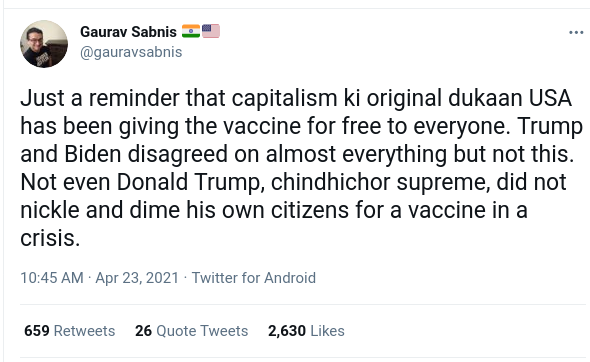
Censorship Censorship of Indians critical of Govt. mishandling has been non-stop. Even U.S. which usually doesn t interfere into India s internal politics was forced to make an exception. But of course, this has been on deaf ears. There is and was a good thread on Twitter by Gaurav Sabnis, a friend, fellow Puneite now settled in U.S. as a professor.
Gaurav on Trump-Biden on vaccination of their own citizens
Now just to surmise what has been happened in India and what has been happening in most of the countries around the world. Most of the countries have done centralization purchasing of the vaccine and then is distributed by the States, this is what we understand as co-operative federalism. While last year, GOI took a lot of money under the shady PM Cares fund for vaccine purchase, donations from well-meaning Indians as well as Industries and trade bodies. Then later, GOI said it would leave the states hanging and it is they who would have to buy vaccines from the manufacturers. This is again cheap politics. The idea behind it is simple, GOI knows that almost all the states are strapped for cash. This is not new news, this I have shared a couple of months back. The problem has been that for the last 6-8 months no GST meeting has taken place as shared by Punjab s Finance Minister Amarinder Singh. What will happen is that all the states will fight in-between themselves for the vaccine and most of them are now non-BJP Governments. The idea is let the states fight and somehow be on top. So, the pandemic, instead of being a public health issue has become something of on which politics has to played. The news on whatsapp by RW media is it s ok even if a million or two also die, as it is India is heavily populated. Although that argument vanishes for those who lose their dear and near ones. But that just isn t the issue, the issue goes much more deeper than that Oxygen:12%
Remedisivir:12%
Sanitiser:12%
Ventilator:12%
PPE:18%
Ambulances 28% Now all the products above are essential medical equipment and should be declared as essential medical equipment and should have price controls on which GST is levied. In times of pandemic, should the center be profiting on those. States want to let go and even want the center to let go so that some relief is there to the public, while at the same time make them as essential medical equipment with price controls. But GOI doesn t want to. Leaders of opposition parties wrote open letters but no effect. What is sad to me is how Ambulances are being taxed at 28%. Are they luxury items or sin goods ? This also reminds of the recent discovery shared by Mr. Pappu Yadav in Bihar. You can see the color of ambulances as shared by Mr. Yadav, and the same news being shared by India TV news showing other ambulances. Also, the weak argument being made of not having enough drivers. Ideally, you should have 2-3 people, both 9-1-1 and Chicago Fire show 2 people in ambulance but a few times they have also shown to be flipped over. European seems to have three people in ambulance, also they are also much more disciplined as drivers, at least an opinion shared by an American expat.
Pappu Yadav, President Jan Adhikar Party, Bihar May 11, 2021
What is also interesting to note is GOI plays this game of Health is State subject and health is Central subject depending on its convenience. Last year, when it invoked the Epidemic and DMA Act it was a Central subject, now when bodies are flowing down the Ganges and pyres being lit everywhere, it becomes a State subject. But when and where money is involved, it again becomes a Central subject. The States are also understanding it, but they are fighting on too many fronts.
Snippets from Karnataka High Court hearing today, 13th March 2021
One of the good things is most of the High Courts have woken up. Many of the people on the RW think that the Courts are doing Judicial activism . And while there may be an iota of truth in it, the bitter truth is that many judges or relatives or their helpers have diagnosed and some have even died due to Covid. In face of the inevitable, what can they do. They are hauling up local Governments to make sure they are accountable while at the same time making sure that they get access to medical facilities. And I as a citizen don t see any wrong in that even if they are doing it for selfish reasons. Because, even if justice is being done for selfish reasons, if it does improve medical delivery systems for the masses, it is cool. If it means that the poor and everybody else are able to get vaccinations, oxygen and whatever they need, it is cool. Of course, we are still seeing reports of patients spending in the region of INR 50k and more for each day spent in hospital. But as there are no price controls, judges cannot do anything unless they want to make an enemy of the medical lobby in the country. A good story on medicines and what happens in rural areas, see no further than Laakhon mein ek.
Allahabad High Court hauling Uttar Pradesh Govt. for lack of Oxygen is equal to genocide, May 11, 2021
The censorship is not just related to takedown requests on twitter but nowadays also any articles which are critical of the GOI s handling. I have been seeing many articles which have shared facts and have been critical of GOI being taken down. Previously, we used to see 404 errors happen 7-10 years down the line and that was reasonable. Now we see that happen, days weeks or months. India seems to be turning more into China and North Korea and become more anti-science day-by-day

Fake websites Before going into fake websites, let me start with a fake newspaper which was started by none other than the Gujarat CM Mr. Modi in 2005 .
Gujarat Satya Samachar 2005 launched by Mr. Modi.
And if this wasn t enough than on Feb 8, 2005, he had invoked Official Secrets Act
Mr. Modi invoking Official Secrets Act, Feb 8 2005 Gujarat Samachar
The headlines were In Modi s regime press freedom is in peril-Down with Modi s dictatorship. So this was a tried and tested technique. The above information was shared by Mr. Urvish Kothari, who incidentally also has his own youtube channel. Now cut to 2021, and we have a slew of fake websites being done by the same party. In fact, it seems they started this right from 2011. A good article on BBC itself tells the story. Hell, Disinfo.eu which basically combats disinformation in EU has a whole pdf chronicling how BJP has been doing it. Some of the sites it shared are

Times of New York
Manchester Times
Times of Los Angeles
Manhattan Post
Washington Herald
and many more. The idea being take any site name which sounds similar to a brand name recognized by Indians and make fool of them. Of course, those of who use whois and other such tools can easily know what is happening. Two more were added to the list yesterday, Daily Guardian and Australia Today. There are of course, many features which tell them apart from genuine websites. Most of these are on shared hosting rather than dedicated hosting, most of these are bought either from Godaddy and Bluehost. While Bluehost used to be a class act once upon a time, both the above will do anything as long as they get money. Don t care whether it s a fake website or true. Capitalism at its finest or worst depending upon how you look at it. But most of these details are lost on people who do not know web servers, at all and instead think see it is from an exotic site, a foreign site and it chooses to have same ideas as me. Those who are corrupt or see politics as a tool to win at any cost will not see it as evil. And as a gentleman Raghav shared with me, it is so easy to fool us. An example he shared which I had forgotten. Peter England which used to be an Irish brand was bought by Aditya Birla group way back in 2000. But even today, when you go for Peter England, the way the packaging is done, the way the prices are, more often than not, people believe they are buying the Irish brand. While sharing this, there is so much of Naom Chomsky which comes to my mind again and again

Caste Issues I had written about caste issues a few times on this blog. This again came to the fore as news came that a Hindu sect used forced labor from Dalit community to make a temple. This was also shared by the hill. In both, Mr. Joshi doesn t tell that if they were volunteers then why their passports have been taken forcibly, also I looked at both minimum wage prevailing in New Jersey as a state as well as wage given to those who are in the construction Industry. Even in minimum wage, they were giving $1 when the prevailing minimum wage for unskilled work is $12.00 and as Mr. Joshi shared that they are specialized artisans, then they should be paid between $23 $30 per hour. If this isn t exploitation, then I don t know what is. And this is not the first instance, the first instance was perhaps the case against Cisco which was done by John Doe. While I had been busy with other things, it seems Cisco had put up both a demurrer petition and a petition to strike which the Court stayed. This seemed to all over again a type of apartheid practice, only this time applied to caste. The good thing is that the court stayed the petition. Dr. Ambedkar s statement if Hindus migrate to other regions on earth, Indian caste would become a world problem given at Columbia University in 1916, seems to be proven right in today s time and sadly has aged well. But this is not just something which is there only in U.S. this is there in India even today, just couple of days back, a popular actress Munmun Dutta used a casteist slur and then later apologized giving the excuse that she didn t know Hindi. And this is patently false as she has been in the Bollywood industry for almost now 16-17 years. This again, was not an isolated incident. Seema Singh, a lecturer in IIT-Kharagpur abused students from SC, ST backgrounds and was later suspended. There is an SC/ST Atrocities Act but that has been diluted by this Govt. A bit on the background of Dr. Ambedkar can be found at a blog on Columbia website. As I have shared and asked before, how do we think, for what reason the Age of Englightenment or the Age of Reason happened. If I were a fat monk or a priest who was privileges, would I have let Age of Enlightenment happen. It broke religion or rather Church which was most powerful to not so powerful and that power was more distributed among all sort of thinkers, philosophers, tinkers, inventors and so on and so forth.

Situation going forward I believe things are going to be far more complex and deadly before they get better. I had to share another term called Comorbidities which fortunately or unfortunately has also become part of twitter lexicon. While I have shared what it means, it simply means when you have an existing ailment or condition and then Coronavirus attacks you. The Virus will weaken you. The Vaccine in the best case just stops the damage, but the damage already done can t be reversed. There are people who advise and people who are taking steroids but that again has its own side-effects. And this is now, when we are in summer. I am afraid for those who have recovered, what will happen to them during the Monsoons. We know that the Virus attacks most the lungs and their quality of life will be affected. Even the immune system may have issues. We also know about the inflammation. And the grant that has been given to University of Dundee also has signs of worry, both for people like me (obese) as well as those who have heart issues already. In other news, my city which has been under partial lockdown since a month, has been extended for another couple of weeks. There are rumors that the same may continue till the year-end even if it means economics goes out of the window.There is possibility that in the next few months something like 2 million odd Indians could die
The above is a conversation between Karan Thapar and an Oxford Mathematician Dr. Murad Banaji who has shared that the under-counting of cases in India is huge. Even BBC shared an article on the scope of under-counting. Of course, those on the RW call of the evidence including the deaths and obituaries in newspapers as a narrative . And when asked that when deaths used to be in the 20 s or 30 s which has jumped to 200-300 deaths and this is just the middle class and above. The poor don t have the money to get wood and that is the reason you are seeing the bodies in Ganges whether in Buxar Bihar or Gajipur, Uttar Pradesh. The sights and visuals makes for sorry reading
Pandit Ranjan Mishra son on his father s death due to unavailability of oxygen, Varanasi, Uttar Pradesh, 11th May 2021.
For those who don t know Pandit Ranjan Mishra was a renowned classical singer. More importantly, he was the first person to suggest Mr. Modi s name as a Prime Ministerial Candidate. If they couldn t fulfil his oxygen needs, then what can be expected for the normal public.

Conclusion Sadly, this time I have no humorous piece to share, I can however share a documentary which was shared on Feluda . I have shared about Feluda or Prodosh Chandra Mitter a few times on this blog. He has been the answer of James Bond from India. I have shared previously about The Golden Fortress . An amazing piece of art by Satyajit Ray. I watched that documentary two-three times. I thought, mistakenly that I am the only fool or fan of Feluda in Pune to find out that there are people who are even more than me. There were so many facets both about Feluda and master craftsman Satyajit Ray that I was unaware about. I was just simply amazed. I even shared few of the tidbits with mum as well, although now she has been truly hooked to Korean dramas. The only solace from all the surrounding madness. So, if you have nothing to do, you can look up his books, read them and then see the movies. And my first recommendation would be the Golden Fortress. The only thing I would say, do not have high hopes. The movie is beautiful. It starts slow and then picks up speed, just like a train. So, till later. Update The Mass surveillance part I could not do justice do hence removed it at the last moment. It actually needs its whole space, article. There is so much that the Govt. is doing under the guise of the pandemic that it is difficult to share it all in one article. As it is, the article is big

10 May 2021

Sandro Tosi: Empire State Building Lights iCalendar

I'm very lucky to be able to see the Empire State Building from my apartment windows, and at night the lights are fantastic! But i'm also curious to know what's going to be today's lights, and tomorrow, etc.I thought I'd easily find a calendar to add to gCal to show that, but i wasn't able to find any, so I made it myself: https://sandrotosi.github.io/esb-lights-calendar/

Jonathan Carter: Free software activities for 2021-04

Here are some uploads for April. 2021-04-06: Upload package bundlewrap (4.7.1-1) to Debian unstable. 2021-04-06: Upload package calamares (3.2.39.2-1) to Debian experimental. 2021-04-06: Upload package flask-caching (1.10.1-1) to Debian unstable. 2021-04-06: Upload package xabacus (8.3.5-1) to Debian unstable. 2021-04-06: Upload package python-aniso8601 (9.0.1-1) to Debian experimental. 2021-04-07: Upload package gdisk (1.0.7-1) to Debian unstable. 2021-04-07: Upload package gnome-shell-extension-disconnect-wifi (28-1) to Debian unstable. 2021-04-07: Upload package gnome-shell-extension-draw-on-your-screen (11-1) to Debian unstable. 2021-04-12: Upload package s-tui (1.1.1-1) to Debian experimental. 2021-04-12: Upload package speedtest-cli (2.1.3-1) to Debian unstable. 2021-04-19: Spnsor package bitwise (0.42-1) to Debian unstable (E-mail request). 2021-04-19: Upload package speedtest-cli (2.1.3-2) to Debian unstable. 2021-04-23: Upload package speedtest-cli (2.0.2-1+deb10u2) to Debian buster (Closes: #986637)

Russell Coker: Minikube and Debian

I just started looking at the Kubernetes documentation and interactive tutorial [1], which incidentally is really good. Everyone who is developing a complex system should look at this to get some ideas for online training. Here are some notes on setting it up on Debian. Add Kubernetes Apt Repository
deb https://apt.kubernetes.io/ kubernetes-xenial main
First add the above to your apt sources configuration (/etc/apt/sources.list or some file under /etc/apt/sources.list.d) for the kubectl package. Ubuntu Xenial is near enough to Debian/Buster and Debian/Unstable that it should work well for both of them. Then install the GPG key 6A030B21BA07F4FB for use by apt:
gpg --recv-key 6A030B21BA07F4FB
gpg --list-sigs 6A030B21BA07F4FB
gpg --export 6A030B21BA07F4FB   apt-key add -
The Google key in question is not signed. Install Packages for the Tutorial The online training is based on minikube which uses libvirt to setup a KVM virtual machine to do stuff. To get this running you need to have a system that is capable of running KVM (IE the BIOS is set to allow hardware virtualisation). It MIGHT work on QEMU software emulation without KVM support (technically it s possible but it would be slow and require some code to handle that), I didn t test if it does. Run the following command to install libvirt, kvm, and dnsmasq (which minikube requires) and kubectl on Debian/Buster:
apt install libvirt-clients libvirt-daemon-system qemu-kvm dnsmasq kubectl
For Debian/Unstable run the following command:
apt install libvirt-clients libvirt-daemon-system qemu-system-x86 dnsmasq kubectl
To run libvirt as non-root without needing a password for everything you need to add the user in question to the libvirt group. I recommend running things as non-root whenever possible. In this case entering a password for everything will probably be more pain than you want. The Debian Wiki page about KVM [2] is worth reading. Install Minikube Test Environment Here is the documentation for installing Minikube [3]. Basically just download a single executable from the net, put it in your $PATH, and run it. Best to use non-root for that. Also you need at least 3G of temporary storage space in the home directory of the user that runs it. After installing minikube run minikube start which will download container image data and start it up. Then you can run commands like the following to see what it has done.
# get overview of virsh commands
virsh help
# list domains
virsh --connect qemu:///system list
# list block devices a domain uses
virsh --connect qemu:///system domblklist minikube
# show stats on block device usage
virsh --connect qemu:///system domblkstat minikube hda
# list virtual networks
virsh --connect qemu:///system net-list
# list dhcp leases on a virtual network
virsh --connect qemu:///system net-dhcp-leases minikube-net
# list network filters
virsh --connect qemu:///system nwfilter-list
# list real network interfaces
virsh --connect qemu:///system iface-list

Russell Coker: Echo Chambers vs Epistemic Bubbles

C Thi Nguyen wrote an interesting article about the difficulty of escaping from Echo Chambers and also mentions Epistemic Bubbles [1]. An Echo Chamber is a group of people who reinforce the same ideas and who often preemptively strike against opposing ideas (for example the right wing denigrating mainstream media to prevent their followers from straying from their approved message). An Epistemic Bubble is a group of people who just happen to not have contact with certain different ideas. When reading that article I wondered about what bubbles I and the people I associate with may be in. One obvious issue is that I have little communication with people who don t write in English and also little communication with people who are poor. So people who are poor and who can t write in English (which means significant portions of the population of India and Africa) are out of communication range for me. There are many situations that are claimed to be bubbles such as white people who are claimed to be innocent of racial issues because they only associate with other white people and men in the IT industry who are claimed to be innocent of sexism because they don t associate with women in the IT industry. But I think they are more of an echo chamber issue, if a white American doesn t access any of the variety of English language media produced by Afro Americans and realise that there s a racial problem it s because they don t want to see it and deliberately avoid looking at evidence. If a man in the IT industry doesn t access any of the media produced by women in tech and realise there are problems with sexism then it s because they don t want to see it. When is it OK to Reject a Group? The Ad Hominem Wikipedia page has a good analysis of different types of Ad Hominem arguments [2]. But the criteria for refuting a point in a debate are very different to the criteria used to determine which sources you should trust when learning about a topic. For example it s theoretically possible for someone to be good at computer science while also thinking the world is flat. In a debate about some aspect of computer programming it would be a fallacious Ad Hominem argument to say you think the Earth is flat therefore you can t program a computer . But if you do a Google search for information on computer programming and one of the results is from earthisflat.com then it would probably save time to skip reading that one. If only one person supports an idea then it s quite likely to be wrong. Good ideas tend to be supported by multiple people and for any good idea you will find a supporter who doesn t appear to have any ideas that are obviously wrong. One of the problems we have as a society now is determining the quality of data (ideas, claims about facts, opinions, communication/spam, etc). When humans have to do that it takes time and energy. Shortcuts can make things easier. Some shortcuts I use are that mainstream media articles are usually more reliable than social media posts (even posts by my friends) and that certain media outlets are untrustworthy (like Breitbart). The next step is that anyone who cites a bad site like Breitbart as factual (rather than just an indication of what some extremists believe) is unreliable. For most questions that you might search for on the Internet there is a virtually endless supply of answers, the challenge is not finding an answer but finding a correct answer. So eliminating answers that are unlikely to be correct is an important part of the search. If someone is citing references to support their argument and they can only cite fringe or extremist sites then I won t be convinced. Now someone could turn that argument around and claim that a site I reference such as the New York Times is wrong. If I find that my ideas were based on a claim that can only be found on the NYT then I will reconsider the issue. While I think that the NYT is generally accurate they are capable of making mistakes and if they are the sole source for claims that go against other claims then I will be hesitant to accept such claims. Newspapers often have exclusive articles based on their own research, but such articles always inspire investigation from other newspapers so other articles appear either supporting or questioning the claims in the exclusive. Saving Time When Interacting With Members of Echo Chambers Convincing a member of a cult or echo chamber of anything is not likely. When in discussions with them the focus should be on the audience and on avoiding wasting much time while also not giving them the impression that you agree with them. A common thing that members of echo chambers say is I don t have time to read about that when you ask if they have read a research paper or a news article. I don t have time to listen to people who can t or won t learn before speaking, there just isn t any value in that. Also if someone has a list of memes that takes more than 15 minutes to recite then they have obviously got time for reading things, just not reading outside their echo chamber. Conversations with members of echo chambers seem to be state free. They make a claim and you reject it, but regardless of the logical flaws you point out or the counter evidence you cite they make the same claim again the next time you speak to them. This seems to be evidence supporting the claim that evangelism is not about converting other people but alienating cult members from the wider society [3] (the original Quora text seems unavailable so I ve linked to a Reddit copy). Pointing out that they had made a claim previously and didn t address the issues you had with it seems effective, such discussions seem to be more about performance so you want to perform your part quickly and efficiently. Be aware of false claims about etiquette. It s generally regarded as polite not to disagree much with someone who invites you to your home or who has done some favour for you, but that is no reason for tolerating an unwanted lecture about their echo chamber. Anyone who tries to create a situation where it seems rude of you not to listen to them saying things that they know will offend you is being rude, much ruder than telling them you are sick of it. Look for specific claims that can be disproven easily. The claim that the Roman Salute is different from the Hitler Salute is one example that is easy to disprove. Then they have to deal with the issue of their echo chamber being wrong about something.

Russell Coker: More EVM

This is another post about EVM/IMA which has it s main purpose providing useful web search results for problems. However if reading it on a planet feed inspires someone to play with EVM/IMA then that s good too, it s interesting technology. When using EVM/IMA in the Linux kernel if dmesg has errors like op=appraise_data cause=missing-HMAC the missing-HMAC means that the error code in the kernel source is INTEGRITY_NOLABEL which has a comment No security.evm xattr . You can check for the xattr on a file with the following command (this example has the security.evm xattr):
# getfattr -d -m - /etc/fstab 
getfattr: Removing leading '/' from absolute path names
# file: etc/fstab
security.evm=0sAwICqGOsfwCAvgE9y9OP74QxJ/I+3eOSF2n2dM51St98z/7LYHFd9rfGTvssvhTSYL9G8cTdRAH8ozggJu7VCzggW1REoTjnLcPeuMJsrMbW3DwVrB6ldDmJzyenLMjnIHmRDDeK309aRbLVn2ueJZ07aMDcSr+sxhOOAQ/GIW4SW8L1AKpKn4g=
security.ima=0sAT+Eivfxl+7FYI+Hr9K4sE6IieZ+
security.selinux="system_u:object_r:etc_t:s0"
If dmesg has errors like op=appraise_data cause=invalid-HMAC the invalid-HMAC means that the error code in the kernel source is INTEGRITY_FAIL which has a comment Invalid HMAC/signature . These errors are from the evm_verifyxattr() function in Linux kernel 5.11.14. The error evm: HMAC key is not set means that the evm key is not initialised, this means the key needs to be loaded into the kernel and EVM is initialised by the command echo 1 > /sys/kernel/security/evm (or possibly some equivalent from a utility like evmctl). When the key is loaded the kernel gives the message evm: key initialized and after that /sys/kernel/security/evm is read-only. If there is something wrong with the key the kernel gives the message evm: key initialization failed , it seems that the way to determine if your key is good is to try writing 1 to /sys/kernel/security/evm and see what happens. After that the command cat /sys/kernel/security/evm should return 3 . The Gentoo wiki has good documentation on how to create and load the keys which has to be done before initialising EVM [1]. I ll write more about that in another post.

9 May 2021

Ben Hutchings: Debian LTS work, April 2021

In April I was assigned 16 hours of work by Freexian's Debian LTS initiative and carried over 2.5 hours from earlier months. I worked 14 hours and will carry over the remainder. I spent a long time trying to verify that the futex issue in was now properly fixed in Linux 4.9, and reviewing the merge of these changes with the real-time (PREEMPT_RT) kernel patchset. Unfortunately this work is not complete and I did not make another upload this month.

Norbert Preining: bash: passing around arguments with quotes

Update: I just learned on IRC that checking with shellcheck would have told me everything, including the usage of arrays, and the linked page even mentions ffmpeg how stupid to reinvent the wheel again and again Thanks to pabs for telling me! It has hit me several times, and searching the internet gives lots of suggestions: How to pass and argument containing quotes to another program from a bash program. My case was a script that automatized video processing using ffmpeg, and I needed to call ffmpeg with arguments like
ffmpeg ... --filter_complex "some arg with spaces" ...
My first (failed) shot at doing this in the shell script was:
filterarg='--filter_complex "some arg with spaces"'
...
ffmpeg $someargs $filterarg ...
which, as most bash gurus will know, will fail. Solutions are using eval that are complicated. Recently I realized a much simpler method using bash arrays: Assume the program show_arguments just prints the arguments passed in, maybe something like (again in bash):
#!/bin/bash
for i in "$@" ; do
  echo "=== $i"
done
The program under consideration would be in the broken version:
#!/bin/bash
# Variant 1 - NOT WORKING
myargs='-filter_complex "arg with space"'
show_arguments $myargs
This would give
=== -filter_complex
=== "arg
=== with
=== space"
which is not what we want. The solution is to stuff the arguments into an array, and expand that as arguments.
#!/bin/bash
# Variant 2 - WORKING
declare -a myargs
myargs=(-filter_complex "arg with space")
show_arguments "$ myargs[@] "
which, correctly, would give
=== -filter_complex
=== arg with space
Now I only need to remember that trick for the next time it bites me!

8 May 2021

Thorsten Alteholz: My Debian Activities in April 2021

FTP master This month I accepted 103 and rejected 10 packages, which is again an increase compared to last month. The overall number of packages that got accepted was only 107. Debian LTS This was my eighty-second month that I did some work for the Debian LTS initiative, started by Raphael Hertzog at Freexian. This month my all in all workload has been 30h. During that time I did LTS and normal security uploads of: I also created debdiffs of tnef and ring for other suites, which did not result in any upload yet. Further I started to work on gpac and struggle with dozens of issues here. Last but not least I did some days of frontdesk duties. Debian ELTS This month was the thirty-fourth ELTS month. Unfortunately my work on python2.7 and python3.4 did not result in an upload before the end of the month. Last but not least I did some days of frontdesk duties. Other stuff On my neverending golang challenge I again uploaded lots of packages either for NEW or as source upload. Last but not least I voted.

7 May 2021

Reproducible Builds (diffoscope): diffoscope 174 released

The diffoscope maintainers are pleased to announce the release of diffoscope version 174. This version includes the following changes:
[ Chris Lamb ]
* Check that we are parsing an actual Debian .buildinfo file, not just
  a file with that extension.
  (Closes: #987994, reproducible-builds/diffoscope#254)
* Support signed .buildinfo files again -- file(1) reports them as
  "PGP signed message".
[ Mattia Rizzolo ]
* Make the testsuite pass with file(1) version 5.40.
* Embed some short test fixtures in the test code itself.
* Fix recognition of compressed .xz files with file(1) 5.40.
You find out more by visiting the project homepage.

6 May 2021

Abhijith PA: Part-2 Transition from Thunderbird to Mutt

If you read my last blog. You might know that I moved my email away from thunderbird to mutt. I thought I will miss thunderbird, nope, not even for a bit. This transition was very smooth. Only things left in thunderbird was my calendar and RSS reader. Couple of weeks ago I switched to calcurse for handling my calendar and To-do list. Like its name, it has a curses TUI. They have its own to-do list and native support for syncing with caldav servers. The to-do list seems buggy when sync between OpenTask Android app. And newsboat is my RSS reader.

Matthew Garrett: More doorbell adventures

Back in my last post on this topic, I'd got shell on my doorbell but hadn't figured out why the HTTP callbacks weren't always firing. I still haven't, but I have learned some more things.

Doorbird sell a chime, a network connected device that is signalled by the doorbell when someone pushes a button. It costs about $150, which seems excessive, but would solve my problem (ie, that if someone pushes the doorbell and I'm not paying attention to my phone, I miss it entirely). But given a shell on the doorbell, how hard could it be to figure out how to mimic the behaviour of one?

Configuration for the doorbell is all stored under /mnt/flash, and there's a bunch of files prefixed 1000eyes that contain config (1000eyes is the German company that seems to be behind Doorbird). One of these was called 1000eyes.peripherals, which seemed like a good starting point. The initial contents were "Peripherals":[] , so it seemed likely that it was intended to be JSON. Unfortunately, since I had no access to any of the peripherals, I had no idea what the format was. I threw the main application into Ghidra and found a function that had debug statements referencing "initPeripherals and read a bunch of JSON keys out of the file, so I could simply look at the keys it referenced and write out a file based on that. I did so, and it didn't work - the app stubbornly refused to believe that there were any defined peripherals. The check that was failing was pcVar4 = strstr(local_50[0],PTR_s_"type":"_0007c980);, which made no sense, since I very definitely had a type key in there. And then I read it more closely. strstr() wasn't being asked to look for "type":, it was being asked to look for "type":". I'd left a space between the : and the opening " in the value, which meant it wasn't matching. The rest of the function seems to call an actual JSON parser, so I have no idea why it doesn't just use that for this part as well, but deleting the space and restarting the service meant it now believed I had a peripheral attached.

The mobile app that's used for configuring the doorbell now showed a device in the peripherals tab, but it had a weird corrupted name. Tapping it resulted in an error telling me that the device was unavailable, and on the doorbell itself generated a log message showing it was trying to reach a device with the hostname bha-04f0212c5cca and (unsurprisingly) failing. The hostname was being generated from the MAC address field in the peripherals file and was presumably supposed to be resolved using mDNS, but for now I just threw a static entry in /etc/hosts pointing at my Home Assistant device. That was enough to show that when I opened the app the doorbell was trying to call a CGI script called peripherals.cgi on my fake chime. When that failed, it called out to the cloud API to ask it to ask the chime[1] instead. Since the cloud was completely unaware of my fake device, this didn't work either. I hacked together a simple server using Python's HTTPServer and was able to return data (another block of JSON). This got me to the point where the app would now let me get to the chime config, but would then immediately exit. adb logcat showed a traceback in the app caused by a failed assertion due to a missing key in the JSON, so I ran the app through jadx, found the assertion and from there figured out what keys I needed. Once that was done, the app opened the config page just fine.

Unfortunately, though, I couldn't edit the config. Whenever I hit "save" the app would tell me that the peripheral wasn't responding. This was strange, since the doorbell wasn't even trying to hit my fake chime. It turned out that the app was making a CGI call to the doorbell, and the thread handling that call was segfaulting just after reading the peripheral config file. This suggested that the format of my JSON was probably wrong and that the doorbell was not handling that gracefully, but trying to figure out what the format should actually be didn't seem easy and none of my attempts improved things.

So, new approach. Rather than writing the config myself, why not let the doorbell do it? I should be able to use the genuine pairing process if I could mimic the chime sufficiently well. Hitting the "add" button in the app asked me for the username and password for the chime, so I typed in something random in the expected format (six characters followed by four zeroes) and a sufficiently long password and hit ok. A few seconds later it told me it couldn't find the device, which wasn't unexpected. What was a little more unexpected was that the log on the doorbell was showing it trying to hit another bha-prefixed hostname (and, obviously, failing). The hostname contains the MAC address, but I hadn't told the doorbell the MAC address of the chime, just its username. Some more digging showed that the doorbell was calling out to the cloud API, giving it the 6 character prefix from the username and getting a MAC address back. Doing the same myself revealed that there was a straightforward mapping from the prefix to the mac address - changing the final character from "a" to "b" incremented the MAC by one. It's actually just a base 26 encoding of the MAC, with aaaaaa translating to 00408C000000.

That explained how the hostname was being generated, and in return I was able to work backwards to figure out which username I should use to generate the hostname I was already using. Attempting to add it now resulted in the doorbell making another CGI call to my fake chime in order to query its feature set, and by mocking that up as well I was able to send back a file containing X-Intercom-Type, X-Intercom-TypeId and X-Intercom-Class fields that made the doorbell happy. I now had a valid JSON file, which cleared up a couple of mysteries. The corrupt name was because the name field isn't supposed to be ASCII - it's base64 encoded UTF16-BE. And the reason I hadn't been able to figure out the JSON format correctly was because it looked something like this:

"Peripherals":[] "prefix": "type":"DoorChime","name":"AEQAbwBvAHIAYwBoAGkAbQBlACAAVABlAHMAdA==","mac":"04f0212c5cca","user":"username","password":"password" ]


Note that there's a total of one [ in this file, but two ]s? Awesome. Anyway, I could now modify the config in the app and hit save, and the doorbell would then call out to my fake chime to push config to it. Weirdly, the association between the chime and a specific button on the doorbell is only stored on the chime, not on the doorbell. Further, hitting the doorbell didn't result in any more HTTP traffic to my fake chime. However, it did result in some broadcast UDP traffic being generated. Searching for the port number led me to the Doorbird LAN API and a complete description of the format and encryption mechanism in use. Argon2I is used to turn the first five characters of the chime's password (which is also stored on the doorbell itself) into a 256-bit key, and this is used with ChaCha20 to decrypt the payload. The payload then contains a six character field describing the device sending the event, and then another field describing the event itself. Some more scrappy Python and I could pick up these packets and decrypt them, which showed that they were being sent whenever any event occurred on the doorbell. This explained why there was no storage of the button/chime association on the doorbell itself - the doorbell sends packets for all events, and the chime is responsible for deciding whether to act on them or not.

On closer examination, it turns out that these packets aren't just sent if there's a configured chime. One is sent for each configured user, avoiding the need for a cloud round trip if your phone is on the same network as the doorbell at the time. There was literally no need for me to mimic the chime at all, suitable events were already being sent.

Still. There's a fair amount of WTFery here, ranging from the strstr() based JSON parsing, the invalid JSON, the symmetric encryption that uses device passwords as the key (requiring the doorbell to be aware of the chime's password) and the use of only the first five characters of the password as input to the KDF. It doesn't give me a great deal of confidence in the rest of the device's security, so I'm going to keep playing.

[1] This seems to be to handle the case where the chime isn't on the same network as the doorbell

comment count unavailable comments

5 May 2021

Junichi Uekawa: Wrote a pomodoro timer in elisp.

Wrote a pomodoro timer in elisp. Why? Because I try to keep my workflow simple, and to keep the simplicity I sometimes need to re-implement stuff. No this is a lame excuse. I have been living in emacs for the past week and felt like it. However writing elisp has been challenging, maybe because I haven't done it for a while. I noticed there's lexical-binding, but I didn't quite get it, my lambda isn't getting the function parameter in scope.

4 May 2021

Steve Kemp: Password store plugin: env

Like many I use pass for storing usernames and passwords. This gives me easy access to credentials in a secure manner. I don't like the way that the metadata (i.e. filenames) are public, but that aside it is a robust tool I've been using for several years. The last time I talked about pass was when I talked about showing the age of my credentials, via the integrated git support. That then became a pass-plugin:
  frodo ~ $ pass age
  6 years ago GPG/root@localhost.gpg
  6 years ago GPG/steve@steve.org.uk.OLD.gpg
  ..
  4 years, 8 months ago Domains/Domain.fi.gpg
  4 years, 7 months ago Mobile/dna.fi.gpg
  ..
  1 year, 3 months ago Websites/netlify.com.gpg
  1 year ago Financial/ukko.fi.gpg
  1 year ago Mobile/KiK.gpg
  4 days ago Enfuce/sre.tst.gpg
  ..
Anyway today's work involved writing another plugin, named env. I store my data in pass in a consistent form, each entry looks like this:
   username: steve
   password: secrit
   site: http://example.com/login/blah/
   # Extra data
The keys vary, sometimes I use "login", sometimes "username", other times "email", but I always label the fields in some way. Recently I was working with some CLI tooling that wants to have a username/password specified and I patched it to read from the environment instead. Now I can run this:
     $ pass env internal/cli/tool-name
     export username="steve"
     export password="secrit"
That's ideal, because now I can source that from within a shell:
   $ source <(pass env internal/cli/tool-name)
   $ echo username
   steve
Or I could directly execute the tool I want:
   $ pass env --exec=$HOME/ldap/ldap.py internal/cli/tool-name
   you are steve
   ..
TLDR: If you store your password entries in "key: value" form you can process them to export $KEY=$value, and that allows them to be used without copying and pasting into command-line arguments (e.g. "~/ldap/ldap.py --username=steve --password=secrit")

Steve Kemp: Password store plugin: enve

Like many I use pass for storing usernames and passwords. This gives me easy access to credentials in a secure manner. I don't like the way that the metadata (i.e. filenames) are public, but that aside it is a robust tool I've been using for several years. The last time I talked about pass was when I talked about showing the age of my credentials, via the integrated git support. That then became a pass-plugin:
  frodo ~ $ pass age
  6 years ago GPG/root@localhost.gpg
  6 years ago GPG/steve@steve.org.uk.OLD.gpg
  ..
  4 years, 8 months ago Domains/Domain.fi.gpg
  4 years, 7 months ago Mobile/dna.fi.gpg
  ..
  1 year, 3 months ago Websites/netlify.com.gpg
  1 year ago Financial/ukko.fi.gpg
  1 year ago Mobile/KiK.gpg
  4 days ago Enfuce/sre.tst.gpg
  ..
Anyway today's work involved writing another plugin, named env. I store my data in pass in a consistent form, each entry looks like this:
   username: steve
   password: secrit
   site: http://example.com/login/blah/
   # Extra data
The keys vary, sometimes I use "login", sometimes "username", other times "email", but I always label the fields in some way. Recently I was working with some CLI tooling that wants to have a username/password specified and I patched it to read from the environment instead. Now I can run this:
     $ pass env internal/cli/tool-name
     export username="steve"
     export password="secrit"
That's ideal, because now I can source that from within a shell:
   $ source <(pass env internal/cli/tool-name)
   $ echo username
   steve
Or I could directly execute the tool I want:
   $ pass env --exec=$HOME/ldap/ldap.py internal/cli/tool-name
   you are steve
   ..
TLDR: If you store your password entries in "key: value" form you can process them to export $KEY=$value, and that allows them to be used without copying and pasting into command-line arguments (e.g. "~/ldap/ldap.py --username=steve --password=secrit")

Erich Schubert: Machine Learning Lecture Recordings

I have uploaded most of my Machine Learning lecture to YouTube. The slides are in English, but the audio is in German. Some very basic contents (e.g., a demo of standard k-means clustering) were left out from this advanced class, and instead only a link to recordings from an earlier class were given. In this class, I wanted to focus on the improved (accelerated) algorithms instead. These are not included here (yet). I believe there are some contents covered in this class you will find nowhere else (yet). The first unit is pretty long (I did not split it further yet). The later units are shorter recordings. ML F1: Principles in Machine Learning ML F2/F3: Correlation does not Imply Causation & Multiple Testing Problem ML F4: Overfitting beranpassung ML F5: Fluch der Dimensionalit t Curse of Dimensionality ML F6: Intrinsische Dimensionalit t Intrinsic Dimensionality ML F7: Distanzfunktionen und hnlichkeitsfunktionen ML L1: Einf hrung in die Klassifikation ML L2: Evaluation und Wahl von Klassifikatoren ML L3: Bayes-Klassifikatoren ML L4: N chste-Nachbarn Klassifikation ML L5: N chste Nachbarn und Kerndichtesch tzung ML L6: Lernen von Entscheidungsb umen ML L7: Splitkriterien bei Entscheidungsb umen ML L8: Ensembles und Meta-Learning: Random Forests und Gradient Boosting ML L9: Support Vector Machinen - Motivation ML L10: Affine Hyperebenen und Skalarprodukte Geometrie f r SVMs ML L11: Maximum Margin Hyperplane die breitest m gliche Stra e ML L12: Training Support Vector Machines ML L13: Non-linear SVM and the Kernel Trick ML L14: SVM Extensions and Conclusions ML L15: Motivation of Neural Networks ML L16: Threshold Logic Units ML L17: General Artificial Neural Networks ML L18: Learning Neural Networks with Backpropagation ML L19: Deep Neural Networks ML L20: Convolutional Neural Networks ML L21: Recurrent Neural Networks and LSTM ML L22: Conclusion Classification ML U1: Einleitung Clusteranalyse ML U2: Hierarchisches Clustering ML U3: Accelerating HAC mit Anderberg s Algorithmus ML U4: k-Means Clustering ML U5: Accelerating k-Means Clustering ML U6: Limitations of k-Means Clustering ML U7: Extensions of k-Means Clustering ML U8: Partitioning Around Medoids (k-Medoids) ML U9: Gaussian Mixture Modeling (EM Clustering) ML U10: Gaussian Mixture Modeling Demo ML U11: BIRCH and BETULA Clustering ML U12: Motivation Density-Based Clustering (DBSCAN) ML U13: Density-reachable and density-connected (DBSCAN Clustering) ML U14: DBSCAN Clustering ML U15: Parameterization of DBSCAN ML U16: Extensions and Variations of DBSCAN Clustering ML U17: OPTICS Clustering ML U18: Cluster Extraction from OPTICS Plots ML U19: Understanding the OPTICS Cluster Order ML U20: Spectral Clustering ML U21: Biclustering and Subspace Clustering ML U22: Further Clustering Approaches

Next.

Previous.