Search Results: "bod"

23 November 2006

Frank Lichtenheld: Searching for pbbuttonsd i386 users

For about five months now the Debian package of pbbuttonsd builds a package on i386, too, since it might actually be useful to have these available on MacBook (Pro) machines as well. What I don't know (since up until now I never actually used or even saw a MacBook with Linux installed) is whether any significant part of the functionality is working there or if it all depends on hardware that was specific to the PowerBooks and iBooks (e.g. PMU). I've decided that I will remove the i386 binary again before etch if nobody claims that it has proven useful too him. So if there are any users out there that would actually miss that package, please speak up now...

22 November 2006

Frank Lichtenheld: Searching for pbbuttonsd i386 users

For about five months now the Debian package of pbbuttonsd builds a package on i386, too, since it might actually be useful to have these available on MacBook (Pro) machines as well. What I don't know (since up until now I never actually used or even saw a MacBook with Linux installed) is wether any significant part of the functionality is working there or if it all depends on hardware that was specific to the PowerBooks and iBooks (e.g. PMU). I've decided that I will remove the i386 binary again before etch if nobody claims that it has proven useful too him. So if there are any users out there that would actually miss that package, please speak up now...

Steve Kemp: You and I should get along so awfully

I spent a good few hours fixing a security problem in the Debian Administration website over the past few days. (A theoretical hole, rather than one being actively exploited. Of course “theoretical” doesn’t mean it wasn’t real!) Now its time for everybody else to test/fix their sites ;) Still behind, although less so than previously. Right now I’m in a happy daze after an amazingly wonderful romantic meal last night - and a fair amount of wine. I like to go eating out at posh restaurants once a month or so. That way it is regular, but still novel enough to be exciting. I guess I’m just a sucker for fancy food and people calling me Sir. (And only rarely adding “… you’re making a scene.”)

Gunnar Wolf: AGH! The Devil! The Devil!

Winter is mercilessly arriving in Mexico City. This is the third day we get an average temperature of 10 Celsius (although the first day it happens with a nice, unclouded sky, as Winter is usually offered here). People wear jackets everywhere, and every conversation starts with mention of the cold weather. Of course, remember very few people have any kind of heating here, as the lowest we ever get is close to the freezing point.
In general lines, I enjoy our winter. However, something happened today that made me have apocalyptic visions: Automatic, synthetic and terrible Christmas music. Yes, somebody brought to the office musical Christmas decorations. I have two choices: Listen to my music loud enough to bother other people (and drown the Christmas chimes) or just go nuts. Well, three choices. If they don't stop it, I might just short-circuit it so it goes to hell forever.

Uwe Hermann: Tagesschau Video Podcast Archive?

Does anybody know about any archive of the Tagesschau Video Podcast (German TV news)? I'm collecting the videos, and I missed the shows from November 8th and November 13th, and they only provide 7 days of "backlog", after a week they seem to remove the videos (which sucks!)... Thanks in advance!

20 November 2006

Simon Richter: Pre-invitation

I'm planning a small hack-a-thon at my flat on the weekend around December 8th to 10th, without any particular goal or focus. The idea is to simply hack on everybody's favourite projects, exert peer pressure onto each other so things get actually done and in the process raise the general (in)sanity level. There is internet/internet6/anonet connectivity, crash space and food (and beer). I'm out of Salmiakki, though.

Andreas Barth: Bugs to sell

There are a couple of bugs around where it would be a shame to remove the package (or where it is next to impossible), which are hard to fix for outsiders but should be way easier for people inside: There are a couple of more such bugs available, please feel free to visit our RC bugs list yourself.

19 November 2006

Jos Parrella: Elections in Venezuela

In two weeks (Dec 3rd) there will be presidential elections in Venezuela. This will be the third time where Hugo Chavez, the current President, will be participating in the elections. The first time, in 1998, he won by 62%, then dropped to 59% in 2000 and currently some polls are giving him between 50 and 60 percent of vote intention. Since 1998, we’ve got a very active electoral movement and controversial situations which have raised very diverse opinions about our electoral system. If I recall correctly, in 1998 people voted using optic forms. In that moment, spanish Indra was the company in charge for the machines and most of the technology used in the elections. That was the time where the Supreme Electoral Council depended on the Executive power, i.e., the President. In 1999, Chavez proposed to rewrite the Constitution, and the National Electoral Council became an independent power. This Constitution was approved in two referenda in 1999, where touchscreen machines were used. In 2000, after the new Constitution was approved, new presidential elections were made. The same touchscreen machines were used and we made a transition between Indra and a multinational holding named Smartmatic. In 2004, after two millions and a half of signatures were gathered to recall Chavez presidency, the revocatory referendum was made, using the Smartmatic machines. Almost six million people voted to maintain Chavez in power. Of course, after eight years of the same party in the power, as well as other problems (namely a national strike and a Coup d’Etat in 2002), several ideas arised regarding the legitimacy of the election process.
Today, the National Electoral Council released a flyer in the press, where they try to issue these topics. I must recognize that, being a newbie voter, I was unaware of several of the things they published today. For example, 8 of every 10 venezuelans over 18 are signed for voting in the elections. That’s one of the higher percentages of public awareness about elections in Latin America, higher than, for example, Colombia. That means 16 million people are able to vote, and we’re used to get around 60 percent of participation. We do vote with touchscreen machines, and the results are completely computerized. The military guards all the equipment, and provides security to the randomly elected civilian which work as temporary personnel. Members of every involved party are present in all the election centers, as well as national and international observers. After you’re checked to vote, you have to give your fingerprint in a special biometric device. This is transmitted live, were possible, avoiding two people voting in the same day. After you vote, your finger is marked with silver nitrate, which goes away after two days or so. Of course, you’re only allowed to vote if you don’t have the mark in your fingers. The touchscreen machines prints a paper which you put into the traditional box. After the voting has concluded, more than half of the boxes will be opened and checked against the information in the machine. The boxes subject to this check are randomly selected, as well. A brief thought about the software used in the machines. In 2004 or so, we (the Free Software Community in Venezuela) struggled and made pressure to the National Electoral Council to reveal the code and publish it wide open. This has been achieved until some point, since every interested person or organization is allowed to take a peek at the code. Dozens of organizations have already done so and are impressed by the features that are now present in the code. Before the first vote is registered, the machine prints a zero-vote confirmation, and then subsequently randomizes the order of the votes registered in memory. Only after all the election centers are closed, the machines start transmitting information. This year, three hours past the closing time we’ll have the results. The final and most important, from my point of view, argument held to support our election system is the random queue organization at the election centres. The registry is sorted by ID number, the votes are randomly stored in the memory and the biometric device is used in a per-arrival basis. Therefore, since nobody takes the same time to vote, the queues will be unarranged therefore making it quite difficult to determine a possible vote sequence. This has been certified lately by the European Union, the Organization of American States and other organizations. Whoever wins this election, I’m quite confident about our election system. I just hope that other institutions in our Country start using reliable systems (for example, the national ID office) in order to give at least the feeling of being in a rightful State.

Piotr Roszatycki: YADA kills kitten ;-)

There was very funny thread about CDBS and kitten. I think any other solution is better than plain Makefile. Long time ago I adopted the YADA. It's wonderful tool for anybody who hates Makefiles. Yes, the project is still alive. Unfortunately I don't have too much time for promoting this project. Just one month ago some developer did NMU for my package (see Bug#391753). He wrote that YADA is quite unfriendly for NMUers. I really wonder, how it could be unfriendly as far as plain Makefile don't support even separate patch files... I think it would be much better if Debian had only one tool for packaging. The RPM's SPEC file as single source for package is more friendly for maintainer than thousands of separate debhelper's files. So the YADA came. But... I understand it is just an option. It is my choose how to package my packages. My own right to decide. I can live with Debian and CDBS, YADA or other packaging helpers.

18 November 2006

Evan Prodromou: 27 Brumaire CCXV

Amita June got her 12-month vaccinations two days ago. She had to get four shots -- two in each chubby little thigh. She's really building up a phobia about going to the doctor's office, screaming her head off each time we go in. Maj thinks it's a bad memory from the time she was sick and Maj took her to the nurse for an emergency checkup, which required getting her temperature taken... from the wrong direction. After her 12-month appointment (earlier last week), Maj bought her the book about Caillou going to visit the doctor, and a little doctor's bag that she waddles around the apartment clutching. We did some practice "shots" with the syringe from the toy doctor's bag, and played with the stethoscope and such. I think it helped a little bit, but still... 4 shots in one day is too much for anybody. Chuck Norris doesn't get 4 shots in one day without a few tears. The worst part, I think, is that the vaccinations give her a little bit of a fever, and she's supposed to get some chicken-pox spots next week sometime. She's been a bit irritable -- easy to understand -- which has made everyone in the house a little tense. When the baby's mad, we're alllllll mad. She's not sleeping well? We're not sleeping well, then. Anyways, hopefully this passes soon. tags:

Web server twiddling for dummies Two fun things I did on my server today. First, I finally got around to installing mod_redir_to_servname, which turns out to be rockingly simple and useful. Thanks to Simon Richter for the good insight. The other thing I did was set up awstats for each of the domains hosted on the server. Much more fantastic than my grungy old Webalizer configuration, that's for sure. Even if it doesn't give me everything I want, it's pretty darn good. tags:

PmWiki upgrade Another thing I did today was move the SonaUiki to my main server, and upgrade it from PmWiki 1.0 to version 2.1. That's something I've been waiting to do for a while -- the site has been really carpet-bombed by spammers, and I haven't been able to add any anti-spam extensions since the version was so old. The upgrade process was pretty painless, and the site is now cookin' with gas. I'd like to go back and update some of the PmWiki Cookbook extensions I wrote a few years ago, like the 404-caching extension and the Dublin Core metadata one. PmWiki's a neato piece of software -- well-crafted, compact, easy to extend and use. If someone bothered to configure Wikiwyg to work with it, I'd give it a serious thumbs-up. tags:

Video interview in The Deal I forgot to mention that there's an interview with me in the The Deal Blogs, the blog network for The Deal magazine. It's a pretty tough crowd at The Deal, so I'm pretty glad I came out looking as good as I did. We'll see how the print article looks, but for now I think I'm pretty OK. tags:

Martin F. Krafft: Online in the skies

I am sitting on Singapore Airlines flight SQ 25 from Frankfurt to Singapore and have wireless connectivity, reasonable for SSH usage. The service provider ConnexionByBoeing is phasing out of business, and in a move to appease the passengers, made the service free of charge in October, throughout the end of the year. This is definitely a first for me, to be able to "surf" several thousand metres above the ground. And while it certainly makes the next twelve hours seem like a lot less [*], I do wonder whether I'd even want broadband on every (long-distance) flight. Flying has always been relaxation to me, time off to read or watch movies I'd otherwise never see, to sleep, dream, stare at clouds, talk, think, be, drift. With the Internet available, work could creep into this time for those who lack control over their use of time. While I tend to disagree that I fall into this group, my dear friend Hanspeter seems to think otherwise. And isn't it great how in such situations, denial does nothing but reconfirm the position of the proponents? It's like smoking, which I do on the occasion. Tell someone that you're "only an occasional smoker" and you'll likely earn an expression of pity and averseness as your peer marks you down as a smoke addict.
[*]

Singapore Airlines is making this a very enjoyable experience. Asian hospitality really amazes and captures me every time. I only wish I had more time than a few days in Singapore.

We're flying in a Boeing 747-400, either very new or completely redone. The in-flight entertainment spans 80 on-demands movies, 90 TV shows, about 200 audio CDs, and several documentaries and live news channels. Add the Internet and those long hours are history.

17 November 2006

Biella Coleman: The Politics of (lyme) bacteria

Recently I read an amazing review of patient advocacy and health (counter)movements by Steven Epstein from the STS program at UCSD. It is still a draft but bound to be published in the New Handbook of Science and Technology Studies and when it is, anyone who works in this area will gain so much from reading the review. It was stunningly broad yet highly specific. He is able to synthesize an enormous literature on patient advocacy, a field that has seen a blizzard of activity, especially in the last twenty years. Along with providing points of entry and departure into the field, he also examines who the burgeoning interest in the field of STS. What I found interesting is that there is very little work being done on a topic I happen to know a lot about, lyme disease and whose politics I have been following since at least 1999. I am not sure why the lacuna but it is an odd disease dripping and screaming with controversy and seems to stand apart from many illnesses, in part because of its odd dual existence. On the one hand, it is an illness that the medical establishment totally recognize as real (and thus in some respects is unlike the class of syndromes from MCS to chronic fatigue, which another STS researcher, Joe Dumit provocatively describes as illnesses you have to fight to get ). But that is only half the picture because mainstream medicine tends think that lyme is not only easy to diagnose but also to treat, so much so that if a person thinks they have lyme (even after a round of antibiotics or lacking diagnostic markers), the are either seen as suffering from something else (and usually then told they have one of those highly contested syndromes), or more often just crazy. So it exists dually: at once recognized but only narrowly, so that in another form, that of chronicty, lyme cannot exist. It is this dual quality of lyme that defines and shapes its politics and just recently, new developments have fueled the controversy. Namely it follows from the Infectious Diseases Society of America new guidelines for the diagnosis and treatment of lyme, published last month. In a nutshell, they basically re-reduce lyme to a very easily diagnosable and treatable illness, calling for even more strict guidelines for its diagnosis than now exist. They sanction a small range of blood tests and thus totally nullify the role for clinical diagnosis, which even the CDC had acknowledged as vital in times past. Unsurprisingly this has thrown the chronic lyme community in a total tizzy and they have not taken this sitting down. A petition has been launched and protests have been planned. And amid the controversy, politicians have already heard the call to arms. In the state where lyme is a famous entity for it was first discovered there, Connecticut, its Attorney General is calling for an anti-trust investigation into the Infectious Diseases Society of America, in essence for using their clout and prestige to legitimate a gold standard in diagnosis and treatment, when it seems far from obvious that this should be the standard. According to the LDA press release:
The national non-profit Lyme Disease Association (LDA), representing more Lyme disease patients than any organization in the United States, applauds Connecticut State Attorney General Richard Blumenthal for beginning an investigation into the Infectious Diseases Society of America (IDSA) Lyme disease guidelines development process. In an unprecedented move, the Attorney General’s office filed a Civil Investigative Demand (CID) to look into possible anti-trust violations by the IDSA in connection with exclusionary conduct and monopolization in the development of the Lyme guidelines
What I find so interesting is that this latest chapter in the grungy and torrid politics of lyme encapsulates the very nature of the politics of lyme, which really is about the agency of bacteria and in the Latourian sense. If Pasteur had to put a lot of effort into making credible the bacteriological model of disease as Brunto Latour covers in The Pasteurization of France and if there was plenty of future prostelyzing needed to bring credibility to the bacteria to more general publics, as Nancy Tomes illustrates in The Gospel of Germs, well now, I think we are in an era where we think we have such intimacy with the biological ins and outs of bacteria, it is almost impossible for the scientific community to imagine bacteria as such complex organisms that they can be in fact very difficult to diagnose, eradicate and treat. It is just no longer part of the basic conceptual universe of most doctors and medical researchers to think of bacteria in this way. The LDA press release acknowledges this very fact in the following way:
The October 2006 guidelines do not acknowledge that a complex bacterium such as the Lyme disease spirochete could possibly survive in the body and the brain, evading the immune system and short-term courses of antibiotics.
For many lyme researchers and doctors, since lyme is a bacteria and we know how to treat those pesky critters, it is frivolous to even imagine or contemplate otherwise. I would call this a hubris that arises not from the arrogance of doctors and the medical establishment but following the heels of success that medicine has indeed had with conquering the bacteria with antibiotics. Even new forms of poweful and highly resistanant TB are still treatable with a potent cocktail. That is, at a cultural level, I understand the blinders. At a political level, however, because people are suffering and because it is plausible that lyme can exist chronically, it is imperative to unseat this cultural comfort borne from past success to get the ball of research rolling anew. I think bacteria (and parasites for that matter as a recent smattering of articles demonstrate) are a lot more savvy creatures that should be treated as novel, wondorous creatures, once again. I would dare say the medical establishment, by refocusing energies on that which they think they have solved, would find themselves quite surprised. updateHere is an article discussing the issues.

Jacobo Tarrío Barreiro: Above the Spanish translations and other unpurposes

The last fashion in certain channel of IRC is disemboweling the Spanish translation of subversion. I refer myself to that is so strange and twisted and full of anglicisms, that it gives laughter. In an opinion poll improvised, nobody has wanted to recognize that they use Linux in Spanish. I, personally, do not utilize those translations because my refined sensibility excites itself (negatively) at the time of seeing certain barbarities. To share the pain, especially among the monolingual English speakers who never have seen software translated, I have written this story in Spanish and later I have translated it semiliterally to English utilizing techniques as advanced as the employed in the translation of subversion. If wishes to rip your eyes out have entered you, I have accomplished my objective. (It sees itself that I know the English too much well, for that my first sketch was too much correct and I had to revise it various times).

Steve Langasek: On setting and meeting goals, and statistical fun

While NMUing plays an important part in getting us to a release, as shown by the thousand or so fixed-in-NMU RC bugs that we recently cleaned up the BTS state on, it's evident after doing this whole release-managing thing for a while that there is a very high (non-linear) correlation between the age of an open RC bug and the likelihood that a release manager is going to have to touch it at some point in order to get it fixed. By and large, maintainers really do a good job of fixing their own packages, which is probably something we don't say enough - maybe 75% of all RC bugs, I'd guess, will (or would) get fixed by maintainers in the first week without anyone needing to poke them about it, and of the remainder, probably another 80-90% get taken care of by BSPers and serial-NMUers like bug-a-day mascot Steinar Gunderson. That's why I'm not bothered overly much by the idea of full-archive searches for hidden RC bugs, like Lucas's piuparts tests, affecting the release timeline, because I know that 95-98% of those bugs are going to be gone two weeks after they're filed anyway, especially when they're no-brainer fixes to maintainer scripts or dependencies. But then that leaves the other 2-5%, which are the ones nobody else has fixed. And why hasn't anyone fixed them? Because they're the hard ones, of course... So although I follow the debian-bugs-rc list and occasionally swat a few non-bugs closed to save the maintainers time, and also provide some nudges when it looks like a package is causing RC bugs to be filed on other packages, my goal for the last full week of my Dunc-Tank contract was to get the count of etch RC bugs unfixed in unstable that are 20 days old or older down from around 50 to under 30. This seemed a reasonable goal, since it had been at 80 the week before, and it would go a long way towards helping the real blockers on the release. Initially I was aiming to bring down the count of RC bugs unfixed in testing that are 20 days old or older to this number, but quickly realized that this wasn't going to be realistic because it depended too much on the autobuilders all operating optimally and there wasn't time to both help fix 20 of the hardest RC bugs and handhold 60 RC bugfixes into testing in one week. In the end, we did miss this lesser target by a day or two. Still not a bad week's work, given that I'm pretty sure I fixed about 20 of these bugs myself in that time period (through NMUs, removals, and analysis+downgrades) and they seem to average 3 hours of work for a fix. And we've been holding at or below 30 on this list of bugs since then, so we're successfully keeping up with new bugs aging past the 20-day mark, which is also a good sign. Unfortunately, I seem to have left myself to fix the alpha Xorg 7.1 bugs on my own time. :) By now the announcement has made the rounds that the release team doesn't think we can hit the Dec. 4 target date because more time is needed for a final release candidate of the installer. Does that mean that RC bugs were the wrong thing to be focusing on for the past weeks? Well, no; if you want one place in Debian where Brooks' Law holds, I think you'll find that getting a d-i release out is it, and we still have a hard road ahead to make sure we do get our other RC issues sorted out in the same time frame. The installer just happens to put a lower limit on a release date, we still have an opportunity to screw it up from there. ;) At least the statistics suggest that we're going in the right direction. Only 13% of RC bugs fall into the "20 days or older and unfixed" category. Half of all RC bugs over 10 days old have a fix of some kind in unstable, and 64% of all reported RC bugs are less than 10 days old. We'll see whether this graph backs me up on this in a couple more days.

Tollef Fog Heen: A replacement for screen. Ish.

Adrian von Bidder writes about retty, a tool to make processes reattach to your terminal. While useful, it seems mostly like a limited version of cryopid which seems even more insane and crackful, but quite cool nevertheless. I have not had a chance to actually try cryopid yet though, so if any of you have, please blog about your experiences with it. Oh, and please package it, somebody.

16 November 2006

Russell Coker: biometrics and passwords

In a comment on my post more about securing an office someone suggested using biometrics. The positive aspect of biometrics is that they can't be lost, no-one is accidentally going to leave a finger or an eye in their car while they go to a party while other authentication devices are regularly lost in such a manner.

The down-side is that having your finger or eye stolen would be a lot less pleasant than having a USB device, swipe-card, key, or other security device stolen. I think that it's good to have an option of surrendering your key when under threat (for the person who might be attacked at least).

Rumor has it that some biometric sensors look for signs of life (EG temperature and pulse), but I believe that these could be faked with a suitable amount of effort. A finger attached to a mini heart/lung machine should make it possible to pass the temperature and pulse checks (although I don't think that I have access to any data that is important enough to justify such effort on the part of an attacker).

One thing that biometrics could be useful for is screen-blankers. It would be good to be able to have a screen-blanker for your computer that operates when you go to get a coffee. For a period of 10 minutes after leaving a biometric method could be used to re-enable access. After that time a different method would ave to be used. This gives the convenience of biometrics for when you need it most (the many short trips away from your computer that you make during the day) but removes the benefit for an attacker who might consider removing part of your body. Also I am not convinced in the general security of biometrics. There are claims that you can make a finger based on a fingerprint which can fool a biometric sensor. If those claims are correct then a biometric sensor would still work for a coffee break (presumably you are not far away and will be back soon, and other people are in the area). The coffee break security is usually to prevent casual snooping such as colleagues who want to see what was on your screen but not actually do anything invasive to get it. Another benefit of biometrics for a screen saver is that although I trust people in the same office as me (whichever office that may be) not to try anything when they might get caught I still don't want them shoulder-surfing my password. Replacing the trivial authentication cases with a fingerprint reader would prevent that.

In the KDE 1.x days I had a shell script launched when the lid closed on my laptop which would lock the screen (the screen-saver ran in the background and a signal could make it lock the screen). This meant that I could merely close the lid of my laptop to lock the screen, this is fast and easy and also is not immediately recognised as locking the screen. Some people get offended if you lock your laptop screen when in their presence as they think that you should trust them enough to leave your most secret data open to them (generally people who aren't serious about computers - I'm sure that the same people would happily lock their diary if I was ever in the same room as it). Being able to lock the screen in a non-obvious way is a security benefit.

Regarding the comment about using a USB device to store passwords, there are two problems with this, one is that all passwords will be available all the time, this means a program that is permitted to access password A would also be given access to password B. The other is that the passwords can be accessed easily. The ideal solution is to have an encryption device that uses public key cryptography and stores the private keys on the device with no way of removing them. It would also permit the user to authorise each transaction.

I would like to see a USB device that stores multiple GPG keys and implements the GPG algorithm (with no way for anyone with less resources than the NSA to extract the keys). The device would have a display and a couple of buttons. When it is accessed it would display messages such as "signing attempt on key 1" and allow me to press a button to authorise or reject that operation.

This means that if I insert the key to sign an email I won't have a background trojan start issuing sign and decrypt commands. The only viable attack that would be permitted is the case where I want to sign a message and my message is sent to /dev/null and a message from an attacker is signed again. The non-arrival of my original message would hopefully alert me to this problem. I am not aware of any hardware which supports these functions.

Also I have just received a couple of RSA SecurID tokens as a sample. An RSA representative phoned me to ask about my use of the tokens, I said that I am an independent consultant and I have been having trouble getting my clients to accept my recommendations to use such devices and that I want to implement them on a test network so that I can give more detailed advice to my clients and hopefully get them to improve their security. For some reason the RSA rep found that funny, but I got my sample hardware so it's fine.

Mario Iseli: Microsoft and Novell - Support for opensource projects?

Right now I sit in my office and read the magazine “InfoWeek”. This is a magazine for IT professionals and IT companies, almost everbody in Switzerland who works as a sysadmin or programmer read it. Generally I really like this magazine, because you find stories about almost everything, opensource, closedsource, new technologies, routers, databases etc. Sometimes there are also good tutorials about how to exchange something in a company with an opensource pendant. Today I found this bad article, the title is “Microsoft unterst tzt Linux” (means in english something like “MS supports Linux”). There’s a picture with Steve Ballmer and Ron Hovsepian shaking their hands. Hmmm, for me the title is just completely wrong. Because this would mean “Linux ==Novell” and nothing more. There’s written that they got a lot of money from Microsoft which is dedicated for opensource projects. Now a question to everyone: Did someone of you got money from Microsoft/Novell for your free software project? I think not really, otherwise I would be very confused. Dear reporters of IT magazines: Linux is a free operating kernel and not “a desktop system developed by Novell”. And by buying money _FOR_ Linux you would have to give this money to the community or whatever because opensource products in general are not developed by companies as Microsoft. Sorry in a way for this article, I hope that the !Free-Software-People reading my blog will learn anything, I really hate this “Linux == Novell product”, because Novell is in my eyes a very proprietary company which destroys parts of the community. :-(

Zak B. Elep: Ubuntu-PH Release Party for 6.10 (Edgy Eft)


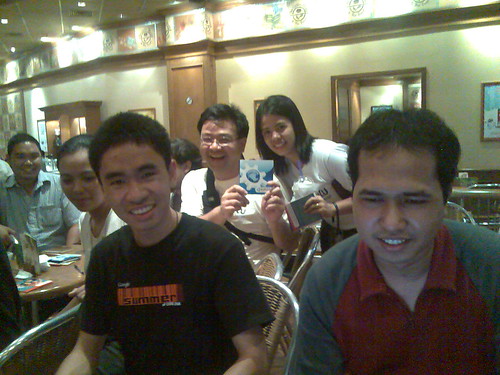
Last night I called Ubunteros nearby Manila for the Edgy Eft (belated) release party at the Coffee Bean and Tea Leaf at Greenbelt 3. Little did I know that there will be a lot of folks coming from the just-concluded FOSS@work workshop joining in the fun, thanks to Yolynne Medina and Eric Pareja. Diane Gonzales and I got to the venue first, then followed by the FOSS@Work folks. Dominique Cimafranca, Migs Paraz, Ranulf Goss, Jopes Gallardo, and Joel Bryan Juliano were there too, and all in all we were easily the noisiest group in the coffee shop, seemingly occupying the entirety of the place. I originally planned to move the group to have dinner somewhere, but along the way everybody seemed to forgot dinner and we quite engaged in talking to everyone else. It was terrific. The 2 boxes of Edgy ,K,Ed Ubuntu CDs I brought were easily given away to everyone; we even had them exchanged and autographed (naks!) reminiscent of what Ealden and I did last February when Mark came here. As a finale, we had a group photo of everyone with their CDs; Dominique remarks that in his informal’ study, more and more women prefer Ubuntu (and I sure do think he’ll be blogging more about this soon. ;) Needless to say, the above photo doesn’t do great justice to what happened last night; it came from my elric which I didn’t get use much as a camera since I too was happily chatting away. That said, I expect RJ Ian will be posting his photos from his brand-spanking-new Kodak camera to the Ubuntu-PH site once he gets back to Mindanao with Yolynne and company. I also think the FOSS@Work folks also have their own photosite or wiki to post more photos, which we’ll be seeing sooner. Jerome Gotangco and Ealden Esca an, the guys whom we all owe Ubuntu-PH to, were unfortunately unable to attend last night, as Jerome was off to Cebu to participate in the ICT congress there, while Ealden was quite busy at work. Hopefully they (as well as last night’s attendees!) can attend the next Release Party for 7.04 (aka Feisty Fawn,) and hopefully it will be just as fun, and be more meaningful if more Ubuntu-PH folks get involved in its development! Update: Yolynne and RJ just posted pics fresh from their arrival to home. Expect more pics later, nicely tagged too…

15 November 2006

Erich Schubert: Third party software

Ubuntu has been attracting "newbie" users, and also has drawn users away from Debian. Some people are annoyed by Ubuntu because of this - I am not. Ubuntu users have been happily collecting third-party repositories to get the latest glitz like beryl. Trevi o compiled a huge list of them, and made it easy to install (DON'T USE THIS!). Everybody concerned with security must go mad with just the throught of collecting thrid party repositories for the fun of it. To most of us, it's bad if we have to use any third party repositories... However, Johan Kiviniemi reacted in an interesting way. His highly experimental repository - setup for some 5 users or so, on his home DSL line - was included in this stupid "every repository I could find" list. Noticing this increase in users, he found out about this madness - and made a package to replace the default wallpapers (and disable wallpaper changing) with this scary warning message. Sounds like a good plan to me, however many users were pissed by being warned that they've done something stupid... So: thank you, Ubuntu community, for helping teaching new users that they shouldn't just blindly install software from the internet. :-) and for keeping these users away from Debian.

Norbert Tretkowski: Broken yaird backport

People keep asking me why installing kernel-images from backports.org fails, and what's the workaround. The reason why installing the packages fails is a broken yaird backport. Because nobody seems interested in fixing it, I just removed yaird from the backports.org archive. Use initramfs-tools instead, it works fine.

Next.

Previous.