Search Results: "agi"

12 April 2009

John Goerzen: Flowers, Music, and Grandparents

Flowers I ve written a lot lately about my Grandma Klassen, who passed away this week. But I m going to start this post about my Grandma Goerzen. She died when I was just an infant. I never knew her, but as the years pass, it seems that I remember her better and better. After we moved out to the farm where she and Grandpa Goerzen lived for decades, we noticed some flowers she had planted 30 years ago were still coming up, having withstood hail, hot summers, frost, construction equipment, and neglect all that time. Terah said, It s like your grandma left us a housewarming gift. Some of these flowers had never bloomed. Until this week. One bloomed for the first time the day Grandma Klassen died. A second bloom appeared the day of her funeral. Music #1 My jr. high and high school band teacher loves music (and old engines, but that s another story). You couldn t sign up for band at my high school; you d sign up for the class called LIFE. To him, music and life are indistinguishable. He says that anybody can speak to somebody, but music is the best way to speak to the heart. My Grandpa Klassen died when I was 11. Grandma Klassen, before her health declined, loved to tell me the story of the music at his funeral. At his funeral, my mom and I played a piano duet of Nearer, My God to Thee which we had already learned for a different event. When we were done, Rev. Epp went to the pulpit and said something along the lines of, If the music in heaven is as good as that, it ll be a great place indeed. I was just 11, and though music did speak to me at that age already, I don t think I understood how it moved people, such as my grandma, until many years later. Music #2 Grandma Klassen loved music, too, and that s reflected in each of her children all of them play trumpet, for instance. So it s no surprise that there was a lot of music this week. She died as two of her children were singing hymns to her at her room in the nursing home. Two of her grandchildren played trumpet for her at her burial. And my brother and his wife played trumpet and piano at her funeral. It was all beautiful, and like my band teacher said, it spoke to my heart. Music #3 I knew about gradma s love of music for quite awhile. When she was in better health, I took her to concerts sometimes. One of her favorite hymns was Joyful, Joyful, but she hadn t known it was based on Beethoven s 9th Symphony. I learned that the Wichita Symphony Orchestra was performing the 9th, and took her to the performance. She loved it, and I seem to recall that she kept talking about it for a few years afterwards. It certainly didn t hurt that the singing on the 4th movement was in German. I burned her a new-fangled CD of it, which I frequently saw in or near her CD player. The Kansas Mennonite Men s Chorus is an all-volunteer choir with about 300 members. They give a couple of concerts a year, and occasionally tour throughout North America and Europe. Their motto is we sing that others may live because 100% of money collected at their concerts goes directly to charity. Attending one of their concerts is a powerful experience not easily forgotten. I think the only time I ve heard a choir come close to being as amazing as that was when I had the opportunity to attend a Robert Shaw concert a few years ago. I went with grandma to one of the Kansas Mennonite Men s Chorus performances a few years ago. As you might expect, she loved it I think she called it powerfully good. This year, I finally joined the choir. I still remember that first practice. We warmed up by singing Holy God, We Praise Thy Name a song that has opened every KMMC concert for years. These people hadn t sung together for almost a year, and there were plenty of new people like me there too. But it only took a few bars of singing before I realized just what it was I had joined. The choir started out with the quietest, but most powerful singing you can imagine: Holy God, we praise thy name. By the time we got to the end of the page, the building was ringing from 300 men singing Infinite thy vast domain, everlasting is thy reign! at the top of their voices, in perfect harmony. We got to the end. The director said. . . Wow. I don t think a first practice ever spoke to my heart before that day. Music #4 Nearly 20 years ago, Grandma Klassen bought me a new bible. After she gave it to me, I asked her what some of her favorite passages were. She took me straight to the blessing in Numbers 6, and made sure I underlined it and bookmarked it. It goes like this:
The Lord bless you,
The Lord keep you,
Make his face to shine upon you and be gracious unto you,
The Lord life up his countenance upon you and give you peace.
My uncle had read this blessing to her the last time he talked to her. And the KMMC for years has ended their concerts with a beautiful benediction based on this passage. Grandma heard it at the concert I attended with her. It has been a favorite of my mom for years, too. So I had the thought: we really ought to sing it as a benediction at her funeral. It was hard to find the right mix of people on short notice, but we wound up with me singing baritone, my brother singing 2nd tenor (we both normally sing bass), and his wife both playing piano and singing 1st tenor, and relying on the piano to fill in the bass part. We had a little chance to practice before the funeral, but not a lot. The two of them have done a lot musically, but I haven t nearly as much, so I got in some extra practice at home, too. When it came time to sing, it was an emotional moment for sure more than a bit hard to focus, knowing the history and meaning of these words. When we got to and give you peace , and moved into the chorus of amen that finishes the song, I almost broke down right there, but didn t quite. We didn t give a perfect performance, for sure, on such short notice. (And they had me singing with them, so we wouldn t have been perfect even with plenty of notice!) But it didn t have to be perfect. After we ended the last, quiet amen , I think I heard about a half-dozen noses blowing all at once. My band teacher was right about music speaking to the heart. Later, during lunch, my aunt said to me, Wow, John, I ve never heard you sing before! That s right, and this may be the last time you hear me sing, too! I don t normally sing in a small group like this. A few minutes later, my uncle that gave the message came over and talked to the three of us. John, today you three brainwashed me. Oh? Yes. For years, I thought that there was no music as beautiful as the trumpet. After hearing you three sing, I have to reconsider. And so my band teacher was also right: music is life. My grandma was a person that could hardly speak without touching the heart. That beautiful melody of her life didn t stop when she died Tuesday afternoon. I ve been hearing it all week.

Sandro Tosi: Reportbug 4.1

So it's Easter (if you believe) and what do I do? Instead of fixing this I cut off a new Reportbug release... yay

Several bug fixed, and the thanks goes to:
Have fun!

Kenshi Muto: Opensource technology study meeting at GREE

Hideki Yamane and Nobuhiro Iwamatsu talked about Debian Project last Friday at GREE was one of famous SNS providers in Japan. GREE uses Debian GNU/Linux on large scale for its services. Hideki, is active Debian Maintainer, talked that using Debian was pretty easy and welcomed every contributors. He also described how Debian Project was managing release, QA, and buildd for a large audience. Nobuhiro, just passed NM tests and is awaiting final DAM's check, spoke about NM process with his personal experience. He is one of Linux kernel upstream developers and has good knowledges about embedded system programmings and device drivers. I hope he passes DAM's check early to improve Debian more. I met and talked with some people who were interesting in Debian after the meeting. Yes, I enjoyed that time.

Andrew Pollock: [debian] Grappling with Git, episode 1

At work, we have a bit of a vested interest in the Puppet and Facter packages that are in Debian, because we ultimately consume them in Ubuntu. We noticed that what was in Debian unstable was lagging a bit behind what was released upstream, and when one of my co-workers tried getting in contact with the Debian developers that were maintaining the Puppet package and got no response, I got involved. I got in touch with Micah Anderson and got myself and Nigel Kersten added to the Alioth project for Puppet. Despite Jamie Wilkinson being listed as the maintainer of the facter package in Debian, he claimed this was news to him, and Matt Palmer, who was listed as an uploader, didn't really claim much knowledge of maintaining the package either, so we took that as blessing to take over that package as well. This is where the fun begins. I've been meaning to try out Git ever since Debconf 7, where all the cool kids were using it and raving about it. I've been meaning to make the Debian DHCP package collaboratively-maintained, and use Git for the revision control, but I haven't quite gotten off my good intentions and done it yet. Part of the problem is not knowing exactly what workflow I should use, and suffering from paralysis by analysis, reluctant to experiment, because I don't want to go down the wrong path. Anyway, this is about Puppet, not DHCP. The Puppet package, as it turns out, is already maintained in Git on Alioth, so the problem here was more one of figuring out what the current workflow was, and trying to follow it. This is where Nigel came in. Conveniently, the upstream Puppet development is done in Git also, and Nigel is a contributor to Puppet upstream, so he had some Git-fu. So between the instructions on how to get started with Git on Alioth and what he knew, we could start fumbling around. It seems like the Alioth Git repository was also tracking the upstream Puppet repository, as there were commits in the Alioth one by Luke Kanies, and we didn't really imagine that he was doing Debian-specific stuff. Here's what we ended up doing to try and get what was in the Alioth repository up to the upstream version 0.24.8 of Puppet:
git clone ssh://apollock@git.debian.org/git/pkg-puppet/puppet.git
This part was fairly straight forward. Clone what's in Alioth locally.
git remote add reductive git://reductivelabs.com/puppet
git remote update
git fetch --tags reductive
Next, we added a remote branch that tracked upstream. We called it "reductive", and we updated it. The bit that took some fiddling with was fetching the tags. Nigel later figured out that tags are inherently private to a repository, and normally stay that way. So if I have a local clone of say the upstream Puppet repository, I can tag it to my heart's content, and normally those tags would stay in my local repository, because they're probably only meaningful to me.
git checkout -b upstream/0.24.8 0.24.8
This bit took a bit of work to arrive at as well. What we wanted to do was create a new branch called upstream/0.24.8, which was at what was tagged 0.24.8 in the reductive repository. Nigel pondered what would happen if you already had a tag or a branch called "0.24.8" before you added the remote repository. This is also why we had to fetch the tags from the remote repository, so we had something to check out.
git checkout master
git merge upstream/0.24.8
Next, we switched back to the master branch and merged the contents of our local upstream/0.24.8 branch that we just created. This now got the Puppet source in the master branch up to what was released as version 0.24.8. (and this is better than just running uupdate?) We did some fiddling with the debian/control file and debian/changelog and fixed up a few things that Lintian was bitching about, and were done. I'd set up a sid chroot with cowdancer previously, and had to do some faffing around with git-buildpackage to convince it to use pbuilder. I ended up using
git-buildpackage --git-builder="pdebuild --debbuildopts '-i\.git -I.git' --basepath /var/cache/pbuilder/base-unstable.cow"
So now we've got most of what we want to ship checked into Git on Alioth. I have no idea if we've done it "right", I suspect we may have done something wrong by operating on the master branch. Looking at the revision history in the Git repository on Alioth, it looks like previously things have been done a few different ways. I certainly want to write up a definitive workflow once we've figured one out. We haven't uploaded the new package to unstable yet, because we're still trying to give it a modicum of testing, and we'd like to sort out the Facter package as well. The Facter package was a more greenfield exercise, as while there was already a Git repository on Alioth for it, it was empty. So Nigel had to do some futzing around to get it checked in the right way to make git-buildpackage want to build it. He did this by himself, so I'm not sure exactly what he did. I've since discovered that it's probably lacking some dependencies it needs, so that'll need to get fixed before it gets uploaded. I look forward to reading blog posts from the smart people who actually know how to use Git properly, telling me how we should have done it. I'm still very interested in coming up with a proper workflow for preparing packages and committing the changes, and for doing code review.

11 April 2009

Benjamin Mako Hill: American Gothic and the Free Culture Imperative

About a year ago, I read American Gothic by Steven Biel and the book has left a surprising lasting impression on me. The book describes the background, history, and life of "American Gothic: America's most famous painting" by Grant Wood. Even if you don't recognize the name "American Gothic", you are likely to recognize the picture or the scene. The book is a serious and -- as far as I can tell -- reasonably comprehensive treatment of the subject that is interesting, insightful at points, and a breeze to read. Thumbnail of the American Gothic Painting Of course, the book is not actually about the painting that hangs in the Art Institute of Chicago -- although it will certainly teach you more than you probably ever wanted to know about that painting, its subjects, its settings, etc. The book is really the story of how that paining has been received, understood, and used. Nearly half of the book focuses on examples of people who have remixed, reworked, reimagined, and reproduced the painting in myriad forms, formats, settings, and ways. The book contains scores of photographs of celebrities posing in American Gothic style settings, dozens of political cartoons based on the paintings, images of talk shows, magazine covers, Broadway plays, product advertisements, toys, gifts, kitch, and more, done up in recognizeable representations of the basic American Gothic form. There is a very incomplete of references to American Gothic in popular culture at Wikipedia that can give a tiny taste of what is out there. The last chapter of the book is devoted to these "parodies" and there's some brief talk of issues around copyright and control of the image. Wood's sister Nan was the owner of the copyright for much of the second half of the twentieth century and is also the woman in the painting. She famously charged several makers of more lurid take-offs with defamation and successfully blocked a number of remixes. In 1988, Nan transferred ownership to the Visual Artists and Galleries Association (VAGA) which will hold the copyright until 2025. VAGA also claims "rights of publicity" in Nan's image which will last until 2060. VAGA takes a very expansive view of its copyright claims and argues that it has both veto power and royalty rights to any recognizably similar work. For example, VAGA does not want the American Gothic image used in alcohol advertisements and has successfully had such ads pulled. Biel's book contains no reference to the amount of money made from licensing the work but one can only conclude that it must be massive. VAGA blocked a plan by Iowa to use the picture on the back of the Iowa state quarter due to licensing disagreements; instead Iowa used a different Wood painting that was clearly in the public domain. What struck me most about Biel's book is related to just how deeply ingrained in American culture the American Gothic image has become. The book cites simple surveys that show that almost every American recognizes the painting (although only a small fraction know the painting's name or who painted it). The thousands of parodies that the book documents are testament to the fact that the painting has become a way of representing something essential about American culture and its values. But in a strange way, the painting's popularity and incessant reuse has also made it part of the culture that it so effectively captured. We can think of culture as a set of shared values and references that help us related to each other and to communicate. Just like idioms in language, culture helps us communicate more effectively, certainly, but also lets us communicate messages that would not be communicable otherwise. When Out Magazine, Coors, or any of several dozen others replace the figures in American Gothic with a gay or lesbian couple, they are succinctly sending a message about homosexual relationships and American traditional values that could not be made any other way. In this way, American Gothic -- both the painting and Biel's book -- represent a strong argument for free culture. If American Society has infused American Gothic with so much value, how can it be fair to let one person or organization own it? Are they not owning an essential mode through which a society can relate, experience, and communicate? I can't help but conclude that it shouldn't matter if VAGA does not like alcohol, advertisements, homosexuality, or wants to make a some money every time someone makes a cartoon parody. These are trivial concerns next to the importance of our society's need to communicate about these issues. If doing so requires the use of a shared cultural reference in VAGA's painting, I find it hard to justify VAGA's position of control. We need to be able to reproduce and reimagine American Gothic because it has become part of us. It's a striking example of the way that art becomes culture and the reason that truly free culture is the only appropriate response. We can't afford to let our experience of the world and each other -- to let ourselves at a very fundamental level -- be owned and controlled.

Randall Donald: 180.44, 2.6.29 and bears, oh my!

I just uploaded nvidia-graphics-drivers 180.44 that work with Debian's 2.6.29 thanks to package team member Len Sorensen. If anyone wants to be as amazing as Len you may join the packaging team too.

I also did some BTS cleaning in regards to bugs reported by people not using the debian packages (and even said so) but reassigned to us anyway.

I am also battling a bad cold. I always get sick on holidays.

Oh one more thing. Go Canucks!

Mike Hommey: Following up on SSH through jump hosts

I got interesting comments on my previous post about SSH through jump hosts, that made me think a bit. The first one of them suggested to use a syntax that unfortunately doesn t work on anything other than zsh, but had the nice idea to add a login for each jump server. Sadly, this only works when there is only one hop, for reasons similar to those we will explore below. The second one suggested / would not be so good a separator, because it would fail in svn+ssh urls and such, which is a good point that I didn t think of only by lack of such use case. The simplicity of the resulting configuration was nice enough. This decided me to take a shot at implementing something that would allow adding both login and port number for each jump server. The first implementation detail to set was which characters to use for login, port number and hop separators. I chose respectively % (@ is unfortunately impossible to use because ssh would take it, leaving out any hop before the character), : (pretty standard) and + (not allowed in DNS, and not too illogical as such a separator, I thought). The result can look like dark magic when you are not savvy with sed and regular expressions:
Host *+*
ProxyCommand ssh $(echo %h sed 's/+[^+]*$//;/+/! s/%%/@/;s/:/ -p / ;s/\([^+%%]*\)%%\([^+]*\)$/\2 -l \1/ ) PATH=.:\$PATH nc -w1 $(echo %h sed s/^.*+//;/:/!s/$/ %p/;s/:/ / )
The syntax you can use to connect through jump hosts is the following:
ssh login1%host1:port1+login2%host2:port2+host3:port3 -l login3
We ll see further down why we can t put a login for the final destination host. Or if you want to skip the boring implementation details, you can also skip to the end, where a slightly more compact version lies: while writing this post, I got some optimization ideas. Let me try to split the sed syntax to make it a little more understandable:
s/+[^+]*$//; # Remove all characters starting from the last + in the string (i.e. keep the n - 1 first hops)
/+/! # If the string doesn t contain a + after the previous command (i.e. there is only one hop remaining), do the following, otherwise, skip until the closing curly brace
s/%%/@/; # Replace % with @ (% is doubled because of the ProxyCommand)
s/:/ -p / # Replace : with -p . Combined with the previous command, we rewrite login%host:port as login@host -p port
;
s/\([^+%%]*\)%%\([^+]*\)$/\2 -l \1/ # Rewrite hop1+hop2+login%lasthop as hop1+hop2+lasthop -l login
The second sed goes like this:
s/^.*+//; # Remove everything up to the last occurrence of + in the string (i.e. only keep the last hop)
/:/! # If there is no : in the string, do the following, otherwise, skip the next statement
s/$/ %p/;
# Add %p at the end of the line
s/:/ / # Replace : with . These last three instructions prepare a host port combination for use with nc.
Let s see what the ProxyCommand looks like for some examples, skipping PATH setting and nc option for better readability:
host1+host2
ssh host1 nc host2 %p
login1%host1+host2:port2
ssh login1@host1 nc host2 port2
login1%host1:port1+host2:port2
ssh login1@host1 -p port1 nc host2 port2
Now, maybe you start to see why we can t put a login on the last hop: not only does it make no sense for nc, but also the main ssh process that runs the ProxyCommand and will actually talk to the remote host won t have any knowledge of it. From the above examples, it also appears obvious why we replace login%host:port with login@host -p port : so that the ssh command in the ProxyCommand gets the proper arguments for login and port. Note we could also replace with host -p port -l login for the same effect. With even more hops, this is what happens:
host1+host2+host3
ssh host1+host2 nc host3 %p
login1%host1:port1+host2:port2+host3
ssh login1%host1:port1+host2:port2 nc host3 %p
Each of these ProxyCommands will trigger another ProxyCommand quite looking like our first few examples. In the first hops, if we d just replace all % with @ , in cases where logins are given everywhere, we d end up with a ProxyCommand like the following:
ssh login%host1+login%host2 nc host3 %p
As we saw above, we can t use a login on the last hop, which means this ProxyCommand wouldn t work as expected and is why we have to rewrite login1%host1+login2%hop2 as login%host1+host2 -l login2 with the last instruction in the first sed. In the end, this is what happens:
login1%host1+login2%host2+host3
ssh login1%host1+host2 -l login2 nc host3 %p
login1%host1:port1+login2%host2:port2+host3:port3
ssh login1%host1:port1+host2:port2 -l login2 nc host3 %p
In this last example, you see the :port2 part is not changed into -p port2 . Actually, it would still work with the latter form : the ProxyCommand ssh login1%host1:port1+host2 -p port2 -l login2 would itself have ssh login1@host1 -p port1 nc host2 %p as ProxyCommand, in which %p would be replaced by port2, given as argument to -p. Based on this and with further small optimizations, we can slightly shorten our ProxyCommand to the following :
Host *+*
ProxyCommand ssh $(echo %h sed 's/+[^+]*$//;s/\([^+%%]*\)%%\([^+]*\)$/\2 -l \1/;s/:/ -p / ) PATH=.:\$PATH nc -w1 $(echo %h sed s/^.*+//;/:/!s/$/ %p/;s/:/ / )
sed instructions decryption is left as an exercise to the reader ;). Update : modified the shortened version to fix the issue spotted in the comments.

Christine Spang: continued world domination

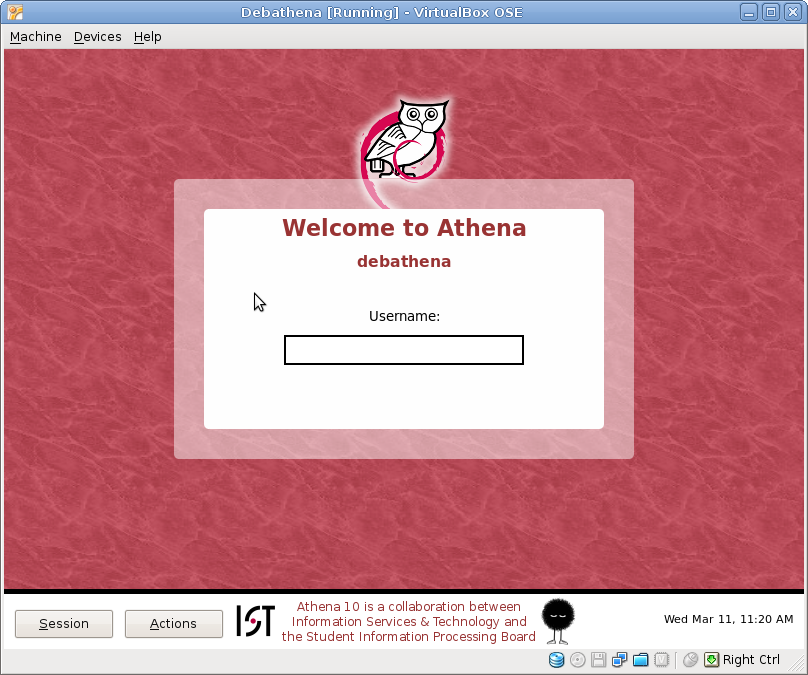
Debathena Beta was rolled out to something along the lines of 10% of formerly RHEL-based computing cluster machines about a month ago. I talked about the plans for this some time ago, and it's exciting to see it actually occurring on vaguely the intended schedule. Now I can tool on campus on Debian (well, almost), and thanks to a generous application of magic**, I can even install any package in Ubuntu's universe repository on cluster machines if I need it (the machine will be restored to a good state on session logout). Rock on.

** I hear it involves schroot and LVM snapshots, but at any rate it appears to be approximately indistinguishable from magic.

10 April 2009

Obey Arthur Liu: Google Summer of Code 2009: Debian s Shortlist

Copy of http://lists.debian.org/debian-devel/2009/04/msg00421.html. Hi folks, We have been pretty busy these past few weeks with the whole Google Summer of Code 2009 student application process.
I can say that we have this year a very good set of proposals and I d like to thank all the students and mentors for this. I am going to present to you our shortlist of projects that we would like to be funded and believe we can reasonably manage to get funded. As always, remember that the number of slots is not final yet at this point so we can t promise anything. The first preliminary slot count given today was *10* (same as last year) and we hope to get *2* more (as we did last year). This shortlist is alphabetically ordered because we don t want to reveal the current internal rankings. I am inviting you to debate what you think is cool, what is useful, what is important to Debian, maybe give us pointers to resources or people that could be helpful for the projects. We will try to alter our current rankings to reflect the zeitgeist in Debian, while taking into account the personal information that we have about each student involved. The deadline for any modification is on the 15th, so get everything in by the 14th. The final selected projects will be announced by Google April 20th, ~12 noon PDT / 19:00 UTC. We ll have another announcement then. Three proposals need or may need a mentor, I indicated it. For more information about the projects or mentoring and how to talk to us directly, scroll down past the list. Debian s Shortlist : - Aptitude Package Management History Tracking
- Automatic Debug Packages Creation and Handling
- Debbugs Web UI: Amancay Strikes Back
- Control Files Parsing/Editing Library/Qt4-Debconf Qt4-Perl bindings
- Debian-Installer Support for GNU/kFreeBSD
- KDE/Qt4 Adept 3.0 Package Manager
- Large Scientific Dataset Package Management
- MIPS N32 ABI Port
- MTD Embedded Onboard flash Partitioning and Installation
- On-demand Cloud Computing with Amazon EC2 and Eucalyptus Integration
- Port back update-manager to Debian and all Derivatives
- Debian Autobuilding Infrastructure Rewrite And the details: Aptitude Package Management History Tracking Student: Cristian Mauricio Porras Duarte, Mentor: Daniel Burrows Aptitude currently does not track actions that the user has performed beyond a single session of the program. One of the most frequent requests from users is to find out when they made a change to a package, or why a package was changed; we want to store this information and expose it in the UI in convenient locations. As a side effect, this might also provide some ability to revert past changes. Automatic Debug Packages Creation and Handling Student: Emilio Pozuelo Monfort, Mentor: Marc Brockschmidt This proposal aims at providing debug binary packages for the packages in the Debian archive in an automatic manner, moving them away from the official Debian archive to an special one. This has the benefits of providing thousands of debug packages without any work needed from the developers, for all the architectures, without bloating
the archive. Debbugs Web UI: Amancay Strikes Back Student: Diego Escalante Urrelo, Mentor: Margarita Manterola The Amancay project aims to be a new read/write web frontend to Debian s BTS; allowing DDs and contributors to easily interact with bugs via an intuitive yet powerful interface, enabling new workflows and creating new contribution opportunities like triaging while upholding reporting quality. Control Files Parsing/Editing Library/Qt4-Debconf Qt4-Perl bindings Student: Jonathan Yu, Mentor: (probably) Dominique Dumont see below This project proposes a common library for parsing and manipulating Debian Control files, including control, copyright and changelog. Main ideas include validating and parsing of these files, with both Strict and Quirks modes for the parser. The second idea is a new frontend for Debconf using Qt4 (for which Perl bindings will be written). Debian-Installer Support for GNU/kFreeBSD Student: Luca Favatella, Mentor: Aurelien Jarno GNU/kFreeBSD is currently using a hacked version of the FreeBSD installer combined with crosshurd as its own installer. While this works more or less correctly for standard installations (read: the exact same installation as in the documentation), it does not allow any changes in the installation process except the hard disk partitioning. This project is about porting debian-installer on GNU/kFreeBSD, and to a bigger extent, make debian-installer less Linux dependant. KDE/Qt4 Adept 3.0 Package Manager Student: Mateusz Marek, Mentor: NEEDS MENTOR, see below. Finish Adept 3.0, a fully integrated package manager for Qt4/KDE4. Adept is currently the only viable path to a Debian native package manager on KDE that would support modern features such as tags, indexed search or good conflict resolving. With Aptitude-gtk still in development and only available for GTK+ and (K)PackageKit having fundamental problems, Debian needs this project to stay in control of its package management on KDE after much neglect in the recent years. Large Scientific Dataset Package Management Student: Roy Flemming Hvaara, Mentor: Charles Plessy Large public datasets, like databases for bioinformatics are typically too big and too volatile to fit the traditional source/binary packaging scheme of Debian. There are some programs that are distributed in Debian, like blast and emboss, that can index specialised databases, but Debian lacks a tool to install or update the datasets they need and keep their indexing in sync. MIPS N32 ABI Port Student: Sha Liu, Mentor: Anthony Fok This project first focuses on creating a new MIPS N32 ABI port for Debian. Different from O32 and N64, N32 is an address model which has most 64-bit capabilities but using 32-bit data structures to save space and process time. A second focus will be given on making such a mipsn32el arch fully optimized for the Loongson 2F CPU which gains more and more popularity in subnotebooks/netbooks in many countries. MTD Embedded Onboard flash Partitioning and Installation Student: Per Andersson, Mentor: Wookey Many embedded devices have MTD onboard flash as persistent storage like the Kurobox Pro NAS, the Neo Freerunner, the Sheeva Plug or the OLPC. With MTD flash being so popular and with increases in capacity, support for MTD partition/installation would make Debian even more interesting to a wide range of of devices, making it one step closer to being universal. On-demand Cloud Computing with Amazon EC2 and Eucalyptus Integration Student: David Wendt Jr, Mentor: (probably) Steffen Moeller see below In many academic fields, as well as commercial industries, people use clusters to distribute tasks among multiple machines. Many times this is done by packaging a whole operating system disk image, uploading it onto the cluster, and having the cluster run it in a VM. This project intends to make it easier for Debian to distribute prepared disk images templates like they distribute CD images now, for the users to recreate or customise these templates with Debian packages and for administrators to host such clusters with Debian. Port back update-manager to Debian and all Derivatives Student: Stephan Peijnik, Mentor: Michael Vogt The project would involve taking the distribution-(Ubuntu-)specific update-manager code, analyzing it, and creating a package with just its core functionality, decoupling the distribution-specific parts and thus making the core code extensible by distribution-specific add-ons. This in turn would remove the need of porting update-manager to Debian with every upstream release. An additional optional goal would be replacing the synaptics-backend with a python-apt based one. Debian Autobuilding Infrastructure Rewrite Student: Philipp Kern, Mentor: Luk Claes Rewrite the software that currently runs the Debian autobuilding infrastructure in a way that makes it more maintainable and robust. It will use Python as its programming language and PostgreSQL for the database backend. By harmonizing buildds, many build failures can be prevented and wasteful workload on buildd volunteers can be reduced. On mentoring: Petr Rockai, the original developer of Adept has offered help to anyone willing to adopt Adept. Sune Vuorela has offered help for any Qt4 and KDE related issues. *We really need a mentor here*. The student is quite competent but Google dictates that we provide a mentor to handle student management. Dominique Dumont, although not DD, has signaled interest in mentoring this, although it hasn t been confirmed yet. Sune Vuorela has offered to help co-mentor for the Qt4-Debconf and Qt4-Perl bindings part. Steffen Moeller has signaled interest in mentoring this, although it hasn t been formally confirmed yet. Charles Plessy of the Debian Med team will provide help for use cases related issues. Eric Hammond, developer of the original vmbuilder image creation tool and maintainer of a set of Debian and Ubuntu images will provide help for Amazon EC2 and image creation issues. Chris Grzegorczyk from the Eucalyptus team will provide help for Eucalyptus and Eucalyptus/Debian integration issues. Contacting us: Considering the tight schedule, most stuff happens live on IRC: #debian-soc on irc.debian.org You can also consult our wiki page for some additional information:
<http://wiki.debian.org/SummerOfCode2009> We have a mailing-list at:
<http://lists.alioth.debian.org/mailman/listinfo/soc-coordination> Keep this discussion on debian-devel@lists.debian.org while cc-ing soc-coordination@lists.alioth.debian.org. This thread is for debian-devel primarily.

9 April 2009

Mohammed Sameer: Bye fglrx...

Thanks to all the hard work by the fglrx packaging team, DRI, MESA, Xorg, Radeon,... etc people!

I've been using fglrx with my laptop since I've had it:

01:00.0 VGA compatible controller: ATI Technologies Inc Radeon Mobility X1400

And to the people behind the Debian packaging..
* xserver-xorg-video-radeon from testing.
* libdrm-intel1 and libdrm2 from unstable
* libgl1-mesa-dri and libgl1-mesa-glx from experimental

vader:~# apt-get --purge remove fglrx-driver fglrx-kernel-src fglrx-kernel-2.6.26-1-686 fglrx-sourceReading package lists... Done
Building dependency tree
Reading state information... Done

The following packages will be REMOVED:
fglrx-driver* (9-2-2)
fglrx-kernel-2.6.26-1-686* (9-2-2+2.6.26-13)
fglrx-kernel-src* (9-2-2)
fglrx-source* (9-2-2)
0 upgraded, 0 newly installed, 4 to remove and 17 not upgraded.
After this operation, 38.8MB disk space will be freed.
Do you want to continue [Y/n]?

I probably lost the ability to suspend and resume but I don't usually do it with that laptop.

Now let's hope my lapop at work will be adapted easily too :)

UPDATE: Seems you lose OpenGL 2.0 if you use the free driver. If you are doing OpenGL stuff like me then you are in trouble ;- read more

8 April 2009

Eddy Petri&#537;or: About the protests in Moldavian Republic

Many people in the western world are completely unaware that in the Moldavian Republic there is an ongoing protest against the current Communist Party which is at power after the parliamentary elections held on Sunday. The protestants accuse the Communists of election fraud and there are numerous reports of dead people being recorded as voters, people which, by religion, chose not to vote, and other several people which couldn't have voted.

Tuesday the protests took a violent turn, apparently "aided" by some instigators which were reported to be seen as recording the protesters, taking notes and, generally, not fitting the picture. During the day the national television broadcasted absolutely no information on the events, and aired documentaries, cartoons and no news on any of the protests. To me, this looked very much alike what the Romanian Television aired during the Romanian Revolution in December '89 when during the fights in the streets of Bucharest the Television aired no images from the centre of Bucharest.

But, back to Moldavia, at the end of the day, sadly, the Parliament and Presidency buildings were devastated, making it easy for the Communist leaders to produce some disinformation propaganda based on real footage.

Yet again, sadly, but it seems under the protection of some of the aforementioned instigators, the flags of the EU and Romania were waved at the highest levels of the Parliament building during the time the protesters allegedly took over that building (there were several reports that the Police forces actually simply let them in, without actually needing/being forced to do that; also the passivity of the policemen seen in the footage from Romanian televisons was obvious).

As many Moldavian students live and study in Romania, some of them wanted to go home and take part at the protests happening in Chi in u. To their surprise, many of them were denied the right to enter their home country. Many, if not all, Romanian journalists were also denied access in the country accusing alternatively technical issues, lack of proper papers (although only the passport or the ID card was officially required), lack of safety, or simply refusing without reason.


Today, the Moldavian president Voronin, accused Romania as being behind the manifestations in Chi in u, Moldova's capital and said it will declare as a persona non grata the Ambasador of Romania in Moldova, and thus forcing him to leave Moldova within 24 hours. He went even further and said that visas will be required from now on for Romanian nationals. As soon as this was announced, it was one of the most invoked reasons by the Moldavian customs as a rejection reason, although, according to Moldavian Embassy officials in Romania, no rules or procedure were known for the release of visas for Romanian nationals.

Also, during Wenesday, Moldavian crossing points were opened and closed alternatively but incosistently accros the entire border for Moldavian nationals. Romanian nationals were denied in most cases (although some Romanian truck drivers were reported as allowed to cross). At some point during the day the Moldavian officials from the customs told the Moldavian students awating at the border that they are offered access on the condition they go direclty home with the buses provided by the Moldavian customs and were warned that going to Chi in u wasn't a smart choice for them. Some of the information from students which managed to enter their home country suggested that is advisable to not enter the country since they were going to be denied of the right to leave the country later, when they were to return to Romania to their studies (after Easter).

What's sadder is that the Moldavian voting system is built in such a way that the vote counting, in the end is done by Government officials behind closed doors, inside a Ministry. OTOH, the international official observed the things which happend in public, but did not see any of the dead voter lists (since they were not present when those votes were casted), and declared the vote as mostly legal and without major or significant incidents.


According to the media, before the elections, the Communists were credited with 35-37% of the votes in an independent poll, while in the exit poll conducted by the Communists themselves they were credited with 42-45% of the votes. In the end the last official partial results credited them with approximately 51% of the votes.

About Vladimir Voronin, it is a known fact that he has double citizenship, Moldavian and Russian and is a reserve general within the Russian Army and currently has a pretty nice pension from the Russian state.


All I can say is that, although the Moldavians' desire to have a real democracy is a legal and reasonable request, the western world chose, due to the international circumstances, to look the other way around and not to incommodate Russia in any way. Moreover, to accuse Romania to have unionist desires an act upon those desires is planly stupid since now Romania is part of the EU and Moldova uniting with Romania is simply impossible now, since Moldavia's economy would sunk even more the fragile and regressing Romanian economy and Romania would instantly fail the EU requirements which would mean disaster for us.

Marc 'Zugschlus' Haber: partition table gone, data still present

I just wanted to make an USB stick bootable and wondered why mkdiskimage -4 /dev/sda 0 32 64 complained about the disk having too many cylinders. After a few moments, it ocurred to me that since libata, the system hard disk has become sda and that the stick was sdb or sdc. One ctrl-C later, fdisk confirmed both counts: That I accidentally started mkdiskimaging my main system hard disk and that the partition table was already gone. A few hours later, the notebook is back in business without too much data loss. Lucky me. My notebook has an alibi installation of Windows XP in its first primary partition sized 4 GB. Since I aborted the mkdiskimage process early enough, I hoped that only the windows installation was hosed. The Linux system is entirely in LVM (with crypted LVs), and LVM hadn t noticed yet that its PV was gone. I reckoned that I still had a chance to rescue my data if I didn t reboot. So I hastily commandeered an USB hard disk (thanks, $CUSTOMER, for quickly supplying one), fdisked, pvcreated and vgextended it and started the pvmove. While this was happening, I theoretically was able to continue working, which I didn t because I was afraid of losing. About half an hour into the copy process, the USB disk chose to deregister itself and the pvmove aborted. Rebooting the disk made it reappear as sde (it was sdd before), and miraculously, a new pvmove call just worked. However, a good fraction of actions on the shell resulted in a lot of input/output errors on the screen. I guessed that this was the first sign of my data finally dying, but I let the pvmove continue. After the pvmove was finished (which was rather fast since the move of the crypted LV means that the crypted data is moved and not de- and recrypted), I had to recreate a /dev/sda2 partition with type 8e before the LVM tools allowed me to vgreduce the VG. I then zeroed out the first 10 GB of the internal disk and spent a few hours reinstalling and patching XP from scratch before I finally went through the pvcreate, vgextend, pvmove routine in the other direction. Then the big moment arrived: fsck of all LVs. I guess that the reason for the input/output errors was that /usr was completely hosed (no single file outside lost+found), but /home and all other file systems holding data where the way back to the (a week old) backup would have been quite painful were ok. I pulled /, /usr and /var from the backup to be consistent again, updated to current sid (avoiding KDE 4 for the time being) and could start working again. The only real loss was a few hours of work that were stored in /usr/local which died along with /usr, so the result of my stupidity was not very catastrophic but still a good lesson. And I have learned that LVM is a robust and resilient beast. Good work. Now I d like to know what happened to my /usr - I always had the impression that pvmove should not break data even when the target disk suddenly goes away...

Obey Arthur Liu: Google Summer of Code at Debian: Update, need mentors!

A quick update before the big one about the 2009 Google Summer of Code. I believe we had a great recruitment drive this year and we have a very good set of proposals to work with. We d like to thank everyone involved for their help. We re now ranking out student applications. I promised elsewhere that I ll send out our shortlist of projects once Google sends us our preliminary slot allocation today but I misread the thread on the -mentors list and that count will only happen on Thursday, so we ll have to wait a bit more. That shortlist would only include projects, but not individual students. The idea is to give a heads up to everyone before committing to a group of projects and students. It is very important to inform the community as it increases visibility of the students work, giving them more help and support (and also avoids duplicating existing not yet publicized work!). As far as mentors go, we should have all of our approximately 14 planned projects covered, except for 2. I m posting them here in case you could mentor or help find mentors for those projects. (The wiki pages are not really up to date, so please come on IRC and ask clarifications, see below) Finish Petr Rockai s Adept 3.0 and bring a Qt4 Package Manager to Debian, with a different interface paradigm than Aptitude-gtk.
Petr said he would provide help with the existing codebase but can t mentor. Sune Vuorela from Debian KDE is ready to help with Qt4 related issues. Build Debian tools to create Debian images for Amazon EC2 and the free Eucalyptus implementation. Packaging of the Eucalyptus hosting framework is also possible.
For this project, we already have on board to help: Charles Plessy from Debian Med, Eric Hammond, developer of the existing vmbuilder Ubuntu tool for EC2 and Chris Grzegorczyk and Rich Wolski, from the Eucalyptus team. Plenty of people to get help from. Mentoring is a great experience! See this for what it entails. If we still can t find a mentor by the end of the week, I ll blast an announcement over at debian-devel@l.d.o along with the project shortlist. In the meantime, don t forget to idle on #debian-soc on irc.debian.org.

7 April 2009

Jon Dowland: zte mf622

I'm currently waiting for my ADSL to be setup and so I've borrowed my mum's "three" 3G mobile broadband USB dongle. The device is a "ZTE MF622" and getting this working in Linux apparently used to be a bit of a nightmare. However, with Debian Lenny and 2.6.26-1-amd64 it is trivial: you plug it in, it appears as a USB mass storage device; wait a little bit and it disappears and comes back as some USB serial devices. You can then chat to /dev/ttyUSB0 (or whatever the first ttyUSB device belonging to the dongle is). There's a working wvdial configuration at http://ubuntuforums.org/archive/index.php/t-665332.html, reproduced here for convenience:
[Dialer Defaults]
Init2 = ATZ
Init3 = ATQ0 V1 E1 S0=0 &C1 &D2 +FCLASS=0
Stupid Mode = 1
Modem Type = Analog Modem
ISDN = 0
Phone = *99#
Modem = /dev/ttyUSB0
Username = user
Dial Command = ATDT
Password = pass
Baud = 460800
IF you don't want to use wvdial there are bare ppp scripts at http://hillj.co.uk/2008/01/31/how-to-get-online-with-three-mobile-uk-and-linux-ubuntu/, although I haven't tested these. Whilst researching this I stumbled across several examples of more extreme ways of getting the initial switchover to work, including http://blog.ufsoft.org/zte-mf622-usb-modem-under-linux#extended which includes a udev snippet that forcefully calls rmmod and modprobe. This will totally fail if you are using usb-storage or usb-serial for anything else, which is probably not the case for the majority of people trying to get this to work at the time they are trying, but there are several examples out there of people complaining that their USB has failed since trying these instructions. We are often accused of having a problem of missing documentation in the free software world. I'm wondering if this is one example of where we have bad, damaging documentation. How can we deal with that? Incidentally, for those whose devices won't automatically switch over to the serial device, there's a program usb-modeswitch (currently in sid) that can do the job for you. There are apparently hacks in the usb-storage Linux kernel module that special-case the switchover for some Huawei devices. I couldn't find anything in there for the ZTE device.

Manoj Srivastava: Manoj: Not your father's kernel-package

A few hours ago, a new version of kernel-package was uploaded to experimental. This is a major change,and I would appreciate it if folks took it out for a spin, kicked the tires, and provide feedback about where this version is lacking. This is only part of the way along in this development cycle. I would like to add a debug-info separation, either in a different directory than / in the image packages, or a separate package by itself. I would also like to create an overlay directory for /usr/share/kernel-package/, so people can inject code or override the defaults for kernel-package easily. I am also willing to make any changes to standardize the handling of hook scripts for kernel packages in Debian.

Table of Contents

./debian/ is ephemeral
make-kpkg removes and re-creates ./debian on every invocation. This started as an exercise to protect ourselves from the upstream builddep functionality, that randomly cleaned out ./debian whether or not it had created it, effectively making it impossible to run dpkg-buildpackage easily (which is ok, if all you care about is the image package) This does make the kernel-package far more nimble; we now offer less surprise to users who did not expect stampts that the kernel-packagge used to not do duplicate work. Now, if you edit a couple of files in the kernel source, and run make-kpkg, the kernel will build as expected. There are no more version mismatch errors, and the kernel version can be modified using localconfig as one desires. With this, kernel-package can routinely be used to build kernels out of the git tree. The con is that we no longer cater to official kernels, or to anyone who expected content in ./debian to persist. At some point, there are plans to implement an overlay directory that will shadow /usr/share/kernel-package/ruleset, but that is not yet implemented. In any case, the kernel team in Debian regards kernel-package to be broken, and have been bad mouthing it and deprecating it for a few years now, so this will not be a loss for them.

Get rid of the facility to patch kernel sources
The patch the kernel facility was adding complexity, and failing to provide the flexibility required for a generic patching facility. It used to be useful at one point, but in the modern parlance, witht he widespread use of distribute version control systems, and various facilities to manage source and patch them, the built in version was clunky. This means the --added-patches option of make-kpkg is gone, the work-around is to prepare the kernel sources before calling make-kpkg.

Remove special case code for official kernels
For the longest tine (well, ever since Herbert Xu too over building kernel images from me), kernel-package has carried specal case code for official images. This has caused some problems, recently, since the need to preserve ./debian has caused no end of problems when the version changed out from under ./debian, or when people wanted to edit a file and expected kernel-package to do a minimal recompile. However, sometime in the Etch release cycle, the kernel team deprecated kernel-package as the means of building official kernels. They have recently started saying they think kernel-package is broken, and have their own recommendation for how to build kernel packages. Therefore, a full release cycle later, we can get rid of the special case rules used for official packages. Also, this allows us to drop ./debian at the drop of a hat, and recreate it with an version that reflects the current state of the kernel sources.

Header package no longer create symbolic links in /usr/src
Instead, ship an example shell script that replicates the old behaviour. This script can then be deployed on the target machines, and could be a part of a locally created kernel configuration package, if one needs to deploy the same behavior across a cluster of machines.

The postinst no longer manipulates symlinks
This is a shift from previous behaviour. Any symbolic link manipulation must now be done with hook scripts in /etc/kernel/*.d directories. Firstly, modern boot loaders scan the boot directory for kernel images, and the user no longer has to code in the path to the symbolic links that the kernel image package used to manipulate. Secondly, hardcoding the behaviour into the postinst made for a very rigid policy; and user wanted more flexibility than that. There is an example shipped with the package that shows a more flexible scheme that kept two symbolic links for version 2.4 kernels, and two symbolic links for 2.6 kernels; it can be easily modified to keep two links for 2.9 kernels and two links for 2.8 kernels, or one of each, or whatever the user wants.

Image postinst no longer runs a boot loader
Please note that this was already the case for grub, one of the more popular boot loaders. Now that we have a mechanism for running arbitrary scripts when the image packages are manipulated, we can stop embedding the boot loader actions in the package itself. This means that lilo, elilo, etc will no longer be run directly by the post install script, and all the code related to detecting the boot loader, managing the configuration, and adding bits about bootloader documentation is all removed from the postinst. This allows the image package to be more flexible, since the end user is no longer restricted to the actions encoded in the image package. This is a fairly large change. It also opens the door for the user to easily use non-standard bootloaders, if they so desire.

The image postinst no longer creates an initramfs
Instead, there are example scripts provided that will perform the task. These scripts will work for official kernel images as well. The initramfs scripts provided work with the make-kpkg images as well as the official images, and are thus better than the script shipped with initramfs-tools themselves, as they offer a super set of functionality. This also demonstrates how the posts install script communicates with the initramfs creation scripts so that no initramfs is generated in case you do not want it.

Alastair McKinstry: Debian Meteorology

I've added a Debian Meteorology section to the DebianScience page on Debian Wiki. The aim is to add the free and open-source meteorology packages I currently maintain and work on at ICHEC to Debian. So far I've packaged CDO (Climate Data Operators), and am working on EMOSLIB, an interpolation library. Enrico Zini is packaging GRIB API. Other interesting packages include the OASIS coupler and the VISIT visualization software, and adding support for meteorology data formats to /etc/magic, with desktop icons and mime filetypes, etc. Tasks to investigate include (1) What other software are people interested in, and (2) getting added to Debian pure blends in Alioth. Tags , , ,

5 April 2009

Christian Perrier: 42,195

Done. I'm right here now sitting on my couch and trying to recover my legs after that first marathon ever. As planned, I met Ralf Treinen and No l K the at the start of the Paris Marathon. As No l was targetting 3h30m while Ralf and I were targetting 4h, we left him go with the faster runners. As No l doesn't blog that much, I think I can say it now: he managed to run in 3h28m, which is awesome. He is incredibly happy with that (we unfortunately didn't manage to meet again after the race as the crowd was too huge and the cellphones were of course miserably failing). Ralf and I ran together the first 12 kilometers. Then we split because he had to stop for a few seconds. Up to the 21st kilometer, I kept the pace for 4h and I was even running a little bit faster. However, this advance vanished slowly from km 25, up to km 35 where the virtual runner that was running 4h passed me..:-). Ralf also passed me around km 38 which is indeed the moment where I was blowing up, running slower and slower. The last 3 kilometers were a nightmare but, still, I managed to finish and my GPS watch tells me I ran for 4h10m. The official time is 4h12m56s, because of a huge "runner jam" at Bastille where we had to wait for 3 minutes before being able to enter the Faubourg Saint-Antoine street. Running through Paris is really magic, particularly with the nice sun we had ( not *too* hot, though) and I am really proud and happy to have my first marathon finished *without walking*. Yay.

Andrew Pollock: [debian] DHCP package futures, the braindump

Now that Lenny is released, I've got some time to go to town on the ISC DHCP packages. The first thing I want to do is get DHCP 4.1 uploaded. Unfortunately, this first requires a bunch of transition work, and the associated coordination that goes with it. This post is an attempt to marshal the stream of consciousness and come up with a plan... Problem #1: everything has 3 in it The packages themselves need to lose the 3 everywhere. The source package is dhcp3. That seems kinda retarded if its DHCP 4.1.0. The binary packages all need to loose the 3 as well. apt-cache rdepends dhcp3-client tells me I'll need to reach out to the maintainers of the following packages:
avahi-autoipd
wifi-radar
synce-hal
rutilt
rootstrap
resolvconf
nfsboot
lxnm
laptop-net
ifupdown
education-desktop-other
dhcdbd
bpalogin
avahi-autoipd
Obviously I can keep the old packages around for a while for transitionary reasons. The 3's also persist in various directories provided by the packages: /etc/dhcp3, /var/lib/dhcp3 apt-file search /etc/dhcp3 tells me I need to reach out to the maintainers of the following packages:
avahi-autoipd
debian-edu-config
debian-installer
dhcdbd
fai-doc
fai-nfsroot
ntp
ntpdate
resolvconf
samba-common
sendmail-base
whereami
Obviously I can keep some compatibility symlinks around for a transition period. Problem #2: the names themselves Is it right to monopolise the name "dhcp-client" or "dhcp-server"? I tend to think not. So should I rename the source package to "isc-dhcp" and prefix all of the binary packages with "isc-"? I think this would cleanly address #520842 and the fact that there's apparently supposed to be a "dhcp-client" virtual package. Problem #3: dhclient-script is old and crufty This is less pressing, and less packaging related, but the dhclient-script we ship now is Debian-specific. There is room for optimisation, and there are better ways to implement the script so it's more externally customisable. I'd also dearly love to switch over to using iproute for everything possible. This brings us to the game plan, which I think I'll write in a future post after I've meditated on the problem a bit, now that I've finally written it all down...

Russell Coker: Fads and Internet Services

Richard Glover has written a polemic about fads on the net [1]. His points are essentially good, but he does over-reach them a bit (which is part of the polemic style) and he also seems a little unimaginative about the future of technology. He starts by suggesting that Twitter [2] is a fad. Twitter has grown in popularity very rapidly, and I believe that the company is not guaranteed to last forever (the business model could fail or a better implementation of the concept could take the users). But the basic premise of Twitter (SMS length messages being published on the net in a similar manner to blog posts) is something that has been proven to work well. So even though I have not felt inclined to use Twitter (either as a reader or a writer) I don t think that the class of service will ever go away. He also cites an example of watching TV news on a mobile phone. While I believe he is right about that not being a viable business, it s because TV news itself isn t a great thing. Before the Internet was commonly used the only ways of getting news of something that happened in the last few hours was via TV or radio, if you want pictures with that then TV was the only option. If you wanted quality news (in-depth coverage, insightful analysis, and a depth of detail) then you were probably out of luck, but the best option available to you was the the newspaper. Watching a TV news segment on a mobile phone (or on a PC connected to the net) is not effective. What I want is a newspaper that is updated as soon as events happen and which contains full color pictures and video. There are a number of web sites which provide this service, The Sydney Morning Herald (which employs Richard Glover) [3] is one example. I think that the current fad for mobile phone TV is like the fad for WAP [4]. Many years ago I worked for an ISP that installed a WAP server, one of my duties was to keep the WAP server running. Everyone who knew anything about technology knew that the project was going to fail, WAP phones were horribly expensive (you could expect to spend an extra 200 guilders or more to buy such a phone) and the features of WAP were not particularly exciting. Also requiring that everything be re-written for WAP was just insanity. The problem with the WAP fad was managers who knew nothing about technology making technical decisions. I m sure that the TV on mobile phone fad is driven by managers in TV companies that are greedy for more revenue opportunities and don t stop to think about the implications. I might watch a news show on free TV, but I m certainly not going to pay by the minute to watch it on my mobile phone. Instead I can just go to a web site such as the SMH and read news items, see pictures, and even watch the occasional video (most TV news doesn t really require any video - they just re-enact scenes or use stock footage to have something on screen). Finally he makes a sarcastic reference to chocolate fondue. That reminds me, someone gave me a fondue set years ago that I haven t used yet. I ll have to make a chocolate fondue! For those of you who live in Melbourne, the restaurant of the Melbourne Swiss Club [5] offers cheese fondue for the main course and chocolate fondue for dessert. Fondue is still with us!

4 April 2009

Adrian von Bidder: Supernatural

Long time since my last movies posting ... Just discovered the U.S. TV series Supernatural, in an episode showing the two heroes being introduced for the first time to the writer of the book series Supernatural , which contains the life of the two heroes. (Strangely, it showed up when I searched for Tarantino's Reservoir Dogs on a torrent search engine.) I'm not quite sure what to think about the series, judging from that episode. I read a lot of fantasy and I like the real-world / fantasy world crossover every now and then, but Supernatural is quite cheaply made. Watching this one episode was fun, but I have no idea if I would actually watch it regularly. (I find, generally, that fantasy is difficult in movies. Lord of the Rings is very well executed and mostly presents the world as just a normal world , and I'm forever thankful to Jackson that he shares my opinion I think he says as much in the bonus materials on one of the DVDs that magic with smoke and flashes mostly ends up in major silliness. I have neither read nor watched anything of the Harry Potter epic, so I can't comment on that.) While I can't comment on Reservoir Dogs yet, I finally got around to watch From Dusk Till Dawn by director Robert Rodriguez, and with Tarantino (also co-writer of the movide, and if you watch the making of, co-director even if it's not in the titles) and Clooney as two of the main characters, together with a wonderful Juliette Lewis. That's certainly one of the movies I'll watch again, several times. Great soundtrack, too. Yesterday, I was a bit disappointed after I watched Time Bandits; Gilliam's later films got much better. It takes something to make a stop motion movie in today's time of cheap and easy computer animation ... so I really liked Tim Burton's Corpse Bride, if not for the rather straightforward story, but for the look and the atmosphere. The movie is also more a musical than a film, which I like very much as well.

Next.

Previous.