Search Results: "will"

25 January 2016

Vincent Fourmond: QSoas tips and tricks: using the fit interface to explore parameters to a function

As I said before, one of the very strong points of QSoas, my data analysis software, is its fitting capacities, and its fitting interface. Today, as a first post in a series of tips and tricks about QSoas, I will show you that the fit interface can also be used for a quick exploration of the effect of parameters on a given function. For that, I have chosen a simple system, the Van der Pol oscillator. The differential equation can be written for QSoas in the following form (in a file named vanderpol.ode):
x = x_0
y = dx_0
d_x = y
d_y = mu * (1 - x**2) * y - x
Note the blank line between the initial conditions and the expression for the derivatives. This is the representation of the form using y as the derivative of x. The integration variable in QSoas is the time t. You can learn more about how to specify differential equations in QSoas from the manual. The game is now simply to use fit-ode to launch the fit interface, but before that, one needs data to serve as a template, generated using generate-buffer:
QSoas> generate-buffer 0 100 1
QSoas> fit-ode vanderpol.ode
Now, the fit interface looks like this:
You can play around with the parameters, and in particular the value of mu... For every modification, hit the Update button, or just Ctrl+U, to see the effect. For data you'd wish to take a closer look at, use the Push current to stack action from the Data... menu, which creates new buffers on the stack. A nice thing is that QSoas keeps the fit parameters as meta-data, which you can see later on using show:
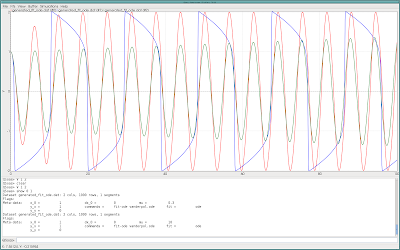
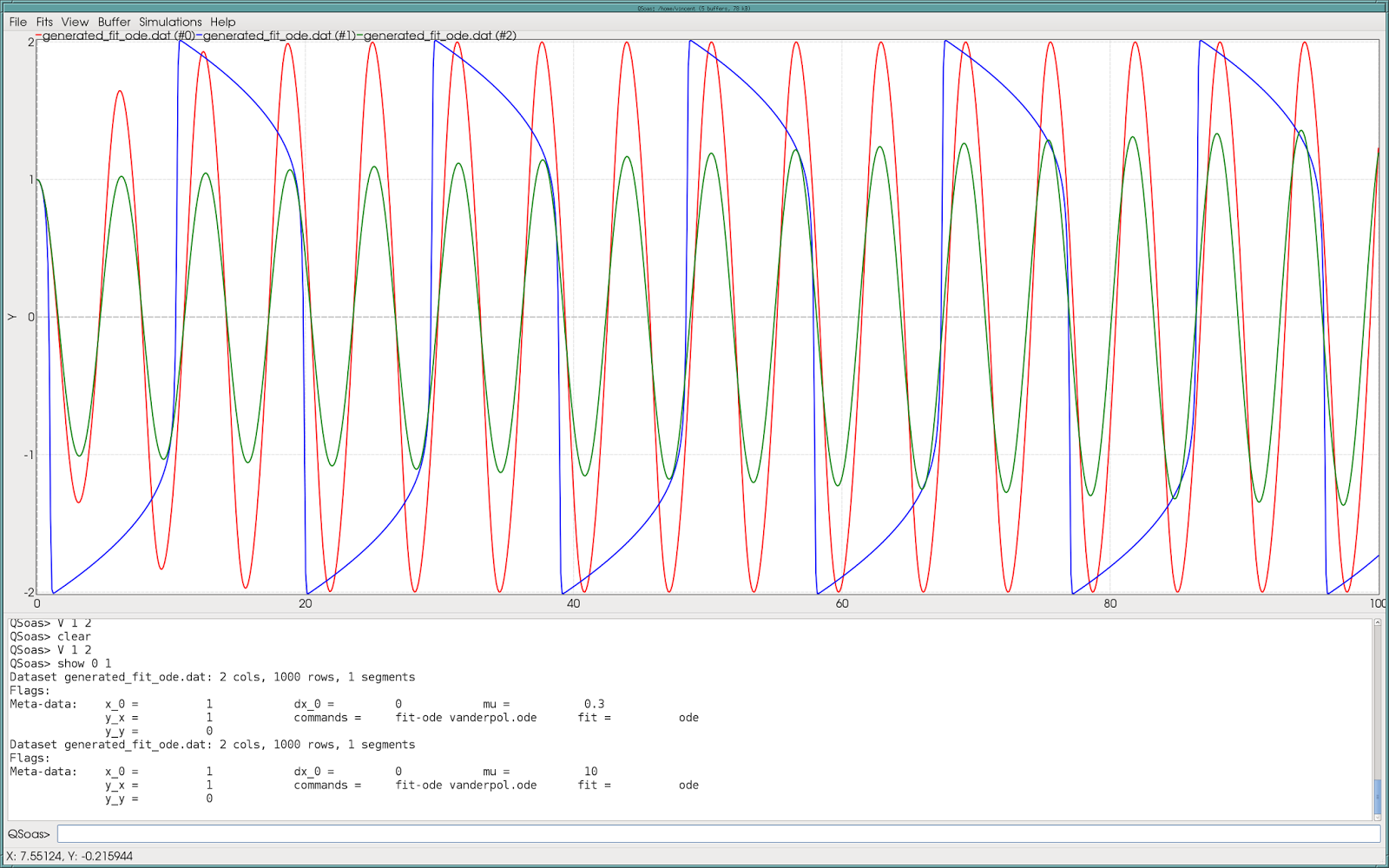
See the values of mu in the terminal above ?This feature of QSoas makes it easy to quickly explore the effect of the parameters of a model on the shape of the resulting curve. I have used that very heavily in my research, I hope others will find it useful too. Enjoy !

Antoine Beaupr : Internet in Cuba

A lot has been written about the Internet in Cuba over the years. I have read a few articles, from New York Times' happy support for Google's invasion of Cuba to RSF's dramatic and fairly outdated report about censorship in Cuba. Having written before about Internet censorship in Tunisia, I was curious to see if I could get a feel of what it is like over there, now that a new Castro is in power and the Obama administration has started restoring diplomatic ties with Cuba. With those political changes coming signifying the end of an embargo that has been called genocidal by the Cuban government, it is surprisingly difficult to get fresh information about the current state of affairs. This article aims to fill that gap in clarifying how the internet works in Cuba, what kind of censorship mechanisms are in place and how to work around them. It also digs more technically into the network architecture and performance. It is published in the hope of providing both Cubans and the rest of the world with a better understanding of their network and, if possible, Cubans ways to access the internet more cheaply or without censorship.

"Censorship" and workarounds Unfortunately, I have been connected to the internet only through the the Varadero airport and the WiFi of a "full included" resort near Jibacoa. I have to come to assume that this network is likely to be on a segregated, uncensored internet while the rest of the country suffers the wrath of the Internet censorship in Cuba I have seen documented elsewhere. Through my research, I couldn't find any sort of direct censorship. The Netalyzr tool couldn't find anything significantly wrong with the connection, other than the obvious performance problems related both to the overloaded uplinks of the Cuban internet. I ran an incomplete OONI probe as well, and it seems there was no obvious censorship detected there as well, at least according to folks in the helpful #ooni IRC channel. Tor also works fine, and could be a great way to avoid the global surveillance system described later in this article. Nevertheless, it still remains to be seen how the internet is censored in the "real" Cuban internet, outside of the tourist designated areas - hopefully future visitors or locals can expand on this using the tools mentioned above, using the regular internet. Usual care should be taken when using any workaround tools, mentioned in this post or not, as different regimes over the world have accused, detained, tortured and killed sometimes for the mere fact of using or distributing circumvention tools. For example, a Russian developer was arrested and detained in 2001 by United States' FBI for exposing vulnerabilities in the Adobe e-books copy protection mechanisms. Similarly, people distributing Tor and other tools have been arrested during the period prior to the revolution in Tunisia.

The Cuban captive portal There is, however, a more pernicious and yet very obvious censorship mechanism at work in Cuba: to get access to the internet, you have to go through what seems to be a state-wide captive portal, which I have seen both at the hotel and the airport. It is presumably deployed at all levels of the internet access points. To get credentials through that portal, you need a username and password which you get by buying a Nauta card. Those cards cost 2$CUC and get you an hour of basically unlimited internet access. That may not seem like a lot for a rich northern hotel party-goer, but for Cubans, it's a lot of money, given that the average monthly salary is around 20$CUC. The system is also pretty annoying to use, because it means you do not get continuous network access: every hour, you need to input a new card, which will obviously make streaming movies and other online activities annoying. It also makes hosting servers basically impossible. So while Cuba does not have, like China or Iran, a "great firewall", there is definitely a big restriction to going online in Cuba. Indeed, it seems to be how the government ensures that Cubans do not foment too much dissent online: keep the internet slow and inaccessible, and you won't get too many Arab spring / blogger revolutions.

Bypassing the Cuban captive portal The good news is that it is perfectly possible for Cubans (or at least for a tourist like me with resources outside of the country) to bypass the captive portal. Like many poorly implemented portals, the portal allows DNS traffic to go through, which makes it possible to access the global network for free by using a tool like iodine which tunnels IP traffic over DNS requests. Of course, the bandwidth and reliability of the connection you get through such a portal is pretty bad. I have regularly seen 80% packet loss and over two minutes of latency:
--- 10.0.0.1 ping statistics ---
163 packets transmitted, 31 received, 80% packet loss, time 162391ms
rtt min/avg/max/mdev = 133.700/2669.535/64188.027/11257.336 ms, pipe 65
Still, it allowed me to login to my home server through SSH using Mosh to workaround the reliability issues. Every once in a while, mosh would get stuck and keep on trying to send packets to probe the server, which would clog the connection even more. So I regularly had to restart the whole stack using these commands:
killall iodine # stop DNS tunnel
nmcli n off # turn off wifi to change MAC address
macchanger -A wlan0 # change MAC address
nmcli n on # turn wifi back on
sleep 3 # wait for wifi to settle
iodine-client-start # restart DNS tunnel
The Koumbit Wiki has good instructions on how to setup a DNS tunnel. I am wondering if such a public service could be of use for Cubans, although I am not sure how it could be deployed only for Cubans, and what kind of traffic it could support... The fact is that iodine does require a server to operate, and that server must be run on the outside of the censored perimeter, something that Cubans may not be able to afford in the first place. Another possible way to save money with the captive portal would be to write something that automates connecting and disconnecting from the portal. You would feed that program a list of credentials and it would connect to the portal only on demand, and disconnect as soon as no traffic goes through. There are details on the implementation of the captive portal below that may help future endeavours in that field.

Private information revealed to the captive portal It should be mentioned, however, that the captive portal has a significant amount of information on clients, which is a direct threat to the online privacy of Cuban internet users. Of course the unique identifiers issued with the Nauta cards can be correlated with your identity, right from the start. For example, I had to give my room number to get a Nauta card issued. Then the central portal also knows which access point you are connected to. For example, the central portal I was connected to Wifi_Memories_Jibacoa which, for anyone that cares to research, will give them a location of about 20 square meters where I was located when connected (there is only one access point in the whole hotel). Finally, the central portal also knows my MAC address, a unique identifier for the computer I am using which also reveals which brand of computer I am using (Mac, Lenovo, etc). While this address can be changed, very few people know that, let alone how. This led me to question whether I would be allowed back in Cuba (or even allowed out!) after publishing this blog post, as it is obvious that I can be easily identified based on the time this article was published, my name and other details. Hopefully the Cuban government will either not notice or not care, but this can be a tricky situation, obviously. I have heard that Cuban prisons are not the best hangout place in Cuba, to say the least...

Network configuration assessment This section is more technical and delves more deeply in the Cuban internet to analyze the quality and topology of the network, along with hints as to which hardware and providers are being used to support the Cuban government.

Line quality The internet is actually not so bad in the hotel. Again, this may be because of the very fact that I am in that hotel, and I get a privileged access to the new fiber line to Venezuela, the ALBA-1 link. The line speed I get is around 1mbps, according to speedtest, which selected a server from LIME in George Town, Cayman Islands:
[1034]anarcat@angela:cuba$ speedtest
Retrieving speedtest.net configuration...
Retrieving speedtest.net server list...
Testing from Empresa de Telecomunicaciones de Cuba (152.206.92.146)...
Selecting best server based on latency...
Hosted by LIME (George Town) [391.78 km]: 317.546 ms
Testing download speed........................................
Download: 1.01 Mbits/s
Testing upload speed..................................................
Upload: 1.00 Mbits/s
Latency to the rest of the world is of couse slow:
--- koumbit.org ping statistics ---
122 packets transmitted, 120 received, 1,64% packet loss, time 18731,6ms
rtt min/avg/max/sdev = 127,457/156,097/725,211/94,688 ms
--- google.com ping statistics ---
122 packets transmitted, 121 received, 0,82% packet loss, time 19371,4ms
rtt min/avg/max/sdev = 132,517/160,095/724,971/93,273 ms
--- redcta.org.ar ping statistics ---
122 packets transmitted, 120 received, 1,64% packet loss, time 40748,6ms
rtt min/avg/max/sdev = 303,035/339,572/965,092/97,503 ms
--- ccc.de ping statistics ---
122 packets transmitted, 72 received, 40,98% packet loss, time 19560,2ms
rtt min/avg/max/sdev = 244,266/271,670/594,104/61,933 ms
Interestingly, Koumbit is actually the closest host in the above test. It could be that Canadian hosts are less affected by bandwidth problems compared to US hosts because of the embargo.

Network topology The various traceroutes show a fairly odd network topology, but that is typical of what I would described as "colonized internet users", which have layers and layers of NAT and obscure routing that keep them from the real internet. Just like large corporations are implementing NAT in a large scale, Cuba seems to have layers and layers of private RFC 1918 IPv4 space. A typical traceroute starts with:
traceroute to koumbit.net (199.58.80.33), 30 hops max, 60 byte packets
 1  10.156.41.1 (10.156.41.1)  9.724 ms  9.472 ms  9.405 ms
 2  192.168.134.137 (192.168.134.137)  16.089 ms  15.612 ms  15.509 ms
 3  172.31.252.113 (172.31.252.113)  15.350 ms  15.805 ms  15.358 ms
 4  pos6-0-0-agu-cr-1.mpls.enet.cu (172.31.253.197)  15.286 ms  14.832 ms  14.405 ms
 5  172.31.252.29 (172.31.252.29)  13.734 ms  13.685 ms  14.485 ms
 6  200.0.16.130 (200.0.16.130)  14.428 ms  11.393 ms  10.977 ms
 7  200.0.16.74 (200.0.16.74)  10.738 ms  10.019 ms  10.326 ms
 8  ix-11-3-1-0.tcore1.TNK-Toronto.as6453.net (64.86.33.45)  108.577 ms  108.449 ms
Let's take this apart line by line:
 1  10.156.41.1 (10.156.41.1)  9.724 ms  9.472 ms  9.405 ms
This is my local gateway, probably the hotel's wifi router.
 2  192.168.134.137 (192.168.134.137)  16.089 ms  15.612 ms  15.509 ms
This is likely not very far from the local gateway, probably still in Cuba. It in one bit away from the captive portal IP address (see below) so it is very likely related to the captive portal implementation.
 3  172.31.252.113 (172.31.252.113)  15.350 ms  15.805 ms  15.358 ms
 4  pos6-0-0-agu-cr-1.mpls.enet.cu (172.31.253.197)  15.286 ms  14.832 ms  14.405 ms
 5  172.31.252.29 (172.31.252.29)  13.734 ms  13.685 ms  14.485 ms
All those are withing RFC 1918 space. Interestingly, the Cuban DNS servers resolve one of those private IPs as within Cuban space, on line #4. That line is interesting because it reveals the potential use of MPLS.
 6  200.0.16.130 (200.0.16.130)  14.428 ms  11.393 ms  10.977 ms
 7  200.0.16.74 (200.0.16.74)  10.738 ms  10.019 ms  10.326 ms
Those two lines are the only ones that actually reveal that the route belongs in Cuba at all. Both IPs are in a tiny (/24, or 256 IP addresses) network allocated to ETECSA, the state telco in Cuba:
inetnum:     200.0.16/24
status:      allocated
aut-num:     N/A
owner:       EMPRESA DE TELECOMUNICACIONES DE CUBA S.A. (IXP CUBA)
ownerid:     CU-CUBA-LACNIC
responsible: Rafael L pez Guerra
address:     Ave. Independencia y 19 Mayo, s/n,
address:     10600 - La Habana - CH
country:     CU
phone:       +53 7 574242 []
owner-c:     JOQ
tech-c:      JOQ
abuse-c:     JEM52
inetrev:     200.0.16/24
nserver:     NS1.NAP.ETECSA.NET
nsstat:      20160123 AA
nslastaa:    20160123
nserver:     NS2.NAP.ETECSA.NET
nsstat:      20160123 AA
nslastaa:    20160123
created:     20030512
changed:     20140610
Then the last hop:
 8  ix-11-3-1-0.tcore1.TNK-Toronto.as6453.net (64.86.33.45)  108.577 ms  108.449 ms  108.257 ms
...interestingly, lands directly in Toronto, in this case going later to Koumbit but that is the first hop that varies according to the destination, hops 1-7 being a common trunk to all external communications. It's also interesting that this shoves a good 90 milliseconds extra in latency, showing that a significant distance and number of equipment crossed. Yet a single hop is crossed, not showing the intermediate step of the Venezuelan link or any other links for that matter. Something obscure is going on there... Also interesting to note is the traceroute to the redirection host, which is only one hop away:
traceroute to 192.168.134.138 (192.168.134.138), 30 hops max, 60 byte packets
 1  192.168.134.138 (192.168.134.138)  6.027 ms  5.698 ms  5.596 ms
Even though it is not the gateway:
$ ip route
default via 10.156.41.1 dev wlan0  proto static  metric 1024
10.156.41.0/24 dev wlan0  proto kernel  scope link  src 10.156.41.4
169.254.0.0/16 dev wlan0  scope link  metric 1000
This means a very close coordination between the different access points and the captive portal system. Finally, note that there seems to be only three peers to the Cuban internet: Teleglobe, formerly Canadian, now owned by the Indian [[!wiki Tata group]], and Telef nica, the Spanish Telco that colonized most of Latin America's internet, all the way down to Argentina. This is confirmed by my traceroutes, which show traffic to Koumbit going through Tata and Google's going through Telef nica.

Captive portal implementation The captive portal is https://www.portal-wifi-temas.nauta.cu/ (not accessible outside of Cuba) and uses a self-signed certificate. The domain name resolves to 190.6.81.230 in the hotel. Accessing http://1.1.1.1/ gives you a status page which allows you to disconnect from the portal. It actually redirects you to https://192.168.134.138/logout.user. That is also a self-signed, but different certificate. That certificate actually reveals the implication of Gemtek which is a "world-leading provider of Wireless Broadband solutions, offering a wide range of solutions from residential to business". It is somewhat unclear if the implication of Gemtek here is deliberate or a misconfiguration on the part of Cuban officials, especially since the certificate is self-signed and was issued in 2002. It could be, however, a trace of the supposed involvement of China in the development of Cuba's networking systems, although Gemtek is based in Taiwan, and not in the China mainland. That IP, in turn, redirects you to the same portal but in a page that shows you the statistics:
https://www.portal-wifi-temas.nauta.cu/?mac=0024D1717D18&script=logout.user&remain_time=00%3A55%3A52&session_time=00%3A04%3A08&username=151003576287&clientip=10.156.41.21&nasid=Wifi_Memories_Jibacoa&r=ac%2Fpopup
Notice how you see the MAC address of the machine in the URL (randomized, this is not my MAC address), along with the remaining time, session time, client IP and the Wifi access point ESSID. There may be some potential in defrauding the session time there, I haven't tested it directly. Hitting Actualizar redirects you back to the IP address, which redirects you to the right URL on the portal. The "real" logout is at:
http://192.168.134.138/logout.user?cmd=logout
The login is performed against https://www.portal-wifi-temas.nauta.cu/index.php?r=ac/login with a referer of:
https://www.portal-wifi-temas.nauta.cu/?&nasid=Wifi_Memories_Jibacoa&nasip=192.168.134.138&clientip=10.156.41.21&mac=EC:55:F9:C5:F2:55&ourl=http%3a%2f%2fgoogle.ca%2f&sslport=443&lang=en-US%2cen%3bq%3d0.8&lanip=10.156.41.1
Again, notice the information revealed to the central portal.

Equipment and providers I ran Nmap probes against both the captive portal and the redirection host, in the hope of finding out how they were built and if they could reveal the source of the equipment used. The complete nmap probes are available in nmap, but it seems that the captive portal is running some embedded device. It is confusing because the probe for the captive portal responds as if it was the gateway, which blurs even more the distinction between the hotel's gateway and the captive portal. This raises the distinct possibility that all access points are actually captive portal that authenticate to another central server. The nmap traces do show three distinct hosts however:
  • the captive portal (www.portal-wifi-temas.nauta.cu, 190.6.81.230)
  • some redirection host (192.168.134.138)
  • the hotel's gateway (10.156.41.1)
They do have distinct signatures so the above may be just me misinterpreting traceroute and nmap results. Your comments may help in clarifying the above. Still, the three devices show up as running Linux, in the two last cases versions between 2.4.21 and 2.4.31. Now, to find out which version of Linux it is running is way more challenging, and it is possible it is just some custom Linux distribution. Indeed, the webserver shows up as G4200.GSI.2.22.0155 and the SSH server is running OpenSSH 3.0.2p1, which is basically prehistoric (2002!) which corroborates the idea that this is some Gemtek embedded device. The fact that those devices are running 14 years old software should be a concern to the people responsible for those networks. There is, for example, a remote root vulnerability that affects that specific version of OpenSSH, among many other vulnerabilities.

A note on Nauta card's security Finally, one can note that it is probably trivial to guess card UIDs. All cards i have here start with the prefix 15100, the following digits being 3576 or 4595, presumably depending on the "batch" that was sent to different hotels, which seems to be batches of 1000 cards. You can also correlate the UID with the date at which the card was issued. For example, 15100357XXX cards are all valid until 19/03/2017, and 151004595XXX cards are all valid until 23/03/2017. Here's the list of UIDs I have seen:
151004595313
151004595974
151003576287
151003576105
151003576097
The passwords, on the other hand, do seem fairly random (although my sample size is small). Interestingly, those passwords are also 12 digits long, which is about as strong as a seven-letter password (mixed uppercase and lowercase). If there are no rate-limiting provisions on that captive portal, it could be possible to guess those passwords, since you have free rein on accessing those routers. Depending on the performance of the routers, you could be lucky and find a working password for free...

Conclusion Clearly, Internet access in Cuba needs to be modernized. We can clearly see that Cuba years behind the rest of the Americas, if only through the percentage of the population with internet access, or download speeds. The existence of a centralized captive portal also enables a huge surveillance potential that should be a concern for any Cuban, or for that matter, anyone wishing to live in a free society. The answer, however, lies not in the liberalization of commerce and opening the doors to the US companies and their own systems of surveillance. It should be possible, and even desirable for Cubans to establish their own neutral network, a proposal I have made in the past even for here in Qu bec. This network could be used and improved by Cubans themselves, prioritizing local communities that would establish their own infrastructure according to their own needs. I have been impressed by this article about the El Paquete system - it shows great innovation and initiative from Cubans which are known for engaging in technology in a creative way. This should be leveraged by letting Cubans do what they want with their networks, not telling them what to do. The best the Googles of this world can do to help Cuba is not to colonize Cuba's technological landscape but to cleanup their own and make their own tools more easily accessible and shareable offline. It is something companies can do right now, something I detailed in a previous article.

24 January 2016

Lunar: Reproducible builds: week 39 in Stretch cycle

What happened in the reproducible builds effort between January 17th and January 23rd:

Toolchain fixes James McCoy uploaded subversion/1.9.3-2 which removes -Wdate-time from CPPFLAGS passed to swig enabling several packages to build again. The switch made in binutils/2.25-6 to use deterministic archives by default had the unfortunate effect of breaking a seldom used feature of make. Manoj Srivastava asked on debian-devel the best way to communicate the changes to Debian users. Lunar quickly came up with a patch that displays a warning when Make encounters deterministic archives. Manoj made it available in make/4.1-2 together with a NEWS file advertising the change. Following Guillem Jover's comment on the latest patch to make mtimes of packaged files deterministic, Daniel Kahn Gillmor updated and extended the patch adding the --clamp-mtime option to GNU Tar. Mattia Rizzolo updated texlive-bin in the reproducible experimental repository.

Packages fixed The following packages became reproducible after getting fixed: Some uploads fixed some reproducibility issues, but not all of them: Patches submitted which have not made their way to the archive yet:

reproducible.debian.net Transition from reproducible.debian.net to the more general tests.reproducible-builds.org has started. More visual changes are coming. (h01ger) A plan on how to run tests for F-Droid has been worked out. (hc, mvdan, h01ger) A first step has been made by adding a Jenkins job to setup an F-Droid build environment. (h01ger)

diffoscope development diffoscope 46 has been released on January 19th, followed-up by version 47 made available on January 23rd. Try it online at try.diffoscope.org! The biggest visible change is the improvement to ELF file handling. Comparisons are now done section by section, using the most appropriate tool and options to get meaningful results, thanks to Dhole's work and Mike Hommey's suggestions. Also suggested by Mike, symbols for IP-relative ops are now filtered out to remove clutter. Understanding differences in ELF files belonging to Debian packages should also be much easier as diffoscope will now try to extract debug information from the matching dbgsym package. This means objdump disassembler should output line numbers for packages built with recent debhelper as long as the associated debug package is in the same directory. As diff tends to consume huge amount of memory on large inputs, diffoscope has a limit in place to prevent crashes. diffoscope used to display a difference every time the limit was hit. Because this was confusing in case there were actually no differences, a hash is now internally computed to only report a difference when one exists. Files in archives and other container members are now compared in the original order. This should not matter in most case but overall give more predictable results. Debian .buildinfo files are now supported. Amongst other minor fixes and improvements, diffoscope will now properly compare symlinks in directories. Thanks Tuomas Tynkkynen for reporting the problem.

Package reviews 70 reviews have been removed, 125 added and 33 updated in the previous week, gcc-5 amongst others. 25 FTBFS issues have been filled by Chris Lamb, Daniel Stender, Martin Michlmayr.

Misc. The 16th FOSDEM will happen in Brussels, Belgium on January 30-31st. Several talks will be about reproducible builds: h01ger about the general ecosystem, Fabian Keil about the security oriented ElectroBSD, Baptiste Daroussin about FreeBSD packages, Ludovic Court s about Guix.

Wouter Verhelst: Playing with Letsencrypt

While I'm not convinced that encrypting everything by default is necessarily a good idea, it is certainly true that encryption has its uses. Unfortunately, for the longest time getting an SSL certificate from a CA was quite a hassle -- and then I'm not even mentioning the fact that it would cost money, too. In that light, the letsencrypt project is a useful alternative: rather than having to dabble with emails or webforms, letsencrypt does everything by way of a few scripts. Also, the letsencrypt CA is free to use, in contrast to many other certificate authorities. Of course, once you start scripting, it's easy to overdo it. When you go to the letsencrypt website and try to install their stuff, they point you to a "letsencrypt-auto" thing, which starts installing a python virtualenv and loads of other crap, just so we can talk to a server and get a certificate properly signed. I'm sure that makes sense for some people, and I'm also sure it makes some things significantly easier, but honestly, I think it's a bit overkill. Luckily, there is also a regular letsencrypt script that doesn't do all the virtualenv stuff, and which is already packaged for Debian, so installing that gets us rid of the overkill bits. It's not in stable, but it is an arch:all package. Unfortunately, not all dependencies are available in Jessie, but backporting it turned out to be not too complicated. Once the client is installed, you need to get it to obtain a certificate, and you need to have the certificate be activated for your webserver. By default, the letsencrypt client will update your server configuration for you, and run a temporary webserver, and do a whole lot of other things that I would rather not see it do. The good news, though, is that you can switch all that off. If you're willing to let it write a few files to your DocumentRoot, it can do the whole thing without any change to your system:
letsencrypt certonly -m <your mailaddress> --accept-tos --webroot -w \
    /path/to/DocumentRoot -d example.com -d www.example.com
In that command, the -m option (with mail address) and the --accept-tos option are only required the first time you ever run letsencrypt. Doing so creates an account for you at letsencrypt.org, without which you cannot get any certificates. The --accept-tos option specifies that you accept their terms of service, which you might want to read first before blindly accepting. If all goes well, letsencrypt will tell you that it wrote your account information and some certificates somewhere under /etc/letsencrypt. All that's left is to update your webserver configuration so that the certificates are actually used. No, I won't tell you how that's done -- if you need that information, it's probably better if you just use the apache or nginx plugin of letsencrypt, which updates your webserver's configuration automatically. But if you already know how to do so, and prefer to maintain your configuration by yourself, then it's good to know that it is at least possible. Since we specified two -d parameters, the certificate you get from the letsencrypt CA will have subjectAlternativeName fields, allowing you to use them for more than one domain name. I specified example.com and www.example.com as the valid names, but there is nothing in letsencrypt requiring that the domain names you specify share a suffix; so yes, it is certainly possible to have multiple domains on a single certificate, if you want that. Finally, you need to ensure that your certificates are renewed before they expire. The easiest way to do that is to add a cronjob, which runs letsencrypt again; only this time, you'll need slightly different options:
letsencrypt certonly --renew-by-default --webroot -w \
    /path/to/DocumentRoot -d domain.name.tld -d www.domain.name.tld
The --renew-by-default option tells letsencrypt that you want to renew your certificates, not create new ones. If you specify this, the old certificate will be revoked, and a new one will be generated, again with three months validity. The symlinks under /etc/letsencrypt/live will be updated, so if your webserver's configuration uses those as the path to your certificates, you don't need to update any configuration files (although you may need to restart your webserver). You'll also notice that the -m and --accept-tos options are not specified this time around; this is because those are only required when you want to create an account -- once that step has been taken, letsencrypt will read the necessary information from its configuration files (and creating a new account for every renewal is just silly). With that, you now have a working, browser-trusted, certificate. Update: fix mistake about installing on Jessie. It's possible (I've done so), but it's been a while and I forgot that I had to recompile several of letsencrypt's dependencies in order for it to be installable.

Petter Reinholdtsen: Creepy, visualise geotagged social media information - nice free software

Most people seem not to realise that every time they walk around with the computerised radio beacon known as a mobile phone their position is tracked by the phone company and often stored for a long time (like every time a SMS is received or sent). And if their computerised radio beacon is capable of running programs (often called mobile apps) downloaded from the Internet, these programs are often also capable of tracking their location (if the app requested access during installation). And when these programs send out information to central collection points, the location is often included, unless extra care is taken to not send the location. The provided information is used by several entities, for good and bad (what is good and bad, depend on your point of view). What is certain, is that the private sphere and the right to free movement is challenged and perhaps even eradicated for those announcing their location this way, when they share their whereabouts with private and public entities.

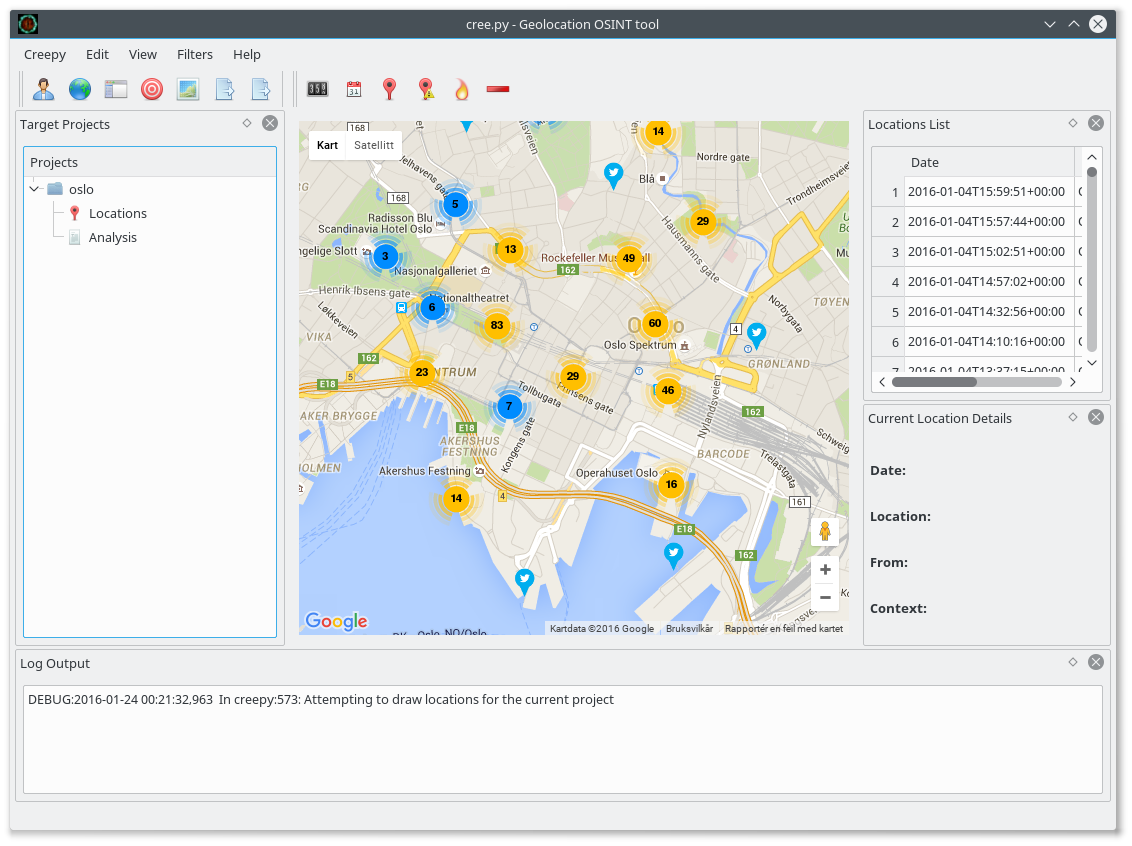
The phone company logs provide a register of locations to check out when one want to figure out what the tracked person was doing. It is unavailable for most of us, but provided to selected government officials, company staff, those illegally buying information from unfaithful servants and crackers stealing the information. But the public information can be collected and analysed, and a free software tool to do so is called Creepy or Cree.py. I discovered it when I read an article about Creepy in the Norwegian newspaper Aftenposten i November 2014, and decided to check if it was available in Debian. The python program was in Debian, but the version in Debian was completely broken and practically unmaintained. I uploaded a new version which did not work quite right, but did not have time to fix it then. This Christmas I decided to finally try to get Creepy operational in Debian. Now a fixed version is available in Debian unstable and testing, and almost all Debian specific patches are now included upstream. The Creepy program visualises geolocation information fetched from Twitter, Instagram, Flickr and Google+, and allow one to get a complete picture of every social media message posted recently in a given area, or track the movement of a given individual across all these services. Earlier it was possible to use the search API of at least some of these services without identifying oneself, but these days it is impossible. This mean that to use Creepy, you need to configure it to log in as yourself on these services, and provide information to them about your search interests. This should be taken into account when using Creepy, as it will also share information about yourself with the services. The picture above show the twitter messages sent from (or at least geotagged with a position from) the city centre of Oslo, the capital of Norway. One useful way to use Creepy is to first look at information tagged with an area of interest, and next look at all the information provided by one or more individuals who was in the area. I tested it by checking out which celebrity provide their location in twitter messages by checkout out who sent twitter messages near a Norwegian TV station, and next could track their position over time, making it possible to locate their home and work place, among other things. A similar technique have been used to locate Russian soldiers in Ukraine, and it is both a powerful tool to discover lying governments, and a useful tool to help people understand the value of the private information they provide to the public. The package is not trivial to backport to Debian Stable/Jessie, as it depend on several python modules currently missing in Jessie (at least python-instagram, python-flickrapi and python-requests-toolbelt). (I have uploaded the image to screenshots.debian.net and licensed it under the same terms as the Creepy program in Debian.)

23 January 2016

Dirk Eddelbuettel: RcppEigen 0.3.2.7.0

A new minor release of RcppEigen is now on CRAN and in Debian. It primarily upgrades to the recent 3.2.7 release of Eigen -- thanks once again to fine work by Yixuan Qiu. We also have one additonal PR by Alexey Stukalow who ensured that the fastLm() example will work fine with when the Intel MKL is used. The NEWS file entry follows.
Changes in RcppEigen version 0.3.2.7.0 (2016-01-18)
  • Updated to version 3.2.7 of Eigen
  • The fastLm example will not include the Lapack header if MKL is defined (thanks to PR #25 by Alexey Stukalow)
Courtesy of CRANberries, there is also a diffstat report for the most recent release.

This post by Dirk Eddelbuettel originated on his Thinking inside the box blog. Please report excessive re-aggregation in third-party for-profit settings.

21 January 2016

Tanguy Ortolo: Removing sam2p from Debian

Issues with sam2p and removal I have been maintaining the Debian package of sam2p for some time. Unfortunately, the upstream development of that program is no longer active, and it is using an old custom build chain that no longer works with recent version of GCC. This package is currently failing to build from source, and while I have been able to patch some issues in the past, and it may still be possible to fix it again, this is not really sustainable. I am therefore considering to remove sam2p from Debian, unless someone has a very good reason to keep it and is able and willing to maintain it.Alternative sam2p is a raster image conversion tool that can convert PNG and JPEG to EPS and PDF while keeping their compression, which is mostly useful to use them in documents compiled with LaTeX. Fortunately, the same can be done with ImageMagick. If you want to convert to EPS, you have to specify that you want EPS 2 or 3, otherwise it would produce EPS level 1 which does not provide native raster compression:

% convert debian-openlogo-raster100.png \
          eps3:debian-openlogo-raster100.eps
% convert debian-openlogo-raster100.png \
          debian-openlogo-raster100.pdf
% ls -lh
1.7K debian-openlogo-raster100.png
6.0K debian-openlogo-raster100.eps
8.8K debian-openlogo-raster100.pdf
% convert photograph.jpg eps3:photograph.eps
% convert photograph.jpg photograph.pdf
% ls -lh
657K photograph.jpg
662K photograph.eps
664K photograph.pdf
% convert scanned-document.png eps3:scanned-document.eps
% convert scanned-document.png scanned-document.pdf
140K scanned-document.png
145K scanned-document.eps
150K scanned-document.pdf
This is a bit less efficient than sam2p, as convert seems to add some fixed overhead, but it does keep the appropriate compression algorithm. See this documentation page from ImageMagick for more information. Using appropriate formats As a reminder, when writing LaTeX documents, depending on your build chain, you can use:
photographs
JPEG or EPS (converted from JPEG with ImageMagick);
raster drawings, screenshots
PNG or EPS (converted from PNG with ImageMagick);
vector graphics
PDF or EPS (convertes from SVG with Inkscape).

Jan Wagner: Using nginx as reverse proxy (for containered Ghost)

In some cases it might be a good idea to use a reverse proxy in front of a web application. Nginx is a very common solution for this scenario these days. As I started with containers for some of my playgrounds, I decided to go this route.

Container security When looking around to implement a nginx in front of a Docker web application, in most cases nginx itself is also a Docker container.

In my eyes Docker containers have a huge disadvantage. To get updated software (at least security related) into production, you have to hope that your container image is well maintained or you have to care about it yourself. If this not the case, you might worry.
As long as you don't have container solutions deployed in large scale (and make use of automatically rebuilding and deploying your container images) I would recommend to keep the footprint of your containered applications as small as possible from security point of view. So I decided to run my nginx on the same system where the Docker web applications are living, but you can also have it placed on a system in front of your container systems. Updates are supplied via usual Distribution security updates.

Installing nginx
# aptitude install nginx
I don't will advise you on the usual steps about setting up nginx, but will focus on things required to proxy into your container web application.

Configuration of nginx As our Docker container for Ghost exposes port 2368, we need to define our upstream server. I've done that in conf.d/docker-ghost.conf.
upstream docker-ghost    
  server localhost:2368;
 
The vHost configuration can be taken into /etc/nginx/nginx.conf but I would recommend to use a config file in /etc/nginx/sites-available/ instead.
server    
  listen 80;
  server_name log.cyconet.org;
  include /etc/nginx/snippets/ghost_vhost.conf;
  location /  
    proxy_pass                          http://docker-ghost;
    proxy_set_header  Host              $http_host;   # required for docker client's sake
    proxy_set_header  X-Real-IP         $remote_addr; # pass on real client's IP
    proxy_set_header  X-Forwarded-For   $proxy_add_x_forwarded_for;
    proxy_set_header  X-Forwarded-Proto $scheme;
    proxy_read_timeout                  900;
   
 
Let's enable the configuration and reload nginx:
# ln -s ../sites-available/ghost.conf /etc/nginx/sites-enabled/ghost.conf && \
 service nginx configtest && service nginx reload

Going further This is a very basic configuration. You might think about delivering static content (like images) directly from your Docker data volume, caching and maybe encryption.

Jonas Smedegaard: IT@school

Siri and I are on a journey through India and Nepal, with the aim of learning about needs of Debian derivatives, to improve Debian and encourage closer integration.

Distribution IT@school is a distribution originally based on Debian, later rebased on Ubuntu. Next release will possibly again be a direct derivative of Debian, or maybe even - time will tell - a Debian pure blend.

Aim is education As its name indicates, IT@school is targeted at schools: The system is used in 8th - 10th grades of most (or all?) public primary schools in Kerala, Together with KEK members Anto and Fayad, Siri and I met with former and current key participants in the project where we learned about its history and current status, and discussed some differences between Ubuntu and Debian. IT@school has a strong emphasis on the educational aspect, arguably setting it apart from Skolelinux/DebianEdu which emphasizes the technical aspect of relieving teachers from admin tasks. In the early years of deployment the project faced many hardware issues - e.g. in getting sound cards to work. This was seen not as problems but as beneficial learning for the teachers facing those issues. Kerala public school system has set the standard for other states in India, but sadly political support within the state has been weak in recent years. It is hoped that next election - this April - will bring a positive change.

School book IT@school is accompagnied by a school book written specifically for use of the included tools. No explicit license is applied to the book (which means it defaults to classic copyright). Possibly it will get Creative Commons licensed. If the school book gets a DFSG-free license, several collaboration opportunities emerge: Currently the book is drafted in LibreOffice but then - due to state procedures - finalized with PageMaker. Would be interesting to setup an alternate process using only Free tools - either with Scribus or XeLaTeX. An important detail here is to ensure that the process supports malayalam script.

Curriculum Work is in progress mapping FLOSS tools to the state curriculum. I recommended to share that work publicly with a Free license, to encourage comparisons across countries, and invite collaboration e.g. with Skolelunux/DebianEdu.

Blend for SBCs Some Kerala higher education schools (sorry, don't remember which) have bought some thousands of RaspberryPi2. I suggested to create a Debian Blend for SBCs (Single Board Computers) - we will see what comes of that idea

Blend for education I also suggested to make a Debian blend around IT@school distribution itself, with its strong focus on educational content - i.e. not just as addon to technical tools but the primary purpose pulling in tools as needed.

Russell Coker: Finding Storage Performance Problems

Here are some basic things to do when debugging storage performance problems on Linux. It s deliberately not an advanced guide, I might write about more advanced things in a later post. Disk Errors When a hard drive is failing it often has to read sectors several times to get the right data, this can dramatically reduce performance. As most hard drives aren t monitored properly (email or SMS alerts on errors) it s quite common for the first notification about an impending failure to be user complaints about performance. View your kernel message log with the dmesg command and look in /var/log/kern.log (or wherever your system is configured to store kernel logs) for messages about disk read errors, bus resetting, and anything else unusual related to the drives. If you use an advanced filesystem like BTRFS or ZFS there are system commands to get filesystem information about errors. For BTRFS you can run btrfs device stats MOUNTPOINT and for ZFS you can run zpool status . Most performance problems aren t caused by failing drives, but it s a good idea to eliminate that possibility before you continue your investigation. One other thing to look out for is a RAID array where one disk is noticeably slower than the others. For example if you have a RAID-5 or RAID-6 array every drive should have almost the same number of reads and writes, if one disk in the array is at 99% performance capacity and the other disks are at 5% then it s an indication of a failing disk. This can happen even if SMART etc don t report errors. Monitoring IO The iostat program in the Debian sysstat package tells you how much IO is going to each disk. If you have physical hard drives sda, sdb, and sdc you could run the command iostat -x 10 sda sdb sdc to tell you how much IO is going to each disk over 10 second periods. You can choose various durations but I find that 10 seconds is long enough to give results that are useful. By default iostat will give stats on all block devices including LVM volumes, but that usually gives too much data to analyse easily. The most useful things that iostat tells you are the %util (the percentage utilisation anything over 90% is a serious problem), the reads per second r/s , and the writes per second w/s . The parameters to iostat for block devices can be hard drives, partitions, LVM volumes, encrypted devices, or any other type of block device. After you have discovered which block devices are nearing their maximum load you can discover which of the partitions, RAID arrays, or swap devices on that disk are causing the load in question. The iotop program in Debian (package iotop) gives a display that s similar to that of top but for disk io. It generally isn t essential (you can run ps ax grep D to get most of that information), but it is handy. It will tell you which programs are causing IO on a busy filesystem. This can be good when you have a busy system and don t know why. It isn t very useful if you have a system that is used for one task, EG a database server that is known to be busy doing database stuff. It s generally a good idea to have sysstat and iotop installed on all systems. If a system is experiencing severe performance problems you might not want to wait for new packages to be installed. In Debian the sysstat package includes the sar utility which can give historical information on system load. One benefit of using sar for diagnosing performance problems is that it shows you the time of day that has the most load which is the easiest time to diagnose performance problems. Swap Use Swap use sometimes confuses people. In many cases swap use decreases overall disk use, this is the design of the Linux paging algorithms. So if you have a server that accesses a lot of data it might swap out some unused programs to make more space for cache. When you have multiple virtual machines on one system sharing the same disks it can be difficult to determine the best allocation for RAM. If one VM has some applications allocating a lot of RAM but not using it much then it might be best to give it less RAM and force those applications into swap so that another VM can cache all the data it accesses a lot. The important thing is not the amount of swap that is allocated but the amount of IO that goes to the swap partition. Any significant amount of disk IO going to a swap device is a serious problem that can be solved by adding more RAM. Reads vs Writes The ratio of reads to writes depends on the applications and the amount of RAM. Some applications can have most of their reads satisfied from cache. For example an ideal configuration of a mail server will have writes significantly outnumber reads (I ve seen ratios of 5:1 for writes to reads on real mail servers). Ideally a mail server will cache all new mail for at least an hour and as the most prolific users check their mail more frequently than that most mail will be downloaded before it leaves the cache. If you have a mail server with reads outnumbering writes then it needs more RAM. RAM is cheap nowadays so if you don t want to compete with Gmail it should be cheap to buy enough RAM to cache all recent mail. The ratio of reads to writes is important because it s one way of quickly determining if you have enough RAM and adding RAM is often the cheapest way of improving performance. Unbalanced IO One common performance problem on systems with multiple disks is having more load going to some disks than to others. This might not be a problem (EG having cron jobs run on disks that are under heavy load while the web server accesses data from lightly loaded disks). But you need to consider whether it s desirable to have some disks under more load than others. The simplest solution to this problem is to just have a single RAID array for all data storage. This is also the solution that gives you the maximum available disk space if you use RAID-5 or RAID-6. A more complex option is to use some SSDs for things that require performance and disks for things that don t. This can be done with the ZIL and L2ARC features of ZFS or by just creating a filesystem on SSD for the data that is most frequently accessed. What Did I Miss? I m sure that I missed something, please let me know of any other basic things to do or suggestions for a post on more advanced things.

Holger Levsen: 20160121-farewell-reproducible.debian.net

Bye bye reproducible.debian.net After an amazing 15 months I've just "pulled the plug" on reproducible.debian.net - well, not really (at all), instead now we have https://tests.reproducible-builds.org! :-) It's still a bit rough and not really yet where I want it to be (more on that soon), but hopefully it will be there, rather soon! And hopefully our patches for dpkg will soon be merged too. At least some, right now I'm slightly puzzled there are seven now, I thought we had 3 or 4 my point here is: while Debian as a whole will freeze late 2016, the core toolchain for Stretch should be ready much sooner. So pretty please

20 January 2016

Matthew Garrett: Linux Foundation quietly drops community representation

The Linux Foundation is an industry organisation dedicated to promoting, protecting and standardising Linux and open source software[1]. The majority of its board is chosen by the member companies - 10 by platinum members (platinum membership costs $500,000 a year), 3 by gold members (gold membership costs $100,000 a year) and 1 by silver members (silver membership costs between $5,000 and $20,000 a year, depending on company size). Up until recently individual members ($99 a year) could also elect two board members, allowing for community perspectives to be represented at the board level.

As of last Friday, this is no longer true. The by-laws were amended to drop the clause that permitted individual members to elect any directors. Section 3.3(a) now says that no affiliate members may be involved in the election of directors, and section 5.3(d) still permits at-large directors but does not require them[2]. The old version of the bylaws are here - the only non-whitespace differences are in sections 3.3(a) and 5.3(d).

These changes all happened shortly after Karen Sandler announced that she planned to stand for the Linux Foundation board during a presentation last September. A short time later, the "Individual membership" program was quietly renamed to the "Individual supporter" program and the promised benefit of being allowed to stand for and participate in board elections was dropped (compare the old page to the new one). Karen is the executive director of the Software Freedom Conservancy, an organisation involved in the vitally important work of GPL enforcement. The Linux Foundation has historically been less than enthusiastic about GPL enforcement, and the SFC is funding a lawsuit against one of the Foundation's members for violating the terms of the GPL. The timing may be coincidental, but it certainly looks like the Linux Foundation was willing to throw out any semblance of community representation just to ensure that there was no risk of someone in favour of GPL enforcement ending up on their board.

Much of the code in Linux is written by employees paid to do this work, but significant parts of both Linux and the huge range of software that it depends on are written by community members who now have no representation in the Linux Foundation. Ignoring them makes it look like the Linux Foundation is interested only in promoting, protecting and standardising Linux and open source software if doing so benefits their corporate membership rather than the community as a whole. This isn't a positive step.

[1] Article II of the bylaws
[2] Other than in the case of the TAB representative, an individual chosen by a board elected via in-person voting at a conference

comment count unavailable comments

Scott Kitterman: Python Packaging Build-Depends

As a follow-up to my last post where I discussed common Python packaging related errors, I thought it would be worth to have a separate post on how to decide on build-depends for Python (and Python3) packages. The python ecosystem has a lot of packages built around supporting multiple versions of python (really python3 now) in parallel. I m going to limit this post to packages you might need to build-depend on directly.

Python (2) Since Jessie (Debian 8), python2.7 has been the only supported python version. For development of Stretch and backports to Jessie there is no need to worry about multiple python versions. As a result, several all packages are (and will continue to be) equivalent to their non- all counterparts. We well continue to provide the all packages for backward compatibility, but they aren t really needed any more. python (or python-all) This is the package to build-depend on if your package is pure Python (no C extensions) and does not for some other reason need access to the Python header files (there are a handful of packages this latter caveat applies to, if you don t know if it applies to your package, it almost certainly doesn t). You should also build-depend on dh-python. It was originally shipped as part of the python package (and there is still an old version provided), but to get the most current code with new bug fixes and features, build-depend on dh-python. python-dev (or python-all-dev) If your package contains compiled C or C++ extensions, this package either provides or depends on the packages that provide all the header files you need. Do not also build-depend on python. python-dev depends on it and it is just an unneeded redundancy. python-dbg (or python-all-dbg) Add this if you build a -dbg package (not needed for -dbgsym). Other python packages There is not, AFAICT, any reason to build-dep on any of the other packages provided (e.g. libpython-dev). It is common to see things like python-all, python, python-dev, libpython-dev in build-depends. This could be simplified just to python-all-dev since it will pull the rest in.

Python3 Build-depends selection for Python 3 is generally similar, except that we continue to want to be able to support multiple python3 versions (as we currently support python3.4 and python3.5). There are a few differences: All or not -all Python3 transitions are much easier when C extensions are compiled for all supported versions. In many cases all that s needed if you use pybuild is to build-depend on python3-all-dev. While this is preferred, in many cases this would be technically challenging and not worth the trouble. This is mostly true for python3 based applications. Python3-all is mostly useful for running test suites against all supported python3 versions. Transitions As mentioned in the python section above, build-depends on python3- all- dev is generally only needed for compiled C extensions. For python3 these are also the packages that need to be rebuilt for a transition. Please avoid -dev build-depends whenever possible for non-compiled packages. Please keep your packages that do need rebuilding binNMU safe. Transitions happen in three stages:
  1. A new python3 version is added to supported python3 versions and packages that need rebuilding due to compiled code and that support multiple versions are binNMUed to add support for the new version.
  2. The default python3 is changed to be the new version and packages that only support a single python3 version are rebuilt.
  3. The old python3 version is dropped from supported versions and packages will multiple-version support are binNMUed to remove support for the dropped version.
This may seem complex (OK, it is a bit), but it enables a seamless transition for packages with multi-version support since they always support the default version. For packages that only support a single version there is an inevitable period when they go uninstallable once the default version has changed and until they can be rebuilt with the new default. Specific version requirements Please don t build-depend against specific python3 versions. Those don t show up in the transition tracker. Use X-Python3-Version (see python policy for details) to specify the version you need.

Summary Please check your packages and only build-depend on the -dev packages when you need it. Check for redundancy and remove it. Try and build for all python3 versions. Don t build-depend on specific python3 versions.

18 January 2016

David Pashley: NullPointerExceptions in Xerces-J

Xerces is an XML library for several languages, but if a very common library in Java. I recently came across a problem with code intermittently throwing a NullPointerException inside the library:
java.lang.NullPointerException
        at org.apache.xerces.dom.ParentNode.nodeListItem(Unknown Source)
        at org.apache.xerces.dom.ParentNode.item(Unknown Source)
        at com.example.xml.Element.getChildren(Element.java:377)
        at com.example.xml.Element.newChildElementHelper(Element.java:229)
        at com.example.xml.Element.newChildElement(Element.java:180)
         
 
You may also find the NullPointerException in ParentNode.nodeListGetLength() and other locations in ParentNode. Debugging this was not helped by the fact that the xercesImpl.jar is stripped of line numbers, so I couldn t find the exact issue. After some searching, it appeared that the issue was down to the fact that Xerces is not thread-safe. ParentNode caches iterations through the NodeList of children to speed up performance and stores them in the Node s Document object. In multi-threaded applications, this can lead to race conditions and NullPointerExceptions. And because it s a threading issue, the problem is intermittent and hard to track down. The solution is to synchronise your code on the DOM, and this means the Document object, everywhere you access the nodes. I m not certain exactly which methods need to be protected, but I believe it needs to be at least any function that will iterate a NodeList. I would start by protecting every access and testing performance, and removing some if needed.
/**
 * Returns the concatenation of all the text in all child nodes
 * of the current element.
 */
public String getText()  
StringBuilder result = new StringBuilder();
 
synchronized ( m_element.getOwnerDocument())  
NodeList nl = m_element.getChildNodes();
for (int i = 0; i < nl.getLength(); i++)  
Node n = nl.item(i);
 
if (n != null && n.getNodeType() == org.w3c.dom.Node.TEXT_NODE)  
result.append(((CharacterData) n).getData());


return result.toString();
 
Notice the synchronized ( m_element.getOwnerDocument()) block around the section that deals with the DOM. The NPE would normally be thrown on the nl.getLength() or nl.item() calls. Since putting in the synchronized blocks, we ve gone from having 78 NPEs between 2:30am and 3:00am, to having zero in the last 12 hours, so I think it s safe to say, this has drastically reduced the problem. The post NullPointerExceptions in Xerces-J appeared first on David Pashley.com.

Russ Allbery: wallet 1.3

It's been over a year since the last release of the wallet, a system for storing and retrieving secure credentials (currently relying on Kerberos authentication). There were a ton of pending changes, mostly thanks to work from Jon Robertson and Bill MacAllister. I'm still really itching to rewrite all of this code, which is also part of why I haven't uploaded packages to Debian proper yet. I no longer like the way that I designed it, particularly in the Perl modules used by the server side, and want to rewrite it rather substantially. Thankfully, I'm starting to use it for work again, although only as a supplement to another in-house key management system. I might just barely be able to justify investing some effort in that as part of my job. We'll see. In the meantime, it feels awkward and clunky to work with, which makes me itch when I'm preparing new releases. In any event, this release adds preliminary support for using Active Directory as a backend for Kerberos keytabs, and adds both nested (ACLs that are groups of other ACLs) and external (run an external command to make authorization decisions) ACLs. It also adds a root instance variant of ldap-attr, and a new object type: password, which will automatically generate a password if one wasn't already stored. There are a few new wallet commands: update, which will always change the content of an object even if marked unchanging, and acl replace, which will replace all instances of an ACL as an owner field with some other ACL. There are also multiple new wallet reports, and various bug fixes to how ACLs are displayed. You can get the latest version from the wallet distribution page.

James McCoy: neovim-coming-to-debian

Almost 9 months after I took ownership of the Neovim RFP, I finally tagged & uploaded Neovim to Debian. It still has to go through the NEW queue, but it will soon be in an experimental release near you. I'm holding off uploading it to unstable for the time being for a couple reasons. Many thanks to Jason Pleau for working on getting the necessary parts of the Lua stack needed to support Neovim into Debian.

17 January 2016

Lars Wirzenius: Obnam survey (January 2016)

Survey URL: http://goo.gl/forms/hdoQZKjs80 I am doing an Obnam survey. The goal of this survey is to collect feedback from those who use Obnam, or have tried it, to guide the project in the future. The survey will run until February 29, 2016. Goals: All questions in this survey are optional. I do not collect personal information at all. The survey is implemented using Google Forms, and so Google probably collects some information; sorry. You don't need to log in to Google to fill in the survey, though, and I encourage you to use all the privacy protection tools you have. I hope as many Obnam users as possible fill in the survey.

16 January 2016

Steve Kemp: Lumail has IMAP .. almost

A couple of years ago I was dissatisfied with mutt, mostly because the mutt-sidebar patch was dropped from the Debian package. That lead to me thinking "How hard can it be to write a modal, console-based mail-client?" It turns out writing a client is pretty simple if you limit yourself solely to Maildirs, and as I typically read my mail over SSH on the mailhost itself that suited me pretty well. Recently I restarted the mail-client. Putting it together from scratch to simplify the implementation, and unify a lot of the adhoc scripting which is provided by Lua. People seem to like the client, but the single largest complaint was "Can't use it - no IMAP." This week I've mostly been adding IMAP support, and today I'll commit the last few bits that mean it is roughly-functional: The outstanding niggles will be relating to getting/setting the new/read/seen/unseen flags, and similar. But I'm pleased that the job wasn't insurmountable. I've used libcurl to provide the IMAP functionality because most of the IMAP libraries I looked at were big, scary, and complex. Using curl to access IMAP is pretty neat, simple, and straightforward. The downside is you're making a lot of "http" requests. So I might need to revisit things. Happily my imap wrapper doesn't need much functionality. So if I can find a better library swapping it out will be simple. In conclusion: Lumail almost has IMAP support, and that might mean it'll be more useful to others.

15 January 2016

Lars Wirzenius: Obnam 1.19 released (backup software)

I have just released version 1.19 of Obnam, the backup program. See the website at http://obnam.org for details on what the program does. The new version is available from git (see http://git.liw.fi) and as Debian packages from http://code.liw.fi/debian, and uploaded to Debian, and soon in unstable. The NEWS file extract below gives the highlights of what's new in this version. NOTE: Obnam has an EXPERIMENTAL repository format under development, called green-albatross. It is NOT meant for real use. It is likely to change in incompatible ways without warning. Do not use it unless you're willing to lose your backup. Version 1.19, released 2016-01-15 Bug fixes: Improvements to the manual: Improvements to functionality:

Mike Hommey: Announcing git-cinnabar 0.3.0

Git-cinnabar is a git remote helper to interact with mercurial repositories. It allows to clone, pull and push from/to mercurial remote repositories, using git. Get it on github. These release notes are also available on the git-cinnabar wiki. Development had been stalled for a few months, with many improvements in the
next branch without any new release. I used some time during the new year
break and after in order to straighten things up in order to create a new
release, delaying many of the originally planned changes to a future 0.4.0
release. What s new since 0.2.2? Development process changes Up to before this release closing in, the master branch was dedicated to
releases, and development was happening on the next branch, until a new
release happens. From now on, the release branch will take dot-release fixes and new
releases, while the master branch will receive all changes that are
validated through testing (currently semi-automatically tested with
out-of-tree tests based on four real-life mercurial repositories, with
some automated CI based on in-tree tests used in the future). The next branch will receive changes to be tested in CI when things
will be hooked up, and may have rewritten history as a consequence of
wanting passing tests on every commit on master.

Next.

Previous.
