Search Results: "sf"

1 December 2007

Joey Hess: my mpd setup

One of the hard things about getting started with mpd is that there seems to be little documentation about the details of how other people use it. Instead you're given a collection of great tools and an excellently designed system, and expected to build your own personal music playing setup out of them with little direction. So I thought I'd document mine. There are several computers around the house that run mpd. One in my office, one has speakers in the bedroom. My laptop, of course. And I put a nslu2 in the living room in a fun lego case that embeds the little computer into a remote controlled speaker (photos when I find a camera). All of these machines have their music libraries synchronised using unison. I use sonata as a graphical frontend and browser. I keep one instance of sonata running on my desktop in the office, so I can go there to change music if my laptop's not on. Also so guests can change the music. I like to listen to whole albums at a time, and sonata doesn't make this especially easy in its user interface. I eventually realised that the best way to do it, for me, was to create a separate playlist for each album. Sonata does make it really easy to click on a playlist and start playing it. I wrote mpgenplaylists to automatically generate those playlists for me. I wrote a set of commands that I can use to transfer state between my mpd daemons. The easiest to use and most useful of these is mpswap, which swaps the state of two daemons. Generally I only have one mpd playing at a time, and the others are paused, though it'll also swap the states of two running mpds. So if I run "mpswap dodo dragon", the music that had been playing in my bedroom starts coming out the speakers in the office. Same song, not a single missed note. That's pretty handy. Or I can run "mpswap dodo" to swap state with my laptop, and carry the music out of the house with me. (This would be more seamless if I carried some bluetooth wundergadget so my computers knew where I am, but I think I'll pass.) Another tool I wrote is mpstore, which dumps the mpd daemon state out to stdout, so it can be saved to a file and later loaded with mpload. I use this when I'm listening to audiobooks, to store my place. Another one is mpfade, that can wake me up by slowly fading in music. Or slowly fade out and stop. Writing these little hacks is addictive, but I won't bore you with the rest. On some of the servers I run mpd-dynamic, a daemon that watches the playlist and makes sure it always has 10 unplayed items in it, chosing new items at random. It also removes old played items from the playlist. This is nice if I want music going without the bother of picking what. I typically add some albums to the playlist, and then when they're done, it keeps playing random stuff until I manually add something else. I do want to find something that can more intelligently pick things to play. I tried lastfmpdqc, but didn't like its results. Switching to mpd has meant that the filenames of mp3s matter again, since mpd UIs expose the filenames (a pity). I used exfalso to clean up all my file names based on the music's tags. I also added ReplayGain information to all my music so mpd can use it to normalise volume. BTW, after all this, I'll probably still only listen to music for an average of 3 hours per week.
mpd-dynamic is in the Audio::MPD perl module. mpdswap, mpdstore, mpfade, mpgenplaylists, and more are in mpdtoys.

30 November 2007

Russell Coker: Vista ReadyBoostReady - Good for Linux?

At the moment it seems that about half the USB flash devices on sale are listed as “Vista ReadyBoost Ready“. I recently bought an 8G USB device that I returned because it could only sustain 4MB/s writes (not much fun for backing up 4G+ of data). So I’ve been wondering whether I should get a ReadyBoostReady device. ReadyBoostReady only means that it is faster than other devices in some ways, it has no inherent feature difference. After some searching I found a FAQ about ReadyBoost [1] which explains what it requires. It seems that ReadyBoost needs “2.5MB/sec throughput for 4K random reads and 1.75MB/sec throughput for 512K random writes“, which isn’t really a lot. About 5-6 years ago I was running some machines with 4 disk RAID-5 arrays that could sustain 3MB/s writes for significantly smaller block sizes (maybe 12K), given that random access is something that disks are really bad at (physical movement of the heads is required) and something that flash is good at) it gives an indication of how low the performance bar is for ReadyBoost. I’m sure that a device which meets the minimum specs would do some good if you have a single disk that’s not overly fast. But if you have a decent RAID array for swap then I doubt that the minimum requirements for ReadyBoost would give a benefit. As for doing bulk transfers, it seems that while ReadyBoost Ready devices will have consistent good performance across all their storage (apparently some devices perform better for the first blocks so that people who use FAT based filesystems can get good performance from their FAT) they won’t necessarily have particularly good performance for bulk IO (1.75MB/s is pitiful when you want to copy DVD images). There are some USB flash devices that are marketted as having high performance and which are supposed to sustain >20MB/s, but I’m unlikely to find them going cheap at my local electronics store. I had hoped that ReadyBoost would be demanding enough that the ReadyBoostReady devices (which aren’t the cheapest flash devices on sale but often aren’t too expensive) would satisfy my requirements.

David Welton: One reason to think Rails is "all that"

The economics of programming languages point to Rails being significantly better than what went before it. I got to thinking about this when reading a comment on a site I like to read, which said:
Rails in itself is, to me, not that impressive. It does a lot of things right, but it does probably just as many wrong. Not the least of which is scaling.
It seems that these sorts of "after the fact" "I know better" comments are a dime a dozen in the world of programming discussions. It's easy to come along after something's been built and puff yourself up by pointing to defects in existing systems and show that, therefore, by comparison, you're a clever fellow. That's not my point, though - what I wish to explain is that yes, Rails really was that much better than what was around before it came onto the scene: "Switching costs" between languages are high. Less so for really sharp programmers, but for the masses that use one or two languages, learning a new language, tools, deployment, etc... is a big step to take, with potentially high risks. Even most A-list programmers I know use a few languages at a time - it's simply easier if you're not tripping over your own feet by switching to a different system every day. "Flow" is easier to attain when you're ensconced in the thinking of one language. For companies, this effect is magnified, and switching to something new is not done lightly. Since companies are beginning to explore Rails, successfully, I might add, you have to conclude that the big step into the unknown was worth it for some reason. Especially considering that a number of other languages rushed to copy various nice aspects of Rails, lessening the need for users of those systems to consider taking the leap. Of course, that's not to say it's a perfect system, without reproach, or has no negative aspects, but in the spirit of honesty, and credit where credit is due, Rails really did move things a step forward, and the willingness of people to incur high switching costs to obtain its benefits is strong evidence of that.

27 November 2007

Erich Schubert: Dist-upgrade hints

Well, I havn't seen this recently. Maybe because aptitude has rename 'upgrade' do 'safe-upgrade', to make it obvious, that 'dist-upgrade' might do unwanted things.Back when I was the maintainer of the galeon webbrowser package, I got bug reports and reports on IRC each time the mozilla packages was updated.The galeon package used to have a conflict with mozilla of any newer major version than the one it was built with. This was a good thing - mozilla APIs were chaning, and when Mozilla was upgraded from let's say version 1.5 to 1.6, it would break galeon. Galeon would at least need to be recompiled or might even need source changes. So there was plenty of reason to add this conflic.People were using 'dist-upgrade' all the time, and what dist-upgrade did then was to upgrade the mozilla package by removing galeon. And they couldn't even install galeon back again, because the new mozilla had replaced the old mozilla in unstable. And each time, I basically had to tell people "well, you shouldn't have used 'dist-upgrade', it's for upgrading between major version of Debian, not for daily use.In fact, running dist-upgrade right now would uninstall 'iceweasel-dom-inspector' for me. I guess this is exactly due to the same reasons.I'm wondering whether we should maybe do a 'uninstall-ok' list (or 'dist-upgrade-hints') and ship it with the distribution. I'd then modify the 'dist-upgrade' command to Note that I'm not suggesting to automatically remove any package. It also is not supposed to be a list with all packages that ever were removed. But just packages where it's known that they might need to be removed. Nor is this list meant to do away with aptitudes automatic uninstalling of packages that were only installed to satisfy dependencies. (If you are still using 'apt-get', you should really consider to use 'aptitude' instead. It will automatically uninstall all those 'libfoo13' packages for you if you use it consequently. Whenever you install a package with 'apt-get', aptitude won't know if it was manually selected or automatically, and assume manual.)So let's say there was experimental-browser in some revision, built with mozilla version 1.7, and conflicting to mozilla 1.8. The browser is discontinued, and ends up in the 'uninstall-hints' file. If the user does a dist-upgrade, it will be removed as usual.However, if 'galeon' has such a conflict and is still alive, it won't be listed in unstables 'uninstall-hints' file, and thus not considered for automatic uninstallation. So people who unnecessarily run dist-upgrade will still suffer less (unless they chose to remove it anyway!)However, if the user has built his own 'custom-webbrowser' package, it will cause a bigger warning when running dist-upgrade, because aptitude doesn't have that package in the hints file. So the users of local packages actually have a benefit here, too.P.S. Sorry; I don't have time to follow planet debian these days. Still if you have feedback it's recommended to use planet or the mailing lists!

Michal Čihař: Binary packages for Gammu, Wammu and python-gammu

When Ubuntu announced public availability of Personal Package Archives, I thought it might be good to use it to provide up to date Gammu related packages. After successful registration I uploaded Gammu package and no reaction so far, so I'll wait. However this memorised me that I wanted to use OpenSUSE Build Service for same purpose some time ago. I filled in registration and as I didn't receive any email about being accepted, I absolutely forgot about that. Now just tried to log in and it works. So you can now have access to latest Gammu, python-gammu and Wammu packages for most recent RPM distributions (Fedora 7, Fedora 8, Mandriva 2006, Mandriva 2007, openSUSE 10.2, openSUSE 10.3, openSUSE Factory, SLES 9 and SLE 10). I could not test them so any feedback is welcome :-). You can find all packages on overview page or directly in download folders. Playing with spec files after long time was quite painful, but I got to it after I managed the hardest thing - how to make build dependencies which will work on all these distros. I hope I will be able to announce similar service for Ubuntu users using PPA, but now I have to wait for some reaction on my source uploads.

Daniel Leidert: LDFLAGS = -Wl, as-needed

Now that I discovered this nice flag I checked a few of my packages. It works nice for the gnome-chemistry-utils application packages. Unfortunately libgcu0 does not benefit from the flag because of libtool bug #347650. However there is an appreciably difference in the dependencies for the plugin and application packages, where the amount of dependencies decreased. For example compare the old
Depends: iceweasel   iceape-browser   xulrunner, libart-2.0-2 (>= 2.3.18),
libatk1.0-0 (>= 1.20.0), libc6 (>= 2.6.1-1), libcairo2 (>= 1.4.0), libgcc1 (>= 1:4.2.1), libgconf2-4 (>= 2.13.5),
libgcu0 (<< 0.9), libgcu0 (>= 0.8), libgl1-mesa-glx   libgl1, libglade2-0 (>= 1:2.6.1), libglib2.0-0 (>= 2.14.0),
libglu1-mesa   libglu1, libgnomecanvas2-0 (>= 2.11.1), libgnomeprint2.2-0 (>= 2.17.0),
libgnomeprintui2.2-0 (>= 2.17.0), libgnomevfs2-0 (>= 1:2.17.90), libgoffice-0-4 (>= 0.4.2),
libgsf-1-114 (>= 1.14.7), libgtk2.0-0 (>= 2.12.0), libgtkglext1, libice6 (>= 1:1.0.0), libnspr4-0d (>= 1.8.0.10),
libopenbabel2, liborbit2 (>= 1:2.14.1), libpango1.0-0 (>= 1.18.3), libsm6, libstdc++6 (>= 4.2.1), libx11-6,
libxml2 (>= 2.6.27), libxmu6, libxt6, zlib1g (>= 1:1.2.3.3.dfsg-1)
and the new Depends field for gcu-plugin:
Depends: libc6 (>= 2.6.1-1), libgcc1 (>= 1:4.2.1), libgcu0 (<< 0.9),
libgcu0 (>= 0.8), libglib2.0-0 (>= 2.14.0), libgnomevfs2-0 (>= 1:2.17.90), libgtk2.0-0 (>= 2.12.0),
libnspr4-0d (>= 1.8.0.10), libstdc++6 (>= 4.2.1), libx11-6, libxml2 (>= 2.6.29), iceweasel   iceape-browser  
xulrunner
As another example bluefish now (the next upload) really only shows the necessary dependencies. Compare the current:
Depends: libart-2.0-2 (>= 2.3.18), libaspell15 (>= 0.60),
libatk1.0-0 (>= 1.20.0), libbonobo2-0 (>= 2.15.0), libbonoboui2-0 (>= 2.15.1), libc6 (>= 2.6.1-1),
libcairo2 (>= 1.4.0), libfontconfig1 (>= 2.4.0), libgconf2-4 (>= 2.13.5), libglib2.0-0 (>= 2.14.0),
libgnome2-0 (>= 2.17.3), libgnomecanvas2-0 (>= 2.11.1), libgnomeui-0 (>= 2.17.1),
libgnomevfs2-0 (>= 1:2.17.90), libgtk2.0-0 (>= 2.12.0), libice6 (>= 1:1.0.0), liborbit2 (>= 1:2.14.1),
libpango1.0-0 (>= 1.18.2), libpcre3 (>= 6.0), libpopt0 (>= 1.10), libsm6, libx11-6, libxcomposite1 (>= 1:0.3-1),
libxcursor1 (>> 1.1.2), libxdamage1 (>= 1:1.1), libxext6, libxfixes3 (>= 1:4.0.1), libxi6, libxinerama1,
libxrandr2 (>= 2:1.2.0), libxrender1
to the “upcoming” Depends field:
Depends: libaspell15 (>= 0.60), libc6 (>= 2.7-1), libglib2.0-0 (>= 2.14.0),
libgnomeui-0 (>= 2.17.1), libgnomevfs2-0 (>= 1:2.17.90), libgtk2.0-0 (>= 2.12.0), libpango1.0-0 (>= 1.18.3),
libpcre3 (>= 6.0)
Nice result. I should check (my) other packages too :) Maybe that’s also something for debichems TODO list.

26 November 2007

Evan Prodromou: 4 Frimaire CCXVI

Long weekend of travel and family, and now we're back on our way to Montreal. I spent most of Thanksgiving weekend with my father's family in New Jersey, where he and my mom both grew up and where 4 of his brothers and sisters still live (and their kids, and so on). We left Montreal on Tuesday afternoon, had dinner in Albany, and got down to Newburg (New York) in the early evening. The next morning we spent several hours at the nearby Woodbury Common Premium Outlets, which was about as crass and consumeristic as it sounds. But the loonie is still strong, and it's nice to buy some clothes. I especially like buying things a few sizes smaller than what I had to get a few months ago. Wednesday night we got into Hillsborough, NJ, where my Aunt Barbara lives, and visited with her and her family. Barb has four great kids -- Phillip (16?), Maddy and Vicky (14?), and Nick (13?), who are all my cousins despite being at least 20 years younger than me. When Amita June was too tired to move we hit the hay for the night, and in the morning we all hung around playing Wii sports (even AJ!), and had a hearty dinner in the early afternoon. Then we went to my Uncle Paul's for dessert, coffee, and a nice 2003 Ramos Pinto Vintage Port that we brought along. Friday and Saturday we spent at my Aunt Helen and Uncle Marty's house in Highland Park (New Jersey). They have a great 100-year-old house right by the Raritan River, and it was really nice seeing them. We had dinner with Paul and his wife Eileen on Friday night, and we saw the lighting of the Christmas tree in Princeton. Today we started the two-day trip home. It's not really that long a drive -- about 6-10 hours, depending on the route and kind of weather -- but we like to split it up into two days, since we have a 2-year-old aboard. We stopped in New York (city)/Queens to see our friend Jen for brunch at a nice place called Quaint, where I got a good house-cured salmon and Maj had an excellent bowl of granola. Amita got some nice challah french toast, which she wolfed down with the help of her kind parents. Tonight we stopped in the Pioneer Valley in Massachusetts to sleep over. I like this part of MA, and the New York Times had a recent article about its bookish culture, called In the Valley of the Literate. We had a nice quick dinner at Bueno Y Sano in Northampton, and we'll stick around tomorrow for more shopping (books! Whole Foods!) and a little site-seeing before we head home. It'll be good to be back in MTL, though. I miss my bed, and we only have a few weeks there before we're off again to California for Christmas time. tags:

Montreal SantaCon Speaking of Christmas, one of the things we'll be shopping for tomorrow is santa costumes. Friday, November 30th is SantaCon Montreal 2007. SantaCon is a world-wide anarchic cluster-together of goofballs and lunatics who go rampaging around their town from bar to mall to bar in full Santa costume (or Mrs. Santa, or elves, or reindeer, or something similar). Everyone's invited, nobody's in charge, and a fun time is had by all. SantaCon started in the 90s in San Francisco (like everything), but I never managed to go. I finally went to SantaCon in Austin in 2001, and had an amazingly good time. My pals at The Ministry of Truth have photo evidence here and here and here. There's nothing like overflowing a bar with 100 of your new best friends, all dressed like Santa, dancing and goofing off and having a good time. It brightens up everyone's day. Anyways, we'll be picking up Maj the beginnings of an outfit here on the US side of the border, so she'll be able to accessorize with her own bits and pieces. I'll probably pick up a couple of spares for friends in Montreal, too. I'm really looking forward to the event -- it should be a good time. There's a Facebook event for people who go for that kind of thing. tags:

le Sans Fil to go municipal I was excited to read (via Steve Faguy) that our beloved local community wireless group, le Sans Fil will be providing wireless to many parks and open spaces around Montreal. This is great news for Montrealers -- the city had previous vowed up the street and back that it would never have a municipal wireless program of any sort. So good deal. It sounds like it's going to be a tough job -- I don't think wiring up outdoor spaces for wireless is anywhere near as easy as doing caf s or homes. And I think it's going to be tough to show value -- after all, people are only outdoors in parks in great numbers during the few warm months of the year here. And when people are out in parks, they're not usually checking their email -- they tend to do more outdoorsy things. But my guess is that park culture will adapt to the new resource pretty well. Congrats to SF -- I think they're a great organization that's up to this new challenge. tags:

23 November 2007

Aigars Mahinovs: TurboGears widget errors

I am making a small project with TurboGears and I am just loving the widgets and the identity framework. There are some rough spots, like the documentation, but luckily for the most pars you can just launch an ipython interpreter and use tab completion to look at what functions are available. But then I got this error:
Traceback (most recent call last):
File "./start-foo.py", line 23, in
from foo.controllers import Root
File “…Foo/foo/controllers.py”, line 22, in
action=”save_settings”
File “/var/lib/python-support/python2.5/turbogears/widgets/meta.py”, line 169, in widget_init
validator = generate_schema(self.validator, widgets)
File “/var/lib/python-support/python2.5/turbogears/widgets/meta.py”, line 277, in generate_schema
if widget.is_named:
AttributeError: type object ‘SettingsFields’ has no attribute ‘is_named’

And I could not find any help on this. Luckily I found Lucas manual and by comparing the code I found that in this part of the code:
settings_form = widgets.TableForm(
fields=SettingsFields,
action="save_settings"
)
Instead of passing the whole SettingsFields class, an instance of it needs to be passed ( as in “fields=SettingsFields(),” ). Cann’t wait to see all the goodies they are making now in TG 2.0, but considering my experience, I will wait until they update the documentation for it before diving in.

22 November 2007

David Welton: Android, Hecl and scripting

Aside from my hard drive crash, I've been working to figure out the best way to integrate Android and Hecl. Since Hecl has been a small, simple, humble language suitable for J2ME (or JavaME or whatever), that has meant in the past that it hasn't really been able to utilize more complex or advanced Java features like reflection, because they aren't present in the J2ME API. Android's more complete implementation of "Java" (yes, I know about the VM, but the programming language I'm writing in is still Java) opens up a number of possibilities. First on my list of things to do was aim for a generic access layer for Java objects using reflection, so that you can do things like this:
$button settext "blah blah"
Now that we have that working, I also wanted to be able to create new Android widgets from Hecl, which is where things get tricky. The "problem" is that I want something that feels like a scripting language, not simply a reflection of the underlying Java. For instance, the XML description of a button looks like this:
<Button id="@+id/execute"
android:layout_width="fill_parent"
android:layout_height="wrap_content"
android:text="Execute"
/>
Which is actually not so bad in terms of verbosity. The Java code is uglier, in my opinion:
Button button = new Button(activity);
button.setLayoutParams(new LinearLayout.LayoutParams(LayoutParams.FILL_PARENT, LayoutParams.WRAP_CONTENT));
button.setText("Execute");
Especially the LayoutParams business, that is nowhere near as clear as the XML, where it's very obvious what values you're giving to what parameters. You wouldn't know that from the Java code without looking up the constructor for the LinearLayout.LayoutParams class. Now, with Hecl I could of course write the code by hand to make things 'friendlier', but I'm worried that if I have to do that too much, it will take a long time to cover the rather extensive API, and it will also bloat the code. The ideal solution would be subvert the XML stuff for my own purposes, however, that's proving tricky. My first idea was to utilize the AttributeSet parameter that you pass to many View derived objects' constructors, in order to transform code like this:
button -text hello -layout_width 100 -layout_height 34
Into something that Android can digest. Unfortunately, that's proving difficult, as the internals of Android barf on the class I'm passing them, even though it, to my knowledge, implements the AttributeSet interface without any problems. This really made me wish that they would hurry up and release the source code, because I would have a far better understanding of the relationship between the XML attributes and the Java methods if I had access to what's going on under the hood. Harumph. My next attempt was a hack that takes things like -text and transforms them into calls to setText, but that isn't as good, because you need a little bit more custom code for things like the layout parameters, which require special handling. However, lacking the source code, or some help from the Google folks with access to it (which isn't likely over the next few days as they're doubtless off consuming turkeys), it looks like that's what I'll have to do.

Kartik Mistry: The festival story Or how to deal with dirty .diff.gz

* Once upon a time, I adopted ‘festival‘ and ‘speech-tools‘ packages. Updated it to my standard style of packaging (learned from different mentors) and fixed long pending bugs. I came to know that there is ‘New Upstream Version’ available from long time. Somehow, .diff.gz was so dirty that didn’t dare to touch it and apply and build the packages. Then, Kumar came and handed over me a nice little script.
#!/usr/bin/awk -f
/^—/
name = $2;
sub(/^[^[\/]+\//, “”, name);
gsub(/\//, “_”, name);
if (name !~ /\.diff$/)
name = name “.diff”;


print $0 >> name;
What it will do? gunzip your dirty .diff.gz and run it over .diff. It will split single .diff in multiple .diff s. You now need to merge or un-merge it manually (ah!). Dpatch can also converts .diff.gz in single patch (then you need to split it yourself! Correct me if I’m wrong!!) We are now able to successfully packaged festival and speech-tools. Thanks a lot to Kumar for help, patient and tweaks! I am now quilt lover! Package will be maintain using ‘collab-maint’ in near future. Ah, learning git for it!

Raphael Geissert: freshmeat.php: a watch helper

Yesterday I posted to -qa about a watch helper script I wrote so freshmeat projects can be used in watch files.


By the time of writing this post there hasn't been any reply yet, which actually disappoints me.
So abusing a little on the fact that my posts are visible on planet.d.o I'd like to know what is everybody's opinion (replying to my message on -qa is preferred to seeing some blog post comments :)).

Freshmeat by providing an XML file with the project's information seems to be addressing the common problems caused when trying to keep track of upstream in a more-or-less automated way.

I really hope this script is put together with sf.php at qa.debian.org/watch/ to make it possible for even more packages to use watch files to keep up with upstream versions :).
And about the xml-fetching *problem* I'm open to suggestions and preferred ways of doing it.

Next thing to do is write some similar script for the kde,maemo,gnome,xfce,debian,qt,etc - apps,look,art,themes,etc .org websites (this will require some collaboration on the site's side unless I play with some regexes, again, to extract the information and generate some listings like with freshmeat.php).

20 November 2007

Russell Coker: RAID and Bus Bandwidth

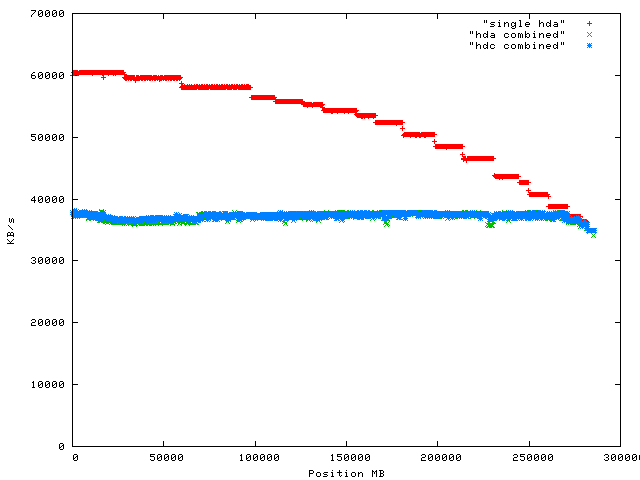
As correctly pointed out by cmot [1] my previous post about software RAID [2] made no mention of bus bandwidth. I have measured the bus bottlenecks of a couple of desktop machines running IDE disks with my ZCAV [3] benchmark (part of the Bonnie++ suite). The results show that two typical desktop machines had significant bottlenecks when running two disks for contiguous read operations [4]. Here is one of the graphs which shows that when two disks were active (on different IDE cables) the aggregate throughput was just under 80MB/s on a P4 1.5GHz while the disks were capable of delivering up to 120MB/s:
On a system such as the above P4 using software RAID will give a performance hit when compared to a hardware RAID device which is capable of driving both disks at full speed. I did not benchmark the relative speeds of read and write operations (writing is often slightly slower), but if for the sake of discussion we assume that read and write give the same performance then software RAID would only give 2/3 the performance of a theoretical perfect hardware RAID-1 implementation for large contiguous writes. On a RAID-5 array the bandwidth for large contiguous writes is the data size multiplied by N/(N-1) (where N is the number of disks), and on a RAID-6 array it is N/(N-2). For the case of a four disk RAID-6 array that would give the same overhead as writing to a RAID-1 and for the case of a minimal RAID-5 array it would be 50% more writes. So from the perspective of “I need X bandwidth, can my hardware deliver it” if I needed 40MB/s of bandwidth for contiguous writes then a 3 disk RAID-5 might work but a RAID-1 definitely would hit a bottleneck. Given that large contiguous writes to a RAID-1 is a corner case and that minimal sized RAID-5 and RAID-6 arrays are rare in most cases there should not be a significant overhead. As the number of seeks increases the actual amount of data transferred gets quite small. A few years ago I was running some mail servers which had a very intense IO load, four U320 SCSI disks in a hardware RAID-5 array was a system bottleneck - yet the IO was only 600KB/s of reads and 3MB/s of writes. In that case seeks were the bottleneck and write-back caching (which is another problem area for Linux software RAID) was necessary for good performance. For the example of my P4 system, it is quite obvious that with a four disk software RAID array consisting of disks that are reasonably new (anything slightly newer than the machine) there would be some bottlenecks. Another problem with Linux software RAID is that traditionally it has had to check the consistency of the entire RAID array in the case of an unexpected power failure. Such checks are the best way to get all disks in a RAID array fully utilised (Linux software RAID does not support reading from all disks in a mirror and checking that they are consistent for regular reads), so of course the issue of a bus bottleneck becomes an issue. Of course the solution to these problems is to use a server for server tasks and then you will not run out of bus bandwidth so easily. In the days before PCI-X and PCIe there were people running Linux software RAID-0 across multiple 3ware hardware controllers to get better bandwidth. A good server will have multiple PCI buses so getting an aggregate throughput greater than PCI bus bandwidth is possible. Reports of 400MB/s transfer rates using two 64bit PCI buses (each limited to ~266MB/s) were not uncommon. Of course then you run into the same problem, but instead of being limited to the performance of IDE controllers on the motherboard in a desktop system (as in my test machine) you would be limited to the number of PCI buses and the speed of each bus. If you were to install enough disks to even come close to the performance limits of PCIe then I expect that you would find that the CPU utilisation for the XOR operations is something that you want to off-load. But then on such a system you would probably want the other benefits of hardware RAID (dynamic growth, having one RAID that has a number of LUNs exported to different machines, redundant RAID controllers in the same RAID box, etc). I think that probably 12 disks is about the practical limit of Linux software RAID due to these issues and the RAID check speed. But it should be noted that the vast majority of RAID installations have significantly less than 12 disks. One thing that cmot mentioned was a RAID controller that runs on the system bus and takes data from other devices on that bus. Does anyone know of such a device?

Jacobo Tarr&#237;o Barreiro: AGPL

If I think that the FSF did the wrong thing, is there any way in which I can display my opposition? Can I become a negative member? Can I make an antidonation: get them to give me money? Update: In other words: I think that the AGPL is not free. Clause 13 is a restriction on usage. I’m very disappointed. (And the GPLv3 is not a high note for the FSF either).

Benjamin Mako Hill: Free Culture Distilled for Free Software Folks

I've posted an an article on my website called Free Culture Advanced which I wrote for the last edition of the Free Software Foundation Members' Bulletin which went out several months ago. The bulletin is one of things you get when you become an associate member of the FSF. The article makes the case for free culture and a freedom definition in terms that are directed to and I hope will resonate with folks from the free software community. I've posted versions of the article in HTML, PDF, and LaTeX.

19 November 2007

Benjamin Mako Hill: Affero General Public License Version 3

The Free Software Foundation sent out a press release today announcing a new addition to the FSF stable of licenses: the Affero General Public License or AGPL. The FSF has also published a set of answers to anticipated questions in the GPL FAQ. The first paragraph of the release explains what the AGPL is:
This is a new license; it is based on version 3 of the GNU General Public License (GNU GPLv3), but has an additional term to ensure that users who interact with the licensed software over a network can receive the source for that program. By publishing this license, the FSF aims to begin fostering user and development communities around free software web services and other network-oriented software.
The GPL is designed to ensure that users of software have access to the source code -- source is prerequisite to freedom and to the type of collaboration that has made free software successful. However, the GPL doesn't say "users" when it talks about who gets freedom; instead, it references people to whom the software is distributed. It doesn't say users for two reasons. The first is that, under copyright, "distribution" is a much more meaningful term and a powerful hook than "use" which is not, in most cases, one of the copyright holder's exclusive rights. The second is that, until very recently, having a copy of software was prerequisite to using it; possession was prerequisite to use. Things have changed. A large part of many people's computing experience involves running web applications. These include email clients (e.g., GMail or other webmails), office applications (e.g., Google Docs), social network systems, and others. These applications all run on servers -- i.e., on other people's computers. The providers of these services, the Googles and the FaceBooks, build upon, modify and improve GPL software without giving back to their users or the community that they took their software from. The AGPL was created several years ago by FSF board member Henri Poole as a way to address this issue. The license took the form of the GPLv2 with one extra clause. It was a first stab at a license and was imperfect. The language and methods were clunky and, most problematically, the license was incompatible with software under the GPL. The new AGPL is based on the GPLv3 and the extra clause has been rethought and rewritten. It has been vetted using the GPLv3 comment process and dozens of insightful comments from dozens of lawyers, hackers, and users of free software have been incorporated. The new license fixes the issues that many folks -- including myself -- had with the first version of the license. More importantly it can now be linked to GPLv3 code which makes the license a whole lot more practical. I am quoted in the release being excited about the license and I really am. I've got 2-3 major development projects (including Selectricity) which I've been waiting to distribute so that I could do so under the AGPLv3. The AGPL isn't a complete answer to the problem faced by disempowered users of web services. Without data or the capacity (in terms of servers, money, and expertise) to run web applications, the state and quality of these users' freedom remains far from clear. Thankfully, there are a whole bunch of folks thinking about what freedom for users of services might be -- it's a conversation that I'm going to push the FSF to participate in and pursue moving forward. The AGPLv3 marks a first solid contribution to the process of answering that question. If you'd like to help supporting or assisting the FSF in this effort, please consider becoming an associate member or donating.

18 November 2007

Evan Prodromou: 27 Brumaire CCXVI

I've been getting really interested in the new crop of Linux-based operating systems for mobile devices. I got a Nokia N800 earlier this year, which I've found really useful -- although a little frustrating, too. And I've been following the developments on OpenMoKo with great interest, too. So last Monday, when Google Android came out, I offered to give an experienced developer's opinion of the development kit for Network World. I spent most of the afternoon trying out the SDK, checking out the documentation, watching the presentation videos, and working on sample applications to get a feel for it. I'm pretty impressed with Android, and I think it's got a good shot to become the Open Source mobile application platform. I think that whoever wins in this space has the chance to shape how all mobile phone platforms work in the future, and to take a good chunk of the market. Opening up the phone platform to allow a real marketplace of third-party apps is, I believe, going to be a huge advantage for whoever can make it work. I think the main two contenders in the area are well ahead of Android so far, but they're really going to have to capitalize on that lead in the next 8-10 months before the first Android handsets are set to hit the market (late 2008 -- although we'll see about that schedule). And I'm not sure they've got the means and commitment to do it. Nokia has been screwing around with the N series of Internet tablets for a while. Which is great -- the operating system is clever, the GUI ("Hildon") GTK-based, and development in Python on the platform is a breeze. The basic tools -- media player, RSS reader (ingenious), Web browser, email, etc. -- work well. However, for unexplained reasons, Nokia hasn't put a damn phone into the thing. If there is a similar device that does everything that the N800 (or N810) does, plus has a phone in it, which one are people going to buy? It seems obvious to me. The other interesting OS is OpenMoKo, which I think is a great project with exactly the right goals. However, there's been some disappointment in the enthusiastic community around the OS as schedules have slipped and the developer preview devices shipped without a functioning dialer app. These two projects will have to fight uphill against the fear, uncertainty and doubt generated by the Android announcement and SDK release, even to stay in the game. And, to be fair, Google's announcement was masterful: classic vaporware -- for a product that won't be shipping for at least a year. But they got a pretty solid list of partners for the platform to sign on (albeit with only vague requirements for support). Best of all, they released a one-two punch of a bunch of developer information videos with tantalizing views of a nice-looking potential device, and a good SDK with tons of documentation and developer tools. It even includes an emulator that looks like a little phone. Awww! Android is slick, it's deep, and it's well-designed. The architecture is smart and sophisticated without being too clever for its own good. It's built on conservative -- maybe a little too conservative -- twin pillars: Java and Linux. For hardware providers, there's Linux's tried-and-true driver framework. For applications developers, way up at the top of the stack, there's good ol' boring Java, with new and smart APIs targeted specifically for mobile device apps, all on top of a new virtual machine called Dalvik that (supposedly) optimizes the hell out of Java bytecode. I was really impressed that the emulator emulates much more than just the Java APIs -- you can build ARM binaries in C that run on the thing. Very nice. Am I still going to get an OpenMoKo device? Maybe. But I'm going to continue playing around with the Android SDK, and looking for early developer versions of Android-supporting devices? Oh, yeah. Oh, and the article I did the research for is here; strangely it ended up on ComputerWorld rather than NetworkWorld. OK for me, though. tags:

More about me and my cool life So, I talked yesterday (Journal/27 Brumaire CCXVI) about how much weight I've lost in the last few months, which has been great. Another thing that's been going on for me is that I've started using the Getting Things Done process for scheduling my tasks and my time. I've never been particularly good at managing my time, but at least I've always known that however late or irresponsible I might be, my brother Ted would always be later. But when I visited San Francisco in August, Ted was really doing great. Friends and family kept telling me how responsible and down-to-earth Ted seemed lately. And whenever he had an idea for something to do, he wrote it down in his little Sidekick device. Ted showed me how the GTD system worked for him, and so I went out and bought the book and started reading it. I have been doing GTD for a few months now, and I've found it really satisfying. I don't worry as much any more about little things that I should be doing -- they're all captured in my system. It's really gratifying. I don't know if I've been quite as successful as Ted in improving my personal productivity, but I do know that I'm feeling a lot better about things and about myself. Which is really all that matters. tags:

Skating away Maj, Amita June and I went ice-skating today. It was AJ's first time out on the ice, and she really enjoyed it (most of the time). We had a couple of spills, mostly because it was really my first time skating with a 2-year-old, and partly because it was her first time skating with anyone. We went to the indoor rink near our old house on rue Cartier at the corner of Marie-Anne. Pretty soon we'll be able to go outside on the pond at Parc Lafontaine. catching our breath Maj isn't really a big skating fan, but she seemed to have a good time this time around. Which made three of us. I think we've got the makings of a Sunday-afternoon family tradition. We'll see, at least. tags:

More one-liners
  • I'm glad to see that the Mister Wong logo contest I talked about a while ago (Journal/21 Thermidor CCXV) has borne fruit. The top 12 logos look pretty good.
  • Maj and I have been catching up on season 3 of Deadwood lately. Great show, nice to see that season three is as solid as previous ones.
  • We've got RecentChangesCamp coming up in San Francisco in February 2008 (I think). Anyone interested should get involved at http://aboutus.org/RCC2008 .
  • What's the best alternative to the Sitemaps protocol for people who are into RDF? I'm thinking you could just make a hugantic RSS 1.0 feed -- after all, it is the "RDF Site Summary" format. Best of all, most search engines consume RSS as a recommended feed format. I'm going to try it with Vinismo and let you all know. The downside: I'm not sure many processors will handle a 100,000-item RSS feed very well.
  • Norman Mailer died just as I got around to reading the copy of ''Oswald's Tale'' I stole from the Driskill Hotel last year at South by Southwest. I can't help feeling responsible.
tags:

Russell Coker: Better Social Networking

When advogato.org was still cool I signed up to it. It was an interesting research project in skill metrics (determining the rating of people’s coding skills by the votes of others and weighting the votes by the rating of each person), and it was nice to be rated Master soon after I joined. I still use it on occasion for the blog syndication feature (when I find a good blog on Advogato I add it to my Planet installation). When orkut.com was really cool (when every time I had dinner with a group of people someone would ask if they could be an “orkut friend”) I signed up to it. It was interesting for a while but then most people got bored with it. Now there is Facebook and MySpace for social networking for social purposes and LinkedIn.com for business related social networking. I periodically get invited to join those services but have not been interested in any other than LinkedIn. I can’t join LinkedIn because their mail server is regarded as a SPAM source by my mail server but their web server refuses to provide any information on why this is (the rejection was apparently long enough ago that it’s rolled off my logs). The problem with all these services is that I am expected to sign up with each of them and go to a moderate amount of effort in writing up all the data in the various web pages. Writing it is a pain, keeping it up to date is more pain, and dealing with spam in “scrap-book” entries in Orkut is still an annoyance which I don’t want to multiply by four! So far the only step I’ve seen towards addressing this issue is the XFN - XHTML Friends Network [1] project. But that seems to be of fairly limited scope (just referring to the friendship status of people in a <A HREF link). I believe that the requirements for social networking are:

  1. Personal data about each person, some of which may only be available to friends or friends of friends.

  2. The user owns their own data, has full control over where it’s sent and the ability to request people who receive it to keep some parts of it secret.

  3. Ability to send email to friends of friends (determined by the wishes of each friend and FOAF).

  4. Ability to get a list of friends of friends.

  5. Incorporation of a standard format for CVs (for business social networking).

I think that the only way to go is to have a standard XML format for storing all personal data (including financial, career, and CV data) that can be used on any web site. Then someone who wants to be involved in social networking could create an XML file for a static web server (or multiple files with different content and password protected access), or they could have a server-side script generate an XML file on the fly with a set of data that is appropriate for the reader. The resulting social network would be entirely distributed and anyone could write software to join in. This covers item 1 and part of item 2. For sending email to friends of friends it would be good to avoid spam as much as possible. One way of doing would be requesting that friends publish a forwarding address on their own mail server in a manner similar to SRS [2]. SRS include the ability for such addresses to expire after a certain period of time (which would be convenient for this). In fact publishing SRS versions of friends email addresses would be a good option if you already use SPF [3] and SRS in your mail server. This covers item 3. The XML format could include information on how far the recipient could transfer it. For example if my server sent an XML file to a recruiting agency with my CV it could state that they could distribute it without restriction (so that they can give it to hiring managers) with the possibility of some fields being restricted (EG not tell the hiring manager what I used to get paid). For my mobile phone number I could send it to my friends with a request that they not send it on. This covers part of item 2. The URL for the friends file would of course be in the main XML file, and therefore you could have different friends lists published from different versions of your profile (EG the profile you send to recruiting agencies wouldn’t include drinking buddies etc). This completes the coverage of item 2. Then to have a friends list you have a single XML file on a web server that has the public parts of the XML files from all your friends. This means that getting a list of friends of friends would involve getting a single XML file for each friend (if you have 100 friends and each friend has 50 unique friends on average then you do 100 HTTP operations instead of 5,000). Minimising the number of web transfer operations is essential for performance and for reliability in the face of unreliable web servers (there is no chance of having 5,000 random web servers for individuals all up and accessible at the same time). This covers item 4. Item 5 is merely a nice thing to have which allows more easily replacing some of the recruiting infrastructure. As any such XML format will have several sections for arbitrary plain text (or maybe HTML) for describing various things the CV could of course be in HTML, but it would be good to have the data in XML. I posted this in the “blog” category because blogs are the only commonly used systems where end users do anything related to XML files (the RSS and ATOM feeds are XML). A blog server could easily be extended to do these social networking systems. As with a blog users could run their own social networking server (publishing their XML files) or they could use a service that is similar in concept to blogger which does it all for them (for the less technical users). Then an analogy to Planet, Technorati, etc in the blog space would be public aggregation services that compare people based on the number of friends they have etc, and attempts to map paths between people based on friends. This could also include GPG [4] data such that signing someone’s GPG key would cause your server to automatically list them in some friend category. The XML format should also have a field for a GPG signature (one option would be to use a GPG sub-key to sign the files and have the sub-key owned by the server). I don’t have any serious time to spend on implementing this at the moment. But if someone else starts coding such a project then I would certainly help test it, debug it, and contribute towards the XML design.

16 November 2007

Guido Trotter: LISA: done!

LISA’07 is over, and just concluded with a great talk about “Cooking at the Keyboard”, which of course I liked a lot, being this one of my favorite hobbies! This was my first LISA conference, and I had an all-round experience, giving an invited talk, hosting a BoF and speaking during the Hit The Ground Running track. Of those three the most fun has been the HTGR talk, in which I quickly summarized the Ganeti platform in 10′ and was able to answer a few questions in the last 5′. I definitely liked giving the invited talk, and I think the idea my teammates had to not just talk but actually give a live demo of our platform was very successful, even if it took some time and effort to prepare. The BoF was nice because it gave people chance to give more feedback and to talk about their ideas, it’s probably the session I learned more from. The slides for the talk are on the conference page, and the ones for HTGR will be soon! Globally it’s been a very intense week of talks, sessions, hallway chats, work and fun, and I definitely hope to be at LISA’08, next November in San Diego (it’s a bit like going back home, isnt it?)! I’m really glad to have come and want really to thank all the people who made this possible and all the people I met here, who made this event so good!

Russell Coker: Safe Banking by SMS?

Is it possible to secure Internet banking with SMS? As secure tokens are too expensive ($10 or more in bulk) and considered to be too difficult to use by many (most?) customers banks have sought out other options. One option that has been implemented by the National Australia Bank and will soon be available from the Commonwealth Bank is SMS authentication of transfers. The idea is that when you issue an online banking request you receive an SMS with a password and then have to enter that password to authenticate it. If you receive an unexpected password then you know you have been attacked. I wonder how much information is in the SMS, does it include the amount and where the money is to be transferred (in the case of a funds transfer - the operation most likely to be used by attackers)? If the full details are not included then an attacker could hijack an active session, get the user to enter the password, and then act as if the user entered the password incorrectly. The user would then request a new SMS and complete their desired transfer without realising that they just authorised a transfer to Russia… If the full details are recorded will the user look at them? Online banking fraud often involves transferring the funds to an idiot in the same country as the victim. Then the idiot sends the money to the attacker in some other manner which is more difficult to track. I wonder whether an attacker could divert the funds transfer to one of the idiots in question and have the victim not realise that the wrong account number was used. Another issue is that of SMS interception. Anyone who can hack the network of a phone company could steal money from any bank account in the country! For wealthy people there is also the possibility of stealing their mobile phone and making funds transfers before they report the theft. Another possibility is to register for a new phone company. Last time I changed phone companies it took about an hour for the new company to have the phone number and I don’t recall the phone company doing anything to verify that I owned the number in question. If an attacker had a credit card with the same name as the victim (names are not unique so this is not impossible or even inherently illegal) they could open a new phone service and steal the number. Someone who’s mobile phone stops working probably wouldn’t assume that it was part of a bank fraud scheme and act accordingly, in fact if they don’t use their mobile phone later it might be several days before someone contacts them in some other manner and mentions that they weren’t answering their mobile phone. A final possibility is the situation where a mobile phone is connected to a computer. Devices that combine mobile phone and PDA functionality are becoming common. A trojan horse program that offered to do something useful when a mobile phone was connected to the PC via a USB cable might fool some users. All that would be required is a few minutes of the phone being connected if the attacker already has the password for online banking. Maybe they could even make it appear that the bank was demanding that the phone be connected to the PC - that should fool users who don’t understand how SMS authentication works. It seems to me that SMS authentication is an improvement (it adds an external device which usually can’t be directly manipulated by the attacker) but is far from perfect security. I previously wrote about the bad idea that you can bank with an infected computer [1]. SMS authentication is a good step towards making things more difficult for attackers (which is always a good idea) but doesn’t really secure the system. Also it costs 5 cents for each SMS, I expect that the banks will want their customers to pay for this - I would rather pay for a $10 token up-front.

Adrian von Bidder: SW and HW-RAID: Bus usage

I wonder why Russel doesn't touch on system bus usage in his excellent article. AFAIK there are three main scenarios: SW-RAID, “classical HW-RAID” (RAID controller which is on the system bus as a complete unit, discs behind it) and “Add-On HW-RAID” (RAID controller is a device on the system bus which controls the non-RAID disc controllers which are also on the system bus.) SW-RAID is clearly worse than classical HW-RAID in terms of system bus usage, but I'm not sure how the Add-On HW-RAID chips compare to that - If CPU to memory bandwidth is much higher than memory to bus bandwidth they might be even worse than SW-RAID (RAID 5/6: transfer data to RAID chip for checksumming and from there to the disc controllers compared to checksumming on the CPU which gives higher CPU usage but less bus load.) But this is guesswork, I don't have much experience in this field, so corrections welcome!

Next.

Previous.