Search Results: "mak"

1 October 2015

Junichi Uekawa: Playing with FUSE and git.

Playing with FUSE and git. I've been playing with FUSE and git to make a file system, for fun. There's already many filesystems that are implemented with FUSE, and there are quite a few ones that implement filesystem for git, but I don't use any of them. I wondered why that is the case but tried to build one anyway. It's in github repository gitlstreefs. I have created several toy file systems in C++. ninjafs is one where it shows ninja targets as files and builds the file target when file is actually needed. They aren't quite as useful yet but an interesting excercise, FUSE was reasonably straightforward to implement simple filesystems with.

30 September 2015

Chris Lamb: Free software activities in September 2015

Inspired by Rapha l Hertzog, here is a monthly update covering a large part of what I have been doing in the free software world:
Debian The Reproducible Builds project was also covered in depth on LWN as well as in Lunar's weekly reports (#18, #19, #20, #21, #22).
Uploads
  • redis A new upstream release, as well as overhauling the systemd configuration, maintaining feature parity with sysvinit and adding various security hardening features.
  • python-redis Attempting to get its Debian Continuous Integration tests to pass successfully.
  • libfiu Ensuring we do not FTBFS under exotic locales.
  • gunicorn Dropping a dependency on python-tox now that tests are disabled.


RC bugs


I also filed FTBFS bugs against actdiag, actdiag, bangarang, bmon, bppphyview, cervisia, choqok, cinnamon-control-center, clasp, composer, cpl-plugin-naco, dirspec, django-countries, dmapi, dolphin-plugins, dulwich, elki, eqonomize, eztrace, fontmatrix, freedink, galera-3, golang-git2go, golang-github-golang-leveldb, gopher, gst-plugins-bad0.10, jbofihe, k3b, kalgebra, kbibtex, kde-baseapps, kde-dev-utils, kdesdk-kioslaves, kdesvn, kdevelop-php-docs, kdewebdev, kftpgrabber, kile, kmess, kmix, kmldonkey, knights, konsole4, kpartsplugin, kplayer, kraft, krecipes, krusader, ktp-auth-handler, ktp-common-internals, ktp-text-ui, libdevice-cdio-perl, libdr-tarantool-perl, libevent-rpc-perl, libmime-util-java, libmoosex-app-cmd-perl, libmoosex-app-cmd-perl, librdkafka, libxml-easyobj-perl, maven-dependency-plugin, mmtk, murano-dashboard, node-expat, node-iconv, node-raw-body, node-srs, node-websocket, ocaml-estring, ocaml-estring, oce, odb, oslo-config, oslo.messaging, ovirt-guest-agent, packagesearch, php-svn, php5-midgard2, phpunit-story, pike8.0, plasma-widget-adjustableclock, plowshare4, procps, pygpgme, pylibmc, pyroma, python-admesh, python-bleach, python-dmidecode, python-libdiscid, python-mne, python-mne, python-nmap, python-nmap, python-oslo.middleware, python-riemann-client, python-traceback2, qdjango, qsapecng, ruby-em-synchrony, ruby-ffi-rzmq, ruby-nokogiri, ruby-opengraph-parser, ruby-thread-safe, shortuuid, skrooge, smb4k, snp-sites, soprano, stopmotion, subtitlecomposer, svgpart, thin-provisioning-tools, umbrello, validator.js, vdr-plugin-prefermenu, vdr-plugin-vnsiserver, vdr-plugin-weather, webkitkde, xbmc-pvr-addons, xfsdump & zanshin.

Norbert Preining: 6 years in Japan

Exactly 6 years ago, on October 1, 2009, I started my work at the Japan Advanced Institute of Science and Technology (JAIST), arriving the previous day in a place not completely unknown, but with a completely different outlook: I had a position as Associate Professor, and somehow was looking forward to an interesting and challenging time. japan-flag 6 years later I am still here at the JAIST, but things have changed considerably, and my future is even less clear than 6 years ago. So it is time to reflect a bit about the last years. The biggest achievement My biggest achievement in these 6 years is probably that I managed to learn Japanese to a degree that I can teach in Japanese (math, logic, etc), can read Japanese books to a certain degree, and have generally no problem communicating in daily life. Said that, there is still a long way to go. Reading, and much more writing, is still requiring concentration and power, far from the natural flow in my other languages. While talking feels rather natural, the complexity of the written language is a huge hurdle. But this is probably the good, the high point of the 6 years, a great challenge, that keeps my mind busy and working and challenged over long time, with still more to do. The happiest thing Many events here in Japan were of great fun and enjoyment for me. The rich culture, paired with a spectacular love for traditional handicraft I haven t seen anywhere else, is a guarantee for enjoyable and intellectually stimulating activities. But the biggest joy of my time here of course was that I found a lovely, beautiful, and caring wife. Not knowing the challenges of an international marriage, I was caught without preparation, and so we had (and still have) rough times due to the cultural differences, and different expectations. But this is what makes life interesting, and so I am always grateful for this chance. Whatever happens in the future, she will be part of my decisions and the center of my life. The biggest disappointment Of course, when you live in a country for some time, you learn to know the highs and lows. As someone interested in politics and social systems, Japan is a pain in the butt in many respects. But the biggest disappointment was in a different area: Working environment. While I love my work and had great surroundings, there is something that always is present in the background: Foreigners here are not considered assets, but embellishment. Meaning that they are the first ones to loose their jobs when times are difficult, meaning that they are not considered as full members. After many years at a university here, and with no outlook on a job after March, I can only say, Japan is a country of Japanese first , especially when it comes to jobs. Of course, other countries are not that different, but looking at the average mixture of nationalities at universities in Europe or the US, and comparing them to Japanese universities, a bleak image is arising. I enjoyed my time here, I worked hard and did a lot for my university, but the economically hard times make it necessary to change things, and that means getting rid of foreigners. That is the reason why the work environment is the biggest disappointment in these years. Future The future is unclear, as it always was. The dire fate of many researchers. Being in my 40ies without a permanent position and a family, I am forced to think hard what my next options are. The hide-and-seek games of Japanese (and other) universities seem to me less and less an option. Sad as it is, after having worked 20+ years in academics, having done some interesting (for me) research and having managed to secure a name in our community, I am not sure where my future is. Continuing on definite contracts does not sound like a great option for me. Several things for the future come to my mind: starting my own business, work as programmer (maybe Google still wants me after I rejected them 2 years ago), work as mountain guide (have done that for some years before going to Japan). All of that is possible, but my loosing the time to research will always be a pain, since I enjoy cracking my brain on some complicated and deep logical problems. Whatever comes, I will take it as a chance to learn new things. And in one way or another it will work out, I hope.

Yves-Alexis Perez: Kernel recipes 2015: Hardened kernels for everyone

As part of my ongoing effort to provide grsecurity patched kernels for Debian, I gave a talk this morning at Kernel Recipes 2015. Slides and video should be available at one point, but you can find the former here in the meantime. I'm making some progresses on #605090 which I should be able to push soon.

29 September 2015

Norbert Preining: Multi-boot stick update: TAILS 1.6, SysresCD 4.6.0, GParted 0.23, Debian 8.2

Updates for my multi-boot/multi-purpose USB stick: All components have been updated to the latest versions and I have confirmed that all of them still boot properly although changes in the grub.cfg file are necessary. So going through these explanations one will end up with a usable USB stick that can boot you into TAILS, System Rescue CD, GNU Parted Live CD, GRML, and also can boot into an installation of Debian 8.2 Jessie installation. All this while still being able to use the USB stick as normal media. multi-usb-disk Since there have been a lot of updates, and also changes in the setup and grub config file, I include the full procedure here, that is, merging and updating these previous posts: USB stick with Tails and SystemRescueCD, Tails 1.2.1, Debian jessie installer, System Rescue CD on USB, USB stick update: TAILS 1.4, GParted 0.22, SysResCD 4.5.2, Debian Jessie, and USB stick update: Debian is back, plus GRML. Let us repeat some things from the original post concerning the wishlist and the main players: I have a long wishlist of items a boot stick should fulfill Requirements A USB stick, the iso images of TAILS 1.6, SystemRescueCD 4.6.0, GParted Lice CD 0.23.0, GRML 2014.11, and some tool to access iso images, for example ISOmaster (often available from your friendly Linux distribution). I assume that you have already an USB stick prepared as described previously. If this is not the case, please go there and follow the section on preparing your usb stick. Three types of boot options We will employ three different approaches to boot special systems: the one is directly from an iso image (easiest, simple to update), the other via extraction of the necessary kernels and images (bit painful, needs some handwork), and the last one is a mixture necessary to get Debian booting (most painful, needs additional downloads and handwork). At the moment we have the following status with respect to boot methods: Booting from ISO image Grub has gained quite some time ago the ability to boot directly from an ISO image. In this case the iso image is mounted via loopback, and the kernel and initrd are specified relatively to the iso image root. This system makes it extremely easy to update the respective boot option: just drop the new iso image onto the USB stick, and update the isofile setting. One could even use some -latest method, but I prefer to keep the exact name. For both SystemRescueCD, GNOME Partition Live CD, and GRML, just drop the iso files into /boot/iso/, in my case /boot/iso/systemrescuecd-x86-4.6.0.iso and /boot/iso/gparted-live-0.23.0-1-i586.iso. After that, entries like the following have to be added to grub.cfg. For the full list see grub.cfg:
submenu "System Rescue CD 4.6.0 (via ISO) ---> "  
  set isofile="/boot/iso/systemrescuecd-x86-4.6.0.iso"
  menuentry "SystemRescueCd (64bit, default boot options)"  
        set gfxpayload=keep
        loopback loop (hd0,1)$isofile
        linux   (loop)/isolinux/rescue64 isoloop=$isofile
        initrd  (loop)/isolinux/initram.igz
   
  ...
 
 
submenu "GNU/Gnome Parted Live CD 0.23.0 (via ISO) ---> "  
  set isofile="/boot/iso/gparted-live-0.23.0-1-i586.iso"
  menuentry "GParted Live (Default settings)" 
    loopback loop (hd0,1)$isofile
    linux (loop)/live/vmlinuz boot=live union=overlay username=user config components quiet noswap noeject  ip= net.ifnames=0 nosplash findiso=$isofile
    initrd (loop)/live/initrd.img
   
  ...
 
 
submenu "GRML 2014.11 ---> "  
  menuentry "Grml Rescue System 64bit"  
        iso_path="/boot/iso/grml64-full_2014.11.iso"
        export iso_path
        loopback loop (hd0,1)$iso_path
        set root=(loop)
        kernelopts=" ssh=foobarbaz toram  "
        export kernelopts
        configfile /boot/grub/loopback.cfg
    
 
Note the added isoloop=$isofile and findiso=$isofile that helps the installer find the iso images. Booting via extraction of kernels and images This is a bit more tedious, but still not too bad. Installation of TAILS files Assuming you have access to the files on the TAILS CD via the directory ~/tails, execute the following commands:
mkdir -p /usbstick/boot/tails
cp -a ~/tails/live/* /usbstick/boot/tails/
The grub.cfg entries look now similar to the following:
submenu "TAILS Environment 1.6 ---> "  
  menuentry "Tails64 Live System"  
        linux   /boot/tails/vmlinuz2 boot=live live-media-path=/boot/tails config live-media=removable nopersistent noprompt timezone=Etc/UTC block.events_dfl_poll_msecs=1000 splash noautologin module=Tails
        initrd  /boot/tails/initrd2.img
 
   
  ...
 
The important part here is the live-media-path=/boot/tails, otherwise TAILS will not find the correct files for booting. The rest of the information was extracted from the boot setup of TAILS itself. Mixture of iso image and extraction Debian jessie As mentioned in the previous post, booting Debian/Jessie installation images via any method laid out above didn t work, since the iso images is never found. It turned out that the current installer iso images do not contain the iso-scan package, which is responsible for searching and loading of iso images. But with a small trick one can overcome this: One needs to replace the initrd that is on the ISO image with one that contains the iso-scan package. And we do not need to create these initrd by ourselves, but simply use the ones from hd-media type installer. I downloaded the following four gzipped initrds from one of the Debian mirrors: i386/initrd text mode, i386/initrd gui mode, amd64/initrd text mode, amd64/initrd gui mode, and put them into the USB stick s boot/debian/install.386, boot/debian/install.386/gtk, boot/debian/install.amd, boot/debian/install.amd/gtk, respectively. Finally, I added entries similar to this one (rest see the grub.cfg file):
submenu "Debian 8.2 Jessie NetInstall ---> "  
    set isofile="/boot/iso/firmware-8.2.0-amd64-i386-netinst.iso"
    menuentry '64 bit Install'  
        set background_color=black
        loopback loop (hd0,1)$isofile
        linux    (loop)/install.amd/vmlinuz iso-scan/ask_second_pass=true iso-scan/filename=$isofile vga=788 -- quiet 
        initrd   /boot/debian/install.amd/initrd.gz
     
    ...
 
Again an important point, don t forget the two kernel command line options: iso-scan/ask_second_pass=true iso-scan/filename=$isofile, otherwise you probably will have to make the installer scan all disks and drives completely, which might take ages. Current status of USB stick Just to make sure, the usb stick should contain at the current stage the following files:
/boot/
    iso/
        firmware-8.2.0-amd64-i386-netinst.iso
        gparted-live-0.23.0-1-i586.iso
        grml64-full_2014.11.iso
        systemrescuecd-x86-4.6.0.iso
    tails/
        vmlinuz Tails.module initrd.img ....
    grub/
        fonts/
            lots of files
        locale/
            lots of files
        x86_64-efi/
            lots of files
        font.pf2
        grubenv
        grub.cfg            *this file we create in the next step!!*
/EFI
    BOOT/
        BOOTX64.EFI
The Grub config file grub.cfg The final step is to provide a grub config file in /usbstick/boot/grub/grub.cfg. I created one by looking at the isoboot.cfg files both in the SystemRescueCD, TAILS iso images, GParted iso image, and the Debian/Jessie image, and converting them to grub syntax. Excerpts have been shown above in the various sections. I spare you all the details, grab a copy here: grub.cfg Conclusion That s it. Now you can anonymously provide data about your evil government, rescue your friends computer, fix a forgotten Windows password, and above all, install a proper free operating system. If you have any comments, improvements or suggestions, please drop me a comment. I hope this helps a few people getting a decent USB boot stick running. Enjoy.

28 September 2015

Antoine Beaupr : Fun experiments with laptop battery

After reading up on a eye-opening blog from Petter Reinholdtsen about laptop batteries, or more specifically Lithium-Ion laptop batteries, I figured I needed to try out the "TLP Linux Advanced Power Management" that I had been keeping an eye on for a while. tlp is yet another tool to control power usage on laptops (mostly Thinkpad, mine is a X120e). The novelty of tlp is the "hands off" approach: everything should be automatically configured for you... Obviously, that means I then went on working for a few hours on breaking and fixing my laptop in random operations. I opened a bunch of pull requests on the interesting battery status package that Petter produced to make it work with my setup and make it display graphs directly (instead of into a file). I also rewrote the graphing tool in Python with SciPy in order to have cleaner labels and be able to deduce the date at which a battery would be completely unusuable because it can't recharge high enough. (At the time of writing, the battery estimated death time is december 7th, but that data is skewed because of a quick change in the battery charge after the BIOS upgrade, below.) I then went on to try to limit my laptop charging to 80%, since this seems to make the battery last longer (sources from Petter: 1, 2, 3). Unfortunately, even after building a local (and trivial) backport of the tlp package to Debian stable (8.2/Jessie), I still couldn't access those controls, as TLP is really just a set of shell scripts that glue a bunch of stuff together.
The backport was simply:
apt-get source tlp
cd tlp*/
debuild
sudo dpkg -i ../tlp*.deb
I read here and there (and in Petter's post) that I needed the tp-smapi-dkms package, so I went ahead an installed it:
sudo apt install tp-smapi-dkms
(Yes, Jessie has a neat apt command now, it's great, upgrade now.) Unfortunately, this still didn't work. I think the error back then was something like:
thinkpad_ec: thinkpad_ec_request_row: arg0 rejected: (0x01:0x00)->0x00
thinkpad_ec: thinkpad_ec_read_row: failed requesting row: (0x01:0x00)->0xfffffffb
thinkpad_ec: initial ec test failed
I have seen suggestions here and there to try the acpi-call-dkms package, but that was useless as it doesn't support my model (but may work with others!). The error there was:
acpi_call: Cannot get handle: Error: AE_NOT_FOUND
Note: I still have it installed - it's unclear what impact it has, and I do not want to break my current setup.
So I then started to look at upgrading my BIOS, for some reason. I was running version 1.13 (8FET29WW) from 05/06/2011. I was able to update to 1.17 (8FET33WW) from 11/07/2012, using the memdisk binary from the syslinux-common package, with some help from the quite useful grub-imageboot package:
sudo apt install syslinux-common grub-imageboot
wget https://download.lenovo.com/ibmdl/pub/pc/pccbbs/mobiles/8fuj10uc.iso
sudo mkdir /boot/images
sudo mv 8fuj10uc.iso /boot/images
sudo reboot
I found the image on the Thinkpad x120e support page from Lenovo (which happily bounces around, so don't rely on the above URLs too much). When I rebooted, I was offered to boot from the image by grub, which went on fine, considering it was running some version of DOS, which is always a bit scary considering it is software that is somewhat almost as old as me.
I wish I could have installed some free software in the BIOS instead of the outdated crap that Lenovo provides, but unfortunately, it seems this will never be possible with Libreboot or Coreboot, mostly because Intel is evil and installs backdoors in all their computers. Fun times.
Fortunately and surprisingly, the update worked and went on pretty smoothly. After that, I was able to set the charge limit with:
echo 80   sudo tee /sys/devices/platform/smapi/BAT0/stop_charge_thresh
Amazing! I had almost forgotten why I almost bricked my system on a thursday, good thing that worked! Now the fun part was that, after some reboots or something I did, I am not sure what, the above stopped working: I couldn't load the drivers at all anymore, dmesg treating me with a nasty:
thinkpad_ec: thinkpad_ec_read_row: failed requesting row: (0x01:0x00)->0xfffffff0
thinkpad_ec: initial ec test failed
Now that is some obscure error message material! Fun stuff. I tried uninstalling tlp, the smapi modules, the acpi-call modules, rebooting, turning the machine off, removing the battery, nothing worked. Even more hilarious, the charge controler was now stuck at 80%: I had artificially destroyed 20% of the battery capacity in software. Ouch. I think this may have been related to uninstalling the tp-smapi-dkms package without unloading it at first. I found some weird entries in my kern.log like this:
tp_smapi unloaded.
thinkpad_ec: thinkpad_ec_read_row: failed requesting row: (0x14:0x00)->0xfffffff0
hdaps: cannot power off
hdaps: driver unloaded.
thinkpad_ec: unloaded.
I think that after that point, I couldn't load either module, not even thinkpad_ec... After tearing out a few more hairs and hammering my head on the keyboard randomly, I thought I could just try another BIOS upgrade, just for the fun of it. Turns out you actually can't rerun the upgrade, but you can change the model number through the same software, and this seems to reset some stuff. So I went back in the ISO image I had loaded earlier, and went on to change the model number (actually setting it to the same value, but whatever, it still ran the update). It turns out this seems to have reset a bunch of stuff and now everything works. I can use tlp setcharge and all the neat tools go well. The two key commands are:
# limit charging to 80% of the battery, but not lower than 40%
sudo tlp setcharge 40 80
# clear the above setting and just charge the battery to 100%
sudo tlp fullcharge
It seems that the 40% bit isn't supported by my laptop, but whatever: the battery stays charged when on AC power anyways, so I don't really understand what the setting is for in the first place. The error there is:
smapi smapi: smapi_request: SMAPI error: Function is not supported by SMAPI BIOS (func=2116)
smapi smapi: __get_real_thresh: cannot get start_thresh of bat=0: Function is not supported by SMAPI BIOS
The second command is what I will need to remember to run before I unplug the laptop for a trip. I suspect this will be really annoying and I may end up disabling all this stuff and just yank the power cable out when the battery reaches 80%, by hand, when I need to. But it was a fun geeking out, and hopefully this will be useful for others. And of course, the graphs from Petter will be interesting in a few months... Before the BIOS upgrade, the battery capacity was reported as 100% (actually, at 100.03%, which was strange). Now, the capacity is at 98.09%, which is probably just a more accurate reading that was fixed in the BIOS upgrade. Finally, also see the useful thinkwiki troubleshooting page and especially their interesting BIOS upgrade documentation which inspired me to write my own version. I would have gladly contributed to theirs, but I seem to have lost my password on this site, with no recovery possible... The arch linux wiki has obviously excellent documentation as well, as usual.

27 September 2015

Sven Hoexter: 1blu hack and the usual TLS certificate key madness

Some weeks ago the german low cost hoster 1blu got hacked and there was a bit of fuss later about the TLS certificates issued by 1blu. I think they reissued all of them. Since I knew that some hoster offer to generate the complete cert + key package for the customer I naively assumed that only the lazy and novice customers were the victims of that issue. Today, while helping someone, I learned that 1blu forces you to use the key generated by them for certificates included in a virtual server bundle and probably other bundles. That makes those bundles a lot less attractive since the included certificate is not useful at all. One could of course argue that a virtual server is not trustworthy anyway, but I'd like to believe for now that it's more complicated to extract stuff from all running virtual servers compared to dumping the central database / key repository. Maybe it's time to create a wrapper around openssl that is less opaque to novice users so we can get rid of key generation by a third party one day. In the end it's a disasterous trend that only got started because of usability issues.

Niels Thykier: There is nothing like (missing) iptables (rules) to make you use tor

I have been fiddling with setting up both iptables and tor on my local machine. Most of it was fairly easy to do, once I dedicated the time to actually do it. Configuring both at the same time also made things easier for me, but YMMV. Regardless, it did take quite a while researching, tweaking and testing most of that time was spent on the iptables front for me. I ended up doing this incrementally. The major 5 steps I went through were:
  1. Created a basic incoming (INPUT) firewall enforcing
  2. Installed tor + torsocks and aliased a few commands to run with torsocks
  3. Created a basic outgoing (OUTPUT) firewall permissive
  4. Make the outgoing firewall enforcing
  5. Migrate the majority of programs and services to use tor.
Some of these overlapped time-wise and I certainly revisited the configuration a couple of times. A couple of things, that I learned:
Filed under: Debian

Lunar: Reproducible builds: week 22 in Stretch cycle

What happened in the reproducible builds effort this week: Toolchain fixes Packages fixed The following 22 packages became reproducible due to changes in their build dependencies: breathe, cdi-api, geronimo-jpa-2.0-spec, geronimo-validation-1.0-spec, gradle-propdeps-plugin, jansi, javaparser, libjsr311-api-java, mac-widgets, mockito, mojarra, pastescript, plexus-utils2, powerline, python-psutil, python-sfml, python-tldap, pythondialog, tox, trident, truffle, zookeeper. The following packages became reproducible after getting fixed: Some uploads fixed some reproducibility issues but not all of them: Patches submitted which have not made their way to the archive yet: diffoscope development The changes to make diffoscope run under Python 3, along with many small fixes, entered the archive with version 35 on September 21th. Another release was made the very next day fixed two encoding-related issues discovered when running diffoscope on more Debian packages. strip-nondeterminism development Version 0.12.0 now preserves file permissions on modified zip files and dh_strip_nondeterminism has been made compatible with older debhelper. disorderfs development Version 0.3.0 implemented a multi-user mode that was required to build Debian packages using disorderfs. It also added command line options to control the ordering of files in directory (either shuffled or reversed) and another to do arbitrary changes to the reported space used by files on disk. A couple days later, version 0.4.0 was released to support locks, flush, fsync, fsyncdir, read_buf, and write_buf. Almost all known issues have now been fixed. reproducible.debian.net disorderfs is now used during the second build. This makes file ordering issue very easy to identify as such. (h01ger) Work has been done on making the distributed build setup more reliable. (h01ger) Documentation update Matt Kraii fixed the example on how to fix issues related to dates in Sphinx. Recent Sphinx versions should also be compatible with SOURCE_DATE_EPOCH. Package reviews 53 reviews have been removed, 85 added and 13 updated this week. 46 packages failing to build from source has been identified by Chris Lamb, Chris West, and Niko Tyni. Chris Lamb was the lucky reporter of bug #800000 on vdr-plugin-prefermenu. Issues related to disorderfs are being tracked with a new issue.

25 September 2015

Steve McIntyre: Linaro VLANd v0.4

VLANd is a python program intended to make it easy to manage port-based VLAN setups across multiple switches in a network. It is designed to be vendor-agnostic, with a clean pluggable driver API to allow for a wide range of different switches to be controlled together. There's more information in the README file. I've just released v0.4, with a lot of changes included since the last release: VLANd is Free Software, released under the GPL version 2 (or any later version). For now, grab it from git; tarballs will be coming shortly.
24 September 2015

Petter Reinholdtsen: The life and death of a laptop battery

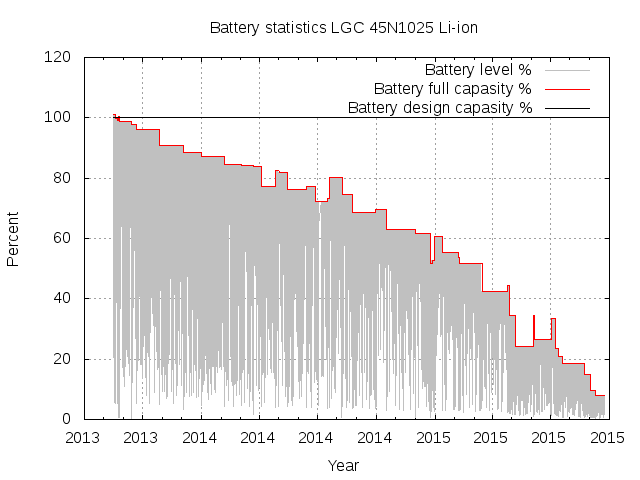
When I get a new laptop, the battery life time at the start is OK. But this do not last. The last few laptops gave me a feeling that within a year, the life time is just a fraction of what it used to be, and it slowly become painful to use the laptop without power connected all the time. Because of this, when I got a new Thinkpad X230 laptop about two years ago, I decided to monitor its battery state to have more hard facts when the battery started to fail. First I tried to find a sensible Debian package to record the battery status, assuming that this must be a problem already handled by someone else. I found battery-stats, which collects statistics from the battery, but it was completely broken. I sent a few suggestions to the maintainer, but decided to write my own collector as a shell script while I waited for feedback from him. Via a blog post about the battery development on a MacBook Air I also discovered batlog, not available in Debian. I started my collector 2013-07-15, and it has been collecting battery stats ever since. Now my /var/log/hjemmenett-battery-status.log file contain around 115,000 measurements, from the time the battery was working great until now, when it is unable to charge above 7% of original capacity. My collector shell script is quite simple and look like this:

#!/bin/sh
# Inspired by
# http://www.ifweassume.com/2013/08/the-de-evolution-of-my-laptop-battery.html
# See also
# http://blog.sleeplessbeastie.eu/2013/01/02/debian-how-to-monitor-battery-capacity/
logfile=/var/log/hjemmenett-battery-status.log
files="manufacturer model_name technology serial_number \
    energy_full energy_full_design energy_now cycle_count status"
if [ ! -e "$logfile" ] ; then
    (
	printf "timestamp,"
	for f in $files; do
	    printf "%s," $f
	done
	echo
    ) > "$logfile"
fi
log_battery()  
    # Print complete message in one echo call, to avoid race condition
    # when several log processes run in parallel.
    msg=$(printf "%s," $(date +%s); \
	for f in $files; do \
	    printf "%s," $(cat $f); \
	done)
    echo "$msg"
 
cd /sys/class/power_supply
for bat in BAT*; do
    (cd $bat && log_battery >> "$logfile")
done
The script is called when the power management system detect a change in the power status (power plug in or out), and when going into and out of hibernation and suspend. In addition, it collect a value every 10 minutes. This make it possible for me know when the battery is discharging, charging and how the maximum charge change over time. The code for the Debian package is now available on github. The collected log file look like this:
timestamp,manufacturer,model_name,technology,serial_number,energy_full,energy_full_design,energy_now,cycle_count,status,
1376591133,LGC,45N1025,Li-ion,974,62800000,62160000,39050000,0,Discharging,
[...]
1443090528,LGC,45N1025,Li-ion,974,4900000,62160000,4900000,0,Full,
1443090601,LGC,45N1025,Li-ion,974,4900000,62160000,4900000,0,Full,
I wrote a small script to create a graph of the charge development over time. This graph depicted above show the slow death of my laptop battery. But why is this happening? Why are my laptop batteries always dying in a year or two, while the batteries of space probes and satellites keep working year after year. If we are to believe Battery University, the cause is me charging the battery whenever I have a chance, and the fix is to not charge the Lithium-ion batteries to 100% all the time, but to stay below 90% of full charge most of the time. I've been told that the Tesla electric cars limit the charge of their batteries to 80%, with the option to charge to 100% when preparing for a longer trip (not that I would want a car like Tesla where rights to privacy is abandoned, but that is another story), which I guess is the option we should have for laptops on Linux too. Is there a good and generic way with Linux to tell the battery to stop charging at 80%, unless requested to charge to 100% once in preparation for a longer trip? I found one recipe on askubuntu for Ubuntu to limit charging on Thinkpad to 80%, but could not get it to work (kernel module refused to load). I wonder why the battery capacity was reported to be more than 100% at the start. I also wonder why the "full capacity" increases some times, and if it is possible to repeat the process to get the battery back to design capacity. And I wonder if the discharge and charge speed change over time, or if this stay the same. I did not yet try to write a tool to calculate the derivative values of the battery level, but suspect some interesting insights might be learned from those. Update 2015-09-24: I got a tip to install the packages acpi-call-dkms and tlp (unfortunately missing in Debian stable) packages instead of the tp-smapi-dkms package I had tried to use initially, and use 'tlp setcharge 40 80' to change when charging start and stop. I've done so now, but expect my existing battery is toast and need to be replaced. The proposal is unfortunately Thinkpad specific.

Matthew Garrett: Filling in the holes in Linux boot chain measurement, and the TPM measurement log

When I wrote about TPM attestation via 2FA, I mentioned that you needed a bootloader that actually performed measurement. I've now written some patches for Shim and Grub that do so.

The Shim code does a couple of things. The obvious one is to measure the second-stage bootloader into PCR 9. The perhaps less expected one is to measure the contents of the MokList and MokSBState UEFI variables into PCR 14. This means that if you're happy simply running a system with your own set of signing keys and just want to ensure that your secure boot configuration hasn't been compromised, you can simply seal to PCR 7 (which will contain the UEFI Secure Boot state as defined by the UEFI spec) and PCR 14 (which will contain the additional state used by Shim) and ignore all the others.

The grub code is a little more complicated because there's more ways to get it to execute code. Right now I've gone for a fairly extreme implementation. On BIOS systems, the grub stage 1 and 2 will be measured into PCR 9[1]. That's the only BIOS-specific part of things. From then on, any grub modules that are loaded will also be measured into PCR 9. The full kernel image will be measured into PCR10, and the full initramfs will be measured into PCR11. The command line passed to the kernel is in PCR12. Finally, each command executed by grub (including those in the config file) is measured into PCR 13.

That's quite a lot of measurement, and there are probably fairly reasonable circumstances under which you won't want to pay attention to all of those PCRs. But you've probably also noticed that several different things may be measured into the same PCR, and that makes it more difficult to figure out what's going on. Thankfully, the spec designers have a solution to this in the form of the TPM measurement log.

Rather than merely extending a PCR with a new hash, software can extend the measurement log at the same time. This is stored outside the TPM and so isn't directly cryptographically protected. In the simplest form, it contains a hash and some form of description of the event associated with that hash. If you replay those hashes you should end up with the same value that's in the TPM, so for attestation purposes you can perform that verification and then merely check that specific log values you care about are correct. This makes it possible to have a system perform an attestation to a remote server that contains a full list of the grub commands that it ran and for that server to make its attestation decision based on a subset of those.

No promises as yet about PCR allocation being final or these patches ever going anywhere in their current form, but it seems reasonable to get them out there so people can play. Let me know if you end up using them!

[1] The code for this is derived from the old Trusted Grub patchset, by way of Sirrix AG's Trusted Grub 2 tree.

comment count unavailable comments

23 September 2015

Simon Josefsson: Cosmos A Simple Configuration Management System

Back in early 2012 I had been helping with system administration of a number of Debian/Ubuntu-based machines, and the odd Solaris machine, for a couple of years at $DAYJOB. We had a combination of hand-written scripts, documentation notes that we cut n paste d from during installation, and some locally maintained Debian packages for pulling in dependencies and providing some configuration files. As the number of people and machines involved grew, I realized that I wasn t happy with how these machines were being administrated. If one of these machines would disappear in flames, it would take time (and more importantly, non-trivial manual labor) to get its services up and running again. I wanted a system that could automate the complete configuration of any Unix-like machine. It should require minimal human interaction. I wanted the configuration files to be version controlled. I wanted good security properties. I did not want to rely on a centralized server that would be a single point of failure. It had to be portable and be easy to get to work on new (and very old) platforms. It should be easy to modify a configuration file and get it deployed. I wanted it to be easy to start to use on an existing server. I wanted it to allow for incremental adoption. Surely this must exist, I thought. During January 2012 I evaluated the existing configuration management systems around, like CFEngine, Chef, and Puppet. I don t recall my reasons for rejecting each individual project, but needless to say I did not find what I was looking for. The reasons for rejecting the projects I looked at ranged from centralization concerns (single-point-of-failure central servers), bad security (no OpenPGP signing integration), to the feeling that the projects were too complex and hence fragile. I m sure there were other reasons too. In February I started going back to my original needs and tried to see if I could abstract something from the knowledge that was in all these notes, script snippets and local dpkg packages. I realized that the essence of what I wanted was one shell script per machine, OpenPGP signed, in a Git repository. I could check out that Git repository on every new machine that I wanted to configure, verify the OpenPGP signature of the shell script, and invoke the script. The script would do everything needed to get the machine up into an operational stage again, including package installation and configuration file changes. Since I would usually want to modify configuration files on a system even after its initial installation (hey not everyone is perfect), it was natural to extend this idea to a cron job that did git pull , verified the OpenPGP signature, and ran the script. The script would then have to be a bit more clever and not redo everything every time. Since we had many machines, it was obvious that there would be huge code duplication between scripts. It felt natural to think of splitting up the shell script into a directory with many smaller shell scripts, and invoke each shell script in turn. Think of the /etc/init.d/ hierarchy and how it worked with System V initd. This would allow re-use of useful snippets across several machines. The next realization was that large parts of the shell script would be to create configuration files, such as /etc/network/interfaces. It would be easier to modify the content of those files if they were stored as files in a separate directory, an overlay stored in a sub-directory overlay/, and copied into the file system s hierarchy with rsync. The final realization was that it made some sense to run one set of scripts before rsync ing in the configuration files (to be able to install packages or set things up for the configuration files to make sense), and one set of scripts after the rsync (to perform tasks that require some package to be installed and configured). These set of scripts were called the pre-tasks and post-tasks respectively, and stored in sub-directories called pre-tasks.d/ and post-tasks.d/. I started putting what would become Cosmos together during February 2012. Incidentally, I had been using etckeeper on our machines, and I had been reading its source code, and it greatly inspired the internal design of Cosmos. The git history shows well how the ideas evolved even that Cosmos was initially called Eve but in retrospect I didn t like the religious connotations and there were a couple of rewrites on the way, but on the 28th of February I pushed out version 1.0. It was in total 778 lines of code, with at least 200 of those lines being the license boiler plate at the top of each file. Version 1.0 had a debian/ directory and I built the dpkg file and started to deploy on it some machines. There were a couple of small fixes in the next few days, but development stopped on March 5th 2012. We started to use Cosmos, and converted more and more machines to it, and I quickly also converted all of my home servers to use it. And even my laptops. It took until September 2014 to discover the first bug (the fix is a one-liner). Since then there haven t been any real changes to the source code. It is in daily use today. The README that comes with Cosmos gives a more hands-on approach on using it, which I hope will serve as a starting point if the above introduction sparked some interest. I hope to cover more about how to use Cosmos in a later blog post. Since Cosmos does so little on its own, to make sense of how to use it, you want to see a Git repository with machine models. If you want to see how the Git repository for my own machines looks you can see the sjd-cosmos repository. Don t miss its README at the bottom. In particular, its global/ sub-directory contains some of the foundation, such as OpenPGP key trust handling.

Russ Allbery: Review: Getting Back to Full Employment

Review: Getting Back to Full Employment, by Dean Baker & Jared Bernstein
Publisher: CEPR
Copyright: 2013
ISBN: 0-615-91836-0
Format: Kindle
Pages: 116
Getting Back to Full Employment is more of a policy paper than a book. The authors both work for economic think tanks; one of those, the Center for Economic and Policy research (co-founded by Baker), is the publisher of this book. It's also free on the Kindle, another sign that the purpose is more about educating and convincing the public than about selling a non-fiction analysis. I found out about this through Paul Krugman, and if you're a regular reader of Krugman's columns and blog, not much here will be a surprise. Baker and Bernstein are advocating what I would call conventional-liberal economic policy by US standards (which means that it's not really that liberal). The short version is that full employment is vital for improving the economic position of the average person, inflation is nowhere near as much of a risk as people claim, and the best economic action the US government can take at present is to aggressively pursue a full employment strategy without worrying excessively about inflation. If you're at all familiar with this debate, you probably already have an opinion about everything in that summary. I certainly do. If you follow economics at all, this debate has been raging ever since the 2008 financial crisis (and earlier versions of the debate were raging before then). Since I'm a regular Krugman reader, you probably know my opinion: the people who have been crying wolf about the dangers of inflation have been systematically wrong about everything for seven years solid, and it's amazing that anyone is still giving them the time of day. Baker and Bernstein make a similar argument at greater length, and with a more academic tone. The risk of any policy paper like this is that reactions will be almost entirely decided by one's pre-existing opinion about the political actions that each economic policy implies. If you (like me) have already decided that government intervention in the economy is useful to prevent concentration of wealth in the hands of a few and provide support for the most vulnerable, everything Baker and Bernstein say here is going to sound quite convincing. If you've already decided that government intervention in the economy almost always leads to tears, and that a large government with the ability to take economic action is far more dangerous than any of the effects of economic downturns and unemployment, it would surprise me if Baker and Bernstein will change your mind. In other words, I'm skeptical that policy papers like this accomplish much. That said, there are a lot of facts and data here, which at least help ground this ongoing argument in more specifics. The authors show you the math: the evidence for moderate inflation not leading to any serious impact for economies, the very strong correlations between low unemployment rates and rising median wages, the theoretical basis for lower bounds on unemployment rates and our extensive past history of assuming that lower bound is much higher than it actually is, and some pointed comparisons to countries like Germany that have taken many of the specific policy recommendations included here and have a far healthier labor market as a result. All the statistics, charts, and discussion of analysis techniques is fairly dry, but I think the data is compelling. Of course, I was already convinced by earlier reading. There are a few bits here that I hadn't seen before, or at least hadn't internalized. One is a subtle but very important statistical limitation: any uncertainty in measuring the inflation rate will lead to incorrect statistical findings that inflation slows growth. The explanation for this takes several pages and is somewhat technical: the short and somewhat inaccurate version is that growth is measured in inflation-adjusted GDP, so if you get inflation wrong, you magnify the correlation between GDP and inflation. An inaccurately-high measure of inflation rate simultaneously leads to underestimating GDP growth for that country; an inflation rate that's inaccurate on the low side leads to overestimating GDP growth. This is inherent in how this comparison is done, and it's hard to see how to avoid it. It's therefore worth taking any analysis of the growth impact from higher inflation with a grain of salt. (Please note here that we're talking about moderate inflation the typical rates between 1% and 8% that you see in developed economics.) Another bit that was new to me was the analysis of the connection between trade deficits and full employment. I typically dismiss any international trade analysis in macroeconomic policy for the US since international trade is a much smaller part of our economy than most people think it is, and because protectionism has been rightfully discarded as a policy approach. But Baker and Bernstein make an interesting argument here about the effects of a strong currency on increasing unemployment; even with the relatively small amount of trade, reducing the deficit would have a noticeable effect. (Increasing the volume of trade but not changing the balance would not.) The authors certainly don't recommend protectionism; they do recommend being willing to let the value of the dollar drop against other currencies as a good way to reduce the deficit, and to be aware that other central banks have intentional policies of propping up the dollar that we're largely ignoring. They also mention that this is a zero-sum game for the world economy as a whole, although I would have preferred a bit more emphasis on that. You can't get very far via beggar-thy-neighbor economic policy. But it's a good reminder that the obsession in some parts with not "devaluing the currency" is economic nonsense and directly hurts employment. The end of the book discusses a variety of sensible policy recommendations ranging from international currency policy to Germany's work-sharing program where the government subsidies reduction of worker hours the same way that we already subsidize unemployment. They all seemed reasonable to me, although, sadly, I have little faith that the dysfunctional US government will consider any of them seriously, particularly more direct approaches such as government taking on the role of employer of last resort. But they're fun to read about and imagine a US in which the government actually did sensible things like that. Getting Back to Full Employment is pretty dry, and it's hard to shake the feeling that writing things like this is basically pointless, so I'm not sure I can really recommend it. But if you like reading Krugman's columns and are interested in similar material from different people at a longer length, that's basically what this is. Rating: 6 out of 10

22 September 2015

Clint Adams: 404 No forwarding address for Ryan Hockert-Lotz in Fall River, MA

[As You Like It, Act III, Scene V] Hey Beautiful I thought of you on the Fourth of July; which does not, in and of itself, distinguish the day from any other since I met you. It was remarkable only in that it was justifiable, given our conversation about fireworks displays. Of course, I'm happy to take the flimsiest of displays as an excuse to mark you. I'm home alone right now, after watching The Bad Seed. Truth be told, the shadows keep spooking me. I can't seem to stop myself from imagining precocious blonde murderers in them. It's a manageable silliness, but made a little less so by the fact that I forgot to lock the door. Less troublesome than the night I spent after Ringu (the original Japanese version of The Ring). I finished watching it in the wee hours of the morning, and I wanted to go to sleep. I was in half a stupor, but the incessant inner critic in me kept imagining all the changes that could have been made to make the movie more truly unsettling until visions of Obake were swimming around me. Ordinarily I doubt I'd be bothered particularly by a 50's classic, but went back up to Boston this afternoon. 's at a conference in Finland, so I invited him down to visit while I have the apartment all to myself. It was strange to have a visitor actually in my home for whom I didn't have to play at being contented. At any rate, being around for three days essentially meant carrying on a three-day-long conversaiton, and the abrupt drop of sociability makes me feel my isolation a little more acutely. We watched The Way We Were together, and agreed that it should be remade with casting that actually works. I hadn't seen it before, and was surprised to find it unusually nuanced and substantial, yet still not good. It was nice to have someone around who would dissect it with me afterward. It's been a while since I actually discussed a film with someone. Partly out of my own fault; I don't always enjoy verbalizing my opinions of movies immediately after watching them if I've found them in the least bit moving. I guess I consider the aftertaste part of the experience. In this case, we both felt the film had missed its emotional mark so it wasn't so much of an issue. On the other hand, I don't find most movies moving. I find them frustratingly flawed, and by the time they end I'm raring to rant about their petty contradictions and failures of logic. I think it might give people the impression that I don't actually make any effort to tease out the messages filmmakers weave into their work. Or maybe I'm just making excuses for having uninteresting friends. Either way, it was pleasant to be in the company of someone eager to tolerate the convolutions of my thought process. On Wednesday night, I have a date to meet up with some former co-workers/friends that I've been passively avoiding for several years now. Every time I fail to carefully manage my visibility, people seem to come flooding back into my life. This time the culprit was a day spent logged into instant messaging without stringent privacy settings. I should feel lucky for that, I suppose. I'm not sure how I actually feel. One of the formers is a woman I was very close to, as far as most of the world her included could discern. The other is a Boston boy I admired for the touch of golden child in the air that hung about him. The main theme of his life was (and I suspect still is) getting to drinks with friends at one of his regular bars at the end of every evening. Which did not at all stop him from being productive, interested in the world, and bright. If he had been a girl I would have been hateful with envy. Instead he's always stood out in my memory as the only person I've had a bit of a crush on despite not finding him particularly intellectually stimulating. A month or so ago he sold his company to google. Now he spends a lot of time out of town giving lectures. I suspect I may be generally happy for him, and I'm not quite sure what to do with that. Thursday I'm leaving for a few days in Denver. I wish I hadn't scheduled it for a time when I could have been the sole occupant of my domicile, but other than that I'm looking forward to it. I've no idea what I'll do there, but at least that means I really am going someplace that wouldn't occur to me outside of a peculiar set of constraints. I think it would be advisable to work out the transportation system before I depart, though. I hope this letter finds you relatively satisfied, at a minimum. I don't actually need to tell you how much I miss talking to you, do I? You're wonderful. Affectionally, as always,

Russ Allbery: Review: Half Life

Review: Half Life, by S.L. Huang
Series: Russell's Attic #2
Publisher: S.L. Huang
Copyright: 2014
ISBN: 0-9960700-5-2
Format: Kindle
Pages: 314
This is a sequel to Zero Sum Game and the second book about Cas Russell, a mercenary superhero (in a world without the concept of superheroes) with preternatural ability to analyze anything about her surroundings with mathematics. While it reuses some personal relationships from the first book and makes a few references to the villains, it's a disconnected story. It would be possible to start here if you wanted to. Cas is now in the strange and unexpected situation of having friends, and they're starting to complicate her life. First, Arthur has managed to trigger some unexpected storehouse of morals and gotten her to try to stop killing people on jobs. That conscience may have something to do with her willingness to take a job from an apparently crazy man who claims a corporation has stolen his daughter, a daughter who appears nowhere in any official records. And when her other friend, Checker, gets in trouble with the mob, Cas tries to protect him in her own inimitable way, which poses a serious risk of shortening her lifespan. Even more than the first book, the story in Half Life is a mix of the slightly ridiculous world of superheroes with gritty (and bloody) danger. It featuring hit men, armed guards, lots of guns, and quite a lot of physical injury and blood. A nasty corporation that's obviously hiding serious secrets shares pages with the matriarch of a mob family who considers Checker sleeping with her daughter to be an abuse of her honor. The story eventually escalates into more outlandish bits of technology, an uncanny little girl, and a plot that would feel at home in a Batman comic. I like books that don't take themselves too seriously, but the contrast between the brutal treatment Cas struggles through and the outrageous mad scientist villain provokes a bit of cognitive whiplash. That said, the villains of Half Life are neither as freakish nor as disturbing as those in Zero Sum Game, which I appreciated. Huang packs in several plot twists, some inobvious decisions and disagreements between Russell and her friends about appropriate strategy, and Cas's discovery that there are certain things she cares very strongly about other than money and having jobs. Cas goes from a barely moral, very dark hero in the first book to something closer to a very grumbly chaotic good who insists she's not as good as she actually is. It's a standard character type, but Huang does a good job with it. Huang also adds a couple of supporting cast members in this book that I hope will stick around. Pilar starts as a receptionist at one of the companies Cas breaks into, and at first seems like she might be comic relief. But she ends up being considerably more competent than she first appears (or that she seems to realize); by the end of the book, I had a lot of respect for her. And Miri makes only a few appearances, but her unflappable attitude is a delight. I hope to see more of her. The biggest drawback to this book for me is that Cas gets hurt a lot. At times, the story falls into one of the patterns of urban fantasy: the protagonist gets repeatedly beaten up and abused until they figure out what's going on, and spends most of the story up against impossible odds and feeling helpless. That's not a plot pattern I'm fond of. I don't enjoy reading about physical pain, and I had trouble at some points in the story with the constant feeling of dread. Parts of the book I read in short bursts, putting it aside to look at something else. But the sense of dread falls off towards the end of the book, as Cas figures out what's actually going on, and none of it is as horrible as it felt it could be. If you have a similar problem with some urban fantasy tropes, I think it's safe to stick with the story. This was a fun story, but it doesn't develop much in the way of deeper themes in the series. There's essentially no Rio, no further discoveries about the villains of the first book, and no further details on what makes Cas tick or why she seems to be the only, or at least one of the few, super-powered people in this world. The advance publicity for the third book seems to indicate that's coming next. I'm curious enough now that I'll keep reading this series. Recommended if you liked the first book. Half Life is very similar, but I think slightly better. Followed by Root of Unity. Rating: 7 out of 10

21 September 2015

Lunar: Reproducible builds: week 21 in Stretch cycle

If you see someone on the Debian ReproducibleBuilds project, buy him/her a beer. This work is awesome. What happened in the reproducible builds effort this week: Media coverage Nathan Willis covered our DebConf15 status update in Linux Weekly News. Access to non-LWN subscribers will be given on Thursday 24th. Linux Journal published a more general piece last Tuesday. Unexpected praise for reproducible builds appeared this week in the form of several iOS applications identified as including spyware. The malware was undetected by Apple screening. This actually happened because application developers had simply downloaded a trojaned version of XCode through an unofficial source. While reproducible builds can't really help users of non-free software, this is exactly the kind of attacks that we are trying to prevent in our systems. Toolchain fixes Niko Tyni wrote and uploaded a better patch for the source order problem in libmodule-build-perl. Tristan Seligmann identified how the code generated by python-cffi could be emitted in random order in some cases. Upstream has already fixed the problem. Packages fixed The following 24 packages became reproducible due to changes in their build dependencies: apache-curator, checkbox-ng, gant, gnome-clocks, hawtjni, jackrabbit, jersey1, libjsr305-java, mathjax-docs, mlpy, moap, octave-geometry, paste, pdf.js, pyinotify, pytango, python-asyncssh, python-mock, python-openid, python-repoze.who, shadow, swift, tcpwatch-httpproxy, transfig. The following packages became reproducible after getting fixed: Some uploads fixed some reproducibility issues but not all of them: Patches submitted which have not made their way to the archive yet: reproducible.debian.net Tests for Coreboot, OpenWrt, NetBSD, and FreeBSD now runs weekly (instead of monthly). diffoscope development Python 3 offers new features (namely yield from and concurrent.futures) that could help implement parallel processing. The clear separation of bytes and unicode strings is also likely to reduce encoding related issues. Mattia Rizolo thus kicked the effort of porting diffoscope to Python 3. tlsh was the only dependency missing a Python 3 module. This got quickly fixed by a new upload. The rest of the code has been moved to the point where only incompatibilities between Python 2.7 and Pyhon 3.4 had to be changed. The commit stream still require some cleanups but all tests are now passing under Python 3. Documentation update The documentation on how to assemble the weekly reports has been updated. (Lunar) The example on how to use SOURCE_DATE_EPOCH with CMake has been improved. (Ben Beockel, Daniel Kahn Gillmor) The solution for timestamps in man pages generated by Sphinx now uses SOURCE_DATE_EPOCH. (Mattia Rizzolo) Package reviews 45 reviews have been removed, 141 added and 62 updated this week. 67 new FTBFS reports have been filled by Chris Lamb, Niko Tyni, and Lisandro Dami n Nicanor P rez Meyer. New issues added this week: randomness_in_r_rdb_rds_databases, python-ply_compiled_parse_tables. Misc. The prebuilder script is now properly testing umask variations again. Santiago Villa started a discussion on debian-devel on how binNMUs would work for reproducible builds.

20 September 2015

Matthew Garrett: The Internet of Incompatible Things

I have an Amazon Echo. I also have a LIFX Smart Bulb. The Echo can integrate with Philips Hue devices, letting you control your lights by voice. It has no integration with LIFX. Worse, the Echo developer program is fairly limited - while the device's built in code supports communicating with devices on your local network, the third party developer interface only allows you to make calls to remote sites[1]. It seemed like I was going to have to put up with either controlling my bedroom light by phone or actually getting out of bed to hit the switch.

Then I found this article describing the implementation of a bridge between the Echo and Belkin Wemo switches, cunningly called Fauxmo. The Echo already supports controlling Wemo switches, and the code in question simply implements enough of the Wemo API to convince the Echo that there's a bunch of Wemo switches on your network. When the Echo sends a command to them asking them to turn on or off, the code executes an arbitrary callback that integrates with whatever API you want.

This seemed like a good starting point. There's a free implementation of the LIFX bulb API called Lazylights, and with a quick bit of hacking I could use the Echo to turn my bulb on or off. But the Echo's Hue support also allows dimming of lights, and that seemed like a nice feature to have. Tcpdump showed that asking the Echo to look for Hue devices resulted in similar UPnP discovery requests to it looking for Wemo devices, so extending the Fauxmo code seemed plausible. I signed up for the Philips developer program and then discovered that the terms and conditions explicitly forbade using any information on their site to implement any kind of Hue-compatible endpoint. So that was out. Thankfully enough people have written their own Hue code at various points that I could figure out enough of the protocol by searching Github instead, and now I have a branch of Fauxmo that supports searching for LIFX bulbs and presenting them as Hues[2].

Running this on a machine on my local network is enough to keep the Echo happy, and I can now dim my bedroom light in addition to turning it on or off. But it demonstrates a somewhat awkward situation. Right now vendors have no real incentive to offer any kind of compatibility with each other. Instead they're all trying to define their own ecosystems with their own incompatible protocols with the aim of forcing users to continue buying from them. Worse, they attempt to restrict developers from implementing any kind of compatibility layers. The inevitable outcome is going to be either stacks of discarded devices speaking abandoned protocols or a cottage industry of developers writing bridge code and trying to avoid DMCA takedowns.

The dystopian future we're heading towards isn't Gibsonian giant megacorporations engaging in physical warfare, it's one where buying a new toaster means replacing all your lightbulbs or discovering that the code making your home alarm system work is now considered a copyright infringement. Is there a market where I can invest in IP lawyers?

[1] It also requires an additional phrase at the beginning of a request to indicate which third party app you want your query to go to, so it's much more clumsy to make those requests compared to using a built-in app.
[2] I only have one bulb, so as yet I haven't added any support for groups.

comment count unavailable comments

Russ Allbery: Review: Shady Characters

Review: Shady Characters, by Keith Houston
Publisher: W.W. Norton
Copyright: 2013
ISBN: 0-393-34972-1
Format: Trade paperback
Pages: 250
Subtitled The Secret Life of Punctuation, Symbols & Other Typographical Marks, Shady Characters is one of those delightfully quirky books that examines the history of something you would not normally connect to history. It's an attempt to document, and in some cases reconstruct, the history of several specific punctuation marks. If you've read and enjoyed Lynn Truss's Eats, Shoots & Leaves, this is a near-perfect complement, focusing on more obscure marks and adding in a more detailed and coherent history. Houston has some interest in the common and quotidian punctuation marks, with chapters on the hyphen, dash, and quotation mark, but he avoids giving a full-chapter treatment to the most obvious periods and commas. (Although one learns quite a bit about them as asides in other histories.) The rest of the book focuses on the newly-popular (the at symbol), the recognizable but less common (the hash mark, the asterisk and dagger symbols used for footnotes, and the ampersand), and the historical but now obscure (the pilcrow or paragraph mark, and the manicule or pointing finger). He even devotes two chapters to unsuccessful invented punctuation: the interrobang and the long, failed history of irony and sarcasm punctuation. And this is an actual history, not just a collection of anecdotes and curious facts. Houston does a great job of keeping the text light, engaging, and readable, but he's serious about his topic. There are many reproductions of ancient documents showing early forms of punctuation, several serious attempts to adjudicate between competing theories of origin, a few well-marked and tentative forays into guesswork, and an open acknowledgment of several areas where we simply don't know. Along the way, the reader gets a deeper feel for the chaos and arbitrary personal stylistic choices of the days of hand-written manuscripts and the transformation of punctuation by technology. So much of what we now use in punctuation was shaped and narrowed by the practicalities of typesetting. And then modern technology revived some punctuation, such as the now-ubiquitous at sign, or the hash mark that graces every telephone touchpad. I think my favorite part of this history was using punctuation as perspective from which to track the changing relationship between people and written material. It's striking how much early punctuation was primarily used for annotations and commentary on the text, as opposed to making the text itself more readable. Much early punctuation was added after the fact, and then slowly was incorporated into the original manuscript, first via recopying and then via intentional authorial choice. Texts started including their own pre-emptive commentary, and brought the corresponding marks along with the notes. And then printing forced a vast simplification and standardization of punctuation conventions. Full compliments to W.W. Norton, as well, for putting the time and effort into making the paper version of this book a beautiful artifact. Punctuation is displayed in red throughout when it is the focus of the text. Endnotes are properly split from footnotes, with asides and digressions presented properly at the bottom of the page, and numbered endnotes properly reserved solely for citations. There is a comprehensive index, list of figures, and a short and curated list of further readings. I'm curious how much of the typesetting care was preserved in the ebook version, and dubious that all of it would have been possible given the current state of ebook formatting. Typesetting, obscure punctuation, and this sort of popular history of something quotidian are all personal interests of mine, so it's unsurprising I found this book delightful. But it's so well-written and engaging that I can recommend it even to people less interested in those topics. The next time you're in the mood for learning more about a corner of human history that few people consider, I recommend Shady Characters to your attention. Rating: 8 out of 10

Dirk Eddelbuettel: RQuantLib 0.4.1

Right before heading off to last week's excellent EARL 2015 conference in London, a new minor release of RQuantLib was released onto CRAN and into Debian. The changes are detailed below.
Changes in RQuantLib version 0.4.1 (2015-09-11)
  • Changes in RQuantLib code:
    • A simple shiny application is now included in the directory shiny/DiscountCurve/ and accessible via the new demo function ShinyDiscountCurve.
    • The option surface plotting example in arrays.R now checks for rgl by using requireNamespace.
    • The files NAMESPACE and DESCRIPTION have been updated to reflect all the suggestions of R CMD check.
    • The Travis CI tests now use binary Debian packages for all package dependencies making the tests a little faster.
Courtesy of CRANberries, there is also a diffstat report for the this release. As always, more detailed information is on the RQuantLib page. Questions, comments etc should go to the rquantlib-devel mailing list off the R-Forge page. Issue tickets can be filed at the GitHub repo.

This post by Dirk Eddelbuettel originated on his Thinking inside the box blog. Please report excessive re-aggregation in third-party for-profit settings.

Next.

Previous.


