Search Results: "ina"

3 June 2016

Eduard Sanou: No more unencrypted emails to gpg contacts

I have been using mutt for about half a year already and I m very happy with it. The previous email client I used was Thunderbird (with the Enigmail extension to handle GPG). There were two main reasons that made me switch. The first one was that I often would like to check my email while I m offline, and it seems that Thunderbird is not very good at this. Sometimes not all my email would have been downloaded (just the headers), and I also found it frustrating that after marking more than 50 emails as read while offline, they would be marked as unread again once I went back online. With mutt I m using mbsync (which apparently is faster than offlineimap) to sync my email to a local folder with a cron job. I couldn t be happier. The other issue was that I like having many filters, and it was tedious to customize filters in Thunderbird: there s no way to copy a filter and modify it, and there s a limit in the combinations of ANDs and ORs for fields. I m using procmail now, which allows me save the filter configuration in plaintext and define patterns with more flexibility. The setup for mutt took several weeks, but I never felt that I couldn t accomplish what I wanted (unlike in Thunderbird). I m using mutt with several python and bash scripts that I wrote. But the reason for this post is an issue that I believe happens in every email client (or should I say, MUA, to be more precise). I ve seen it happening to people using both Thunderbird and mutt, and I bet it has happened in other cases: sending an email to someone for which you have their GPG key unencrypted unwillingly. I ve seen this happening in email replies with several participants: after a few encrypted messages are exchanged, someone replies in the clear, quoting all the previous messages. I tried to avoid this by configuring mutt to encrypt and sign by default, forcing me to set sign only manually before sending every email that I can t send encrypted (I d like to send all my emails encrypted, but not everybody has a GPG key :( ). So what happened? I got so used to sending many unencrypted emails that I would press P S (PGP setting, Sign only) before sending emails as a reflex act. And I sent an email unencrypted to a friend for which I have his GPG key :( So I thought: It s a very rare case to want to send an unencrypted email to someone for which you have their GPG key. I think extensions like Enigmail should give you a warning when this happens, to alert you about it. In my case, I solved it with a python script that inspects the email, and, if it s unencrypted and the recipient/s is/are in your GPG keyring it warns you about it and returns an error. The script stores a temporary file with the Message-ID so that if you run it again with the same email it will properly send the email without returning an error. Now, I only needed to configure mutt to use this script as the sendmail command:
per_account:set sendmail  = "$HOME/bin/check-mail-gpg /usr/bin/msmtp -a $my_email"
And here goes the python script check-mail-gpg:
#! /usr/bin/python3
import os
import sys
import subprocess
import email.parser
from email.header import decode_header
from email.utils import parseaddr
STATUS_FILE = '/tmp/check-mail-gpg.tmp'
def dec(header):
    head = decode_header(header)
    if len(head) == 1 and head[0][1] == None:
        return head[0][0]
    else:
        return ''.join([h.decode(enc) if enc else h.decode('ascii') \
                for (h,enc) in head])
def send_mail(mail):
    print('Calling external email client to send the email...')
    #return -1 # testing mode
    p = subprocess.Popen(sys.argv[1:], stdin=subprocess.PIPE)
    p.stdin.write(mail.encode('utf-8'))
    p.stdin.close()
    return p.wait()
def main():
    mail = sys.stdin.read()
    heads = email.parser.Parser().parsestr(mail, headersonly=True)
    content = heads['Content-Type'].split(';')[0].strip()
    print('Content is:', content)
    if content == 'multipart/encrypted':
        print('Ok: encrypted mail, we can return now...')
        sys.exit(send_mail(mail))
    addrs = [parseaddr(addr) for addr in heads['To'].split(',')]
    print('Found emails:', addrs)
    gpg_cnt = 0
    for name, addr in addrs:
        print('Looking for', addr, 'in the keyring...')
        res = subprocess.call(['gpg', '--list-keys', addr],
                stdout=subprocess.DEVNULL, stderr=subprocess.DEVNULL)
        if res == 0:
            gpg_cnt += 1
    if gpg_cnt == 0:
        print('Ok: no email found in the gpg keyring, we can return now...')
        sys.exit(send_mail(mail))
    if not os.path.exists(STATUS_FILE):
        open(STATUS_FILE, 'w').close()
    msg_id = heads['Message-ID']
    msg_id_prev = ''
    with open(STATUS_FILE, 'r') as f:
        msg_id_prev = f.read()
    if msg_id.strip() == msg_id_prev.strip():
        sys.exit(send_mail(mail))
    else:
        with open(STATUS_FILE, 'w') as f:
            f.write(msg_id)
        print('Alert: trying to send an unencrypted email to', addrs,
                ', for which some gpg keys were found in the keyring!')
        print('Try again if you are sure to send this message unencrypted.')
        sys.exit(1)
if __name__ == '__main__':
    main()

Update I ve been told about the option crypt_opportunistic_encrypt in mutt, which provides a feature very similar to what I was looking for. This option will automatically enable encryption when the recipient has a GPG key in your keyring. From mutt s man page:
3.41. crypt_opportunistic_encrypt Type: boolean Default: no Setting this variable will cause Mutt to automatically enable and disable encryption, based on whether all message recipient keys can be located by mutt. When this option is enabled, mutt will determine the encryption setting each time the TO, CC, and BCC lists are edited. If $edit_headers is set, mutt will also do so each time the message is edited. While this is set, encryption settings can t be manually changed. The pgp or smime menus provide an option to disable the option for a particular message. If $crypt_autoencrypt or $crypt_replyencrypt enable encryption for a message, this option will be disabled for the message. It can be manually re-enabled in the pgp or smime menus. (Crypto only)

Simon D saulniers: Google Summer Of Code

I am part of the group of students working with the Debian organization. You can see my profile on the Debian wiki here.

Improving distributed and secure communication using free software This the title of my project for this summer. It sounds good, but what am I going to really do? Well, since I m a student at Universit du Qu bec Montr al, I have had the opportunity to meet with the company Savoir-Faire Linux in Montreal last year and that s when I found out about their exciting project: Ring.
Ring is one of the few projects which bring communication confidentiality and freedom in the hands of the users.

OpenDHT Ring is divided in multiple components as explained here: https://ring.cx/en/about/technical. The component I work on is called OpenDHT. This is the distributed hash table which enables Ring users to communicate in a decentralized network. I have already been working on this project for a year now, so you won t see me posting reports where I say I have to find my way around in this project. In fact, I have contributed to rewriting a major part of the code for better maintainability. In the begining of last summer, I was able to be part of a research association between Savoir-Faire Linux and Universit du Qu bec Montr al. We have been working on adding two major features to OpenDHT.

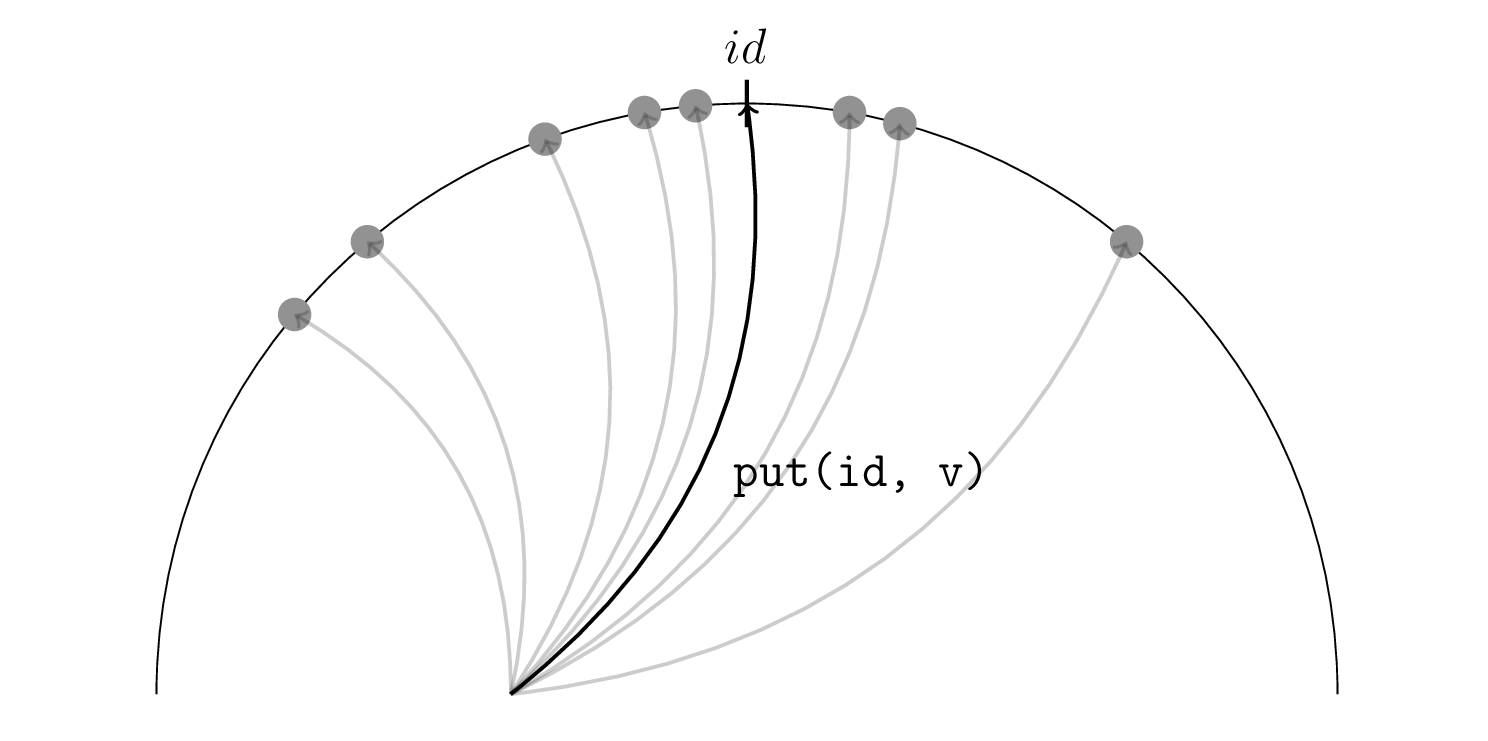
Short introduction to Distributed Hash Tables OpenDHT is based on the Kademlia design. If you know about DHTs, you are aware that they define the notion of distance using the XOR metric. This makes the tuple (H_n, xor) a metric space, where H_n is the space of identifier keys of length n. This way, you can find an identifier be the closest to a target hash than the rest of the nodes in the network.
In order to find some data that is associated with some hash h, you have to find the nodes in the network for which the distance between their hash identifier and the target hash h is minimized. The group of nodes which are the closest to the target hash (OpenDHT allows up to 8 nodes) will hold data for that hash.

Data persistence Let s say you ask a group of 8 nodes to hold some data for a hash and you want the data to hold the whole time until its expiration time as come. If the group of 8 nodes change because that for some reason those nodes leave or others just arrive and have an id that is closer to the target hash than the initial group of 8 nodes. The data would then not be found on the new group of 8 nodes. A first and simple solution was to count on the initial creator of the value to periodically announce the value to the group of 8 nodes. However, what if this node leaves? This is one of the main problem that I ve been working on solving since 2015. A first version of this was produced on September 2015. However, we experienced traffic issues and were forced to redesign the OpenDHT network requests engine. We are presently working on adding a Query feature that would enable filtering of data on remote nodes, hence substantially lowering the overall traffic produced by a response to a get request.

Indexation During the last year, I have also been working on the design of a solution for the use case of indexation. In a more technical way, this is the capability to find data by providing a map where its key is a string field and the mapped value is the value associated to that field, much like in a form. This could help find data for which you don t know the hash, but you have specific information about its content. In other words, this would be a search engine for OpenDHT. I have already created a working, but still in progress, version of this. You can find it on http://opendht.net, on the index branch. Now, Nicolas Reynaud (kaldoran) is contributing to this during the GSOC.

Roadmap As I explained on my page on the Debian Wiki, I am going to work on:
  1. Developing new functionalities in OpenDHT aiming at reducing overall generated traffic.
  2. Maintenance and optimization of the OpenDHT code in general.
  3. Optimizing data persistence solution over the distributed hash table.
  4. Merge (1) in the Ring daemon component in order to benefit from lower traffic in Ring.
  5. Make OpenDHT use TCP protocol instead of UDP. This is going to reduce code complexity and enhance robsutness of the DHT.
For further details, read my reports!

2 June 2016

Kevin Avignon: Making a platformer in F# with MonoGame

Hey guys, Being myself a fan of functional programming and cross-platform development, I thought you might like a nice read on how to create your very first platformer game with F# & MonoGame. Making a platformer in F# with MonoGame For those not having any prior knowledge of F#, don t worry, I m going to do Continue reading Making a platformer in F# with MonoGame

Jamie McClelland: Mobile Instant Messaging

Now that I've gone down the signal road, when can I get off of it? The two contenders I've found for more politically conscious mobile-friendly instant messaging are Tox and XMPP. And the problems to solve are: The Tox Project has a great design (peer-to-peer) and handles end-to-end encryption as part of its core design. However, the Antox mobile client has not only failed to solve the battery drain problem but seems to also have a serious bandwidth issue as well. Also, what is up with this drama? How about XMPP? For years, XMPP clients have been using OTR - and many instant messaging applications support it, including ChatSecure. And now, there seems to be quite a bit of excitement around implementing a better protocol called OMEMO. Incidentally, the OMEMO protocol uses the same Double Ratchet (previously referred to as the Axolotl Ratchet) protocol that Signal uses. While there are some irritating hiccups around using the available GPL library for Double Ratchet on iPhone apps, it seems like these issues are being sorted out and soon we'll have some kind of standard way for XMPP clients to exchange end-to-end encrypted messages. Let's move on to notifications and battery drain. If you believe the author of the Android Conversations App there doesn't seem to be a problem. However, client state indication seems to be the only issue related to battery drainage he addresses and I couldn't figure out how to easily install that extension on our Debian Jessie prosody instance since it isn't included in the prosody-modules package in Debian and it requires additional modules for it to work. Chris Ballinger, the author of ChatSecure (iOS and Android XMPP app), is less optimistic about this problem in general. In short, he thinks we need a proper "push" mechanism and has even started to implement one. At the same time, a new (and different) XMPP standard called Push Notifications - XEP-0357 has been released and it is even implemented in Prosody (although not yet available in Debian). So the future seems bright, right? Well, not exactly. All of this "push" activity seems to solve this problem: A federated/decentralized application cannot properly use Apple's APNs or Google's GCM. In the words of Chris Ballinger:
The biggest problem is that there is no easy way to send push messages between my app and your app. For me to send a push to one of your app s users on iOS, I must first obtain an APNs SSL certificate/key pair from you, and one of your user s push token that uniquely identifies their device to Apple. These push tokens are potentially sensitive information because they allow Apple to locate your device (in order to send it a push).
So, even if we manage to get one of these two standards for push notifications up and running, we have only succeeded in solving Signal's centralization problem, not the dependence on Google Play Services and Apple Push Network (in fact it's quite mysterious to me how you could even use the Prosody implementation of Push Notifications with GCM or APN). So... what we really would need would be to figure out how to implement one of these two push standards and then get it to work with an alternative to GCM and APN (perhaps MQTT)? Which, I think would require changes to the XMPP client. Geez. I may be on Signal longer than I planned.

1 June 2016

Antoine Beaupr : (Still) working too much on the computer

I have been using Workrave to try to force me to step away from the computer regularly to work around Repetitive Strain Injury (RSI) issues that have plagued my life on the computer intermittently in the last decade. Workrave itself is only marginally efficient at getting me away from the machine: as any warning systems, it suffers from alarm fatigue as you frenetically click the dismiss button every time a Workrave warning pops up. However, it has other uses.

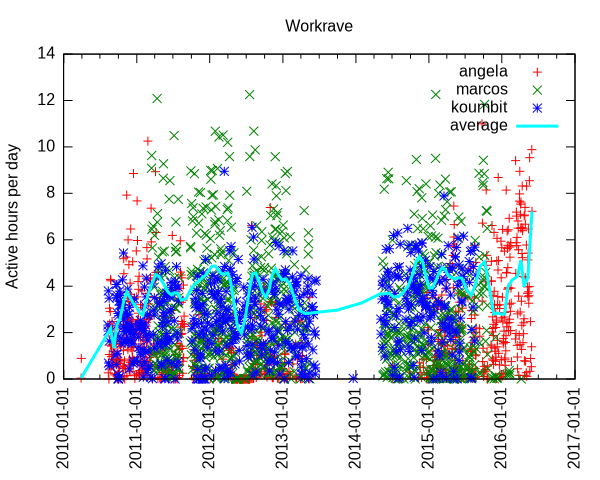
Analyzing data input In the past, I have used Workrave to document how I work too much on the computer, but never went through more serious processing of the vast data store that Workrave accumulates about mouse movements and keystrokes. Interested in knowing how much my leave from Koumbit affected time spent on the computer, I decided to look into this again. It turns out I am working as much, if not more, on the computer since I took that "time off": per machine keystrokes per day and average We can see here that I type a lot on the computer. Normal days range from 10 000 to 60 000 keystrokes, with extremes at around 100 000 keystrokes per day. The average seem to fluctuate around 30 to 40 000 keystrokes per day, but rises sharply around the end of the second quarter of this very year. For those unfamiliar with the underlying technology, one keystroke is roughly one byte I put on the computer. So the average of 40 000 keystrokes is 40 kilobyte (KB) per day on the computer. That means 15 MB over a year or about 150MB (or 100 MiB if you want to be picky about it) over the course of the last decade. That is a lot of typing. I originally thought this could have been only because I type more now, as opposed to use more the mouse previously. Unfortunately, Workrave also tracks general "active time" which we can also examine: per machine keystrokes per day and average Here we see that I work around 4 hours a day continuously on the computer. That is active time: not just login, logout time. In other words, the time where i look away from the computer and think for a while, jot down notes in my paper agenda or otherwise step away from the computer for small breaks is not counted here. Notice how some days go up to 12 hours and how recently the average went up to 7 hours of continuous activity. So we can clearly see that I basically work more on the computer now than I ever did in the last 7 years. This is a problem - one of the reasons of this time off was to step away from the computer, and it seems I have failed.
Update: it turns out the graph was skewed towards the last samples. I went more easy on the keyboard in the last few days and things have significantly improved: per machine keystrokes per day and average, 3 days later
Another interesting thing we can see is when I switched from using my laptop to using the server as my main workstation, around early 2011, which is about the time marcos was built. Now that marcos has been turned into a home cinema downstairs, I went back to using my laptop as my main computing device, in late 2015. We can also clearly see when I stopped using Koumbit machines near the end of 2015 as well.

Further improvements and struggle for meaning The details of how the graph was produced are explained at the end of this article. This is all quite clunky: it doesn't help that the Workrave data structure is not easily parsable and so easily corruptible. It would be best if each data point was on its own separate line, which would be long, granted, but so easier to parse. Furthermore, I do not like the perl/awk/gnuplot data processing pipeline much. It doesn't allow me to do interesting analysis like averages, means and linear regressions easily. It could be interesting to rewrite the tools in Python to allow better graphs and easier data analysis, using the tools I learned in 2015-09-28-fun-with-batteries. Finally, this looks only at keystrokes and non-idle activity. It could be more interesting to look at idle/active times and generally the amount of time spent on the computer each day. And while it is interesting to know that I basically write a small book on the computer every day (according to Wikipedia, 120KB is about the size of a small pocket book), it is mostly meaningless if all that stuff is machine-readable code. Where is, after all, the meaning in all those shell commands and programs we constantly input on our keyboards, in the grand scheme of human existence? Most of those bytes are bound to be destroyed by garbage collection (my shell's history) or catastrophic backup failures.
While the creative works from the 16th century can still be accessed and used by others, the data in some software programs from the 1990s is already inaccessible. - Lawrence Lessig
But is my shell history relevant? Looking back at old posts on this blog, one has to wonder if the battery life of the Thinkpad 380z laptop or how much e-waste I threw away in 2005 will be of any historical value in 20 years, assuming the data survives that long.

How this graph was made I was happy to find that Workrave has some contrib scripts to do such processing. Unfortunately, those scripts are not shipped with the Debian package, so I requested that to be fixed (#825982). There were also some fixes necessary to make the script work at all: first, there was a syntax error in the Perl script. But then since my data is so old, there was bound to be some data corruption in there: incomplete entries or just plain broken data. I had lines that were all NULL characters, typical of power failures or disk corruptions. So I have made a patch to fix that script (#826021). But this wasn't enough: while this processes data on the current machine fine, it doesn't deal with multiple machines very well. In the last 7 years of data I could find, I was using 3 different machines: this server (marcos), my laptop (angela) and Koumbit's office servers (koumbit). I ended up modifying the contrib scripts to be able to collate that data meaningfully. First, I copied over the data from Koumbit in a local fake-koumbit directory. Second, I mounted marcos home directory locally with SSHFS:
sshfs anarc.at:/home/anarcat marcos
I also made this script to sum up datasets:
#!/usr/bin/perl -w
use List::MoreUtils 'pairwise';
$  = 1;
my %data = ();
while (<>)  
    my @fields = split;
    my $date = shift @fields;
    if (defined($data $date ))  
        my @t = pairwise   $a + $b   @ $data $date , @fields;
        $data $date  = \@t;
     
    else  
        $data $date  = \@fields;
     
 
foreach my $d ( sort keys %data )  
    print "$d @ $data $d \n";
 
Then I made a modified version of the Gnuplot script that processes all those files together:
#!/usr/bin/gnuplot
set title "Workrave"
set ylabel "Keystrokes per day"
set timefmt "%Y%m%d%H%M"
#set xrange [450000000:*]
set format x "%Y-%m-%d"
set xtics rotate
set xdata time
set terminal svg
set output "workrave.svg"
plot "workrave-angela.dat" using 1:28 title "angela", \
     "workrave-marcos.dat" using 1:28 title "marcos", \
     "workrave-koumbit.dat" using 1:28 title "koumbit", \
     "workrave-sum.dat" using 1:2 smooth sbezier linewidth 3 title "average"
#plot "workrave-angela.dat" using 1:28 smooth sbezier title "angela", \
#     "workrave-marcos.dat" using 1:28 smooth sbezier title "marcos", \
#     "workrave-koumbit.dat" using 1:28 smooth sbezier title "koumbit"
And finally, I made a small shell script to glue this all together:
#!/bin/sh
perl workrave-dump > workrave-$(hostname).dat
HOME=$HOME/marcos perl workrave-dump > workrave-marcos.dat
HOME=$PWD/fake-koumbit perl workrave-dump > workrave-koumbit.dat
# remove idle days as they skew the average
sed -i '/ 0$/d' workrave-*.dat
# per-day granularity
sed -i 's/^\(........\)....\? /\1 /' workrave-*.dat
# sum up all graphs
cat workrave-*.dat   sort   perl sum.pl > workrave.dat
./gnuplot-workrave-anarcat
I used a different gnuplot script to generate the activity graph:
#!/usr/bin/gnuplot
set title "Workrave"
set ylabel "Active hours per day"
set timefmt "%Y%m%d%H%M"
#set xrange [450000000:*]
set format x "%Y-%m-%d"
set xtics rotate
set xdata time
set terminal svg
set output "workrave.svg"
plot "workrave-angela.dat"  using 1:($23/3600) title "angela", \
     "workrave-marcos.dat"  using 1:($23/3600) title "marcos", \
     "workrave-koumbit.dat" using 1:($23/3600) title "koumbit", \
     "workrave.dat"         using 1:($23/3600) title "average" smooth sbezier linewidth 3
#plot "workrave-angela.dat" using 1:28 smooth sbezier title "angela", \
#     "workrave-marcos.dat" using 1:28 smooth sbezier title "marcos", \
#     "workrave-koumbit.dat" using 1:28 smooth sbezier title "koumbit"

Keerthana Krishnan: Dealing with the Light Blue Screen Of Doom

Hi! With my third consecutive post of the day, I d like to speak about the login error usually seen on Gnome desktops, aka : Light Blue Screen of Doom . As far as I know, this bug is associated with Gnome and is usually because of faulty installation of gnome files and it was something that tormented me endlessly last week when I tried to install Debian 8 (Jessie) Unfortunately, I never really fixed it myself. What started off as a problem with gnome quickly snowballed into something else that wiped my routing table, making sure I couldn t even update the corrupted files properly. Although I came across a lot of bug reports in my quest to solve it, I never really found a solution.
Reinstallation seems to be only option left here, but there are a few checks you can make
  1. Call the terminal. Use Ctrl+Alt+F2, you should be able to get your command line.
  2. Login as root. This is extreme troubleshooting. You need root
  3. Check and see if startx works. (Yay! problem solved if it does!)
  4. Try to see if the basic gnome packages are installed type apt-get install with basic gnome packages like gnome-desktop-environment, gdm, gnome, etc.. to see if they are installed. If not, try to install them and then run the startx command.
  5. If you can t install them, or if they are already installed, try running the updating the system

    apt-get update
    apt-get upgrade
    apt-get dist-upgrade //If OS is at newest version
  6. If updating doesn t work and gives Failed to Fetch errors for all the source links, try pinging the network to make sure you have a connection.

    ping google.com
    ping 8.8.8.8
  7. If you do have a connection, verify the sources :

    nano /etc/apt/sources.list
    deb http://ftp.us.debian.org/debian jessie main contrib non-free
    #deb-src http://ftp.us.debian.org/debian jessie main contrib non-free
    deb http://security.debian.org/ jessie/updates main contrib non-free
    #deb-src http://security.debian.org/ jessie/updates main contrib non-free
    deb http://ftp.us.debian.org/debian testing main contrib non-free
    #deb-src http://ftp.us.debian.org/debian testing main contrib non-free
    deb http://security.debian.org/ testing/updates main contrib non-free
    #deb-src http://security.debian.org/ testing/updates main contrib non-free
  8. If you have no connection, check your routing table with the command netstat -nr . If this routing table is completely empty, then I ve got some bad news for you. Reinstallation is your new friend. Try and see if you can copy your files using command line. cp and ls are basically your new best friends.
Here s a guide to help change your OS. Hopefully, everything works out and you re back to working in no time!

Russell Coker: I Just Ordered a Nexus 6P

Last year I wrote a long-term review of Android phones [1]. I noted that my Galaxy Note 3 only needed to last another 4 months to be the longest I ve been happily using a phone. Last month (just over 7 months after writing that) I fell on my Note 3 and cracked the screen. The Amourdillo case is good for protecting the phone [2] so it would have been fine if I had just dropped it. But I fell with the phone in my hand, the phone landed face down and about half my body weight ended up in the middle of the phone which apparently bent it enough to crack the screen. As a result of this the GPS seems to be less reliable than it used to be so there might be some damage to the antenna too. I was quoted $149 to repair the screen, I could possibly have found a cheaper quote if I had shopped around but it was a good starting point for comparison. The Note 3 originally cost $550 including postage in 2014. A new Note 4 costs $550 + postage now from Shopping Square and a new Note 3 is on ebay with a buy it now price of $380 with free postage. It seems like bad value to pay 40% of the price of a new Note 3 or 25% the price of a Note 4 to fix my old phone (which is a little worn and has some other minor issues). So I decided to spend a bit more and have a better phone and give my old phone to one of my relatives who doesn t mind having a cracked screen. I really like the S-Pen stylus on the Samsung Galaxy Note series of phones and tablets. I also like having a hardware home button and separate screen space reserved for the settings and back buttons. The downsides to the Note series are that they are getting really expensive nowadays and the support for new OS updates (and presumably security fixes) is lacking. So when Kogan offered a good price on a Nexus 6P [3] with 64G of storage I ordered one. I m going to give the Note 3 to my father, he wants a phone with a bigger screen and a stylus and isn t worried about cracks in the screen. I previously wrote about Android device service life [4]. My main conclusion in that post was that storage space is a major factor limiting service life. I hope that 64G in the Nexus 6P will solve that problem, giving me 3 years of use and making it useful to my relatives afterwards. Currently I have 32G of storage of which about 8G is used by my music video collection and about 3G is free, so 64G should last me for a long time. Having only 3G of RAM might be a problem, but I m thinking of trying CyanogenMod again so maybe with root access I can reduce the amount of RAM use.

30 May 2016

Russ Allbery: Review: By the Sword

Review: By the Sword, by Mercedes Lackey
Series: Vows and Honor #4
Publisher: DAW
Copyright: February 1991
ISBN: 0-88677-463-2
Format: Mass market
Pages: 492
By the Sword is the next book in my (slow) Valdemar re-read. This one is a bit hard to classify in the series; it's technically a stand-alone novel, and it doesn't require a lot of prior series knowledge. But the heroine, Kerowyn, is a relative of Tarma and Kethry, and Tarma and Kethry appear in this novel. Most of the book also deals with similar themes as the rest of the Tarma and Kethry books, even though it's also a bridge into Valdemar proper. I'm going to follow Fantastic Fiction and call it book four of the Vows and Honor series, even though the publisher doesn't refer to it that way and it's not strictly correct. I think that creates the right impression, and it's mildly better to read the other Tarma and Kethry novels first. This book is also a bit confusing for reading order. It was published just before the Mage Winds trilogy, and happens before them in series chronological order (between that trilogy and the Talia series). But some of the chronologies in some of the Valdemar books show it after the Mage Winds trilogy. I think I originally read it afterwards, but both natural reading order and publication order puts it first, and that's the ordering I followed this time. Series ordering trivia aside (sometimes the comic book shared universe continuity geek in me raises its head), By the Sword is a hefty, self-contained novel about a very typical Lackey protagonist. Kerowyn is the daughter of a noble house, largely ignored by her father in favor of her brother and tasked with keeping the keep running since her mother died. She wants to learn to fight and ride, but that's not part of her father's plans for her. But those plans become suddenly irrelevant when the keep is attacked during her brother's wedding and the bride kidnapped. Unless someone at least attempts to recover her, this will be taken as an excuse for conquest of the keep by the bride's family. (Spoilers for the start of the book in the following paragraph. I think the outcomes are reasonably obvious given the type of book this is, but skip it if you don't want to know anything about the plot.) If you're familiar with Lackey's musical work (most probably won't be, but you might if you follow filk), "Kerowyn's Ride" is the start of this book. Kerowyn goes to her grandmother Kethry, who is semi-legendary to Kerowyn but well-known to readers of the rest of the series. From Kethry, she acquires Need; with Need's help, she improbably manages to rescue her brother's bride. It seems like a happy ending, but it completely disrupts and destroys her life. Her role as hero does not fit any of the expectations the remaining members of the household have for her. But it also gives her an escape: she ends up as Tarma and Kethry's student, learning all the things about fighting she'd craved to learn and preparing for a life as a mercenary. Quite a few adventures follow, all of which are familiar to Lackey readers and particularly to readers of the Tarma and Kethry books. But I think this is one of Lackey's better-written books. The pacing is reasonably good despite the length of the book, Kerowyn is a likable and interesting character, and I like the pragmatism and practicalities that Lackey brings to sword and sorcery mercenary groups. In style and subject matter, it's the closest to Oathbreakers, which was also my favorite of the Tarma and Kethry novels. By the Sword is both the natural conclusion of the Tarma and Kethry era and arc, and vital foundational material for what I think of as the "core" Valdemar story: Elspeth's adventures during Selany's reign, which start in the Mage Winds trilogy immediately following this. Kerowyn becomes a vital supporting character in the rest of the story, and Need is hugely important in events to come. But even if you're not as invested in the overall Valdemar story arc as I am, this is solid, if a bit predictable and unspectacular, sword and sorcery writing presented in a meaty and satisfying novel with a good coming-of-age story. This is one of my favorites of the Valdemar series as measured by pure story-telling. There are other books that provide more interesting lore and world background, but there are few characters I like as well as Kerowyn, and I find the compromise she reaches with Need delightful. If you liked Oathbreakers, I'm pretty sure you'd like this as well. And, of course, recommended if you're reading the whole Valdemar series as a fairly key link in the plot and a significant bridge between the Heralds and Tarma and Kethry's world, a bridge that Elspeth is about to cross in the other direction. Rating: 8 out of 10

Reproducible builds folks: Reproducible builds: week 57 in Stretch cycle

What happened in the Reproducible Builds effort between May 22nd and May 28th 2016: Media coverage Documentation update Toolchain fixes Packages fixed The following 18 packages have become reproducible due to changes in their build dependencies: canl-c configshell dbus-java dune-common frobby frown installation-guide jexcelapi libjsyntaxpane-java malaga octave-ocs paje.app pd-boids pfstools r-cran-rniftilib scscp-imcce snort vim-addon-manager The following packages have become reproducible after being fixed: Some uploads have fixed some reproducibility issues, but not all of them: Patches submitted that have not made their way to the archive yet: Package reviews 123 reviews have been added, 57 have been updated and 135 have been removed in this week. 21 FTBFS bugs have been reported by Chris Lamb and Santiago Vila. strip-nondeterminism development tests.reproducible-builds.org Misc. This week's edition was written by Reiner Herrmann and Holger Levsen and reviewed by a bunch of Reproducible builds folks on IRC.

Daniel Stender: My work for Debian in May

No double posting this time ;-) I've got not so much spare time this month to spend on Debian, but I could work on the following packages: This series of blog postings also includes little introductions of and into new packages in the archive. This month there is: Pyinfra Pyinfra is a new project which is currently still in development state. It has been already pointed out in an interesting German article1, and is now available as package maintained within the Python Applications Team. It's currently a one man production by Nick Barrett, and eagerly developed in the past weeks (we're currently at 0.1~dev24). Pyinfra is a remote server configuration/provisioning/service deployment tool which belongs in the same software category like Puppet or Ansible2. It's for provisioning one or an array of remote servers with software packages and to configure them. Pyinfra runs agentless like Ansible, that means for using it nothing special (like a daemon) has to run on targeted servers. It's written to be used for provisioning POSIX compatible Linux systems and has alternatives when it comes to special features like package managers (e.g. supports apt as well as yum). The documentation could be found in usr/share/doc/pyinfra/html/. Here's a little crash course on how to use Pyinfra: The pyinfra CLI tool is used on the command line like this, deploy scripts, single operations or facts (see below) could be used on a single server or a multitude of remote servers:
$ pyinfra -i <inventory script/single host> <deploy script>
$ pyinfra -i <inventory script/single host> --run <operation>
$ pyinfra -i <inventory script/single host> --facts <fact>
Remote servers which are operated on must provide a working shell and they must be reachable by SSH. For connecting, --port, --user, --password, --key/--key-password and --sudo flags are available, --sudo to gain superuser rights. Root access or sudo rights of course have to be already set up. By the way, localhost could be operated on the same way. Single operations are organized in modules like "apt", "files", "init", "server" etc. With the --run option they could be used individually on servers like follows, e.g. server.user adds a new user on a single targeted system (-v adds verbosity to the pyinfra run):
$ pyinfra -i 192.0.2.10 --run server.user sam --user root --key ~/.ssh/sshkey --key-password 123456 -v
Multiple servers can be grouped in inventories, which hold the targeted hosts and data associated with them, like e.g. an inventory file farm1.py would contain lists like this:
COMPUTE_SERVERS = ['192.0.2.10', '192.0.2.11']
DATABASE_SERVERS = ['192.0.2.20', '192.0.2.21']
Group designators must be all caps. A higher level of grouping are the file names of inventory scripts, thus COMPUTE_SERVERS and DATABASE_SERVERS can be referenced to at the same time by the group designator farm1. Plus, all servers are automatically added to the group all. And, inventory scripts should be stored in the subfolder inventory/ in the project directory. Inventory files then could be used instead of specific IP addresses like this, the single operation then gets performed on all given machines in farm1.py:
$ pyinfra -i inventory/farm1.py  --run server.user sam --user root --key ~/.ssh/sshkey --key-password=123456 -v
Deployment scripts could be used together with group data files in the subfolder group_data/ in the project directory. For example, a group_data/farm1.py designates all servers given in inventory/farm1.py (by the way, all.py designates all servers), and contains the random attribute user_name (attributes must be lowercase), next to authentication data for the whole inventory group:
user_name = 'sam'
ssh_user = 'root'
ssh_key = '~/.ssh/sshkey'
ssh_key_password = '123456'
The random attribute can be picked up by a deployment script using host.data() like follows, user_name could be used again for e.g. server.user(), like this:
from pyinfra import host
from pyinfra.modules import server
server.user(host.data.user_name)
This deploy, the ensemble of inventory file, group data file and deployment script (usually placed top level in the project folder) then could be run that way:
$ pyinfra -i inventory/farm1.py deploy.py
You have guessed it, since deployment scripts are Python scripts they are fully programmable (please regard that Pyinfra is build & runs on Python 3 on Debian), and that's the main advantage point with this piece of software. Quite handy for that come Pyinfra facts, functions which check different things on remote systems and return information as Python data. Like e.g. deb_packages returns a dictionary of installed packages from a remote apt based server:
$ pyinfra -i 192.0.2.10 --fact deb_packages --user root --key ~/.ssh/sshkey --key-password=123456
 
    "192.0.2.10":  
        "libdebconfclient0": "0.192",
        "python-debian": "0.1.27",
        "libavahi-client3": "0.6.31-5",
        "dbus": "1.8.20-0+deb8u1",
        "libustr-1.0-1": "1.0.4-3+b2",
        "sed": "4.2.2-4+b1",
Using facts, Pyinfra reveals its full potential. For example, a deployment script could go like this, linux.distribution() returns a dict containing the installed distribution:
from pyinfra import host
from pyinfra.modules import apt
if host.fact.linux_distribution['name'] == 'Debian':
   apt.packages(packages='gummi', present=True, update=True)
elif host.fact.linux_distribution['name'] == 'CentOS':
   pass
I'll spare more sophisticated examples to keep this introduction simple. Beyond fancy deployment scripts, Pyinfra features an own API by which it could be programmed from the outside, and much more. But maybe that's enough to introduce Pyinfra. That are the usage basics. Pyinfra is a brand new project and it remains to be seen whether the developer can keep on further developing the tool like he does these days. For a private project it's insane to attempt to become a contender for the established "big" free configuration management tools and frameworks, but, if Puppet has become too complex in the meanwhile or not3, I really don't think that's the point here. Pyinfra follows an own approach in being programmable the way which it is. And it's definitely not harm to have it in the toolbox already, not trying to replace nothing. Brainstorm After the first package has been in experimental, the Brainstorm library from Swiss AI research institute IDSIA4 is now available as python3-brainstorm in unstable. Brainstorm is a lean, easy-to-use library for setting up deep learning networks (multiple layered artificial neural networks) for machine learning applications like for image and speech recognition or natural language processing. To set up a working training network for a classifier for handwritten digits like the MNIST dataset (a usual "hello world") just takes a couple of lines, like an example demonstrates. The package is maintained within the Debian Python Modules Team. The Debian package ships a couple of examples in /usr/share/python3-brainstorm/examples (the data/ and examples/ folders of the upstream tarball are combined here). Among them there are5: The current documentation in /usr/share/doc/python3-brainstorm/html/ isn't complete yet (several chapters are under construction), but there's a walkthrough on the CIFAR-10 example. The MNIST example has been extended by Github user pinae, and has been explained in German C't recently6. What are the perspectives for further development? Like Zhou Mo confirmed, there are a couple of deep learning frameworks around having a rather poor outlook since there have been abandoned after being completed as PhD projects. There's really no point for thriving to have them all in Debian, like the ITP of Minerva has been given up partly for this reason, there weren't any commits since 08/2015 (and because cuDNN isn't available and most likely won't). Brainstorm, 0.5 have been released 05/2015, also was a PhD project as IDSIA. It's stated on Github that the project is "under active development", but the rather sparse project page on the other side expresses the "hope the community will help us to further improve Brainstorm". This sentence much often implies that the developers are not actively working on the project. But there are recent commits and it looks that upstream is active and could be reached when there are problems, and that the project is active. So I don't think we're riding a dead horse, here. The downside for Brainstorm in Debian is, it seems that the libraries which are needed for GPU accelerated processing can't be fully provided. Pycuda is available, but scikit-cuda (an additional library which provides wrappers for CUDA features like CUBLAS, CUFFT and CUSOLVER) is not and won't be, because the CULA Dense Toolkit (scikit-cuda also contains wrappers for also that) is not available freely as source. Because of that, a dependency against pycuda, not even as Suggests (it's non-free), has been spared. Without GPU acceleration, Brainstorm computes the matrices on openBLAS using a Cython wrapper on the NumpyHandler, and the PyCudaHandler couldn't be used. openBLAS makes pretty good use of the available hardware (it distributes over all available CPU cores), but it's not yet possible to run Brainstorm full throttle using available floating point devices to reduce training times, which becomes crucial when the projects are getting bigger. Brainstorm belongs to the number of deep learning frameworks already being or becoming available in Debian. Currently there is: I've checked over Microsoft's CNTK, but although it's also set free recently I have my doubts if that could be included. Apparently there are dependencies against non-free software and most likely other issues. So much for a little update on the state of deep learning in Debian, please excuse if my radar misses something.

  1. Tim Sch rmann: "Schlangen l: Automatisiertes Service-Deployment mit Pyinfra". In: IT-Administrator 05/2016, pp. 90-95.
  2. For a comparison of configuration management software like this, see B wetter/Johannsen/Steig: "Baukastensysteme: Konfigurationsmanagement mit Open-Source-Software". In: iX 04/2016, pp. 94-99 (please excuse the prevalence of German articles in the pointers, I've just have them at hand).
  3. On the points of critique on Puppet, see Martin Loschwitz: "David gegen Goliath Zwei Welten treffen aufeinander: Puppet und Ansible". In Linux-Magazin 01/2016, 50-54.
  4. See the interview with IDSIA's deep learning guru J rgen Schmidhuber in German C't 2014/09, p. 148
  5. The examples scripts need some more finetuning. To run the data creation scripts in place the environment variable BRAINSTORM_DATA_DIR could be set, but the trained networks are currently tried to write in place. So please copy the scripts into some workspace if you want to try them out. I'll patch the example scripts to run out-of-the-box, soon.
  6. Johannes Merkert: "Ziffernlerner. Ein k nstliches neuronales Netz selber gebaut". In: C't 2016/06, p. 142-147. Web: http://www.heise.de/ct/ausgabe/2016-6-Ein-kuenstliches-neuronales-Netz-selbst-gebaut-3118857.html.
  7. See Ramon Wartala: "Tiefensch rfe: Deep learning mit NVIDIAs Jetson-TX1-Board und dem Caffe-Framework". In: iX 06/2016, pp. 100-103
  8. https://lists.debian.org/debian-science/2016/03/msg00016.html

Steve Kemp: A mixed weekend

This past seven days have been a little mixed: Finally I spent the tail end of the weekend being a little red, sore, and itchy. . I figured this was a surprising outbreak of Dyshidrosis on my hands, and eczema on my body. Instead I received a diagnosis of Scarlet Fever. So now I feel somewhat Dickensian! Apparently this infection is on the rise!

Russ Allbery: Review: Empires of EVE

Review: Empires of EVE, by Andrew Groen
Publisher: Andrew Groen
Copyright: 2015
Printing: 2016
ISBN: 0-9909724-0-2
Format: Hardcover
Pages: 171
The version of this book I read was the hardcover Kickstarter campaign reward, since I was a backer. I believe it's the same as the hardcover currently available for sale from the author's site for those who didn't back the project. There are also softcover and Kindle versions. I've lost track of whether they have less sidebar content, or just less high-quality artwork. EVE Online ("EVE" is not an acronym, just the developer's way of writing the name, so you'll also see "Eve" both for the game and for this book) is a massively multiplayer on-line role-playing game (MMORPG) based on interstellar mining, manufacturing, and combat. Its Icelandic developer takes a different, more emergent approach than most MMORPG developers: rather than fill the world exclusively with pre-scripted adventures and enemies (although there is some of that for those who want it), vast regions of EVE's world are left open to the players to govern, exploit, or fight over as they see fit. Player versus player combat plays a large role in that aspect of the game, and many actions that would be prohibited or made impossible in other games (stealing from other players, betrayals, tricking other players into fatal situations) are permitted and sometimes core components of the game. EVE is best-known for its economy, which is almost entirely player-driven and requires extensive mining and manufacturing work by large teams of players to build the largest and most powerful ships in the game. Empires of EVE is an unusual type of book, one that I'm not sure would have been possible ten years ago. Subtitled "a history of the great wars of EVE Online," it's a history of a virtual world, but not one sponsored by the developer or part of the marketing or lore of the game. I love seeing this (which is also why I backed the Kickstarter). Video games have developed beyond just games to play into games to watch other people play (successfully competing, for me and for many others, for the role previously filled by professional sports), and now into emergent events that are complex enough, and dramatic enough, to warrant their own third-party history. I was quite surprised and delighted by how broad the audience for this sort of writing is. And this is not a shallow effort. Andrew Groen is a freelance writer who does not, himself, play EVE. He approaches the complex political and in-game fighting with the attitude of a reporter and historian, cites sources (to the standards I would expect for long-form journalism, if not quite at the level of academic history), discloses where history has been lost or one side of some fight could not be contacted, and puts substantial effort into explaining the political strengths and weaknesses of the shifting in-game alliances. It's a proper political history of an imaginary world, including objective (so far as I can tell) reporting of times when developers were accused of assisting one of the factions. If, like me, you don't play EVE and are primarily interested in this book to get a feel for the game, there are a few caveats to be aware of. EVE is divided into regions with game-enforced security levels. The ones near the center of the game galaxy are heavily policed by the game to prevent most of the player versus player combat and let new players get their feet. Those regions also offer various built-in missions that don't require interacting with other players. As one moves out from that central area, the game-provided security (and I believe the game-provided interactions) drops off. Empires of EVE deals exclusively with nullsec space: the outer regions of the game where the richest resources are, and where there is no law or policing except what's done by the players themselves. The game here, and as described in the book, is relentlessly blood-thirsty, but this isn't representative of the entire game. Second, most of this book is devoted to ship-to-ship combat and missions of conquest and reprisal. But combat is built on top of a vast "civilian" infrastructure of mining and manufacturing, and there are players who focus on those aspects of the game and rarely, if ever, fight. Groen talks about this in passing, since it can have significant influence on the politics of the game, but spends little time describing the day-to-day life in the game for those players. The focus here is on the resulting combat. Finally, Groen starts his history at the EVE beta in 2003 but ends it in 2009. Maneuvering and wars have, of course, continued ever since, but he has to stop somewhere. As he mentioned during the Kickstarter, it takes some years for events to become history, and for people to be willing to talk about them. The developer has kept changing the game, so some of the mechanics here will be mildly stale and the current political alliances are quite likely far different (although many of the players discussed in this book are still playing). With those caveats, though, this is a fascinating book, even if this isn't your sort of game. Personally, I have a deep-seated dislike of games like Diplomacy where alliances, betrayal, and political maneuvering is sanctioned and encouraged by the game. I've never played EVE and I can't imagine ever wanting to, particularly after reading this book. But it's still a fascinating war history and analysis of slightly skew human politics. The alliances and backstabbing are reminiscent of real human history, but the game setting adds some significant twists: players can just quit if they're not having fun, the largest threat to strong alliances is players just not bothering to show up because they're not having fun or because the risk is too high, and without the stability and momentum of real-world institutions, in-game corporations and alliances can collapse overnight when players lose faith in them. From a distance, it's quite entertaining to see how those factors reshape politics and propaganda. (If sadly somewhat reminiscent of the sort of personalities that killed Usenet. I shouldn't have been surprised that organized Internet trolls made an appearance in EVE, although the nature of EVE politics meant they fit right in rather than doing much to spoil other people's fun, at least in nullsec.) I can't speak to the other formats, but the hardcover is also a gorgeous book. The artwork isn't quite my style, and the in-game screen shots are a bit muddy and confusing (not Groen's fault), but the maps are clear and invaluable, the propaganda posters are amazing, and the hardcover printing is clearly of a very high quality. I felt like I got my $50 worth in terms of presentation and quality printing, and have a book that isn't going to fall apart in a few years. The one quibble that I have is that Groen picked a fairly thin and light font for the main text, which my eyes had some trouble with on high-gloss paper. Something thicker and darker may not have looked as good on the page, but it would have been easier to read. The font choice for the sidebars was a lovely high-contrast white on black, but I would have appreciated something a bit larger. If you have vision issues, you may find the ebook more readable, if not as beautiful. Empires of EVE has apparently been very successful within its niche, which makes me happy. I would love to read more books of this type. I know I'm not the only person who grew up with gaming but has been increasingly drawn into watching other people game or reading about other people game. I love watching or reading about people who have put the effort into becoming very good at something they love, and when that comes with emergent history, creative propaganda, and a lot of assholes to root against (although sadly not many people to root for), the history of EVE makes compelling reading, at least for me. Recommended if this is at all your sort of thing; the ebook version of the book is fairly inexpensive. Rating: 8 out of 10

Norbert Preining: OpenPHT 1.5.2 for Debian/sid

I have updated the openpht repository with builds of OpenPHT 1.5.2 for Debian/sid for both amd64 and i386 architecture. For those who have forgotten it, OpenPHT is the open source fork of Plex Home Theater that is used on RasPlex, see my last post concerning OpenPHT for details. plex-debian-new The repository also contains packages (source and amd64/i386) for shairplay which is necessary for building and running OpenPHT. sid and testing For sid use the following lines:

deb http://www.preining.info/debian/ openpht-sid main
deb-src http://www.preining.info/debian/ openpht-sid main
You can also grab the binary for amd64 directly here for amd64 and i386, you can get the source package with
dget http://www.preining.info/debian/pool/main/o/openpht/openpht_1.5.2.514-1.dsc
Note that if you only get the binary deps, you also need libshairplay0 from amd64 or i386. jessie Builds for Debian stable release jessie are not done by now. The release file and changes file are signed with my official Debian key 0x860CDC13. Now be ready for enjoying the next movie!

29 May 2016

Kevin Avignon: Interesting project : Render stereoscopic 3D images using Kinect 2.0

Hi guys, Last summer, I got into an interesting course entitled Emerging topics in information technologies . During the first part of the course, we focused more on 3D computer vision techniques and how to manipulate 3D images.Issues such as depth-image-based rendering were obscure and captivating enough to get me motivated throughout the summer semester. In order Continue reading Interesting project : Render stereoscopic 3D images using Kinect 2.0

28 May 2016

Russ Allbery: Another small book haul

Book reading is happening, and more book review posting will be happening. I'm a bit behind in writing reviews, but the holiday weekend is a good opportunity to do a bit of catching up. In the meantime, here are some new acquisitions: Roxanne J. Coady & Joy Johannessen (ed.) The Books That Changed My Life (nonfiction)
James S.A. Corey Caliban's War (sff)
James S.A. Corey Abaddon's Gate (sff)
Max Gladstone Full Fathom Five (sff)
Max Gladstone Last First Snow (sff)
N.K. Jemisin The Fifth Season (sff)
Guy Gavriel Kay Children of Earth and Sky (sff)
Naomi Novik Uprooted (sff)
Ada Palmer Too Like the Lightning (sff)
Graydon Saunders Safely You Deliver (sff)
Neal Stephenson Seveneves (sff)
Jeff VanderMeer Annihilation (sff) This is mostly catching up on books that were nominated for awards. I want to read the (legitimate) nominees for Hugo best novel this year if I can find the time, and VanderMeer won the Nebula last year. The rest of Gladstone's series to date was on sale, and I really liked the first book. And of course a new Guy Gavriel Kay is buy on sight. I'm currently re-reading The Sarantine Mosaic, since I read that before I started writing reviews and Children of Earth and Sky is apparently set in historical contact with it. (It's possible all of Kay's historical fantasies are set in the same universe, but they're usually fairly disconnected.)

Dirk Eddelbuettel: RcppArmadillo 0.7.100.3.0

armadillo image The first Armadillo release of the 7.* series is out: a new version 7.100.3. We uploaded RcppArmadillo 0.7.100.3.0 to CRAN and Debian. This followed the usual thorough reverse-dependecy checking of by now 230 packages using it. This release now requires a recent enough compiler. As g++ is so common, we explicitly test for version 4.6 or newer. So if you happen to be on an older RHEL or CentOS release, you may need to get yourself a more modern compiler. R on Windows is now at 4.9.3 which is decent (yet stable) choice; the 4.8 series of g++ will also do. For reference, the current LTS of Ubuntu is at 5.3.1, and we have g++ 6.1 available in Debian testing. This new upstream release adds a few new helper functions (which are particularly useful in statistics, but were of course already available to us via Rcpp), more slicing of Cube data structures and a brand new sparse matrix decomposition module courtesy of Yixuan Qiu -- whom R users know as the author of the RSpectra package (which replaces his older rArpack package) and of course all the most excellent work he provided to RcppEigen. Armadillo is a powerful and expressive C++ template library for linear algebra aiming towards a good balance between speed and ease of use with a syntax deliberately close to a Matlab. Changes in this release are as follows:
Changes in RcppArmadillo version 0.7.100.3.0 (2016-05-25)
  • Upgraded to Armadillo test release 7.100.3
    • added erf(), erfc(), lgamma()
    • added .head_slices() and .tail_slices() to subcube views
    • spsolve() now requires SuperLU 5.2
    • eigs_sym(), eigs_gen() and svds() now use a built-in reimplementation of ARPACK for real (non-complex) matrices (code contributed by Yixuan Qiu)
  • The configure code now checks against old g++ version which are no longer sufficient to build the package.
Courtesy of CRANberries, there is also a diffstat report for this release. As always, more detailed information is on the RcppArmadillo page. Questions, comments etc should go to the rcpp-devel mailing list off the R-Forge page.

This post by Dirk Eddelbuettel originated on his Thinking inside the box blog. Please report excessive re-aggregation in third-party for-profit settings.

Petter Reinholdtsen: Tor - from its creators mouth 11 years ago

A little more than 11 years ago, one of the creators of Tor, and the current President of the Tor project, Roger Dingledine, gave a talk for the members of the Norwegian Unix User group (NUUG). A video of the talk was recorded, and today, thanks to the great help from David Noble, I finally was able to publish the video of the talk on Frikanalen, the Norwegian open channel TV station where NUUG currently publishes its talks. You can watch the live stream using a web browser with WebM support, or check out the recording on the video on demand page for the talk "Tor: Anonymous communication for the US Department of Defence...and you.". Here is the video included for those of you using browsers with HTML video and Ogg Theora support: I guess the gist of the talk can be summarised quite simply: If you want to help the military in USA (and everyone else), use Tor. :)

27 May 2016

Mike Gabriel: MATE 1.14 landing in Debian unstable...

I just did a bundle upload of all MATE 1.14 related packages to Debian unstable. Packages are currently building for the 23 architectures supported by Debian, build status can be viewed on the DDPO page of the Debian MATE Packaging Team [1] Credits Again a big thanks to the packaging team. Martin Wimpress again did a fabulous job in bumping all packages towards the 1.14 release series during the last weeks. During last week, I reviewed his work and uploaded all binary packages to a staging repository. Also a big thanks to Vangelis Mouhtsis, who recently added more hardening support to all those MATE packages that do some sort of C compilation at build time. After testing all MATE 1.14 packages on a Debian unstable system, I decided to do a bundle upload today. Packages should be falling out of the build daemons within the next couple of hours/days (depending on the architecture being built for). GTK2 -> GTK3 The greatest change for this release of MATE to Debian is the switch over from GTK2 to GTK3. People using the MATE desktop environment on Debian systems are invited to test the new MATE 1.14 packages and give feedback via the Debian bug tracker, esp. on the user experience regarding the switch over to GTK3. Thanks to all who help getting MATE 1.14 in Debian better every day!!! Known issues when running in NXv3 sessions The new GTK3 build of MATE works fine locally (against local X.org server). However, it causes some trouble (i.e. graphical glitches) when running in an NXv3 based remote desktop session. Those issues have to be addressed by me (while wearing my NXv3 upstream hat), I guess (sigh...). light+love,
Mike [1] https://qa.debian.org/developer.php?login=pkg-mate-team@lists.alioth.deb...

Kevin Avignon: Euler problems

Hi guys, Late post before I go to bed. I don t know if you ever heard about Euler problems ? It s a series of challenging computer and mathematical programming problems. They require some thinking in order to be solved. The reason behind solving them is to acquire better skills at problem solving, which is something Continue reading Euler problems

Dirk Eddelbuettel: rfoaas 0.1.9

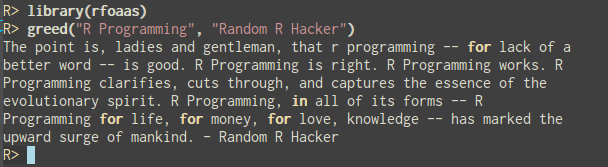
rfoaas greed example Time for new release! We just updated rfoaas on CRAN, and it now corresponds to version 0.1.9 of the FOAAS API. The rfoaas package provides an interface for R to the most excellent FOAAS service--which provides a modern, scalable and RESTful web service for the frequent need to tell someone to f$#@ off. Release 0.1.9 brings three new access point functions: greed(), me() and morning(). It also adds an S3 print method for the returned object. A demo of first of these additions in shown in the image in this post. As usual, CRANberries provides a diff to the previous CRAN release. Questions, comments etc should go to the GitHub issue tracker.

This post by Dirk Eddelbuettel originated on his Thinking inside the box blog. Please report excessive re-aggregation in third-party for-profit settings.

Next.

Previous.