Search Results: "bod"

6 December 2006

Gustavo Franco: FLOSS in Brazil turns out to be a joke

Well, forget anything you've heard about how well developed is Brazil in terms of FLOSS. The gov't loves FLOSS, the NGOs and even a lot of companies too, right? Wrong!

With just a few exceptions (and i think i work in one of them and i'm glad), the FLOSS hype in Brazil is a marketing thing. Even the most proprietary software defender needs to agree that FLOSS and every aspect of it, has appeal where there's not enough money or where the money isn't being distributed in a fair manner.

The point is that a lot of gov't institutions, NGOs and companies are using the FLOSS appeal and its arguments with the masses to do what a brazilian does best (after playing soccer): Corruption. The recipe is simple: Tell as much people as possible that you're developing the FLOSS 'foo' and ask for funding - even companies do that here and when they don't, they join a gov't institution. You know, when you haven't compromises with results and the law and have contacts it isn't that hard get some money here and there for your 'foo' project.

Many times nobody out of the project office (when there's a real one) ever see the source code of that and in a lot of times it will be delayed forever or it will suck - but when it sucks they blame the 'community' (they don't know the difference between user and developer community). Wait, but where's all that money? The money is in the same places where part of the 3 trillions of dollars (no, i'm not wrong) that were used by less developed countries during the past years from the north-american and european banks. Go figure...

My hint for these FLOSS advocates in Brazil and those with some money for funding projects here: Hire somebody that have a vague idea what a user community, developer community, software licenses and source code are in the next time.

Steve Kemp: With our lecherous plans

Multiple times we’ve talked about having a Debian-Developer-Gallery. That could be something like all the pictures from various conferences and events, to just having a mugshot of each registered developer. So :
  1. Is this a good idea?
  2. Do you have a picture you’d like to be included?
I’m volunteering to setup a simple site which will contain one photograph of each Debian Developer (ideally which they will submit themselves, I’m not sure how to handle the case of somebody saying “This pictures is foo@debian.org” when foo didn’t authorise/expect it to become public.) This simple site will be accessed via: Each page will contain: (No ratings, no tagging, possibly a “random user” link, or an index by username. Nothing complex or too dynamic) Suggestions for a better name would be appreciated. I figure either “faces” or “mugshots” - since the obvious “gallery.d.net” is already taken. So .. comment here if you think this is a good idea. Or feel free to mail me a link/attached image. Assuming I get say 50 developers thinking this is a good idea I will setup the DNS alias and put the site live. Bandwidth will be minimal, but I think having the friendly faces (?!) visible would be a good thing. And will make identification of people prior to meetings signficantly easier. (At times like this I wish I could host a real poll .. but ignoring that for a second.)

Adrian von Bidder: We Know Who Takes the Blame!

Sam Hocevar is wrong when he says:
Suppose for instance that you stopped contributing to Debian months ago [...] You are obviously not only directly responsible for Etch being late due to your lack of involvement, ...
“You” are not responsible for Etch being late. The Debian project has picked an official scapegoat for Etch being late and for everything else in Debian that just doesn't work how it should. So everybody can now relax: no Debian developer is personally responsible for anything. It's really convenient if some people group together and do something that other people don't like and then give it a name. You can blame the new thing for everything you don't want to do or don't like, without actually having to name the people behind it or thinking about constructive ways to improve matters. It's always “them”. Yes, I'm pissed by the attitude of some very vocal people. Dunc Tank is not an official Debian project, so I still fail to see how it's different from Canonical, Progeny, Credativ etc. hiring people. Dunc Tank even pays people to work directly on Debian, it doesn't pay them to do Debian-related work that might eventually benefit Debian, too. As a private employer, Dunc Tank is free to pick who to employ and who not to employ. Yes, Dunc Tank and some Debian project roles do overlap, but stuff like this can't be avoided, especially in time consuming volunteer projects doing stuff that can also be done for money. Debian is not a charity, but a project competing directly with commercial products, so its members shouldn't be surprised when the question of money comes up every now and then. (And just to make it clear: I'm not arguing against Sam, who blogged about a totally different topic. The part I quoted just got me started.)

John Goerzen: Insurance

I was visiting with our homeowners insurance company the other day (very good folks). Because we weren't living in our house during renovation, we had to get a more expensive type of policy. The agent that sold it do is is no longer with the company, so the new person handling our account asked me, "Why did he want you to get this policy?"

"Well, he said it was because we weren't living there." Then I suddenly remembered the rest of what he said, and couldn't help cracking up. "Plus, he said that if something like a fire happened, people might not notice."

What can I say. Psychic insurance salesman.

On that note, I was having a discussion with someone about large windows on a house. That person was saying that "everyone" always puts their large windows on the front (or back of their house, I forget which) so that potential burglers are easier to spot. He was concerned about where we were putting windows on our house.

This had never occured to me.

But I pointed out that our yard was on fire and nobody noticed for hours. What difference would it make where our windows are?

"Ah, good point," he said.

On that note, you ought to check out rush hour in the country. Truly this is a lot of traffic for roads around here.

5 December 2006

John Goerzen: Review of VPSLink

Back in June, I wrote about my switch to VPSLink for my virtual private server (VPS) host.

Now it's 6 months later, my initial contract is up, and it's time to consider whether to renew it.

Overall, VPSLink has worked out reasonably well. I have their Link-4 plan, which provides 512MB RAM, 20GB of disk storage, and 500GB of bandwidth for $40/mo (or down to $33/mo if you pay for 12 months in advance).

Reliability and Uptime

VPSLink has been reasonably reliable. I wouldn't say that they have been exceptionally reliable, though.

Some outages:


They have generally responded to support requests in a reasonable amount of time, and support has been approximately as helpful as I'd expect.

Overall, there've been a few issues but, aside from that 8-hour outage in July, nothing especially remarkable.

Automated Tools

VPSLink has a "control panel" where you can reboot, start, or stop your virtual machine. You can see how much bandwidth you've used in a month, your IPs, and billing information.

You can also create support requests and view the status of support requests there. You can also view all correspondence on a given ticket, and add new correspondence to it -- a nice touch that's useful if your email is down because your VPS is down.

The reboot/start/stop facility didn't work during one outage, though.

Resources

The 20GB of disk space is nice to have, though I never used it all. No complaints there.

But the memory setup is rather strange. This may be because VPSLink is using OpenVZ instead of its more popular (and featureful) commercial counterpart Virtuozzo, or something such as Xen.

Those that have used OpenVZ/Virtuozzo know there is a /proc/user_beancounters file in the virtual environment that reports on the limits of resources allocated to your virtual server. VZ lets the server admins regulate the amount of resident RAM, swap, inodes, pending IP connections, amount of virtual RAM, etc, etc. About 3 dozen items in total.

Unlike some companies like JohnCompanies, VPSLink was not willing to make any adjustments to this file for me. For instance, my mail server may need more simultaneous open files than they have by default, but they wouldn't work with me to make reasonable adjustments.

But the larger problem was with regard to RAM. This was particularly annoying. VPSLink does not permit any access to swap, so the 512MB is what you get. But tools like top show the entire memory allocation on the host, and are mostly useless in tracking down your own usage.

You can look at the privvmpages entry in /proc/user_beancounters to get an idea of your current usage, but that's it. There is a script on their wiki that will turn this into a more useful number, but again, it's not the most helpful.

The minute you try to allocate anything past 512MB, your processes start getting killed. According to /proc/user_beancounters, even though my system normally hovers around 70% of that 512MB allocated, I've had 290,567 instances where a process has been refused its request to allocate memory since the last reboot. Such instances usually cause a process to crash.

Other Virtuozzo companies like JohnCompanies will give you "burstable RAM", so if others aren't using their full RAM allocation at the moment that your machine goes over your regular limit, you can go over it to a certain extent. That was very effective at preventing crashes during times of higher than usual memory usage, and I never had trouble with this at JohnCompanies.

I've had a lot of trouble with VPSLink because of these hard, no-exceptions limits. Getting hit by the Google bot at the same time as the MSN bot could raise memory usage enough that processes would start getting killed. Depending on which process it is, it could take down cron, apache, the mail server, whatever. And there is no log of which processes die because of this.

In normal circumstances, this wouldn't pose even a noticeable impact to a server; inactive bits could be swapped out, etc.

I am also suspicious of exactly how OpenVZ calculates memory usage. Since moving to a physical Linux box, my memory usage seems to be much lower than the privvmpages would seem to indicate, even though it's running the exact same code.

So I had some outages on my server that were caused by OpenVZ memory limits, which didn't get listed in the overall outages above.

This problem is the #1 reason I'm leaving VPSLink.

Performance

Overall performance has been acceptable. The CPU speed appears to be reasonable and about as expected.

The disk performance has been more problematic, however. It tends to be rather slow. There have been times when I can type "ls" in a directory with about 10 files and it takes 5-10 seconds to respond. And I wasn't even using "-l".

Now that sort of thing is certainly the exception. But it makes databases -- and websites that rely on databases -- very slow.

The performance measurements over at RealMetrics also show VPSLink as being at the bottom of the pack for disk performance.

Overall

VPSLink is a reasonable value, and if monthly cost is important to you, probably a good choice. Don't expect it to be spotless, though. I would call the overall experience pretty average. Nothing too spectacular in either direction in any respect.

3 December 2006

Amaya Rodrigo: Amayita in ProzacLand

[Absolutely nothing related in any way to Debian or Free Software here, so you can just skip ahead]

As some of you may be already aware of, I suffer from OCD, in a very mild form. If left untreated for long enough time, in my case it was years, it leads to depression. A good one. You can end up in Learned Helplessness Land, where your closest companion will be your inner voice, constantly criticising you, blaming you for anything that happens, I even used to believe I brought bad luck to the people I was with or met.

I strive for perfection, and the world is not perfect, not everything is under my control, and OCD is just a jail. In my case it is cleaning and re-arranging stuff. My perfectly shiny jail.

Some of my friends think it is so bourgeois that I have a person come clean my house every week. Maybe they do not understand that I can t clean, because I can t stop. The same way an ex-addict can t take $SUBSTANCE_OF_CHOICE. When I get stressed I tend to clean, and when I start cleaning I just don t stop. One stupid example of how ridiculous it can get: doing the laundry in an empty laundry machine so that it is clean inside. I can kill my plants by watering them too much, specially Cactus, dist-upgrading all my machines every morning, and then several more times a day, even if i know there will be no updates available at all.

And while I am doing it, I don t enjoy it. I can t stop, control it or decide anything. I follow very strict rituals, things have to be the right way, following a very complex set of rules that make sense to no one else but me. Well, not even me. But I have to, I don t choose to, and that is where the jail comes from.

I think it all comes from my childhood, in a very chaotic household, at a deeply disturbed family, with an abusive, alcoholic father and a very overwhelmed mother, the only thing I could control in my life was that my room was clean and arranged, as opposed to the rest of the house, and my homework perfect, as opposed to the rest of my life. The same way anorexics feel in control when they let themselves starve to death, because they control the food they eat, their hunger and their bodies.

My father also turned up to be psychotic, manic-depressive, and what not. When my mother finally forced^W helped him to stop drinking, I had this hope that things would be fine, but they didn t really improve. I was eleven. At the beginning it was the drinking, then the mental illness, then the aging, but my worst fear has always been to become him. To do onto others what was done to me. When I was 16 I already knew I would never have kids. I can t even bear to think that I could fuck up the way my family did. I can t even bear the thoughts of passing these genes onto an innocent baby. I specially hate the idea of bringing a new baby into this fucked up world, with so many kids out there so helpless, as myself as a kid, that nobody wants. I would definitely adopt a kid one day, if I was sure I would not repeat certain behaviours on him/her. If a doctor would put it in writing with his own blood.

In 2004, wanting to kill myself, even with a well thought plan and a written unofficial will (who gets my laptop, who gets my clothes, who gets my money, and so on) I went into treatment. Some of you might remember I was kind of MIA at the time. I was on Prozac, tranquilizers, and a year and a half therapy later, I was fine. I was even happy! That was by Debconf 5, after being fired from a job that was hurting me, giving up a 15 years relationship that had become unhealthy for both of us, the death of two very dear friends, and other looses not worth mentioning in this blog post that already gives too much away, I was finally happy. My life radically changed, my jail was almost gone, my fears were under control, I was finally free.

But, recently, a very dear friend of mine got sick, not any near what my father was or had ever been, but I saw myself in a mirror. My worst fears paralyzed me. My inner voice whispered I would end up being him. Again. And again. And some more. So I had to fight my I can do this alone pride, called my doctor and I am back on all the crap that will probably fuck my brain chemistry in the long run, and back on therapy, which is the only resource that will be really helpful for my life. I am not as bad as I once was, and it is going to be much easier this time, but I am scared as hell, because I though this was gone forever. But my friend got sick, and I had a stressful couple of months at work, and (yay!) I started cleaning again.

My physical health is also reflecting what I am going through. I am in a very acute UTI episode. The amount of pills I take in the morning is getting scary now. The pain and the burn are hardly bearable, and I have become unwillingly an early riser. I wake up at 5:30 or 6:00 am, and go to bed somewhere between 8:00 and 10:00 pm. One of the side effects of the painkillers is I can t really focus my sight at the moment, so my computing is painful and limited.

Being unable to concentrate on the computer I engaged in compulsive house improvement.

* I changed every light switch and power outlet in the house without turning the power off. Dangerous? Sure. Am I proud of my new skill? You bet!

* I revamped a very old and crappy piece of furniture I found in the trash. When the lady that cleans for you has a better cell phone than you, and you can t afford new shoes for the winter, you start looking at the stuff other people throw away in a different way. In a very different way.

* I lost ten kilos, and the clothes I wore to Brazil fit again. I am fixing the broken bits, because I can t really afford to get clothes of my new size anymore either.

Some pics of my achievements (some work is still in progress):


You might have noticed my web server is down at the moment. I hope this post explains why I am timing out. My server is called aenima, latin for soul, and quite incidentally.

David Moreno Garza: iPod scrobbling to Last.FM

Does anybody know of some nice and clean way to send my information on songs played on my iPod (5.5G in my case) to Last.FM? It seems that most of the apps around require iTunes (like iSproggler), but I’d love to do it with a simple script run on a console (and the iTunesDB propietary binary files happens to be a PITA). Because of lack of time, if nothing exists on that at the moment, I’d be glad to offer a bounty for such app.

2 December 2006

Steve McIntyre: Dude, you're married!

Spent an excellent day yesterday at Noodles' and Kathy's wedding. The ceremony itself was in the centre of Norwich, then for the reception we headed North into the wilds of Norfolk to Wolterton Hall. It's an old stately home, with real character, perfect for a large gathering of family and friends. Things went really well, and as far as I could tell everybody enjoyed themselves. Kathy's dress was lovely, as was Jonathan's strokable purple velvet jacket. *grin* Of course, I have a small selection of photos online now.

Erich Schubert: Go Tagging!

Debtags made quite some progress the last months. Many thanks to Enrico Zini, who did most of the work. We now have a new database (on alioth), a new editing frontend (using Ajax, and accessing this database) and a couple of nice utils around it. Go Tagging is a page listing untagged packages - by popularity contest score. Just go there, click a package you are somewhat familiar with (sorry, the really popular ones are already gone :-) but there are still some well-known ones in there such as "rails") and edit the tags. Enrico also did some kind of AI to suggest tags. This is not based on the Google Summer of Code project, but something Enrico did using the Xapian search engine index he's been using for the main search function. A couple of good features have been proposed, but are not yet implemented. For example, a "similar packages" overview, so that when you've been tagging one package you could easily switch over to another similar package. Or a per-maintainer view. It was suggested that it should be added to the packages.qa.debian.org per-maintainer view page; this would be great, but will require some more work to be done. On a related base, it would be interesting to make a tag cloud (like this Debian package cloud) on one maintainers packages only. This would then be a view of one maintainers interests in Debian... Anyway, thanks to everybody who has been tagging packages and helping with the backend databases and applications.

1 December 2006

Joachim Breitner: Personal Videocast Charts

I don t have a TV here in Ghana (and I don t miss it at all), but some audio-visual content consumption from time to time is nice. Therefore, I started to subscribe to various Videocasts, using the comfortable Democracy Player. Here are my regulars , also see my list of German podcasts.BrickfilmsSome like lego. Some like stop motion animation. I like both. Therefore, I am a big fan of lego movies, and the brickfilms bodcast delivers the best ones directly to me. Unfortunately, does not get posted to very often.Olde EnglishMy sense of humer is not every one else s. Therefore, I guess not everyone will enjoy the sketches of the Olde English comedy group. I could try to list some of my favorites episodes, like One picture every day , but discover that for yourself.BSODInteresting, highly technical hour-long videocast covering interesting topics such as how the telefone system works (and what funny things you can do with it), bulding a infra-red remote control gun that will control your (or anyone s) TV from quite a distance and similar topics. It could cover a bit more software topics, and less Windows based things and personally, I think the Bastard Sons of Dial-Up put slightly too much emphasize on bad language and underground-activists-like appearance. But that might be genuine, and the content is of good quality, so it is worth watching.The Tech JunkiesOnly three episodes so far, but these two guy are doing great and funny things with electronics (such as testing what happens when you plug a speaker into the power outlet). They also have covered lock picking, and I especially enjoyed seeing a bump key in action, as so far I only read about that technique.Player 1 vs. Player 2A two-guy talk show about computer games. Slightly oriented towards old and console games, but still interesting for most gamers, I d say. They have not released a new episode for almost a year now, I hope that they will start sending again some day.

29 November 2006

Gunnar Wolf: Yet again, bitten by a meme

I came across Adam's post inviting everybody to participate in a simple meme propagation speed and path tracking experiment. Well, I bite. Here I am. Some points to consider (for Acephalous, who started and tracks this meme): If people like me read Adam's blog via an aggregator (Planet Debian), and when I post I I get syndicated at the same aggregator, won't this disturb your metrics/readings? Or if I know I'm syndicated at least in two aggregators (Planet Debian and Planeta Linux M xico - If there is another one, please tell me :) ), won't that also influence somehow?

Adrian von Bidder: Harddisk Password Security

I set a harddisk password on my laptop, because if my Laptop is stolen, I care more about the data than about the laptop as such. But I'm wondering if this gives me real security (as in: only people like data recovery labs who actually disassemble the disk and run the platters against another disk's electronics can access my data) or if it gives me absolutely no security (as in short two clearly labeled pins to reset.) Anybody got some good resources on this?

28 November 2006

Erich Schubert: Say NO to voting machines

Voting machines produce results not verifyable by independent people watching the election. This must not be allowed! So if you are a resident of germany, please sign this Petition an den Petitionsausschuss des Deutschen Bundestags (or the equivalent Ersatzpetition, since we are apparently overloading their system) Votes must remain verifyable by everybody, not only a handful computer experts!

Benjamin Mako Hill: Bring the Bling?

I'm been perplexed by the recent fracas around the possibility of Ubuntu shipping non-free drivers by default as part of the feisty release goal to bring the bling. The issue has been discussed by many people, most recently and eloquently in a blog post by Scott James Remnant. I have never been 100% comfortable with our (Ubuntu's) decision to ship proprietary drivers. The Ubuntu philosophy document -- which Mark Shuttleworth and I drafted originally -- says quite unambiguously:
Every computer user should have the freedom to run, copy, distribute, study, share, change and improve their software for any purpose, without paying licensing fees.
I believe this deeply. Consequently, I feel that binary drivers in Ubuntu are, and always have been, a failure to live up to our principles. If our philosophy document is still representative, most people in our community should be a little uncomfortable with them -- even if they think, as most of us do, that shipping them is the correct thing to do. Early on Ubuntu decided that binary firmware and hardware drivers would be distributed and quasi-supported in restricted. While not completely comfortable with the move, I could understand and defend it for three reasons:
  1. The drivers were easily removable and not enabled by default unless necessary to achieve functioning hardware.
  2. As part of this process, we promised to work with vendors to accelerate the freeing/open-sourcing of their drivers.
  3. Perhaps most importantly, I couldn't imagine not using them if it were the choice between non-free drivers or inoperable hardware.
The proposal to include proprietary nVidia driver in place of the existing free nVidia driver is important because it changes, or eliminates, the first and third justifications. Since the first issue has been discussed in depth, it seem appropriate to focus on the third and final point. The point is perhaps best introduced with an observation:
While I have met many people who research and buy hardware to avoid the need for non-free drivers, something I do myself, I have never met anyone who voluntarily chooses inoperable hardware on a computer they use over working hardware through a non-free driver.
While not airtight, this observation is precisely why the old policy of using non-free drivers only when no free drivers exist works so well. By effectively synonymizing use of the non-free driver with use of the hardware, the crisis created by non-free drivers is rendered paradoxical: anybody using a piece of hardware that only works with non-free drivers is, by definition, either using non-free drivers or not using the hardware. The only way to not use non-free drivers in situations where no free drivers exist is to not use hardware that requires them. If you use different hardware, you will not need to use non-free drivers. This important justification is completely inapplicable to the proposal to include non-free drivers in place of free (but not perfect) alternatives. Second, while shipping non-free drivers is wrong because we lose our freedom and violate our philosophy, the desire for basic hardware support is universal and important enough that it's defensible. One reason that the "binary by default for bling" situation alarms me is that I don't believe that the desire for desktop bling is as universal, or as strong, as the desire for working hardware. An analogy might be stealing food to feed your family and stealing a CD from the record store. Both are wrong because stealing is wrong, but I have a lot more sympathy for the hungry thief in the first example because CDs are not as necessary as food and because many people would rather go without a new CD than steal. We can ask: "Which is worse: selling your soul for a decent job or selling your soul for a PS3?" In an absolute sense, neither is worse; but it's easier to support the former than the latter. I'm very impressed with Beryl -- but I have trouble empathizing strongly with the need for a spinning desktop cube. New users may be impressed and attracted to an Ubuntu desktop powered by proprietary drivers. They might also be impressed by proprietary applications. However, it is self-defeating to attract new users to our free platform and principles by compromising our core values. Many users already make the decision to use non-free video drivers and Ubuntu makes it very easy to do so once they have made that choice. Installing binary drivers by default is choosing for the large number of users who will stick with any default. It may be a conservative stance but as long as we believe that a non-insignificant number of users would choose to live without bling before compromising Ubuntu's philosophy and goals, we should make the difficult decision to side with freedom by default. When discussing this issue, many people say, it's not my decision or it isn't my call. Regardless of whether anyone agrees with me and regardless of who the final decision is up to -- and it's not clear to me now -- I believe that the Ubuntu community has the power to inform and shape the development of their distribution. As the Ubuntu community, we can make our position heard. The best place to do that right now seems to be the Accelerated X specification comments page. One can also email the the Technical Board (for technical comments) and the Community Council (for principle or philosophy related issues).

26 November 2006

John Goerzen: Society's Views of Dads

Back before Jacob was born, I was reading The Expectant Father: Facts, Tips, and Advice for Dads-to-Be, 2nd ed. by Armin A. Brott and Jennifer Ash. It was a good book and I recommend it.

Towards the end, there was a section that the author clearly was passionate about, and it made me mad too.

He was talking about society's attitudes towards dads. He started by looking at messages that are sent out in commercials. One study of commercials said that "100% of jerks singled out in male-female relationships were male. There were no exceptions. . ." That study also said that 100% of the ignorant and incompetant people in commercials were male as well.

He went on to cite some examples. Tons of slogans like "kid tested, mother approved", "choosy moms choose Jif", Robitussin's "recommended by Dr. Mom", etc. And one for Post Raisin Bran in which a father and daughter are impressed by their cereal. Dad says, "somebody must really love us. Who do you think it is?" The daughter answers, "Mommy!"

Of course, these were just some examples from commercials, but they seem to reflect a message that dads are, at best, incompetant. Brott mentions studies that show that men display the same decision-making skill and affection as parents as women do.

Brott went on to talk about some of his experiences. One time, while he was in a park playing with his children, a little girl started to fall off the top of a slide. He was right there and was able to catch her as she fell -- probably saving her from, at best, a broken bone. The girl's mother rushed over, ignored Brott, and said to the girl, "did he hurt you?"

I started to see this sort of thing all over the place even before Jacob was born. In stores, there would be tons of infant shirts, bibs, etc. saying things like "I love mommy," rarely even one thing that mentioned daddy. Similar patterns were there for greeting cards and pretty much everything else baby-related.

I've noticed this even more since Jacob was born. There have been times when Terah and I are somewhere together, standing right beside each other, and someone will ask Terah all about Jacob, and totally ignore me. Even if I'm the one holding him. I'm sure people are well-intentioned; some of them that have done this are people we know well and I know they mean well. Somtimes, I don't even notice when this is going on (though Terah does and when she mentions it later, I remember it).

Do they just expect that men don't care? Or do they think that since Terah is working part time, and I'm working full time, that we must be "traditional" enough that I don't care to be involved in Jacob's life? (Though I'm not sure that the "detached & uninvolved dad" stereotype ever was true, at least from the examples I can think of) It's hard to miss out on so many moments of Jacob's life during the day that Terah gets to be there for. But that doesn't mean that I'm an uninvolved or clueless dad.

Now, despite this little rant, there are quite a few people out there that have no problem including me in discussions about Jacob -- relatives, friends, people at church, co-workers, etc. In fact, probably more people include me than don't. I really appreciate that, and especially the extra effort some of them go to in order to include me. (I know how much effort it took to find baby clothes that mention dad, for instance) Terah is best at all this, making sure that I get to be part of Jacob's life as much as I possibly can be, and I really appreciate that.

But to Wyeth (makers of Robitussin): Don't think I haven't noticed that Walgreens sells "Wal-Tussin", same active ingredients as your product, and at a lower price. Dr. Dad knows how to buy generic.

Sebastian Rittau: Gaia shut down by Google

Clint: Did you actually read the letter sent by Google? I actually consider this to be a perfect example of "don't be evil." There are no threats in that letter, Michael Jones, the writer, is just explaining why Gaia hurts Google and in what way he think the Gaia project is violating Google's Terms of Service. He tells the Gaia project members that he understands their curiosity, even calls them "smart engineer[s] like ourselves", but asks them to "refocus [their] work toward building an open earth viewer that uses open earth images." I don't think that Google is free to do whatever they want with the images of the earth stored on their server. They most likely have a rather restrictive deal with the actual image providers. And even if they hadn't, Google probably pays a rather large amount of money to these image providers. I can understand that they don't want to offer these images for everybody to grab. I consider this letter to be very kind and understanding, compared to what seems to be standard today: Let the lawyers do the talking, or don't bothering with the talking at all and just sueing.

24 November 2006

Evan Prodromou: 3 Frimaire CCXV

I think there's a certain special sloth that Americans get to experience on the day after Thanksgiving that we don't get on other parts of the year. Something about the combination of gluttony and wholesomeness makes Black Friday a very mellow, enjoyable time. Maybe it's the fact that it's officially now The Holiday Season, but the stressful tasklist of December hasn't started yet. Or maybe just that it's a day off of work for no good reason except it just is. Maybe it's the fridge full of leftovers that still taste kind of good. I dunno. We had a good Thanksgiving dinner yesterday evening. Maj, Amita June and I had planned to go visit family in New Brunswick (New Jersey) for the holiday, which was really nice to do last year. But our visas are running out in December, and although we're (probably) not going to have a problem renewing them, our lawyer said it was a bad time to leave the country. So, we stayed in Montreal for Thanksgiving. Canadians have their own Thanksgiving, of course, on the 2nd Monday of October, but not having grown up with that day as Thanksgiving, and with most of our family celebrating in November, it's hard to get motivated around Canadian Thanksgiving. And it's just not that big a deal in Quebec, anyways. So we had a good dinner here; John Usher, Niko, Jeff Waye, Meg and Patti all came over and had a good time of it. I cooked my first Thanksgiving dinner -- a big salmon, potatoes and sweet potatoes, roasted broccoli and wax beans, a great big salad. Every family has a Thanksgiving dish tradition -- one of the Prodromous' is a big pot of macaroni and cheese. So I made that, too. We all ate pretty well, drank some wine, talked about the future of music and how fun it is to play hockey. Unfortunately, I managed to miss my Blinky Hockey practice last night -- I tried to put the (overtired) baby to bed at 10PM and ended up falling asleep myself. All in all a good TG, even though far from family. tags:

Speaking of home All of Canada is abuzz right now about a recently-proposed bill by the ruling Conservative Party in Parliament to declare the Quebecois to be a nation within Canada. Sovereignty of Quebec has been an extremely contentious issue in Canada over the last 50 years (two sovereignist parties are major players at the federal and provincial level), and this form of recognition is an interesting step. The whole thing began with Michael Ignatieff, a candidate for the leadership of the opposition Liberal Party. He has stated publicly that Quebec is indeed a nation, and his followers are pushing to have that be part of the Liberal Party platform. The sovereignist Bloc Quebecois tried to steal their thunder by introducing a bill in parliament to the same effect. Their thunder was in turn stolen by the Government with the latest bill, which now has the support of all the parties and will almost definitely pass. The wording of the bill is interesting. First, it calls the Quebecois a nation -- the people themselves, not Quebec qua territory or government. Although the government has stated that this includes all people in Quebec, it's still pretty obviously targeted towards recognition of an ethnic group, French-speaking Quebecois, more than everybody who's living inside the borders. Second, it recognizes this group as a nation within Canada -- deflating the suggestion that it may become an independent state. I have to admit that the ambiguous nature of Quebec's status is one of the things I find fascinating about living in Montreal. As far as I can tell, few sovereignists hope for anything like a total split with Canada, but instead are looking for some sort of autonomous status. On the other side, even the staunchest federalists have seemed comfortable with granting Quebec more of an international profile, such as giving Quebec a formal role in UNESCO. My guess is that the nature of Quebec's relationship with Canada will change gradually until it reaches some stable point where everyone's comfortable. I don't know where that stable point is, but I think it'll be interesting to find out. At the turn of the 20th century, if you had told people that the British, Austrian, Turkish and Russian Empires would be dissolved and almost forgotten within 100 years, they would have scoffed. But in that short span of time, the idea of empire, spheres of influence, and Great Powers has passed from the world stage. We simply don't think in terms of Empire any more, but in terms of nation-states. My guess is that the 21st century will see a similar change in the idea of nation-state. With pressure from supranational organizations like the UN, EU, GATT and the International Criminal Court, as well as pressure from unrecognized nations like Quebec and Catalunya and Wales, I think the firm borders of the nation-state are going to loosen up a lot. What it will mean is anyone's guess, but I think if we're lucky we'll have a richer tapestry of nations and people participating in global politics and culture. And I think Quebec will be an important part of those changes. tags:

Thanks, Biella! I'm glad to see that Biella is going to give us the goods on PR. Our Wikitravel 2007 Get-together is going to be on the island of Puerto Rico, and Biella's from there, so she's going to make up a list of good places to check out. Great news! tags:

Holger Levsen: download free software - patent it - profit

Today I read that Intel basically completly patented VoIP as long as the UI is somehow connected to a personal computer instead of a normal telephone. What makes this madness even more braindead, is the fact that the patent was filed two month after the initial release of asterisk, a free software for VoIP.

/me goes to patent the wheel and the fork now. Oh wait, I don't have the money to file a patent right now. Hopefully nobody with money reads this blog ;-)

23 November 2006

Sergio Talens-Oliag: 2nd gvSIG Conference

I have not written anything on this blog for a long time and after someone told me about it I decided that I could do it today; the long delay between posts comes from the fact that I'm quite busy with my current jobs and they don't leave me free time to work on Debian or Free Software related projects in general. Today I've been on the 2nd gvSIG Conference, a two day conference related to the gvSIG project, a GPL'ed Java based GIS (Geographical Information System) promoted by Regional Council for Infrastructures and Transportation (CIT) of the Valencian Government. I know about this project since it was made public, but I never tried it because I have a very poor GIS knowledge and I always try to avoid Java based software if possible (luckily one of the main reasons for that will change soon). Some months ago I tried the tool, but I left it soon because I found its interface quite weird and had no data to play with. Today I've seen a presentation about the raster capabilities that will be included on the next version of gvSIG and I have to admit that I've been quite impressed by them. I don't think I will use the tool much, but it is good to see free software projects like this one succeed; having local GNU/Linux distributions is not bad, but IMHO projects like this one are a much better way of using public money and promote the use and development of Free Software. My only complaint about the project is that the project development is not as open as I would like it to be (there is no public revision control system, no bug-tracker, ...), probably because almost all of the work is done by local software development companies that don't like to share their work until it is finished and don't have a free software development culture... ... but hey, nobody is perfect... ;)

Edd Dumbill: Really really getting the testing religion

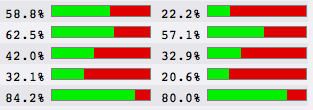
Writing tests is virtuous. It's the wholemeal bread of programming. Do it, and you'll be so much fitter. Except it tastes like cardboard and gets in the way of consuming the yummy treacle sponge of programming. But now I've got the testing religion. I view the lack of tests with the disapprobation of a reformed smoker tutting and huffing at the merest suggestion of a Marlboro Light. How did this happen and how can I be sure I won't backslide? The moment of transition was the first time that a test saved me from releasing software with a bad bug in it. The theoretical knowledge of virtue was translated into the palpitating relief of not disgracing myself in public. After that happened a few more times, I found myself desperately uncomfortable with the idea of releasing anything that didn't have decent test coverage. And so a virtuous habit is formed. It's not just driven by fear. With the right tools to hand, writing tests can be a lot of fun. You don't always need to be "in the zone". If you've got a spare half hour here and there, you can use it to increase the coverage of your tests. Getting better at testing is one of the ways I've become a much more proficient Rails developer over the last year of work on Expectnation. In case it helps anybody else, I thought I'd share some of the tools and techniques that are part of making Rails testing fun and effective. Continuous testing Whenever a checkin is made to our source repository, tests are run and the results emailed to everybody working on the project. As with the "you broke the build" disincentive, you need to be kept honest by frequent running of the tests. There are a variety of tools around to help you do continuous integration with Rails, most of which have some dependence on you using Subversion for source control. In the event, I just created my own script to do what we required. Coverage reports rcov coverage barsOne of the big mental hurdles with testing is knowing how many tests you should aim for.  You can't prove a negative: even if your tests are all passing it still doesn't tell you much about the tests you haven't written that might fail! We use rcov as part of the continuous integration process, and post the results to our project web site. The pretty red and green bars give you some idea of when you're starting to get adequate test coverage, and the line-by-line breakdown is invaluable. Tainting strings One of the easiest errors to make in Rails templates is to miss the call to h(), to escape any HTML in an output string. The only real way to catch these errors is through automation. The wonderful safe_erb plugin helps you do just that. By using Ruby's tainting mechanism for strings, it throws an exception if you render any external data unescaped. One of the beneficial side effects of safe_erb is that you then become very particular about ensuring your functional tests properly cover every action in your application.  Tests such as get 'index', which before seemed mundane and redundant, are now essential, as you want to test for tainted strings. In addition to the above techniques, there are a lot of fun shiny gadgets to help you write tests, such as ZenTest, but the three things above are the ones I've found to be of significant value. I ought to conclude with words of praise for Rails. It goes out of its way to make testing an important part of the development lifecycle, and the availability of the of unit, functional and integration test functionality makes it easy to get started. Every time I teach somebody about Rails' testing features, they end up finding it very enjoyable.
Don't forget, testing can be fun!

Next.

Previous.