Search Results: "agi"

24 April 2009

Jon Dowland: my first attempt at hacking on Linux: a story

I have a little job that runs on my web server and tells me what URIs people have tried to fetch over the last 24 hours which were not successful. One of these URIs was for a page that used to contain my first ever Linux device driver. That device driver is now obsolete and so there was little point in tracking down the code and putting it back in place, but I did think there was a story to tell, so today I wrote down what happened with this driver at the URI. Thanks to the magic of ikiwiki's "inline" directive, here it is in the log: This is a story about my first real attempt to contribute to the Linux kernel. The Davicom DM9601 is a cheap USB NIC that I picked up on ebay at some point in late 2006. Suprisingly, at the time, there was no driver for it in the Linux kernel. I'd had some experience hacking on the kernel whilst working for IBM and I've always wanted to get more involved, so I thought this would be a good opportunity. I searched around and managed to find a vendor-written driver for the 2.4.x kernel series, but nothing newer. I felt that the best approach would be to start porting this driver to 2.6, improving it along the way. I got to work, and after several hours I had something that would compile against 2.6 series headers, at least, so I put my progress online and wrote a short log post about it (dm9601). A really invaluable resource whilst doing this was LWN.net's "Porting device drivers to the 2.6 kernel". Once I had the code up there, kernel hacker Arnd Bergmann got in touch with me. He said, quite frankly, that my driver had a long way to go, but that he would be willing to help mentor me and guide me in improving it so that it would make it into mainline. This was fantastic news: this is exactly what people need when trying to get up to speed with the customs of something as complex as the kernel development community. Arnd sent me a long list of things I needed to fix. Whilst I had my code online I had several other people get in touch with me and provide things like device IDs for their NICs that they needed to add in order to get it to work for their hardware. Several weeks later, after implementing a good chunk of Arnd's suggestions, I had a driver that worked, at least a little bit, with 2.6, so I got back in touch with Arnd. Bad news, for me at least: Peter Korsgaard, another kernel hacker, had implemented a dm9601 driver from scratch over a weekend. Apparently he was at a friend's house, his friend had this device, he noticed there wasn't a driver in the kernel already and sat down to write it as a fun project. From scratch. In one weekend. This was a bit of a blow. I couldn't imagine having the skill and knowledge required to be able to pump out a driver like that, but I knew the first step on the road was what I was doing, and that road was now closed. I couldn't really blame Peter, I could only really feel quite jealous at his prowess, so that was the end of that. His driver was much leaner, much tidier, fitted the kernel programming style properly, and was thus accepted. However, for my hardware at least, it didn't actually work, and he didn't have access to the device after that one weekend, so he wasn't in a position to fix it. This situation lasted about 4 months from 2007-02-23, when Peter's driver was accepted, until about 2007-06-27 with this patch. From this whole experience, I did manage to get one small patch into the kernel: one which added the device IDs for my NIC and those of the people who had got in touch with me.

23 April 2009

Matthew Palmer: Insane/Brilliant Idea of the Day

I've been talking serial consoles with a couple of the other guys at work: how nice they are to have for machines in the datacenter, how annoying it is that vPro serial-over-LAN doesn't seem to be robust (yet?), and how serial access concentrators are lung-and-kidney expensive (especially when you've got 50-some racks to outfit). This discussion, combined with my ongoing embedded-hardware-fascination lust for a SheevaPlug appears to have spurred my brain into coming up with a Brilliant Idea: tie a SheevaPlug to a pile of USB to serial adapters and use that as your per-rack serial concentrator. Imagine: faffenheimer, a dedicated server you manage for a customer, and located in rack 27 of your DC, has just crashed, and you'd like to know WTF has happened rather than just blindly reboot, but you're in the office 15 minutes away from the DC floor, and the customer's going to want that machine back up and running pretty quickly.
workstation:~/porn$ ssh rack27.serial
rack27:~$ sconsole faffenheimer
[screen session attached]
[minicom running, shows the horror of a kernel crash dump]
[oh look at that, kernel bug]
^A ESC
[pgup pgup]
[enter]
[pgdn pgdn]
[enter]
^A >/tmp/faffenheimer-crash-dump
^A d
rack27:~$ exit
workstation:~/porn$ scp rack27.serial:/tmp/faffenheimer-crash-dump ~
workstation:~/porn$ powercycle rack27 faffenheimer
Shiny! We got a crash dump in a minute or so (rather than having to take phonecam photos of KVM screens in the DC), never had to leave our comfy seat, and the machine's on it's way back up. We're now free to pursue diagnostic activities on that crash dump at our leisure. 10 minutes later, the downtime for faffenheimer that was automatically set when we ran powercycle runs out and Nagios sends us threatening messages. Hmm, something's gone wrong here. Back into the console...
workstation:~/porn$ ssh rack27.serial
rack27:~$ sconsole faffenheimer
[screen session attached]
[Boot is hung waiting for root password after initrd has bombed]
[Type root password]
[Oh look, the root MD appears to have come asunder]
[clickety-click... fixee fixee]
[reboot]
The more I think about this, the more I reckon I'm onto a bona fide winner. The sheevaplug is a powerful ARM-based system with USB/ethernet/SD ports that is packaged literally in it's own power supply wall wart -- it's a plastic box with power plug prongs poking out the side. That's all there is to it. The USB to serial adapter things are likely to be a bit more of a pain, but I've played with enough of them by now to not be too scared. So, you plug the Sheeva into a power socket, plug an Ethernet cable and USB hub into the Sheeva, configure things a bit so that the system knows which serial adapter maps to which machine, and you're away. Oh, and the best bit: the Sheeva apparently draws as little as 2W when idle. A whole datacentre's worth of serial goodness for about a server's worth of power. The cost per rack should be somewhere below AU$250, especially in bulk. Let's see if I can convince work to spring for a Sheeva, a USB hub, and a half dozen or so USB to serial adapters to test this whole thing out. Given that the whole thing looks like it'd cost less than AU$250 (plus my R&D time), I can't imagine it'll be too hard a sell to at least give it a go. Watch this space...

Adrian von Bidder: Let's kill KHTML

Reading Kyle's view on Konqueror and KHTML's current status: I couldn't agree more. I use konqueror instead of Firefox because I quite like its GUI, and its integration into KDE is obviously better than Firefox'. Issues with various websites prompt me to have an Iceweasel window open as well quite a large part of the time. Let's just switch to WebKit, so the market only has to care about Gecko and WebKit and can ignore one more marginal rendering engine. I see libqt-webkit 4.5 is in experimental and a Google query on debian konqueror webkit at least shows an Ubuntu packaging effort of the Konqueror WebKit KPart, so the days of khtml on my Desktop are certainly nearing its end. At this point: Kudos to the KDE folks (Debian and upstream). KDE4.2 is really, really usable, the remaining issues are really small. And, if I don't try to manually interfer like I did in my first attempt, migrating the KDE settings from ~/.kde4 to ~/.kde actually did work just fine on my netbook.

Manoj Srivastava: Manoj: Ontologies: Towards a generic, distribution agnostic tool for building packages from a VCS

This is a continuation from before. I am digressing a little in this post. One of the things I want to get out of this exercise is to learn more about Ontologies and Ontology editors, and on the principle that you can never learn something unless you build something with it (aka bone knowledge), so this is gathering my thoughts to get started on creating an Ontology for package building. Perhaps this has been done before, and better, but I ll probably learn more trying to create my own. Also, I am playing around with code, an odd melange of my package building porcelain, and gitpkg, and other ideas bruited on IRC, and I don t want to blog about something that would be embarrassing in the long run if some of the concepts I have milling around turn out to not meet the challenge of first contact with reality. I want to create a ontology related to packaging software. It should be general enough to cater to the needs any packaging effort in a distribution agnostic and version control agnostic manner. It should enable us to talk about packaging schemes and mechanisms, compare different methods, and perhaps to work towards a common interchange mechanism good enough for people to share the efforts spent in packaging software. The ontology should be able to describe common practices in packaging, concepts of upstream sources, versioning, commits, package versions, and other meta-data related to packages. vcs-pkg concept diagram I am doing this ontology primarily for myself, but I hope this might be useful for other folks involved in packaging software. So, here follow a set of concepts related to packaging software, people who like pretty pictures can click on the thumbnail on the right:

21 April 2009

Russell Coker: Mo Rewards

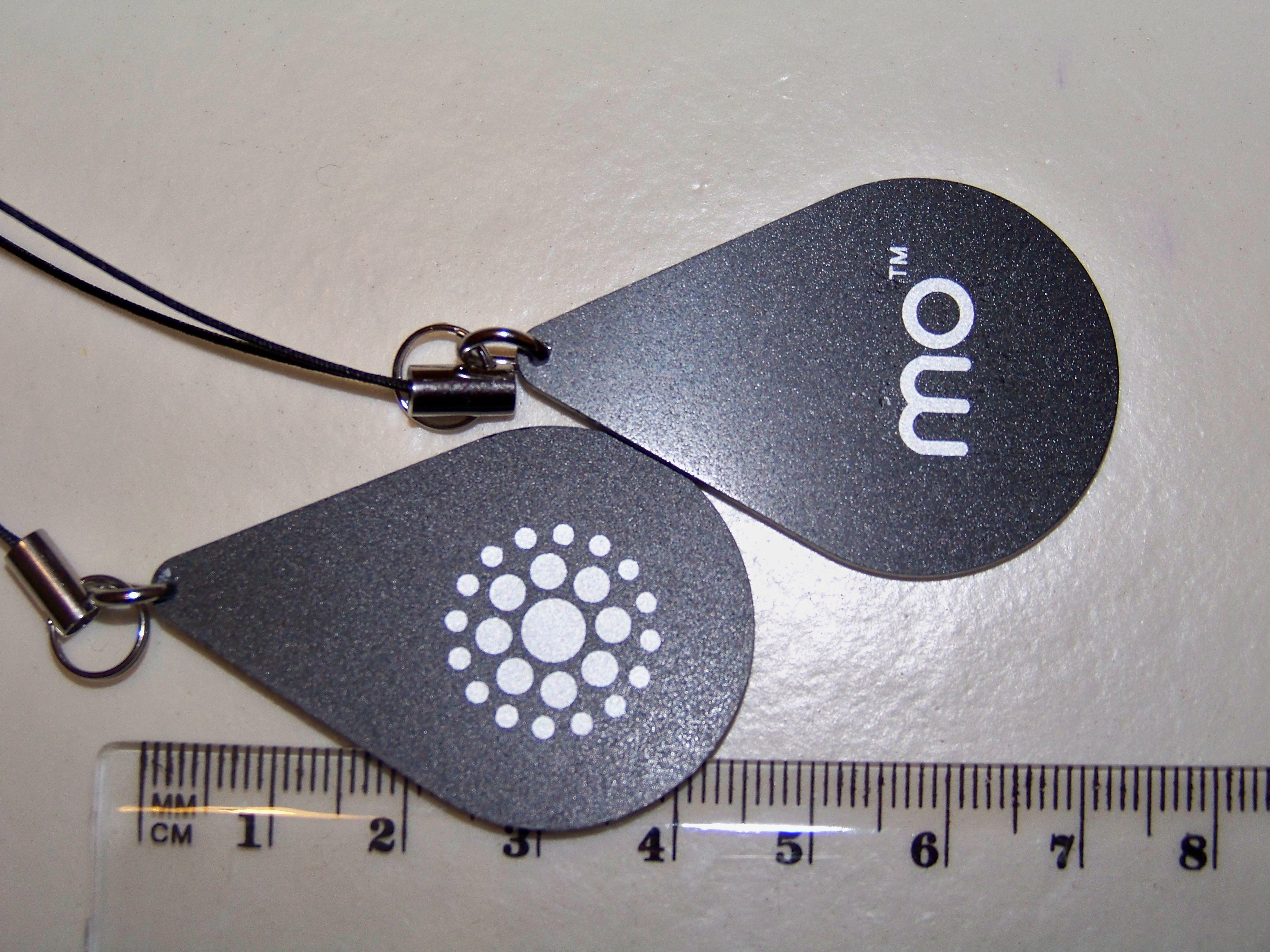
While shopping at Highpoint [1] today I noticed that they had a new loyalty system. It s called Mo Rewards [2] (for which the real web site is at MoCoMedia.net [3] which has no link from the main site because they didn t care enough about their web presence). The way that Mo works is that everyone gets a free RFID token similar to the two in the above photograph. The token comes with a pseudo-random seven letter code that you have to SMS to register it to your phone. You SMS the code and then receive a confirmation SMS. After that you can wave your token near a detector any time you visit the shopping center and you will receive three SMS messages with discount offers. You can send an SMS with your gender and birth-year to receive more targeted offers. To redeem offers you have to wave your token near a detector at the store so they know who is using the offers. Then of course once the database knows that you are a regular customer at a certain shop they can send you targeted advertising to entice you to buy from that shop on every visit. I presume that they have some sort of bidding system for adverts from the shops of a similar nature to the Google advertising. It s an interesting system and a lot better than most loyalty programs. One interesting thing about this is that high quality RFID devices are being given out for free. The tokens are quite solidly constructed and could be used for a variety of other purposes. I couldn t find anyone offering RFID tags at a reasonable price with a quick Google search (the cheapest was $75 for 100 tags - and they were the fragile ones used for marking stock in shops). So a hobbyist who wanted to do some RFID stuff could buy a cheap reader under one of the demo offers (where you get a reader and a small quantity of keys for a reasonable price) and then collect free RFID tokens from shopping centers. I expect that the number of people who would do such things is small enough to not be statistically significant and therefore not affect the business model. The tags are given out freely with no requirement that you must use them for the expected purpose (Mo Rewards) instead of using them for your own RFID work.

Sune Vuorela: Debian KDE bugs

So. On Sunday, we worked through some of the bugs filed against KDE in Debian. Mostly, we cleaned up in old cruft, and a few bugs got forwarded. A bunch of the Debian KDE people participated, and some KDE Bugsquad people also dropped by. And a special thanks goes to the apparant newcomer, Karl Ferdinand Ebert, for doing a fantastic work, and I also succeeded in getting Anne-Marie Mahfouf to take a look at the kdeedu reports. We cleaned up in kdegraphics, kdeedu, kdeadmin and akregator reports, and did quite some work on the bug magnets of konqueror, kmail and kopete. Total result was around 100 bugs down, and we discovered a few bugs that had hidden in between the others, that is actually packaging issues.
All in all a success, that definately should be repeated in a month or two.

19 April 2009

Manoj Srivastava: Manoj: Looking at porcelain: Towards a generic, distribution agnostic tool for building packages from a VCS

This is a continuation from before. Before I go plunging into writing code for a generic vcs-pkg implementation, I wanted to take a close look at my current, working, non-generic implementation: making sure that the generic implementation can support at least this one concrete work-flow will keep me grounded. One of the features of my home grown porcelain for building package has been that I use a fixed layout for all the packages I maintain. There is a top level directory for all working trees. Each package gets a sub-directory under this working area. And in each package sub-directory, are the upstream versions, the checked out VCS working directory, and anything else package related. With this layout, knowing the package name is enough to locate the working directory. This enable me to, for example, hack away at a package in Emacs, and when done, go to any open terminal window, and say stage_release kernel-package or tag_releases ucf without needing to know what the current directory is (usually, the packages working directory is several levels deep /usr/local/git/debian/make-dfsg/make-dfsg-3.91, for instance. However, this is less palatable for a generic tool imposing a directory structure layout is pretty heavy. And I guess I can always create a function called cdwd, or something, to take away the tedium of typing out long cd commands. Anyway, looking at my code, there is the information that the scripts seem to need in order to do their work. So, if I do away with the whole working area layout convention, this can be reduced to just requiring the user to: Hmm. One user specified directory, where the results are dumped. I can live with that. However, gitpkg has a different concept: it works purely on the git objects, you feed it upto three tree objects, the first being the tree with sources to build, and the second and third trees being looked at only if the upstream tar archive can not be located, and passes the trees to pristine tar to re-construct the upstram tar. The package name and version are constructed after the source-tar archive is extracted to the staging area. I like the minimality of this. This is continued here.

Matthew Garrett: Extended Qualcomm Gobi features

And while I'm on the subject of bitching about hardware support, I had some time to poke at the Qualcomm Gobi hardware a bit more last week. With the aid of Dan Williams of Network Manager fame we identified[1] that the hardware actually does rather more than is obvious from the qcserial driver. There's two extra ports - one is for diagnostics, and the other claims to be an NMEA port. Poking support for these into qcserial is easy enough, but they don't seem especially chatty. The more interesting factor is that the fourth interface on the endpoint is a network device. This isn't unusual in modern hardware - PPP isn't a terribly helpful layering for data transfer, so most recent high speed data cards also provide support for some kind of network device. If you're lucky it's a spec-compliant cdc device. If you've got a gobi then it claims to be a vendor defined class and type and the .inf file for the driver claims that it's a proprietary cdc device. Testing this got cut short by us not actually having an account on Verizon[2], so we don't have any data dumps to work out what the framing looks like.

Interestingly, doing USB dumps revealed that Windows seemed to do everything via the network device. We didn't see any traffic from the other ports, even when attempting to turn on the GPS. So it may also have some magic out of band configuration that doesn't simply use AT commands.

If anyone has this stuff working under Windows, it'd be interesting to try getting some dumps to try to work out what's going on here.

[1] By the simple process of opening the device manager under Windows. Ahem.

[2] The test machine was a Vaio P, which came with a gobi but no SIM slot. Thanks, Sony. Thony.

18 April 2009

Bastian Venthur: Using rng for bug triaging

Reportbug-NG s ability to filter and sort bugreports in various ways can greatly help triaging bugreports after a certain criterion. In this example I use the bugs of the KDE team, because they have quite a lot of bugs and are currently on a bug triage. Two releases ago I tried to help them cleaning their BTS from obsolete bugeports. My tactic back then was to find bugreports where no action has been taken for a long time. I noticed that there was no easy way to find such bugs since neither reportbug nor the BTS allowed to sort the bugs this way, so finding the candidates I searched for was very cumbersome. So let s try to find those bugs with rng: To get all bugs belonging to the KDE team start rng with the maintainer as argument:
rng debian-qt-kde@lists.debian.org
After rng started you see a table with all bugreports against the packages of the KDE team. To find potentially solved or unreproducible bugs, click on the last column header to sort the list by the date of the last action. The date of the last action is the date where the bugreport received it s last mail (including control@b.d.o mails). You will see that there are quite a lot bugs which haven t been touched for more than two years. Many of them don t have a unreproducible or moreinfo tag. If you want to help the KDE team, you can now start trying to reproduce the bug. If that s not possible you can tag them with moreinfo and unreproducible. If there is no reply in roughly one month or so it s probably safe to close this bug. To quickly find a lot of other candidates to close one can use the filter of rng. Just enter moreinfo in the filter and the table will reduce to all bugreports containing this word or tag. Now you can again sort this list by date of last action and you will see quite a lot bugs bugs where more info was requested but no action took place for more than one year. Those need to be inspected, but probably quite a few of them are safe to close. This example shows how filtering and sorting can greatly help to find certain bugs and support bug triaging. But please: don t carelessly close very old bugs! Read the reports and try to reproduce them, find matching bugreports in upstream s BTS and ask the submitter if in doubt.

17 April 2009

Erich Schubert: Web data time series

For a research project, I'm looking for some real-world time series data. Time-series are an interesting thing to study, however it is hard to get access to interesting non-trivial real-world data.I was wondering if some people could contribute me some summarized web access data; no URLs or IP addresses.The data I'd like to get can best be explained by the preprocessing step:
...   perl -ne '/\[(\d+\/\w+\/\d 4 :\d\d):\d\d/
&& print $1."\n";'   sort   uniq -c
(Sorry if you aren't fluent in regexp - it extracts the date and hour out of an Apache default log file, nothing else. These lines are then summarized by counting their unique appearances.)That should produce 24 lines per day (one per hour), looking like this:
  count day-of-month/month/year:hour
It would be cool if you could send me some series for a couple of sites, if you happen to be in the position to provide this data. The data should cover at least a few weeks, the longer the better even up to a few years.Too small sites are however not very useful but might be too noisy (so probably not the personal home page of your mom). If you are providing a larger number of series, you are of course free to include them.I don't care much about what the site actually contains, I'd just ask you to give a tiny amount of meta information:Data use:The main project idea is to evaluate different distance metrics in their capability of separting the different data sources, assuming that there is some difference in the shape in these curves. A different problem can be constructed by breaking the series into chunks covering approximately a day and then trying do separate different days, starting hours of the series (or offset server timezone vs. user timezone) and/or weekdays from weekends.In our experiments, we've come to the conclusion that the experimental results are most interesting when there is a sufficient number of classes; so I'd like to get like 20 different interesting data series. At the same time, the series should be long enough, so I can break them into multiple chunks to have a reasonable number of 'sub-series' per class. If I have really long series, or e.g. series covering the same site but from multiple servers, I could even experiment with taking sample of different length from these sets.(Say I have series covering 2 years, that is ~17k samples, from 3 servers, then I can take 51 disjoint sub-series of length 1000, or 102 of length 500, ...)But it's obviously not possible for me to collect this data myself - I don't operate two dozen of such sites myself ...An extra project I've been considering some time is some peak prediction for web accesses. Say you're running some fast growing site, wouldn't it be useful to have a prediction when the number of accesses will likely hit some magical limit (and e.g. overload your server) so you can increase your capacity on time? Of course it would be more sensible to apply this prediction e.g. onto CPU usage, e.g. predicting when your system might hit 90% load average over a 5 minute window in regular operation. Network bandwidth and disk IO also come into mind. You get the idea.Please send them via email to erich.schubert AT gmail comThank you.[P.S. Already recieved the first series, thank you! I can take care of sorting myself, no need to worry about that. And yes, I'm aware that the series will probably all be quite similar - common computer usage patterns such as work hours - but that is common in real world data and part of the challenge. Separting apples from dinosaurs is not a challenge.]

16 April 2009

Manoj Srivastava: Manoj: Towards a generic, distribution agnostic tool for building packages from a VCS

I have been involved in vcs-pkg.org since around the time it started, a couple of years ago. The discussion has been interesting, and I learned a lot about the benefits and disadvantages of serializing patches (and collecting integration deltas in the feature branches and the specific ordering of the feature branches) and maintaining integration branches (where the integration deltas are collected purely in the integration branch, but might tend to get lost in the history, and a fresh integration branch having to re-invent the integration deltas afresh). However, one of the things we have been lax about is getting down to brass tacks and getting around to being able to create generic packaging tools (though for the folks on the serializing patches side of the debate we have the excellent quilt and the topgit packages). I have recently mostly automated my git based work-flow, and have built fancy porcelain around my git repository setup. During IRC discussion, the gitpkg script came up. This seems almost usable, apart from not having any built-in pristine-tar support, and also not supporting git submodules, which make is less useful an alternative than my current porcelain. But it seems to me that we are pretty close to being able to create a distribution, layout, and patch handler agnostic script that builds distribution packages directly from version control, as long as we take care not to bind people into distributions or tool specific straitjackets. To these ends, I wanted to see what are the tasks that we want a package building script to perform. Here is what I came up with.
  1. Provide a copy of one or more upstream source tar-balls in the staging area where the package will be built. This staging area may or may not be the working directory checked out from the underlying VCS; my experience has been that most tools of the ilk have a temporary staging directory of some kind.
  2. Provide a directory tree of the sources from which the package is to be built in the staging area
  3. Run one or more commands or shell scripts in the staging area to create the package. These series of commands might be very complex, creating and running virtual machines, chroot jails, satisfying build dependencies, using copy-on-write mechanisms, running unit tests and lintian/puiparts checks on the results. But the building a package script may just punt on these scripts to a user specified hook.
The first and third steps above are pretty straight forward, and fairly uncontroversial. The upstream sources may be handled by one of these three alternatives:
  1. compressed tar archives of the upstream sources are available, and may be copied.
  2. There is a pristine-tar VCS branch, which in conjunction with the upstream branch, may be used to reproduce the upstream tr archive
  3. Export and create an archive from the upstream branch, which may not have the same checksum as the original branch
The command to run may be supplied by the user in a configuration file or option, and may default based on the native distribution, to dpkg-buildpackage or rpm. There are a number of already mature mechanisms to take a source directory and upstream tar archive and produce packages from that point, and the wheel need not be re-invented. So the hardest part of the task is to present, in the staging area, for further processing, a directory tree of the source package, ready for the distribution specific build commands. This part of the solution is likely to be VCS specific. This post is getting long, so I ll defer presenting my evolving implementation of a generic vcs-pkg tool, git flavour, to the next blog post. This is continued here.

Martin F. Krafft: Government exaction

Do you listen to the radio? I don t, and there are multiple reasons for that: First and foremost, I don t like the music they play these days. Even though there are stations which will occasionally play a more eclectic tune, the Swiss government does not, to my knowledge, dictate any quota, like New Zealand actually requires stations to broadcast New Zealand music at least 20% of the time. The result is music made by producers, who stand pop icons with little clothing in front of microphones, instruct them to move their bodies in obscene ways, and coach them to croak songs someone else wrote en masse in some basement somewhere. All those songs sound alike. To ensure a constant supply of pop dolls, they hype television shows with titles such as Germany s seeks the next superstar , when most of Germany actually couldn t care less, and only those with vacuous brain capacity follow with excitement, because they wouldn t know what else to do. Second, I don t have the time or energy to listen to discussion rounds on the radio, especially not when topic are about society , which noone can define in the first place. Wittgenstein always had it right. The same goes for most commentaries. If I don t have anything to do, I prefer to listen to birds in the trees, rather than someone s polished opinion. The scariest aspect is that those people actually believe that they have something worthwhile to say, and so do their producers and the other staff, when in most cases, they don t. At least not worthwhile to people who have other things occupying their minds. I also don t like someone to make a pre-selection of news and squash that into 5-15 minute time slots, to be read out by dull-sounding speakers. I d rather skim over articles, and the Web ensures that I get the information I want much quicker than the radio stations can transmit them. And sports over the radio waves makes me come close to aural epileptic seizures. I am painting the sky black a bit. I am fully aware that there exist people with thought-provoking arguments, that some stations play interesting music I would otherwise never discover, and that the radio is a source of entertainment in the lives of thousands of other people who are less privileged than me. But when the Billag rang my doorbell today and wanted CHF 14,10 per month for posession of any device capable of turning radio waves into sound, including those radio waves broadcast over the Internet these days, I got a bit furious. In the past, they concentrated only on actual radio and TV receivers. When I moved into my previous flat in Zurich in 2002, they wanted money because my stereo had a tuner button. I refused to pay, opened the device, unsoldered the radio coil, and sent it to them with an angry letter of refusal; they let me off the hook. Since then, they changed the law in 2007 (but haven t actually updated the forms they force you to sign) to include audio players, cellular phones, and computers, which are all radio-capable. I d really prefer if they used their funds to revert that trend, or at least remove the loudspeakers from all mobile phones. But instead, this morning, I skid right into their claws. As I said before, the radio is also a social support system, and as such I have less of a problem to subsidise it. However, given that I strongly disagree with the quality level broadcast, I would prefer to direct my money towards causes I consider more useful, and with which I could better identify. Unfortunately, the whole system is governmentalised to the point where this choice is taken away from me. The Billag website helpfully offers answers to the common questions, including one along the lines of quality. They suggest that you get in touch directly with the programme directors to complain about their content, and offer suggestions. Shortly after I moved to Zurich, Radio Lora offered me a radio show. Radio Lora is a private station, but they also receive subsidies from the monies exacted by the government, so I am using them as an example here. I suggested that I concentrated only on progressive and psychedelic rock from the sixties and the seventies. They refused the show in the end, claiming that this would not be what their listeners want. So instead I now get to pay for content that is deemed more appropriate. I can only imagine the pains I d have to go through to be able to host a radio show concentrating on eclectic tunes on one of the public radio stations. And even if I succeeded (without becoming a full-time public radio broadcaster), then I could only contribute a few hours a week to that content. If you ask me, the Swiss government is overstepping its competencies a bit. NP: Mono: Hymn to the Immortal Wind

Manoj Srivastava: Manoj: The glaring hole in most git tools, or the submodule Cinderella story

There are a lot of little git scripts and tools being written by a lot of people. Including a lot of tools written by people I have a lot of respect for. And yet, they are mostly useless for me. Take git-pkg. Can t use it. Does not work with git submodules. Then there is our nice, new, shiny, incredibly bodacious 3.0 (git) source format. Again, useless: does not cater to submodules. I like submodules. They are nice. They allow for projects to take upstream sources, add Debian packaging instructions, and put them into git. They allow you to stitch together disparate projects, with different authors, and different release schedules and goals, into a coherent, integrated, software project. Yes, I use git submodules for my Debian packaging. I think it is conceptually and practically the correct solution. Why submodules? Well, one of the first things I discovered was that most of the packaging for my packages was very similar but not identical. Unfortunately, the previous incarnation of my packages with a monolithic rules file in each ./debian/ directory, it was easy for the rules files in packages to get out of sync and there was no easy way to merge changes in the common portions an any sane automated fashion. The ./debian/ directories for all my packages package that they are instrumental in packaging. So, since I make the ./debian/ directories branches of the same project, it is far easier to package a new package, or to roll out a new feature when policy changes the same commit can be applied across all the branches, and thus all my source packages, easily. With a separate debian-dir project, I can separate the management of the packaging rules from the package code itself. Also, I have abstracted out the really common bits across all my packages into a ./debian.common directory, which is yet another project, and included in as a submodule in all the packages so there is a central place to change the common bits, without having to duplicate my efforts 30-odd times. Now people are complaining since they have no idea how to clone my package repositories, since apparently no one actually pays attention to a file called .gitmodules, and even when they do, they, and the tools they use, have no clue what to do with it. I am tired of sending emails with one off-cluebats, and I am building my own porcelain around something I hope to present as a generic vcs-pkg implementation soon. The firs step is a wrapper around git-clone, that understands git submodules. So, here is the browsable code (there is a link in there to the downloadable sources too). Complete with a built in man page. Takes the same arguments as git-clone, but with fewer options. Have fun.

15 April 2009

Pablo Lorenzzoni: rsync logs with restricted ssh

SSH is really the Swiss Army pocket knife of sysadmin tools. When I needed to periodically synchronize log files from an old server (old as in customer-would-never-update-it-or-install-anything-new), I built a simple and secure solution using rsync and ssh. This is what I did: (I will call remote the system where the logs I want to retrieve are, and local system where I want them to be copied to) First I created an account with a restricted shell (ideally this should be a system account, but we ll get there!):

remote# adduser --ingroup nogroup --shell /bin/rbash rlogs
Then locally, I created a new, password-less ssh key pair, copying it to my remote system:

local$ ssh-keygen
>>> When asked where to save it, I chose a different name, like .ssh/rlogs
local$ ssh-copy-id -i .ssh/rlogs.pub rlogs@remote
...
>>> You can delete the password of user rlogs, so it, effectively,
>>> cannot log-in with it (almost like a system user).
remote# passwd -d rlogs
Now you should be able to run password-less rsync already (note that I use -e option to point to a different key):

local$ mkdir logs
local$ rsync -av -e "ssh -i $HOME/.ssh/rlogs" rlogs@remote:"logs/" logs/
receiving file list ... done
./
file1
file2
...
fileN
But even with a restricted shell, I wanted even less possible things to happen. That s what command= directive is for It will only allow that command to be run in a session started by that key. Since rsync translates a lot of its command-line options, I run it again with a dirty ps-in-a-loop in the remote host, just to see what running rsync locally causes remotely:

remote$ while 1; do ps wp $(pgrep rsync); sleep 1; done
...
local$ rsync -av -e "ssh -i $HOME/.ssh/rlogs" rlogs@remote:"logs/" logs/
>>> in the remote loop you should be able to get the command:
  PID TTY      STAT   TIME COMMAND
 6183 ?        Ss     0:00 /usr/bin/rsync --server --sender -vlogDtpre.i . logs/
Here comes the authorized_keys magic. At the remote host I edited .ssh/authorized_keys to add a command= line with what I found out in my dirty loop. Also, I added a couple of directives to restrict it even further (they are pretty self-explanatory):

rlogs@remote$ cat .ssh/authorized_keys
command="rsync --server --sender -vlogDtpre.i . logs/",no-port-forwarding,no-agent-forwarding,no-X11-forwarding,no-pty ssh-rsa (...) myuser@local
Now everything is set. I just added the rsync command to the local crontab and it s done.

Julien Danjou: Taking the other direction

I've started to develop awesome more than 18 months ago, and somehow I feel it's time to stop a bit and think where we come from and where we are going to. The motivation I never though I'd be written a window manager one day. That seems kinda stupid when you see how many window manager there's around. As many people, I've tested and have been using tons of window manager: Window Maker, Fluxbox, etc. In August 2007, I was using fvwm since 2004 and was quite happy with it. I used the famous fvwm-crystalhttp://www.fvwm-crystal... as a configuration starter and then rewrote lots of stuff. Digging into fvwm configuration files was boring, and since I'm lazy, I never really configured it to fit entirely my needs. The thing is that, in July 2007, my workstation died. I bought a new one based on the amd64 architecture. Too bad, with this new box, fvwm decided that it will not longer runs and was segfaulting almost every time I logged in. I was really upset. Another failure in the window manager world. So I decided to get the yearly ride of testing many window managers. I went on the no more developed stuff like the *boxes, ion3, etc but well, I did not like them, there were not powerful enough, too bugged or upstream was insane. Then I found xmonad. The Haskell configuration file format made my cry. I did not want to learn Haskell, it seemed too obfuscated to me. At that time it was even not packaged for Debian, so I gave up. But I found dwm in the meantime, and I loved it. It was simple, and the source code was almost understandable and easy to hack. I subscribed to the dwm mailing-list, in order to participate to its development, etc But I got really disappointed. No patch were welcome and the development seemed to be almost finish in this sight. People patches were lying around, but no one really care. Each user was managing its own set of patches. That's not what I learnt and what I love in free software. So, as many users, I began to maintain my patches in my corner. But I began to have more ideas The jdwm I just added a 'j' in front of dwm and started to hack it days and nights to add many feature I missed, like multi-head, etc On 5th September 2007, I created a git repository to host my code. That's gonna be awesome. Five days later, on 10th September, I finally found a name for my new pet: awesome, borrowed from Barney Stinson who heavily uses and abuses this word. The 1.x branch The first releases until December were noted 1.x. It was just a better dwm with a simple flat configuration file.. The configuration file used libconfig, but it was a very poor choice. And I was not able to put in into Debian because of name clash. The 2.x branch The 2.x branch came in January 2008 with a brand new configuration file format based on libconfuse, which was a bit more powerful. Many concepts and features that have been added in this branch are still used in the current 3.x branch. At this time, between December 2007 and April 2008, the community was growing smoothly. But as I said, awesome 2 was based on a flat configuration file. That raised a problem very soon: users expectation were growing and the development team (me and a couple of regular contributors) was unable to cope with them. One of the event that started to change my mind was the support for titlebars. When I've added titlebar support, it was minimal. It was on top of a window, with the window title. Dot. Then I've started to add a lot of options, like the application icon drawing, the position (left, right, bottom) etc. And then users started to ask for more, like: "add titlebar on windows only when the window is floating". That's ok, but that's complicated: that's again another option to do some stuff conditionally. And then, why don't add titlebar on windows when <insert random events here>? The 3.x branch Why At that time, around April 2008, I'd totally stopped development. I was trying to find a solution which was simple and powerful. But after 2 weeks of thinking, I was not able to find anything else than: use a real language for configuration. So, I've started prototyping awesome 3 using Lua. The choice was not obvious, and despite the problem Lua might suffer, it's one of the easiest language to integrate into an existing application. There's still a video of a first version here. But, let's go a little back: in January 2008, Arnaud Fontaine contacted me because he was interested to use awesome as one of its school project. He decided to port awesome from Xlib to XCB, a modern asynchronous X library. His work took some time, but in May 2008, Arnaud did finished to port git master version of awesome to use XCB. Consequently, I decided to start a new major branch, using XCB instead of Xlib (no change for users in this regard) and Lua instead of our previous flat configuration file format. Development It took me a while to get from here to there, but in September 2008, it was ready. We had a simple Lua API, and the XCB port was working perfectly. It took us some time to release and have something totally working, because we had to work on XCB and contribute back to the project. It was really not ready to use by an application, but we did great work in this area and it's now really fine. We're still here Releases continue to happens, 3.1 around December 2008, and 3.2 around March 2009. 3.3 should be here in June. One of the drawback we had, is that we moved many stuff from C to Lua. Why? Because writing things in Lua is quicker and easier to maintain than C, and makes thing more configurable for the user. For example, the layout algorithm used to organize window were written in C until 3.2 came out. At that time, users had no choice than using a set of predefined layout to organize their windows. Starting with 3.2, if they have minimal knowledge about geometry, they can start writing a layout function organising windows on the screen. But this kind of API changes was a bit rough for users, since they had to port some part of their configuration file to the new API. The thing is that the project was still a teenager at that time, not really knowing were it will go. But I'm happy to announce that API breakage are more and more rare (so far only one minor between 3.2 and 3.3), and anyway always for the Good. But I admit that it built a bad reputation around awesome 3.x during its first month of existence. Future direction I am currently working on 3.3 development. We have still many things to do. Time passing, we get more idea, and more users. And more users bring more ideas. We also have many more contributors, and some guys are even taking maintainer-ship of some code area. Conclusion My post title is "Taking the other direction" because I feel this way. I've got that feeling that some approaches in projects like GNOME are sometimes bad. Please don't misread me, I know we are not playing in the same yard. When adding a key shortcut for starting an application makes you dig into gconf, I wonder how this is a win for the user. Well, it's probably a win for the end-user, but I surely am not one of them. And I don't intend to target them with my software, anyway. And now, when I hear things like GNOME 3.0 and the "desktop shell" approach, that makes me smile. Guys, it was time, but have luck. What I see from here, is that any desktop control interface is wrong somehow, and that there's no approach that can fulfill all users wishes. I think that we, the awesome development team (no pun intended) took the direction of building a frame-work window manager rather than a solution written in marble. We (partially) solved the issue of UI ergonomic by not writing one and allowing the user to write his own. I don't say that's easy to do for most of users, but it's doable. And I think it's worth it: I use window managers since I use Linux, around 1998. If something like awesome came 5 years ago, I'd be using it so far, because you can write Fluxbox or WindowMaker using awesome in a hundred of Lua code. And you can write your own version of it. And it starts in less than 3 seconds, supporting almost all standard desktop specification (ICCCM, EWMH, XDG, system tray, message notification, D-Bus, etc), whereas many of the window mangers do not. You can even write and play space invaders. Finally, I'm happy about the the road we took so far, and hope we will continue into that direction. The rants I read about our project are not that big, compared to the kudos we received.

Julien Danjou: Taking the other direction

I've started to develop awesome more than 18 months ago, and somehow I feel it's time to stop a bit and think where we come from and where we are going to. The motivation I never though I'd be written a window manager one day. That seems kinda stupid when you see how many window manager there's around. As many people, I've tested and have been using tons of window manager: Window Maker, Fluxbox, etc. In August 2007, I was using fvwm since 2004 and was quite happy with it. I used the famous fvwm crystal as a configuration starter and then rewrote lots of stuff. Digging into fvwm configuration files was boring, and since I'm lazy, I never really configured it to fit entirely my needs. The thing is that, in July 2007, my workstation died. I bought a new one based on the amd64 architecture. Too bad, with this new box, fvwm decided that it will not longer runs and was segfaulting almost every time I logged in. I was really upset. Another failure in the window manager world. So I decided to get the yearly ride of testing many window managers. I went on the no more developed stuff like the *boxes, ion3, etc but well, I did not like them, there were not powerful enough, too bugged or upstream was insane. Then I found xmonad. The Haskell configuration file format made my cry. I did not want to learn Haskell, it seemed too obfuscated to me. At that time it was even not packaged for Debian, so I gave up. But I found dwm in the meantime, and I loved it. It was simple, and the source code was almost understandable and easy to hack. I subscribed to the dwm mailing-list, in order to participate to its development, etc But I got really disappointed. No patch were welcome and the development seemed to be almost finish in this sight. People patches were lying around, but no one really care. Each user was managing its own set of patches. That's not what I learnt and what I love in free software. So, as many users, I began to maintain my patches in my corner. But I began to have more ideas The jdwm I just added a 'j' in front of dwm and started to hack it days and nights to add many feature I missed, like multi-head, etc On 5th September 2007, I created a git repository to host my code. That's gonna be awesome. Five days later, on 10th September, I finally found a name for my new pet: awesome, borrowed from Barney Stinson who heavily uses and abuses this word. The 1.x branch The first releases until December were noted 1.x. It was just a better dwm with a simple flat configuration file.. The configuration file used libconfig, but it was a very poor choice. And I was not able to put in into Debian because of name clash. The 2.x branch The 2.x branch came in January 2008 with a brand new configuration file format based on libconfuse, which was a bit more powerful. Many concepts and features that have been added in this branch are still used in the current 3.x branch. At this time, between December 2007 and April 2008, the community was growing smoothly. But as I said, awesome 2 was based on a flat configuration file. That raised a problem very soon: users expectation were growing and the development team (me and a couple of regular contributors) was unable to cope with them. One of the event that started to change my mind was the support for titlebars. When I've added titlebar support, it was minimal. It was on top of a window, with the window title. Dot. Then I've started to add a lot of options, like the application icon drawing, the position (left, right, bottom) etc. And then users started to ask for more, like: "add titlebar on windows only when the window is floating". That's ok, but that's complicated: that's again another option to do some stuff conditionally. And then, why don't add titlebar on windows when <insert random events here>? The 3.x branch Why At that time, around April 2008, I'd totally stopped development. I was trying to find a solution which was simple and powerful. But after 2 weeks of thinking, I was not able to find anything else than: use a real language for configuration. So, I've started prototyping awesome 3 using Lua. The choice was not obvious, and despite the problem Lua might suffer, it's one of the easiest language to integrate into an existing application. There's still a video of a first version here. But, let's go a little back: in January 2008, Arnaud Fontaine contacted me because he was interested to use awesome as one of its school project. He decided to port awesome from Xlib to XCB, a modern asynchronous X library. His work took some time, but in May 2008, Arnaud did finished to port git master version of awesome to use XCB. Consequently, I decided to start a new major branch, using XCB instead of Xlib (no change for users in this regard) and Lua instead of our previous flat configuration file format. Development It took me a while to get from here to there, but in September 2008, it was ready. We had a simple Lua API, and the XCB port was working perfectly. It took us some time to release and have something totally working, because we had to work on XCB and contribute back to the project. It was really not ready to use by an application, but we did great work in this area and it's now really fine. We're still here Releases continue to happens, 3.1 around December 2008, and 3.2 around March 2009. 3.3 should be here in June. One of the drawback we had, is that we moved many stuff from C to Lua. Why? Because writing things in Lua is quicker and easier to maintain than C, and makes thing more configurable for the user. For example, the layout algorithm used to organize window were written in C until 3.2 came out. At that time, users had no choice than using a set of predefined layout to organize their windows. Starting with 3.2, if they have minimal knowledge about geometry, they can start writing a layout function organising windows on the screen. But this kind of API changes was a bit rough for users, since they had to port some part of their configuration file to the new API. The thing is that the project was still a teenager at that time, not really knowing were it will go. But I'm happy to announce that API breakage are more and more rare (so far only one minor between 3.2 and 3.3), and anyway always for the Good. But I admit that it built a bad reputation around awesome 3.x during its first month of existence. Future direction I am currently working on 3.3 development. We have still many things to do. Time passing, we get more idea, and more users. And more users bring more ideas. We also have many more contributors, and some guys are even taking maintainer-ship of some code area. Conclusion My post title is "Taking the other direction" because I feel this way. I've got that feeling that some approaches in projects like GNOME are sometimes bad. Please don't misread me, I know we are not playing in the same yard. When adding a key shortcut for starting an application makes you dig into gconf, I wonder how this is a win for the user. Well, it's probably a win for the end-user, but I surely am not one of them. And I don't intend to target them with my software, anyway. And now, when I hear things like GNOME 3.0 and the "desktop shell" approach, that makes me smile. Guys, it was time, but have luck. What I see from here, is that any desktop control interface is wrong somehow, and that there's no approach that can fulfill all users wishes. I think that we, the awesome development team (no pun intended) took the direction of building a frame-work window manager rather than a solution written in marble. We (partially) solved the issue of UI ergonomic by not writing one and allowing the user to write his own. I don't say that's easy to do for most of users, but it's doable. And I think it's worth it: I use window managers since I use Linux, around 1998. If something like awesome came 5 years ago, I'd be using it so far, because you can write Fluxbox or WindowMaker using awesome in a hundred of Lua code. And you can write your own version of it. And it starts in less than 3 seconds, supporting almost all standard desktop specification (ICCCM, EWMH, XDG, system tray, message notification, D-Bus, etc), whereas many of the window mangers do not. You can even write and play space invaders. Finally, I'm happy about the the road we took so far, and hope we will continue into that direction. The rants I read about our project are not that big, compared to the kudos we received.

Stefano Zacchiroli: xmonad + gnome on Debian

... finally I'm tiling too! Short story: I've just switched to xmonad as my window manager of choice within a Gnome desktop environment; I give some tips on how to achieve that quickly on a current Debian/unstable machine. /me and tiling window managers I switched to Gnome a long time ago. The benefit of that over good old window managers is enjoying an integrated environment and a workplace that you can find on other machines (e.g., the netbook you installed for your mother, the office desktop, the student lab machines, ...). Still, I've never been particularly happy about Gnome's default window manager: metacity. The feature I was missing the most is the ability to configure windows programmatically so that they appear where and how I want by default; sadly enough, the Gnome session mechanism is not yet able to do that properly. Hence, I've tried various time switching to a tiling window manager, imposing the extra requirement that it should integrate with Gnome. The coolest guy on the block of that area seems to be awesome and I gave it a try some months ago. I liked most of its (sometime revolutionary) principles, like window tagging, but I equally hated various aspects of it: People nowadays tell me that awesome works fine with Gnome, so maybe I've just been unlucky back then, but sometime the first impression does count. I've never considered seriously xmonad, thinking (with no sound reason, apparently) that it was a project of the series: "I'm a fan of programming language $LANG, all my apps should be written in $LANG, my window manager is no exception", with LANG=haskell. Then two things happened:
  1. a couple of weeks ago I stumbled upon the xmonad wiki and documentation, and I was impressed by the average quality of the information shipped there. It is not something you usually find in "language showcase" projects.
  2. Patrick blogged about its switch to xmonad + Gnome, with enthusiastic feedback. If that's not a sign I don't know what it can be :-)
Getting started with xmonad + Gnome on Debian There is a page explaining how to use xmonad with Gnome in the xmonad wiki, but a handful of additional tips will help you get started in Debian, even if you know (almost) nothing about Haskell (yet). The (crazy) way in which xmonad works is that you create your config file as ~/.xmonad/xmonad.hs. That file is a full fledged Haskell program, which gets compiled to obtain your own xmonad executable which you run as your own window manager. /usr/bin/xmonad is the executable you initially run, but is just a wrapper around the compilation + run mechanism The modMask setting means that ALT will get delivered to applications, while all xmonad commands are delivered via the infamous windows key: no more conflicts between apps and WM \o/. The default Gnome configuration is quite nice: you can retain your Nautilus desktop (in spite of what is written on the wiki), mod-p will get you a gnome-run dialog box, and appropriate padding for the (upper!) Gnome panel. The only glitch is that you will get 9 desktops which can clutter your workspace switched. My solution is to have the appler show workspaces on 2 rows but beware of bug 524065, which is really annoying. The above example will make the pidgin buddy list and run application dialog box float by default. The commented line is an example of how to deliver specific windows to arbitrary workspaces. To find out window properties on which match in your xmonad.hs, my magic command is xprop egrep "CLASS NAME". Note that you don't need to care about panel placement because it is already taken care of by the default gnome config. Still beware of not using myManageHook as your only management hook, you should update the default one using the <+> monad as I did above. xmonad rant So, what's wrong with xmonad + Gnome in Debian? Well, the fact that it will take about 200 Mb of disk space on amd64 by default. o_O Why so? Because xmonad is affected by the static linking hell which seems to be shared by modern statically typed functional languages, including in the category both Haskell and my beloved OCaml. In short, applications written for those language link statically code written in the implementation language in most cases; they rely on legacy shared libraries only for bindings to C libraries. For xmonad that means that if you are fine with the default configuration you will get a cheap 2 Mb binary package. If you are not, you will need to write your conffile ... which is a Haskell program ... using several contrib libraries ... and needing ghc6 to be compiled and run as your own window manager executable. This is plainly dumb and induces all the usual problems of static linking, like disk consumption due to non-shared (Haskell) code, and worries about staying up to date with the latest library release in case of fixes (including security fixes) need to be propagated to user executables. Truth to be said, /usr/bin/xmonad does a wonderful job in hiding all this to the final user, but still the design choice is an unpleasant one.

14 April 2009

Michael Schutte: Chain of unfortunate events

I did some work on kbd today. I basically took an old Debian patch, the only significant divergence from the original tarball, and altered it in a way that I can read and understand it more easily (so I can send it upstream in good conscience). This process naturally involved a lot of errors. As I m talking about loadkeys here, they became unpleasantly obvious whenever I tested my code: First I messed up everything but plain printable ASCII characters (so the return key was mapped to Unicode U+0201 instead of the correct K(0x02, 0x01)), then I managed to completely freeze everything. In both cases, Alt+F7 was affected by the damage. Just like Ctrl+Alt+Del. Time for the good old boring elephants. I learn from mistakes when I make them twice, so a while sleep 60; do chvt 7; done loop saved me from further reboots. I nuked /dev/tty1 once more (in the really cool, irreversible way that disables all keypresses), but I could move on to the next VT. After a final adjustment, my modified patch finally worked. I sent it upstream, forgot about the troublesome debugging and went on to something else. Later in the evening, I decided to end the last school holidays in my life with a bit of instant messaging. BitlBee, a Jabber IRC gateway, is running on my virtual private server for this purpose. Being the occasional chatter that I am, I haven t touched it since the recent upgrade to Lenny. The format of its account configuration files has apparently changed, so I started to set up BitlBee anew. It kept telling me that there is an Authentication failure ; given the peculiar setup of the XMPP server I use, this didn t really surprise me. But still, this thing had worked before. Perhaps I really got my password wrong? I haven t typed it for ages, BitlBee stored it for me. As the administrator of my Jabber server, I could easily reset my password to what I thought it was. BitlBee still refused to get past the identification stage. I decided to install Gajim, entered my account information and told it to connect. Gnah. One or the other Python exception caused an eternal stream of error dialogue boxes to appear simultaneously and steal my focus. I don t have a keyboard shortcut for xkill and I couldn t type anything in a Urxvt (error message #54321 would receive the keystrokes). Ctrl+Alt+F1, get me out of here! Oh, right, I broke that one! At that point, I burst into a laugh. Somewhere in this post, there are a few bugs to report.

13 April 2009

Andrew Pollock: [tech] Queensland Rail to get WiFi

I just read that they plan to put WiFi on the trains in Brisbane. I had one of my crazy business ideas to try and do this years ago. I think it'd be great for public transport adoption. Imagine being able to be on top of your email by the time you arrive at your desk? Of course, with mobile broadband becoming more and more ubiquitous, you don't really need WiFi on the train, so it may be too late...

12 April 2009

Sean Finney: a productive weekend for debian stuff

(note that i've just tried enabling the comments feature of ikiwiki, so feel free to use it :) ) (update: okay so i apparently failed to enable comments earlier... but it should be working now :) ) compiz(-fusion) 0.8.2 uploaded to unstable for all you lovers of desktop bling, the latest stable release of compiz-fusion has been uploaded to unstable. new features of note: new one-off script for building compiz packages the biggest problem with trying to maintain compiz packages is that they're for some reason distributed as almost a dozen different source projects upstream, but extremely interdependant wrt their API. therefore updating the packages to a new upstream version is a Big Pain. i've numbed that pain a bit with a new helper script, which should amongst other things make it easier to manage backports to lenny, which i've already seen people requesting. compiz 0.8.2 lenny packages available for testing ..which brings us to our next topic. before i upload them to somewhere a little more official, i figure i could put a call out to teh lazywebs to do some QA work and make sure that it doesn't totally explode on your system (unless you're using the explode animation plugin, in which case it's functioning properly) sources.list entry to try it out on an amd64 lenny system:
deb http://people.debian.org/~seanius/compiz/lenny-backports/amd64 ./

sources.list entry to try it out on an i386 lenny system:
deb http://people.debian.org/~seanius/compiz/lenny-backports/i386 ./

and then apt-get install compiz compiz-fusion-plugins-main (etc) so give it a try and let me know how it goes! pkg-php moving to git with some initial legwork from Mark Hershberger we've migrated to a git repository for the php packaging vcs. due to the long and convoluted history of our svn repository, we decided it wasn't worth the effort of trying to get every single svn commit mapped into the new repo. as a compromise to having to start from scratch, we used the existing branches/tags on top of a series of upstream tarball imports to get an accurate representation of the release history. new git<->bts integration hook for debian packaging i've been dabbling with a new hook to make for more useful integration from a git-buildpackage oriented workflow. in this workflow the changelog is often the last thing prepared, possibly days or even weeks after a fix has been committed for a bug. therefore the standard tagpending and typical changelog-scanning hooks aren't incredibly useful. instead, this hook scans for "Closes:" meta-info in the commits, similar to how "git dch" does, and then sends a notification and/or control commands to the bts. here's an example. note that it also mentions the branch that recieved the fix in the notification, so it's easier to see which branches have a fix at a quick glance. how to use this for your own git repo:
REPO_PATH=/path/to/your/repo.git
HOOK_REPO_PATH=/somewhere/you/want/to/put/it
git clone git://git.debian.org/users/seanius/vcs-hooks/git-hooks.git $HOOK_REPO_PATH
ln -sf $HOOK_REPO_PATH/git-post-receive-url-notifications.py $REPO_PATH/hooks/post-receive

there's a number of configurable options (take a look at the top of the file for some fairly verbose comments), but it should work with some fairly reasonable defaults out of the box. it can also be configured to do the more traditional changelog-scanning, but i'm finding it to be a better workflow to avoid combining changelog entries with the actual fixes (makes them harder to cherry-pick later), and a notification with a link to the changelog entry really isn't that useful beyond what "bts tag nnn pending" can already do. plus i don't like the typical duplication involved in manually managing the changelog. i find it better to generate the changelog via git-dch and automatically get all the "closes:" tags, and then just do a bit of editorial touchups before preparing/releasing the upload. so give it a try if you like, feel free to send feedback/fixes/etc. for example i think the utf-8 support might still be a bit dodgy, as well as possibly the automatic gitweb url detection and changelog scanning.

Next.

Previous.