Search Results: "xam"

27 July 2010

Petter Reinholdtsen: Circular package dependencies harms apt recovery

I discovered this while doing automated testing of upgrades from Debian Lenny to Squeeze. A few packages in Debian still got circular dependencies, and it is often claimed that apt and aptitude should be able to handle this just fine, but some times these dependency loops causes apt to fail. An example is from todays upgrade of KDE using aptitude. In it, a bug in kdebase-workspace-data causes perl-modules to fail to upgrade. The cause is simple. If a package fail to unpack, then only part of packages with the circular dependency might end up being unpacked when unpacking aborts, and the ones already unpacked will fail to configure in the recovery phase because its dependencies are unavailable. In this log, the problem manifest itself with this error:
dpkg: dependency problems prevent configuration of perl-modules:
 perl-modules depends on perl (>= 5.10.1-1); however:
  Version of perl on system is 5.10.0-19lenny2.
dpkg: error processing perl-modules (--configure):
 dependency problems - leaving unconfigured
The perl/perl-modules circular dependency is already reported as a bug, and will hopefully be solved as soon as possible, but it is not the only one, and each one of these loops in the dependency tree can cause similar failures. Of course, they only occur when there are bugs in other packages causing the unpacking to fail, but it is rather nasty when the failure of one package causes the problem to become worse because of dependency loops. Thanks to the tireless effort by Bill Allombert, the number of circular dependencies left in Debian is dropping, and perhaps it will reach zero one day. :) Todays testing also exposed a bug in update-notifier and different behaviour between apt-get and aptitude, the latter possibly caused by some circular dependency. Reported both to BTS to try to get someone to look at it.

Steve Kemp: Sometimes you just wonder would other people like this?

Sometimes I write things that are for myself, and later decide to release on the off-chance other people might be interested. I've hated procmail for a long time, but it is extremely flexible, and for the longest time I figured since I'd got things working the way I wanted there was little point changing. When it comes to procmail there are few alternatives: Unfortunately both Exim and Email::Filter suffer from a lack of "pipe" support. To be more specific Exim filters and Email::Filter allow you to pipe an incoming message to an external program - but they regard that as the end of the delivery process. So, for example, you cannot receive a message (on STDIN), pipe it through crm114, then process that updated message. (i.e. The output of crm114). Maildrop does allow pipes, but suffers from other problems which makes me "not like it". My own approach is to have a simple mail-sieve command which is configured thusly:
set maildir=/home/steve/Maildir
set logfile=/home/.trash.d/mail-sieve.log
#
#  Null-senders
#
Return-Path: /<>/        save .Automated.bounces/
#
#  Spam filter
#
filter /usr/bin/crm -u /home/steve/.crm /usr/share/crm114/mailreaver.crm
#
#  Spam?
#
X-CRM114-Status: /SPAM/   save .CRM.Spam/
X-CRM114-Status: /Unsure/ save .CRM.Unsure/
#
#  People / Lists
#
From: /foo@example.com/  save .people.foo/
From: /bar@example.com/  save .people.bar/
..
..
#
#  Domains
#
To: /steve.org.uk$/               save .steve.org.uk/
To: /debian-administration.org$/  save .debian-administration.org.personal/
#
#  All done.
#
save .inbox.unfiled/
On the one hand this is simple, readable, and complete enough for myself. On the other hand if I were going to make it releasable I think I'd probably want to add both conditionals and the ability to match upon multiple header values. Getting there would probably involve something like this on the ~/.mail-filter side :
if ( ( From: /foo@example.com )  
     ( From: /bar@example.com ) )
 
   save .people.example.com/
   exit
 
# ps. remind me how much I hate parsers and lexers?
That starts to look very much like Exim's filter language, at which point I think "why should I bother". Pragmatically the simplest solution would be to add a "Filter" primitive to Email::Filter - and pretend I understood the nasty "Exit" settings. ObQuote: Andre, we don't use profanity or double negatives here at True Directions. - "But I'm a Cheerleader".

26 July 2010

Russell Coker: Creating a SE Linux Chroot environment

Why use a Chroot environment? A large part of the use of chroot environments is for the purpose of security, it used to be the only way of isolating a user from a section of the files on a server. In many of the cases where a chroot used to be used for security it is now common practice to use a virtual server. Also another thing to note is that SE Linux provides greater access restrictions to most daemons than a chroot environment would so in many case using SE Linux with a sensible policy is a better option than using a chroot environment to restrict a daemon. So it seems to me that the security benefits that can be obtained by using a chroot environment have been dramatically decreased over the last 5+ years. One significant benefit of a chroot environment is that of running multiple different versions of software on one system. If for example you have several daemons that won t run correctly on the same distribution and if you don t want to have separate virtual machines (either because you don t run a virtualisation technology or because the resources/expense of having multiple virtual servers is unacceptable) then running multiple chroot environments is a reasonable option. The Simplest Solution The simplest case is when all the chroot environments are equally trusted, that means among many other things that they all have the latest security patches applied. Then you can run them all with the same labels, so every file in the chroot environment will have the same label as it s counterpart in the real root this will mean that for example a user from the real root could run /chroot/bin/passwd and possibly get results you don t desire. But it s generally regarded that the correct thing to do is to have a chroot environment on a filesystem that s mounted nosuid which will deal with most instances of such problems. One thing to note however is that the nosuid mount option also prevents SE Linux domain transitions, so it s not such a good option when you use SE Linux as domain transitions are often used to reduce the privileges assigned to the process. There are two programs for labeling files in SE Linux, restorecon is the most commonly used one but there is also setfiles which although being the same executable (restorecon is a symlink to setfiles) has some different command-line options. The following command on a default configuration of a Debian/Lenny system will label a chroot environment under /chroot with the same labels as the main environment: setfiles -r /chroot /etc/selinux/default/contexts/files/file_contexts /chroot I am considering adding an option to support chroot environments to restorecon, if I do that then I will probably back-port it to Lenny, but that won t happen for a while. For a simple chroot once the filesystem is labelled it s ready to go, then you can start daemons in the chroot environment in the usual way. Less trusted Chroot environments A reasonably common case is where the chroot environment is not as trusted. One example is when you run an image of an old server in a chroot environment. A good way of dealing with this is to selectively label parts of the filesystem as required. The following shell code instructs semanage to add file contexts entries for a chroot environment that is used for the purpose of running Apache. Note that I have given specific labels to device nodes null and urandom and the socket file log in the /dev directory of the chroot environment (these are the only things that are really required under /dev), and I have also put in a rule to specify that no other files or devices under /dev should be labelled. If /dev is bind mounted to /chroot/dev then it s important to not relabel all the devices to avoid messing up the real root environment and it s impractical to put in a specific rule for every possible device node. Note that the following is for a RHEL4 chroot environment, other distributions will vary a little some of the file names. semanage -i << END
fcontext -a -t root_t -f -d /chroot
fcontext -a -t bin_t /chroot/bin.*
fcontext -a -t usr_t /chroot/usr.*
fcontext -a -t usr_t /chroot/opt.*
fcontext -a -f -d /chroot/dev
fcontext -a -f -s -t devlog_t /chroot/dev/log
fcontext -a -f -c -t null_device_t /chroot/dev/null
fcontext -a -f -c -t urandom_device_t /chroot/dev/urandom
fcontext -a -t "<<none>>" "/chroot/dev/.*"
fcontext -a -t "<<none>>" "/chroot/proc.*"
fcontext -a -t lib_t /chroot/lib.*
fcontext -a -t lib_t /chroot/usr/lib.*
fcontext -a -t bin_t /chroot/usr/bin.*
fcontext -a -t httpd_exec_t -d /chroot/usr/bin/httpd
fcontext -a -t var_t /chroot/var.*
fcontext -a -t var_lib_t /chroot/var/lib.*
fcontext -a -t httpd_var_lib_t /chroot/var/lib/php.*
fcontext -a -t var_log_t /chroot/var/log.*
fcontext -a -t var_log_t -f /chroot/var/log/horde.log.*
fcontext -a -t httpd_log_t /chroot/var/log/httpd.*
fcontext -a -t var_run_t /chroot/var/run.*
fcontext -a -t httpd_var_run_t -f /chroot/var/run/httpd.pid
fcontext -a -t httpd_sys_content_t /chroot/var/www.*
END
You could create a shell script to run the above commands multiple times for multiple separate Apache chroot environments. If there is a need to isolate the various Apache instances from each other (as opposed to just protecting the rest of the system from a rogue Apache process) then you could start each copy of Apache with a different MCS sensitivity label which will provide adequate isolation for most purposes as long as no sensitivity label dominates the low level of any of the others. If you do that then the semanage commands require the -r option to specify the range. You could have one chroot environment under /chroot-0 with the sensitivity label of s0:c0 for it s files and another under /chroot-1 with the sensitivity label of s0:c1 for it s files. To start one environment you would use a command such as the following: runcon -l s0:c0 setsid chroot /chroot-0 /usr/sbin/httpd

25 July 2010

Russell Coker: SE Linux audit2allow -R and Milter policy

Since the earliest days there has been a command named audit2allow that takes audit messages of operations that SE Linux denied and produces policy that will permit those operations. A lesser known option for this program is the -R option to use the interfaces from the Reference Policy (the newer version of the policy that was introduced a few years ago). I have updated my SE Linux repository for Lenny [1] with new packages of policy and python-sepolgen that fix some bugs that stopped this from being usable. To use the -R option you have to install the selinux-policy-dev package and then run the command sepolgen-ifgen to generate the list of interfaces (for Squeeze I will probably make the postinst script of selinux-policy-dev do this). Doing this on Lenny requires selinux-policy-default version 0.0.20080702-20 or better and doing this on Debian/Unstable now requires selinux-policy-default version 0.2.20100524-2 (which is now in Testing) or better. Would it be useful if I maintained my own repository of SE Linux packages from Debian/Unstable that can be used with Debian/Testing? You can use preferences to get a few packages from Unstable with the majority from Testing, but that s inconvenient and anyone who wants to test the latest SE Linux stuff would need to include all SE Linux related packages to avoid missing an important update. If I was to use my own repository I would only include packages that provide a significant difference and let the trivial changes migrate through Testing in the normal way. The new Lenny policy includes a back-port of the new Milter policy from Unstable, this makes it a lot easier to write policy for milters. Here is an example of the basic policy for two milters, it allows the milters (with domains foo_milter_t and bar_milter_t) to start, to receive connections from mail servers, and to create PID files and Unix domain sockets. policy_module(localmilter,1.0.0)

milter_template(foo)
files_pid_filetrans(foo_milter_t, foo_milter_data_t, sock_file file )

milter_template(bar)
files_pid_filetrans(bar_milter_t, bar_milter_data_t, sock_file file )
allow bar_milter_t self:process signull;
type bar_milter_tmp_t;
files_tmp_file(bar_milter_tmp_t)
files_tmp_filetrans(bar_milter_t, bar_milter_tmp_t, file)
manage_files_pattern(bar_milter_t, tmp_t, bar_milter_tmp_t) After generating that policy I ran a test system in permissive mode and sent a test message. I ran audit2allow on the resulting AVC messages from /var/log/audit/audit.log and got the following output: #============= bar_milter_t ==============
allow bar_milter_t bin_t:dir search;
allow bar_milter_t bin_t:file getattr;
allow bar_milter_t home_root_t:dir search;
allow bar_milter_t ld_so_cache_t:file read getattr ;
allow bar_milter_t lib_t:file execute;
allow bar_milter_t mysqld_port_t:tcp_socket name_connect;
allow bar_milter_t net_conf_t:file read getattr ioctl ;
allow bar_milter_t self:process signal;
allow bar_milter_t self:tcp_socket read write create connect setopt ;
allow bar_milter_t unlabeled_t:association recvfrom sendto ;
allow bar_milter_t unlabeled_t:packet recv send ;
allow bar_milter_t urandom_device_t:chr_file read;
allow bar_milter_t usr_t:file read getattr ioctl ;
allow bar_milter_t usr_t:lnk_file read;
#============= foo_milter_t ==============
allow foo_milter_t ld_so_cache_t:file read getattr ;
allow foo_milter_t lib_t:file execute;
allow foo_milter_t mysqld_port_t:tcp_socket name_connect;
allow foo_milter_t net_conf_t:file read getattr ;
allow foo_milter_t self:capability setuid setgid ;
allow foo_milter_t self:tcp_socket write setopt shutdown read create connect ;
allow foo_milter_t unlabeled_t:association recvfrom sendto ;
allow foo_milter_t unlabeled_t:packet recv send ; Running the audit2allow command with the -R option gives the following output, it includes the require section that is needed for generating policy modules:
require
type sshd_t;
type ld_so_cache_t;
type bar_milter_t;
type foo_milter_t;
class process signal;
class tcp_socket setopt read create write connect shutdown ;
class capability setuid setgid ;
class fd use;
class file read getattr ;

#============= bar_milter_t ==============
allow bar_milter_t ld_so_cache_t:file read getattr ;
allow bar_milter_t self:process signal;
allow bar_milter_t self:tcp_socket read write create connect setopt ;
corecmd_getattr_sbin_files(bar_milter_t)
corecmd_search_sbin(bar_milter_t)
corenet_sendrecv_unlabeled_packets(bar_milter_t)
corenet_tcp_connect_mysqld_port(bar_milter_t)
dev_read_urand(bar_milter_t)
files_read_usr_files(bar_milter_t)
files_read_usr_symlinks(bar_milter_t)
files_search_home(bar_milter_t)
kernel_sendrecv_unlabeled_association(bar_milter_t)
libs_exec_lib_files(bar_milter_t)
sysnet_read_config(bar_milter_t)
#============= foo_milter_t ==============
allow foo_milter_t ld_so_cache_t:file read getattr ;
allow foo_milter_t self:capability setuid setgid ;
allow foo_milter_t self:tcp_socket write setopt shutdown read create connect ;
corenet_sendrecv_unlabeled_packets(foo_milter_t)
corenet_tcp_connect_mysqld_port(foo_milter_t)
kernel_sendrecv_unlabeled_association(foo_milter_t)
libs_exec_lib_files(foo_milter_t)
sysnet_read_config(foo_milter_t) To get this working I removed the require lines for foo_milter_t and bar_milter_t as it s not permitted to both define a type and require it in the same module. Then I replaced the set of tcp_socket operations write setopt shutdown read create connect with create_socket_perms as it s easiest to allow all the operations in that set and doesn t give any security risks. Finally I replaced the mysql lines such as corenet_tcp_connect_mysqld_port(foo_milter_t) with sections such as the following:
mysql_tcp_connect(foo_milter_t)
optional_policy(
mysql_stream_connect(foo_milter_t)
) This gives it all the access it needs and additionally the optional policy will allow Unix domain socket connections for the case where the mysqld is running on localhost.

24 July 2010

Andrew Pollock: [geek] Cleaning up from 20 years ago

I'm a terrible hoarder. I hang onto old stuff because I think it might be fun to have a look at again later, when I've got nothing to do. The problem is, I never have nothing to do, or when I do, I never think to go through the stuff I've hoarded. As time goes by, the technology becomes more and more obsolete to the point where it becomes impractical to look at it. Today's example: the 3.5" floppy disk. I've got a disk holder thingy with floppies in it dating back to the mid-nineties and earlier. Stuff from high school, which I thought might be a good for a giggle to look at again some time. In the spirit of recording stuff before I throw it out, I present the floppy disks I'm immediately tossing out.
MS-DOS 6.2 and 6.22
Ah the DOS days. I remember excitedly looking forward to new versions of MS-DOS to see what new features they brought. I remember DOS 5.0 being the revolutionary one. The dir command grew a ton of options.
XTreeGold
More from the DOS days, when file management was such a pain in the arse that there was a business model to do it better. ytree seems like a fairly good looking clone of it for Linux.
WinZip for Windows 95, Windows NT and Windows 3.1
Ha. I actually paid money for an official WinZip floppy disk.
Nissan Maxima Electronic Brochure
I'm amazed this fit on a floppy disk
Turbo Pascal 6.0
Excluding GW-BASIC, this was the first "real" language I dabbled in. I learned it in Information Processing & Technology in grades 11 and 12. I never got into the OO stuff that version 6.0 was particularly geared towards.
Where in the World is Carmen Sandiego?
Awesome educational game. I was first introduced to this on the Apple ][, and loved it. This deserves being resurrected for a console.
Captain Comic II
Good sequel to the original, but I never found a version that worked properly (I could never convince it to let me finish it)
HDM IV
Ah, Hard Disk Menu. A necessity from the DOS days when booting up to a C:\> prompt just really didn't cut it. I used to love customising this thing.
ARJ, LHA, PK-ZIP
Of course, you needed a bazillion different decompression programs back in the days of file trading. I guess things haven't changed much with Linux. There's gzip, bzip2, 7zip, etc.
Zeliard
I wasted so many hours playing this. The ending was so hard.
MicroSQL
This was some locally produced software from Brisbane, written in Turbo Pascal (I think). It was a good introduction to SQL, I used it in high school and my first stab at University.
DOOM and DOOM II
Classics. I don't seem to have media for it any more, but I also enjoyed playing Heretic and Hexen. Oooh, Hexen has been ported to Linux? Must check that out...
SimCity 2000
I wasn't a big fan of this game, but I liked the isometric view that 2000 had, compared to the previous version.

Chris Lamb: Four men in a mine

kumbunterland posed this question in the park yesterday:
There are four men in a coal mine. This exit is narrow so that no more than 2 men can exit at the same time. In addition, there is only one torch and they can't leave the mine without it. Each man walks at a different speed. The first man takes one minute to exit the mine the bridge distance, the second takes two minutes, the third takes five, and the fourth takes eight minutes. If two men walk together they must walk at the slower speed. For example, if person #1 and person #3 go together, they will leave the mine in 5 minutes. Then, person #1 could return back to return the torch to the others (taking another one minute) so they can use it to exit again. The coal mine will collapse in exactly 15 minutes; you must find a way to allow all the men to leave the mine within this time.
Unfortunately, swi-prolog is broken on the N900, so I wasn't able to solve it right then:
solution(Men, Bound, Out) :-
    torchInside(Men, [], [], Log),
    totalDuration(Log, 0, Duration), Duration =< Bound,
    swritef(Out, '%w  (%w minutes)', [Log, Duration]).
% We use torch Inside,Outside  predicates like a state machine.
torchInside(A, B, Log, X) :-
    % Move two people from inside -> outside the mine
    combination(2, A, S), subtract(A, S, A1), append(S, B, B1),
    torchOutside(A1, B1, [S Log], X).
torchOutside([], _, Log, Log).
torchOutside(A, B, Log, X) :-
    % Move someone from outside -> inside the mine
    combination(1, B, S), subtract(B, S, B1), append(S, A, A1),
    torchInside(A1, B1, [S Log], X).
% Utilities:
totalDuration([], X, X).
totalDuration([H T], Acc, X) :-
    max_list(H, Max), NewAcc is Acc + Max,
    totalDuration(T, NewAcc, X).
combination(0, _, []).
combination(N, [H T], [H Comb]) :-
    N > 0, N1 is N - 1, combination(N1, T, Comb).
combination(N, [_ T], Comb) :-
    N > 0, combination(N, T, Comb).
?- solution([1, 2, 5, 8], 15, X).
X = "[[2, 1], [2], [5, 8], [1], [1, 2]]  (15 minutes)" ;
X = "[[1, 2], [1], [5, 8], [2], [1, 2]]  (15 minutes)" ;
false.
I'm fun at parties.

23 July 2010

Kees Cook: Achievement Unlocked

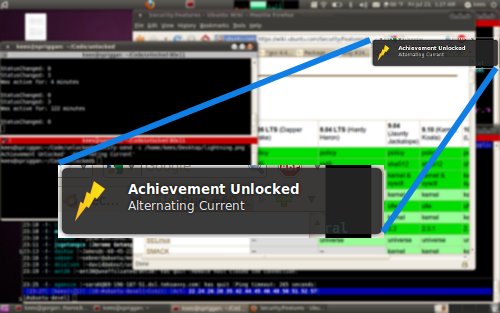
I think it would be fun to add an achievement system to the Ubuntu Desktop, like is done on Steam and XBox. The tricky part is tracking various events and finding amusing correlations. For example, if your screen-saver kicks in 40 times in a single 24 hour period, you could earn the Alternating Current achievement, indicating that you re being repeatedly interrupted all day long: achievement unlocked: alternating current There are all kind of things to track and correlate. Miles moved with the mouse, clicks taken, keys pressed, files opened, applications installed, buddies added, IMs received, sent, etc. There are all kinds of achievements that could be designed that could be used to help people discover how to use Ubuntu, or for just plain humor. Achievement Unlocked: Application Deficit Disorder when you uninstall 100 applications you installed in the prior week. I ve been told this might all be very easy to implement with the Gnome Activity Journal (Zeitgeist), but I haven t had a chance to investigate further. UPDATE: I can easily imagine this being tracked in CouchDB, synced between systems via UbuntuOne, and could be linked to any other remote APIs that people could dream up, including Launchpad, Forums, REVU, Identi.ca, etc.

22 July 2010

Steve Kemp: My Linksys router now runs Linux and almost provides PXE.

I've been interesting in running Linux upon my router for a long time, but I never had a really compelling reason to do so. The potential for brickage was always too high to make me want to experiment for the sake of it. However last night I installed Gargoyle upon my Linksys WRT53GL. Although I have no single compelling reason to do so there were a few things on my mind which made me risk it:
Syslog
I thought it would be nice to log things to my desktop machine.
QoS
I often run rsync to mirror my photographs, videos, and files, to off-site locations. These are then replicated via chironfs. Being able to use QoS to prioritise SSH traffic, which is the transport I use for rsync, means I don't suffer from laggy connections.
Graphing & Statistics
Having statistics and traffic information is interesting.
Since I've only just installed it I've not had too much opportunity to experiment with it - and my initial forays were not so productive. For example "opkg install tcpdump" failed as the root filesystem wasn't big enough. However which was to update the router to function as PXE server. I installed the tftpd server:
opkg install tftpd-hpa
Then I added this to /etc/dnsmasq.conf:
dhcp-boot=pxelinux.0,router.my.flat,192.168.1.1
Only after I'd done this did I realise two things: Tomorrow, (after visiting the dentist. Uggh) I will experiment with this further. Right now it looks like I have two options: Either way I have to store the files upon another host, due to the constrained space on the router's filsystem. So the question becomes "Which service should I run externally: TFPTD or NFS?". Running TFTPD, upon my desktop, seems smaller, less of a security risk, and neater. Running TFTPD also avoids issues if I reboot both the router and my desktop at the same time as a stalling NFS mount could prevent a timely router-boot. ObQuote: Looking for a secret door. Places like this always have a secret door.

- St Trinian's 2: The Legend of Fritton's Gold

20 July 2010

Ond&#345;ej &#268;ert&iacute;k: Theoretical Physics Reference Book

Today I fulfilled my old dream --- I just created my first book! Here is how it looks like:

More images
here.

Here is the source code of the book: http://github.com/certik/theoretical-physics, the repository contains a branch 'master' with the code and 'gh-pages' with the generated html pages, that are hosted at github, at the url theoretical-physics.net.

Then I published the book at Lulu: http://www.lulu.com/product/hardcover/theoretical-physics-reference/11612144, I wanted a hardcover book, so I setup a project at Lulu, used some Lulu templates for the cover and that was it. Lulu's price for the book is $19.20 (166 black & white pages, hardcover), then I can set my own price and the rest of the money probably goes to me. I set the price to $20, because Lulu has free shipping for orders $20 or more. You can also download the pdf (for free) at the above link (or just use my git repository). So far this didn't cost me anything.

I have then ordered the book myself (just like anybody else would, at the above address) and it arrived today. It's a regular hardcover book. Beautiful, you can browse the pictures above. It smells deliciously (that you have to believe me). And all that it cost me was $19.20.

As for the contents itself, you can browse it online at theoretical-physics.net, essentially it's most of my physics notes, that I collected over the years. I'd like to treat books like software --- release early release often. This is my first release and I would call it beta. The main purpose of it was to see if everything goes through, how long it takes (the date inside the book is July 4, 2010, I created and ordered it on July 5, got the physical book on July 19) and what the quality is (excellent). I also wanted to see how the pages correspond to the pdf (you can see for yourself on the photos, click on the picasa link above).

Now I need to improve the first pages a bit, as well as the last pages, improve the index, write some foreword and so on. I also need to think how to better organize the contents itself and generally improve it. I also need to figure out some versioning scheme, so far this is version 0.1. I think I'll do edition 1, edition 2, edition 3, and so on. And whenever I feel that I have added enough new content, I'll just publish it as a new edition. So if you want to buy it, I suggest to wait for my 1.0 version, that will have the mentioned improvements.

It'd be also cool to have all the editions online somehow and create nice webpages for it (currently theoretical-physics.net points directly to the book html itself).

So far the book is just text. I still need to figure out how to handle pictures and also whether or not to use program examples (in Python, using sympy, scipy, etc.). So far I am inclining not to put there any program codes, as then I don't need to maintain them.

Overall I am very pleased with the quality, up to some minor issues that I mentioned above, everything else end up just fine. I think we have come a long way from the discovery of the printing press. Anybody can now create a book for free, and if you want to hold the hardcopy in your hands, it costs around $20. You don't need to order certain amounts of books, nor partner with some publisher etc. I think that's just awesome.

Russell Coker: Digital Video Cameras

I ve just done some quick research on Digital Video Cameras for some relatives. It seems to me that the main feature that is necessary is Full HD (1920*1080) resolution as everyone seems to be getting 1920*1080 resolution monitors (getting smaller doesn t save enough money to be worth-while). Resolutions higher than 1920*1080 will probably available in affordable monitors in the next few years, so the ability of programs like mplayer to zoom videos will probably be required even for Full HD video soon. Saving maybe $300 on a video camera while getting a lower resolution doesn t seem like a good idea. The next feature is optical zoom, most cameras are advertised with features such as advanced zoom to try and trick customers, cameras which advertise 60* or better zoom often turn out to only have 20* zoom. I think that about 20* optical zoom should be considered the minimum, not that there is anything special about 20* zoom, it s just that there is a good range of cameras with better zoom capacity. Image stabilisation is a required feature, no-one can keep their hand perfectly steady and the typically a DVC only gets hand-held use most people who own them don t even own a tripod! Digital image stabilisation is apparently not nearly as good as optical image stabilisation, and image stabilisation that involves moving the CCD is apparently somewhere in between. Finally it s good to have the ability to take quality photos as few people will want to carry a Digital Camera and a Digital Video Camera. I did a search for DVCs on the web site of Ted s Camera store (a chain of camera stores in Australia that generally provide good service at a competitive price but not the cheapest price). The best of the Ted s options seems to be the Panasonic SD60 HD Video [1] which does 25* optical zoom, 1920*1080i video, 5 megapixel still photography, and optical image stabilisation it costs $750 from Ted s. The next best option seems to be the Sony Handycam HDR-CX110 HD [2] which does 25* optical zoom, 1920*1080i video, 3.1 megapixel 2048*1536 still photography, and digital image stabilisation. The Panasonic seems to be a better option due to having optical image stabilisation and a higher resolution for still photographs. It is also $750 from Ted s. Now there s the issue of how well the cameras work on Linux. A quick Google search indicated that the Sony cameras present themselves as USB card readers and can be mounted on a Linux system, I couldn t discover anything about the Panasonic. If I was going to buy one I would take my Netbook to the store and do a quick test. I don t have enough information to recommend either of those cameras, they may have some awful defects that are only apparent when you use them. But in terms of features they seem pretty good. The Panasonic SD60 HD Video should be a good benchmark when comparing cameras in the store. If nothing else the camera store staff seem to not be very helpful if asked generic questions such as which camera is best , but if asked questions such as how is this other camera better than the one I m looking at they can usually give good answers. If anyone has any other advice for purchasing a DVC then please let me know. Either generic advice or specific examples of Linux-friendly DVCs that have been purchased recently.

19 July 2010

Giuseppe Iuculano: Why would you prefer chromium-browser in sid over google-chrome

I ve seen a lot of Debian user asking: What is the difference between chromium-browser in sid and google-chrome (stable)? , Does chromium-browser support html5, h264, vp8? Why would I prefer chromium-browser in sid over google-chrome (stable)? BTW, the next step is to get chromium-browser into testing and upload a dev version (6.x) in experimental. Related posts:
  1. Chromium ready for unstable

17 July 2010

Petter Reinholdtsen: What are they searching for - PowerDNS and ISC DHCP in LDAP

This is a followup on my previous work on merging all the computer related LDAP objects in Debian Edu. As a step to try to see if it possible to merge the DNS and DHCP LDAP objects, I have had a look at how the packages pdns-backend-ldap and dhcp3-server-ldap in Debian use the LDAP server. The two implementations are quite different in how they use LDAP. To get this information, I started slapd with debugging enabled and dumped the debug output to a file to get the LDAP searches performed on a Debian Edu main-server. Here is a summary. powerdns Clues on how to set up PowerDNS to use a LDAP backend is available on the web. PowerDNS have two modes of operation using LDAP as its backend. One "strict" mode where the forward and reverse DNS lookups are done using the same LDAP objects, and a "tree" mode where the forward and reverse entries are in two different subtrees in LDAP with a structure based on the DNS names, as in tjener.intern and 2.2.0.10.in-addr.arpa. In tree mode, the server is set up to use a LDAP subtree as its base, and uses a "base" scoped search for the DNS name by adding "dc=tjener,dc=intern," to the base with a filter for "(associateddomain=tjener.intern)" for the forward entry and "dc=2,dc=2,dc=0,dc=10,dc=in-addr,dc=arpa," with a filter for "(associateddomain=2.2.0.10.in-addr.arpa)" for the reverse entry. For forward entries, it is looking for attributes named dnsttl, arecord, nsrecord, cnamerecord, soarecord, ptrrecord, hinforecord, mxrecord, txtrecord, rprecord, afsdbrecord, keyrecord, aaaarecord, locrecord, srvrecord, naptrrecord, kxrecord, certrecord, dsrecord, sshfprecord, ipseckeyrecord, rrsigrecord, nsecrecord, dnskeyrecord, dhcidrecord, spfrecord and modifytimestamp. For reverse entries it is looking for the attributes dnsttl, arecord, nsrecord, cnamerecord, soarecord, ptrrecord, hinforecord, mxrecord, txtrecord, rprecord, aaaarecord, locrecord, srvrecord, naptrrecord and modifytimestamp. The equivalent ldapsearch commands could look like this:
ldapsearch -h ldap \
  -b dc=tjener,dc=intern,ou=hosts,dc=skole,dc=skolelinux,dc=no \
  -s base -x '(associateddomain=tjener.intern)' dNSTTL aRecord nSRecord \
  cNAMERecord sOARecord pTRRecord hInfoRecord mXRecord tXTRecord \
  rPRecord aFSDBRecord KeyRecord aAAARecord lOCRecord sRVRecord \
  nAPTRRecord kXRecord certRecord dSRecord sSHFPRecord iPSecKeyRecord \
  rRSIGRecord nSECRecord dNSKeyRecord dHCIDRecord sPFRecord modifyTimestamp
ldapsearch -h ldap \
  -b dc=2,dc=2,dc=0,dc=10,dc=in-addr,dc=arpa,ou=hosts,dc=skole,dc=skolelinux,dc=no \
  -s base -x '(associateddomain=2.2.0.10.in-addr.arpa)'
  dnsttl, arecord, nsrecord, cnamerecord soarecord ptrrecord \
  hinforecord mxrecord txtrecord rprecord aaaarecord locrecord \
  srvrecord naptrrecord modifytimestamp
In Debian Edu/Lenny, the PowerDNS tree mode is used with ou=hosts,dc=skole,dc=skolelinux,dc=no as the base, and these are two example LDAP objects used there. In addition to these objects, the parent objects all th way up to ou=hosts,dc=skole,dc=skolelinux,dc=no also exist.
dn: dc=tjener,dc=intern,ou=hosts,dc=skole,dc=skolelinux,dc=no
objectclass: top
objectclass: dnsdomain
objectclass: domainrelatedobject
dc: tjener
arecord: 10.0.2.2
associateddomain: tjener.intern
dn: dc=2,dc=2,dc=0,dc=10,dc=in-addr,dc=arpa,ou=hosts,dc=skole,dc=skolelinux,dc=no
objectclass: top
objectclass: dnsdomain2
objectclass: domainrelatedobject
dc: 2
ptrrecord: tjener.intern
associateddomain: 2.2.0.10.in-addr.arpa
In strict mode, the server behaves differently. When looking for forward DNS entries, it is doing a "subtree" scoped search with the same base as in the tree mode for a object with filter "(associateddomain=tjener.intern)" and requests the attributes dnsttl, arecord, nsrecord, cnamerecord, soarecord, ptrrecord, hinforecord, mxrecord, txtrecord, rprecord, aaaarecord, locrecord, srvrecord, naptrrecord and modifytimestamp. For reverse entires it also do a subtree scoped search but this time the filter is "(arecord=10.0.2.2)" and the requested attributes are associateddomain, dnsttl and modifytimestamp. In short, in strict mode the objects with ptrrecord go away, and the arecord attribute in the forward object is used instead. The forward and reverse searches can be simulated using ldapsearch like this:
ldapsearch -h ldap -b ou=hosts,dc=skole,dc=skolelinux,dc=no -s sub -x \
  '(associateddomain=tjener.intern)' dNSTTL aRecord nSRecord \
  cNAMERecord sOARecord pTRRecord hInfoRecord mXRecord tXTRecord \
  rPRecord aFSDBRecord KeyRecord aAAARecord lOCRecord sRVRecord \
  nAPTRRecord kXRecord certRecord dSRecord sSHFPRecord iPSecKeyRecord \
  rRSIGRecord nSECRecord dNSKeyRecord dHCIDRecord sPFRecord modifyTimestamp
ldapsearch -h ldap -b ou=hosts,dc=skole,dc=skolelinux,dc=no -s sub -x \
  '(arecord=10.0.2.2)' associateddomain dnsttl modifytimestamp
In addition to the forward and reverse searches , there is also a search for SOA records, which behave similar to the forward and reverse lookups. A thing to note with the PowerDNS behaviour is that it do not specify any objectclass names, and instead look for the attributes it need to generate a DNS reply. This make it able to work with any objectclass that provide the needed attributes. The attributes are normally provided in the cosine (RFC 1274) and dnsdomain2 schemas. The latter is used for reverse entries like ptrrecord and recent DNS additions like aaaarecord and srvrecord. In Debian Edu, we have created DNS objects using the object classes dcobject (for dc), dnsdomain or dnsdomain2 (structural, for the DNS attributes) and domainrelatedobject (for associatedDomain). The use of structural object classes make it impossible to combine these classes with the object classes used by DHCP. There are other schemas that could be used too, for example the dnszone structural object class used by Gosa and bind-sdb for the DNS attributes combined with the domainrelatedobject object class, but in this case some unused attributes would have to be included as well (zonename and relativedomainname). My proposal for Debian Edu would be to switch PowerDNS to strict mode and not use any of the existing objectclasses (dnsdomain, dnsdomain2 and dnszone) when one want to combine the DNS information with DHCP information, and instead create a auxiliary object class defined something like this (using the attributes defined for dnsdomain and dnsdomain2 or dnszone):
objectclass ( some-oid NAME 'dnsDomainAux'
    SUP top
    AUXILIARY
    MAY ( ARecord $ MDRecord $ MXRecord $ NSRecord $ SOARecord $ CNAMERecord $
          DNSTTL $ DNSClass $ PTRRecord $ HINFORecord $ MINFORecord $
          TXTRecord $ SIGRecord $ KEYRecord $ AAAARecord $ LOCRecord $
          NXTRecord $ SRVRecord $ NAPTRRecord $ KXRecord $ CERTRecord $
          A6Record $ DNAMERecord
    ))
This will allow any object to become a DNS entry when combined with the domainrelatedobject object class, and allow any entity to include all the attributes PowerDNS wants. I've sent an email to the PowerDNS developers asking for their view on this schema and if they are interested in providing such schema with PowerDNS, and I hope my message will be accepted into their mailing list soon. ISC dhcp The DHCP server searches for specific objectclass and requests all the object attributes, and then uses the attributes it want. This make it harder to figure out exactly what attributes are used, but thanks to the working example in Debian Edu I can at least get an idea what is needed without having to read the source code. In the DHCP server configuration, the LDAP base to use and the search filter to use to locate the correct dhcpServer entity is stored. These are the relevant entries from /etc/dhcp3/dhcpd.conf:
ldap-base-dn "dc=skole,dc=skolelinux,dc=no";
ldap-dhcp-server-cn "dhcp";
The DHCP server uses this information to nest all the DHCP configuration it need. The cn "dhcp" is located using the given LDAP base and the filter "(&(objectClass=dhcpServer)(cn=dhcp))". The search result is this entry:
dn: cn=dhcp,dc=skole,dc=skolelinux,dc=no
cn: dhcp
objectClass: top
objectClass: dhcpServer
dhcpServiceDN: cn=DHCP Config,dc=skole,dc=skolelinux,dc=no
The content of the dhcpServiceDN attribute is next used to locate the subtree with DHCP configuration. The DHCP configuration subtree base is located using a base scope search with base "cn=DHCP Config,dc=skole,dc=skolelinux,dc=no" and filter "(&(objectClass=dhcpService)( (dhcpPrimaryDN=cn=dhcp,dc=skole,dc=skolelinux,dc=no)(dhcpSecondaryDN=cn=dhcp,dc=skole,dc=skolelinux,dc=no)))". The search result is this entry:
dn: cn=DHCP Config,dc=skole,dc=skolelinux,dc=no
cn: DHCP Config
objectClass: top
objectClass: dhcpService
objectClass: dhcpOptions
dhcpPrimaryDN: cn=dhcp, dc=skole,dc=skolelinux,dc=no
dhcpStatements: ddns-update-style none
dhcpStatements: authoritative
dhcpOption: smtp-server code 69 = array of ip-address
dhcpOption: www-server code 72 = array of ip-address
dhcpOption: wpad-url code 252 = text
Next, the entire subtree is processed, one level at the time. When all the DHCP configuration is loaded, it is ready to receive requests. The subtree in Debian Edu contain objects with object classes top/dhcpService/dhcpOptions, top/dhcpSharedNetwork/dhcpOptions, top/dhcpSubnet, top/dhcpGroup and top/dhcpHost. These provide options and information about netmasks, dynamic range etc. Leaving out the details here because it is not relevant for the focus of my investigation, which is to see if it is possible to merge dns and dhcp related computer objects. When a DHCP request come in, LDAP is searched for the MAC address of the client (00:00:00:00:00:00 in this example), using a subtree scoped search with "cn=DHCP Config,dc=skole,dc=skolelinux,dc=no" as the base and "(&(objectClass=dhcpHost)(dhcpHWAddress=ethernet 00:00:00:00:00:00))" as the filter. This is what a host object look like:
dn: cn=hostname,cn=group1,cn=THINCLIENTS,cn=DHCP Config,dc=skole,dc=skolelinux,dc=no
cn: hostname
objectClass: top
objectClass: dhcpHost
dhcpHWAddress: ethernet 00:00:00:00:00:00
dhcpStatements: fixed-address hostname
There is less flexiblity in the way LDAP searches are done here. The object classes need to have fixed names, and the configuration need to be stored in a fairly specific LDAP structure. On the positive side, the invidiual dhcpHost entires can be anywhere without the DN pointed to by the dhcpServer entries. The latter should make it possible to group all host entries in a subtree next to the configuration entries, and this subtree can also be shared with the DNS server if the schema proposed above is combined with the dhcpHost structural object class. Conclusion The PowerDNS implementation seem to be very flexible when it come to which LDAP schemas to use. While its "tree" mode is rigid when it come to the the LDAP structure, the "strict" mode is very flexible, allowing DNS objects to be stored anywhere under the base cn specified in the configuration. The DHCP implementation on the other hand is very inflexible, both regarding which LDAP schemas to use and which LDAP structure to use. I guess one could implement ones own schema, as long as the objectclasses and attributes have the names used, but this do not really help when the DHCP subtree need to have a fairly fixed structure. Based on the observed behaviour, I suspect a LDAP structure like this might work for Debian Edu:
ou=services
  cn=machine-info (dhcpService) - dhcpServiceDN points here
    cn=dhcp (dhcpServer)
    cn=dhcp-internal (dhcpSharedNetwork/dhcpOptions)
      cn=10.0.2.0 (dhcpSubnet)
        cn=group1 (dhcpGroup/dhcpOptions)
    cn=dhcp-thinclients (dhcpSharedNetwork/dhcpOptions)
      cn=192.168.0.0 (dhcpSubnet)
        cn=group1 (dhcpGroup/dhcpOptions)
    ou=machines - PowerDNS base points here
      cn=hostname (dhcpHost/domainrelatedobject/dnsDomainAux)
This is not tested yet. If the DHCP server require the dhcpHost entries to be in the dhcpGroup subtrees, the entries can be stored there instead of a common machines subtree, and the PowerDNS base would have to be moved one level up to the machine-info subtree. The combined object under the machines subtree would look something like this:
dn: dc=hostname,ou=machines,cn=machine-info,dc=skole,dc=skolelinux,dc=no
dc: hostname
objectClass: top
objectClass: dhcpHost
objectclass: domainrelatedobject
objectclass: dnsDomainAux
associateddomain: hostname.intern
arecord: 10.11.12.13
dhcpHWAddress: ethernet 00:00:00:00:00:00
dhcpStatements: fixed-address hostname.intern
One could even add the LTSP configuration associated with a given machine, as long as the required attributes are available in a auxiliary object class.

Gregory Colpart: Network connection with HTC Hero and Debian

I have an HTC Hero, an Android phone, for one year. But I never tried to share his network connection with my Debian laptop. To prepare my trip to Debconf10, I try it today and I m surprised because it s so easy! 1. Plug your phone on USB
2. Active Share your phone network on phone (in french: Partage du r seau mobile )
3. You see now an usb0 ethernet device:
usb0  Link encap:Ethernet  HWaddr a2:17:af:4f:fa:da
BROADCAST MULTICAST  MTU:1500  Metric:1
RX packets:0 errors:0 dropped:0 overruns:0 frame:0
TX packets:0 errors:0 dropped:0 overruns:0 carrier:0
collisions:0 lg file transmission:1000
RX bytes:0 (0.0 B)  TX bytes:0 (0.0 B)
4. Configure usb0 to have the network configuration 192.168.100.100/24 with your favorite tool (ifconfig for example).
5. Now you can ping your phone with 192.168.100.254. Use it as gateway and enjoy: your laptop is now connected with Wi-Fi, GPRS or 3G+! Note: I use HTC Hero with Android 1.5 (build number: 2.73.61.5) and the french mobile phone provider Orange.

John Goerzen: KD0MJT

Wow tonight was thrilling. It s hard to explain why, but it s pretty exciting to have a radio setup that is all wrong in so many ways work well enough for me to sit in my kitchen in Kansas and talk to someone in Indianapolis using only two-way HF radios. I recently passed my technician and general amateur radio exams. I ve been talking to some very nice people locally on the 2m band, which permits local (say, 100-200mi radius) communication. It s been fun, but Kansas is sparsely populated enough that sometimes there just isn t any activity. At all. Earlier this week, my Yaesu FT-857D and two antennas arrived. I tried it first on VHF, and had a nice chat with Kent (KB0RWI) a few miles away. But tonight was the big experiment. I bought a 20m dipole antenna. This is basically a 30-foot-long wire, connected to a balun and a coax feed line in the middle. You re supposed to put it at least 30 feet off the ground, and away from trees, houses, etc. You re supposed to have a nice RF ground for your transmitter, power supply, antenna tuner, and all that stuff. You re not supposed to just run the coax under that (until today, annoying) small hole in the seal under the kitchen storm door. You re supposed to have to have the correct connectors on your coax, instead of soldering an RG-8 PL-259 onto some RG-8X because you re new at this and didn t realize that you need to buy an adapter. And, I m really pretty sure that you re not supposed to have an aggressive outdoor cat complete with a full set of claws and teeth attack the coax RG-8X cable as it s being pulled through the grass. Fail to do any of these things, and the thing might not work well, or might not work at all, or for people that use old equipment, might burn out your radio or something. So anyway I got out the ladder today, and I got the antenna maybe 10-15 feet in the air. I have three trees in a row with the perfect separation to hang each end and the center balun from. So while Jacob went around playing with water and trying out the ladder on occasion (with my help), I used some string to hang the antenna. In the trees, not far from them. Near the house. Not 30ft off the ground. I strung the feed line into the house, set up all my equipment on our kitchen table, flipped the switch. And nothing. Just the occasional familiar whine while tuning. I tried the 20m band, then the 40m, then even 15, 12, and 10. No activity anywhere. So what was wrong? I improvised some grounding extracted the ground conductor from an old strip of AC house wiring, shoved it into the ground, and grounded the tuner and transmitter. No difference. I unplugged the coax, and tested it with my multimeter. It tested out OK. I plugged it back in and wiggled the connector. Turns out the connector isn t in great shape, but it had been working. I tried transmitting. The tuner made a whole bunch of alarming-sounding clicking noises (sounded like a symphony of relays), indicated SWR over 3, and the ammeter on my power supply went a bit nuts. Later I realized that I just wasn t giving the tuner enough time to tune up; with a few more seconds, it tuned up just fine on every frequency. (So yes, it was supposed to do that.) And, it turns out, that all I needed to do was wait a little while longer to hear some signals. Pretty soon I was finding stuff all over the 40m band. I heard a discussion from Chicago, another from Oklahoma City, some apparent broadcasters from Africa. I decided I would try and transmit. I was hearing one side of a discussion very clearly and decided I would wait for an opportunity to try to contact that person. I heard his callsign, K9RM. I looked it up, and realized he was near Indianapolis, where I had lived for awhile. Eventually he invited a station trying to get in to participate. And: KD0MJT (I announced my callsign, as a request to join the conversation) He said he only made out the 0, but eventually we were talking quite well. It was a brief conversation, but interesting; the person he was talking to was in Portland, and couldn t hear me (and I could barely hear him, but not loud enough to make out). That with no phone lines, no Internet provider needed, etc. And with a rig that is far from being at peak efficiency. I had no idea what to expect tonight and was surprised that just tossing an antenna up in a tree let me talk to someone in Indiana. That s 650 miles away. I wonder what I ll be able to do once I get things done the right way. This hobby is going to be fun. Many thanks to Mike_W for equipment suggestions, Kent and Dan from Newton ARC for encouragement and coming out to the house to test things, Kent for being my first ham radio contact ever (on 2m while I was using an old 1981 radio), Chuck (K9RM) for taking a few minutes to be my first HF contact, and my dad for helping plan out exterior wall penetration methods that will eliminate this coax under the kitchen door and lack of grounding business. Jacob, by the way, still loves his radios and is starting to take an interest in mine. It wouldn t shock me at all of he s one of these kids that gets his technician license in the 2nd grade or something. I think he and I can do this together for a long time.

16 July 2010

Gustavo Noronha Silva: WebKitGTK+ 1.2.2 and 1.2.3 released!

Some of you may have noticed WebKitGTK+ 1.2.2 and 1.2.3 have been uploaded recently. Here s their announcement =). A quick summary: if you re running the 1.2.x series upgrade to 1.2.3. Here s some information regarding 1.2.2: 1.2.2 is an update to the 1.2.x stable series; along with a lot of crash, and misc fixes the biggest changes are: 1) the inclusion of a new API from the development branch (webkit_back_forward_list_clear()),
because it s simple and will help with fixing a problem in Epiphany stable, and 2) lots of drag and drop, and clipboard related work by Martin Robinson. Despite not being strictly fixes, we believe the stable series has a lot to gain from this work; a couple examples should illustrate this better: the changes included fix both a crash when dragging links from WebKit into other browsers, and the annoying bug that made the cursor get stuck in a grab when dragging, sometimes.
http://webkitgtk.org/webkit-1.2.2.tar.gz
MD5: 40338001324a38b977c163291e8816d3
Here s some information regarding 1.2.3: To some such a quick succession in releases may look like a brown paper bag was in order. Not strictly, but indeed 1.2.3 aims to fix some oversights with easy fixes. First of all, WebKit was not buildable with ICU 4.4.1, but thankfully a fix had already been checked in to trunk, so 1.2.3 includes that fix. Secondly, Debian s Michael Gilbert has done a great job going through all CVEs released about WebKit, and including patches in the Debian package. 1.2.3 includes all of the commits from trunk to fix those, too.
http://webkitgtk.org/webkit-1.2.3.tar.gz
MD5: 0ab5c478a6f5b74a1ae96bf13a456662
You can read some more details, including the list of CVEs that were addressed, in the NEWS file:
http://gitorious.org/webkitgtk/stable/blobs/master/WebKit/gtk/NEWS
Enjoy!

Dirk Eddelbuettel: Rcpp 0.8.4

Romain and I wrapped up release 0.8.4 of Rcpp last Friday. However, given the time of year, it only appeared on CRAN this morning, and then only after some prodding as CRAN processing is more or less closed this week and probably next. This release builds upon release 0.8.3. Highlights include changes to the sugar framework for highly expressive C++ constructs which gained new vector function as well as a first set of matrix function. As well, unit tests have been reorganised in such a way that we end up with a lot fewer compilations (but of several files at once) which reaps significant speed gains. Date calculation now use the same mktime() function R itself uses (and which comes from Arthur Olson's tzone library). The NEWS entry follows below:
0.8.4   2010-07-09
    o   new sugar vector functions: rep, rep_len, rep_each, rev, head, tail,
        diag
        
    o   sugar has been extended to matrices: The Matrix class now extends the 
        Matrix_Base template that implements CRTP. Currently sugar functions 
        for matrices are: outer, col, row, lower_tri, upper_tri, diag
    o   The unit tests have been reorganised into fewer files with one call
        each to cxxfunction() (covering multiple tests) resulting in a
        significant speedup
    o   The Date class now uses the same mktime() replacement that R uses
        (based on original code from the timezone library by Arthur Olson)
        permitting wide dates ranges on all operating systems
    o   The FastLM example has been updated, a new benchmark based on the
        historical Longley data set has been added
    o   RcppStringVector now uses std::vector<std::string> internally
    
    o   setting the .Data slot of S4 objects did not work properly
As always, even fuller details are in Rcpp Changelog page and the Rcpp page which also leads to the downloads, the browseable doxygen docs and zip files of doxygen output for the standard formats. A local directory has source and documentation too. Questions, comments etc should go to the rcpp-devel mailing list off the R-Forge page

15 July 2010

Enrico Zini: On python, frameworks and TOOWTDI

On python, frameworks and TOOWTDI The Python world is ridden with frameworks, microframeworks, metaframeworks and their likes. They are often very clever things, but more often than not they are a tool of despair. A very peculiar thing about Python web frameworkish things is that there are so many of them. There's cherrypy (in its various API redesigns), fapws, gunicorn, bottle and flask, paste, werkzeug and flup, tornado, pylons, turbogears 1 and 2, django, repoze who, what and whatnot, all the myriad of rendering engines and buffet as a metathing on top of them, diesel, twisted, and I apologise if I don't spend my day listing and hyperlinking them all, I hope I made my point. Frameworks are supposed to standardise some aspects of programming; the nice thing about standards is that there are so many of them to choose from, and they all suck, so I'll make my own. But wasn't Python supposed to be the world of TIOOWTDI? Ok, everbody knows it isn't. Just in the standard library there are 2 implementations of pickle and 2 urllibs. But people like the TIOOWTDI idea. I believe the reason people like the TIOOWTDI idea is because it creates a framework. It standardises some aspects of programming, and defines building blocks that guarantee that people doing similar jobs will be using similar sets of components. Let's take for example the datetime module in the standard library. It is an embarassing example of a badly designed module, so embarassing that the standard library documentation continuously fails to document its fundamental design flaws and common work-arounds hoping that noone notices them, but as a consequence each poor soul starting to use it for nontrivial things has to google for hours in despair to rediscover in how many ways it's broken. But still, datetime works as a structure to hold those values that make a date, time, or full UTC timestamp. For that job it's become the standard, and as such it's an important component of the Python TIOOWTDI framework: one can use it to exchange datetimes among different libraries: for example ORMs are using it instead of rolling their own, which makes database programming so much easier when date/time is involved. Even if the implementation is far from perfect, once we apply TIOOWTDI to dates and timestamps, python code from different authors can exchange dates without worries. This is much better than having 3 different superior datetime libraries and having to convert date objects from one to another when passing values from a web form to an ORM. There is an often overlooked Python framework. The Pyton framework. It's called TIOOWTDI. All the micro-mini-midi-maxi-meta-frameworks that people scatter around, are, or should be, just experiments, proofs of concept, competing ideas waiting to be distilled in The Only One Way, bringing the Python experience one step forward. What is unfortunate is that this last distillation thing happens so rarely that people get used to the idea of having to use proof of concept code to get things done. Update: this post apparently wasn't very clear, so here is some clarification:

Enrico Zini: Released cfget 0.15

Released cfget 0.15 I have released version 0.15 of cfget. cfget is a tool to extract values from ini-style config files. A trivial thing, really. It is also simple to install: it is a single python executable and it has no dependencies besides the python standard library. It is trivial and simple, but because of the complex requirements (and sponsorship) of ISAC - CNR it has recently accumulated quite a set of features, and it manages to get a remarkable lot of things done. There are several news since 0.8, worth a rather major announcement: Added --dump=pickle Now all the contents of the configuration files, plus all the contents generated by cfget plugins, can be dumped in pickle format. This provides a quick and dirty way to load all cfget-generated data into a python dict:
data = pickle.loads(
    subprocess.Popen(
        ["cfget", "--dump=pickle"],
        stdout=subprocess.PIPE).communicate()[0])
It sounds like a rather complicated way to read a configuration file, but if you have various plugins that compute nontrivial derived configuration values, that quick&dirty hack could be quite useful. Curly brace expansion Suppose that you have a config file like this:
[general]
mode = show
[show]
command = display
[edit]
command = gimp
And you want to get the command from the section indicated by general/mode. Now you can, very easily: cfget ' general/mode /command' When it notices curly braces, cfget will literally replace them with the result of querying their contents, then parse the expression again. Simple expression support ISAC - CNR are using cfget to configure the run of a rather complicated physical model, and use plugins to derive all sorts of values form the base configuration. This works, but there are times when adding a function to a plugin sounds like overkill: for example, sometimes one needs foo/bar + 1, or just the hour of a timestamp. For those simple cases, I've added support for simple expressions: So to compute a middle point one can now do this:
cfget "round((pos/start + pos/end) / 2)"
It needs a space around arithmetic operators to avoid conflicts with characters used to refer to configuration values, but with the space the expressions look nicer, so the result is that it generally does the right thing. Just as a scary thought, curly braces work with and in expressions:
cfget "values/val round((pos/end - pos/start) / 2)  + 1"
Although if someone ends up having a hairy thing like that, it is worth considering to replace it with a dynamic value computed using a plugin.

14 July 2010

Mike Hommey: I/O patterns on ELF binary initialization

[ I meant to finish this article much earlier, but i had to leave it in a half-written draft state for quite some time due to other activities ] One particular issue that arises with big binary files is that of I/O patterns. It looks like it is not something under the usual scope for both ld.so and programs/libraries, but it can have a dramatic influence on startup times. My analysis is far from complete, would need to be improved by actually investigating ld.so code further, and so far has been limited to libxul.so built from mozilla-central, with the help of icegrind, on x86-64 linux. As I wrote recently, icegrind allows to track memory accesses within mmap()ed memory ranges. As ld.so does mmap() the program and library binaries, tracking the memory accesses within these mmap()s allows to get a better idea at I/O patterns when an ELF binary is initialized. I only focused on local accesses within a single given binary file (libxul.so) because the case of Firefox loading many files at startup is already being scrutinized, and because most of the non-Firefox files being read at Firefox startup (system and GNOME libraries) are most likely already in the page cache. I also focused on that because it was an interesting case that could be helpful to understand how big (and maybe less big) binaries may be affected by the toolchain (compiler, linker and dynamic linker) and possibly by some coding practices. For the record, what I did to get these results is to use icegrind and elflog, with further additions to the sections file with some output from objdump -h : I added sections that elflog wouldn t give (such as .plt, .hash, .dynsym, etc.), and even down to the entry level for the .rela.dyn section. The latter is particularly interesting because icegrind only outputs the first access for any given section. To see sequential accesses within that section, you need to split it in smaller pieces, which I did for .rela.dyn entries (each one being 24 bytes on x86-64). Uncommenting some parts of the icegrind code was also useful to track where some accesses were made from, code-wise. Now, the interesting data: One of the first accesses is a nullification of a few variables within the .bss section. The .bss section is usually an anonymous piece of memory, that is, a range of mmap()ed memory that is not backed by a file, and filled with zeroes by the kernel (I think it even does that lazily). It is used for e.g. variables that are initialized with zeroes in the code, and obviously, any code accessing these variables would be addressing at some offset of the .bss section. It means the section needs to start in memory at the offset it has been assigned by the linker at build time. This is actually where problems begin. When the .bss section offset as assigned by the linker doesn t align on a page (usually 4KB), the mmap()ed .bss can t be at that location, and really starts on the next page. The remainder is still mmap()ed from the binary file, and ld.so will itself fill that part. As the .bss section doesn t start on a page boundary, any write at this location will trigger the kernel reading the entire page. This means one of the first set of data being read from the file is the end of the section preceding .bss, and the beginning of the following one. Most likely, respectively the .data and .comment sections. While this probably doesn t matter much when the binary file is small, when it is big enough, reading in a non sequential manner will trigger hard disk seeks, and we all know how they can hurt performance. Although thankfully, cheap SSDs should be coming some day, in the meanwhile, we still need to cope with the bad performance. The interesting part is, the .bss section is really empty in the binary file, so its virtual memory address could be anywhere. Why the linker wouldn t align it at a page boundary without having to resort to a linker script is beyond me. The next accesses go back and forth between .dynamic, .gnu.hash, .dynstr, .gnu.version_r, .gnu.version and .dynsym. These are probably all related to symbol version resolution and DT_NEEDED library loading. While most of these sections are at the beginning of the file (not necessarily in the order they are read from), the .dynamic section is much nearer to the end, but way before .data, so that it won t even have been loaded as a by-product of the .bss section loading. After that, the .rela.dyn section is read, and for each relocation entry it contains, the relocations are being applied. Relocations is one of the mechanisms by which position independent code (PIC) is made possible. When a library is loaded in memory, it is not necessarily loaded at the same address every time. The code and data contained in the library thus need to cope with that constraint. Fortunately, while the base address where the library is mmap()ed in memory is not necessary constant, the offsets of the various sections are still as codified in the binary. The library code can thus directly access data at the right offset if it knows the base offset of the library (which is what is done on the x86 ABI), or if it knows where the current instruction is located (which is what is done on the x86-64 ABI). Static data (initialized in e.g. a const or a global variable, or, in C++ case, vtables), on the other hand, may contain pointers to other locations. This is where relocation enters the scene. The .rela.dyn section contains a set of rules describing where in the binary some pointers need to be adjusted depending on the base library offset (or some other information), and how they should be updated. ld.so thus reads all .rela.dyn entries, and applies each relocation, which means that while .rela.dyn is being read sequentially, reads and writes are also performed at various places of the binary, depending on the content of the .rela.dyn entries. This is where this gets ugly for Firefox: there are near 200000 such relocations. On x86-64 an entry is 24 bytes (12 on x86), and each of these is going to read/write a pointer (8 bytes on x86-64, 4 on x86) at some random (though mostly ordered) location. The whole .rela.dyn section not being read ahead, what actually happens is that it is read in small batches, with seeks and reads of other data at various locations in between. In libxul.so case, this spreads over .ctors, .data.rel.ro, .got, and .data. The relocation entries are somehow ordered by address to be rewritten, though they occasionally jump backwards. Some of these relocations also appear to be touching to .gnu.version, .dynsym and .dynstr, because their type involves a symbol resolution. Once .rela.dyn relocation have been dealt with comes .rela.plt s turn. The principle is the same for this section: entries describe what kind of relocation must be done where, and how the result must be calculated. The scope of this section, though, is apparently limited to .got.plt. But before explaining these relocations, I ll explain what happens with the PLT. The PLT (Procedure Linkage Table) is used when calling functions from external libraries. For example, in a Hello World example, the PLT would be used for calls to the puts function. The function making the call would in fact call the corresponding PLT location. The PLT itself, on x86 and x86-64, at least, consists of 3 instructions (I ll skip the gory details, especially for x86, where the caller needs to also set some register before calling the PLT). The first instruction is the only one to be called most of the time: it reads the final destination in the .got.plt section, and jumps there. That final destination, obviously, is not fixed in the library file, since it needs to be resolved by its symbol. This is why the two subsequent instructions exist : originally, the destination stored in the .got.plt section points back to the second instruction ; the first instruction will effectively be a nop (no operation), and the following instructions will be executed. They will jump into code responsible for symbol resolution, update of the .got.plt entry for the next call, and call of the real function. But pointing back to the second instruction is like the pointers in static data we saw above : it s not possible in position independent code. So, the .rela.plt relocations are actually filling the .got.plt section with these pointers back to the PLT. There are a tad more than 3000 such relocations. All these relocations should be going away when prelinking the binaries, but from my several experimentations, it looks like prelinking only avoids relative relocations, and not the others, while it technically could skip all of them. prelink even properly applies all the relocations in the binary, but executing the binary rewrites the same information at startup for all but relative relocations. That could well be a bug in either ld.so not skipping enough relocations or prelink not marking enough relocations to be skipped. I haven t dug deep enough in the code to know how prelinking works exactly. Anyways, prelinking is not a perfect solution, as it also breaks ASLR. Sure, prelink can randomize library locations, but it relies on the user or a cron job doing so at arbitrary times, but that s far from satisfying. An interesting thing to note, though, is that a good part of the relocations prelinking doesn t rid us of in libxul.so (more than 25000) are due to the __cxa_pure_virtual symbol, which is used for, well, pure virtual methods. In other words, virtual methods that don t have an implementation in a given class. The __cxa_pure_virtual function is set as method in the corresponding field(s) of the class VTABLE in the .data.rel.ro section. This function is provided by libstdc++, and as such, is dynamically linked. But this function is just a dummy function, doing nothing. Defining an empty __cxa_pure_virtual function to be included in libxul.so makes these relocations become relative, thus taken care of by prelinking. After all relocations occur, the library initialization itself can begin, and the content of the .init section is executed. That section, indirectly, executes all functions stored in the .ctors section. This includes static initializers, which are unfortunately called backwards, as Taras pointed out already. Each of these static initializers are also accessing various locations in the .data or .bss sections, which may or may not have already been loaded during the relocation phase. The execution of these initializers will also (obviously) read various pieces of the .text section (despite its name, it contains executable sections, i.e. functions code). The initialization of the library ends there, and no access should happen until a function from the library is called. In libxul.so case, XRE_main is first called, then many other functions, but that s another story. All that needs to be remembered about the startup process past this point is that the .text section will be read heavily, as well as the various data, got, plt and dynamic symbol sections, in a very scattered way. While most of these sections may have been retrieved in memory already, as a byproduct of the various initialization processes described above, some may have not, increasing even more the need to seek at all places in the binary file. Now the main problem with all these I/O patterns at startup, is that it seems the only way reorganizing the binary layout may have a visible impact is by considering all the above, and not only a part of it, because only addressing a part of it is very likely to only move part of the problem to a different layer. All in all, making sure the relevant sections of libxul.so are read by the kernel before ld.so enters the game is a good short-term solution to avoid many seeks at startup.

12 July 2010

Thorsten Glaser: On ASLR (Address Space Layout Randomisation)

I ve got some interesting results using r1.1 of an example test programme (r1.2 got cleaned up and more output) on various systems, regarding ASLR. The 1.1 revision tests everything mksh R40+ will use (except there will probably no larger than page sized allocations) for its LCG PRNG. On OpenBSD (MirBSD, rieBSD) malloc(3) uses in fact mmap(2), which is randomised. (Though -pie doesn t yet work as it s supposed to.) Some OSes are better than others but look for yourself. (Read on to continue, not part of the RSS for size reasons. This wlog entry may be updated with bumped date unperiodically.)

Next.

Previous.