Search Results: "spa"

2 July 2013

Stefano Zacchiroli: introducing sources.debian.net

all Debian source are belong to us TL;DR: go to http://sources.debian.net and enjoy.
Debsources is a new toy I've been working on at IRILL together with Matthieu Caneill. In essence, debsources is a simple web application that allows to publish an unpacked Debian source mirror on the Web. You can deploy Debsources where you please, but there is a main instance at http://sources.debian.net (sources.d.n for short) that you will probably find interesting. sources.d.n follows closely the Debian archive in two ways:
  1. it is updated 4 times a day to reflect the content of the Debian archive
  2. it contains sources coming from official Debian suites: the usual ones (from oldstable to experimental), *-updates (ex volatile), *-proposed-updates, and *-backports (from Wheezy on)
Via sources.d.n you can therefore browse the content of Debian source packages with usual code viewing features like syntax highlighting. More interestingly, you can search through the source code (of unstable only, though) via integration with http://codesearch.debian.net. You can also use sources.d.n programmatically to query available versions or link to specific lines, with the possibility of adding contextual pop-up messages (example). In fact, you might have stumbled upon sources.d.n already in the past few days, via other popular Debian services where it has already been integrated. In particular: codesearch.d.n now defaults to show results via sources.d.n, and the PTS has grown new "browse source code" hyperlinks that point to it. If you've ideas of other Debian services where sources.d.n should be integrated, please let me know. I find Debsources and sources.d.n already quite useful but, as it often happens, there is still a lot TODO. Obviously, it is all Free Software (released under GNU AGPLv3). Do not hesitate to report new bugs and, better, to submit patches for the outstanding ones. Acknowledgements PS in case you were wondering: at present sources.d.n requires ~381 GB of disk space to hold all uncompressed source packages, plus ~83 GB for the local (compressed) source mirror

1 July 2013

Russ Allbery: Pod::Thread 1.01 and faq2html 1.32

Julien LIE pointed out a rendering problem with one of my pages, and some further investigation revealed that the changes that I made to faq2html when moving away from Subversion caused all sorts of problems. I started testing a new version of it, and then found a bunch of other problems with pod2thread. One I already knew about, but others I'd not seen before. Since I was working on this anyway, I decided to fix all the problems I knew about. Pod::Thread 1.01 now correctly encodes its output for UTF-8, which will fix some long-standing problems with ISO 8859-1 characters used to render non-breaking spaces. It also fixes some minor formatting issues and adds a workaround for the inability to format formatting codes in headings when generating an artificial table of contents. faq2html 1.32 now supports multiple subheadings at the top of a page provided that the start of the second subheading is still a centered line. I use this format in a bunch of my package README files, all of which had been misformatted due to not having this support. I did a large test generation of my web pages, and I don't think I added any new problems. (faq2html is inherently tricky, since it's converting plain text to HTML and has to do a bunch of markup guessing. I suppose one of these days I should just give up and switch over to writing README files in Markdown or something.) While I was at it, I also modernized Pod::Thread's module packaging and switched it to Module::Build, which is the direction I'm (slowly) going for all of my Perl module work. The generic parts of the test suite also got a refresh to the latest versions of my generic test suite code (which I'm currently maintaining in rra-c-util for lack of a better location). That had one interesting wrinkle. Pod::Thread was the one Perl distribution where I'd played with using a module filter program (something ExtUtils::MakeMaker supports) to set the module $VERSION automatically during the build. This had the advantage of letting me maintain the distribution version in one place (Makefile.PL) no matter how many Perl modules there are. However, Module::Build doesn't support that. So, this afternoon I wrote Module::Build::SetVersion, which overrides the processing of *.pm files to set the $VERSION string to whatever one sets dist_version to in Build.PL. This lets you just put placeholder strings in all of the modules, and the process of building them into blib will substitute in the current distribution version. Currently, this module is only in this package and subclasses Module::Build (it really should be a mixin of some kind, but I didn't work out a good way of doing that). I'm going to experiment with copying it into my various module packages, but I suppose at some point I should wrap it up in its own distribution, add a test suite, and release it properly. (If you would find this useful, drop me email and I'll prioritize releasing it properly on CPAN somewhat higher.) Note that you can do the same thing with the existing Module::Build::PM_Filter module, as well as a bunch of other things, but that requires you write and maintain a Perl script at the top level of the distribution that does the desired transformations and seemed unnecessarily complex for what I was trying to do. I really wanted something I could just drop in and forget about. You can get the latest releases of Pod::Thread and faq2html from my web tools distribution page.

30 June 2013

Lars Wirzenius: Oops: Making sure your backups work

It's 9 in the evening. Do you know if your backups work? Do you know when you last made a successful backup of all of your data? Do you know whether you can restore from that backup? If not, how well can you sleep? You should verify your backups, and do it regularly, not just when you first set up the backup system. Verification means doing whatever you need to do to ensure all of your precious data has been backed up and can be correctly restored from the backups. The simplest way to do that is to restore all your data, and compare it with your live data, and note any differences. That requires you have enough free disk space to restore everything, but it's the almost the only way to be really sure. It's also a great way to ensure the restoring actually works. If you don't test that, don't be sure you can do it when needed. Some backup software has a verification mode, which doesn't actually write the restored data to disk, but compares it with live data directly. This can save space, and can be a reasonable compromise, but you should test actual restoring as well. You could do that by restoring only some of the live data, perhaps choosing files randomly for each test. If you have the disk space to do a complete restore, doing so is a great way to excercise your disaster recovery process in general. Here's one way of doing it: How often should you do that? That, again, depends on how you feel about your data, and how much you trust your backup tools and processes. If it's really important that you can recover from a disaster, you need to verify more frequently. If data loss is merely inconvenient and not life-changingly disastrous, you can verify less often.

Russ Allbery: Random haul

A random book haul, for no particular reason other than that it had been a while and several books came out that I have been eagerly awaiting (in one case for many years): Ann Aguirre Wanderlust (sff)
Ann Aguirre Killbox (sff)
Ann Aguirre Doubleblind (sff)
Ann Aguirre Aftermath (sff)
Ann Aguirre Endgame (sff)
Yoon Ha Lee A Conservation of Shadows (sff collection)
M.J. Locke Up Against It (sff)
China Mi ville Railsea (sff)
Chris Moriarty Ghost Spin (sff)
Paul Nahin An Imaginary Tale (non-fiction) Yes, Ghost Spin finally exists, and I have held it in my hands. Now if I can just remember what was happening in Spin State and Spin Control. I may just have to re-read them, which would be such a hardship.... The explanation of all the Aguirre purchases is that if you say sensible things amid the latest round of obnoxious sexism in the SFF community, and particularly when anonymous cowards claim your writing is obviously bad because of what you say, there are people like me who may well buy your entire series, new, as a show of support. Particularly if it was already on their radar as something to read. I already had the first book, but I bought all the rest sight unseen, based just on the strength of her commentary and some of the things other people have said about the books. This afternoon, I finished reading Grimspace, the first in the series, and now I'm delighted that I already have the others in hand. Excellent stuff; a bit trying on suspension of disbelief in a few spots, but the pacing was so good I didn't care. Review coming eventually when I catch up further. Yoon Ha Lee is my absolute favorite SF short fiction author writing currently, and that's saying something since I generally don't like short fiction. I've been eagerly awaiting her first collection ever since I heard it had gone to print. Also, in the context of picking up eight more SF novels or collections by women, I want to note just how irritating it is when people claim that women don't write science fiction. I read quite a lot of science fiction, and I haven't had any trouble finding female authors. I haven't even needed to try; the books I read run about half female authors with no special attention or effort on my part. If someone honestly hasn't heard of those writers, I have a bunch of suggestions in my collected book reviews, but too often it seems less a plea for help and more a rhetorical point about how science fiction is somehow more naturally male. Which is complete bullshit, and I have the library and reviews to prove it. Last year I read 13 unambiguous science fiction novels by women (not counting any fantasy). Some of them I liked, some of them I didn't, some of them were more believable than others, and some of them were harder (in the sense of being more scientifically plausible) than others just like the 11 science fiction novels, not counting fantasy, by men that I read in the same time frame. So far this year, I've reviewed one science fiction novel by a woman and two by men, and I have two more by women (and one by a man) waiting to be reviewed. I'm not doing anything special, just reading what's published, what's been recommended to me, and what wins awards. Anyone else can do exactly the same thing.

28 June 2013

Daniel Leidert: Idea: A new toy (ein neues Spielzeug) ... HP Microserver N54L

Ich fertige regelm ig Backups meiner Systeme an. Diese werden auf der Systemplatte meines Notebooks abgelegt und via rsync auf mobilen Speicher dupliziert. Hierzu verwende ich eine USB-Festplatte. Diese enth lt auch Medien-Dateien und wird regelm ig an den Fernseher angeschlossen. Prinzipiell halte ich meine Daten daher f r sicher. Aber vor kurzem stie ich an die Grenzen ihrer Kapazit t. Schon l nger habe ich nach einer Alternative gesucht, nicht zuletzt da heute viel gr ere Festplatten m glich sind und mein Laptop ber einen eSATA-Anschluss verf gt, der schneller als USB2.0 ist. Meine bevorzugte Variante war ein FANTEC DB-ALU3e Geh use mit einer WD Red WD20EFRX 2TB (5400 RPM) Festplatte, die f r den 24/7 Betrieb zertifiziert ist (und zudem ber eine ausgezeichnete Reputation verf gt). Die Kombination lief sehr gut und schnell, sieht edel aus, ben tigt aber eine externe Stromversorgung. Ich kann Sie als Speicherl sung absolut empfehlen. Allerdings hatte ich zu diesem Zeitpunkt noch weitere Anspr che, die mit der o.g. L sung nicht zu befriedigen sind. So trage ich mich bereits l nger mit dem Gedanken an ein RAID-1-NAS. Au erdem spiegelt sich die Beanspruchung meiner Notebook-Festplatte durch das Pakete-Bauen f r Debian im S.M.A.R.T.-Status wieder. Daher wollte ich diese Arbeit an einen robusten lokalen buildd-Boliden abgeben und habe ber den Kauf eines g nstigen Rechners nachgedacht. Ein NAS verbraucht aber deutlich weniger Strom als ein Desktop-Rechner. Also wie l sst sich ein buildd und ein energiesparendes NAS vereinen? Per Zufall stie ich bei einem lokalen H ndler auf den HP ProLiant MicroServer N40L. Das Angebot klang super und so entschied ich mich zum Kauf meines neuen Spielzeuges: ein HP ProLiant MicroServer N54L, der zuk nftig folgende Aufgaben verrichten soll:
Datensicherung
Die Sicherung der Daten erfolgt cron-gesteuert auf den RAID-Verbund in eine gesonderte (verschl sselte) Partition. Der S.M.A.R.T.-Status der Festplatten wird via smartd berwacht. Sollte eine Platte kaputt gehen, bestehen gute Aussichten, die Daten zu retten. Eine zuk nftige Option w re auch noch ein RAID-6 Verbund.
NAS / File-Server
Das Ger t verf gt ber bis zu 6 SATA Anschl sse. Davon werden vier standardm ig via Wechselrahmen belegt. Die mitgelieferte 250GB Festplatte wird vorerst das Betriebssystem aufnehmen und an den drei verbleibenden Anschl ssen werden zun chst drei WD Red WD20EFRX 2TB (5400 RPM) Festplatten als RAID-5-Verbund f r den notwendigen Platz sorgen. Letzterer l sst sich ohne Erweiterung nur via Software-Raid und mdadm realisieren.
buildd
Betriebssystem wird Debian GNU/Linux. Der Hauptspeicher wird auf mindestens 8GB ECC-Ram aufger stet.
HTPC (XBMC)
Der Microserver l sst sich nicht als Massenspeicher an einen Fernseher anschlie en. Daher soll vorr. XBMC in Verbindung mit einem USB3.0 BR/DVD-Player den Server zum Entertainment-Ger t erheben.
Das ganze soll m glichst wenig Strom verbrauchen und leise sein. Zum Anschluss an das lokale Netzwerk habe ich mich f r WLAN entschieden, da kein Gigabit-Ethernet vorhanden ist. Folgende Teile ben tige ich f r "meinen" Server:
Server
HP ProLiant N54L MicroServer mit Turion II Neo 2,2 GHz, 2GB RAM/250GB HDD - ca. 200 EUR (lokal)
Bel ftung / Lautst rke
Scythe Slip Stream Geh usel fter 120mm 800RPM 11dB - ca. 9 EUR (SY1225SL12L)
Scythe Slip Stream Geh usel fter 120mm 500RPM 7,5dB - ca. 8 EUR (SY1225SL12SL)
Netzwerk
TP-Link TL-WN722N(C) 150Mbps USB-Adapter - ca. 15 EUR (TL-WN722N(C))
File-Server
3x WD Red WD20EFRX 2TB 5400 RPM SATA600 f r NAS 24/7 - ca. 95 EUR / St. (WD20EFRX)
buildd
8GB (2x4GB) Kingston ValueRAM DDR3-1333 CL9 ECC Modul RAM-Kit - ca. 85 EUR (KVR1333D3E9SK2/8G)
16GB (2x8GB) Kingston ValueRAM DDR3-1333 CL9 ECC Modul RAM-Kit - ca. 145 EUR (KVR1333D3E9SK2/16G)
HTPC
Sapphire Radeon HD 5450/6450/6570/6670/7750 PCIe 16x Low-Profile passiv/aktiv - ca. 25..100 EUR (11166-45-20G, 11190-09-20G, 11191-27-20G, 11191-02-20G, 11192-18-20G, 11202-10-20G)
SILVERSTONE PCIe 1x USB3.0 2xInt 2xExt - ca. 21 EUR (SST-EC04-P)
Logitech K400 od. Keysonic ACK-540RF - ca. 40 EUR (920-003100 bzw. ACK-540 RF)
BR/DVD-Player od. Brenner mit USB3.0 Anschluss - 50..100 EUR
LCD-Mod
LDC Display Modul mind. 4x20 - ca. 10 EUR
Interessant ist auch noch die Option einer echten RAID-Karte. Ich stie dabei auf die IBM ServeRAID M1015 (46M0831) und diesen Hinweis. Kauft man stattdessen den "Schl ssel" zur Freischaltung des vollen Funktionsumfanges, dann bezahlt man (lokal) zus tzlich ca. 150 EUR! Aber das nur BTW. N tzliche Links:

Vincent Bernat: lan o: a task launcher powered by cgroups

A few months ago, I was looking for a piece of software to spawn long-running tasks on behalf of some daemon with the benefit of the tasks not being interrupted when this daemon is restarted. Here are the specifications: The last requirement explains why tasks are not spawned directly by the daemon requesting them: its complexity or the way it needs to be operated may need frequent restarts. Even if it is possible to re-execute a daemon while keeping its children, like stateful re-exec support in Upstart, this is quite difficult: internal state should be serialized and restored. Part of this state can be contained into a third-party library. While Upstart or systemd seemed to be good candidates for this purpose, I didn t find a straightforward way to run arbitrary tasks without any privilege1. Here comes lan o2. It is a very simple task launcher. It can run any tasks, stop them and check if they are still running. It leverages cgroups in recent Linux kernels and avoids the use of any daemon.

Quick tour Before looking at how lan o works, let s have a look at how it can be used. To avoid usage conflicts, each task is run in the context of a namespace that needs to be initialized:
$ sudo lanco testns init -u $(id -un) -g $(id -gn)
This is the only command that needs to be run as root. Subsequent ones can be run as a normal user. Let s run some task:
$ lanco testns run first-task openssl speed aes
$ lanco testns check first-task && echo "Still running"
Still running
$ lanco testns ls
testns
   first-task
      28456 openssl speed aes 
  
The output of the task is logged into a file:
$ head -3 /var/log/lanco-testns/task-first-task.log
Doing aes-128 cbc for 3s on 16 size blocks: 8678442 aes-128 cbc's in 2.85s
Doing aes-128 cbc for 3s on 64 size blocks: 2478283 aes-128 cbc's in 2.99s
Doing aes-128 cbc for 3s on 256 size blocks: 628105 aes-128 cbc's in 3.00s
If the task is too long, we can kill it:
$ lanco testns run first-task openssl speed aes
$ lanco testns stop first-task
You cannot run a task that already exists or kill a task that does not exist:
$ lanco testns run first-task openssl speed aes
2013-06-09T22:50:34 [WARN/run] task first-task is already running
$ lanco testns stop second-task
2013-06-09T22:50:45 [WARN/stop] task second-task is not running
Thanks to the use of cgroups, lan o is able to track multiple processes even when they are forking away3:
$ lanco testns run second-task sh -c \
>  "while true; do (sleep 30 &)& sleep 1; done"
$ lanco testns ls
testns
   first-task
      28456 openssl speed aes 
   second-task
      29572 sh -c while true; do (sleep 30 &)& sleep 1; done 
      29575 sleep 30 
      29593 sleep 30 
      29596 sleep 30 
      29599 sleep 30 
      29622 sleep 30 
      29644 sleep 1 
      29645 sleep 30 
  
$ lanco testns stop second-task
$ lanco testns check second-task   echo "Killed!"
Killed!
Also, there is a top-like command (lanco testns top): lanco top

Using cgroups Control groups (cgroups) is a mechanism to partition a set of tasks and their future children into hierarchical groups with a set of parameters.

Hierarchy Let s start with the hierarchical stuff first. To create a new hierarchy, you have to mount the cgroup filesystem on some empty directory. Usually, cgroups hierarchies are setup in /sys/fs/cgroups which is a tmpfs filesystem:
# mount -t tmpfs tmpfs /sys/fs/cgroup -o nosuid,nodev,noexec,relatime,mode=755
Now, we can create our first hierarchy:
# cd /sys/fs/cgroup
# mkdir my-first-hierarchy
# mount -t cgroup cgroup my-first-hierarchy -o name=my-first-hierarchy,none
# ls -1 my-first-hierarchy
cgroup.clone_children
cgroup.event_control
cgroup.procs
notify_on_release
release_agent
tasks
We ll see later the purpose of none. The most interesting file is tasks. It contains the PIDs of all processes in our group. Since there are currently no sub-group, all processes are part of it. Let s create a sub-group and attach a process to it:
# mkdir first-child
# cd first-child
# ls -1
cgroup.clone_children
cgroup.event_control
cgroup.procs
notify_on_release
tasks
# echo $$ > tasks
# cat tasks
23184
23311
# cat /proc/$$/cgroup 
9:name=my-first-hierarchy:/first-child
8:perf_event:/
7:blkio:/
6:net_cls:/
5:freezer:/
4:devices:/
3:cpuacct,cpu:/
2:cpuset:/
1:name=systemd:/user/bernat/1
We have added our shell to the new cgroup. Moreover, all its children will also be part of this group. This explains why we have two tasks: the shell and cat. The last command is quite interesting: for each hierarchy, it shows which cgroup the task belongs to. For a given hierarchy, each task is exactly in one group. The most useful features of lan o are done using just this: a namespace is a named hierarchy and each task is enclosed into a cgroup so it can be tracked properly.

Subsystems A subsystem makes use of the task grouping provided by cgroups to assign resources to a set of tasks. Each available subsystem can only be in one hierarchy, so the usual way to setup things is to assign a hierarchy for each subsystem4. Let s have a look at the cpuset subsystem: it allows to assign tasks to specific CPUs and memory nodes (for NUMA systems). Let s suppose we have 4 cores and we want to assign the first core to common system tasks and the three remaining ones to nginx:
# cd /sys/fs/cgroup
# mkdir cpuset
# mount -t cgroup cgroup cpuset -o cpuset
# echo 0-3 > cpuset/cpuset.cpus
# echo 0 > cpuset/cpuset.mems
# mkdir cpuset/system
# echo 0 > cpuset/system/cpuset.cpus
# echo 0 > cpuset/system/cpuset.mems
# for task in $(cat cpuset/tasks); do
>    echo $task > cpuset/system/tasks
> done
# mkdir cpuset/nginx
# echo 1-3 > cpuset/nginx/cpuset.cpus
# echo 0 > cpuset/nginx/cpuset.mems
# for task in $(pidof nginx); do
>    echo $task > cpuset/nginx/tasks
> done
The first mount is not needed if something else (like systemd) has setup the appropriate subsystem. Now, even if some system process is going crazy, it won t affect the performance of your webserver. The kernel comes with a more complete documentation if you need additional details on cgroups. There are high level tools to manipulate them, like the tools provided by libcg, but they are currently quite buggy and invasive.

Use in lan o Here are the features used by lan o:
  • For each namespace, a specific named hierarchy is created.
  • By setting the appropriate permissions on the hierarchy, an unprivileged user can create subgroups.
  • Each submitted task has its own sub-group for tracking purpose.
  • Actions can be executed when a task terminates by using the release agent mechanism5.
  • The cpuacct subsystem is used to track CPU usage: a group is created in this subsystem for this purpose.

  1. Both systemd and Upstart are difficult to run without being PID 1 and without being root. They both support user sessions but this requires to use them as PID 1 as well. I discovered later than runit would have been a good fit: it does not require to be PID 1, it does not need to be run as root and the service directory can be specified by an environment variable. It could have been tweaked to meet the above requirements.
  2. Lan o means launcher in esperanto. The unusual diacritic on the letter c is not present in many web fonts, so the rendering may be a little odd.
  3. Linux cgroups do not provide any facility to kill a whole group. We need to iterate through the processes and kill them one by one. lan o does not try to freeze processes before killing them and therefore may be inefficient against violent fork bombs.
  4. The cpu and cpuacct subsystems are the notable exception. There seems to be little use to keep them in separate hierarchies, so they are part of the same hierarchy.
  5. Unfortunately, only one global release agent per hierarchy can be used. Since lan o provides with the ability to execute an arbitrary command when a task terminates, the command needs to be stored on the filesystem for the release agent of the namespace to execute it.

Justus Winter: Getting into the mood - my second week

tl; dr version: shutdown works, Debian GNU/Hurd booting using sysvinit:
Loading GNU Mach ...
Loading the Hurd ...
GNU Mach 1.3.99-486
AT386 boot: physical memory map from 0x0 to 0x9f400
AT386 boot: physical memory map from 0x100000 to 0x1fffe000
AT386 boot: physical memory from 0x0 to 0x1fffe000
Enabling FXSR
pcibios_init : BIOS32 Service Directory structure at 0xfcff0
pcibios_init : BIOS32 Service Directory entry at 0xfc7ba
pcibios_init : PCI BIOS revision 2.10 entry at 0xfc78c
Probing PCI hardware.
ide: Intel 82371 PIIX3 (dual FIFO) DMA Bus Mastering IDE
    Controller on PCI bus 0 function 9
ide: BM-DMA feature is not enabled (BIOS), enabling
    ide0: BM-DMA at 0xc100-0xc107
    ide1: BM-DMA at 0xc108-0xc10f
hd0: got CHS=762/128/63 CTL=c8 from BIOS
hd0: QEMU HARDDISK, 3001MB w/256kB Cache, CHS=762/128/63, DMA
hd2: QEMU DVD-ROM, ATAPI CDROM drive
ide0 at 0x1f0-0x1f7,0x3f6 on irq 14
ide1 at 0x170-0x177,0x376 on irq 15
Floppy drive(s): fd0 is 1.44M
FDC 0 is a S82078B
probing scsi 5/22: Adapteco1542FInvalidiaddresseforishpnt.with 1542.
Invalid address for shpnt with 1542.
probing scsi 18/22:AWesternxDigitalAWD-7000nFailed9initialization of WD-7000 SCSI card!
probing eata on/1f0EATA0:Daddress 0x1f04in3use, skipping probe.
probing eata on 170EATA0: address 0x170 in use, skipping probe.
probing scsi 21/22: Iomega7parport ZIP drive ppa: Version 1.42
ppa: Probing port 03bc
ppa: Probing port 0378
ppa:         SPP port present
ppa:         PS/2 bidirectional port present
ppa: Probing port 0278
done
scsi : 0 hosts.
scsi : detected total.
Partition check (DOS partitions):
 hd0: hd0s1 hd0s2 < hd0s5 >
lpr0: at atbus0, port = 378, spl = 6, pic = 7.
2omultibootxmodulesd/execl$(exec-task=task-create)ne=$ kernel-command-line  --host-priv-port=$ host-port  --device-master-port=$ device-port  --exec-server-task=$ exec-task  -T typed $ root  $(task-create) $(task-resume)               task loaded: ext2fs --readonly --multiboot-command-line=root=device:hd0s1 console=com0 --host-priv-port=1 --device-master-port=2 --exec-server-task=3 -T typed device:hd0s1
task loaded: exec /hurd/exec
start ext2fs: Hurd server bootstrap: ext2fs[device:hd0s1] exec init proc auth
INIT: version 2.88 booting
Using makefile-style concurrent boot in runlevel S.
Activating swap...done.
Checking root file system...fsck from util-linux 2.20.1
hd2 : tray open or drive not ready
end_request: I/O error, dev 02:00, sector 0
ext2fs_check_if_mount: Can't check if filesystem is mounted due to missing mtab file while determining whether /dev/hd0s1 is mounted.
/dev/hd0s1: clean, 43930/181056 files, 281248/723200 blocks
done.
Cleaning up temporary files... /tmp.
/etc/rcS.d/S06mtab.sh: 48: /etc/rcS.d/S06mtab.sh: cannot open /proc/mounts: No such file
Activating lvm and md swap...(default pager): Already paging to partition hd0s5!
done.
Checking file systems...fsck from util-linux 2.20.1
hd2 : tray open or drive not ready
end_request: I/O error, dev 02:00, sector 0
done.
Mounting local filesystems...mount: invalid option -- 'O'
Try  mount --help' or  mount --usage' for more information.
failed.
Activating swapfile swap...(default pager): Already paging to partition hd0s5!
done.
df: Warning: cannot read table of mounted file systems: No such file or directory
Cleaning up temporary files....
Configuring network interfaces...inetutils-ifconfig: invalid arguments
ifup: failed to open pid file /run/network/ifup-/dev/eth0.pid: No such file or directory
Internet Systems Consortium DHCP Client 4.2.2
Copyright 2004-2011 Internet Systems Consortium.
All rights reserved.
For info, please visit https://www.isc.org/software/dhcp/
can't create /var/lib/dhcp/dhclient./dev/eth0.leases: No such file or directory
Listening on Socket//dev/eth0
Sending on   Socket//dev/eth0
DHCPDISCOVER on /dev/eth0 to 255.255.255.255 port 67 interval 6
DHCPREQUEST on /dev/eth0 to 255.255.255.255 port 67
DHCPOFFER from 10.0.2.2
DHCPACK from 10.0.2.2
can't create /var/lib/dhcp/dhclient./dev/eth0.leases: No such file or directory
bound to 10.0.2.15 -- renewal in 38544 seconds.
done.
Cleaning up temporary files....
Setting up X socket directories... /tmp/.X11-unix /tmp/.ICE-unix.
INIT: Entering runlevel: 2
Using makefile-style concurrent boot in runlevel 2.
Starting enhanced syslogd: rsyslogd.
Starting deferred execution scheduler: atd.
Starting periodic command scheduler: cron.
Starting system message bus: dbusFailed to set socket option"/var/run/dbus/system_bus_socket": Protocol not available.
Starting OpenBSD Secure Shell server: sshd.
GNU 0.3 (debian) (console)
login:
This is the result of: This yields a surprisingly functional Debian/Hurd system with sysvinit. There are still lot's of loose ends, I populated my status page with them. I spent quite some time in #hurd on freenode and Pino Toscano offered to send me some old notes of his about the sysvinit issue. This turned out to be most helpful as his notes were about plugging sysvinits init into the boot process. This was the next logical thing to do for me, so first thing Monday morning I just put his runsystem.sysv file with some very minor tweaks (my version) into my overlay and had a working system in front of my eyes. That certainly was a nice way to start a week of work :), so many thanks again Pino! For your convenience I've created an overlay with all necessary changes and recompiled binaries. Be careful though, you might want to backup /sbin/reboot first or you won't be able to reboot your system! Of course my tool does that for you, and I've managed to create a reasonably small (253 mb) image thanks to the zerofree tool, the process of compacting images is implemented in hurdtest as the compact subcommand. I also added sysvinit specific tests. So if you want to try hurdtest, download the image and unxz it, my tool expects the image to be in the current working directory and be named image.qcow2. Download and untar an overlay and execute:
% hurdtest -logfile log -sysvinit overlay path/to/second-week-overlay
If you specify -logfile you can execute tail -f path/to/log to see what the VM is printing to the console in real time. The sysvinit specific tests demonstrate that indeed sysvinit is managing the system and that e. g. init 0 or shutdown -r now works. There are at least three major problems that I will need to tackle for this project: I think the last issue is what I'm going to look at next week. There's information about this in the Hurd wiki and I've spoken with Richard Braun about it and he drilled me to think about the hurdish way to solve this. I think I've got a pretty good picture of how to implement this in my head and am eager to give it a go. This will involve adding a function to Hurds filesystem interface that allows one to query an active translator about his mount options and "source" and about all active and passive translators that are attached to one of its nodes. This is where the fun actually begins. This is changing an integral part of an operating system, but this is okay since it is just another program written in c, operating in userspace. But hey I know that, that's just c and if something goes wrong (and it always does) I fire up gdb and have a look. And mind you, I'm running all this as an unprivileged user, no need to jeopardize the entire system for that. Besides implementing /proc/mounts I will also add -O, --test-opts to mount, and -v, --verbose to swapo n,ff . PS: My blog is still not properly registered to planet.d.o. I asked planet@ about that, but got no response. Any help? I never imagined blogging being so stressful, I care about losing potential readers :/

Daniel Leidert: Testing SMART status of my Toshiba USB harddrive

I recently bought an external USB harddrive, made by Toshiba. It's the HDDR500E03X model with 500GB space, internal shock sensor and ramp loading technology. Now yesterday I learned, that I can also cover its health status using the smartmontools. The usb* device types did not fit, but the sat did. It is as easy as running:
smartctl -d sat -c /dev/sdb
smartctl -d sat -t long /dev/sdb

Russ Allbery: Review: This Alien Shore

Review: This Alien Shore, by C.S. Friedman
Publisher: DAW
Copyright: 1998
Printing: July 1999
ISBN: 0-88677-799-2
Format: Mass market
Pages: 564
Jamisia is an orphan taken in by the Shido corporation, but she has a fairly comfortable and happy life in Shido Station. She lives in the care of her tutor, has friends, has something that feels like a relatively normal life. Then the station is attacked and destroyed by a rival corporation and she barely escapes in a one-person lifeboat, sent inexplicably by her tutor with a fake identity to rendezvous with a spaceship heading for the up-and-out. That begins a long and quite confusing flight away from everything she's known, and a discovery that her life is far more complicated than she thought. Meanwhile, far from the backwater of corporate tyranny that Earth has become, a new computer virus is wreaking havoc on Guild outpilots. The Guild navigate the ainniq: a sort of subspace that allows ships to slip between nodes without regard to distance. This is the only acceptable method of interstellar travel now that humans know that the more conventional Hausman Drive causes massive genetic mutations, and only Guerans have the secret of navigating it safely. But a virus of a sophistication no one has seen before appears to be targeting outpilot brains through their implants. This Alien Shore is told in two threads but multiple characters and viewpoints. Jamisia (yes, I stumbled over that name the entire book) spends nearly the whole book running while discovering that her head is a very complicated place for very bad reasons. Meanwhile, various other people (most notably the careful and meticulous Kio Masada) are analyzing and tracing the virus, which is of deep concern to the powers that be in the Guaran-controlled network of human colonies. The threads do come together eventually, helped by a young and much more impulsive hacker named Phoenix who is also on the trail of the virus, but it takes much longer than I expected. The book is a bit of cyberpunk, a bit of space opera, and is stuffed to the brim with world-building ideas. There's always something that feels slightly emotionally off about C.S. Friedman novels. Her characters are a bit too intense, a bit too full of primary colors and inherent natures. They don't do a lot of changing; they're just a little too much purely themselves to feel quite accurate. Sometimes it matters and sometimes it doesn't. This is one of the books where it mostly doesn't, partly because it's full of such an amazing variety of characters, and partly because Friedman does a great job adding situational complexity by playing them off of each other and showing them through each other's eyes. Pyschological realism, though, this isn't, nor would I look to Friedman for that. That's somewhat unfortunate given how central psychology is to this book. The focus that slowly emerges from this novel is the whole-hearted embrace of psychological difference as a force for creativity, power, and perspective. Acceptance, respect for, and integration of difference borders on a religious belief for Guerans, which makes this book one of the most wholeheartedly inclusive stories (at least for psychology) I've read. I loved that message enough to overlook the fact that those psychological differences are not treated with much subtlety. The most central of the differences (a very mild spoiler, but one that's essentially given away on the back cover and that is easy to guess early in the book) is multiple personalities. Sadly, I thought that was also the least successful. Friedman treats the topic respectfully and as a difficult asset, which I liked, but it's bog-standard fictional multiple personalities. The presentation owes much more to popular fiction than to the reality of disassociative identity, and the notes that Friedman hits (and the characteristics that the multiples embody) are predictable. However, her second major psychological idea is simply brilliant. The Guerans have developed a coding system for people to communicate their psychological profile to anyone who sees them, and all of the Gueran characters in the novel actively engage with that system and make extensive use of it. Friedman hints at a great deal of subtlety: a wealth of primary patterns (many of which are described in quite enjoyable animal metaphors as chapter epigraphs), secondary patterns that can be layered underneath, and a complex interaction of base patterns and patterns for daily mood. Here, I think Friedman's mild tendency towards archetypal characters helps, since it makes the psychological coding system clearer for the reader. I wish it had been more central to the story and explained further, although I can see the risk of turning the novel into an RPG sourcebook. (Although, now that I mention it, I would love to read an RPG sourcebook for this universe.) The other point for which I have to give Friedman huge credit is that at least half of the book is about a computer virus, the analysis of that virus, and the hacking culture of her future universe, and at no point during the story did I want to start throwing things. There are no completely unbelievable magic computer programs, the sense of movement of data and virtual presence through computer networks seemed vaguely plausible and less steeped in unrealistic VR metaphors, the sense of aesthetics of code is captured remarkably well for a story of this sort, and Friedman even brings some variety to her computer-savvy characters. There are a few mildly stereotyped young hackers (although even those have a tendency to have more depth than the stereotype), but Friedman also populates her electronic world with the other types you rarely see in these novels: thoughtful, brilliant, but meticulous researchers, competent technicians who don't engage as much on the aesthetic aspects, and even moderately-intelligent users who pay attention to the computers their lives are built around. I could actually believe in both these people and the software they use with only the suspension of disbelief required for any future SF. That's not to say there are no flaws, quibbles, or places where computers probably won't ever work that way. But that's part of what makes me so impressed. Friedman is still using computers and hacking in the direct service of a fairly typical SF plot to achieve specific dramatic ends and to create a mystery. She's not building the story around actual technology; she's staying fairly close to the sort of technology and plots that a lot of cyberpunk and hacking novels have. And yet she manages not to make the computing entirely stupid or unbelievable. It's existence proof that an SF author can pay attention to experts and research without compromising the story they want to tell. I want to take this book and smack Robert Sawyer upside the head with it. This is a great idea book with a heavily computer-driven plot strand that I quite enjoyed. It is, however, not without its flaws. The virus-hunting part of the plot is significantly more interesting than Jamisia's flight, particularly given that she keeps running, and running, and running, encountering various people who seem important and end up not being important at all. It takes more than half the book before anything particularly interesting happens to her; up until then, I was dragging myself through her segments so that I could get back to Masada and the other Guerans. She's also annoyingly dim about some things. I figured out what the deep secret in her brain was within the first four or five chapters (it's entirely obvious from the political structure of Friedman's universe), and I have no idea why it took everyone else so long to figure it out. There is also, as mentioned, the slightly off feeling of the characters that I find typical of Friedman, and a cut-throat power struggle at the heart of the book that just didn't have enough psychological believability to fully engage me. But the ideas are wonderful: technology-driven political structures, corporate-controlled states, ideological clashes, lots of believable cultural interactions, and a neat two-option interstellar travel system (even if the nature of the Hausman Drive damage bears no resemblence to any genetic science known to our reality). And that's on top of a wonderful visual language of psychology and discussions of computer security that I actually enjoyed reading. Friedman's the sort of author who won't be to everyone's tastes. You have to have some tolerance for her tendency to write grand clashes of power between highly flawed, aggressively emotional people. Sometimes you have to put up with rather a lot of setup. But I really liked this novel. I suspect I'm editing out a lot of the boring bits in my memory, but I fondly remember that edited version as a ton of fun. Rating: 8 out of 10

Matt Zimmerman: Scaling Human Systems: Making and keeping commitments

This is part 3 in a series on organizational design and growth. What it means

Taking responsibility for action, and following through. Every time. Why it s important

Commitments are a cornerstone of collaborative teamwork. Knowing what to expect from others makes it possible to plan beyond your own work. If you aren t sure whether a task will be completed, you carry that uncertainty as low-grade anxiety, which accumulates and creates cognitive load. You may even spend extra time checking back to make sure the need has been met. Old status quo

Most work happens without an explicit commitment at all. Consistency is highly variable from one individual, team or circumstance to another. Tasks fall through the cracks, and we may not even realize it until much later. New status quo

When something needs to get done, someone agrees to take responsibility for it. When this happens, everyone involved can trust that it will get done. When exceptions happen, we acknowledge them, and seek to understand what happened so that we can do better in the future. Behaviors that help

Obstacles that stand in our way Further reading

27 June 2013

Matthew Garrett: Automating HP server BIOS setup

One of the goals of our work at Nebula is making it as easy as possible for someone to set up a private cloud. In an ideal world that would involve being able to just plug in the controller hardware, wire up a rack of servers and turn everything on, but right now there are cases where the default firmware configuration on the servers doesn't match our desired configuration. Plugging a console into individual servers just to set some BIOS options is (based on personal experience) about as much fun as writing a doctoral thesis on the experience of watching paint dry, so it seemed worth trying to find a way to avoid people having to deal with that. Thankfully, it turns out that the industry has come to a similar set of conclusions. Recent Dell hardware lets you use WS-MAN, which makes it easy to do things like enable security features as long as you have an authenticated connection to the iDRAC management system. This actually works out wonderfully - the first time a Dell node sends a PXE request to the Cloud Controller, it can push back some configuration changes, reboot the system and then boot it in a known good configuration. Thanks, Dell![1].

HP's slightly trickier. As far as I've been able to work out, the remotely-available programmatic interfaces only provide configuration interfaces to the iLO device itself, along with a range of chassis-level monitoring. Instead, HP provide a couple of utilities that allow the OS to change values. The first of these is called conrep. Conrep is able to modify BIOS settings, but needs an XML file which tells it which configuration values are at which addresses. That's a bit of a pain. Thankfully it's being replaced with a new tool called hprcu which is able to directly query the firmware in order to figure out which configuration options are available and which values have to be stored where in order to set them. You run hprcu once and it spits out a file containing your existing settings. You modify that, feed it back into hprcu, reboot and you're set.

Sounds pretty ideal. What's the problem? The first is that hprcu is currently only shipped as a 32-bit binary, and right now we don't deploy any 32-bit support code on our nodes. It'd be irritating to have to do so just to configure the firmware. The second is that it works by doing raw port IO, and that's not going to be possible from userspace once we've moved to a UEFI Secure Boot setup.

So, obviously, I've been working on reimplementing it. The first step was to figure out what it was actually doing. The first step was to strace it to see if it was using the kernel IPMI interface. strace showed no accesses to /dev/ipmi*. My next thought was that it could be using some sort of shared memory segment with the iLO hardware, so I used MMIOTrace to dump the memory accesses it made. Turned out there weren't many, and certainly not enough to do anything interesting. Then I went back to the strace logs and saw that it was calling iopl() a bunch, and then I got sad.

iopl() allows a userspace application to change its io privilege levels. The Linux manpage for the iopl() call is amazingly helpful, informing us with a straight face that "This call is necessary to allow 8514-compatible X servers to run under Linux." What it actually does is grant userspace access to the full range of io ports.

So, what's an io port? The x86 architecture (and some others) provide two ways to communicate with hardware. The one that's mostly used these days is to map the hardware into the same address space as memory (memory-mapped io), but x86 has an entirely separate address range that can be used. This is significantly more limited, as only 65,536 addresses are available for the entire system. Further, you can only read or write a maximum of 4 bytes in a single transaction. However, while slower and less generally useful than memory-mapped io, port io has the advantage that it's much simpler to implement. As a result, a lot of the original PC hardware was intended to be accessed via port io, and a bunch of that's still present. Want to reprogram your real-time clock? Port io. Want to read from the legacy keyboard controller? Port io. For low-bandwidth transactions, it's a completely reasonable way to implement hardware.

Applications[2] perform port io by executing in and out instructions. Since these instructions allow you to do things like, say, hit the keyboard controller directly[3], userspace is generally forbidden from calling them. Sufficiently privileged applications can call iopl() to raise their privileges and gain access to the full set of io ports. But, since in and out are CPU-level instructions, the actual port io accesses won't show up in strace. So I had to take another approach.

The correct way of doing this would be to LD_PRELOAD something that intercepted iopl(), didn't call it, let the application perform an in or out instruction, caught the fault, looked at the stack frame, called iopl(), performed the access, dumped debug details, dropped iopl() again and restored state. Because that seemed like a bunch of work, I took advantage of the fact that hprcu had separate in and out functions and used gdb. I told gdb to break on every call to in or out, dump the register state and then continue. Then I hacked up a script to parse the register dumps and tell me where the reads and writes were going. Astonishingly, it worked. And then I read the results and got really sad.

PCI setup is hard, if you're a BIOS. You've got PCI devices with large memory windows and you've got to arrange them all somehow and look you've only got 640K of RAM you can access while you're doing this and come on, seriously? So PC-type systems define a port IO interface to performing PCI configuration. Each PCI device has an address made up of a bus, a device and a function. You take a 32-bit integer, set the top bit to indicate that you want PCI access, put the bus in bits 16-23, the device in bits 11-15, the function in bits 8-10 and the configuration register on that device you want to access in bits 0-7. Then you write that to io port 0xcf8. Reads or writes to io port 0xcfc then read or write from that configuration register on that device. This lets the BIOS tell each PCI device where it's going to live in mmio address space without having to actually perform any mmio. Good work, BIOS developers.

This works fine in the BIOS, because nothing else is running while the BIOS is. It even works fine in the kernel, which uses this approach on older hardware that doesn't provide a memory-mapped mechanism to access PCI configuration registers. But it works really badly if you're doing it in userspace, because it shares a problem with all other indexed accesses. You write an address to 0xcf8. You write a value to 0xcfc. What happens if the kernel writes to 0xcf8 before you write to 0xcfc? Your access goes to some other register on some other device and suddenly you've just mapped a PCI device over the top of RAM and well I sure hope you saved all your work.

So, I wasn't thrilled to discover that hprcu was communicating with the iLO by using 0xcf8/0xcfc port io accesses. Not only was it going to stop working once we started deploying UEFI Secure Boot, it had the potential to cause really annoyingly hard to debug problems. Working out how to reimplement it became something of a priority.

By looking at the XML files it generated, and by following the port IO accesses it was performing, I could figure out pretty much how it worked. Some configuration values are stored in the real-time clock CMOS. These were just done in the standard way - write the address to port 0x70, read or write the value to port 0x71[4]. Other configuration values were stored in NVRAM, with accesses going via PCI. This was a little trickier to figure out, because sometimes different NVRAM addresses went to the same PCI address. I finally figured it out - there's a 48 byte window into NVRAM via the PCI configuration registers, and another register which chooses which set of NVRAM is visible. So, take the NVRAM address, divide by 48, write that value to register 0xa6, take the modulus, add it to 0x80 and write the desired value to that address.

So now I knew enough to be able to take an existing XML file and deploy it. Definitely progress, and I could even add support to the kernel. But I still wanted to know how hprcu generated that XML file in the first place. Running strings over the binary showed a bunch of debug output that it never actually printed, but immediately after the help text it also printed SsLlFf:HhAaTtOoDd. I've lost enough years of my life to this kind of thing to be able to identity that as a getopt format string, and there was that tantalising D option at the end that went entirely unmentioned in the help text. Re-running hprcu with the -D argument gave me huge piles of debug output, including references to a DMI entry and an $RBS table.

DMI is a standard for exposing system information, and one aspect of it is providing data from the firmware to the operating system. The OS can look for a defined signature in a fixed area of memory and then pull out a bunch of data about the hardware, including things like the vendor name, model, serial number, BIOS version and more. Some of these information tables are standardised and some are vendor-specific. hprcu was looking for a vendor-specific table and then scanning for it looking for a known signature. That table turned out to to contain a set of signatures and addresses. The address corresponding to the signature hprcu was contained a bunch of data starting with "$RBS". It also contained a huge quantity of ASCII that looked awfully like the strings in the XML file that hprcu had written. Success!

So, the rest of today was spent on working out the format of this table. This was only marginally less tedious than setting up BIOS settings on 20 servers by hand, but I've made enough progress to be able to figure out how to write a kernel-level driver for this. That's about half-done now - the parsing code is all implemented, I just need to add the sysfs glue and I am nowhere near drunk enough for that right now[5], so for now you're just getting a format description.

To start with, look for a DMI table with a type of 0xe5. This contains several entries of 4 bytes of signature, 8 bytes of address and 4 bytes of length. Find the entry with a signature of "$CRQ" and map the corresponding address. The first four bytes of the mapped region should be "$RBS". The first record is 21 bytes into the file. Each record starts with a single byte representing the type and two bytes representing the record length. Records of type 1 contain an ascii string that starts 8 bytes into the record, and have a further type number 6 bytes into the record that tells you what type of string it is. 0x05 indicates that it's a "Feature string", which defines the overall classification of the following features. 0x06 is an "Option string", which provides a human readable explanation of what this configuration value corresponds to. 0x60 is an "Optional warning string", which tells the user which further configuration may be required before the configuration change takes effect.

All other types appear to be configuration options. Bytes 3 to 6 provide the little-endian name of the configuration option. Bytes 7 and 8 provide a unique numberical identifier for the configuration option. Byte 13 indicates the type. 0x03 is stored in CMOS. 0x04 is stored in NVRAM. 0x05 appears to be some different kind of CMOS store. I haven't figured out the others. There then follows a set of choices. These vary in length depending on the type - 0x03 are 14 bytes long, 0x04 are 6 bytes long, 0x05 are 5 bytes long. Type 0x03 choices have the choice id at byte 0, the CMOS offset at byte 2, the mask at byte 3 and the value at byte 4. Type 0x04 choices have the choice id at byte 0, the nvram offset at bytes 1 and 2, the mask at byte 3 and the value at byte 4. Type 0x05 choices have the choice id at byte 0, the cmos offset at byte 1, the mask at byte 2 and the value at byte 3. There are optional flags following each choice - if the final byte of the choice isn't 0, there then follow 6 bytes of flags. The first four bytes provide the name of a configuration option (little-endian, again), the fifth byte refers to a choice on that option and the sixth byte indicates what kind of flag. 0x1 appears to indicate that the option is mutually exclusive with that other option. Examples include the embedded serial port and virtual serial port options, where it's impossible to map both to the same address at once. A choice can have multiple flags.

After a configuration option, there'll be a set of option string records. In turn, these correspond to the previous choices - if a configuration option had three choices, there'll be three option string records. I haven't figured out whether there's a stronger way of binding the option string records to the configuration choice yet. The other thing I haven't entirely figured out are the details of configuring the platform to perform a cold reboot on the next power cycle, but the io traces for that don't look too bad.

The aim is to provide a kernel driver that exposes all these configuration options via sysfs, including indicating the current value, the available values and letting the user set a new value. In an ideal world we'd have a wonderfully generic interface to this kind of functionality, but I'm (sadly) not sure that that's possible.

And that's how I spent the past two days.

[1] (Thell)
[2] Or, indeed, kernels
[3] And, hence, read your keystrokes
[4] Which has exactly the same problems as the PCI access, in that if you happen to ask the clock what the time is while hprcu is accessing CMOS, at least one of you is going to get very confused
[5] Obviously, I would never write kernel code while drunk. You're certainly not running any of it in your enterprise kernel.

comment count unavailable comments

26 June 2013

Daniel Pocock: The irrational fear of the Internet, foreign hackers and blue ties

In recent times, many people around the world have come to appreciate the fears of Australians. Fear of the Internet drove our communications minister to pursue a policy of Internet censorship that has been compared to countries like North Korea. Senator Stephen Conroy's policies achieved the global ridicule that they deserve when he was awarded the title of 2009 Internet Villain of the year. Today, a change of leadership has censored him out of a job and his scare campaign will hopefully disappear with him. Fear of people who work surfaced more recently. Our Prime Minister spent much of this year lashing out at highly skilled workers, especially IT workers she disrespectfully accused of "stealing jobs". Promoting a fear of men in blue ties took her into uncharted territory. In London, the omniprescent security theatre constantly reminds people to fear suspicious packages. But is Australia really to be concerned about blue ties? Blue ties get their revenge As always in politics, it is a story of hyopcrisy. Gillard herself was born in the UK and has no right to be criticising other hard working, highly skilled professionals because they have a foreign background. As for that pesky bunch of bloggers running wild on the Internet her communications minister aspired to suppress: when the Prime Minister did a widely derided photo shoot for a women's magazine, the bloggers lit up the web like a Christmas tree. Within 24 hours, a petition was circulating within her party to sack her Remarkably, while accusing foreigners of "stealing" jobs, it has been a subject of some debate that she only obtained her own job by taking it from another member of her own party in the middle of the night. Today, that same man came to work in a blue tie and took the job back. Hopefully Gillard's fears will leave with her.

Steve Kemp: So mid-summer is over.

So my partner and I spent last week in Helsinki, visiting for Midsummer. The place was lovely, albeit "too damn hot"tm. (Despite my regularly shaved head I'm a pale-skinned redhead covered in freckles. In sustained sun I can be burned in the space of 10-20 minutes. Ouch.) I ate cake, went to a sauna, and all the usual things. I also had personal interviews with all the mosquitos. The only downside to the holiday was the timing: I'm a sysadmin and sometimes that involves out of hours work, so you can shuffle virtual machines around, upgrade processors, and do all the kind of "disruptive" work outside core business hours. Yesterday I was awake for 22 hours and I was working for 14 of them. Today I'm doing nothing that involves a computer other than a token check-in or three to make sure everything is fine. 99% of the time I don't mind working late, starting early, or scheduling an event outside working hours (e.g. last night I worked from 10PM-3AM ). But with the holiday I've definitely been feeling burned. My sleeping is screwed up, and I'm just getting grumpy and stupid. Still there were some highlights and I took some nice photos, met some good people, and learned some more Finnish. I actually tried to find some Finnish instructor(s) here in Edinburgh, upon my return, and was amused to discover that there is an Edinburgh-based Finnish Society. Amused? They cancelled their midsummer event due to poor weather. For the rest of the week I'm going to be very careful to count working hours and do nothing excessive. I've also got to get back into my gym-routine. Still there is good news on the horizon. I get a new computer next Monday. The new machine will run Wheezy, and Awesome. With 8GB RAM I'll stop hitting OOM conditions once I process many photographs, and I'm going to be very dedicated in using revision control for everything. (I've noticed I've gotten lazy and have started storing bookmarks locally again, instead of under revision control which is a bad sign.) Rambling. I woke up early (10:30AM) because "Microsoft Technical Support" called me and told me my computer had a virus ..

25 June 2013

Joey Hess: git annex and my mom

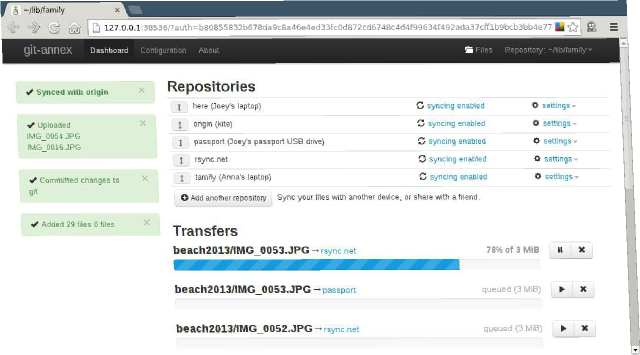
[I'm encouraging git-annex users to post their success stories, and this one is my own.] I set up git-annex on my mom's and sisters' computers a couple of months ago. I noticed this was the first software I've written that I didn't have to really explain how to use. All I told them was, put files in this folder, and the rest of us will be able to see them. Don't put anything too big in there, or anything you don't want others to see. I paired the computers using XMPP, and set up an encrypted transfer repository using a free account rsync.net gave me for beta testing. I also added a repository on my server, which made things more robust. (XMPP has since improved, but it's still a good idea to have a git repository to suppliment XMPP.) I also have two removable drives that are used to back up our files. This was all set up using the webapp. And adding a computer takes just a couple of minutes that way. I set it up at my sister's in a spare moment during a visit, and it all just worked. Our shared git annex contains a couple of hundred files, and is a couple of gigabytes in size. And growing pretty fast as we find things we want to share. Mostly photos and videos so far but I won't be surprised to find poems and books pop up in there from the family's poets and authors. And it'll grow further as I add people who've so far been left out. Coming home from a week at the beach with my grand nephew and niece, was the first time I really used git-annex without thinking about it. Collapsed on a hotel bed, I plugged in my camera and loaded in the trip's photos. Only to see the hotel wifi cost extra. Urk, no! Later, in the lobby, I found an open wifi network, and watched it automatically sync up. screenshot By the time I was home, the video of cute kids playing weathermen and reporting on our near miss by a tropical storm had been enjoyed by the folks who didn't make that family gathering.

Wouter Verhelst: Output

Reading package lists... Done
Building dependency tree       
Reading state information... Done
The following packages will be REMOVED:
  aptitude*
0 upgraded, 0 newly installed, 1 to remove and 41 not upgraded.
After this operation, 4650 kB disk space will be freed.
Do you want to continue [Y/n]? 
It just so happens that I've been blogging long enough that I can say with pretty good confidence that I've been using aptitude for about eight years now. Originally, the aptitude resolver was mostly good enough that in most cases, I could just tell aptitude to mark packages for upgrades, and it'd work; only in a few cases did I have to tell it to find a different solution. Unfortunately, this is no longer the case; when given a complex problem, aptitude is far too happy to just go ahead and remove packages these days. Sometimes, when I tell it to upgrade package "foo", it'll find that something is uninstallable, and then tell me that by removing package "foo" (but upgrading some of the libraries it depends on) we can get the situation resolved. The resolver has some more bugs, but this really is the worst of it. Recently, I've noticed that nowadays I often find myself fighting aptitude trying to remove packages, to the point that eventually it gives up and I have to retry with "apt-get update" or "apt-get dist-upgrade" or similar. Which then works flawlessly. I've decided that enough is enough, and I'll just stick with apt-get for now.

Dirk Eddelbuettel: Rcpp 0.10.4

A new version of Rcpp is now on the CRAN network for GNU R; binaries for Debian have been uploaded as well. This release brings a fairly large number of fixes and improvements across a number of Rcpp features, see below for the detailed list. We are also announcing with this release that we plan to phase out the RCPP_FUNCTION_* macros. Not only have they been superceded by Rcpp Modules and Rcpp Atributes (each of which has its own pdf vignette in the Rcpp package), but they also appear to be at best lightly used. We are for example not aware of any CRAN packages deploying them. To provide a smooth transition, we are aiming to keep them around for another twelve months, but plan to remove them with the first release after that time window has passed. As before, we tested the release rather rigorously by checking against all packages I could (relatively easily) built on my server: this time it covered 91 of the 124 CRAN packages depending on Rcpp. As all of these 91 packages passed their checks, we do not expect any issues with dependent packages. The complete NEWS entry for 0.10.4 is below; more details are in the ChangeLog file in the package and on the Rcpp Changelog page.
Changes in Rcpp version 0.10.4 (2013-06-23)
  • Changes in R code: None beyond those detailed for Rcpp Attributes
  • Changes in Rcpp attributes:
    • Fixed problem whereby the interaction between the gc and the RNGScope destructor could cause a crash.
    • Don't include package header file in generated C++ interface header files.
    • Lookup plugins in inline package if they aren't found within the Rcpp package.
    • Disallow compilation for files that don't have extensions supported by R CMD SHLIB
  • Changes in Rcpp API:
    • The DataFrame::create set of functions has been reworked to just use List::create and feed to the DataFrame constructor
    • The operator-() semantics for Date and Datetime are now more inline with standard C++ behaviour; with thanks to Robin Girard for the report.
    • RNGScope counter now uses unsigned long rather than int.
    • Vector<*>::erase(iterator, iterator) was fixed. Now it does not remove the element pointed by last (similar to what is done on stl types and what was intended initially). Reported on Rcpp-devel by Toni Giorgino.
    • Added equality operator between elements of CharacterVectors.
  • Changes in Rcpp sugar:
  • Changes in Rcpp build tools:
    • Fix by Martyn Plummer for Solaris in handling of SingleLogicalResult.
    • The src/Makevars file can now optionally override the path for /usr/bin/install_name_tool which is used on OS X.
    • Vignettes are trying harder not to be built in parallel.
  • Changes in Rcpp documentation:
    • Updated the bibliography in Rcpp.bib (which is also sourced by packages using Rcpp).
    • Updated the THANKS file.
  • Planned Deprecation of RCPP_FUNCTION_*:
    • The set of macros RCPP_FUNCTION_ etc ... from the preprocessor_generated.h file will be deprecated in the next version of Rcpp, i.e they will still be available but will generate some warning in addition to their expected behavior.
    • In the first release that is at least 12 months after this announcement, the macros will be removed from Rcpp.
    • Users of these macros (if there are any) should start replacing them with more up to date code, such as using Rcpp attributes or Rcpp modules.
Thanks to CRANberries, you can also look at a diff to the previous release 0.10.3. As always, even fuller details are on the Rcpp Changelog page and the Rcpp page which also leads to the downloads, the browseable doxygen docs and zip files of doxygen output for the standard formats. A local directory has source and documentation too. Questions, comments etc should go to the rcpp-devel mailing list off the R-Forge page

24 June 2013

Vincent Sanders: A picture is worth a thousand words

When Sir Tim made a band the first image on the web back in 1992, I do not imagine for a moment he understood the full scope of what was to follow. I also do not imagine Marc Andreessen understood the technical debt he was about to introduce and that fateful day in 1993 when he proposed the img tag allowing inline images.

Many will argue of course that the old adage of my title may not apply to the web, where if it were true, every page view would be like reading a novel! and many of those novels would involve cats or one pixel tall colour gradients.

Leaving aside the philosophical arguments for a moment it takes web browser author a great deal of effort to quickly and efficiently put those cat pictures in front of your eyeballs.
NavigatingImages are navigated by a user in a selection of ways, including:
Whatever the method, the resulting object is subject to the same caching operations as any content object within a browser. These caching and storage operations are not specific to images however images are one of the most resource intensive objects a browser must regularly deal with (though javascript and stylesheet sources are starting to rival it at times) because they are relatively large and numerous.
Pre render processing
When the image object fetch is completed the browser must process the image for rendering which is where this gets even more complicated. I shall use how this works in NetSurf as I know that browsers internals best, but operation is pretty similar in many browsers.

The content fetch will have performed basic content sniffing to determine the received objects mime type. This is necessary because a great number of servers are misconfigured and a disturbingly large number of images served as png are really jpegs etc. Indeed sometimes you even get files served which are not images!

Upon receipt of enough data to decode the image header, for the detected mime type, the images metadata is extracted. This metadata usually includes things like size and colour depth.

If the img tag in the original source document omitted the width or height of the image the entire document render may have to be reflowed at this point to allow the correct spacing. The reflow process is often unsightly and should be avoided. Additionally at this stage if the image is too large to handle or an unhandled format the object will be replaced with the "broken" image icon.

Often that will be everything that is done with the image, when I added "lazy" image conversion to NetSurf we performed extensive profiling and discovered well over 40% of images on visited pages are simply never viewed by the user but that small (100 pixel on a side) images were almost always displayed.

This odd distribution comes down to how images are used in modern web pages, they broadly fall into two categories of "decoration" and "content" for example all the background gradients and sidebar images etc. are generally small images used as decoration whereas the cat picture above is part of the "content". A user may not scroll down a page to see content but almost always gets to "view" the decoration.
Rendering
Created by Andrea R used under CC Attribution-NonCommercial-ShareAlike 2.0 licence
The exact browser heuristics used differ as to when the render operation is performed but they all have a similar job to perform. When i say render here this may be possibly as an "off screen" view if they are actually on another tab etc. Regardless the image data must be converted from the source data (a PNG, JPEG etc.) into a format suitable for the browsers display plotting routines.

The browser will create a render bitmap in whatever format the plotting routines require (for example the GTK plotters use a Cairo image surface) , use an image library to unpack the source image data (PNG) into the render bitmap (possibly performing transforms such as scaling and rotation) and then use that bitmap to update the pixels on screen.

The most common transform at render time is that of scaling, this can be problematic as not all image libraries have output scaling capabilities which results in having to decode the entire source image and then scaling from that bitmap.

This is especially egregious if the source image is large (perhaps a multi megabyte jpeg) but the width and height are set to produce a thumbnail. The effect is amplified if the user has set the image cache size limit to a small value like 8 Megabytes (yes some users do this apparently their machines have 32MB of RAM and they browse the web)

In addition the image may well require tiling (for background gradients) and quite complex transforms (including rotation) thanks to CSS 3. Add in that javascript can alter the css style and hence the transform and you can imagine quite how complex the renderers can become.
CachingThe keen reader might spot that repeated renderings of the source image (e.g. because window is scrolled or clipped) result in this computationally expensive operation also being repeated. We solve this by interposing a render image cache between the source data and the render bitmaps.

By keeping the data in the preferred format, image rendering performance can be greatly increased. It should be noted that this cache is completely distinct from the source object cache and relates only to the rendered images.

Originally NetSurf used to perform the render conversion for every image as it was received without exception, rather than at render time, resulting in a great deal of unnecessary processing and memory usage. This was originally done for simplicity and optimising for "decoration" images.

The rules for determining what gets cached and for how long are somewhat involved and the majority of the code within the current implementation NetSurf uses is metrics and statistic generation to produce better decisions.

There comes a time at which this cache is no longer sufficient and rendering performance becomes unacceptable. The NetSurf renderer errs on the side of reducing resource usage (clearing the cache) at the expense of increased render times. Other browsers make different compromises based on the expected resources of the user base.
FinallyHopefully that gives a reasonable overview to the operations a browser performs just to put that cat picture in front of your eyeballs.

And maybe next time your browser is guzzling RAM to plot thousands of images you might have a bit more appreciation to exactly what it is up to.

23 June 2013

Ben Armstrong: Tutorial: wheezy live iso-hybrid with persistence on USB

As of wheezy, Debian no longer offers for download any prebuilt hdd (formerly known as usb-hdd) live images, which, in squeeze, were necessary if you wanted to use persistence. The good news is, since the new wheezy iso-hybrid images use xorisso, you can copy an image to a USB key and repartition it to add a persistence partition. Unfortunately, the filesystem itself is read-only, so you have to manually append the persistence boot parameter each time you boot the image. If that doesn t bother you, you can skip this whole tutorial and just follow the instructions in live-manual for adding a persistence partition and you re all set. This tutorial explains how to extract the contents of a wheezy iso-hybrid live image to a USB key and modify it to boot with this parameter permanently enabled. I am writing it solely as a workaround and do not endorse this as a means to customize Debian Live images in general. I would love to help make a more convenient, supported way to accomplish the same thing for a future release. Meanwhile, the supported and recommended way to make any change to a Debian Live image is to build it from scratch using live-build, as described in live-manual. A simplified Debian Live Images Autobuilder web service is available that works well for many common customizations, if you prefer. Please use one of these methods if you want to do this, or other customizations in the supported way. Otherwise, read on. Prerequisites Identify the USB key device Caution: Always double-check the device you are writing to is the correct one to avoid losing precious data. There are two things to do to protect yourself. The first is, don t write the USB key as root. The second is, first use ls -l /dev/disk/by-id to identify which device is the target USB key.
lrwxrwxrwx 1 root root  9 Jun 22 11:58 
usb-SanDisk_Cruzer_Contour_0000184CA87406BC-0:0 -> ../../sdb
As you can see, my SanDisk Cruzer Countour is /dev/sdb. For the rest of the tutorial, I ll be referring to this device as /dev/sdX to avoid unfortunate cut-and-paste disasters. When you follow along, make sure you substitute the correct device for your USB key on your system. Initialize the USB key Start by plugging in the key and unmounting any automounted partitions to ensure nothing is accessing the device, e.g.
$ umount /dev/sdX1
Now make changes to the partition table. Use parted because it may be run as an ordinary user and has some advanced capabilities beyond more basic tools like fdisk.
$ /sbin/parted
WARNING: You are not superuser.  Watch out for permissions.
GNU Parted 2.3
Using /dev/sdX
Welcome to GNU Parted! Type 'help' to view a list of commands.
(parted) print devices
/dev/sdX (8221MB)
(parted) select                                                           
New device?  [/dev/sdX]?                                                  
Using /dev/sdX
(parted)
Note that when run as an ordinary user, if you only have one removable drive (which may include mp3 players, cameras, e-readers) plugged in, parted immediately selects that device. But just to be sure, use print devices to list the devices and select to if you need to select a different one, as shown above. Repartition the USB key Once you ve verified you have the correct device, start repartitioning. Write a new partition table with mklabel msdos to wipe out all of the old partitions on it. You may skip this step and adapt the remaining instructions if there are partitions you need to keep. This is your last chance to bail if the device is wrong, so make sure it is the correct one before proceeding.
(parted) mklabel msdos
Warning: The existing disk label on /dev/sdX will be destroyed and all data
on this disk will be lost. Do you want to continue?
Yes/No? y
Error: Partition(s) 1, 2, 3, 4, 5, 6, 7, 8, 9, 10, 11, 12, 13, 14, 15, 16 on
/dev/sdX have been written, but we have been unable to inform the kernel of
the change, probably because it/they are in use.  As a result, the old
partition(s) will remain in use.  You should reboot now before making further
changes.
Ignore/Cancel? i
(parted)
The error is normal, and appears when you run parted as an ordinary user, so it is OK each time it appears to press i to ignore it. For the rest of this tutorial I will omit these errors from the output for brevity. Make three partitions, a fat32 partition for the image itself that is 5% larger than the size of the ISO, a 1G ext4 partition for persistence, and an extra fat32 partition for the rest of the space. Put the extra partition first so that other OSes you might use the key with will be able to use it. Use relative positioning from the end of the device to make it easy to put all of the rest of the space in the first partition. Finally, flag the live image partition bootable.
(parted) mkpart primary fat32 1 -1897M
(parted) mkpart primary ext4 -1897M -897M
(parted) mkpart primary fat32 -897M -0
(parted) set 3 boot on
(parted) quit
Information: You may need to update /etc/fstab.
Unplug the USB key and plug it in again so that the kernel will re-read the updated partition table. If there were old filesystems on the key that were automounted, unmount them again. Now we re ready to make the new filesystems.
$ umount /dev/sdX1
$ /sbin/mkdosfs -nEXTRA /dev/sdX1
mkdosfs 3.0.16 (01 Mar 2013)
$ /sbin/mkfs.ext4 -q -Lpersistence /dev/sdX2
$ /sbin/mkdosfs -nLXDE /dev/sdX3
mkdosfs 3.0.16 (01 Mar 2013)
Make the USB key bootable Use install-mbr to install an MBR on the key and syslinux to install the bootloader to boot into your live image partition.
$ /sbin/install-mbr /dev/sdX
$ syslinux -i /dev/sdX3
Mount the partitions Unplug the key and plug it in again so the new partitions will be automounted. Observe where the partitions are mounted with df.
$ df
...
/dev/sdX1        6204568         4   6204564   1% /media/EXTRA
/dev/sdX3         831888         4    831884   1% /media/LXDE
/dev/sdX2         944120      1204    894124   1% /media/persistence
Extract the ISO contents to the key To continue preparing this key as an unprivileged user, use p7zip to extract the ISO. You may alternatively mount the ISO loopback and extract it that way, but you must be root to do that.
$ cd /media/LXDE
$ 7z x ~/debian-live-7.0.0-amd64-lxde-desktop.iso
...
Extracting  live/filesystem.packages-remove
...
When live/filesystem.squashfs is extracted (right after live/filesystem.packages-remove) it will take the longest time of all of the files to extract, as it contains the whole live filesystem. Be patient and eventually it and all other files on the image will finish extracting.
...
Everything is Ok
Folders: 245
Files: 370
Size:       892183367
Compressed: 895483904
Modify the bootloader configuration files The syslinux bootloader configuration directory and files within it are named isolinux when installed on an ISO. You need to rename the directory and two files changing isolinux to syslinux so the bootloader will find them on your fat32 live image partition.
$ mv isolinux syslinux
$ mv syslinux/isolinux.cfg syslinux/syslinux.cfg
$ mv syslinux/isolinux.bin syslinux/syslinux.bin
Enable full persistence Next, append persistence to the live boot parameters and turn on full persistence by putting / union in a persistence.conf file in the persistence partition.
$ sed -i 's/\(append boot=.*\)$/\1 persistence/' syslinux/live.cfg
$ cd /media/persistence
$ echo / union > persistence.conf
Reboot into the live system Now your USB key is ready to boot with full persistence enabled. Have fun!

22 June 2013

Justus Winter: My first week and some promising though hacky results

Hi Planet Debian :) my name is Justus Winter, I'm a computer science student at the University of Hamburg. I'm participating in the GSOC 2013, my task is to make Debian/Hurd systems boot using the same initialization scripts Debian/Linux uses. I spent the community bonding period with some gsoc related administrative tasks, updating my development machine and getting reacquainted with the Hurd system. It was nice to see how far Debian/Hurd has come since my last "serious" encounter with it. I've setup a continuous build solution on one of my Hurd VMs and prepared a package repository. I'll post details once I have some packages to share. I built the hurd, sysvinit and ifupdown packages and dived into the interesting world of literate programming. I'm going to write about that when I start looking into the ifupdown related issues. But most importantly I started writing a tool to automate all the tasks I would do during my work that could possibly be automated. As I'm working on the boot process, it makes sense to use some kind of virtualization software so I can work in the comfort of my usual development environment. My virtualization solution of choice is qemu and I actually wrote a qemu based black-box test solution for a former employer once, so I already was familiar with qemu and wrapping my own code around it. Without further ado, here it is: https://bitbucket.org/teythoon/hurdtest Provided that you have golang installed, you can compile it easily:
teythoon@europa /tmp % export GOPATH= pwd 
teythoon@europa /tmp % go get bitbucket.org/teythoon/hurdtest
teythoon@europa /tmp % bin/hurdtest
Usage: hurdtest [options] <command> [<arguments...>]
Currently it has the following subcommands:
test
Starts a VM, logs in as root, tests the interaction with the VM, verifies that certain VFS locations are writable, tests the network connectivity, the DNS resolution and installs and runs the hello package.
update
Executes aptitude update && aptitude full-upgrade, reboots the system and runs the test subcommand. If successful, it commits the changes to the virtual disk and creates a snapshot.
overlay
Takes as argument the path to a directory that is copied to the VM, reboots the machine and runs the test subcommand.
The update command is nice because it allows me to keep the VM up to date while ensuring that the image remains usable, with respect to what the test command considers a usable state of a Debian system. I'd really like to get some suggestions on how to test the "health" of a Debian system. You can look at how the tests are implemented in test.go, it's quite easy to add more and more interesting tests, and you don't even have to clean up after them or worry about any side-effects as the changes are not committed to the virtual disk. This is hurdtest doing an update:
teythoon@europa ~/repos/hurd/hurd-tests % bin/hurdtest update
2013/06/22 19:59:45 starting kvm [-drives file=image.qcow2,cache=writeback,snapshot=on -serial unix:/tmp/285813369/serial -monitor unix:/tmp/285813369/monitor -nographic -m 512]
2013/06/22 19:59:45 Waiting for grub...
2013/06/22 19:59:46 Waiting for login prompt...
2013/06/22 20:00:05 Updating system
2013/06/22 20:02:52 Get: 1 http://www.local unstable InRelease [8279 B]
Get: 2 http://http.debian.net sid InRelease [205 kB]
Get: 3 http://ftp.debian-ports.org unreleased InRelease [23.9 kB]
[...]
Setting up perl (5.14.2-21) ...
Reading package lists...
Building dependency tree...
Reading state information...
Reading extended state information...
Initializing package states...
Reading task descriptions...
2013/06/22 20:02:52 Update successful. Snapshotting system...
2013/06/22 20:02:53 Rebooting system...
2013/06/22 20:02:54 Waiting for grub...
2013/06/22 20:02:59 Waiting for login prompt...
2013/06/22 20:03:16 Running main.testTrue...
2013/06/22 20:03:16 Running main.testFalse...
2013/06/22 20:03:17 Running main.testClean...
[...]
2013/06/22 20:03:18 Running main.testNetwork...
2013/06/22 20:03:18 Running main.testResolver...
2013/06/22 20:03:20 Running main.testAptitudeInstall...
2013/06/22 20:03:46 Test successful. Reverting system...
2013/06/22 20:03:48 Halting system...
2013/06/22 20:03:53 Committing changes...
2013/06/22 20:03:57 Creating snapshot...
2013/06/22 20:04:04 All done.
bin/hurdtest update  157.31s user 69.71s system 87% cpu 4:18.94 total
The overlay command implements my work flow. I can edit scripts or drop hacked up executables onto my VM and see the results without any manual intervention. There's the -interactive flag that does this in a loop, avoiding the VM startup time using qemu snapshots. With this I can apply an overlay and see the results of the test suite in about a minute on my system. From early experiments I knew that simply running /etc/rcS.d/S* prevented the system from booting correctly, so I figured my first task should be to figure out what went wrong there. Using my tool (and developing it in that process) and many iterations later I came up with a surprisingly small diff of scripts in the initscripts and utilities shipped with the hurd package. For your convenience here is a tarball that you can extract to the root of your Debian/Hurd installation to reproduce my results (of course I invite you to use my tool for that purpose):
% bin/hurdtest overlay test
2013/06/22 21:35:31 starting kvm [-drive file=image.qcow2,cache=writeback,snapshot=on -serial unix:/tmp/345188134/serial -monitor unix:/tmp/345188134/monitor -nographic -m 512]
2013/06/22 21:35:31 Waiting for grub...
2013/06/22 21:35:31 Waiting for login prompt...
2013/06/22 21:35:48 Creating tarball...
./
./etc/
./etc/hurd/
./etc/hurd/rc
./etc/init.d/
./etc/init.d/checkroot.sh
./etc/init.d/mountall.sh
./runme
./lib/
./lib/init/
./lib/init/mount-functions.sh
./sbin/
./sbin/swapon
./bin/
./bin/mount
2013/06/22 21:35:48 Extracting overlay...
2013/06/22 21:35:49 Rebooting system...
2013/06/22 21:35:49 Waiting for grub...
2013/06/22 21:35:55 Writing log to /tmp/bootlog-802006344
2013/06/22 21:35:55 Waiting for login prompt...
2013/06/22 21:36:20 Booting successful.
2013/06/22 21:36:20 Running main.testTrue...
2013/06/22 21:36:21 Running main.testFalse...
2013/06/22 21:36:21 Running main.testClean...
2013/06/22 21:36:21 Running anonymous function...
2013/06/22 21:36:22 Running anonymous function...
2013/06/22 21:36:22 Running main.testUname...
2013/06/22 21:36:22 Running main.testNetwork...
2013/06/22 21:36:22 Running main.testResolver...
2013/06/22 21:36:23 Running main.testAptitudeInstall...
bin/hurdtest overlay ../hurd-tests-old/test  44.20s user 20.01s system 82% cpu 1:17.94 total
And here is the boot log:
Loading GNU Mach ...
Loading the Hurd ...
GNU Mach 1.3.99-486
AT386 boot: physical memory map from 0x0 to 0x9f400
AT386 boot: physical memory map from 0x100000 to 0x1fffe000
AT386 boot: physical memory from 0x0 to 0x1fffe000
Enabling FXSR
pcibios_init : BIOS32 Service Directory structure at 0xfcff0
pcibios_init : BIOS32 Service Directory entry at 0xfc7ba
pcibios_init : PCI BIOS revision 2.10 entry at 0xfc78c
Probing PCI hardware.
ide: Intel 82371 PIIX3 (dual FIFO) DMA Bus Mastering IDE
    Controller on PCI bus 0 function 9
ide: BM-DMA feature is not enabled (BIOS), enabling
    ide0: BM-DMA at 0xc100-0xc107
    ide1: BM-DMA at 0xc108-0xc10f
hd0: got CHS=762/128/63 CTL=c8 from BIOS
hd0: QEMU HARDDISK, 3001MB w/256kB Cache, CHS=762/128/63, DMA
hd2: QEMU DVD-ROM, ATAPI CDROM drive
ide0 at 0x1f0-0x1f7,0x3f6 on irq 14
ide1 at 0x170-0x177,0x376 on irq 15
Floppy drive(s): fd0 is 1.44M
FDC 0 is a S82078B
probing scsi 0/22: advansys probing scsi 1/22: BusLogic probing scsi 2/22: UltraStor 14F/34F rev. 4.33.00  probing scsi 3/22: UltraStor 14F/24F/34F probing scsi 4/22: Adaptec 152x SCSI driver; $Revision: 1.1 $ probing scsi 5/22: Adaptec 1542 Invalid address for shpnt with 1542.
Invalid address for shpnt with 1542.
probing scsi 6/22: Adaptec 174x (EISA) probing scsi 7/22:  probing scsi 8/22: Always IN2000 probing scsi 9/22:  probing scsi 10/22:  probing scsi 11/22:  probing scsi 12/22: Trantor T128/T128F/T228 probing scsi 13/22: DTC 3180/3280  probing scsi 14/22: Tekram DC390(T) V1.11 Feb-05-1997 probing scsi 15/22:  probing scsi 16/22: ncr53c8xx - revision 2.5f.1 probing scsi 17/22: EATA (Extended Attachment) PIO driver probing scsi 18/22: Western Digital WD-7000 Failed initialization of WD-7000 SCSI card!
probing scsi 19/22: EATA/DMA 2.0x rev. 4.33.00  probing eata on 1f0EATA0: address 0x1f0 in use, skipping probe.
probing eata on 1c88probing eata on 2c88probing eata on 3c88probing eata on 4c88probing eata on 5c88probing eata on 6c88probing eata on 7c88probing eata on 8c88probing eata on 9c88probing eata on ac88probing eata on bc88probing eata on cc88probing eata on dc88probing eata on ec88probing eata on fc88probing eata on 170EATA0: address 0x170 in use, skipping probe.
probing eata on 230probing eata on 330probing scsi 20/22: AM53C974 probing scsi 21/22: Iomega parport ZIP drive ppa: Version 1.42
ppa: Probing port 03bc
ppa: Probing port 0378
ppa:     SPP port present
ppa:     PS/2 bidirectional port present
ppa: Probing port 0278
done
scsi : 0 hosts.
scsi : detected total.
Partition check (DOS partitions):
 hd0: hd0s1 hd0s2 < hd0s5 >
lpr0: at atbus0, port = 378, spl = 6, pic = 7.
module 0: ext2fs --readonly --multiboot-command-line=$ kernel-command-line  --host-priv-port=$ host-port  --device-master-port=$ device-port  --exec-server-task=$ exec-task  -T typed $ root  $(task-create) $(task-resume) module 1: exec /hurd/exec $(exec-task=task-create)                                                                                                                                                                           2 multiboot modules                                                                                                                                                                                                                    task loaded: ext2fs --readonly --multiboot-command-line=root=device:hd0s1 console=com0 --host-priv-port=1 --device-master-port=2 --exec-server-task=3 -T typed device:hd0s1
task loaded: exec /hurd/exec
start ext2fs: Hurd server bootstrap: ext2fs[device:hd0s1] exec init proc auth
Using makefile-style concurrent boot in runlevel S.
ERROR: could not open /proc/stat: No such file or directory
Activating swap...done.
Checking root file system...fsck from util-linux 2.20.1
hd2 : tray open or drive not ready
end_request: I/O error, dev 02:00, sector 0
ext2fs_check_if_mount: Can't check if filesystem is mounted due to missing mtab file while determining whether /dev/hd0s1 is mounted.
/dev/hd0s1: clean, 44328/181056 files, 288266/723200 blocks
done.
Cleaning up temporary files... /tmp.
mount: /run: Unknown device or filesystem
mount: /run/lock: Unknown device or filesystem
mount: /proc: Unknown device or filesystem
mount: /run/shm: Unknown device or filesystem
/etc/rcS.d/S06mtab.sh: 48: /etc/rcS.d/S06mtab.sh: cannot open /proc/mounts: No such file
Activating lvm and md swap...(default pager): Already paging to partition hd0s5!
done.
Checking file systems...fsck from util-linux 2.20.1
hd2 : tray open or drive not ready
end_request: I/O error, dev 02:00, sector 0
done.
Mounting local filesystems...mount: invalid option -- 'O'
Try  mount --help' or  mount --usage' for more information.
failed.
Activating swapfile swap...(default pager): Already paging to partition hd0s5!
done.
df: Warning: cannot read table of mounted file systems: No such file or directory
Cleaning up temporary files....
Configuring network interfaces...inetutils-ifconfig: invalid arguments
ifup: failed to open pid file /run/network/ifup-/dev/eth0.pid: No such file or directory
Internet Systems Consortium DHCP Client 4.2.2
Copyright 2004-2011 Internet Systems Consortium.
All rights reserved.
For info, please visit https://www.isc.org/software/dhcp/
can't create /var/lib/dhcp/dhclient./dev/eth0.leases: No such file or directory
Listening on Socket//dev/eth0
Sending on   Socket//dev/eth0
DHCPDISCOVER on /dev/eth0 to 255.255.255.255 port 67 interval 5
DHCPREQUEST on /dev/eth0 to 255.255.255.255 port 67
DHCPOFFER from 10.0.2.2
DHCPACK from 10.0.2.2
can't create /var/lib/dhcp/dhclient./dev/eth0.leases: No such file or directory
bound to 10.0.2.15 -- renewal in 36884 seconds.
done.
Cleaning up temporary files....
Setting up X socket directories... /tmp/.X11-unix /tmp/.ICE-unix.
Using makefile-style concurrent boot in runlevel 2.
Starting enhanced syslogd: rsyslogd.
Starting deferred execution scheduler: atd.
Starting periodic command scheduler: cron.
Starting system message bus: dbusFailed to set socket option"/var/run/dbus/system_bus_socket": Protocol not available.
Starting OpenBSD Secure Shell server: sshd.
GNU 0.3 (debian) (console)
login:
I know it isn't that pretty, but it yields a working Debian/Hurd system that is more like a Debian/Linux system. For example /dev/shm and /run ,/* are connected to a tmpfs translator. I think this is a rather encouraging first result. I added my findings to the list of open issues. Another nice thing about hurdtest is that it is not even Hurd specific (only a tiny bit GNU Mach specific). I'm going to make it work nicely with Debian/Linux and Debian/kFreeBSD, since this is a very handy tool for anyone hacking on the Debian boot process (and with some changes for any OS). If anyone tries it out, I'd love to get feedback and patches. The tool requires the guest to be configured to use the first serial console for grub, the kernel and the userspace. The password for the user root must be empty. The guest has to have a working network connection setup at boot time. I will provide a suitable image as soon as I devise a good way to zero-fill the free space on the virtual disk. Is there any better way than to fill the disk with a huge file containing zeros? Without doing that the image is too large even compressed with xz. So this was my first week working for Debian. Next week I will focus on getting patches for the hurd and initscripts package in shape, I need to add some functionality to the mount utility shipped with the hurd package. It provides a mount-like experience on the Hurd, on which binding a translator (e. g. /hurd/ext2fs) to a filesystem node is an operation that does not involve the kernel (GNU Mach) at all, and is in fact a operation that any unprivileged user may perform. That is one of the nice features the Hurd has, it empowers its users.

21 June 2013

Lars Wirzenius: How long is a string: how many backups are enough?

You've set up a backup repository, and you have been backing up to it every day for a month now: your backup history is getting long enough to be useful. Can you be happy now? Welcome to the world of threat modelling. Backups are about insurance, of mitigating small and large disasters, but disasters can strike backups as well. When are you so safe you no disaster will harm you? There is always a bigger disaster waiting to happen. If you backup to a USB drive on your work desk, and someone breaks in and steals both your computer and the USB drive, the backups did you no good. You fix that by having two USB drives, and you keep one with your computer and the other in a bank vault. That's pretty safe, unless there's an earth quake that destroys both your home and the bank. You fix that by renting online storage space from another country. That's quite good, except there's a bug in the operating system that you use, which happens to be the same operating system the storage provider uses, and hackers happen to break into both your and their systems, wiping all files. You fix that by hiring a 3D printer that prints slabs of concrete on which your data is encoded using QR codes. You're safe until there's a meteorite hits Earth and destroys the entire civilisation. You fix that by sending out satellites with copies of your data, into stable orbits around all nine planets (Pluto is too a planet!) in the solar system. Your data is safe, even though you yourself are dead from the meteorite, until the Sun goes supernova and destroys everything in the system. There is always a bigger disaster. You have to decide which ones are likely enough that you want to consider them, and also decide what the acceptable costs are for protecting against them. A short list of scenarios for thinking about threats: These questions do not cover everything, but they're a good start. For each one, think about: The threat modelling here is about safety against accidents and natural disasters. Threat modelling against attacks and enemies is similar, but also different, and will be the topic of the next episode in the adventures of Bac-Kup.

Next.

Previous.