Search Results: "sf"

14 December 2007

Martin F. Krafft: Surveys on the console

As part of my research, I may have to conduct a survey among Debian contributors. The word "survey" usually elicits frowns because surveys are often misconducted. MJ has taken the time to draft up some advice to surveyors. Problems with surveys generally fall into one of two categories: content and presentation. I'll refrain from making statements about content (Wikipedia has some stuff on questionaire construction) and instead concentrate on presentation in the following. Commonly in the digital age, surveys are administered via a web page or e-mail. In my recent Ph.D. transfer report, I identified a number of shortcomings with these approaches: Asking Debian contributors to click radio buttons on a web page is a bit like expecting a mountain biking champion to ride a tricycle across a paddock: painful, if not offensive. Furthermore, web surveys can only be taken while on-line, when most of us have better things to do. E-mail surveys address some of these problems, but create new ones: answers cannot be constrained to a domain (think multiple-choice), character set and formatting issues make evaluation difficult, and it's impossible to prevent users from attaching comments or modifying responses. In thinking about the issue, I came up with a third means to administer a survey: a console tool. Think of a Debian package which provides a console application controlled by a study-specific data file. The data file specifies the questions and their answer domains, and the tool presents those to the participant. Since most of Debian happens on the console anyway, such an approach to surveys seems more appropriate. Interaction with the survey tool would be as easy as pressing the 2 or 4 keys to select one of the multiple choices, and the tool would immediately move on to the next question (and not wait for the user to hit enter). Obviously, n and p should allow navigation back and forth across the set, and c would spawn a text editor to give the user a chance to attach a comment to his/her current response, in which s/he might criticise the question or provide additional information. Finally, the tool should be able to pick up where it left off, should the user chose to exit/suspend the survey for now. Integration with debconf or another interface abstraction is also worth consideration. There is more to it: people change their minds and should thus be able to amend responses. With their consent, it might be valuable to track such changes and inquire about their motivations. As I was thinking about how to realise this, I suddenly arrived at version control: use Git as a backend storage. The set of cool features this would enable seems to be endless: it works off-line and can be used to track aforementioned changes, but also offers the possibility to create a squashed result in case the participant prefers to submit only the final result. Furthermore, it's a trivial change between anonymous submissions, and submissions authenticated by a GPG signature. In addition, the survey tool should be able to display questions according to previous responses (control flow). For instance, if the survey determines that a given user is a contributor to the bug tracking system, but not a project member, it wouldn't make sense to ask when s/he received his/her Debian account. Furthermore, questions could be dynamically creatable from context, so that the survey can drill into depth depending on previous responses, rather than asking the same questions to all participants. I am currently applying for funding to outsource the development of such a tool. If you are interested in coding it up and getting paid for it, speak to me. Here are some more specifications to keep in mind before jumping on: These are likely to be incomplete, but should convey the basic picture. Feedback is always welcome! NP: Oceansize: Frames Update: James Andrewartha pointed me to purity, which asks multiple-choice questions on the console. It has the kind of interface which I envision. Also, Chris Lamb suggested this personality survey as a base line. Well, actually he just suggested I look into it.

Martin F. Krafft: Finally on the right track

It's now three weeks since I am officially a Ph.D. student at the University of Limerick, but I've been too busy to do anything about it. Today, I finally updated my research webpage and sat down to tell you the tale of how I successfully defended my research, but failed to leave the country the next day. As is customary in the British system, I initially enrolled at UL as a Master student. In October, I then applied for a transfer to the Ph.D. track, submitted a transfer report and prepared for a live defence, according to the UL code of practice. On 23 November, I presented my research to my examiners, Dr. P r gerfalk and Patrick Healy, who found my work to be at Ph.D. level and approved of my transfer. I was moderately nervous going into the presentation, not really knowing what was expected of me. In the end, however, the presentation went well and the ensuing discussion provided valuable feedback. Thank you, P r and Paddy, as well as Norah (who chaired), and Brian (my supervisor) for all your time, help, and support. After the defence, Mel waited outside with a beer in hand, and it being Friday and all, I happily popped the cap and drank. Plans to head to The Stables gave way to chilling on the couch in 110 (my home away from home), before we headed to town for the Kila gig. We arrived early, had some beers, enjoyed the show, had some more beers, went home, and had some more beers to Guitar Hero, and when I crawled into bed, I was shocked to find out that I had lost all track of time and it was in fact already 5:30 on Saturday morning, instead of the perceived 2 o'clock. See, the source of this shock was a plane that left Dublin the next day around noon, and a rental car that was to get me there, leaving the house at 8. But when my alarm shattered my drunk dreams at 7:30, it quickly became clear (or well, everything was blurred, actually), that I would have a hard time getting into the car, and I would certainly never manage to navigate it to Dublin, a three hour drive. So I called up the airline and the rental company and rescheduled for the next day (only one flight from Dublin to Zurich a day), and went back to dreamland. I am entirely unsure whether my Ph.D. transfer defence was enough of a reason to get smashed. I still had a good time, though as always in Ireland, especially with this crowd NP: The Flower Kings: The Rainmaker

13 December 2007

Raphael Geissert: HOWTO create and maintain a repository using reprepro and DeBaBaReTools

DeBaBaReTools seems to work good enough that writing an early-stage HOW TO seems to worth the time :)

The first thing to do is of course fetch the sources:
$ svn export https://neo.yahostme.com/svn/DeBaBaReTools/trunk/ DeBaBaReTools


Build and install the package:
$ cd DeBaBaReTools; dpkg-buildpackage -b; dpkg -i ../debabaretools_0.2_all.deb


$ dpkg -L debabaretools
/.
/etc
/etc/DeBaBaReTools
/etc/DeBaBaReTools/common.conf
/usr
/usr/bin
/usr/bin/wannaBuild
/usr/bin/needsBuild
/usr/bin/needsReBuild
/usr/bin/buildQueue
/usr/bin/checkSums
/usr/bin/wannaUpload
/usr/bin/processIncoming
/usr/share
/usr/share/doc
/usr/share/doc/debabaretools
/usr/share/doc/debabaretools/copyright
/usr/share/doc/debabaretools/ENV
/usr/share/doc/debabaretools/changelog.gz
/usr/share/doc/debabaretools/TODO
/usr/share/DeBaBaReTools
/usr/share/DeBaBaReTools/backends
/usr/share/DeBaBaReTools/backends/config
/usr/share/DeBaBaReTools/backends/config/reprepro.sh
/usr/share/DeBaBaReTools/backends/probe.sh
/usr/share/DeBaBaReTools/backends/fetch
/usr/share/DeBaBaReTools/backends/fetch/dget.sh
/usr/share/DeBaBaReTools/backends/verbosity.sh
/usr/share/DeBaBaReTools/backends/lock
/usr/share/DeBaBaReTools/backends/lock/default.sh
/usr/share/DeBaBaReTools/backends/setDefault.sh
/usr/share/DeBaBaReTools/backends/buildQueue
/usr/share/DeBaBaReTools/backends/buildQueue/plaintext.sh
/usr/share/DeBaBaReTools/backends/signature
/usr/share/DeBaBaReTools/backends/signature/gpgv.sh
/usr/share/DeBaBaReTools/backends/check
/usr/share/DeBaBaReTools/backends/check/default.sh
/usr/share/DeBaBaReTools/backends/build
/usr/share/DeBaBaReTools/backends/build/pbuilder.sh
/usr/share/DeBaBaReTools/backends/upload
/usr/share/DeBaBaReTools/backends/upload/dput.sh
/usr/share/DeBaBaReTools/backends/parsers
/usr/share/DeBaBaReTools/backends/parsers/default.sh
/usr/share/DeBaBaReTools/backends/repository
/usr/share/DeBaBaReTools/backends/repository/shared.sh
/usr/share/DeBaBaReTools/backends/repository/reprepro.sh
/usr/share/DeBaBaReTools/backends/misc.sh
/usr/share/DeBaBaReTools/backends/codenamesTable
/usr/share/DeBaBaReTools/backends/codenamesTable/release.sh
/usr/share/DeBaBaReTools/backends/codenamesTable/reprepro.sh
/usr/share/DeBaBaReTools/backends/config/default.sh
/usr/share/DeBaBaReTools/backends/fetch/default.sh
/usr/share/DeBaBaReTools/backends/buildQueue/default.sh
/usr/share/DeBaBaReTools/backends/signature/default.sh
/usr/share/DeBaBaReTools/backends/build/default.sh
/usr/share/DeBaBaReTools/backends/upload/default.sh
/usr/share/DeBaBaReTools/backends/repository/default.sh
/usr/share/DeBaBaReTools/backends/codenamesTable/default.sh


Now you have to create a base reprepro repository. I strongly recommend setting the REPREPRO_BASE_DIR ENV variable if possible.

A recommended repository structure is (in repoitory/):
.:
./build:
./build/cache:
./build/data:
./build/data/logs:
./build/tmp:
./conf:
distributions
incoming
options
tiffany.py
uploaders
./db:
./debian:
./debian/dists:
etch
oldstable
sarge
sid
stable
testing
unstable
./debian/dists/...
./debian/pool/...
./incoming:
./incoming/accepted:
./incoming/new:
./incoming/rejected:
./pub:
./pub/UploadQueue:

Note that the build/, incoming/ and pub/ directory structures are DeBaBaReTools' defaults, if you want to change them you will have to set some variables at the configuration file ($HOME/.DeBaBaReToolsrc).

The distributions file must at least contain the Codename, Suite and Architectures entries for DeBaBaReTools to work correctly. Note that the current code used to correlate the suites with the codenames greps for the given codename/suite including two lines before and two after the match, so the entry must be on that scope.
E.g.
$ cat conf/distributions
Codename: sid
Suite: unstable
Architectures: i386 amd64 source
Components: main contrib non-free
Uploaders: uploaders
DebIndices: Packages Release .bz2 .gz .
DscIndices: Sources Release . .gz .bz2
Contents: .bz2 .gz .
Tracking: minimal includechanges keepsources


conf/incoming must name at least one rule. This is because when installing, DeBaBaReTools will grep for all the rule names and execute them one by one.
The rest of reprepro's setup is trivial.

When building packages with pbuilder, DeBaBaReTools expects the basetgz's to be named like $PBUILDER_CACHE/$CODENAME.tgz where $PBUILDER_CACHE is an environment variable defaulting to /var/cache/pbuilder.

Tweaking DeBaBaReTools:
Because we are using reprepro and pbuilder we'll give some hints to DeBaBaReTools so it uses a reprepro-specific and/or pbuilder-specific backend where possible.

$ echo 'HINT_ALL="reprepro pbuilder"' > $HOME/.DeBaBaReToolsrc


The .DeBaBaReToolsrc file is sourced by all scripts, so you might even set variables like $REPREPRO_BASE_DIR there.

/usr/share/doc/debabaretools/ENV documents only some of the multiple environment variables that can be specified to customise DeBaBaReTools' behaviour. It is important to say that variables which are empty will be filled with a default value.

You may now want to modify .dput.cf by adding a 'local' target for your repository:
[local]
fqdn = localhost
method = local
incoming = /home/raphael/Deb/repository/pub/UploadQueue
allow_unsigned_uploads = 0
run_dinstall = 0


So let the fun begin! :)

To make sure everything is ok let's run processIncoming in verbose mode:
VERBOSE=1 processIncoming
processIncoming v0.1 started.
processIncoming v0.1 stopped.

Not getting that output means something is not ok.

All the scripts will try to source a file called $HOME/.$ APP_NAME rc, where $APP_NAME is the name of the script, e.g. processIncoming. This can be used to customise them even more.

Tweaking the scripts behaviour:

processIncoming offer some options such as:


wannaBuild:


When you should call which DeBaBaReTools script:
processIncoming takes care of accepting package uploads and installing them when told to do so.
needsBuild processes the .changes files accepted by processIncoming and tells the build queue manager that a given package needs to be built, or when the binary package is also uploaded, or is already built.
wannaBuild only takes care of building source packages (note that arch: all-onnly packages WON'T be built, they must be uploaded together with the source package).

So the workflow is:
processIncoming -> needsBuild -> INSTALL=1 processIncoming

A package won't be installed in the repository if it isn't handled before by needsBuild.

Here's a demonstration (note the usage of VERBOSE=1):
$ dput local kcometen3_1.1-1_source.changes
Checking Signature on .changes
...
Uploading to local (via local to localhost):
Successfully uploaded packages.
Not running dinstall.
sh: /usr/bin/mini-dinstall: No such file or directory
Error while executing command.
Continuing...

The package is now at pub/UploadQueue

$ VERBOSE=1 processIncoming
processIncoming v0.1 started.
Processing /home/raphael/Deb/repository/pub/UploadQueue/kcometen3_1.1-1_source.changes...
mv'ing "/home/raphael/Deb/repository/pub/UploadQueue/kcometen3_1.1-1.diff.gz" to "/home/raphael/Deb/repository/incoming/accepted/"
mv'ing "/home/raphael/Deb/repository/pub/UploadQueue/kcometen3_1.1-1.dsc" to "/home/raphael/Deb/repository/incoming/accepted/"
mv'ing "/home/raphael/Deb/repository/pub/UploadQueue/kcometen3_1.1-1_source.changes" to "/home/raphael/Deb/repository/incoming/accepted/"
mv'ing "/home/raphael/Deb/repository/pub/UploadQueue/kcometen3_1.1.orig.tar.gz" to "/home/raphael/Deb/repository/incoming/accepted/"
processIncoming v0.1 stopped.

After checking sums and signature, the upload is accepted.

$ VERBOSE=1 needsBuild
needsBuild v0.2 started.
Architectures: i386 amd64 all
Now processing /home/raphael/Deb/repository/incoming/accepted/kcometen3_1.1-1_source.changes
Adding kcometen3 to be built in i386 for the sid distribution
Adding kcometen3 to be built in amd64 for the sid distribution
mv'ing "/home/raphael/Deb/repository/incoming/accepted/kcometen3_1.1-1.dsc" to "/home/raphael/Deb/repository/incoming"
mv'ing "/home/raphael/Deb/repository/incoming/accepted/kcometen3_1.1.orig.tar.gz" to "/home/raphael/Deb/repository/incoming"
mv'ing "/home/raphael/Deb/repository/incoming/accepted/kcometen3_1.1-1.diff.gz" to "/home/raphael/Deb/repository/incoming"
mv'ing "/home/raphael/Deb/repository/incoming/accepted/kcometen3_1.1-1_source.changes" to "/home/raphael/Deb/repository/incoming"
needsBuild v0.2 stopped.

The package is now marked to be built on i386 and amd64 for sid (note that distro to codename conversion is performed) and moved to incoming/ so processIncoming is able to install it.

$ VERBOSE=1 processIncoming
processIncoming v0.1 started.
processIncoming v0.1 stopped.

There's nothing under pub/UploadQueue and nothing is installed (do you remember the INSTALL=0 option? :))

$ INSTALL=1 VERBOSE=1 processIncoming
processIncoming v0.1 started.
No distribution found for 'kcometen3_1.1-1_source.changes'!
There have been errors!
No distribution found for 'kcometen3_1.1-1_source.changes'!
There have been errors!
No distribution found for 'kcometen3_1.1-1_source.changes'!
There have been errors!
making diffs between /home/raphael/Deb/repository/debian/dists/sid/main/source/Sources and /home/raphael/Deb/repository/debian/dists/sid/main/source/Sources.new:
generating diff
Exporting indices...
processIncoming v0.1 stopped.

The errors can be safely ignored, it is just that reprepro couldn't install kcometen3_1.1-1_source.changes for the specified install rule (I've one for each distro, that's why).

$ VERBOSE=1 wannaBuild
wannaBuild v0.1 started.
Fetching list of packages to be built for unstable
Fetching source package kcometen3 v1.1-1
Use of uninitialized value in string eq at /usr/bin/dget line 377.
cat: /home/raphael/Deb/repository/build/data/needsBuild.unstable: No such file or directory
Starting build backend...
Executing sudo pbuilder --update --basetgz /var/cache/pbuilder/unstable.tgz
Starting build process
Verifying signature of /home/raphael/Deb/repository/build/kcometen3jb3362/kcometen3_1.1-1_i386.changes...
gpgv: no valid OpenPGP data found.
gpgv: the signature could not be verified.
Please remember that the signature file (.sig or .asc)
should be the first file given on the command line.
Fetching list of packages to be built for testing
Fetching list of packages to be built for stable
Fetching list of packages to be built for oldstable
wannaBuild v0.1 stopped.

There are still some things that need to be fixed (e.g. the no such file or directory message).
Other than that, the output is just fine: the package wasn't automatically signed so when trying to check the signature it failed to find it thereby not uploading the package automatically.

Now we cd to build/kcometen3jb3362/, review the build log, the .changes file, and we finally sign it.
Afterwards, we upload the package and install it:

$ VERBOSE=1 processIncoming
processIncoming v0.1 started.
Processing /home/raphael/Deb/repository/pub/UploadQueue/kcometen3_1.1-1_i386.changes...
mv'ing "/home/raphael/Deb/repository/pub/UploadQueue/kcometen3_1.1-1_i386.changes" to "/home/raphael/Deb/repository/incoming/accepted/"
mv'ing "/home/raphael/Deb/repository/pub/UploadQueue/kcometen3_1.1-1_i386.deb" to "/home/raphael/Deb/repository/incoming/accepted/"
processIncoming v0.1 stopped.

$ VERBOSE=1 needsBuild
needsBuild v0.2 started.
Architectures: i386 amd64 all
Now processing /home/raphael/Deb/repository/incoming/accepted/kcometen3_1.1-1_i386.changes
mv'ing "/home/raphael/Deb/repository/incoming/accepted/kcometen3_1.1-1_i386.deb" to "/home/raphael/Deb/repository/incoming"
mv'ing "/home/raphael/Deb/repository/incoming/accepted/kcometen3_1.1-1_i386.changes" to "/home/raphael/Deb/repository/incoming"
needsBuild v0.2 stopped.


$ INSTALL=1 VERBOSE=1 processIncoming
processIncoming v0.1 started.
No distribution found for 'kcometen3_1.1-1_i386.changes'!
There have been errors!
No distribution found for 'kcometen3_1.1-1_i386.changes'!
There have been errors!
No distribution found for 'kcometen3_1.1-1_i386.changes'!
There have been errors!
making diffs between /home/raphael/Deb/repository/debian/dists/sid/main/binary-i386/Packages and /home/raphael/Deb/repository/debian/dists/sid/main/binary-i386/Packages.new:
generating diff
Exporting indices...
processIncoming v0.1 stopped.


done :)

We can now setup some cronjobs:
*/10 * * * * processIncoming
*/5 * * * * needsBuild
@daily INSTALL=1 processIncoming

needsReBuild and uploadQueue still need to be written, so don't expect them to do anything right now.

I hope people start using it so I receive more feedback :D

Sune Vuorela: Extramadamadura day 1

Debian-KDE && Debian-i18n meeting in extremadura. I’m attending. Yay. Flight: on time for once, but apparantly Iberia has added one extra row of seats, so very little space.
Bus ride: okay. but still a 3-4 hour bus ride.
Beds/bedrooms: Is working.
Breakfast: Crap.
Network: Heavily firewalled, but ssh works on port 22. Extremely laggy, connections dropped, …. In general, crap.
Lunch: Quite okay. Probably because the standard lunch got cancelled, so we got better lunch.
Dining schedules: Completely weird.
The people: Debian people quite nice.
Why does so few spanish people speak english? Except the network, I am kind of satisfied.

12 December 2007

Adrian von Bidder: Hardware sucks

Specifically, Wifi. Connecting an ipw2200 to a rt2400 in ad hoc mode turns out to only work with 40 bit WEP or unencrypted, and then only with bit rates that remind me of analog modems (as I write this over an assh connection, the cursor lags several characters. Nominally, the connection is 11Mbps, but as soon as there's a bit of traffic, it drops to 5.5Mbps, and the actual data transferred is always at the 4kBps level. Hmm. Fun, now the WiFi suddenly decided to drop to 2Mbps, and it seems that I actually have 2Mbps, so probably I should hardwire it at this setting. Of course I didn't expect the rt2400 to magically acquire WPA capabilities, but I'd at least expect the specified stuff to work... This is not bleeding edge hardware, after all, so even the Linux drivers should have had time to mature. (OTOH WEP is b0rken regardless of the bit strength, so I should replace that rt2400 stuff anyway.)

11 December 2007

Steve Kemp: Your trumpet's blowing for far too long,

So I run a blog. You might have read bits of it in passing, probably more due to syndication than actual desire. Initially I started off using Wordpress, but that was later purged once I bit the bullet and decided I'd rather be blogless than install PHP upon any server I cared about. To replace my blog I looked for different solutions and eventually decided to try something built upon Ruby (on Rails). That lead to me trying Typo. After a little bit of pain I decided this wasn't a great solution. So in the hunt for something new I moved to Mephisto, but over the past few months I've noticed that my virtual machine has been running low on memory - and the culprit has always been the Mongrel isntance which was running the blog. So once more into the breach. This time I had a new plan. I'd actually use a piece of blog software which I wrote for a couple more sites, a static system which outputs RSS & HTML files - with no dynamic-fu at all. That system is the chronicle blog compiler. In performing the migration I accidentally flooded a couple of Planet-Planet installations. It took me a moment to work out why, and that was because my RSS feeds didn't include valid "pubDate" files for the entries.. So now I've made a new release of chronicle which supports valid RSS feeds, as tested against the feed validator and all is well. Well almost. Users no longer have access to post comments, and whilst I've successfully migrated 700+ entries through to four different blogging engines I've managed to lost most (all) comments along the way at different points in time which is a real shame. In the future I'll setup a simple CGI system to write comments to text files, and then allow them to rsync'd and merged into the entries. I just don't have the concentration to manage that right now. In the meantime hello to Planet Sysadmin - never heard of you before, but thanks for carrying my feed. I'm suprised I qualify, but I guess at the very least I'm spreading interesting lyrics... (Remind me to post the mod_rewrite rules I'm using now; I've kept all links at the same location through successive blog migrations which means I have numerous mod_rewrite rules which are probably obsolete, but I just don't want to touch them because cool URIs don't change....)

Benjamin Mako Hill: Wikimedia and the Free Culture Movement

An essay I wrote for the Wikimedia Foundation fundraising drive was just published on the the foundation's Why Give blog. The essay, titled Wikimedia and the Free Culture Movement, discusses the movement for free culture, Wikimedia's central role in it, and the importance of supporting the foundation because, I argue, the immediate success of the free culture movement is intimately tied up in Wikimedia's efforts. It is very exciting to see an essay I wrote linked prominently from the top of every page in Wikipedia! It is also exciting to imagine that I might help the Wikimedia foundation at this important time in that organization's life. I am giving to two organizations in support of two causes this year: the Wikimedia Foundation in support of free culture and the Free Software Foundation in support of free software. No other two groups are as committed or are doing as much to build a world where knowledge, and the tools we use to use, produce, and communicate it, are and remain free.

David Welton: Charlie Munger's criticism of economics

I found this transcript of a speech by Charlie Munger thanks to Greg Mankiw's blog: Academic Economics: Strengths and Faults After Considering Interdisciplinary Needs (pdf) Despite the very dry sounding title, it's an astute criticism of economics that I greatly enjoyed. My own interest in economics stems from attempting to understand how things like open source software and programming languages fit into the world at large, and what forces govern their rise and fall. Economics is generally a pretty good way of thinking about problems like that - one of the best there is. But it's certainly a system that is far from perfect, and Munger points out some of its defects in an effective way, without going overboard and trashing the whole discipline, as some do. His words give voice to somewhat vague doubts in my own mind, and back them up with the experience and successful career of Mr. Munger. Like all good criticism, it's also constructive and suggests improvements rather than simply tearing down. I don't agree with his complaints about free trade and China, but they're not completely without foundation, and that's probably a discussion best left to someone else's online journal. Suffice it to say that I think he's performing a bit of slight of hand by turning hypothetical numbers where everyone is objectively better off into a relative ranking, where there can only be one "winner". Overall, though, it's a good read, especially if you have read a few things about the subject of economics.

MJ Ray: Movements: back again (just)

I'm back (again) but I'm not feeling 100% well (again). I'll write about the various events I attended and share the pictures as soon as I get bluetooth file transfer working (is that obex?) but here are some sites I commented on recently:

When is it going to be the norm for JavaScript?
Never, I hope.
Down with the Press Release!!
I wonder if I didn't like this because open letters aren't very common here.
Print before you think! - Atomo64's Blog - by Raphael
Reposting the old psnup -2 trick... works in Mozilla-based browsers, at least
How Old Are ProBlogger Readers? Poll Results
I whinge about ProBlogger's misuse of bar charts again...
How Much Money Do Bloggers Earn Blogging?
and again... guess I should stop doing that. But histograms ROCK. Excuse me - I'm still ill...
blog.aksw.org Blog Archive Open-source innovation platform Cofundos.org
I've seen a couple of these cooperative free software funding ideas recently. Here's one...
Information Unlimited A proposal for user-driven commercial free software development.
and here's another...
gmane.org.fsf.europe.discussion
and here's a little background on the first.
Sustaining Alternative Media - Bristol Indymedia to Bristol Social Forum
It's just too damn awkward to contribute to BIMC.
Miriam Ruiz: Journalists avoiding writing about Free Software?
Since when have journalists avoided writing about stuff because of criticism? Sounds like an excuse to me.
Issues Forums in the UK, Meet Tim Erickson in November at London E-Democracy 07 Conference E-Democracy.Org - Project Blog
I did meet Tim. Which was nice.
Labour: Queen's Speech - full statement
I saw this site advertised on TV after the speech, visited it, asked a question. No answer. 'nuff said. I asked a question on another page and it was deleted unanswered. Control freakery at its best.
ConservativeHome's ToryDiary: Cameron takes Tory message of social justice to Labour heartlands
My question about the surprising Conservative Cooperative Movement announcement. No answer. Are all the political parties similar? Do any of them have any answers?
BBC Internet Blog - Linux Figures
Part one of the reaction of the BBC director who thought they only have 600 Linux users.
BBC Internet Blog - Open Standards
Part two of the reaction "The BBC is committed to open standards [...] wherever possible" - yeah, tell that to their satellite system and the Ceefax-killers! (Warning: may contain Andrew Suffield...)
BBC Internet Blog - Operating System Figures
Part three - explains just how their analysis system got the numbers so horrendously wrong. "All of the BBC's regular reporting mechanisms use the User Agent string" - D'oh!

8 December 2007

Andrew Pollock: [life] Australia bound

We're heading back for the annual trip home. This time it's not really a holiday, it's just three weeks of running around like a headless chicken, catching up with friends and family. We're killing time at SFO at the moment waiting for our flight to board. There's much to be said for arriving at the airport ludicrously early. We had the shortest check in line I've ever seen for an international flight. Security was also ridiculously quick. It all adds up to a stress-free travelling experience. I'm working from the Sydney office for a week, and then taking two week's vacation. Sarah's sorting out her E-3D renewal while we're in Sydney, as she was unable to travel when I renewed mine in Dublin earlier in the year. After that I'm taking all of January off as unpaid time off, so I can look after Sarah after her heart surgery in January and just generally decompress. We got a good deal with Qantas. The package gives us three domestic flights within Australia, which works out perfectly to allow us to visit Canberra and Brisbane. I'm looking forward to seeing my family, as I haven't seen them since we lost Joshua, and I'm sure it's been as hard from them as it has been for me being so far apart from each other. It'll be good to have a cry together.

7 December 2007

Benjamin Mako Hill: New Antifeatures Article and FSF Members' Bulletin

The FSF's fall members bulletin is out. For it, I spent some time refining the blogpost I recently wrote on antifeatures into an article. I got a whole lot of feedback last time (Thanks!), most of which criticized my choice of examples. I've structured this version around different, and I hope less controversial, examples. Please read the new article and leave comments here, especially if you criticized the old one. The bulletin also includes two pieces introducing a campaign against software patents that the FSF plans to launch early next year and a discussion of the AGPL by Brett Smith. This bulletin hints at what I think are the big issues that the FSF plans to take on next year: software patents, web services, and creative new takes on the free software message that are designed to resonant beyond our historically very technical community of hackers. I'll write more on this in the next week or so. To support this mission, and to receive future copies of the bulletin directly, please consider becoming an associate member today during the FSF's year-end members drive.

Erich Schubert: Intel wireless (ipw3945) still broken

It's now far over a year that the ipw3945 driver doesn't work reliably for me on stock Debian kernels. From other blogs I figured it only occurs in SMP situation, and even then not on all systems.On my laptop, I can reproduce it rather reliably: connect to the WPA2 encrypted network at my parents and transfer a file to one of the other computers on the network. An IO rate of a couple hundred kb/s will make the wireless card disconnect frequently. Often I end up having to flip the kill switch twice to get it working again.I have however found a workaround: use a kernel with preemption enabled.So it seems that there is something in that driver which will in certain situations trigger a big lock. Actually you can even hear that - sound will also be interrupted shortly when the wireless dies. Without preemption enabled, this will make the wireless card run into a timeout and reset itself.I don't know yet if this completely fixes it. But other comments in the bug report at bughost suggest that it's at least much more stable. bug 1085 seems another instance of this bug and is open since june 2006. As good as their OSS record is, it seems that Intel has given up on fixing this bug.There are other drivers causing similar problems. For example the dcdbas driver for the Dell Bios used to check for the wireless kill switch, display brightness and such functionality. When I load that driver, hal or NetworkManager will interrupt my sound every few seconds when polling the kill switch. Maybe they would just need to get hold of a system affected so they can diagnose it properly themselves. There have been at least 20 people reporting this bug by now, most of them on Dell systems.

5 December 2007

Evan Prodromou: 14 Frimaire CCXVI

One thing that's been interesting me lately is RSS. Yeah, I know, not exactly cutting-edge technology, but the format -- in its three different forms -- has become the default for machine-to-machine transfer of serial information on the Web. So RSS really represents our individual or collective presence on the Web spread across time, space, and theme. I'm particularly interested in RSS because I'm working on themed portals like Keiki. It's one of our goals to pull in the parenting part of a person's personality spread on other parts of the Web, so you don't have to re-enter it in Keiki if you don't want to. It's a fun problem to be solving. But as I was playing with the format, I realized that I'm spread pretty far across the Web, myself. I make most of my contributions to this blog, but I'm also part of other communities and a user of other services. What if I used some software like Planet to pull together the disparate threads of me into one place? So that's what I did. I ended up using a tool called Gregarius instead of Planet, mostly because I originally intended to install it on Godaddy's hosting service, which doesn't support cron jobs, which Planet needs. Once I realized how ad-infested GD's "free" hosting service is, though, I moved all my sites off of it, and back to Antipater. And my personal aggregator is there, too. It was interesting to pull in the accounts I've listed on About Me and see which ones produced RSS feeds. Some I expected (my Flickr feed, my del.icio.us feed) and others I didn't (my Upcoming feed surprised me). I was also surprised by sites that didn't produce a feed. I really expected something from Pownce and Tribe.net), but I couldn't get them to cough up a feed. Most disappointing was Facebook, which has a really nice mini-feed of my activity there that doesn't seem to translate into an RSS feed in any possible way. But otherwise things went very quick. I found Gregarius really easy to work with, although its inability to pull tag (metadata) and categories out of RSS streams. There's an autotagger plugin, but I haven't gotten it to catch any tags yet. Oh, and the OPML output was horrible -- I think it might generate HTML that looks like raw OPML -- totally useless. In any event, if you feel like cyberstalking me or just seeing what I'm doing around the rest of the Web, keep an eye on evanprodromou.info. There's even a handy aggregated RSS feed... just in case you want it. tags:

Biella Coleman: Rethinking Blogs: The importance of fewer posts and preaching to the choir

It is hard to believe that I have been blogging for over five years. And what is clear is that being an assistant professor is not all that conducive for blogging and this is materially evident in my sparse posting pattern over the last few months. It has been particularly bad in the last month thanks to a week long international trip, back-to-back sickness over Thanksgiving week, and finally going to Washington D.C. for the AAAs. But this retreat from blogging as well as teaching on so-called Web 2.0 software, like blogs, has made me rethink the value and limits of the craft of blogging and so I am going to take some time (that I feel like I don t really have, but oh-well..) to write them down as I am preparing a short piece for on the politics of Web 2.0 and I hope I can transfer some of these ideas there. So as I have already mentioned, I am an now infrequent blogger. Prior to the era of RSS, this could have meant the death of my blog because if people went to visit my page and there was no new post and then this happened a few more times, they would just stop visiting. The magic of RSS is that it brings the blog post to you and this alters the landscape of possibilities within the context of what has been nothing short of a seismic explosion of blogs. What I am finding and this will be no surprise to anyone is that it is just too difficult to keep up too many of a certain class of blogger the prolific poster who posts medium to long posts and worse, nearly everyday! To make a point about the effects of this, allow me to tell a story: Two blogs I really like are Joe Reagle’s blog on Open Communities as well as Tenured Radical. Both provide captivating posts but I recently unsubscribed to Radical Tenure and not Joe Reagle s. Why? My decision was purely pragmatic. Because she posts way too much, I just can t keep up. If I stop reading her blog for 2 weeks, and then pay a visit via bloglines, I am faced with a blogolanche and I am trying to avoid, at all costs, overwhelming situations. On the other hand, if I stop reading Joe s blog for 2 weeks, there may be one or two posts so I feel like I can spare the time to continue reading. Ironically, I will now visit Tenured Radical every month, much as I did prior to the RSS era, just to take a quick scan and see if there is anything I must read. There is another class of blogs, such as Sivacracy, that update their site frequently but the posts are tidy and short and so I can usually keep up and they provide important news for my projects. But the type of blog that provides longer ruminations has proliferated (and I really like reading those) but I suspect that as the blogosphere has expanded, less people can commit to those types of blogs. In other words, today, you may hang on to more readers, if you only blog 1 to 2 times a week instead of 3-5 weekly posts that are medium to long in length. Now I may be completely OFF the mark with this by generalizing my own experience so I would be interested in hearing people s experiences or better, if anyone could point me to someone who studies these types of pattern, I would really appreciate it. On a related note, last week I taught a now famous piece by Cass Sunstein on political balkanization on the Internet that is in part secured by blogging. His core argument, which I think stands to some degree, is that the blogosphere is less an arena where people with different inclinations and views meet to debate, and thus change their views, but is an arena where your pre-existing ideas are reinforced because you are simply reading and debating with people who hold your worldview. As I mentioned, I think this is true in so far as you don t see people on the left and right engaging in some debate that substantially transforms their ideas. But the argument is faulty or missing something crucial about the nature of politics, in so far as that the so called left or right or so called liberal and conservative positions are truly not unitary so that if different types of liberals/lefties are engaging with each other to change positions and ideas within that group, well then, the critical function of blogging is in fact well and alive. To state using an example, there are plenty of liberals who, in my opinion, could use a little radicalization and perhaps this is happening in the blogosphere because people come across a spectrum of ideas and positions from within their political pole. Finally and this point really is not mine but I am poaching it from Jeff Juris who made it last weekend at the AAA meeting during his presentation on activist videos. One of his findings was that activists were the only ones watching video s documenting protests when hosted on radical political sites like Indymedia. When they were placed on Youtube, the audience expanded considerably: conservatives were also watching them, but they effect was not to make their more sympathetic toward the left and their political points, but simply to reinforce their position, which is evident in the archived comments expressing their great distaste of the left. This is a perfect example of the Balkanization that Sunstein talks about but with an important reversal: it comes from confronting difference not avoiding it! But Jeff made the excellent point that there is a critical function in preaching to the choir: it ensures that the choir will not stop singing! That is, your political passions are not simply ensured, they must be renewed and given the massive amounts of apathy peppering our population, renewal by confronting what you believe in, is vital. So my advice is keep producing posts, keep reading even if it tends to be stuff you already believe in BUT please, post less. Less, I think, is really becoming the new more….

Russell Coker: The Meaning of Godwin s Law

A widely cited unofficial rule on the Internet is known as Godwin’s Law [1]. In it’s original form this rule states that “As an online discussion grows longer, the probability of a comparison involving Nazis or Hitler approaches one“. Mike Godwin noted that “overuse of Nazi and Hitler comparisons should be avoided, because it robs the valid comparisons of their impact“. The purpose of noting and publicising this is to reduce such false comparisons. It’s often used as a rule for conduct in various fora where it’s regarded that if you compare your opponent in a debate to Hitler or unjustly call them a Nazi then the debate is over and you have lost. In more recent times due to successful application of Godwin’s Rule the frequency of inappropriate comparisons has dramatically decreased. This combined with the small number of people on the net who are interested in discussing historical events that happened ~60 years ago (and the even smaller number of people who are interested in learning about them) means that the possibility of robbing valid comparisons of their impact is small. Now a large part of the use of Godwin’s rule is because it’s regarded as an ad-hominem attack that distracts everyone from serious discussion more than most such attacks. To see examples of this you merely have to do a Google search for “Bill Gates” and “Hitler” (currently 597,000 web pages have both those terms). Note that the original reason for avoiding such false comparisons is given to sustain the impact of legitimate comparisons. It is quite legitimate to use the term Nazi when describing anyone who wants to implement mass-murder and slavery on a national scale (or any of the other awful things that the Nazis did), or the propaganda and other mechanisms that the NSDAP used to gain power. It is also legitimate to make historical comparisons, comparing Stalin to Hitler is historically valid (both were awful tyrants that committed a similar range of crimes) - I’m not going to compare them in this post but I merely note that such a comparison is valid (and is the subject of much debate by people who are interested in history). I’ve just had a religious zealot named Elder Dave accuse me of breaching some new version of Godwin’s Law. I believe that my mention of the fact that his religious group (which wants to deny homosexuals the same legal rights as all other people) has some beliefs in common with the Westboro Baptist Church [2] is valid. The Westboro Baptist Church seems to be the leading organisation in the English-speaking world for demanding legislation to discriminate against homosexuals. Anyone else who demands such legislation IS trying to achieve similar aims and should expect this to be noted by everyone who has any knowledge of what is happening in the world. Religious groups are given a lot of freedom to discriminate internally (EG “Priest” is one of the few jobs that can be denied to a qualified woman without any legal recourse). Also I think that most people will agree that it’s acceptable for them to advocate self-repression (EG the book What Some of You Were [3]). But when they try and get legislation enacted to institutionalise such discrimination I believe that they are going too far. As for why the 95% of us who aren’t gay should be bothered about this issue, there’s the famous poem by Martin Niem ller which is known by the line “First they came for the Jews” [4] (actually there are a few versions of the poem some of which don’t mention Jews - check the link for details). Here’s another Wikipedia link for the same poem [5].

4 December 2007

Ondřej Čertík: M rida - wrap up

From November 28 till December 2, 2007, I attended a Debian QA and release teams work session in Extremadura, which is an autonomous community of western Spain, that managed to install Debian on 90000 computers in every school (technically a Debian based distribution called gnuLinEx) and Junta de Extremadura also sponsored this meeting.

I took photos of all participants, see my first, second and third posts. When I arrived at the Madrid airport where we first met, I set myself a goal to remember all names and faces, so I used my blog to help me and I think I succeeded in the end. :)

See also our wiki page that we used prior and during the meeting.

So what did we do besides throwing candies?


Lucas Nussbaum will send a summary email soon about the meeting, so I'll just speak for myself:


I worked with Gon ri on svnbuildstat, that is a service for building packages and show statistics about lintian/linda/piuparts checks. It for example contains all packages of the Debian Python Modules Team (that I am a member of) and many others. We discussed and started to work on how to create robust buildbots, that can be installed as a regular Debian package with zero (if possible) configuration, so that many people can just install them without pain, thus providing a huge scalability to the project.

We wrote a preliminary patch to pbuilder for killing the build if it exceeds given memory/disk usage. I had to learn the internals of pbuilder and I lost quite some time squashing some stupid bug I caused while writing the patch.

I spent most of my time with svnbuildstat, mostly learning and discussing things. This will be important for the future, but to also have some real results, I also fixed some packages I comaintain:

Together with Kumar Appaiah we fixed the python-numpy package and I had it uploaded, then I learned how to work with quilt instead of dpatch to handle patches in Debian packages, thanks to Holger's webpage, that contains a nice tutorial. Then I switched from dpatch to quilt in python-scipy and backported a patch from upstream svn to fix a segfault bug and had the package uploaded.

Then I finished the Cython package and had it uploaded. Cython is a marvelous package to speed up Python programs and interface C/C++ programs. I greatly recommend to try. If you don't like it, you can try some of at least 10 other ways to wrap C code in Python. I also used quilt in there to backport a patch from the upstream Mercurial repository to implement parsing @classmethods. Quilt is really a pleasure to work with.

Impressions from the meeting

I've been using Debian since 2001 as my only operating system on all of my computers, so I am not a complete beginner. But it never occured to me I could get involved in Debian more than a user and an occasional bug reporter. What a mistake.

I started packaging new things and fixing packages that I need for my work and that didn't work. This got me involved quite a bit in Debian. But in M rida it was the first time I could dring a beer (well, especially wine) with Debian Developers and I found out they are really cool people. They are all very skilled. Also something, that I love about Debian, is that the people involved in it share two common features, that are very important for them - respect to democracy and personal freedom. When I think about it, those are probably the first two items on my presonal list of values.

Of course, everytime there is a group of 1000+ people, there are good and bad people, more and less skilled, but important is the overall atmosphere - and that is as I described. I think Debian is truly unique. There is Gentoo, that has maybe 40 (?) active developers. There is Ubuntu, that has maybe 100 (?) developers, but it's basically a comercial distribution and there is not so many interesting work for non employees of Canonical. There is opensuse and fedora, where I am not sure about the numbers. The atmosphere in Debian can change in the future, one never knows, but as of the end of 2007, I think it's very cool to get involved.

Maybe it's not for everyone, but it's the right place for me.

Evan Prodromou: 13 Frimaire CCXVI

I'm organizing a micro-coworking session here in Montreal for 6 December (15 Frimaire). "Micro-coworking session" is just a fancy way of saying "hanging out together and working at a caf ". Folks will be meeting in the back of Caff ArtJava from about 9AM to about 5PM. More info on the subStation Coworking event page on Upcoming. The event is for people interested/involved in (or supportive of) Station-C, the incipient Montreal coworking facility scheduled to open in February 2008. But everyone's welcome to come by -- heck, we'd have a hard time keeping you away. tag:

Private and public life in the age of Facebook One of the things I find interesting about life on the Internet is the distinction between public and private life. So much of our lives are on-line today; for many of us, the Web is where we make our living, make our friends, enjoy our social life, and plan our off-line activities. But what about those personal activities that don't jibe with our intended professional image? If we have out-of-the-mainstream political or religious views, or unorthodox social activities, how do we keep them to ourselves? How do you talk about things on-line with friends that maybe you don't want your parents or other family to know about -- or vice versa? How do we preserve our reputation in more than one sphere, in situations where those spheres are very different? I think there are a number of strategies for doing this.
  1. Be discreet. In other words, just don't put personal stuff on the Web. Keep up your professional image at all times, and don't use Web sites or tools to make connections in more private ways. This is probably the safest strategy, and the one that most privacy groups and media recommend. But there are some downsides, too. You miss out on the Web's power to enhance your life as a well-rounded human being -- your personal life languishes for the benefit of your professional one. You give up on some important opportunities to connect with other human beings in a deep and meaningful way. Especially if your interests are shared by only a small percent of the human population, it's unlikely you'll run into other people who share them off-line. I also think there's something unhealthy about stifling your personal side for your professional life's benefit.
  2. Use pseudonyms. Another way of being "discrete" -- here, I mean separated into different parts. I think this is one of the most common ways to deal with the problem. Use your "real name" for activities, groups, and opinions that you feel safe presenting to the world at large, and use made-up names or handles for activities you might not feel like discussing at a job interview. This can be very successful, but also nerve-wracking. What parts of life require a "secret identity", and what parts don't? What if one part of your life leaks into another? It can also be tedious to set up, say, two or three different Flickr accounts, two or three Facebook accounts, umpteen blogs, etc. Or, you keep a LinkedIn account for work and a MySpace one for your partying set, and hope that Google doesn't make a link between the two. But you can get sick of managing them, and other people don't know which name or pseudonym to use and when to "out" you to their other friends.
  3. Integrate. By this I mean: let your personal and professional life grow together. Decide what parts of your personal life you're willing to make public, and bring them into your public persona. Parts of your life that you don't feel you can integrate, consider letting go of. I think this can be risky and difficult, but ultimately I think it's the most healthy psychologically for people who spend a lot of time on the Web. Most often, these people either work for themselves and don't have to answer to others, or they work in industries where offbeat or out-of-the-mainstream lifestyles are tolerated or encouraged (or the need for highly-skilled people makes those "quirks" easier to ignore). Or they just gamble that nobody at their work or in their family is really checking (quite often the case).
  4. Wait for better software. I think the main reason that this is a problem is that social software developers aren't very good sociologists. Or, rather, we focus on the software rather than on the social. It would be nice to see the next generation of Web services support the multiple facets of a person's life. I'm an Open Source fanatic, a Web developer, a wikitista, an entrepreneur, a father, a Burner, a Montrealer, a man, a prankster, a partier and a cook -- among many other things. How can social software, or a federation of services, let me reflect these different aspects of my personality to my friends, coworkers, colleagues, relatives and strangers? Could I define finer-grained relationships with others than just "friend", and choose what parts of my life to feature or downplay with each? It's a fascinating design and implementation question, and my hope is that someone will take on the challenge in the future.
I think this is a situation where our society and our software both need to evolve and change. It would be nice -- very nice -- if edgy politics or weirdo culture didn't hurt your chances of advancing in your chosen field. And if friends, family and colleagues could accept us all for who we are, in all our parts. But it will also be nice if software and software usage patterns on the Web let us find a way to adapt to that, too. People have lots of different parts and lots of different personae that they inhabit at different times and in different contexts -- it would be great to match our social software more to that reality. tags:

One-liners Some other things to note:
  • Montr al has had an insane amount of snow in the last few days. I dug out our car for about 90 minutes this morning, and drove for hours in snow-blind traffic. Not an easy time, but boy the city is lovely like this.
  • I'm doing a talk on extending MediaWiki at the PHP Qu bec meeting this Thursday, Dec 6. Meeting info is here.
  • Pictures from Montreal Santarchy are available on Grimmwire's Santarchy Montreal 2007 set. Great group, fun crowd, loooooong night. Oh boy.
  • Speaking of SantaCon, Santarchy in Second Life sounds totally nutso.
  • My server overload problems seem to be getting better. I moved Vinismo to its own server on Amazon Elastic Compute Cloud. I also moved SonaUiki and the Br leurs site to GoDaddy, where I have a ridiculous number of free Web hosting credits. It worked surprisingly well, and GoDaddy supports PmWiki out-of-the-box. Nice! Update: Apparently GoDaddy adds a whole bunch of ads in on their free Web hosting. I didn't notice; I have Adblock Plus installed. Gar. I'll have to move these sites back pronto.
  • My light and convenient Toshiba Port g R200 has been throwing I/O errors. So I gotta get a new hard drive. Good news: the thing's still under warranty (yay!). Bad news: I gotta drive through this miserable weather to a place in St. L onard to get the HD replaced. Boo!
tags:

Luciano Bello: Debian Logo and Messier 74

Many years ago I heard that the Debian logo represents a galaxy. And I always thought There is no galaxy that looks like that . Of course, I was wrong.
The Astronomy Picture of the Day from few days ago is a really nice picture of the Messier 74 galaxy.

Any resemblance is purely coincidental :)

2 December 2007

Chris Lamb: Custom Debian-Installer images for DCS

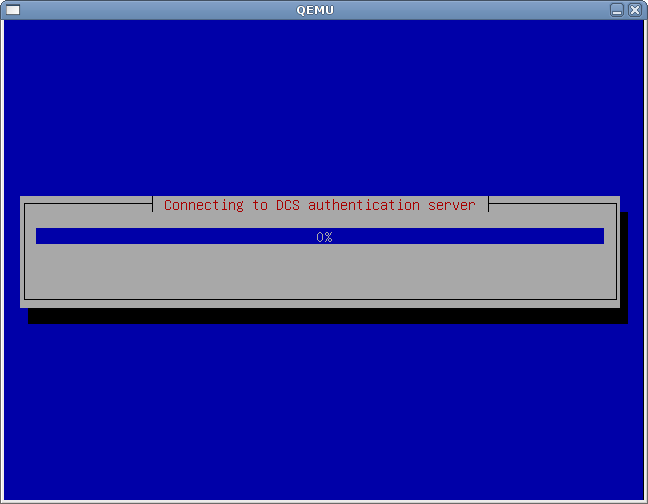
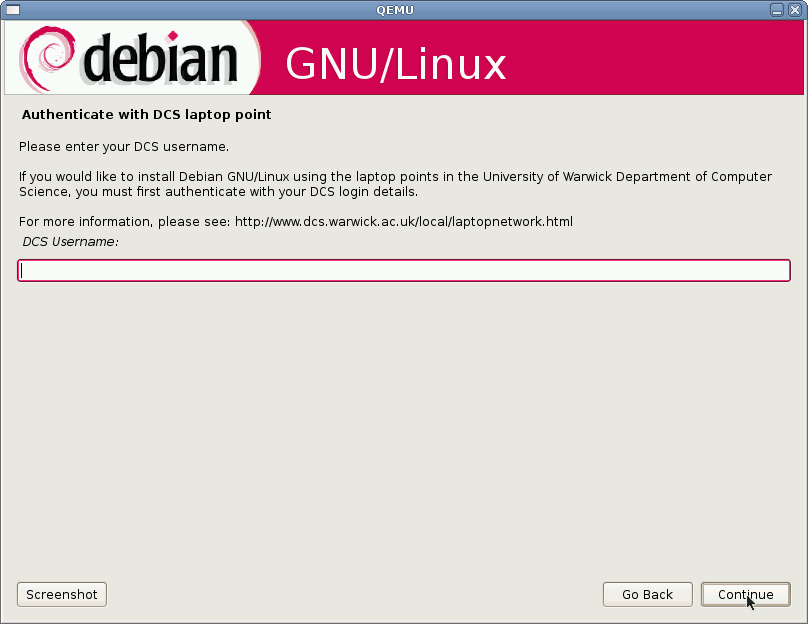
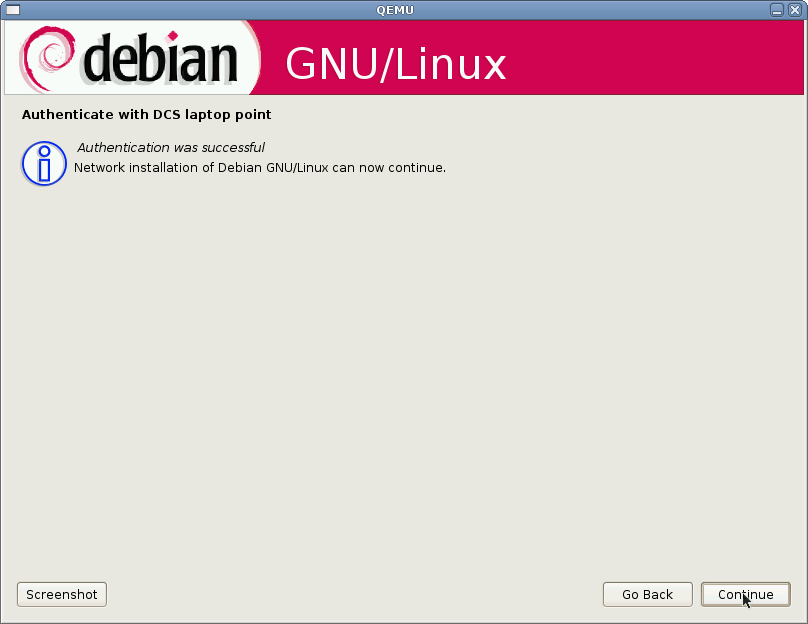
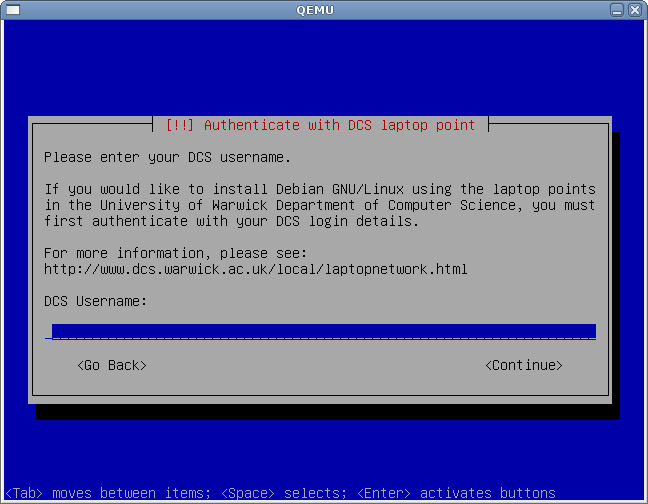
It can be a little awkward installing Debian in my Department’s labs. After obtaining a DHCP lease, you cannot establish any useful connection without first authenticating against a HTTP Basic page. However, as this page uses SSL and D-I’s Wget is not linked against any SSL libraries, you are a little stuck. To solve this (and to avoid resorting to ugly hacks), I created a udeb that prompts the user for their username and password (see screenshots above) and then authenticates using a statically-linked build of Curl. It seems to be fairly robust, and only bloats the ISO by about 200KB. I’ve also preseeded a number of options suitable for DCS, such as using the local mirror and assuming UK locales and keyboard, etc. My modifications are available, along with some documentation on how to recreate my images. I have also uploaded a few images to our mirror. D-I hacking turns out to be quite fun and relatively painless, but I’m now stuck for a useful project to use it again, and I probably don’t know enough yet to tackle some of its Lenny goals either. Any ideas? Oh, if some d-i guru can explain how I can force the display of the “Choose suite” question without patching choose-mirror, that would also be excellent.

1 December 2007

John Goerzen: Attention Junkmailers

We love to hear from you. I'm sure that's what you're thinking, anyway, as you prepare volumes of paper to send to our mailbox.

But just so you know, let me explain just how much we love the material you send us.

When we get one of your catalogs, it will get added to the junk mail pile. Every so often, I will go through this pile. I will contact the company behind each and every mailing, asking them to remove me from their list and not rent my name further. If I have extra time, I will probably also write that note on your postage-paid envelope and pop it in the mailbox. I will also add your name to my list of companies that send me junk mail, so I can avoid doing business with you in the future. If you have sent me junk mail in the past, rest assured that I will find some creatively enjoyable way of dealing with your refusal to honor my removal request.

After I have processed your piece of artfully-crafted handiwork, possibly trying to sell me pink laptops or a shirt with the word "femail" on it -- whatever that means -- I will deposit your catalog, along with dozens of other similar catalogs, on the kitchen floor.

This is when the real fun begins, because now it's Jacob's turn to process them.

He will usually start by ripping out every page from the catalog. He'll start slowly and carefully, ripping out pages one at a time, savoring the wonderful rrrrriiiiippppp noise as he goes. But then he'll get faster, going for two pages at a time, then more, until finally he just will lunge for paper by the handful to crush, tear, or otherwise mutilate.

After that, there are many things he might do to your fine piece of unsolicited advertising. Perhaps he will enjoy drooling on it -- a satisfying fate for your 4-color catalog, don't you think? Or perhaps he will grab some of your pages, carefully emblazoned with your logo, and tear them into as many tiny bits as he can. Or maybe he will simply gather your work together on the floor, then spin himself around on top of it, scattering the remnants as far and wide as possible, cackling all the while. He may also smear bits of food on them if he ate recently, or perhaps he will simply resume tearing pages apart.

But whatever he does, rest assured that he will treat your catalog with the care and attention it deserves. No catalog will survive intact, and as many pages as possible will be ripped apart and left in bits. He does, after all, have a great attention to detail.

After Jacob is done, we will gather up what remains and put it all in our recycling container.

Oh, and under no circumstances will we actually make a purchase from your catalog.

Here are two pictures of the scene.

img_4160.jpg

Notice the careful concentration in this photo. Obviously he knows that Dell has been ignoring my removal requests for some time, and is taking note to tear their pages into the smallest possible bits.

But it's not all hard work -- processing your catalogs is fun, too.

img_4163.jpg

Next.

Previous.