Search Results: "ean"

17 August 2013

Russ Allbery: WebAuth 4.5.4

WebAuth is the site-wide centralized web authentication system that we use at Stanford. This release is a bug-fix release for the central login server, mostly focused on multifactor authentication but also featuring a wide variety of random bug fixes. Going into this release, I filtered the Apache error logs on all of our production servers for a period of a month and then set out to fix every log anomaly or odd behavior pattern that I detected. The most significant bug fix is to support for requiring non-password session factors. The code handled this entirely incorrectly, resulting in the user being stuck at the password authentication prompt and never able to proceed. It also cleans up several corner cases involving REMOTE_USER authentication to sites that require a Kerberos authenticator (such as for delegated credentials). This release downgrades a mismatch of login credentials and a webkdc-proxy token (single sign-on credentials) to a log warning rather than a fatal error and just discards the non-matching single sign-on credentials. This case ideally shouldn't happen, but sometimes users share devices, and if they hit a site with forced login or session factors, it's easy for this case to arise. WebLogin now retries the WebKDC POST once and ignores SIGPIPE errors to work around problems with signals from the FastCGI process manager. It also rewrites non-ASCII characters in XML from the WebKDC to work around XML validation errors created by non-ASCII characters in Kerberos error messages, pending a better fix on the WebKDC side. Password changes no longer go through the replay detection logic, which should not apply to them. Several error messages in WebLogin are now clearer. The WebKDC now requires that the return URL in a WebAuth request be an absolute URL and not contain any non-ASCII characters. A bug in the way that errors during the authentication process were reported has been fixed and should produce better error output for the user. There are also a few other, more minor bug fixes, particularly to logging and error reporting. You can get the latest release from the official WebAuth distribution site or from my WebAuth distribution pages.

16 August 2013

Sylvain Le Gall: OASIS website updated

Logo OASIS small The OASIS website has not been updated since a while. So I decide to take a shot at making more up to date. This blog post is about the pipeline I have but in place to automatically update the website. It is the first end to end 'continuous deployment' project I have achieved. Among the user visible changes: The OASIS website repository is also on Github. Feel free to fork it and send me pull request if you see any mistake. The website is still using a lot of markdown processed by pandoc. But there are some new technical features: Since I start using quite quite a lot Python, I have decided to use it for this project. It has a lot of nice libraries and it helps me to quickly do something about the website (and provides plenty of idea to create equivalent tools in OCaml). The daily generation: Jenkins I have a Jenkins instance running, so I decided to use it to compile once a day the new website with updated documentation and links. This Jenkins instance also monitor changes of the OASIS source code. So I can do something even more precise: regenerate the website after every OASIS changes. I use the Jenkins instance to also generate a documentation tarball for OASIS manual and API. This helps a lot to be able to display the latest manual and API documentation. This way I can quickly browse the documentation and spot errors early. Another good point about Jenkins, is that it allows to store SSH credential. So I created a build user, with its own SSH key, in the OCaml Forge and I use it to publish the website at the end of the build. Right now Jenkins do the following: Data gathering To build the website I need some data: The OCaml Forge has a nice SOAP API. But one need to be logged in to access it. This is unfortunate, because I just want to access public data. The only way I found to gather my data was to scrape the OCaml Forge. Python has a very nice scraping library for that: beautifulsoup. I use beautifulsoup to parse the HTML downloaded from the Files tab of the OASIS project and extract all the relevant information. I use curl to download the documentation tarball (for released versions) and for the latest development version. Code Template Python has also a very nice library to process template: mako. Using the data I have gathered, I feed them to mako and I process all the .tmpl files in the repository to create matching files. Among the thing that I have transformed into template: Fix documentation and indexing One of the problem of providing access to all versions of the documentation, is that people can end up reading an old version of the documentation. In order to prevent that, I use two different techniques: To prevent search engine to index the file, I have created a robots.txt that list all URL of old documentation. This should be enough to prevent search engine to index the wrong page. To warn the user that he is reading the wrong version, I have added a box "you are not viewing the latest version". This part was tricky but beautifulsoup v4 provide a nice API to edit HTML in place. I just have to find the right CSS selector to define the position where I want to insert my warning box. Code Publish The ultimate goal of the project is the 'continuous deployment'. Rather than picking what version to deploy and do the process by hand, I let Jenkins deploy every version of it. Deploying the website used to be a simple rsync. But for this project I decided to use a fancier method. I spend a few hours deciding what was the best framework to do the automatic deployment. There are two main frameworks around: capistrano (Ruby) and fabric (Python). Fabric is written in Python, so I pick this one because it was a good fit for the project. Fabric biggest feature is to be a SSH wrapper. The fabric script is quite simple and to understand it, you just have to know that local run a local command and run run a command on the target host. The fabfile.py script do the following: Given this new process, the website is updated in 3 minutes automatically after a successful build of OASIS.

Sylvain Le Gall: Augeas tips and tricks for Puppet user: edit a complex node.

I have a recurring problem when trying to use augeas on a complex node: trying to edit a specific entry in a list which is uniquely defined by many attributes. You probably don't know that you have this problem, but it is easy to spot it into your augeas/puppet resource. Here are some symptoms of this problem:
 
 augeas  
   "setup-shorewall":
     changes =>
       [
         "set entry[last() + 1]/source 'all'",
         "set entry[last()]/dest 'all'",
         "set entry[last()]/policy 'REJECT'",
         "set entry[last()]/log_level 'info'",
       ],
     onlyif => "match entry[source = 'all'][dest = 'all'][policy = 'REJECT'] size == 0";
For a long time, I thought it was the only solution. But last week, I read again the documentation and found another solution. My main concerns are the onlyif and last() parts, it doesn't look clean to me. The problem is that I cannot define the entry all at once and if I use a value that will be set late, the node cannot be targeted in between. The clean way to do this was to define first the target attribute. Typically, in augeas changes:
 set spec[user = '$name']/user '$name'
This way if the node doesn't exist it is created and you can then use it directly:
 set spec[user = '$name']/host_group/host 'ALL'
 set spec[user = '$name']/host_group/command1 'ALL'
 set spec[user = '$name']/host_group/command1/tag 'PASSWD'
But sometimes it is not possible to set the attribute directly -- typically when you need to use multiple attribute. The solution in this case is to use defnode:
 defnode target entry[#comment = 'puppet: <%= name %>']/ "<%= name %>"
 set $target/action '<%= action %>'
 set $target/source '<%= source %>'
 set $target/#comment 'puppet: <%= name %>'
 clear $target
The big trick here is that defnode needs a value, but most of the time you cannot set a value for the node -- because it has none. To solve this, you set a value with defnode, process with your change and you clear the node at the end. This recent discovery has simplify a lot some augeas changes I use. Feel free to leave comment on your personal technique to deal with augeas and puppet.

Justus Winter: All the important bits are there - please test and review :)

Finally, more bootlog-pr0n:
start ext2fs: Hurd server bootstrap: ext2fs[device:hd0s1] exec init proc auth
INIT: version 2.88 booting
Using makefile-style concurrent boot in runlevel S.
Activating swap...done.
Checking root file system...fsck from util-linux 2.20.1
hd2 : tray open or drive not ready
end_request: I/O error, dev 02:00, sector 0
/dev/hd0s1: clean, 44680/181056 files, 292234/723200 blocks
done.
Activating lvm and md swap...(default pager): Already paging to partition hd0s5!
done.
Checking file systems...fsck from util-linux 2.20.1
hd2 : tray open or drive not ready
end_request: I/O error, dev 02:00, sector 0
done.
Cleaning up temporary files... /tmp.
Mounting local filesystems...done.
Activating swapfile swap...(default pager): Already paging to partition hd0s5!
done.
df: Warning: cannot read table of mounted file systems: No such file or directory
Cleaning up temporary files....
Configuring network interfaces...inetutils-ifconfig: invalid arguments
ifup: failed to open pid file /run/network/ifup-/dev/eth0.pid: No such file or directory
Internet Systems Consortium DHCP Client 4.2.2
Copyright 2004-2011 Internet Systems Consortium.
All rights reserved.
For info, please visit https://www.isc.org/software/dhcp/
can't create /var/lib/dhcp/dhclient./dev/eth0.leases: No such file or directory
Listening on Socket//dev/eth0
Sending on   Socket//dev/eth0
DHCPDISCOVER on /dev/eth0 to 255.255.255.255 port 67 interval 8
DHCPREQUEST on /dev/eth0 to 255.255.255.255 port 67
DHCPOFFER from 10.0.2.2
DHCPACK from 10.0.2.2
can't create /var/lib/dhcp/dhclient./dev/eth0.leases: No such file or directory
bound to 10.0.2.15 -- renewal in 34744 seconds.
done.
Cleaning up temporary files....
Setting up X socket directories... /tmp/.X11-unix /tmp/.ICE-unix.
INIT: Entering runlevel: 2
Using makefile-style concurrent boot in runlevel 2.
Starting enhanced syslogd: rsyslogd.
Starting deferred execution scheduler: atd.
Starting periodic command scheduler: cron.
Starting system message bus: dbusFailed to set socket option"/var/run/dbus/system_bus_socket": Protocol not available.
Starting OpenBSD Secure Shell server: sshd.
unexpected ACK from keyboard
GNU 0.3 (debian) (console)
login: root
root@debian:~# shutdown -h now
Broadcast message from root@debian (console) (Fri Aug 16 20:02:47 2013):
The system is going down for system halt NOW!
INIT: Switching to runlevel: 0root@debian:~#
INIT: Sending processes the TERM signal
INIT: Sending processes the KILL signal
Using makefile-style concurrent boot in runlevel 0.
Stopping deferred execution scheduler: atd.
task c10f72a8 deallocating an invalid port 2098928, most probably a bug.
Asking all remaining processes to terminate...done.
All processes ended within 1 seconds...done.
Stopping enhanced syslogd: rsyslogd.
Deconfiguring network interfaces...ifdown: failed to open pid file /run/network/ifdown-/dev/eth0.pid: No such file or directory
Internet Systems Consortium DHCP Client 4.2.2
Copyright 2004-2011 Internet Systems Consortium.
All rights reserved.
For info, please visit https://www.isc.org/software/dhcp/
can't create /var/lib/dhcp/dhclient./dev/eth0.leases: No such file or directory
Listening on Socket//dev/eth0
Sending on   Socket//dev/eth0
/bin/sh: 1: ifconfig: not found
done.
Deactivating swap...swapoff: /dev/hd0s5: 177152k swap space
done.
Unmounting weak filesystems...umount: /etc/mtab: Warning: duplicate entry for device /dev/hd0s1 (/dev/cons)
umount: could not find entry for: /dev/cons
done.
Unmounting local filesystems...done.
mount: cannot remount /: Device or resource busy
Will now halt.
init: notifying pfinet of shutdown...init: notifying tmpfs swap of shutdown...init: notifying tmpfs swap of shutdown...init: notifying tmpfs swap of shutdown...init: notifying ext2fs device:hd0s1 of shutdown...init: halting Mach (flags 0x8)...
In tight loop: hit ctl-alt-del to reboot
(You might note that df complains about not being able to read the mtab file. That is because it has been built with _PATH_MOUNTED being /var/run/mtab. This will correct itself when the coreutils package is being rebuilt against a patched libc.) I spent my last two weeks with polishing my patch series, that meant a lot of package rebuilds and that means a lot of waiting (even more so on the Hurd, short version: fakeroot-hurd could be fast but is not yet working properly, fakeroot-tcp is slow) and thus some frustration ;) Also I had to pay special attention so that the upgraded packages could be installed without accidentally breaking anything in the process. Making sysvinit pid 1 is surprisingly tricky in this regard since it breaks the ABI and requires a libc fix that also worked with the current Hurd servers. Here are the patches: So I had some spare time on my hand while waiting for numerous package rebuilds and I took this as an opportunity to read papers about Mach and to familiarize myself with mig, the Mach Interface Generator. While I have used it in the past, I had not yet looked at its implementation. And I had to patch the exec server, and there was both code implementing a questionable feature (on-demand unzipping of binaries) and code that was not even compiled (courtesy of the preprocessor) and had probably bit-rot by now. So I figured I could spend my time doing some cleanups: I have rebuild all the necessary packages and uploaded them into an apt repository:
deb http://teythoon.cryptobitch.de/gsoc/heap/debian unstable main
Please use unstable for now. Also make sure that you have a recovery plan for your Debian/Hurd installation if anything goes wrong. For your convenience there's a seed tarball containing packages with the appropriate sources.list.d snippets and the repository key: https://teythoon.cryptobitch.de/gsoc/heap/debian/seed.tar If you want to switch to the new runsystem.sysv, do:
# update-alternatives --config runsystem
Whenever you switch runsystems, please use reboot-hurd to reboot the system. This is the most robust way. Known issues: Next week I will address the network related issues. By now they are the source of most of the error messages in the bootlog.

15 August 2013

Bits from Debian: Happy 20th birthday Debian!

Today is Debian's 20 anniversary. This anniversary would have been impossible without a strong community of users and developers. That's why for its commemoration, we asked the Debian community what Debian meant to them. Below you have a selection of the answers we got.
Since I run Debian on my computers, I do not play anymore to 3D shooting games, not because of the lack of Free 3D drivers, but because developing Debian is more fun and addictive. Debian is a truly community based distro which is devoted to FOSS ideas and standards. It perfectly works on high variety of hardware. Users from all over the world have been using Debian and contributing to it during 20 years. And I am proud to be one of them. Happy Birthday, Debian! When I considered switching to Linux I asked friends which distribution to choose. I was told skip other distributions that were considered more newbie-friendly at the time and go straight to Debian instead. It might be more work initially, they said, but it would save me the hassle of switching to Debian later on, which I would inevitably do. Turns out they were right. I started my Linux experience more than ten years ago with Debian and have yet to see a better Linux distribution. [...] You are a worldwide community of volunteers working together for 20 years now. To me this is an encouraging example and, given the sorry state of the world we live in, more important than the technical quality of the operating system. I wish you another successful twenty years and to stay as independent as you are. I initially started in Debian as it was an interesting technical challenge. Over the years the community and having good standards around what Free Software is has become more important. As a user of Debian for 14 years, and a former Debian Developer for 10, I would like to wish a happy birthday to the best project on the internet, and the best Linux distribution ever. Thanks for all of your support over the years! "Rock Solid Stability and Absolute Freedom" Thats what Debian means to me. Debian gives me a feeling that I am using the best linux has to offer. You know your machine is in safe hands. As a long time Debian user and sometimes supporter [...] I wish Debian all the best for next 20 years and beyond! Debian is the universal operating system. And it's free (and not just as in beer ;-) Debian is an awesome combination of obsessive high quality software and software freedom. It's a pleasure to be able to use and contribute to this project. Thanks to all for their excellent work! Cheers to 2**20 years more! [...] I am so very thankful to all of the people who have contributed to and continue to contribute to such a wonderful ecosystem of tools. I love the commitment to the long term goals of security, freedom and transparency with respect to the computer systems that we all use and rely upon and the information that we store on them. Debian is the operating system that makes me free. Debian is a family gathered around great idea. Its pure love.

Richard Hartmann: DebConf13 group photo

Group photo and historic T-shirts for general consumption. Click through for full resolution. If you want to have all the JPGs and NEFs (raw files), feel free to grab them from this DebConf-local mirror. Those files still have the EXIF information intact to easen any post-processing done by people who can actually do this stuff. It would probably make sense to agree on a canonical version, crop, clean, and then put on numbers with names, etc. Group photo Historic T-shirts, in order

Russell Coker: Google web sites and Chromium CPU Use

Chromium is the free software build of the Google Chrome web browser. It s essentially the same as the Google code but will often be an older version, particularly when you get Chromium from Debian/Stable (or any other Linux distribution that doesn t track the latest versions all the time) and compare it to getting Chrome straight from Google. My wife is using Chromium on an AMD Opteron 1212 for all the usual web browsing tasks. Recently I ve noticed that it takes a lot of CPU time whenever she leaves a Google web site open, that can be Google+, Gmail, or Youtube. Web standards are complex and it s difficult to do everything the way that one might desire. Making a web browser that doesn t take 100% CPU time when the user is away from their desk may be a difficult technical challenge. Designing a web site that doesn t trigger such unwanted behavior in common web browsers might also be a challenge. But when one company produces both a web browser and some web sites that get a lot of traffic it s rather disappointing that they don t get this right. It could be that Google have fixed this in a more recent version of the Chrome source tree, and it could be that they fixed the browser code before rolling out a new version of Google+ etc which causes problems with the old version (which might explain why I ve never seen this problem). But even if that is the case it s still disappointing that they aren t supporting older versions. There is a real need for computers that don t need to be updated all the time, running a 3 month old Linux distribution such as Debian/Wheezy shouldn t be a problem. There s also a possibility that part of the cause of the problem is that an Opteron 1212 is a relatively slow CPU by today s standards and it s the slowest system I m currently supporting for serious desktop use. I don t even think it was one of the fastest CPUs available when it was released 4 years ago. But I think we should be able to expect systems to remain usable for more than 4 years. The Opteron 1212 system is a Dell PowerEdge tower server that is used as a workstation and a file server, so while I get desktop systems with faster CPUs for free I want to keep using the old PowerEdge server to avoid data corruption. As an aside I ve been storing important data on BTRFS for a year now and the only data loss I ve suffered has been due to a faulty DIMM. The filesystem checksums built in to modern filesystems such as BTRFS and ZFS mean that RAM corruption covers a greater portion of the risk to data integrity and the greater complexity of the data structures in such filesystems gives the possibility of corruption that can t be fixed without mkfs (as happened to me twice on the system with a bad DIMM). The consequences of such wasted CPU use are reduced CPU time for other programs which might be doing something useful, extra electricity use, and more noise from CPU cooling fans (which is particularly annoying for me in this case). Any suggesstions for reducing the CPU use of web browsers, particularly when idle?

Russ Allbery: rra-c-util 4.9

This is another rollup of various pending changes in my collection of supporting software. The libkafs portability layer now supports k_pioctl somewhat more completely by providing a fallback to lpioctl when using the AFS libraries and a system call failure when no library was found. The libkafs functions are also now properly prototyped if the library was found but no header files were available. The network_connection function, when given a timeout, restarts waiting for a non-blocking connect if interrupted by a signal. That means the timeout could in theory be much longer than intended if it's interrupted by a signal repeatedly, but hopefully that situation will be rare enough to not pose any problems. There are also a few fixes to the networking test suite. The standard Perl tests now check for POD in more places, don't check the Perl syntax of SYNOPSIS for scripts, work with packages without Build.PL or a t directory, and also check style for files under a usr directory. The PCRE Autoconf probe now copes with Mac OS X, which has the library but no headers. Finally, this release incorporates a combination test suite and utility script that checks that the versions of embedded Perl modules stay in sync with the overall package version. You can get the latest release from the rra-c-util distribution page.

14 August 2013

Steve Kemp: Lumail binaries are wheezy only for the moment

This morning I made a new release of Lumail, which recently completed the transition from using mimetic to GMime for all its MIME needs. I was happy with mimetic, except it didn't have the facility to decode encoded header-values. I wrote some code, but it was broken, so I made the decision that we should move to something that made this easier, and GMime was chosen. Jeffrey Stedfast was very helpful in answering my questions with near-perfect code samples. Beyond that this release features some more Lua primitives and a couple of bug-fixes. The only annoyance is that the version of GMime I'm using, 2.6.x, isn't available to users of the Squeeze release of Debian GNU/Linux. It is available as a backport, but that means building binaries with sbuild is a pain - due to #700522. So for the moment I've only built binaries for Wheezy users. ObQuote: "You know who I am, I've not been off TV for that long!" - Alan Patridge, Alpha Papa

13 August 2013

Kees Cook: TPM providing /dev/hwrng

A while ago, I added support for the TPM s pRNG to the rng-tools package in Ubuntu. Since then, Kent Yoder added TPM support directly into the kernel s /dev/hwrng device. This means there s no need to carry the patch in rng-tools any more, since I can use /dev/hwrng directly now:
# modprobe tpm-rng
# echo tpm-rng >> /etc/modules
# grep -v ^# /etc/default/rng-tools
RNGDOPTIONS="--fill-watermark=90%"
# service rng-tools restart
And as before, once it s been running a while (or you send SIGUSR1 to rngd), you can see reporting in syslog:
# pkill -USR1 rngd
# tail -n 15 /var/log/syslog
Aug 13 09:51:01 linux rngd[39114]: stats: bits received from HRNG source: 260064
Aug 13 09:51:01 linux rngd[39114]: stats: bits sent to kernel pool: 216384
Aug 13 09:51:01 linux rngd[39114]: stats: entropy added to kernel pool: 216384
Aug 13 09:51:01 linux rngd[39114]: stats: FIPS 140-2 successes: 13
Aug 13 09:51:01 linux rngd[39114]: stats: FIPS 140-2 failures: 0
Aug 13 09:51:01 linux rngd[39114]: stats: FIPS 140-2(2001-10-10) Monobit: 0
Aug 13 09:51:01 linux rngd[39114]: stats: FIPS 140-2(2001-10-10) Poker: 0
Aug 13 09:51:01 linux rngd[39114]: stats: FIPS 140-2(2001-10-10) Runs: 0
Aug 13 09:51:01 linux rngd[39114]: stats: FIPS 140-2(2001-10-10) Long run: 0
Aug 13 09:51:01 linux rngd[39114]: stats: FIPS 140-2(2001-10-10) Continuous run: 0
Aug 13 09:51:01 linux rngd[39114]: stats: HRNG source speed: (min=10.433; avg=10.442; max=10.454)Kibits/s
Aug 13 09:51:01 linux rngd[39114]: stats: FIPS tests speed: (min=73.360; avg=75.504; max=86.305)Mibits/s
Aug 13 09:51:01 linux rngd[39114]: stats: Lowest ready-buffers level: 2
Aug 13 09:51:01 linux rngd[39114]: stats: Entropy starvations: 0
Aug 13 09:51:01 linux rngd[39114]: stats: Time spent starving for entropy: (min=0; avg=0.000; max=0)us
I m pondering getting this running in Chrome OS too, but I want to make sure it doesn t suck too much battery.

2013, Kees Cook. This work is licensed under a Creative Commons Attribution-ShareAlike 3.0 License.
Creative Commons License

12 August 2013

Sylvain Le Gall: Migrating a puppet maintained computer from Squeeze to Wheezy

This blog post is a little recipe to do a Debian migration for a node using Puppet and some other good practices. We do all the following commands as root, which on of the exceptional situation where you should have a real root session (login through console, or su -). I tend to avoid using the X server while doing an upgrade, so my 'best' setup is to have a laptop to take note and check things on the internet and a session to the computer to upgrade (ssh + su - or login as root into console). In both case, I use screen during the upgrade so that I can handle disconnection. Create or update your admin-syscheck script First of all, a good practice is to have a script that runs various test on the system that checks everything is ok. This is not only for upgrade but in general. But in the case of upgrade, it can be particularly useful. I call this script admin-syscheck. This is a simple bash script. This script check various aspect of the system and serve me as my external worker to check the most advanced knowledge I have gathered about setting up a service. For example, I know that having *.bak or *.dpkg-dist in /etc/ means that something needs to be merged and a file should be deleted. Another example is about setting up the right alias for 127.0.0.1 and ::1 (which you can differentiate using getent ahostsv4 and getent ahostsv6). I have packaged this script and distributed it using a specific apt-get repository. You can just distribute it using puppet. I recommend to run it daily to track changes (e.g. after an apt-get dist-upgrade) and to check that my setup is aligned with my most up-to-date knowledge about setting up a service (i.e. this is my external worker). In our case we are interested in checking presence of old and new configuration files, before and after upgrading. Here is this specific section of my script:
if ! $IS_ROOT; then
  warning "Not trying to detect dpkg leftover file in /etc/."
else
  LEFTOVER_FILES=( $(find /etc/ \
      -name "*.dpkg-dist" -o \
      -name "*.dpkg-old" -o \
      -name "*.ucf-old" -o \
      -name "*.ucf-dist" -o \
      -name "*.bak") )
  for i in "$ LEFTOVER_FILES[@] "; do
    if [ "$i" = "/etc/hosts.deny.purge.bak" ]; then
      continue
    fi
    if $fix; then
      BASE=$ i%.* 
      cond_exec vim -d $BASE $i
      read -p "Delete $i (y/N)? " ans
      if [ "$ans" = "y" ]; then
        cond_exec rm $i
      fi
    else
       report_error "dpkg leftover file: '$i'."
    fi
  done
fi
(cond_exec allows to do a dry run, you can just remove it). Setting $fix to true will spawn a vim -d old new command where you can edit and then delete the leftover file. This is extremly handy. Upgrading to Wheezy I strongly recommend to read first the upgrade chapter of the release notes. This gives you a more complete overview of the upgrade procedure. I just go through the basic step here. 1. Update everything on the system:
$> apt-get update 
$> apt-get dist-upgrade
2. Check that the current configuration apply cleanly:
$> puppet agent --test
3. Run admin-syscheck:
$> admin-syscheck
And fix all the problems. 4. Disable puppet: I use a cronjob to run puppet, so I just comment the line for the job (/etc/cron.d/puppet-custom). You should disable puppet by stopping the daemon and preventing it to run by editing /etc/default/puppet and set START=no. 4. Fix your sources and pinning: Change squeeze to wheezy in /etc/apt/sources.list and remove useless files in /etc/apt/sources.lists.d/. (You may keep certain sources that refers to stable, like google-chrome.list).
$> rm /etc/apt/sources.list.d/* # Check if this ok to do this with your system.
Although, I tend to fully purge /etc/apt/sources.list expect for the main line (removing backports and security is fine for a short time). The first run of puppet after upgrade will anyway reset this file.
$> rm /etc/apt/preferences.d/* # (at least the ones that do pin some version)
You can although remove all pinning from /etc/apt/preferences. 5. Now you start the real upgrade:
$> apt-get update 
$> apt-get dist-upgrade
6. During the upgrade you will be asked if you want to keep old configuration files or install the newer one from the maintainer. I have always wondered what to answer to this. But here is the answer after a few major upgrade: always install configuration files from maintainer if the service has no ultra-specific settings that could break during the upgrade. The only file, that I should not upgrade on my system, is /etc/sudoers. In this very specific case, you need to make sure before the upgrade that the old and new configuration can coexist. In the squeeze to wheezy case, I have just setup a few extra augeas rules to set the secure_path before the upgrade and it was fine. This is typically the kind of situation where you are thankful to have a real root session. 7. The upgrade can be long and require various fixing to remove/re-add packages to circumvent problems. At the end you will have a set of file *.dpkg-old and *.ucf-old (and some *.dpkg-dist and *.ucf-dist). The *-old files are your old version of the file, while the corresponding files match the maintainer version of it. The *-dist files are the maintainer version of the file and the corresponding files match your old version of it. Starting from here you have 2 options: First upgrade This is the tricky part, you'll have to spend a little time on it: 1. Go over all *. ucf,dpkg - old,dist and merge them with the corresponding configuration file. Use admin-syscheck with fix=true 2. Make a copy of your /etc directory into /etc.new:
$> cp -rp /etc /etc.new
3. Run puppet again:
$> puppet agent --test
4. Disable again the automatic run of puppet, if the previous command has re-enabled it. 5. Make a diff between /etc and /etc.new. Since you have a run of puppet, you know what has changed and should not have changed.
$> diff -Nurd /etc.new /etc
Everytime you find some files that doesn't match your expectation for the upgrade with puppet, change the corresponding puppet manifest to have what you expect. For example, if this is a file:
if ($lsbdistcodename == 'wheezy')  
  file  
    "/etc/foo":
        source => "puppet:///files/foo.wheezy"
    
  else  
  file  
    "/etc/foo":
        source => "puppet:///files/foo.squeeze"
    
 
People working with augeas and puppet, will appreciate the fact that they probably have 0 changes to make for this to work (since it only does a few replacement in configuration files). 6. Once you are happy with the changes, copy back /etc.new to /etc and go to step 3 until the difference is almost 0. 7. Re-enable automatic run of puppet. Do this procedure for a least each computer category you have (e.g. Desktop and Server nodes). Once you are fully confident your new puppet setup works, you will be able to use 'further upgrade' for the other nodes. Further upgrade. This one is super easy compare to a first upgrade: 1. Re-enable puppet and have it run at least once:
$> puppet agent --test
2. Merge *. dpkg,ucf - dist,old with corresponding files (you can run admin-syscheck with fix=true). This is mostly a sanity check since you should have already solved most problem with the 'first upgrade' procedure. That's it. Enjoy your upgrade to Wheezy with puppet.

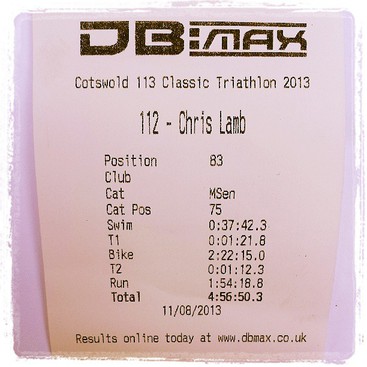
Chris Lamb: Cotswold Classic Middle Distance triathlon

https://chris-lamb.co.uk/wp-content/2013/cotswold_course.jpg Since becoming interested in triathlon in October of last year, my goal in 2013 was not to just finish a "70.3" (or "Half-Ironman"), but to complete one in under 5 hours. At the time, each discipline was woefully inadequate; I had not swum in over a decade, my cycling was average and I had only begun running again after years away from exercise. The somewhat arbitrary target time would dictate my training. For example, the high proportion of time spent on the bike combined with the injury-sensitive nature of running meant that cycling would have a highest return on investment of the three disciplines. Despite that, I would need to take the run seriously but carefully - I decided to enter a series of monthly 10K races where I could steadily reduce my times over the year. Races themselves formed a crucial part of my preparation and a carefully balanced race calendar was surprisingly important, balancing upcoming milestones that would provide an achievable goal as well as uncovering weaknesses in enough time so they could be worked on. Whilst I did post about my first triathlon, I felt no compulsion with the interleaving five or six races as I was evaluating them in the context of the 70.3 rather than as races in their own right.

Swim
Distance
1900m
Time
37:42
Whilst this wasn't my worst open water swim, it was certainly not my best. The first 500m was straightforward, but I lost my form over the next 500m and I overcompensated with excessive kick. My calves responded by cramping badly two or three times after that, losing both momentum and time. Curiously, whenever I could identify my speed relative to my effort (for example, by some underwater reeds) I could use that as feedback and my rotation (etc.) would temporarily return. Pool swimming always has markers of this kind, whilst a murky lake does not. In conclusion, my lack of open water training outside of races held me back more than I expected.
Bike https://chris-lamb.co.uk/wp-content/2013/cotswold_bike.jpg
Distance
52 miles
Time
2:22 (21.9 mph average)
I had thoroughly absorbed the advice that you should prepare for your primary race so that it feels like another day at the office. On this criterion, the bike leg was almost perfect. My nutrition strategy energy drink every 5 minutes, gel every 30 minutes worked fine until mile 35 where I felt like I had taken on too much fluid (and no time to take a bathroom break). I had a temporary hiccup with my rear derailleur but my "tame" 52/34 12x28 gearing was vindicated on the climbs, although in retrospect that might mostly be schadenfreude. Tens of hours acclimatising to a time trial bike was rewarded by being able to spend the entire leg in "aero" position (ignoring 90-degree turns or serious gradients), improving efficiency.
Run https://chris-lamb.co.uk/wp-content/2013/cotswold_run.jpg
Distance
13.1 miles (21km)
Time
1:54:18 (5:25/km)
I had prepared a chart which provided the pace I required based on the race time at the start of the run. I would then only need to monitor my run pace instead of repeatedly extrapolating a finish time as even basic arithmetic can become impossible when fatigued. This strategy was chosen as I was too risk-adverse to aim for a faster time than strictly required; the downside of missing the target from aiming too high and "blowing up" outweighed going a few minutes faster overall. Despite that, I ran half-marathon personal best. Unfortunately, due to pressing the wrong watch button after the swim, the chart was worthless unless I could assume the race started exactly at 6:30AM. With no other option I decided to trust that with some padding, but the uncertainly it added was unsettling. Adding to that feeling, my left hip started to twinge at 7K, something it has never done before. My plan was to get to 16K, take a caffeine gel and then keep ratcheting up the pace until the finish. In my long run training I could speed up to a 4:10/km pace but after 5 hours of racing and being reasonably sure I was going to reach my goal, the best I could summon was 4:45/km. My form completely shot, I crossed the finish line and got into a fetal position in the shade behind a tent, scaring the race organisers for a few minutes.
Overall
Total time
4:56:50
Writing this the day after the race, I am still a little unsure of how I feel. I am obviously extremely content that I reached my goal but given the volume and detail of preparation it was not a huge surprise to me on race day that I did so. This combined with the "real" work and progress being achieved throughout the training seems to have robbed the event of some element of triumph it could have had, but that in itself was somewhat expected. Where next? I had always dismissed the consensus view of needing to take a decent break after the season has ended but now I am looking forward to putting triathlon-specific training on hold for a while and explore other things. I highly doubt this will be my last triathlon though. https://chris-lamb.co.uk/wp-content/2013/cotswold_result.jpg (Full results)

Ian Campbell: Heading to DebConf 13

Going to DebConf13! Seems like DebConf 13 is in full swing, I'm not heading over until tomorrow because I spent the weekend at the Bloodstock Festival. As sad as I am to miss the Cheese and Wine party tonight, having seen a dozen or so excellent bands since Friday, lubricated by a few gallons of Hobgoblin, and rounded off by Exodus, Anthrax & Slayer last night I think I made the right call! So I got home around lunchtime today, unpacked my rucksack, scrubbed myself clean, repacked again for Switzerland (no tent this time). Next up is a curry with my parents tonight and then catching the Eurostar tomorrow morning, I'll have plenty of time for hacking on my cubieboard2 on the train and finally arrive in Vaumarcus tomorrow evening. See everyone soon!

11 August 2013

Steve Kemp: Lumail now uses GMime

A hectic day and now we use GMime for all MIME-fu. This has allowed me to decode headers correctly, setup MIME parts properly in outgoing mails with attachments, and cleanup the code-base. The next release of Lumail will contain basically just this change, as it is pretty drastic. But first I need to work out how to make binaries for Squeeze compiled against the back-ported version of gmime-2.6.x. (Previously we used libmimetic. Which was awesome in its way, but caused me some pain with RFC 2047 header-decoding.)

Gregor Herrmann: DebCamp 2013

[no pictures here, just a short report]. Today DebConf, this year's edition of the annual Debian developer conference, started with two inspiring talks about Debian proper, one by Lucas Nussbaum, the other by Joey Hess. This also means that yesterday DebCamp ended, the period preceeding DebConf and dedicated to working on Debian together with others. Here's a short report from my point of view: I arrived here on Tuesday, the first day of DebCamp. I immediately fell in love with the venue, & despite the early stage of setup, everything I needed was working fine for me from the very start. Like in previous years, I used the time to do work in the Debian Perl Group, especially taking advantage of the presence of other team members. That's the great thing about DebCamp & DebConf: collaborating in real-life & real-time, from quickly asking a question over sitting together to think about solutions for a problem to "just" chatting & thereby developping ideas for the future. In the previous days I I really enjoy my time here, & I'm especially happy to meet some people for the first time in meat space. This is only possible due to the generous support of the DebConf sponsors & the immense efforts of the DebConf team. Thank you!

Michal &#268;iha&#345;: Good morning DebConf

Yesterday evening I've arrived at DebConf 13. I was quite tired after traveling so I just had few beers and went to bed. The travel went quite well besides somebody else broke wine and my suitcase was all wet from it. Fortunately almost nothing got inside so I have some clean clothes for next week :-). As I went to bed quite early, I woke up early as well so I went to short walk to see what is nearby: Sunrise at Lake Neuch tel Castle Vaumarcus Castle Vaumarcus

Filed under: English Debian Photography 0 comments Flattr this!

10 August 2013

Kurt Roeckx: Anti-piracy and privacy

In the Dutch language area (Netherlands and Flanders) most e-book publishers changed from using DRM to using a watermark since February. It's now something like 62% with watermark, 24% with DRM and 14% without either. I was hoping that more with move to the watermark, but it doesn't seem to change much. The watermark in the e-books are used to find the original buyer in case of piracy. The information in the e-book does not itself identify the buyer, it just some random ID. That ID can then be used to trace back to buyer. We work with a 3rd party to deliver the e-books to our consumers. They get a random string from us that we can use to trace back the order, and from there we can trace back who bought it. The 3rd party than generates their own random string and puts that in the e-book. They only only keep those 2 random strings, and so have no way to trace this back to the buyer, we are the only one that known who bought it. And I think this is how it should work. I think this is also what the privacy laws require us to do. But now we got a new contract that states that we must directly give information about the buyer if some anti-piracy agency (BREIN) finds an e-book file online. We must keep the information about the buyer for minimum of 2 years and maximum of 5 years. And if we don't sign the contract we won't be allowed to sell e-books with watermark anymore. So this means that they want to bypass the normal judicial system, and probably contact those buyers they accuse of piracy directly. I questioned that this was legal. They say that it is legal according to the Dutch privacy law, but I have a hard time interpreting any of the options in article 8 as that we can give that information without the explicit consent of the person. I guess you can interpret option f in several ways, and that their lawyers do it differently than me. This will probably remain unclear until some court decides on it.

9 August 2013

Craig Small: pidof moving to procps

pidof is a program that finds the PID of a named program. In some ways it is like a cut-down pgrep found in the procps package. pidof currently sits in sysvinit-tools. There are plans to move all utilities that use the proc filesystem under one package which will make the maintenance of them simpler, which in effect means moving pidof from sysvinit-tools to procps. The short-term bump should make it better in the long term. Now as I wear two hats (Debian maintainer and procps upstream) there are two very important things I/we need to know. Debian developers can chime in on the debian-devel email list, or email myself. If its an upstream issue then either email me, or even better, the procps email list

8 August 2013

Neil McGovern: IT recruitment sexism is alive and well

sexismWith the number of female software engineers standing at 20.9% [1], recruitment of females into the industry is a major concern. A friend of mine, Rosemary Francis who's MD of Ellexus, has a great talk about this issue. It mentions various methods you can use to tailor your job applications to be more attractive to females, by simply being careful not to exclude or put off potential applicants. However, there is also a very poor way of doing so, which is highly sexist and plays to stereotypes. As we can see from Bloopark's hiring page, this is exactly what they have done.
Web developer (m)
Need for programming
You are addicted to PHP, MySQL and Javascript since years? Your life makes no sence without programming? Your girlfriend doesn't understand, why you start learning the fifth php framework and your parents say, your head is full of unix and linux. Do you want to talk to us about this? We want to invite you to an anonymous or maybe very personal meeting. No worries, we will bring you to a team that understands you and will support your passion of programming. Web developer (f)
Beautiful und sexy code wanted
We are convinced that woman are great programmers. Woman write sexy code: neat and clean. Many of them have long relationship... with PHP5, MySQL and Javascript. They like to talk and communication is essential in our work. Female programmers get along with customers very well and take such a good care of code quality, as if it is a pair of their new shoes. The best thing is that their detailed documentation and code organisation match the rules of Feng-Shui. Are you a female programmer with passion? May we invite you for coffee?
Really? New pair of shoes? Pictures of nail varnish? They're in a relationship with code? And why does the male version need to have a girlfriend rather than a boyfriend? [1] US Bureau of Labor Statistics (BLS) - ftp://ftp.bls.gov/pub/special.requests/lf/aa2010/aat11.txt

Next.

Previous.