Search Results: "dom"

8 December 2007

Andrew Pollock: [life] Australia bound

We're heading back for the annual trip home. This time it's not really a holiday, it's just three weeks of running around like a headless chicken, catching up with friends and family. We're killing time at SFO at the moment waiting for our flight to board. There's much to be said for arriving at the airport ludicrously early. We had the shortest check in line I've ever seen for an international flight. Security was also ridiculously quick. It all adds up to a stress-free travelling experience. I'm working from the Sydney office for a week, and then taking two week's vacation. Sarah's sorting out her E-3D renewal while we're in Sydney, as she was unable to travel when I renewed mine in Dublin earlier in the year. After that I'm taking all of January off as unpaid time off, so I can look after Sarah after her heart surgery in January and just generally decompress. We got a good deal with Qantas. The package gives us three domestic flights within Australia, which works out perfectly to allow us to visit Canberra and Brisbane. I'm looking forward to seeing my family, as I haven't seen them since we lost Joshua, and I'm sure it's been as hard from them as it has been for me being so far apart from each other. It'll be good to have a cry together.

7 December 2007

Erich Schubert: Spammers and DNS WTF.

My domains DNS is still hosted with the company I registered it at. I'm planning to move it to a different company early next year. So when a friend asked me for secondary nameserver exchange, I already set up the new DNS.So my current setup is like this:Primary and secondary nameserver are at my old provider, serving their copy of the DNS zone (which obviously lists their nameservers as NS)The A and MX records point to my server, which will sometime also be the new master NS. This host has an own copy of the zone file, which agrees on the 'regular' entries, but lists my server as well as the friends two servers as NS. This is the only link from the domain to the friends servers. Let me emphasize this: neither my server nor my friends servers are currently listed in the .tld database. Their NS entries still point to the old providers server. I'm planning to change that in January.Now my friend told me, that he had about 10 email delivery attempts to my domain in his logs, obviously coming from some spammers.WTF? In order to link my domain to his server, you'd need to What is the reason to jump through all those hoops? Do many admins configure a secondary NS to be an unlisted, unprotected relay for incoming email?Is it common for secondary NS to receive random emails from spammers?

Brandon Holtsclaw: Baby Steps

Well the last few days I have updated many things in a lot of different areas, the most noticeable right away is I have updated my website theme, I’m still not 100% happy with it, link colors are a bit off and such but its “good enough” to go live, if your reading this via an RSS feed go check out my main page and drop me some feedback. ( if your really interested in the theme and want it for your own website you can grab it at http://www.imbrandon.com/misc/human_0.5.tar.gz
I’ve released it under GPLv2 , its not perfect but its exactly what I’m running as of this writing. ) The next thing is I changed ISP from Comcast Cable ( ugh ) to Yahoo! Branded AT&T 6M/768k DSL, not only is this faster and cheaper than my old connection, it has the nice side effect of giving me a flickr Pro account free* ( *included in the connection price somehow I’m sure ), that brings us to the next change … I’ve started using my flickr pro account and am loving it, with things like the fuse filesystem FlickrFS and kFlickr makes using flickr easy and painless. Along with that there is this awesome GPL wordpress plugin FAlbum that lets me integrate my Flickr sets into a photoalbum on wordpress very simply and looks great too. Visit my new web album here http://www.imbrandon.com/images/ ( I’ve uploaded just over 100 photos to get it started, I still need to tag and sort most of them ) And last but not least on top of my Ubuntu Core Developer Status, I’ve finally got in contact with a “full-time” sponsor for my contributions in Debian, this will make my application for NM alot smoother with an Advocate ( when I get around to filling out the NM form, LOL ), wish me luck.

6 December 2007

Erich Schubert: Fight against surveillance

The german government (that is the CDU CSU and SPD partys) passed a law that would require communication providers to keep connection data for half a year. This data retention includes phone calls, emails and internet connection data such as IP addresses.This law was passed as a "preventive" step against terrorism, mostly. Which is such an hilariously bad argumentation, actually.This is a serious step towards total surveillance, and is considered to be unconstitutional by many. Amongst others, it seriously undermines Confidentiality protection for e.g. priests, lawyers, doctors and journalists. Apart from opening the doors for total surveillance, of course and not having any desireable effect when it comes to preventing crimes, especially terrorism. Over 20.000 people already have already signed a complaint of unconstitutionality to be handed in at the Federal Constitutional Court in germany. This would then be the biggest complaint of unconstitutionality in the (short) history of the Federal republic of Germany. (1300 people complained 1983 against the census, which led to privacy protection becoming considered a key role of the german constitution)Right now, the law is waiting to be signed by the German state president (and we hope that he might refuse to sign it). Once it has take effect, the complaint can be handed in.Web page with further information.If you are a German resident, please join the 20.000+ others who have already signed a mandate for the complaint of unconstitutionality. Deadline is December 24th.It's our freedom we're fighting for!

Sam Hocevar: Bits from India

Incredible !ndia As Christian already stated, we are currently in this lovely city with friendly people whom we French people have great trouble understanding, totally insane traffic and colourful taxis you find nowhere else, and dangerously spicy food. And no, it s not Mexico City. My first talk at FOSS.IN/2007 in Bangalore, India (Giving back to the community: how does Debian perform?) was an attempt at explaining to upstream developers what Debian did with their software, and where to proactively find information about the changes we do, the bugs that are reported, etc. I did this talk because Bangalore has this incredible ratio of software developers per square kilometer, while at the same time we have so few Indian DDs despite the 1.12 billion inhabitants. So I expected to find people doing much development but not necessarily familiar with Debian. With Christian s two other talks about translation works in Debian and how to contribute to Debian, we did quite a thorough coverage of Debian for a novice audience. My second talk, in the main conference track, will be on Saturday and will be an even more general presentation of Debian. Of course, my slides are not ready yet, what did you expect? Debian business cards There has been great interest in my Debian business cards, so I m providing their SVG source (to be loaded and printed in Inkscape, for they make extensive use of the blur effect which is an Inkscape extension) for anyone interested. They use the Sexsmith and Sans Condensed Uralic fonts, available in Debian packages ttf-larabie-straight and ttf-uralic. Sam s Debian business card Sam s Debian business card (back) Sam s Debian business card (sample) I don t know enough about SVG scripting and object cloning, so to do the text shadow you will have to edit the same object twice. Sorry about that. Here are the files: background image (PNG), generic DD front (SVG), custom DPL front (SVG), back (SVG). The background image was cropped from Ayo s Debian Expo wallpaper. The rest of the design should be considered public domain. Just a note about the different languages I ve been using at the back: I know I could have used more fancy languages with beautiful glyphs to show how truly universal our system is, but I did not know which to choose. So I just put the languages I personally vaguely understood.

Anthony Towns: Asus eeePC

Okay, so any excuse to bring out the Laphroaig is fine by me, but the cute little eeePC is better than most. That it’s cute and popular is all very well, but what really makes my day is this is the first device I’ve seen that both doesn’t hide the fact it’s running Linux, and is available in maintstream stores in Australia. A random review from the Sydney Morning Herald:
You also don’t get Windows. Asus has adopted the free Linux operating system that’s been slowly yet steadily growing in popularity over the past decade. This keeps the cost down and makes better use of its relatively modest hardware, which would creak under the weight of Windows. It does mean not being able to use your favourite Windows software but, fortunately, the Eee PC comes with dozens of programs, including the familiar Firefox web browser and Skype for online phone calls.
That came out on the day the eeePC was released in Australia. Three days later, they did a followup:
Taiwan computer maker Asus might have underestimated the local demand for its diminutive Eee PC, as the $499 laptop is now virtually sold out in Australia.
From that, there’s a brief take on who’s actually buying them:
“We’ve had customers coming in buying two or three units for the family - the mix of customer has been probably novices more than the tech types,” he said.
It’s really good to see that Linux is getting credit in pretty much all those stories, no matter how mainstream. Xandros is pretty rarely mentioned, and I don’t think I’ve seen Debian mentioned yet. But even without the credit, it’s still pretty cool that with the eeePC and Dell’s trysting with Ubuntu, the real in-roads to pre-installed consumer Linux these days are building on Debian. I’d always expected that Red Hat or SuSE or someone with more commercial muscle would get through that door first (they’ve certainly had box sets more readily available!), but apparently elitist, freedom obsessed, techno-geekery actually works better, somehow. At least when there’s a company to put a smiley face in front of it all :) The other interesting thing about choosing Xandros, is that it presumably means the eeePC is covered by Microsoft’s patent protection scheme – which means no baseless threats against eeePC users from Microsoft, but also that Microsoft’s probably getting a cut of whatever Xandros receives from each eeePC sale. Whether you think that’s a problem or not, the result is probably going to be that it’s the thin edge of the wedge: it’s removed Microsoft from blocking a Linux preinstall on consumer hardware, which means we can see that regular people like Linux systems enough that they sell out in days. And that means Linux systems are a fact of life, and if Microsoft try to stop them by making it difficult for you to sell Windows systems, well, that’ll just make it difficult to sell Windows systems – which is another win for Linux. And once you get to the point where the argument for paying off Microsoft doesn’t rely on keeping your OEM deal for Windows, but is just a matter of whether their patents are actually valid… Oh, also nice from the promoting free software angle, is that the first thing you see if you decide to visit Asus’s eeePC site to check the gizmo is the news item:
2007.11.27 ASUSTek is committed to meet the requirements of the GNU General…
Add the fact that an eeePC running a Debian-derivative has access to all the software in the Debian repositories for no cost, and the new government’s planned rebates and investments in IT probably mean that parents can get close to a full refund, and you’re getting pretty close to a choice of spending nothing and getting a popular, reasonably functional and very portable laptop with all the software you could ever want, that just happens to be running Linux, or paying an extra few hundred or thousand dollars to get a Windows laptop, and then probably pirating whatever software you end up needing. In any event, to my mind, that makes 2007 the year of the Linux on the desktop: everything from here is just a simple matter of quantity. What’s next?

Evan Prodromou: 15 Frimaire CCXVI

My friend Hugh McGuire just launched a new Web site: earideas. It's a curated collection of the best podcasts on the Web -- kind of an interesting choice. Hugh's best known for the Librivox project -- a collaborative effort of thousands to make public-domain audio books freely available on the Web. He's also the leader of datalibre.ca and the co-founder of Collectik, the social sharing site for podcast enthusiasts. All of which is to say that he's a massive-collaboration kind of guy. So why the curated collection? Says Hugh, "It s built specifically so that you don t have to do anything much more than you do when you turn on a radio." In other words, they're finding the best stuff for you. I think the site makes a nice complement to Collectik. In any event: the gang at earideas has asked for lists of people's top 5 favorite podcasts. I'm still not very much into the podcasting thing; I don't have a portable digital music player, and I haven't found listening to music on my laptop or desktop really useful. But I do listen some of the time, so I figure I could give my suggestions.
  1. Linuxcast by the personable and telegenic Don Marti. Great coverage of software and society in the Free world.
  2. FLOSS Weekly. The "weekly" part is a bit of a stretch, but this is a very good interview show about Free/Libre/Open Source Software. I miss Chris DiBona as host, but Randall Schwartz is no slouch, either.
  3. Destinyland. Destiny is perhaps one of the greatest pop culture researchers alive today. This very occasional podcast is just like having Destiny corner you at a party and talk for 90 minutes about the suspicious circumstances of Alfalfa's death. It's fascinating.
  4. CBC Radio 3 Podcast. Yeah, it may make me terribly unhip, but I like Radio 3.
  5. Radio Open Source. I want to hate this show for capitalizing on the name "open source" without actually providing any open content or talking about Free Software. But it's one of the best shows on the Web.
All right, that's my five. Good luck, Hugh and the rest of the gang at earideas.com. tags:

Million-dollar idea So, I use a Logitech Trackman Marble for my desktop computer -- sometimes called the one true pointing device. I think it's awesome, and I've had it for maybe 10 years. The only downside is that every 6-8 weeks I have to pop off the cover and clean out all the finger oils, dust, hand hair and cookie crumbs that have amalgamated to a greasy, fuzzy crud inside. It may be one of the most disgusting things I do regularly -- and remember, I have a 2-year-old, so that's saying something. Anyways, here's my idea for a device, free for you to use. It's a self-cleaning trackball (or mouse). Just like a self-cleaning oven, every few weeks you'd click a special button on the device and it would heat itself to 800 F for about 90 minutes until the dang thing is just glowing white-hot and it vaporizes any crud that may be inside. Then, you can go about your business with a smooth, clean mouse (or trackball) again. Viola! I think the idea would work for keyboards, too, but I really rarely clean my keyboard. Filthy keyboards seem to work fine most of the time, and when they don't work well you can just throw them away and get a new one. But there's no accounting for taste and anyways people may want to buy a matching set of self-cleaning keyboard and mouse rather than just one or the other on its own. You, reader, can use this awesome million-dollar idea on your own, free of charge. Enjoy! tags:

Clint Adams: Stuffing the flash

I needed to quickly stuff a bunch of random music onto a ridiculously small vfat medium. I used this:
#!/bin/zsh
# also released under the gnocchi-ng license
zmodload -i zsh/datetime
zomg_shuffle()  
  declare -A h
  local +h -Z 5 RANDOM=$EPOCHSECONDS
  integer i
  for ((i=1; i <= $#; ++i))   h[$i.$RANDOM]=$argv[i]  
  reply=( $h )
 
zug=( /pathtomusic/ogg/**/*.ogg )
zomg_shuffle $zug
for i in "$reply[@]"
do
 cp -v "$i" /media/tinyflashdrive/"$ $ i:t //[:?\"*]/_ "     rm -v /media/tinyflashdrive/"$ $ i:t //[:?\"*]/_ " ; exit 1 
done

5 December 2007

Russell Coker: The Meaning of Godwin s Law

A widely cited unofficial rule on the Internet is known as Godwin’s Law [1]. In it’s original form this rule states that “As an online discussion grows longer, the probability of a comparison involving Nazis or Hitler approaches one“. Mike Godwin noted that “overuse of Nazi and Hitler comparisons should be avoided, because it robs the valid comparisons of their impact“. The purpose of noting and publicising this is to reduce such false comparisons. It’s often used as a rule for conduct in various fora where it’s regarded that if you compare your opponent in a debate to Hitler or unjustly call them a Nazi then the debate is over and you have lost. In more recent times due to successful application of Godwin’s Rule the frequency of inappropriate comparisons has dramatically decreased. This combined with the small number of people on the net who are interested in discussing historical events that happened ~60 years ago (and the even smaller number of people who are interested in learning about them) means that the possibility of robbing valid comparisons of their impact is small. Now a large part of the use of Godwin’s rule is because it’s regarded as an ad-hominem attack that distracts everyone from serious discussion more than most such attacks. To see examples of this you merely have to do a Google search for “Bill Gates” and “Hitler” (currently 597,000 web pages have both those terms). Note that the original reason for avoiding such false comparisons is given to sustain the impact of legitimate comparisons. It is quite legitimate to use the term Nazi when describing anyone who wants to implement mass-murder and slavery on a national scale (or any of the other awful things that the Nazis did), or the propaganda and other mechanisms that the NSDAP used to gain power. It is also legitimate to make historical comparisons, comparing Stalin to Hitler is historically valid (both were awful tyrants that committed a similar range of crimes) - I’m not going to compare them in this post but I merely note that such a comparison is valid (and is the subject of much debate by people who are interested in history). I’ve just had a religious zealot named Elder Dave accuse me of breaching some new version of Godwin’s Law. I believe that my mention of the fact that his religious group (which wants to deny homosexuals the same legal rights as all other people) has some beliefs in common with the Westboro Baptist Church [2] is valid. The Westboro Baptist Church seems to be the leading organisation in the English-speaking world for demanding legislation to discriminate against homosexuals. Anyone else who demands such legislation IS trying to achieve similar aims and should expect this to be noted by everyone who has any knowledge of what is happening in the world. Religious groups are given a lot of freedom to discriminate internally (EG “Priest” is one of the few jobs that can be denied to a qualified woman without any legal recourse). Also I think that most people will agree that it’s acceptable for them to advocate self-repression (EG the book What Some of You Were [3]). But when they try and get legislation enacted to institutionalise such discrimination I believe that they are going too far. As for why the 95% of us who aren’t gay should be bothered about this issue, there’s the famous poem by Martin Niem ller which is known by the line “First they came for the Jews” [4] (actually there are a few versions of the poem some of which don’t mention Jews - check the link for details). Here’s another Wikipedia link for the same poem [5].

4 December 2007

Ond&#345;ej &#268;ert&iacute;k: M rida - wrap up

From November 28 till December 2, 2007, I attended a Debian QA and release teams work session in Extremadura, which is an autonomous community of western Spain, that managed to install Debian on 90000 computers in every school (technically a Debian based distribution called gnuLinEx) and Junta de Extremadura also sponsored this meeting.

I took photos of all participants, see my first, second and third posts. When I arrived at the Madrid airport where we first met, I set myself a goal to remember all names and faces, so I used my blog to help me and I think I succeeded in the end. :)

See also our wiki page that we used prior and during the meeting.

So what did we do besides throwing candies?


Lucas Nussbaum will send a summary email soon about the meeting, so I'll just speak for myself:
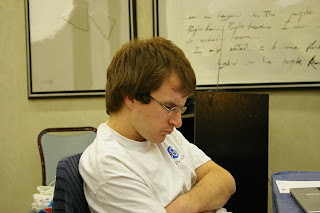

I worked with Gon ri on svnbuildstat, that is a service for building packages and show statistics about lintian/linda/piuparts checks. It for example contains all packages of the Debian Python Modules Team (that I am a member of) and many others. We discussed and started to work on how to create robust buildbots, that can be installed as a regular Debian package with zero (if possible) configuration, so that many people can just install them without pain, thus providing a huge scalability to the project.

We wrote a preliminary patch to pbuilder for killing the build if it exceeds given memory/disk usage. I had to learn the internals of pbuilder and I lost quite some time squashing some stupid bug I caused while writing the patch.

I spent most of my time with svnbuildstat, mostly learning and discussing things. This will be important for the future, but to also have some real results, I also fixed some packages I comaintain:

Together with Kumar Appaiah we fixed the python-numpy package and I had it uploaded, then I learned how to work with quilt instead of dpatch to handle patches in Debian packages, thanks to Holger's webpage, that contains a nice tutorial. Then I switched from dpatch to quilt in python-scipy and backported a patch from upstream svn to fix a segfault bug and had the package uploaded.

Then I finished the Cython package and had it uploaded. Cython is a marvelous package to speed up Python programs and interface C/C++ programs. I greatly recommend to try. If you don't like it, you can try some of at least 10 other ways to wrap C code in Python. I also used quilt in there to backport a patch from the upstream Mercurial repository to implement parsing @classmethods. Quilt is really a pleasure to work with.

Impressions from the meeting

I've been using Debian since 2001 as my only operating system on all of my computers, so I am not a complete beginner. But it never occured to me I could get involved in Debian more than a user and an occasional bug reporter. What a mistake.

I started packaging new things and fixing packages that I need for my work and that didn't work. This got me involved quite a bit in Debian. But in M rida it was the first time I could dring a beer (well, especially wine) with Debian Developers and I found out they are really cool people. They are all very skilled. Also something, that I love about Debian, is that the people involved in it share two common features, that are very important for them - respect to democracy and personal freedom. When I think about it, those are probably the first two items on my presonal list of values.

Of course, everytime there is a group of 1000+ people, there are good and bad people, more and less skilled, but important is the overall atmosphere - and that is as I described. I think Debian is truly unique. There is Gentoo, that has maybe 40 (?) active developers. There is Ubuntu, that has maybe 100 (?) developers, but it's basically a comercial distribution and there is not so many interesting work for non employees of Canonical. There is opensuse and fedora, where I am not sure about the numbers. The atmosphere in Debian can change in the future, one never knows, but as of the end of 2007, I think it's very cool to get involved.

Maybe it's not for everyone, but it's the right place for me.

3 December 2007

Miriam Ruiz: Software patents are buggy

Patents are the best way to improve development, and software inventors have just the natural right to their algorithms and designs. Research and Development in industry wouldn’t just work without patent protection, and technology improvements would just stop, right? Well, I’m not so sure of that. Key arguments against software patents, stolen from Pieter Hintjens’ article:

2 December 2007

Thijs Kinkhorst: NWERC over

The NW-Europe Programming Contest NWERC is over (for two weeks already). The winners were from Oxford, and the best Dutch team were our Utrecht prodigies at number 7 (full standings). If I may, I think it's been a great success, but of course, there's in our eyes much to be improved. And we will, in 2008. We also got some compliments about our own jury system DOMjudge, which is nice to hear. Even more good news is that we were allowed to send three teams off to the ICPC World Finals. These finals are in Bannf, Canada and I'll probably be there aswell.

Steve Kemp: Let the bells ring out for Christmas

In the next week I intend to drop the search engine which archives content posted to Planet Debian. It appears to have very little use, except for myself, and I'm significantly better at bookmarking posts of interest these days. If you'd like to run your own copy the code is available and pretty trivial to reimplement regardless. There are only two parts: Once you've done that you'll have a database populated with blog entries, and you just need to write a little search script. ObRandom: In the time it has been running it has archived 15,464 posts!

Matthew Johnson: Passwordless Encrypted Root in Debian

If, like me, you wanted both an encrypted root filesystem and some form of bootsplash you may have discovered that this is tricky. You need to enter the decryption passphrase on the terminal which means exiting the bootsplash. I decided it must be possible to use a USB token with the key on it rather than a passphrase to decrypt the drive and while this seems supported upstream, it is not supported out of the box on Debian. This is a short howto explaining my solution. Pre-requisites You will need a USB hard disk and a computer using Debian with an encrypted root filesystem. I am assuming that you are using a stock kernel with an initramfs image and have a luks encrypted LVM containing the root filesystem. You will have to change some of the details below to match your specific system. In the examples below /dev/hda5 is the encrypted partition and /dev/sda2 is the partition on the USB disk holding the key. Setting up the key First we need to generate a random key and put it on the disk. To save having to mount things in the initramfs, I chose to use a partition at the end of the USB flash disk. This means repartitioning and reformatting your USB disk. I recommend allocating the last cylinder in fdisk to primary partition 2. Once you have the second, small partition (you are only going to use 1k, so as small a partition as possible) you can put a key on it. This is as simple as dd if=/dev/urandom of=/dev/sda2 bs=1M . Adding the key to the luks partition Next, you need to add your new key as able to decrypt the partition. Luks allows several keys to be able to unlock the partition. The real key is decrypted under each of the user keys or passphrases and stored in a key slot' in the partition. To add your key type:
touch /tmp/keyfile
chmod 600 /tmp/keyfile 
dd if=/dev/sda2 bs=1k count=1 of=/tmp/keyfile
cryptsetup luksAddKey /dev/hda5 /tmp/keyfile
wipe /tmp/keyfile
Note the careful handling of the temporary key file (luksKeyAdd won't read from stdin, whereas luksOpen will), I recommend storing it on a ramdisk and you should certainly use wipe rather than rm if you don't. Once you have added your USB key you could remove the passphrase from the key list with luksDelKey, but if for any reason you lose the USB hdd you will be unable to decrypt the partition; I recommend leaving both keys available. Booting automatically In order to boot using the USB key we need to provide a couple of helper scripts in order for the initramfs to work. We also need to set some parameters on the kernel command line. In Debian these scripts can be added to the initramfs by putting them in /etc/initramfs-tools/. The first script is a helper script used when building the initramfs. This writes a second script into the initramfs itself which takes the partition as a parameter and prints the key on stdout. This should be written to /etc/initramfs-tools/hooks/cryptkey (executable) and contain:
#!/bin/sh --
PREREQ=""
prereqs()
 
   echo "$PREREQ"
 
case $1 in
prereqs)
   prereqs
   exit 0
   ;;
esac
. /usr/share/initramfs-tools/hook-functions
cat > $ DESTDIR /bin/loadkey 
The second script runs immediately before the cryptsetup script in the initramfs and ensures that the USB disk is available. This will cause the boot sequence to block until the USB disk is inserted and the device nodes created by udev. It can be provided directly in /etc/initramfs-tools/scripts/local-top/00ensureusb (executable) and should contain:
#!/bin/sh --
PREREQ=""
prereqs()
 
   echo "$PREREQ"
 
case $1 in
   prereqs)
      prereqs
      exit 0
   ;;
esac
if ! grep cryptopts /proc/cmdline >/dev/null; then return; fi
. /scripts/functions
log_begin_msg "Waiting for USB to become available..."
modprobe usbcore
modprobe uhci_hcd
modprobe ehci_hcd
modprobe usb_storage
while [ ! -b /dev/sda2 ]; do
   sleep 1
done
log_end_msg
exit 0
The cryptsetup script itself reads configuration from the kernel command line. Here you can give it a script which will read the key and the source for the key to read. Edit your grub or lilo config and append the following to the kernel command line: cryptopts=keyscript=/bin/loadkey,key=/dev/sda2,source=/dev/hda5,target=hda5_crypt,lvm=hecate-root You will obviously have to change the name of your lvm root partition (volumegroup-logicalvolume). I recommend having two entries in the boot menu, one with the cryptopts and one without to allow easy decryption using the passphrase instead. Conclusion That should be everything. Boot your computer and inset the usb hdd. When the boot process passes decryption you can remove it again. You may have to replug it if you boot with it inserted to start with.

1 December 2007

Joey Hess: my mpd setup

One of the hard things about getting started with mpd is that there seems to be little documentation about the details of how other people use it. Instead you're given a collection of great tools and an excellently designed system, and expected to build your own personal music playing setup out of them with little direction. So I thought I'd document mine. There are several computers around the house that run mpd. One in my office, one has speakers in the bedroom. My laptop, of course. And I put a nslu2 in the living room in a fun lego case that embeds the little computer into a remote controlled speaker (photos when I find a camera). All of these machines have their music libraries synchronised using unison. I use sonata as a graphical frontend and browser. I keep one instance of sonata running on my desktop in the office, so I can go there to change music if my laptop's not on. Also so guests can change the music. I like to listen to whole albums at a time, and sonata doesn't make this especially easy in its user interface. I eventually realised that the best way to do it, for me, was to create a separate playlist for each album. Sonata does make it really easy to click on a playlist and start playing it. I wrote mpgenplaylists to automatically generate those playlists for me. I wrote a set of commands that I can use to transfer state between my mpd daemons. The easiest to use and most useful of these is mpswap, which swaps the state of two daemons. Generally I only have one mpd playing at a time, and the others are paused, though it'll also swap the states of two running mpds. So if I run "mpswap dodo dragon", the music that had been playing in my bedroom starts coming out the speakers in the office. Same song, not a single missed note. That's pretty handy. Or I can run "mpswap dodo" to swap state with my laptop, and carry the music out of the house with me. (This would be more seamless if I carried some bluetooth wundergadget so my computers knew where I am, but I think I'll pass.) Another tool I wrote is mpstore, which dumps the mpd daemon state out to stdout, so it can be saved to a file and later loaded with mpload. I use this when I'm listening to audiobooks, to store my place. Another one is mpfade, that can wake me up by slowly fading in music. Or slowly fade out and stop. Writing these little hacks is addictive, but I won't bore you with the rest. On some of the servers I run mpd-dynamic, a daemon that watches the playlist and makes sure it always has 10 unplayed items in it, chosing new items at random. It also removes old played items from the playlist. This is nice if I want music going without the bother of picking what. I typically add some albums to the playlist, and then when they're done, it keeps playing random stuff until I manually add something else. I do want to find something that can more intelligently pick things to play. I tried lastfmpdqc, but didn't like its results. Switching to mpd has meant that the filenames of mp3s matter again, since mpd UIs expose the filenames (a pity). I used exfalso to clean up all my file names based on the music's tags. I also added ReplayGain information to all my music so mpd can use it to normalise volume. BTW, after all this, I'll probably still only listen to music for an average of 3 hours per week.
mpd-dynamic is in the Audio::MPD perl module. mpdswap, mpdstore, mpfade, mpgenplaylists, and more are in mpdtoys.

Joey Hess: lego vs programming

I spent about four hours this evening building something out of lego, something I'd not done seriously in a good many years. I was suprised how much it felt like starting writing a program from scratch, and how many parallels I kept finding between snapping the bricks together and writing code. Here are just a few of them.

30 November 2007

Daniel Burrows: The Dreaded I-Word

A popular and recurrent topic of conversation on the Internet has the following form:
Is (X) innovative?
I occasionally find myself reading these discussions; they have the same sort of macabre fascination for me that's often ascribed to train wrecks, messy divorces, and Usenet. Of course, the outcome (or rather the lack of one) is always predetermined. The only variable is how many pixels will be mutilated and how many absurd postures will be struck before the dust settles. Why do I say the outcome is predetermined? Because in not one of these discussions does the person posing the question precisely define what innovation is. If the discussion concerned, say, whether an object was blue, or made of concrete, or 5 meters by 6 meters, this would not be a real problem: while any hair can be split, there are commonly accepted definitions of blue, concrete, and meter that are sufficient for an informal discussion. But innovation is not blue, concrete, or meter. Different people have subtly, even radically different views of what constitutes innovation and how to measure it. Hence, any discussion involving more than one person quickly devolves into chaos. One person will say, X is innovative because of such-and-such, and another will reply, X is not innovative because of such-and-such unrelated reason. Both writers are correct by their own definitions of innovation; they are answering different questions, and so they end up talking past one another. Although these discussions never go anywhere, I think it's entertaining and enlightening to catalogue some of the definitions of innovation that the participants use. I've listed some popular definitions below; feel free to email me with more suggestions and I'll update the list. Of course, since people rarely bother to define their terms, most of these meanings have been inferred from the statements people have made about what is and is not innovative. As a result, some of them are fairly absurd and may not accurately reflect the opinions of the speakers, had the speakers stopped to think about what they were saying. Caveat lector. Conventions: Below, personal pronouns such as I and me refer to the speaker. The words product, idea, and technique are used interchangeably and as appropriate to refer to the thing whose innovativeness is in dispute.
  • The idea advanced the state of human knowledge.
  • The idea was an improvement over existing ideas.
  • The idea improved the state of practice within its field.
  • The idea was previously unknown.
  • The idea was previously unknown to its creator.
  • The idea was previously unknown to me.
  • The technique solved a problem thought to be unsolvable.
  • The technique solved a problem with no known solution.
  • The technique solved a problem with no solution known to me.
  • The technique solved a problem with no solution known to its inventor.
  • The product was aesthetically pleasing to me.
  • The product is entirely unlike any other product with which I am familiar.
  • The product is exactly the same as some other product with which I am familiar.
  • The product solved a problem more effectively than existing tools.
  • The product made its creator the wealthiest living human.
  • The product made its creator wealthy.
  • The product made someone wealthy.
  • The product reaped a huge profit for the corporation selling it.
  • The product was bought by many people.
  • The product was used by many people.
  • The product was useful to many people.
  • The product was useful to someone.
  • I bought the product.
  • The product was useful to me.
  • The product was created by (some particular entity, such as Toyota or Apple).
  • The product was not created by (some particular entity).
  • The product is good. (NB: of course good is another ambiguous term with many definitions, one of which appears to be innovative; the fun never stops!)
A Contrarian View This post charitably assumes that the purpose of the discussions I described, and the goal of the participants, is to arrive at a commonly agreed-upon answer to the opening question. In reality, though, most discussions on the Internet, particularly when they involve many anonymous or pseudonymous parties, are just tribal wars. Individuals decide which side to affiliate themselves with, then search for arguments that will tend to support their side or undercut the opposition. Facts and logic are largely irrelevant, except as weapons with which to smack one's opponents, and a dismissive put-down is as good as or better than a reality-based analysis. Actually changing your mind based on the evidence presented shows weakness, and is to be avoided at all costs. If you have to assert that up is down, do it. In this environment, using vague terms appears to be a bonus, since it gives you more wiggle room and opportunities to play gotcha!. If someone responds to your post with facts that rebut you based on the definition you were using, you can pick any other definition and say ...but what about..? Which is why these discussions (in which no-one is actually discussing anything) are both a fascinating window into human nature and a depressing commentary on human nature, and why I keep finding myself reading them.
PS: This post is the first long post that I've used ikiwiki to write. An advantage of my new workflow, where I write posts on the bus and commit them into a local git repository, is that I have a nice block of time to write down random thoughts that have occurred to me on the way to or from work; sometimes I forget what I was going to write over the course of the day, and when I get home I usually get deluged in email and real life. It's always amazing to me how long it takes to write posts when I actually think about what I'm doing. This post has taken me at least an hour to compose, and I think probably more (especially counting the composition I did in my head while, e.g., walking from point A to point B). It's a lot harder -- which means, of course, that it's fun; if I don't get distracted by a coding project, I'll be trying to take advantage of my new workflow to post more often.

Felipe Augusto van de Wiel: 30 Nov 2007

It is about time...

qmail under Public Domain
Using qmail-ldap for quite some time (first because of my employer and then because I was used to it), the DJB license was a major pain, qmail-ldap patch is under BSD, but the original qmail was non-free. Yes, was. Yesterday DJB released qmail under Public Domain, and based on a GoogleVideo, he is going to change the license for all his existent software and for all his future works.

For some strange reason the URL direct to the video doesn't work, but if you do a search you are able to use the Watch video here option.


Not only that
Yes, I know. I'm not going to say sorry, I should post more, this last three months were not exactly the best ones, and I thought about writing something about what I was doing for Debian and other projects here but ended up being consumed by University, Work, Real Life and "Other Stuff (tm)".

One of the important things on the way is the Debian i18n Extremadura Meeting to be held on December, when we expect to work on i18n.debian.net, change from CVS to SVN, improve DDTP and ddtss and work with Pootle related stuff and infrastructure.

In the meantime, we are also changing our Primary Push Server for volatile.debian.org from durin to verdi (don't worry, a proper announcement will be made on an announcement list close to you). :-)

Thanks for everybody that had the patient to wait for my replies and/or my actions, and the ones that calmly understood my undergoing situation, giving me support and offering help. Thank you very much!

Russell Coker: Vista ReadyBoostReady - Good for Linux?

At the moment it seems that about half the USB flash devices on sale are listed as “Vista ReadyBoost Ready“. I recently bought an 8G USB device that I returned because it could only sustain 4MB/s writes (not much fun for backing up 4G+ of data). So I’ve been wondering whether I should get a ReadyBoostReady device. ReadyBoostReady only means that it is faster than other devices in some ways, it has no inherent feature difference. After some searching I found a FAQ about ReadyBoost [1] which explains what it requires. It seems that ReadyBoost needs “2.5MB/sec throughput for 4K random reads and 1.75MB/sec throughput for 512K random writes“, which isn’t really a lot. About 5-6 years ago I was running some machines with 4 disk RAID-5 arrays that could sustain 3MB/s writes for significantly smaller block sizes (maybe 12K), given that random access is something that disks are really bad at (physical movement of the heads is required) and something that flash is good at) it gives an indication of how low the performance bar is for ReadyBoost. I’m sure that a device which meets the minimum specs would do some good if you have a single disk that’s not overly fast. But if you have a decent RAID array for swap then I doubt that the minimum requirements for ReadyBoost would give a benefit. As for doing bulk transfers, it seems that while ReadyBoost Ready devices will have consistent good performance across all their storage (apparently some devices perform better for the first blocks so that people who use FAT based filesystems can get good performance from their FAT) they won’t necessarily have particularly good performance for bulk IO (1.75MB/s is pitiful when you want to copy DVD images). There are some USB flash devices that are marketted as having high performance and which are supposed to sustain >20MB/s, but I’m unlikely to find them going cheap at my local electronics store. I had hoped that ReadyBoost would be demanding enough that the ReadyBoostReady devices (which aren’t the cheapest flash devices on sale but often aren’t too expensive) would satisfy my requirements.

29 November 2007

Martin F. Krafft: Rewarding geek^W survey participants

Sooner or later, I will conduct a series of interviews as well as a community survey among Debian package maintainers as part of my research. The motivation for my research is to improve the workflows in the Debian project. How could I make you take part in such a survey? A key challenge and necessity of a survey is to ensure a high degree of participation, or else the responses cannot be read as descriptive of the entire group. Well-formulated questions and a smart way to present them are prerequisites. For instance, I'd consider it quite counter-productive (somewhat ironic even) to ask Debian package maintainers to hit radio buttons on a web form. Instead, participation should require the use of tools with which we are familiar. Another way to get people to respond is by showing how their time will help the project. This assumes that the research hypothesis is tangible and the whole endeavour plausible. And that people care. A third means of motivation is to reward participants. Commonly, this is done by way of a draw among all participants at the end of the survey, and a price given out to the (random) winner. Obviously, the individual's chances get slimmer with every additional participant, but if the price is right, it's still worth a try. I've been pondering for a few days on what a right price would be. Previously, Nokia Internet tablets have been hip, but would you dedicate your time to a survey where you could win one of those? Or a Neo1973 (thanks Lo-lan-do)? Or would a game console, such as the PS3 or the Wii be more exciting? Or is there something (in the same price range) out there you want and would, uh, fill for fill out the survey I mean Please take a moment and let me know which price you could not resist. Don't hesitate to provide me with a list I could just as well let the winner of the draw chose her/his favourite NP: The Pineapple Thief: 8 Days Later Update: Gaudenz Steinlin suggested a Thecus N2100.

Next.

Previous.