Search Results: "cas"

9 March 2013

Francesca Ciceri: Female participation in Debian (reloaded)

This dent by M nica Ram rez Arceda finally gave me the energy to update the statistics about female participation in Debian, first published by Margarita Manterola back in 2010. So, here the new graph updated to February 2013. Female participation in Debian graph The necessary caveat is that is not easy (at least for me) to tell the gender just based on first names, so the actual numbers may be higher. In addition, you should be warned that there are some contributions not easily traceable: it's the case of translators, graphic artists and documentation writers, as well as event organizers. For instance, Beatrice Torracca doesn't appear in these stats, and she is the co-coordinator of the Italian translation team and a long term Debian (and free software in general) contributor. There was a proposal to better track non packaging contributors, but no news on that front yet (at least that I'm aware of). Sources: You can find the data used as well as the updated graph here. TODO:

8 March 2013

Michael Stapelberg: Replying to Debian BTS messages in notmuch

Previously, my workflow regarding replying to bugreports outside my own packages was very uncomfortable: I first downloaded the mbox archive from the BTS, then imported that in claws-mail, hit reply all, remove submit@, add bugnumber@, then send the email. Therefore, I decided to hack up a little elisp function to automate this process for notmuch. It first downloads the message from the BTS, adds it to the notmuch database, then calls notmuch-mua-reply on the message and fixes the To: header:
;; Removes submit@bugs.debian.org from the recipients of a reply-all message.
(defun debian-remove-submit (recipients)
  (delq nil
	(mapcar (lambda (recipient)
		  (and (not (string-equal (nth 1 recipient) "submit@bugs.debian.org"))
		       recipient))
		recipients)))
(defun debian-add-bugrecipient (recipients bugnumber)
  (let* ((bugaddress (concat bugnumber "@bugs.debian.org"))
	 (addresses (mapcar (lambda (x) (nth 1 x)) recipients))
	 (exists (member bugaddress addresses)))
    (if exists
	recipients
      (append (list (list (concat "Bug " bugnumber) bugaddress)) recipients))))
;; TODO: msg should be made optional and it should default to the latest message in the bugreport.
;; NB: bugnumber and msg are both strings.
(defun debian-bts-reply (bugnumber msg)
  ;; Download the message to ~/mail-copy-fs/imported.
  (let ((msgpath (format "~/mail-copy-fs/imported/bts_%s_msg_%s.msg" bugnumber msg)))
    (let* ((url (format "http://bugs.debian.org/cgi-bin/bugreport.cgi?msg=%s;mbox=yes;bug=%s" msg bugnumber))
	   (download-buffer (url-retrieve-synchronously url)))
      (save-excursion
	(set-buffer download-buffer)
	(goto-char (point-min)) ; just to be safe
	(if (not (string-equal
		  (buffer-substring (point) (line-end-position))
		  "HTTP/1.1 200 OK"))
	    (error "Could not download the message from the Debian BTS"))
	;; Delete the HTTP headers and the first "From" line (in order to
	;; make this a message, not an mbox).
	(re-search-forward "^$" nil 'move)
	(forward-char)
	(forward-line 1)
	(delete-region (point-min) (point))
	;; Store the message on disk.
	(write-file msgpath)
	(kill-buffer)))
    ;; Import the mail into the notmuch database.
    (let ((msgid (with-temp-buffer
		   (call-process "~/.local/bin/notmuch-import.py" nil t nil (expand-file-name msgpath))
		   (buffer-string))))
      (notmuch-mua-reply (concat "id:" msgid) "Michael Stapelberg <stapelberg@debian.org>" t)
      ;; Remove submit@bugs.debian.org, add <bugnumber>@bugs.debian.org.
      (let* ((to (message-fetch-field "To"))
	     (recipients (mail-extract-address-components to t))
	     (recipients (debian-remove-submit recipients))
	     (recipients (debian-add-bugrecipient recipients bugnumber))
	     (recipients-str (mapconcat (lambda (x) (concat (nth 0 x) " <" (nth 1 x) ">")) recipients ", ")))
	(save-excursion
	  (message-goto-to)
	  (message-delete-line)
	  (insert "To: " recipients-str "\n")))
      ;; Our modifications don t count as modifications.
      (set-buffer-modified-p nil))))
In case you want to get updates, you can find the latest version of this code in my configfiles git repository. To add a single message to the notmuch database and get its message ID, I have written this simple python script (using python-notmuch), located in ~/.local/bin/python-import.py:
#!/usr/bin/env python
# vim:ts=4:sw=4:et
import notmuch
import sys
if len(sys.argv) < 2:
    print "Syntax: notmuch-import.py <filename>"
    sys.exit(0)
db = notmuch.Database(mode=notmuch.Database.MODE.READ_WRITE)
(msg, status) = db.add_message(sys.argv[1])
print msg.get_message_id()
If you have any improvements, I d love to hear about it. If it s useful for you, enjoy.

Sylvain Le Gall: Always test your HD first

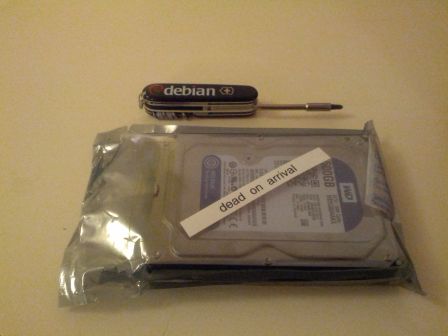
I just received a WD 500GB Blue, to replace the hard drive of my wife's computer. First thing after unpacking: start to test. And I was right to do it... there are bad blocks on it. WD 500GB DOA The story: I tend to do proactive replacement of hard drive, to avoid losing too much data or be in hurry when the current one fails. There are two ways to monitor a hard drive: Logcheck is pretty straightforward to install. It scans your log every two hours and send you a report of what is happening. It is not a very precise tool and you have to tune it a little bit to just send you what is relevant (install extra rules to ignore what you know is not of interest). Whenever you start to see log entry like that:
Jan 24 18:16:08 foo kernel: [ 1965.343980] ata5.00: exception Emask 0x50 SAct 0x39 SErr 0x800 action 0x6 frozen
Jan 24 18:16:08 foo kernel: [ 1965.343991] ata5.00: irq_stat 0x08000000, interface fatal error
Jan 24 18:16:08 foo kernel: [ 1965.344001] ata5: SError:   HostInt  
Jan 24 18:16:08 foo kernel: [ 1965.344036] ata5.00: failed command: READ FPDMA QUEUED
Jan 24 18:16:08 foo kernel: [ 1965.344055] ata5.00: cmd 60/08:00:18:31:44/00:00:1a:00:00/40 tag 0 ncq 4096 in
Jan 24 18:16:08 foo kernel: [ 1965.344059]          res 40/00:2c:e6:c2:fd/00:00:26:00:00/40 Emask 0x50 (ATA bus error)
Jan 24 18:16:08 foo kernel: [ 1965.344071] ata5.00: status:   DRDY  
Jan 24 18:16:08 foo kernel: [ 1965.344081] ata5.00: failed command: WRITE FPDMA QUEUED
It is a good time to think about changing your hardrive -- but it is maybe too late. Smartmontools (aka smartd) is dedicated tool to monitor hard drives and do a good job. I think it is not installed by default in Debian, but it should be. It scans your hard drive for SMART capabilities and monitor the health of the HD using internal tools. In the case of bad blocks, you will start to see entry like that:
Feb 17 14:05:17 bar smartd[1268]: Device: /dev/sda [SAT], 1 Currently unreadable (pending) sectors
Feb 17 14:35:17 bar smartd[1268]: Device: /dev/sda [SAT], 1 Currently unreadable (pending) sectors
Obviously when you see this log, it is also a good time to change your hard drive. In the case of my wife's HD, I just got data from logcheck. It means that the error is not that important (transient failure, something is wrong but the HD can cope with it). But I still decided to get a new one for my wife. Whenever, I receive a new drive, the first thing I do is to check it for errors. You can do that using the program badblocks in write mode. It takes ages to test (count up to 1 day for 1TB on USB), but at the end you know that you have a good candidate -- where it is worth install your data. You just have to follow this procedure
  1. dmesg grep sd
  2. try to find what drive is the one you want to test in the output of 1.
  3. cfdisk /dev/sdX, sdX being the drive you want to test
  4. check that what you see in cfdisk is what you expect to test: right name and capacity for the drive
  5. sudo badblocks -wvs /dev/sdX
  6. run sudo tail -f /var/log/syslog in parallel just in case
  7. wait
If some errors appears in /var/log/syslog, you know something bad is happening. Whenever you have a single failing block, don't think it is ok. It is NOT ok for a HD to start its life with failing blocks. In this case, repack the drive and send it for replacement ASAP. In the case of my hard drive: smartd mail:
The following warning/error was logged by the smartd daemon:
Device: /dev/sda [SAT], 15 Currently unreadable (pending) sectors
syslog entries:
Mar  2 20:52:57 foo kernel: [ 8317.419715] ata4.00: exception Emask 0x0 SAct 0x1 SErr 0x0 action 0x0
Mar  2 20:52:57 foo kernel: [ 8317.419724] ata4.00: irq_stat 0x40000008
Mar  2 20:52:57 foo kernel: [ 8317.419732] ata4.00: failed command: READ FPDMA QUEUED
Mar  2 20:52:57 foo kernel: [ 8317.419747] ata4.00: cmd 60/80:00:00:af:08/00:00:28:00:00/40 tag 0 ncq 65536 in
Mar  2 20:52:57 foo kernel: [ 8317.419750]          res 41/40:00:65:af:08/00:00:28:00:00/40 Emask 0x409 (media error) <F>
Mar  2 20:52:57 foo kernel: [ 8317.419758] ata4.00: status:   DRDY ERR  
Mar  2 20:52:57 foo kernel: [ 8317.419764] ata4.00: error:   UNC  
Mar  2 20:52:57 foo kernel: [ 8317.423959] ata4.00: configured for UDMA/133
I am not blaming any particular brand (like Western Digital), all computer parts I have ever bought had to follow the same procedure and it is a known fact that computer parts as a non-zero percentage of chance to be DOA (dead on arrival) or after a few weeks. But as a consumer you should be aware of that and take action to avoid spending 10h configuring your computer to see it failing after a week... The waste of time to test is a win on the long term.

7 March 2013

Vincent Sanders: Man cannot discover new oceans unless he has the courage to lose sight of the shore

Continuing with my whirlwind introduction to NetSurf Development now is the time to start examining the code, how its arranged and how to interact with the existing developers.

The way the NetSurf source is structured is around the idea of the frontends each being a native browser. While this implies that there are nine separate browsers that happen to share a common code base the separation is not quite that well defined.

Each frontend provides the OS entry point (the main() function in a c program) and calls out to standard browser initialisation entry function netsurf_init() and then starts running the browsers main dispatch loop with netsurf_main_loop() when that exits the frontend cleans up with netsurf_exit().

The frontends provide a large selection of functions which are called from the core code. These routines run from running the event scheduler through to rendering graphics and text.
Finding your way aroundThe browsers directory layout is fairly shallow consisting of some Makefiles, the nine frontend directories and eleven others.

The Makefiles are GNU make and represent a pretty straightforward linear build system. We do not use recursive make or autotools. There are plans to use the core buildsystem that all the other components use.

The frontend directories contain the code for the frontend and the makefile fragments to build them which are included by the top level Makefile.

In addition there is:
desktop
This contains the non frontend specific code that actually behaves like a browser. For example desktop/netsurf.c contains the three primary functions we outlined in the introduction. You will also find much of the function and data structures interfaces the frontend must provide. It is unlikely someone new to the project will need to change anything in here (there be dragons) but is an important set of routines.
utils
Here you will find the utility and compatibility interfaces, things like url handling, logging, user messages, base64 handling. These are utility interfaces that do not justify splitting out their functionality to a separate library but are useful everywhere. Changing an interface in here would likely result in a major refactor.
For example one quirk is the logging macro was created before varadic C preprocessor macros were universal so it must be called as LOG(("hello %s world", world_type)) e.g. with double brackets. Fixing this and perhaps improving the logging functionality would be "nice" but the changes would be massive and potentially conflict with ongoing work.
content
This contains all the core code to handle contents i.e. html, css, javascript, images. The handling includes retrieval of the resources from URI , correct caching of the received objects and managing the objects state. It should be explicitly stated that the content handlers are separate and use this core functionality. The actual content handlers to deal with object contents such as the routines to decode image files or render html are elsewhere.
image
This is where the content handlers for the various image types are kept. The majority of these image types (jpeg, png, webp, gif, bmp) use a standard library to perform the actual decode (libjpeg, libpng etc.). One special feature used by most image handlers is that of a decoded image cache which is distinct and separate from the content cache.
The decoded image cache manages decoding of the source images (the jpegs and pngs) into frontend specific "render" bitmaps. For example the gtk frontend keeps the decoded images as a cairo surface ready for immediate plotting.
The cache uses a demand based (when the browser actually displays the image) just in time strategy which has been carefully balanced, with real world input, to reduce the overhead of unnecessary image decoding and processing against memory usage for the render bitmaps.
css
The css content handlers provide for the processing of css source text and use the NetSurf libcss library to process into a bytecode suitable for applying style selection at render time.
javascript
The javascript handlers (strictly speaking this should be named the "script" directory as all types of script are handled here) provide basic functionality to bind a javascript engine to the rest of the browser, principally the Document Object Model (DOM) accessed with libdom. The only engine that currently has bindings is Spidermonkey from the Mozilla foundation.
render
This is the heart of the browser containing the content handler for html (and plain text). This handler deals with:
  • Acquiring the html.
  • Running the base parser as data arrives which generates the DOM and hence DOM events from which additional resource (stylesheets etc.) fetches are started.
  • Deal with script loading
  • Constructing the box model used for layout
  • Performing the Layout and rendering of the document.
Because this module has so many jobs to do it has inevitably become very complex and involved, it is also the principle area of core development . Currently NetSurf lacks a dynamic renderer so changes made by scripts post document load event are not visible. This also has the side effect that the render is only started after the DOM has finished construction and all the resources on a page have completed their fetch which can lead to undesirable display latency.
Docs
Documentation about building and using NetSurf. If anyone wants a place to start improving NetSurf, this is it, it is very incomplete. It must be noted this is not where dynamically generated documentation is found. For the current Doxygen output the best place to look is the most recent build on the Continuous Integration system.
resources
These are runtime resources which are common to all frontends. To be strictly correct they may be the sources which get converted into runtime resources e.g. The FatMessages file which is teh message text for all frontends in all languages, this gets processed at build time into separate files ready.
!NetSurf
This is another resources directory and technically the resources for the riscos frontend. The naming and reliance on this directory are historical. To allow the RISC OS frontend to be run directly from the source directory and an inability of RISC OS to process symbolic links most common runtime resources end up in here and linked to from elsewhere.
test
These are some basic canned test programs and files, principally to test elements of the utils and perform specific exercise of various javascript components.
Getting started
Once a developer has a checked out working build environment and can run the executable for their chosen frontend (and maybe done some web browsing :-) it is time to look at contributing.

If a developer does not have a feature or bug in mind when they begin the best way to get started is often to go bug hunting. The NetSurf bugtacker has lots to choose from unfortunately. Do remember to talk to us (IRC is the best bet if you are bug hunting) about what you are up to but do not be impatient. Some of those bugs are dirty great Shelob types and are not being fixed because even the core developers are stumped!

When first getting going I cannot recommend reading the code enough, this seems to be a skill that many inexperienced open source developers have yet to acquire, especially if they are from a predominately proprietary development background. One wonderful feature of open source software is you get to see all of it, all the elegant nice code and all the "what the hell were they thinking" code too.

One important point is to use your tools well the source is in git, if you learn how to use git well you will gain a skill that is readily portable, not just for NetSurf. And not just revision control tools, learn to use your debugger well and tools like valgrind. Those skills will replay the time spent learning them themselves many times over.

When using git one thing to remember is commit early and often, it does not matter if you have lots of junk commits and dead ends, once you have something viable you can use
git rebase --interactive
and rewrite it all into a single sensible set of commits. Also please do remember to develop on a branch, or if you did not
git pull --rebase
is your friend to avoid unnecessary merges.
Playing nicely with othersThe NetSurf community is a small band of unpaid volunteers. On average we manage to collectively put in, perhaps, ten hours a week with the occasional developer weekend where we often manage over twenty hours each.

The result is that developer time is exceptionally valuable, add in a mature codebase with its fair share of technical debt and you get a group who, when they get to work on NetSurf, are incredibly busy. To be fair we are just like every other small open source project in that respect.

What this means to a new contributor is that they should try and do their homework before asking the obvious questions. The documentation is there for a reason and in spite of its obvious shortcomings please read it!

When asking questions it should be noted that currently the majority of active contributors are in the Europe so if you visit the IRC channel or post questions to lists the time difference is something to keep in mind.

I carefully said contributor above and not developer, users trying the CI builds and reporting results are welcome...as long as they report useful bugs to the bug tracker. Simon Tatham has produced an excellent resource on this subject.

Also we are always happy to receive translations to new languages (diff against the FatMessages file would be outstandingly useful but anything is welcome), artwork, documentation. Just recall what I mentioned about busy developers. Surest way to get us to see something is the development mailing list, you will probably get a reply, though I will not promise how fast!

Some of the more common mistakes when interacting with the community are:
In conclusion
Hopefully this has been of some use although I had hoped to cover more and provide deeper insights and advice on the codebase but there is only so much generalisation to be done before it is just easier for the developer to go read the code for themselves.

I look forward to lots of new contributions :-) though I fear this may all end up as more of a crib sheet for next time we do GSOC, time will tell.

6 March 2013

Keith Packard: composite-swap

Composite and Swap Getting it Right Where the author tries to make sure DRI3000 is going to do what we want now and in the future DRI3000 The basic DRI3000 plan seems pretty straightforward:
  1. Have applications allocate buffers full of new window contents, attach pixmap IDs to those buffers and pass them to the X server to get them onto the screen.
  2. Provide a mechanism to let applications know when those pixmaps are idle so that they can reuse them instead of creating new ones for every frame.
  3. Finally, allow the actual presentation of the contents to be scheduled for a suitable time in the future, generally synchronized with the monitor. Let the client know when this has happened in case they want to synchronize themselves to vblank.
The DRI3 extension provides a way to associate pixmap IDs and buffers, and given the MIT-SHM prototype I ve already implemented, I think we can safely mark this part as demonstrably implementable. That leaves us with a smaller problem, that of taking pixmap contents and presenting them on the screen at a suitable time and telling applications about the progress of that activity. In the absence of compositing, I m pretty sure the initial Swap extension design would do this job just fine, and should resolve some of the known DRI2 limitations related to buffer management. And, I think that goal is sufficient motivation to go and implement that. However, I wanted to write up some further ideas to see if the DRI3000 plan can be made to do precisely what we want in a composited world. The Composited Goal To make sure we re all on the same page, here s what I expect from the Swap extension in a composited world:
  1. Application calls Swap with new window pixmap
  2. Compositor hears about the new pixmap and uses that to construct a new screen pixmap
  3. Compositor calls Swap with new screen pixmap
  4. Vertical retrace happens, executing the pending swap operation
  5. Compositor hears about the swap completion for the screen
  6. Application hears about the swap completion for its window
In particular, applications should not hear that their swap operations are complete until the contents appear on the screen. This allows for applications to throttle themselves to the screen rate, either doing double or triple buffering as they choose. I didn t add steps here indicating buffers going idle or being allocated, because I think that should all happen behind the scenes from the application s perspective. Many applications won t care about the swap completion notification either, but some will and so that needs to be visible. Redirected Swaps? Owen Taylor suggested that one way of getting the compositor involved would be to have it somehow redirect Swap operations, much like we do with window management operations today. I think that idea may be a good direction to try:
  1. Application calls Swap with new window pixmap
  2. Swap is redirected to compositor, passing along the new window pixmap
  3. Compositor constructs a new screen pixmap using the new window pixmap
  4. Compositor calls Swap on the screen and the window, passing the new screen pixmap and the new window pixmap. When the screen update occurs, the screen and the window both receive swap completion events.
This has the added benefit that the X server knows when the compositor is expecting window pixmaps to change like this the compositor has to explicitly request Swap redirection. Window Pixmap Names and GEM Buffer Handles One issue that swapping window pixmaps around like this brings up is how to manage existing names for the window pixmap. Right now, applications expect that window pixmaps will only change when the window is resized. If the Swap extension is going to actually replace the window pixmap when running with a suitable compositor, then we need to figure out what the old names will reference. Are there non-compositor applications using NameWindowPixmap that matter to us? How about non-compositor applications using TextureFromPixmap to get a GEM handle for a window pixmap? For now, I m very tempted to just break stuff and see who complains, but knowing what we re breaking might be nice beforehand. Idling Pixmaps When an application is done drawing to a window pixmap and has passed it off to the X server for presentation, we d like for that pixmap to be automatically marked as discardable as soon as possible. This way, when memory is tight, the kernel can come steal those pages for something critical. Of course, applications may not want to let the server mark the pixmap as idle after being used, so a flag to the Swap call would be needed. Ideally, the pixmap would become idle immediately after the pixmap contents have been extracted. In the absence of a compositor, that would probably be when the Swap operation completes. With a compositor running, we d need explicit instruction from the compositor telling us that the window pixmap was now idle :
 
    SwapIdle
    drawable: Drawable
    pixmap: Pixmap
       
 
Furthermore, the application needs to know that the pixmap is in fact idle. I think that we ll need a synchronous X request that marks a buffer as no longer idle and have that return whether the buffer was discarded while idle. It doesn t seem sufficient to use events here as the application will need to completely reconstruct the pixmap contents in this case. This reply could also contain information about precisely what contents the pixmap does contain.
 
    SwapReuse
    drawable: Drawable
    pixmap: Pixmap
       
    valid: BOOL
    swap-hi: CARD32
    swap-lo: CARD32
 
Pixmap Lifetimes and Triple Buffered Applications If we redirect the Swap operation and send the original application window pixmap ID to the compositor, what happens when the application frees that pixmap before the compositor gets around to using the contents? Surely the Compositor must handle such cases, and not just crash. However, I m fine with requiring that the application not free the pixmap until told by the compositor.

Raphael Geissert: A bashism a week: returning

Inspired by Thorsten Glaser's comment about where you can break from, this "bashism a week" is about a behaviour not implemented by bash.

return is a special built-in utility, and it should only be used on functions and scripts executed by the dot utility. That's what the POSIX:2001 specification requires.

If you return from any other scope, for example by accidentally calling it from a script that was not sourced but executed directly, the bash shell won't forgive you: it does not abort the execution of commands. This can lead to undesired behaviour.

A wide variety of shell interpreters silently handle such calls to return as if exit had been called.

An easy way to avoid such undesired behaviours is to follow the best practice of setting the e option, i.e.
set -e
. With that option set at the moment of calling return outside of the allowed scopes, bash will abort the execution, as desired.

The POSIX specification does not guarantee the above behaviour either as the result in such cases is "unspecified", however.

5 March 2013

Tanguy Ortolo: Suspend your computer from a non-mainstream desktop environment

Battery icon UPower for regular users Major desktop environments usually provide a user-friendly menu to suspend your computer. Internally, if seems to use something called UPower, which uses something called PolicyKit, which in turn may or may not use another piece called ConsoleKit (do not ask me what all these pieces are and how they relate to each other, I do not know and I do not want to know). For the regular user, the result is the following: when they click on that button, it suspends their computer.UPower for command line users However, if you are using a more unusual desktop environment, for instance a simple, light window manager, you will not have such a button. And no, UPower does not provide a simple command line tool to suspend your computer (they probably consider that command line is out of fashion ). Well, in case you need it, here is a way to suspend your computer from a command line or whatever: just alias it or bind it to a key shortcut. It uses some dark DBus magic:
$ dbus-send --system --print-reply --dest='org.freedesktop.UPower' \
    /org/freedesktop/UPower org.freedesktop.UPower.Suspend
If you prefer to hibernate your computer, that is, to suspend it, not to RAM but to disk:
$ dbus-send --system --print-reply --dest='org.freedesktop.UPower' \
    /org/freedesktop/UPower org.freedesktop.UPower.Hibernate
As you can see, for some reason it requires some duplication of information: the name org.freedesktop.UPower appears three times in that command line: in the destination , object path and interface member , whatever that could mean. Again, do not ask me why, I know nothing about that and I do not want to. Notes
  1. Actually, UPower does provide a command line tool called upower, but the only thing it does (monitoring power sources) is not really useful for that matter.

4 March 2013

Lucas Nussbaum: Debian is (still) changing

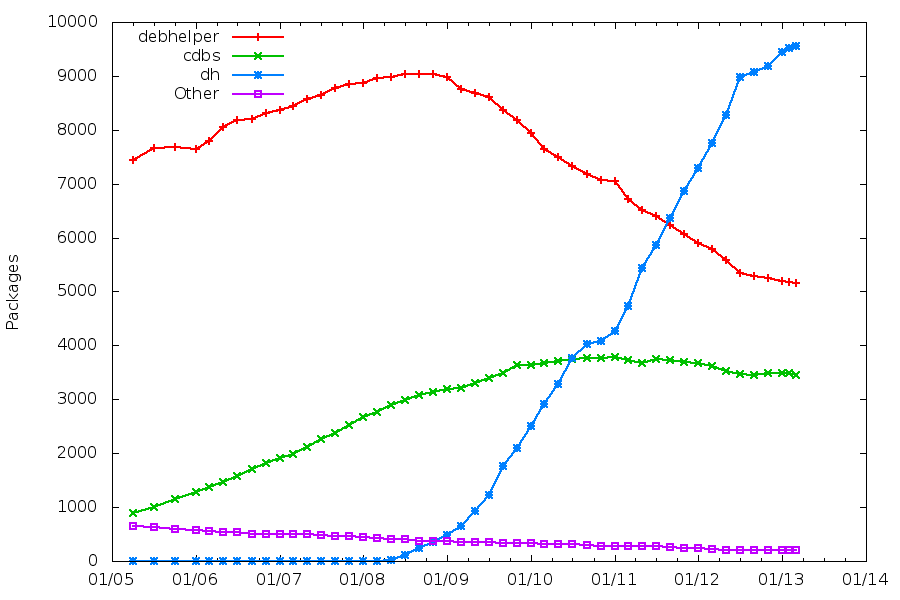
(Looking for those graphs online, I realized that I never properly published them, besides that old post) I ve been playing with snapshot.d.o, which is a fantastic resource if you want to look at Debian from an historical perspective (well, since 2005 at least). Team maintenance comaint
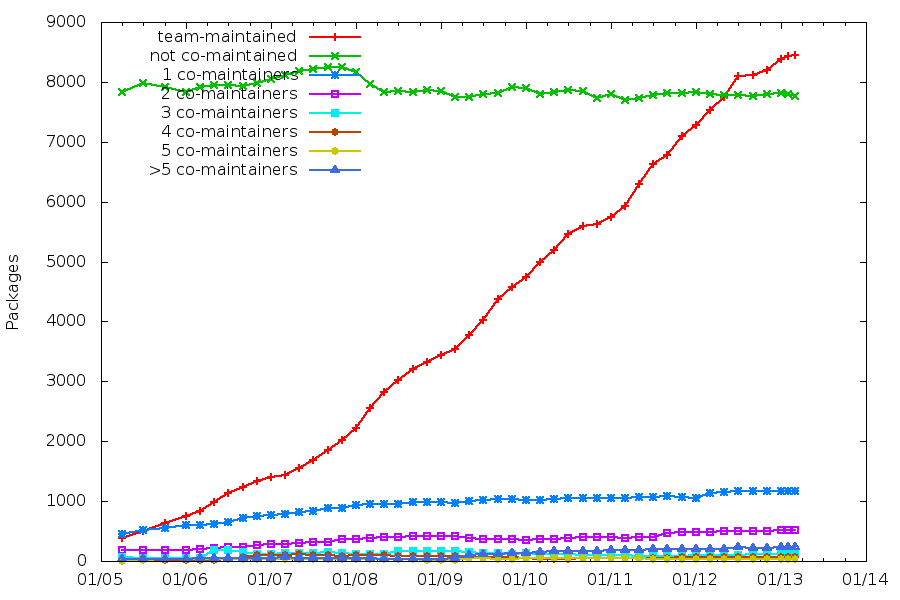
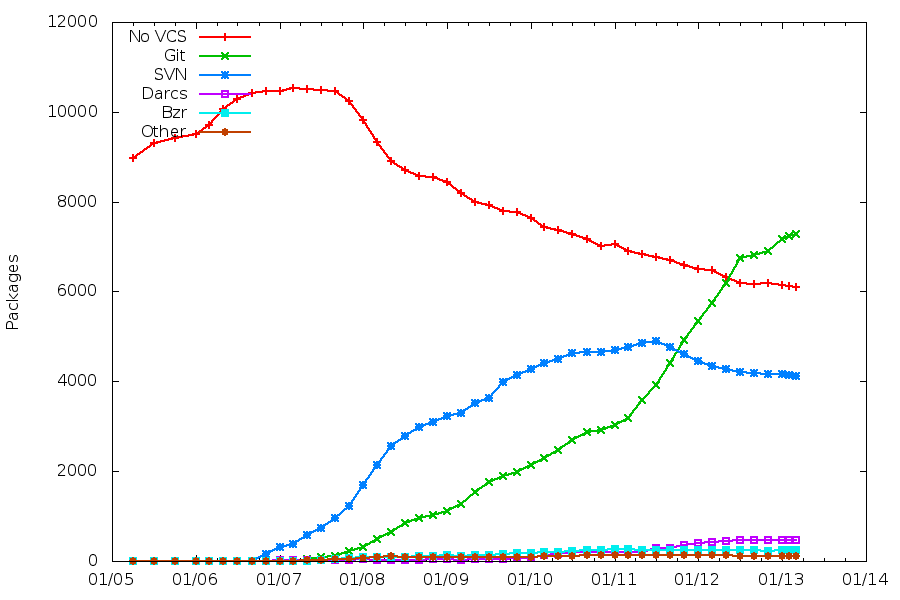
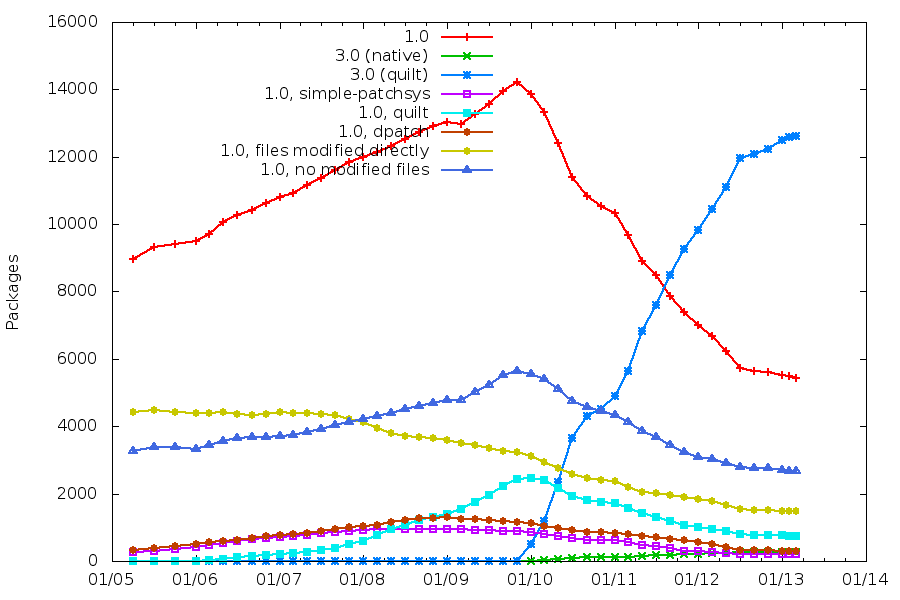
We now have more team-maintained packages than packages maintained by someone alone. Interestingly, the small, ad-hoc group of developers model does not really take off. Maintenance using a VCS vcs A large majority of our packages are maintained in a VCS repository, with Git being the clear winner now. Possible goal for Jessie: standardize on a Git workflow, since every team tends to design its own? Packaging helpers helpers Again, we have a clear winner here, with dh. It s interesting to note that, while dh was designed as a CDBS killer, it kind-of fails in that role. Possible goal for Jessie: deprecate at least pure-debhelper packaging? Patch systems and packaging formats formats-patches Again, clear winner with 3.0 (quilt). The (dirty) scripts that generate those graphs are available in Git (but you need to connect to stabile to execute them, and it s rather time consuming hours/days).
3 March 2013

Philipp Kern: git-annex: encrypted remotes

Due to the data loss I blogged about, I had to reverse engineer the encryption used by git-annex for its encrypted special remotes. The file system on which the content lived has a bullet hole of 8 GB in it, which was helpfully discarded by pvmove. It's pretty unhappy about that fact, parts of the git repository are unusable and directories cannot be accessed anymore. git-annex cannot possibly run anymore.

However, I was still able to access the git-annex branch within said git repository (using porcelain). This branch contains a file called remote.log which contains the keys of the special remotes. There's one per remote, encrypted to a GPG key of your choice and all files within that remote are encrypted with the same symmetric key.

One small detail stopped me from getting the decryption right the first time, though. It seems that git-annex uses randomness generated by GPG and armored into base64. In my na vet I spotted the base64 and decoded it. Instead it's used verbatim: the first 256 bytes as HMAC key (which reduces randomness to 192 bytes) and the remaining bytes for the symmetric key used by GPG (which will do another key derivation for CAST5 with it). A bug about that just hit the git-annex wiki.

With that knowledge in mind I wrote a little tool that's able to generate encrypted content keys from the plain ones used in the symlinks. That helps you to locate the file in the encrypted remote. Fetch it and then use the tool to decrypt the file in question with the right key.

The lesson: Really backup the git repository used with git-annex and especially remote.log. I'm now missing most of the metadata but for some more important files it's luckily still present. Recovery of the file content does not depend on it if you can deduce the filename from the content. If you have many little files it might be a bit futile without it, though.

Lucas Nussbaum: DPL game

When Francesca started her DPL game, I too started think about possible candidates. Here is my shortlist of dream candidates: Seriously, if you are a DD, you have the right to run. There s no need for someone to nominate you. If you think that you could possibly say something interesting during the discussion period, and can spare the time to participate in the -vote@ discussions, please run. DPL campaigns used to be a great time where Debian visions, goals, politics and random stuff were discussed. The more candidates, the more interesting campaigns (8 candidates in 2007!). Also, there are already two three other candidates, so even if you don t want the job, it s not that risky. (Initially, I thought about nominating everyone, but security-wise, it might not be such a great idea.)

Petter Reinholdtsen: Frikanalen - Complete TV station organised using the web

Do you want to set up your own TV station, schedule videos and broadcast them on the air? Using free software? With video on demand support using free and open standards? Included a web based video stream as well? And administrate it all in your web browser from anywhere in the world? A few years now the Norwegian public access TV-channel Frikanalen have been building a system to do just this. The source code for the solution is licensed using the GNU LGPL, and available from github. The idea is simple. You upload a video file over the web, and attach meta information to the file. You select a time slot in the program schedule, and when the time come it is played on the air and in the web stream. It is also made available in a video on demand solution for anyone to see it also outside its scheduled time. All you need to run a TV station - using your web browser. There are several parts to this web based solution. I'll mention the three most important ones. The first part is the database of videos and the schedule. This is written in Django and include a REST API. The current database is SQLite, but the plan is to migrate it to PostgreSQL. At the moment this system can be tested on beta.frikanalen.tv. The second part is the video playout, taking the schedule information from the database and providing a video stream to broadcast. This is done using CasparCG from SVT and Media Lovin' Toolkit. Video signal distribution is handled using Open Broadcast Encoder. The third part is the converter, handling the transformation of uploaded video files to a format useful for broadcasting, streaming and video on demand. It is still very much work in progress, so it is not yet decided what it will end up using. Note that the source of the latter two parts are not yet pushed to github. The lead author want to clean them up a bit more first. The development is coordinated on the #frikanalen IRC channel (irc.freenode.net), and discussed on the frikanalen mailing list. The lead developer is Benjamin Bruheim (phed on IRC). Anyone is welcome to participate in the development.

2 March 2013

Philipp Kern: PSA: LVM, pvmove and SSDs

If you use LVM with Wheezy on a solid-state drive, you really want to install the latest lvm2 update (i.e. 2.02.95-6, which contains the changes of -5). Otherwise, if you set issue_discards=1 in /etc/lvm/lvm.conf, you will experience severe data loss when using pvmove. Happened to me twice, once I didn't care (chroot data being lost), the second time (today) I did. Not fun, especially when the backup of the data was scheduled for the same day.

One has to wonder why it takes three months for a bug that trashes data to reach testing. (Obviously I know the answer, but they're not particularly good reasons.) Other distributions, like Ubuntu, were much quicker to notice and incorporate that fix. And in the case of the named distribution not because they auto-synced it from unstable. If somebody notices such a grave bug, please yell at people to get the fix out there to our users. Thanks.

Bastian Blank: LDAP, Insignificant Space and Postfix

For some, LDAP, just like X.500, is black magic. I won't argue against. Sometimes it really shows surprising behavior. It always makes sense, if you think about what LDAP is built for. One surprising behavior is the handling of the "Insignificant Space"
LDAP supports syntax and comparator methods. The syntax specifies how the entry should look. Usually this is some form of text, but numbers or stuff like telephone numbers are supported as well. The comparators specifies how the values are compared. Most of the text comparators are defined to apply the handling of insignificant spaces. Insignificant space handling normalizes the use of spaces. First all leading and trailing spaces are removed. All the internal spaces are normalized to at most two spaces. At the end all strings starts and ends with one space to allow proper sub-string matches. The resulting strings are used for comparisons. This behavior makes sense most of the time. If the user want to find something in the directory, he usually don't cares about spaces, but about content. But I found one occurrence where this produces some grieve. Postfix supports LDAP since some time. And lets say, it does not care about spaces in its queries. This is no problem as e-mail addresses do not contain spaces. Or do they?
Yes, e-mail addresses can contain spaces. This is not widely known, but still allowed. This addresses are quoted and the command looks like RCPT TO:<" test"@example.com>. The local part is quoted and contains a space at the beginning. And this is where the problem starts. Postfix sanitizes the address. It uses a simplified internal representation of the address for all lookups. So the address gets test@example.com. This form is used in all table lookups. The LDAP table uses the internal form of the address. This address is copied verbatim into the query. This query may look this way (mail= test@example.com). It is sent to the server this way. The LDAP server applies the insignificant space modifications. The query is now interpreted and the comparator specified modifications are applied. The query gets effectively changed to (mail=test@example.com). And this is where the fun starts. Postfix accepts undeliverable mails. Depending on the setup, such LDAP queries may be used to check for valid addresses. Because of the space handling, the sender can add spaces to the beginning of the address and it will still be considered valid. In later steps this addresses are not longer valid. Addresses starting with spaces are considered invalid in some locations of Postfix. What surprised me a bit is that virtual alias handling did not map them. The unmodified addressed showed up on the LMTP backend server. That's why they showed up my radar. I would say Postfix is wrong in this case. The LDAP server applies the spec correctly and defines spaces in e-mail addresses as insignificant. Postfix on the other side considers them significant. The easiest fix would be to not allow any spaces in the LDAP table.

Russ Allbery: Review: Asimov's, June 2011

Review: Asimov's Science Fiction, June 2011
Editor: Sheila Williams
Issue: Volume 35, No. 6
ISSN: 1065-2698
Pages: 112
Sheila Williams's editorial is about a new ebook-only anthology of Asimov's stories, with some discussion of electronic sales. This sort of business editorial is what she's best at writing, although in this case I'm far enough in my reading that I'm reading it through a bit of a time machine. Silverberg's essay is about popular bubbles and is mildly interesting, although I've read quite a lot about this at greater length. I think he misses the plot at the end, though, where he brings in the 2008 collapse and works on focusing the blame on speculators rather than those selling the fraudulent investments. James Patrick Kelly has a surprisingly graceful introduction to fanfic that does a better job at conveying the underlying enthusiasm than most mainstream coverage. The review column this month is Peter Heck's workman-like survey of recently released books of interest. "The Cold Step Beyond" by Ian R. MacLeod: Most of MacLeod's writing I've read has focused on lush world-building, usually with a mix of magic and industrial revolution. This felt like a departure: a character study of a heavily-modified warrior and monster hunter against a clearly science-fictional background. The protagonist has no memory of her past beyond her training in a religious institution, and is as much machine as woman. She is on one of her first missions to hunt dangerous monsters. But she's given almost no direction, and rather than encountering a monster, she encounters a feral woman with an ancient ray gun. MacLeod has a very SFnal twist waiting in the wings, but what I liked best were the character dynamics and the interplay of duty and self-determination. (8) "All the News That's Fit" by Carol Emshwiller: This story follows Emshwiller's normal pattern of telling the story of an outsider and representative of outsider culture trying to understand a society, but her protagonist here is both more alone and more proactive than her average protagonist. She lives in a distant mountain village only rarely visited by a traveling reporter who brings news from outside. When he doesn't come, she goes out looking for him, at first to rescue him if he ran into trouble and later to find the news herself. Much of the story has the reader worrying nervously for her as she observes the large city while clearly having no idea how to live there. The ending provides an interesting and (at least for me) unexpected twist on the rural person coming to the big city, but it was marred by a level of anger from the protagonist that I never thought was well-motivated. (6) "Walking Stick Fires" by Alan DeNiro: There is a science fiction subgenre that, for lack of a better term, I'll call post-apocalyptic surrealism. This is an entry in that strange subgenre, featuring two alien bikers having mostly unmotivated adventures with strange objects and even stranger creatures on an Earth that's apparently been invaded and mostly devastated by multiple parties. Like a lot of post-apocalyptic surrealism, it never makes much sense. It reminded me of Rucker but with a bit more characterization and less hand-waving math. (4) "Apocalypse Daily" by Felicity Shoulders: I really liked the premise for this story. The protagonist is a concept designer for a social-oriented MMORPG, but one where only scores and resources carry over rather than the whole world. The goal of the game is survival: the world ends regularly, globally or locally, in a huge variety of ways, and one scores points and earns resources for further iterations by finding ways to survive that catastrophe. The game is structured to encourage cooperation, at least at first. But Katrina gets into a mildly paranoid workplace conflict with someone else on her team, leading to some significant changes in the underlying expectations of the game. Unfortunately, while the background and idea are quite solid, the direction the story goes is predictable pessimism, the conclusion doesn't say much that I found interesting, and I ended up detesting the protagonist. I would have preferred a more unique psychological twist. (6) "The Fighter" by Colin P. Davies: This is a rather short story, essentially an idea study in the context of a police stop of a futuristic entertainment fighter. This is another one of those depressing takes on a common SF trope. I didn't entirely follow the world-building, but it was all dark and pointless enough that I didn't really want to dig further. (4) "Kiss Me Twice" by Mary Robinette Kowal: I've read a few police procedurals featuring AIs before, but this is by far the best one I've read. Huang is a detective, and like all the detectives he makes extensive use of the police department AI. Unlike most of the detectives, though, he treats her as a full partner and close to human, and she reciprocates with a Mae West persona and a closer relationship with him than most of the department. They're in the middle of investigating a murder when there is a raid on the police department and the AI herself is stolen. The rest of the story entangles their investigation with the theft of the AI. The police AI is, of course, restored from backup, but that's the first time that's ever happened to her, and she's shaken by it, and more disturbed by the knowledge that there are two copies of her running. The mystery angle of the story is reasonably satisfying, but the AI characterization and Huang's careful feeling-out of their relationship and appropriate behavior on his part is the best part of the story. This is a great story: long, satisfying, and thoroughly excellent. I'd happily read more fiction in this universe. (8) Rating: 7 out of 10

1 March 2013

Ritesh Raj Sarraf: I am so indebted to the community

As someone who learned computers on his own, I always acknowledged the value that the Free Software movement has brought. The accessibility of these topics, which are only supposed to be part of text books and schools, is available for anyone and everyone who has the resource and passion to do it. But this past week, 2 things made me pretty impressed with the maturity and quality of work that we do.

rrs@zan:/media$ sudo lvextend -r -v -L 100G /dev/BackupDisk/DATA

Finding volume group BackupDisk
Executing: fsadm --verbose check /dev/BackupDisk/DATA
fsadm: "ext4" filesystem found on "/dev/mapper/BackupDisk-DATA"
fsadm: Skipping filesystem check for device "/dev/mapper/BackupDisk-DATA" as the filesystem is mounted on /media/DATA
fsadm failed: 3
Archiving volume group "BackupDisk" metadata (seqno 7).
Extending logical volume DATA to 100.00 GiB
Found volume group "BackupDisk"
Loading BackupDisk-DATA table (254:2)
Suspending BackupDisk-DATA (254:2) with device flush
Found volume group "BackupDisk"
Resuming BackupDisk-DATA (254:2)
Creating volume group backup "/etc/lvm/backup/BackupDisk" (seqno 8).
Logical volume DATA successfully resized
Executing: fsadm --verbose resize /dev/BackupDisk/DATA 104857600K
fsadm: "ext4" filesystem found on "/dev/mapper/BackupDisk-DATA"
fsadm: Device "/dev/mapper/BackupDisk-DATA" size is 107374182400 bytes
fsadm: Parsing tune2fs -l "/dev/mapper/BackupDisk-DATA"
fsadm: Resizing filesystem on device "/dev/mapper/BackupDisk-DATA" to 107374182400 bytes (13107200 -> 26214400 blocks of 4096 bytes)
fsadm: Executing resize2fs /dev/mapper/BackupDisk-DATA 26214400
resize2fs 1.42.5 (29-Jul-2012)
Filesystem at /dev/mapper/BackupDisk-DATA is mounted on /media/DATA; on-line resizing required
old_desc_blocks = 4, new_desc_blocks = 7
The filesystem on /dev/mapper/BackupDisk-DATA is now 26214400 blocks long.
I didn't have much hope that this extend operation would succeed. But it did. When I initiated this operation, in the background, I had the backups being synced parallely (which actually made me resize my volume. :-)
The other item which made me happy yesterday was Audacity. Once upon a time, when I needed to split a music file to cut a ringtone out of it, I'd go looking for software that could do it. Then I would hope that one of those software vendors have a fully working version and not a demo with just 5 seconds clipping. Cowon was one media player I can recollect I've used to split audio files.
But in this case, I had a different requirement. I needed to increase the dB of my ringtone file so that it sounded really a ringtone (Example: Bourne Ultimatum OST). Audacity, not only did it do the job, it did it for me in just 3-5 minutes. And all with just button clicks. For a n00b with no experience in that domain, I was really impressed.

28 February 2013

Gunnar Wolf: Dkg: Unwrap it with Blender. And ask @octagesimal / @casyopea !

Daniel tells his story building a wooly mammoth, and throws some ideas on how this could be implemented easily with free software. But if I read his post correctly, Daniel still misses the precise ways to do it. Our friends Octavio and Claudia (twitted hereby) have given some Blender courses here at our classroom at home (Guys! Come again! We miss you!), and host the Spanish-speaking g-blender community. At one of their courses, they showed how to model an object/character, and in order to color/texture its parts, you can unwrap it This process yields a flattened image with the surfaces that build your object, that you can then color. Well, you can also use it as a base pattern to cut and sew your plush! It is not meant to be used for this (although it works), so it won't give you the extra tabs to be sewn in place, and the joints might not be at the most comfortable places. But it is base you can work from.

Russ Allbery: podlators 2.5.1

This is a quick, test-suite-only release to handle a new warning in Pod::Simple 3.26 that broke the test suite. Pod::Simple now warns if the =item elements seem to mix different types of items (bullets, numbers, and text strings). This triggered a couple of times in the test suite: once where I was explicitly testing the Pod::Man handling of that case (now moved to a separate test suite where I can suppress errors), and in several other places where I was testing item tag widths in formatting and was using =item 1 as the test for a single-column tag. That's now disambiguated with Z<>. There are various other changes pending, but alas I don't have time for a proper release at the moment. (Particularly since I'll probably be tackling coding style changes and a switch to Module::Build in the next release.) You can get the latest version from CPAN or from the podlators distribution page.

27 February 2013

Sylvain Le Gall: planet.ocaml.org spring cleaning

Hi planet.ocaml.org. Just a quick post to thanks Marek Kubica for his help on the planet.ocaml.org spring cleaning. Here are the feeds that have been removed: http://redlizards.com/blog/feed/?tag=ocaml http://blog.mestan.fr/feed/?cat=16 http://www.sairyx.org/tag/ocaml/feed/ http://blog.dbpatterson.com/rss http://www.nicollet.net/toroidal/ocaml/feed/ http://ocamlhackers.ning.com/profiles/blog/feed?tag=ocaml&xn_auth=no http://eigenclass.org/R2/feeds/rss2/all http://procrastiblog.com/category/ocaml/feed http://savonet.sourceforge.net/liquidsoap.rss Here is the feed that have been added: http://newblog.0branch.com/rss.xml Here are the feeds that have been updated: https://ocaml.janestreet.com/?q=rss.xml http://scattered-thoughts.net/atom.xml http://www.rktmb.org/feed/tag/ocaml/atom http://nleyten.com/feed/tag/ocaml/atom http://www.mega-nerd.com/erikd/Blog/index.rss20 http://y-node.com/blog/feeds/latest/ If you want that we had back your blog, please follow the howto add your feed to planet. We didn't have removed feed on purpose, this was just a way to get rid of a lot of 404, And don't forget, planet.ocamlcore.org is now served by planet.ocaml.org! Update your feed reader.

Neil McGovern: Let s get physical

Two recent announcements have been made about how it's viewed that people should interact with each other. Both, in my opinion, are misguided. Firstly, Yahoo's chief executive, Marissa Mayer has announced that she's banning staff from remote working. The idea behind this announcement is simple - that "some of the best decisions and insights come from hallway and cafeteria discussions, meeting new people, and impromptu team meetings". This is absolutely spot on, but the next sentence in the leaked internal memo is more problematic: "Speed and quality are often sacrificed when we work from home".
Don't get me wrong, working remotely has some special challenges, but they are by no means insurmountable. There's lots of tips for people working remotely which will turn into a future blog post at some point (I'm running an internal training about how to do it in a couple of weeks), but three simple rules are stay connected, set a routine and take care of yourself. The second decision is one by Ubuntu to move Ubuntu Developer Summits to a purely online meeting, ditching the physical meeting. This misses the point of conferences. If we simply wanted to listen to talks and presentations, why meet up at all? Webcasts have been around for the last 20 years, and yet conferences still exist. The most important part of a conference isn't the talks, it's the "hallway track" - it's the ability for people to meet up, chat and socialise. Be this an impromptu meeting in the corridor, or over a few nice beers. Without this component, why schedule a time at all? Simply publish a list of talks over the coming 3 months, and anyone can pick the best time for them to attend. At Collabora, many of our engineers work remotely. One of the perks we offer is the ability to attend conferences, and to "touch base" and visit and work from one of the offices. It is important to recognise the importance of collaboration physically and it shouldn't be discounted the way Ubuntu has done. But it should not be seen as a silver bullet to an organisation, like Yahoo seem to be implying. Both extremes are wrong, and a balance must be struck to ensure the best outcome for productivity and innovation. (Title from an iconic 80s song)

25 February 2013

Matthew Palmer: libvirt errors that are not helpful

Since there is absolutely zero Google juice on this problem, here s some hints in case someone else is out there beating their heads on their keyboard in frustration. The problem: when trying to define a storage pool (or 90+% of other virsh commands), you get this sort of result:
# virsh pool-define /tmp/pooldef
error: Failed to define pool from /tmp/pooldef
error: this function is not supported by the connection driver: virStoragePoolDefineXML
Or this:
# virsh pool-create /tmp/pooldef
error: Failed to create pool from /tmp/pooldef
error: this function is not supported by the connection driver: virStoragePoolCreateXML
Not helpful at all. The problem is (or, at least it was for me) that I have both KVM and virtualbox installed (I prefer KVM, but vagrant uses virtualbox and I m playing around with it). It would appear that libvirt is preferring to use virtualbox over KVM, which is stupid because virtualbox doesn t appear to be fully supported (as evidenced by the extensive set of functions that are not supported by the virtualbox connection driver). The solution: edit /etc/libvirt/libvirt.conf, and ensure that the following line is defined:
uri_default = "qemu:///system"
This will tell libvirt to use KVM (via qemu) rather than virtualbox, and you can play with pools to your hearts content.

Next.

Previous.