Search Results: "xam"

13 August 2010

Guido G nther: Git-buildpackage 0.5.6

Git-buildpackage 0.5.6 in experimental got rid of it's pbuilder/cowbuilder examples and added Russ's nice git-pbuilder script. I'm very happy how this turned out, now building with cowbuilder is as simple as:
# Initially create a cowbuilder environment once
git-pbuilder create
# Build the package
git-buildpackage --git-pbuilder
# At a later point update the cowbuilder environment with new versions
git-pbuilder update
Or for another distribution:
DIST=lenny git-pbuilder create 
git-buildpackage --git-pbuilder --git-dist=lenny
The new version also better interacts with dch from devscripts. So things like:
git-dch --bpo --qa --nmu
are now also supported when adding new changelog sections. Git-dch now detects new upstream version numbers automatically and bumps the version accordingly. In order to get this working I finally fixed the tag format. Since the current version in unstable should get a chance to move to testing first, I've uploaded 0.5.6 to experimental. Flattr this

12 August 2010

Olivier Berger: My report after the BOF on distributed bugtrackers at DebConf

Here are my notes about the very insteresting BOF on distributed bugtrackers held at DebConf This is just some elements of report (some taken from the gobby edits, and written down by me after watching the video (unfortunately missing 2 mins of sound in the beginning of the video stream/recording)). This is not a full report of all the discussions, as some discussed elements weren t of interest IMHO. You ll find here many ideas of mine, links and pointers (resulting of our work in the context of the Helios project on similar topics), so this is in no way a report of what was said exactly during the BOF. Aspects of interest: Note that these topics may in principle be discussed on the Distributed bug trackers mailing list: http://kitenet.net/cgi-bin/mailman/listinfo/dist-bugs Tools / implementation ideas : Storage of repositories / databases of remote bugs : About such storage, and the RDF store option, here s a prototype of ours that exposes UDD s bug facts through a SPARQL interface, allowing to publish bug facts as RDF (setup in the frame of the Helios project). It includes both Debian and Ubuntu bugs, and allows interlinking them in a standard way (with Semantically described links in RDF). See http://testforge.int-evry.fr/d2r-server/resource/spackage/evolution for an example. The problem is not how to distribute (distributed database systems exist), but the semantics of bug properties, and the different implementations of interfaces of different tools : which standard to implement, or how many converters are necessary if no standard ? We believe that navigation/referencing/tracking of external bugs would be much easier if bugs were LinkedData citizens, i.e. they would be exposed with (standard) formats like Semantic Web ontologies served with Semantic Web standards (like RDF). The worst case is currently to have to perform web scraping on bugtracker interfaces. How to avoiding scraping ? A solution could be to publish RDFa / microformats using common standard semantics, directly from the bugtracker pages at bugs URLs (see my wishlist for debbugs on that subject : 590931: Would be great to integrate RDFa metadata into debbugs pages). Now some pointers to historical details on the same subject and Debian (old posts by Lars Wirzenius) : Overall, the discussion was quite interesting, but didn t reach any sensitive progress regarding the state of the art. Much needs to be worked on, mainly on standardizing APIs, semantic descriptions of bugs, and implementation in tools like SD for instance. Stay tuned for more progress.

10 August 2010

Stephan Peijnik: What's all the fuzz about canonical-census?

I know I have not updated this blog in quite a long time now, but something caught my attention today: canonical-census.

As slashdot.org reports Canonical begins with tracking their (OEM) installations. Now it's obvious that people are uncomfortable with a program running on their system which phones back to their OS vendor, that's why I have had a quick look at what exactly canonical-census does.

Firstly however, I would like to point out that the report on slashdot.org is very clear about which information is being gathered, being "the number of times this system previously sent to Canonical [...], the Ubuntu distributor channel, the product name as acquired by the system's DMI information, and which Ubuntu release is being used". And it's perfectly correct. After getting the canonical-census Debian source package (using dget -u https://launchpad.net/ubuntu/+archive/partner/+files/canonical-census_0.1.dsc) the source package shows, besides the Debian packaging information, two scripts:

Now what do those scripts actually do?

send-census is installed in /etc/cron.daily, which means it will be executed once a day by the system's cron daemon. It's a mere 48 lines long, and its code is quite simple. So everyone with at least some shell scripting experience can easily check what it's doing. Now guess what, it sends exactly the information as reported on slashdot to Canonical. Nothing more and nothing less.

Technically it keeps a plain text file containing a single number as its call-counter, residing in /var/lib/send-install-count/counter and uses an on my Ubuntu Lucid system nonexistent /var/lib/ubuntu_dist_channel file for getting information about the distribution channel.
The above mentioned "system's DMI information" is not the whole bunch of DMI information available, but only the contents of /sys/class/dmi/id/product_name, which strangely enough returns "System Product Name" on my machine. Last but not least it uses lsb-release to get the distribution release (ie. 10.04 for my system).

Now those four pieces of information are sent to http://census.canonical.com/submit via a simple HTTP GET query, using wget. The full URL with all the parameters added is:
http://census.canonical.com/submit?count=count&dcd=dist_channel&product=dmi_product_name&release=ubuntu_release_version

The second script, census, is the part working on Canonical's script. Basically census reads in their Apache's access log file and creates an SQLite database from the contents of the log file. With 391 lines this script is a bit longer, but it does not end up in the Debian package at all.

Personally I do not see how Canonical or one of their partners could possibly do anything harmful with that information. Comparing this to Debian's popcon reveals that Debian is gathering a lot more information.

Now there are two more things one should consider: census is targeted at OEMs, which means its unlikely that it will end up on each and every Ubuntu installation and can be uninstalled by removing the canonical-census package with your favorite package manager.

Finally, think about this for a second: It's a shell script you can always examine. There is no hidden magic and it's a plain HTTP request the script is sending. No evil things happening there.
And now compare that to what other (often proprietary) software vendors do and how much data they submit, possibly even in encrypted form so you do not know for sure what is being sent to them.

Personally I welcome the openness of Canonical with providing their users with the package's code this early and being straight about what information it submits. They could have silently added it to those installations after all...

Happy hacking!

Dirk Eddelbuettel: RQuantLib 0.3.4

A fresh release of RQuantLib is now on CRAN and in Debian. RQuantLib combines (some of) the quantitative analytics of QuantLib with the R statistical computing environment and language. This follows the 0.3.3 release from last week and has again a number of internal changes. All uses of objects from external namespaces are now explicit as I removed the remaining using namespace QuantLib;. This makes things a little more verbose, but should be much clearer to read, especially for those not yet up to speed on whether a given object comes from any one of the Boost, QuantLib or Rcpp namespaces. We also generalized an older three-dimensional plotting function used for option surfaces -- which had already been used in the demo() code -- and improved the code underlying this: arrays of option prices and analytics given two input vectors are now computed at the C++ level for a nice little gain in efficiency. This also illustrates the possible improvements from working with the new Rcpp API that is now used throughout the package, Full changelog details, examples and more details about this package are at my RQuantLib page.

7 August 2010

Dirk Eddelbuettel: RInside release 0.2.3

A new 0.2.3 release of RInside is now on CRAN. RInside is a set of convenience classes which facilitate embedding of R inside of C++ applications and programs. RInside works particularly well with Rcpp and now depends on it. This is the first release since March when we released 0.2.2. A few things got added to Rcpp in the meantime, and RInside is taking advantage of some of these as illustrated in several of the included examples. More details and the changelog are on the RInside page which also leads

5 August 2010

Matt Zimmerman: DebConf 10: Day 3

How We Can Be the Silver Lining of the Cloud (Eben Moglen) Eben s talk was on the same topic as his Internet Society talk in February, which I had downloaded and watched some time ago. He challenges the free software community to develop the software to power the freedom box , a small, efficient and inexpensive personal server. Such a system would put users more in control of their online lives, give them better protection for it under the law, and provide a platform for many new federated services. It sounds like a very interesting project, which I d like to write more about. Statistical Machine Learning Analysis of Debian Mailing Lists (Hanna Wallach) Hanna is bringing together her interests in machine learning and free software by using machine learning techniques to analyze of publicly available data from free software communities. In doing so, she hopes to develop tools for studying the patterns of collaboration, innovation and other behavior in these communities. Her methodology uses statistical topic models, which infer the topic of a document based on the occurrence of topical words, to group Debian mailing list posts by topic. Her example analyzed posts from the debian-project and debian-women mailing lists, inferring a set of topics and categorizing all of the posts according to which topic(s) were represented in them. Using this data, she could plot over time the frequency of discussion of each topic, which revealed interesting patterns. The audience quickly zoned in on practical applications for things like flamewar and troll detection. Debian Derivatives BoF (Matt Zimmerman) I organized this discussion session to share perspectives on Debian derivatives, in particular how we can improve cooperation between derivatives and Debian itself. The room was a bit hard to find, so attendance was relatively small, but this turned out to be a plus. With a smaller group, we were able to get acquainted with each other, and everyone participated. Unsurprisingly, there were many more representatives from Ubuntu than other derivatives, and I was concerned that Ubuntu would dominate the discussion. It did, but I tried to draw out perspectives from other derivatives where possible. On the whole, the tone was positive and constructive. This may be due in part to people self-selecting for the BoF, but I think there is a lot of genuine goodwill between Debian and Ubuntu. Stefano Zacchiroli took notes in Gobby during the session, which I expect he will post somewhere public when he has a chance.

4 August 2010

Dirk Eddelbuettel: RQuantLib 0.3.3

A new release (now at version 0.3.3) of RQuantLib is now on CRAN and in Debian. RQuantLib combines (some of) the quantitative analytics of QuantLib with the R statistical computing environment and language. Many of the changes in this new version are internal. The code was re-written using the new Rcpp API throughout, and the build system was further simplified using the LinkingTo: mechanism. The arithmetic average-price asian option pricer was added. A few other code updates were made as well. Full changelog details, examples and more details about this package are at my RQuantLib page.

Ingo Juergensmann: OS X, Linux and netatalk

After coming back from holiday where I made lots of photos and videos, I needed the possibility to import all those from SD cards to my fileserver running Debian unstable. To import the photos I used Digikam on Linux, that was no problem. But for the videos I needed iMovie and/or FinalCut Express on my Mac. I've looked into Kino and Cinelerra, but those Linux apps are awful. The problem was that iMovie is able to directly import from our Panasonic HD camcorder to the network storage. I was always forced to first import the fotoage to the drive in my MacBook Pro and copy it then to the Linux box onto a Samba share. The solution for that problem is to use netatalk/AFP. The Linux box appears as a Mac Xserve then. However, I quickly found some HowTos for configuring netatalk. One HowTo is from Mike Hughes and the other one can be found on disgruntled-dutch.com. If you follow these two HowTos you're quite close to have a working AFP service to interact with your Mac via Bonjour/Avahi. There are mainly two problems when you follow them. First, Mike Hughes has some illegal chars in his sample /etc/avahi/services/afpd.servicefile:
<!DOCTYPE service-group SYSTEM avahi-service.dtd >
<service-group>
<name replace-wildcards= yes >%h</name>
The quotation marks are the problem. Instead of you'll need normal " quotation marks. Or you can use the file on disgruntled-dutch.com. Next problem is the configuration of the shares. On both sites the examples are using cdb as CNID backend:
~/ "Home Directory" cnidscheme:cdb options:usedots,upriv
But this will give the following error:
Aug 3 23:30:29 muaddib afpd[8151]: Can't open volume "/home/ij" CNID backend "cdb"
Aug 3 23:31:26 muaddib afpd[8151]: Cannot find module named [cdb] in registered module list!
The solution can be found on forum.ubuntuusers.de (German): you'll need to change the cdb to dbd. So, the Home Directory share will look like this then:
~/ "Home Directory" cnidscheme:dbd options:usedots,upriv
Quite simple and easy. Now restart your avahi-daemon and netatalk services and have fun! When you want to use a share on your Linux server for TimeMachine backups, you'll need to add a "tm" to the options of your share.

Russell Coker: WordPress Maintainability

For a while I ve been maintaining my own WordPress packages. I use quite a few plugins that weren t included in Debian, some of them have unclear licenses so they can t go in Debian while the rest would have to go in Volatile at best because they update regularly and often have little or no information in the changelog to describe the reason for the update so we have to assume there is a potential security issue and update it reasonably quickly. As I m maintaining plugin packages it seems most reasonable to keep maintaining my own packages of WordPress itself which I started doing some time ago then the version in Debian became outdated. Now WordPress isn t a convenient package to maintain, the design of it is that a user will upload it to their web space via FTP or whatever, it s not designed to be managed by a packaging system with the option of rolling back upgrades that don t work, tracking dependencies, etc. One example of this is the fact that it comes with a couple of plugins included in the package, of which Akismet is widely used. The Akismet package is periodically updated asynchronously from the updates to the WordPress package with the apparent expectation that you can just FTP the files. Of course I have to build a new WordPress package whenever Akismet is changed. Now there is a new default theme for WordPress called TwentyTen [1]. This theme ships with WordPress and again has updates asynchronously. Just over a week ago my blog prompting me for an update to the theme even though I hadn t consciously installed it I have to update because I don t know whether one of the other users on the same system has chosen it and because having a message about an update being required is annoying. The Themes update page has no option for visiting the web site for the theme and only offered to send it to my server via FTP or SFTP, of course I m not going to give WordPress access to change it s own PHP files (and thus allow a trojan to be installed). So I had to do some Google searching to find the download page for TewntyTen which happens to not be in the first few results from a Google search (even though those pages look like they should have a link to it and thus waste the time of anyone who just wants to download it). After downloading the theme I had to build a new WordPress package containing it I could have split it out into a separate package and have the WordPress package depend on it, but I ve got enough little WordPress packages already. It doesn t seem worth-while to put too much effort into my private repository of WordPress packages that possibly aren t used by anyone other than me. Plugins aren t as bad, the list of plugins gives you a link to the main web page for each plugin which allows you to download it. I wonder what portion of the WordPress user-base install via FTP to a server that they don t understand and what portion of them use servers that are maintained properly with a packaging system, my guess is that with the possible exception of WordPress.com most bloggers are running on packaged code. It seems to me that optimising for Debian and CentOS is the smart thing to do for anyone who is developing a web service nowadays. That includes files managed by the packaging system, an option to downgrade (as well as upgrade) the database format (which changes with almost every release), and an option for upgrading the database from the command-line (so it can be done once for dozens or hundreds of users). deb http://www.coker.com.au lenny wordpress I have a repository of WordPress packages that anyone can use with the above APT sources.list line. There is no reason why they shouldn t work with Testing or Unstable (the packaging process mostly involves copying PHP files to the correct locations) but I only test them on Lenny.

3 August 2010

Joachim Breitner: ipatch, the interactive patch editor

The problem: Splitting patches As a Debian maintainer, I often work with patches (files listing changes to text files), for example when tracking the modification I make to some software before I upload the package to Debian. To manage these patches, quilt is a nice tool: It helps you maintain a stack of patches on top of the original code and encourages you to keep your variously modifications separate. One use case is not supported by quilt at all: Splitting patches. One often has a large patch containing several independent changes. This might happen after you fix a few problems in the upstream code and then run dpkg-buildpackage, which will create one patch of your changes and put it in debian/patches. Before, I had to manually edit the patch and write the hunks, which are the building blocks of patches, into separate file. Where it already works There is no such problem when using a version control system, such as Darcs. Especially Darcs is rightly famous for its user-friendly interface and powerful hunk-selection features. You can even split a single hunk (which could be a change to one line) into two separate steps! Have a look at the HunkEditor page on the Darcs wiki to see how that works.
Let s steal a feature Well, it is not stealing if it is Free Software... Darcs has these nice capabilities and provides them in the context of version control systems, while we need them in the context of patch files. But Darcs is providing an API to its code, so shoudn t it be possible to create a program that uses the Darcs code to split patch files? As a matter of fact, it is possible: You can see that program in action on this 3min Ogg Theora-Video or directly here if your browser supports HTML5:
<video controls="true" height="448" src="http://www.joachim-breitner.de.nyud.net/various/ipatch-demo.ogv" tabindex="0" width="704">Looks like your browser does not support HTML5</video>
Nice, can I use it? The code is a working proof of concept. What you see works. You do not see how it handles patches that create or delete files, patches that do not apply cleanly or are already applied or any kind of error handling. That does not work yet. If you still want to try it, you can grab the code from the Darcs repository at http://darcs.nomeata.de/ipatch, but you need to build the latest development state of the Darcs library first. I think ipatch could become a very useful and powerful tool with applications in areas where nobody would think of using Darcs. I definitely want some integration into quilt, replacing the splitted patch in the series by the replacing patches automatically. Maybe even a git plugin could be created? But I don t think I can push this project far enough on my own. So this is an invitation to join me and make ipatch a great tool. This invitation goes especially to the Darcs developers: Please have a look how the code uses the Darcs API and help to improve the collaboration here. I think we can use the darcs-users mailing list until there is need for a dedicated mailing list.

Mark Brown: ASoC updates in 2.6.35

Linux 2.6.35 has been a fairly interesting release from an ASoC point of view, with several notable framework enhancements:

Dirk Eddelbuettel: RcppExamples 0.1.1

On Friday, I quickly provided a new release of RcppExamples, our example package for using Rcpp, to CRAN. Very little content has been updated --- and a new TODO file even notes that we need to add more documentation for the new Rcpp API. And update existing documentation as lots has changed since the initial release in March. But at least this package now joins RcppArmadillo is using the highly-recommened LinkingTo: Rcpp directive in the DESCRIPTION file to let R find the Rcpp headers, making the build process a little more robust. A few more details on the page are on the RcppExamples page.

Lucas Nussbaum: On extending Debian membership to non-programming contributors

Stefano raised again the issue of providing some kind of Debian membership to people that contribute to Debian in unusual ways (not involving deep purely technical skills), like doing translation, documentation, marketing, design, etc. Each time this discussion comes back, people seem to think that we need another membership status for them. But what for? It s true that the name Debian Developer is suboptimal for non-programmers. But it s also suboptimal for most DDs, since most of us don t strictly develop software: we just maintain packages, mainly developing meta-data around the upstream source code. Debian Developer is how we call our full-fledged project members. Do we want to classify those non-programming contributors as second-class citizens? If not, we need to make them Debian Developers , not some strange other name. Of course, there s the issue of security and trust. Debian Developers have upload rights on all packages, and access to the project s machines. And it s a bit strange to trust non-programmers with that level of power. On the other hand, we have many Debian Developers that are mostly inactive, became DDs half a decade ago, and have the same access rights. Worst, it s possible that they remember how to use dput, having used it before! And 95% of DDs (me included) should probably not be uploading the libc, even if they can. Why should they be more trusted than active non-programming contributors that probably would be quite scared by the idea of breaking something? Overall, I think that this issue is actually a non-issue. We should:

2 August 2010

Joachim Breitner: Protecting static content selectively by OpenID

When I created my on-line photo album, we had the year 2001 and there was nothing wrong with publishing ones photos in the Internet. It has been almost ten years now, and things have changed. Privacy is an issue, especially when it also affects your friends and family. The problem
So I needed to find some protection. These were my requirements:
  1. I only want to protect parts of the site, as there are some pictures that I intentionally share with the public. This selection should be possible down to the individual image.
  2. The solution should work without any dynamic server component besides the web server itself. This rules out any self-written CGI scripts as well.
  3. One password, given to all my friends etc., is not sufficient as it might leak to unintended audience.
  4. I do not want my visitors to have to register and remember yet another username and password just for my site. I also do not want to manage this user database.
  5. I do not want to have do large changes to the file structure of my photo album.
This rules out most common options, e.g. protection by a .htpasswd file. Requirements 3 and 4 point to a solution based on OpenID. With OpenID, my visitors can authenticate against a service they already use (Google, Yahoo, etc.), relieving me from the burden of maintaining a user database and them from having to remember a password. There is a mod_auth_openid module for the Apache webserver, and it is even distributed with Debian in the libapache2-mod-auth-openid package. So requirement 2 is fulfilled. The tricky part is: How do we achieve OpenID protection for some images, and not for others. The solution I first played around with selectively enabling or disabling mod_auth_openid based on <FileMatch> directives in the Apache configuration, but it was not elegant and would not scale well. I have more than 20.000 pictures to manage, and have already selected over 5000 pictures to be shown without protection. My solution is based on a partial copy of the whole directory tree that contains all public files. To save disk space, these are just symbolic links to the real file in the protected location. Some mod_rewrite magic then takes care of giving the user the impression that all files are in the same location. I set up a small example of my solution, which has this directory structure:
.:
drwxr-xr-x 2 root root 4096  2. Aug 12:03 images
lrwxrwxrwx 1 root root   18  1. Aug 12:05 index.html -> private/index.html
lrwxrwxrwx 1 root root   18  1. Aug 12:05 login.html -> private/login.html
drwxr-xr-x 3 root root 4096  2. Aug 12:03 private
./images:
lrwxrwxrwx 1 root root 33  2. Aug 12:00 pleaselogin.png -> ../private/images/pleaselogin.png
lrwxrwxrwx 1 root root 28  2. Aug 12:03 public.png -> ../private/images/public.png
./private:
drwxr-xr-x 2 root root 4096  2. Aug 12:00 images
-rw-r--r-- 1 root root  267  2. Aug 12:03 index.html
-rw-r--r-- 1 root root   94  2. Aug 12:01 loggedin.html
-rw-r--r-- 1 root root 2091  2. Aug 12:03 login.html
-rw-r--r-- 1 root root   10 18. Nov 2009  protected.html
./private/images:
-rw-r--r-- 1 root root 4074  2. Aug 11:58 pleaselogin.png
-rw-r--r-- 1 root root 2670  2. Aug 11:58 private.png
-rw-r--r-- 1 root root 2043  2. Aug 11:58 public.png
As you can see, real files only reside in private/, outside of that, only symbolic links exist. The apache configuration protects the private directory and blends it into the main directory:
   <directory /var/www/nomeata.de/openid-test>
        RewriteEngine On
        # Abuse the login page as an error image
        RewriteCond % QUERY_STRING  \.(png jpg)
        RewriteRule ^login.html$ /openid-test/images/pleaselogin.png
        # Ship private files, if they exist, unless public files exist
        RewriteCond  $1 !^private
        RewriteCond  /var/www/nomeata.de/openid-test/$1 !-f
        RewriteCond  /var/www/nomeata.de/openid-test/private/$1 -f
        RewriteRule  ^(.+)$ /openid-test/private/$1
   </directory>
   <directory /var/www/nomeata.de/openid-test/private>
        AuthOpenIDEnabled        On
        AuthOpenIDDBLocation     /var/lib/apache2/mod_auth_openid/mod_auth_openid.db
        AuthOpenIDLoginPage      /openid-test/login.html
        AuthOpenIDTrustRoot      http://nomeata.de
        AuthOpenIDCookiePath     /
        AuthOpenIDCookieLifespan 2592000
    </directory>
A special trick handles the login page for protected images: If the login page is requested and the referrer indicates that the user tried to access a .png or .jpg file, apache will instead ship an image containing an error message. For my photo album I have a small Perl script that, given a directory with a private/ directory therein and a list of rules in form of glob patterns, will symlink matching files and remove symlinks that are not allowed any more.
What s next? As you can see, this does not actually protect the content. It only requires the user to authenticate, then everything is visible. To select which OpenIDs are allowed to access which code, some bugs will have to be fixed in mod_auth_openid first. There was little activity there recently, I hope that the project is not dead.

Matt Zimmerman: DebConf 10: Day 1

This week, I am attending DebConf 10 at Columbia University in New York. The first day of DebConf is known as Debian Day. While most of DebConf is for the benefit of people involved in Debian itself, Debian Day is aimed at a wider audience, and invites the public to learn about, and interact with, the Debian project. These are the talks I attended. Debian Day Opening Plenary (Gabriella Coleman, Hans-Christoph Steiner) Hans-Christoph discussed Debian and free software from a big picture perspective: why software freedom matters, challenging the producer/consumer dichotomy, how the Debian ecosystem hangs together, and so on. Steps to adopting F/OSS in government (Andy Oram) Andy discussed FLOSS adoption in governments, drawing on examples from Peru, the city of Munich, the state of Massachusetts. He covered the reasons why this is valuable, the relationship between government transparency and software freedom, and practical advice for successful adoption and deployment. Pedagogical Freedom (panel, Jonah Bossewitch et al) The panelists discussed the use of technology in education, especially free software, some of the parallels between free software and education, and what these communities could learn from each other. This is a promising topic, though the perspectives seemed to be mostly from the education realm. There is much to be learned on both sides. Google Summer of Code 2010 at Debian (Obey Arthur Liu) This talk covered the student projects for this year s Summer of Code. Most of the students were in attendance, and presented their own work. They ranged from more specialized projects like the Hurd installer, to core infrastructure improvements like multi-arch in APT. Beyond Sharing: Open Source Design (Mushon Zer-Aviv) Mushon gave an excellent talk on open design. This is a subject I ve thought quite a bit about, and Asheesh validated many of my conclusions from a different angle. I ve added a new post to my todo list to go into more detail on this subject. Some points from his talk which resonated with me: How Government can Foster Freedom in Technology (Hon. Gale Brewer) Councillor Brewer paid a visit to DebConf to tell us about the work she is doing on the city council to promote better government through technology. Brewer seems to be a strong advocate of open data, saying essentially that all government data should be public. She summarized a bill to mandate that New York City government data be public, shared in raw form using open standards, and kept up to date. It sounded like a very strong move which would encourage third party innovation around the data. She also discussed the need for greater access to computers and Internet connectivity, particularly in educational settings, and a desire to to have all public hearings and meetings shared online. Why is GNU/Linux Like a Player Piano? (Jon Anderson Hall, Esq.) Jon is a very engaging speaker. He drew parallels between the development of player pianos, reproducing pianos, reed organs, pipe organs and free software. He even tied in Hedi Lamarr s work which led to spread spectrum wireless technology. To be quite honest, I did not find that these analogies taught me much about either free software or player pianos, but nonetheless, I couldn t help but take an interest in what he was saying and how he presented it. DebConf Opening Plenary (Gabriella Coleman) Biella and company explained all the ins and outs of the event: where to go, what to do (and not do), and most importantly, whom to thank for all of it. Now in its 11th year, DebConf is an impressively well-run conference. I m looking forward to the rest of the week!

30 July 2010

Lucas Nussbaum: Debcamp+Debconf again!

As I did since 2007, I will be attending Debconf again this year. I have been quite busy recently, and am lagging behind in some of my Debian work, so I plan to use Debconf to get stuff done, not just socialize and attend talks. Here is my TODO list, basically by order of willingness to do the work . It s probably too much for 9 days, so don t hesitate to talk to me if you want to help with some items.

29 July 2010

Dirk Eddelbuettel: RcppArmadillo 0.2.4

A new release of RcppArmadillo is now on CRAN. RcppArmadillo makes it easy to write highly efficient and highly readable C++ code for linear algebra (based on Armadillo) in R extensions (using Rcpp for the interface). This release upgrades the included Armadillo version to 0.9.52 (see here for Conrad's high-level changes). We had to make two minor tweaks. In the fastLm() help page example we switched from inv() to pinv()</tt)> The short NEWS file extract follows:
0.2.4   2010-07-27
    o   Upgraded to Armadillo 0.9.52 'Monkey Wrench'
    o   src/fastLm.cpp: Switch from inv() to pinv() as inv() now tests for
        singular matrices and warns and returns an empty matrix which stops
        the example fastLm() implementation on the manual page -- and while
        this is generally reasonably it makes sense here to continue which
        the Moore-Penrose pseudo-inverse allows us to do this
More information is on the RcppArmadillo page. Questions, comments etc should go to the rcpp-devel mailing list off the R-Forge page.

Gintautas Miliauskas: Python course projects

This spring I read a course on Python in Vilnius University, Department of Mathematics and informatics. The course was not mandatory, which I suspect is one of the reasons why my students were quite a bright and motivated bunch. I began the course with a brief introduction to the Python language and the standard library, then dedicated a few lectures to Django and in the remainder I covered various libraries (GUI toolkits, Pygame) and techniques (testing, debugging, optimization). One of the major tasks of the course (and the deciding factor in the final valuation) was to develop a project using Python. The students were given complete freedom over the topic of the project and the tools used, as long as Python was involved. The quality of the result varied, of course; had I given concrete tasks, the low bar would definitely have been higher. However, I am happy with how things turned out. Probably the best-executed project was 1000 Online, an online multiplayer card game (see rules). It was developed by Vytautas Karpavi ius. Vytautas apparently had prior experience with Python and Django, nevertheless, the quality of the app (and the code behind it) is impressive. Among the other projects, Gegute.lt, a Lithuanian clone of Reddit is still up and running. It's nothing too fancy, but looks quite clean for a university project. Other projects perhaps were not perfectly executed, but were very interesting conceptually. Jonas Keturka developed a bot (BitBucket) for the online strategy game Travian. Marius Damarackas developed a web-based guess-the-song game. He used YouTube for the song material and Last.fm (IIRC) to make you guess among similar songs, so that it would not be too easy. Andrius Chamentauskas developed a Puyo Pop clone (GitHub) with PyGame, complete with multiplayer and an AI. Paulius Budzinskas worked towards his course paper by developing a bacteria movement modelling and visualisation app (GitHub; Lithuanian only). David Abdurachmanov developed a spell-checker bot for WikiAnswers.com, with a really baroque and sophisticated architecture. I believe he has applied to Google Summer of Code with that project; I wonder how that is working out. For reference, you can find links to all student repositories on GitHub/BitBucket in this list. Beware: some of them may be documented/commented in Lithuanian. Another interesting effect of the course was that people started using Python in other related courses, for example in Mathematical Modelling and Numeric Methods. I even heard that the lecturer was impressed and expressed interest in learning Python. Another lecturer, this time a statistician, was interested in teaching and using SAGE at lab practice. Feeling such 'ripples' going through the department sure felt nice. By the way, the university also offers lectures on Ruby, read by Saulius Grigaitis. I took some inspiration from him for the course form and content.

Tim Retout: Reverse build-depends

I've started to build up to actually doing some development-related activities. Maybe. But first, we've got QR Codes dotted around the hacklab and on our namebadges if we're taking part in the keysigning - I persuaded zbarcam (from the zbar-tools package) to reveal their mysterious secrets. I'm looking into packaging some Java libraries that use maven. Fun. I think I'll be attending some of the talks in the Java track, although I feel like I'm three years late to the party. While trying to find a good example, I wanted to list all packages which reverse-build-depended on maven-debian-helper. This must be a common task? With some stuff stolen from lamby, I hacked together a shell alias:
rbuilddep()  
    grep-dctrl -sPackage -i -r -F Build-Depends,Build-Depends-Indep "\b$1\b" \
            /var/lib/apt/lists/*_Sources \
          awk '  print $2  ' \
          sort \
          uniq
 
But this surely can't be the last word on this. For one thing, it might also be useful to recursively find these reverse dependencies. I hope I've missed some obvious way of doing this. I reckon my attention span has got really poor over the last couple of years. More running tomorrow morning. But first, ice cream, I think.

28 July 2010

Sune Vuorela: Transport data easily to mobile phones

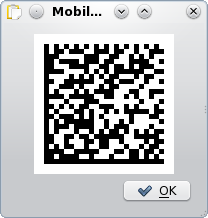
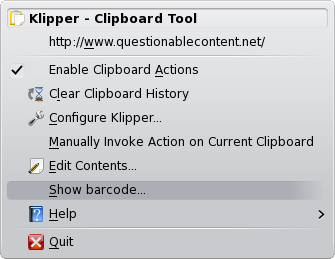
I guess we all have the challenge of how to easily get a link or a phone number or some other strings of data from the computer to the mobile phone. With the help of mobile barcodes and klipper, this is now possible in KDE Trunk to do easily. Place some data in clipboard, click on klipper and select Show barcode. show barcode option in klipper menu Mobile barcode in klipper To read it, open the barcode app in your phone (mBarcode on n900 for example) and point it to your monitor.
Next.

Previous.