Search Results: "nate"

19 September 2010

Iustin Pop: Debian Thanks

There are many ways that people express their thanks to Debian: mails, nice comments in a bug report, patches, so on. But to receive them in person is one of the most pleasing ones. I recently visited Bologna at the invitation of another DD (hi Guido!). The trip was nice, my first trip to this city, and a significant part of it was devoted to the local food (of course!). One evening, after a late dinner which included an absolutely fantastic Mascarpone desert, as we were paying at the cashier, one of the guys from the restaurant came forward and shook my hand while telling me something. I was tired and the few Italian I know didn't help at all, so I was at a loss on what's happening. Now, if you've ever been in a foreign country without knowing the language, you know this feeling: there is something strange going on, people are talking in a language you don't understand, and you might have just made a very big social mistake without realising it. Or it's just a silly, harmless misunderstanding. The only question is whether staying silent and just smiling is the right thing to do. In other words, you're at a complete loss. This all happens usually in just one or two seconds, before someone (if anyone, that is) manages to translate for you. In this particular case, the translation initially didn't make any sense at all: It's your t-shirt ; I usually wear t-shirts, and people never congratulate me for it. Then I realised: I was wearing one of my Debian t-shirts. My companions told him that I'm indeed involved with Debian, and he was extending his thanks. So, from a bolognese fan whose name I unfortunately didn't catch, to the Debian Project: thanks!

17 September 2010

Russell Coker: Preferring Low Quality and Microsoft Software

Is Low Quality in Italian Academia related to the choice of Low Quality Software? Diego Gambetta and Gloria Origgi wrote an interesting paper titled L-worlds: The curious preference for low quality and its norms [1]. The paper describes how in Italian universities (and large portions of Italian life) there are covert agreements that both parties in a transaction (the employee and the employer or the buyer and the seller) will deliver less than agreed while pretending that they are offering the agreed exchange. People who offer high quality in exchanges are discriminated against because they make people who offer low quality in exchange feel guilty. Nathan suggests that this is the explanation for people choosing to pay for inferior software from Microsoft instead of getting superior software for free [2]. Now it does seem quite plausible that someone who is offering low quality goods in the manner of Italian academia would refuse to consider software from any company other than Microsoft, after all the easiest way of selecting software is to phone a MS representative and be told exactly what to buy. But I don t think that this explains even a significant fraction of the people who refuse free software. There is no direct analogy between bilateral agreements to produce low quality and the choice of MS Software because MS Software is quite expensive (they demand what would be considered a high quality trade in the jargon of the paper). If someone was to buy one of the cheaper laptops in Australia (around $650 new) and upgrade to the full version of Windows 7 along with purchasing the home version of MS Office then the cost of software would be almost as much as the cost of hardware. If they wanted one other MS product then the cost of MS software would probably be greater than the cost of hardware. Hardware costs are steadily falling and MS prices are only increasing, for people who use MS software we should expect that soon the MS tax will be the majority of the costs of running a typical PC. Good Reasons for Choosing MS One thing we have to consider is that there are people who have good reasons for using MS software. One example is the companies that depend on proprietary applications which are central to their business. When the entire company s data is stored in an undocumented proprietary database it s really not easy to change to a different application even when everyone in the company knows the software to be of amazingly low quality. If the vendor of the proprietary application in question decides to only support MS Windows then it s customers (victims?) have no choice about which OS to use. One interesting thing to note about such companies that are locked in to proprietary software is that the amount that they spend per year on license and support fees is usually greater than the cost of hiring one good programmer. If a few such companies formed a consortium to develop free software to manage their business where each company paid the salary of one programmer then after a couple of years of development they could move to the free software and reduce their operating expenses. Another category of users who have a good reason to choose MS is the people who play games seriously. If you want to play games then MS Windows does offer some real advantages. The price of games will usually be a fraction of the hardware cost (the serious gamers spend a lot more on hardware than most people) and MS Windows is apparently the best PC OS for commercial games. Personally I ve found that there are more than enough free games on Linux to waste my time, Warzone 2100 [3] is one that I currently play, and I ve tried Battle for Wesnoth [4] in the past and found it too time consuming and addictive. How a Preference for Low Quality could lead to Microsoft I think that everyone who has any significant experience in the computer industry has encountered companies that have large areas of low quality. This generally tends to be in large corporations as small companies can t afford the waste. In some large corporations Linux on the desktop is never considered, even when people are hired as Linux sysadmins and there are obvious productivity benefits to having the same OS on the desktop as on the servers (even if two desktop PCs are required so that proprietary software can be run on MS-Windows). Major wrote a good satire of the corporate IT non-working culture with a comparison to medical work [5], it illustrates the principle of a coalition to ensure low quality. He later documented how he was sacked by the low quality coalition at a company that uses a lot of Microsoft software [6]. So it does seem that when customers don t care at all about the quality of the result it does help drive some sales for Microsoft. But that doesn t explain the market share that they have. It takes a lot of work to get Market Share without Quality Microsoft has spared no effort in gaining market share. Every possible effort including buying out small competitors, aggressively FUDing competition, using all manner of legal attacks (including the threat of patent suits), and deliberately breaking standards has been used. I think it s reasonable to assume that the MS senior management are not entirely stupid, they do so many things that are unethical and possibly illegal because they know that they need to do so to maintain their market share. The result is that the market capitalisation of MS is almost as high as that of Apple and Apple makes vastly superior products. Given the amount of effort that MS uses to keep market share it seems apparent that they aren t just relying on customers not caring about quality. Should users have to Understand Computers? My observation is that most users don t want to know much about how their computers work. The desire to understand computers seems to be about as common as the desire to understand cars, people just want to buy one that looks good and have it work. The difference is that cars are very compatible while computers aren t. Cars have the same controls in the same places and large parts of the design are specified by law so that they can t differ between models. Proprietary software is usually intentionally incompatible with other software (both open and proprietary) to try and gain a competitive advantage. Hardware is often incompatible due to the rapid developments in technology and the requirements for new interfaces to take advantage of new features. In concept it seems reasonable for someone who is about to spend $30,000 on a car and $1000 on a computer (for hardware and software) to spend 30 times longer considering which brand of car to buy. One could argue that more than 30 times as much consideration should be given to the car as most people can t afford to discard a car that they don t like. As people spend a few minutes considering which brand of car to buy they can be excused for spending a few seconds considering which type of computer to buy. But once a choice has been made about which software to use it s very difficult to change to something else, while in comparison it s easy to drive a car that was manufactured by a different company. So a poorly informed choice made at an early stage can have costly long-term affects when buying software. If we had mandated open standards for file formats and data interchange then users would be able to make choices that don t result in their data being locked in to some proprietary format. Such standards could be set through government tender processes, if every government agency was to only buy software that complies with open standards then the proprietary software vendors would scramble to make their products less incompatible. The result would be that bad choices in purchasing software could become learning experiences that result in better purchases in future instead of being a lock on users that forces them to keep using the same software that doesn t satisfy their needs. Conclusion I think that the best thing about the paper by Diego Gambetta and Gloria Origgi is that it highlights the issue of low quality. No-one wants to be considered a loser, so maybe this can encourage people to strive for high quality (or at least try to make their work suck a little less). Regardless of the conclusion they eventually reach, it s probably good for people to occasionally wonder do I suck? .

Alexander Reichle-Schmehl: Some notes about the Debian on the HP Mini 2102

The other day I got the HP mini 2102 Netbook I won at the Release Cricital Bug Contests. Many thanks for it! It works more or less out of the box with Debian Squeeze, including Suspend, Hibernate, external VGA Port. Batterie seems to hold for about 7 hours, which is okay, too. However, it wasn't shipped with Debian pre-installed, as I had been told. After unpacking the Netbook right in the train on may to work after picking it up in the morning, it was quite disapointing to just see Windows 7 installing some software for over two hours, before I could do anything with it! Booting the debian-installer via usb worked, but I couldn't use the keyboard (which BTW doesn't have Page Up/Down, Pos1 and End keys) in the syslinux boot menu. But as the usb-images ship with a setup.exe wich adds the installer to the Windows boot loader, that wasn't a major problem (it just took me a while to find it). The HP mini 2102 is a quite new Netbook, but to my suprise nearly everyhting worked out of the Box. Some minor problems where the battery display. With Kernel 2.6.32 it only showed the current state, but no estimations how long it would hold. Installing Kernel 2.6.35 fixed that. The Synaptics clickpad (which is a touchpad without buttons physically sepperated from the touching area) isn't fully supported. The Kernel driver has already been updated (see #572842), however xorg synaptics driver hasn't been updated to support it. Don't ask me, why there hasn't been a bug report for that package; I asked for it in #597082 and put the packages on my people account. You just need to download and install the xserver-xorg-input-synaptics deb and you should at least have two usable mouse buttons. You can try some fine tunning as described in the Debian wiki, but not everything seems to be supported (e.g. multitouch, emulated third mouse button). The last problem is quite interesting. While the build in wireless adapter works very well, it constantly looses the connection, when I connect it to my Palm Pre in his hotspot-mode. But I have no idea how to debug it, as it works very well with other wireless networks, while my regular notebook works without problems with the Palm Pre. So I don't know, why wpasupplicant constantly looses the connection and reconnects. It someone has some hints about these two issues, an e-mail would be most welcome. Thanks! Update: Oh, I got Pg-Up, Pg-Down, End and Pos1 keys via fn and the cursors keys! Yeah!

15 September 2010

Iustin Pop: Virtual hardware failures

Note: The title is intentionally unclear; it can be read both as virtual failures and failures of virtual hardware , and I'm not sure which one is the better for the cases below. One of the funny things about virtualization is how virtual hardware fails. It often happens that my NFS-stored virtual machine images suffer an NFS glitch or something, at which point one can see in the kernel logs:
kernel: mptscsih: ioc0: attempting task abort! (sc=ffff880018320100)
kernel: sd 0:0:0:0: [sda] CDB: Read(10): 28 00 00 00 00 38 00 00 08 00
kernel: mptscsih: ioc0: task abort: FAILED (sc=ffff880018320100)
kernel: mptscsih: ioc0: attempting target reset! (sc=ffff880018320100)
kernel: sd 0:0:0:0: [sda] CDB: Read(10): 28 00 00 00 00 38 00 00 08 00
kernel: mptscsih: ioc0: target reset: SUCCESS (sc=ffff880018320100)
kernel: mptscsih: ioc0: attempting task abort! (sc=ffff880018320100)
kernel: sd 0:0:0:0: [sda] CDB: Read(10): 28 00 00 00 00 38 00 00 08 00
kernel: mptscsih: ioc0: task abort: FAILED (sc=ffff880018320100)
kernel: mptscsih: ioc0: attempting task abort! (sc=ffff88001eefcc00)
kernel: sd 0:0:0:0: [sda] CDB: Read(10): 28 00 00 98 01 a7 00 00 08 00
kernel: mptscsih: ioc0: task abort: FAILED (sc=ffff88001eefcc00)
kernel: mptscsih: ioc0: attempting target reset! (sc=ffff880018320100)
kernel: sd 0:0:0:0: [sda] CDB: Read(10): 28 00 00 00 00 38 00 00 08 00
kernel: mptscsih: ioc0: target reset: SUCCESS (sc=ffff880018320100)
While the NFS transient issues are probably a real bug, I have this image of a state machine inside the driver trying over and over the same error paths, in a futile attempt at fixing the hardware , and not locking onto/matching the real hardware behaviour. Or, this most recent case during boot and resource probing:
kernel:  e1000: 0000:00:08.0: e1000_probe: The EEPROM Checksum Is Not Valid
kernel:  /*********************/
kernel:  Current EEPROM Checksum : 0x031a
kernel:  Calculated              : 0x031a
kernel:  Offset    Values
kernel:  ========  ======
kernel:  00000000: 08 00 27 f6 f3 9b 00 00 ff ff 00 00 00 00 00 00
kernel:  00000010: 00 00 00 00 08 44 1e 00 86 80 0e 10 86 80 40 30
kernel:  00000020: 00 00 00 00 00 00 00 00 00 00 00 00 00 00 00 00
kernel:  00000030: 00 00 00 00 00 00 00 00 00 00 00 00 00 00 00 00
kernel:  00000040: 00 00 61 70 0c 28 c8 00 c8 00 00 00 00 00 00 00
kernel:  00000050: 00 00 00 00 00 00 00 00 00 00 00 00 00 00 02 06
kernel:  00000060: 00 00 00 00 00 00 00 00 00 00 00 00 00 00 00 00
kernel:  00000070: 00 00 00 00 00 00 00 00 00 00 00 00 00 00 1a 03
kernel:  Include this output when contacting your support provider.
kernel:  This is not a software error! Something bad happened to your hardware or
kernel:  EEPROM image. Ignoring this problem could result in further problems,
kernel:  possibly loss of data, corruption or system hangs!
kernel:  The MAC Address will be reset to 00:00:00:00:00:00, which is invalid
kernel:  and requires you to set the proper MAC address manually before continuing
kernel:  to enable this network device.
kernel:  Please inspect the EEPROM dump and report the issue to your hardware vendor
kernel:  or Intel Customer Support.
kernel:  /*********************/
kernel:  e1000: 0000:00:08.0: e1000_probe: Invalid MAC Address
kernel:  e1000: 0000:00:08.0: e1000_probe: (PCI:33MHz:32-bit) 00:00:00:00:00:00
kernel:  e1000: eth0: e1000_probe: Intel(R) PRO/1000 Network Connection
This is an emulated Intel NIC under VirtualBox. I have never seen it before, and it went away after a reboot. The most funny thing is the This is not a software error! message well, it definitely is :), but the driver has no way to know that. I think that these software-driven failures probably trigger some obscure error handling paths; I assume that the usual failures for real versus virtual hardware are quite different in nature, and that recovery is again different. This leads to using the wrong strategy for recovery, but fortunately nothing is really broken, just in the wrong state Since I'm not familiar with low-level driver details, I might be wrong of course; I'm just speculating on what I think goes on inside the driver. I'm not even mentioning virtual clock issues, as those are no longer funny

James Morrison: Monthly Events

I discovered another awesome monthly event. This time it was Sci-fi Burlesque. I got a couple pictures, but unfortunately, I didn't get a good picture of the storm trooper. Nothing says awesome like tribbles, storm troopers and burlesque!

The previous interesting event was Bawdy Storytelling.

Christoph Berg: Firefox: HeaderControl

I'm a fan of LC_MESSAGES=de_DE and localized web pages -- almost. Unfortunately, the wording of many translations in Debian often drives me nuts. This applies mostly to web pages and package descriptions. Apologies to all hard-working translators -- the percentage of good translations does not outweigh the "wtf" cases for me. Still, I didn't want to switch to English for all the web. Rhonda pointed me to a Firefox ^W Iceweasel plugin: HeaderControl. Now *.debian.org is English for me (reading the constitution in German doesn't solve DAM problems anyway). Yay!

14 September 2010

Kees Cook: my part in the ecosystem

I was asked to write about what I do at Canonical and what I do in the Free Software community at large. There is obviously a great deal of overlap, but I ll start with the things I m involved with when I m wearing my Ubuntu hat. My primary job at Canonical is keeping Ubuntu secure. This means that I, along with the rest of the Ubuntu Security Team, coordinate with other Free Software distributions and upstream projects to publish fixes together so that everyone in the community has the smallest possible window of vulnerability, no matter if they re running Ubuntu, Debian, RedHat/Fedora, SUSE/openSUSE, Gentoo, etc. Between vendor-sec, oss-security, and the steady stream of new CVEs, there is plenty going on. In addition to updates, the Security Team works on pro-active security protections. I work on userspace security hardening via patches to gcc and the kernel, and via build-wrapper script packages. Much of this work has been related trying to coordinate these changes with Debian, and to clean up unfinished pieces that were left unsolved by RedHat, who had originally developed many of the hardening features. Things like proper /proc/$pid/maps permissions, real AT_RANDOM implementation, upstreaming executable stack fixing patches, upstreaming kernel NX-emu, etc. Most of the kernel work I ve done has gotten upstream, but lately some of the more aggressive protections have been hitting frustrating upstream roadblocks. Besides the hardening work, I also improve and support the AppArmor Mandatory Access Control system, as well as write and improve confinement profiles for processes on Ubuntu. This work ends up improving everyone s experience with AppArmor, especially now that it has gotten accepted upstream in the Linux kernel. I audit code from time to time, both on the clock with Canonical and in my free time. I m no Tavis Ormandy, but I try. ;) I ve found various security issues in Xorg, Koffice, smb4k, libgd2, Inkscape, curl+GnuTLS, hplip, wpa_supplicant, Flickr Drupal module, poppler/xpdf, LimeSurvey, tunapie, and the Linux kernel. With my Canonical hat off, I do all kinds of random things around the Free Software ecosystem. I m a sysadmin for kernel.org. In Debian, I maintain a few packages, continue to try to push for security hardening, and contribute to the CVE triage efforts of the Debian Security Team. I ve written or maintain several weird projects, including MythTVFS for browsing MythTV recordings, GOPchop for doing non-encoding editing of MPEG2-PS streams, Perl s Device::SerialPort module, and the TAP paging server Sendpage. For a selection of things I ve contributed to other project, I ve implemented TPM RNG access in rng-tools, made contributions to Inkscape s build and print systems, implemented CryptProtect for Wine, wrote a PayPal IPN agent in PHP that actually checks SSL certificates unlike every other implementation I could find, added additional protocol-specific STARTTLS negotiations to OpenSSL, implemented the initial DVD navigation support in MPlayer, updated serial port logic in Scantool for communicating with vehicle CAN interfaces, tried to add support for new types of timeouts in Snort and Ettercap, fixed bugs in mutt, and added HPUX audio support to the Apple ][ emulator XGS. As you can see, I like making weird/ancient protocols, unfriendly file formats, and security features more accessible to people using Free Software. I ve done this through patches, convincing people to take those patches, auditing code, testing fixes and features, and doing packaging work. When I go to conferences, I attend UDS, DefCon, OSCon, and LinuxCon. I ve presented in the past at OSCon on various topics including security, testing, and video formats, and presented at the Linux Security Summit (miniconf before LinuxCon this year) on the need to upstream various out-of-tree security features available to the Linux kernel. I love our ecosystem, and I love being part of it. :)

Michal Čihař: Learning graphviz

While working on new Gammu documentation I came to need to include some graphs showing some workflows. Looking into Sphinx documentation (which is used for the documentation for Gammu), I've discovered nice integration with graphviz. Fortunately it was pretty easy to learn the basics, though I've never used it before and here it comes - message processing workflows for SMSD.

13 September 2010

Norbert Tretkowski: Microblogging, part 2

When I blogged about microblogging using Twitter a while ago, I got some suggestions regarding Identi.ca in the comments. I did not know about Identi.ca at that time, but decided to give it a try. Identi.ca is a service like Twitter based on StatusNet, an open source microblogging platform. After using both services in parallel for a while, with constant frustration about the unreliable Identi.ca -> Twitter gateway, I now finally decided to completely drop my account on Twitter.

Unfortunately something got miserably wrong while playing with the Identi.ca -> Twitter gateway last week, I somehow lost all my subscribers and subscriptions, so please resubscribe to my account.

12 September 2010

Gregor Herrmann: RC bugs 2010/34 - 2010/36

I thought it's about time to write a short report on my RC bug squashing activities again; nothing spectacular, but maybe it motivats others *hint*

10 September 2010

Bernd Zeimetz: refactoring the guruplug server plus

As mentioned in my last blog post the GuruPlug Server Plus needs some major refactoring before it can be used. Not doing so will make you end up with a fried brick. There are various stories in the forums about cooling it properly, so you might want to have a look first instead of following mine blindly. And of course - whatever you do - it is your fault when you end up with a brick, not mine!.

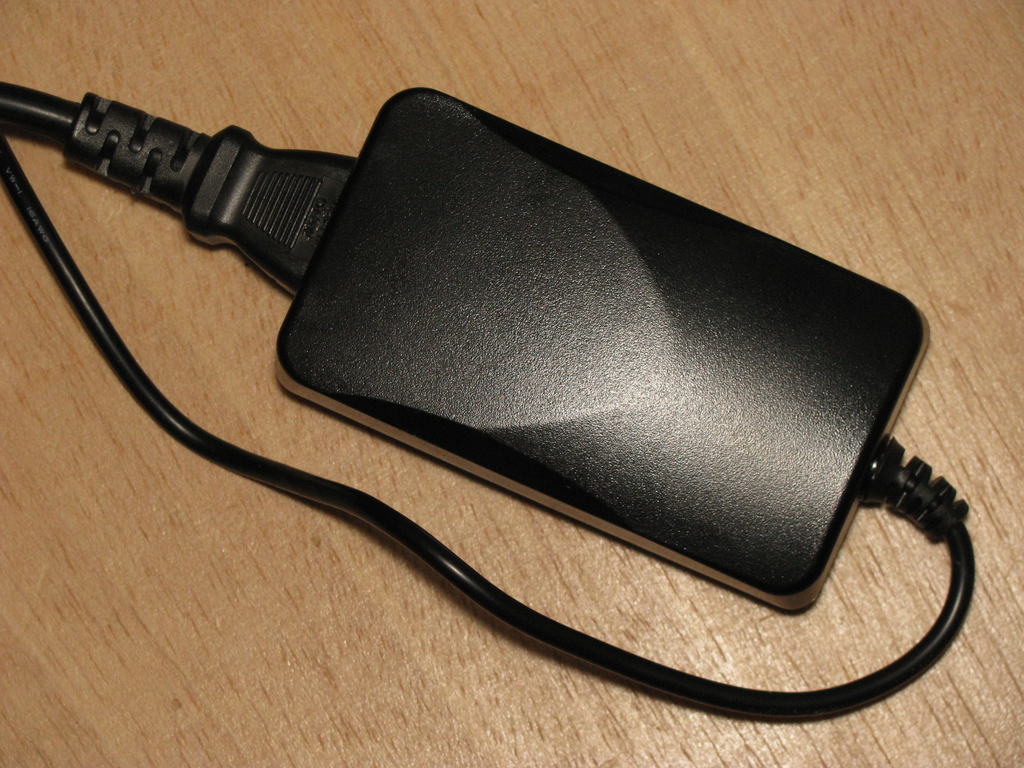
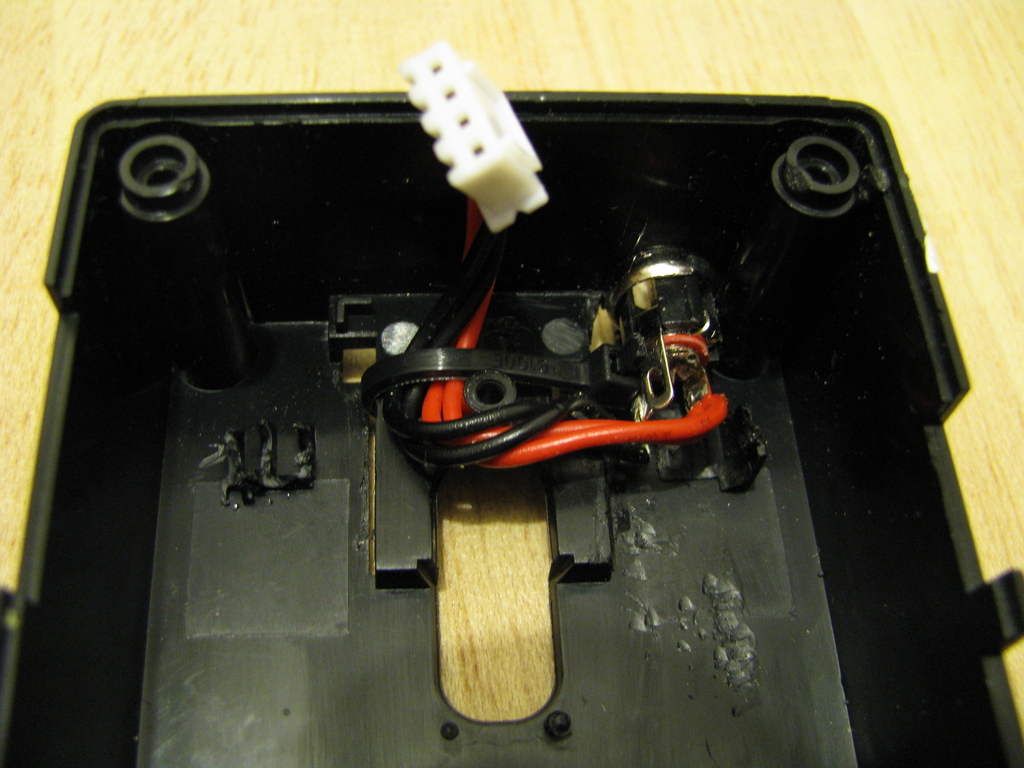
Replacing the power supply As I would never ever trust the PSU (see my last blog post for the gory details) and some additional free space in the case is necessary, it is time to rip it out. As replacement I've ordered an external 5V/20W PSU. To connect it to the plug I've drilled a hole into the case and added a proper connector after soldering the original cable from the old PSU to it. Make sure to add some retainer to stop the cable from touching the CPU/memory heat sinks later. GuruPlug Server Plus PSU replacement GuruPlug Server Plus PSU cabling

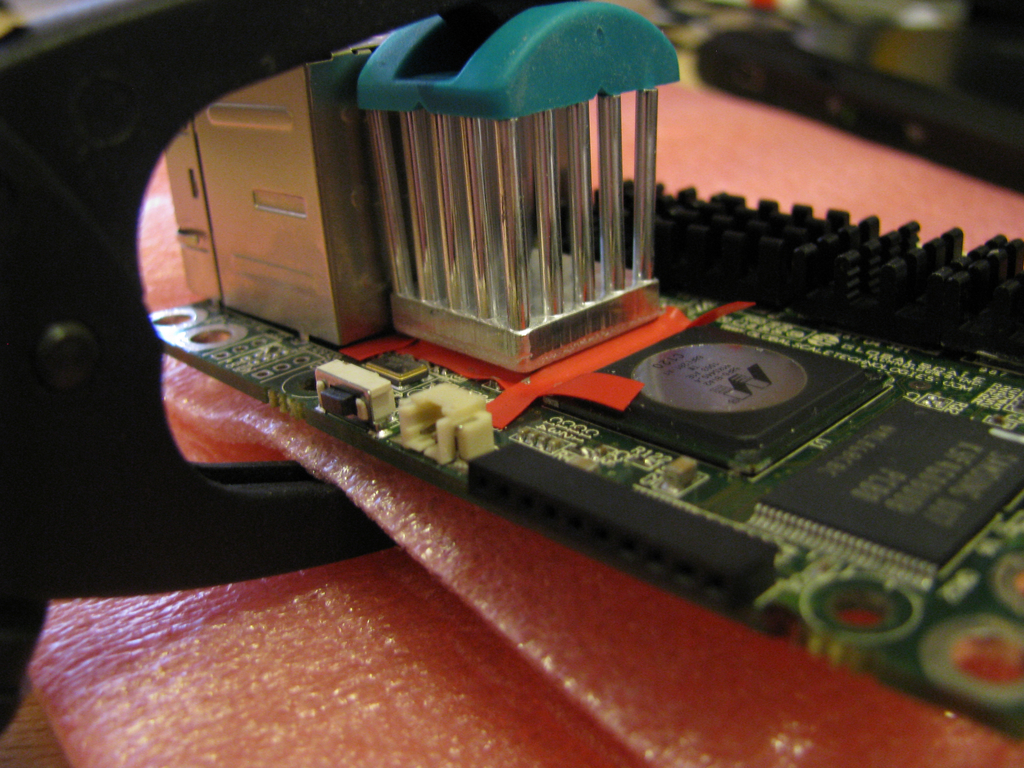
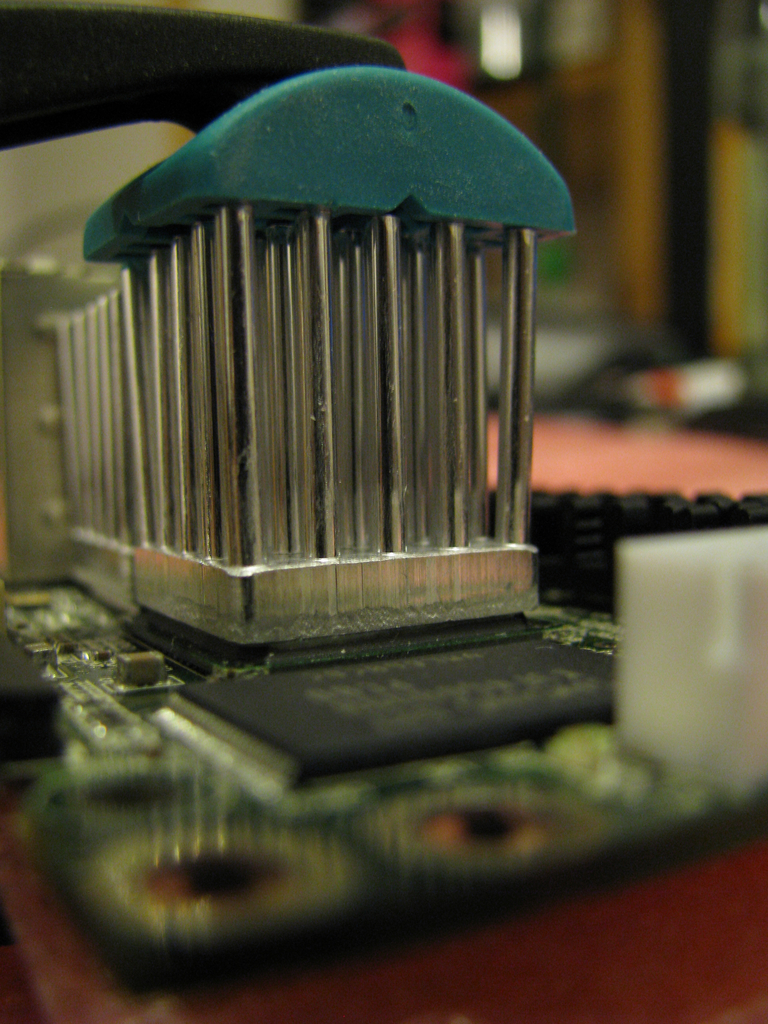
Proper heatsinks One of the biggest problems in the original GuruPlug design is the heat spreading and collecting piece of alloy, which probably makes things even worse than better. After some discussion in #debian-devel the idea came up, that the board should be able to run fine without a heatsink - at least when idling. That is the case, indeed. So let's get rid of that piece of alloy, together with the holders and springs. Unfortunately heat things are necessary to handle some work load. To mount them make sure you get some good thermal glue as you don't want to insulate the chips from their heat sinks. I've used Arctic Silver II thermal glue - not cheap, but working well. Make sure to clean the heat sinks and chips properly with alcohol (2-Propanol is my favourite for that), so there is no fat and dust left. When you use the glue be careful to read the documentation properly and make sure you apply only as much as necessary - a thin coating is enough. After applying the glue and mounting the heat sink you need a clamp to put some pressure on it while the glue dries.

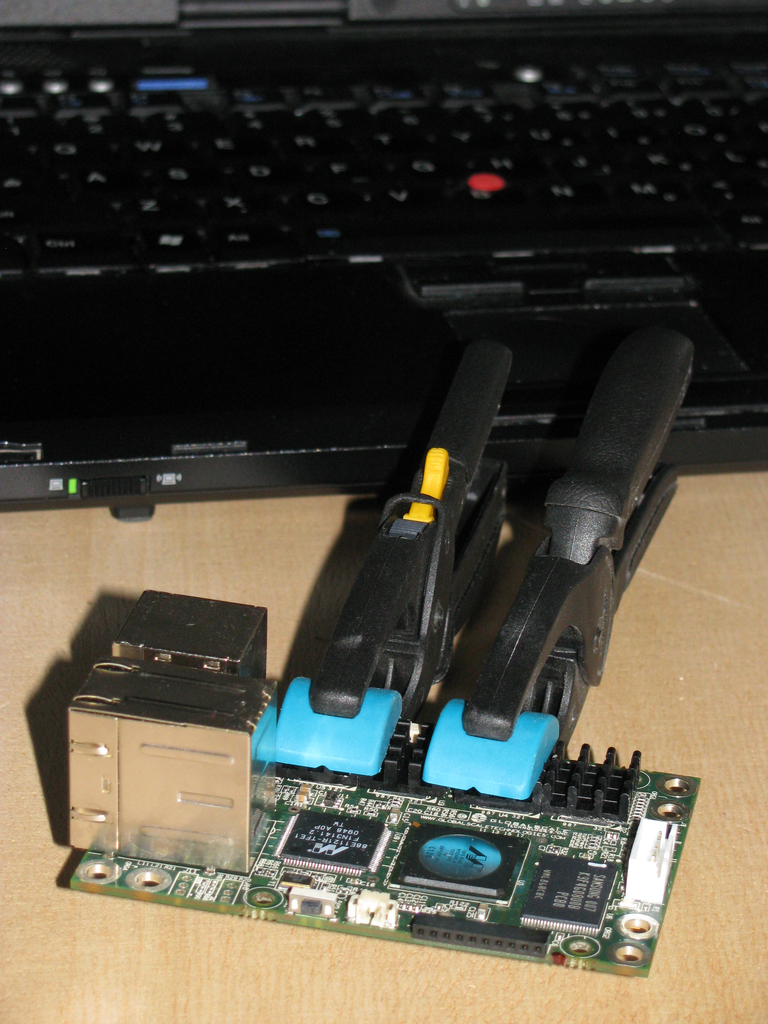
Heat sinks for the memory As there is a lot of space around the memory chips, I've got some 14x14x6mm heat sinks. Luckily there are only small parts on the other side of the board, so it was not hard to attach clamps to ensure the glue is able to dry properly. In case largish amounts of glue are squeezing out between heat sink and chip you probably want to start from scratch and clean everything (quickly!) with alcohol again. GuruPlug Server Plus memory heat sink clamping

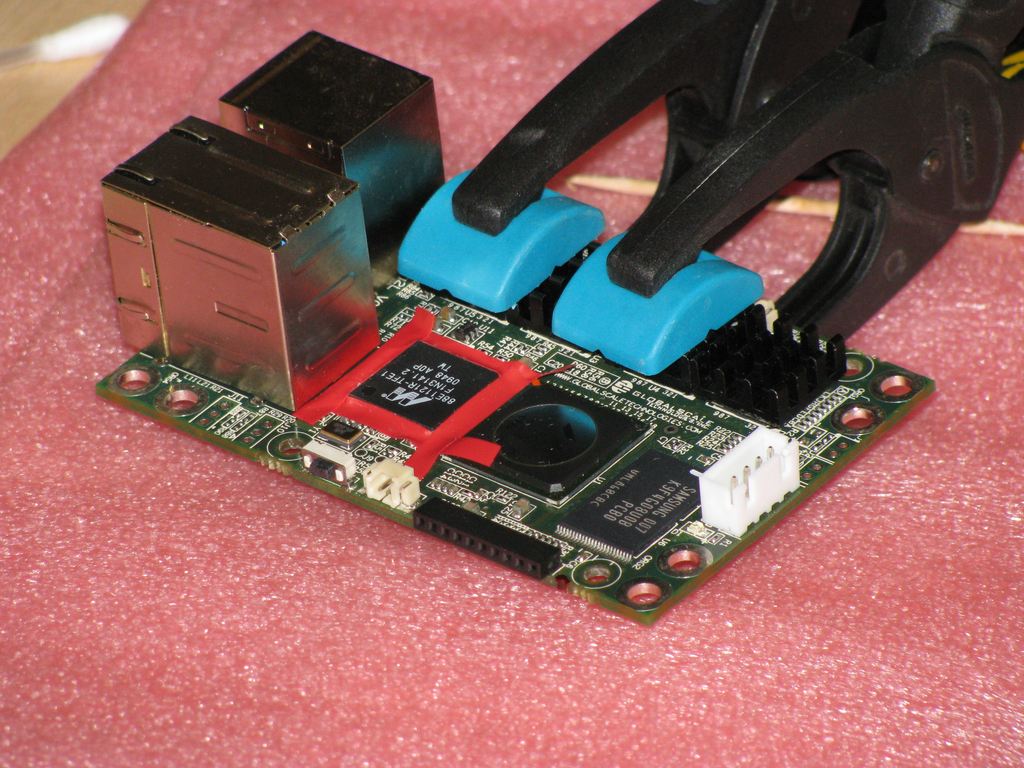
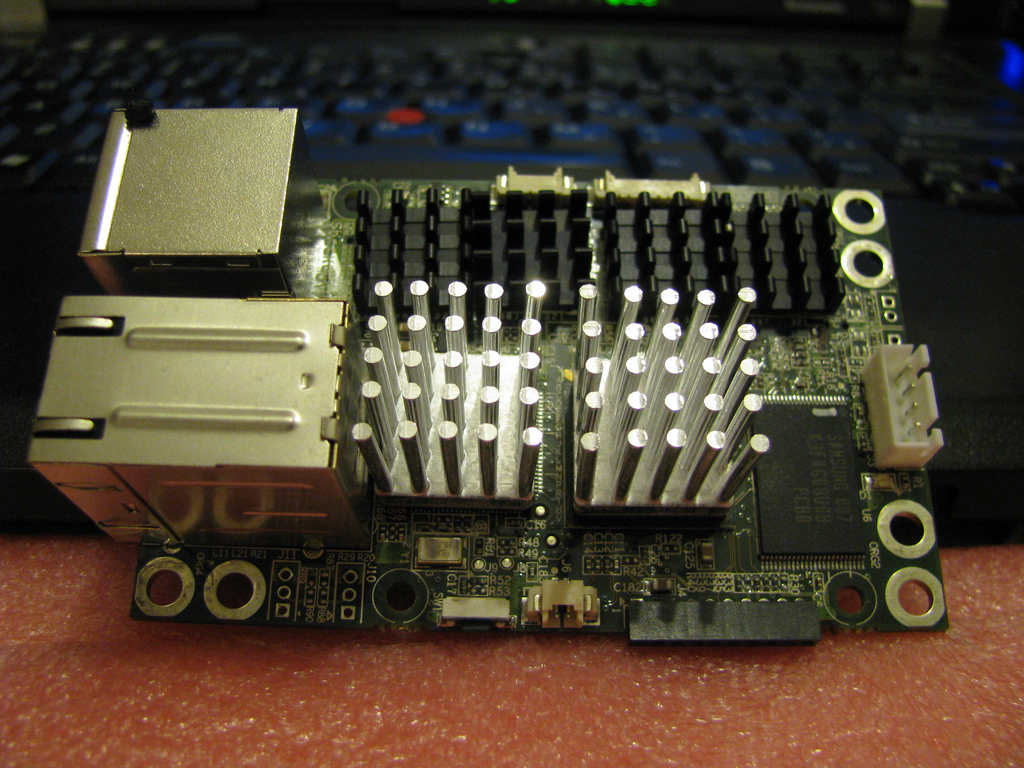
Gigabit Ethernet PHY and CPU heatsinks PHY and CPU need proper heatsinks as they're becoming pretty hot under load. Due to space limitations I had to stick with a 17x17x20mm heat sink for the PHY. I've tried to get a largish heat sink with BGA mount for the CPU, but I was not able to find one in short time and without ordering 1000 of them. So I've got another one of the 17x17x20mm model for the CPU. Later I found two other heat sinks which might fit on the GuruPlug's CPU: Malico 19x19x25mm or a Advanced Thermal Solutions Maxigrip. But for now the smaller one will have to do the job, also I'm scared to removed it without destroying the CPU. To mount the heat sink on the PHY a bit of preparation is necessary to ensure that the glue doesn't result in short cuts on the IC's pins. The arctic silver documentation recommends to use silicone on the pins to stop the glue. As I neither had the proper silicone nor did I want to make such a mess, I've decided to get a sticky insulating tape and some tooth picks to mount it properly on the IC pins. Make sure to do a proper job here! With good clamps you can work on the PHY while the memory heat sink glue is still drying. GuruPlug Server Plus - preparing the PHY The other problem on this side of the board is that some higher parts are mounted on the lower side of the board, so make sure to get some foam to protect them from your clamps. Except of the size of the heat sinks there is no real difference to the small ones: add glue, mount the heat sink and fix it with a clamp. GuruPlug Server Plus - mounting the PHY heatsink Before the glue dries completely make sure you remove the duct tape strips again. Be careful not to wipe any excess glue onto the IC pins. If you manage to do so you might want to remove and clean everything properly. So just be careful and everything should be fine. GuruPlug Server Plus - mounting the PHY heatsink 3 Mounting the heat sink on the CPU is easier as the CPU is a nice BGA package. No need to protect pins an there are none. GuruPlug Server Plus - mounting the CPU heatsink

Finished As you're able to see on the photo I did not the very perfect job, but fine enough to work properly. GuruPlug Server Plus - heatsinks

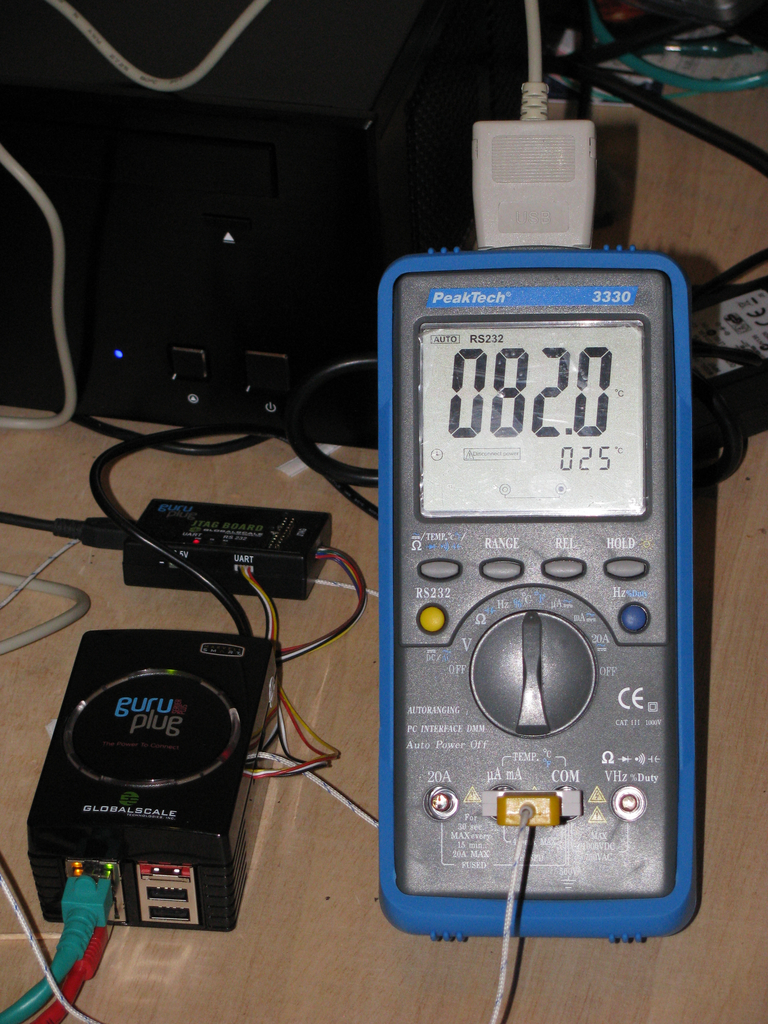
First tests with the new heatsinks Some tests with stress and some heavy network traffic showed quickly that the heat sinks are working well! But not well enough to be able to mount them into the original closed case (how the hell was this supposed to work before!?). Without any air to breath the temperature on the CPU heat sink went up to 85 deg C quickly. So on the CPU's die are > 100 deg C, which is at least close to the max allowed temperature. GuruPlug Server Plus - still too hot

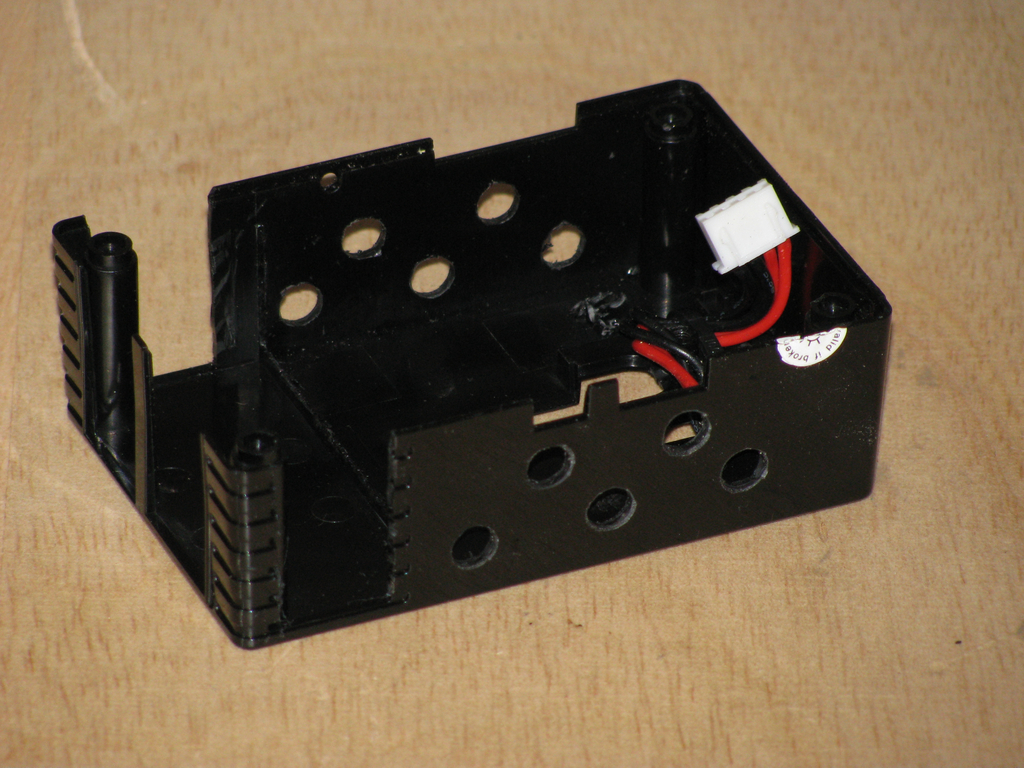
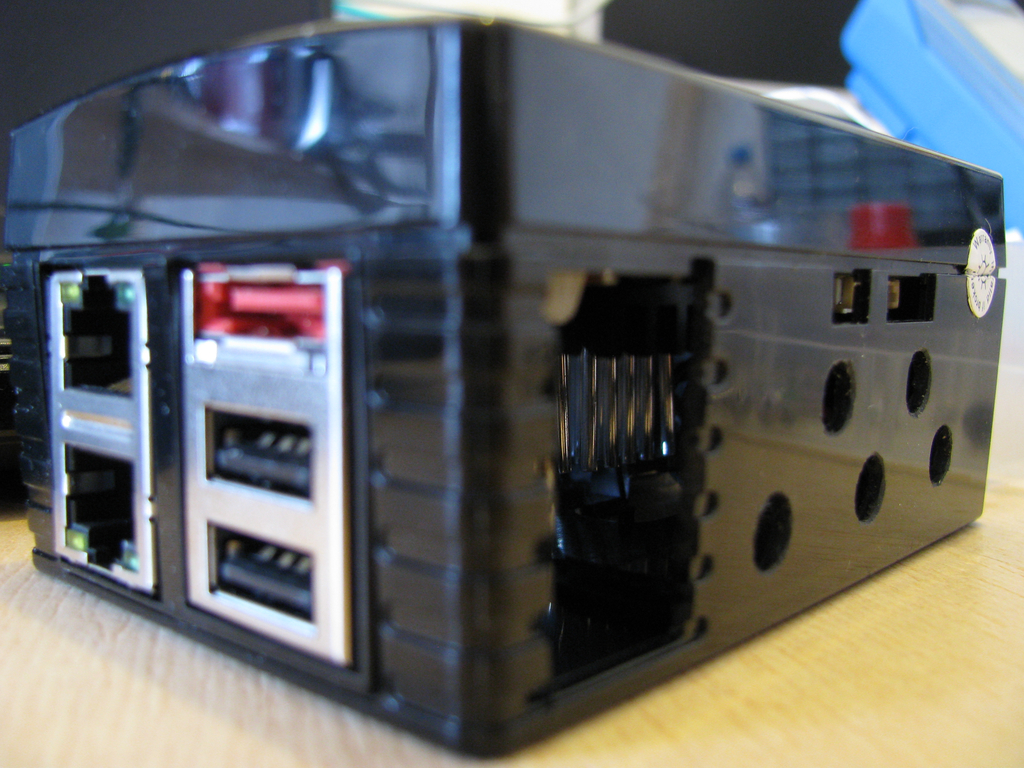
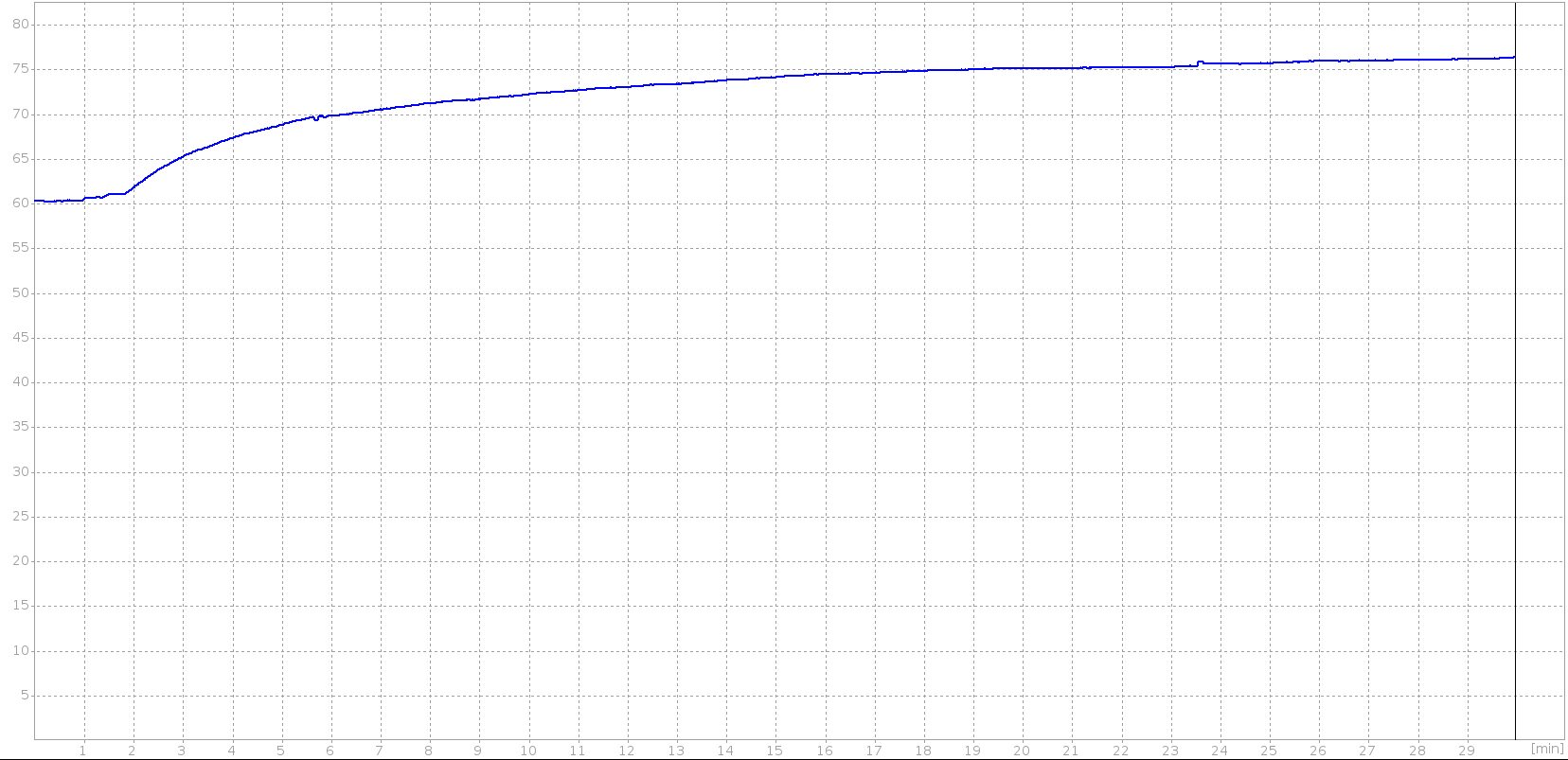
Adding air holes Obviously some additional air holes are necessary. After meeting my drill and cutter, the original case looks a bit like a piece of cheese now. GuruPlug Server Plus - case with air holes 1 GuruPlug Server Plus - case with air holes 2 Some more tests show that the temperature sticks around 76 deg C under heavy load now. That is still pretty hot, especially when the temperature in the room becomes hotter in summer. As I'm not going to run a lot of traffic trough it (my cable connection is limited to 20 MBit/s anyway), I guess it will work. Below is a graph I've recorded with my multimeter and qtdmm. It shows that the temperature rises to ~76 deg C and stays there. GuruPlug Server Plus - temperature curve Not sure if I could introuce some more load, the CPU had a load of 6 running stress. Network traffic was around 2x100MBit/s again. I could imagine with 2xGBit the CPU and PHY would become much hotter (no idea if it would be able to handle it at all, though). The PHY was usually a bit cooler than the CPU, so I didn't spend time to measure the temperature properly.

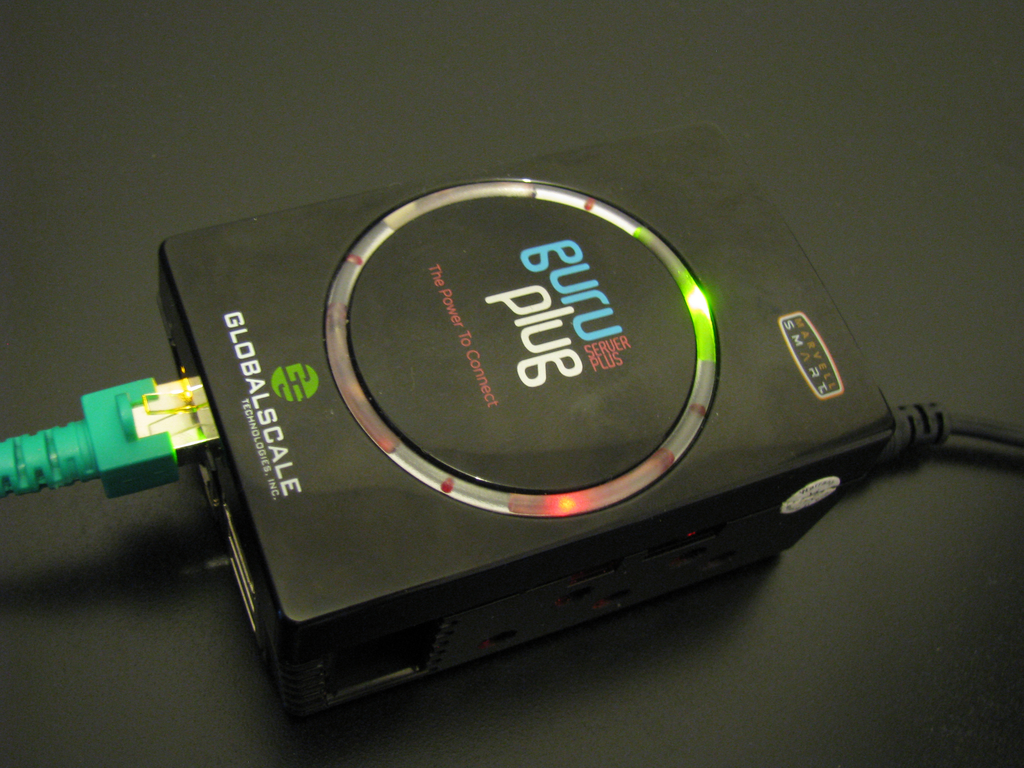
Conclusion My opinion is still the the original design of the plug is an insane QA and design failure. There is no way that it could ever work as shipped originally. If I'd have to design a new case for it, it should have a single insulated compartment for a PSU to ensure that no contact with high voltage is possible. The case around all other parts should be made of alloy with a lot of air holes. So the case could be used as heat sink (properly done, not with these insulating duct tape strips) and at the same time allow air circulation and a nice view on the LEDs on the board. Of course the case would be much more expensive than, but I'm sure it would work properly and would be worth the money. And if done peoperly, it would look much better than this blinking plastic thing. I could imagine it would sell well! So at the end I'm wondering what GlobalScale Technologies will do. I doubt it will be possible to create the 'professional upgrade kit' as they had announced before. Replacing all units is the only proper way. We'll see what happens. At least my GuruPlug is working well now and it will be used as replacement for my OpenWRT router soon. WiFi is not working, but that will be handled by my media center anyway. GuruPlug Server Plus - running plug

Dirk Eddelbuettel: Rcpp 0.8.6

After a somewhat longer than usual break, we now have a new release of Rcpp on CRAN and in Debian. This release adds quite few things. The main one may be the addition of density, distribution, quantile and random number functions for a rather large number of statistical distribution. Usage is pretty much as it would be in R, yet it is vectorised at the C++ level. A fair number of unit tests were added too, but some work is left to do there too.
Support for complex number was enhanced both in the expressive 'sugar' context and via a few binary operators that had been missing. We also started a new vignette to provide a 'quick reference'; unfortunately this is not quite complete yet. The NEWS entry follows below:
0.8.6   2010-09-09
    o	new macro RCPP_VERSION and Rcpp_Version to allow conditional compiling
        based on the version of Rcpp
    
           #if defined(RCPP_VERSION) && RCPP_VERSION >= Rcpp_Version(0,8,6)
           ...
           #endif
    o   new sugar functions for statistical distributions (d-p-q-r functions)
	with distributions : unif, norm, gamma, chisq, lnorm, weibull, logis,
	f, pois, binom, t, beta.
    o   new ctor for Vector taking size and function pointer so that for example
    	   NumericVector( 10, norm_rand )
	generates a N(0,1) vector of size 10
    o   added binary operators for complex numbers, as well as sugar support 
    o   more sugar math functions: sqrt, log, log10, exp, sin, cos, ...
    o	started new vignette Rcpp-quickref : quick reference guide of Rcpp API
        (still work in progress)
    o	various patches to comply with solaris/suncc stricter standards
    o	minor enhancements to ConvolutionBenchmark example
    o	simplified src/Makefile to no longer require GNU make; packages using
        Rcpp still do for the compile-time test of library locations
    
As always, even fuller details are in Rcpp Changelog page and the Rcpp page which also leads to the downloads, the browseable doxygen docs and zip files of doxygen output for the standard formats. A local directory has source and documentation too. Questions, comments etc should go to the rcpp-devel mailing list off the R-Forge page

Sylvain Le Gall: Dirty fix for omlet vim extension

omlet (or here) is a vim extension for writing OCaml code. In my opinion, it has a better indentation than the standard OCaml vim support. Unfortunately, it has a cost: the indentation vim code is more complex. And it has a few bugs :-( The main bug is that it doesn't like unbalanced comment opening "(*" and closing "*)" tags. From time to time, it enters an infinite (or very long) loop when there such a tag left in your file. It can be very far away from the point you are editing. It isn't too problematic, because unbalanced tags are a syntax error. But the problem is that it matches these tags inside strings also. So whenever you start using regular expression like "(.*)" the whole indentation fails. But there is a very ugly solution to this problem! Problematic code:
 let parse_rgxp =
   Pcre.regexp ~flags:[ CASELESS] 
     "^(?<license>[A-Z0-9\\-]*[A-Z0-9]+)\
      (?<version>-[0-9\\.]+)?(?<later>\\+)?\
      ( *with *(?<exception>.*) *exception)?$"
Solution, add ignore"(*":
 let parse_rgxp =
   ignore "(*";
   Pcre.regexp ~flags:[ CASELESS] 
     "^(?<license>[A-Z0-9\\-]*[A-Z0-9]+)\
      (?<version>-[0-9\\.]+)?(?<later>\\+)?\
      ( *with *(?<exception>.*) *exception)?$"
Very very ugly coder: you balance comment tags in dead code -- very very bad ;-) ps: another solution when the plugin enters the infinite loop, hit Ctrl-C. This will stop it and let you define your own indentation.

Keith Packard: altos-release

AltOS The Altus Metrum Operating System Altos is the core of the software for all of the Altus Metrum products. It runs on the 8051-based micro-controllers within both the flight computer and the ground station devices. AltOS a small cooperatively multi-tasking operating system. AltOS Version 0.7.1 Released Bdale and I have just released AltOS version 0.7.1. Version 0.7.1 is the first release to include the new Java-based ground station software which runs on Linux, Mac OS X and various Windows flavors. AltOS Changes in 0.7.1
  1. Deal with Windows and Mac OSX USB stacks. These two operating systems do interesting things with USB and found some boundary conditions within the AltOS USB stack which couldn t be tested on Linux. With test cases discovered, the panic calls were turned into code that dealt with these cases correctly.
  2. Increase packet mode payload size and add callsigns. The callsigns are set by the master end of the packet link (normally the TeleDongle) so that the entire radio conversation conforms to regulatory requirements. Increasing the payload size makes data transfers go faster.
  3. Place configuration data in fixed flash addresses. This change makes it possible to read the serial number and radio calibration data back out of the flash data when reprogramming a device.
TeleMetrum Changes in 0.7.1
  1. Ensure GPS date information is written to on-board data logger. The GPS date information is used when constructing eeprom log file names; without this, the eeprom downloading tool would generate a filename based on the current date.
  2. Allow TeleMetrum to be used as a programming dongle. This means the user can reprogram a TeleDongle or another TeleMetrum using the TeleMetrum as a programming dongle. Before this, only the TeleDongle could be used to program other devices.
AltosUI - Ground Station Software for Altus Metrum devices Version 0.7.1 is the first release containing our new cross-platform Java-based user interface. AltosUI can: Three Operating Systems, One AltosUI AltosUI provides all of these features on the three target operating systems, Linux, Mac OS X (version 10.5 or newer) and Windows (XP, Vista or 7). The bulk of the software is written in Java and is built once and tested and delivered on all three target platforms. A tiny shim library is built on each system to provide access to the Altus Metrum devices connected over the USB link. Thanks to our contributors! We ve gotten lots of help getting this software built and tested: Future Plans With the basic AltOS and AltosUI functionality running, we ve got lots of ideas about where to take the system in the future. And, we d love to hear ideas from you as well. Some of the ideas we ve like to get done include:
  1. Google Earth file export. We had a Linux-based C program to export a KML (Keyhole Markup Language) file that Google Earth can read and present to the user overlayed on satellite photo data.
  2. Data Plotting. Being able to plot flight data right in the UI would be nice, and there are several Java plotting packages available to try out.
  3. State-dependent display. When the rocket is on the pad, you only want to know if it s ready to fly. When the rocket is descending on a chute, you want to know where it is in the sky and how fast its falling. Presenting a limited amount of information that is most likely interesting to the user should make the display more useful.
  4. Ejection charge testing. The TeleMetrum firmware has the ability to fire ejection charges over the USB or radio links. Safely hooking this up to the user interface will allow for wireless ejection system testing. The key here is safely , of course, which means figuring out a fool proof user interface.
I m sure there are any number of additions that could be made to this list; feel free to send along ideas that you ve got. Of course, all of this software is licensed under the GNU General Public License, so you can get the source and hack on it in the comfort of your own home.

Dirk Eddelbuettel: Rcpp 0.8.6

After a somewhat longer than usual break, we now have a new release of Rcpp on CRAN and in Debian. This release adds quite few things. The main one may be the addition of density, distribution, quantile and random number function for a rather large number of statistical distribution. Usage is pretty much as it would be in R, yet it is vectorised at the C++ level. A fair number of unit tests were added too, but some work is left to do there too.
Support for complex number was enhanced both in the expressive 'sugar' context and via a few binary operators that had been missing. We also started a new vignette to provide a 'quick reference'; unfortunately this is not quite complete yet. The NEWS entry follows below:
0.8.6   2010-09-09
    o	new macro RCPP_VERSION and Rcpp_Version to allow conditional compiling
        based on the version of Rcpp
    
           #if defined(RCPP_VERSION) && RCPP_VERSION >= Rcpp_Version(0,8,6)
           ...
           #endif
    o   new sugar functions for statistical distributions (d-p-q-r functions)
	with distributions : unif, norm, gamma, chisq, lnorm, weibull, logis,
	f, pois, binom, t, beta.
    o   new ctor for Vector taking size and function pointer so that for example
    	   NumericVector( 10, norm_rand )
	generates a N(0,1) vector of size 10
    o   added binary operators for complex numbers, as well as sugar support 
    o   more sugar math functions: sqrt, log, log10, exp, sin, cos, ...
    o	started new vignette Rcpp-quickref : quick reference guide of Rcpp API
        (still work in progress)
    o	various patches to comply with solaris/suncc stricter standards
    o	minor enhancements to ConvolutionBenchmark example
    o	simplified src/Makefile to no longer require GNU make; packages using
        Rcpp still do for the compile-time test of library locations
    
As always, even fuller details are in Rcpp Changelog page and the Rcpp page which also leads to the downloads, the browseable doxygen docs and zip files of doxygen output for the standard formats. A local directory has source and documentation too. Questions, comments etc should go to the rcpp-devel mailing list off the R-Forge page

9 September 2010

Joerg Jaspert: Debian work

It has been a pretty exhausting time since my last blog post in my area of Debian land . If you followed the news you should have seen some of it. Last weekend there was the point release. For those I have the (good?) position to sit in the middle of the working queue, where the hardest part (sorting out which stuff to include, getting it all build, etc) is already done. Still, due to the amount of steps neccessary to take its usually a multi-hour thing. This one release was even slower, as we had to wait for hours until the package lists had all been built - unfortunately the thing writing that keeps berkeley db files of data around as cache - and uses the FULL path to the files as key. How stupidly annoying when the path changes during a server move. Ohwell. The other big part that got a tiny bit of press coverage was the move from www.backports.org over to backports.debian.org. This was actually waiting for me for a good longish while already (err, well, since well before DC9 this was decided to happen) but now I finally got myself moved. This turned out to be much more work than I ever feared (which is part of the reason why it took so long), but some numbers: The db update alone took me a week to figure out which steps to do in which order. Good to have an automated system, if you the manage to have the updates run specific to the main archive. Ups. When I was done with the database (during which I managed to just erase all work done by formorer and rhonda on the webpage, ups^2) I had some code and config cleanups to do, and especially manage to get it all running with a new path layout. Much less complicated, but enough work to do, before I finally was far enough to get it all move so far that formorer could start testing it and we could turn off the old system. At this time I had to fix up our shell scripts for our cron jobs, but that (with one exception) was a nearly straight forward easy task. And on Wednesday I managed another goal - backports is fully running the master branch of dak, the exact same code as on ftp-master. The cronjobs are slightly different, as well as the config (of course, duh), but otherwise its the same. My current goal and the last things left on this move todo is to change the cronjobs so that debian as well as backports do run the SAME scripts, but their configs list which tools should be run when. Considering that my dinstall cron already contains something pretty much a state machine I think I m insane enough to get this in shell, but when I told that to Mark (you know, the second ftpmaster :) ), I heard something very much like vomiting (you know, 700km between us, this might mean something) and then the plea to use a real language for the task. Oh my. I like my shell. :)
There is one big black cloud on the horizon to see. I have to do something similar for security. They are at a dak (and database) version pretty similar to what bpo had. They do need to support this obnoxious spare new format too before they can support security for squeeze, so there is no way I can ignore that archive for much longer. I already asked DSA for a vm in which I can play (not good to interrupt security archive for long), but probably wont start on this before the upcoming FTPMaster meeting. Pretty busy otherwise. Wellwell, I hope it will be less painful, as I now know the steps already. :)

Rapha&#235;l Hertzog: Can Debian achieve world domination without being on Facebook?

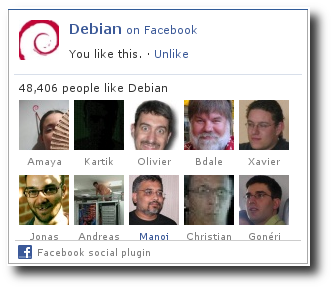
Debian Developers who like Debian on FacebookFacebook is not very popular among free software hackers. When I announced my Facebook page on identi.ca (see here) I got a few replies suggesting it was odd for me to use Facebook. Indeed there are many good reasons why Facebook should be avoided: it is a centralized and proprietary service that is not very privacy-friendly. But the truth is that lots of people are using it (even Debian developers, can you recognize them on the picture?) and some are using their Facebook news feed as their main source of news. You might wonder how many persons that represents, so here are the figures: the Debian Facebook page has 48,361 fans and the Ubuntu one has 247,932 fans. That s right, an announce put on the Debian facebook page would reach more persons than the most popular announce list that Debian is currently running (debian-announce@lists.debian.org has about 29,000 subscribers). Unfortunately that Debian Facebook page is empty and I don t even know who the administrator is. The Ubuntu page on the contrary is properly configured to relay news from The Fridge and Jono Bacon is posting some custom updates from time to time. Debian contributors regularly mention world domination as the ultimate goal of the universal operating system (I even feature this in my blog header banner! :-) ). But working towards world domination means in my opinion that we should communicate our ideals of freedom to as many people as possible, even if they are using a service that we don t want to promote. The Debian social contract acknowledges that some users have to use non-free software and we provide the non-free section for them. In the same spirit, I believe we must have a presence on Facebook. That does not mean that we endorse Facebook, and we should surely promote Joindiaspora once it s usable. But in the mean time we should reach out to Facebook users and allow them to follow us with the platform of their choice. That s the choice I recently made when I decided to setup a public facebook page featuring my free software work, my blog and my book. So if you are a Facebook user, click here to visit my page and click on Like if you want to follow this blog in your Facebook news feed. I also share interesting Debian or Ubuntu related articles that I discover while reading my RSS subscriptions. Below are the usual facebook widgets for the 3 pages quoted in this article (they might not show up if you read this article through an RSS feed):
<iframe allowtransparency="true" frameborder="0" scrolling="no" src="http://www.facebook.com/plugins/likebox.php?id=103161013077063&amp;width=292&amp;connections=0&amp;stream=false&amp;header=false&amp;height=62" style="border:none; overflow:hidden; width:292px; height:62px;"></iframe>
<iframe allowtransparency="true" frameborder="0" scrolling="no" src="http://www.facebook.com/plugins/likebox.php?id=9801962186&amp;width=292&amp;connections=0&amp;stream=false&amp;header=false&amp;height=62" style="border:none; overflow:hidden; width:292px; height:62px;"></iframe>
<iframe allowtransparency="true" frameborder="0" scrolling="no" src="http://www.facebook.com/plugins/likebox.php?id=6723083591&amp;width=292&amp;connections=0&amp;stream=false&amp;header=false&amp;height=62" style="border:none; overflow:hidden; width:292px; height:62px;"></iframe> Flattr this Share/Bookmark 14 comments Support my work

8 September 2010

Michal &#268;iha&#345;: phpMyAdmin GSoC 2010 summary

GSoC 2010 is over for some time and I should write some summary how students projects ended up. The very short summary is that all five students were successful and their work got merged. Follows description of the project in no particular order. Thanks to Martynas Mickevicius you can now get charts out of various parts of phpMyAdmin. They are used on server status pages or you can get query results in form of several charts. It seems to work pretty well at least what I've tried so far. Ankit Gupta was working on Visual Query Builder for phpMyAdmin. Unfortunately this is only project which is not yet merged to master branch, mostly because some UI things were not yet finished. But hopefully it will be merged soon. Adnan Mughal was converting our schema export feature from PDF to support multiple formats. You can now get the schema as SVG, DIA or even Visio formats, some of them will require a little bit of tuning still, because the scaling is not perfect. Ninad Pundalik did a lot of work on AJAXifying phpMyAdmin. His changes touched quite a lot of places and there are still some rough edges (as you can see in our bug tracker), but this is definitely welcome improvement and I hope it will get stable soon. Piotr Przybylski basically continued in his effort two years ago when he had reimplemented setup script and now he had focused on user configuration. It can be stored in session, browser local storage (HTML 5 feature) or in separate table in phpMyAdmin configuration storage (that's new name for pmadb). This is something what people were requesting for very long time and I'm happy we can finally bring this feature. And last but not least is Lorikeet Lee, who spend lot of time on tuning user interface of phpMyAdmin. The most visible changes are on export and import pages, which now should be less scaring for new users, but there are other changes in lot of other places, for example the main page. Generally it was a great summer and I hope we will be so successful also next year. PS: You can try all these features on http://demo.phpmyadmin.net/.

Giuseppe Iuculano: chromium-browser removed from testing

Ok, this happened, chromium-browser was removed from testing and will not be included in Debian squeeze. Some days ago (before the hard freeze) I contacted the release team and asked about a possible inclusion of Chromium 6 in squeeze. The main reason of this request is that in April there was at least one major refactoring of the SVG code (webkit). The internal webkit copy is too outdated in chromium 5, and backporting any future SVG security patches (and unfortunately the story says they are frequent) is very hard. I got no answer, and after one week of silence and the hard freeze announcement, I realized that chromium 5 is not supportable and decided to upload chromium 6 in unstable (It was already in experimental). I asked the Release Team to unblock chromium-browser 6.0.472.53~r57914-3 or remove chromium-browser 5.0.375.127~r55887-1 from testing. Well, after one hour they removed chromium-browser from testing. I failed, my efforts to get chromium in Squeeze were in vain. Debian failed, a modern and much appreciated web browser will not be included in our next stable release. Related posts:
  1. Why would you prefer chromium-browser in sid over google-chrome
  2. Chromium ready for unstable

Next.

Previous.