Search Results: "ean"

31 August 2013

Christian Perrier: DebConf 13: hacking outcome

I *did* some hacking at DebConf, as usual. For once, I had no TODO list: after all, I never complete these, so why make one? Still, I participated to discussions around samba packaging, mostly animated by Ivo De Decker and I think we're making good progress towards samba 4.x packages. The road is long, quite complicated, but we now have a stronger team, with a very active Ivo, Jeroen Dekkers who officially joined, Steve Langasek who still cherishes one of his pet packages (and even branched in our git with the Ubuntu packages). Great work and thanks to Ivo for pushing this forward. I also worked quite actively on the migration of fonts packages to git (I now reached the point where I'm more comfortable with git than SVN, yes, everything can happen). These packages were modernized at the same time and checked for new upstream versions (I have to say that few of these fonts had new upstream versions, indeed). We unfortunately found no time to have a good font BoF in Vaumarcus, indeed...but I'm not sure we would have many things to say. The work is done and done well, in this team. Some progress was made, also, for restoring a working "monolithic" build of D-I. This build gathers together all udebs from unstable, which means it offers a D-I image that uses ALL udebs from nustable.....which is not the default of other images. This would be very helpful for translators who want to check their work as soon as possible. In the future, with a Jenkins task that would build each package at each commit and then build a monolithic image, we could have a way to provide a tes snapshot of D-I git repos.....which could help catching more bugs (or more of my stupid mistakes). So, in general, I consider this a quite successful DebConf when it comes at "real" production.

Vincent Fourmond: First release of Tioga that works on win32

While I usually don't announce releases of tioga, as it is now mostly in maintenance mode, with not a lot of new features, today is a different story. I finally got around to try and build it on windows, and after a bit of a fight, I got it to compile and work there (I got hit by the classical fopen(file, "w") for binary files, that don't make any difference on Linux and Mac, but that do on Windows...). The release is already available on the rubyforge download page. Gems will be available later on today.To actually make it work on windows, here is what you need to install:And that's it ! That also means that ctioga2 works on windows, if you run:
gem install ctioga2

30 August 2013

Daniel Pocock: Big decision?

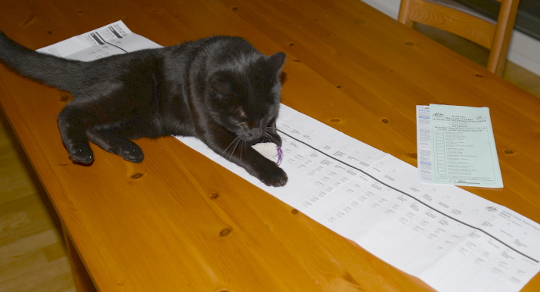
Most people have probably heard that elections are on in Australia. I just received my postal ballot paper the other day and in the spirit of transparency, I'm sharing it here on my blog. Spoilt for choice There are two ballots, one for the Lower House and the other for the Senate. The big one is for the Senate. Our cat is on top of it to help give some perspective on how big it is. Like the columns on a bloated spreadsheet, the parties are designated with symbols from A to AM and then there are some leftover candidates too. Animal instincts With so many candidates to choose from, even our kitty may have found an opportunity in the Animal Justice Party - although that little snack in her claws suggests that she is more interested in the law of the jungle than any political debate. She may want to be wary not to fall under the wheel of the party next to them, Motoring Enthusiasts. The Senate, a place for convicted hackers? The next party in the picture is Wikileaks and their number one candidate, of course, is the first person to successfully claim asylum from Australia, Julian Assange. It's no secret that he has a string of convictions for computer hacking in the 90s and that when US authorities catch up with him, their drone won't just be dropping him a letter demanding a $2,100 penalty fine through the window. So how do they compare? As I contemplate my decision, lets look at the numbers:
Party Seats won in 2010
House of Reps, Senate
Criminal charges against members in last 3 years
Labor Party 72, 31 173, mainly fraud
Liberal/National coalition (conservative) 73, 34 3, including shoplifting and assault
Wikileaks 0 None - Assange is not actually charged with any crime
All of a sudden, in a country that is often the butt of British jokes about convicts, Assange starts to look squeaky clean. He may take further comfort from knowing that out of all those crimes, hacking is the only one that appears to have the presidential seal of approval. Conclusion Whichever way I vote may or may not make so much difference. With so many candidates to choose from though, there is little sign of any quality leadership from any corner of Australian politics. Whether Mr Assange is elected or not, many people will have a chuckle when they realise he almost ended up alongside the Australian Sex Party out of 38 other possible parties randomly distributed across the ballot. Please feel free to comment: which party is the most ridiculous?

Joey Hess: best DebConf ever

For me, DebConf13 in Switzerland was a perfect DebConf, and generally an great developer meeting and conference. I've attended several past DebConfs in Canada, Norway, Brazil, Finland, Mexico, Scotland, Spain, NYC, Bosnia, and Nicaragua. I have special memories of each. DebConf13 was ideal in every way. Let's start with the camping. Only a minority of us did it, and my campsite was located in a small field behind a bar that was often noisy late into the night, when I was trying to rest and preserve my European jetlag remedy of inverted sleeping schedule. Still, I love sleeping cocooned in a tent, and going through the routines of camping and spending time alone there was a good counterpoint to DebConf. I generally find myself retreating for a day or two in the middle of a week-long conference, burnt out with social interactions. That didn't happen this time. I need to find way to camp at future DebConfs. (Also special shout out to wonderful people who lent me a warmer sleeping bag, and bought me a pillow while on a trip to town! Upgraded my first backpacking in Europe experience's comfort level a lot!) The next perfect thing for me were the talks I gave at DebConf. I always enjoy presenting at DebConf, and barely remember when I'd get nervous doing it. But I really felt comfortable giving these talks in a way I've not before. I'm pleased with how the Debian Cosmology talk turned out; I'd worried it would be a downer talk, or too light, or not well received, and none of those problems surfaced. I was especially happy with my dh_busfactor session, which I prepared for all of 10 minutes and was structured entirely to benefit me by talking over my thoughts and getting feedback, and in which I probably drove the camerapeople crazy running my own mic into the audience. Despite all that, I think it succeeded being interesting for the participants as well as for me. Hope to follow up on it soon.. But beyond the two talks I submitted, there were a series of ad-hoc scheduled talks. It seemed that every day I spent at least an hour discussing something I'm deeply involved in. This started with the Ikiwiki bof, and then there was an epic series of (unrecorded) BoFs about git stuff, which basically turned into an unofficial git track at DebConf. Much, much discussion of git-annex and other things I'm involved in. BTW, I really like that DebConf, as well as being a formal conference on top, is really an un-conference underneath, with new BoFs and things popping up on the schedule all week long. You can even have completely unscheduled meetings that somehow get just the right mix of people to make something awesome happen.
But it wasn't all about talks. Indeed, I only attended 2 or 3 sessions a day. The DebConf13 venue was controversial, but I found it excellent for getting things done. Rather than one or two massive rooms that get too noisy to think in, this venue had many little nooks and crannies suited for different types of work. There were so many I only discovered some while walking down the hill as I was leaving the venue! Anchoring it all was the excellent view, and I particularly enjoyed the "scenic hacklab". I was particularly impressed with the flexability of the venue's management. Someone asked if we could have cheese for breakfast, and every breakfast thereafter had not one but often three excellent cheeses. One day we'd be complaining that there were not enough vegetables in the food, and the next we'd be eating an excellent vegetarian Swiss lunch. They even apparently relaxed stringent Swiss rules on not allowing tents in sightlines visible from people further up the hill. They were clearly happy to welcome our crazy gathering to Le Camp. They let a DD borrow and use a chain saw and build a bonfire! The venue also encouraged getting out and exploring the surrounding countryside. Too often I end up spending the whole DebConf without seeing much of the area around. This time I at least got down the hill to see the castle in Vaumarcus a few times, and enjoyed many evening walks amoung the grape fields. The conference dinner (on a boat!) tied into this well too. And the daytrip to CERN was a great addition. We got to poke around the control center for a massive particle accellerator! My only regret is we didn't get a chance to actually go inside the LHC tunnels. Back to DebConf, another thing I really liked about this one was that its location allowed several upstream authors of software in Debian (other than the usual suspects who are both upstreams and Debian Developers) to attend. I don't know if Lennart Poettering changed any minds about systemd with his talk, but I was happy for the opportunity to buy him a beer. I didn't get to Monty's talk, but it was excellent to see him attend as well. Finally, I got to meet old friends I'd not seen in years, and new ones I've not met in real life before. We're still not sure where this whole DebConf thing is going -- will it be all about the cheese and wine party and greybeards in 20 years time? But one thing we know is we enjoy our little slice of the year where kilts and coding are equally unremarkable, where problems that seem intractable online somehow solve themselves in person, where we come away with ideas for an entire year and memories for a lifetime.

29 August 2013

Wouter Verhelst: RIP userdevfs

... and good riddance Just over 10 years ago now (it really has been that long), I had a first stab at adding some code to debian-installer to support m68k machines. As part of that, I invented userdevfs, a d-i module which would grep dmesg to figure out which hardware is detected, and would dynamically generate /dev entries based on that. It made it possible to use debian-installer without too much trouble on kernels that didn't support autoloading of modules (d-i expects the absense of a /dev entry to signal the absense of hardware), while our m68k kernel hadn't gone beyond 2.2 still; but it was always a bit of an ugly hack. At the time, I saw it as a short-time necessary evil. When the m68k port had been kicked from Debian, I would probably have thrown it out. Had it never been kicked from Debian, all else being equal, I would probably still have kicked it given a chance, since 2.6 kernels can now be run on m68k machines. All that is not true, though, since in the mean time my ugly hack had been repurposed to also work on ports that did support 2.6 and more recent kernels, but did not support autodetecting hardware. As such, it's still in recent Debian releases. Today, however, I noticed #717872, signalling that as the one port where it was still needed no longer did, my ugly hack has finally found its demise. That is a good thing.

28 August 2013

Matt Zimmerman: Scaling Human Systems: Roles and Responsibilities

This is part 5 in a series on organizational design and growth. What it means

Each of us has a job to do, probably more than one, and our teammates should know what they are. Why it s important

Roles are a kind of standing commitment we make to each other. They re a way of dividing up work which is easy to understand and simple to apply. Utilizing this tool will make it easier for us to coordinate our day to day work, and manage the changes and growth we re going through. Old Status Quo

Roles are vague or nonexistent. Management roles in particular are probably not well understood. Many people juggle multiple roles, all of which are implicit. Moving to a new team means learning from scratch what other people do. People take responsibility for tasks and decisions largely on a case-by-case basis, or based on implicit knowledge of what someone does (or doesn t do). In many cases, there is only one person in the company who knows how to perform a certain function. When someone leaves or goes on vacation, gaps are left behind. New Status Quo

Each individual has a clear understanding of the scope of their job. We have a handful of well defined roles, which are used by multiple teams and have written definitions. People who are new or transfer between teams have a relatively easy time understanding what the people around them are doing. Many day to day responsibilities are defined by roles, and more than one person can fill that role. When someone leaves a team, another person can cover their critical roles. Behaviors that help

Obstacles that stand in our way

27 August 2013

Neil McGovern: Adblock adding ads to block ads

shutterstock_151488752Confused yet? The popular browser extension AdBlock for Chrome/Chromium and Safari has launched a new crowdsourced campaign - to buy up internet advertising space inviting people to download AdBlock, so they can block ads. Additionally, if they raise enough, they'd like to get additional space for a billboard at Times Square, a full page spread in the New York Times, and even a TV slot at the Superbowl (although the target for this is $4.2M, so I'm not entirely confident they'll make it.) However, this does raise an interesting question, which has been under debate for some time. How do you make money on the internet without adverts? Wikipedia has a few interesting suggestions. Firstly, affiliate programmes. These mean that any products or services that are linked or searched via the original site earn a little bit of commission for that site. Founded in the mid-90s, and most famously used by Amazon, it's a possible method for getting money. However, it should be deployed with careful thought. If a blogger or reviewer is recommending a product, is it simply because they are being paid to do so, or is it a genuine endorsement? The BBC ban this practice, and the Society of Professional Journalists also has strong guidelines on taking gifts. Interestingly, a few search engines now offer this to browsers for them sending their default search traffic to them. Secondly, you could engage in (what I consider to be) the shady practice of data monetisation. People visit a website, and they leave data about their visit. By visiting here, you've told me that you're probably interested in technology issues, what country and city you're from, and where you came from. Other programmes and sites will also be able to wrap up what other sites you've visited, and can build up quite a profile of your browsing habits. Add together a rather unscrupulous vendor, and they can also know your contact details. This metadata can then be sold on. Thirdly, you can essentially ask your readers for money. Donations, via a micropayment link (which I use) or larger donation requests. Another method is to have a membership system, where content is locked up behind a paywall. This does, however, risk making your content less valuable as people will just head elsewhere for news and opinion. To counter this, a couple of sites (LWN, Slashdot) simply delay the latest news for a little while. Alternatively, you can just ask like the fantastic C G P Grey has done. Interestingly, he also has a great video on why advertising can be a bad thing for content creators. Lastly, you can sell things. This could be your authorship services on another site as a guest post, writing a book, offering consultancy services, or simple merchandise. In summary though, which is more honest? An advert may well bend your view on what sort of content is being created, but is at least a lot more open than potentially hiding real motives behind affiliate links, and a lot more open than selling data. Asking for money is fairly straightforward, though could easily backfire if it's viewed as begging. Google's advertising income totalled $43.7 billion in 2012 - so it's quite clear that advertising is big business. Websites cost money to run, can the web survive in an ad-free environment? If so, it certainly won't be the same web as we know today.

25 August 2013

Joey Hess: southern fried science fiction with plum sauce

Had an afternoon of steak and science fiction. Elysium is only so-so, but look what we found in a bookstore that was half religious materials and half SF, local books, and carefully hidden romance novels:
Star Wars, Star Trek and the 21st Century Christians
Best part was at the end, when I finally found one of the local asian markets Tomoko tells us about when she casually pulls out the good stuff at family gatherings. I will be back for whole ducks, fresh fish, squid, 50 lb bags of rice, tamarind paste, fresh ginger that has not sat on the shelf for 2 months because only I buy it, etc. Only an hour from home in the woods! Between the garlic scapes, bean sprouts, enoki mushrooms, etc that I got for $10 today and this week's CSA surprise of 18 inch snake beans and smoked pork knuckles, I have the epic stir fry potential.. Spock and R2D2

Yves-Alexis Perez: Expiration extension on PGP subkeys

So, last year I've switched to an OpenPGP smartcard setup for my whole personal/Debian PGP usage. When doing so, I've also switched to subkeys, since it's pretty natural when using a smartcard. I initially set up an expiration of one year for the subkeys, and everything seems to be running just fine for now. The expiration date was set to october 27th, and I though it'd be a good idea to renew them quite in advance, considering there's my signing key in there, which is (for example) used to sign packages. If the Debian archive considers my signature subkey expired, that means I can't upload packages anymore, which is a bit of a problem (although I think I could still upload packages signed by the main key). dak (Debian Archive Kit, the software managing the Debian archive) uses keys from the keyring provided by Debian admins, which is usually updated every month or so from the keyring.debian.org public key server, so pushing the expiration date two months before the due date seemed like a good idea. I've just did that, and it was pretty easy, actually. For those who followed my setup last year, here's how I did it: First, I needed my main smartcard (the one storing the main key), since it's the only one able to do operations on the subkeys. So I plug it, and then:
corsac@scapa: gpg --edit-key 71ef0ba8
gpg (GnuPG) 1.4.14; Copyright (C) 2013 Free Software Foundation, Inc.
This is free software: you are free to change and redistribute it.
There is NO WARRANTY, to the extent permitted by law.
Secret key is available.
pub  4096R/71EF0BA8  created: 2009-05-06  expires: never       usage: SC  
                     trust: ultimate      validity: ultimate
sub  4096g/36E31BD8  created: 2009-05-06  expires: never       usage: E   
sub  2048R/CC0E273D  created: 2012-10-17  expires: 2013-10-27  usage: A   
sub  2048R/A675C0A5  created: 2012-10-27  expires: 2013-10-27  usage: S   
sub  2048R/D98D0D9F  created: 2012-10-27  expires: 2013-10-27  usage: E   
[ultimate] (1). Yves-Alexis Perez <corsac@corsac.net>
[ultimate] (2)  Yves-Alexis Perez (Debian) <corsac@debian.org>
gpg&> key 2
pub  4096R/71EF0BA8  created: 2009-05-06  expires: never       usage: SC  
                     trust: ultimate      validity: ultimate
sub  4096g/36E31BD8  created: 2009-05-06  expires: never       usage: E   
sub* 2048R/CC0E273D  created: 2012-10-17  expires: 2013-10-27  usage: A   
sub  2048R/A675C0A5  created: 2012-10-27  expires: 2013-10-27  usage: S   
sub  2048R/D98D0D9F  created: 2012-10-27  expires: 2013-10-27  usage: E   
[ultimate] (1). Yves-Alexis Perez <corsac@corsac.net>
[ultimate] (2)  Yves-Alexis Perez (Debian) <corsac@debian.org>
gpg> expire
Changing expiration time for a subkey.
Please specify how long the key should be valid.
         0 = key does not expire
      <n>  = key expires in n days
      <n>w = key expires in n weeks
      <n>m = key expires in n months
      <n>y = key expires in n years
Key is valid for? (0) 429d
Key expires at mar. 28 oct. 2014 12:43:35 CET
Is this correct? (y/N) y
At that point, a pinentry dialog should ask you the PIN, and the smartcard will sign the subkey. Repear for all the subkeys (in my case, 3 and 4). If you ask for PIN confirmation at every signature, the pinentry dialog should reappear each time. When you're done, check that everything is ok, and save:
gpg> save
corsac@scapa: gpg --list-keys 71ef0ba8
gpg: checking the trustdb
gpg: public key of ultimately trusted key AF2195C9 not found
gpg: 3 marginal(s) needed, 1 complete(s) needed, PGP trust model
gpg: depth: 0  valid:   4  signed:   5  trust: 0-, 0q, 0n, 0m, 0f, 4u
gpg: depth: 1  valid:   5  signed:  53  trust: 5-, 0q, 0n, 0m, 0f, 0u
gpg: next trustdb check due at 2013-12-28
pub   4096R/71EF0BA8 2009-05-06
uid                  Yves-Alexis Perez <corsac@corsac.net>
uid                  Yves-Alexis Perez (Debian) <corsac@debian.org>
sub   4096g/36E31BD8 2009-05-06 [expires: 2014-10-28]
sub   2048R/CC0E273D 2012-10-17 [expires: 2014-10-28]
sub   2048R/A675C0A5 2012-10-27 [expires: 2014-10-28]
sub   2048R/D98D0D9F 2012-10-27 [expires: 2014-10-28]
Now that we have the new subkeys definition locally, we need to push it to the keyservers so other people get it too. In my case, I also need to push it to Debian keyring keyserver so it gets picked at the next update:
corsac@scapa: gpg --send-keys 71ef0ba8
gpg: sending key 71EF0BA8 to hkp server subkeys.pgp.net
corsac@scapa: gpg --keyserver keyring.debian.org --send-keys 71ef0ba8
gpg: sending key 71EF0BA8 to hkp server keyring.debian.org
Main smartcard now back in safe place. As far as I can tell, there's no operation needed on the daily smartcard (which only holds the subkeys), but you will need to refresh your public key on any machine you use it on before it gets the updated expiration date.

Matthias Klumpp: Some Tanglu updates

Tanglu Logo (big)Long time since I published the last update about Tanglu. So here is a short summary about what we did meanwhile (even if you don t hear that much, there is lots of stuff going on!) Better QA in the archive We now use a modified version of Debian s Britney tool to migrate packages from the newly-created staging suite to our current development branch aequorea . This ensures that all packages are completely built on all architectures and don t break other packages. New uploads and syncs/merges now happen through the staging area and can be tested there as well as being blocked on demand, so our current aequorea development branch stays installable and usable for development. People who want the *very* latest stuff, can embed the staging-sources into their sources.list (but we don t encourage you to do that). Improved syncs from Debian The Synchrotron toolset we use to sync packages with Debian recently gained the ability to sync packages using regular expressions. This makes it possible to sync many packages quickly which match a pattern. Tons of infrastructure bugfixes The infrastructure has been tweaked a lot to remove quirks, and it now works quite smoothly. Also, all Debian tools now work flawless in the Tanglu environment. A few issues are remaining, but nothing really important is affected anymore (and some problems are merely cosmetic). Long term we plan to replace the Jenkins build-infrastructure with the software which is running Paul Tagliamontes debuild.me (only the buildd service, the archive will still be managed by dak). This requires lots of work, but will result in software not only usable by Tanglu, but also by Debian itself and everyone who wants a build-service capable of building a Debian-distro. KDE 4.10 and GNOME 3.8 Tanglu now offers KDE 4.10 by default, a sync of GNOME 3.8 is currently in progress. The packages will be updated depending on our resources and otherwise just be synced from Debian unstable/experimental (and made working for Tanglu). systemd 204 & libudev1 Tanglu now offers systemd 204 as default init system, and we transitioned the whole distribution to the latest version of udev. This even highlighted a few issues which could be fixed before the latest systemd reached Debian experimental. The udev transition went nicely, and hopefully Debian will fix bug#717418 too, soon, so both distributions run with the same udev version (which obviously makes things easier for Tanglu ^^) Artwork We now have a plymouth-bootscreen and wallpapers and stuff is in progress :-) Alpha-release & Live-CD ? This is what we are working on we have some issues in creating a working live-cd, since live-build does have some issues with our stack. We are currently resolving issues, but because of the lack of manpower, this is progressing slowly (all contributors also work on other FLOSS projects and of course also have their work :P ) As soon as we have working live-media, we can do a first alpha release and offer installation media. You! Tanglu is a large task. And we need every help we can get, right now especially technical help from people who can build packages (Debian Developers/Maintainers, Ubuntu developers, etc.) We especially need someone to take care of the live-cd. But also the website needs some help, and we need more artwork or improved artwork ;-) In general, if you have an idea how to make Tanglu better (of course, something which matches it s goals :P ) and want to realize it, just come back to us! You can reach us on the mailiglists (tanglu-project for stuff related to the project, tanglu-devel for development of the distro) or in #tanglu / #tanglu-devel (on Freenode).

24 August 2013

Marko Lalic: PTS rewrite: Django Memory Usage


Rewriting the PTS in a fairly large Web framework such as Django is sure to cause larger memory consumption by even the more simple tasks, when compared to a couple of (loosely related) perl scripts. If anything, simply due to the fact that the entire Django machinery needs to be loaded.

However, just how large the memory consumption difference between the two can be seen in the example of the command to dispatch received package emails to users. In the new version, the command is implemented as a Django management command, whereas before it was a perl script dispatch.pl relying on the common.pl script for some additional functions.

The reason this command's memory usage is important is an incident with the current test deployment of the new PTS found at http://pts.debian.net. All package mails that the old PTS receives are also forwarded to the new instance in order to expose the new implementation to real-world mail traffic. At a certain point, over a hundred mails were received instantly causing over a hundred dispatch processes to be launched. This led to the system running out of memory and the kernel had to run the OOM Killer which brought down PostgreSQL server thereby causing the site to become unavailable.

For now, such a problem seems to have been prevented from reoccurring by setting up exim to queue messages when a certain system average load is exceeded, however it is interesting to check how large the memory consumption difference between the old and new dispatch really is.

Measurement setupIn order to measure the memory use, two messages of different sizes were used: 1KB and 1MB.

For the new PTS two cases were considered, when the database used is sqlite3 and PostgreSQL. In both cases, it was simply initialized by syncdb, meaning it contained only the default keywords found in the initial fixture and no registered users and subscriptions. The DEBUG setting was set to False.

For testing the old PTS's dispatch.pl, the database was also initialized empty.

This way, the tests should show the actual difference between the two implementations.

Since the main concern here is the maximum memory usage of the dispatch script, a simple bash script was written which takes a PID of a running process and outputs the maximum memory usage as reported by ps once the process is terminated. The script used is shown below.

#!/usr/bin/env bash

pid=$1

while ps $pid >/dev/null
do
ps -o vsz= $ pid
sleep 0.1
done sort -n tail -n1

Old PTS Measurements
The maximum memory usage of the old PTS was:
  1. 37.8 MB for the 1 KB message
  2. 38.2 MB for the 1 MB message

New PTS Measurements

sqlite3
The maximum memory usage of the new PTS using sqlite3 was:
  1. 91.77 MB for the 1 KB message
  2. 92.59 MB for the 1 MB message

PostgreSQL

The maximum memory usage of the new PTS using PostgreSQL was:
  1. 148 MB for the 1 KB message
  2. 160 MB for the 1 MB message

Comparison and DiscussionWhen comparing the memory used by the old dispatch.pl implementation and the new PTS running sqlite3, the difference does not seem to be too large and is to be expected, since, as mentioned, the whole Django framework is loaded when executing a management command.

However, the huge difference between the two versions of the new PTS: the one using sqlite3 and the one using PostgreSQL is very surprising indeed.

Another interesting measurement is the difference between running a bare Django management command: one including only a sleep statement (in order to allow enough time to measure its memory usage) on PostgreSQL and sqlite3. In both cases, the memory usage was only about 1 MB less than what the respective maximum memory usage when processing the 1 KB message.

All this considered, the logical conclusion seems to be that either psycopg2 package and/or the Django postgresql_psycopg2 database engine use a lot more memory than the corresponding sqlite3 alternatives.

Could anyone shed some more light as to what causes this stark difference between using sqlite3 and Postgres in Django? Anything that could be done to mitigate it?

23 August 2013

Thorsten Glaser: FrOSCon 2013, or, why is there no MirBSD exhibit?

FrOSCon is approaching, and all MirBSD developers will attend but why s there no MirBSD exhibit? The answer to that is a bit complex. First let s state that of course we will participate in the event as well as the Open Source world. We ll also be geocaching around the campus with other interested (mostly OSS) people (including those we won for this sport) and helping out other OSS projects we ve become attached to. MirOS BSD, the operating system, is a niche system. The conference on the other hand got younger and more mainstream. This means that almost all conference visitors do not belong to the target group of MirOS BSD which somewhat is an ancient solution : the most classical BSD around (NetBSD loses because they have rc.d and PAM and lack sendmail(8), sorry guys, your attempt at being not reformable doesn t count) and running on restricted hardware (such as my 486SLC with 12 MiB RAM) and exots (SPARCstation). It s viable even as developer workstation (if your hardware is supported otherwise just virtualise it) but its strength lies with SPARC support and embedded x86 . And being run as virtual machine: we re reportedly more stable and more performant than OpenBSD. MirBSD is not cut off from modern development and occasionally takes a questionable but justified choice (such as using 16-bit Unicode internally) or a weird-looking but beneficial one (such as OPTU encoding saving us locale(1) hassles) or even acts as technological pioneer (64-bit time_t on ILP32 platforms) or, at least, is faster than OpenBSD (newer GNU toolchain, things like that), but usually more conservatively, and yes, this is by design, not by lack of manpower, most of the time. The MirPorts Framework, while technically superiour in enough places, is something that just cannot happen without manpower. I (tg@) am still using it exclusively, continuing to update ports I use and occasionally creating new ones (mupdf is in the works!), but it s not something I d recommend someone (other than an Mac OSX user) to use on a n n-MirBSD system (Interix is not exactly thriving either, and the Interix support was only begun; other OSes are not widely tested). The MirBSD Korn Shell is probably the one thing I will be remembered for. But I have absolutely no idea how one would present it on a booth at such an exhibition. A talk is much more likely. So no on that front too. jupp, the editor which sucks less, is probably something that does deserve mainstream interest (especially considering Natureshadow is using it while teaching computing to kids) but probably more in a workshop setting. And booth space is precious enough in the FH so I think that d be unfair. All the other subprojects and side projects Benny and I have, such as mir c , josef stalin, FreeWRT, Lunix Ewe, Shellsnippets, the fonts, etc. are interesting but share few, if any, common ground. Again, this does not match the vast majority of visitors. While we probably should push a number of these more, but a booth isn t it here, either. MirOS Linux ( MirLinux ) and MirOS Windows are, despite otherwise-saying rumours called W*k*p*d*a, only premature ideas that will not really be worked on (though MirLinux concepts are found in mir c and stalin). As you can see, despite all developers having full-time dayjobs, The MirOS Project is far from being obsolete. We hope that our website visitors understand our reasons to not have an exhibition booth of our own (even if the SPARCstation makes for a way cool one, it s too heavy to lift all the time), and would like to point out that there are several other booths (commercial ones, as well as OSS ones such as AllBSD, Debian and (talking to) others) and other itineries we participate in. This year both Benny and I have been roped into helping out the conference itself, too (not exactly unvoluntarily though). The best way to talk to us is IRC during regular European geek hours (i.e. until way too late into the night which Americans should benefit from), semi-synchronously, or mailing lists. We sort of expect you to not be afraid to RTFM and look up acronyms you don t understand; The MirOS Project is not unfriendly but definitely not suited for your proverbial Aunt Tilly, newbies, desktop users, and people who aren t at least somewhat capable of using written English (this is by design).

Justus Winter: No noweb anymore...

... which is probably a good thing. But here is the boot log you all have been waiting for:
start ext2fs: Hurd server bootstrap: ext2fs[device:hd0s1] exec init proc auth
INIT: version 2.88 booting
Using makefile-style concurrent boot in runlevel S.
Activating swap...done.
Checking root file system...fsck from util-linux 2.20.1
hd2 : tray open or drive not ready
end_request: I/O error, dev 02:00, sector 0
/dev/hd0s1: clean, 44693/181056 files, 291766/723200 blocks
done.
Activating lvm and md swap...(default pager): Already paging to partition hd0s5!
done.
Checking file systems...fsck from util-linux 2.20.1
hd2 : tray open or drive not ready
end_request: I/O error, dev 02:00, sector 0
done.
Cleaning up temporary files... /tmp.
Mounting local filesystems...done.
Activating swapfile swap...(default pager): Already paging to partition hd0s5!
done.
df: Warning: cannot read table of mounted file systems: No such file or directory
Cleaning up temporary files....
Configuring network interfaces...Internet Systems Consortium DHCP Client 4.2.2
Copyright 2004-2011 Internet Systems Consortium.
All rights reserved.
For info, please visit https://www.isc.org/software/dhcp/
Listening on Socket//dev/eth0
Sending on   Socket//dev/eth0
*** stack smashing detected ***: dhclient terminated
Aborted
Failed to bring up /dev/eth0.
done.
Cleaning up temporary files....
Setting up X socket directories... /tmp/.X11-unix /tmp/.ICE-unix.
INIT: Entering runlevel: 2
Using makefile-style concurrent boot in runlevel 2.
Starting enhanced syslogd: rsyslogd.
Starting deferred execution scheduler: atd.
Starting periodic command scheduler: cron.
Starting system message bus: dbusFailed to set socket option"/var/run/dbus/system_bus_socket": Protocol not available.
Starting OpenBSD Secure Shell server: sshd.
unexpected ACK from keyboard
GNU 0.3 (debian) (console)
login: root
[...]
root@debian:~# ifup /dev/eth0
Internet Systems Consortium DHCP Client 4.2.2
Copyright 2004-2011 Internet Systems Consortium.
All rights reserved.
For info, please visit https://www.isc.org/software/dhcp/
Listening on Socket//dev/eth0
Sending on   Socket//dev/eth0
*** stack smashing detected ***: dhclient terminated
Aborted
Failed to bring up /dev/eth0.
root@debian:~# dhclient -v -pf /run/dhclient.-dev-eth0.pid -lf /var/lib/dhcp/dhclient.-dev-eth0.leases /dev/eth0
Internet Systems Consortium DHCP Client 4.2.2
Copyright 2004-2011 Internet Systems Consortium.
All rights reserved.
For info, please visit https://www.isc.org/software/dhcp/
Listening on Socket//dev/eth0
Sending on   Socket//dev/eth0
*** stack smashing detected ***: dhclient terminated
Aborted
root@debian:~# dhclient -pf /run/dhclient.-dev-eth0.pid -lf /var/lib/dhcp/dhclient.-dev-eth0.leases /dev/eth0
root@debian:~# ifup /dev/eth0
Internet Systems Consortium DHCP Client 4.2.2
Copyright 2004-2011 Internet Systems Consortium.
All rights reserved.
For info, please visit https://www.isc.org/software/dhcp/
Listening on Socket//dev/eth0
Sending on   Socket//dev/eth0
DHCPREQUEST on /dev/eth0 to 255.255.255.255 port 67
DHCPACK from 10.0.2.2
bound to 10.0.2.15 -- renewal in 34108 seconds.
ps: comm: Unknown format spec
root@debian:~# halt
Broadcast message from root@debian (console) (Fri Aug 23 19:42:19 2013):
The system is going down for system halt NOW!
INIT: Switching to runlevel: 0root@debian:~#
INIT: Sending processes the TERM signal
INIT: Sending processes the KILL signal
Using makefile-style concurrent boot in runlevel 0.
Stopping deferred execution scheduler: atd.
task c10f53f8 deallocating an invalid port 2098928, most probably a bug.
Asking all remaining processes to terminate...done.
All processes ended within 1 seconds...done.
Stopping enhanced syslogd: rsyslogd.
Deconfiguring network interfaces...Internet Systems Consortium DHCP Client 4.2.2
Copyright 2004-2011 Internet Systems Consortium.
All rights reserved.
For info, please visit https://www.isc.org/software/dhcp/
Listening on Socket//dev/eth0
Sending on   Socket//dev/eth0
DHCPRELEASE on /dev/eth0 to 10.0.2.2 port 67
/dev/eth0 (2):
  inet address  0.0.0.0
  netmask       255.255.255.0
  broadcast     10.0.2.255
  flags         BROADCAST ALLMULTI MULTICAST
  mtu           1500
done.
Deactivating swap...swapoff: /dev/hd0s5: 177152k swap space
done.
Unmounting weak filesystems...umount: /etc/mtab: Warning: duplicate entry for device /dev/hd0s1 (/servers/socket/26)
umount: /etc/mtab: Warning: duplicate entry for device /dev/hd0s1 (/dev/cons)
umount: could not find entry for: /dev/cons
umount: could not find entry for: /servers/socket/26
done.
mount: cannot remount /: Device or resource busy
Will now halt.
store a new irq 11init: notifying pfinet of shutdown...init: notifying tmpfs swap of shutdown...init: notifying tmpfs swap of shutdown...init: notifying tmpfs swap of shutdown...init: notifying ext2fs device:hd0s1 of shutdown...init: halting Mach (flags 0x8)...
In tight loop: hit ctl-alt-del to reboot
With some tiny patches for ifupdown I've been able to resolve network related issues. All of them? Of course not, funny thing about developing for the Hurd is that once you fix one thing, then some other thing or code path is executed that has never been run on Hurd before, and therefore something else breaks. In this case I fixed ifupdown to generate valid names for the pid file and leases file and all of the sudden dhclient starts dying. Funny thing about that is, if one drops the -v flag from the dhclient invocation as I did it above, the crash isn't triggered and once the lease file has been successfully written, it is safe to add the -v flag again. Not yet sure what goes on there, then again, looking at the source of isc-dhcp-client it is not so surprising that it crashes :/ When I first looked at ifupdown it was written in noweb, a literate programming tool. It is an interesting idea, even more so since (classic) c can be very verbose and cryptic. But it decouples the control flow from the structure of the program, which makes patching it quite a challenge since it is not as obvious where the changes have to go in. This is how ifupdown looked some weeks ago:
% wc --lines ifupdown.nw
6123 ifupdown.nw
% pdftk ifupdown.pdf dump_data   grep NumberOfPages
NumberOfPages: 113
The ifupdown.nw is the noweb source, from which seven .c, four .h, two .pl and one Makefile are generated. It also contains a redicioulus amount of documentation, to the point that the authors at several points did not now what to write and just drop some nonsensical lines into the file. The source also compiles to a 113 page pdf file, that contains all of the documentation and all of the code, not at all in the order that one would expect a program to be written, but in the order the authors chose to structure the documentation. Fortunately for me the maintainer decided to drop the noweb source and to add the generated files to the source control system. This made my job much easier :) So here are the patches I published this week: I must admit that I do not know exactly what I will do next week. Obviously fixing the dhclient crash would be nice, I'll look into that. But I'm surely find some useful thing to do.

22 August 2013

Matthew Garrett: Re: Default offerings, target audiences, and the future of Fedora

Eric (a fellow Fedora board member) has a post describing his vision for what Fedora as an end goal should look like. It's essentially an assertion that since we have no idea who our users are or what they want, we should offer them everything on an equal footing.

Shockingly enough, I disagree.

At the most basic level, the output of different Special Interest Groups is not all equal. We've had issues over the past few releases where various spins have shipped in a broken state, because the SIG responsible for producing them doesn't have the resources to actually test them. We're potentially going to end up shipping F20 with old Bluetooth code because the smaller desktops aren't able to port to the new API in time[1]. Promoting these equally implies that they're equal, and doing so when we know it isn't the case is a disservice to our users.

But it's not just about our users. Before I joined the Fedora project, I'd worked on both Debian and Ubuntu. Debian is broadly similar to the current state of Fedora - no strong idea about what is actually being produced, and a desire among many developers to cater to every user's requirements. Ubuntu's pretty much the direct opposite, with a strongly defined goal and a willingness to sacrifice some use cases in order to achieve that goal.

This leads to an interestingly different social dynamic. Ubuntu contributors know what they're working on. If a change furthers the well-defined aim of the project, that change happens. Moving from Ubuntu to Fedora was a shock to me - there were several rough edges in Fedora that simply couldn't be smoothed out because fixing them for one use case would compromise another use case, and nobody could decide which was more important[2]. It's basically unthinkable that such a situation could arise in Ubuntu, not just because there was a self appointed dictator but because there was an explicit goal and people could prioritise based on that[3].

Bluntly, if you have a well-defined goal, people are more likely to either work towards that goal or go and do something else. If you don't, people will just do whatever they want. The risk of defining that goal is that you'll lose some of your existing contributors, but the benefit is that the existing contributors will be more likely to work together rather than heading off in several different directions.

But perhaps more importantly, having a goal can attract people. Ubuntu's Bug #1 was a solid statement of intent. Being freer than Microsoft wasn't enough. Ubuntu had to be better than Microsoft products on every axis, and joining Ubuntu meant that you were going to be part of that. Now it's been closed and Ubuntu's wandered off into convergence land, and signing up to spend your free time on producing something to help someone sell phones is much less compelling than doing it to produce a product you can give to your friends.

Fedora should be the obvious replacement, but it's not because it's unclear to a casual observer what Fedora actually is. The website proudly leads with a description of Fedora as a fast, stable and powerful operating system, but it's obvious that many of the community don't think of Fedora that way - instead it's a playground to produce a range of niche derivatives, with little consideration as to whether contributing to Fedora in that way benefits the project as a whole. Codifying that would actively harm our ability to produce a compelling product, and in turn reduce our ability to attract new contributors even further.

Which is why I think the current proposal to produce three first-class products is exciting. Offering several different desktops on the download page is confusing. Offering distinct desktop, server and cloud products isn't. It makes it clear to our users what we care about, and in turn that makes it easier for users to be excited about contributing to Fedora. Let's not make the mistake of trying to be all things to all people.

[1] Although clearly in this case the absence of a stable ABI in BlueZ despite it having had a dbus interface for the best part of a decade is a pretty fundamental problem.
[2] See the multi-year argument over default firewall rules and the resulting lack of working SMB browsing or mDNS resolving
[3] To be fair, one of the reasons I was happy to jump ship was because of the increasingly autocratic way Ubuntu was being run. By the end of my involvement, significant technical decisions were being made in internal IRC channels - despite being on the project's Technical Board, I had no idea how or why some significant technical changes were being made. I don't think this is a fundamental outcome of having a well-defined goal, though. A goal defined by the community (or their elected representatives) should function just as well.

comment count unavailable comments

Petter Reinholdtsen: Second beta release (beta 1) of Debian Edu/Skolelinux based on Debian Wheezy

The second wheezy based beta release of Debian Edu was wrapped up today, slightly delayed because of some bugs in the initial Windows integration fixes . This is the release announcement: New features for Debian Edu 7.1+edu0~b1 released 2013-08-22 These are the release notes for Debian Edu / Skolelinux 7.1+edu0~b1, based on Debian with codename "Wheezy". About Debian Edu and Skolelinux Debian Edu, also known as Skolelinux, is a Linux distribution based on Debian providing an out-of-the box environment of a completely configured school network. Immediately after installation a school server running all services needed for a school network is set up just waiting for users and machines being added via GOsa , a comfortable Web-UI. A netbooting environment is prepared using PXE, so after initial installation of the main server from CD or USB stick all other machines can be installed via the network. The provided school server provides LDAP database and Kerberos authentication service, centralized home directories, DHCP server, web proxy and many other services. The desktop contains more than 60 educational software packages and more are available from the Debian archive, and schools can choose between KDE, Gnome, LXDE and Xfce desktop environment. This is the sixth test release based on Debian Wheezy. Basically this is an updated and slightly improved version compared to the Squeeze release. ALERT: Alpha based installations should reinstall or downgrade the versions of gosa and libpam-mklocaluser to the ones used in this beta release. Both alpha and beta0 based installations should reinstall or deal with gosa.conf manually; there are two options: (1) Keep gosa.conf and edit this file as outlined on the mailing list. (2) Accept the new version of gosa.conf and replace both contained admin password placeholders with the password hashes found in the old one (backup copy!). In both cases every user need to change their their password to make sure a password is set for CIFS access to their home directory. Software updates Other changes Known issues Where to get it To download the multiarch netinstall CD release you can use The MD5SUM of this image is: 1e357f80b55e703523f2254adde6d78b
The SHA1SUM of this image is: 7157f9be5fd27c7694d713c6ecfed61c3edda3b2 To download the multiarch USB stick ISO release you can use The MD5SUM of this image is: 7a8408ead59cf7e3cef25afb6e91590b
The SHA1SUM of this image is: f1817c031f02790d5edb3bfa0dcf8451088ad119 How to report bugs http://wiki.debian.org/DebianEdu/HowTo/ReportBugs

21 August 2013

Rog rio Brito: SNA Acceleration vs. UXA Acceleration

Seeing as recent versions of Xorg have made it into Debian's testing (which I am using right now, instead of my usual sid installations), I decided to see what they would bring me in terms of performance, since they have the SNA acceleration implemented as well as the standard UXA acceleration. Well, I did not have any other tests to perform, but below are the results on my wife's laptop (a Core i5 2410M), when running gtkperf: With UXA
GtkPerf 0.40 - Starting testing: Mon Aug 12 20:33:20 2013
GtkEntry - time:  0.19
GtkComboBox - time:  5.36
GtkComboBoxEntry - time:  3.59
GtkSpinButton - time:  0.60
GtkProgressBar - time:  0.41
GtkToggleButton - time:  0.73
GtkCheckButton - time:  0.48
GtkRadioButton - time:  0.97
GtkTextView - Add text - time: 21.72
GtkTextView - Scroll - time:  2.29
GtkDrawingArea - Lines - time:  6.18
GtkDrawingArea - Circles - time:  6.74
GtkDrawingArea - Text - time:  4.32
GtkDrawingArea - Pixbufs - time:  0.67
 --- 
Total time: 54.25
With SNA
GtkPerf 0.40 - Starting testing: Mon Aug 12 20:36:58 2013
GtkEntry - time:  0.21
GtkComboBox - time:  4.86
GtkComboBoxEntry - time:  2.67
GtkSpinButton - time:  0.59
GtkProgressBar - time:  0.24
GtkToggleButton - time:  0.61
GtkCheckButton - time:  0.51
GtkRadioButton - time:  1.00
GtkTextView - Add text - time: 17.19
GtkTextView - Scroll - time:  1.84
GtkDrawingArea - Lines - time:  2.70
GtkDrawingArea - Circles - time:  2.65
GtkDrawingArea - Text - time:  1.72
GtkDrawingArea - Pixbufs - time:  0.11
 --- 
Total time: 36.91
So, with SNA, the timing that I get are almost 2 times lower, which is superb for a very simple /etc/X11/xorg.conf config file:
Section "Device"
        Identifier "Intel Graphics"
        Driver "intel"
        Option "AccelMethod" "sna"
EndSection
I have not noticed any change, but if drawing graphics faster means that I get a bit more of battery life, then I will be super happy. I still have not tested if this works on my notebook with a Core2Duo T7250. Crossing my fingers so that it does.

19 August 2013

Sylvestre Ledru: Clang 3.3 and Debian

The LLVM toolchain version 3.3 has been released a couple months ago.
Here are now the result of the rebuild of Debian archive using this version of the compiler.
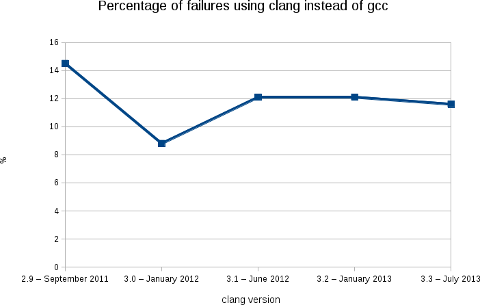
Like the previous releases, we are at a bit less than 12% of packages failing (2188 packages on a total of 18854).
More warnings / errors detections have been added to the software (for example: like this defect of the C++ standard or the detection of unused linker option) causing more build failures, but, in the mean time, we fixed some issues in the Debian packages... As usual, the following image shows clearly the evolution of the build failures over time.
As stated in my blog post for the release 3.2, this rebuilds prove that Clang is ready for production in term of support of the C, C++ and Objective C languages. With the performance results showed by Chandler Carruth from Google at the last Euro LLVM summit (see this video from 5:40), I believe that it is now time to report and fix the bugs in the upstream packages. I also presented this work (video) at the Debconf 13 last week in Vaumarcus (Switzerland) and I will be also presenting this work at the Linux Plumbers Conference, New Orleans. With L o Cavaille (as part of his GSOC) and Paul Tagliamonte, we are also working on providing a better automatic rebuild infrastructure for clang-built packages (and other static analyzers). More in the next few weeks. Finally, I would like to thank folks at AWS for the Debian credit and David Suarez for helping on with the Ruby segfaults.

17 August 2013

Daniel Pocock: DebConf13: breakthroughs in OTP and WebRTC

Saturday, 17 August was a day that saw groundbreaking new work revealed at DebConf13 and may have been a watershed moment in the emergence of WebRTC for the free software community.
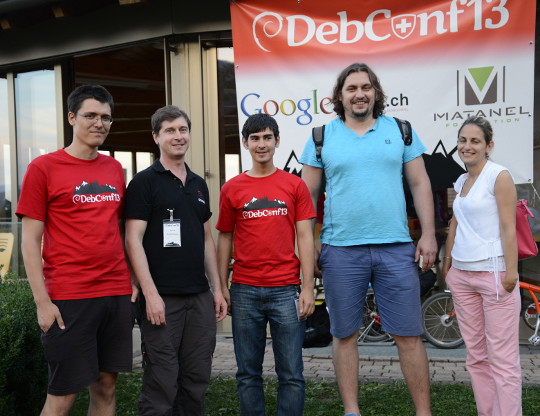
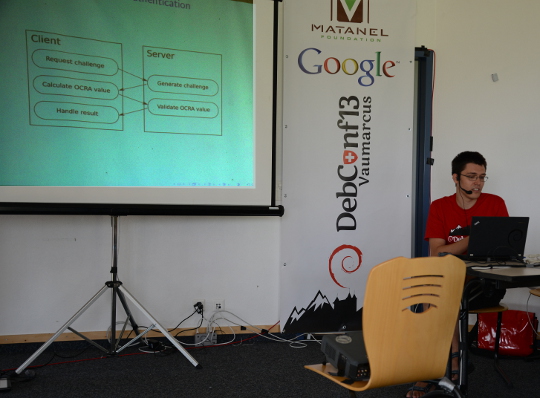
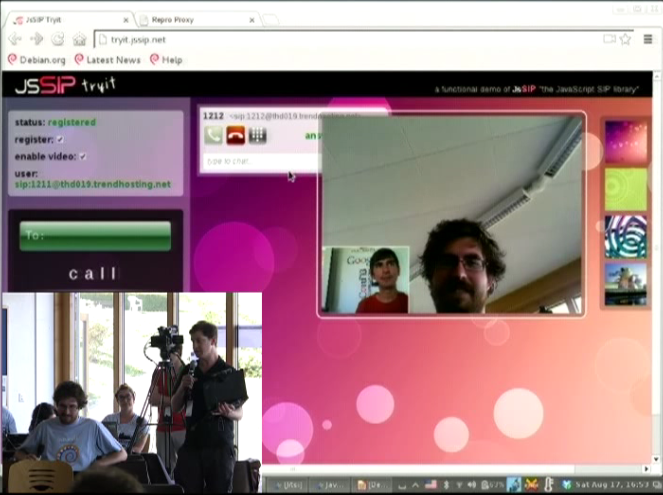
Fabian Gr nbichler, Daniel Pocock, Catalin Constantin Usurelu, Emil Ivov, Yana Stamcheva Advancing the use of One Time Passwords with free software Google Summer of Code (GSoC) student Fabian Gr nbichler has spent the summer enhancing oath-toolkit and dynalogin to support a more diverse range of One Time Password schemes. dynalogin's original 1.0 release supports vanilla HOTP and TOTP authentication schemes. Fabian's work has extended the framework to support the more generic and powerful OCRA approach. To find out about all the benefits this brings, I would strongly encourage you to review his slides and video presentation, with a demo where it is explained thoroughly. While there are existing hardware tokens that support HOTP and TOTP using this open algorithm (Gooze has been kind enough to donate some which were on display), the mutual challenge-response schemes are yet to be widely supported in hardware and this means that Fabian's work is now at the cutting edge of development in this area. WebRTC: premium voice/video chat in modern browsers, no plugin required Another member of Debian's GSoC program, Catalin Constantin Usurelu helped organise and run one of the must-see sessions of DebConf13 (video available). In a demonstration that had all the hallmarks of a magic show, Catalin and I took random members of the audience and invited them to wave a magic wand over their web browsers and effortlessly turn them into Skype-busting softphones. As the grand finale, we took Wookey's blog and showed him how to add a WebRTC "call-me" page in less than 20 seconds, less time than it takes to hand over all your private data to the registration process of those rather uncomfortable alternatives. Anybody else seeking to duplicate this effort is encourage to review options like Drucall for Drupal or just directly use JsSIP Jitsi and the Jitsi Video-bridge The grand-finale of the DebConf13 real-time communications track was our guest speaker, Emil Ivov, founder of the Jitsi softphone project. Jitsi itself has recently been accepted into Debian and is easier than ever before to install and use. Emil's talk (video and slides available) went into some detail about the cutting edge development activities of his team, particularly the new Jitsi Video bridge Subsequent to the talk, we had some out-of-bands discussion about ways to potentially integrate Jitsi Video bridge with the open source dvswitch system used to produce streams and recordings from free software events such as DebConf and FOSDEM. It is hoped that this will provide an additional option for remote participation at free software events of all sizes. Upcoming events Emil and I have been invited to participate in the WebRTC Conference Paris 2013 in December. This will be an excellent opportunity to have further discussion about progress with WebRTC and do more to raise the compelling case for premium quality free software to meet the demanding needs of modern business communications. There are a series of talks for both technical and business-oriented audiences.

Steve Kemp: Soon it will be time for something different

This weekend I'm mostly alternating between reading, writing, and trying to avoid death by the plague.[*] I've switched Lumail to using a UTF-8 aware string library, which means we can now handle the obvious case:
--
-- Prove keybindings work.
--
keymap['global'][' '] = 'msg("UTF-8 rocks!")'
Similarly we can stuff input into the buffer:
--
-- Pretend the user typed ":msg ...\n"
--
stuff( ":msg('  is pie')\n" );
This transition was annoying to handle, but wasn't too difficult. There is only one more major update required, according to the development roadmap, which is to double check that UTF-8 output is correct. Otherwise I think I'm almost done. In the sense that I don't see anything obvious missing, barring things that won't ever happen such as mutt-style "tag" support. I've updated the online examples to include some nice code: I can't claim to have many users, so far the development has been carried out by myself and approximately four other people. But that matters not. I genuinely believe this is a good client and it really suits the way that I handle (large volumes of) email: Allowing you to open multiple folders at once means you get a great view into your currently-unread mail, regardless of where procmail has placed it. The overriding feeling having "completed" the client is that Lua rocks. I'm torn between wanting to sleep some more, and wondering what other system/package/tool can be extended by Lua. As epiphanies go my on_idle() update takes some beating.
* - I do not have the black death, but I'm not well.

Lars Wirzenius: Yarn, a scenario testing tool

I write a fair number of Unix command line programs, and I want to have test suites for them. A year and a half ago I wrote a tool to make that easier: cmdtest. However, it turned out to not be a particularly good one, primarily because it doesn't make it easy to write good test code. Tests and test code should be obviously correct, so you don't need a test suite for your test suite. Earlier this year, Daniel and I started a slow, but long discussion about this. We'd talk it over during many a lunch, figuring out what we actually want. We eventually converged on an approach based on for Unix command line programs, and based on Markdown documents. We then wrote that up as a README, and then took another month refining the README before writing any code. The naming discussion only took a week. As a concrete example, here is a real test scenario, from Obnam, for testing its new FUSE plugin:
SCENARIO Browsing backups with FUSE plugin
ASSUMING user is in group fuse
GIVEN a live data directory
AND a 0 byte file called empty
AND a 1 byte file called one
AND a 4096 byte file called 4k
AND a 10485760 byte file called 10meg
AND a hardlink to 4k called 4k-hardlink
AND a symlink to 4k called 4k-symlink
AND a directory called some-dir
AND a symlink to ../4k called some-dir/other-symlink
WHEN live data is backed up
AND repository is fuse mounted
THEN latest generation can be copied correctly from fuse mount
FINALLY unmount repository
Some explanations: Test scenarios like this are obviously not directly executable. We need to provide the code that actually executs each step. For this, yarn provides an IMPLEMENTS section, of which I will show one example: the creation of the files.
IMPLEMENTS GIVEN a (\d+) byte file called (\S+)
dd if=/dev/zero of="$DATADIR/live/$MATCH_2" bs=1 count="$MATCH_1"
(The other IMPLEMENTS sections for that Obnam test scenario are also only about a line of shell. The longest one is four lines, because it has an if statement that I like to format in a fairly verbose way. I'm skipping the others to avoid needless repetition.) The text after the keyword (GIVEN, WHEN, THEN, etc) in the test scenario is a single line of free-form text, which is matched by a regular expression in the IMPLEMENTS section. There must be exactly one matching IMPLEMENTS for each line in a test scenario. The body of IMPLEMENTS is a shell script snippet. Yarn provides a temporary directory for each scenario, and the path to that is given in the DATADIR environment variable. Yarn also cleans up the directory afterwards, unless the user running yarn requests otherwise, so tests that only change things in the temporary directory don't need any FINALLY steps. The above example uses FINALLY to unmount the FUSE filesystem at the end. The regular expressions can capture parts of the text in the scenario step, and these are provided to the shell script using environment variables: MATCH_1 etc. This is a simple, but powerful mechanism for implementing very flexible steps, which also means the number of steps can be kept down. The IMPLEMENTS sections are shared between all test scenarios. This makes it very easy to write new scenarios using already-existing steps, by choosing which ones to use, in which order, and making use of any variability in the steps that their implementations provide. Yarn is a new tool, and I expect it to mature in the coming months. It's included in the cmdtest Debian package, and is already in Debian jessie and unstable, for those who want to try it. (My personal apt repository has a .deb for wheezy as well; backports are welcome). The yarn scenario testing language itself is not set in stone, but Daniel and I both want to be careful about making changes to it. It's all meant to be very simple: an obviously correct testing tool is better than an intricate one. I've used yarn in several of my own little programs now, as has Daniel, and we've used it at work as well. Undoubtedly we'll find bugs in the implementation, and we're still feeling our way to figuring out how to write really excellent scenarios, and how to structure steps with the best possible taste. We'll also start designing a shell library that yarn provides to the IMPLEMENTS sections, for doing things that we find ourselves doing in many projects. It is already clear to me, however, that yarn is oh so much better than cmdtest could ever be. I'm even starting to express ideas for new tools as yarn test documents, so I'm clear what they should do. If and when I ever get to actually implementing the tools, I'll have a test suite for them already. See, for example, first attempts at specifying how a fast file transfer tool, fling, which is to use Linux-only system calls to reach wire speeds over wired LAN, and a tool to recompress compressed files with another compression tool. We hope yarn will prove to be useful for others as well. If you try it, and have suggestions or comments, please e-mail us.

Next.

Previous.