Search Results: "cas"

16 March 2013

Russ Allbery: On (not) drinking

Captain Awkward, which is still the best advice column on the Internet, just posted an entry about someone being pestered to drink after saying that they don't drink. As another one of those people who just don't drink, but not for any specific reason that people seem to accept, I felt like blathering a bit more about that. This is mostly about me rather than about the thread over there, so I figured I'd do it on my own journal. First, I completely agree with the response that it's no one else's business why you do or don't drink, and people who persist in trying to get you to drink (or do anything else, no matter how innocuous) after you have clearly told them no are being rude and have forfeited the right to further conversation. But it also really frustrates me to see that people have to cope with that situation, particularly since I suspect it's gendered. My personal experience (as a man, and one who has a fairly firm way of expressing myself naturally) is that I say I don't drink and that's the end of it. Occasionally someone will ask me why. I've never had anyone pester me beyond that. I think the age of the letter writer (22) has something to do with this, but I suspect gender sadly also has something to do with this. People seem to be much more willing to tell women what to do and not take no for an answer. It's unbelievably rude when people do that. Don't do that. If you decide you can pester someone about their personal choices because of their gender (and, for that matter, their age, or any other reason), you deserve to get your head handed to you on a plate. Second, I wonder if some of the reason why I don't run into problems with this is that I work on a college campus. The latter means that there's a lot of surrounding culture around drinking and dealing with drinking, such as the university policy that any party have EANABs (Equally Attractive Non-Alcoholic Beverages) available as well. There's a bit of a cultural understanding that pushing people into drinking isn't okay. Third, since people do occasionally ask why I don't drink, or assume that anyone who doesn't drink is doing so for religious reasons or because they're an alcoholic, or might object to them drinking, here are a few reasons why I don't drink. It may be useful information in case you run into more people in the world like me. So, that's me. It makes no difference at all to me if other people drink. Enjoy! You won't offend me, there isn't any overtone to it, I'm not being judgemental when I say I don't drink, and it's not a dangerous topic or anything. There are probably others like me. If you run into us, all you have to say after "no thanks, I don't drink" is "oh, okay."

15 March 2013

Hideki Yamane: pbuilder/cowbuilder and piuparts failed

Today, I've failed to create pbuilder's base.tgz and cowbuilder's base.cow, and log says as below

Get:1 http://ftp.jp.debian.org sid Release.gpg [836 B]
Hit http://ftp.jp.debian.org sid Release
Ign http://ftp.jp.debian.org sid Release
Hit http://ftp.jp.debian.org sid/main amd64 Packages/DiffIndex
Hit http://ftp.jp.debian.org sid/main Translation-en
Fetched 836 B in 0s (3011 B/s)
Reading package lists...
W: GPG error: http://ftp.jp.debian.org sid Release: The following signatures were invalid: BADSIG AED4B06F473041FA Debian Archive Automatic Signing Key (6.0/squeeze) <ftpmaster debian.org="">
I: Obtaining the cached apt archive contents</ftpmaster>
"The following signatures were invalid: BADSIG" ?

apt (0.9.7.8) unstable; urgency=criticial

* SECURITY UPDATE: InRelease verification bypass
- CVE-2013-1051

[ David Kalnischk ]
* apt-pkg/deb/debmetaindex.cc,
test/integration/test-bug-595691-empty-and-broken-archive-files,
test/integration/test-releasefile-verification:
- disable InRelease downloading until the verification issue is
fixed, thanks to Ansgar Burchardt for finding the flaw
Maybe this cause it (just wild guess).

And piuparts also failed.


8m16.5s DEBUG: Starting command: ['chroot', '/tmp/tmpivurbJ', 'eatmydata', 'umount', '/proc']
8m16.5s DUMP:
umount: /proc: device is busy.
(In some cases useful info about processes that use
the device is found by lsof(8) or fuser(1))
8m16.5s DEBUG: Command failed (status=1), but ignoring error: ['chroot', '/tmp/tmpivurbJ', 'eatmydata', 'umount', '/proc']
8m16.5s DEBUG: Starting command: ['rm', '-rf', '--one-file-system', '/tmp/tmpivurbJ']
8m16.6s DUMP:
rm: skipping '/tmp/tmpivurbJ/proc', since it's on a different device
8m16.6s ERROR: Command failed (status=1): ['rm', '-rf', '--one-file-system', '/tmp/tmpivurbJ']
rm: skipping '/tmp/tmpivurbJ/proc', since it's on a different device

8m16.7s DEBUG: Starting command: ['chroot', '/tmp/tmpivurbJ', 'umount', '/proc']
8m16.8s DUMP:
chroot: failed to run command 'umount': No such file or directory


It mounts binfmt_misc mount under /proc and try to umount /proc without umount it again, again and again... then failed. What causes this annoying behavior?

Please let me know.

Lior Kaplan: Team work on RTL bugs

After returning from a vacation, I went over my RTL bugs backlog. I missed helping with checking a few patches, so I got left with verifying the fixes done by the KACST guys on master. Last week was dedicated for verifications of the bug fixes, even found a regression and reverted the commit after discussion with the author. Yesterday, I took my time with pushing these fixes also to the 4-0 branch, having them available as soon as possible instead of waiting for the 4.1 release. Total of 7 bugs got pushed, see https://wiki.documentfoundation.org/RTL_Bugs#4.0.3 for the list. I notified the developers, so they ll know their changes are available to the public sooner than expected (and let the people enjoy their work earlier). All these pushes make sure that master doesn t have any RTL support superiority over the current stable branch. In one of the cases I had to do some follow up about the commit, finding another relevant commit. This was merged with a trick Eike taught me a while ago for squashing commits with git rebase. Fridrich quickly helped with verifying that the squash stills looks good, letting me push another dependent fix on top of it.
Filed under: LibreOffice

Jon Dowland: list filtering

The classic procmail recipe for (reasonably) safe automatic mailing list filtering is
:0
* ^List-Id:[^<]+<\/[a-z0-9-.]+
$MAILDIR/MATCH/
This relies on mailing lists being configured such that the first part of the ID, up to the first dot, is a good identifier for the list. this is not always the case (*.lists.fedoraproject.org, I'm looking at you). Removing the dot from the expression above means you end up with unambiguous, albeit long, folder names (devel.lists.fedoraproject.org). If you access this mail over IMAP, you have another problem: the dots create a nested folder heirarchy that probably doesn't make any sense (devel lists fedoraproject org). It's possible to change the configuration of IMAP clients and servers to use a different delimiter, but this is not an oft travelled road, and I don't feel like finding the pot holes. Better to substitute the dot for something else. I'd recommend an ASCII character, Unicode seems to throw up a whole bunch of client problems. Here's a variation that solves the problem:
:0
* ^List-Id:[^<]+<\/[a-z0-9-.]+
 
  :0
  subst=  echo "$MATCH"   tr . :
  :0
  $MAILDIR/$subst/
 
At the cost of elegance, you can add rules to give friendlier names to lists from folks who have well-defined list-ids (integration left as an exercise to the reader):
:0
* ^List-Id:.*debian.*lists\.debian\.org
subst=  echo "$MATCH"   sed 's/\([A-Za-z0-9-]\+\)\..*/\1/'
Finally, there are some "lists" you probably don't want to file in their own individual folders. Inject these into the top-most rule:
* ! ^List-Id.*groups\.facebook\.com
Finally thanks to Brett for showing me some exim filter snippets that would let me implement the above in a (slightly) nicer looking way. Sadly I think I'm stuck with procmail for some other features I use, but it's been a while since I looked.

MJ Ray: Debian Project Leader 2013 election campaign links: part 1

This is basically a link-post to the Debian Project Leader election email discussions on GMANE s blog-style interface to debian-vote. After only 3 days of the 21, there s already a pageful, so if I don t start collecting links now, I ll probably miss some. Right or wrong, I ve grouped these into three topics: The Job
  1. Why do you think you are a good candidate for DPL (10 Mar 2013)
  2. How do you plan to represent Debian externally? (10 Mar 2013)
  3. about a DPL board (12 Mar 2013)
  4. DPL term duration (12 Mar 2013)
  5. Work balance and traveling (12 Mar 2013)
  6. trying to do awesome and risking to fail (11 Mar 2013)
  7. To Lucas: how do you plan to push your ideas (12 Mar 2013)
  8. All candidates quotes for the press if you win (13 Mar 2013)
Money
  1. using debian funds for Debian s hardware infrastru (12 Mar 2013)
  2. Usage of Debian s Money (12 Mar 2013)
  3. Debian s relationship with money and the economy (12 Mar 2013)
Project Management
  1. getting new people to Debian (10 Mar 2013)
  2. Free Software challenges and Debian role (11 Mar 2013)
  3. Development and technical issues and challenges (10 Mar 2013)
  4. Are there problematic infrastructure or processes in Debian? (12 Mar 2013)
  5. to Moray: encourage teams to take interns (11 Mar 2013)
So, what do you think are the key points or differences? Leave me a comment, or get involved in the discussions. Campaigning ends and voting begins 30/31 March.

John Goerzen: It s Warm Enough For Mud

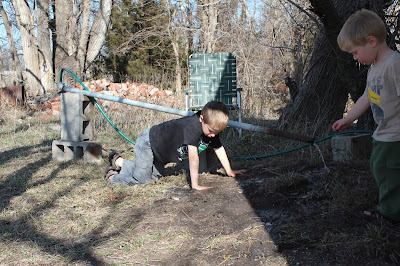
Today the outdoor temperatures got to nearly 75F/24C. The boys had this idea to go play with their streams . Here s one of the cleaner moments: I had set up an old pipe and a hose, with the water coming slowly out of the pipe onto a little mound of dirt. They can then use their fingers to make channels in the dirt for the water to flow through. They ve found that sticks can become bridges, making a hole in the earth makes a pond, and, oh yes, it s quite muddy and a lot of fun. Oliver at one point realized that he could splash the mud all around quite nicely. And he wanted to make sure I took photos of his hands. They could have played out there for hours, I m sure. When it was time to clean up, they enjoyed seeing the mud come off their sandals, arms, hands, and feet. It was a perfect use for the first really warm day of spring.

14 March 2013

Iustin Pop: Types as control flow constructs

A bug I've recently seen in production code gave me the idea for this blog post. Probably smarter people already wrote better things on this topic, so this is mostly for myself, to better summarise my own thoughts. Corrections are welcome, please leave a comment! Let's say we have a somewhat standard API in Python or C++: Signalling failures to initialise the object can be done in two ways: either by raising an exception, or by returning a null/None result. There are advantages and disadvantages to both: The None model can create latent bugs, for example in the following code:
ok = True
for arg in input_list:
  t = init_t(arg)
  if t is None:
    ok = False
    continue
  t.process()
return ok
The presence of the continue statement there is critical. Removing it, or moving it after some other statements which work with t will result in a bug. So using value-based returns forces us to introduce (manually) control points, without having the possibility to validate the model by the compiler (e.g. in C++). So it would seem that this kind of latent bugs pushes us to use the exception model, with its drawbacks. Let's look at how this interface would be implemented in (IMHO) idiomatic Haskell (where the a and b types represent the input and output types):
initT :: a -> Maybe T
processT :: T -> b
my_fn =
  
 case initT arg of
   Nothing -> -- handle failure
   Just v -> processT v
Yes, this can be written better, but it's beside the main point. The main point is that by introducing a wrapper type around our main type (T), we are forced via the type system to handle the failure case. We can't simply pass the result of initT to a function which accepts T, because it won't type check. And, no matter what we do with the result value, there are no exceptions involved here, so we only have to think about types/values, and not control flow changes. In effect, types become automatically-validated control-flow instructions. Or so it looks to me . So using types properly, we can avoid the exception-vs-return-value debate, and have all advantages without the disadvantages of either. If that is the case, why isn't this technique used more in other languages? At least in statically typed languages, it would be possible to implement it (I believe), via a C++ template, for example. In Python, you can't actually apply it, as there's no static way of enforcing the correct decapsulation. I was very saddened to see that Google's Go language, which is quite recent, has many examples where initialisation functions return a tuple err, value = , separating the actual value from the error, making it not safer than Python. It might be that polymorphic types are not as easy to work with, or it might be the lack of pattern matching. In any case, I don't think this was the last time I've seen a null pointer dereference (or the equivalent AttributeError: 'NoneType' object has no attribute ). Sadly You can even go further in Haskell and introduce more control flow structure via wrapper types. Please bear another contrived example: an HTML form that gets some input data from the user, validates it, saves it to the database, and echoes it back to the user. Without types, you would have to perform these steps manually, and ensure they are kept in the correct order when doing future modifications. With types, you only have to design the types correctly and export only smart contructors (but not the plain ones):
module Foo ( ValidatedValue
           , validateValue
           , RecordId
           , CommittedValue
           , commitValue
           , buildFeedbackForm
           ) where
data ValidatedValue a = ValidatedValue a
validateValue :: a -> Maybe (ValidatedValue a)
data RecordId =  
data CommittedValue a = CommittedValue a RecordId
commitValue :: ValidatedValue a -> ComittedValue a
buildFeedbackForm :: CommittedValue a -> HTMLDoc
From these types, it follows more or less that the only correct workflow is:
  1. get a value from the user
  2. validate it
  3. commit it, getting a transaction/record ID
  4. send the response to the user
In other words:
handleFeedbackForm = buildFeedbackForm . commitValue . validateValue
There are still issues here, e.g. the type a is completely hidden behind the wrapper types, and we can't recover some basic properties (even if we use newtype, unless we use GeneralizedNewtypeDeriving). But it does offer a way to improve control flow safety. And that is my 0.02 currency unit for today.

Don Armstrong: libravatar for the BTS (and boring encoding fixes)

While working on fixing a few encoding problems that I managed to introduce to the BTS almost half a year ago, I took a side bit of coding, and introduced libravatar support to the BTS. Every e-mail now has an avatar to the right which should correspond to the sender. Libravatar is a federated service, which means that if you control your domain, you can serve your own icons. It also automatically falls back to gravatar, so if you're using that service, things should "just work". Hopefully this will be primarily amusing, and people won't abuse it. More importantly, but much less fun, the double encoding problems (where mails would get double-encoded if any of the headers contained non-us-ascii text), and mojibake wontfix icon ( ) should be fixed now. If you see any additional cases of this, please report them to owner@bugs.debian.org.

Matthias Klumpp: Tanglu

Hi everyone! Today I make an announcement I thought I would never ever make. But things changed. Discussion about this has a long history, starting as a non-serious suggestion at DesktopSummit 2011, continued with people on IRC, but it was decided back then that it wouldn t be worth the effort. This has changed too, and a small team has formed to work on it. We hereby announce Tanglu, a new Debian-based-Linux distribution. A new logo?Why do we need another one? Let me explain the concepts of that distro: Tanglu will be based on Debian Testing and follow the Debian development closely. It will have a 6-months release-cycle and it s target audience are Linux desktop users. We will make installing and setting up the distro as easy as possible. Tanglu will be usable for both developers of upstream software and the average Linux user and Linux newbie. This is possible because in our opinion developers and users don t have different needs for a desktop system. Both kinds of users like a polished desktop which just works . We will, hwever, not apply any kind of fancy modification on upstream software, we will basically just distribute what upstream created, so users can get an almost pure GNOME and KDE experience. Tanglu is designed to be able to solve the issue that Debian is frozen for a long time and Debian Developers can t make new upstream versions available for testing easily. During a Debian freeze, DDs can upload their software to the current Tanglu development version and later start the new Debian cycle with already tested packages from Tanglu. The delta between Tanglu and Debian should be kept as minimal as possible. However, Tanglu is not meant as experimental distribution for Debian, so please upload experimental stuff to Experimental. Only packages good enough for a release should go into Tanglu. Ideally, Tanglu and Debian should be working well together in mixed environments, where you for example have Debian servers and multiple Tanglu desktops with the new software, targeted at desktop user. Since the differences between Tanglu and Debian should not be very high, administering both systems should be very easy (if you know Debian). Tanglu will be an open project, driven by community. At the beginning of each cycle, people can make suggestions for release goals they want to implement (similar to Fedora, but without FESCo). These proposals are discussed in public and are rejected if there are major technical concerns. If consensus about a certain proposal is lacking, a vote is done for it. The proposal can be accepted with absolute majority. If this does not happen, the proposal is postponed for the next release, where people can vote for it again. If nobody wants that function, it is rejected. In general, decisions made by Debian are superior and have to be followed. We don t think we know every package and every software better than the original upstream. That s why it makes much sense to rely on feedback from others and to have a community-based and peer-reviewed distribution, instead of secretly developing stuff and dumping it on the community. Tanglu will have a highly predictable set of features, defined at the beginning of a cycle, so you will know what you can expect from the next release as soon as possible and plan for it. Tanglu will make it easy to deploy applications for it. It will contain a software-center, similar to what Ubuntu has. We will also try to establish a solution for a Linux-AppCenter , a place for Linux applications, which will be open not only for Tanglu, but can be implemented in any other distribution too. Possible income will flow back into development of the platform. Now, let s answer the FQA (Future Questions Asked): Why don t you contribute to Debian directly and create yet another distribution? First of all, we contribute to Debian ;-) And for me, I can say that I will contribute to Debian even more. The point is that Debian can not cover all possible use-cases, and with Tanglu we want to make a distro which solves this. You might ask why we have to create a new distro for that, instead of creating improvements inside Debian? Creating a new distro allows us to do stuff we can never do in Debian. For example, we will include proprietary firmware in that distro, we will make installations of proprietary stuff possible easily (but don t ship with it by default) and we will have a time-based release cycle. These are already things which are a no-go for Debian, and that s fine. We don t want Debian to support these cases, as it is already a great distribution. We want to offer a distro as close to Debian as possible, but with a few modifications for use-cases which are not covered by Debian itself. Of course we will participate in DEX. If Debian Developers contribute to Tanglu, freezes will take even longer! This is an often-heard concern, it comes up on every mailinglist discussion about continuing development while freeze. I would disagree here, packaging new upstream stuff is not slowing down testing and improving of packages in Testing. Also, Tanglu is an offer for Debian developers to participate (we will sync privileges for their packages) we don t expect anyone to work on it, but as we think DDs know their packages best, we will make it possible for them to participate without extra barriers. We hope that Tanglu can add value to Debian and that Debian cycles can start with better-tested packages. You said you are a small team you cannot develop a whole distribution with it! Let s put that to the test! ;-) All people working on this are well aware of the issue that the project can not survive without much community-involvement on the long run. But we see a chance that many people are interested in it and that there is a high demand for it. At the beginning, we will just start with a small set of packages. We will also sync many packages from Ubuntu, to reduce workload. For example, it is planned to use the Ubuntu-Kernel and KDE packaging. By doing this, we keep the workload at the beginning low. We also reduce duplicate work with that. We even have some possible sponsors for the new distribution. But nothing is set in stone yet, so just wait for it to happen. :) Why not participate in Arch, OpenSUSE $other_distro? These are not Debian ;-) . I know, it sounds odd, but if you like the Debian way of doing things, you want to use a Debian-based distribution. There is nothing wrong with OpenSUSE. And Debian has issues too. But we want to be close to Debian and use it s tools and way of doing things. I hate you!!! You are doing it wrong!! The project is useless!
Well, that s fine. But there is no reason for hating us. If you dislike our idea, there are basically two options: First, you hate us but the project is successful. In that case, you have been wrong with hate, as there are definitely people who liked the project and contributed to it. Second, you hate us and we fail. In this case, there is no reason for hate, as the project will just vanish and you don t have to worry about it. So hating it would ve been just a big waste of energy. Also keep in mind that forking is a way to keep development healthy and to adapt software to new use-cases which it didn t target before. And we are not introducing incompatibilities here (like e.g. writing our own display server could). Instead, we want to stay close to Debian and reuse as much code as possible. Which desktop will you use? Everyone can add a new desktop to Tanglu, as long as the desktop-environment is present in Debian. Long term, we will have to offer Linux-newbies a default flavour, probably by setting a default download on the website. But as long as there is a community for a given desktop-environment, the desktop is considered as supported. At the beginning, we will focus on KDE, as many people have experience with it. But adding vanilla GNOME is planned too. Can you say something about the software used in Tanglu? Yes, but this is still in flow, so I can t promise final decisions here. On the server, side, we will try to use the Dak for repository management, as soon as we have enough server capacity. We will also use the standard Debian repository GUI and basically reuse most of the software there, to diverge less from Debian. The distribution itself will use a Linux Kernel from Ubuntu and systemd as the primary init system, as well as the login manager logind. It will be based on current Debian Testing with some fresh packages from Unstable and Experimental. We might also use the Ubuntu driver packages and KDE packaging. We expect to have a very rough start with the first release, but there will be enough time to polish Tanglu. Nice idea! How can I help? Well, you can help with basically anything at time from writing manuals, over designing logos and pages to administering a webserver and create packages. We are at an early stage of development at the moment, but we wanted to go public with it as soon as possible, to include the community and receive feedback so we can make that distro community-centric from the beginning. Most of the infrastructure is currently in progress too. So, if you want to get started with Tanglu, subscribe to our mailinglist tanglu-devel and write a mail to it, intruducing yourself. We can then include you in the loop. Generally, if you want to get access to our machines, a trusted GPG-signature will help a lot. If you want to talk to us, join #tanglu-devel or Freenode! Most discussions are currently happening there. And that s it! Tanglu will be awesome!

Some other projects of mine will develop a bit slower because I am now involved in Tanglu. But nothing will stop, and there is some pretty cool stuff coming for both GNOME and KDE (and I still have to implement DEP-11 for Debian). :)

Joerg Jaspert: zsh config - and prompt

As most people that are using that funny grey on black thing with the blinking white box AKA a commandline, I do have a heavily configured shell. zsh in my case. Some while ago my old configuration for it started to annoy me and so I set out to redo it. With the basic requirement to be flexible and able to adjust to various zsh versions (back as far as Lenny). I ve set out and looked how others do it and took the (I hope) best bits and put them together in a way I like it. Maybe others want to pick from me, so here I describe a little, maybe someone is interested First - the config is completly inside .zsh. The only thing directly in my $HOME is a symlink from $HOME/.zshenv to $HOME/.zsh/zshenv.home. All in one place, nicer this way. The zshenv just sets ZDOTDIR, so zsh then uses the .zsh itself. Next I am using modules . Well, actually everything is splitted out in small(er) files, so its way easier to maintain. And to overwrite stuff wherever I need to. So my .zshrc just loads those module files - and then goes and checks if it finds the same file inside a series of subdirectories. Those subdirectories are based on the hostname, the kernel name, the username, the domain name and the name of the distribution of the system. And a number of combinations of those. That system allows me, for example, to have a set of aliases defined only on Debian systems (like those to do with apt-get & co). Or define some extra variables if I login to the host franck, domain debian.org. Or whatever more. I m also on the way of doing something similar for all my dotfiles. While I was working at that I finally got fed up with the fact that my prompt, which is based on Phil! s wasn t doing what I wanted it on various of the hosts I access. Thankfully someone pointed me at a change to the grml zsh config: Frank Terbeck rewrote their prompt to make use of the zstyle system. Now that got me going, I like the idea of having the whole prompt easily configurable and changeable. My prompt always has shown slight differences depending on where the shell runs, which meant I had to carefully craft PS1 for every such change, and when one changes something one had to check all the places to adjust them too. No longer. I took Franks work and extended it for me. I wanted to still have a design matching my old prompt (minus colors, I changed color themes anyways), but with full flexibility the zstyle system can offer here. Now I am at a point where As an example, on the ftp-master host my prompt, while otherwise being the same as everywhere else, contains one extra item - displaying the current status of the archive (dinstall). If you want to try it, the setup file is available, but note that I don t give any warranty. :) Works for me . I load it in my Prompts module, while having the prompt setup file in my function path. The 4 commented lines, my testcase, are a nice example of a custom token, though a real life one, the setup for the ftp-master prompt with the one extra item can be found over here. Comments? Bugfixes? Enhancements? Update: Got asked for an example how to use my prompt to fake another. So here is what you need to do to use my prompt setup to imitate the prompt clint, as delivered with zsh:
autoload promptinit && promptinit
zstyle ':prompt:ganneff' vcs_info true
# Alternatively you can set whatever you like it to be.
zstyle ':prompt:ganneff' set_vcs_info_defaults true
zstyle ':prompt:ganneff' colors true
## no right prompt
zstyle ':prompt:ganneff:right:setup' use-rprompt false
## color of brackets depending on variable
zstyle ':prompt:ganneff:*:items:openbracket' pre '$ $ SSH_CLIENT+"$ PR_YELLOW " :-"$ PR_RED " '
zstyle ':prompt:ganneff:*:items:openbracket' post '$ PR_NO_COLOR '
zstyle ':prompt:ganneff:*:items:closebracket' pre '$ $ SSH_CLIENT+"$ PR_YELLOW " :-"$ PR_RED " '
zstyle ':prompt:ganneff:*:items:closebracket' post '$ PR_NO_COLOR '
zstyle ':prompt:ganneff:*:items:openanglebracket' pre '$ $ SSH_CLIENT+"$ PR_YELLOW " :-"$ PR_RED " '
zstyle ':prompt:ganneff:*:items:openanglebracket' post '$ PR_NO_COLOR '
zstyle ':prompt:ganneff:*:items:closeanglebracket' pre '$ $ SSH_CLIENT+"$ PR_YELLOW " :-"$ PR_RED " '
zstyle ':prompt:ganneff:*:items:closeanglebracket' post '$ PR_NO_COLOR '
## extra date format, and its color
zstyle ':prompt:ganneff:*:items:date' token '%D %a %y/%m/%d %R %Z '
zstyle ':prompt:ganneff:*:items:date' pre '$ PR_CYAN '
## pts. %l instead of %y, also color again
zstyle ':prompt:ganneff:*:items:pts' token '%l'
zstyle ':prompt:ganneff:*:items:pts' pre '$ PR_GREEN '
zstyle ':prompt:ganneff:*:items:pts' post '$ PR_NO_COLOR '
## host ends with :
zstyle ':prompt:ganneff:*:items:host' token '%m:'
## and a different style for the rc level
zstyle ':prompt:ganneff:*:items:rc' token '%(?..[%?%1v] )'
zstyle ':prompt:ganneff:*:items:rc' pre ''
## change color for other parts that differ to my default
zstyle ':prompt:ganneff:*:items:user' pre '$ PR_GREEN '
zstyle ':prompt:ganneff:*:items:host' pre '$ PR_GREEN '
zstyle ':prompt:ganneff:*:items:at' pre '$ PR_GREEN '
zstyle ':prompt:ganneff:*:items:path' pre '$ PR_GREEN '
zstyle ':prompt:ganneff:*:items:history' pre ''
## Show the shell level in a different way
zstyle ':prompt:ganneff:*:items:shell-level' pre ''
zstyle ':prompt:ganneff:*:items:shell-level' token 'zsh%(2L./$SHLVL.) '
## And history is just a bold number. Lazy here, not using pre and post
zstyle ':prompt:ganneff:*:items:history' token '%B%h%b '
## And the last part in prompt, a # or % depending on privileges
## Using standard zsh tokens for bold
zstyle ':prompt:ganneff:*:items:privileges' pre '%B'
zstyle ':prompt:ganneff:*:items:privileges' post '%b'
## Now there are two parts not defined by default, so lets create them
## Both are simple existing variables, no need for extra precmd functions
## system info
zstyle ':prompt:ganneff:extra:ostype' pre '$ PR_CYAN '
zstyle ':prompt:ganneff:extra:ostype' post '$ PR_NO_COLOR '
zstyle ':prompt:ganneff:extra:ostype' token "$ MACHTYPE /$ OSTYPE /$(uname -r)"
## zsh version
zstyle ':prompt:ganneff:extra:zshvers' pre '$ PR_CYAN '
zstyle ':prompt:ganneff:extra:zshvers' post '$ PR_NO_COLOR '
zstyle ':prompt:ganneff:extra:zshvers' token "$ ZSH_VERSION "
zstyle ':prompt:ganneff:left:full:setup' items \
    openbracket date closebracket openbracket pts closebracket openbracket ostype closebracket \
    openbracket zshvers closebracket newline openanglebracket user at host \
    path closeanglebracket newline \
    shell-level space history rc space vcs privileges space
prompt ganneff
And if you now tell me Uh, thats so much more than just saying /prompt clint/ , then you are right. But then: This way is flexible. As I wrote above, my prompt on the ftpmaster host is different. Actually, my prompt on all machines inside the domain debian.org differs, by having
zstyle ':prompt:ganneff:*:items:host' pre '$ PR_YELLOW '
in the Prompts definition for domain:debian.org. And thats enough to show me im on a .debian.org machine by a yellow hostname, instead of my default red. On the ftpmaster host I have the additional few lines: # Want one more piece in my prompt here, dinstall status zstyle :prompt:ganneff:left:full:setup items \ ulcorner line openparentheses user at host pts closeparentheses line history \ line dinstall line shell-level line flexline openparentheses path closeparentheses line urcorner newline \ llcorner line rc openparentheses time closeparentheses line vcs line change-root pipe space
zstyle ':prompt:ganneff:extra:dinstall' pre '$ PR_CYAN '
zstyle ':prompt:ganneff:extra:dinstall' post '$ PR_NO_COLOR '
zstyle ':prompt:ganneff:extra:dinstall' token '$DINSTALL'
zstyle ':prompt:ganneff:extra:dinstall' precmd jj_update_dinstall
zmodload zsh/mapfile
jj_update_dinstall ()  
    DINSTALL="$ $ (z)$ (f)mapfile[/srv/ftp.debian.org/web/dinstall.status] [2] [3,99] "
 
And woo, thats simple. I think. (There ought to be a way to just easily add the item at a defined place in the items zstyle, but meh, too lazy to look).

Rudy Godoy: Subversion auth using SSH external key-pair

Normally when using Subversion s SSH authentication facility you ll use your own SSH generated key-pair that svn will read from the proper location, usually $HOME/.ssh. However, there could be situations when you ll need to use a different key-pair. In such case you can use a nice trick to make svn+ssh authentication work smoothly. Let s say you have an external key-pair and the public key it s already set on the svn server. You store the private key somewhere in your home directory. Now when doing a svn checkout you ll find that you have to use SSH s -i parameter. However, when used together with svn it won t work as expected as you ll normally do when using ssh with an external key-pair. Subversion makes your life easier by using the $SVN_SSH environment variable, so you can put the ssh command and modifiers that fit your needs. In the external key case you can do something like:

export SVN_SSH="ssh -i </path/to/external-key>"
Next time you use svn s ssh auth it will read $SVN_SSH then use it. So now you can use svn commands such checkout, etc in the same fashion you normally do.
svn co svn+ssh://rudy@somesvnserver.at.somwhere.org/repo/for/software
Update: Jeff Epler offered great advice for using .ssh/config and key-pairs based on hostname. See the comments below.

Mike Hommey: Google Reader death, or how the cloud model can fail you

If you re a Google Reader user, you probably read in one of your subscriptions that Google is pulling the plug on Google Reader. It is yet another demonstration of why putting data in the cloud isn t so much of a nice idea: the service you rely on may well disappear some day, with all the data it contains. Sure Google, in its extreme goodness, allows you to take out the Google Reader data. Or does it?
These are what you ll get from Google Takeout for Reader: Interestingly, while looking into shared-by-followers.json, I found urls that would correspond to friend streams. For instance, Tim Bray s is http://www.google.com/reader/public/atom/user/05198174665841271019/state/com.google/broadcast. But it s useless: all it displays is permission denied . As for subscriptions, one of the strengths of Google Reader is that it allowed to search though past items, which means a big part of the interesting data is the archived items. But that s not part of the take out . Sure, you have the feed urls, but most RSS feeds contain a limited amount of items, not the entire history of items for the given feed. So, history is more or less lost. Except if I star, like or share all items in all my subscriptions and take out again. So much goodness. It could have been worse, though.

13 March 2013

Raphael Geissert: A bashism a week: assigning to variables and special built-ins

Assigning a value to a variable when executing a command is a way to populate the command's environment, without the variable assignment persisting after the command completes. This is not true, however, when a special built-in is the command being executed.

POSIX:2001 states that "Variable assignments specified with special built-in utilities remain in effect after the built-in completes".

Not only this is tricky because it depends on whether a utility is a special built-in or not, but the bash interpreter does not respect that behaviour of the POSIX standard. That is, special built-ins are not so "special" to the bash interpreter.

This leaves two things to take into account when assigning to a variable when executing a command: whether the command is a special built-in, and whether bash is interpreting the script.

Now, the list of special built-ins is rather short and it would be a bit unusual to perform variable assignments when calling them, except for some cases: "exec", "eval", "." (dot), and ":" (colon).

It is important to note that ":" and "true" differ in this regard; the former is a special built-in, the latter is just a utility. Watch out for this kind of differences when using ":" or "true" to nullify a command. E.g.

Compare
$ dash -c '
method=sed
# some condition or user setting ends up making:
method=true
# later:
foo=bar $method
echo foo: $foo'
foo:
To (redacted for brevity):
$ dash -c '
method=:
foo=bar $method
echo foo: $foo'
foo: bar

Russ Allbery: WebAuth 4.4.3

WebAuth is the site-wide web authentication system that we use at Stanford. After a lot of time focusing on things at work other than coding, it's been my primary job for the past nine months or so, which has been a lovely change. I wasn't planning on doing another 4.4 release and instead focusing on 4.5.0 (which is well underway and adds significant new features to multifactor support), but I kept finding bugs, including several that were quite embarassing. So this is another bug-fix release, and hopefully the last one before 4.5.0. WebAuthTrustAuthzIdentity enabled WebAuthDoLogout in the same scope (ever since it was added in 4.4.0). It's horribly embarassing to have been writing C for more than 20 years and still manage to omit a break in a switch statement. Benjamin Coddington found another bug in authorization identity handling where if the user changed their authorization identity to match their authentication identity, their authentication would be rejected. We now detect that case and just discard the authorization identity if it's the same as the authentication identity. There are multiple fixes in the mod_webauth logging of bad app tokens: expired app tokens are now logged with a proper message (and at info level rather than error), empty app tokens (created internally and therefore seen by subqueries before fixup to delete expired app tokens) are now just ignored, and invalid app tokens don't result in spewing binary strings into the Apache error log. mod_webauthldap has, since the beginning, refused to add more than 127 values of a multivalued LDAP attribute to the environment. We ran into that limit with entitlements, so it's now been removed. This runs the risk of overflowing the environnment, but I did some calculations, and it looks like you're going to have to try really hard and have impressively large multivalued attributes to create that problem. If it actually becomes a problem for someone, I'll add a configuration option. There's also a syntax fix to the default WebLogin error template and a variety of minor bug fixes, mostly around error handling conditions, to correct problems caught by clang --analyze. (The current master branch gets a completely clean bill of health from clang --analyze using clang 3.0.) You can get the latest release from the official WebAuth distribution site or from my WebAuth distribution pages.

12 March 2013

Eddy Petri&#537;or: Herbalife, a detailed analysis

You might remember that a while ago I mentioned I got involved in skepticism to the point I even co-host a podcast, Skeptics in Romania (in Romanian).

Among the subjects we tackle there are claims about various miracle fruits, shady dietary advice, various nonscientific health products, and even scams. We try to inform or listeners about ways to identify themselves such dangerous/fake products and how they can inform themselves about the claims they might encounter, what questions they should ask before considering buying (into) such things.

One sensitive subject is the so called multilevel marketing, especially for people involved in such businesses.

This is a sensitive subject because many of these schemes are actually pyramidal schemes, also known as Ponzi schemes. These are illegal in many countries, since they are, in fact scams designed to lure people with supposed high profits and little work.

One such pyramidal system... well you can judge yourselves (note that the presentation contains many slides, but it's really captivating):

http://www.businessinsider.com/bill-ackmans-herbalife-presentation-2012-12?op=1j

Russ Allbery: Review: Commitment Hour

Review: Commitment Hour, by James Alan Gardner
Series: League of Peoples #2
Publisher: Eos
Copyright: April 1998
ISBN: 0-380-79827-1
Format: Mass market
Pages: 343
This is the second book in Gardner's League of Peoples universe, following Expendable, but it is largely unrelated to that novel apart from taking place in the same universe. Expendable follows the portion of humanity that has left Earth and embraced the universe and the advanced technology of the League. Committment Hour is set on Earth, in one of the remaining low-tech settlements that have become a backwater of humanity. Earth is governed by the Spark Lords, who appear to be a sort of scientific artistocracy empowered by the League of Peoples (Gardner gets into this more in later books in the series), but the community in this book is largely left alone. The protagonist of Committment Hour is Fullin, a resident of Tober Cove. The Tober Cove community has a very unusual interaction with gender. Every year, all inhabitants under the age of twenty (starting at the age of two) are taken away by what are viewed locally as gods. When they return, they have the opposite gender. They live their childhoods alternating gender every year, including a mandatory pregnancy (created on one of those trips by the gods) and childbirth. Then, at the age of twenty, rather than being gender-swapped like the other children, they choose the gender that they'll live with for the rest of their life. Fullin is (at least at the start of this book) currently male, but as the book opens on the eve of the day of his final gender committment, he's still undecided on what gender he'll choose. A review of this sort of book immediately requires a significant caveat: this story is all about social constructions of gender and about the implications of one specific transgender scenario. As a cisgender man who fits comfortably within society's normal gender construction, I'm not going to do the best job of judging how well it deals with those issues. It was on the long list for the Tiptree Award, which is a fairly good sign that it does okay, and a quick Internet search didn't uncover any significant dislike, but it's quite possible that I would miss places where it fell short. That said, I found Gardner's presentation of gender fascinating, in large part because Committment Hour is told from deeply inside Fullin's perspective and Gardner treats the Tober Cove gender swapping mostly as the unremarked normal. Fullin and the other inhabitants are quite aware that gender doesn't work for them the way that it does for everyone else, but they consider their gender process entirely sensible and can't imagine how weird life would be without the chance to experience both genders and to have carried a child. And Gardner has several aces up his sleeve that let him, by the end of the book, position Tobin Cove's experience as a very specific and local experience that would not necessarily generalize to gender in society at large, which I thought was an ingenious way to avoid overreaching and excessive generalization. This is not a gender utopia; Fullin's world is rather patriarchal and strongly gender essentialist. The village was, in the past, ruled by a sort of religious fantatic who laid down very firm rules about the roles of men and women, and the village largely stuck to them, but since anyone can choose which gender they want to become, the gender essentialism is also undermined in an interesting way. It becomes more akin to a choice of careers rather than an innate quality, albeit with only two choices and with a permanent decision at the age of 20. Gardner complicates the situation further by introducing a neuter gender (at least that's what the characters call it; by physical description, hermaphrodite would be a more accurate description). People actually have three choices on their twentieth birthday, and although the Patriarch who ruled Tober Cove outlawed and banished all "neuts," it's still a choice. Near the start of Committment Hour one of those who chose the "neut" gender returns to Tober Cove in the company of a Spark Lord (thus making "it" the pronoun used by the natives untouchable and somewhat immune to the normal local prejudice). Committment Hour follows Fullin and his close friend and possible future wife or husband through their last day before their committment hour, a day complicated by the incessant curiosity of the observing Spark Lord and his companion. Gardner has some rather neat world building and some revelations in store; this is the sort of book where, by the end, the curtain has been fully pulled back and the audience gets to peer into the machinery. But most of the book is about the social and societal structure of Tober Cove, about how it feels to swap back and forth between genders (and how specific that is to Tober Cove's unique situation), and how this complicates interpersonal interactions. It's an immersive sort of book that puts the reader in Fullin's head and shows his (and her) comfort with the Tober Cove culture and discomfort with the life choices that he faces as part of committment. As with everything by him I've read, Gardner's tone in writing is unique and can take a bit of getting used to. His stories tend to have a light, almost flippant attitude with frequent touches of absurdist humor, which can give the erroneous impression that he isn't taking his story seriously. But there is depth beneath that tone. Fullin may treat some questions flippantly, but he gives them serious thought and works through the consequences. And I was delighted by how Fullin completely scuttled the Spark Lord's arrogant assumption of superiority around his scientific understanding of things Fullin treats as mythological. Committment Hour is different fare than the typical SF novel, with a lot of focus on an unusual domesticity and small village politics. The technology and the world building are mostly saved for the climax, although are quite satisfying when they finally come. It's primarily a thought-provoking treatment of gender that avoids overreaching by grounding the story in a specific situation. I found it a bit slow in places, and occasionally wanted the characters to stop being stupid and stop dithering, but I ended up enjoying it rather more than I expected. Mildly recommended. Rating: 7 out of 10

11 March 2013

Gunnar Wolf: So you want to be a leader

So we are at the beginning of this year's Debian Project Leader elections. And yes, after Stefano's long and (IMO) very successful DPL term, I feel as my voting machinery is somewhat stuck; it will not be so easy to get it back up to speed. Anyway, I have glanced over the three platforms, but only actually read 1.5 from the three DPL platforms. I know that whoever succeeds, I will be quite happy with the results. This year there are three runners for the post. I have worked in several teams with two of them, and would love to know better the third. In the same order as presented in the vote:

Gergely Nagy
I have not yet worked with Gergely, but enjoy reading him. The closest I have been to working with him was sketching a packaging tutorial during DebConf11, in Bosnia. Sadly, I was quite busy, and he picked up the complete workload And correspondingly, got the credits. I can say that Gergely has a very important quality, the ability to put in seductively easy words the most complex processes. So, yes, being the Debian Leader post a public-facing one, I am certain he has one of the important qualities.
Moray Allan
We have worked together organizing DebConf for many years, first loosely as orga-team members, and starting two years ago (and together with Holger Levsen) as formal delegates. I think our team is quite well balanced, and Moray plays an important role. Holger and I are sometimes anxious to take measures, measures that IMO would have proven disastrous more than once. Moray is often the voice of reason. Given that another one of the DPL's roles is to mediate in social conflicts and keep Debian working smoothly (or something close to it ;-) ), that is also a very important trait of a DPL, and I'm also sure Moray would shine as a good leader.
Lucas Nussbaum
I have long been part of the pkg-ruby-extras team (although I am way less active than what I used to, where Lucas often dazzles us with his intense streaks of activity. Among this group of three, I see Lucas firstly as the most technically oriented, the biggest implementer. Also, as the proactive bug-finder and team-herder. And yes, Lucas is maybe the most enthusiastic about the (always) important Making Debian Sexy point. So, if elected, I'm sure this facet will also make him shine
So, it's not that I'm trying to bribe our next DPL with sweet nice words about how interesting a person or how good a friend he is, but am trying to look at the election process as something different. It seems for me that we are going to choose which Debian do we want to pursue for this starting period. Now, for our soon-to-be-ex-DPL Stefano: As many will surely tell you (or already have): You rock. I truly enjoyed your DPL term, and there is much we should adopt and learn from your personality and leadership. And, although it has waned over the past few years, many people tend to publish their (stated?) vote during the campaigning period. I (think I) have never done so, and this time I will surely not do so. Choosing a DPL involves personal feelings, sympathies, and many non-objective things. And although I know nobody will feel hurt if I don't put them in the first place, I prefer not to expose such issues. I can only assure you that this year, "None of the above" will sink to the bottom of my ballot.

10 March 2013

Gergely Nagy: DPL platform

Last year, I invited you all to walk the plank with me, to follow me on a road, a road that even I was unsure where it led. I had a vision, I had ideas, but I had little to show for a plan. Even worse, some of my ideas, some of the things I've thought I knew, turned out to be wrong this past year. While my original plan was to pursue the goals I set out in my previous platform, I did none of that, and before I get to the meat of the platform, I owe you an explanation why: After walking the plank last year, I spent some time swimming to the shore, determined that no matter what, I will get things done. But how shall I do that? And when, with whom? Those questions needed an answer, therefore I took on a coat of an ordinary hacker, and started a journey to find the answers.That is how the past year's been spent: looking and learning. I was - and still am - following every major Debian list, I'm on IRC, absorbing all the information that fits into my tiny mind. I see now, that there's a lot more to be done than I thought last year, that some of the assumptions I made then, were wrong. And having spent a long time learning, it is my hope, that I did learn, and that this time, the plans I came up with will serve the same goal I had last year, better.That goal is as simple as growing Debian from a community of mostly technical folk to something much bigger, a community of enthusiastic, bright-eyed people who all want to do their part of making the world a better place. Big words, big task.The problemOne of the most fundamental problems with the project is that it is old, and hasn't grown up yet. We're still very focused on technical merit - don't get me wrong, that is important too, but there's much more we can do than that! We have tremendous amounts of talent, but pretty much every team is suffering from lack of people, and we seem to be slow and ineffective in recruiting new contributors (either from within the project, or outside of it), and even worse at keeping them motivated. This is not new, I worried about it last year, and I'm not the only one to see things this way, respectable members of the project expressed their pessimism publicly too.This is our biggest issue. We can be excellent at the technical level, but not being able to keep people motivated, failing to find new contributors is hurting us more and more, and it is my firm belief that without quick improvement in these areas, it won't be just me virtually walking the plank.On the flip side, we have every tool in our possession to steer ourselves into a better, brighter direction. We have excellent hackers, we have people who are terrific at communication, we have people who inspire others (just see the pattern on the dpl-game!), we have everything we need. Read on then, dear reader, and see my plan!Dancing on a tightropeTo tread on a path we have not taken so consciously before, we need to have a vision to strive for. A vision for the project as a whole, and a vision for ourselves, to see where we'd like to be a few years from now.As Stefano put it so well in his platform last year, Debian is a very unique member of the larger Free Software ecosystem - go and read his description, it can hardly be written better. This is the same vision I share, where Debian grows up to be much more than hundreds of talented people putting together a distribution. I want to see Debian becoming more than that, something that attracts not only the technical geniuses, but those who wield the power of speech and inspiration too, for these traits rarely go together.I envision a project, where people recognise each other's strengths, and make use of these strengths; where we can - and will - turn to each other, and work closely together, to achieve such good balance of skills of all kinds, as we already achieved in creating and maintaining the distribution itself.Let's dance!But alas, a vision is useless without a plan. That is a mistake I made last year, one that I will not repeat again. The approaches I choose may seem strange, or weird at first, but rest assured, they were carefully considered, and most of them tried out in a smaller setting. CommunicationWhat I've seen and experienced over the past year (and thinking back, far more than that - I just didn't know where to put the experience at that time) is that written communication is rarely the best medium to reach out to people. In this age we live in, written text reaches those who were already curious, it rarely reaches those who're still waiting for enlightenment. And even if it does, more often than not, there is no direct channel between the writer and the reader, which hurts not only the latency of the communication, but the quality too. Not to mention, that - however sad it may sound - the recipient is often too shy to engage.What does help, is face to face time. Events, where we can reach out to people, and receive immediate feedback, where we can notice the shy ones, and help them. Where we can immediately adapt to expectations.For this reason, I feel it necessary to encourage and help local teams in every possible way, to organise hackfests, code retreats, and all kinds of events that they feel will attract the bright-eyed youth (be them 20 or 80, it's the spirit that counts) we so direly need. These events need not be technical at all: a session about Debian publicity, about representing the project in press or on conferences is just as useful (if not more). Along with hackfests, we could - and should - have events focused on improving communication, for that is just as important.With strong focus placed on non-technical matters, I believe we can step on a path of rapid progress: my experience shows that techies and non-techies can inspire one another very well, much more than two techies would. With a focus on areas we are lacking in, we are indirectly improving those we are already good at. Inspiration & motivationBut finding new contributors, be them technically-sawwy or not is only part of the task, and the easier one too. It is much harder to keep people interested and motivated over a long period of time, than to find them once.On one hand, I would like to rely on those members of our community, who we all hold in high esteem (including, but not limited to those mentioned during the dpl-game). They know what keeps them going, they know what drives them away, we need to learn from that. I'd like to hear them speak more often, on conferences, if possible, as they are, I believe, a much more credible source than any elected official, at least in some situations.I'd also like to hear everyone's voice, from old members to the newest ones, I'd like to read - and if so need be, conduct - interviews with people who recently became Debian Developers, to hear about their experience, to learn what they think is good or bad, because a fresh view is just as important as a decade long experience.On the other hand, we need to act on the issues discovered too. We already know that quite a lot of trouble stems from lack of time, overburden and eventually burn out. We know the solution to this: recruit more people, and utilise the resources we do have better. Part of that can be solved by expanding our numbers, but for the other part, we may need deeper changes. What those may be, I cannot tell yet, there simply wasn't enough time to dig deeper, and I'm likely not the best person to undertake the task, either. I am, however, confident that we'll discover the solution as we travel along.The first step is gaining knowledge, without this, no further plans can be made. RecruitmentI already touched the recruitment part earlier, at least the how of the approach. What I'd like to expand on is the why, in particular: why encourage recruiting non-packaging contributors, when we are building a distribution, and we're lacking packaging manpower too?Let me answer those questions separately.First of all, I still like to think - but perhaps I am wrong - that we have an unbelievable amount of packaging manpower, which we fail to use to its full extent. We can use more, we always will be able to. But it also helps if we manage to put our existing resources to better use.And that is where non-packaging contributions come in. If we improve our skills in areas we're lacking in, that in turn, will improve the general quality of the project, which in turns improves morale, and a vibrant, well functioning, welcoming community attracts even more people, and keeps us motivated in the long run too.Mouse on the tightropeWith all that out, you may be wondering who I may be, and why you have not seen my name over the mailing lists in recent years. I'm not a terribly vocal person anymore, not a hot-headed teen I used to be some ten years ago. Most who know me, know me by my online nick name, algernon, and in most cases, I prefer that in real life too, for silly reasons I'd rather not dive into (but the primary one being that people have a hard time correctly pronouncing my name, and I have a hard time recognising my name unless pronounced the way I learnt it). Nevertheless, my name is Gergely Nagy, and I'm a recovering hacker, who intends to become a bachelor of (hungarian) arts, by majoring in Hungarian grammar & literature sometime in the next three to five years.Over the course of the past year, I also strived to observe and learn from exceptional leaders at my day job, because there, I have the advantage of meeting with them face to face, to interact with them on a daily basis. Fortunately for me, there are people among them from whom I learned a great deal about not only motivation, but about behind-the-scenes politics too - both a valuable lesson.And while I still have a tremendous amount of things to learn, I like to believe that I can do that. I know I can learn technical things extremely quickly (my day job depends on that, I would be out of a job if I failed at that), I'm positive that I can do the same in other areas as well, at least as long as it doesn't involve extreme amounts of economics. That proved to be a major barrier in the past.But back to the more important point: my organising, presentation and leading skills. I'm a co-organiser of the Budapest Clojure User Group meetups, I started to encourage GSoC participation at my day job last year (we participated thanks to OpenSUSE who gave us a slot), and I'm driving it this year, aiming to become a mentoring organisation of our own. I'm doing regular talks and presentations, participate in code retreats, meetups and other similar events where I can both practice and learn the art of interacting with people, and the fine art of organising events.

Axel Beckert: Rendering Markdown, Asciidoc and Friends automatically while Editing

Partially because of Markdown being Github s markup format of choice, I enjoy writing documents in simple markup formats more and more. There s though one common annoyance with these formats compared to writing plain HTML The Annoyance They need to be rendered (i.e. more or less compiled) before you can view your outpourings rendered, e.g. in the web browser. So the workflow usually is:
  1. Saving the current file in your favourite editor
  2. Switch to terminal with commandline
  3. Cursor up, Enter
  4. Switch to your favourite web browser
  5. Hit the reload button
Using a Specialized Editor with Live Preview One choice would be to use a specific editor with live rendering. The one I know in Debian (from Wheezy on) is ReText (Debian package retext). It supports Markdown and reStructuredText. But as with most simple GUI editors, I miss there many of the advanced editing commands possible with Emacs. Using Emacs Markdown Mode Then there is the Markdown Mode for Emacs (part of Debian s emacs-goodies-el package), where you can get a preview by pressing C-c C-c p. But for some reason this takes several seconds, opens a new buffer and window with the rendered HTML code and then starts (hardcoded) Firefox (which is not my preferred web browser). And if you do that a second time without closing Firefox first, it won t just reload the file but will open a new tab. You might think that just hitting reload should suffice. But no, the new tab has a different file name, so reload doesn t help. Additionally it may not use my preferred Markdown implementation. Meh. Well, I probably could fix all those issues with Markdown Mode, it s only Emacs Lisp. Heck, the called command is even configurable. But fixing at least four issues to fix one workflow annoyance? Maybe some other time, but not as long there are other nice choices Using inotifywait to Render on Write So everytime you save the currently edited file, you immediately want to rerender the same HTML file from it. This can be easily automated by using Linux inotify kernel subsystem which notices changes to the filesystem, and reports those to applications which ask for it. One such tool is inotifywait which can either output all or just specific events, or just exit if the first requested event occurs. With the latter it s easy to write a while loop on the commandline which regenerates a file after every write access. I use either Pandoc or Asciidoc for that since both generate full HTML pages including header and footer, but you can use that also with Markdown to render just the HTML body. Most browsers render it correctly anyway:
while inotifywait -q -e modify index.md; do pandoc -s -f markdown -t html -o index.html index.md; done
while inotifywait -q -e modify index.txt; do asciidoc index.txt; done
while inotifywait -q -e modify index.md; do markdown index.md > index.html; done
This solution is even editor- and build-system-agnostic (But not operating-system-agnostic.) inotifywait is part of inotify-tools, a useful set of commandline tools to interface with inotify. They re packaged in Debian as inotify-tools, too. Using mdpress for Markdown plus Impress.js based Slides The ruby-written mdpress is a special case of the previous case. It s a commandline tool to convert Markdown into Impress.js based slide shows and it has an option named --automatic which causes it to keep running and automatically update the presentation as soon as changes are made to the Markdown file. mdpress is not yet in Debian, but there s an ITP for it and Impress.js itself recently entered Debian as libjs-impress. Nevertheless, two dependencies (highlight.js, ITP ed, ruby-launchy, ITP ed) are still missing in Debian.

Next.

Previous.