Search Results: "sto"

2 July 2015

Enrico Zini: italian-fattura-elettronica

Billing an Italian public administration Here's a simple guide for how I managed to bill one of my customers as is now mandated by law in Italy. Create a new virtualbox machine I would never do any of this to any system I would ever want to use for anything else, so it's virtual machine time. Install smart card software into it Descent into darkness Set up things for fattura-pa Set up things for signing locally with dike Set up things for signing locally with ArubaSign Try fattura-pa again Maybe fattura-pa would work with Oracle's Java plugin? Aftermath I shut down that virtual machine and I'm making sure I never run anything important on it. Except, of course, generating legally binding signatures as required by the Italian government. What could possibly go wrong?

Antonio Terceiro: Upgrades to Jessie, Ruby 2.2 transition, and chef update

Last month I started to track all the small Debian-related things that I do. My initial motivation was to be concious about how often I spend short periods of time working on Debian. Sometimes it s during lunch breaks, weekends, first thing in the morning before regular work, after I am done for the day with regular work, or even during regular work, since I do have the chance of doing Debian work as part of my regular work occasionally. Now that I have this information, I need to do something with it. So this is probably the first of monthly updates I will post about my Debian work. Hopefully it won t be the last. Upgrades to Jessie I (finally) upgraded my two servers to Jessie. The first one, my home server, is a Utilite which is a quite nice ARM box. It is silent and consumes very little power. The only problem I had with it is that the vendor-provided kernel is too old, so I couldn t upgrade udev, and therefore couldn t switch to systemd. I had to force systemv for now, until I can manage to upgrade the kernel and configure uboot to properly boot the official Debian kernel. On my VPS things are way better. I was able to upgrade nicely, and it is now running a stock Jessie system. fixed https on ci.debian.net pabs had let me know on IRC of an issue with the TLS certificate for ci.debian.net, which took me a few iterations to get right. It was missing the intermediate certificates, and is now fixed. You can now enjoy Debian CI under https . Ruby 2.2 transition I was able to start the Ruby 2.2 transition, which has the goal of switch to Ruby 2.2 on unstable. The first step was updating ruby-defaults adding support to build Ruby packgaes for both Ruby 2.1 and Ruby 2.2. This was followed by updates to gem2deb (0.18, 0.18.1, 0.18.2, and 0.18.3) and rubygems-integration . At this point, after a few rebuild requests only 50 out of 137 packages need to be looked at; some of them just use the default Ruby, so a rebuild once we switch the default will be enough to make it use Ruby 2.2, while others, specially Ruby libraries, will still need porting work or other fixes. Updated the Chef stack Bringing chef to the very latest upstream release into unstable was quite some work. I had to update: In the middle I also had to package a new dependency, ruby-ffi-yajl, which was very quickly ACCEPTED thanks to the awesome work of the ftp-master team. Random bits

Christoph Berg: PostgreSQL 9.5 in Debian

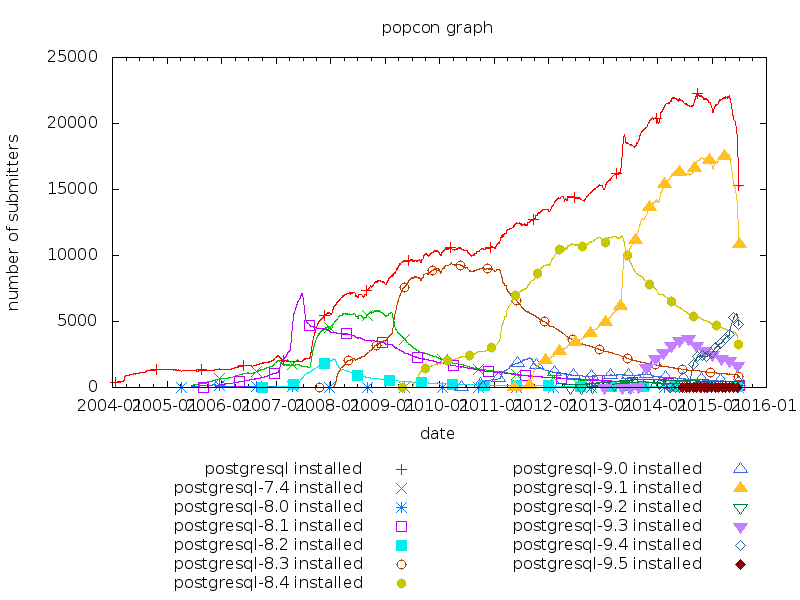
Today saw the release of PostgreSQL 9.5 Alpha 1. Packages for all supported Debian and Ubuntu releases are available on apt.postgresql.org: deb http://apt.postgresql.org/pub/repos/apt/ YOUR_RELEASE_HERE-pgdg main 9.5 The package is also waiting in NEW to be accepted for Debian experimental. Being curious which PostgreSQL releases have been in use over time, I pulled some graphics from Debian's popularity contest data: Before we included the PostgreSQL major version in the package name, "postgresql" contained the server, so that line represents the installation count of the pre-7.4 releases at the left end of the graph. Interestingly, 7.4 reached its installation peak well past 8.1's. Does anyone have an idea why that happened?
Ritesh Raj Sarraf: Laptop Mode Tools 1.67

I am pleased to announce the release of Laptop Mode Tools, version 1.67. This release has many important bug fixes, and everyone is recommended to upgrade. Of the many, one important fix is to, more reliably check for Device Mapper based devices, which is common these days with Crypt and LVM. For the summary of changes to quote from git log:
1.67 - Thu Jul  2 17:05:07 IST 2015
    * Relax minimum window size to accomodate low res screens
    * Fix variable name to comply with our "constants" assuptions
    * Get more aggressive in power saving for Intel HD Audio
    * Account Device Mapper devices
    * Add swsusp freeze support
    * Switch battery-level-polling default to True
    * Detect ethernet carrier, early and relibaly
    * changes the boolean setting *_ACTIVATE_SATA_POWER to a customizable
      *_SATA_POLICY, with backward-compatible defaults and documentation
      Thanks Yuir D'Elia
PS: On a side note, over the years, Linux's power savings functionality has improved a lot, all thanks to its use in the mobile worlds. At the same time, because of more companies shipping drivers depending on external firmware, stability has become less reliable. And to add to that, bare functionality of devices typically ask for disabling, you know what, LPM. So, at the end, the result is the same.

Categories:

Keywords:

Like:

Petter Reinholdtsen: MakerCon Nordic videos now available on Frikanalen

Last oktober I was involved on behalf of NUUG with recording the talks at MakerCon Nordic, a conference for the Maker movement. Since then it has been the plan to publish the recordings on Frikanalen, which finally happened the last few days. A few talks are missing because the speakers asked the organizers to not publish them, but most of the talks are available. The talks are being broadcasted on RiksTV channel 50 and using multicast on Uninett, as well as being available from the Frikanalen web site. The unedited recordings are available on Youtube too. This is the list of talks available at the moment. Visit the Frikanalen video pages to view them. Part of the reason this took so long was that the scripts NUUG had to prepare a recording for publication were five years old and no longer worked with the current video processing tools (command line argument changes). In addition, we needed better audio normalization, which sent me on a detour to package bs1770gain for Debian. Now this is in place and it became a lot easier to publish NUUG videos on Frikanalen.

Michael Prokop: HAProxy with Debian/squeeze clients causing random Hash Sum mismatch

Update on 2015-07-02 22:15 UTC: as Petter Reinholdtsen noted in the comments:

Try adding /etc/apt/apt.conf.d/90squid with content like this: Acquire::http::Pipeline-Depth 0; It turn off the feature in apt confusing proxies.
this indeed avoids those Hash Sum mismatch failures with HAProxy as well. Thanks, Petter! Many of you might know apt s Hash Sum mismatch issue and there are plenty of bug reports about it (like #517874, #624122, #743298 + #762079). Recently I saw the Hash Sum mismatch usually only when using random mirrors with e.g. httpredir.debian.org in apt s sources.list, but with a static mirror such issues usually don t exist anymore. A customer of mine has a Debian mirror and this issue wasn t a problem there neither, until recently: Since the mirror also includes packages provided to customers and the mirror needs to be available 24/7 we decided to provide another instance of the mirror and put those systems behind HAProxy (version 1.5.8-3 as present in Debian/jessie). The HAProxy setup worked fine and we didn t notice any issues in our tests, until the daily Q/A builds randomly started to report failures:
Failed to fetch http://example.org/foobar_amd64.deb Hash Sum mismatch
When repeating the download there was no problem though. This problem only appeared about once every 15-20 minutes with random package files and it affected only Debian/squeeze clients (wheezy and jessie aren t affected at all). The problem also didn t appear when directly accessing the mirrors behind HAproxy. We tried plenty of different options for apt (Acquire::http::No-Cache=true, Acquire::http::No-Partial=true, ) and also played with some HAProxy configurations, nothing really helped. With apt s Debug::Acquire::http=True we saw that there really was a checksum failure and HTTP status code 102 ( Processing , or in terms of apt: Waiting for headers ) seems to be involved. The actual problem between apt on Debian/squeeze and HAProxy is still unknown to us though. While digging deeper into this issue is on my todo list yet, I found a way to avoid those Hash Sum mismatch failures: switch from http to https in sources.list. As soon as https is used the problem doesn t appear anymore. I m documenting it here just in case anyone else should run into it.

Steve Kemp: My new fitness challenge

So recently I posted on twitter about a sudden gain in strength: To put that more into context I should give a few more details. In the past I've been using an assisted pull-up machine, which offers a counterweight to make such things easier. When I started the exercise I assumed I couldn't do it for real, so I used the machine and set it on 150lb. Over a few weeks I got as far as being able to use it with only 80lb. (Which means I was lifting my entire body-weight minus 80lb. With the assisted-pullup machine smaller numbers are best!) One evening I was walking to the cinema with my wife and told her I thought I'd be getting close to doing one real pull-up soon, which sounds a little silly, but I guess is pretty common for random men who are 40 as I almost am. As it happens there were some climbing equipment nearby so I said "Here see how close I am", and I proceeded to do 1.5 pullups. (The second one was bad, and didn't count, as I got 90% of the way "up".) Having had that success I knew I could do "almost two", and I set a goal for the next gym visit: 3 x 3-pullups. I did that. Then I did two more for fun on the way out (couldn't quite manage a complete set.) So that's the story of how I went from doing 1.5 pullus to doing 11 in less than a week. These days I can easily do 3x3, but struggle with more. It'll come, slowly.

So pull-up vs. chin-up? This just relates to which way you place your hands: palm facing you (chin-up) and palm way from you (pull-up). Some technical details here but chinups are easier, and more bicep-centric.
Anyway too much writing. My next challenge is the one-armed pushup. However long it takes, and I think it will take a while, that's what I'm working toward.

Lars Wirzenius: Obnam 1.10 released (backup software)

I have just released version 1.10 of Obnam, my backup program. See the website at http://obnam.org for details on what it does. The new version is available from git (see http://git.liw.fi) and as Debian packages from http://code.liw.fi/debian, and uploaded to Debian, hopefully soon in unstable. The NEWS file extract below gives the highlights of what's new in this version. Version 1.10, released 2015-07-01 Major bug fixes: Minor new features: Minor fixes:

1 July 2015

Daniel Silverstone: Be careful what you ask for

Date: Wed, 01 Jul 2015 06:13:16 -0000
From: 123-reg <noreply@123-reg.co.uk>
To: dsilvers@digital-scurf.org
Subject: Tell us what you think for your chance to win
X-Mailer: MIME::Lite 3.027 (F2.74; T1.28; A2.04; B3.13; Q3.13)
Tell us what you think of 123-reg!
<!--
.style1  color: #1996d8 
-->
Well 123-reg mostly I think you don't know how to do email.

Steve McIntyre: Quick trip to Sweden

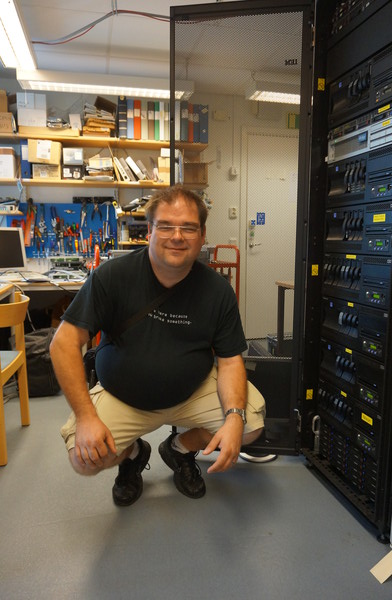
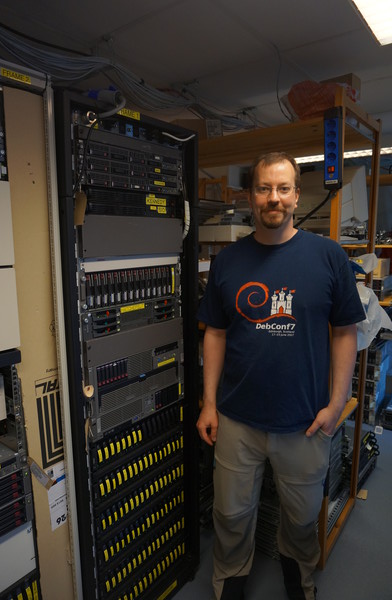
Jo and I spent a few days in Sweden and had an awesome time! The main reason for being there was Leif and Maria's wedding way up north in Skellefte . They cunningly organised their ceremony for the Midsummer weekend, which was an excellent plan - we had a full weekend of partying while we were there. :-) the happy couple We had some time to ourselves while we were there, so we wandered about a little and got to see some of the beautiful coastal countryside. Trund n Then on the way home we stopped off in Ume to visit Mattias Wadenstein (maswan) and his wife Melanie, and he showed me around some of the machines that he's been admining on behalf of Debian. Maybe I'm a sad geek, but I feel quite a bond with one of the machines there, pettersson.debian.org. It's the official CD build machine for Debian, and I've been responsible for thrashing it really hard for the last 5 years or so... :-) Pettersson and friends Massive thanks to the University of Ume and their Academic Computer Club for hosting Debian machines and serving all the CD images for us! maswan and a lot of disks The only downsides from the trip were the massive tiredness (midnight sun is pretty, but notconducive to sleep!) the mosquito bites and the nasty plague^Wcold that we picked up while we were there... Ah well. :-)

29 June 2015

Lunar: Reproducible builds: week 9 in Stretch cycle

What happened about the reproducible builds effort this week: Toolchain fixes Norbert Preining uploaded texinfo/6.0.0.dfsg.1-2 which makes texinfo indices reproducible. Original patch by Chris Lamb. Lunar submitted recently rebased patches to make the file order of files inside .deb stable. akira filled #789843 to make tex4ht stop printing timestamps in its HTML output by default. Dhole wrote a patch for xutils-dev to prevent timestamps when creating gzip compresed files. Reiner Herrmann sent a follow-up patch for wheel to use UTC as timezone when outputing timestamps. Mattia Rizzolo started a discussion regarding the failure to build from source of subversion when -Wdate-time is added to CPPFLAGS which happens when asking dpkg-buildflags to use the reproducible profile. SWIG errors out because it doesn't recognize the aforementioned flag. Trying to get the .buildinfo specification to more definitive state, Lunar started a discussion on storing the checksums of the binary package used in dpkg status database. akira discovered while proposing a fix for simgrid that CMake internal command to create tarballs would record a timestamp in the gzip header. A way to prevent it is to use the GZIP environment variable to ask gzip not to store timestamps, but this will soon become unsupported. It's up for discussion if the best place to fix the problem would be to fix it for all CMake users at once. Infrastructure-related work Andreas Henriksson did a delayed NMU upload of pbuilder which adds minimal support for build profiles and includes several fixes from Mattia Rizzolo affecting reproducibility tests. Neils Thykier uploaded lintian which both raises the severity of package-contains-timestamped-gzip and avoids false positives for this tag (thanks to Tomasz Buchert). Petter Reinholdtsen filled #789761 suggesting that how-can-i-help should prompt its users about fixing reproducibility issues. Packages fixed The following packages became reproducible due to changes in their build dependencies: autorun4linuxcd, libwildmagic, lifelines, plexus-i18n, texlive-base, texlive-extra, texlive-lang. The following packages became reproducible after getting fixed: Some uploads fixed some reproducibility issues but not all of them: Untested uploaded as they are not in main: Patches submitted which have not made their way to the archive yet: debbindiff development debbindiff/23 includes a few bugfixes by Helmut Grohne that result in a significant speedup (especially on larger files). It used to exhibit the quadratic time string concatenation antipattern. Version 24 was released on June 23rd in a hurry to fix an undefined variable introduced in the previous version. (Reiner Herrmann) debbindiff now has a test suite! It is written using the PyTest framework (thanks Isis Lovecruft for the suggestion). The current focus has been on the comparators, and we are now at 93% of code coverage for these modules. Several problems were identified and fixed in the process: paths appearing in output of javap, readelf, objdump, zipinfo, unsqusahfs; useless MD5 checksum and last modified date in javap output; bad handling of charsets in PO files; the destination path for gzip compressed files not ending in .gz; only metadata of cpio archives were actually compared. stat output was further trimmed to make directory comparison more useful. Having the test suite enabled a refactoring of how comparators were written, switching from a forest of differences to a single tree. This helped removing dust from the oldest parts of the code. Together with some other small changes, version 25 was released on June 27th. A follow up release was made the next day to fix a hole in the test suite and the resulting unidentified leftover from the comparator refactoring. (Lunar) Documentation update Ximin Luo improved code examples for some proposed environment variables for reference timestamps. Dhole added an example on how to fix timestamps C pre-processor macros by adding a way to set the build date externally. akira documented her fix for tex4ht timestamps. Package reviews 94 obsolete reviews have been removed, 330 added and 153 updated this week. Hats off for Chris West (Faux) who investigated many fail to build from source issues and reported the relevant bugs. Slight improvements were made to the scripts for editing the review database, edit-notes and clean-notes. (Mattia Rizzolo) Meetings A meeting was held on June 23rd. Minutes are available. The next meeting will happen on Tuesday 2015-07-07 at 17:00 UTC. Misc. The Linux Foundation announced that it was funding the work of Lunar and h01ger on reproducible builds in Debian and other distributions. This was further relayed in a Bits from Debian blog post.

28 June 2015

Ben Armstrong: Bluff Trail Early Summer 2015

Here s a photo journal of a walk I just completed around the Pot Lake loop of the Bluff Wilderness Hiking Trail. Hope you enjoy it! I was dissatisfied with my initial post, so have reduced the size to improve load time, changed the gallery software and have rewritten many of the captions. [slb_group]
My favourite stunted tamarack, clinging to the rocks.Click this photo to start the slideshow.
The Bluff Wilderness Hiking Trail is a series of four loops. Today I ll tackle only the first in order to get as many pictures as possible, and because when hiking solo, I prefer to stay on the more heavily traveled part. In late summer, I ll probably do all four loops with my friend Ryan again. Meanwhile, I ll stay in shape coming out here when I can for shorter walks. The trail starts here. Right away, even before heading between the marker stones, there s a pretty view of Cranberry Lake off to the right. Pink lady slippers have been plentiful this year! All along the trail, you can find hundreds, if not thousands of these. Boardwalks provide dry passage across the boggy bits. The pitcher plants are thriving, too. The vines with tiny, round leaves are wintergreen. Tasty! I ve not seen anything larger than a deer out here. Roots and rocks are a recurring theme. Many feet beating down on the first loop have packed the earth hard and have exposed more roots than you ll see deeper into the trail system where fewer hikers travel. Step carefully. Sheep laurel is an eye-catcher. To me, they look like little, pink jewels. Yellow markers clearly mark the Pot Lake loop. At crucial junctures there are some signs to point you the right way. If you re looking only at your feet, you may see black circles marked with arrows on some of the rocks, also pointing the way. The vegetation varies from scraggly and clinging to the rocks, to lush and green. The path is wet in parts. Nothing impassible, though. On the first loop in particular, and even within only the first kilometre, there are some pretty stunning views of the lake. Very quickly, you ll find yourself perched up top on the rocks. On this stretch, you need to hop a bit from one rock to the next. Just as quickly as you ascended, you descend back down to the lake again. A good place to stop and have a snack. The start of the first loop, itself. I chide myself for not having discovered this trail until about 2007, even though we moved out here in 2005. It s a treasure we re indebted to the WRWEO for preserving. Leave some comments in the box, if you like. You ll find these maps along the way to track your progress. Remember to follow proper trail etiquette. A particularly steep climb! Despite the best trail maintenance efforts, water still goes where it wants! Good to have boots. Another steep climb. This tree is chattering at me. Raising quite a racket. What s in the hole? I patiently wait with my camera to get a good shot of the tree s occupants. Mother woodpecker, feeding her babies! As the feeding continues, the chirping intensifies! Up on top of a big rock with a view over the lake is another favourite stopping place for a snack. The view at my snack break rock. I never get tired of it. There are some pretty big boulders. Next time I ll bring a friend to stand under it for scale. Another terrific view. A stream just before the first portage. This portage connects Cranberry Lake with Pot Lake. The portage is clearly marked. The Pot Lake end of the portage. One of several upturned trees, with the roots now forming a wall along one side of the trail. The spiral of the roots mimics the spiral split in this boulder which you can walk all of the way into until you reach the centre. Rocks and trees and trees and rocks White pine catkins. Suddenly the close forest opens up into a wide view all around. My favourite stunted tamarack, clinging to the rocks. Last year s cones. This year s aren t out yet on this tree. I love the tamarack s delicate new needles. These blueberries have a head start. Can t wait until it s time to harvest them. Nearly at the top of the Pot Lake loop. This is Pot Lake, itself. I was struck by this one little blighted berry, showing a blush of distress-induced colour amongst the green ones. Another view, nearly at the top. A sign beneath the map: Rare Plant Species: Mountain Sandwort Arenaria groenlandica. Use caution and stay on designated trails. Avoid disturbing habitat. Finally, the top. A map to mark your progress. Apparently the Mountain Sandwort, right at the base of the sign. The mountain sandwort is a pretty, delicate little thing. After passing the sign, the view from the top over Cranberry Lake, indeed both lakes, is a reward worth climbing all of the way up to see. Some other hiker has left a cairn. The descent is not too steep at first. The approach down to the back side of Pot Lake from the top is marked by exposed bedrock and scrubby plants. Finally back to some cover, which is welcome on hotter days. A ferny fairyland. It s not all abrupt ups and downs. Here s an easy, winding stretch of trail. Cinnamon ferns. Ambling along. Rounding the end of Pot Lake. Not very long after reaching the lake, the path climbs several metres up above it. There are some nice, rootless bits on this side of the loop, giving your ankles and knees a break. This guy seemed extremely agitated to see me. A new tamarack cone! Did I mention I like tamaracks? The steep descent back to Cranberry Lake again. Finally back where the loop starts.
[/slb_group]

Sven Hoexter: moto g GPS reset when it is not working with CM 12.1

There seems to be an issue with the moto g, CM 12.1 (nightlies) and the GPS. My GPS receiver stopped to work as well and I could recover it with the following steps in fastboot mode as described on xda-developers.
fastboot erase modemst1
fastboot erase modemst2
fastboot reboot
That even works with the 4.2.2 fastboot packaged in anroid-tools-fastboot.

Russell Coker: RAID Pain

One of my clients has a NAS device. Last week they tried to do what should have been a routine RAID operation, they added a new larger disk as a hot-spare and told the RAID array to replace one of the active disks with the hot-spare. The aim was to replace the disks one at a time to grow the array. But one of the other disks had an error during the rebuild and things fell apart. I was called in after the NAS had been rebooted when it was refusing to recognise the RAID. The first thing that occurred to me is that maybe RAID-5 isn t a good choice for the RAID. While it s theoretically possible for a RAID rebuild to not fail in such a situation (the data that couldn t be read from the disk with an error could have been regenerated from the disk that was being replaced) it seems that the RAID implementation in question couldn t do it. As the NAS is running Linux I presume that at least older versions of Linux have the same problem. Of course if you have a RAID array that has 7 disks running RAID-6 with a hot-spare then you only get the capacity of 4 disks. But RAID-6 with no hot-spare should be at least as reliable as RAID-5 with a hot-spare. Whenever you recover from disk problems the first thing you want to do is to make a read-only copy of the data. Then you can t make things worse. This is a problem when you are dealing with 7 disks, fortunately they were only 3TB disks and only each had 2TB in use. So I found some space on a ZFS pool and bought a few 6TB disks which I formatted as BTRFS filesystems. For this task I only wanted filesystems that support snapshots so I could work on snapshots not on the original copy. I expect that at some future time I will be called in when an array of 6+ disks of the largest available size fails. This will be a more difficult problem to solve as I don t own any system that can handle so many disks. I copied a few of the disks to a ZFS filesystem on a Dell PowerEdge T110 running kernel 3.2.68. Unfortunately that system seems to have a problem with USB, when copying from 4 disks at once each disk was reading about 10MB/s and when copying from 3 disks each disk was reading about 13MB/s. It seems that the system has an aggregate USB bandwidth of 40MB/s slightly greater than USB 2.0 speed. This made the process take longer than expected. One of the disks had a read error, this was presumably the cause of the original RAID failure. dd has the option conv=noerror to make it continue after a read error. This initially seemed good but the resulting file was smaller than the source partition. It seems that conv=noerror doesn t seek the output file to maintain input and output alignment. If I had a hard drive filled with plain ASCII that MIGHT even be useful, but for a filesystem image it s worse than useless. The only option was to repeatedly run dd with matching skip and seek options incrementing by 1K until it had passed the section with errors. for n in /dev/loop[0-6] ; do echo $n ; mdadm examine -v -v scan $n grep Events ; done Once I had all the images I had to assemble them. The Linux Software RAID didn t like the array because not all the devices had the same event count. The way Linux Software RAID (and probably most RAID implementations) work is that each member of the array has an event counter that is incremented when disks are added, removed, and when data is written. If there is an error then after a reboot only disks with matching event counts will be used. The above command shows the Events count for all the disks. Fortunately different event numbers aren t going to stop us. After assembling the array (which failed to run) I ran mdadm -R /dev/md1 which kicked some members out. I then added them back manually and forced the array to run. Unfortunately attempts to write to the array failed (presumably due to mismatched event counts). Now my next problem is that I can make a 10TB degraded RAID-5 array which is read-only but I can t mount the XFS filesystem because XFS wants to replay the journal. So my next step is to buy another 2*6TB disks to make a RAID-0 array to contain an image of that XFS filesystem. Finally backups are a really good thing

24 June 2015

Russell Coker: Smart Phones Should Measure Charge Speed

My first mobile phone lasted for days between charges. I never really found out how long it s battery would last because there was no way that I could use it to deplete the charge in any time that I could spend awake. Even if I had managed to run the battery out the phone was designed to accept 4*AA batteries (it s rechargeable battery pack was exactly that size) so I could buy spare batteries at any store. Modern phones are quite different in physical phone design (phones that weigh less than 4*AA batteries aren t uncommon), functionality (fast CPUs and big screens suck power), and use (games really drain your phone battery). This requires much more effective chargers, when some phones are intensively used (EG playing an action game with Wifi enabled) they can t be charged as they use more power than the plug-pack supplies. I ve previously blogged some calculations about resistance and thickness of wires for phone chargers [1], it s obvious that there are some technical limitations to phone charging based on the decision to use a long cable at ~5V. My calculations about phone charge rate were based on the theoretical resistance of wires based on their estimated cross-sectional area. One problem with such analysis is that it s difficult to determine how thick the insulation is without destroying the wire. Another problem is that after repeated use of a charging cable some conductors break due to excessive bending. This can significantly increase the resistance and therefore increase the charging time. Recently a charging cable that used to be really good suddenly became almost useless. My Galaxy Note 2 would claim that it was being charged even though the reported level of charge in the battery was not increasing, it seems that the cable only supplied enough power to keep the phone running not enough to actually charge the battery. I recently bought a USB current measurement device which is really useful. I have used it to diagnose power supplies and USB cables that didn t work correctly. But one significant way in which it fails is in the case of problems with the USB connector. Sometimes a cable performs differently when connected via the USB current measurement device. The CurrentWidget program [2] on my Galaxy Note 2 told me that all of the dedicated USB chargers (the 12V one in my car and all the mains powered ones) supply 1698mA (including the ones rated at 1A) while a PC USB port supplies ~400mA. I don t think that the Note 2 measurement is particularly reliable. On my Galaxy Note 3 it always says 0mA, I guess that feature isn t implemented. An old Galaxy S3 reports 999mA of charging even when the USB current measurement device says ~500mA. It seems to me that method the CurrentWidget uses to get the current isn t accurate if it even works at all. Android 5 on the Nexus 4/5 phones will tell the amount of time until the phone is charged in some situations (on the Nexus 4 and Nexus 5 that I used for testing it didn t always display it and I don t know why). This is an useful but it s still not good enough. I think that what we need is to have the phone measure the current that s being supplied and report it to the user. Then when a phone charges slowly because apps are using some power that won t be mistaken for a phone charging slowly due to a defective cable or connector.

23 June 2015

Russell Coker: One Android Phone Per Child

I was asked for advice on whether children should have access to smart phones, it s an issue that many people are discussing and seems worthy of a blog post. Claimed Problems with Smart Phones The first thing that I think people should read is this XKCD post with quotes about the demise of letter writing from 99+ years ago [1]. Given the lack of evidence cited by people who oppose phone use I think we should consider to what extent the current concerns about smart phone use are just reactions to changes in society. I ve done some web searching for reasons that people give for opposing smart phone use by kids and addressed the issues below. Some people claim that children shouldn t get a phone when they are so young that it will just be a toy. That s interesting given the dramatic increase in the amount of money spent on toys for children in recent times. It s particularly interesting when parents buy game consoles for their children but refuse mobile phone toys (I know someone who did this). I think this is more of a social issue regarding what is a suitable toy than any real objection to phones used as toys. Obviously the educational potential of a mobile phone is much greater than that of a game console. It s often claimed that kids should spend their time reading books instead of using phones. When visiting libraries I ve observed kids using phones to store lists of books that they want to read, this seems to discredit that theory. Also some libraries have Android and iOS apps for searching their catalogs. There are a variety of apps for reading eBooks, some of which have access to many free books but I don t expect many people to read novels on a phone. Cyber-bullying is the subject of a lot of anxiety in the media. At least with cyber-bullying there s an electronic trail, anyone who suspects that their child is being cyber-bullied can check that while old-fashioned bullying is more difficult to track down. Also while cyber-bullying can happen faster on smart phones the victim can also be harassed on a PC. I don t think that waiting to use a PC and learn what nasty thing people are saying about you is going to be much better than getting an instant notification on a smart phone. It seems to me that the main disadvantage of smart phones in regard to cyber-bullying is that it s easier for a child to participate in bullying if they have such a device. As most parents don t seem concerned that their child might be a bully (unfortunately many parents think it s a good thing) this doesn t seem like a logical objection. Fear of missing out (FOMO) is claimed to be a problem, apparently if a child has a phone then they will want to take it to bed with them and that would be a bad thing. But parents could have a policy about when phones may be used and insist that a phone not be taken into the bedroom. If it s impossible for a child to own a phone without taking it to bed then the parents are probably dealing with other problems. I m not convinced that a phone in bed is necessarily a bad thing anyway, a phone can be used as an alarm clock and instant-message notifications can be turned off at night. When I was young I used to wait until my parents were asleep before getting out of bed to use my PC, so if smart-phones were available when I was young it wouldn t have changed my night-time computer use. Some people complain that kids might use phones to play games too much or talk to their friends too much. What do people expect kids to do? In recent times the fear of abduction has led to children doing playing outside a lot less, it used to be that 6yos would play with other kids in their street and 9yos would be allowed to walk to the local park. Now people aren t allowing 14yo kids walk to the nearest park alone. Playing games and socialising with other kids has to be done over the Internet because kids aren t often allowed out of the house. Play and socialising are important learning experiences that have to happen online if they can t happen offline. Apps can be expensive. But it s optional to sign up for a credit card with the Google Play store and the range of free apps is really good. Also the default configuration of the app store is to require a password entry before every purchase. Finally it is possible to give kids pre-paid credit cards and let them pay for their own stuff, such pre-paid cards are sold at Australian post offices and I m sure that most first-world countries have similar facilities. Electronic communication is claimed to be somehow different and lesser than old-fashioned communication. I presume that people made the same claims about the telephone when it first became popular. The only real difference between email and posted letters is that email tends to be shorter because the reply time is smaller, you can reply to any questions in the same day not wait a week for a response so it makes sense to expect questions rather than covering all possibilities in the first email. If it s a good thing to have longer forms of communication then a smart phone with a big screen would be a better option than a feature phone , and if face to face communication is preferred then a smart phone with video-call access would be the way to go (better even than old fashioned telephony). Real Problems with Smart Phones The majority opinion among everyone who matters (parents, teachers, and police) seems to be that crime at school isn t important. Many crimes that would result in jail sentences if committed by adults receive either no punishment or something trivial (such as lunchtime detention) if committed by school kids. Introducing items that are both intrinsically valuable and which have personal value due to the data storage into a typical school environment is probably going to increase the amount of crime. The best options to deal with this problem are to prevent kids from taking phones to school or to home-school kids. Fixing the crime problem at typical schools isn t a viable option. Bills can potentially be unexpectedly large due to kids inability to restrain their usage and telcos deliberately making their plans tricky to profit from excess usage fees. The solution is to only use pre-paid plans, fortunately many companies offer good deals for pre-paid use. In Australia Aldi sells pre-paid credit in $15 increments that lasts a year [2]. So it s possible to pay $15 per year for a child s phone use, have them use Wifi for data access and pay from their own money if they make excessive calls. For older kids who need data access when they aren t at home or near their parents there are other pre-paid phone companies that offer good deals, I ve previously compared prices of telcos in Australia, some of those telcos should do [3]. It s expensive to buy phones. The solution to this is to not buy new phones for kids, give them an old phone that was used by an older relative or buy an old phone on ebay. Also let kids petition wealthy relatives for a phone as a birthday present. If grandparents want to buy the latest smart-phone for a 7yo then there s no reason to stop them IMHO (this isn t a hypothetical situation). Kids can be irresponsible and lose or break their phone. But the way kids learn to act responsibly is by practice. If they break a good phone and get a lesser phone as a replacement or have to keep using a broken phone then it s a learning experience. A friend s son head-butted his phone and cracked the screen he used it for 6 months after that, I think he learned from that experience. I think that kids should learn to be responsible with a phone several years before they are allowed to get a learner s permit to drive a car on public roads, which means that they should have their own phone when they are 12. I ve seen an article about a school finding that tablets didn t work as well as laptops which was touted as news. Laptops or desktop PCs obviously work best for typing. Tablets are for situations where a laptop isn t convenient and when the usage involves mostly reading/watching, I ve seen school kids using tablets on excursions which seems like a good use of them. Phones are even less suited to writing than tablets. This isn t a problem for phone use, you just need to use the right device for each task. Phones vs Tablets Some people think that a tablet is somehow different from a phone. I ve just read an article by a parent who proudly described their policy of buying feature phones for their children and tablets for them to do homework etc. Really a phone is just a smaller tablet, once you have decided to buy a tablet the choice to buy a smart phone is just about whether you want a smaller version of what you have already got. The iPad doesn t appear to be able to make phone calls (but it supports many different VOIP and video-conferencing apps) so that could technically be described as a difference. AFAIK all Android tablets that support 3G networking also support making and receiving phone calls if you have a SIM installed. It is awkward to use a tablet to make phone calls but most usage of a modern phone is as an ultra portable computer not as a telephone. The phone vs tablet issue doesn t seem to be about the capabilities of the device. It s about how portable the device should be and the image of the device. I think that if a tablet is good then a more portable computing device can only be better (at least when you need greater portability). Recently I ve been carrying a 10 tablet around a lot for work, sometimes a tablet will do for emergency work when a phone is too small and a laptop is too heavy. Even though tablets are thin and light it s still inconvenient to carry, the issue of size and weight is a greater problem for kids. 7 tablets are a lot smaller and lighter, but that s getting close to a 5 phone. Benefits of Smart Phones Using a smart phone is good for teaching children dexterity. It can also be used for teaching art in situations where more traditional art forms such as finger painting aren t possible (I have met a professional artist who has used a Samsung Galaxy Note phone for creating art work). There is a huge range of educational apps for smart phones. The Wikireader (that I reviewed 4 years ago) [4] has obvious educational benefits. But a phone with Internet access (either 3G or Wifi) gives Wikipedia access including all pictures and is a better fit for most pockets. There are lots of educational web sites and random web sites that can be used for education (Googling the answer to random questions). When it comes to preparing kids for the real world or the work environment people often claim that kids need to use Microsoft software because most companies do (regardless of the fact that most companies will be using radically different versions of MS software by the time current school kids graduate from university). In my typical work environment I m expected to be able to find the answer to all sorts of random work-related questions at any time and I think that many careers have similar expectations. Being able to quickly look things up on a phone is a real work skill, and a skill that s going to last a lot longer than knowing today s version of MS-Office. There are a variety of apps for tracking phones. There are non-creepy ways of using such apps for monitoring kids. Also with two-way monitoring kids will know when their parents are about to collect them from an event and can stay inside until their parents are in the area. This combined with the phone/SMS functionality that is available on feature-phones provides some benefits for child safety. iOS vs Android Rumour has it that iOS is better than Android for kids diagnosed with Low Functioning Autism. There are apparently apps that help non-verbal kids communicate with icons and for arranging schedules for kids who have difficulty with changes to plans. I don t know anyone who has a LFA child so I haven t had any reason to investigate such things. Anyone can visit an Apple store and a Samsung Experience store as they have phones and tablets you can use to test out the apps (at least the ones with free versions). As an aside the money the Australian government provides to assist Autistic children can be used to purchase a phone or tablet if a registered therapist signs a document declaring that it has a therapeutic benefit. I think that Android devices are generally better for educational purposes than iOS devices because Android is a less restrictive platform. On an Android device you can install apps downloaded from a web site or from a 3rd party app download service. Even if you stick to the Google Play store there s a wider range of apps to choose from because Google is apparently less restrictive. Android devices usually allow installation of a replacement OS. The Nexus devices are always unlocked and have a wide range of alternate OS images and the other commonly used devices can usually have an alternate OS installed. This allows kids who have the interest and technical skill to extensively customise their device and learn all about it s operation. iOS devices are designed to be sealed against the user. Admittedly there probably aren t many kids with the skill and desire to replace the OS on their phone, but I think it s good to have option. Android phones have a range of sizes and features while Apple only makes a few devices at any time and there s usually only a couple of different phones on sale. iPhones are also a lot smaller than most Android phones, according to my previous estimates of hand size the iPhone 5 would be a good tablet for a 3yo or good for side-grasp phone use for a 10yo [5]. The main benefits of a phone are for things other than making phone calls so generally the biggest phone that will fit in a pocket is the best choice. The tiny iPhones don t seem very suitable. Also buying one of each is a viable option. Conclusion I think that mobile phone ownership is good for almost all kids even from a very young age (there are many reports of kids learning to use phones and tablets before they learn to read). There are no real down-sides that I can find. I think that Android devices are generally a better option than iOS devices. But in the case of special needs kids there may be advantages to iOS.

Orestis Ioannou: GSoC Debsources updates

The first 4 weeks have been really great. I had the chance to work on the new webapp, the copyright tracker. Here are my first 4 reports for the weeks: Summary During these weeks i completed the navigation (by prefix, list of versions etc) for the copyright tracker, the license rendering and the API for searching by checksum and by package/version/filename. Still under review the batch API (request many files at once) and the the respective views for the API. In the following weeks I ll work on the database and the plugins to mine license information on update time. Experience The experience i accumulate every week is immense. During the review process of my code i receive great feedback from zack, matthieu, and jpleau. It is a great chance for everyone to improve his/hers coding skills. At the university we barely get any feedback on our code, let alone communicate directly with professors to find the best solution for a given problem. I think it gets development in another level. For example at the university we use git/mercurial for our projects, although we don't really pay attention at commit messages and we marginally make use of these tools besides 'commit pull push'. During the last weeks i had the chance to use far more commands in order to squash amend rebase commits to have a beautiful and useful log history! And this is just a minor example. All in all I think it is a great introduction to the free/open source community for somebody, like me, who has been for years only a user and couldn't find the opportunity to contribute! And don't get me wrong, gsoc is not only about coding skills. At least for myself having the chance to get just a small taste of how the Debian community works, gets organised, get things done (!) is somehow priceless! Summer of code TDD I have finally understood why test driven development is so powerful. As i am advancing in the project i am sometimes obliged to retouch some areas, refactor pieces of code. Having a great test suite that keeps you on track about the changes, and possible outages in advance is pretty powerful. What is coming I feel the project is on the right path. Both clemux (fellow gsoc student working on debsources) and me are advancing in a productive pace. I hope that soon enough the copyright Blueprint will be completed (most notable pending functionalities are the plugins-hooks to mine the licenses at update time, introduction of at least another license oracle possible ninka, statistics) so that everyone can take profit of the new tools provided by DebSources. Although we haven't talked much about it the patch tracker should also come into the play sooner rather than later. Stay tuned!
22 June 2015

Sven Hoexter: Free SSL/TLS snakeoil from wosign.com

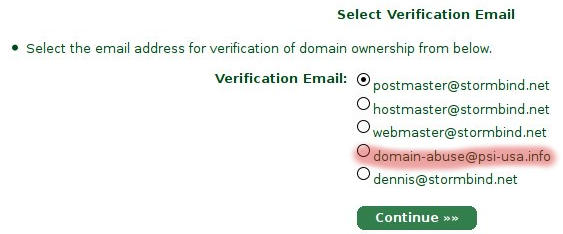
I've been a proponet of CaCert.org for a long time and I'm still using those certificates in some places, but lately I gave in and searched for something that validates even on iOS. It's not that I strictly need it, it's more a favour to make life for friends and family easier. I turned down startssl.com because I always manage to somehow lose the client certificate for the portal login. Plus I failed to generate several certificates for subdomains within the primary domain. I want to use different keys on purpose so SANs are not helpful, neither are wildcard certs for which you've to pay anyway. Another point against a wildcard cert from startssl is that I'd like to refrain from sending in my scanned papers for verification. On a sidenote I'm also not a fan of random email address extractions from whois to sent validation codes to. I just don't see why the abuse desk of a registrar should be able to authorize on DV certificates for a domain under my control. startssl abuse desk in dv validation So I decided to pay the self proclaimed leader of the snakeoil industrie (Comodo) via cheapsslshop.com. That made 12USD for a 3 year Comodo DV certificate. Fair enough for the mailsetup I share with a few friends, and the cheapest one I could find at that time. Actually no hassle with logins or verification. It looks a bit like a scam but the payment is done via 2checkout if I remember correctly and the certificate got issued via a voucher code by Comodo directly. Drawback: credit card payment. Now while we're all waiting for letsencrypt.org I learned about the free offer of wosign.com. The CA is issued by the StartSSL Root CA, so technically we're very close to step one. Beside of that I only had to turn off uBlock origin and the rest of the JavaScript worked fine with Iceweasel once I clicked on the validity time selection checkbox. They offer the certificate for up to 3 years, you can paste your own csr and you can add up to 100 SANs. The only drawback is that it took them about 12 hours to issue the certificate and the mails look a hell lot like spam if you sent them through Spamassassin. That provides now a free and validating certificate for sven.stormbind.net in case you'd like to check out the chain. The validation chain is even one certificate shorter then the chain for the certificate I bought from Comodo. So in case anyone else is waiting for letsencrypt to start, you might want to check wosign until Mozilla et al are ready. From my point of view the only reason to pay one of the major CAs is for the service of running a reliable OCSP system. I also pointed that out here. It's more and more about the service you buy and no longer just money for a few ones and zeroes.

Lunar: Reproducible builds: week 8 in Stretch cycle

What happened about the reproducible builds effort this week: Toolchain fixes Andreas Henriksson has improved Johannes Schauer initial patch for pbuilder adding support for build profiles. Packages fixed The following 12 packages became reproducible due to changes in their build dependencies: collabtive, eric, file-rc, form-history-control, freehep-chartableconverter-plugin , jenkins-winstone, junit, librelaxng-datatype-java, libwildmagic, lightbeam, puppet-lint, tabble. The following packages became reproducible after getting fixed: Some uploads fixed some reproducibility issues but not all of them: Patches submitted which have not made their way to the archive yet: reproducible.debian.net Bugs with the ftbfs usertag are now visible on the bug graphs. This explain the recent spike. (h01ger) Andreas Beckmann suggested a way to test building packages using the funny paths that one can get when they contain the full Debian package version string. debbindiff development Lunar started an important refactoring introducing abstactions for containers and files in order to make file type identification more flexible, enabling fuzzy matching, and allowing parallel processing. Documentation update Ximin Luo detailed the proposal to standardize environment variables to pass a reference source date to tools that needs one (e.g. documentation generator). Package reviews 41 obsolete reviews have been removed, 168 added and 36 updated this week. Some more issues affecting packages failing to build from source have been identified. Meetings Minutes have been posted for Tuesday June 16th meeting. The next meeting is scheduled Tuesday June 23rd at 17:00 UTC. Presentations Lunar presented the project in French during Pas Sage en Seine in Paris. Video and slides are available.

Next.

Previous.