Search Results: "agi"

7 September 2009

Gunnar Wolf: Google having gender issues related to old-agers?

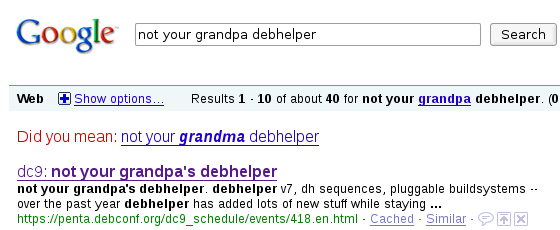
I am updating an old package's packaging style to take advantage of the new DebHelper 7 goodities. So far, I have been quite successful, but I hit a problem And before bugging on IRC, I decided to check with Joey Hess' presentation at DebConf9, Not your grandpa's debhelper. Of course, not remembering the URL, it was the most natural thing to ask Google: Did you mean... Not your grandma's Debhelper  WTF! Of course, putting this thingy aside, the right answer was the first hit. However, what is the first hit for the Grandma version? Quite dangerous: A post in Ubuntuforums for which the Google excrept reads: this tool can obviously eat your cat, poison your grandma, create an earthquake or do any other unexpected harm, so I don't provide any warranty whatsoever. I sincerely prefer joeyh's version.

Jordi Mallach: Flags and outrages

A bit more than two years ago, two young Spaniards on vacation in Latvia maybe went a bit too far during one of their night parties and decided to remove some Latvian flags that hanged from a post in the streets of Riga. They spent 1 month in prison, with charges for outraging the Latvian flag. The Spanish media talked about the disproportionate charges, the ridiculous and medieval laws in Latvia and so on. Today, we learn that Jaume d'Urgell will go to prison due to the outraging crime of substituting the current Spanish flag with the Republican flag of 1931 on the facade of a public building. So much for medieval laws and institutions like the Spanish monarchy.

Eugene V. Lyubimkin: I became DD.

That are only 3 simple words, but their value is hard to underrate. It's very important milestone in my Debian work.

The achievement might not be possible, if there wasn't the help of:
- Vincent Bernat, who thoroughly corrected my first packaging and sponsored my first (and not only) package;
- Dmitry E. Oboukhov, who uploaded many packages for me and also gave some useful advices;
- Roger Leigh, who spent not one day to improve my packaging skills, and also advocated my NM application;
- Enrico Zini, who was my NM Application Manager.
Thank you!

Thanks to people who built my NM procession chain up to creating the account: Bernd Zeimetz (FD), Christoph Berg (DAM), Peter Palfrader (account creation).

6 September 2009

Stefano Zacchiroli: rc bug of the day - again

8 RC bugs in 8 days I got back from vacation about 10 days ago. For the first time in recent years, I've spent 2 weeks of vacation mostly without email (excluding 2 "breaks" of 10 minutes each in an internet point, just to verify that my electronic world was not collapsing). The net result is that I feel very recharged and more productive both at work and for other tasks. Including Debian. Hence, during last week, I've tried an experiment. When during the day I feel bored about a given task, instead of reloading compulsively the page of an online newspaper, instead of checking (once more) my email, instead of checking (once more) my feeds, I try to fix an RC bug. For the first week, the result has been encouraging: one RC bug fixed per day (on the average, some day I haven't fixed any, some other 2 or 3): In some sense, this try to be kudos to the amazing initiative of Sesse, a few releases ago (or was it Lenny? my memory still sucks, no matter how recharged I feel). He has been fixing one RC bug a day for several months. I'm quite sure I won't be able to deliver the same result, but maybe this post will motivate other people, so that collectively we can fix a handful of RC bugs per day. Of course in the beginning it's easy, because there are a lot of "simple" bugs to fix and also because (as you can notice in the list above) "clusters" of similar RC bugs, that require similar fixes, can be identified. But the effort is useful nevertheless, since it cleans up RC bug list enabling more capable people to fix more resistent bugs. I'm gonna tag RC reports like this one with "rc" and "debian". If people follow up with similar initiatives we can rinse out of planet a feed of pretty good news for the Debian development community :-) In the interest of sharing best practices, here is my RC bug squashing workflow:
  1. go to http://bts.turmzimmer.net/details.php, choose "both" (i.e. squeeze + sid) as distribution and sort by "bugnr" (so that you can avoid most recent reports, which are not yet NMU material)
  2. choose an inspiring bug form the list which is at least 1 week old (better at least 2 or 3), study its log; for the moment, I tend to prefer neglected bug logs, where the maintainer has been unresponsive
  3. apt-get source package , sudo cowbuilder --build package_1.2-3.dsc , install the result and check for bug reproducibility
  4. fix the bug ! (yes, this is the easy step :-) ), taking care of not changing anything else
  5. dch --nmu
  6. dpkg-source -b package-1.2/ , sudo cowbuilder --build package_1.2-3.1.dsc , check if the bug is fixed and the package otherwise working
  7. lintian package_1.2-3.1.changes , check that there are no regressions in lintian errors wrt latest uploaded version
  8. interdiff -z package_1.2-3.diff.gz package_1.2-3.1.diff.gz , check that no unexpected changes have slipped in
  9. debsign package_1.2-3.1*changes , dput -e 2 package_1.2-3.1*changes (as allowed by devref 5.11.1)
  10. nmudiff --delay 2 , in the text: briefly describe in what the patch consists, and mention devref 5.11.1
I welcome suggestions on how to improve the above workflow in order to be both more effective and more polite with maintainers (FWIW, all the maintainer feedback I've received thus far for the above NMUs has been totally positive: you rock guys.).

Frans Pop: debtree 0.7.3 - Oh what tangled webs we weave

It's been quite some time (almost two years) since my previous "release" of debtree, but now version 0.7.3 is available. And it still generates very nice graphs :-) The changes are relatively minor: a few nice fixes for corner cases that were not handled correctly, and an update of the default lists of "skip" and "end" packages which help to limit the size of graphs for a fair number of packages I tried (including konqueror and openoffice.org).
Reason to revisit debtree was a recent nice mail from a debtree user, but also the current discussions about udev and the FHS. I'm on the side of "let's please keep /usr mountable separately". Mostly because I like a (small) encrypted root with a separate (large) unencrypted /usr'. I'm also increasingly unhappy with the default size of Debian's desktop installs, especially now that it looks as if Squeeze will see installation of Recommends by default by tasksel (and thus Debian Installer). For comparison, the size of a default Gnome desktop install for Etch was 1360MB; for Lenny it is 1830MB; for Squeeze it looks like it will be well over 3000MB! Remember that for Sarge we installed both Gnome and KDE from CD1 with both together taking 1390MB? Sure, some of that is real functionality, but a lot is also (IMO) redundant visual effects that only serve to slow the desktop down and junk needed to do stuff automagically. And a heck of a lot is duplicated functionality. One of the main reasons I switched to Linux was because it gave me back control over my systems, but with KDE4 and pervasive stuff like hal and all the various "kits" Linux is on a fast track that's giving priority to flashiness over real functionality and eroding that control. Here's a fairly default dependency graph for hal (click for full image). Looks reasonable, right? hal dependency graph But that's only because most major dependencies, such as dbus, policykit and pm-utils have been pruned. Here's a complete graph, with only libc6 omitted (full image is 1.5MB). Truly a tangled web. Scary. full hal dependency graph One can also look at it from the other side. Today I upgraded my sid chroot and found I suddenly needed to install libavahi-client3, libavahi-common3, libavahi-common-data and libdbus-1-3. Why? Reason turned out to be libcups2, so I checked if I really needed that. And here's why I do. libgtk2.0-0 dependency graph Most of these dependencies of libgtk2.0-0 I can understand, but isn't gtk supposed to be a graphical toolkit library? Couldn't printing support be implemented in some more specialized Gnome printing toolkit library? But I'm probably missing something. Anyway, now that I have a bit more perl experience through my recent work on debmirror, maybe I should finally port debtree from shell script to perl...
See the debtree home page for a full overview of how to read the graphs, but here's a quick intro. Purple arrows are Pre-Depends, blue are Depends and black are Recommends; green connections show Provides. The green packages are currently installed in my sid chroot, while the white ones are not. The diamonds show where the graph has been pruned: dependencies for these packages are not shown.

Torsten Werner: 10 years in Debian now

I think this was my first contribution to the Debian operating system:

grace (5.0.3-1) unstable; urgency=low

* added Replaces: xmgr, closes #35010, #42115, the only conflicting
file is the grconvert binary which is identical in both packages
* changed editor to sensible-editor
* redebianized using dh_make and debhelper
* new upstream, closes: #41146, #27308, #28944, #29705, #38214
* NMU

-- Torsten Werner Mon, 6 Sep 1999 22:19:04 +0200

That was 10 years ago. By the way the package is still in the distribution but orphaned now. Please note that our bug numbers had 5 digits only!

I don't want to count the packages that I am involved today but I am concentrating on Java related stuff. We got OpenJDK into Lenny and since DebConf9 it is our default JDK. Thanks to the recent work of Ludovic Claude we can use Maven for building official Debian packages. That will hopefully make packaging easier for many packages where upstream is using Maven as the build tool. I recommend joining the debian-java list if you are interested in those topics.

And I am a member of the FTP team today which is a great honour. It is quite
some extra work but we are now closer to the 1 week waiting time for NEW
processing (on average). Processing NEW is another place where I could see that
times are changing: this week I accepted a package (c) Microsoft Corporation
into Debian main what seemed to be impossible ten years ago.

4 September 2009

Andrew Pollock: [life] Two years later

It feels totally surreal that 2 years ago today, we lost our baby. The point is really driven home when we see friends kids who are of a similar age to what Joshua would be, and they're these walking (running), talking toddlers. It's hard to imagine that we too could be running around after a boy of that size by now. Two years feels like an absolute eternity. We're going to make a little getaway to the B&B we retreated to for Joshua's due date and just spend some quiet time together. September used to be my favourite month of the year. Every September school holidays we'd go to a beach house that we had in the family at Palm Beach, and I'd always associate September with two weeks of sun and sand. Now September is littered with painful memories of days when things that shouldn't have ever happened did, and days where things that should have happened didn't.

Russell Coker: Ownership of Laptops for Work

Jetstar has announced some new changes to the way they manage their IT infrastructure [1]. Some parts of it are obvious things that people have been doing (or wanting to do) for a long time such as using thin clients with no moving parts (not even cooling fans). But the really interesting part is their plan for managing laptops. They are using a virtual machine image on a flash storage device that can run on any system. So deploying a new system will only require installing the virtual machine software and inserting a storage device. Moving a user s environment to a different system (EG due to hardware failure) will merely require inserting the storage device in a new system. That raises the issue of ownership of the device. It seems that Jetstar are considering using systems that are owned by employees, Stephen Tame said In two years time a laptop should be a condition of employment, and this includes bringing your own laptop . When introducing that I expect there would be some resistance by employees who don t want to spend the money. However
I have previously estimated the costs of running a car [2] which works out to more than $1,650 per year for insurance, registration, basic maintenance, and the interest that would have been received if the car had not been purchased and the money had been invested. Laptops can be purchased for significantly less than $1000 (currently the EeePC 701 is on sale for $219) and can be expected to last for three years or more if you are careful to avoid damage and don t run demanding software. So a job that demands ownership of a laptop is asking for a much smaller financial investment than one which demands ownership of a car. But I expect that many employees won t see it that way. The up-side for employees to bring their own laptops is that they can choose a model that suits their preference. Everyone has preferences regarding the size of keys on a keyboard, the distance that they travel and the pressure required to register a key-press. For desktop machines it s easy to swap keyboards but for laptops there is no such option. Then there s the issue of the trade-off between physical size and weight vs display resolution, personal preferences in this regard will depend to some extent on the body mass and strength of the employee. Now there are a number of security issues related to personal laptop use. Obviously if the laptop has a Trojan-horse program installed then it could sniff any data that goes past on the network. The most trivial case of this could be addressed by running VPN software inside the emulated environment. This would force a Trojan to compromise the virtual environment (EG by modifying the address space) or to compromise the files on disk (insert a Trojan inside the filesystem for the virtual environment). The former would be tricky to get right while the latter would be trivial. Both attack methods have been used in the past and proven to work. This is why many companies prohibit their employees from connecting their own systems to the corporate network. One example of a system that is based around running virtual machines for all desktop operations is the NSA NetTop project [3]. NetTop involves a SE Linux system that runs multiple instances of VMWare for different desktop environments. Each VMWare instance runs at a particular sensitivity level and uses a VPN connection to a back-end network running at the same level. The aim of NetTop is to prevent applications in the different VMWare instances from communicating with each other. The significant difference between a typical NetTop installation and what JetStar might be doing is that NetTop runs on a secure base it s hardware that has been purchased and installed by a military organisation and is run in a secure facility. While personal laptops that are owned by employees can be expected to be infected with viruses and Trojan-horse programs. In the past I have suggested that an employment package for any skilled employee should include some budget for buying things that facilitate the work [4]. It seems to me that a company like JetStar could best achieve their goals by assigning a budget to each new employee to buy a machine for their use. The employee then gets to choose a machine up to that budget which would only be for work purposes. Then when the employee leaves or the machine becomes due for replacement it could be sold at auction. When considering all the costs involved in hiring a new person, spending something less than $1,000 to buy a laptop is nothing. Finally if buying machines for work purposes, you really don t want employees using them for surfing porn. Porn sites tend to be particularly bad for malware distribution. To reduce the incidence of such problems I think that work machines should have their sound hardware disabled and laptops should not be purchased with overly large displays. There is no need to make work machines totally unsuitable for porn surfing (which would also make them less effective for work), but making them less suitable than a $500 budget PC should dramatically reduce the scope of the problem.

Matthew Palmer: I want those two day of my life back, Puppet

Pop Quiz time, everyone (well, the Puppet-using subset of "everyone", anyway). Where is the dependency loop in the following manifest:
class klass  
   file   ['/tmp/a']: ensure => present  
 
define def_file()  
   include klass
   file   $name:
      ensure => present,
      require => File['/tmp/a']
    
 
def_file   '/tmp/b':  
def_file   '/tmp/c': require => File['/tmp/b']  
This seems pretty straightforward: /tmp/c can't be created until /tmp/b (via the direct require) and /tmp/a (via the define) have been created, while /tmp/b can't be created until /tmp/a is created. You can draw some pretty graphs and see that everything looks fine. However, if you run this manifest, you will find that roughly half the time, you will get a failure saying that there's a dependency loop (and the other half of the time it'll work fine), like this: "err: Could not apply complete catalog: Found dependency cycles in the following relationships". So, where is the loop? It's because the require on the /tmp/c resource also applies to the /tmp/a resource -- iff the include klass directive is applied to the /tmp/c resource. So /tmp/a then requires /tmp/b , and /tmp/b requires /tmp/a , and it's LOOP TIME! Whether or not this loop occurs on a particular Puppet run is controlled by fickle Lady Fate (because Ruby hashes, which are used at some point internally in this process, don't have a well-defined or stable order). As to why the include only applies to one of the defines rather than all of them, well, that's related to the fact that a class only gets evaluated once, and I think someone was having a lazy day when they wrote that part of the system (I can't imagine it would be the end of the world if each instance of the class was linked to the defined resource in the scope tree). Now, when you've only got the above manifest, it's relatively straightforward to isolate the problem and fix it -- I had it sorted in about an hour. The two days prior to that were isolating the bug from the live manifest, because there are about 20 instances of def_file in our live manifest, and so I'd have to run Puppet (on average) 20 times to make the problem appear every time I had a new hypothesis (and since I didn't know whether the bug was client-side or server-side, I had to run it in the real, full-blown environment, which slows things down further). If the class-handling stuff had been written properly, then the error would have been constant, rather than intermittent, and I would have been asking for a couple of hours credit, not a couple of days. The fix? Use virtual resources instead of the class, which does $DEITY-only-knows-what to the scope tree. These have their own giant buckets of ugliness, but our options, at this point, are unpleasantly limited. I really do wonder why I'm not a raging alcoholic sometimes. The reasons not to are strangely hard to recall right at this moment...

3 September 2009

Andrew McMillan: Storing Secrets

Something that has been annoying me recently with my bank has been that their website tells me that they will never ask for my password over the phone. And then their call centre asks me for my password. Over the phone. Of course the call centre doesn't mean my website password - they mean the special 'ultra-secure 5ekr1t code phrase', but they don't have a good, universally understood word to use for that. Hopefully they'll work one out, but they appear to have got the message anyway. This got me to thinking about how these phrases are used, and how insecure they are in reality. After all when I store a website password I go to significant lengths to ensure that the same password is not represented by the same string of characters in my database. How vulnerable are our secrets in the databases of organisations we do business with?
<!--break--> Simple Password Storage Surprisingly often people do store passwords in databases in plain text, so that should their website get hacked someone would quite possibly be able to download the whole password database. Please feel free to name and shame these organisations in the comments below. My own pet hate in this regard is the 'Mailman' mailing list software: by default on 'mailman day' - the first day of each month - it sends me my password. In plain text. Of course many developers recognise this flaw, and work around it by using a one-way hash to obscure the password. Usually they choose md5 for their hashing algorithm though, and they often fail to use a 'salt' to randomise the plaintext prior to hashing. This means that even though a password might seem obscure like 'Supercalifragilisticexpialidocious!', and no doubt it will hash to something that seems obscure like 'a7290d426b6a1764af6fd7fba5db214e', but you can often find it straighforwardly by looking it up through one of the friendly reverse hash lookup websites. There's even a Digest::MD5::Reverse perl module on CPAN to interface to a bunch of these in a more automated way! Oh dear. One way to go beyond this is using a 1-way hashing algorithm, with a random salt included into the plaintext before the hashing, so that if (god forbid) two users had 'password' for their password I might see two rows in my database like:
davical=# select username, password from usr;
  username                       password                          
-------------+------------------------------------------------
 user1          SSHA qCctCH5dirYCf29uxJiE68LvmLRDdnBkbldiWlE=
 user2          SSHA y8yOzjoh9fSkVwLaXGoVtWdiIYxmU2FCb2dOZXc=
(2 rows)
When the user wants to log in I apply the same transformation to their incoming password (appending the same salt) and compare against my stored hash. If they match then it must be the same password they used previously. Storing passwords in this way secures them from casual, or even reasonably determined access, although naturally they can still be logged at the beginning and end of the communication - or even in the middle, if we didn't encrypt that bit! The PHP function I use to salt and hash the password is as follows:
/**
* Make a salted SHA1 string, given a string and (possibly) a salt.  PHP5 only (although it
* could be made to work on PHP4 (@see http://www.openldap.org/faq/data/cache/347.html). The
* algorithm used here is compatible with OpenLDAP so passwords generated through this
* function should be able to be migrated to OpenLDAP.
*
* If no salt is supplied we will generate a random one.
*
* @param string $instr The string to be salted and SHA1'd
* @param string $salt Some salt to sprinkle into the string to be SHA1'd so we don't
*                     get the same PW always hashing to the same value.
* @return string  SSHA  followed by a base64 encoded SHA1 of the salted string.
*/
function session_salted_sha1( $instr, $salt = "" )  
  if ( $salt == "" )  
    $salt = substr( base64_encode(sha1(rand(100000,9999999),true))), 2, 9);
   
  return ( sprintf(" SSHA %s", base64_encode(sha1($instr.$salt, true) . $salt)));
 
What about Secret Code Phrases? The problem with these secret code phrases, apart from all of the forgetability and guessability problems that have repeatedly been identified elsewhere, is that they are much less likely to be stored in a one-way hash. Are you going to ask your call-centre staff to type in the customer's secret code phrase? Didn't think so. And if you did it's going to add pronouncability issues to the whole mix. So this means that those organisations who have our secret code phrases in their database will, in all likelihood, have them stored directly as plain text, displaying them to the random call-centre staffer along with all of our other account details, and especially making them vulnerable to accidental disclosure. Disclosure of a sort that doesn't necessarily involve knowing they have been disclosed. Proliferation of Use These things provide the appearance of security - 'Security Theatre' as Bruce Schneier terms it - and because of that they're taken up in a kind of a cargo cult of security: "if the banks do it that way it must be a really good form of security". This makes the problem much worse, because now I have to remember a secret code phrases not only for banks, but for ISPs, phone companies, online auction websites, and so on. How many mother's maiden names, favourite teachers and friend's phone numbers do I have? I'm sure I'm at well up whatever curve it is that measures the number of passwords a person has, because five years ago I had so many I started to store them all in an encrypted database - protected by a yet another password, of course. Now in order to get my story straight I have to store my 'secret code phrases' in there too. If I didn't store my secret code phrases in that database, I'd obviously be re-using them everywhere, from a very small set - perhaps the same one that everyone around me overhears, every time I have to ring my bank to authorise another payment from my account. Because the proliferation of use is not just the breadth of wannabe thespians hoping to climb on the stage of this latest play, but the way they want to use it all the time, too. In fact the only conversation I've had recently with my bank where they didn't want it was when they rang me. Obviously I was the only person who could answer a phone in my house, right? It isn't just security theatre: I think we can see that this analogy belongs much deeper into the sub-genre of 'Security Farce'. Is there a solution? I don't have any easy answers - other than the ones to my security questions, of course - but some improvements are possible. Other banks have quizzed me about stuff like recent expenditure or credit card limits from time to time, but I've usually passed those tests by reading my last bank statement - or failed them by not having it to hand! I don't really think that the answers can lie in that direction because the information is only quite loosely tied to my identity. For some parts of the call-centre handling of secret code phrases there are changes that could make them more secure, but in the fairly short term these organisations need to find a different way to perform these out of band identity checks. For the actual storage of the code phrases it would be a marginal improvement if the database did not contain the actual phrase. Perhaps it could be encrypted with some application-known key, so that it can be unencrypted when it needs to be displayed, but never stored in the clear. Of course there's still the problem with that key... Verification of the secret code phrase could be done by someone not involved in the transaction, so that the call could be temporarily passed into a 'verification stream' where a different person performed the verification step without the context of the account details or enquiry. Though this sort of complexity seems unlikely with call centres seemingly being outsourced to the cheapest supplier. One thing does seem likely to become increasingly true: there is less and less private data in our lives, and every time we share one of these little nuggets with our bank, or our electricity company, or our on-line associates-we-call-friends, is one more chance that it escapes into the hands of the foaming-at-the-mouth-terrorist-cracker-communist-nazi-right-wing-religious-fruitcake hordes. The highest bar for personal verification which any of my banks currently sets for me is a random choice from a set of personally entered questions, with a set of personally entered answers, for which I have to enter two randomly selected characters using my mouse. That's not bad for safe verification, and I'd have to be really impressed with their security if that was stored in the database by a passphrase-protected encryption key. With that bank I don't know what they do over the phone - I assume they've concluded they can trust my logged on persona enough that I can do what I want online, consequently I haven't had to call them and share those secrets with everyone in earshot. Maybe paranoid freaks like me will go back to a chequebook and close down on-line access to their bank accounts entirely when they find themselves having to supply a skin scraping in order to authorise their next $500 payment. "Please insert your finger in the AccuYou(tm) BloodSucker(tm) to proceed with this payment" - well, I guess it might cut down my spending! In any case, biometrics need to be understood before they can be used effectively and appropriately - and remotely over the phone is probably not one of the ways that they can be trusted to work.

2 September 2009

Russell Coker: Healthcare and Free Software

The Washington Monthly has an interesting article about healthcare and Free Software [1]. It seems that a free system named VistA from the US Veterans Affairs department (not to be confused with the unpopular OS Vista that Microsoft released a few years ago) is competing against a range of proprietary software for managing patient data. VistA has apparently performed very well, it s cheap and easy to install, the data can be shared with other programs, and it was largely written by doctors and nurses so it s optimised to their needs. It has been proven that VistA has saved many lives through better management of medicines and through permitting statistical analysis of the results of various treatments. It has also allowed medical staff to work more quickly which reduces waiting times and medical expenses. But as you would expect in the US, whenever there is a way of saving lives while also saving money there are companies lobbying for the opportunity to make money while allowing innocent people to die. Of course there are established medical companies who are doing this now and have been doing so for some time. But the latest news is that Microsoft, Intel, Cisco, and Allscripts, are sponsoring the Electronic Health Record Stimulus Tour an aggressive measure to railroad doctors into buying proprietary software now. MS is known for totally ignoring the law when it gives them an opportunity to gain market share, but this is a new low. What will MS do next? Sell drugs to children?

31 August 2009

Gunnar Wolf: Serverless and mailless

Oops. Yesterday (Sunday, 31/08/09) I far from any computer-like object for most of the day. When I got back home, of course, I promptly opened my laptop to check my mail who knows what destiny might have for me in a 24 hour period? Maybe I won yet another fortune I have to cash in Nigeria? Maybe there is (GASP!) a new RC bug on one of my packages? But no, my mail server didn't feel like answering to my ssh queries. The connection was established, but shut down before even sending the protocolary SSH-2.0-OpenSSH_5.1p1 string. Fearing an overload (after all, the little bugger is just a Mac Mini running in another room in my house), I tried to check (via Web) its Munin status Apache didn't want to listen either. It answered, but got only access denied. Things started worrying me But (silly me) not enough The machine runs headless1, so I just danced the boring raising elephants song2. Allowed for a couple of minutes for everything to settle, and tried to connect. Horror, now even pings didn't work! So I ran to fetch my old, bulky and trusty monitor. Went back to the machine, plugged it in, switched it off and back on. Everything worked fine this time At least appearingly. I opened up mutt and started happily reading mails, while trying to understand on another console what happened at 07:06 that didn't get logged anywhere and had the machine dead for basically all the day. And then, BRRRT-BRRRT-BRRRT, I started hearing the HDD seeking. I was able to send a couple of mails, but decided to let the machine rest and... Will reduce its disk usage to an absolute minimum. Fortunately, I have already the machine meant to replace it A much nicer, beefier iMac G5, waiting to be vacated from its data, task which has suddenly become prioritary. So, in short: If you need to get in touch with me in the next day or two, don't count on my usual @gwolf.org mail, as it is down. I hope to be able to get the data out of the poor little bugger painlessly after it rests a bit. And I hope not to drown in a sea of mails after I get the replacement back online :-/
  1. 1. for those not used to computerspeak: without a connected monitor
  2. 2. For those following at home who don't understand how Raising Elephants Is So Utterly Boring, this is a (silly, stupid but useful) mnemotecnic for as-properly-as-possible restarting hung Linux systems: Hold AltGr (right-Alt) + SysRq (in reduced/notebook keyboards, Fn+SysRq), and type R E I S U B (leaving a couple of seconds between key, ideally waiting for all disk activity to settle between each). That means:
    unRaw
    Take control of keyboard back from X,
    tErminate
    Send SIGTERM to all processes, allowing them to terminate gracefully,
    kIll
    send SIGKILL to all processes, forcing them to terminate immediately,
    Sync
    Flush data to disk),
    Unmount
    Remount all filesystems read-only,
    reBoot.
    Well... Reboot the system

Andrew Pollock: [debian] ISC DHCP 4.1 package progress report

It's been a while since I last wrote about where I was up to with the DHCP 4.1 packaging for Debian. I'm pleased to report that the packages are now ready for upload to experimental. The main delay was doing some basic testing to make sure that the transition from the v3 packages to the new v4 packages worked properly. I'm glad I took the time to set up a Xen test environment, because I found all sorts of problems, and fixed them. The only reason I'm not uploading the packages today is because my testing uncovered a bug (#544371) in the way ifupdown is invoking dhclient. Until that is resolved, there's not a lot of point in uploading, as dhclient won't work. Oh, and the DHCP server LDAP patch still needs to be sorted out, but I'm not going to wait for that to do an experimental upload.

30 August 2009

Robert Collins: 30 Aug 2009

Made some time to hack... the results: config-manager 0.4 released, re-uploaded to debian (it was removed due to some confusion a while back). This most notably drops the hard dependency on pybaz and adds specific-revision support for bzr. subunit snapshot packaging sorted out to work better with subunit from Ubuntu/Debian. This latest snapshot has nested progress and subunit2gtk included. PQM got a bit of a cleanup:
  • The status region shown during merges is ~ twice as tall now.
  • if the precommit_hook outputs subunit it will be picked up automatically and shown in the status region.
  • all deprecation warnings in python2.6 are cleaned up
  • Pending bugfixes were merged from Tim Cole and Daniel Watkins - thanks guys!
  • 7 June 2009

    Clint Adams: The Texas math(s) aftermath

    Belkinsauce is plotting against me, hiding my items and mismanaging his soundfont. Such is his wont.

    Martin Meredith: Automated PPA GPG Keys

    After reading Alan Pope s recent post on installing GPG keys for PPAs easily, I thought I d have a bit of a hack around. Personally, I regularly add PPAs to my system, whether it be for Chromium Daily Builds, Bazaar, Gwibber, or anything else. I ve found the most annoying thing is the installation of the GPG keys. Now, I wouldn t reccomend this for everyone, but, for some, it might be exactly what you ve been looking for. Here s what I did:- Firstly, I saved the Script that Alan linked to as /usr/local/bin/ppakeys and chmod d it to 755. I then created a new file, /etc/apt/apt.conf.d/05ppa containing the following line
    APT::Update::Pre-Invoke "if [ -x /usr/local/bin/ppakeys ]; then /usr/local/bin/ppakeys; fi ; ;
    Now, every time I do a sudo apt-get update - it ll check for new keys that I need, and install them as neccessary. Magic! <edit> Please make sure the quotes are correct if you copy and paste this!</edit>

    6 June 2009

    Russell Coker: Actually You Do Care

    A reasonably common feature in Internet debates is that of one party claiming to not care about the issue. Statements such as I haven t got time to debate this or I m not interested are used to try and disclaim any interest in the topic. Such claims are silly and rather amusing. Outside the Internet it does make sense to say I don t care because interactions are between small numbers of people. Telling a tele-marketer that you don t care about their product is part of the process of getting them to stop calling you. But it doesn t make sense in interactions between large numbers of people. If there are 100 people on a mailing list then there will be a variety of opinions about any issue, but one thing you can count on is that the majority of people on the list are not interested in whether any individual cares about an issue. If there was a general desire to discover how many people cared about a topic of discussion then the way to determine this would be via an online poll. In almost every situation individuals saying I don t care in email just isn t a scalable solution. The only exception is when someone in a leadership position is asked for an opinion, in such a case a response is expected and if the leader actually doesn t care then saying so and letting other methods be used to resolve the dispute makes sense. One common case where an I don t care message is seen is at the end of a long and heated discussion. After a discussion has gone on for a while (well beyond the point where it was obvious that no-one was going to change their position) one party might claim to not care or not have the time to debate the issue. But of course if they didn t care at all or had no time then they wouldn t have written any messages on the topic. If they had a limit to their time or care factor then they would probably have stated their opinion once and maybe written a single follow-up post clarifying the first one. Anyone who has written 6+ messages or a total of 1000+ words on a topic obviously cares and obviously has time. In such cases it seems that claiming to not care or not have time is a final desperate attempt at getting the last post on a topic by someone who subscribes to the last post wins school of online debating. Another common case is when someone makes a point that is decisively refuted. The Internet is filled with people who can t handle criticism and who can never leave any critical email without a reply. In such a situation claiming to not care is a way that such a person can protect their fragile ego even if the point is indefensible. One of the variations on this theme is to claim to be an expert who doesn t care enough to educate people on mailing lists (or even provide a couple of URLs that reference what they need to know). As a hint, if you are going to claim to be an expert while making statements that disagree with notable experts in the field in question (professors at prestigious universities, Nobel laureates, or people who have demonstrated great practical success) then you really need to demonstrate your expertise and cite references. While generally it s the scope of the Internet that makes the I don t care argument silly, it also doesn t make sense in interactions via electronic media such as private email where a sender can be ignored. If you don t care about a private email in reply to one of your messages then what you will do is simply delete it. Replying and saying I don t care merely demonstrates that you do care, invites another reply, and shows that you have a fragile ego to protect. My general practice when dealing with such people is to send one reply to every message that they send me, such people typically demonstrate how much they care by sending me more than a dozen messages explaining in detail how much they don t care. Another variation on the theme of private correspondence is people who write blog comments that are obviously inappropriate and will not pass moderation. Someone who polls my blog to see if their comment has been approved and then writes an abusive comment when they discover that they fell well short of my comment quality standards obviously cares about having their comment published. To then claim to not care about whether their comment was approved is obviously a lie. Google is almost entirely filled with things that I don t care about. I demonstrate the fact that I don t care about them by not commenting.

    5 June 2009

    Gunnar Wolf: RubyCamp Mexico

    RubyCamp UNAM logo Today I attended RubyCamp (schedule available), organized by my friends at Instituto de F sica, at my University. I presented three plugins I made and regularly use. The organizers followed a short, more informal scheme than most conferences I am used to Talk slots range between 5 and 15 minutes, so we attended a whole day of semi-lightning talks. Of course, many people have run late, and although there was quite a bit of free space in the schedule, it has been practically non-stop I was thinking on also giving a talk on encodings (as many people really still don't understand what is UTF-8, what is Latin1, why all that mess People, please learn at least The Absolute Minimum Every Software Developer Absolutely, Positively Must Know About Unicode and Character Sets (No Excuses!)), but the schedule is full by now. Interesting and successful experiment, I'd say. The talks are being taped, and the organizers say they will be soon made available online. There are many cultural details to note here. First of all, yes, the Rails Fanboys _are_ a cult/sect. I think we have ~90% of MacBooks... I still fail to understand why a coder feels at ease on MacOS. I deeply despise it! Also, most of this community have bitten the Twitter plague. This is also a community very much into businessspeak, speaking a word in English for each two words in Spanish (I try to be consistent, not mixing languages at least). Some conferences have been quite business- and enterpeneur-oriented. Although I should not complain too much about this, as it is an important aspect for many people But I still don't feel at ease having talks on how to run a business if we were asked for presentations on technical aspects! Anyway - I was quite happy to be here. This is the first real technical, code-oriented conference I have attended in a long time in Mexico. And we need more like this! We have too many entry-level, evangelization-oriented conferences, but very few like this one. [update]: Group photo!

    Stefano Zacchiroli: turbogears 2 packaging - take 3

    TurboGears 2 packaging - (another) status update Brief status update on TG2 packaging. As expected, this week has been very busy and I'm writing the update offline on a train, but nevertheless I've good news to share: ... the last item above would theoretically mean that TG2 is already usable, but it is not the case due to the infamous #507909 which breaks both TG2 and TG1 in unstable (the latter was working in Lenny, and I had to resort to a Lenny chroot for a recent course I've taught about web development). In short, turbojson is in unstable, in spite of the lack of several of its dependencies, making impossible any import of it. ..., stay tuned, keep faith, bear with me, almost there, ... etc.

    Brett Parker: And summer bites again!

    So, summer has arrived - how can I tell? The heat is killing the servers in our office again, the poor little AC unit can't keep up when the temperature outside is getting to summer weather. So the door to the magical cupboard is open for the moment, as the office temperature is slightly lower (but still, not great), and it's keeping the cupboard at somewhere around 26, which is still a little higher than I'd like, but better than the 32/33 that knocks the main firewall out. I'll be replacing the main firewall over the weekend with a lower power (and thus less heat generating) soekris box (which should have enough grunt to shift the packets), and means that we'll go from OpenBSD 4.3 -> OpenBSD 4.5 at the same time. Also, it's time to finally get the workstations on to lenny - as they're all NFS root, it becomes slightly tricky to get the setup just right for them... hopefully we can start rolling it out to the developers early next week, and then we should be in business...

    Next.

    Previous.