Search Results: "reg"

2 December 2012

Gregor Herrmann: RC bugs 2012/47-48

I was a bit busy (mostly in pleasant ways) during the last two weeks, so this reports covers a longer period of my RC bug activities:

1 December 2012

Steve Kemp: Reassessing what I want from a simple website creation tool

Thanks very much to everybody who commented, both publicly and privately, on my previous entry. To recap: I have three sites that were each generated by slightly different templating software I'd built and tweaked over the years. I was frustrated that the three copies of the generation tool had all drifted and diverged from each other, and was looking to setup a new (static) site. The obvious conclusion was either: I'd cheerfully decided to go down the second route, because life is short. But after having quick reads, then spending several hours investigating likely contenders I kept finding reasons why they weren't suitable. Today I reworked my tool to succesfully generate each of the three sites. That was less annoying than expected, after I'd decided "I'll have to change my templates anyway, when I switch to a real tool". So in the interests of sharing I placed my tool online, and wrote documentation: This is not a U-turn. This is not a commitment to avoid the investigation of real replacements. This is just something I had to do as a cleanup and to make sure I fully understood exactly what my requirements were. In conclusion: My requirements are now absolutely known, fixed, and understood. I still firmly intend and expect to migrate to something by the end of the year. Ideally something that will make tag pages, RSS feeds, and other clever things easy. (Getting rid of literal shell usage in my templates, and unifying the way I auto-generate galleries via file globs was a useful change in its own regard - I always felt slightly dirty..) Lookout for more summaries and reviews of specific tools when I've had the chance to relax and start looking again.

27 November 2012

Christian Perrier: Tristan da Cunha

I happen to be a great fan of ocean races, so like many, particularly here in France, I'm following the Vend e Globe ocean race, alone around the world on 60-feet IMOCA race ships, without stop or assistance. In its early editions, Vend e Globe was easy to explain : start from Les Sables d'Olonne and come back there after going around Antarctica by leaving it to starboard. Period. Now, it's a bit more complicated as, for security reasons, the sailors have to pass a few points meant to prevent them from going too south (during first editions, some sailors went as south as 65 S). Sailors are currently heading "down" the Atlantic and will probably pass in the vicinity of the Tristan da Cunha island. This island has always been fascinating to me. It is the remotest point inf the world with a permanent population. The closest inhabited land is over 2800km away. 271 people live there. No airport. No regular ship line. Only fishing boats from time to time and that's all. It's probably hard to imagine what is the life there....but I find this fascinating, in some way. Maybe one of these parts of the world where I would like to go and never will. And there's even a volcano (indeed, the island *is* a volcano) : I wonder if there is a Linux user over there...

26 November 2012

Michal Čihař: Weblate 1.3 at SUSE Studio

Finally, I've managed to update SUSE Studio images with Weblate to recently released 1.3. So you can now fetch there various images for your virtual machines or clouds. There is also new support for SUSE Cloud or OpenStack in SUSE Studio, so you can enjoy these as well. Within this version, I've upgraded the system to openSUSE 12.2 and included MTA in the image, so that you can send out registration emails. You can find more information about Weblate at http://weblate.org/.

Filed under: English Suse Weblate 0 comments Flattr this!

Russell Coker: Links November 2012

Julian Treasure gave an informative TED talk about The 4 Ways Sound Affects US [1]. Among other things he claims that open plan offices reduce productivity by 66%! He suggests that people who work in such offices wear headphones and play bird-songs. Naked Capitalism has an interesting interview between John Cusack and Jonathan Turley about how the US government policy of killing US citizens without trial demonstrates the failure of their political system [2]. Washington s blog has an interesting article on the economy in Iceland [3]. Allowing the insolvent banks to go bankrupt was the best thing that they have ever done for their economy. Clay Shirky wrote an insightful article about the social environment of mailing lists and ways to limit flame-wars [4]. ZRep is an interesting program that mirrors ZFS filesystems via regular snapshots and send/recv operations [5]. It seems that it could offer similar benefits to DRBD but at the file level and with greater reliability. James Lockyer gave a movingTEDx talk about his work in providing a legal defence for the wrongly convicted [6]. This has included overturning convictions after as much as half a century in which the falsely accused had already served a life sentence. Nathan Myers wrote an epic polemic about US government policy since 9-11 [7]. It s good to see that some Americans realise it s wrong. There is an insightful TED blog post about TED Fellow Salvatore Iaconesi who has brain cancer [8]. Apparently he had some problems with medical records in proprietary formats which made it difficult to get experts to properly assess his condition. Open document standards can be a matter of life and death and should be mandated by federal law. Paul Wayper wrote an interesting and amusing post about Emotional Computing which compares the strategies of Apple, MS, and the FOSS community among other things [9]. Kevin Allocca of Youtube gave an insightful TED talk about why videos go viral [10]. Jason Fried gave an interesting TED talk Why Work Doesn t Happen at Work [11]. His main issues are distraction and wasted time in meetings. He gives some good ideas for how to improve productivity. But they can also be used for sabotage. If someone doesn t like their employer then they could call for meetings, incite managers to call meetings, and book meetings so that they don t follow each other and thus waste more of the day (EG meetings at 1PM and 3PM instead of having the second meeting when the first finishes). Shyam Sankar gave an interesting TED talk about human computer cooperation [12]. He describes the success of human-computer partnerships in winning chess tournaments, protein folding, and other computational challenges. It seems that the limit for many types of computation will be the ability to get people and computers to work together efficiently. Cory Doctorow wrote an interesting and amusing article for Locus Magazine about some of the failings of modern sci-fi movies [13]. He is mainly concerned with pointless movies that get the science and technology aspects wrong and the way that the blockbuster budget process drives the development of such movies. Of course there are many other things wrong with sci-fi movies such as the fact that most of them are totally implausible (EG aliens who look like humans). The TED blog has an interesting interview with Catarina Mota about hacker spaces and open hardware [14]. Sociological Images has an interesting article about sporting behaviour [15]. They link to a very funny youtube video of a US high school football team who make the other team believe that they aren t playing until they win [16] Related posts:
  1. Links April 2012 Karen Tse gave an interesting TED talk about how to...
  2. Links March 2012 Washington s Blog has an informative summary of recent articles about...
  3. Links November 2011 Forbes has an interesting article about crowd-sourcing by criminals and...

25 November 2012

Michael Stapelberg: RC bugs

I recently worked on the following RC bugs: I have to say that I find the BTS to be very hard to read from the perspective of a newcomer who wants to help squashing RC bugs, both from a technical and a social standpoint. As an example for the technical side: blocking bugs are very easy to miss, so innocent bugreports which seem actionable turn out to just wait for another bug with lots of discussion. Also, it seems like the best interface to the BTS for RC bugs is UDD, so RichiH s RC report was quite helpful. For the social side: Bugreports often are in a state in which it is not clear what the next course of action is, e.g. #634261 (the bug is not considered RC, but still has severity: grave) or #684633 (dropping from testing suggested but not clear whether a removal request has been filed or not). I m aware that this is very vague critic. I suppose what I am missing is a way in which we can make the list of RC bugs more actionable. When I am browsing through RC bugs, I often open bugreports and figure out that there s nothing I can do. Possibly a way to improve this situation is by letting people claim ownership of a bug and then filtering for un-owned bugs and those which have an owner but have not seen any activity for some period of time.

Lars Wirzenius: Made some t-shirt designs

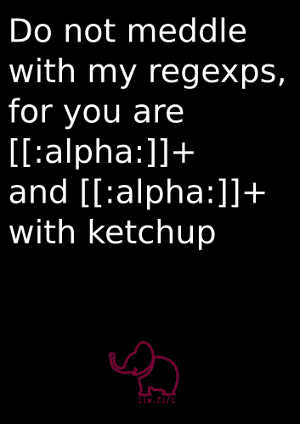
I enjoy funny and geeky t-shirts. For some time, I've been collecting ideas of my own, and now I've implemented them as Trunk tees (US), a Cafepress shop. I'll add more over time. do-not-meddle-regexps.jpg

Andrew Cater

Just tested the Wheezy beta 4 netboot installer. Worked well, no regressions - well set for a good release.

24 November 2012

Russ Allbery: Review: Dune

Review: Dune, by Frank Herbert
Series: Dune #1
Publisher: Ace
Copyright: 1965
Printing: September 1990
ISBN: 0-441-17271-7
Format: Mass market
Pages: 537
The Atreides family, distant cousins to the imperial family, have ruled the planet of Caladan for twenty generations. Caladan is a wet farming world, comfortable and pleasant, but not horribly important. But House Atreides is feuding with House Harkonnen, and, at the start of Dune, that feud maneuvers Duke Leto into giving up his holdings and moving his family to take possession of Arrakis. Arrakis is a desert planet, previously controlled by Baron Harkonnen. It is unrelentingly hostile, home to smugglers and dangerous local desert dwellers called Fremen. But it's also one of the most important planets in the galaxy, since it's the sole origin of the chemical called melange, or spice. Spice permits a limited form of prescience, which allows the navigators of the Spacing Guild to successfully steer ships across the interstellar void. Arrakis's production of spice is what makes interstellar travel, and therefore all of interstellar civilization, possible. Dune is the story of Paul Atreides, son and heir to Duke Leto Atreides. His mother, Lady Jessica, is one of the Bene Gesserit, a secretive order of women devoted to mental and physical discipline and to the long-term genetic improvement of mankind. He is not supposed to exist; Lady Jessica was supposed to only bear a daughter of Leto. But he may be something special, the long-sought (but also dangerous) Kwisatz Haderach who can unite male and female Bene Gesserit powers. The Bene Gesserit take great interest in him from the start of Dune. More surprisingly, so do the Fremen of Arrakis; from the moment he arrives there, he seems to be fulfilling prophecies of theirs that are partly, but not entirely, ones planted by the Bene Gesserit long ago. The feud with the Harkonnens, the unstable place of Arrakis in galactic politics, the dreams of the Fremen and the Imperial ecologist on Arrakis of terraforming, Bene Gesserit plans, Paul's abilities, and the legends of the Fremen all combine in a complex mix of politics, battle, and clashes of culture. Dune is an acknowledged SF masterpiece, one of the best-known classics of the genre. It's usually found in short lists of the best SF novels ever written. It spawned five sequels by Frank Herbert (about which more in a moment), as well as numerous additional sequels and prequels by Kevin J. Anderson and Brian Herbert. It's been adopted for the screen twice, not to mention board games, video games, and numerous other projects. This is my second reading, the first in about twenty years, but the story was still immediately familiar from having seen films and having discussed and read about the universe. This is not science fiction in any strict sense. Dune is science fiction in the same way that Star Wars is: a futuristic gloss on top of power structures inspired by feudalism, heavily mixed with mysticism, mental powers, magic, and implausible but convenient science that creates the story effects the author wants. Both Bene Gesserit powers in general and Paul's abilities in particular are effectively magic. There is some hand-waving explanation of their ability to verbally control other people as taking advantage of specific pitches and intonations that people are vulnerable to, but it's effectively spell-casting (and is a direct inspiration for Jedi mind tricks). All of the mysticism (and there's quite a lot of it in Dune, including race memory, precognition, and even molecular transformation) resembles the Force from Star Wars more than anything scientific. Dune is epic fantasy told on a science fiction stage, complete with a young protagonist coming into his powers and dangerous and sometimes hostile mentors. What Dune gets right, and what has put it so high in the pantheon of great science fiction, is the world building. Herbert sets the story tens of thousands of years into the future of humanity and then effectively projects the feeling of deep history over everything in the novel. This is the kind of book that has appendices with more background information; more to the point, it's the kind of book where you may actually read them out of curiosity. Mankind has a vast interstellar empire (Herbert's universe, like Asimov's Foundation universe, admits no aliens) governed by a system akin to the early British monarchy. An emperor rules in balance with the Great Houses, who meet in a sort of parliament. But against both is a third force: the Spacing Guild, who maintains a monopoly over all interstellar travel. (And the Bene Gesserit form an underground, secretive fourth power base.) Herbert plays with vast swaths of time and great forces of history as well as very good epic fantasy and better than nearly all SF I've read. The detailed world-building is equally good. Nearly all of Dune takes place on the desert planet of Arrakis, which has a lovingly-described ecology and local culture built entirely around scarcity of water. (The details of that ecology are much of the plot and mystery of the book, so I won't spoil them further.) While I doubt the precise details hold up to close scientific scrutiny, this is an obvious precursor to the great ecological stories of later SF, such as Kim Stanley Robinson's Mars trilogy. The details all feel right and hang together in satisfying ways, while also generating the great Sand Worms of Arrakis, a key ingredient in several of the best set pieces in the history of SF. This is the sort of book where the fascinating details and discoveries about the world do as much to keep one turning the pages as the plot, although the plot is also satisfyingly twisty and tense. Unfortunately, Dune doesn't get everything right. The amount of mysticism involved is a bit much, and at times the drug-trip mystical experiences of viewpoint characters turn into excessively purple prose and nearly incomprehensible descriptions. Those mystical experiences also involve race and genetic memory, a concept that's just scientific enough to be unbelievable. A few of the other scentific cheats are also rather blantant; for example, Herbert constructs an elaborate, artificial technology of shielding that seems designed primarily as an excuse to add sword combat to a futuristic story, and I have always struggled to suspend disbelief about the way lasers and shields interact in Dune. The Spacer Guild's monopoly on interstellar travel can be explained; their monopoly on local orbital space, or even the high stratosphere, both vital to allow certain things on Arrakis to remain secret, are much more dubious. Herbert mostly doesn't try to explain these things, and as with Star Wars the less explained the cheats are, the better they work as part of the story. But the technological background doesn't hold up against much examination. Worse, for me, is the general quality of the writing. Herbert does some things very well, such as world-building, and avoids awkward infodumps. Characterization and pacing are both fairly solid; he does a good job with Paul and Jessica in particular, and I've always liked the Fremen. But he wants to put the reader in everyone's head, frequently by giving character thoughts as italicized dialogue, and to enable that he uses a perspective that I always find distracting. Most fiction is written in tight third person. This means that the viewpoint character for any given section of the book is referred to in the third person, like all the other characters, but the reader has special access to their thoughts and emotions. We get to know what they're really thinking and feeling, not just the impressions they give to others, while the non-viewpoint characters are shown only from external appearances and the thoughts of the viewpoint character. Some books hold to the same viewpoint character throughout, but more commonly books move between viewpoint characters at scene breaks to provide more angles on the book's events. First person, in which the story is told by a specific character as if they were telling a story or writing it down, is the most common alternative. Third person objective, in which we don't get any special insight into the internal thoughts of any of the characters, is less common but still unsurprising. Dune does not use any of those perspectives. Instead, Dune uses wandering third-person omniscient, in which we get the inner thoughts and emotions of a character in a scene and then a few lines later the inner thoughts and emotions of a different character. This is the sort of thing that may or may not bug you depending on how much you've read, how deep the expectations of perspective are ingrained, and how much you notice perspective. It drives me nuts. I subconsciously align with the viewpoint character of a section, and pay attention to the ways that authors indicate which character will be the viewpoint character at the start of a scene. Herbert's constant flitting from character to character makes me dizzy. We get the verbatim thoughts of everyone almost indiscriminately, making me feel like I'm randomly hopscotching through the scene. For me, this does two things: it hurts my ability to get engrossed in the story, since I'm constantly thrown out of my normal reading mode when the viewpoint unexpectedly shifts, and it makes the writing feel repetitive. One keeps hearing about the same thing from multiple perspectives, and at times the story bogs down in everyone's internal dialogues rather than showing character reactions and letting the reader draw their own conclusions. I think it tries for a cinematic perspective, but ends up making the story feel muddled. The other flaw, which I didn't notice originally but which leaped out at me during this re-read, is that Herbert's world-building uses quite a few stereotypes. The most notorious, and most widely discussed, is of course the Fremen. Herbert draws heavily on Arab and Islamic culture even beyond the obvious similarities of people living in a harsh, arid climate. He borrows some rather loaded terms and cultural markers, such as jihad, to construct a culture of potential religious fanatics. This is not all bad; the Fremen are clearly portrayed as the good guys, which is a refreshing change from more typical current portrayals of Islam. But it becomes clear that they have aligned their entire culture around influences from outside, and the whole plot of Dune can be fairly characterized as an instance of "what these people need is a white man." Paul (and Kynes before him) joins their culture as well, but Paul becomes a better native than the natives, while simultaneously bringing his outside perspective. It's the sort of plot that is more widely noticed today than it would have been in 1965. Another major example of this, and one that I found more blatant, is that Herbert turns the Harkonnen into hissable, one-sided villains and uses some nasty stereotypes to do it. The insane torturer is consistently and repeatedly described as effeminate, fat is used as a marker of moral inferiority and evil, and the primary villain is homosexual and prefers drugged young male slaves. Here too, this sort of characterization short-cut was more common in 1965, but it's not appealing and makes the (already rather camp) scenes set among the Harkonnen even less enjoyable. Less clear-cut is the way women are handled throughout Dune. I do have to give Herbert some credit, particularly for the era in which he was writing. There are powerful female characters in Dune, including both Jessica and Alia, who have their own independent power and successfully pursue their own agendas throughout. The effectively all-female Bene Gesserit is a major political power in the story and is treated by the other players with respect as well as fear. But it's hard not to also notice the general position of women as subservient to men, not only in the general culture of the Great Houses but also in the more positively-portrayed Fremen culture. Indeed, the subservience of women is even worse in Fremen culture, where they're treated like property and where being killed by a woman is a sign of shame. Again, Herbert deserves some credit for doing better than a lot of 1960s fiction, but the sexism fairy has still been at work here. None of these flaws change the fact that Dune is a masterpiece. Herbert brings together history, world building, ecology, politics, and a compelling coming-of-age story about a messiah figure into a fast-paced, sweeping epic with a thoroughly satisfying conclusion. I think they do make it a flawed masterpiece, but it's still one of those SF novels that everyone should read at least once. Sadly, it's also a masterpiece that I think has suffered from its own success in the form of sequels, prequels, and a ton of supporting material. This is one of the problems that truly excellent world building can lead to. Human history is fractal: any specific detail can be examined in more depth and will usually lead (provided that information is available at all) to even more fascinating detail. The best world building conveys that impression of depth. That's what Herbert achieves here with hints, notes, and asides: the sense that galactic history is a vast ediface with the same fractal complexity as real human history. It makes for a compelling background, but it also inspires people to dig into that background and flesh out all of the details the way that we do with human history. But this doesn't actually work; invented history created by one person simply cannot be fractal in the same way. Human history is endlessly complex because it was generated by the complex interactions of many people. Invented history is an illusion that hints at complexity by building the same surface, but one mind, or even a small number of minds, cannot generate the same depth. The result is that if one digs too deep, one removes that convincing surface and ends up with a mundane, simplistic, and unsatisfyingly fake set of events. I think that's what's happened with all of the supporting material that's been written around Dune since its original publication. Dune is of a piece, a single story that's deeply enjoyable on its own terms and leaves the reader with a satisfying impression of complexity. The systemic excavation of that complexity lessens it and reveals too much of the illusion. Yes, I want to know more about the Butlerian Jihad, but that's the point: the wanting is the sign of succesful crafting of imagined history. Reading the definitive account is more likely to leave me unsatisfied than to lead to the recursive curiosity that human history can create. The sequels to Dune written by Herbert himself are, for me, another matter. Some reviewers level the same criticism at them: that Herbert dives too far into background best left unexplored. But they have the advantage of moving forward, telling more of the story set off by Paul, and the end of Dune is a clear setup for a sequel. One of Paul's goals throughout most of the book has been left unaccomplished. I don't think Herbert dove too deep into his creation; rather, my problem with his sequels (all of which I've read, although it's been some years now) is that he took the story in a direction that I actively disliked and found painful to read. Regardless, the general consensus is that the sequels aren't as good as the original, and while Dune doesn't fully resolve its story, it's complete enough that it's possible to stop here. Stopping is the general recommendation, although I still may re-read and review the sequels at some point. Followed by Dune Messiah. Rating: 8 out of 10

23 November 2012

Tanguy Ortolo: Mobile browsers, you suck (or: RTFM CSS media type)

Mobile devices A number of people are using small mobile devices to read Web pages. These devices have small screens, which make it hard to read pages designed for a large screen width.CSS Media types to the rescue Good news: the W3C thought of that fourteen years ago, when they introduced the concept of media types in CSS 2:
<link rel="stylesheet" type="text/css" media="handheld"/>
Here, the attribute media="handheld" indicates this dedicated style sheet should be loaded by hand-held devices (typically small screen, limited bandwidth) (quoting the CSS 2.1 Specification). Cool stuff, for a specification written in 1998, is it not? or not Well, bad news: mobile browsers do not honour it. Try this test page with a hand-held device: if the browser respects the specification, it should display a section of text which is not shown for regular browsers. It probably wont. So, how do people do to implement a specific style for mobile devices? Well, the W3C seemed to acknowledge the fact that mobile browser authors had no intention of respecting the existing specification, so they extended it with Media Queries:
<link rel="stylesheet" type="text/css" media="screen and (max-device-width: 480px)"/>
Here, this attribute indicates this dedicated style sheet is to be loaded by devices with a screen not too large (in pixels: not sure how this would work with small but high resolution screens). Thank you, mobile browsers, for not implementing a specification that was designed just for you before you even existed, and requiring such a kludge with a new specification instead

22 November 2012

Bdale Garbee: Shiny Black Friday

Altus Metrum is pleased to announce our first-ever "Shiny Black Friday" event! We're combining a special, one-time discount on TeleMini products with a price reduction on TeleMetrum boards ... and a new product introduction! For one day only, Friday, 23 November 2012, we are offering a special $50 discount on TeleMini Starter Kits (regular $225, now only $175!) and TeleMini boards (regular $125, now only $75!). This discount is available only for direct orders from our web site, see below. TeleMini is a baro-only recording dual deployment altimeter with radio telemetry and direction finding features. Learn more about TeleMini at We are also pleased to announce that TeleMetrum is back in stock after a brief production delay. To celebrate, we are dropping the price of extra TeleMetrum boards from $350 to $325. Starter kits will continue to sell for $400. TeleMetrum is a dual-deploy altimeter with accel and baro sensors, GPS, and radio telemetry and direction finding features all on one board! Learn more about TeleMetrum at Last, but certainly not least (unless we're talking size or mass!), we are proud to introduce a new product... MicroPeak! MicroPeak is a tiny board that provides highly accurate peak barometric altitude recording. About the size and weight of a US dime with battery ready to fly (18x14mm, 1.9 grams), this is the ideal altimeter for model rocket contests. MicroPeak is so easy to use that it's also the ideal altimeter for young people working on rocket related science fair projects, etc! MicroPeak sells for $50, learn more at Find more information on all Altus Metrum products at http://altusmetrum.org. The special Black Friday discount on TeleMini products is available only on orders placed through Bdale's web store at http://auric.gag.com. Thank you for making 2012 such a great year for Altus Metrum, LLC. We're having fun, and look forward to introducing several exciting new products in the weeks and months ahead!

21 November 2012

Axel Beckert: Suggestions for the GNOME Team

Thanks to Erich Schubert s blog posting on Planet Debian I became aware of the 2012 GNOME User Survey at Phoronix. Like back in 2006 I still use some GNOME applications, so I do consider myself as GNOME user in the widest sense and hence I filled out that survey. Additionally I have to live with GNOME 3 as a system administrator of workstations, and that s some kind of usage, too. ;-) The last question in the survey was Do you have any comments or suggestions for the GNOME team? Sure I have. And since I tried to give constructive feedback instead of only ranting, here s my answer to that question as I submitted it in the survey, too, just spiced up with some hyperlinks and highlighting:
Don t try to change the users. Give the users more possibilities to change GNOME if they don t agree with your own preferences and decisions. (The trend to castrate the user was already starting with GNOME 2 and GNOME 3 made that worse IMHO.) If you really think that you need less configurability because some non-power-users are confused or challenged by too many choices, then please give the other users at least the chance to enable more configuration options. A very good example in that hindsight was Kazehakase (RIP) who offered several user interfaces (novice, intermediate and power user or such). The popular text-mode web browser Lynx does the same, too, btw. GNOME lost me mostly with the change to GNOME 2. The switch from Galeon 1.2 to 1.3/2.0 was horrible and the later switch to Epiphany made things even worse on the browser side. My short trip to GNOME as desktop environment ended with moving back to FVWM (configurable without tons of clicking, especially after moving to some other computer) and for the browser I moved on to Kazehakase back then. Nowadays I m living very well with Awesome and Ratpoison as window managers, Conkeror as web browser (which are all very configurable) and a few selected GNOME applications like Liferea (luckily still quite configurable despite I miss Gecko s about:config since the switch to WebKit), GUCharmap and Gnumeric. For people switching from Windows I nowadays recommend XFCE or maybe LXDE on low-end computers. I likely would recommend GNOME 2, too, if it still would exist. With regards to MATE I m skeptical about its persistance and future, but I m glad it exists as it solves a lot of problems and brings in just a few new ones. Cinnamon as well as SolusOS are based on the current GNOME libraries and are very likely the more persistent projects, but also very likely have the very same multi-head issues we re all barfing about at work with Ubuntu Precise. (Heck, am I glad that I use Awesome at work, too, and all four screens work perfectly as they did with FVWM before.)
Thanks to Dirk Deimeke for his (German written) pointer to Marcus Moeller s interview with Ikey Doherty (in German, too) about his Debian-/GNOME-based distribution SolusOS.

Michal &#268;iha&#345;: Weblate available as BitNami stack

Weblate is now available for your cloud or virtual machines - BitNami has published Weblate stack. BitNami stack allows you to install native application on Linux or Mac OS X as well as provides images for virtual machines or to be run within cloud (some of these options are still waiting to be built). Also I wanted to finally release SUSE Studio images, but all I get out of that are HTTP 500 errors (whenever I tried since Friday). Luckily today I at least managed to build one image to test. This allowed me to reproduce bug with broken registration as mailserver was missing in the image.

Filed under: English Suse Weblate 0 comments Flattr this!

19 November 2012

Russ Allbery: Review: Inversions

Review: Inversions, by Iain M. Banks
Publisher: Pocket
Copyright: 1998
Printing: May 2001
ISBN: 0-7434-1196-X
Format: Mass market
Pages: 376
Inversions poses a special challenge for book metadata for reviews that try to avoid spoilers. If you've looked at my index of reviews, I may have arguably already spoiled you. I'm going to discuss the book with that spoiler, as most reviews do, because I think it's a better book knowing that information up-front. But if you want to avoid any spoilers, stop reading here, and avoid looking at its placement in my review index. Inversions consists of the interleaved stories of two people: a strange female doctor to the king of Haspide, and the bodyguard of the Protector of Tassassen. The doctor's story is told in the form of letters written by the doctor's apprentice to his "Master," who has clearly told him to spy on the doctor. (The identity of this person is revealed during the story.) The bodyguard's story is told in the third person and presented as a reconstruction of events. The stories never meet, although the two countries have some indirect political exchanges. The doctor becomes entangled in court intrigue and several murders, and the bodyguard protects the Protector (a general in charge of what was effectively a military coup against the former regime) during a war with neighboring barons who had initially supported him. Both stories reach conclusions, but somewhat unsatisfactory ones. The two characters never meet in the book. All of this is set among countries at a medieval level of technology. The doctor faces scorn and derision, not to mention outright opposition, both because she's a woman (she's only permitted to claim the title of doctor due to the king's favor and her claimed citizenship in a far-away land with strange customs) and because she uses more effective and more modern techniques. Other physicians still bleed patients, but the doctor is clearly aware of the germ theory of disease, dismisses contageon via bad odors, and otherwise strikes the reader as someone with advanced medical knowledge trying to practice it in primitive conditions. The spoiler, which is never stated outright but which is relatively apparent from various hints and allusions dropped by the characters, as well as at least one event that would otherwise have to be supernatural, is that Inversions actually takes place in the Culture milieu. How this planet and these stories fit into that milieu remains unexplained throughout the story, but we do get some clues in supposedly made-up stories that the bodyguard tells the son of the Protector, stories that are recognizable to Culture readers as less fictional than they sound in a medieval context. Banks has a tendency to play with unusual narrative structure and to fall on the mainstream side of SF plot construction. Inversions is a very closely-observed pair of entwined stories told in a way that downplays most of the dramatic structure and rising action and that undermines feelings of conclusion or catharsis. Despite having, on later reflection, two clear plots with clear conclusions, it feels more like parallel slices of life and stubbornly refuses to advertise any conclusions or deeper meaning. Whether that works will probably have a lot to do with the reader's tolerance for trying to draw one's own conclusions. I found it frustrating and unsatisfying, but knowing going in that it's a Culture novel helped by adding some deeper structure to give the story a modicum of meaning. Insofar as there's a larger theme, it's the exploration of the conflict between the two Culture citizens that is presented, thinly disguised, in the bodyguard's stories. This connection is not obvious; even determining how to map the two characters into the stories is a touch challenging. But if one is aware of it and looking for it in advance, it provides a bit of broader structure and some basis for judging the actions of the doctor and the bodyguard against a larger plan. I needed that to wring enjoyment from the book; I never cared enough about the characters otherwise to fully engage with either story. With the puzzle, and the constant search for connections to Culture concepts, it's somewhat more interesting, but it's still maddeningly indirect. (And, from various other Internet reactions, I don't think I'm missing something obvious.) It's possible that I went into the book with some incorrect assumptions that undermined my enjoyment. Hopefully this review will help other readers. Knowing that this is a Culture book and enjoying the process of finding references makes it more fun (and most of the references aren't too hard to find). But don't expect lots of closure from the stories, and don't expend to find out "what's really going on." It's not that sort of book. If you enjoy the individual stories for themselves, you'll have the best chance of enjoying the book as a whole, with the Culture references providing a fun additional layer. If the basic stories don't appeal, the Culture material probably isn't enough to make the book engrossing. Rating: 6 out of 10

18 November 2012

Gregor Herrmann: RC bugs 2012/46

it's seems we're starting to run out of RC bugs with the implicit usertag easy-enough-for-gregoa

what I've done in the last days besides working on the bugs listed below is to tag quite a few bugs pending that were uploaded into a DELAYED queue. please try to remember to set this tag on delayed NMUs, nmudiff is quite convenient here.

Jamie McClelland: New Privacy Arguments are Needed

Another decent article on online privacy was published by the NYT this morning. The article documents the collection and centralized aggregation of consumer data online. It ends with a strong message about consumers becoming the "product" - which echoes what Noam Chomsky and Ben Bagdikian have been saying for decades. The problem with this critique is that it doesn't go far enough. Chomsky and Bagdikian didn't say readers are the product of modern journalism and that's bad because nobody wants to be a product. They critiqued the model because it produces terrible journalism and democracy suffers as a result. Similarly, the online trading of audiences and the invasion of our privacy that results has more important implications than "don't be a sucker" which seems to be the gist of the privacy argument these days. Honestly, I don't stay awake at night worrying that Nike knows I'm looking for a pair of sneakers, or even that they know my income. I do stay awake at night worrying that people are tagging my photo on Facebook, which could allow the New York Police Dept to submit a photo of protesters to Facebook and get a list of names and addresses of the people in the photo. Or it could allow the police to track my movements via existing networks of surveillance cameras by matching my image to my name. Would that require a search warrant? How would that impact my trust in my government to know that my movements are being tracked? Or worse, to know they might be tracked but I'll never know if they are or aren't? Many governments (including the US) have sordid histories of infiltrating political organizations and intentionally sowing dissent. Having access to activists' purchasing habits provides a treasure trove of material for this purpose that previously was labor intensive for cops to collect. It also provides leverage during interrogation, a time of heightened emotional vulnerability where the mere mention of a private detail of one's life can have a powerful impact. How can we prevent law enforcement from having access to these details of our lives? And then there's the dragnet. A central database of consumer habits provides a tantalizing collection of information that could be searched for people who fit a profile of a crime. Is solving the crime at hand worth the invasion of privacy that results from people being investigating only based on their consumer habits? How would we measure the impact an investigation like this would have on our confidence in democracy and government? The corporate advertisers promoting this kind of data collection argue that these problems are the price of progress. However, the ideology behind these technology developments is capitalism, not some intrinsic aspect of the Internet or network communications. Historically, the Internet has developed based on a drive toward de-centralization. Email and web sites, the bedrock of Internet activity, are based on these principles: anyone can add their own email server or web server and everyone can seamlessly access it. In contrast, the logic of capitalism as it relates to the Internet, is one of centralization and aggregating data. Facebook and Google want you to use their platforms for all your online activities so they have as complete a picture as possible of what you like and do. As the New York Times article describes, companies like Rubicon want to track all your movements and aggregate that data for profit. We have a choice. We can carefully evaluate our use of corporate services and consider the implications it has not only on our lives but on society as a whole. And, we can choose to use and support services that promote open standards and interoperability that will respect our personal privacy values. Want a practical example? Friendica is software designed to allow you to post status alerts, photos, videos and other information about yourself in a way similar to Facebook. However, it has one big difference: you can host your account on any server running the software anywhere in the world. You can still "friend" people on different servers, but we don't have to all trust the same organization to host it. Furthermore, Friendica allows you to post once and automatically cross-post to your Twitter, Facebook or other similar services. Sound good? You are welcome to try out an account on the May First/People Link install: https://friends.mayfirst.org/.

17 November 2012

Antoine Beaupr : First stable release of the Drupal OpenID Provider

A short announcement to mark the release of the first stable OpenID provider for Drupal. Started by James Walker around 4 years ago, I have since then got commit access and taken care of the module for the last 2 years. And while it was not an easy task, with the help of the community, this module was able to mature to a fully featured, flexible and standard implementation during that time. One has to wonder however, is it too late for OpenID?

A bit of history Drupal was one of the pioneers in OpenID support. Back in 2006 when the protocol was still in its infancy (less than a year old!), Drupal was adding OpenID support to its 4.7 release through a contrib module and two years later, the Drupal 6.0 release was sporting OpenID in core, although not without significant interoperability issues. Still, we could say that rapid adoption by such a popular CMS as Drupal really boosted OpenID's adoption. At about the same time, Yahoo, Sourceforge, Myspace, Microsoft and Google would all join the OpenID bandwagon. On the OpenID "provider" side of things, things were not so great however. Back when I started experimenting with this, it wasn't actually that easy to host your own OpenID provider, to allow your users to login to other OpenID-enabled sites. While there are a lot of different libraries to provide OpenID support in your application there was not (and still isn't) any software that gives you an OpenID provider and is dedicated to that. No official reference implementation either, other than the code from the one of the founding companies of OpenID, JanRain. There was an OpenID provider module in Drupal, but there was no official release done until a two beta releases in 2010.

Koumbit's community involvement It is about that time I started getting involved in the project. Koumbit needed an easy way for our workers to log into multiple sites without too much trouble, so I started looking at OpenID provider implementations. The lack of dedicated software somehow made the Drupal implementation a natural fit, and I started experimenting with the module, filing bugs and reviewing patches, as there were a lot of interoperability and design issues with the provider. After a while, walkah was kind enough to give me full access to the project and I started doing regular releases (every few months), culminating in today's official 1.0 release for both Drupal 6 and Drupal 7, which I am very proud and happy about. While I am here, I want to send many thanks to the people behind the Drupal 7 port: paranojik, mikecar, xamanu and testing from neizod. A lot of issues were also patched, reviewed and tested by numerous contributors that are unfortunately difficult to track down other than reading the commit log. So we at Koumbit have been running our own OpenID provider for a good while now, and it has the key advantage of being connected to our LDAP directory (with the D6 LDAP integration module so it is, in a sense, a central point for authentication at Koumbit. Very often people don't clearly understand what their LDAP password does, and I can easily remind them "it's the OpenID thing", or "try your password in the OpenID site" if they think they have forgotten it. So much goes on in the web browser these days that it makes everything much easier.

The problem with Drupal's OpenID provider However, it is kind of embarrassing that it took so long. More than 6 years after the OpenID protocol was written, we have a stable OpenID provider. Now, this may be because I am overly conservative about stable releases, but I don't think so: the OpenID provider module had, for a long time, serious interoperability issues with OpenID sites. There was also a clear lack of features on the OpenID provider, a gap that various third party modules, now documented on the OpenID provider homepage are now trying to fill. There is also serious security issues with the protocol itself. The complexity and lack of clarity of the OpenID specification have rendered my work quite difficult at time, as the protocol has significant ambiguities and no clear reference implementation. OpenID is unfortunately renowned to be vulnerable to phishing and while Koumbit's use of the HTTPS protocol alleviates some of those issues (especially the redirect session hijack), tools like sslstrip can bypass those protections easily. The privacy aspect is also problematic, as the user is usually not free to choose which information from his or her profile is divulged to the site they are logging into. Of course those issues may be overlooked if the security trade off is not worth it. In the case of Koumbit, we use OpenID on a lot of client sites, but usually nothing critical, and we train our users to pay attention to the HTTPS icon when login in their OpenID account.

Are there alternatives? But unfortuantely, the reality is that there are not really any alternatives to OpenID out there. Mozilla's new BrowserID initiative (now rebranded Persona, boy those guys sure love rebranding..) is interesting, but actually has even more flaws than OpenID itself. Not only is it not resolving the phishing problem, it actually creates new problems, including my personal favorite, trusting server-side Javascript code, which OpenID is not using that much. I should also mention the Shibboleth module which has a surprising number of installs recorded on Drupal.org, but that depends on the much more complicated Shibboleth federation, for which there is no server implementation for Drupal, from what I understand. Oauth, on the other end, is even more widely used, and has server-side components like Oauth Login Provider and Services 3.x. We could also simply give up and use our souls stored at Facebook, Google and Twitter for authentication everywhere. Maybe OpenID opened the door for those corporations to see that there is a real opportunity in leveraging user's profile to track their online activity. It is not something that OpenID was necessarily designed for but it's an idea that certainly permeates Facebook connect and "like" buttons or Twitter and Google online business strategies, where you are the product sold to advertisers. I personally believe we should keep the struggle for distributed and standard identity mechanisms for the web that respect users' privacy. With Drupal's OpenID Provider, it is possible to create a secure, privacy-aware identity provider, although I still have to perform that damn security audit. Experiments with those third party modules should also be encouraged and I welcome any feedback on those modules. While I do not plan to attend OpenID conferences or do significant development on the OpenID provider right now, I will certainly make sure Koumbit keeps its commitment to maintaining stewardship on the OpenID provider module in Drupal. I encourage people to try it out, submit issues and patches to make it even better. Long life to OpenID! PS: if people are interested in funding that security audit, I would be happy to perform this through my regular work at Koumbit.org, just file a request at services@koumbit.org.

Petter Reinholdtsen: Why isn't the value of copyright taxed?

While working on a Norwegian translation of the Free Culture by Lawrence Lessig (76% done), which cover the problems with todays copyright law and how it stifles creativity, one idea occurred to me. The idea is to get the tax office to help make more works enter the public domain and also help make it easier to clear rights for using copyrighted works. I mentioned this idea briefly during Yesterdays presentation by John Perry Barlow, and concluded that it was best to put it in writing for a wider audience. The idea is not really based on the argument that copyrighted works are "intellectual property", as the core requirement is that copyrighted work have value for the copyright holder and the tax office like to collect their share from any value controlled by the citizens in a country. I'm sharing the idea here to let others consider it and perhaps shoot it down with a fresh set of arguments. Most valuables are taxed by the government. At least here in Norway, the amount of money you have, the value of our land property, the value of your house, the value of your car, the value of our stocks and other valuables are all added together. If the tax value of these values exceed your debt, you have to pay the tax office some taxes for these values. And copyrighted work have value. It have value for the rights holder, who can earn money selling access to the work. But it is not included in the tax calculations? Why not? If the government want to tax copyrighted works, it would want to maintain a database of all the copyrighted works and who are the rights holders for a given works, to be able to associate the works value to the right citizen or company for tax purposes. If such database exist, it will become a lot easier to find out who to talk to for clearing permissions to use a copyrighted work, which is a very hard operation with todays copyright law. To ensure that copyright holders keep the database up-to-date, it would have to become a requirement to be able to collect money for granting access to copyrighted works that the work is listed in the database with the correct right holder. If copyright causes copyright holders to have to pay more taxes, they will have a small incentive to "disown" their copyright, and let the work enter the public domain. For works with several right holders one of the right holders could state (and get it registered in the database) that she do not need to be consulted when clearing rights to use the work in question and thus will not get any income from that work. Stating this would have to be impossible to revert and stop the tax office from adding the value of that work to the given citizens tax calculation. I assume the copyright law would stay the same, allowing creators to pick a license of their choosing, and also allowing them to put their work directly in the public domain. The existence of such database will make it even easier to clear rights, and if the right holders listed in the database is taxed, this system would increase the amount of works that enter the public domain. The effect would be that the tax office help to make it easier to get rights to use the works that have not yet entered the public domain and help to get more work into the public domain and . Why have such taxing not happened yet? I am sure the tax office would like to tax copyrighted work values if they could.

Russell Coker: Geeky Jeans

It s likely that most people make things like comfort, style, and price the main criteria when purchasing clothes. But there are other things that can be more important such as the ability to fit a phone in the pocket. My last pair of jeans was from Rivers (one of the more affordable Australian clothing stores which also has online sales) [1]. They were the long leg version and have front pockets that are 28cm deep (measured from the bottom of the pocket to the lowest part of the lip) and 15cm wide (a 15cm ruler will barely fit sideways in the pocket). I ve just got some new jeans from Rivers which are the regular leg length, they have front pockets which are 21cm deep and slightly more than 16cm wide. The old pair could fit a Nexus 7 tablet in the front pocket. The new pair should more easily fit such a tablet in the pocket but it might be less comfortable to walk with the tablet in the pocket. I don t plan to try using my front pocket for a tablet (I d be more likely to use a backpack or my Scott e vest [2]), but a Galaxy Note 2 (which is about the largest device that most people would want in their pocket) would fit nicely. I find the Rivers jeans to be quite comfortable and I like the way they look. They also only cost $25 online or $30 in the store. When I bought my first pair before I even had a 4 phone they were good value and they will be even better value early next year when I get a bigger phone. Even though Rivers jeans may wear out faster than more expensive brands, for $30 it s easy to just buy a few pairs at a time. During an email discussion of geeky clothing the issue of women s clothes having fewer and smaller pockets was raised. Unfortunately I didn t think to measure the pockets in women s jeans when I was at the Rivers to discover whether they have big pockets too. I ll do that next time I m in the area.

16 November 2012

Diego Escalante Urrelo: EFI mode boot on Macbook3,1 with Debian

After my last post I got curious about booting the Macbook in EFI mode. Because, well, why not? So I googled for a while and found this blog post which served as a great reference and comment on two other. I understand EFI is somewhat buggy and what works for me might not work for you. So be careful, have a rescue disk at hand. On that topic, I should say that I could not get this to work with Debian sid s 3.2 kernel, but 3.5 from experimental worked fine for me.

Hopefully, you after booting EFI succesfully. My main question before doing this was What works? , I had heard some weird rumours and mentions that you had to run X in framebuffer mode and weird stuff like that. This is bullshit. Everything works fine, with the same standard software and setup. Features:

So, here we go. I am posting my notes in shell-like since I find little benefit in turning them into an essay or something more textual. Good luck! # Install grub-efi-$arch.
# Usually $arch depends on your processor.
# Best bet: you can use OSX to check for this:
#
# $ ioreg -l -p IODeviceTree grep firmware-abi
# It will print EFI32, or EFI64. You know what to do.
$ sudo apt-get install grub-efi-amd64 # Now we need to mount the system EFI partition for GRUB2 to install
# itself on it.
# NOTE: you have to do this, installing the package is NOT enough.
$ sudo mkdir /boot/efi
$ sudo mount /dev/sda1 /boot/efi
# Did you get the right partition?
# It should have an EFI directory with an APPLE directory inside.
# DO NOT DELETE THE APPLE DIRECTORY, PRICK.
$ ls /boot/efi
EFI/
$ ls /boot/efi/EFI/
APPLE/
# Create a new directory, debian will do.
# Run grub-install so GRUB2 drops its EFI code in the new directory.
$ sudo mkdir /boot/efi/EFI/debian
$ sudo grub-install
$ ls /boot/efi/EFI/
$ ls /boot/efi/EFI/debian/
# Help rEFIt know this is a GNU/Linux boot.
# rEFIt assigns icons depending on the name of the EFI file, grub64x is not in its list
$ sudo mv /boot/efi/EFI/debian/grub64x.efi /boot/efi/EFI/debian/e.efi # IMPORTANT: Add the proper modeset.
# For EFI-only systems: efi_uga
# For UEFI systems: efi_gop
# Without this you won t have any graphics.
$ sudo vim /etc/default/grub
...
GRUB_VIDEO_BACKEND="efi_uga"
...
# Update grub, reboot. Hope that everything worked.
$ sudo update-grub Extra credit
You can clean your MBR from the old GRUB2-pc installation (if you installed it to the hybryd-MBR, like a sane person) from OSX:
$ sudo fdisk -u /dev/disk(tab-to-complete, verify it is the right disk) (Read the man page for your fdisk to be sure -u still means fix MBR while keeping partitions )

Next.

Previous.