Search Results: "ads"

16 April 2017

Chris Lamb: Elected Debian Project Leader

I'd like to thank the entire Debian community for choosing me to represent them as the next Debian Project Leader. I would also like to thank Mehdi for his tireless service and wish him all the best for the future. It is an honour to be elected as the DPL and I am humbled that you would place your faith and trust in me. You can read my platform here.

Shirish Agarwal: single person cult-based political parties

Summer heat

Summer heat

I would like to start with sharing is the mercury has been shot in recent times to record temperatures. For instance, Pune has been recording temperatures between 41 and 43 degrees consistently. The result of that has been a massive reduction in volunteer activity on my part as well as some reduction in work activity. The body wants and needs to conserve energy. Even my mobile phone s lithium-ion battery becomes too hot and I have to turn it off in the crucial time from 12 17:00 hrs after which the weather cools down a bit. I am curious to know if I m the only one or there are others like me. I have seen quite a few construction, re-construction and renovation projects taking quite a hit by this incredible heat wave. If it isn t climate change then I don t know what is. And this is not limited to Pune but the whole of Western Maharashtra, Gujarat, Madhya Pradesh and quite a few parts of North India too. In Pune we are expecting it to hit 45 degrees pretty soon. And I don t see this ending anytime soon, at least till July when the rains comes and we have some relief from this weather. Balasaheb Thackeray, Founder Shiv Sena Balasaheb Thakre/Thackeray founded the Shiv Sena in/around 1966. While he was cartoonist by trade, most of his cartoons were anti-migrant in nature. The target was the urban, unemployed Marathi youth based mostly in Mumbai and the suburbs. The Shiv Sena vandalized properties run by South Indian businessman, Gujaratis. The Shiv Sena and Balasaheb Thackeray were also responsible in part due to the massive closure of cloth mills in South Mumbai. While the workers struggled to make ends meet, some whose wife and children died, fell into prostitution, drugs or whatever they could to make ends meet while the party and more important Mr. Balasahab Thackeray prospered. In spite of the many threats, there are and were many South Indians who prospered inspite of Shiv Sena s threats. Gujaratis on the other hand went back to Gujarat and now Surat rivals Mumbai. Another decade or so and Surat and not Mumbai would be the financial capital of India, the way Gujaratis are working towards it. Then in the 90 s people from U.P. and Bihar came in search of livelihood, again the same rhetoric and even attacks were done against people from U.P. and Bihar. The only thing that was missing for all these people is a domicile certificate which you can get only after living 15 years in Mumbai. The only thing that they and other political parties have been successful is murdering journalists. I m sad to report that Maharashtra, my home state has a very bad report card in preventing such murders. And it s both the State and the Centre who have to share the blame equally. Come to 2017 and Shiv Sena doesn t have a leg to stand on. Balasaheb Thackeray is no more, his son didn t inherit Balasaheb s fiery character and the nephew has now another outfit called Maha Navnirman Sena. Also, all those who were one-time outsiders are now residents of Mumbai (with the domicile certificate) and hence registered voters. There is another angle to it as well, Marathas for far too long thought that people they will elect from their community will do something from their community just like auto rickshaw drivers thought that educated unemployed youth from their community would be better than the agents who rip them off whenever they have some work in the local R.T.O. (Road Transport Office) . Similar to auto rickshaw drivers, the Marathas realized that none of the leaders whom they elected would ever do the work. This is why when last year there were huge Maratha rallies all over the state (peaceful demonstrations all around though). I just shared Pune as am most concerned with my city although similar rallies were held in Mumbai (Khargar), Nagpur, Solapur among other places that I know of. But as shown on youtube there was no central leadership (a.k.a. leaders) and still they were the most disciplined lot. While the Marathas may say one thing, in part they are also culprits of their own past. My interactions with few Marathas was that they are still smitten by what happened in the second and the third Anglo-Maratha War . It is sad because I do see them adding lot of value provided they keep a cool head as I have seen some do. Business or service is the game only for cooler heads. Things came to a head though about couple of weeks back when Mr. Ravindra Gaikwad, a Shiv Sena M.P. assaulted some elderly Air India Staff. While things have cooled down since then, it only belittles both the person and the party. If anything, Air India can be accused of being to gentleman like in the whole case. The only crime of its own making is it has been looted since the beginning by Indian MP s and their relatives with over-staffing and old age of the planes and being over-priced in an extremely price sensitive market. It doesn t have any low-cost options but all of that is another story altogether. Converse to this, the current Prime Minister, Mr. Narendra Modi and Malcolm Turnbull enjoyed the ride of the Delhi Metro. In Politics as well as in life, symbolism scores big. That showed where Mr. Modi s priorities lie and where Mr. Gaikwad s. In the end, the writing seems to be on the wall for not just the Shiv Sena but I would say all single-personality based parties. They need to widen both their political scope and activities and have prominent personalities with strong leadership taking the country along rather than being petty-minded.
Filed under: Miscellenous Tagged: #17th century, #Air India, #anti-migrant policy, #Indian Summer, #Maratha, #Maratha History, #Me Maratha, #Me Maratha rallies, #planet-debian

15 April 2017

Dirk Eddelbuettel: Rcpp now used by 1000 CRAN packages

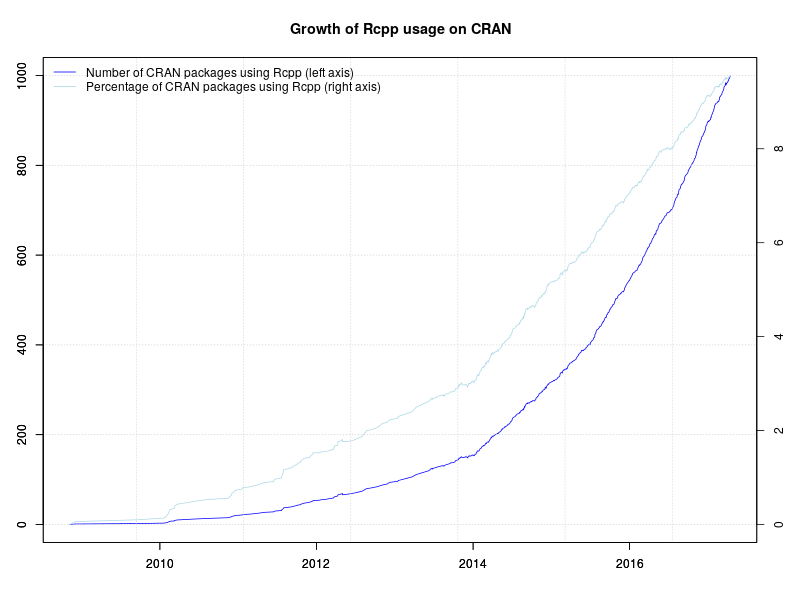
800 Rcpp packages Moments ago Rcpp passed a big milestone as there are now 1000 packages on CRAN depending on it (as measured by Depends, Imports and LinkingTo, but excluding Suggests). The graph is on the left depicts the growth of Rcpp usage over time. One easy way to compute such reverse dependency counts is the tools::dependsOnPkgs() function that was just mentioned in yesterday's R^4 blog post. Another way is to use the reverse_dependencies_with_maintainers() function from this helper scripts file on CRAN. Lastly, devtools has a function revdep() but it has the wrong default parameters as it includes Suggests: which you'd have to override to get the count I use here (it currently gets 1012 in this wider measure). Rcpp cleared 300 packages in November 2014. It passed 400 packages in June 2015 (when I only tweeted about it), 500 packages in late October 2015, 600 packages last March, 700 packages last July, 800 packages last October and 900 packages early January. The chart extends to the very beginning via manually compiled data from CRANberries and checked with crandb. The next part uses manually saved entries. The core (and by far largest) part of the data set was generated semi-automatically via a short script appending updates to a small file-based backend. A list of packages using Rcpp is kept on this page. Also displayed in the graph is the relative proportion of CRAN packages using Rcpp. The four per-cent hurdle was cleared just before useR! 2014 where I showed a similar graph (as two distinct graphs) in my invited talk. We passed five percent in December of 2014, six percent July of 2015, seven percent just before Christmas 2015, eight percent last summer, and nine percent mid-December 2016. Ten percent is next; we may get there during the summer. 1000 user packages is a really large number. This puts a whole lot of responsibility on us in the Rcpp team as we continue to keep Rcpp as performant and reliable as it has been. And with that a very big Thank You! to all users and contributors of Rcpp for help, suggestions, bug reports, documentation or, of course, code.

This post by Dirk Eddelbuettel originated on his Thinking inside the box blog. Please report excessive re-aggregation in third-party for-profit settings.

Gunnar Wolf: On Dmitry Bogatov and empowering privacy-protecting tools

There is a thorny topic we have been discussing in nonpublic channels (say, the debian-private mailing list... It is impossible to call it a private list if it has close to a thousand subscribers, but it sometimes deals with sensitive material) for the last week. We have finally confirmation that we can bring this topic out to the open, and I expect several Debian people to talk about this. Besides, this information is now repeated all over the public Internet, so I'm not revealing anything sensitive. Oh, and there is a statement regarding Dmitry Bogatov published by the Tor project But I'll get to Tor soon. One week ago, the 25-year old mathematician and Debian Maintainer Dmitry Bogatov was arrested, accused of organizing riots and calling for terrorist activities. Every evidence so far points to the fact that Dmitry is not guilty of what he is charged of He was filmed at different places at the times where the calls for terrorism happened. It seems that Dmitry was arrested because he runs a Tor exit node. I don't know the current situation in Russia, nor his political leanings But I do know what a Tor exit node looks like. I even had one at home for a short while. What is Tor? It is a network overlay, meant for people to hide where they come from or who they are. Why? There are many reasons Uninformed people will talk about the evil wrongdoers (starting the list of course with the drug sellers or child porn distributors). People who have taken their time to understand what this is about will rather talk about people for whom free speech is not a given; journalists, political activists, whistleblowers. And also, about regular people Many among us have taken the habit of doing some of our Web surfing using Tor (probably via the very fine and interesting TAILS distribution The Amnesiac Incognito Live System), just to increase the entropy, and just because we can, because we want to preserve the freedom to be anonymous before it's taken away from us. There are many types of nodes in Tor; most of them are just regular users or bridges that forward traffic, helping Tor's anonymization. Exit nodes, where packets leave the Tor network and enter the regular Internet, are much scarcer Partly because they can be quite problematic to people hosting them. But, yes, Tor needs more exit nodes, not just for bandwidth sake, but because the more exit nodes there are, the harder it is for a hostile third party to monitor a sizable number of them for activity (and break the anonymization). I am coincidentially starting a project with a group of students of my Faculty (we want to breathe life again into LIDSOL - Laboratorio de Investigaci n y Desarrollo de Software Libre). As we are just starting, they are documenting some technical and social aspects of the need for privacy and how Tor works; I expect them to publish their findings in El Nigromante soon (which means... what? ), but definitively, part of what we want to do is to set up a Tor exit node at the university Well documented and with enough academic justification to avoid our network operation area ordering us to shut it down. Lets see what happens :) Anyway, all in all Dmitry is in for a heavy time. He has been detained pre-trial at least until June, and he faces quite serious charges. He has done a lot of good, specialized work for the whole world to benefit. So, given I cannot do more, I'm just speaking my mind here in this space. [Update] Dmitry's case has been covered in LWN. There is also a statement concerning the arrest of Dmitry Bogatov by the Debian project. This case is also covered at The Register.

Dirk Eddelbuettel: #5: Easy package information

Welcome to the fifth post in the recklessly rambling R rants series, or R4 for short. The third post showed an easy way to follow R development by monitoring (curated) changes on the NEWS file for the development version r-devel. As a concrete example, I mentioned that it has shown a nice new function (tools::CRAN_package_db()) coming up in R 3.4.0. Today we will build on that. Consider the following short snippet:
library(data.table)
getPkgInfo <- function()  
    if (exists("tools::CRAN_package_db"))  
        dat <- tools::CRAN_package_db()
      else  
        tf <- tempfile()
        download.file("https://cloud.r-project.org/src/contrib/PACKAGES.rds", tf, quiet=TRUE)
        dat <- readRDS(tf)              # r-devel can now readRDS off a URL too
     
    dat <- as.data.frame(dat)
    setDT(dat)
    dat
 
It defines a simple function getPkgInfo() as a wrapper around said new function from R 3.4.0, ie tools::CRAN_package_db(), and a fallback alternative using a tempfile (in the automagically cleaned R temp directory) and an explicit download and read of the underlying RDS file. As an aside, just this week the r-devel NEWS told us that such readRDS() operations can now read directly from URL connection. Very nice---as RDS is a fantastic file format when you are working in R. Anyway, back to the RDS file! The snippet above returns a data.table object with as many rows as there are packages on CRAN, and basically all their (parsed !!) DESCRIPTION info and then some. A gold mine! Consider this to see how many package have a dependency (in the sense of Depends, Imports or LinkingTo, but not Suggests because Suggests != Depends) on Rcpp:
R> dat <- getPkgInfo()
R> rcppRevDepInd <- as.integer(tools::dependsOnPkgs("Rcpp", recursive=FALSE, installed=dat))
R> length(rcppRevDepInd)
[1] 998
R>
So exciting---we will hit 1000 within days! But let's do some more analysis:
R> dat[ rcppRevDepInd, RcppRevDep := TRUE]  # set to TRUE for given set
R> dat[ RcppRevDep==TRUE, 1:2]
           Package Version
  1:      ABCoptim  0.14.0
  2: AbsFilterGSEA     1.5
  3:           acc   1.3.3
  4: accelerometry   2.2.5
  5:      acebayes   1.3.4
 ---                      
994:        yakmoR   0.1.1
995:  yCrypticRNAs  0.99.2
996:         yuima   1.5.9
997:           zic     0.9
998:       ziphsmm   1.0.4
R>
Here we index the reverse dependency using the vector we had just computed, and then that new variable to subset the data.table object. Given the aforementioned parsed information from all the DESCRIPTION files, we can learn more:
R> ## likely false entries
R> dat[ RcppRevDep==TRUE, ][NeedsCompilation!="yes", c(1:2,4)]
            Package Version                                                                         Depends
 1:         baitmet   1.0.0                                                           Rcpp, erah (>= 1.0.5)
 2:           bea.R   1.0.1                                                        R (>= 3.2.1), data.table
 3:            brms   1.6.0                     R (>= 3.2.0), Rcpp (>= 0.12.0), ggplot2 (>= 2.0.0), methods
 4: classifierplots   1.3.3                             R (>= 3.1), ggplot2 (>= 2.2), data.table (>= 1.10),
 5:           ctsem   2.3.1                                           R (>= 3.2.0), OpenMx (>= 2.3.0), Rcpp
 6:        DeLorean   1.2.4                                                  R (>= 3.0.2), Rcpp (>= 0.12.0)
 7:            erah   1.0.5                                                               R (>= 2.10), Rcpp
 8:             GxM     1.1                                                                              NA
 9:             hmi   0.6.3                                                                    R (>= 3.0.0)
10:        humarray     1.1 R (>= 3.2), NCmisc (>= 1.1.4), IRanges (>= 1.22.10),\nGenomicRanges (>= 1.16.4)
11:         iNextPD   0.3.2                                                                    R (>= 3.1.2)
12:          joinXL   1.0.1                                                                    R (>= 3.3.1)
13:            mafs   0.0.2                                                                              NA
14:            mlxR   3.1.0                                                           R (>= 3.0.1), ggplot2
15:    RmixmodCombi     1.0              R(>= 3.0.2), Rmixmod(>= 2.0.1), Rcpp(>= 0.8.0), methods,\ngraphics
16:             rrr   1.0.0                                                                    R (>= 3.2.0)
17:        UncerIn2     2.0                          R (>= 3.0.0), sp, RandomFields, automap, fields, gstat
R> 
There are a full seventeen packages which claim to depend on Rcpp while not having any compiled code of their own. That is likely false---but I keep them in my counts, however relunctantly. A CRAN-declared Depends: is a Depends:, after all. Another nice thing to look at is the total number of package that declare that they need compilation:
R> ## number of packages with compiled code
R> dat[ , .(N=.N), by=NeedsCompilation]
   NeedsCompilation    N
1:               no 7625
2:              yes 2832
3:               No    1
R>
Isn't that awesome? It is 2832 out of (currently) 10458, or about 27.1%. Just over one in four. Now the 998 for Rcpp look even better as they are about 35% of all such packages. In order words, a little over one third of all packages with compiled code (which may be legacy C, Fortran or C++) use Rcpp. Wow. Before closing, one shoutout to Dirk Schumacher whose thankr which I made the center of the last post is now on CRAN. As a mighty fine and slim micropackage without external dependencies. Neat.

This post by Dirk Eddelbuettel originated on his Thinking inside the box blog. Please report excessive re-aggregation in third-party for-profit settings.

14 April 2017

Laura Arjona Reina: Underestimating Debian

I had two issues in the last days that lead me a bit into panic until they got solved. In both cases the issue was external to Debian but I first thought that the problem was in Debian. I m not sure why I had those thoughts, I should be more confident in myself, this awesome operating system, and the community around it! The good thing is that I ll be more confident from now on, and I ve learned that hurry is not a good friend, and I should face my computer problems (and everything in life, probably) with a bit more patience (and backups). Issue 1: Corrupt ext partition in a laptop I have a laptop at home with dual boot Windows 7 + Debian 9 (Stretch). I rarely boot the Windows partition. When I do, I do whatever I need to do/test there, then install updates, and then shutdown the laptop or reboot in Debian to feel happy again when using computers. Some months ago I noticed that booting in Debian was not possible and I was left in an initramfs console that was suggesting to e2fsck /dev/sda6 (my Debian partition). Then I ran e2fsck, say a to fix all the issues found, and the system was booting properly. This issue was a bit scary-looking because of the e2fsck output making screen show random numbers and scrolling quickly for 1 or 2 minutes, until all the inodes or blocks or whatever were fixed. I thought about the disk being faulty, and ran badblocks, but faced the former boot issue again some time after, and then decided to change the disk (then I took the opportunity to make backups, and install a fresh Debian 9 Stretch in the laptop, instead of the Debian 8 stable that was running). The experience with Stretch has been great since then, but some days ago I faced the boot issue again. Then I realised that maybe the issue was appearing when I booted Debian right after using Windows (and this was why it was appearing not very often in my timeline  ). Then I payed more attention to the message that I was receiving in the console
Superblock checksum does not match superblock while trying to open /dev/sda6
 /dev/sda6:
 The superblock could not be read or does not describe a valid ext2/ext3/ext4
 filesystem. If the device is valid and it really contains an ext2/ext3/ext4
 filesystem (and not swap or ufs or something else), then the superblock
 is corrupt, and you might try running e2fsck with an alternate superblock:
 e2fsck -b 8193
 or
 e2fsck -b 32768
and searched about it, and also asked about it to my friends in the redeslibres XMPP chat room  I found this question in the AskUbuntu forum that was exactly my issue (I had ext2fsd installed in Windows). My friends in the XMPP room friendly yelled booo! at me for letting Windows touch my ext partitions (I apologised, it will never happen again!). I now consistently could reproduce the issue (boot Windows, then boot Debian, bang!: initramfs console, e2fsck, reboot Debian, no problem, boot Windows, boot Debian, again the problem, etc). I uninstalled the ext2fsd program and tried to reproduce the issue, and I couldn t reproduce it. So happy end. Issue 2: Accessing Android internal memory to backup files The other issue was with my tablet running Android 4.0.4. It was facing a charge issue, and I wanted to backup the files there before sending it to repair. I connected the tablet with USB to my laptop, and enabled USB debugging. The laptop recognized a MZ604 camera connected, but Dolphin (the file browser of my KDE Plasma desktop) could not show the files. I looked at the settings in the tablet to try to find the setting that allowed me to switch between camera/MTP when connecting with USB, but couldn t find it. I guessed that the tablet was correctly configured because I recall having made a backup some months ago, with no hassle (in Debian 8). I checked that my Debian (9) had installed the needed packages:
 ii kio-mtp 0.75+git20140304-2 amd64 access to MTP devices for applications using the KDE Platform
 ii libmtp-common 1.1.12-1 all Media Transfer Protocol (MTP) common files
 ii libmtp-runtime 1.1.12-1+b1 amd64 Media Transfer Protocol (MTP) runtime tools
 ii libmtp9:amd64 1.1.12-1+b1 amd64 Media Transfer Protocol (MTP) library
So I had no idea about what was going on. Then I suspected some problem in my Debian (maybe I was needing some driver for the Motorola tablet?) and booted Windows 7 to see what happened there. Windows detected a MZ604 device too, but couldn t access the files either (when clicking in the device, no folders were shown). I began to search the internet to see if there were some Motorola drivers out there, and then found the clue to enable the correct settings in the Android device: you need to go to Settings > Storage, and then press the 3-dots button that makes the Menu function, and then appears USB computer connection and there, you can enable Camera or MTP. Very hidden setting! I enabled MTP, and then I could see the folders and files in my Windows system (without need of installing any additional driver), and make my backup. And of course after rebooting and trying in Debian, it worked too. Some outcomes/conclusions Comments? You can comment on this post using this pump.io thread.
Filed under: My experiences and opinion Tagged: Android, Debian, English, KDE, Libre software for Windows

Dirk Eddelbuettel: RcppArmadillo 0.7.800.2.0

armadillo image A new RcppArmadillo version 0.7.800.2.0 is now on CRAN. Armadillo is a powerful and expressive C++ template library for linear algebra aiming towards a good balance between speed and ease of use with a syntax deliberately close to a Matlab. RcppArmadillo integrates this library with the R environment and language--and is widely used by (currently) 318 other packages on CRAN -- an increase of 20 just since the last CRAN release of 0.7.600.1.0 in December! Changes in this release relative to the previous CRAN release are as follows:

Changes in RcppArmadillo version 0.7.800.2.0 (2017-04-12)
  • Upgraded to Armadillo release 7.800.2 (Rogue State Redux)
    • The Armadillo license changed to Apache License 2.0
  • The DESCRIPTION file now mentions the Apache License 2.0, as well as the former MPL2 license used for earlier releases.
  • A new file init.c was added with calls to R_registerRoutines() and R_useDynamicSymbols()
  • Symbol registration is enabled in useDynLib
  • The fastLm example was updated

Courtesy of CRANberries, there is a diffstat report. More detailed information is on the RcppArmadillo page. Questions, comments etc should go to the rcpp-devel mailing list off the R-Forge page.

This post by Dirk Eddelbuettel originated on his Thinking inside the box blog. Please report excessive re-aggregation in third-party for-profit settings.

13 April 2017

Rapha&#235;l Hertzog: Freexian s report about Debian Long Term Support, March 2017

A Debian LTS logoLike each month, here comes a report about the work of paid contributors to Debian LTS. Individual reports In March, about 190 work hours have been dispatched among 14 paid contributors. Their reports are available: Evolution of the situation The number of sponsored hours has been unchanged but will likely decrease slightly next month as one sponsor will not renew his support (because they have switched to CentOS). The security tracker currently lists 52 packages with a known CVE and the dla-needed.txt file 40. The number of open issues continued its slight increase not worrisome yet but we need to keep an eye on this situation. Thanks to our sponsors New sponsors are in bold.

No comment Liked this article? Click here. My blog is Flattr-enabled.

Francois Marier: Automatically renewing Let's Encrypt TLS certificates on Debian using Certbot

I use Let's Encrypt TLS certificates on my Debian servers along with the Certbot tool. Since I use the "temporary webserver" method of proving domain ownership via the ACME protocol, I cannot use the cert renewal cronjob built into Certbot. Instead, this is the script I put in /etc/cron.daily/certbot-renew:
#!/bin/bash
/usr/bin/certbot renew --quiet --pre-hook "/bin/systemctl stop apache2.service" --post-hook "/bin/systemctl start apache2.service"
pushd /etc/ > /dev/null
/usr/bin/git add letsencrypt
DIFFSTAT="$(/usr/bin/git diff --cached --stat)"
if [ -n "$DIFFSTAT" ] ; then
    /usr/bin/git commit --quiet -m "Renewed letsencrypt certs"
    echo "$DIFFSTAT"
fi
popd > /dev/null
It temporarily disables my Apache webserver while it renews the certificates and then only outputs something to STDOUT (since my cronjob will email me any output) if certs have been renewed. Since I'm using etckeeper to keep track of config changes on my servers, my renewal script also commits to the repository if any certs have changed.

External Monitoring In order to catch mistakes or oversights, I use ssl-cert-check to monitor my domains once a day:
ssl-cert-check -s fmarier.org -p 443 -q -a -e francois@fmarier.org
I also signed up with Cert Spotter which watches the Certificate Transparency log and notifies me of any newly-issued certificates for my domains. In other words, I get notified:
  • if my cronjob fails and a cert is about to expire, or
  • as soon as a new cert is issued.
The whole thing seems to work well, but if there's anything I could be doing better, feel free to leave a comment!

Michal &#268;iha&#345;: Weblate 2.13.1

Weblate 2.13.1 has been released quickly after 2.13. It fixes few minor issues and possible upgrade problem. Full list of changes: If you are upgrading from older version, please follow our upgrading instructions. You can find more information about Weblate on https://weblate.org, the code is hosted on Github. If you are curious how it looks, you can try it out on demo server. You can login there with demo account using demo password or register your own user. Weblate is also being used on https://hosted.weblate.org/ as official translating service for phpMyAdmin, OsmAnd, Aptoide, FreedomBox, Weblate itself and many other projects. Should you be looking for hosting of translations for your project, I'm happy to host them for you or help with setting it up on your infrastructure. Further development of Weblate would not be possible without people providing donations, thanks to everybody who have helped so far! The roadmap for next release is just being prepared, you can influence this by expressing support for individual issues either by comments or by providing bounty for them.

Filed under: Debian English SUSE Weblate 0 comments

12 April 2017

Vincent Bernat: Proper isolation of a Linux bridge

TL;DR: when configuring a Linux bridge, use the following commands to enforce isolation:
# bridge vlan del dev br0 vid 1 self
# echo 1 > /sys/class/net/br0/bridge/vlan_filtering

A network bridge (also commonly called a switch ) brings several Ethernet segments together. It is a common element in most infrastructures. Linux provides its own implementation. A typical use of a Linux bridge is shown below. The hypervisor is running three virtual hosts. Each virtual host is attached to the br0 bridge (represented by the horizontal segment). The hypervisor has two physical network interfaces: Typical use of Linux bridging with virtual machines The main expectation of such a setup is that while the virtual hosts should be able to use resources from the public network, they should not be able to access resources from the infrastructure network (including resources hosted on the hypervisor itself, like a SSH server). In other words, we expect a total isolation between the green domain and the purple one. That s not the case. From any virtual host:
# ip route add 192.168.14.3/32 dev eth0
# ping -c 3 192.168.14.3
PING 192.168.14.3 (192.168.14.3) 56(84) bytes of data.
64 bytes from 192.168.14.3: icmp_seq=1 ttl=59 time=0.644 ms
64 bytes from 192.168.14.3: icmp_seq=2 ttl=59 time=0.829 ms
64 bytes from 192.168.14.3: icmp_seq=3 ttl=59 time=0.894 ms
--- 192.168.14.3 ping statistics ---
3 packets transmitted, 3 received, 0% packet loss, time 2033ms
rtt min/avg/max/mdev = 0.644/0.789/0.894/0.105 ms

Why? There are two main factors of this behavior:
  1. A bridge can accept IP traffic. This is a useful feature if you want Linux to act as a bridge and provide some IP services to bridge users (a DHCP relay or a default gateway). This is usually done by configuring the IP address on the bridge device: ip addr add 192.0.2.2/25 dev br0.
  2. An interface doesn t need an IP address to process incoming IP traffic. Additionally, by default, Linux accepts to answer ARP requests independently from the incoming interface.

Bridge processing After turning an incoming Ethernet frame into a socket buffer, the network driver transfers the buffer to the netif_receive_skb() function. The following actions are executed:
  1. copy the frame to any registered global or per-device taps (e.g. tcpdump),
  2. evaluate the ingress policy (configured with tc),
  3. hand over the frame to the device-specific receive handler, if any,
  4. hand over the frame to a global or device-specific protocol handler (e.g. IPv4, ARP, IPv6).
For a bridged interface, the kernel has configured a device-specific receive handler, br_handle_frame(). This function won t allow any additional processing in the context of the incoming interface, except for STP and LLDP frames or if brouting is enabled1. Therefore, the protocol handlers are never executed in this case. After a few additional checks, Linux will decide if the frame has to be locally delivered:
  • the entry for the target MAC in the FDB is marked for local delivery, or
  • the target MAC is a broadcast or a multicast address.
In this case, the frame is passed to the br_pass_frame_up() function. A VLAN-related check is optionally performed. The socket buffer is attached to the bridge interface (br0) instead of the physical interface (eth0), is evaluated by Netfilter and sent back to netif_receive_skb(). It will go through the four steps a second time.

IPv4 processing When a device doesn t have a protocol-independent receive handler, a protocol-specific handler will be used:
# cat /proc/net/ptype
Type Device      Function
0800          ip_rcv
0011          llc_rcv [llc]
0004          llc_rcv [llc]
0806          arp_rcv
86dd          ipv6_rcv
Therefore, if the Ethernet type of the incoming frame is 0x800, the socket buffer is handled by ip_rcv(). Among other things, the three following steps will happen:
  • If the frame destination address is not the MAC address of the incoming interface, not a multicast one and not a broadcast one, the frame is dropped ( not for us ).
  • Netfilter gets a chance to evaluate the packet (in a PREROUTING chain).
  • The routing subsystem will decide the destination of the packet in ip_route_input_slow(): is it a local packet, should it be forwarded, should it be dropped, should it be encapsulated? Notably, the reverse-path filtering is done during this evaluation in fib_validate_source().
Reverse-path filtering (also known as uRPF, or unicast reverse-path forwarding, RFC 3704) enables Linux to reject traffic on interfaces which it should never have originated: the source address is looked up in the routing tables and if the outgoing interface is different from the current incoming one, the packet is rejected.

ARP processing When the Ethernet type of the incoming frame is 0x806, the socket buffer is handled by arp_rcv().
  • Like for IPv4, if the frame is not for us, it is dropped.
  • If the incoming device has the NOARP flag, the frame is dropped.
  • Netfilter gets a chance to evaluate the packet (configuration is done with arptables).
  • For an ARP request, the values of arp_ignore and arp_filter may trigger a drop of the packet.

IPv6 processing When the Ethernet type of the incoming frame is 0x86dd, the socket buffer is handled by ipv6_rcv().
  • Like for IPv4, if the frame is not for us, it is dropped.
  • If IPv6 is disabled on the interface, the packet is dropped.
  • Netfilter gets a chance to evaluate the packet (in a PREROUTING chain).
  • The routing subsystem will decide the destination of the packet. However, unlike IPv4, there is no reverse-path filtering2.

Workarounds There are various methods to fix the situation. We can completely ignore the bridged interfaces: as long as they are attached to the bridge, they cannot process any upper layer protocol (IPv4, IPv6, ARP). Therefore, we can focus on filtering incoming traffic from br0. It should be noted that for IPv4, IPv6 and ARP protocols, the MAC address check can be circumvented by using the broadcast MAC address.

Protocol-independent workarounds The four following fixes will indistinctly drop IPv4, ARP and IPv6 packets.

Using VLAN-aware bridge Linux 3.9 introduced the ability to use VLAN filtering on bridge ports. This can be used to prevent any local traffic:
# echo 1 > /sys/class/net/br0/bridge/vlan_filtering
# bridge vlan del dev br0 vid 1 self
# bridge vlan show
port    vlan ids
eth0     1 PVID Egress Untagged
eth2     1 PVID Egress Untagged
eth3     1 PVID Egress Untagged
eth4     1 PVID Egress Untagged
br0     None
This is the most efficient method since the frame is dropped directly in br_pass_frame_up().

Using ingress policy It s also possible to drop the bridged frame early after it has been re-delivered to netif_receive_skb() by br_pass_frame_up(). The ingress policy of an interface is evaluated before any handler. Therefore, the following commands will ensure no local delivery (the source interface of the packet is the bridge interface) happens:
# tc qdisc add dev br0 handle ffff: ingress
# tc filter add dev br0 parent ffff: u32 match u8 0 0 action drop
In my opinion, this is the second most efficient method.

Using ebtables Just before re-delivering the frame to netif_receive_skb(), Netfilter gets a chance to issue a decision. It s easy to configure it to drop the frame:
# ebtables -A INPUT --logical-in br0 -j DROP
However, to the best of my knowledge, this part of Netfilter is known to be inefficient.

Using namespaces Isolation can also be obtained by moving all the bridged interfaces into a dedicated network namespace and configure the bridge inside this namespace:
# ip netns add bridge0
# ip link set netns bridge0 eth0
# ip link set netns bridge0 eth2
# ip link set netns bridge0 eth3
# ip link set netns bridge0 eth4
# ip link del dev br0
# ip netns exec bridge0 brctl addbr br0
# for i in 0 2 3 4; do
>    ip netns exec bridge0 brctl addif br0 eth$i
>    ip netns exec bridge0 ip link set up dev eth$i
> done
# ip netns exec bridge0 ip link set up dev br0
The frame will still wander a bit inside the IP stack, wasting some CPU cycles and increasing the possible attack surface. But ultimately, it will be dropped.

Protocol-dependent workarounds Unless you require multiple layers of security, if one of the previous workarounds is already applied, there is no need to apply one of the protocol-dependent fix below. It s still interesting to know them because it is not uncommon to already have them in place.

ARP The easiest way to disable ARP processing on a bridge is to set the NOARP flag on the device. The ARP packet will be dropped as the very first step of the ARP handler.
# ip link set arp off dev br0
# ip l l dev br0
8: br0: <BROADCAST,MULTICAST,NOARP,UP,LOWER_UP> mtu 1500 qdisc noqueue state UP mode DEFAULT group default qlen 1000
    link/ether 50:54:33:00:00:04 brd ff:ff:ff:ff:ff:ff
arptables can also drop the packet quite early:
# arptables -A INPUT -i br0 -j DROP
Another way is to set arp_ignore to 2 for the given interface. The kernel will only answer to ARP requests whose target IP address is configured on the incoming interface. Since the bridge interface doesn t have any IP address, no ARP requests will be answered.
# sysctl -qw net.ipv4.conf.br0.arp_ignore=2
Disabling ARP processing is not a sufficient workaround for IPv4. A user can still insert the appropriate entry in its neighbor cache:
# ip neigh replace 192.168.14.3 lladdr 50:54:33:00:00:04 dev eth0
# ping -c 1 192.168.14.3
PING 192.168.14.3 (192.168.14.3) 56(84) bytes of data.
64 bytes from 192.168.14.3: icmp_seq=1 ttl=49 time=1.30 ms
--- 192.168.14.3 ping statistics ---
1 packets transmitted, 1 received, 0% packet loss, time 0ms
rtt min/avg/max/mdev = 1.309/1.309/1.309/0.000 ms
As the check on the target MAC address is quite loose, they don t even need to guess the MAC address:
# ip neigh replace 192.168.14.3 lladdr ff:ff:ff:ff:ff:ff dev eth0
# ping -c 1 192.168.14.3
PING 192.168.14.3 (192.168.14.3) 56(84) bytes of data.
64 bytes from 192.168.14.3: icmp_seq=1 ttl=49 time=1.12 ms
--- 192.168.14.3 ping statistics ---
1 packets transmitted, 1 received, 0% packet loss, time 0ms
rtt min/avg/max/mdev = 1.129/1.129/1.129/0.000 ms

IPv4 The earliest place to drop an IPv4 packet is with Netfilter3:
# iptables -t raw -I PREROUTING -i br0 -j DROP
If Netfilter is disabled, another possibility is to enable strict reverse-path filtering for the interface. In this case, since there is no IP address configured on the interface, the packet will be dropped during the route lookup:
# sysctl -qw net.ipv4.conf.br0.rp_filter=1
Another option is the use of a dedicated routing rule. Compared to the reverse-path filtering option, the packet will be dropped a bit earlier, still during the route lookup.
# ip rule add iif br0 blackhole

IPv6 Linux provides a way to completely disable IPv6 on a given interface. The packet will be dropped as the very first step of the IPv6 handler:
# sysctl -qw net.ipv6.conf.br0.disable_ipv6=1
Like for IPv4, it s possible to use Netfilter or a dedicated routing rule.

About the example In the above example, the virtual host get ICMP replies because they are routed through the infrastructure network to Internet (e.g. the hypervisor has a default gateway which also acts as a NAT router to Internet). This may not be the case. If you want to check if you are vulnerable despite not getting an ICMP reply, look at the guest neighbor table to check if you got an ARP reply from the host:
# ip route add 192.168.14.3/32 dev eth0
# ip neigh show dev eth0
192.168.14.3 lladdr 50:54:33:00:00:04 REACHABLE
If you didn t get a reply, you could still have issues with IP processing. Add a static neighbor entry before checking the next step:
# ip neigh replace 192.168.14.3 lladdr ff:ff:ff:ff:ff:ff dev eth0
To check if IP processing is enabled, check the bridge host s network statistics:
# netstat -s   grep "ICMP messages"
    15 ICMP messages received
    15 ICMP messages sent
    0 ICMP messages failed
If the counters are increasing, it is processing incoming IP packets. One-way communication still allows a lot of bad things, like DoS attacks. Additionally, if the hypervisor happens to also act as a router, the reach is extended to the whole infrastructure network, potentially exposing weak devices (e.g. PDU) exposing an SNMP agent. If one-way communication is all that s needed, the attacker can also spoof its source IP address, bypassing IP-based authentication.

  1. A frame can be forcibly routed (L3) instead of bridged (L2) by brouting the packet. This action can be triggered using ebtables.
  2. For IPv6, reverse-path filtering needs to be implemented with Netfilter, using the rpfilter match.
  3. If the br_netfilter module is loaded, net.bridge.bridge-nf-call-ipatbles sysctl has to be set to 0. Otherwise, you also need to use the physdev match to not drop IPv4 packets going through the bridge.

Daniel Pocock: What is the risk of using proprietary software for people who prefer not to?

Jonas berg has recently blogged about Using Proprietary Software for Freedom. He argues that it can be acceptable to use proprietary software to further free and open source software ambitions if that is indeed the purpose. Jonas' blog suggests that each time proprietary software is used, the relative risk and reward should be considered and there may be situations where the reward is big enough and the risk low enough that proprietary software can be used. A question of leadership Many of the free software users and developers I've spoken to express frustration about how difficult it is to communicate to their family and friends about the risks of proprietary software. A typical example is explaining to family members why you would never install Skype. Imagine a doctor who gives a talk to school children about the dangers of smoking and is then spotted having a fag at the bus stop. After a month, if you ask the children what they remember about that doctor, is it more likely to be what he said or what he did? When contemplating Jonas' words, it is important to consider this leadership factor as a significant risk every time proprietary software or services are used. Getting busted with just one piece of proprietary software undermines your own credibility and posture now and well into the future. Research has shown that when communicating with people, what they see and how you communicate is ninety three percent of the impression you make. What you actually say to them is only seven percent. When giving a talk at a conference or a demo to a client, or communicating with family members in our everyday lives, using a proprietary application or a product or service that is obviously proprietary like an iPhone or Facebook will have far more impact than the words you say. It is not only a question of what you are seen doing in public: somebody who lives happily and comfortably without using proprietary software sounds a lot more credible than somebody who tries to explain freedom without living it. The many faces of proprietary software One of the first things to consider is that even for those developers who have a completely free operating system, there may well be some proprietary code lurking in their BIOS or other parts of their hardware. Their mobile phone, their car, their oven and even their alarm clock are all likely to contain some proprietary code too. The risks associated with these technologies may well be quite minimal, at least until that alarm clock becomes part of the Internet of Things and can be hacked by the bored teenager next door. Accessing most web sites these days inevitably involves some interaction with proprietary software, even if it is not running on your own computer. There is no need to give up Some people may consider this state of affairs and simply give up, using whatever appears to be the easiest solution for each problem at hand without thinking too much about whether it is proprietary or not. I don't think Jonas' blog intended to sanction this level of complacency. Every time you come across a piece of software, it is worth considering whether a free alternative exists and whether the software is really needed at all. An orderly migration to free software In our professional context, most software developers come across proprietary software every day in the networks operated by our employers and their clients. Sometimes we have the opportunity to influence the future of these systems. There are many cases where telling the client to go cold-turkey on their proprietary software would simply lead to the client choosing to get advice from somebody else. The free software engineer who looks at the situation strategically may find that it is possible to continue using the proprietary software as part of a staged migration, gradually helping the user to reduce their exposure over a period of months or even a few years. This may be one of the scenarios where Jonas is sanctioning the use of proprietary software. On a technical level, it may be possible to show the client that we are concerned about the dangers but that we also want to ensure the continuity of their business. We may propose a solution that involves sandboxing the proprietary software in a virtual machine or a DMZ to prevent it from compromising other systems or "calling home" to the vendor. As well as technical concerns about a sudden migration, promoters of free software frequently encounter political issues as well. For example, the IT manager in a company may be five years from retirement and is not concerned about his employer's long term ability to extricate itself from a web of Microsoft licenses after he or she has the freedom to go fishing every day. The free software professional may need to invest significant time winning the trust of senior management before he is able to work around a belligerant IT manager like this. No deal is better than a bad deal People in the UK have probably encountered the expression "No deal is better than a bad deal" many times already in the last few weeks. Please excuse me for borrowing it. If there is no free software alternative to a particular piece of proprietary software, maybe it is better to simply do without it. Facebook is a great example of this principle: life without social media is great and rather than trying to find or create a free alternative, why not just do something in the real world, like riding motorcycles, reading books or getting a cat or dog? Burning bridges behind you For those who are keen to be the visionaries and leaders in a world where free software is the dominant paradigm, would you really feel satisfied if you got there on the back of proprietary solutions? Or are you concerned that taking such shortcuts is only going to put that vision further out of reach? Each time you solve a problem with free software, whether it is small or large, in your personal life or in your business, the process you went through strengthens you to solve bigger problems the same way. Each time you solve a problem using a proprietary solution, not only do you miss out on that process of discovery but you also risk conditioning yourself to be dependent in future. For those who hope to build a successful startup company or be part of one, how would you feel if you reach your goal and then the rug is pulled out underneath you when a proprietary software vendor or cloud service you depend on changes the rules? Personally, in my own life, I prefer to avoid and weed out proprietary solutions wherever I can and force myself to either make free solutions work or do without them. Using proprietary software and services is living your life like a rat in a maze, where the oligarchs in Silicon Valley can move the walls around as they see fit.

Michal &#268;iha&#345;: Weblate 2.13

Weblate 2.13 has been released today pretty much on the schedule. The most important change being more fine grained access control and some smaller UI improvements. There are other new features and bug fixes as well. Full list of changes: If you are upgrading from older version, please follow our upgrading instructions. You can find more information about Weblate on https://weblate.org, the code is hosted on Github. If you are curious how it looks, you can try it out on demo server. You can login there with demo account using demo password or register your own user. Weblate is also being used on https://hosted.weblate.org/ as official translating service for phpMyAdmin, OsmAnd, Aptoide, FreedomBox, Weblate itself and many other projects. Should you be looking for hosting of translations for your project, I'm happy to host them for you or help with setting it up on your infrastructure. Further development of Weblate would not be possible without people providing donations, thanks to everybody who have helped so far! The roadmap for next release is just being prepared, you can influence this by expressing support for individual issues either by comments or by providing bounty for them.

Filed under: Debian English Gammu phpMyAdmin SUSE Weblate 0 comments

11 April 2017

Joey Hess: starting debug-me and a new devblog

I've started building debug-me. It's my birthday, and building a new program is kind of my birthday gift to myself, because I love starting a new program and seeing where it goes. (Also, my Patreon backers wanted me to get on with building debug-me.) I also have a new devblog! Up until now, I've had a devblog that only covered work on git-annex. That one continues, but the new devblog is for development journaling for any project I'm working on. http://joeyh.name/devblog/

Matthew Garrett: Disabling SSL validation in binary apps

Reverse engineering protocols is a great deal easier when they're not encrypted. Thankfully most apps I've dealt with have been doing something convenient like using AES with a key embedded in the app, but others use remote protocols over HTTPS and that makes things much less straightforward. MITMProxy will solve this, as long as you're able to get the app to trust its certificate, but if there's a built-in pinned certificate that's going to be a pain. So, given an app written in C running on an embedded device, and without an easy way to inject new certificates into that device, what do you do?

First: The app is probably using libcurl, because it's free, works and is under a license that allows you to link it into proprietary apps. This is also bad news, because libcurl defaults to having sensible security settings. In the worst case we've got a statically linked binary with all the symbols stripped out, so we're left with the problem of (a) finding the relevant code and (b) replacing it with modified code. Fortuntely, this is much less difficult than you might imagine.

First, let's find where curl sets up its defaults. Curl_init_userdefined() in curl/lib/url.c has the following code:
set->ssl.primary.verifypeer = TRUE;
set->ssl.primary.verifyhost = TRUE;
#ifdef USE_TLS_SRP
set->ssl.authtype = CURL_TLSAUTH_NONE;
#endif
set->ssh_auth_types = CURLSSH_AUTH_DEFAULT; /* defaults to any auth
type */
set->general_ssl.sessionid = TRUE; /* session ID caching enabled by
default */
set->proxy_ssl = set->ssl;

set->new_file_perms = 0644; /* Default permissions */
set->new_directory_perms = 0755; /* Default permissions */

TRUE is defined as 1, so we want to change the code that currently sets verifypeer and verifyhost to 1 to instead set them to 0. How to find it? Look further down - new_file_perms is set to 0644 and new_directory_perms is set to 0755. The leading 0 indicates octal, so these correspond to decimal 420 and 493. Passing the file to objdump -d (assuming a build of objdump that supports this architecture) will give us a disassembled version of the code, so time to fix our problems with grep:
objdump -d target grep --after=20 ,420 grep ,493

This gives us the disassembly of target, searches for any occurrence of ",420" (indicating that 420 is being used as an argument in an instruction), prints the following 20 lines and then searches for a reference to 493. It spits out a single hit:
43e864: 240301ed li v1,493
Which is promising. Looking at the surrounding code gives:
43e820: 24030001 li v1,1
43e824: a0430138 sb v1,312(v0)
43e828: 8fc20018 lw v0,24(s8)
43e82c: 24030001 li v1,1
43e830: a0430139 sb v1,313(v0)
43e834: 8fc20018 lw v0,24(s8)
43e838: ac400170 sw zero,368(v0)
43e83c: 8fc20018 lw v0,24(s8)
43e840: 2403ffff li v1,-1
43e844: ac4301dc sw v1,476(v0)
43e848: 8fc20018 lw v0,24(s8)
43e84c: 24030001 li v1,1
43e850: a0430164 sb v1,356(v0)
43e854: 8fc20018 lw v0,24(s8)
43e858: 240301a4 li v1,420
43e85c: ac4301e4 sw v1,484(v0)
43e860: 8fc20018 lw v0,24(s8)
43e864: 240301ed li v1,493
43e868: ac4301e8 sw v1,488(v0)

Towards the end we can see 493 being loaded into v1, and v1 then being copied into an offset from v0. This looks like a structure member being set to 493, which is what we expected. Above that we see the same thing being done to 420. Further up we have some more stuff being set, including a -1 - that corresponds to CURLSSH_AUTH_DEFAULT, so we seem to be in the right place. There's a zero above that, which corresponds to CURL_TLSAUTH_NONE. That means that the two 1 operations above the -1 are the code we want, and simply changing 43e820 and 43e82c to 24030000 instead of 24030001 means that our targets will be set to 0 (ie, FALSE) rather than 1 (ie, TRUE). Copy the modified binary back to the device, run it and now it happily talks to MITMProxy. Huge success.

(If the app calls Curl_setopt() to reconfigure the state of these values, you'll need to stub those out as well - thankfully, recent versions of curl include a convenient string "CURLOPT_SSL_VERIFYHOST no longer supports 1 as value!" in this function, so if the code in question is using semi-recent curl it's easy to find. Then it's just a matter of looking for the constants that CURLOPT_SSL_VERIFYHOST and CURLOPT_SSL_VERIFYPEER are set to, following the jumps and hacking the code to always set them to 0 regardless of the argument)

comment count unavailable comments

Sean Whitton: coffeereddit

Most people I know can handle a single coffee per day, sometimes even forgetting to drink it. I never could understand how they did it. Talking about this with a therapist I realised that the problem isn t necessary the caffeine, it s my low tolerance of less than razor sharp focus. Most people accept they have slumps in their focus and just work through them. binarybear on reddit

Riku Voipio: Deploying OBS

Open Build Service from SuSE is web service building deb/rpm packages. It has recently been added to Debian, so finally there is relatively easy way to set up PPA style repositories in Debian. Relative as in "there is a learning curve, but nowhere near the complexity of replicating Debian's internal infrastructure". OBS will give you both repositories and build infrastructure with a clickety web UI and command line client (osc) to manage. See Hectors blog for quickstart instructions. Things to learned while setting up OBSMe coming from Debian background, and OBS coming from SuSE/RPM world, there are some quirks that can take by surprise. Well done packagingUsually web services are a tough fit for Distros. The cascade of weird dependencies and build systems where the only practical way to build an "open source" web service is by replicating the upstream CI scripts. Not in case of OBS. Being done by distro people shows. OBS does automatic rebuilds of reverse dependenciesAka automatic binNMUs when you update a library. This however means you need lots of build power around. OBS has it's own dependency resolver on the server that recalculate what packages need rebuilding when - workers just get a list of packages to install for build-depends. This a major divergence from Debian, where sbuild handles dependencies client side. The OBS dependency handler doesn't handle virtual packages* / alternative build-deps like Debian - you may have to add a specific "Prefer: foo-dev" into the OBS project config to solve alternative choices. OBS server and worker do http requests in both directionsOn startup workers connect to OBS server, open a TCP port and wait requests coming OBS. Having connections both directions is a bit of hassle firewall-wise. On the bright side, no need to setup uploads via FTP here.. Signing repositories is complicatedWith Debian 9.0 making signed repositories pretty much mandatory, OBS makes signing rather complicated. obs-signd isn't included in Debian, since it depends on gnupg patch that hasn't been upstreamed. Fortunately I found a workaround. OBS signs release files with /usr/bin/sign -d /path/to/release. Where replacing the obs-signd provided sign command your own script is easy ;) Git integration is rather bolted-on than integratedOBS provides a method to integrate with git using services. - There is no clickety UI to link to git repo, instead you make an xml file called _service with osc. There is no way to have debian/ tree in git. The upstream community is friendlyIncluding the happiest thanks from an upstream I've seen recently. SummaryAll in all rather satisfied with OBS. If you have a home-grown jenkins etc based solution for building DEB/RPM packages, you should definitely consider OBS. For simpler uses, no need to install OBS yourself, openSUSE public OBS will happily build Debian packages for you. *How useful are virtual packages anymore? "foo-defaults" packages seem to be the go-to solution for most real usecases anyways.

Antoine Beaupr : A report from Netconf: Day 2

This article covers the second day of the informal Netconf discussions, held on on April 4, 2017. Topics discussed this day included the binding of sockets in VRF, identification of eBPF programs, inconsistencies between IPv4 and IPv6, changes to data-center hardware, and more. (See this article for coverage from the first day of discussions).

How to bind to specific sockets in VRF One of the first presentations was from David Ahern of Cumulus, who presented a few interesting questions for the audience. His first was the problem of binding sockets to a given interface. Right now, there are four different ways this can be done:
  • the old SO_BINDTODEVICE generic socket option (see socket(7))
  • the IP_PKTINFO, IP-specific socket option (see ip(7)), introduced in Linux 2.2
  • the IP_UNICAST_IF flag, introduced in Linux 3.3 for WINE
  • the IPv6 scope ID suffix, part of the IPv6 addressing standard
So there's a problem of having too many ways of doing the same thing, something that cannot really be fixed without breaking ABI compatibility. But even worse, conflicts between those options are not reported by the kernel so it's possible for a user to set up socket flags in a way that certain flags override others and there are no checks made or errors reported. It was agreed that the user should get some notification of conflicting changes here, at least. Furthermore, binding sockets to a specific VRF (Virtual Routing and Forwarding) device is not currently possible, so Ahern asked what the best way to do this would be, considering the many options available. A use case example is a UDP multicast socket that could be bound to a specific interface within a VRF. This is an old problem: Tom Herbert explained that there were previous discussions about making the bind() system call more programmable so that, for example, you could bind() a UDP socket to a discrete list of IP addresses or a subnet. So he identified this issue as a broader problem that should be addressed by making the interfaces more generic. Ahern explained that it is currently possible to bind sockets to the slave device of a VRF even though that should not be allowed. He also raised the question of how the kernel should tell which socket should be selected for incoming packets. Right now, there is a scoring mechanism for UDP sockets, but that cannot be used directly in this more general case. David Miller said that there are already different ways of specifying scope: there is the VRF layer and the namespace ("netns") layer. A long time ago, Miller reluctantly accepted the addition of netns keys everywhere, swallowing the performance cost to gain flexibility. He argued that a new key should not be added and instead existing infrastructure should be reused. Herbert argued this was exactly the reason why this should be simplified: "if we don't answer the question, people will keep on trying this". For example, one can use a VRF to limit listening addresses, but it gets complicated if we need a device for every address. It seems the consensus evolved towards using, IP_UNICAST_IF, added back in 2012, which is accessible for non-root users. It is currently limited to UDP and RAW sockets, but it could be extended for TCP.

XDP and eBPF program identification Ahern then turned to the problem of extracting BPF programs from the kernel. He gave the example of a simple cBPF (classic BPF) filter that checks for ARP packets. If the filter is read back from the kernel, the user gets a blob of binary data, which is hard to interpret. There is an kernel verifier that can show C-like output, but that is also difficult to interpret. Ahern then added annotations to his slide that showed what the original program actually does, which was a good demonstration of why such a feature is needed. Ahern explained that, at least for cBPF, it should be possible to recover the original plaintext, or at least something close to the original program. A first step would be to replace known constants (like 0x806 for ARP). Even with eBPF, it should be possible to improve the output. Alexei Starovoitov, the BPF maintainer, explained that it might make sense to start by returning information about the maps used by an eBPF program. Then more complex data structures could be inspected once we know their type. The first priority is to get simple debugging tools working but, in the long term, the goal is a full decompiler that can reconstruct instructions into a human-readable program. The question that remains is how to return this data. Ahern explained that right now the bpf() system call copies the data to a different file descriptor, but it could just fill in a buffer. Starovoitov argued for a file descriptor; that would allow the kernel to stream everything through the same descriptor instead of having many attach points. Netlink cannot be used for this because of its asynchronous nature. A similar issue regarding the way we identify express data path (XDP) programs (which are also written in BPF) was raised by Daniel Borkmann from Covalent. Miller explained that users will want ways to figure out which XDP program was installed, so XDP needs an introspection mechanism. We currently have SHA-1 identifiers that can be internally used to tell which binary is currently loaded but those are not exposed to user space. Starovoitov mentioned it is now just a boolean that shows if a program is loaded or not. A use case for this, on top of just trying to figure out which BPF program is loaded, is to actually fetch the source code of a BPF program that was deployed in the field for which the source was lost. It is still uncertain that it will be possible to extract an exact copy that could then be recompiled into the same program. Starovoitov added that he needed this in production to do proper reporting.

IPv4/IPv6 equivalency The last issue or set of issues that Ahern brought up was the question of inconsistencies between IPv4 and IPv6. It turns out that, because both protocols were (naturally) implemented separately, there are inconsistencies in how they are handled in the Linux kernel, which affect, among other things, the VRF framework. The first example he gave was the fact that IPv6 addresses added on the loopback interface generate unreachable routes in the main routing table, yet this doesn't happen with IPv4 addresses. Hannes Frederic Sowa explained this was part of the IPv6 specification: there are stronger restrictions on loopback interfaces in IPv6 than IPv4. Ahern explained that VRF loopback interfaces do not implement these restrictions and wanted to know if this was a problem. Another issue is that anycast routes are added to the wrong interface. This is apparently not specific to VRF: this was done "just because Java", and has been there from day one. It seems that the Java Virtual Machine builds its own routing table and assumes this behavior, so changing this would break every JVM out there, which is obviously not acceptable. Finally, Martin Kafai Lau asked if work should be done to merge the IPv4 and IPv6 FIB (forwarding information base) trees. The FIB tree is the data structure that represents routing tables in the Linux kernel. Miller explained that the two trees are not semantically equivalent: while IPv6 does source-address lookup and routing, IPv4 does not. We can't remove the source lookups from IPv6, because "people probably use that". According to Alexander Duyck, adding source tables to IPv4 would degrade performance to the level of IPv6 performance, which was jokingly referred to as an incentive to switch to IPv6. More seriously, Sowa argued that using the same compressed tree IPv4 uses in IPv6 could make sense. People may want to have source routing in IPv4 as well. Miller argued that the kernel is optimized for 32-bit addresses in IPv4, and conceded that it could be scaled to 64-bit subnets, but 128-bit addresses would be much harder. Sowa suggested that they could be limited to 64 bits, as global routes that are announced over BGP usually have such a limit, and more specific routes are usually at discrete prefixes like /65, /127 (for interconnect links) or /128 for (for point-to-point links). He expressed concerns over the reliability of such an implementation so, at this point, it is unlikely that the data structures could be merged. What is more likely is that the code path could be merged and simplified, while keeping the data structures separate.

Modules options substitutions The next issue that was raised was from Ji P rko, who asked how to pass configuration options to a driver before the driver is initialized. Some chips require that some settings be sent before the firmware is loaded, which leads to a weird situation where there is a need to address a device before it's actually recognized by the kernel. The question then can be summarized as to how to pass information to a device that doesn't exist yet. The answer seems to be that devlink could do this, as it has access to the full device tree and, therefore, to devices that can be addressed by (say) PCI identifiers. Then a possible devlink command could look something like:
    devlink dev pci/0000:03:00.0 option set foo bar
This idea raised a bunch of extra questions: some devices don't have a one-to-one mapping with the PCI bridge identifiers, for example, meaning that those identifiers cannot be used to access such devices. Another issue is that you may want to send multiple settings in a single transaction, which doesn't fit well in the devlink model. Miller then proposed to let the driver initialize itself to some state and wait for configuration to be sent when necessary. Another way would be to unregister the driver and re-register with the given configuration. Shrijeet Mukherjee explained that right now, Cumulus is doing this using horrible startup script magic by retrying and re-registering, but it would be nice to have a more standard way to do this.

Control over UAPI patches Another issue that came up was the problem of changes in the user-space API (UAPI) which break backward compatibility. P rko said that "we have to be more careful about those changes". The problem is that reviewers are not always available to make detailed reviews of such changes and may not notice API-breaking changes. P rko proposed creating a bot to check if a given patch introduces UAPI changes, changes in structs, or in netlink enums. Miller said he could block merges until discussions happen and that patchwork, which Miller uses to process patches from the mailing list, does some of this. He also pointed out there aren't enough test cases in the first place. Starovoitov argued UAPI isn't special, there are other ways of breaking backward compatibility. He expressed concerns that such a bot could create a false sense that everything is fine while a patch could break compatibility and not be detected. Miller countered that UAPI is special in that "we're stuck with it forever". He then went on to propose that, since there's a maintainer (or more) for each module, he can make sure that each maintainer explicitly approves changes to those modules.

Data-center hardware changes Starovoitov brought up the issue of a new type of hardware that is currently being deployed in data centers called a "multi-host NIC" (network interface card). It's a single NIC that is connected to multiple servers. Facebook, for example, uses this in its Yosemite platform that shoves twelve servers into a 2U rack mount, in three modules. Each module is made of four servers connected to the traditional switch fabric with a single NIC through PCI-Express. Mellanox and and Broadcom also have similar devices. One question is how to manage those devices. Since they are connected through a PCI-Express bus, Linux will see them as a NIC, yet they are also a little like switches, in that they interconnect multiple servers. Furthermore, the kernel security model assumes that a NIC is trusted, and gladly opens its own memory to NICs through DMA; this can become a huge security issue when the NIC is under the control of another server. This can especially become problematic if we consider that there could be TLS hardware offloading in the future with the introduction of in-kernel TLS stacks. The other problem is the question of reliability: since those devices are currently "dumb", they need to be managed just like a regular NIC. If the host managing the card crashes, it could disable a whole set of servers that rely on the same NIC. There could be an election process among the servers, but that complicates significantly what used to be a simple PCI connection. Mukherjee pointed out that the model Cisco uses for this is that the "smart NIC" is a "slave" of the main switch fabric. It's a daughter card, which makes it easier to manage from a network perspective. It is clear that Linux will need a way to represent those devices, probably through the newly introduced switchdev or DSA (distributed switch architecture), but it will be something to keep an eye on as density increases in the data center. There were many more discussions during Netconf, too many to cover here, but in the end, Miller thanked everyone for all the interesting topics as the participants dispersed for a day off to travel to Montreal to attend the following Netdev conference.
The author would like to thank the Netconf and Netdev organizers for travel to, and hosting assistance in, Toronto. Many thanks to Alexei Starovoitov for his time taken for a technical review of this article. Note: this article first appeared in the Linux Weekly News.

10 April 2017

Daniel Pocock: If Alan Turing was born today, would he be a Muslim?

Alan Turing's name and his work are well known to anybody with a theoretical grounding in computer science. Turing developed his theories well before anybody invented file sharing, overclocking or mass surveillance. In fact, Turing was largely working in the absence of any computers at all: the transistor was only invented in 1947 and the microchip, the critical innovation that has made computing both affordable and portable, only came in 1960, four years after Turing's death. To this day, the Turing Test remains a well known challenge in the field of Artificial Intelligence. The most prestigious prize in computing, the A.M. Turing Award from the ACM, equivalent to the Nobel Prize in other fields of endeavour, is named in Turing's honour. (This year's award is another British scientist, Sir Tim Berners-Lee, inventor of the World Wide Web).
Potentially far more people know of Alan Turing for his groundbreaking work at Bletchley Park and the impact it had on cracking the Nazi's Enigma machines during World War 2, giving the allies an advantage against Hitler. While in his lifetime, Turing exposed the secret communications of the Nazis, in his death, he exposed something manifestly repugnant about his own society. Turing's challenges with his sexuality (or Britain's challenge with it) are just as well documented as his greatest scientific achievements. The 2014 movie The Imitation Game tells Turing's story, bringing together the themes from his professional and personal life. Had Turing chosen to flee British persecution by going abroad, he would be a refugee in the same sense as any person who crossed the seas to reach Europe today to avoid persecution elsewhere. Please prove me wrong In March, I blogged about the problem of racism that plagues Britain today. While some may have felt the tone of the blog was quite strong, I was in no way pleased to find my position affirmed by the events that occurred in the two days after the blog appeared. Two days and two more human beings (both immigrants and both refugees) subjected to abhorrent and unnecessary acts of abuse in Great Britain. Both cases appear to be fuelled directly by the evil that has been oozing out of number 10 Downing Street since they decided to have a referendum on "Brexit". What stands out about these latest crimes is not that they occurred (this type of thing has been going on for months now) but certain contrasts between their circumstances and to a lesser extent, the fact they occurred immediately after Theresa May formalized Britain's departure from the EU. One of the victims was almost beaten to death by a street gang, while the other was abused by men wearing uniforms. One was only a child, while the other is a mature adult who has been in the UK almost three decades, completely assimilated into British life, working and paying taxes. Both were doing nothing out of the ordinary at the time the abuse occurred: one had engaged in a conversation at a bus stop, the other was on a routine visit to a Government office. There is no evidence that either of them had done anything to provoke or invite the abhorrent treatment meted out to them by the followers of Theresa May and Nigel Farage. The first victim, on 30 March, was Stojan Jankovic, a refugee from Yugoslavia who has been in the UK for 26 years. He had a routine meeting at an immigration department office where he was ambushed, thrown in the back of a van and sent to rot in a prison cell by Theresa May's gestapo. On Friday, 31 March, it was Reker Ahmed, a 17 year old Kurdish-Iranian beaten to the brink of death by a crowd in south London. One of the more remarkable facts to emerge about these two cases is that while Stojan Jankovic was basically locked up for no reason at all, the street thugs who the police apprehended for the assault on Ahmed were kept in a cell for less than 48 hours and released again on bail. While the harmless and innocent Jankovic was eventually released after a massive public outcry, he spent more time locked up than that gang of violent criminals who beat Reker Ahmed. In other words, Theresa May and Nigel Farage's Britain has more concern for the liberty of violent criminals than somebody like Jankovic who has been working and paying taxes in the UK since before any of those street thugs were born. A deeper insight into Turing's fate With gay marriage having been legal in the UK for a number of years now, the rainbow flag flying at the Tate and Sir Elton John achieving a knighthood, it becomes difficult for people to relate to the world in which Turing and many other victims were collectively classified by their sexuality, systematically persecuted by the state and ultimately died far sooner than they should have. (Turing was only 41 when he died). In fact, the cruel and brutal forces that ripped Turing apart (and countless other victims too) haven't dissipated at all, they have simply shifted their target. The slanderous comments insinuating that immigrants "steal" jobs or that Islam is about terrorism are eerily reminiscent of suggestions that gay men abduct young boys or work as Soviet spies. None of these lies has any basis in fact, but repeat them often enough in certain types of newspaper and these ideas spread like weeds. In an ironic twist, Turing's groundbreaking work at Bletchley Park was founded on the contributions of Polish mathematicians, their own country having been the first casualty to Hitler, they were also both immigrants and refugees in Britain. Today, under the Theresa May/Nigel Farage leadership, Polish citizens have been subjected to regular vilification by the media and some have even been killed in the street. It is said that a picture is worth a thousand words. When you compare these two pieces of propaganda: a 1963 article in the Sunday Mirror advising people "How to spot a possible homo" and a UK Government billboard encouraging people to be on the lookout for people who look different, could you imagine the same type of small-minded and power-hungry tyrants crafting them, singling out a minority so as to keep the public's attention in the wrong place?

Many people have noticed that these latest UK Government posters portray foreigners, Muslims and basically anybody who is not white using a range of characteristics found in anti-semetic propaganda from the Third Reich: Do the people who create such propaganda appear to have any concern whatsoever for the people they hurt? How would Alan Turing have felt when he encountered propaganda like that from the Sunday Mirror? Do posters like these encourage us to judge people by their gifts in science, the arts or sporting prowess or do they encourage us to lump them all together based on their physical appearance? It is a basic expectation of scientific methodology that when you repeat the same experiment, you should get the same result. What type of experiment are Theresa May and Nigel Farage conducting and what type of result would you expect? Playing ping-pong with children If anybody has any doubt that this evil comes from the top, take a moment to contemplate the 3,000 children who were baited with the promise of resettlement from the Calais "jungle" camp into the UK under the Dubs amendment. When French authorities closed the "jungle" in 2016, the children were lured out of the camp and left with nowhere to go as Theresa May and French authorities played ping-pong with them. Given that the UK parliament had already agreed they should be accepted, was there any reason for Theresa May to dig her heels in and make these children suffer? Or was she just trying to prove her credentials as somebody who can bastardize migrants just the way Nigel Farage would do it? How do British politicians really view migrants? Parliamentarian Keith Vaz, former chair of the Home Affairs Select Committee (responsible for security, crime, prostitution and similar things) was exposed with young men from eastern Europe, encouraging them to take drugs before he ordered them "Take your shirt off. I'm going to attack you.". How many British MP's see foreigners this way? Next time you are groped at an airport security checkpoint, remember it was people like Keith Vaz and his committee who oversee those abuses, writing among other things that "The wider introduction of full-body scanners is a welcome development". No need to "take your shirt off" when these machines can look through it as easily as they can look through your children's underwear. According to the World Health Organization, HIV/AIDS kills as many people as the September 11 attacks every single day. Keith Vaz apparently had no concern for the possibility he might spread this disease any further: the media reported he doesn't use any protection in his extra-marital relationships. While Britain's new management continue to round up foreigners like Stojan Jankovic who have done nothing wrong, they chose not to prosecute Keith Vaz for his antics with drugs and prostitution. Who is Britain's next Alan Turing? Britain's next Alan Turing may not be a homosexual. He or she may have been a child turned away by Theresa May's spat with the French at Calais, a migrant bundled into a deportation van by the gestapo (who are just following orders) or perhaps somebody of Muslim appearance who is set upon by thugs in the street who have been energized by Nigel Farage. If you still have any uncertainty about what Brexit really means, this is it. A country that denies itself the opportunity to be great by subjecting itself to be ruled under the "divide and conquer" mantra of the colonial era. Throughout the centuries, Britain has produced some of the most brilliant scientists of their time. Newton, Darwin and Hawking are just some of those who are even more prominent than Turing, household names around the world. One can only wonder what the history books will have to say about Theresa May and Nigel Farage however. Next time you see a British policeman accosting a Muslim, whether it is at an airport, in a shopping centre, keeping Manchester United souvenirs or simply taking a photograph, spare a thought for Alan Turing and the era when homosexuals were their target of choice.
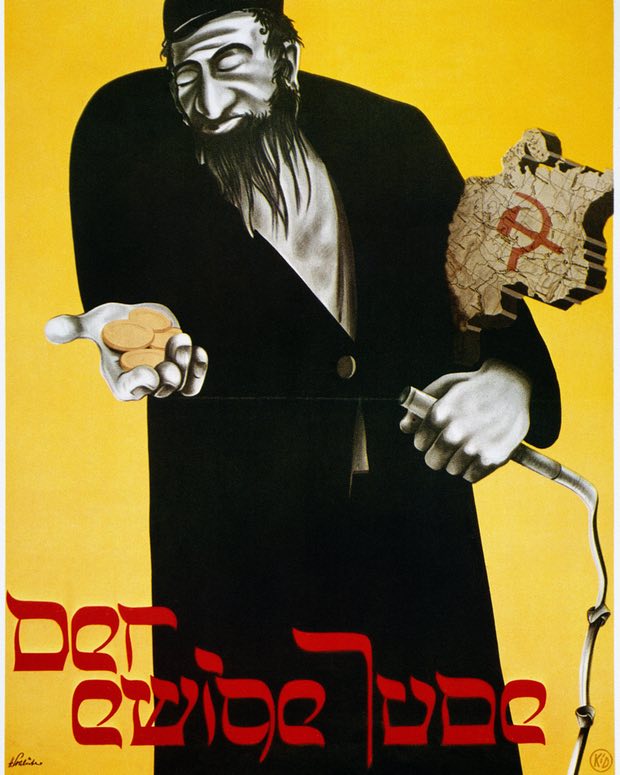

Michal &#268;iha&#345;: New free software projects on Hosted Weblate

Hosted Weblate provides also free hosting for free software projects. Finally I got to processing requests a bit faster, so there are just few new projects. This time, the newly hosted projects include: If you want to support this effort, please donate to Weblate, especially recurring donations are welcome to make this service alive. You can do them on Liberapay or Bountysource.

Filed under: Debian English Weblate 0 comments

Next.

Previous.