Search Results: "reg"

21 December 2012

Petter Reinholdtsen: A word on bitcoin support in Debian

It has been a while since I wrote about bitcoin, the decentralised peer-to-peer based crypto-currency, and the reason is simply that I have been busy elsewhere. But two days ago, I started looking at the state of bitcoin in Debian again to try to recover my old bitcoin wallet. The package is now maintained by a team of people, and the grunt work had already been done by this team. We owe a huge thank you to all these team members. :) But I was sad to discover that the bitcoin client is missing in Wheezy. It is only available in Sid (and an outdated client from backports). The client had several RC bugs registered in BTS blocking it from entering testing. To try to help the team and improve the situation, I spent some time providing patches and triaging the bug reports. I also had a look at the bitcoin package available from Matt Corallo in a PPA for Ubuntu, and moved the useful pieces from that version into the Debian package. After checking with the main package maintainer Jonas Smedegaard on IRC, I pushed several patches into the collab-maint git repository to improve the package. It now contains fixes for the RC issues (not from me, but fixed by Scott Howard), build rules for a Qt GUI client package, konqueror support for the bitcoin: URI and bash completion setup. As I work on Debian Squeeze, I also created a patch to backport the latest version. Jonas is going to look at it and try to integrate it into the git repository before uploading a new version to unstable. I would very much like bitcoin to succeed, to get rid of the centralized control currently exercised in the monetary system. I find it completely unacceptable that the USA government is collecting transaction data for almost all international money transfers (most are done in USD and transaction logs shipped to the spooks), and that the major credit card companies can block legal money transactions to Wikileaks. But for bitcoin to succeed, more people need to use bitcoins, and more people need to accept bitcoins when they sell products and services. Improving the bitcoin support in Debian is a small step in the right direction, but not enough. Unfortunately the user experience when browsing the web and wanting to pay with bitcoin is still not very good. The bitcoin: URI is a step in the right direction, but need to work in most or every browser in use. Also the bitcoin-qt client is too heavy to fire up to do a quick transaction. I believe there are other clients available, but have not tested them. My experiment with bitcoins showed that at least some of my readers use bitcoin. I received 20.15 BTC so far on the address I provided in my blog two years ago, as can be seen on the blockexplorer service. Thank you everyone for your donation. The blockexplorer service demonstrates quite well that bitcoin is not quite anonymous and untracked. :) I wonder if the number of users have gone up since then. If you use bitcoin and want to show your support of my activity, please send Bitcoin donations to the same address as last time, 15oWEoG9dUPovwmUL9KWAnYRtNJEkP1u1b.

20 December 2012

Russell Coker: Samsung Galaxy S3 First Review with Power Case

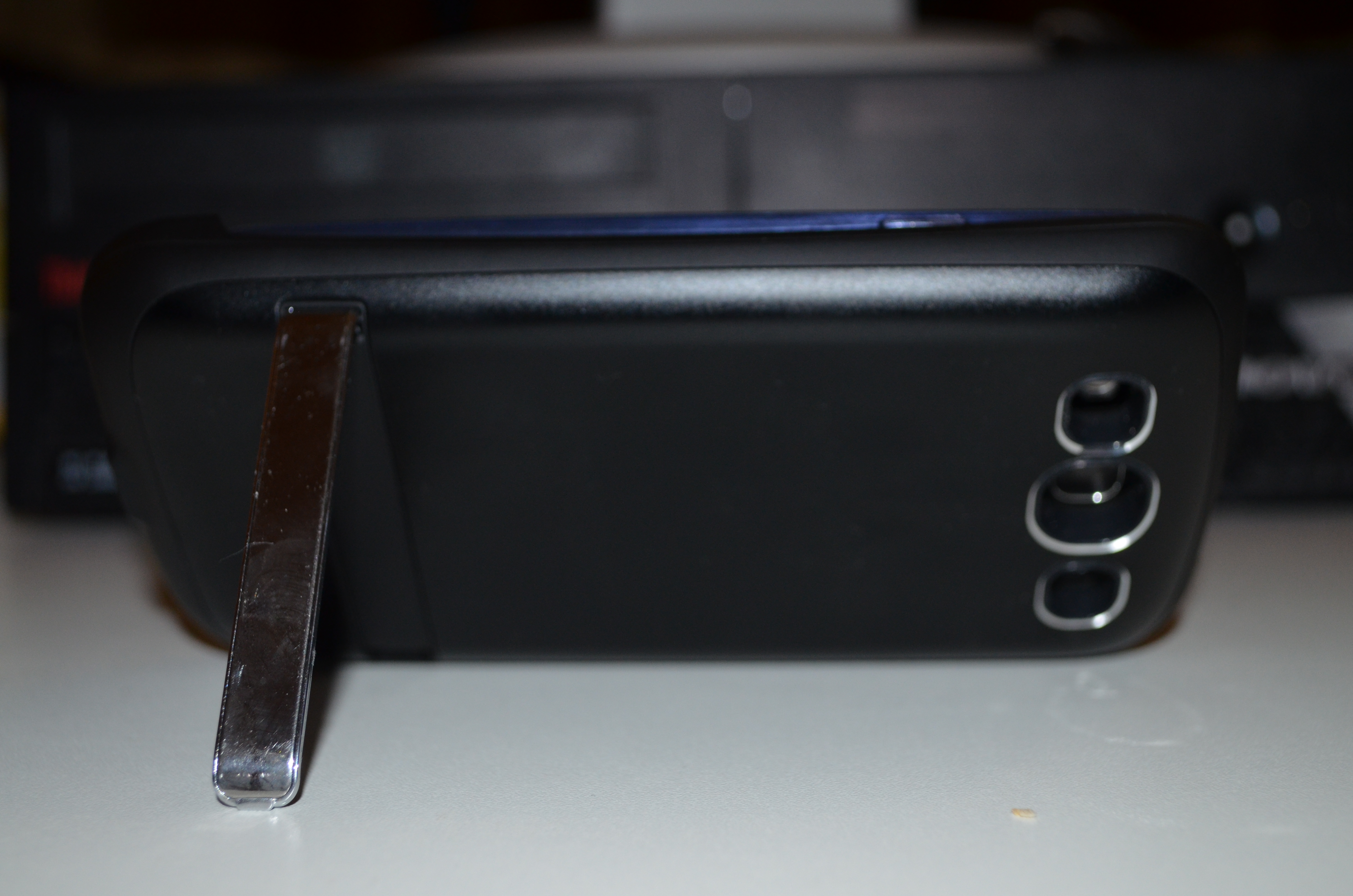
My new Samsung Galaxy S3 arrived a couple of days ago. Kogan added to the weirdness in their shipping that I documented in a previous post [1] by shipping the two phones on consecutive days with separate invoices for $789 each (as opposed to the $449 that I paid). This means that if customs were to track this down they could bust me for import duties (which apply whenever you order more than $1000 of electronics from another country) as multiple shipments in a small period of time are aggregated for tax purposes. It also means that it would be easy to defraud the tax office or an employer about the cost of the devices if I didn t blog about it Phone and Case Review back of power case with S3 installed next to back plastic of S3S3 and case next to each other To install the Samsung Galaxy S3 in the power case I bought from Kogan the back of the S3 has to be removed. One annoying implication of this is that when using the phone in it s case I will either have to carry the back of the phone with me or have no option of removing the case during the day. The phone has to slide in to the case from a small angle and if it s removed carelessly there seems to be a risk of breaking the power connector on the case. S3 on power case standedge view of S3 in power case stand The above photos show the kick-stand on the power case in use, I haven t yet had an opportunity to use the stand for anything other than photography and as it s made of thin plastic there s a reasonable chance that it will break off before I ever use it properly. One major deficiency of the power case is that it has no protection for the screen. The typical gel case will extend by about 2mm above the screen which means that you can place the phone screen-down on a table without a risk of scratching the screen. Also if a phone in a gel case is dropped on a hard surface it seems likely that the chance of the screen hitting a bump and cracking will be lower although I m not aware of any research regarding how well this theory works in practice. This combined with the fact that the power case is smooth and difficult to grip makes it quite unsuitable for regular use. I am concerned that the added mass of the power case would increase the risk of serious phone damage if it s dropped screen-down. I plan to buy a gel case ASAP which I will use most of the time. I will swap the gel case for the power case on the occasions when I expect to spend an extended period of time away from home or an office where I can charge my phone. The power case really should have been designed with a flange that extends above the level of the screen on all sites. It also shouldn t be smooth on the outside. Phone Review The Galaxy S3 equals the Galaxy S for the title of the most slippery phone I ve ever owned. This combined with the fact that the Galaxy S3 is slightly thinner and also 10% wider and longer makes it a more difficult phone to hold. It s a phone that really needs a case with a lot of grip. The camera is reasonable given the fact that any device that is 8.6mm thick will have a very small focal length and also a very small CCD for receiving light. The laws of physics just don t allow something the size of the Galaxy S3 to have a half-decent camera. My ideal mobile phone would be about the size of the Galaxy S3 with the power case, it would use the extra thickness for a big battery as well as a much longer focal length for the camera. I d like a phone to be about 16mm thick over most of it s area with a section that s 20mm for the camera. The burst shot mode (which allows you to take 20 pictures rapidly) is good for capturing certain types of relatively slow movement (EG someone s mouth moving when they talk). But it s no good at all if you try to pan the camera while doing burst mode. When I first started using the phone it gave me lots of hints about using various functions. This wasn t particularly useful for me as most things are obvious to anyone who has much experience with computers and the non-obvious things are probably going to be forgotten if you are doing something else when the help system prompts you. It will be useful for my sister in law who s getting the other phone, but the down-side of this is that I can t configure her phone before delivering it. She needs to use it first to see all the tips. The Galaxy S3 has a screen that s 4.8 diagonally which is slightly larger than the 4.0 screens of my previous Android phones (Sony Ericsson Xperia X10 and Samsung Galaxy S). That gives 44% more screen area which is a good thing. Unfortunately many apps seem to display the same amount of data, I had hoped that 44% more area and 140% more pixels would result in most apps displaying more data by default. Fortunately ConnectBot (my SSH client of choice) gives me 60 rows and 120 columns on the Galaxy S3 as opposed to the mere 31 rows and 80 columns on the Xperia X10. I don t use ConnectBot that often (a phone is a really bad ssh client no matter how you do it), but when I do it s really important and the extra space matters. The down-side of the larger screen for me is that the distance from the center of the palm of my hand to the end of my thumb is slightly less than 4.8 . This means that I can t hold the Galaxy S3 with one corner in the palm of my hand and still reach the far corner of the screen. So I am forced to hold the sides of the phone for one-handed use which means that it would be easier for it to slip out of my hand. A further complication is that the settings and back buttons are very close to the edge of the phone and can be hit by accident very easily. Hopefully a gel case will alleviate that. But I have never owned a hand-held device which was so difficult to hold in a stock configuration. According to AndroSensor (one of my favorite demo programs for showing useless things that a phone can do) the Galaxy S3 lacks support for measuring humidity and external temperature but it has all the other sensors. I think I can survive without knowing how hot and humid my pockets are, but it would still be nice to have every possible feature. The default partitioning of the phone storage is to have all internal storage used for applications and none used for a VFAT filesystem accessible over USB. It s nice that I won t run out of application storage space (a problem I ve had with every other Android device) but it does mean that I ll have to buy a micro SD card before I can use the phone properly. Micro SD storage costs about $1.50 per gig in the size range from 8G to 32G, it s not particularly expensive but it s annoying to have the phone not be fully usable right from the start. Without using a SD card I have to use gphoto2 to download pictures from the phone so it s fully usable in every way. But the cost of the power case, the gel case I m about to buy, and an SD card make the phone less of a bargain. The phone has more RAM, a faster CPU, and Android 4.1. These are all really good things, but nothing worth writing about in a review. Conclusions The power case is very poorly designed, I probably wouldn t buy it if I knew then what I know now. For one-handed phone use by someone like me with longer than average fingers a 4.0 phone is about the largest possible. This doesn t mean that phones should stay small, but it does mean that Apple weren t being entirely silly when they released all the 3.5 iPhones. Presumably a large portion of the population would find a 3.5 phone to be as usable as a 4.0 phone is for me. It now seems to me that as a 4.8 screen is going to be impractical for one-hand use by almost everyone the phone designers should concentrate more on larger phones similar to the Samsung Galaxy Note. I think that the 4.8 screen size may be ideal for some young children who could use it the way an adult might use a 7 tablet an Android phone seems to be a relatively common present for children in the 6-12 age range. Generally I think that no-one should ever buy a new phone or tablet without trying one of the same size. While I am happy with the S3 it really doesn t work in the way I expected. Having 2.9* as many characters on screen for ConnectBot is a massive benefit. If I ever write another magazine article on a hand-held device the extra size and resolution will really help if I found a suitable editor (please make suggestions in the comments). For the WordPress client to write long blog posts on it then the screen could potentially be reasonably useful, but so far it seems that it s more suited to reviewing posts and comments than to writing posts. Generally the Samsung Galaxy S3 is a good phone and I think it s great value for money when it s less than $500.

18 December 2012

Russ Allbery: Review: Liars and Outliers

Review: Liars and Outliers, by Bruce Schneier
Publisher: John Wiley
Copyright: 2012
ISBN: 1-118-14330-2
Format: Hardcover
Pages: 285
One of the perils of buying a book written by a blogger one reads regularly is that the book may be little more than a rehashing of their blog, with insufficient original material to warrant the time investment. Sometimes it's still nice to support them financially, but it may not make sense to read the book. I've been following Schneier's blog for years (as should anyone with an interest in security), including through the entire process of writing Liars and Outliers, and was a bit worried that might be the case here. Thankfully, I can reassure any other worried potential readers that is not the case. This is substantial new material establishing a firm framework for thinking about incentives and controls in any society or organization. Liars and Outliers talks about security mechanisms, but it's not, at its core, a book about security. Rather, it's a book about incentives, order, and how order is established. It's a comprehensive reductionist analysis of how societies create predictability and compliance to allow us to trust other people who we have never met before and will never meet again. It's a unique (at least in my experience) combination of anthropology, sociology, security analysis, and political science. Schneier cuts across fields in an idiosyncratic but illuminating way that reminded me of (on an entirely separate topic) Jane Jacobs. This is not a prescriptive book, nor is a collection of answers, solutions, or even deep analysis of particular problems. Rather, it's an attempt to construct a general framework for analyzing societal dilemmas: conflicts between individual desires and social good, how those conflicts are resolved, and how societies can weigh the scales and influence the statistical outcomes. The closest Schneier comes to telling the reader how to solve problems is a checklist, at the end of the book, for designing effective societal pressures. Its primary contribution is vocabulary and structure. It also passes one of my litmus tests for any book about human behavior: Schneier complicates, broadens, deepens, and expands understanding, and points out complex interactions and complex feedback in effects we're inclined to consider simple, rather than simplifying or eliminating human complexity. One point I found refreshing about this book is that Schneier is scrupulous in refusing to define either society or individuals as good or bad, to the point of carefully defining terminology used in all of the social dilemmas. Following societal rules is called compliance; not following those rules is called defection. In some cases, defection is morally correct (Schneier's most frequent example is in the civil rights struggles of the 1960s in the United States). In all cases, social pressures are tools, which can be used to encourage compliance with moral or immoral systems, and which are deployed by totalitarian dictatorships and utopian communes alike. Schneier explicitly puts out of scope for this book the questions of how societal goals should be determined, how they change, and whether any given societal rule or interest is moral or immoral. He focuses, rather, only on the mechanisms, with a primary goal of informing and deepening debates over how best to encourage behavior that societies want to encourage and discourage behavior societies want to discourage. He also emphasizes discourage, as opposed to eliminate. Early on, Schneier shows some of the results of game theory, as well as basic common sense, that indicate that no healthy society can totally eliminate defection. Not only would that stifle valuable and important reform, such as changes in civil rights, but the degree of pressure required is immense. Defectors are natural and will always exist, and are sometimes valuable and necessary. Rather, the goal of a society is to reduce defectors to a level where most people can ignore their existence most of the time, a state that leads to the level of risk and trust required to have a functioning and healthy society. The word society, similarly, is intentionally broad, and can refer to just about any collection of people, from a circle of friends to a corporation, institution, or country. However, as Schneier points out early in the book, small societies rarely need much in the way of formal pressure and appear almost magically self-governing. That's the first property that he disassembles, resulting in a general classification of societal pressures into four categories: moral, reputational, institutional, and security systems. The last is an odd category that's partly orthagonal to the other three. Moral pressure is internalized conscience: the normal tendency of nearly everyone to follow their own moral code, a code that's at least partly constructed and certainly heavily influenced by the surrounding society. Reputational pressure is, in a sense, externalized morality: it's the informal reactions of others around one to one's past actions. Included in reputational pressure is shunning of every kind, from cutting off a friendship to boycotts against corporations, but it also includes confrontation from another member of one's society, the more subtle effects of our individual desires to be liked and respected, and all the various aspects of "face", honor, and respect within a community. Small communities are frequently self-governing, in Schneier's model, because they're small enough that moral and reputational pressures are sufficient and no other pressures are required. We're so used to applying moral and reputational pressure to other humans almost unconsciously that we sometimes don't even notice its existence, leading to that "magical" self-governing property. But Schneier puts pressures in a sequence: pressures that work extremely well with small groups often don't scale. Moral pressure works best with small groups and reputational pressure with somewhat larger groups, but when societies scale beyond the limits of reputational pressure when, for example, one frequently interacts with people whose reputations are unknown to you and whose subsequent opinion of you will not be relevant institutional pressure is required to force compliance. Institutional pressure is the sort of pressure that we all tend to think of first when we look for ways to enforce rules: laws, policies, contracts, and other codes of behavior that carry with them formal punishments and some enforcement mechanism. But even in societies so large that institutional pressures are frequently required, such as whole countries, moral and reputational pressures still exist and are extremely important. One of Schneier's most interesting points is his analysis of how institutional pressures can paradoxically undermine reputational and moral pressures, resulting in more defection than if the institutional pressure hadn't existed. This is just the basic framework of Schneier's analysis, hopefully giving you a feel for the structure of the book. He goes much deeper into the complicated interactions between the various levels of pressure, and then dives into an extensive look at competing societal dilemmas: cases where there is more than one society in play simultaneously, possibly demanding contradictory actions. Liars and Outliers also includes a wonderful analysis of organizational entities within the same framework, including their much-different reactions to moral, reputational, and institutional pressures. One of the most cogent analyses of the difficulties of regulating both corporations and governmental institutions falls out of that analysis, once one looks at them in light of Schneier's basic framework. Pressures quickly become complex and multi-layered, and human reactions to pressures are frequently counter-intuitive. Schneier draws extensively on game theory to show that some counter-intuitive responses are actually emergent properties of logical analysis of the situation, but that others are more uniquely human and have little or nothing to do with a mathematical cost-benefit analysis. I haven't even mentioned his discussion of security systems, and how they can extend moral, reputational, and institutional pressures, as well as add a new type of pressure (making a defecting action impossible) that scales even better than institutional pressures. Liars and Outliers has all of the supporting infrastructure you would expect in a scholarly book: notes, extensive references, and a good index. I suspect it will end up being used as at least additional reading in college classes. The notes are, unfortunately, end notes, making the full context of the book much harder to read than was necessary, but at least Schneier does separate the notes from the references so that one doesn't chase notes for further explanation and find a simple citation. As with any book like this, one always wishes it could end in a simple prescription to fix everything, but of course it doesn't. But that's also a measure of a good scholarly work. Human and organizational motivations are complex and tricky, and any framework for analyzing them needs to be able to represent that complexity. Schneier here has constructed a very powerful one, one that I started using in discussions before I'd even finished the book. Perhaps the most valuable contribution of Liars and Outliers to public discussion is clear terminology and categories, which can be of great help in finding the core components of a problem. Liars and Outliers can be slow going, particularly early on when Schneier is still defining terms and setting up the background of his analysis. One can get a bit tired of the analysis matrices of societal dilemmas. But stick with it through the groundwork, since the analyses of competing societal dilemmas and of the impact of societal pressures on organizations are exceptional. Highly recommended, particularly for anyone who is designing or implementing societal pressures: managers, political activists, or anyone in a security-related field. Rating: 8 out of 10

17 December 2012

Dominique Dumont: Be wary of optimised for devices

Hello This story began with linphone having a weird behavior: every now and then, the mouse pointer would become stuck: the pointer moves, but clikcking on it always activate the same widget. Since this always happened in the middle of phone conference done for work, this was infuriating. Long story short, I finally found that my plantronics USB headset was responsible for this weird behavior. This headset is connected to the USB bus and is seen by the computer as a USB sound card. The bug was triggered by pressing the mute button provided by the headset. Suspicious of this usb device, I used lsusb to find the features provided by the heaset: $ lsusb -v -s 1:3 2>&1 grep InterfaceClass
bInterfaceClass 1 Audio
bInterfaceClass 3 Human Interface Device
Audio devices were expected, but why a HID device ? This device is a headset, not a keyboard or a mouse Testing further, I also saw some number poping up on my screen whenever I pressed the the mute button. The only way to get the mouse back was to unplug the headset. A quick google search gave a solution to setup X11 to ignore the headset. Problem solved. But this did not answer the question regarding the HID device. Then I got a hint in the form of a sticker glued on the headset USB plug: Optimized for Microsoft Lync . This page gave the answer: an optimised for Lync device provides mute/unmute across PC and device . I can only guess that when the mute button is pressed, some data is sent from the HID interface. Unfortunately, the window manager does not like to be on the receiving end of this data. The moral of this story is: optimized for something actually means not standard .
ok. There s a bug somewhere. The comments of this blog have convinced me that I went too far with the moral of this story. It s now overstriked instead of plainly remvoed so the comments still make sense. Thanks everybody for the constructive comments.
All the best
Tagged: wtf

Russell Coker: Using BTRFS

I ve just installed BTRFS on some systems that matter to me. It is still regarded as experimental but Oracle supports it with their kernel so it can t be too bad and it s almost guaranteed that anything other than BTRFS or ZFS will lose data if you run as many systems as I do and I run lots of systems that don t have enough RAM for ZFS (4G isn t enough in my tests). So I have to use BTRFS. BTRFS and Virtual Machines I m running BTRFS for the DomUs on a virtual server which has 4G of RAM (and thus can t run ZFS). The way I have done this is to use ext4 on Linux software RAID-1 for the root filesystem on the Dom0 and use BTRFS for the rest. For BTRFS and virtual machines there seem to be two good options given that I want BTRFS to use it s own RAID-1 so that it can correct errors from a corrupted disk. One is to use a single BTRFS filesystem with RAID-1 for all the storage and then have each VM use a file on that big BTRFS filesystem for all it s storage. The other option is to have each virtual machine run BTRFS RAID-1. I ve created two LVM Volume Groups (VGs) named diska and diskb, each DomU has a Logical Volume (LV) from each VG and runs BTRFS. So if a disk becomes corrupt the DomU will have to figure out what the problem is and fix it. #!/bin/bash
for n in $(xm list cut -f1 -d\ egrep -v ^Name\ ^Domain-0) ; do
echo $n
ssh $n "btrfs scrub start -B -d /"
done I use the above script in a cron job from the Dom0 to scrub the BTRFS filesystems in the DomUs. I use the -B option so that I will receive email about any errors and so that there won t be multiple DomUs scrubbing at the same time (which would be really bad for performance). BTRFS and Workstations The first workstation installs of BTRFS that I did were similar to installations of Ext3/4 in that I had multiple filesystems on LVM block devices. This caused all the usual problems of filesystem sizes and also significantly hurt performance (sync seems to perform very badly on a BTRFS filesystem and it gets really bad with lots of BTRFS filesystems). BTRFS allows using subvolumes for snapshots and it s designed to handle large filesystems so there s no reason to have more than one filesystem IMHO. It seems to me that the only benefit in using multiple BTRFS filesystems on a system is if you want to use different RAID options. I presume that eventually the BTRFS developers will support different RAID options on a per-subvolume basis (they seem to want to copy all ZFS features). I would like to be able to configure /home to use 3 copies of all data and metadata on a workstation that only has a single disk. Currently I have some workstations using BTRFS with a BTRFS RAID-1 configuration for /home and a regular non-RAID configuration for everything else. But now it seems that this is a bad idea, I would be better off just using a single copy of all data on workstations (as I did for everything on workstations for the previous 15 years of running Linux desktop systems) and make backups that are frequent enough to not have a great risk. BTRFS and Servers One server that I run is primarily used as an NFS server and as a workstation. I have a pair of 3TB SATA disks in a BTRFS RAID-1 configuration mounted as /big and with subvolumes under /big for the various NFS exports. The system also has a 120G Intel SSD for /boot (Ext4) and the root filesystem which is BTRFS and also includes /home. The SSD gives really good read performance which is largely independent of what is done with the disks so booting and workstation use are very fast even when cron jobs are hitting the file server hard. The system has used a RAID-1 array of 1TB SATA disks for all it s storage ever since 1TB disks were big. So moving to a single storage device for /home is a decrease in theoretical reliability (in addition to the fact that a SSD might be less reliable than a traditional disk). The next thing that I am going to do is to install cron jobs that backup the root filesystem to something under /big. The server in question isn t used for anything that requires high uptime, so if the SSD dies entirely and I need to replace it with another boot device then it will be really annoying but it won t be a great problem. Snapshot Backups One of the most important uses of backups is to recover from basic user mistakes such as deleting the wrong file. To deal with this I wrote some scripts to create backups from a cron job. I put the snapshots of a subvolume under a subvolume named backup . A common use is to have everything on the root filesystem, /home as a subvolume, /home/backup as another subvolume, and then subvolumes for backups such as /home/backup/2012-12-17, /home/backup/2012-12-17:00:15, and /home/backup/2012-12-17:00:30. I make /home/backup world readable so every user can access their own backups without involving me, of course this means that if they make a mistake related to security then I would have to help them correct it but I don t expect my users to deal with security issues, if they accidentally grant inappropriate access to their files then I will be the one to notice and correct it. Here is a script I name btrfs-make-snapshot which has an optional first parameter -d to cause it do just display the btrfs commands it would run and not actually do anything. The second parameter is either minutes or days depending on whether you want to create a snapshot on a short interval (I use 15 minutes) or a daily snapshot. All other parameters are paths for subvolumes that are to be backed up: #!/bin/bash
set -e

# usage:
# btrfs-make-snapshot [-d] minutes days paths
# example:
# btrfs-make-snapshot minutes /home /mail

if [ "$1" == "-d" ]; then
BTRFS="echo btrfs"
shift
else
BTRFS=/sbin/btrfs
fi

if [ "$1" == "minutes" ]; then
DATE=$(date +%Y-%m-%d:%H:%M)
else
DATE=$(date +%Y-%m-%d)
fi
shift

for n in $* ; do
$BTRFS subvol snapshot -r $n $n/backup/$DATE
done Here is a script I name btrfs-remove-snapshots which removes old snapshots to free space. It has an optional first parameter -d to cause it do just display the btrfs commands it would run and not actually do anything. The next parameters are the number of minute based and day based snapshots to keep (I am currently experimenting with 100 100 for /home to keep 15 minute snapshots for 25 hours and daily snapshots for 100 days). After that is a list of filesystems to remove snapshots from. The removal will be from under the backup subvolume of the path in question. #!/bin/bash
set -e

# usage:
# btrfs-remove-snapshots [-d] MINSNAPS DAYSNAPS paths
# example:
# btrfs-remove-snapshots 100 100 /home /mail

if [ "$1" == "-d" ]; then
BTRFS="echo btrfs"
shift
else
BTRFS=/sbin/btrfs
fi

MINSNAPS=$1
shift
DAYSNAPS=$1
shift

for DIR in $* ; do
BASE=$(echo $DIR cut -c 2-200)
for n in $(btrfs subvol list $DIR grep $BASE/backup/.*: head -n -$MINSNAPS sed -e "s/^.* //"); do
$BTRFS subvol delete /$n
done
for n in $(btrfs subvol list $DIR grep $BASE/backup/ grep -v : head -n -$MINSNAPS sed -e "s/^.* //"); do
$BTRFS subvol delete /$n
done
done A Warning The Debian/Wheezy kernel (based on the upstream kernel 3.2.32) doesn t seem to cope well when you run out of space by making snapshots. I have a filesystem that I am still trying to recover after doing that. I ve just been buying larger storage devices for systems while migrating them to BTRFS, so I should be able to avoid running out of disk space again until I can upgrade to a kernel that fixes such bugs.

16 December 2012

Gregor Herrmann: RC bugs 2012/50

have I said before that we are running out of easy RC bugs? the list is a bit short this week: to make up for this poor performance, I've uploaded ~14 new lib.*-perl packages to the NEW queue yesterday & today :)

15 December 2012

Thorsten Glaser: Der heilige Frieden?

(Apologies for putting this on Planet Debian, but it says the one or other non-English post is okay as long as it s an exception. I feel I need to reach more people with this, but don t feel like translating this into English right now.)
Update: Tanguy asked for a short English summary: it s me ranting against the rioting against muslims and the call for more CCTV surveillance after a possible bomb was found at the train station. In Bonn herrscht immer noch Bombenstimmung , wenn man z.B. auf die Webseite der Lokalzeitung schaut von dem Amoklauf in Connecticut, ber den sich im IRC gewunder wird, ist immer noch nichts zu sehen, daf r wird flei ig wider Islamisten gehetzt. Ich finde das besorgniserregend, mu doch jetzt jeder Angeh rige des Islams f rchten, verfolgt oder benachteiligt zu werden. Das reizt doch erst recht zum Gegenschlag, bei dem dann auch Menschen, die absolut nicht mit der hier vorherrschenden Meinung und Politik bereinstimmen, getroffen werden k nnen. Ich pers nlich habe kein Problem mit Menschen anderen Glaubens oder anderer Weltanschauung, solange wir friedlich miteinander leben k nnen. Ich teile eure Unzufriedenheit mit dem herrschenden Staat, der immer weitergehenden berwachung, Unterdr ckung von Leuten, die nicht dem vorherrschenden Menschenbild entsprechen (egal an welchen Kategori n), und bitte die, die dies lesen, nochmal nachzudenken, bevor sie etwas tun, was hinterher Unschuldige trifft oder gar in friendly fire ausartet. Hat eigentlich wer die in Bad Godesberg ausgegebenen Koran-B cher sich mal angeschaut? Als ich davon las, war ich ja zugegebenerma en neugierig, weil ich vom Koran leider eher wenig kenne, wei aber nicht, wie neutral oder eben nicht die bersetzung gehalten ist. Anhand dessen, was ich bereits mitbekam, sollte das eher friedlicher sein als was durch sp tere Theologen festgelegt wurde wie ja auch zum Beispiel im Christentum, aber ber die Horrorepisoden der christlichen Kirche will ich jetzt auch nicht mich auslassen, in der Hoffnung, da auch diese sich mit den Jahren gebessert hat. (Ist nur halt das Problem mit den Leuten, die die alten Hetzparolen jetzt noch verbreiten. Ist wie im Netz mit den Groupies von Theo de Raadt, die noch asiger zu Leuten sind als er selber.) (Au erdem mu man ja bef rchten, durch Besitz eines Korans schon vorverurteilt zu werden heutzutage *seufz* ich finde das nicht gut!) Update (ich verga ): auch der Ruf nach mehr Video berwachung ist nur Panikmache. Das geht nur zu Lasten des Normalb rgers. Vielleicht lassen sich noch Kleinstdelikte wie Taschendiebstahl damit abschrecken, aber gerade diese Bomben und dergleichen sind doch oft von Leuten, die vor Konsequenzen keine Angst haben, organisiert. Die werden dann maximal M rtyrer. Ich wiederhole nochmal f r die Politiker und die ganz langsamen unter den Lesern: berwachung verhindert keine Straftat.

Jose Luis Rivas: Why Jekyll

Why? I switched to Jekyll but it wasn't a fast decision. I really tried to give WordPress a chance, again, but I'm not getting along pretty well with PHP since like 2 years ago. In fact, is a headache to maintain on my server. In the course of the years I have had several downtimes on my PHP-based sites because of changes like PHP-FPM. Some sites just dropped working for me while others kept doing OK. This is in the same server, with the same database and the same codebase (WordPress). After a lot of time programming on Node.js and been learning more Ruby (CoffeeScript made me love the syntax) I just got tired of using more resources of what I really needed, and with a regular CMS that means a database. Why would I need a database if I just update like once a day? For a comment-system? There's Disqus already, and people can just comment you on Twitter or make a Branch for it, or just write you an email! Plain simple. Jekyll So there was Jekyll, a pretty nice tool creating static-sites very fast and easy to learn. It didn't needed a database and because all is static is pretty fast. Even the hosting requirements got lowered to the point I could (and I did) just upload this to GitHub and served it from there as a GitHub Page! One more thing One thing made me decided to upload to GitHub as well was Prose.io, a simple text-editor for GitHub with support for MarkDown made by the guys @ developmentseed.com. So while it was made for being updated on my terminal I could just do it as well from the web, from anywhere with just my GitHub account and having previews on-the-fly. The downside Since I don't control this server I couldn't setup redirections for my old feeds. Of course, I could have just copied the same pattern in a folder and put there an XML feeding the category X, but I think is easier to update the planets being feeded to the new URIs. On the bright-side I even could put pretty-permalinks to work! So the structure for my old links kept the same.

13 December 2012

Andrea Veri: The future is Cloudy

Have you ever heard someone talking extensively about Cloud Computing or generally Clouds? and have you ever noticed the fact many people (even the ones who present themselves as experts) don t really understand what a Cloud is at all? That happened to me multiple times and one of the most common misunderstandings is many see the Cloud as something being on the internet. Many companies add a little logo representing a cloud on their frontpage and without a single change on their infrastructure (but surely with a price increment) they start calling their products as being on the Cloud. Given the lack of knowledge about this specific topic people tend to buy the product presented as being on the Cloud without understanding what they really bought. But what Cloud Computing really means? it took several years and more than fifteen drafts to the National Institute of Standards and Technology s (NIST) to find a definition. The final accepted proposal:
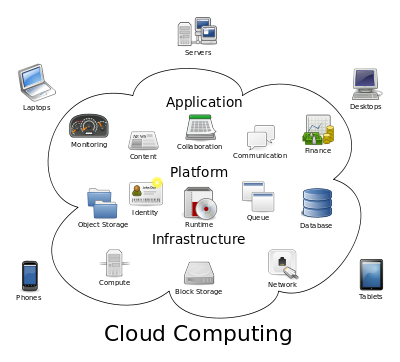
Cloud computing is a model for enabling ubiquitous, convenient, on-demand network access to a shared pool of configurable computing resources (e.g., networks, servers, storage, applications and services) that can be rapidly provisioned and released with minimal management effort or service provider interaction.

The above definition requires a few more clarifications specifically when it comes to understand where should we focus on while checking for a Cloud Computing solution. A few key points:
  1. On-demand self-service: every consumer will be able to unilaterally provision multiple computing capabilities like server time, storage, bandwidth, dedicated RAM or CPU without requiring any sort of human interaction from their respective Cloud providers.
  2. Rapid elasticity and scalability: all the computing capabilities outlined above can be elastically provisioned and released depending on how much demand my company will have in a specific period of time. Suppose the X company is launching a new product today and it expects a very large number of customers. The X company will add more resources to their Cloud for the very first days (where they suppose the load to be very high) and then it ll scale the resources back as they were before. Elasticity and scalability permit the X company to improve and enhance their infrastructure when they need it with an huge saving in monetary terms.
  3. Broad network access: capabilities are available over the network and accessed through standard mechanisms that promote use by heterogeneous thin or thick client platforms (e.g., mobile phones, tablets, laptops, and workstations).
  4. Measured service: Cloud systems allow maximum transparency between the provider and the consumer, the usage of all the resources is monitored, controlled, and reported. The consumer knows how much will spend, when and in how long.
  5. Resource pooling: each provider s computing resources are pooled to serve multiple consumers at the same time. The consumer has no control or knownledge over the exact location of the provided resources but may be able to specify location at a higher level of abstraction (e.g., country, state, or datacenter).
  6. Resources price: when buying a Cloud service make sure the cost for two units of RAM, storage, CPU, bandwidth, server time is exactly the double of the price of one unit of the same capability. An example, if a provider offers you one hour of bandwitdh for 1 Euro, the price of two hours will have to be 2 Euros.
Another common error I usually hear is people feeling Cloud Computing just as a place to put their files online as a backup or for sharing them with co-workers and friends. That is just one of the available Cloud features , specifically the Cloud Storage , where typical examples are companies like Dropbox, Spideroak, Google Drive, iCloud and so on. But let s make a little note about the other three features :
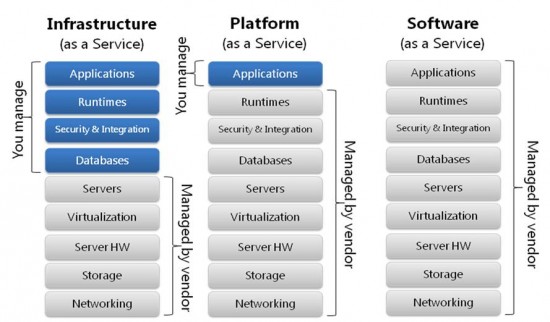
  1. Infrastructure as a Service (IaaS): the capability provided to the consumer is to provision processing, storage, networks, and other fundamental computing resources where the consumer is able to deploy and run arbitrary software, which can include operating systems and applications. In this specific case the consumer has still no control or management over the underlying Cloud infrastructure but has control over operating systems, storage, and deployed applications. A customer will be able to add and destroy virtual machines (VMs), install an operating system on them based on custom kickstart files and eventually manage selected networking components like firewalls, hosted domains, accounts.
  2. Platform as a Service (PaaS). the capability provided to the consumer is to deploy onto the cloud infrastructure consumer-created or acquired applications created using programming languages, libraries, services, and tools (like Mysql + PHP + PhpMyAdmin or Ruby on Rails) supported by the provider. In this specific case the consumer has still no control or management over the Cloud infrastructure itself (servers, OSs, storage, bandiwitdh etc.) but has control over the deployed applications and configuration settings for the application-hosting environment.
  3. Software as a Service (SaaS): the capability provided to the consumer is to use the provider s applications running on a Cloud infrastructure. The applications are accessible through various client devices, such as a browser, a mobile phone or a program interface. The consumer doesn t not manage nor control the Cloud infrastructure (servers, OSs, storage, bandwidth, etc.) that allows the applications to run. Even the provided applications aren t customizable by the consumer, which should rely on limited configuration settings.
The Cloud Computing technology is reasonably the future but can we trust Cloud providers? Are we sure that no one will ever have access to our files except us? and what about governments interested in acquiring a specific customer data hosted on the Cloud? I always suggest to read deeply both the Privacy Policy and Terms of Use of a certain service before signing in especially when it comes to choose a Cloud storage provider. Many providers have the same aspect, they seem to provide the same resources, the same amount of storage for the same price but legally they may present different problems, and that is the case of Spideroak vs Dropbox. Quoting from the Dropbox s Privacy Policy:
Compliance with Laws and Law Enforcement Requests; Protection of DropBox s Rights. We may disclose to parties outside Dropbox files stored in your Dropbox and information about you that we collect when we have a good faith belief that disclosure is reasonably necessary to (a) comply with a law, regulation or compulsory legal request; (b) protect the safety of any person from death or serious bodily injury; (c) prevent fraud or abuse of DropBox or its users; or (d) to protect Dropbox s property rights. If we provide your Dropbox files to a law enforcement agency as set forth above, we will remove Dropbox s encryption from the files before providing them to law enforcement. However, Dropbox will not be able to decrypt any files that you encrypted prior to storing them on Dropbox.
It s evident that Dropbox employees can access your data or be forced by legal process to turn over your data unencrypted. On the other side, Spideroak on its latest update to its Privacy Policy states that data stored on their Cloud is encrypted and inaccessible without user s key, which is stored locally on user s computers. And what about the latest research paper, titled Cloud Computing in Higher Education and Research Institutions and the USA Patriot Act written by the legal experts of the University of Amsterdam s Institute for Information Law stating the anti-terror Patriot Act could be theoretically used by U.S. law enforcement to bypass strict European privacy laws to acquire citizen data within the European Union without their consensus? The only requirement for the data acquisition is the provider being an U.S company or an European company conducting systematic business in the U.S. For example an Italian company storing their documents (protected by the European privacy laws and under the general Italian jurisdiction) on a provider based in Europe but conducting systematic business in the United States, could be forced by U.S. law enforcement to transfer data to the U.S. territory for inspection by law enforcement agencies. Does someone really care about the privacy of companies, consumers and users at all? or better does privacy exists at all for the millions of the people that connect to the internet every day?

11 December 2012

Russell Coker: Links December 2012

Steven Johnson gave an interesting TED talk about where good ideas come from [1]. He starts by attributing coffee replacing alcohol as a standard drink for some good ideas and then moves on to how ideas develop. Erez Lieberman Aiden and Jean-Baptiste Michel gave an interesting and amusing TED talk about the ngram analysis of books that Google scanned [2]. Here is the link for the Google Books ngram search [3]. Clay Shirky gave an insightful TED talk about how the Internet is changing the world [4]. He cites Open Source programmers as the modern day equivalent to the Invisible College based on our supposed great ability to get along with other people on the Internet. If we really are so much better than the rest of the Internet then things must be bad out there. He ends with ways of using Git to draft legislation. Hans Rosling gave an interesting TED talk about religion and the number of babies that women have [5]. His conclusion is that it s more about income and social stability and that the world s population can stabilise at 10 billion if we provide family planning to everyone. Alexis C. Madrigal wrote an interesting interview with Genevieve Bell about her work at Intel and the way people use technology [6]. Indigogo is raising funds for the Cuddle Mattress , it s a mattress with foam slats and a special fitted sheet to allow your arm to slide between the slats [7]. So you could have your arm underneath your SO for an extended period of time without risking nerve damage. They also show that when sleeping on your side your shoulder can go between the slats to avoid back problems. Nate Silver (who is famous for predicting US elections gave an interesting TED talk about racism and politics [8]. One of his main points is to show the correlation between racism and lack of contact of members of other races. Sociological Images has an interesting article by Lisa Wade about whether marriage is a universal human value [9]. In regard to historical marriage she says women were human property, equivalent to children, slaves, servants, and employees . The general trend in the comments seems to be that there are so many types of marriage that it s difficult to make any specific claims to traditional marriage unless you count a tradition of a short period in a single geographic region. Plurality is an excellent sci-fi short movie on youtube [10]. TED has an interesting interview with Hakeem Oluseyi about his research about astrophysics and how he achieved a successful career after being a gangster as a teenager [11]. He has some good ideas about helping other children from disadvantaged environments become successful. Paul Dwerryhouse wrote an interesting blog post about his work in designing and implementing a filesystem based on a Cassandra data store with FUSE [12]. Paul also wrote a post about using Apache Zookeeper to lock metadata to permit atomic operations [13]. The documentary Monumental Myths provides an interesting and insightful analysis of the processes of creating, maintaining, and explaining monuments [14]. It focusses on some significant monuments in the US and explains both sides to each story. Howard Zinn makes the insightful point that when people present a certain point of view of history it s not controversial, as soon as you present the other side they call it controversial . That happens even in debates about current issues. Howard also says to criticise whatever the government does is not anti-America, it s anti-government, it s pro-America, it s pro the people, it s pro the country . The song that plays during the closing credits is interesting too. The music video Same Love is one of the best presentations of the argument for marriage equality [15]. Chris Samuel wrote an interesting post about systems locked down for Windows 8 and options for purchasing PCs for running Linux [16]. His solution is to buy from ZaReason. I saw his laptop in action at the last LUV meeting and it looks really nice. Unfortunately a byproduct of the extremely thin form factor is the fact that it lacks a VGA port, this meant that Chris had to use my Thinkpad T61 (which is rather clunky by comparison) for his presentation.

9 December 2012

Gregor Herrmann: RC bugs 2012/49

my short list of contributions to RC bug fixing during the last week:

7 December 2012

Joachim Breitner: Calculating the internal rate of return with hledger

For more than ten years now, I am a regular and happy user of GnuCash, the free accountancy program. Especially the integrated online banking support for HBCI that allows me not only to fetch my transactions, but also to transfer money using a cryptographic makes it a great tool. Nevertheless, it has shortcomings, especially when it comes to reports. And for some reason I never felt the urge to hack on that C/Guile code (although I recently hacked a bit on the UI).

Joey Hess blog post about Simon Michael s hledger made me look at that command line based accountancy tool. It certainly won t replace Gnucash for me, but luckily ledger, of which hledger is a re-implementation, can read GnuCash s file format and convert it to a ledger file that hledger can read as well. So now I can do analysis on my financial data in Haskell what would you want more? One report that I was missing was the internal rate of investment of some account. This is the annual rate of a hypothetical fixed interest-bearing savings account that would, given the same deposits and payouts, result in the same final value. I now implemented this as the hledger-irr command and as you would expect you can find it on hackage. See the package description for documentation and example output. It is very fresh, hardly tested code, so don t base important decisions on it yet. Also, it needs work to work correctly with multiple currencies or things with varying prices, and I am not yet sure what to do there. Update: Simon asked me to elaborate the difference to hledger-interest by Peter Simons (on which my code was initial based, but eventually I rewrote everything but the option parsing code). The difference is that hledger-interest answers the question I have this investment with this yearly interest rate (which may even change), how large are the interest payments going to be. I imagine a usecase is that you have borrowed some money to a friend at a certain (surely amicable) rate and need to figure out what he owes you, even when you gave him the money mid year and he payed you some back shortly after easter. hledger-irr serves a different purpose: Here you already know your investment payments, gains and losses and you want to have a number describing how good your investment was. One usecase might be that, at the end of a live of paying into a pension fund, you ask yourself: Given all the feeds and commissions, was this a good idea or should I just have invested the money myself? Then the internal rate of investment tells you how lucrative an alternative fixed-rate investment would have had to been to match your pension fund investment. (Or course this is not the only aspect that you should look at when comparing investments, as it totally ignores risk and possible insurance elements of the investment.)

6 December 2012

James Bromberger: Official Debian Images on Amazon Web Services EC2

Please Note: this article is written from my personal perspective as a Debian Developer, and is not the opinion or expression of my employer.
Amazon Web Service s EC2 offers customers a number of Operating Systems to run. There are many Linux Distributions available, however for all this time, there has never been an Official Debian Image or Amazon Machine Image (AMI), created by Debian. For some Debian users this has not been an issue as there are several solutions of creating your own personal AMI. However for the AWS Users who wanted to run a recognised image, it has been a little confusing at times; several Debian AIMs have been made available by other customers, but the source of those images has not been Debian . In October 2012 the AWS Marketplace engaged in discussions with the Debian Project Leader, Stefano Zacchiroli. A group of Debian Developers and the wider community formed to generated a set of AMIs using Anders Ingemann s ec2debian-build-ami script. These AMIs are published in the AWS Marketplace, and you can find the listing here: No fees are collected for Debian for the use of these images via the AWS Marketplace; they are listed here for your convenience. This is the same AMI that you may generate yourself, but this one has been put together by Debian Developers. If you plan to use this AMI, I suggest you read http://wiki.debian.org/Cloud/AmazonEC2Image, and more explicity, SSH as the user admin and then sudo -i to root. Additional details Anders Ingemann and others maintain a GitHub project called ec2debian-build-ami which generates a Debian AMI. This script supports several desired features, an was also updated to add in some new requirements. This means the generated image supports: Debian Stable (Squeeze; 6.0.6 at this point in time) does not contain the cloud-init package, and neither does Debian Testing (Wheezy). A fresh AWS account (ID 379101102735) was used for the initial generation of this image. Any Debian Developer who would like access is welcome to contact me. Minimal charges for the resource utilisation of this account (storage, some EC2 instances for testing) are being absorbed by Amazon for this. Co-ordination of this effort is held on the debian-cloud mailing list. The current Debian stable is 6.0.6 Squeeze , and we re in deep freeze for the Wheezy release. Squeeze has a Xen kernel that works on the Parallel Virtual Machine (PVM) EC2 instance, and hence this is what we support on EC2. (HVM images are a next phase, being headed up by Yasuhiro Akarki <ar@d.o>). Marketplace Listing The process of listing in the AWS Marketplace was conducted as follows: This image went out on the 19th of November 2012. Additional documentation was put into the Wiki at: http://wiki.debian.org/Cloud/AmazonEC2Image/Squeeze A CloudFormation template may help you launch a Debian instance by containing a mapping to the relevent AMI in the region you re using: see the wiki link above. What s Next The goal is to continue stable releases as they come out. Further work is happening to support generation of Wheezy images, and HVM (which may all collapse into one effort with a Linux 3.x kernel in Wheezy). If you re a Debian Developer and would like a login to the AWS account we ve been using, then please drop me a line. Further work to improve this process has come from Marcin Kulisz, who is starting to package ec2debian-build-ami into a Debian: this will complete the circle of the entire stack being in main (one day)! Thanks goes to Stefano, Anders, Charles, and everyone who contributed to this effort. Resources

Kurt Roeckx: iDEAL and ING

For the e-webshops site I run I started implementing iDEAL because we have a lot customers in the Netherlands. iDEAL is a standard used in the Netherlands to do online payments. We needed to open a bank account for that in the Netherlands, so we did that with ING in October. It first took them a month to reject us, stating we needed to register our company in Belgium. Of course we're already registered, we couldn't be in business in the first place if we weren't. After pointing them to the government website it seems to have sorted itself out a few days later. So once we were approved I could actually start to test the software for iDEAL. It uses XML sig which I think is a horrible standard. Once I started testing it I directly ran into a problem. They give me an error back saying that the signature wasn't valid. So I contacted them about 2 weeks ago and have yet to get answer back that's useful. So far it went like this:
So I'm now back to step 1.

5 December 2012

Francesca Ciceri: recipe for a bsp

Take a well known FLOSS friendly hotel located in the German region of Nordrhein-Westfalen. Take a bunch of nasty Release Critical bugs affecting the next Debian stable release. Add a dozen of Debian Developers and contributors (allocating slots for two Italians and a Spaniard). Add a couple of packs of Haribo, some Parmigiano-Reggiano, various liters of Club Mate and Salmiakki candies. Lock the doors (well, metaphorically speaking) for an entire weekend and mix all. You'll end up with a great Bug Squashing Party! On Monday morning, you'll wake up with: The only thing to do, then, will be to thanks Rhonda for organizing it and all the people who participated for making it a success.

Russell Coker: Ingress

Today Google sent me an invite for Ingress their latest augmented reality game [1]. The fact that they sent me the invitation while the Google Play store page for Ingress [2] tells me that it s not available in my country (Australia) is interesting. Google obviously aren t using their Big Brother powers effectively! The way to install Ingress if you are in Australia, New Zealand, or other countries where it s not supported is to do a Google search on the words Ingress and APK and take the highest available version (1.08 at the moment). Then you will find a web site that offers it with no authentication and the potential of getting a trojan version. Forcing people to install the software in an insecure manner doesn t seem to be in the best interests of Google. I first installed the game on my Sony Ericsson Xperia X10 which has a 1 GHz Qualcomm Snapdragon QSD8250 CPU and runs Android 2.3.3 compiled by Sony-Ericsson and performance was terrible. It often would fail to respond to the UI effectively, it would process touch actions after I had repeated them because they didn t seem to have registered, scrolling text at the same speed as playing audio was apparently impossible. Then I briefly tried running it on my Samsung Galaxy S which has a 1 GHz (ARM Cortex A8) CPU and runs Android 2.3.7 with a CyanogenMod-7.1.0-GalaxyS build. It seemed to be a bit faster but the difference was small enough that I could have imagined it. I tried it on the cheap Onix tablet I bought from Aldi this morning [3] but it refused to work every time I tried and eventually crashed the tablet and forced me to use the reset button. Finally I tried it on a Kogan Agora 10 tablet running Android 4.0.4 with what Kogan describes as a 1GHz ARMv7 CPU and it seemed a lot more usable. I haven t yet tried actually playing the game on the Kogan Agora tablet, but the fact that I can read the messages from other players is a significant improvement over the experience on the phones. On the phones the poor performance of the UI made it almost impossible to read messages from other players, now it s merely extremely annoying. I m very disappointed with this. Almost three years ago I reviewed the Seer augmented reality software from IBM that performed tasks that are more demanding and did it well [4]. The IBM Seer software ran on a HTC Hero which had a 528 MHz Qualcomm MSM7600A CPU, it s really disappointing that Ingress can t run well on modern phones particularly as the augmented reality part of the game which I ve seen so far is not much different to what Google Maps, Osmand, and other mapping programs do. The IBM Seer software was good enough to drive the purchase of new phones. When I first got an Android phone almost two years ago I wanted to run such augmented reality software and it was a factor that determined my choice of phone. Unfortunately I still haven t found anything to live up to that promise. IBM s software was tailored to the Australian Open even a tennis fan would find it to be of little interest for about 360 days of the year and I haven t found any other augmented reality software that is useful and works well (please let me know if there s something I ve missed). I find it difficult to imagine that anyone would be inspired to change their phone purchase plans after seeing a demo of Ingress on any hardware that I own. It seems that it will probably be usable on my Xperia X10 and all features should work on the Kogan Agora tablet, but I don t think that any of them will allow the game to live up to the hype.

4 December 2012

Daniel Kahn Gillmor: Error messages are your friend (postgres is good)

Here is a bit of simple (yet subtly-flawed) sql, which produces different answers on different database engines:

0 dkg@pip:~$ cat test.sql
drop table if exists foo;
create table foo (x int, y int);
insert into foo VALUES (1,3);
insert into foo VALUES (1,5);
select y from foo group by x;
0 dkg@pip:~$ sqlite3 < test.sql
5
0 dkg@pip:~$ mysql -N dkg < test.sql
3
0 dkg@pip:~$ psql -qtA dkg < test.sql
ERROR:  column "foo.y" must appear in the GROUP BY clause or be used in an aggregate function
LINE 1: select y from foo group by x;
               ^
0 dkg@pip:~$ 
are two of the many reasons postgresql is my database engine of choice.Tags: errors, postgresql, sql

Andrea Veri: My favorite WordPress Plugins

It took me a while to build a complete WordPress blog with all the things I needed, from modifying the default Twenty Eleven theme to broadcasting my posts directly on Twitter. WordPress has a nice selection of plugins and given the fact I spent a few days evaluating all the possibilities, I decided to share my own setup to speed up the process in case you are willing to build a WordPress powered blog. The plugins: And a few modifications I made on my Child theme for the Twenty Eleven theme to suit my needs: Remove the navigation buttons on the header. On the Child theme s style.css:
#access, #branding .only-search #s, .entry-header .comments-link  
display: none;
 
Remove the gray line on the top of the header s banner. On the Child theme s style.css:
#branding  
border-top: none;
 
.and a little tip about WordPress itself: have you ever wondered how you could install/update/remove a WordPress theme or plugin without FTP access? Here s how! On the config.php file:
/*** Updates WordPress without FTP credentials. ***/
define('FS_METHOD','direct');
If you know any other handy WordPress Tip or Plugin, please share!

Russ Allbery: Review: The Borrowers

Review: The Borrowers, by Mary Norton
Series: The Borrowers #1
Illustrator: Beth Krush
Illustrator: Joe Krush
Publisher: Sandpiper
Copyright: 1953
Printing: 1986
ISBN: 0-15-204737-9
Format: Trade paperback
Pages: 180
Arrietty is a 14-year-old girl who lives under the clock. Well, actually, she lives under the kitchen floor, but the entrance to her family's passageway is under the clock, from which they get their name. She sleeps in an old cigar box, her living room is wallpapered with strips cut from letters (and decorated with postage stamps), and she keeps a journal in a miniature book that's half the size she is. Arrietty, and her parents Pod and Homily, are Borrowers. The Borrowers is a classic series of children's books by Mary Norton about miniature people who, at least in this first book, live in the walls and take things. Not big things, but all the little things: the blotter paper, the pins, the stray sock, old postage stamps, empty matchboxes, and the occasional thimble. With these things, they build their furniture, their clothes, and their homes, safely hidden in the walls and other secret places, always wary of the "human beans" (as Arrietty's mother tends to call them). That life is, of course, a remarkable simulation of middle-class, class-conscious British life, which is much of the fun. Arrietty's family lives in the home of an elderly woman who's confined to bed, so it's quiet, safe, and driven entirely by routine. They only have to watch out for the maid and the gardener, and they keep regular schedules. That's just the way the Borrowers like it; predictable and quiet. Which is why they get caught entirely by surprise when a boy shows up, recovering from illness in the country, and spots Pod on one of his borrowing runs. This is technically a re-read, but I read the original series so long ago that I barely remembered it. Not that there is all that much to remember, at least in the way of plot. This first book follows one of the standard plots for children's books of this type (although it follows Arrietty as the viewpoint character rather than the more common choice of the boy): boy discovers hidden creatures, hidden creatures are afraid, boy turns out to want to make friends with them, they strike up a friendship, peril nonetheless ensues. If you've read many children's books, you've probably read this before; The Mouse and the Motorcycle is an obvious example (and, in terms of plot, a somewhat better book). Arrietty is a typical protagonist, her parents are silly (and a bit flighty, particularly her mother), and the boy is, disappointingly, almost a non-entity. But you don't read The Borrowers for the plot. The brilliance of this book is in the descriptions of what they use, how they use it, and how they construct their ingenious homes. Norton captures much of the wonder of other miniaturization stories (the movie Honey, I Shrunk the Kids is an obvious example), but takes it one step further into clever and thoughtful repurposing. The book is full of off-hand descriptions of how everyday objects become different everyday objects for miniature people, giving it the same delight that one gets from descriptions of how model railroad dioramas or hand-made doll houses are constructed. The detailed (if busy) illustrations by the Krushes help tremendously with visualization and make the descriptions even more fun. This is very much a children's book based on an exploration of a single great idea, so don't expect too much in the way of plot or deep characterization. It's also not science fiction; there isn't any realistic extrapolation of culture. The Borrowers all behave like perfectly ordinary English people without any further explanation because, of course, that's what they would do. Re-reading it as an adult, I wished there was a bit more meat to it. But the ingenuity is still a delight. It's great fun to spend a couple of hours imagining how one would construct the miniature accouterments of everyday life. Followed by The Borrowers Afield. Rating: 7 out of 10

Next.

Previous.