Search Results: "ina"

7 July 2016

Ben Hutchings: Debian LTS work, June 2016

I was assigned another 15 hours of work by Freexian's Debian LTS initiative and carried over 5 from last month. I worked a total of 19 hours, carrying over 1. I spent a week in the Front Desk role and triaged many new security issues for wheezy. I prepared the Linux 3.2.81 stable update, sent it out for review and finally released it. I then rebased the wheezy-security branch on top of that and added some later security fixes that were not yet suitable for a kernel.org update. I uploaded to wheezy-security and issued DLA-516-1. I started working on the next Linux stable updates (3.2.82 and the next wheezy LTS update) and on an update for imagemagick, but haven't uploaded anything for them yet.

Markus Koschany: My Free Software Activities in June 2016

My monthly report covers what I have been doing for Debian. I write it for Debian s Long Term Support sponsors but also for the wider free software community in the hope that it might inspire people to get more involved with Debian or free software in general. Debian Android Debian Games Debian Java Debian LTS This was my fifth month as a paid contributor and I have been paid to work 19,75 hours on Debian LTS. In that time I did the following: QA uploads

6 July 2016

Mike Gabriel: [Arctica Project] Release of nx-libs (version 3.5.99.0)

Introduction NX is a software suite which implements very efficient compression of the X11 protocol. This increases performance when using X applications over a network, especially a slow one. NX (v3) has been originally developed by NoMachine and has been Free Software ever since. Since NoMachine obsoleted NX (v3) some time back in 2013/2014, the maintenance has been continued by a versatile group of developers. The work on NX (v3) is being continued under the project name "nx-libs". History Until January 2015, nx-libs was more mainly a redistribution approach of the original NX (v3) software. We (we as in mainly a group of X2Go developers) kept changes applied to the original NoMachine sources as minimal as possible. We also kept the original files and folders structure. Patches had been maintained via the quilt utility on top of a Git repository, the patches had always been kept separate. That was the 3.5.0.x series of nx-libs. In January 2015, the characteristics of nx-libs as maintained by the X2Go project between 2011 and 2015 changed. A decision was reached: This effort is now about to be released as "nx-libs 3.6.0.0". Contributors Since 2011, the nx-libs code base has to a great extent been maintained in the context of the X2Go Project [1]. Qindel Group joining in... In 2014, developers from the Qindel Group [2] joined the nx-libs maintenance. They found X2Go's work on nx-libs and suggested joining forces as best as possible on hacking nx-libs. The Arctica Project comming up... Starting in January 2015, the development on the 3.6.x branch of the project was moved into a new project called the Arctica Project [3]. Development Funding by Qindel In September 2015, a funding project was set up at Qindel. Since then, the Qindel group greatly supports the development of nx-libs 3.6.x monetarily and with provided man power. The funding project officially is a cooperation between Qindel and DAS-NETZWERKTEAM (business run by Mike Gabriel, long term maintainer of nx-libs). The funding is split into two subprojects and lasts until August 2017: The current nx-libs development effort is coordinated in the context of the Arctica Project (by Mike Gabriel), with use cases in Arctica, X2Go and TheQVD (VDI product worked on at Qindel) in mind. People involved There are various people involved in nx-libs 3.6.x maintenance and development, some of them shall be explicitly named here (in alphabetical order of surnames): Some other people have contributed, but have left the project already. Thanks for your work on nx-libs: A big thanks to everyone involved!!! Special thanks go to Stefan Baur for employing Mihai Moldovan and handling all the bureaucracy, so that Mihai can work on this project and get funded for his work. Achievements of nx-libs 3.5.99.0 We are very close to our self-defined release goal 3.6.0. The below tasks have already been (+/-) completed for version 3.5.99.0: In a previous blog post [4], the code reduction in nx-libs has already been discussed. With this announcement, we want to give a status update about our effort of shrinking the nx-libs code base:
    [mike@minobo nx-libs (3.6.x)]$ cloc --match-f '.*\.(c cpp h)' .
        1896 text files.
        1896 unique files.                                          
        7430 files ignored.
    http://cloc.sourceforge.net v 1.60  T=5.88 s (307.3 files/s, 143310.5 lines/s)
    -------------------------------------------------------------------------------
    Language                     files          blank        comment           code
    -------------------------------------------------------------------------------
    C                              958          68574          74891         419638
    C/C++ Header                   730          25683          33957         130418
    C++                            120          17007          11721          61292
    -------------------------------------------------------------------------------
    SUM:                          1808         111264         120569         611348
    -------------------------------------------------------------------------------
The previous statistics had these sums in the last line. First the nx-libs 3.5.0.x code tree (where we came from):
    -------------------------------------------------------------------------------
    SUM:                          5614         329279         382337        1757743
    -------------------------------------------------------------------------------
Then the nx-libs 3.6.x status as it was on May 9th 2016:
    -------------------------------------------------------------------------------
    SUM:                          1922         118581         126783         662635
    -------------------------------------------------------------------------------
Another 50.000 lines of code have been removed over the past two months. Work pending for the final 3.6.0 release goal Known Issues There are several open issues on the nx-libs Github project space, see https://github.com/ArcticaProject/nx-libs/issues. Testing the nx-libs 3.5.99.0 We are currently working on provisioning release builds and nightly builds of nx-libs for various recent Linux distributions. Please stay tuned and watch Mike Gabriel's blog [5]. We already have nightly builds of nx-libs for Debian and Ubuntu [6], but there are more to come soon. Until now, please use the build recipes provided in the README.md file of the nx-libs source tree [7]. References

5 July 2016

Joachim Breitner: HaL deadline extended

There is this long-running workshop series Haskell in Leipzig, which is a meeting of all kinds of Haskell-interested folks (beginners, experts, developers, scientists), and for year s instance, HaL 2016, I have the honour of being the program committee chair. The original deadline passed last week, and after looking through the submissions it became clear that although the quality was good, the quantitiy was still lacking. I therefore extended the submission deadline by two weeks, until July 15th. So if you have something worth talking about, please do submit a proposal1 and come to Leipzig!. Why should you submit here? Because it gives you a platform to talk about your ideas to an audience that usually does not consist just of your fellow speakers, as it is often with purely academic workshops, but real listeners of various kinds. And it is a fun event. And why should you come to Leipzig? Because of all the interesting talks and tutorials! Of course I cannot say a lot here yet, besides that our invited speaker Alejandro Russo from Chalmers and Gothenburg University will present his work on information-flow control in Haskell (i.e., SecLib, LIO, MAC, HLIO).

  1. And if you want to save me from sleepless nights, submit the first version a few days before the deadline

Kevin Avignon: How can Type Providers make life awesome ?

4 July 2016

Benjamin Mako Hill: Studying the relationship between remixing & learning

With more than 10 million users, the Scratch online community is the largest online community where kids learn to program. Since it was created, a central goal of the community has been to promote remixing the reworking and recombination of existing creative artifacts. As the video above shows, remixing programming projects in the current web-based version of Scratch is as easy is as clicking on the see inside button in a project web-page, and then clicking on the remix button in the web-based code editor. Today, close to 30% of projects on Scratch are remixes. Remixing plays such a central role in Scratch because its designers believed that remixing can play an important role in learning. After all, Scratch was designed first and foremost as a learning community with its roots in the Constructionist framework developed at MIT by Seymour Papert and his colleagues. The design of the Scratch online community was inspired by Papert s vision of a learning community similar to Brazilian Samba schools (Henry Jenkins writes about his experience of Samba schools in the context of Papert s vision here), and a comment Marvin Minsky made in 1984:
Adults worry a lot these days. Especially, they worry about how to make other people learn more about computers. They want to make us all computer-literate. Literacy means both reading and writing, but most books and courses about computers only tell you about writing programs. Worse, they only tell about commands and instructions and programming-language grammar rules. They hardly ever give examples. But real languages are more than words and grammar rules. There s also literature what people use the language for. No one ever learns a language from being told its grammar rules. We always start with stories about things that interest us.
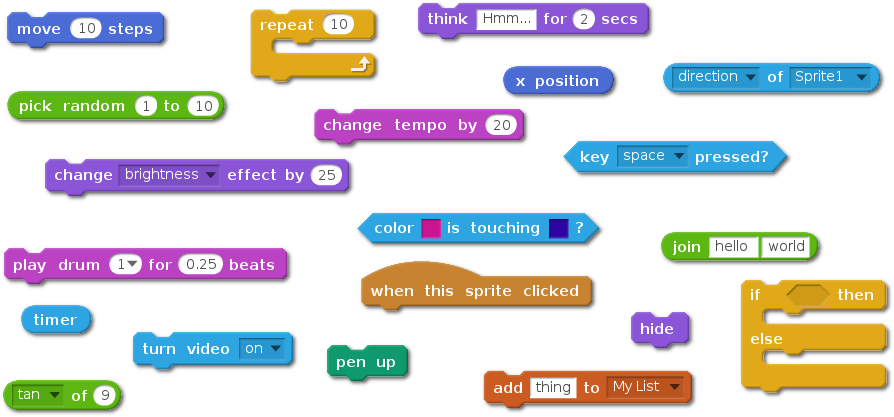
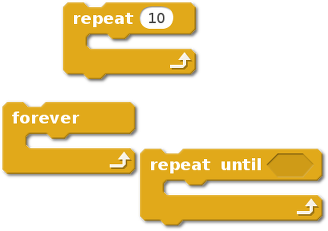
In a new paper titled Remixing as a pathway to Computational Thinking that was recently published at the ACM Conference on Computer Supported Collaborative Work and Social Computing (CSCW) conference, we used a series of quantitative measures of online behavior to try to uncover evidence that might support the theory that remixing in Scratch is positively associated with learning. scratchblocksOf course, because Scratch is an informal environment with no set path for users, no lesson plan, and no quizzes, measuring learning is an open problem. In our study, we built on two different approaches to measure learning in Scratch. The first approach considers the number of distinct types of programming blocks available in Scratch that a user has used over her lifetime in Scratch (there are 120 in total) something that can be thought of as a block repertoire or vocabulary. This measure has been used to model informal learning in Scratch in an earlier study. Using this approach, we hypothesized that users who remix more will have a faster rate of growth for their code vocabulary. Controlling for a number of factors (e.g. age of user, the general level of activity) we found evidence of a small, but positive relationship between the number of remixes a user has shared and her block vocabulary as measured by the unique blocks she used in her non-remix projects. Intriguingly, we also found a strong association between the number of downloads by a user and her vocabulary growth. One interpretation is that this learning might also be associated with less active forms of appropriation, like the process of reading source code described by Minksy. The second approach we used considered specific concepts in programming, such as loops, or event-handling. To measure this, we utilized a mapping of Scratch blocks to key programming concepts found in this paper by Karen Brennan and Mitchel Resnick. For example, in the image below are all the Scratch blocks mapped to the concept of loop . scratchblocksctWe looked at six concepts in total (conditionals, data, events, loops, operators, and parallelism). In each case, we hypothesized that if someone has had never used a given concept before, they would be more likely to use that concept after encountering it while remixing an existing project. Using this second approach, we found that users who had never used a concept were more likely to do so if they had been exposed to the concept through remixing. Although some concepts were more widely used than others, we found a positive relationship between concept use and exposure through remixing for each of the six concepts. We found that this relationship was true even if we ignored obvious examples of cutting and pasting of blocks of code. In all of these models, we found what we believe is evidence of learning through remixing. Of course, there are many limitations in this work. What we found are all positive correlations we do not know if these relationships are causal. Moreover, our measures do not really tell us whether someone has understood the usage of a given block or programming concept.However, even with these limitations, we are excited by the results of our work, and we plan to build on what we have. Our next steps include developing and utilizing better measures of learning, as well as looking at other methods of appropriation like viewing the source code of a project.

This blog post and the paper it describes are collaborative work with Sayamindu Dasgupta, Andr s Monroy-Hern ndez, and William Hale. The paper is released as open access so anyone can read the entire paper here. This blog post was also posted on Sayamindu Dasgupta s blog and on Medium by the MIT Media Lab.

Paul Wise: Check All The thingS!

check-all-the-things (aka cats, Meow!) is a tool that aims to make it easy to know which tools can be used to check a directory tree and to make it easy to run those tools on the directory tree. The tree could either be a source tree or a build tree or both. It aims to check as much of the tree as possible so the output can be very verbose and have many false positives. It is not for the busy, lazy or noise intolerant. It runs the checks by matching file names and MIME types against those registered for a list of checks. Each check has a set of dependencies, flags, filename wildcards, MIME type wildcards, comments and prerequisite commands. By default it: It runs all checks for the current distro/release except: There are command-line options to customise the behaviour and automatic bash shell completion via argcomplete. There are 177 checks (including TODO ones) in 73 different categories. There are an additional 224 not-well-specified TODO items for new checks in comments. It is exceptionally easy to add new checks once one knows how to use the tool one wants to add. At this point in time it is probably not a good idea to run it in an untrusted directory tree for several reasons: The project initially started as really hacky wiki page full of commands to run. At some point I figured it was time to make this actually be maintainable and started on a project to do that. At around the same time Jakub Wilk was working on maquack to replace the wiki page. Somehow I found out about it and talked to him about it. It was vastly less hacky than my version so I ended up taking it over and continuing it under the check-all-the-things name. I polished it for the last two years and finally released it into Debian unstable during DebCamp16.

3 July 2016

Reproducible builds folks: Reproducible builds: week 61 in Stretch cycle

What happened in the Reproducible Builds effort between June 19th and June 25th 2016. Media coverage GSoC and Outreachy updates Toolchain fixes Other upstream fixes Emil Velikov searched on IRC for hints on how to guarantee unique values during build to invalidate shader caches in Mesa, when also no VCS information is available. A possible solution is a timestamp, which is unique enough for local builds, but can still be reproducible by allowing it to be overwritten with SOURCE_DATE_EPOCH. Packages fixed The following 9 packages have become reproducible due to changes in their build dependencies: cclib librun-parts-perl llvm-toolchain-snapshot python-crypto python-openid r-bioc-shortread r-bioc-variantannotation ruby-hdfeos5 sqlparse The following packages have become reproducible after being fixed: Some uploads have fixed some reproducibility issues, but not all of them: Patches submitted that have not made their way to the archive yet: Package reviews 139 reviews have been added, 20 have been updated and 21 have been removed in this week. New issues found: 53 FTBFS bugs have been reported by Chris Lamb, Santiago Vila and Mateusz ukasik. diffoscope development Quote of the week "My builds are so reproducible, they fail exactly every second time." Johannes Ziemke (@discordianfish) Misc. This week's edition was written by Chris Lamb (lamby), Reiner Herrmann and Holger Levsen and reviewed by a bunch of Reproducible builds folks on IRC.

Jonathan McDowell: Confirming all use of an SSH agent

For a long time I ve wanted an ssh-agent setup that would ask me before every use, so I could slightly more comfortably forward authentication over SSH without worrying that my session might get hijacked somewhere at the remote end (I often find myself wanting to pull authenticated git repos on remote hosts). I m at DebConf this week, which is an ideal time to dig further into these things, so I did so today. As is often the case it turns out this is already possible, if you know how. I began with a setup that was using GNOME Keyring to manage my SSH keys. This isn t quite what I want (eventually I want to get to the point that I can sometimes forward a GPG agent to remote hosts for signing purposes as well), so I set about setting up gpg-agent. I used Chris excellent guide to GnuPG/SSH Agent setup as a starting point and ended up doing the following:
$ echo use-agent >> ~/.gnupg/options
$ echo enable-ssh-support >> ~/.gnupg/gpg-agent.conf
$ sudo sed -i.bak "s/^use-ssh-agent/# use-ssh-agent/" /etc/X11/Xsession.options
$ sudo rm /etc/xdg/autostart/gnome-keyring-ssh.desktop
The first 2 commands setup my local agent, and told it to do SSH agent foo. The next stopped X from firing up ssh-agent, and the final one prevents GNOME Keyring from being configured to be the SSH agent, without having to remove libpam-gnome-keyring as Chris did. After the above I logged out of and into X again, and could see ~/.gnupg/S.gpg-agent.ssh getting created and env grep SSH showing SSH_AUTH_SOCK pointing to it (if GNOME Keyring is still handling things it ends up pointing to something like /run/user/1000/keyring/ssh). [Update: Luca Capello emailed to point out this was a bad approach; there s thankfully no need to do the last 2 commands that require root. #767341 removed the need to edit Xsession.options and you can prevent GNOME Keyring starting on a per user basis with:
(cat /etc/xdg/autostart/gnome-keyring-ssh.desktop ;
 echo 'X-GNOME-Autostart-enabled=false') > \
 ~/.config/autostart/gnome-keyring-ssh.desktop
] After this it turned out all I need to do was ssh-add -c <ssh keyfile>. The -c says confirm use and results in the confirm flag being appended to the end of ~/.gnupg/sshcontrol (so if you ve already done the ssh-add you can go and add the confirm if that s the behaviour you d like). Simple when you know how, but I ve had conversations with several people in the past who wanted the same thing and hadn t figured out how, so hopefully this is helpful to others.

Paul Wise: DebConf16 Open Festival day 1

Today was day one of the DebConf16 Open Festival and I attended the open hardware panel, part of the talk about Code For South Africa, shirish's experiences and the DebConf new folks session. The open hardware panel was a wide ranging discussion between bdale, Andy and indiebio. bdate talked about the experiences he has had with his rocketry hardware. bdale said "Make concious decisions about what you are buying", referencing a case where he investigated, found a GPL violation and didn't buy. Various people care about openness of different layers of the hardware. Off-the-shelf products are very strongly integrated, which is great for makers but means that people who care about lower layers like CPU micro-architecture aren't able to participate. Andy said "We are just beginning to come out of the shareware stage [of open hardware]". bdale mentioned the companies who do hardware production as a service from design files. Later in the pub some folks mentioned j-core, an open re-implementation of SuperH processors. I missed most of the code4sa talk unfortunately, but it was about government services and open data. shirish covered his journey through life to Debian. His youth, how satellite TV and knowledge of the outside world came to India around the time of the Iraq war. His experience accessing the Internet for the first time, uncensored vs the usual censorship in India's media. His experiences of Windows 95 viruses and crashes. He learned of PCTwist Linux through a magazine cover. His initial install was not a success but eventually managed to break through and install a desktop, but experienced network and other issues. Eventually he encountered Ubuntu and began contributing bug reports. His experiences there led him to Debian. He began blogging about Debian. In the last few years he and others have been going around the country doing mini-DebConfs at institutes around India. The first question was predictably about having a DebConf in India and how shirish might like to get more involved. DebConf in India sounds like a possibility some day and shirish was thinking about getting involved in publicity, marketting and the Debian installer. The DebConf new folks session was a great intro to DebConf for folks new to the community. There were some quite excellent touches added to this year's version of the event by indiebio and Rhonda. I also got some things done. Usual spam reporting. Reviewed wiki RecentChanges. Talked to the chromium-bsu/MacPorts maintainer about AX_CHECK_GL brokenness. Filed Debian wishlist bug #829292 asking to update autoconf-archive. Redirected a Hurd porterbox request to the exodar admin and quickly found out I was wrong to do that, rectified. Then we found out the LDAP sync to exodar was broken. Replied to someone who intends to sell Debian pre-installs. Thanked BunsenLabs folks for joining the derivatives list. Applied reproducible builds patch for cats from Chris Lamb. Heard about awesome new terminal-mode screensaver. Moo! Prepared a blog post about check-all-the-things.

Kevin Avignon: Tech questions 11-16: Artificial intelligence

11. Why use a genetic algorithm instead of a backpropagation algorithm to train a neural net ? 12. What is the difference between a support vector machine (SVM) and an artificial neural network (ANN) ? 13. What s a Naives Bayes classifier ? 14. What is the difference between supervised and unsurpervised learning 15. What is Continue reading Tech questions 11-16: Artificial intelligence

Lisandro Dami n Nicanor P rez Meyer: Upcoming KDEPIM changes in unstable (KMail, Kontact, KOrganizer, etc)

For those who care about kdepim (kmail, kontact, korganizer, etc)

Currently the latest version of kdepim is available in experimental. According to our limited tests it's working way better than kdepim 4.14 (more stable, more performant, less bugs). However migrating from one to the other is not a trivial process (distribution wise, hopefully not for our users).

Among the drawbacks in the new kdepim: knode, ktimetracker and kjots were dropped from the official kdepim components. kjots is now an independent project, not tied to the kdepim release cycle. But more importantly, knode and ktimetracker are not maintained upstream any more, we are temporarily still shipping the old KDE 4 versions, but we will drop them after stretch unless they get new upstream maintainers.

To iron out the wrinkles that are surely still there, we are now planning to start a transition for kdepim, effectively blocking all kdepim related packages in unstable until the transition is complete. This will allow us to keep the current kdepim in testing unchanged until kdepim 16.04 is ready to migrate fully to testing.

If you want to test the new kdepim versions right now, please use the version in experimental, as uploading all the packages to unstable will take some time until there is a working kdepim in unstable (mixing experimental and the unstable uploads should be fine).

If you depend on having a working kdepim, please avoid installing the new kdepim packages that will be landing in unstable in the following days, until all the components are available. We expect this will take a couple of weeks, we will post another entry when the packages are ready in unstable.

A list of the binary packages involved in the transition can be found [here].

If you find issues in the new packages, please let us know either via irc in #debian-kde, the kde mailing list debian-kde@lists.debian.org, or send us a bug report (please make sure that it wasn't reported before).

We'll send an updated note when kdepim is fully uploaded to unstable.

Happy hacking,

The Debian Qt/KDE Team.

2 July 2016

Jonathan Carter: So, that was DebCamp16!

Picture: Adrian Frith

University of Cape Town, host location to DebConf 16. Picture: Adrian Frith

What an amazingly quick week that was Our bid to host DebConf in Cape Town was accepted nearly 15 months ago. And before that, the bid itself was a big collective effort from our team. So it s almost surreal that the first half of the two weeks of DebCamp/DebConf is now over. Things have been going really well. The few problems we ve had so far were too small to even mention. It s a few degrees colder than it usually is this time of the year and there s already snow on the mountains, so Cape Town is currently quite chilly.
Hacking by the fire at the sports club

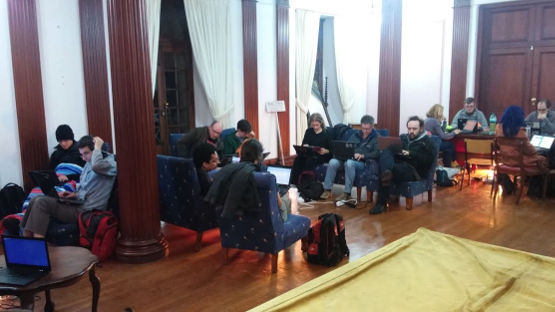
Gathering some heat by the fire at the sports club while catching up to the world the day before it all started.

All Kinds of Quality Time I really enjoyed working with the video team last year, but this year there was just 0 time for that. Working on the orga team means dealing with a constant torrent of small tasks, which is good in its own way because you get to deal with a wide variety of Debian people you might not usually get to interact with, but video team problems are more fun and interesting. Next year I hope to do a lot more video work again. If you re at DebConf over the next week, I can highly recommend that you get involved!
Video team hacking away at problems

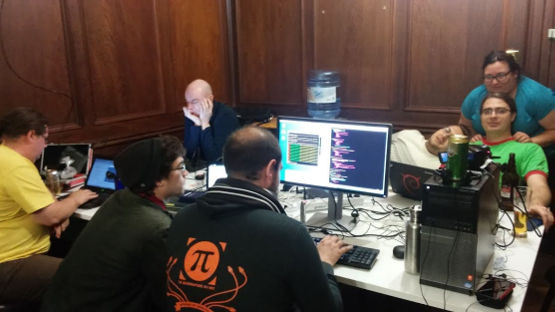
Video team members hacking away at problems late at night during DebCamp

The first time I met Debian folk was early in 2004. I worked at the Shuttleworth Foundation as Open Source Technical Co-ordinator at the time, and Mark Shuttleworth had them over for one of the early Ubuntu sprints in Canonical s early days. I was so intimidated by them back then that I could hardly even manage to speak to them. I was already a big free software fan before working there, but little did I even dream to think that I would one day be involved in a project like Ubuntu or Debian. My manager back then encouraged me to go talk to them and get involved and become a Debian Developer and joked that I should become highvoltage@debian.org. I guess that was when the initial seeds got planted and since then I ve met many great people all over the world who have even became friends during UDS, DebConf, BTS and other hackfests where Debianites hang out. It gave me a really nice warm feeling to have all these amazing, talented and really friendly people from all over coming together in this little corner of the world to work together on projects that I think are really important.
Finding a warm space to work in the Happy Feet hack lab

Finding a warm space to work in the Happy Feet hack lab

Oh the Chicken Back at DebConf12, someone (I don t remember the exact history) brought a rubber chicken to DebConf who was simply called Pollito ( chicken in Spanish). Since then the chicken has grown into somewhat of a mascot for DebConf. Back in 2012 I already imagined that if we would ever host a DebConf, I d make a little of picture book story about Pollito. Last year after DC15, when bringing Pollito over, I created a little story called Pollito s first trip to Africa . I was recovering from flu while putting that together and didn t spend much time on it, but it turned out to be somewhat of a hit. I was surprised to see it in the #debconf topic ever since I posted it :) We gave a tour of the campus on the first and second days and it was quite time consuming and there was no way we could do it every day for the rest of DebCamp, so on the 2nd day I smacked together a new rush job called Pollito s Guide to DC16 . The idea was that newcommers could use it as a visual guide and rely on others who have been there for a while if they get stuck. I wish I had the time to make it a lot nicer, but I think the general idea is good and next year we can have a much nicer one that might not be quite as Pollito focused.
Pollito's Guide to DC16

Pollito s Guide to DC16

Debian Maintainer After all these years, I finally sat down and applied to become a Debian Maintainer, and the application was successful (approved yesterday \o/). Now just for the wait until my key is uploaded to the keyring. I haven t yet had time to properly process this but I think once the DebConf dust settles and I had some time to recover, I will be ecstatic. Some actual DebCampy work Everywhere I go, I see people installing a bunch of GNOME extensions on their Debian GNOME desktops shortly after installation using http://extensions.gnome.org/ (I noticed this even at DebCamp!). A few months ago I thought that it s really about time someone package up some of the really popular ones. So I started to put together some basic packaging for AIMS Desktop around a month ago. During the last few days of DebCamp, things were going well enough with the organisational tasks that I had some time to do some actual packaging work and improve these so that they re ready for upload to the Debian archives. The little DebCamp time I had ended up being my very own little extension fest :) I worked on the following packages which are ready for upload: I worked on the following packages which still need minor work, might be able to get them in uploadable state by the end of DebConf: The actual packaging of GNOME extensions is actually pretty trivial. It s mostly source-only JavaScript with some CSS and translations and maybe some gsettings schemas and dialogs. Or at least, it would be pretty trivial, but many extensions are without licenses, contain embedded code (often JavaScript) from other projects, or have no usable form of upstream tarball, to name a few of the problems. So I ve been contacting the upstream authors of these packages where there have been problems, and for the most part they ve been friendly and pretty quick to address the problems. So that s it, for now. I couldn t possibly sum up the last week and everything that lead up to it in a single blog post. All I can really say is thank you for letting me be a part of this very special project!

Russ Allbery: Review: Ashes of Honor

Review: Ashes of Honor, by Seanan McGuire
Series: October Daye #6
Publisher: DAW
Copyright: September 2012
ISBN: 1-101-59480-2
Format: Kindle
Pages: 368
This is the sixth book in the October Daye series, contains payoffs for some relationships that have been building over the whole series, and involves entangled politics set up by previous books. It's not the place to start with the series. Ashes of Honor starts, as so many of Toby's books do, with a friend asking her for help. But this request is entirely unexpected, and the help needed comes as a complete surprise: a previously unknown changeling, who has disappeared. A changeling whose powers are completely out of control, and who poses a threat to reality itself. As Toby's cases go, this involves a lot fewer horrible things happening to her and a lot more faerie politics and maneuvering than usual. I appreciated that; I'm not as fond of the books that go deep into despair or desperation. It does involve Toby getting almost killed multiple times, but, due to earlier events of the series, that isn't quite as bad as it used to be. More focus on investigation and political maneuvering and less Toby braving her way through horrors works for me. Even more notably, this book marks Toby finally figuring out that she has friends and allies who are there to help, not just be obligations she feels overwhelmed by or aid that she's not allowed to accept. This was one of her most frustrating characteristics; it's a relief to see her finally relax. This opens the way not only for deeper friendships and more complex plots but also a relationship that I've been awaiting for the entire series, and it's as much fun as I was hoping it would be. Toby started the series rather messed up and unwilling to let anyone close. It was for understandable reasons, but I like her better when she realizes why people respect her. Toby's connections with the royalty of the Bay Area also allow McGuire to tell a political story that moves farther afield from the Shadowed Hills. First in One Salt Sea and now in Ashes of Honor we see more of local politics, more of the lore of McGuire's universe, and another dangerous queen. Toby is particularly fun when she's dangerously outflanking people with considerably more power than she has. At this point, you could call it a specialty. I thought McGuire's take on San Jose and the sort of person who would be in charge of its fae was on point. We also get more of the Luidaeg, which is always a good sign for a Toby novel, and more of Tybalt, who is entangled in a major subplot of the story. Next to Luidaeg, Tybalt is my favorite of Toby's friends, so this book is full of the things that make me happy. McGuire adds some more pieces to her transplanted Celtic mythology and some tantalizing hints of what the fae have left behind. I'm hoping we see more of that in future books. (I suspect that may be what this whole series is building up to.) The story doesn't have quite as much oomph as One Salt Sea, but it's still one of the best books in the series so far. If you've enjoyed the series up to this point, keep reading. Followed by Chimes at Midnight. Rating: 8 out of 10

1 July 2016

Joachim Breitner: When to reroll a six

This is a story about counter-intuitive probabilities and how a small bit of doubt turned out to be very justified. It begins with the game To Court the King (German: Um Krone und Kragen ). It is a nice game with dice and cards, where you start with a few dice, and use your dice rolls to buy additional cards, which give you extra dice or special powers to modify the dice that you rolled. You can actually roll your dice many times, but every time, you have to set aside at least one die, which you can no longer change or reroll, until eventually all dice have been set aside. A few years ago, I have played this game a lot, both online (on yucata.de) as well as in real life. It soon became apparent that it is almost always better to go for the cards that give you an extra die, instead of those that let you modify the dice. Intuitively, this is because every additional die allows you to re-roll your dice once more. I concluded that if I have a certain number of dice (say, n), and I want to have a sum as high as possible at the end, then it may make sense to reroll as many dice as possible, setting aside only those showing a 6 (because that is the best you can get) or, if there is no dice showing a 6, then a single die with the best score. Besides for small number of dice (2 or 3), where even a 4 or 5 is worth keeping, this seemed to be a simple, obvious and correct strategy to maximize the expected outcome of this simplified game. It is definitely simple and obvious. But some doubt that it was correct remained. Having one more die still in the game (i.e. not set aside) definitely improves your expected score, because you can reroll the dice more often. How large is this advantage? What if it ever exceeds 6 then it would make sense to reroll a 6. The thought was strange, but I could not dismiss it. So I did what one does these days if one has a question: I posed it on the mathematics site of StackExchange. That was January 2015, and nothing happened. I tried to answer it myself a month later, or at least work towards at an answer, and did that by brute force. Using a library for probabilistic calculations for Haskell I could write some code that simply calculated the various expected values of n dice for up to n = 9 (beyond that, my unoptimized code would take too long):
1:  3.50000 (+3.50000)
2:  8.23611 (+4.73611)
3: 13.42490 (+5.18879)
4: 18.84364 (+5.41874)
5: 24.43605 (+5.59241)
6: 30.15198 (+5.71592)
7: 35.95216 (+5.80018)
8: 41.80969 (+5.85753)
9: 47.70676 (+5.89707)
Note that this calculation, although printed as floating point numbers, is performed using fractions of unbounded integers, so there are no rounding issues that could skew the result. The result supported the hypothesis that there is no point in rolling a 6 again: The value of an additional die grows and approaches 6 from beyond, but judging from these number is never going to reach it. Then again nothing happened. Until 14 month later, when some Byron Schmuland came along, found this an interesting puzzle, and set out a 500 point bounty to whoever solved this problem. This attracted a bit attention, and a few not very successful attempts at solving this. Eventually it reached twitter, where Roman Cheplyaka linked to it. Coincidally a day later some joriki came along, and he had a very good idea: Why not make our life easier and think about dice with less sides, and look at 3 instead of 6. This way, and using a more efficient implementation (but still properly using rationals), he could do a similar calculation for up to 50 dice. And it was very lucky that he went to 50, and not just 25, because up to 27, the results were very much as expected, approaching value of +3 from below. But then it surpassed +3 and became +3.000000008463403. In other words: If you have roll 28 dice, and you have exactly two dice showing a 3, then it gives you better expected score if you set aside only one 3, and not both of them. The advantage is minuscule, but that does not matter it is there. From then on, the results behaved strangely. Between 28 and 34, the additional value was larger than 3. Then, from 35 on again lower than 2. It oscillated. Something similar could be observed when the game is played with coins. Eventually, joriki improved his code and applied enough tricks so that he could solve it also for the 6-sided die: The difference of the expected value of 198 dice and having 199 dice is larger than 6 (by 10 21...)! The optimizations that allowed him to calculate these numbers in a reasonable amount of time unfortunately was to assume that my original hypothesis (never rerolling a 6 is optimal), which held until n < 199. But this meant that for n > 199, the code did not yield correct results. What is the rationale of the story? Don t trust common sense when it comes to statistics; don t judge a sequence just from a few initial numbers; if you have an interesting question, post it online and wait for 16 months.

Kevin Avignon: Learning F# through testing (Koans)

Elena 'valhalla' Grandi: Busy/idle status indicator

Busy/idle status indicator


About one year ago, during my first http://debconf15.debconf.org/, I've felt the need for some way to tell people whether I was busy on my laptop doing stuff that required concentration or just passing some time between talks etc. and available for interruptions, socialization or context switches.

One easily available method of course would have been to ping me on IRC (and then probably go on chatting on it while being in the same room, of course :) ), but I wanted to try something that allowed for less planning and worked even in places with less connectivity.

My first idea was a base laptop sticker with two statuses and then a removable one used to cover the wrong status and point to the correct one, and I still think it would be nice, but having it printed is probably going to be somewhat expensive, so I shelved the project for the time being.

Immagine/foto

Lately, however, I've been playing with hexagonal stickers https://terinjokes.github.io/StickerConstructorSpec/ and decided to design something on this topic, whith the result in the figure above, with the hacking sticker being my first choice, and the concentrating alternative probably useful while surrounded by people who may misunderstand the term hacking .

While idly looking around for sticker printing prices I realized that it didn't necessarly have to be a sticker and started to consider alternatives.

One format I'm trying is inspired by "do not disturb" door signs: I've used some laminating pouches I already had around which are slightly bigger than credit-card format (but credit-card size would also work of course ) and cut a notch so that they can be attached to the open lid of a laptop.

Immagine/fotoImmagine/foto

They seem to fit well on my laptop lid, and apart from a bad tendency to attract every bit of lint in a radius of a few meters the form factor looks good. I'll try to use them at the next conference to see if they actually work for their intended purpose.

SVG sources (and a PDF) are available on my website http://www.trueelena.org/computers/projects/busy_idle_indicator.html under the CC-BY-SA license.

Kevin Avignon: The easy way to learn F# ABC s

30 June 2016

Steve Kemp: So I've been busy.

The past few days I've been working on my mail client which has resulted in a lot of improvements to drawing, display and correctness. Since then I've been working on adding GPG-support. My naive attempt was to extract the signature, and the appropriate body-part from the message. Write them both to disk then I could validate via:
gpg --verify msg.sig msg
However that failed, and it took me a long to work out why. I downloaded the source to mutt, which can correctly verify an attached-signature, then hacked lib.c to neuter the mutt_unlink function. That left me with a bunch of files inside $TEMPFILE one of which provided the epiphany. A message which is to be validated is indeed written out to disk, just as I would have done, as is the signature. Ignoring the signature the message is interesting:
Content-Type: text/plain; charset=UTF-8
Content-Transfer-Encoding: quoted-printable
On Mon, 27 Jun 2016 08:08:14 +0200
...
--=20
Bob Smith
The reason I'd failed to validate my message-body was because I'd already decoded the text of the MIME-part, and I'd also lost the prefixed two lines "Content-type:.." and Content-Transfer:.... I'm currently trying to work out if it is possible to get access to the RAW MIME-part-text in GMIME. Anyway that learning aside I've made a sleazy hack which just shells out to mimegpg, and this allows me to validate GPG signatures! That's not the solution I'd prefer, but that said it does work, and it works with inline-signed messages as well as messages with application/pgp-signature MIME-parts. Changing the subject now. I wonder how many people read to the end anyway? I've been in Finland for almost a year now. Recently I was looking over websites and I saw that the domain steve.fi was going to expire in a few weeks. So I started obsessively watching it. Today I claimed it. So I'll be slowly moving things from beneath steve.org.uk to use the new home steve.fi. I also setup a mini-portfolio/reference site at http://steve.kemp.fi/ - which was a domain I registered while I was unsure if I could get steve.fi. Finally now is a good time to share more interesting news:

Next.

Previous.