Search Results: "cas"

25 April 2013

Julien Danjou: OpenStack Design Summit Havana, from a Ceilometer point of view

Last week was the OpenStack Design Summit in Portland, OR where we, developers, discussed and designed the new OpenStack release (Havana) coming up. The summit has been wonderful. It was my first OpenStack design summit -- even more as a PTL -- and bumping into various people I've never met so far and worked with online only was a real pleasure! <figure> <figcaption>Me and Nick ready to talk about Ceilometer new features.</figcaption> </figure> Nick Barcet from eNovance, our dear previous Ceilometer PTL, and myself, talked about Ceilometer and presented the work that bas been done for Grizzly, with some previews of what we'll like to see done for its Havana release. You can take a look at the slides if you're curious. Design sessions Ceilometer had his design sessions during the last days of the summit. We noted a lot of things and commented during the sessions in our Etherpads instances. The first session was a description of Ceilometer core architecture for interested people, and was a wonderful success considering that the room was packed. Our Doug Hellmann did a wonderful job introducing people to Ceilometer and answering question. <figure> <figcaption>Doug explaining Ceilometer architecture.</figcaption> </figure> The next session was about getting feedbacks from our users. We had a lot of surprise to discover wonderful real use-cases and deployments, like the CERN using Ceilometer and generating 2 GB of data per day! The following sessions ran on Thursday and were much more about new features discussion. A lot ot already existing blueprints were discussed and quickly validated during the first morning session. Then, Sandy Walsh introduced the architecture they use inside StackTach, so we can start thinking about getting things from it into Ceilometer. API improvements were discussed without surprises and with a good consensus on what needs to be done. The four following sessions that occupied a lot of the days were related to alarming. All were lead by Eoghan Glynn, from RedHat, who did an amazing job presenting the possible architectures with theirs pros and cons. Actually, all we had to do was to nod to his designs and acknowledge the plan on how to build this. That last two sessions were about discussing advanced models for billing where we got some interesting feedback from Daniel Dyer from HP, and then were a quick follow-up of the StackTach presentation from the morning session. Havana roadmap The list of blueprints targetting Havana is available and should be finished by next week. If you want to propose blueprints, you're free to do so and inform us about it so we can validate it. The same applies if you wish to implement one of them! API extension I do think the API version 2 is going to be heavily extended during this release cycle. We need more feature, like the group-by functionnality. Healthnmon In parallel of the design sessions, discussions took place in the unconference room with the Healthnmon developers to figure out a plan in order to merge some of their efforts into Ceilometer. They should provide a component to help Ceilometer supports more hypervisors than it currently does. Alarming Alarming is definitely going to be the next big project for Ceilometer. Today, Eoghan and I started building blueprints on alarming, centralized in a general blueprint. We know this is going to happen for real and very soon, thanks to the engagements of eNovance and RedHat who are commiting resources to this amazing project!

Jeff Licquia: Linux Is Hard, Except When It Isn t

Online tech news site Ars Technica (which I recommend, by the way) recently reviewed the Dell XPS 13 Developer Edition. Its unique feature: it ships with Ubuntu Linux as the default operating system. This preload deal had a few unique properties: That last point deserves some explanation. A few vendors have grabbed a Windows computer they sell and allowed the option to preload Linux on it, but without support; you re on your own if it doesn t work in some way, which is likely. Essentially, they save you the time of wiping Windows off the box and doing a fresh install, but not much more. But this laptop comes out of Dell s Project Sputnik, a project to put out Linux machines for developers with a DevOps flavor, and they felt the machine had to work as well as their regular products. So they actually put effort and testing into getting the laptop to run Ubuntu well, with all the drivers configured properly and tweaked to support the machine s quirks, just like they do for Windows. And so, the review is surprised to learn that Ubuntu on the XPS 13, well, just works! It s even in the title of the review. Here s reviewer Lee Hutchinson s observations:
I ve struggled before with using Linux as my full-time operating environment both at work and at home. I did it for years at work, but it was never quite as easy as I wanted it to be on an older Dell laptop, keeping dual monitor support working correctly across updates required endless fiddling with xorg.conf, and whether or not it was Nvidia s fault was totally irrelevant to swearing, cursing Past Lee, trying desperately to get his monitors to display images so he could make his 10am conference call without having to resort to running the meeting on the small laptop screen.
And thence comes the astonishment: on this Linux laptop, everything just works. Most of the review is spent on the kinds of hardware features that distinguish this from other laptops: the keyboard is like this, the screen is that resolution, it has this CPU and this much RAM and so on. Some space is devoted to impressions of the default Ubuntu 12.04 install, and some space is given to the special DevOps software, which helps the developer reproduce the software environment on the laptop when deploying apps. But before all that, Hutchinson has to put in a dig:
It s an impressive achievement, and it s also a sad comment on the overall viability of Linux as a consumer-facing operating system for normal people. I don t think anyone is arguing that Linux hasn t earned its place in the data center it most certainly has but there s no way I d feel comfy installing even newbie-friendly Ubuntu or Mint on my parents computers. The XPS 13 DE shows the level of functionality and polish possible with extra effort, and that effort and polish together means this kind of Linux integration is something we won t see very often outside of boutique OEMs.
Of course, Windows is actually worse than Linux on the hardware front when you don t get it pre-installed. Imagine if more vendors put as much effort into preinstalled Linux as they did into preinstalled Windows. In that alternate reality, I imagine people would react more like this:
Isn t that what you re looking for in a mainstream product? Rick chided. In 1996 it was: Wow look at this, I got Linux running on xxxxxxxx. Even in 2006 that was at times an accomplishment When was the last time you turned on an Apple or Windows machine and marveled that it just worked? It should be boring.
Which was, of course, the reaction Hutchinson got when discussing the review with a Linux-using friend. With Microsoft being less of a friend to the hardware vendors every day, here s a case study more of them should be paying attention to.

21 April 2013

Charles Plessy: Do we really need contrib ?

The Debian project distributes software packages via its archive, propagated through a network of mirrors. This archive is organised in three areas, main, that contains the Debian system, and contrib and non-free, that contain accessory packages that are not Free. The packages in non-free contain files that have a proprietary license. The source packages in contrib contain only Free files, but produce binary packages that are either useless without the access to remote services, or contain non-Free files, or cause the installation of non-Free materials. The contrib area is an endless source of discussions, as it is not always easy to draw the line between what is usable and what is useless without remote services. I wonder if it would be better to replace the contrib area by a new priority level, remote , lower than extra. Packages that are entirely Free (source and binary) and that do not cause the installation of proprietary software would be fit for main. For the packages that can not function without non-Free software, given that the work to be done to free them is the same regardless whether the proprietary code is included in the source package (in non-free) or not (in contrib), I think that in both cases the package should be in non-free as it is not Free in practice. This would allow for a simple criterion: does the selection of a binary package trigger the installation of non-Free files? If yes, the package and its source belong to non-free. If not, they belong to main. Then, if they need to access a remote service that would not be possible to set up on a network where only Debian is available, their priority would be remote.

20 April 2013

Ulrich Dangel: Analyzing rc bug messages

Michael Stapelberg recently posted a blog post about looking into the number of Debian Developers actively working on RC bugs for the upcoming wheezy release. In this blog post I analyze the data shared by Michael and provide the R commands used to generate the plots & findings. If you are interested into looking into the data yourself, but don t like R, I suggest using ipython notebook + numpy instead.

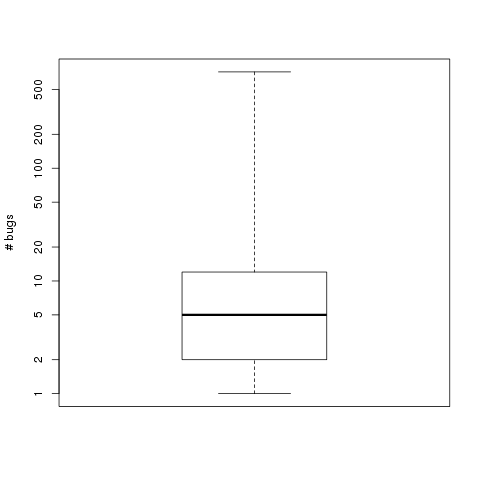
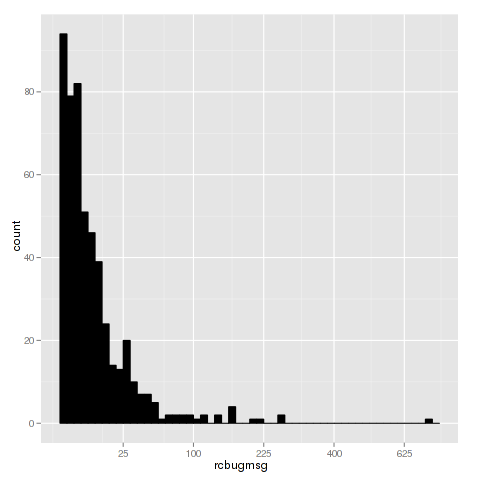
Analysis After parsing the data file we typically want to get an understanding of the data, by using summary(bugs) we get the minimum(1), median(5), mean(15.4), max(716) and quantiles of the data. This shows that the number of messages is wide-spread and a few people contribute a lot. To visualize the dispersion of the data we can create a box plot showing the range of messages: boxplot As the first and third quantile are close together we can assume that the majority of the work is done by a few, especially since the second quantile is 5. This is supported by the histogram below, where the x axis is the number of recorded messages and y is the number of developers. histogram

Top 10 contributors The TOP 10 contributors, according to the dataset, are:
  1. Lucas Nussbaum - 716 messages
  2. Gregor Herrmann - 270 messages
  3. Jakub Wilk - 270 messages
  4. Andreas Beckmann - 225 messages
  5. Julien Cristau - 205 messages
  6. Cyril Brulebois - 169 messages
  7. Moritz Muehlenhoff - 162 messages
  8. Michael Biebl - 159 messages
  9. Salvatore Bonaccorso - 158 messages
  10. Christoph Egger - 142 messages

r commands These are the commands used to generate the plots and information in this plot:
bugs <- read.csv("by-msg.csv")
summary(bugs)
boxplot(bugs$rcbugmsg, log='y', range=0, ylab="# bugs")
quantile(bugs$rcbugmsg)
0%  25%  50%  75% 100%
1    2    5   12  716
# create histogram
llibrary('ggplot2')
ggplot(bugs, aes(x=rcbugmsg)) + geom_histogram(binwidth=.5, colour="black", fill="black") + scale_x_sqrt()
top10 <- tail(bugs[order(bugs$rcbugmsg),], 10)
top10

Ulrich Dangel: Analyzing rc bug messages

Michael Stapelberg recently posted a blog post about looking into the number of Debian Developers actively working on RC bugs for the upcoming wheezy release. In this blog post I analyze the data shared by Michael and provide the R commands used to generate the plots & findings. If you are interested into looking into the data yourself, but don t like R, I suggest using ipython notebook + numpy instead.

Analysis After parsing the data file we typically want to get an understanding of the data, by using summary(bugs) we get the minimum(1), median(5), mean(15.4), max(716) and quantiles of the data. This shows that the number of messages is wide-spread and a few people contribute a lot. To visualize the dispersion of the data we can create a box plot showing the range of messages: boxplot As the first and third quantile are close together we can assume that the majority of the work is done by a few, especially since the second quantile is 5. This is supported by the histogram below, where the x axis is the number of recorded messages and y is the number of developers. histogram

Top 10 contributors The TOP 10 contributors, according to the dataset, are:
  1. Lucas Nussbaum - 716 messages
  2. Gregor Herrmann - 270 messages
  3. Jakub Wilk - 270 messages
  4. Andreas Beckmann - 225 messages
  5. Julien Cristau - 205 messages
  6. Cyril Brulebois - 169 messages
  7. Moritz Muehlenhoff - 162 messages
  8. Michael Biebl - 159 messages
  9. Salvatore Bonaccorso - 158 messages
  10. Christoph Egger - 142 messages

r commands These are the commands used to generate the plots and information in this plot:
bugs <- read.csv("by-msg.csv")
summary(bugs)
boxplot(bugs$rcbugmsg, log='y', range=0, ylab="# bugs")
quantile(bugs$rcbugmsg)
0%  25%  50%  75% 100%
1    2    5   12  716
# create histogram
llibrary('ggplot2')
ggplot(bugs, aes(x=rcbugmsg)) + geom_histogram(binwidth=.5, colour="black", fill="black") + scale_x_sqrt()
top10 <- tail(bugs[order(bugs$rcbugmsg),], 10)
top10

19 April 2013

Rog rio Brito: Some recent Debian activities

I have been occasionally working on some Debian-related tasks. Chrony One of those was to get chrony is a slightly better shape, by using, at least, a patch system (indeed, I "modernized" its packaging with the format "3.0 (quilt)"), put it in a git repository and would like to receive some comments on what I have so far. The bug Debian bug #694690 contains a very brief description of my intentions and of the problems that I see in the current package. IMVHO, it is a very nice NTP client and server and it could even be used as the default for Debian, once it gets in shape. There is at least another high-profile distribution, namely Fedora, that switched to chrony as its default NTP software. We can certainly take a look at what they are doing and join forces here. MongoDB Another package where I spent some time was with mongodb: MongoDB is a tricky package that is only built for 2 arches: amd64 and i386. The version in unstable for i386 was 2.0.x (roughly the same as for wheezy), which the version in unstable for amd64 was 2.4.1, which has many features that 2.0 lacks. The packaging of it is a bit tricky, since the source tree has bazillion embedded/convenience libraries (e.g., Google's v8, Mozilla's spidermonkey, BOOST, Google's Snappy, PCRE 3 etc.). Up to version 2.4.1-2, it used all these convenience copies, which is of course, a problem for a distribution like Debian. I changed part of the build process to use the libraries that we already have in Debian and, as Antonin Kral uploaded this newer version, unsurprisingly the binary packages are smaller (especially if you take into account that a handful of the libraries may already be installed on the system). A few hours later, Antonin uploaded a new upstream version, which means that we now have better MongoDB packages to play with. I am, in fact, really playing with MongoDB as my first NoSQL database, since 10gen is giving an introductory course on how it works and my motivation was to get what we have in Debian in shape for the course. You can say that I am a firm believer of the "eat your own dogfood" principle. Regarding MongoDB only being built for i386 and amd64, the BTS has a patch to enable building for kFreeBSD, but the patch is for the 2.0 series and the code has changed so drastically in relation to the 2.4 series that there is no hope of it applying. It would be super nice to have MongoDB working on kFreeBSD and on HURD also, though. nocache There is a very nice command line program called nocache that was packaged by Dmitry Smirnov (and just approved by the FTP masters!) whose packaging I briefly reviewed per Dmitry's request and this is an amazing utility whose purpose is to bypass/minimize file system caching for a program. This is especially useful when you are making backups (reading lots of files that would, otherwise, fill the filesystem cache, even if they are not used frequently) or if you are just streaming one file (possibly larger than the system's RAM) to another computer and you have no need to use the file immediately after that. It performs its job by using the LD_PRELOAD mechanism and using posix_fadvise's flag POSIX_FADV_DONTNEED for the files that will be touched. Post note Oh, just one aside: for the readers of Debian Planet and other aggregation services which are not Debian Developers/Maintainers, I contributed to these packages without being the maintainer of them, just scratching some itches and contributing back what I produced.

Gunnar Wolf: Of European descent

A colleague of mine at Facultad de Ingenier a pointed me to a note published in the Faculty's gazette about a short cycle of talks we had on April 4th, trying to get life and interest back in the once-active LIDSOL (Laboratorio de Investigaci n y Desarrollo en Software Libre, Free Software Research and Development Laboratory), which nowadays lies mostly dormant. Good thing the official communication channels got notice of this! Only I am not sure if they can properly produce Spanish (as this feels more like an English redaction). Quoting only the first lines of the paragraph that referes to me:
La ltima conferencia fue presentada por Gunnar Wolf, que aunque su nombre nos hiciera pensar en una nacionalidad europea, l es nacido en tierras mexicanas pero con descendencias h ngaras, austriacas y polacas.
Which translates to:
The last talk was presented by Gunnar Wolf, that although he has a name that makes us think about an European nationality, he was born in Mexican soil, but with Hungarian, Austriac and Polish descent.
As far as I can tell (and I am almost sure I know all of the story At least on that regard), I have no descent yet. Not Hungarian, Austriac, Polish, nor of any nationality. (nitpickers: Yes, similar words are often used. In Spanish, it would be correct to say de ascendencia h ngara, austriaca y polaca, and in my attempt towards English translation, it would be of Hungarian, Austriac and Polish descent).

17 April 2013

John Goerzen: Amazement

One of the benefits of working from home is that I have a great view of Kansas from my desk. While I work, I have seen sunrises, snowfall, birds, rain, ice, and all sorts of wildlife. I heard this verse of Home on the Range the other day, which reminded me of this:
How often at night when the heavens are bright
With the light from the glittering stars
Have I stood here amazed and asked as I gazed
If their glory exceeds that of ours.
One time, I asked Jacob if I should wake him up at night to see the stars. He said an excited yes! So when it was dark outside, I woke him up, carried him outside, and held him while he looked up. He said a long, breathy Wooooow! Then he went back to bed, curled up with his butterfly, and fell asleep smiling. Every so often, we repeat this little routine. There are many opportunities in life to just stand somewhere and be amazed. You don t have to be in Kansas. Children know this. The rest of us just have to notice.

Daniel Pocock: Switzerland Schilthorn with 007 (leg 3)

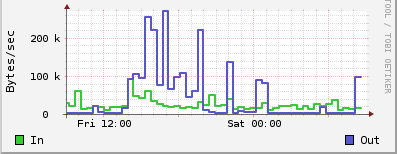
Friday's video of the 2nd leg of the cable car journey was quite popular, Ganglia stats for the video server can't be wrong: The first leg was skipped because of the low cloud cover. Weather reports in Switzerland, such as www.meteosuisse.ch often show a distinction between the low clouds and high clouds, because many Swiss mountain resorts are high enough to enjoy ample sunshine by virtue of their altitude even when cities like Zurich and Geneva are overcast. Now for the third leg, rising up to Berg. In the video, it is hard to gauge the size of the rocky cliffs along the route, but looking at the cable car's shadow will give a clue. As the cable car approaches the station in Berg, it feels like it takes forever to complete the journey. That is because the rocks are so much bigger than they appear from a distance. <video controls="" height="340" poster="http://upload.wikimedia.org/wikipedia/commons/thumb/0/03/Schilthorn_with_Bernese_Alps%2C_2012_August.jpg/800px-Schilthorn_with_Bernese_Alps%2C_2012_August.jpg" width="560">
<source src="http://video.danielpocock.com/VID_20121025_122453.m4v" type="video/mp4"></source>
<source src="http://video.danielpocock.com/VID_20121025_122453.webm" type="video/webm"></source>
</video> The final leg to the Schilthorn summit will appear shortly. I understand many people are starting to contemplate their DebConf13 travel and summer holidays - please feel free to email me if you'd like me to post a video of some other feature in Switzerland.
AttachmentSize
ganglia-schilthorn2.png8.71 KB

Gerfried Fuchs: Pentatonix

I know it's been ages since I last blogged anything at all. To some degree I had a down phase, but I hope to get out of it. It's nice to see that there are people out there who give me a prod every now and then, and don't let me drown. Thanks, most of you probably know that I mean exactly you, and in case you are uncertain, you probably are meant if you contact me every now and then. Anyway, if you remember that I blogged about Lindsey Stirling last year and you started to follow her you might have already stumbled upon the next band I'd like to present. I'm speaking of Pentatonix. These five humans have terrific voices that they use in a very special way that is quite unique. I don't want to delay the songs I want to present to you any longer, so here they are: Like always, enjoy! And hopefully read me again more regularly again.

/music permanent link Comments: 1 Flattr this

Joey Hess: Template Haskell on impossible architectures

Imagine you had an excellent successful Kickstarter campaign, and during it a lot of people asked for an Android port to be made of the software. Which is written in Haskell. No problem, you'd think -- the user interface can be written as a local webapp, which will be nicely platform agnostic and so make it easy to port. Also, it's easy to promise a lot of stuff during a Kickstarter campaign. Keeps the graph going up. What could go wrong? So, rather later you realize there is no Haskell compiler for Android. At all. But surely there will be eventually. And so you go off and build the webapp. Since Yesod seems to be the pinnacle of type-safe Haskell web frameworks, you use it. Hmm, there's this Template Haskell stuff that it uses a lot, but it only makes compiles a little slow, and the result is cool, so why not. Then, about half-way through the project, it seems time to get around to this Android port. And, amazingly, a Haskell compiler for Android has appeared in the meantime. Like the Haskell community has your back. (Which they generally seem to.) It's early days and rough, lots of libraries need to be hacked to work, but it only takes around 2 weeks to get a port of your program that basically works. But, no webapp. Cause nobody seems to know how to make a cross-compiling Haskell compiler do Template Haskell. (Even building a fully native compiler on Android doesn't do the trick. Perhaps you missed something though.) At this point you can give up and write a separate Android UI (perhaps using these new Android JNI bindings for Haskell that have also appeared in the meantime). Or you can procrastinate for a while, and mull it over; consider rewriting the webapp to not use Yesod but some other framework that doesn't need Template Haskell. Eventually you might think this: If I run ghc -ddump-splices when I'm building my Yesod code, I can see all the thousands of lines of delicious machine generated Haskell code. I just have to paste that in, in place of the Template Haskell that generated it, and I'll get a program I can build on Android! What could go wrong? And you even try it, and yeah, it seems to work. For small amounts of code that you paste in and carefully modify and get working. Not a whole big, constantly improving webapp where every single line of html gets converted to types and lambdas that are somehow screamingly fast. So then, let's automate this pasting. And so the EvilSplicer is born! That's a fairly general-purpose Template Haskell splicer. First do a native build with -ddump-splices output redirected to a log file. Run the EvilSplicer to fix up the code. Then run an Android cross-compile. But oh, the caveats. There are so many ways this can go wrong.. Anyway, if you struggle with it, or pay me vast quantities of money, your program will, eventually, link. And that's all I can promise for now.
PS, I hope nobody will ever find this blog post useful in their work. PPS, Also, if you let this put you off Haskell in any way .. well, don't. You just might want to wait a year or so before doing Haskell on Android.

16 April 2013

Wouter Verhelst: The devops "installer"

puppet and similar things are very nice tools for managing your systems. Rather than doing the same thing 100 times, it's much more interesting to spend some time describing how to do something, and then have it done hundreds of times automatically. However, I'm starting to see a distressing trend lately. I'd like to say that puppet is not an installer, nor is it a replacement for one. Here's why: Please, pretty please, with sugar on top: just provide packages. If that can't be done, just provide clear installation instructions and/or a puppet module that I can include or something. Don't assume I'm a system administrator not worth his paycheck. Thanks. note: the gitorious example above is just that, an example. I've seen more cases of people doing similar things, not just gitorious. Surprisingly, it's mostly from people who're on the ruby kool-aid. I hope that's not related... Update: (2013-04-18) despite my usage of buzzwords in the title of this post, I did not mean to imply that any of the above has anything to do with devops. Instead, what the post is supposed to say is that you should not fall into the trap of believing that devops methods, which may work wonderfully internal to your organization, will therefore also work wonderfully for processes outside your organization.

Stefano Zacchiroli: bits from the DPL for March-April 2013

Dear Project Members,
   "Now that I have your attention, I would like to make the following
delegations:"

... nah, scrap that. In my last day in office I first of all owe you a report of DPL activities for the last reporting period of this term, i.e. March 8th until today. Here it is! Highlights Talks Over the past month or so I've attended and spoken on behalf of Debian in the following occasions: Assets I've approved the budget for the following forthcoming sprints: Also, we've bought a 3-year warranty pack for the disk array that powers ftp-master.d.o (~900 USD). On the income side, Brian Gupta has started an interesting matching fund experiment, in order to raise funds for the forthcoming DebConf13. The matching fund will be open until April 30th, so your help in spreading news would be welcome. Many thanks to Brian for the idea and to his company, Brandorr Group, for funding it. DPL helpers Three more DPL helpers IRC meetings have been held; minutes are available at the usual place. Legal Spring Cleaning I've finally cleaned up the pile of pending legal matters (but I'm sure new ones will show up for the delight of the next DPL :-P) Once again, I'd like to thank SFLC for the pro bono and very high quality legal advice they keep on offering to Debian. Miscellaneous
Now, before I get sentimental, let me thank Gergely, Lucas, and Moray for running in the recently concluded DPL election. Only thinking of running and then go through a campaign denote a very high commitment to the Project; we should all be thankful to them. Then I'd like to congratulate Lucas for his election. I've known him for a long time, and I can testify about his clear vision of the role Debian has to play in Free Software and on what Debian needs to improve to do so. Best wishes for the term ahead, Lucas! Finally, I'd like to thank you all for the support you've shown me over the past 3 years. Serving as DPL is a great honor, but also a very demanding job. Thank to you all, and to how cool Debian is, it has been for me an incredibly rewarding experience. I had no idea what I were doing when I embarked on this adventure, but in hindsight I don't regret any of it. See you around, as I don't plan to be anywhere far away from Debian anytime soon. Cheers.
PS the day-to-day activity logs for March and April 2013 are available at the usual place master:/srv/leader/news/bits-from-the-DPL.txt.20130 3,4

14 April 2013

Bits from Debian: DPL election is over, congratulations Lucas Nussbaum!

The Debian Project Leader election has concluded and the winner is Lucas Nussbaum. Of a total of 988 developers, 390 developers voted using the Condorcet method. More information about the result is available in the Debian Project Leader Elections 2013 page. The new term for the project leader will start on April 17th and expire on April 17th 2014.

13 April 2013

Andrew Shadura: A bit more on TrueCrypt

Few days ago I was discussing my last blog post with a colleague of mine, Luka Tvrd , and he s mentioned that it actually is possible to harmlessly decrypt the TrueCrypted filesystem in online mode, resize it, and encrypt it back again. Well, I decided to try, because I have had some problems with that setup. Apart from init script reordering I had to make (not covered in the post, as I did it later and haven t found time yet to write about that), I ran into a trouble while trying to enable swapping. As the only partition I had was formatted into NTFS, placing a swap file there isn t the best idea ever. I actually tried doing so, but after two deadlocks I had in few hours I had to rethink that. Indeed, as NTFS is implemented in the user space using ntfs-3g, as soon as this process gets swapped out, the system is left helpless. The swap is on the file system driver of which is in the swap, which is on the file system driver of which is well, you get the idea. Basically, I got rid of ext3-on-the-loop, and now I have real ext3 in a LUKS container, plus a separate swap partition. Now the other problem is: I still have an encrypted NTFS filesystem which I occasionally need to access, but I don t want to type the pass phrase twice Something to think about.

12 April 2013

Keith Packard: dri3k first steps

DRI3K First Steps Here s an update on DRI3000. I ll start by describing what I ve managed to get working and then summarize discussions that happened on the xorg-devel mailing list. Private Back Buffers One of the big goals for DRI3000 is to finish the job of moving buffer management out of the X server and into applications. The only thing still allocated by DRI2 in the X server are back buffers; everything else moved to the client side. Yes, I know, this breaks the GLX requirement for sharing buffers between applications, but we just don t care anymore. As a quick hack, I figured out how to do this with DRI2 today allocate our back buffers separately by creating X pixmaps for them, and then using the existing DRI2GetBuffersWithFormat request to get a GEM handle for them. Of course, now that all I ve got is a pixmap, I can t use the existing DRI2 swap buffer support, so for now I m just using CopyArea to get stuff on the screen. But, that works fine, as long as you don t care about synchronization. Handling Window Resize The biggest pain in DRI2 has been dealing with window resize. When the window resizes in the X server, a new back buffer is allocated and the old one discarded. An event is delivered to invalidate the old back buffer, but anything done between the time the back buffer is discarded and when the application responds to the event is lost. You can easily see this with any GL application today resize the window and you ll see occasional black frames. By allocating the back buffer in the application, the application handles the resize within GL; at some point in the rendering process the resize is discovered, and GL creates a new buffer, copies the existing data over, and continues rendering. So, the rendered data are never lost, and every frame gets displayed on the screen (although, perhaps at the wrong size). The puzzle here was how to tell that the window was resized. Ideally, we d have the application tell us when it received the X configure notify event and was drawing the frame at the new size. We thought of a cute hack that might do this; track GL calls to change the viewport and make sure the back buffer could hold the viewport contents. In theory, the application would receive the X configure notify event, change the viewport and render at the new size. Tracking the viewport settings for an entire frame and constructing their bounding box should describe the size of the window; at least it should describe the intended size of the window. There s at least one serious problem with this plan applications may well call glClear before calling glViewport, and as glClear does not use the current viewport, instead clearing the whole window, we couldn t use the viewport as an indication of the current window size. However, what this exercise did lead us to realize was that we don t care what size the window actually is, we only care what size the application thinks it is. More accurately, the GL library just needs to be aware of any window configuration changes before the application, so that it will construct a buffer that is not older than the application knowledge of the window size. I came up with two possible mechanisms here; the first was to construct a shared memory block between application and X server where the X server would store window configuration changes and signal the application by incrementing a sequence number in the shared page; the GL library would simply look at the sequence number and reallocate buffers when it changed. The problem with the shared memory plan was that it wouldn t work across the network, and we have a future project in mind to replace GLX indirect rendering with local direct rendering and PutImage which still needs accurate window size tracking. More about that project in a future post though X Events to the Rescue So, I decided to just have the X server send me events when the window size changed. I could simply use the existing X configure notify events, but that would require a huge infrastructure change in the application so that my GL library could get those events and have the application also see them. Not knowing what the application is up to, we d have to track every ChangeWindowAttributes call and make sure the event_mask included the right bits. Ick. Fortunately, there s another reason to use a new event we need more information than is provided in the ConfigureNotify event; as you know, the Swap extension wants to have applications draw their content within a larger buffer that can have the window decorations placed around it to avoid a copy from back buffer to window buffer. So, our new ConfigureNotify event would also contain that information. Making sure that ConfigureNotify event is delivered before the core ConfigureNotify event ensures that the GL library should always be able to know about window size changes before the application. Splitting the XCB Event Stream Ok, so I ve got these new events coming from the X server. I don t want the application to have to receive them and hand them down to the GL library; that would mean changing every application on the planet, something which doesn t seem very likely at all. Xlib does this kind of thing by allowing applications to stick themselves into the middle of the event processing code with a callback to filter out the events they re interested in before they hit the main event queue. That s how DRI2 captures Invalidate events, and it works , but using callbacks from the middle of the X event processing code creates all kinds of locking nightmares. As discussed above, I don t care when GL sees the configure events, as long as it gets them before the application finds about about the window size change. So, we don t need to synchronously handle these events, we just need to be able to know they ve arrived and then handle them on the next call to a GL drawing function. What I ve created as a prototype is the ability to identify specific events and place them in a separate event queue, and when events are placed in that event queue, to bump a sequence number so that the application can quickly identify that there s something to process. Making the Event Mask Per-API Instead of Per-Client The problem described above about using the core ConfigureNotify events made me think about how to manage multiple APIs all wanting to track window configuration. For core events, the selection of which events to receive is all based on the client; each client has a single event mask, and each client receives one copy of each event. Monolithic applications work fine with this model; there s one place in the application selecting for events and one place processing them. However, modern applications end up using different APIs for 3D, 2D and media. Getting those libraries to cooperate and use a common API for event management seems pretty intractable. Making the X server treat each API as a separate entity seemed a whole lot easier; if two APIs want events, just have them register separately and deliver two events flagged for the separate APIs. So, the new DRI3 configure notify events are created with their own XID to identify the client-side owner of the event. Within the X server, this required a tiny change; we already needed to allocate an XID for each event selection so that it could be automatically cleaned up when the client exited, so the only change was to use the one provided by the client instead of allocating one in the server. On the wire, the event includes this new XID so that the library can use it to sort out which event queue to stick the event in using the new XCB event stream splitting code. Current Status The above section describes the work that I ve got running; with it, I can run GL applications and have them correctly track window size changes without losing a frame. It s all available on the dri3 branches of my various repositories for xcb proto, libxcb, dri3proto and the X server. Future Directions The first obvious change needed is to move the configuration events from the DRI3 extension to the as-yet-unspecified new Swap extension (which I may rename as Present , as in please present this pixmap in this window ). That s because they aren t related to direct rendering, but rather to tracking window sizes for off-screen rendering, either direct, indirect or even with the CPU to memory. DRI3 and Fences Right now, I m not synchronizing the direct rendering with the CopyArea call; that means the X server will end up with essentially random contents as the application may be mid-way through the next frame before it processes the CopyArea. A simple XSync call would suffice to fix that, but I want a more efficient way of doing this. With the current Linux DRI kernel APIs, it is sufficient to serialize calls that post rendering requests to the kernel to ensure that the rendering requests are themselves serialized. So, all I need to do is have the application wait until the X server has sent the CopyArea request down to the kernel. I could do that by having the X server send me an X event, but I think there s a better way that will extend to systems that don t offer the kernel serialization guarantee. James Jones and Aaron Plattner put together a proposal to add Fences to the X Sync extension. In the X world, those offer a method to serialize rendering between two X applications, but of course the real goal is to expose those fences to GL applications through the various GL sync extensions (including GLARBsync and GLNVfence). With the current Linux DRI implementation, I think it would be pretty easy to implement these fences using pthread semaphores in a block of memory shared between the server and application. That would be DRI-specific; other direct rendering interfaces would use alternate means to share the fences between X server and application. Swap/Present The Second Extension By simply using CopyArea for my application presentation step, I think I ve neatly split this problem into manageable pieces. Once I ve got the DRI3 piece working, I ll move on to fixing the presentation issue. By making that depend solely on existing core Pixmap objects as the source of data to present, I can develop that without any reference to DRI. This will make the extension useful to existing X applications that currently have only CopyArea for this operation. Presentation of application contents occurs in two phases; the first is to identify which objects are involved in the presentation. The second is to perform the presentation operation, either using CopyArea, or by swapping pages or the entire frame buffer. For offscreen objects, these can occur at the same time. For onscreen, the presentation will likely be synchronized with the scanout engine. The second form will mean that the Fences that mark when the presentation has occurred will need to signaled only once the operation completes. A CopyArea operation means that the source pixmap is ready immediately after the Copy has completed. Doing the presentation by using the source pixmap as the new front buffer means that the source pixmap doesn t become ready until after the next swap completes. What I don t know now is whether we ll need to report up-front whether the presentation will involve a copy or a swap. At this point, I don t think so the application will need two back buffers in all cases to avoid blocking between the presentation request and the presentation execution. Yes, it could use a fence for this, but that still sticks a bubble in the 3D hardware where it s blocked waiting for vblank instead of starting on the next frame immediately. Plan of Attack Right now, I m working on finishing up the DRI3 piece: The first three seem fairly straight forward. The fencing stuff will involve working with James and Aaron to integrate their XSync changes into the server. After that, I ll start working on the presentation piece. Foremost there is figuring out the right name for this new extension; I started with the name Swap as that s the GL call it implements. However, Swap is quite misleading as to the actual functionality; a name more like Present might provide a better indication of what it actually does. Of course, Present is both a verb and a noun, with very different connotations. Suggestions on this most complicated part of the project are welcome!

Michal &#268;iha&#345;: Hackweek 9 is over

Hackweek 9 is over and it's time to share what I've done on Weblate during that. I think everything went quite well and Weblate is now ready for 1.5 release. I'm slowly deploying it on my installations (unfortunately this release migration will need some noticeable downtime for bigger installations) and everything seems to work fine so far. I believe this is possible thanks to massive test coverage - all important code is covered by testcases. So what you can expect in 1.5 release? The most visible change is probably new machine translation support, providing support for way more backends and allow you to plug in own services as well. The other changes include word counting (what might give you more idea how much work is remaining) or fancy progress bars in all places (they used to be available for translations only). From the other side, Weblate can now run custom scripts to pre-process translations before commit, what can be used for various things from generating byte compiled files to sorting or cleaning up the translation files. Also Weblate should be now much faster - there were dozen of optimizations done, leading to much lower press on database server. If you want to see more detailed work progress, check Hackweek project page or Weblate changelog. PS: In case no problems appear, Weblate 1.5 should be released on Sunday.

Filed under: English Phpmyadmin Suse Weblate 0 comments Flattr this!

11 April 2013

Andrew Pollock: [life/repatexpat] Differences on how one purchases petrol

The differences between how one fuels one's car are quite pronounced, between California and Australia. Firstly, if you're paying with plastic, it's a given that you can pay at the pump. I could count on my hands the number of times I've had to walk into a gas station to pay for gas in the US. Having a small child, I was not looking forward to having to either leave her in the car so I could pay for my petrol, or having to deal with all of the rigmarole of getting her out of her car seat, just so she can accompany me inside the petrol station to make a brief transaction and then have to get her back into her car seat again. Not to mention how it drags out the whole process. Yesterday I had to wait for a pump while everyone leaves their car, queues inside to pay a single cashier, and then returns to their car and drives away. It'd be an interesting Productivity Commission report to see how much time is lost, just so people can be tempted by the high-margin items inside. Then there's pumping the petrol. California, being all hippy, requires all the fuel nozzles to have these fandangled "vapour recovery" things, which basically fit over the part of the pump that goes inside the fuel tank and does some sort of, well, vapour recovery. The upside, you're not sniffing fumes while you're pumping your petrol. The other fabulous thing about Californian fuel pumps is you can lock the handle down, so you don't have to stand there like a shag on a rock squeezing the handle while a $100 trickles into your car. You can get back in your car and listen to the radio. Or clean your windscreen. Or entertain your kid. I'd love to know why Australian pumps don't lock on any more. I have memories from my early childhood of them locking on. So yeah, I think Australians lose out quite badly when it comes to the petrol station experience. I was pleased to discover that the Woolworths branded Caltex petrol stations seem to have some sort of pay at the pump infrastructure, it just requires you to have their specific credit card or something. I need to do more research, because if I can pay at the pump, I will.

Bdale Garbee: Batteries and Pyro Circuits

Keith and I have discovered a change in the behavior of the protection circuits integrated in the LiPo batteries we sell for use with Altus Metrum products that poses a risk for our customers. This post is meant to document what we now know, communicate changes we're planning as a result, and explain what we think flyers of our existing electronics and batteries may want to do to maximize their chances of successful flights. Background Choosing batteries and designing pyro circuits for high power rocketry avionics involves a variety of trade-offs. Reliability is the highest concern, both because nobody wants to lose an airframe due to a failed pyro event, and also because airframes recovering anomalously have safety implications. But we also care about other factors including cost and weight, and usually want to minimize the complexity of both the electronics and the overall installation. The objective of a pyro circuit is to dump enough energy rapidly into an electric match to cause it to catch fire. We need batteries both to power the electronics that decide when to fire the charge, and to provide the energy that actually ignites the match. The two most common battery types seen in the rocketry hobby are alkaline cells, often the nominal 9V rectangular variety, and rechargeable batteries based on Lithium Polymer (LiPo) chemistry. LiPo cells are 3.7 volts per cell nominal voltage, are very light, and have a high energy density. LiPo capacity is measured in units of current times time, so an 850mAh cell should be able to deliver 850 milliamps for an hour. The battery industry also uses something called a "C rate" to describe how fast the battery can be usefully discharged, wich is a multiplier relative to the battery capacity. So a battery with 850mAh capacity and a "2C" rating can deliver current at a sustained rate of 1700mA until discharged, while the same capacity at a "5C" rating can deliver 4250mA. By comparison, most 9V alkaline batteries are actually composed of 6 individual 1.5V cells enclosed in a wrapper. It's hard to get hard numbers for capacity and discharge rate, since in an alkaline cell the two are not independent, and the discharge rate is related to the volume of each individual cell. The data sheet for an Energizer 522 shows just over 600mAh at a 25mA discharge rate, dropping to about 300mAh at a 500mA discharge rate. Importantly for use in pyro circuits, LiPo cells have a very low source impedance, which means they can source immense amounts of current. It's not unusual for cells in the 1000mAh range to have ratings in excess of 30C! Because this rapid discharge ability can pose a risk of fire, it's common for LiPo cells to come with a "protection board" integrated into the battery assembly that is designed to limit the current to some rate such as 2C continuous duty. In large airframes, or projects that involve staging, air-starts, or other complex pyro event sequences, the most reliable approach will always be to use separate batteries for the control electronics and the source of pyro firing power. In the limit, having separate pyro batteries for each pyro charge with the control electronics only providing the switching to connect the batteries to the charges could even make sense. But for most airframes, this is overkill, and the increases in mass, volume, and wiring complexity just don't make sense. The challenge, then, is how to design electronics that will robustly initiate pyro events without negatively affecting the rest of the electronics when operating from a single shared battery. Altus Metrum Pyro Circuits The very first prototypes of TeleMetrum were designed to use a single-cell LiPo battery, and had an on-board 100mA charging circuit. Because we needed 5 volts to power the accelerometer, we had a small switching regulator that up-converted the LiPo voltage, and we used some of that regulator's output to charge a 1000uF capacitor. The pyro circuit used Fairchild FDN335N N-channel MOSFET switches in a low-side switching configuration to dump the energy stored in the capacitor through an attached ematch. Those FETs had an on resistance of under a tenth of an ohm in our operating conditions. The circuit worked very reliably, but the 1000uF electrolytic cap was huge and we struggled with the mechanics of such a large part hanging off the board... It turns out that 3.7 volts is way more than enough to fire a typical low-current e-match or equivalents like the Quest Q2G2 igniters. In fact, bench testing with a good digital oscilloscope showed that a typical e-match with resistance of 1.3-1.8 ohms will fire in approximately 13 microseconds when hit with the nominal 3.7 volts from a LiPo. So, starting with our v0.2 boards, we switched to using the LiPo battery voltage directly to fire the pyro charges, eliminating the clunky electrolytic capacitor entirely. We also switched to the Fairchild FDS9926A dual N-channel MOSFET whose specs are better in all regards for our application. The on resistance is down around 40 milli-ohms in our circuit, such that the current ratings are much higher (FET current limits are primarily driven by how much heat is generated due to current flowing through the channel's on resistance). Because using the LiPo voltage directly means we're effectively temporarily putting a very low resistance across the battery during the pyro events, the input voltage to the voltage regulator gets pulled down. To ensure the processor could "ride through" these events, we added a 100uF surface mount bulk capacitor on the 3.3 volt regulated voltage rail, which bench testing demonstrated was more than sufficient to maintain processor operation through pyro events. And that is essentially the same pyro circuit on all the boards, both TeleMetrum and TeleMini, that we have shipped to date. What's Changed The LiPo batteries we source and sell with our electronics come with a protection board and cable terminated in a 2-pin, 2mm "JST" connector. The specs on the protection board have always been "2C continuous", but we observed the ability to source much higher currents for short periods such as the 13 micro-seconds or so required to fire an e-match. Thus these protection circuits seemed just fine .. we could fire e-matches with a burst of current but were protected against short circuits in the wiring or our boards by the 2C continuous limit. Unfortunately, the most recent batch of batteries we sourced seem to have a much "twitchier" protection circuit. We can draw more than 2C for short bursts, but not as much as with prior boards, and not for as long an interval. With a 1 ohm power resistor on the pyro terminals of one of our boards, we get about 9 milliseconds of power before the protection circuit cuts in and shuts the battery down. The power stays down until all load is removed, which at least means the board is turned off and back on again, and in some cases could even mean the battery is unplugged and re-plugged since we draw trace current to keep the GPS memory alive even when the power is turned off, and at least some of the new batteries see that as enough to keep the power turned off after an over-current event. For many e-matches, this isn't an issue, since 9 milliseconds is way longer than the 13 microseconds needed to fire the charge. Unfortunately, we've discovered that many of the e-matches bought and used in the rocketry hobby are actually made for use in the fireworks industry, where it is desireable to retain continuity after firing so that series connections of e-matches all can fire even if some fire faster than others! This means that while the resistance goes up some after firing, sometimes the drain on the battery remains sufficient to cause the protection circuit to kick in even after the pyro charge has fired. What We're Doing About It If we remove the protection circuit from the LiPo (or jumper around it), all existing Altus Metrum products will operate successfully with pyro charges thave have an effective resistance of as low as 1 ohm. That's lower than any e-match or Q2G2 we've ever seen, so in effect what this means is that if you have an existing Altus Metrum flight computer, and you remove the LiPo protection circuit, you're good to go. This does not really make things any more "dangerous", since our battery chargers are all current limited and our discharge patterns will never cause heating of the battery. Frankly, in a rocket, the most likely way to cause a problem with a LiPo is by smashing or puncturing the actual battery during bench work or during a crash... and those cause the same problems with or without a protection board present. In the future, we will ship batteries that have either a much higher C rating on the protection circuit, or have no protection circuit at all. The number of problems reported by actual customers that we think should be attributed to LiPo protection circuit boards is very low, and we suspect most of our customers who are happily flying their boards can continue to do so. Ground testing where you fire pyro charges (or at least e-matches) using RF to issue the commands (not USB, since the LiPo charger is running any time USB is connected!) will confirm whether there's a problem. If the board resets (does startup beeps) after a pyro event, or shuts down completely (no LED activity), then you have a problem. If the matches light and the board keeps running, you're good to go. However, any Altus Metrum customer with LiPo batteries sourced from us or our distributors who is worried about this problem (even if you haven't seen problems in ground testing or previous flights), and who doesn't want to try soldering on the battery circuit board yourself, is welcome to contact us about removing the protection circuit for you. We won't charge anything other than shipping. To take advantage of this offer, just send email to fixmybattery@altusmetrum.org telling us how many of which capacity batteries you have that you'd like updated, and we'll respond with an RMA number and shipping details. Going Even Further As previously indicated, with the LiPo protection circuits removed, all of our current products will work reliably with at least 1 ohm across the pyro terminals. That should cover all real-world flying conditions just fine, but we're not satisfied yet. We've designed a new pyro control circuit that transfers the maximum possible energy to the load regardless of battery voltage without ever allowing the voltage to the processor to droop at all. We're testing this new circuit in various prototypes now, and if it pans out it will probably show up first in MegaMetrum and then trickle down to TeleMetrum and TeleMini as those products are updated later this year. The new pyro circuit tolerates 0 ohms (dead shorts) on the pyro terminals for as long as the battery can provide current, which is as good as it gets. We think the circuit is clever enough that we'll probably write more about it once we're finished validating it.

10 April 2013

Peter Makholm: Reviewing my own regular expressions

Regular expressions are a wonderful tool, but as many other powerful tools they tend to be misused. If I had a penny for everytime I recommended against using regular expressions for parsing HTML fragments . yeah you know what I mean. This time made me think a bit about my own use of regular expressions. Do I ever fall in the trap of misusing regular expressions myself? Looking at my current code base I couldn t find any glaring misuses, if I could only get a list of all the regular expressions in my current project. Regular expressions to the rescue? No, that would probably be quite an horrible adventure. Luckily I have tools to parse Perl: PPI to the rescue: <script src="https://gist.github.com/pmakholm/5354001.js"></script> A few hundred regular expressions. Most of them just matching simple substrings (in some cases case insensitive) or just short hand for testing a handful of equalities in one go. The only zero-width assertions we are using are the word boundary and quantifiers are mostly used on simple character classes like \d, \s, [0-9a-f] and a few anything but this one or two characters ([^>]). Lessons learned: 1) PPI is cool. 2) I really do use regular expressions as I preach.

Next.

Previous.