Search Results: "spa"

1 September 2013

Russ Allbery: Review: An Artificial Night

Review: An Artificial Night, by Seanan McGuire
Series: October Daye #3
Publisher: DAW
Copyright: September 2010
ISBN: 1-101-44276-X
Format: Kindle
Pages: 368
This is the third book of the October Daye series, following A Local Habitation. It could be read out of order, as each chapter of Toby's story so far is somewhat standalone, but I wouldn't recommend it. You'd miss the character development and the background behind several friendships. As with the previous book review, a caveat: I am reviewing this book four months after finishing it, rather than the normal couple of weeks, so apologies in advance for any thinness or inaccuracies. The first sign that something is about to go seriously wrong in Toby's life this time is a visitor. She says her name is May Daye, and apparently she's Toby's Fetch: a duplicate in nearly every respect except personality, manifested to guide someone to their death. Their imminent death. The second sign is that her best friend's children are kidnapped. The children who treat her like an aunt. And the cause of that kidnapping is far, far beyond the level of power that Toby could be expected to deal with. I have profound mixed feelings about this book. On one hand, McGuire further expands Toby's web of connections and shows us more of Toby's friends and their background, and that's becoming my favorite part of this series. She introduces May, who I think is a great character: at first apparently much different than Toby, but with a similarity beneath surface impressions that one notices more over time. And I thought the climax of the story, once we finally got there, was very moving and well-done. Also, I just love the way that McGuire uses children's rhymes and doggerel throughout this series as a magical element, and that's particularly well-handled here. Due to the nature of the antagonist, McGuire has a good excuse to bring that front and center, and the process of familiar rhymes expanding into deep magical rules was a fun intellectual experience. Best of all, the Luidaeg plays a significant role in the story again. The Luidaeg is, hands down, my favorite character in McGuire's constructed universe, and she becomes even more so over the course of this story. Her complex relationship with Toby is clearly blossoming into a friendship that's surprising both of them deeply, but a friendship that has to play by an odd set of rules (like so much else in Toby's life). I loved her here. Seeing someone that difficult and abrupt show unexpected emotional depths is one of the story elements I enjoy the most. The problem, though, is that quite a lot of An Artificial Night is very, very dark. And by that, I don't mean that there is a lot of tension, or that Toby is struggling against monsterous things, although both of those statements are also true. Rather, Toby is not only out of her league but ends up in some viciously nasty situations, and they persist for rather more of this book than I would have preferred. Putting one's protagonist through hell has a long tradition in urban fantasy, but I found the level of sheer helplessness that Toby struggled through to be a bit more than I wanted to read about. It was too reminiscent of events from Toby's background (as discussed in Rosemary and Rue) that I still don't like to think about. There is, of course, an eventual payoff, as dark as the interim events seem. One knows that, given the genre and given that this is an ongoing series, and even just given the nature of stories. But as much as I like the growing cast of this series, and adored the scenes with the Luidaeg, I found parts of this journey to be deeply disturbing, and not in an enjoyable dramatic tension sort of way. I don't mind protagonists being seriously hurt (although it's not my favorite plot), or even some amount of despair, but this went beyond that. I think McGuire was going for a story about sacrifice and self-definition, about trying even when one can't possibly win, and I can appreciate the narrative arc. But parts of the book were simply awful to read for me. I'm therefore not quite sure what to say in terms of a recommendation. I'm still reading the series, and will definitely read the next book. I think my reaction is somewhat idiosyncratic; the events here will probably not bother others as much as they bothered me. And I can't disagree with their dramatic effectiveness, or with the way that McGuire builds conflict out of the rules of fairy and is building Toby into a stronger and more capable person than she ever thought she could be. But there were still spots where I wished I were reading a different book. Hopefully the next book in the series will be that book I wanted to read. Followed by Late Eclipses. Rating: 6 out of 10

31 August 2013

Chris Lamb: Decrypting the Caesar cipher using shell

In cryptography, a Caesar cipher, also known as Caesar's cipher, the shift cipher, Caesar's code or Caesar shift, is one of the simplest and most widely known encryption techniques. It is a type of substitution cipher in which each letter in the plaintext is replaced by a letter some fixed number of positions down the alphabet. [...]
#!/bin/sh
IN="MJHVIZN ZPIO YJHPN"
for I in $(seq 25); do
    echo $I $IN   tr $(printf %$ I s   tr ' ' '.')\A-Z A-ZA-Z
done
This outputs:
1 NKIWJAO AQJP ZKIQO
2 OLJXKBP BRKQ ALJRP
3 PMKYLCQ CSLR BMKSQ
4 QNLZMDR DTMS CNLTR
5 ROMANES EUNT DOMUS
6 SPNBOFT FVOU EPNVT
7 TQOCPGU GWPV FQOWU
8 URPDQHV HXQW GRPXV
9 VSQERIW IYRX HSQYW
10 WTRFSJX JZSY ITRZX
11 XUSGTKY KATZ JUSAY
12 YVTHULZ LBUA KVTBZ
13 ZWUIVMA MCVB LWUCA
14 AXVJWNB NDWC MXVDB
15 BYWKXOC OEXD NYWEC
16 CZXLYPD PFYE OZXFD
17 DAYMZQE QGZF PAYGE
18 EBZNARF RHAG QBZHF
19 FCAOBSG SIBH RCAIG
20 GDBPCTH TJCI SDBJH
21 HECQDUI UKDJ TECKI
22 IFDREVJ VLEK UFDLJ
23 JGESFWK WMFL VGEMK
24 KHFTGXL XNGM WHFNL
25 LIGUHYM YOHN XIGOM
The only line which makes sense is 5 ROMANES EUNT DOMUS, giving us our solution.

Chris Lamb: Decrypting the Caesar cipher using shell

In cryptography, a Caesar cipher, also known as Caesar's cipher, the shift cipher, Caesar's code or Caesar shift, is one of the simplest and most widely known encryption techniques. It is a type of substitution cipher in which each letter in the plaintext is replaced by a letter some fixed number of positions down the alphabet. [...]
#!/bin/sh
IN="MJHVIZN ZPIO YJHPN"
for I in $(seq 25); do
    echo $I $IN   tr $(printf %$ I s   tr ' ' '.')\A-Z A-ZA-Z
done
This outputs:
1 NKIWJAO AQJP ZKIQO
2 OLJXKBP BRKQ ALJRP
3 PMKYLCQ CSLR BMKSQ
4 QNLZMDR DTMS CNLTR
5 ROMANES EUNT DOMUS
6 SPNBOFT FVOU EPNVT
7 TQOCPGU GWPV FQOWU
8 URPDQHV HXQW GRPXV
9 VSQERIW IYRX HSQYW
10 WTRFSJX JZSY ITRZX
11 XUSGTKY KATZ JUSAY
12 YVTHULZ LBUA KVTBZ
13 ZWUIVMA MCVB LWUCA
14 AXVJWNB NDWC MXVDB
15 BYWKXOC OEXD NYWEC
16 CZXLYPD PFYE OZXFD
17 DAYMZQE QGZF PAYGE
18 EBZNARF RHAG QBZHF
19 FCAOBSG SIBH RCAIG
20 GDBPCTH TJCI SDBJH
21 HECQDUI UKDJ TECKI
22 IFDREVJ VLEK UFDLJ
23 JGESFWK WMFL VGEMK
24 KHFTGXL XNGM WHFNL
25 LIGUHYM YOHN XIGOM
The only line which makes sense is 5 ROMANES EUNT DOMUS, giving us our solution.

30 August 2013

Daniel Pocock: Big decision?

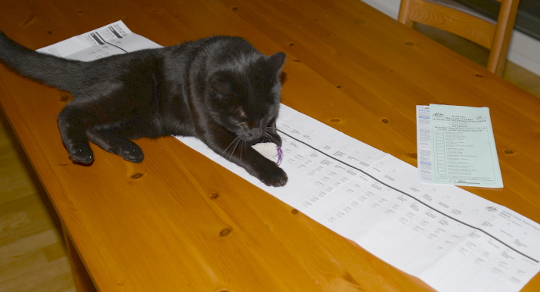
Most people have probably heard that elections are on in Australia. I just received my postal ballot paper the other day and in the spirit of transparency, I'm sharing it here on my blog. Spoilt for choice There are two ballots, one for the Lower House and the other for the Senate. The big one is for the Senate. Our cat is on top of it to help give some perspective on how big it is. Like the columns on a bloated spreadsheet, the parties are designated with symbols from A to AM and then there are some leftover candidates too. Animal instincts With so many candidates to choose from, even our kitty may have found an opportunity in the Animal Justice Party - although that little snack in her claws suggests that she is more interested in the law of the jungle than any political debate. She may want to be wary not to fall under the wheel of the party next to them, Motoring Enthusiasts. The Senate, a place for convicted hackers? The next party in the picture is Wikileaks and their number one candidate, of course, is the first person to successfully claim asylum from Australia, Julian Assange. It's no secret that he has a string of convictions for computer hacking in the 90s and that when US authorities catch up with him, their drone won't just be dropping him a letter demanding a $2,100 penalty fine through the window. So how do they compare? As I contemplate my decision, lets look at the numbers:
Party Seats won in 2010
House of Reps, Senate
Criminal charges against members in last 3 years
Labor Party 72, 31 173, mainly fraud
Liberal/National coalition (conservative) 73, 34 3, including shoplifting and assault
Wikileaks 0 None - Assange is not actually charged with any crime
All of a sudden, in a country that is often the butt of British jokes about convicts, Assange starts to look squeaky clean. He may take further comfort from knowing that out of all those crimes, hacking is the only one that appears to have the presidential seal of approval. Conclusion Whichever way I vote may or may not make so much difference. With so many candidates to choose from though, there is little sign of any quality leadership from any corner of Australian politics. Whether Mr Assange is elected or not, many people will have a chuckle when they realise he almost ended up alongside the Australian Sex Party out of 38 other possible parties randomly distributed across the ballot. Please feel free to comment: which party is the most ridiculous?

Joey Hess: best DebConf ever

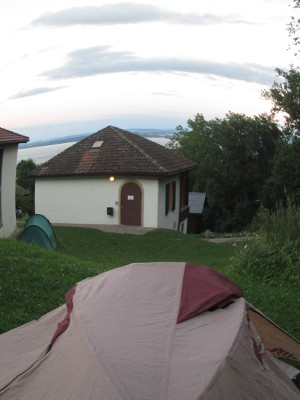
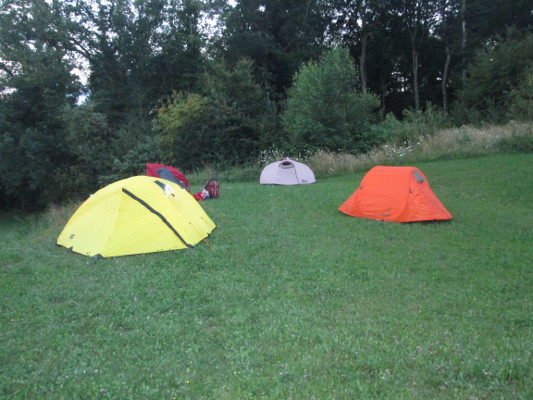
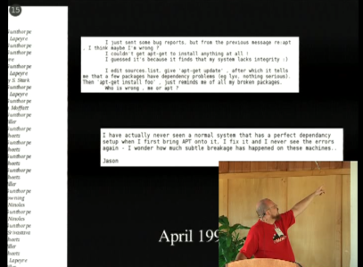
For me, DebConf13 in Switzerland was a perfect DebConf, and generally an great developer meeting and conference. I've attended several past DebConfs in Canada, Norway, Brazil, Finland, Mexico, Scotland, Spain, NYC, Bosnia, and Nicaragua. I have special memories of each. DebConf13 was ideal in every way. Let's start with the camping. Only a minority of us did it, and my campsite was located in a small field behind a bar that was often noisy late into the night, when I was trying to rest and preserve my European jetlag remedy of inverted sleeping schedule. Still, I love sleeping cocooned in a tent, and going through the routines of camping and spending time alone there was a good counterpoint to DebConf. I generally find myself retreating for a day or two in the middle of a week-long conference, burnt out with social interactions. That didn't happen this time. I need to find way to camp at future DebConfs. (Also special shout out to wonderful people who lent me a warmer sleeping bag, and bought me a pillow while on a trip to town! Upgraded my first backpacking in Europe experience's comfort level a lot!) The next perfect thing for me were the talks I gave at DebConf. I always enjoy presenting at DebConf, and barely remember when I'd get nervous doing it. But I really felt comfortable giving these talks in a way I've not before. I'm pleased with how the Debian Cosmology talk turned out; I'd worried it would be a downer talk, or too light, or not well received, and none of those problems surfaced. I was especially happy with my dh_busfactor session, which I prepared for all of 10 minutes and was structured entirely to benefit me by talking over my thoughts and getting feedback, and in which I probably drove the camerapeople crazy running my own mic into the audience. Despite all that, I think it succeeded being interesting for the participants as well as for me. Hope to follow up on it soon.. But beyond the two talks I submitted, there were a series of ad-hoc scheduled talks. It seemed that every day I spent at least an hour discussing something I'm deeply involved in. This started with the Ikiwiki bof, and then there was an epic series of (unrecorded) BoFs about git stuff, which basically turned into an unofficial git track at DebConf. Much, much discussion of git-annex and other things I'm involved in. BTW, I really like that DebConf, as well as being a formal conference on top, is really an un-conference underneath, with new BoFs and things popping up on the schedule all week long. You can even have completely unscheduled meetings that somehow get just the right mix of people to make something awesome happen.
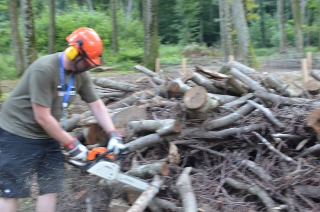
But it wasn't all about talks. Indeed, I only attended 2 or 3 sessions a day. The DebConf13 venue was controversial, but I found it excellent for getting things done. Rather than one or two massive rooms that get too noisy to think in, this venue had many little nooks and crannies suited for different types of work. There were so many I only discovered some while walking down the hill as I was leaving the venue! Anchoring it all was the excellent view, and I particularly enjoyed the "scenic hacklab". I was particularly impressed with the flexability of the venue's management. Someone asked if we could have cheese for breakfast, and every breakfast thereafter had not one but often three excellent cheeses. One day we'd be complaining that there were not enough vegetables in the food, and the next we'd be eating an excellent vegetarian Swiss lunch. They even apparently relaxed stringent Swiss rules on not allowing tents in sightlines visible from people further up the hill. They were clearly happy to welcome our crazy gathering to Le Camp. They let a DD borrow and use a chain saw and build a bonfire! The venue also encouraged getting out and exploring the surrounding countryside. Too often I end up spending the whole DebConf without seeing much of the area around. This time I at least got down the hill to see the castle in Vaumarcus a few times, and enjoyed many evening walks amoung the grape fields. The conference dinner (on a boat!) tied into this well too. And the daytrip to CERN was a great addition. We got to poke around the control center for a massive particle accellerator! My only regret is we didn't get a chance to actually go inside the LHC tunnels. Back to DebConf, another thing I really liked about this one was that its location allowed several upstream authors of software in Debian (other than the usual suspects who are both upstreams and Debian Developers) to attend. I don't know if Lennart Poettering changed any minds about systemd with his talk, but I was happy for the opportunity to buy him a beer. I didn't get to Monty's talk, but it was excellent to see him attend as well. Finally, I got to meet old friends I'd not seen in years, and new ones I've not met in real life before. We're still not sure where this whole DebConf thing is going -- will it be all about the cheese and wine party and greybeards in 20 years time? But one thing we know is we enjoy our little slice of the year where kilts and coding are equally unremarkable, where problems that seem intractable online somehow solve themselves in person, where we come away with ideas for an entire year and memories for a lifetime.

Michael Stapelberg: How git performs when you throw all of Debian at it

During DebConf, Asheesh presented the idea of using git instead of the file system for storing the contents of Debian Code Search. The hope was that it would lead to fewer disk seeks and less data due to gits delta-encoding. Maybe the reduction would be big enough that enough data could be held in RAM to allow for fast retrieval. Joey Hess helped me out with a couple of details: he revealed that using git repack -a -d will lead to a single packfile that optimally contains HEAD, not caring about the history. Also, he showed me how to use git cat-file. We did a small-scale experiment and the results were promising. I told him I ll do the experiment of just committing the entire unpacked source mirror to git and promised to follow up with the results, so here goes:
stapelberg@couper ~/unpacked master $ time cat <<EOT   git cat-file --batch >/dev/null
:linux_3.2.32-1/sound/pci/ice1712/aureon.c
:linux_3.2.32-1/sound/soc/codecs/sgtl5000.c
:linux_3.2.32-1/sound/pci/hda/patch_conexant.c
EOT
cat <<<''  0,00s user 0,00s system 62% cpu 0,006 total
git cat-file --batch > /dev/null  4,38s user 1,08s system 99% cpu 5,477 total
stapelberg@couper ~/unpacked master $ time cat linux_3.2.32-1/sound/pci/ice1712/aureon.c linux_3.2.32-1/sound/soc/codecs/sgtl5000.c linux_3.2.32-1/sound/pci/hda/patch_conexant.c >/dev/null
cat linux_3.2.32-1/sound/pci/ice1712/aureon.c   > /dev/null  0,00s user 0,00s system 69% cpu 0,006 total
stapelberg@couper ~/unpacked master $ time cat <<EOT   git cat-file --batch >/dev/null
:i3-wm_4.6-1/libi3/font.c
EOT
cat <<<':i3-wm_4.6-1/libi3/font.c'  0,00s user 0,00s system 51% cpu 0,008 total
git cat-file --batch > /dev/null  4,30s user 1,18s system 99% cpu 5,533 total
stapelberg@couper ~/unpacked master $ time cat i3-wm_4.6-1/libi3/font.c >/dev/null
cat i3-wm_4.6-1/libi3/font.c > /dev/null  0,00s user 0,00s system 0% cpu 0,004 total
Even after repeating those tests a couple of times to get a warm page cache, the result stays the same: git takes about 5 seconds to resolve the deltas in a large repository. Even if this was 5 seconds startup time and a very small amount of additional time per file, it would not be acceptable for our use case. The conclusion is that git is clearly not suitable for this kind of usage, which is not surprising after having heard a couple of times that git does not scale :-). For the curious, the .git/objects directory is 29 GiB for roughly 140 GiB of source code, so the delta encoding is quite impressive in terms of saving space. However, keep in mind that the compressed (!) Debian source archive is about 35 GiB, so the savings are not that huge.

28 August 2013

Vincent Sanders: Men admire the man who can organize their wishes and thoughts in stone and wood and steel and brass.


I would probably not yet worthy of the admiration Emerson was alluding to but I do like to make things. As anyone who has read previous posts knows I have pretty much embraced the "do things, tell people" idea.

One small wrinkle is doing things needs somewhere to work. Since moving myself and the family to rented accommodation in Cambridge (swampy 3,500 year old English city, not the one in Massachusetts) I have been lacking space to do practical projects.

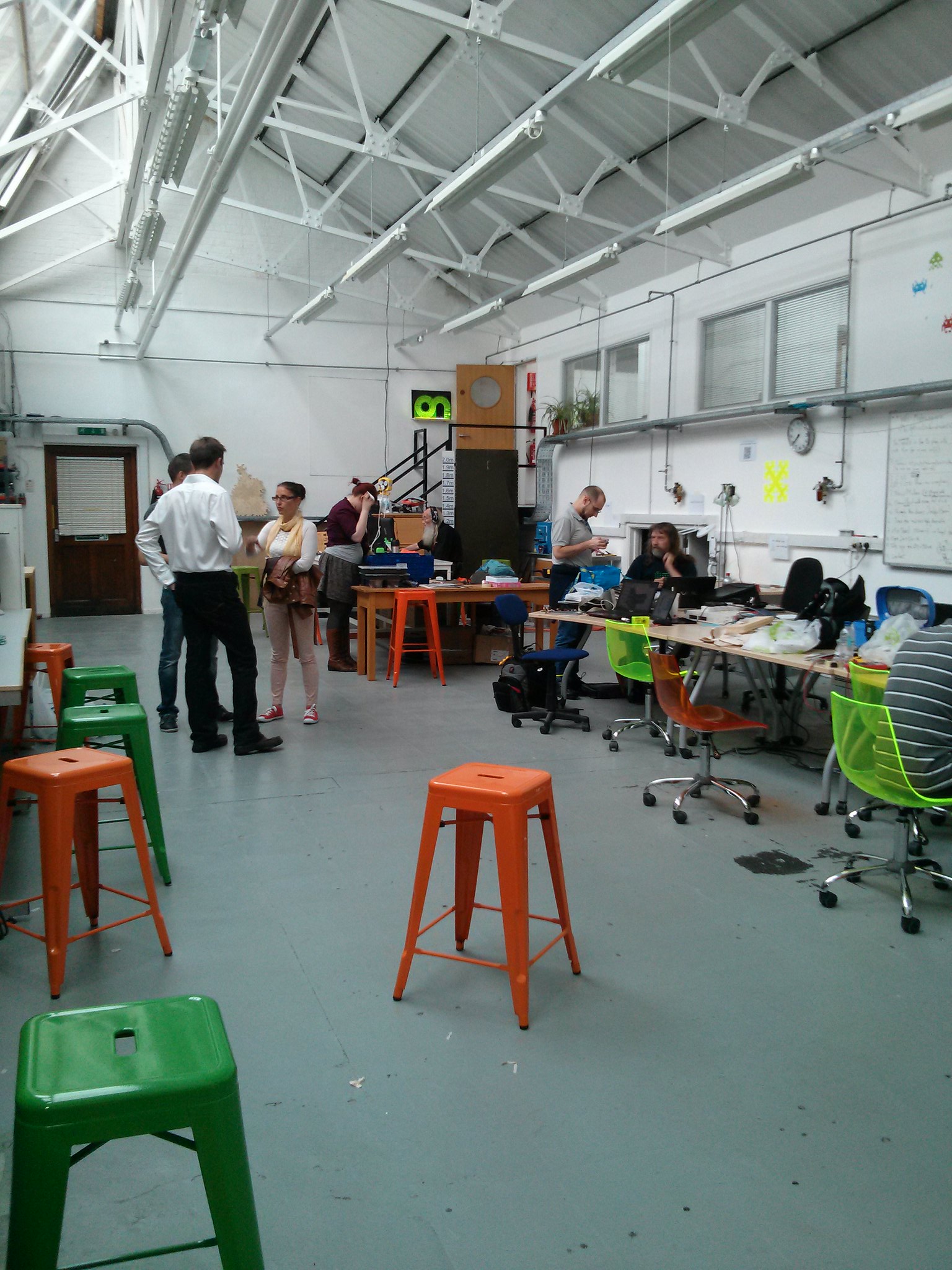
The main space
To fix this lack I have joined the cambridge makespace which, in addition to somewhere I can work gives me access to some tools I was previously unable to afford. The space gives practical training on the more complex machines (any tool can be dangerous if you do not use it correctly) which recently allowed my induction on the CNC router.

My instructor , Mark Mellors, who was good enough to give up some of his valuable making time to train me (and accidentally get his car stuck in a car park overnight by staying late) suggested that it was a good idea to have a design to try.

I decided to use this opportunity to actually create something useful (though now I re-read Marks message it did suggest a simple design...oopsy). I had been working at the electronics bench in previous weeks and been uncomfortable using the existing stools and chairs as they were either a bit high or unable to be adjusted high enough for the 80cm tall benches. I decided to design a 60cm tall stool for use at this workbench.

My initial idea was for a simple three leg stool, round top, three legs, how hard could it be? Initial research showed that showed that above 30cm the legs needed to be braced to each other. This is because the leg to seat joints simply cannot handle the stress caused by leverage which longer legs introduce.

I looked at the structure of several stools online and was initially drawn towards creating something like the IKEA Dalfred bar stool. It was discovered that the design would be easier to realise if it were made from sheet material which give a smaller challenge to a naive operator of a CNC router. Because of this simpler designs were researched and I eventually found a simple design I liked.

The design could not however be used directly as it was for imperial sized material which is not available in europe. I selected the QCAD open source CAD package and recaptured the design adjusting for the available 12mm plywood sheet material. This resulted in an imperial measurement design for metric materials.

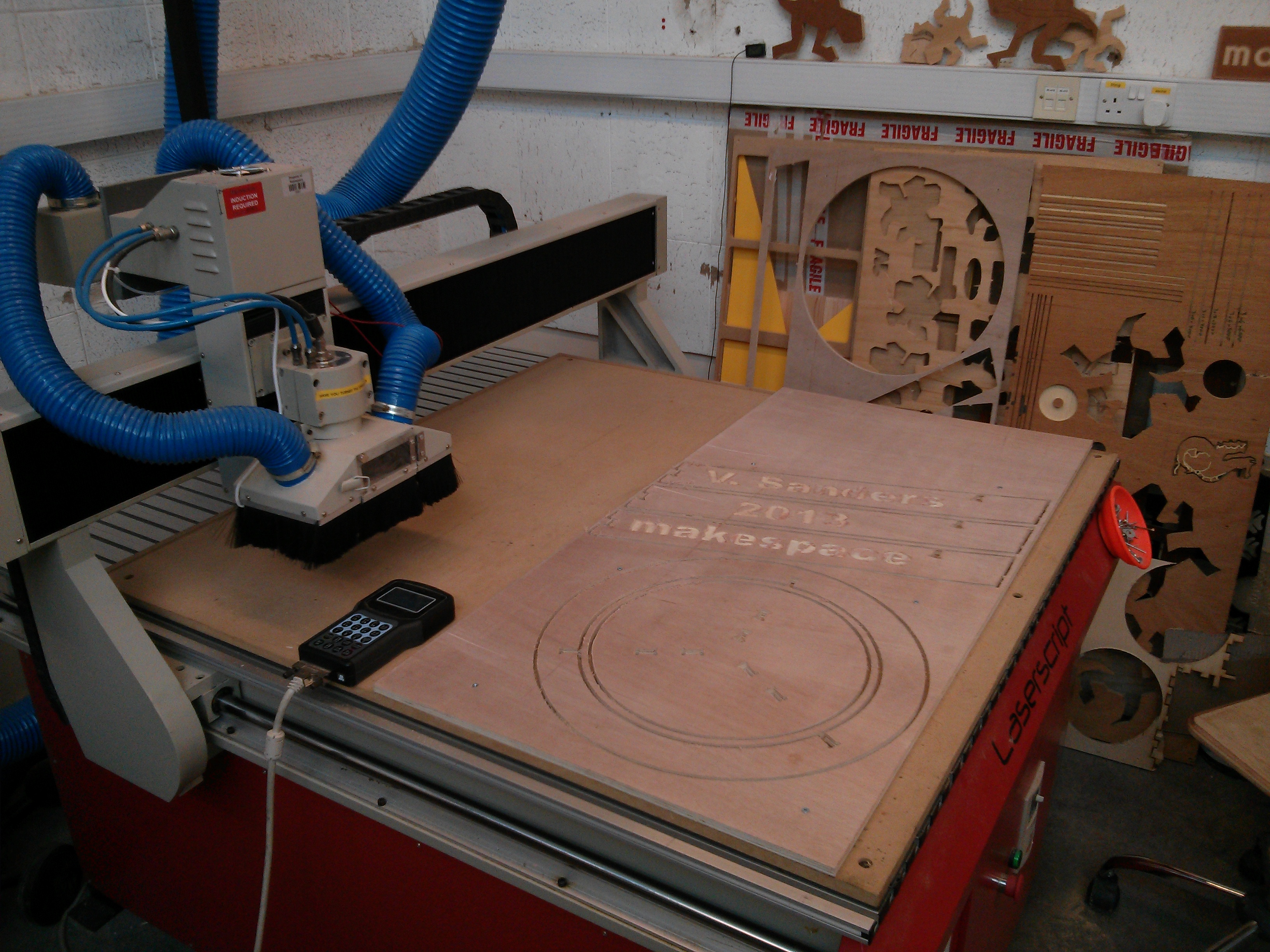
Mark helped me transfer the DXF into the CAM software (vcarve pro 7, after I discovered the demo version of this software generates files which cannot be imported into the full edition!) and generate toolpaths for our machine. Once the toolpaths are saved to a USB stick (no modern conveniences like direct upload here) the job can be run on the machine.

Here I ran into reality, turns out that tolerances in imperial combined with lack of understanding how plywood reacts resulted in excessive play in the joints. This resulted in an unusable stool, which simply tried to rotate around its central axis and become flatpack. I had successfully turned 10 worth of plywood into some sawdust and a selection of useless shapes. On the other hand I did become competent with the router workflow so it was not a complete failure.

I was determined to make the design work so I decided to start from scratch with a similar design but entirely in metric. I performed some material research both online and practically (why yes i did spend an informative hour in several cambridge DIY shops with digital calipers, why do you ask?) it turns out that generally available 12mm thick plywood actually ranges between 11.9 and 12mm thick.

I did some test slot cuts of varying width and determined that the available stock can be "persuaded" to fit into a 11.8mm wide slot. This Interference fit joint is strong and removes the need for adhesive in most cases.

Second cut still attached to the bed. Leftovers of first attempt in the background
The sheet plywood material is readily available with a width of 1220mm and a height of 606mm (a full sheet is 2440mm long which is cut into four with a 4mm wide saw blade) so making the legs fit within a sheet and be close to the 60cm target should be possible.

I selected a suitable seat radius (175mm) and from that determined the minimal gap to the base ring with a 6mm end mill tool (20mm for two toolpaths and some separation) and hence the minimum suitable width of the base ring (50mm) giving a total radius of 245mm.

For the legs allowance was made for two joints of 30mm with 30mm separation between them the legs come out at 90mm width. If a 6mm space and a 6mm toolpath top and bottom of the sheet is accounted for a 582mm height (606 - 24) is available in which to fit the legs. The top of the leg which fits into the seat is 12mm tall leaving 570mm total leg height.

12mm plywood stool design
At this point I selected some arbitrary values for the leg positioning and angle (30mm from seat centre and 15 ) using a right angle triangle triganometry this produced a stool with a base of around 550mm or 100mm outside the radius of the seat. This seemed a pleasing shape and when the values for the holding ring were calculated it is at 104mm height which also seems to work out well.

This design was cut on the machine, lightly finished with some sandpaper and assembled. The legs slotted into the ring first and then the legs eased into the seat slots, the whole thing flipped and the seat hammered home onto the legs.

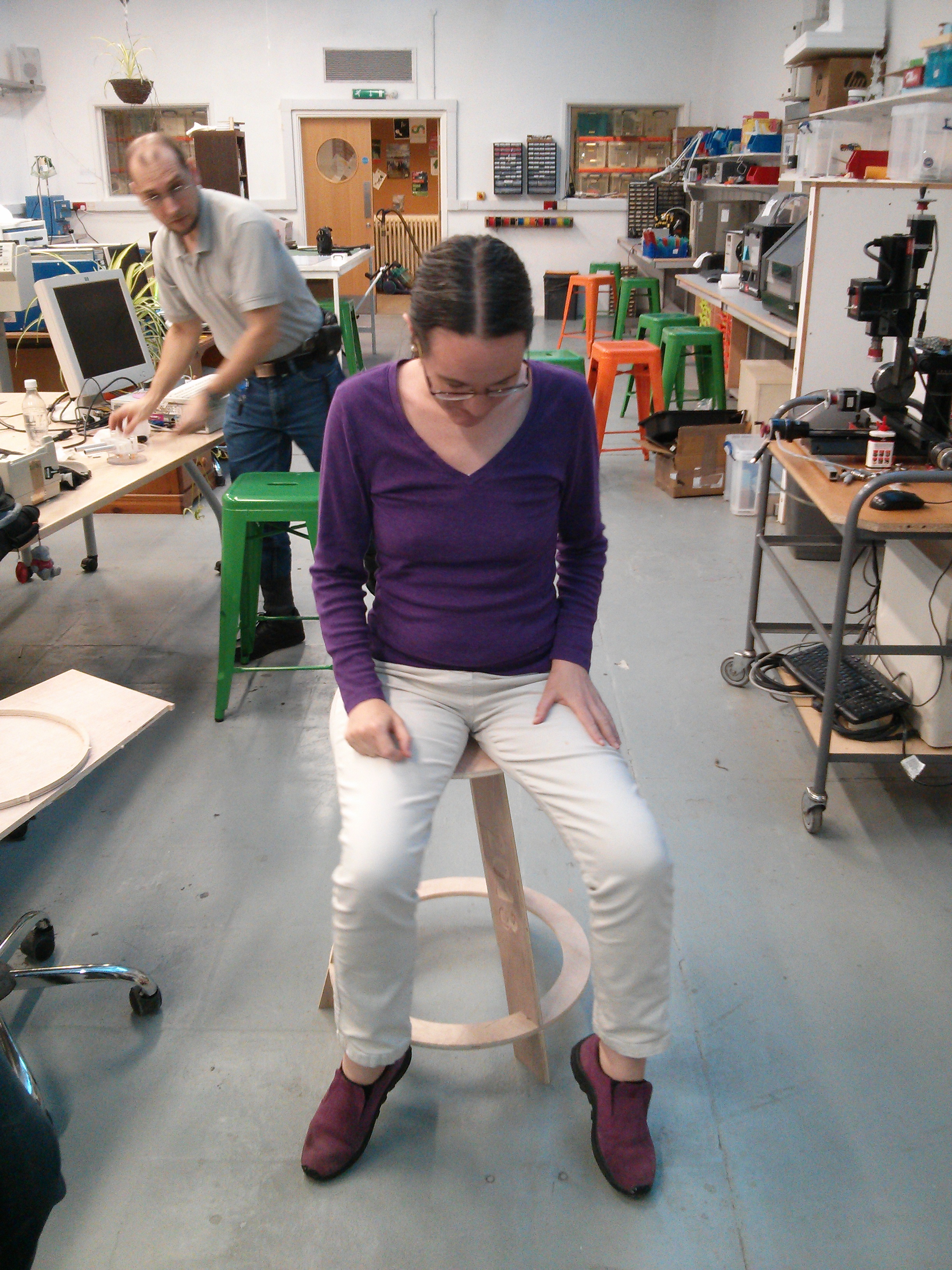
Anne Harrison volunteering to try the wobbly stool of doom
Success! It physically fit together and if you were brave enough you could sit on it. Unfortunately the plywood seemed to flex around the central axis of rotation in a rather alarming way, fine if you are under 70 kilos but not giving the impression of security most people want from their seating.

Ok, lets try with five legs instead of three (at least we can reuse the existing three legs)...nope still not good enough and another 10 gone.

18mm Plywood stool design
The others in the space suggested a few ideas to improve matters and the one I selected was to use 18mm plywood instead of 12mm, this should improve rigidity. There was a brief pause in proceedings to discover 18mm sheet is actually 17.7mm and needs a 17.5mm slot to make the interference fit work.

Completed 18mm stool
A swift redesign later altering the seat radius, gap, ring width and leg height to accommodate the new material and we have version 4 and it works without caveat. Tested up to 150Kg load without trouble, there is a small amount of flex still but nothing that feels worrying.

I finished the stool by rounding the seat top edge with a ball bearing rounding bit in a manual router and applying a couple of coats of gloss acrylic varnish. Finished stool is now doing service at the space.

In conclusion the final design allows someone with a CNC router to create a useful 580mm high fixed stool for 7.50 in timber plus cutter wear and varnish so maybe 8.50 total.

You can actually get five legs and a seat/ring out of a 1220x606 sheet and with intelligent arrangement a single 1220x2440 sheet will probably yield five or possibly six stools in total

I am making the design files of the proven 18mm version available (heck they are all there...but you have been warned, none of the other solutions produce a satisfactory result) under the MIT licence so anyone can reproduce. More pretty pictures are also available.

Matt Zimmerman: Scaling Human Systems: Roles and Responsibilities

This is part 5 in a series on organizational design and growth. What it means

Each of us has a job to do, probably more than one, and our teammates should know what they are. Why it s important

Roles are a kind of standing commitment we make to each other. They re a way of dividing up work which is easy to understand and simple to apply. Utilizing this tool will make it easier for us to coordinate our day to day work, and manage the changes and growth we re going through. Old Status Quo

Roles are vague or nonexistent. Management roles in particular are probably not well understood. Many people juggle multiple roles, all of which are implicit. Moving to a new team means learning from scratch what other people do. People take responsibility for tasks and decisions largely on a case-by-case basis, or based on implicit knowledge of what someone does (or doesn t do). In many cases, there is only one person in the company who knows how to perform a certain function. When someone leaves or goes on vacation, gaps are left behind. New Status Quo

Each individual has a clear understanding of the scope of their job. We have a handful of well defined roles, which are used by multiple teams and have written definitions. People who are new or transfer between teams have a relatively easy time understanding what the people around them are doing. Many day to day responsibilities are defined by roles, and more than one person can fill that role. When someone leaves a team, another person can cover their critical roles. Behaviors that help

Obstacles that stand in our way

27 August 2013

Neil McGovern: Adblock adding ads to block ads

shutterstock_151488752Confused yet? The popular browser extension AdBlock for Chrome/Chromium and Safari has launched a new crowdsourced campaign - to buy up internet advertising space inviting people to download AdBlock, so they can block ads. Additionally, if they raise enough, they'd like to get additional space for a billboard at Times Square, a full page spread in the New York Times, and even a TV slot at the Superbowl (although the target for this is $4.2M, so I'm not entirely confident they'll make it.) However, this does raise an interesting question, which has been under debate for some time. How do you make money on the internet without adverts? Wikipedia has a few interesting suggestions. Firstly, affiliate programmes. These mean that any products or services that are linked or searched via the original site earn a little bit of commission for that site. Founded in the mid-90s, and most famously used by Amazon, it's a possible method for getting money. However, it should be deployed with careful thought. If a blogger or reviewer is recommending a product, is it simply because they are being paid to do so, or is it a genuine endorsement? The BBC ban this practice, and the Society of Professional Journalists also has strong guidelines on taking gifts. Interestingly, a few search engines now offer this to browsers for them sending their default search traffic to them. Secondly, you could engage in (what I consider to be) the shady practice of data monetisation. People visit a website, and they leave data about their visit. By visiting here, you've told me that you're probably interested in technology issues, what country and city you're from, and where you came from. Other programmes and sites will also be able to wrap up what other sites you've visited, and can build up quite a profile of your browsing habits. Add together a rather unscrupulous vendor, and they can also know your contact details. This metadata can then be sold on. Thirdly, you can essentially ask your readers for money. Donations, via a micropayment link (which I use) or larger donation requests. Another method is to have a membership system, where content is locked up behind a paywall. This does, however, risk making your content less valuable as people will just head elsewhere for news and opinion. To counter this, a couple of sites (LWN, Slashdot) simply delay the latest news for a little while. Alternatively, you can just ask like the fantastic C G P Grey has done. Interestingly, he also has a great video on why advertising can be a bad thing for content creators. Lastly, you can sell things. This could be your authorship services on another site as a guest post, writing a book, offering consultancy services, or simple merchandise. In summary though, which is more honest? An advert may well bend your view on what sort of content is being created, but is at least a lot more open than potentially hiding real motives behind affiliate links, and a lot more open than selling data. Asking for money is fairly straightforward, though could easily backfire if it's viewed as begging. Google's advertising income totalled $43.7 billion in 2012 - so it's quite clear that advertising is big business. Websites cost money to run, can the web survive in an ad-free environment? If so, it certainly won't be the same web as we know today.

Robert Collins: Using vanilla novaclient with Rackspace cloud

The Rackspace docs describe how to use rackspace s custom extensions, but not how to use plain ol nova. Using plain nova is important if you want cloud portability in your scripts. So for future reference these are the settings:

export OS_AUTH_URL=https://identity.api.rackspacecloud.com/v2.0/
export OS_REGION_NAME=DFW
export OS_USERNAME=<username>
export OS_TENANT_NAME=<clientid>
export OS_PASSWORD=<password>
export OS_PROJECT_ID=<clientid>
export OS_NO_CACHE=1
unset NOVA_RAX_AUTH
unset OS_AUTH_SYSTEM

26 August 2013

Vincent Fourmond: Announcing version 0.5 of ctioga2

I've just released version 0.5 of ctioga2, my plotting program. While there is still quite a lot of improvements I'd like to get in some day, the past few days have seen a lot of activity. Probably the most important change is the new space-separated command file format, much simpler than the old one (which is still supported, although marked clearly as deprecated now). Another important change for the users is the large improvement of error reporting: in most cases, ctioga2 pinpoints the exact location where things go wrong; it also features reporting on LaTeX errors. The last important feature is also the introduction of real contour plots, such as the one below, coming from the documentation:
Now, I feel like ctioga2 is coming close to gnuplot in terms of features and ease of use. Part of my plans for the website is to create a gnuplot mockup gallery, in which I would take as many examples from the gnuplot website as possible (ie all the ones ctioga2 can reproduce) and compare the code and look of both.Among features I'd like to implement for ctioga2, here are the ones that I think are the most important ones:But maybe you have other ideas you'd like to see before that ?

25 August 2013

Gregor Herrmann: RC bugs 2013/31-34

after a break, here's again a report about my work on RC bugs. in this case, all bugs either affect packages in the pkg-perl group and/or packages involved in the Perl 5.18 transition.

Joey Hess: idea: git push requests

This is an idea that Keith Packard told me. It's a brilliant way to reduce GitHub's growing lockin, but I don't know how to implement it. And I almost forgot about it, until I had another annoying "how do I send you a patch with this amazing git technology?" experience and woke up with my memory refreshed. The idea is to allow anyone to git push to any anonymous git:// repository. But the objects pushed are not stored in a public part of the repository (which could be abused). Instead the receiving repository emails them off to the repository owner, in a git-am-able format. So this is like a github pull request except it can be made on any git repository, and you don't have to go look up the obfuscated contact email address and jump through git-format-patch hoops to make it. You just commit changes to your local repository, and git push to wherever you cloned from in the first place. If the push succeeds, you know your patch is on its way for review. Keith may have also wanted to store the objects in the repository in some way that a simple git command run there could apply them without the git-am bother on the receiving end. I forget. I think git-am would be good enough -- and including the actual diffs in the email would actually make this far superior to github pull request emails, which are maximally annoying by not doing so.
Hmm, I said I didn't know how to implement this, but I do know one way. Make the git-daemon run an arbitrary script when receiving a push request. A daemon.pushscript config setting could enable this. The script could be something like this:
#!/bin/sh
set -e
tmprepo="$(mktemp -d)"
# this shared clone is *really* fast even for huge repositories, and uses
# only a few 100 kb of disk space!
git clone --shared --bare "$GIT_DIR" "$tmprepo"
git-receive-pack "$tmprepo"
# XXX add email sending code here.
rm -rf "$tmprepo"
Of course, this functionality could be built into the git-daemon too. I suspect a script hook and an example script in contrib/ might be an easier patch to get accepted into git though. That may be as far as I take this idea, at least for now..

Vincent Bernat: Boilerplate for autotools-based C project

When starting a new HTML project, a common base is to use HTML5 Boilerplate which helps by setting up the essential bits. Such a template is quite useful for both beginners and experienced developers as it is kept up-to-date with best practices and it avoids forgetting some of them. Recently, I have started several little projects written in C for a customer. Each project was bootstrapped from the previous one. I thought it would be useful to start a template that I could reuse easily. Hence, bootstrap.c1, a template for simple projects written in C with the autotools, was born.

Usage A new project can be created from this template in three steps:
  1. Run Cookiecutter, a command-line tool to create projects from project templates, and answer the questions.
  2. Setup Git.
  3. Complete the todo list .

Cookiecutter Cookiecutter is a new tool to create projects from project templates. It uses Jinja2 as a template engine for file names and contents. It is language agnostic: you can use it for Python, HTML, Javascript or C! Cookiecutter is quite simple. You can read an introduction from Daniel Greenfeld. The Debian package is currently waiting in the NEW queue and should be available in a few weeks in Debian Sid. You can also install it with pip. Bootstrapping a new project is super easy:
$ cookiecutter https://github.com/vincentbernat/bootstrap.c.git
Cloning into 'bootstrap.c'...
remote: Counting objects: 90, done.
remote: Compressing objects: 100% (68/68), done.
remote: Total 90 (delta 48), reused 64 (delta 22)
Unpacking objects: 100% (90/90), done.
Checking connectivity... done
full_name (default is "Vincent Bernat")? Alfred Thirsty
email (default is "bernat@luffy.cx")? alfred@thirsty.eu
repo_name (default is "bootstrap")? secretproject
project_name (default is "bootstrap")? secretproject
project_description (default is "boilerplate for small C programs with autotools")? Super secret project for humans
Cookiecutter asks a few questions to instantiate the template correctly. The result has been stored in the supersecret directory:
.
  autogen.sh
  configure.ac
  get-version
  m4
      ax_cflags_gcc_option.m4
      ax_ld_check_flag.m4
  Makefile.am
  README.md
  src
      log.c
      log.h
      Makefile.am
  secretproject.8
  secretproject.c
  secretproject.h
2 directories, 13 files

Remaining steps There are still some steps to be executed manually. You first need to initalize Git, as some features of this template rely on it:
$ git init
Initialized empty Git repository in /home/bernat/tmp/secretproject/.git/
$ git add .
$ git commit -m "Initial import"
[...]
Then, you need to extract the todo list built from the comments contained in source files:
$ git ls-tree -r --name-only HEAD   \
>   xargs grep -nH "T[O]DO:"   \
>   sed 's/\([^:]*:[^:]*\):\(.*\)T[O]DO:\(.*\)/\3 (\1)/'   \
>   sort -ns   \
>   awk '(last != $1)  print ""   last=$1 ; print '
2003 Add the dependencies of your project here. (configure.ac:52)
2003 The use of "Jansson" here is an example, you don't have (configure.ac:53)
2003 to keep it. (configure.ac:54)
2004 Each time you have used  PKG_CHECK_MODULES  macro (src/Makefile.am:12)
2004 in  configure.ac , you get two variables that (src/Makefile.am:13)
2004 you can substitute like above. (src/Makefile.am:14)
3000 It's time for you program to do something. Add anything (src/secretproject.c:76)
3000 you want here. */ (src/secretproject.c:77)
[...]
Only a few minutes are needed to complete those steps.

What do you get? Here are the main features:
  • Minimal configure.ac and Makefile.am.
  • Changelog based on Git logs and automatic version from Git tags2.
  • Manual page skeleton.
  • Logging infrastructure with variadic functions like log_warn(), log_info().
logging output of lldpd

About the use of the autotools The autotools are a suite of tools to provide a build system for a project, including:
  • autoconf to generate a configure script, and
  • automake to generate makefiles using a similar but higher-level language.
Understanding the autotools can be a quite difficult task. There are a lot of bad documentations on the web and the manual does not help by describing corner-cases that would be useful if you wanted your project to compile for HP-UX. So, why do I use it?
  1. I have invested a lot of time in the understanding of this build system. Once you grasp how it should be used, it works reasonably well and can cover most of your needs. Maybe CMake would be a better choice but I have yet to learn it. Moreover, the autotools are so widespread that you have to know how they work.
  2. There are a lot of macros available for autoconf. Many of them are included in the GNU Autoconf Archive and ready to use. The quality of such macros are usually quite good. If you need to correctly detect the appropriate way to compile a program with GNU Readline or something compatible, there is a macro for that.
If you want to learn more about the autotools, do not read the manual. Instead, have a look at Autotools Mythbuster. Start with a minimal configure.ac and do not add useless macros: a macro should be used only if it solves a real problem. Happy hacking!

  1. Retrospectively, I think boilerplate.c would have been a better name.
  2. For more information on those features, have a look at their presentation in a previous post about lldpd.

Francesca Ciceri: Some things I learnt at DebConf13

My self-tagged badge

24 August 2013

Marko Lalic: PTS rewrite: Django Memory Usage


Rewriting the PTS in a fairly large Web framework such as Django is sure to cause larger memory consumption by even the more simple tasks, when compared to a couple of (loosely related) perl scripts. If anything, simply due to the fact that the entire Django machinery needs to be loaded.

However, just how large the memory consumption difference between the two can be seen in the example of the command to dispatch received package emails to users. In the new version, the command is implemented as a Django management command, whereas before it was a perl script dispatch.pl relying on the common.pl script for some additional functions.

The reason this command's memory usage is important is an incident with the current test deployment of the new PTS found at http://pts.debian.net. All package mails that the old PTS receives are also forwarded to the new instance in order to expose the new implementation to real-world mail traffic. At a certain point, over a hundred mails were received instantly causing over a hundred dispatch processes to be launched. This led to the system running out of memory and the kernel had to run the OOM Killer which brought down PostgreSQL server thereby causing the site to become unavailable.

For now, such a problem seems to have been prevented from reoccurring by setting up exim to queue messages when a certain system average load is exceeded, however it is interesting to check how large the memory consumption difference between the old and new dispatch really is.

Measurement setupIn order to measure the memory use, two messages of different sizes were used: 1KB and 1MB.

For the new PTS two cases were considered, when the database used is sqlite3 and PostgreSQL. In both cases, it was simply initialized by syncdb, meaning it contained only the default keywords found in the initial fixture and no registered users and subscriptions. The DEBUG setting was set to False.

For testing the old PTS's dispatch.pl, the database was also initialized empty.

This way, the tests should show the actual difference between the two implementations.

Since the main concern here is the maximum memory usage of the dispatch script, a simple bash script was written which takes a PID of a running process and outputs the maximum memory usage as reported by ps once the process is terminated. The script used is shown below.

#!/usr/bin/env bash

pid=$1

while ps $pid >/dev/null
do
ps -o vsz= $ pid
sleep 0.1
done sort -n tail -n1

Old PTS Measurements
The maximum memory usage of the old PTS was:
  1. 37.8 MB for the 1 KB message
  2. 38.2 MB for the 1 MB message

New PTS Measurements

sqlite3
The maximum memory usage of the new PTS using sqlite3 was:
  1. 91.77 MB for the 1 KB message
  2. 92.59 MB for the 1 MB message

PostgreSQL

The maximum memory usage of the new PTS using PostgreSQL was:
  1. 148 MB for the 1 KB message
  2. 160 MB for the 1 MB message

Comparison and DiscussionWhen comparing the memory used by the old dispatch.pl implementation and the new PTS running sqlite3, the difference does not seem to be too large and is to be expected, since, as mentioned, the whole Django framework is loaded when executing a management command.

However, the huge difference between the two versions of the new PTS: the one using sqlite3 and the one using PostgreSQL is very surprising indeed.

Another interesting measurement is the difference between running a bare Django management command: one including only a sleep statement (in order to allow enough time to measure its memory usage) on PostgreSQL and sqlite3. In both cases, the memory usage was only about 1 MB less than what the respective maximum memory usage when processing the 1 KB message.

All this considered, the logical conclusion seems to be that either psycopg2 package and/or the Django postgresql_psycopg2 database engine use a lot more memory than the corresponding sqlite3 alternatives.

Could anyone shed some more light as to what causes this stark difference between using sqlite3 and Postgres in Django? Anything that could be done to mitigate it?

Marko Lalic: PTS Rewrite Project Status

The rewrite has already achieved some of the major goals which have been set in the beginning, as well as made some changes and improvements along the way. Some of the major points of the new system implemented so far will be presented here.

    Tasks framework
    The current PTS implementation regenerates the HTML pages for all packages a few times per day. A goal of the rewrite was to make smaller incremental updates possible so that the information displayed for each package can be much more dynamic.

    In order to allow incremental updates, it is necessary to consider the situation where updating some information should trigger an update of other information.

    This is where the tasks framework comes in. It allows developers to define a task with a list of "events" that it produces. An event can be triggered by any change to shared information or anything else the task would like to signal. Each event is identified by a simple unique string name. Events can also contain arbitrary (JSON-serializable) objects. Other than events that it produces, a task defines a list of dependencies events it depends on.

    When a single task should be executed, the tasks framework uses this information to build a dependency graph (a DAG) and executes the tasks in topological sort order, making sure each task runs only after all tasks which could raise an event it depends on have finished. It automatically makes the raised events available to the task so that it can access the extra data. Tasks for which no event was raised are skipped.

    Such execution of a task along with all its dependencies is called a Job. A Job's state is persisted to the database after each task completes its operation. This allows Jobs to be continued if there is an unexpected error causing it to terminate.

    So far, the tasks framework has already proven useful. For example, there are tasks which extract some package information to a denormalized model suited for directly displaying the data in the package page after a new package version is detected in a repository. Other examples are tasks which update standards-version warnings (after a new package version is detected) and the news generation task based on various detected changes to the packages (new source version, version removed from repository, version migrated to another repository).

    Vendor-specific customizationAnother goal of the rewrite was to make the PTS less Debian-specific. This is so that derivatives could easily deploy their own versions of the PTS. The idea is to have a number of core PTS services which alternative deployments can customize and augment.

    The simplest way vendors can customize PTS is by changing some of the local settings values. An example of this would be changing the PTS_VENDOR_NAME which leads to this name being displayed in any part of the system.

    This is fairly uninteresting since the information is always static. What is more interesting is when the vendor should provide different information based on some context, e.g. package name, received message, etc. This requirement led to the concept of the vendor app with a rules module.

    Various core parts of the PTS specify hook functions which different vendors can implement to provide customized behavior of the core component. Some examples are:
    • providing URLs to a developer information site (e.g. http://qa.debian.org/developer.php in Debian's case) based on a developer's email
    • providing a URL to a bug tracker for a particular package (based on the package type and bug category type)
    • providing additional rules to tag received package mails with keywords
    • providing additional headers to be injected in the forwarded package mails
    • providing a list of bugs which should be displayed in the bugs panel
    A settings value is set giving the full dotted path to the Python module containing the implementation of these hook functions.

    Vendor-specific featuresA step beyond customizing core features is for vendors to include their own specific functionality. The already described tasks framework allows for implementing custom data update/generation processes (optionally depending on core events). Furthermore, since a vendor-specific Django app is expected, it can contain any vendor-specific models which are managed just as the core models are (syncdb, migrations, etc. all work as expected). The last piece of the puzzle is displaying this information on the package page.

    Currently, all package information is provided in various boxes (general, bugs, links, etc.) which were named panels. The rewrite has made it possible to implement additional panels in a really elegant way.

    It is required to implement a class with some properties giving:
    • the panel's title
    • position in the page (left, center, right)
    • panel importance (higher importance panels are placed above lower importance ones in the same column)
    To generate the HTML for a package, two alternatives are allowed. The first is to provide a property which gives (explicitly marked safe) HTML output which is then included in the correct position verbatim. The second alternative, which is what should cover most needs and should be preferred, is to provide a property giving a template name and a property giving the additional context variables necessary to render this template. By using the power of Python properties, the context can be dynamically generated for each package by the panel. The PTS then makes sure to pass the correct panel's context when rendering its template and to include the rendered result in the final package page.

    Various convenience classes are implemented in the panel API, but those are better left to be read about in the panels API documentation.

    Changes from current PTSSome existing features of PTS were not simply rewritten to fit into a Django project, but also improved upon.

    One of the first such changes was reducing the number of confirmation mails sent by the email control bot to only one per received control mail (as per a wishlist PTS bug).

    Work started by Markus Wanner (see this bug) was expanded on and integrated with the new News model so that any inline GPG signatures found in the content of a news item are automatically extracted and the signers name displayed in the package page.

    The existing TODO and Probems panels have been merged into a single Action Needed panel. However, besides merging their representation in the package page, all the package issues are now represented as an ActionItem Django model which provides additional meta-data (item type, date created/updated, severity level) which could be used in the future to provide additional functionality (such as all packages with a certain issue type).

    The descriptions of the action items were also shortened from their current rendition, with the detailed description being moved to a dedicated item page. If Javascript is enabled in the user's browser, it can also be displayed in a popup.

    GUIThe graphical interface has seen some changes, however I hesitate to claim improvements. In my opinion, some of it is definitely better, more polished and more "modern" (for what it's worth).

    Still, this could benefit from more people getting involved in testing and providing feedback so that the design is polished to suit the largest number of users. For example, the padding between the panels is increased, which to me definitely looks better, however, it is possible that this introduces too much whitespace and reduces the information density below what some may expect.

    RecapOverall, I am quite pleased with where the project is currently. Most of the information provided by the current PTS has been reimplemented, with only a few smaller ones remaining. For now, since we are nearly entering the final month of GSoC, the development will switch focus from porting old features to the new PTS to adding in some new ones. Namely, user registration and account management is in the pipeline for the coming week. It entails features such as managing package subscriptions via the online interface (for multiple emails associated with the account) and sso.debian.org integration for Debian Developers.

    This post aimed to provide the most notable changes and improvements made so far to the PTS. In reality, there has been quite a lot of them and not everything is covered here. For more information, check out the PTS documentation which is updated weekly (corresponding to the weekly deployments) or the source code repository.

    The latest iteration of the PTS can always be found at http://pts.debian.net. The mail control interface bot responds to mails sent to control@pts.debian.net.

    Stay tuned for updates and be sure to check out pts.debian.net on at least a weekly basis to see new deployments in action!

    23 August 2013

    Thorsten Glaser: FrOSCon 2013, or, why is there no MirBSD exhibit?

    FrOSCon is approaching, and all MirBSD developers will attend but why s there no MirBSD exhibit? The answer to that is a bit complex. First let s state that of course we will participate in the event as well as the Open Source world. We ll also be geocaching around the campus with other interested (mostly OSS) people (including those we won for this sport) and helping out other OSS projects we ve become attached to. MirOS BSD, the operating system, is a niche system. The conference on the other hand got younger and more mainstream. This means that almost all conference visitors do not belong to the target group of MirOS BSD which somewhat is an ancient solution : the most classical BSD around (NetBSD loses because they have rc.d and PAM and lack sendmail(8), sorry guys, your attempt at being not reformable doesn t count) and running on restricted hardware (such as my 486SLC with 12 MiB RAM) and exots (SPARCstation). It s viable even as developer workstation (if your hardware is supported otherwise just virtualise it) but its strength lies with SPARC support and embedded x86 . And being run as virtual machine: we re reportedly more stable and more performant than OpenBSD. MirBSD is not cut off from modern development and occasionally takes a questionable but justified choice (such as using 16-bit Unicode internally) or a weird-looking but beneficial one (such as OPTU encoding saving us locale(1) hassles) or even acts as technological pioneer (64-bit time_t on ILP32 platforms) or, at least, is faster than OpenBSD (newer GNU toolchain, things like that), but usually more conservatively, and yes, this is by design, not by lack of manpower, most of the time. The MirPorts Framework, while technically superiour in enough places, is something that just cannot happen without manpower. I (tg@) am still using it exclusively, continuing to update ports I use and occasionally creating new ones (mupdf is in the works!), but it s not something I d recommend someone (other than an Mac OSX user) to use on a n n-MirBSD system (Interix is not exactly thriving either, and the Interix support was only begun; other OSes are not widely tested). The MirBSD Korn Shell is probably the one thing I will be remembered for. But I have absolutely no idea how one would present it on a booth at such an exhibition. A talk is much more likely. So no on that front too. jupp, the editor which sucks less, is probably something that does deserve mainstream interest (especially considering Natureshadow is using it while teaching computing to kids) but probably more in a workshop setting. And booth space is precious enough in the FH so I think that d be unfair. All the other subprojects and side projects Benny and I have, such as mir c , josef stalin, FreeWRT, Lunix Ewe, Shellsnippets, the fonts, etc. are interesting but share few, if any, common ground. Again, this does not match the vast majority of visitors. While we probably should push a number of these more, but a booth isn t it here, either. MirOS Linux ( MirLinux ) and MirOS Windows are, despite otherwise-saying rumours called W*k*p*d*a, only premature ideas that will not really be worked on (though MirLinux concepts are found in mir c and stalin). As you can see, despite all developers having full-time dayjobs, The MirOS Project is far from being obsolete. We hope that our website visitors understand our reasons to not have an exhibition booth of our own (even if the SPARCstation makes for a way cool one, it s too heavy to lift all the time), and would like to point out that there are several other booths (commercial ones, as well as OSS ones such as AllBSD, Debian and (talking to) others) and other itineries we participate in. This year both Benny and I have been roped into helping out the conference itself, too (not exactly unvoluntarily though). The best way to talk to us is IRC during regular European geek hours (i.e. until way too late into the night which Americans should benefit from), semi-synchronously, or mailing lists. We sort of expect you to not be afraid to RTFM and look up acronyms you don t understand; The MirOS Project is not unfriendly but definitely not suited for your proverbial Aunt Tilly, newbies, desktop users, and people who aren t at least somewhat capable of using written English (this is by design).

    Justus Winter: No noweb anymore...

    ... which is probably a good thing. But here is the boot log you all have been waiting for:
    start ext2fs: Hurd server bootstrap: ext2fs[device:hd0s1] exec init proc auth
    INIT: version 2.88 booting
    Using makefile-style concurrent boot in runlevel S.
    Activating swap...done.
    Checking root file system...fsck from util-linux 2.20.1
    hd2 : tray open or drive not ready
    hd2 : tray open or drive not ready
    hd2 : tray open or drive not ready
    hd2 : tray open or drive not ready
    end_request: I/O error, dev 02:00, sector 0
    /dev/hd0s1: clean, 44693/181056 files, 291766/723200 blocks
    done.
    Activating lvm and md swap...(default pager): Already paging to partition hd0s5!
    done.
    Checking file systems...fsck from util-linux 2.20.1
    hd2 : tray open or drive not ready
    hd2 : tray open or drive not ready
    end_request: I/O error, dev 02:00, sector 0
    done.
    Cleaning up temporary files... /tmp.
    Mounting local filesystems...done.
    Activating swapfile swap...(default pager): Already paging to partition hd0s5!
    done.
    df: Warning: cannot read table of mounted file systems: No such file or directory
    Cleaning up temporary files....
    Configuring network interfaces...Internet Systems Consortium DHCP Client 4.2.2
    Copyright 2004-2011 Internet Systems Consortium.
    All rights reserved.
    For info, please visit https://www.isc.org/software/dhcp/
    Listening on Socket//dev/eth0
    Sending on   Socket//dev/eth0
    *** stack smashing detected ***: dhclient terminated
    Aborted
    Failed to bring up /dev/eth0.
    done.
    Cleaning up temporary files....
    Setting up X socket directories... /tmp/.X11-unix /tmp/.ICE-unix.
    INIT: Entering runlevel: 2
    Using makefile-style concurrent boot in runlevel 2.
    Starting enhanced syslogd: rsyslogd.
    Starting deferred execution scheduler: atd.
    Starting periodic command scheduler: cron.
    Starting system message bus: dbusFailed to set socket option"/var/run/dbus/system_bus_socket": Protocol not available.
    Starting OpenBSD Secure Shell server: sshd.
    unexpected ACK from keyboard
    GNU 0.3 (debian) (console)
    login: root
    [...]
    root@debian:~# ifup /dev/eth0
    Internet Systems Consortium DHCP Client 4.2.2
    Copyright 2004-2011 Internet Systems Consortium.
    All rights reserved.
    For info, please visit https://www.isc.org/software/dhcp/
    Listening on Socket//dev/eth0
    Sending on   Socket//dev/eth0
    *** stack smashing detected ***: dhclient terminated
    Aborted
    Failed to bring up /dev/eth0.
    root@debian:~# dhclient -v -pf /run/dhclient.-dev-eth0.pid -lf /var/lib/dhcp/dhclient.-dev-eth0.leases /dev/eth0
    Internet Systems Consortium DHCP Client 4.2.2
    Copyright 2004-2011 Internet Systems Consortium.
    All rights reserved.
    For info, please visit https://www.isc.org/software/dhcp/
    Listening on Socket//dev/eth0
    Sending on   Socket//dev/eth0
    *** stack smashing detected ***: dhclient terminated
    Aborted
    root@debian:~# dhclient -pf /run/dhclient.-dev-eth0.pid -lf /var/lib/dhcp/dhclient.-dev-eth0.leases /dev/eth0
    root@debian:~# ifup /dev/eth0
    Internet Systems Consortium DHCP Client 4.2.2
    Copyright 2004-2011 Internet Systems Consortium.
    All rights reserved.
    For info, please visit https://www.isc.org/software/dhcp/
    Listening on Socket//dev/eth0
    Sending on   Socket//dev/eth0
    DHCPREQUEST on /dev/eth0 to 255.255.255.255 port 67
    DHCPACK from 10.0.2.2
    bound to 10.0.2.15 -- renewal in 34108 seconds.
    ps: comm: Unknown format spec
    root@debian:~# halt
    Broadcast message from root@debian (console) (Fri Aug 23 19:42:19 2013):
    The system is going down for system halt NOW!
    INIT: Switching to runlevel: 0root@debian:~#
    INIT: Sending processes the TERM signal
    INIT: Sending processes the KILL signal
    Using makefile-style concurrent boot in runlevel 0.
    Stopping deferred execution scheduler: atd.
    task c10f53f8 deallocating an invalid port 2098928, most probably a bug.
    Asking all remaining processes to terminate...done.
    All processes ended within 1 seconds...done.
    Stopping enhanced syslogd: rsyslogd.
    Deconfiguring network interfaces...Internet Systems Consortium DHCP Client 4.2.2
    Copyright 2004-2011 Internet Systems Consortium.
    All rights reserved.
    For info, please visit https://www.isc.org/software/dhcp/
    Listening on Socket//dev/eth0
    Sending on   Socket//dev/eth0
    DHCPRELEASE on /dev/eth0 to 10.0.2.2 port 67
    /dev/eth0 (2):
      inet address  0.0.0.0
      netmask       255.255.255.0
      broadcast     10.0.2.255
      flags         BROADCAST ALLMULTI MULTICAST
      mtu           1500
    done.
    Deactivating swap...swapoff: /dev/hd0s5: 177152k swap space
    done.
    Unmounting weak filesystems...umount: /etc/mtab: Warning: duplicate entry for device /dev/hd0s1 (/servers/socket/26)
    umount: /etc/mtab: Warning: duplicate entry for device /dev/hd0s1 (/dev/cons)
    umount: could not find entry for: /dev/cons
    umount: could not find entry for: /servers/socket/26
    done.
    mount: cannot remount /: Device or resource busy
    Will now halt.
    store a new irq 11init: notifying pfinet of shutdown...init: notifying tmpfs swap of shutdown...init: notifying tmpfs swap of shutdown...init: notifying tmpfs swap of shutdown...init: notifying ext2fs device:hd0s1 of shutdown...init: halting Mach (flags 0x8)...
    In tight loop: hit ctl-alt-del to reboot
    
    With some tiny patches for ifupdown I've been able to resolve network related issues. All of them? Of course not, funny thing about developing for the Hurd is that once you fix one thing, then some other thing or code path is executed that has never been run on Hurd before, and therefore something else breaks. In this case I fixed ifupdown to generate valid names for the pid file and leases file and all of the sudden dhclient starts dying. Funny thing about that is, if one drops the -v flag from the dhclient invocation as I did it above, the crash isn't triggered and once the lease file has been successfully written, it is safe to add the -v flag again. Not yet sure what goes on there, then again, looking at the source of isc-dhcp-client it is not so surprising that it crashes :/ When I first looked at ifupdown it was written in noweb, a literate programming tool. It is an interesting idea, even more so since (classic) c can be very verbose and cryptic. But it decouples the control flow from the structure of the program, which makes patching it quite a challenge since it is not as obvious where the changes have to go in. This is how ifupdown looked some weeks ago:
    % wc --lines ifupdown.nw
    6123 ifupdown.nw
    % pdftk ifupdown.pdf dump_data   grep NumberOfPages
    NumberOfPages: 113
    
    The ifupdown.nw is the noweb source, from which seven .c, four .h, two .pl and one Makefile are generated. It also contains a redicioulus amount of documentation, to the point that the authors at several points did not now what to write and just drop some nonsensical lines into the file. The source also compiles to a 113 page pdf file, that contains all of the documentation and all of the code, not at all in the order that one would expect a program to be written, but in the order the authors chose to structure the documentation. Fortunately for me the maintainer decided to drop the noweb source and to add the generated files to the source control system. This made my job much easier :) So here are the patches I published this week: I must admit that I do not know exactly what I will do next week. Obviously fixing the dhclient crash would be nice, I'll look into that. But I'm surely find some useful thing to do.

    Gregor Herrmann: DebConf 2013

    [still no pictures here, feel free to go to gallery.debconf.org]. After my report about DebCamp, & after being home for 5 days now, here are some thoughts about DebConf13: First of all, I really enjoyed being there, & this was one of the best DebConfs for me so far. An important reason for this was the place: Le Camp was in my opinion the best DebConf venue ever (I've been to), with everything & everyone in one place, & still enough space (especially outdoors space!) for work & relaxing. Kudos to the local team for finding this spot, & for sticking to it despite some criticism. In general, I'd like to say thanks to the local team for the perfect organisation of all aspects you did a great job! What else did I enjoy? As usual, meeting old friends & making new ones was an important part. It was great to see people I've worked together with on-line in person for the first time, & also to get to know new people. Debian not only produces a great operating system, it also is an awesome community! Speaking of which: I attended quite a few seesions from the Community and Team tracks, & it's good to see that lots of energy & thoughts are going into improving how we deal with new or existing contributors. Like each year, we had the "use Perl;" BoF, the annual meeting of the Debian Perl Group, where we discussed various topics around our tasks, tools, & workflow. As each year, in a very friendly & collaborative atmosphere. Besides that, I attended talks about systemd & upstart; the first one disappointed me, since it felt more like a sales pitch than a technical talk & the presenter come across alot like "I know better than you what's good for you", the latter was better but tried to avoid upstart's main issue, the infamous Canonical Contributor License Agreement; of course the audience raised this topic in the Q&A part afterwards. Rock vs. hard place Other interesting topics were what Debian can learn from Ubuntu's QA processes for its own testing migration (mail from the Release Team pending, AFAIK); lots of git stuff, & especially the "birth" of dgit, a tool to treat the Debian archive as a git remote. If this gets traction, it could be a revolution in packaging! The lintian BoF encouraged me further to try to create some pkg-perl specific checks, & then there was jenkins, piuparts, autopkgtest, etc. On Friday we celebrated Debian's 20th birthday with a huge Krem nita/Cr meschnitte/mille-feuille. & with the Poetry Night at the campfire. Usually I'd close with "See you next year in Portland!"; but since it seems like the local team has decided to scratch DebCamp (which they only said after being asked in the Q&A after their presentation), I'm not sure how attractive this really is for me We'll see. Thanks again to everyone who made this DebConf possible!

    Next.

    Previous.