Search Results: "pm"

13 February 2009

Kees Cook: World Of Goo compiled on Ubuntu

I first played World of Goo on the Wii. I loved it. Great stuff, reminded me a little of Lemmings, but way way better. Today I found out it s also available for Linux, and I immediately downloaded it. I was pleased to see a .deb available and thought I d dig into the binary a little to see how it was put together. I m hugely excited to see that it looks like the game was built on Ubuntu Intrepid for both the .deb and .tar.gz packages:
$ strings -a WorldOfGoo.bin grep -i gcc
...
GCC: (Ubuntu 4.3.2-1ubuntu12) 4.3.2
The bundled libraries appear to come from Gentoo:
$ strings -a libs/libogg.so.0 grep -i gcc
...
GCC: (GNU) 4.2.3 (Gentoo 4.2.3 p1.0)
OpenSSL (and libpng?) from Gentoo seem to have been statically linked into the binary:
$ strings -a WorldOfGoo
...
GCC: (GNU) 4.2.3 (Gentoo 4.2.3 p1.0)
_x86_AES_encrypt
...
What I m so very excited about is that third party software producers are using Ubuntu for their releases. This means they get all the security and code-quality improvements that are built into the Ubuntu compiler for free:
$ objdump -CR WorldOfGoo.bin grep _chk
...
084043f0 R_386_JUMP_SLOT __memcpy_chk
Many thanks to Maks Verver for doing the porting. I m really enjoying the demo. Also, I can see your devel path! :)
$ strings -a WorldOfGoo.bin grep openssl
OPENSSLDIR: "/home/maks/Projects/wog/libs/openssl-0.9.8j-linux-i386/ssl"
...
All this said, it may be that they re actually only compiling pieces (like the Open Dynamics Engine, which seems to contain the bulk of the *_chk calls) on Ubuntu (or using .a files from a distro-compiled library that enables hardening only in builds RedHat, SuSE), but doing the .deb and .tar.gz project linking on Ubuntu (which is why the compiler name shows up in the resulting binary). The RPM shows the *_chk functions too actually the disassembly is identical between deb and RPM, which would imply that only final linking was done on the native distros but compiled elsewhere. I d love to hear more details if Maks stumbles on this blog. :)

Neil Williams: What's this em1 version thing?

From tomorrow, if you start seeing bugs or getting email about your packages where the version string ends in em[0-9], or where dependencies mentioned by reportbug include such a version suffix, the user is running one of the two Emdebian distributions to be released alongside lenny (and based on lenny packages). You might also see Emdebian in the output of 'apt-cache policy' if your bug reports request or supply such data.

If there is any doubt that the bug is present in Debian, please immediately re-assign the bug to the buildd.emdebian.org pseudo-package in the BTS.

I'll be posting to d-d-a with more information on the releases and the em1 version suffix - just as soon as Lenny itself is released.

A patch for reportbug is being tested and I'll file the bug probably tomorrow. A large proportion of the development work to actually get Emdebian to the point of two releases only happened after the lenny freeze began. (Not the recent deep freeze, the initial toolchain freeze before DebConf8). (reportbug itself is not currently part of Emdebian for a variety of reasons.)

Emdebian only uses a small subset of Debian packages, so this principally involves the core packages in Debian, GTK+2.0 and dependencies, XFCE and GPE as well as a small number of applications like iceweasel, sylpheed, xchat-gnome and grisbi.

The two Emdebian distributions will be:

Emdebian Grip 1.0 (lenny)
A small Debian-compatible Emdebian installation
Full release title:
Emdebian GNU/Linux Grip 1.0 (based on Debian GNU/Linux 5.0 "lenny").
Short release name:
Emdebian Grip 1.0 (lenny)
Common release names:
Emdebian Grip or Grip (lenny)
Architectures: i386, amd64, powerpc, arm, armel, mips and mipsel


Emdebian Grip explicitly supports mixing Debian and Emdebian and that is how a Debian package could end up depending on a package from Emdebian Grip - this is not expected to be a problem because Grip packages are binary-compatible with the Debian version, just with some files removed from the package. (i.e. Grip is post-processed, not recompiled.) Grip typically comes in at ~600Mb for a full XFCE desktop and uses the Lenny debian-installer images. (Grip base system ~250Mb.) I'm currently running Emdebian Grip on my Acer Aspire1.

More information: http://www.emdebian.org/grip/

Emdebian Crush 1.0 (lenny)
The smallest Emdebian installation - cross-built from Debian sources.
Full release title:
Emdebian GNU/Linux Crush 1.0 (based on Debian GNU/Linux 5.0 "lenny").
Short release name:
Emdebian Crush 1.0 (lenny)
Common release names:
Emdebian Crush or Crush (lenny)
Architectures: arm only


More information: http://www.emdebian.org/crush/

Crush is the cross-built distribution from Emdebian - significant functional changes exist compared to the Debian package, libraries have been recompiled with options turned off and functionality removed etc. and Crush has dropped support for python or perl, and uses a modified, more recent version of busybox instead of coreutils. Crush is the hardest distribution to install, maintain and update and requires extensive customisation for particular machines with the benefit that it is an ultimately flexible Debian where the base system (equivalent to a debootstrap in Debian) can fit into 24Mb installed and a GPE GUI in 75Mb. uClibc support is expected in Crush 2.0 (squeeze), allowing sizes to shrink by another 10Mb or so. I'm currently running Emdebian Crush on my balloon3.

12 February 2009

MJ Ray: The South West RDA s Business Stakeholder Conference: Shooting the Economic Rapids

I was at this event back in November and they ve just emailed me this week to point out the speeches and some recordings are now available online. The appointed Regional Development Agency is getting more powerful as our indirectly-elected South West Regional Assembly is phased out, so if you re based in SW England, you may find their current views affect a lot of your daily life over the next few years. After the meeting, I passed on a few comments about how Business Link is failing to support cooperatives and I was asked for numbers, but I don t think I have them yet. I m still following this up and will post about it again later.

11 February 2009

David Moreno: Debian get-together in NYC this next 1234567890

So, Biella already posted a reminder, and I m doing it again on my blog, here.
Attention New York City Debianistas,
The astrological confluence of 1234567890[0], the impending release of
Lenny[1], and the odd sighting of a horned mythical beast that
cryptozoologists are calling a 'new FTP-master-assistant/slave' being
sighted in the mist off the shores of the East River[2] will result in
all emacs users to transcend and all vim users to be transponded to
their respective motherships, which are scheduled for near-orbit on that
night.
You will only be taken if you have a sip of beer on the 13th, before
6:31:30pm at the Pacific Standard[3]. 
If you come late, you may suffer nano for all eternity.
Micah
ps. All nano users will be Left Behind  to tend to the servers that we
did not bring with us on the Rapture  rickshaw. 
ps. lets keep the the post-apocalyptic space editor battle that will
erupt between the S.S. Church of Emacs, and the H.R.H VIMperator
mothership for later, and drink with revelry together now.
0.  date -d '@1234567890' 
1. http://lists.debian.org/debian-devel-announce/2009/02/msg00000.html
2. http://lists.debian.org/debian-devel-announce/2009/01/msg00004.html
3. http://www.pacificstandardbrooklyn.com
Don t be late, it s at 1234567890!

Biella Coleman: Finally

Not so long ago, I was lamenting to some Debian developer about how LONG it took for me to write stuff, of any quality at least. And aside from my own slowish pace, the academic publishing process is slow as molasses. The two together make for a deadly combo. This friend reminded me that Debian took a heck of a long time to release and at the time, this reminder actually made me feel a lot better. Well, after years of toiling, updating, bug squashing, and lots of lots of arguing, Lenny is coming out and those of us in NYC are celebrating. Though this has been circulated on the Debina-nyc list, it never hurts to circulate a little wider, especially for this event.
Attention New York City Debianistas, The astrological confluence of 1234567890[0], the impending release of
Lenny[1], and the odd sighting of a horned mythical beast that
cryptozoologists are calling a new FTP-master-assistant/slave being
sighted in the mist off the shores of the East River[2] will result in
all emacs users to transcend and all vim users to be transponded to
their respective motherships, which are scheduled for near-orbit on that
night. You will only be taken if you have a sip of beer on the 13th, before
6:31:30pm at the Pacific Standard[3]. If you come late, you may suffer nano for all eternity. Micah ps. All nano users will be Left Behind to tend to the servers that we
did not bring with us on the Rapture rickshaw. ps. lets keep the the post-apocalyptic space editor battle that will
erupt between the S.S. Church of Emacs, and the H.R.H VIMperator
mothership for later, and drink with revelry together now. 0. date -d @1234567890
1. http://lists.debian.org/debian-devel-announce/2009/02/msg00000.html
2. http://lists.debian.org/debian-devel-announce/2009/01/msg00004.html
3. http://www.pacificstandardbrooklyn.com

Jon Dowland: firehose

I use Google Reader to manage most of the sites that I regularly read. Today it occurred to me that it would be very useful to have some functionality whereby feeds in a common folder could be read in one aggregated display, a bit like how planetplanet works. I then learned that Google Reader does exactly that already: It's fairly obvious to use in the normal reader, a little bit more subtle in the mobile version (you must click the folder once to load it up in a new page, then click it again to see the aggregated contents). That prompted me to try and tidy up my subscriptions and sort them in a way that took advantage of this feature. Deciding that the Google Reader interface was too primitive to properly organise all of my subscriptions (there are about 100 or so of them), I exported my subscriptions as OPML and imported them into liferea. I then dutifully pruned the list and sorted the remainder into a heirarchy of folders. In most cases I categorised things according to their topic: e.g., "computing", "friends", etc.; with two important exceptions: feeds that I track for debugging purposes but don't actually read (such as my own weblog) I put in a folder "don't read". Feeds that I have decided I need to read every post to (and there are very few of those) I moved into a top-level folder called "essential". I note that liferea 1.4.18 at least does not support the planet-style aggregation feature for folders that Google Reader does. On re-importing to Google Reader, I discovered another facet of it's behaviour that I'd neglected to pay attention to: it does not support heirarchical folders. (How could I use this software for so long and not really understand how it works?) In fact, folders are more like tags, with feeds existing in multiple folders. To make matters even more confusing, there is an entirely separate notion of tags, which applies to items inside subscriptions. Regarding the concept of an "essential" list. If you cut down your firehose consumption to just feeds which met the "essential" criteria, would you find yourself short on information, or just short on noise? Sometimes I read a book that for one reason or another (perhaps just one: excellent writing?) I cannot put down. I utterly devour the book and finish it much more quickly than average. Wouldn't it be nice if other information could be consumed so vociforously? When trying to read things such as academic papers or bid proposals, someone unused to them may find them very hard going. Someone with more practise might managed to "read" such a document much more quickly. Perhaps there is a point to all the firehose noise: maybe we need long immersion in the culture or context to train ourselves up so we can optimally consume the good stuff?

Julien Danjou: OpenOffice is better as a pager than as a text processor

Since several month, awesome users have reported a bug with OpenOffice.org. When using OOo and clicking on a menu, or using the mouse wheel to read a document, the currently selected tag (desktop) will change automagically to another one. I've digged into awesome and found that awesome received a _NET_CURRENT_DESKTOP request. As defined by EWMH, this kind of request are sent by a pager to change the active desktop. That was weird. Nobody is using a pager here. So, I just kicked my gdb out, attached it to OOo, breaking on XSendEvent call. And I got it:
Breakpoint 1, XSendEvent (dpy=0x1a00080, w=483, propagate=0, event_mask=1572864, event=0x7fff1fd70d70)
   at ../../src/SendEvent.c:46
(gdb) bt
#0  XSendEvent (dpy=0x1a00080, w=483, propagate=0, event_mask=1572864, event=0x7fff1fd70d70)
   at ../../src/SendEvent.c:46
#1  0x00007f8c0ab4193f in vcl_sal::WMAdaptor::switchToWorkArea ()
  from /usr/lib/openoffice/basis3.0/program/libvclplug_genlx.so
#2  0x00007f8c0aafdbd8 in X11SalFrame::Show ()
  from /usr/lib/openoffice/basis3.0/program/libvclplug_genlx.so
#3  0x00007f8c1378623c in Window::Show ()
  from /usr/lib/openoffice/program/../basis-link/program/libvcllx.so
#4  0x00007f8c13785f40 in Window::Show ()
  from /usr/lib/openoffice/program/../basis-link/program/libvcllx.so
#5  0x00007f8c1372cb54 in FloatingWindow::StartPopupMode ()
  from /usr/lib/openoffice/program/../basis-link/program/libvcllx.so
#6  0x00007f8c1373c877 in ?? () from /usr/lib/openoffice/program/../basis-link/program/libvcllx.so
#7  0x00007f8c1373ccf2 in ?? () from /usr/lib/openoffice/program/../basis-link/program/libvcllx.so
#8  0x00007f8c1373ce84 in ?? () from /usr/lib/openoffice/program/../basis-link/program/libvcllx.so
#9  0x00007f8c13795e7f in ?? () from /usr/lib/openoffice/program/../basis-link/program/libvcllx.so
#10 0x00007f8c13797e74 in ?? () from /usr/lib/openoffice/program/../basis-link/program/libvcllx.so
#11 0x00007f8c13796748 in ?? () from /usr/lib/openoffice/program/../basis-link/program/libvcllx.so
#12 0x00007f8c0aafe6f8 in X11SalFrame::HandleMouseEvent ()
  from /usr/lib/openoffice/basis3.0/program/libvclplug_genlx.so
#13 0x00007f8c0ab040c2 in X11SalFrame::Dispatch ()
  from /usr/lib/openoffice/basis3.0/program/libvclplug_genlx.so
#14 0x00007f8c0ab31625 in SalX11Display::Yield ()
  from /usr/lib/openoffice/basis3.0/program/libvclplug_genlx.so
#15 0x00007f8c0ab356f3 in ?? () from /usr/lib/openoffice/basis3.0/program/libvclplug_genlx.so
#16 0x00007f8c0ab2df1f in SalXLib::Yield () from /usr/lib/openoffice/basis3.0/program/libvclplug_genlx.so
#17 0x00007f8c135b050e in Application::Yield ()
  from /usr/lib/openoffice/program/../basis-link/program/libvcllx.so
#18 0x00007f8c135b0587 in Application::Execute ()
  from /usr/lib/openoffice/program/../basis-link/program/libvcllx.so
#19 0x00007f8c17517e80 in ?? () from /usr/lib/openoffice/program/../basis-link/program/libsofficeapp.so
#20 0x00007f8c135b4b24 in ?? () from /usr/lib/openoffice/program/../basis-link/program/libvcllx.so
#21 0x00007f8c135b4bc5 in SVMain () from /usr/lib/openoffice/program/../basis-link/program/libvcllx.so
#22 0x00007f8c1754ca6c in soffice_main ()
  from /usr/lib/openoffice/program/../basis-link/program/libsofficeapp.so
#23 0x000000000040105b in main ()
I started digging more into the code, and this is what I finally found in salframe.cxx:
       // #i45160# switch to desktop where a dialog with parent will appear 
       if( mpParent && mpParent->m_nWorkArea != m_nWorkArea ) 
           GetDisplay()->getWMAdaptor()->switchToWorkArea( mpParent->m_nWorkArea );
Beautiful! It even has a comment with a IssueZilla bug number. Let's go and see where it comes from. After 10 minutes of research to find that fucking IZ, I finally found the link to the issue #45160. The bug is IMHO not related to OOo but to a window manager doing poor job. I've found that an awesome user already reported an bug err, wait, I mean an issue as issue #96684 (remember there's no bug in OOo, only issues) and I commented about it. UPDATE: It seems OOo developers have agreed to fix that bug eventually.

10 February 2009

Vincent Fourmond: A makefile snippet for generaring ray-traced images from pymol

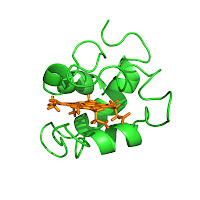
For my research, to create neat images of the molecules I study, I use Pymol. It's free, part of Debian, command-driven, very powerful and it produces really good-looking pictures. Although, admittedly, if you don't buy a subscription, the documentation is rather sparse. I'm using scripts to generate ray-traced pictures, but I can't include the ray command directly in the scripts, as Pymol would not give me the opportunity to change anything before tracing (and things I trace take loads of time...). So I write a ray command, but I comment it out, such as in the following example, cytochrome.pml:
load http://www.rcsb.org/pdb/files/1c6s.pdb
hide everything
show sticks, (resname HEC)
color orange, (resname HEC)
show cartoon
bg_color white
set_view (\
     0.939850032,    0.167392358,    0.297758341,\
     0.336208642,   -0.299271941,   -0.892972171,\
    -0.060366094,    0.939367712,   -0.337551534,\
     0.000000000,    0.000000000, -106.161231995,\
    33.668910980,   -4.749122620,  -24.822664261,\
    -9.742469788,  222.064941406,    0.000000000 )
# ray 800,800
So, to easily generate PNG images from such a file, I wrote the following makefile snippet, that does the job (as demonstrated by the figure on the right, produced by this very snippet ran on the cytochrome.pml file above):
%.png: %.pml
 cd $(dir $<); \
 ray_trace_args= grep -o 'ray.*' $(notdir $<)  tail -n1   egrep -o '([0-9, ]+)'   sed 's/ //g'  ; \
 pymol -c -d "@$(notdir $<)" -d "cmd.ray($$ray_trace_args)" -g $@
I hope this snippet will prove useful for others. At any rate, it will prove useful for me ! Just for the record, this protein, represented in cartoon view, is called cytochrome c6 and is one of the proteins implied in the photosynthesis of some organisms.

Matthew Palmer: Look Ma, I'm in the paper!

From the local paper, yesterday, in a larger article about the bushfires roaming hither and yon:

While arsonists are allegedly responsible for the fatal fires in Victoria, it was "idiots" who laid the groundwork for a potential blaze in the Royal National park near Helensburgh yesterday. Rural Fire Service Illawarra manager Richard Cotterill said that despite a total fire ban being in effect for the Illawarra and most of southern NSW, weekend bushwalkers in the park lit a campfire and then left it to smoulder. Mr Cotterill said two trucks with about 10 firefighters tended to the bushfire hazard just before 1pm, after being alerted to the smoking logs by a resident. "Obviously someone has not taken the fire ban rules into account and we are just lucky that we haven't had any significant wind conditions being as hot as it is," Mr Cotterill said. "Something like that is obviously potentially very, very dangerous. You get a wind blowing embers into the bush and it is downhill from there. "It's a very stupid thing to do and obviously people don't realise just how dangerous it can be."
I like Richard. Nice bloke, works hard for the local area, speaks straight and doesn't mince words. "Idiots" indeed. Several thousand homes are threatened if the Royal National Park burns. We've got easier evacuation paths than a lot of the people down in Victoria had, but it still could have been pretty bad. Meanwhile, the weather up here has turned grey and cold, which will be a mixed blessing for the firefighters working up at Peats Ridge and Singleton, and down around Bega. It's a lot nicer to fight a fire at 24 degrees celsius rather than 40, but the misty rain we've had around home would be enough to make backburning impossible, whilst not being enough to really knock down the fire. The winds we got on Sunday night would have made life far more exciting than is comfortable, too.

9 February 2009

Steve Kemp: It is an army bred for a single purpose

It is funny the way things work out when you're looking for help. Recently I was working on a Ruby + FUSE based filesystem and as part of the development I added simple diagnostic output via trivial code such as this:
@debug && puts "called foo(# param );"
That was adequate for minimal interactive use, but not so good for real live use. In real live use I started outputing messages to a dedicated logfile, but in practise became overwhelmed by thousands of lines of output describing everything ever applied to the filesystem. I figured the natural solution was to have a ring-buffer. (Everybody knows what a ringbuffer is, right?) It could keep the last 500 messages and newer debug information would just replace older entreis. That'd be just enough to be useful if I had a problem, but not so overwhelming it would get ignored. In Perl I found a nice ringbuffer library, but for Ruby nothing. Locking a region of shared memory via shmget, shmset and keeping an array of a few hunded strings would be simple, but it seems odd I have to code this myself. I started searching around and I accidentally stumbled upon the unrelated IPC::DirQueue perl module. Not useful for my ringbuffer logging problem, but beautifully useful. There is no package for Debian but that was easily created:
dh-make-perl --build --cpan IPC::DirQueue
Already I have a million and one uses for it - not least to solve my problem of maintaining a centralised quarantine for all the spam mail rejected by N MX machines. (Which currently uses a combination of rsync and lockfiles.) This is the reason why sites like Perl Advent Calendar are useful - they introduce a useful module every day or two, and introduce you to thinks that you can use in the future. Of course keeping a sustainable site like that up and running is hard which is why sites like debaday struggle to attract contributors, for example. Anyway random happyness. ObFilm: Lord of the rings: Two Towers

Biella Coleman: Electric Sun

Welcome, Congress, to our generation s electric sun. Earlier, I had posted the Wikileaks link to these congressional reports with comments of my own but I thought I would pen down a few thoughts as I finally electronically leafed through some of them. These reports remind me a little bit of another set of reports that are publicly available, which are the Congressional Quarterly reports, which are an excellent resource for research. They are a bit dry but provide a wealth of information and perhaps more important, citations to law cases, journalist articles, and academic pieces (everything that journalistic pieces, in other words, do not do). It does 1/2 the research for you, as I like to think. The few reports I have scanned from the leaks remind me, in fact, of the CQ reports, in content, style and tone. And while I thought CQ reports published on a wide range of topics, these semi-private reports are far more extensive in terms of topics and far more specific as well:
CRS: Humane Treatment of Farm Animals: Overview and Issues, December 10, 2008
CRS: FDA s Authority to Ensure That Drugs Prescribed to Children Are Safe and Effective, December 2, 2008
CRS: African American Members of the United States Congress: 1870-2008, December 4, 2008
CRS: The Pigford Case: USDA Settlement of a Discrimination Suit by Black Farmers, January 13, 2009
CRS: Selected Legal and Policy Issues Related to Coalbed Methane Development, March 9, 2004
I look forward to hearing/learning more about how they are used (I can t imagine that each report is read by many) and why exactly they were hidden away as they don t seem to be the type of information that should be kept classified.

Lucas Nussbaum: Ultimate Debian Database talk at FOSDEM

Of course, I was in Brussels this week-end, for FOSDEM. I gave a talk about Ultimate Debian Database (slides here) in the Debian devroom. The conclusion was UDD is ready, go play with it! so you know what you should do now! FOSDEM in general was great and huge (see the video from Quim Gil if you still doubt that) as usual. On a more sad note, the worst talk of the week-end was without any possible doubt Frans Pop s release team bashing. Nobody is claiming that the release management of the lenny release cycle was perfect: there s always room for improvement. But given the context and the constraints, I think that they did a very good job. Frans talk boiled down to: The release team doesn t know what they are doing, I would have done much better because I m so qualified. Giving such talks at FOSDEM, in front of an audience with many people not involved in Debian development, is really insulting. To make things worse, he finished the talk late, not leaving any time for questions/discussion, so the audience might be left with the impression that his opinions are representative of the opinions of DDs.

MJ Ray: Setting up and sustaining a global FOSS-based business (Ian Lynch)

Another Monday, start of the working week and I m thinking about business again. Ian Lynch of The Learning Machine is a smart cookie who I ve collaborated with before. He leads a free-software-based business which is very different from TTLLP s cooperative model and he gave a talk about it to Manchester Free Software. Here are the headlines:-
Building a FOSS Business
  • No fees from licenses
  • Services allied to FOSS
  • Something everyone needs
  • Low cost to produce
  • Low cost to distribute
  • Encourage FOSS take up
  • Increase the number of FOSS contributors
  • Make money to support FOSS development
Background theory and research
  • Clay Christensen and the theory of disruptive innovation
  • The innovators dilemma
  • Seeing What is Next
Business Growth
  • 3 horizons of business growth
  • Horizon 1 current profitable business
  • Horizon 2 business with clear potential
  • Horizon 3 possibilities currently being explored
  • Pipeline for growth
Tipping points
  • Critical mass
  • Viral effects
The ideal product
  • Something everyone needs
  • Something that costs nothing to make
  • Something that costs nothing to distribute
  • Something that has increasing value the more that is bought.
The INGOTs
  • International Grades Open Technologies
  • Market disruption
  • Lower barriers to entry
  • Target those currently not in the market
  • Provide products that are good enough
  • Improve and add features over time
Primary Schools - KS3
  • No-one targets primary schools
  • Very little certification in KS3
  • Use specialist schools community plans
  • Upsell from primary to secondary
  • KS3 add value at with less work for teachers
Developing world
  • Enable developing countries into the qualifications market
  • Target those making the transition to FOSS
  • Ally to netbook/smartphone internet access to lower costs
  • Use UK Awarding Body status for credibility.
The above points are under a Creative Commons cc-by-sa license and the original report was at Manchester Free Software. Sometimes FSUK-Manchester produce videos of talks, but I ve not seen this one yet. Watch their page for details. What can Ian s business analysis teach us about free software businesses? What interesting questions does it leave open? Have you had anything to do with the INGOTs? I ve not worked in education for a while, so I d love to hear tales from the chalkface about them.

8 February 2009

Joey Hess: focusing on the screen

Biella asks if I can read novels from a screen. Yes, I've read what has to be getting close to a thousand novels that way, over the past 8+ years. I was thinking about this just the other day as I read The once and future e-book: on reading in the digital age. That article does a good job arguing against many of the common complaints about ebooks, such as "I can't read an ebook in the bathtub".
my pile of paper
Right now, I have a pile of paper books I want to read or am in the middle of reading. But if I want something new to read, I don't reach for that pile, but for my (much larger) directory of ebooks. The pile of paper is reserved for special occasions: plane trips, camping, etc. I started reading ebooks in circumstances where it was too hard to get access to paper ones. Traveling in the third world, hauling along a lot of paper books wasn't practical. Living rural, where every book had to be backpacked in. I've stuck with it because it works for me and because I've enjoyed stretching my muscles of concentration on the screen. To me, the focus required to read an ebook from the screen is similar to the focus required to work on a program. And completly different than skimming through a web page. The best example of this that I have right now is Real World Haskell, which I've almost finished (hurrah!) reading in a combination of paper and web editions. I was only able to stick with reading this book when I got the paper version. I use the web version for reference, or for looking for help on a challenging part of the book. For reading, it's just too much a web page; too easy to skim, or be distracted by the comments that can be attached to every paragraph, or jump off to Wikipedia.
screenshot of my ebook reader
Just as most programmers tune their development environment so that it uniquely suites them, I've put a lot of thought, trial, and error into tuning my ebook reading environment. The most important thing seemed to be getting rid of anything that interfered with focusing on the text. Since I wasn't (easily) able to use that environment for reading Real World Haskell, I wasn't able to read it from the screen.

Peter Van Eynde: @ fosdem but also not really

This year I managed to go to fosdem every day, even at the beer event. Not that I attended many talks: I was quite busy getting the network to work. We got wireless in almost all locations in the end. Setting up and fixing the problems took most of Saturday. On Sunday we added the final 'experimental' room via a wireless bridge link across the square, with the beam over the heads of the people in the queue for Belgian fries.

In the end it all worked and we had only a few configuration and many cable problems. I must say it was more for to 'work' at fosdem then to just be there. May thanks to Jerome Paquay who actually arranged to lend the equipment from our employer (Cisco) and to configure it. Thanks for AY for ... well being AY.

Next year n-mode? serious uplinks?


Ian Wienand: Converting DICOM images

If you go for an ultrasound or some other imaging procedure, they may give you a CD with the images that requires some overly complicated and under-featured Windows viewer. Chances are these images are in DICOM format, which is like the AVI of the medical world. Your first clue will be that file might report the file as an unoptimised QuickTime movie, e.g.
$ file ./QMAG0001
./QMAG0001: Apple QuickTime movie (unoptimized)
After figuring out the file type wasn't actually anything to do with QuickTime, I tried some of the many different tools and methods to convert this to something viewable. Unfortunatley, the DICOM viewer in GIMP and ImageMagick (probably the same thing?) didn't like the files at all, and neither did a range of other tools. I finally managed to do it with the dcm2pnm tool from the Debian dcmtk package -- just point it at the file and it spits out a PNM which is easily converted by all graphics tools. You can also encapsulate a series of images in a DICOM file, like a little movie. dcm2pnm extracts these easily, but requires the --all-frames options. An ffmpeg recipe to turn these extracted files into a more easily viewable movie is:
$ ffmpeg -qscale 5 -r 20 -b 9600 -i foo.%d.ppm movie.mp4
I certainly can't guarantee this will actually work for you, as DICOM appears to be an extremely complicated format with many possible vendor extensions. But hopefully it's a starting point!

5 February 2009

Frans Pop: Debian on HP 2510p

In August I got a very nice HP 2510p notebook which is now my main system for development. This took a while for two reasons. First of all the system did not resume 100% reliably. This has now been solved, although the final patches needed for that will only be in 2.6.29, but that's no problem as I run upstream kernels anyway (I do quite a bit of kernel testing). Kudos have to go to Rafael J. Wysocki who has been doing a huge amount of work to improve the suspend/resume code in the kernel. Second of all I wanted a docking station so I could continue to use my 19" monitor, with the laptop's LCD as second display. I bought the docking station in December. The challenge then was to automatically (de)activate the external display when the notebook is (un)docked. Unfortunately there are no ACPI events, but the hp-wmi module (written by Mattew Garrett) sends docking events to the input subsystem. I wrote a small program to catch these events and a script that uses xrandr to switch displays. There were two issues with that setup. The first docking event was getting lost, but I managed to fix that. And the X server would crash when starting some applications (einstein and virtualbox) after undocking, but there's a patch for that too now. The notebook is now really well supported and stable. The system is currently running Debian/lenny with a KDE desktop and a 2.6.29-rc3 kernel. Working with upstream developers to get this far has really been worthwhile, and fun.

4 February 2009

Daniel Kahn Gillmor: Python editor/IDE for new (high school) coders?

I'm supporting a class of high school students who are new to programming, and will be learning some python. Most of these students are comfortable with computers, but not hacker types, and few if any of them have written code before. I'm looking for an editor or an Integrated Development Environment (IDE) that won't be too scary for them, and will help them get used to the novel idea of writing code without simultaneously having to get used to the novel idea of an unfamiliar user interface. So i can't expect them to pick up my beloved emacs, for example. But on the other end of the spectrum, i'd hate for them to try to write python in an word processor (i've seen people do it!). Here's what i think i'm looking for: Do you have suggestions for tools that work well for the above needs? Favorites? Are there features other than the "top three" i listed above that you think i should pay attention to? FWIW, they'll be working in a labful of machines running Ubuntu Hardy for the most part, but i'm willing to port and deploy programs (particularly ones that feel like a perfect fit) if they're not available in hardy.Tags: ide, python, recommendations, student

Next.

Previous.