Clint Adams: Mystical secrets of the bookworm
apt install usrmerge or perform its equivalent on or prior to 2021-08-14.
We are very pleased to announce that Lenovo,
Infomaniak,
Roche,
Amazon Web Services (AWS)
and Google,
have committed to supporting DebConf21 as Platinum sponsors.
As a global technology leader manufacturing a wide portfolio of connected products,
including smartphones, tablets, PCs and workstations as well as AR/VR devices,
smart home/office and data center solutions, Lenovo
understands how critical open systems and platforms are to a connected world.
Infomaniak is Switzerland's largest web-hosting company,
also offering backup and storage services, solutions for event organizers,
live-streaming and video on demand services.
It wholly owns its datacenters and all elements critical
to the functioning of the services and products provided by the company
(both software and hardware).
Roche
Roche is a major international pharmaceutical provider and research company
dedicated to personalized healthcare. More than 100.000 employees worldwide
work towards solving some of the greatest challenges for humanity using
science and technology. Roche is strongly involved in publicly funded
collaborative research projects with other industrial and academic partners
and have supported DebConf since 2017.
Amazon Web Services (AWS) is one of the world's
most comprehensive and broadly adopted cloud platform,
offering over 175 fully featured services from data centers globally
(in 77 Availability Zones within 24 geographic regions).
AWS customers include the fastest-growing startups, largest enterprises
and leading government agencies.
Google is one of the largest technology companies in the
world, providing a wide range of Internet-related services and products such
as online advertising technologies, search, cloud computing, software, and hardware.
Google has been supporting Debian by sponsoring DebConf for more than
ten years, and is also a Debian partner sponsoring parts
of Salsa's continuous integration infrastructure
within Google Cloud Platform.
With these commitments as Platinum Sponsors,
Lenovo, Infomaniak, Roche, Amazon Web Services and Google are contributing
to make possible our annual conference,
and directly supporting the progress of Debian and Free Software,
helping to strengthen the community that continues to collaborate on
Debian projects throughout the rest of the year.
Thank you very much for your support of DebConf21!
Participating in DebConf21 online
The 22nd Debian Conference is being held Online, due to COVID-19,
from August 22nd to 28th, 2021. There are 8 days of activities, running from 10:00 to 01:00 UTC.
Visit the DebConf21 website at https://debconf21.debconf.org
to learn about the complete schedule, watch the live streaming and join the different
communication channels for participating in the conference.
tools.deps.alpha, a library for dependency graph
resolution and classpath building, and the CLI tool clj, for REPL
interaction. If time permitted, I was also to improve the quality of
both new and existing Clojure packages, and the overall Debian Clojure
packaging process. My mentor was Louis-Louis-Philippe V ronneau, and my
co-mentor was Utkarsh Gupta.clojure-debian-helper). The second reason for which we only
currently have a suboptimal Clojure experience in Debian, and probably
the root of the previous one, is that many core build tools and
libraries for the language have not simply been packaged yet. My project
aimed to attack that seemingly root cause.As I said, another reason for me choosing this project is my own
experience as the Co-founder and Leader of, probably, the first Free
Software Community experience in my hometown of San Juan, Argentina.
That interest in Free Software evolved in a first PhD attempt in what is
now known as the field of Peer Production. A subject that has lived
within me as a research interest during my day job at a University.Being a Clojure fan, it felt only logical combining all those interests
somehow. And this project seemed like the ideal combination.clojure-cli.clojure-cli.clojure to use clojure-cli.clojure-cli scripts.private field in the API and Self-Service section in requesting tests to adding an option to publish them when ready through both interfaces.
Merge Requests:
Rspec for writing tests in ruby and understood how writing tests is an integral part of coding any project.
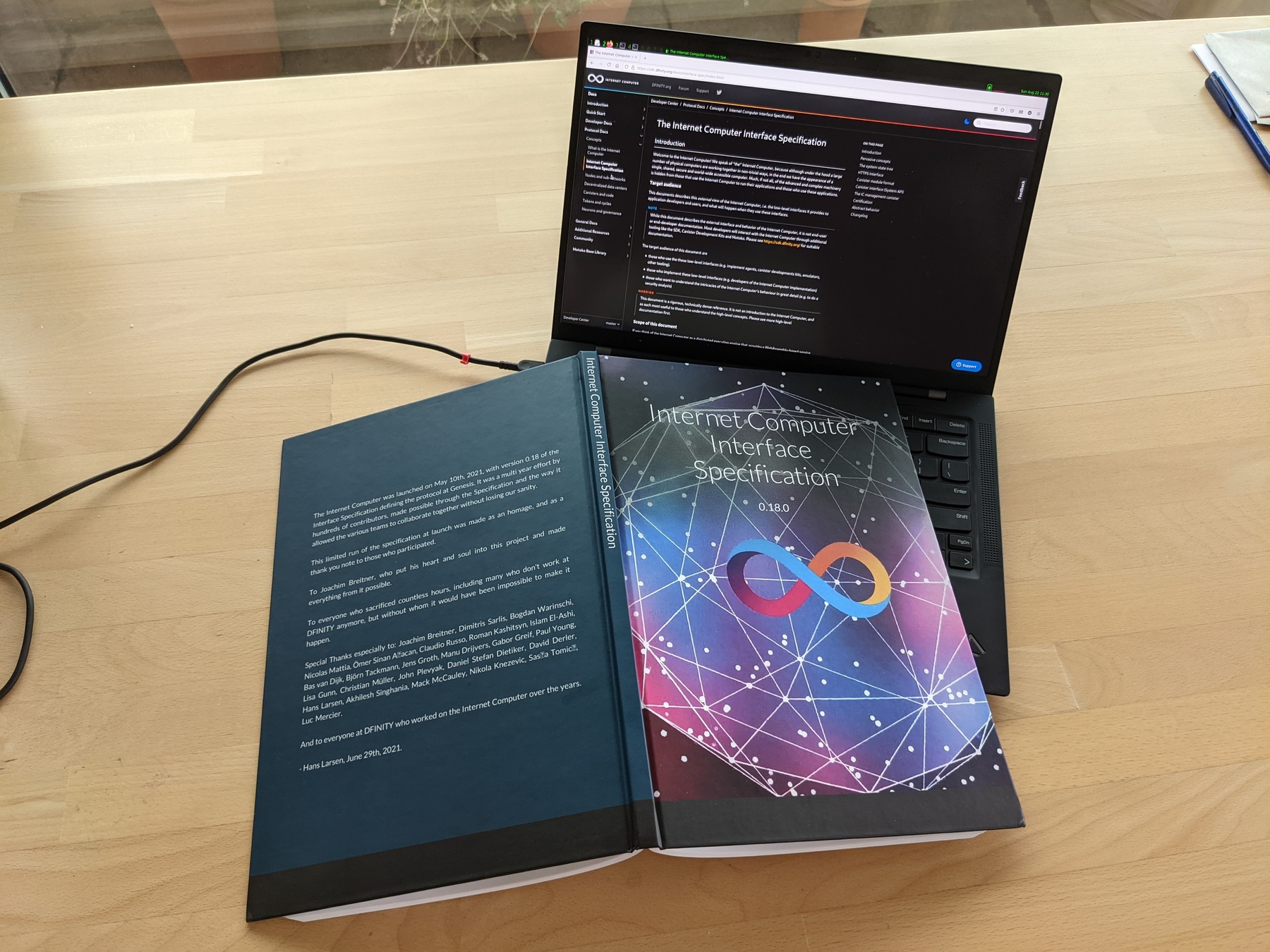
Two months ago was my last day of working as an employee for DFINITY, and as I mentioned in the previous blog post, one of my main contributions was the introduction and maintenance of the Interface Specification.
The Interface Specification as a book
ic-ref repository.
The third release of RcppFastFloat arrived on CRAN. The package wraps fastfloat, another nice library by Daniel Lemire. For details, see the recent arXiv paper showing that one can convert character representations of numbers into floating point at rates at or exceeding one gigabyte per second.
This release deals with a header include on everybody s favourite CRAN platform bringing the result status to a clean suite of all OKs.
Courtesy of my CRANberries, there is also a diffstat report for this release. If you like this or other open-source work I do, you can now sponsor me at GitHub.Changes in version 0.0.3 (2021-08-21)
- Account for SunOS with an additional
#define- Minor update to
DESCRIPTION
This post by Dirk Eddelbuettel originated on his Thinking inside the box blog. Please report excessive re-aggregation in third-party for-profit settings.
Continuing with details of the task I left on
extra-apt-sources parameter is added to both API and Self-Service section for the test request object and the part which took some time was deciding on its validation since if you ever deal with apt sources, you would know that there exist a lot of combinations of a valid apt source and in the end, the decision was taken to just add the minimal checks.
private tests, it made sense to have a way of looking them up in the Self-Service section. So a new column is added to the test records in Job-History marking the visibility of a test (private or public) and a new filter to filter out records based on the visibility.
retry tests is also added in Self-Service in the Job-History section so that private tests can also be retried. As earlier, this option was only available in Package History pages but those pages do not show the private tests.
publish these test results of private tests at some point.
For the API section, a new endpoint is added to accept a string of run_ids which is ready to be published, and for the Self-Service , in the Job-History page a Publish button is added to be clicked after check boxing the required tests.
I've now completed my 4th year on my part-time PhD (a.k.a.
Stage 2). I'm 2/3 of the way through.
Here's my stage 2 / year 4 report. As I've written before,
this isn't graded so it might not be an example of a good one, but I
did pass progression.
I had hoped to write some more blog posts about the actual content of my
work before another administrative document. I spent a couple of hours
drafting one a few weeks back but didn't finish it!
I have been using the GIMP since about 20 years or so, but recently started to also work with Krita since I found it quite nice to work with (besides the text module, which is a pain).
As there came out the first beta of Krita 5, I decided to throw it into my KDE/Plasma OBS builds to try it out. To get it working, add my OBS key say in /usr/local/share/keyrings/obs-npreining.asc and add a file /etc/apt/sources.lists.d/obs-npreining-krita-beta.list, containing the following line:
deb [signed-by=/usr/local/share/keyrings/obs-npreining.asc] https://download.opensuse.org/repositories/home:/npreining:/debian-kde:/krita-beta/Debian_Unstable/ ./
Warning: Krita will also warn you, but files saved with version 5 might not be openable with version 4 of Krita, so be sure to have a backup of your files in case you need to go back to Krita 4.
Enjoy.
181. This version includes the following changes:
[ Chris Lamb ]
* New features and bug fixes:
- Don't require apksigner in order to compare .apk files using apktool.
- Add a special-case to squshfs image extraction to not fail if we aren't
root/superuser. (Closes: #991059)
- Reduce the maximum line length to avoid O(n^2) Wagner-Fischer algorithm,
which meant that diff generation took an inordinate amount of time.
(Closes: reproducible-builds/diffoscope#272)
- Include profiling information in --debug output if --profile is not set.
- Don't print an orphan newline when the Black source code formatter
self-test passes.
* Tests:
- Update test to check specific contents of squashfs listing, otherwise it
fails depending on the test systems uid-to-username mapping in passwd(5).
- Assign "seen" and "expected" values to local variables to improve
contextual information in/around failed tests.
* Misc changes:
- Print the size of generated HTML, text (etc.) reports.
- Profile calls to specialize and diffoscope.diff.linediff.
- Update various copyright years.
I have an early model Raspberry Pi 4. I wanted to install Debian on an SSD connected via a cable to a USB3 port. It turned out that the version of the software in the EEPROM would not boot reliably so the first task was to update this with the latest stable EEPROM available from the Raspberry Pi downloads.
The easiest way to do this was to boot an SD card with Raspbian on. Once that was done, I had a Pi that would boot from an SSD.
Untar the files
A tarball of UEFI from Pete's Github repository at https://github.com/pftf/RPi4/releases - latest is v 1.29 as at 20210814.
Plugging in the SSD to another machine to format the drive: msdos format, one ESP partition in FAT32 and marked bootable and the rest of the drive blank.
One aarch64 DVD image from the usual place.
https://cdimage.debian.org/debian-cd/current/arm64/iso-dvd/debian-11.0.0-arm64-DVD-1.iso
Untar the UEFI tarball into the ESP partition you've just made
Plug the SSD into a USB3 port on the RPi using a USB -> SATA cable
Write the aarch image to a USB stick using dd and place that into one of the other USB ports. Add a keyboard.
Install
Power up the RPi4, hit Esc and work your way through UEFI to select a boot device and go, save the settings and go.
The install is almost identical to any Debian d-i install.
There is a setting in UEFI to reclaim the 1G of memory that was masked out, there's a setting for control of the fan shim if you have that style of fan.
End result - happiness
Done the other day and sitting next to me on the desktop.
YNAB
On the advice of many friends, I tried to use You Need A
Budget. I gave it a seriously long, proper
evaluation: over a year. But I just couldn't get it to work for me. I don't
want to try and explain why. To be honest, those same friends who advocated for
it fairly strongly, also gave me a pretty hard time for giving up on it!
Despite it not clicking for me, there are a few concepts from YNAB that I quite
like:
hledger.
| Publisher: | Tordotcom |
| Copyright: | 2021 |
| ISBN: | 1-250-30112-2 |
| Format: | Kindle |
| Pages: | 151 |
I'm awfully lucky when you think about it. Garbagetown is the most wonderful place anybody has ever lived in the history of the world, even if you count the Pyramids and New York City and Camelot. I have Grape Crush and Big Bargains and my hibiscus flower, and I can fish like I've got bait for a heart so I hardly ever go hungry, and once I found a ruby ring and a New Mexico license plate inside a bluefin tuna. Everyone says they only hate me because I annihilated hope and butchered our future, but I know better, and anyway, it's a lie. Some people are just born to be despised. The Loathing of Tetley began small and grew bigger and bigger, like the Thames, until it swallowed me whole.Garbagetown is a giant floating pile of garbage in the middle of the ocean, and it is, so far as anyone knows, the only "land" left in the world. Global warming has flooded everything until the remaining Fuckwits (as their future descendants call everyone who was alive at the time) took to the Misery Boats and searched hopelessly for land. Eventually they realized they could live on top of the now-massive Pacific Garbage Patch and began the Great Sorting, which is fifty years into Tetley's past. All of the types of garbage were moved into their own areas, allowing small micronations of scavengers to form and giving each area its own character.
Candle Hole is the most beautiful place in Garbagetown, which is the most beautiful place in the world. All of the stubs of candles the Fuckwits threw out piled up into hills and mountains and caverns and dells, votive candles and taper candles and tea lights and birthday candles and big fat colorful pillar candles, stacked and somewhat melted into a great crumbling gorgeous warren of wicks and wax. All the houses are cozy little honeycombs melted into hillside, with smooth round windows and low golden ceilings. At night, from far away, Candle Hole looks like a firefly palace. When the wind blows, it smells like cinnamon, and freesia, and cranberries, and lavender, and Fresh Linen Scent, and New Car Smell.Two things should be obvious from this introduction. First, do not read this book looking for an accurate, technical projection of our environmental future. Or, for that matter, physical realism of any kind. That's not the book that Valente is writing and you'll just frustrate yourself. This is science fiction as concretized metaphor rather than prediction or scientific exploration. We Fuckwits have drowned the world with our greed and left our descendants living in piles of our garbage; you have to suspend disbelief and go with the premise. The second thing is that either you will like Tetley's storytelling style or you will not like this book. I find Valente very hit-and-miss, but this time it worked for me. The language is a bit less over-the-top than Space Opera, and it fits Tetley's insistent, aggressive optimism so well that it carries much of the weight of characterization. Mileage will definitely vary; this is probably a love-it-or-hate-it book. The Past is Red is divided into two parts. The first part is the short story "The Future is Blue," previously published in Clarkesworld and in Valente's short story collection of the same name. It tells the story of Tetley's early life, how she got her name, and how she became the most hated person in Garbagetown. The second part is much longer and features an older, quieter, more thoughtful, and somewhat more cynical Tetley, more life philosophy, and a bit of more-traditional puzzle science fiction. It lacks some of the bubbly energy of "The Future is Blue" but also features less violence and abuse. The overall work is a long novella or very short novel. This book has a lot of feelings about the environment, capitalism, greed, and the desire to let other people solve your problems for you, and it is not subtle about any of them. It's satisfying in the way that a good rant is satisfying, not in the way that a coherent political strategy is satisfying. What saves it from being too didactic or self-righteous is Tetley, who is happy to record her own emotions and her moments of wonder and is mostly uninterested in telling other people what to do. The setting sounds darkly depressing, and there are moments where it feels that way in the book, but the core of the story and of Tetley's life philosophy is a type of personal resilience: find the things that make you happy, put one foot in front of the other, and enjoy the world for what it is rather than what it could be or what other people want to convince you it might be. It's also surprisingly funny, particularly if you see the humor in bizarrely-specific piles of the detritus of civilization. The one place where I will argue with Valente a bit is that The Past is Red thoroughly embraces an environmental philosophy of personal responsibility. The devastating critique aimed at the Fuckwits is universal and undistinguished except slightly by class. Tetley and the other inhabitants of Garbagetown make no distinction between types of Fuckits or attempt to apportion blame in any way more granular than entire generations and eras. This is probably realistic. I understand why, by Tetley's time, no one is interested in the fine points of history. But the story was written today, for readers in our time, and this type of responsibility collapse is intentionally and carefully constructed by the largest polluters and the people with the most power. Collective and undifferentiated responsibility means that we're using up our energy fretting about whether we took two showers, which partly deflects attention from the companies, industries, and individuals that are directly responsible for the vast majority of environmental damage. We don't live in a world full of fuckwits; we live in a world run by fuckwits and full of the demoralized, harried, conned, manipulated, overwhelmed, and apathetic, which is a small but important difference. This book is not the right venue to explore that difference, but I wish the vitriol had not been applied quite so indiscriminately. The rest, though, worked for me. Valente tends to describe things by piling clauses on top of adjectives, which objectively isn't the best writing but it fits everything about Tetley's personality so well that I think this is the book where it works. I found her strange mix of optimism, practicality, and unbreakable inner ethics oddly endearing. "The Future is Blue" is available for free on-line, so if in doubt, read some or all of it, and that should tell you whether you're interested in the expansion. I'm glad I picked it up. Content warning for physical and sexual abuse of the first-person protagonist, mostly in the first section. Rating: 7 out of 10

.zim) files that can be downloaded and viewed entirely offline. You can get the entire text of the English Wikipedia in less than 100GB.
apt install kiwix will get you a graphical desktop application that allows you to download and read ZIMs. apt install kiwix-tools installs kiwix-serve (among others), which serves ZIM files over an HTTP server.
Additionally, there are now tools in Debian that allow you to create your own ZIM files: zimwriterfs and the python3-libzim library.
All of this would not have been possible without the support of the Kiwix developers, who made it a priority to properly support Debian. All of the Kiwix and repositories have a CI process that builds Debian packages for each pull request and needs to pass before it'll be accepted.
Ubuntu users can take advantage of our primary PPA or the bleeding-edge PPA. For Debian users, my goal is that unstable/sid will have the latest verison within a few days of a release, and once it moves into testing, it'll be available in Debian Backports.
It is always a pleasure working with the Kiwix team, who make a point to send stickers and chocolate every year :)
git clone using the https address I got a fatal not found error.
It seems that gitweb, out of the box, allows for easy web-browsing of git
repositories but needs some extra work if you want to clone over https.
Specifically, you need to use git-http-backend.
The git-http-backend man page is very useful, but assumes you are accessing
your repos via https://example.org/git instead of simply
https://git.exmple.org.
These lines are my variation to the suggested apache configuration lines provided by
man git-http-backend.
They differ by:
/usr/lib/git-core path instead of /usr/libexec/git-coregit-receive-pack since I only plan to clone and don t plan to push
back to this repo.DocumentRoot /usr/share/gitweb
<Directory /usr/share/gitweb>
Options +FollowSymLinks +ExecCGI
AddHandler cgi-script .cgi
Require all granted
</Directory>
<Directory /usr/lib/git-core>
Require all granted
</Directory>
SetEnv GIT_PROJECT_ROOT /var/lib/git
AliasMatch ^/(.*/objects/[0-9a-f] 2 /[0-9a-f] 38 )$ /var/lib/git/$1
AliasMatch ^/(.*/objects/pack/pack-[0-9a-f] 40 .(pack idx))$ /var/lib/git/$1
ScriptAliasMatch \
"(?x)^/(.*/(HEAD \
info/refs \
objects/info/[^/]+ \
git-upload-pack))$" \
/usr/lib/git-core/git-http-backend/$1
ScriptAlias / /usr/share/gitweb/gitweb.cgi/
apache2, some requests to
/usr/lib/git-core/git-http-backend, and everything else to gitweb.cgi.
Bullseye has been released, and we are in the post-release rush with lots of changes going on. On the KDE/Plasma side we are trying to move all our accumulated changes to unstable. On the OSC side, frameworks 5.85 and KDE Gears 21.08.0 have been released.
Debian Bullseye
As mentioned previously, the now released Debian/Bullseye contains KDE Frameworks 5.78, including several backports of fixes from 5.79 to get smooth operation. Plasma 5.20.5, again with several cherry picks for bugs will be in Bullseye, too. The KDE/Apps are mostly at 20.12 level, and the KDE PIM group packages (akonadi, kmail, etc) are at 20.08.
Debian unstable (and in time also testing)
Frameworks 5.83 and Plasma 5.21.5 have been uploaded to unstable. This is a temporary measure until several necessary packages have cleared the NEW queue. After that we will upload frameworks 5.85 and Plasma 5.22.N.
KDE Gears is still at 20.08, but we have 21.04 in experimental, and I am currently preparing to upload 21.08.0, should be done soon.
OBS packages
The OBS packages as usual follow the latest release, and currently ship KDE Frameworks 5.85, KDE Gears 21.08.0, and Plasma 5.22.4. The package sources are as usual (note the different path for the Plasma packages and the apps packages, containing the release version!), for Debian/unstable:
deb https://download.opensuse.org/repositories/home:/npreining:/debian-kde:/frameworks/Debian_Unstable/ ./
deb https://download.opensuse.org/repositories/home:/npreining:/debian-kde:/plasma522/Debian_Unstable/ ./
deb https://download.opensuse.org/repositories/home:/npreining:/debian-kde:/apps2108/Debian_Unstable/ ./
deb https://download.opensuse.org/repositories/home:/npreining:/debian-kde:/other/Debian_Unstable/ ./
and the same with Testing instead of Unstable for Debian/testing.
OBS for bullseye
For now, use the Testing packages with the addition dependencies:
deb https://download.opensuse.org/repositories/home:/npreining:/debian-kde:/other-deps/Debian_Testing/ ./
deb https://download.opensuse.org/repositories/home:/npreining:/debian-kde:/frameworks/Debian_Testing/ ./
deb https://download.opensuse.org/repositories/home:/npreining:/debian-kde:/plasma522/Debian_Testing/ ./
deb https://download.opensuse.org/repositories/home:/npreining:/debian-kde:/apps2108/Debian_Testing/ ./
deb https://download.opensuse.org/repositories/home:/npreining:/debian-kde:/other/Debian_Testing/ ./
Sooner or later OBS will offer Debian Bullseye as proper target, and then I will prepare releases for it and write another blog post.
Closing
Expect continued breakage of the next weeks until the upload storm subsides a bit.
nailing-cargo/1.0.0.
nailing-cargo
is a wrapper around the Rust build tool cargo. nailing-cargo can:
Cargo.toml)
crates.io, which is a minimally-curated repository.
I didn't want to expose my main account to that.
And, at the time, I was working on a project which for which I was
also writing a library as a dependency, and I found that cargo
couldn't cope with this unless I were to commit (to my git repository)
the path (on my local laptop) of my dependency.
I filed some bugs, including about the unpublished crate problem.
But also, I was stubborn enough to try to find
a workaround that didn't involve committing junk to my git history.
The result was a
short but horrific shell script.
I wrote about this
at the time (March 2019).
Over the last few years the difficulties I have with cargo have
remained un-resolved. I found my
interactions
with
upstream
rather discouraging.
It didn't seem like I would get anywhere by trying to help
improve cargo to better support my needs.
So instead I have gradually improved nailing-cargo. It is now a Perl
script. It is rather less horrific, and has
proper documentation
(sorry, JS needed because GitLab).
Why Perl ?
Rust would have been my language of choice. But I wanted to avoid a
chicken-and-egg situation. When you're doing privsep, nailing-cargo
has to run in your more privileged environment. I wanted something
easy to get going with.
nailing-cargo has to contain a TOML parser; and I found a small one,
TOML-Tiny, which was good enough as a starting point, and small enough
I could bundle it as a git subtree. Perl is nicely fast to start up
(nailing-cargo --- true runs in about 170ms on my
laptop), and it is easy to write a Perl script that will work on
pretty much any Perl installation.
Still unsolved: embedding cargo in another build system
A number of my projects contain a mixture of Rust code with other
languages. Unfortunately, nailing-cargo doesn't help with the
problems which arise trying to integrate cargo into another build
system.
I generally resort to find runes for finding Rust source
files that might influence cargo, and stamp files for seeing if I have
run it recently enough; and I simply live with the fact that cargo
sometimes builds more stuff than I needed it to.
Future
There are a number of ways nailing-cargo could be improved.
Notably, the need to overwrite your actual Cargo.toml is
very annoying, even if nailing-cargo puts it back afterwards.
A big problem with this is that it means that
nailing-cargo has to take a lock, while your cargo rune runs.
This effectively prevents using nailing-cargo with long-running
processes. Notably, editor integrations like rls and racer.
I could perhaps solve this with more linkfarm-juggling, but that
wouldn't help in-tree builds and it's hard to keep things up to date.
I am considering using
LD_PRELOAD trickery or maybe bwrap(1) to "implement"
the alternative Cargo.toml feature which was
rejected by cargo upstream in 2019
(and
again in April
when someone else asked).
Currently there is no support for using sudo for
out-of-tree privsep. This should be easy to add but it needs someone
who uses sudo to want it (and to test it!)
The documentation has some other
dicusssion of limitations, some of
which aren't too hard to improve.
Patches welcome!| Series: | Between Earth and Sky #1 |
| Publisher: | Saga Press |
| Copyright: | October 2020 |
| ISBN: | 1-5344-3769-X |
| Format: | Kindle |
| Pages: | 454 |
Next.