Search Results: "ean"

21 October 2013

Aigars Mahinovs: Moved to Mezzanine

After my server that has hosted my blog for some years had given out its last breath (second motherboard failure), I decited it was time for a change. And not just server change, but also change in the blog engine itself. As I now focus on Python and Django almost exclusively at work, it felt logical to use some kind of Django-based blog or CMS. I tried django-cms and mezzanine and ... Mezzanine is so fast and simple, that I simply stopped looking. After simply following the tutorial and creating a skeleton project, I had a ready-to go site with all the CMS features, incuding a blog. I just had to change a few settings to have the blog module be the home page of the site, change site settings for the title and Google Analytics settings and such and tweak the theme a bit to my liking. This was my first real exposure to a Bootstrap design. I must say - it is very simple to understand and modify if your needs fit within its limits. For example, I wanted to remove the left sidebar and expand the main content block to fill that. All I had to do was to remove the div element with class "left-sidebar span-2" and change the class of the main content part from "span-7" to "span-9". To do that I simply copied the templates/base.html file from mezzanine default templates and modified it. The information from django-debug-toolbar showed me what files were used in rendering the page. But the feature that really got me hooked was the Wordpress import. Using a simple management command I was able to feed into Mezzanine instance the XML export file from Wordpress. It created blog posts, categories, comments, static pages and even redirects from Wordpress permalinks to Mezzanine permalinks. It was not flawless - there were a few issues: After that was done it was a relatively straightforward process of picking up the code and data and deploying it to a Django-friendly hosting service. There is a plenty of good competition out there, most now offer a simple one-click Django installation, so I just created a simple Django skeleton via their web interface and then replace what they generated with my app while keeping their settings as local_settings.py . I should probably write a bit more details about the process. After I create a custom fabric file for this. It is quite a strange feeling to have a Mezzanine blog that responds faster from a shared server half a continent away, compared to a Wordpress on dedicated server in the same room There are a few features that I am still missing - most notably draft post autosave. That has bitten me hard while writing this post :P Also a Twitter digest post feature. But on the bright side - that is a great motivation to write such features, preferably in a portable way that other people can use too :)

17 October 2013

Don Armstrong: Using Mutt with Org Mode (with refile)

I use org mode extensively, and had added Zack's workflow for integrating mutt with org mode to my ~/.emacs some time ago. However, I've been annoyed that refiling closes the org-capture frame before refiling finishes. The following trivial modification to Zack's code (which I previously modified to work with org-mode >= 0.8) waits to close the frame until you've finished refiling.
 (require 'org-protocol)
 (add-hook 'org-capture-mode-hook 'delete-other-windows)
 (setq my-org-protocol-flag nil)
 (defadvice org-capture-finalize (after delete-frame-at-end activate)
   "Delete frame at remember finalization"
   (progn (if my-org-protocol-flag (delete-frame))
          (setq my-org-protocol-flag nil)))
 (defadvice org-capture-refile (around delete-frame-after-refile activate)
   "Delete frame at remember refile"
   (if my-org-protocol-flag
       (progn
         (setq my-org-protocol-flag nil)
         ad-do-it
         (delete-frame))
     ad-do-it)
   )
 (defadvice org-capture-kill (after delete-frame-at-end activate)
   "Delete frame at remember abort"
   (progn (if my-org-protocol-flag (delete-frame))
          (setq my-org-protocol-flag nil)))
 (defadvice org-protocol-capture (before set-org-protocol-flag activate)
   (setq my-org-protocol-flag t))
Now, the frame automatically disappears after you refile it, keeping my refile.org clean.

16 October 2013

Matthew Garrett: Standing for the Linux Foundation Technical Advisory Board

According to its charter, the Linux Foundation Technical Advisory Board exists "to advise The Linux Foundation Board of Directors (Board) and the management of The Linux Foundation (Management) on matters related to supporting the technical agenda of The Linux Foundation". It consists of 10 members, with 5 seats up for election each year. Elections take place at an event at Kernel Summit, but are also open to attendees of whichever conference is colocated with the Kernel Summit that year. The election announcement is emailed to the Linux kernel list and tech-board-discuss, a mostly moribund list that springs into life once a year for election announcements.

This arrangement seemed odd to me even back in 2007. Back then the Linux Foundation was already sponsoring development of certain non-kernel components, and now that list is even larger. While nominally open to all, nominations for the TAB tend to end up being people actively involved in the kernel community. That's probably better than people limited to any other single technical community (kernel developers tend to end up dealing with bugs from a fairly wide range of projects, so they're not entirely unaware of what other people have to deal with), but it still seems suboptimal. The current membership is mostly limited to people who spend little to no time working with userspace developers, let alone anyone active in other Linux Foundation projects. I don't think this is a good thing

So, after several years of considering it, I'm finally standing for the TAB. I've been an active developer at most levels of the Linux stack, from the kernel through to desktop environments. I've worked closely with distributions. I've even worked closely with firmware developers. I'm not intimately involved in any of the other Linux Foundation projects, but I have experience that allows me to better understand their needs and motivations than I'd have from having spent my entire life living in the kernel. Being on the TAB would make it easier to ensure that these projects are represented in a meaningful way.

Of the other people who I know are standing (and this list may well grow longer), I'm inclined to vote for:
The election is currently scheduled to be National Museum in Edinburgh on the evening of the 23rd of October. If you're attending Linuxcon or one of the colocated events, please do come along and vote.

(Updated to correct a typo)

comment count unavailable comments

15 October 2013

Matthew Garrett: Hacker News is a social echo chamber

Hacker News is a fairly influential link aggregation site, with stories submitted and voted on by users. As explained in the FAQ, the ranking of stories is roughly determined by the number of votes divided by a function of the time since submission. It's not a huge traffic driver (my personal experience of stories on the front page is on the order of 30,000 hits), but it's notable because the demographic tends to include a more technically literate and influential set of readers than most other sites. The discussion that ensues from technical posts often includes meaningful feedback from domain experts. Stories that appear there are likely to be noted by technology workers, especially in the Silicon Valley startup field[1].

That rather specific demographic appears to correlate with other traits. There's a rather more techno-libertarian bias on Hacker News than on most general discussion forums, which is consistent with the startup-oriented culture that it springs from - the desire to provide disruptive solutions to real world problems tends to collide with existing regulatory frameworks, so it's unsurprising that a belief in individual rights and small government would overlap with US startup culture. There's a leaning towards the use of web technologies rather than traditional client applications, which matches what people are doing in the rest of the world. And there's more enthusiasm for liberal open-source licenses over Copyleft licenses, which makes sense in a web-focused environment (as I wrote about here).

Now, personally I'm a big-government, client-app, Copyleft kind of person, but for the most part I don't think the above is actively dangerous. It's inevitable that political views will vary, we'll probably continue to cycle between thick and thin clients for generations and nobody's ever going to demonstrably prove that one licensing model deserves to win over another. But what is important is that the ongoing debates between these opinions be driven by facts, and that it remain obvious that these disagreements exist. As far as technical (and even political) discussion goes, Hacker News doesn't seem to
have a problem with that. Disagreeing with the orthodoxy is tolerated.


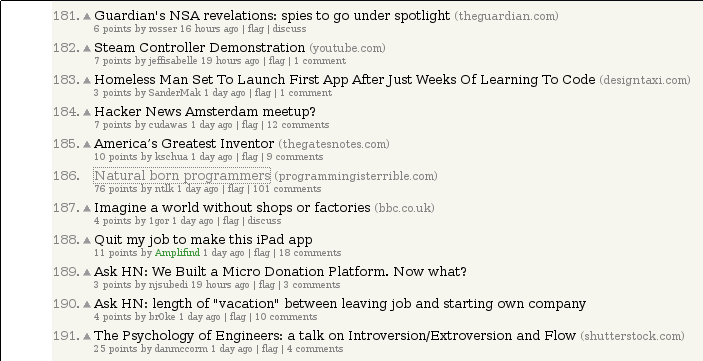
This seems less true when it comes to social issues. When a posting discussing the myth of the natural born programmer[2] hit the front page, the top rated comment is Paul Graham[3] off-handedly discounting the conclusions drawn. The original story linked to a review of peer-reviewed scientific research. Graham simply discounts it on the basis of his preconceptions. Shortly afterwards, the story plummeted off the front page, now surrounded by stories posted around the same time but with much lower scores.

How does this happen? There's two publicised methods which can result in stories dropping down the order. Users with high karma scores (either via submitting popular stories or writing popular comments) are able to flag submissions, and if enough do so then a negative weighting is applied to the story. There's also a flamewar detector, a heuristic that attempts to detect contentious subjects and pushes them off the front page.

The effect of both is to enforce the status quo of social beliefs. Stories that appear to challenge the narrative that good programmers are just naturally talented tend to vanish. Stories that discuss the difficulties faced by minorities in our field are summarily disappeared. There are no social problems in the technology industry. We have always been at war with Eastasia.

This isn't healthy. We don't improve the state of the software industry by hiding stories that expose conflicts. Flamewars don't solve problems, but without them we'd be entirely unaware of how much of a victim blaming mentality exists amongst our peers. It's true that conflict may reinforce preconceptions, causing people to dig in as they defend their beliefs. However, the absence of conflict does nothing to counteract that. If you're never exposed to opinions you disagree with, you'll never question your existing beliefs.

Hacker News is a privately run site and nobody's under any obligation to change how they choose to run it. But the focus on avoiding conflict to such an extent that controversial stories receive less exposure than ones that fit people's existing beliefs doesn't enhance our community. If we want to be able to use technology as an instrument of beneficial change to society as a whole, we benefit from building a diverse and welcoming community and questioning our preconceptions. Building a social echo chamber risks marginalising us from the rest of society, gradually becoming ignored and irrelevant as our self-reinforcing opinions drift ever further away from the mainstream. It doesn't help anybody.

[1] During the batch of interviews I did last year, two separate interviewers both mentioned a story they'd read on Hacker News that turned out to have been written by me. I'm not saying that that's what determined a hire/don't hire decision, but it seems likely that it helped.
[2] The article in question discusses the pervasive idea that some people are inherently good programmers. It turns out that perpetuating the idea that some people are just born good at a particular skill actually discourages others from even trying to learn it, even those who are just as capable.
[3] One of the co-founders of Y-Combinator and creator of Hacker News.

(Edited to fix a footnote reference)

comment count unavailable comments

14 October 2013

Bits from Debian: Ada Lovelace Day: meet some of the "women behind Debian"!

Today is Ada Lovelace Day:
"Ada Lovelace Day is about sharing stories of women - whether engineers, scientist, technologists or mathematicians - who have inspired you to become who you are today. The aim is to create new role models for girls and women in these male-dominated fields by raising the profile of other women in STEM". source
To celebrate, we asked to some of the "women behind Debian" to share their stories with us. Enjoy! Alt Ada Lovelace portrait Ana Guerrero Lopez (ana) Who are you? I'm a 30-something years old geek. I'm from Andalusia, Spain but live in France. What do you do in Debian? I work mostly on my packages, in sponsoring new people's packages and in this very blog you're reading now. I also maintain an unofficial Google+ page about Debian. At $PAID job, I work in an internal Debian distribution so from time to time, I get the opportunity to contribute back some of the stuff we do there. How and why did you start contributing to Debian? I started using Debian around 2003 switching from Mandrake. I was a happy Debian user when the Debian Women project started in the summer 2004. When I saw the project announced, I asked myself why I wasn't contributing to Debian and the rest is history... in a couple of weeks it'll be my 7 years DD-versary! If for some reason you want a longer reply to this question, read here. Beatrice Who are you? I am a PhD student with a degree in Biology. I am a computer fan since my first C64 and I am a self-taught computer geek wanna-be. And I am a bug fan - not software bugs, real bugs :) What do you do in Debian? I work on translations - doing the translation work itself, but also reviewing other translators' work and helping in coordinating the translation effort. How and why did you start contributing to Debian? I started using Linux because I liked the idea of an open source operative system based on collaboration and I began reviewing open source software translations. Since my first Linux system was Debian Potato and I sticked to Debian ever since, it only seemed natural to focus my translation work on Debian. Christine Caulfield Who are you? My name is Christine Caulfield. My day job is principal software engineer at Red Hat working on the cluster infrastructure components corosync & pacemaker. Outside computing I'm a musician and sound engineer. I play violin with lots of technology attached, and love avant garde music. What do you do in Debian? I'm not that active on Debian any more due to pressure of time, and maturity of the packages I work on. I currently maintain the, little-used, DECnet userspace packages and the, even less used I suspect, mopd bootloader. I used to maintain lvm2 for a while but dropped that a few years ago. How and why did you start contributing to Debian? My initial reasons for joining Debian were slightly selfish, to find a home for the DECnet project that I was heavily involved in at the time. I was a keep Debian user and people wanted a distribution where the software was easy to set up. DECnet is quite complicated for users to configure, being a totally independant networking stack to IP and so OS support is needed. Debian seemed like the logical place to make this happen. As mentioned above I got quite involved for a time and maintained other packages too. I picked up lvm2 because I was on the lvm2 dev team at work in Red Hat and as it was a new package at that time I seemed a logical choice. Elena Grandi (valhalla) Who are you? I'm a 30-something years old geek and Free Software enthusiast from Italy. What do you do in Debian? I'm currently maintaining a few packages (2 python modules and a python program) as a sponsored uploader; I'm also slowly looking around for other things to do (by preference technical, but not limited to packaging), with the aim to spend more time contributing to Debian. How and why did you start contributing to Debian? For a while I had being distro-hopping between "fun" distributions (the ones that break now and then) on the desktop while using Debian stable on the home server and in chroots. I was already doing marginal contributions to those distributions, where finding stuff that was missing was easy, but my perception as a stable user was that Debian was already working fine and probably didn't really need any help. Then I started to socialize on IRC with some DDs and DMs, and realized that my perception was superficial and that in reality there were dark holes in the depths of the archive where Evil festered and prospered and... ok, sorry, I got carried away :) Anyway, since I was actually using Debian more and more I decided to start contributing: I read documentation, I attended the useful IRC sessions on #debian-women and decided that it was probably best not to add new stuff, but look for things that I used and that needed help. Then nothing happened for a while, because finding stuff that doesn't work is hard (at least on my mostly textual systems). Then one day I was trying to write a python script that needed to verify gpg signed messages; it had to run on my Debian server, so I was trying to use python-pyme and its documentation was painful to use, while I remembered an earlier attempt using python-gnupg that was much more pythonic, but not available in Debian. In a fit of anger I decided to forgo all of my good intentions and actually add a new package: I checked the sources for problems, packaged, sent it to mentors@d-o, got reviews, fixed problems, resent and finally got sponsored and well, everything started. Francesca Ciceri (madamezou) Who are you? I'm Francesca, a 30-something Italian graduated in Social Sciences. What do you do in Debian? I'm a (non uploading) Debian Developer since 2011 and have been DPN editor, press officer, webmaster for www.debian.org and translator for the Italian l10n team. Recently, due to time constraints, I had to reduce my involvement and now only work on two things: writing/editing articles for bits.debian.org together with Ana Guerrero, and creating subtitles for the DebConf talks, in the DebConf Subs team. How and why did you start contributing to Debian? Basically thanks to the sudden abundance of free time - due to an health problem - and the desire to give something back to this wonderful operating system. After that, I found out that Debian is not only a great OS but also a very special community. Today, some of my dearest friends are people I met through Debian. :) Laura Arjona Who are you? I live in Madrid (Spain), and work as IT Assistant in the Technical University of Madrid (UPM). I'm married and I have a 4-years-old son. What do you do in Debian? In 2012 I started to clean spam and to translate Debian web pages into Spanish. I also follow the work of the web and publicity team, I hope I'll get more involved there too. And of course, I'm in Debian Women :) How and why did you start contributing to Debian? I'm using Debian at work since 2007 (servers), and in my desktops since 2010. I like very much that it is a community distro and I wanted to participate. I was already doing translations in other (small) free software projects, so I began here too. The Debian-Women list, the planet, and people in identi.ca helped me to learn a lot and feel part of the community even when I was not contributing yet. M nica Ram rez Arceda (monica) Who are you? My name is M nica Ram rez Arceda and I am an enthusiast of free software and sharing knowledge cultures: for me it's a kind of philosophy of life. I studied Maths a long time ago but ended up working as a developer for some years. Now I'm working as an IT teacher. What do you do in Debian? Debian is a huge project, so you can help in various scopes. Mainly, I work on packaging, fixing wnpp bug inconsistencies in BTS and helping in spam cleaning of the mailing lists. But I also enjoy doing some non-technical work from time to time: the project I am just now involved is organizing, with the rest of Debian Catalan community, a local team to propose Barcelona as the venue for a minidebconf where all the speakers will be women. How and why did you start contributing to Debian? In 2000 I discovered Free Software world and I fell deeply in love with its philosophy. Since then, I've been trying to do my best in different activities, like spreading the word, giving free courses, helping collectives and friends in technical stuff (from installing Debian to developing some helping apps for them)... but two years ago I was looking forward to join a free software project and I decided to try Debian, since it has been my first and only distro in my day-to-day life for about ten years. So, I wanted to give back Debian all what it had offered to me, but.... I thought I couldn't (hey, Debian is for real hackers, not for you little ant!), but I started to adopt some orphaned packages, do some QA uploads, fix some RC bugs, talk with some Debian Developers that helped me and encouraged me more than I expected, I traveled to my first Debconf... And one thing takes you to the other, and on March 2012 I became a DD. Now, I'm glad to see that everything that frightened me is not so scary :-)

Brett Parker: Just in case you missed it...

So, I've changed jobs, I now work for the incredibly awesome Mythic Beasts, So far it's been great, we've hit a few problems, we've made sane plans, and we're moving forwards and making things easier to manage long term. I've mostly been involved with debugging mac-mini boot problems, and getting them working with (as far as possible) stock kernels, rather than our previous set of custom compiled kernels, so that it's easier to upgrade later, and so that we're not having to maintain a whole set of patches that we shouldn't need to! We're also starting to package our own software that we use internally so that actually deploying new servers is becoming a lot easier, and configuration of our previous packages is now (mostly) handled by debconf, meaning that actually setting up backups is becoming much easier. We've also changed out main backup strategy from using a (slightly flaky) openvpn connection with loopback mounted ext3 filesystems to using rsync with the --fake-super option - the only thing that we've found slightly wrong with this so far is that --fake-super can't reconcile symlinks (it uses user level xattr to store the origional permissions, and with symlinks this doesn't work, because, apparently, symlinks should store user xattr attrbutes!). We also offer ipv6 for all our dedicated and vps customers, as per the mythic blog - and our 2 authoritative name servers are both v6 enabled. We're working towards making all of our core services available over both ipv4 and ipv6, and we should be there soon. It's fantastic to work for a company that has the technical knowledge and no-shit stance that Mythic Beasts has, we will hold our hands up if we do something wrong, and we'll tell you exactly what happened, why, and what we're doing to stop it from happening again. So, 1 month in, and I'm absolutely loving working for them, and I've been a customer of theirs since black cat networks sold their domain name side to them, and shortly afterwards bluelinux sold their virtual servers service to them. Our new VDS lite service is reasonably priced, and well spec'd. I thoroughly recommend our services, and obviously, we actually use our own vds service to provide some of our services - so it's as important to us that it keeps working as it is for our customers. Wow, so that was a very salesy post. Erm, next time, back to whinging about authors not having written the books I'm waiting for yet! :)

13 October 2013

Francesca Ciceri: MissRepresentation: discussing gender stereotypes in Moldova

Recently, I've been attending a training course in Moldova about the representation of gender in the media and the influence on society of gender stereotypes.
The course was organized by Inesa Lupu, of Invento and financed by the UE as part of the Youth in Action program. It was the first time, for me, in this kind of international project and it was, in a word, fantastic.
Among the participants, there were people from Azerbaijan, Georgia, Italy, Latvia, Moldova and Slovenia.
That meant a great mix of cultures, languages and experiences.
And that was the key, in my opinion, of the success: coming from different countries and different social and cultural contexts meant that we were able to have a very broad and diverse point of view on the problem of gender stereotypes. So, here's some highlights on what we discussed. The media representation of gender (aka: gender issues are not only women issues) Tough Guise by Jackson Katz is a interesting documentary about the way the modern society - particularly in the US - defines masculinity as intrinsically tied to violence, aggressivity and "toughness" and on the consequences of this on the society as a whole. The author's theory is "that male violence, misogyny, and homophobia are inextricably linked to how we define manhood as a culture. The film gives special attention to how American media have glamorized increasingly regressive and violence masculine ideals in the face of mounting social and economic threats to traditional white male heterosexual authority". It then results clear that we cannot avoid to think about gender issues as women and men issues, because after all is the cultural definition of both femininity and masculinity that heavily influences the behaviour of men and women and their interaction.
In particular, I liked Katz's analysis of media's use of victim blaming speech while reporting of violences against women which tend to shift the focus from the violence perpetrated by men as part of definition of masculinity. Another documentary we watched, more focused on women representation, is MissRepresentation by Jennifer Siebel Newsom.
The film analyses the under representation of women in position of power, and the issue of women and leadership, especially in politics, in the US. Nothing too new, if you are interested in gender issues, as it is a widely discussed and studied topic, but still worth watching. After watching them, we formed little groups of three-four persons from different countries to discuss them, and it was even more interesting to listen the opinion of the guys (we had four male participants). The guys talking about Tough Guise Photography and Phototherapy As a workshop on media representation of gender, photography and advertisement were two of the main argument we spoke about. We focused on it for two days: our trainer, Lietta Granato - photographer and phototherapist - first gave us a lesson on photography, making us experimenting a bit with exposure times and diaphragm's aperture. a lesson on photography Then she presented the evolution in the last 50 year or so, of the depiction of women in the ads.
And that, to be honest, was a bit upsetting.
I've already had seen one of the most important and widely known films on this theme, the Killing Us Softly series by Jean Kilbourne, but some of the ads Lietta showed to us were really really horrible. Actually, most of them were horrible. Commenting and deconstructing these ads would take a separate blogpost, probably, and there are many people more competent than me on the topic, so I've decided to simply share some of the worst ads in a collage, without much commenting. These are vintage, from the fifties to the seventies. a collage of vintage sexist ads Do you think we got better? Pff. a collage of recent sexist ads They go from promoting violence and rape to heavily objectifying women. Special mention for the Compaq ad: as a geek woman I feel particularly insulted by the idea that I'm supposed to use a "pocket pc" as "pocket mirror". Because I wouldn't be able, obviously, to use it as a computer. Lietta also introduced us to photographic therapy and particularly the work of Jo Spence and Rosy Martin. If you browse Jo Spence's site, please be aware that there is a series of pics documenting all the stages of her illness (she died of breast cancer) and they are pretty intense. "In 1984, alongside Rosy Martin, Spence developed Photo-Therapy , adopting techniques from co-counselling. The considerable achievement of Photo-Therapy was to invert the traditional relationship between the photographer and the subject. If historically the subject had little control over their own representation, Photo-Therapy shifts this dynamic. The subject was able to act out personal narratives and claim agency for their own biography." (source: http://www.jospence.org/biography.html)
I love this concept and I really really love Spence's photos. To close on a happier note, I really suggest you to allocate 20 minutes of your time to watch this great talk by Nigerian novelist Chimamanda Ngozi Adichie, about the role of "single story" in shaping stereotypes and misunderstandings.

Matthew Palmer: RACK_ENV: It's not *for* you

(With apologies to Penny Arcade I m probably the last person on earth to realise this, but the RACK_ENV environment variable (and the -E option to rackup) isn t intended for consumption by anything other than Rack itself. If you want to indicate what sort of environment your application should run in, you re going to have to do it via some other means. Why is this? Because the interpretation that Rack applies to the value of RACK_ENV that you set makes no sense whatsoever outside of Rack. Valid options are development , deployment , and none . If you follow the usual Rails convention of naming your environments development , test , and production (and maybe staging if you re feeling adventurous), then in any environment other than development , you re not going to be telling Rack anything it understands. As I said, I may be the last person on earth to have worked this out, but I doubt it. There are plenty of bug reports and WTF? blog posts and Stack Overflow questions that appear to stem from people misunderstanding the purpose of RACK_ENV. Sadly, the Rack documentation is very quiet on the whole topic, and the only place that mentions how the environment is interpreted is in the comments for Rack::Server.new and that doesn t tie that environment to the -E option or RACK_ENV environment variable. At any rate, the take away is simple: unless you want Rack to pre-configure a bundle of middleware for you, RACK_ENV or rackup -E is not the configuration variable you re looking for. Use something else to tell your app how it s supposed to work.

12 October 2013

Michael Vogt: apt 0.9.12

The recently released apt 0.9.12 contains a bunch of good stuff, bugfixes and cleanups. But there are two new feature I particularly like. The first is the new parameter with-new-pkgs for the upgrade
command:
# apt-get upgrade --with-new-pkgs
that will install new dependencies on the upgrade but never remove
packages. A typical use-case is a stable system that gets a kernel
with a new kernel ABI package. The second is show-progress for
install/remove/upgrade/dist-upgrade which will show inline progress
when dpkg is running to indicate the global progress.
# apt-get install --show-progress tea
...
Selecting previously unselected package tea-data.
(Reading database ... 380116 files and directories currently installed.)
Unpacking tea-data (from .../tea-data_33.1.0-1_all.deb) ...
Progress: [ 10%]
Progress: [ 20%]
Progress: [ 30%]
Selecting previously unselected package tea.
Unpacking tea (from .../tea_33.1.0-1_amd64.deb) ...
Progress: [ 40%]
Progress: [ 50%]
Progress: [ 60%]
Processing triggers for doc-base ...
Processing 2 added doc-base files...
Registering documents with scrollkeeper...
...
Processing triggers for man-db ...
Setting up tea-data (33.1.0-1) ...
Progress: [ 70%]
Progress: [ 80%]
Setting up tea (33.1.0-1) ...
Progress: [ 90%]
Progress: [100%]
For the install progress, there is also a new experimental option
Dpkg::Progress-Fancy . It will display a persistent progress status bar in the last terminal line. This works like this:
# apt-get -o Dpkg::Progress-Fancy=true install tea
apt-install-fancy-progress This kind of information is obviously most useful on complex operations like big installs or (release) upgrades.

10 October 2013

Russ Allbery: Review: 2312

Review: 2312, by Kim Stanley Robinson
Publisher: Orbit
Copyright: 2012
ISBN: 0-316-19280-5
Format: Kindle
Pages: 563
Swan Er Hong is a native of Mercury, granddaughter of one of the most influential women in the solar system. Alex, known as the Lion of Mercury, has just died as the story opens, and Swan is mourning. But she's also discovering that something else has been going on, something that Alex had not confided in her. Something that involves an inspector from the asteroids, a scientist from Titan, and a message Alex left in the event of her death, asking Swan to convey something personally to another scientist on Io. And then Mercury is attacked and the situation becomes much more complicated. 2312 is, like most Robinson novels, built on top of monumental world-building. The date is given away by the title; the setting is a solar system full of terraforming, habitats, and explosive human colonization. There are human settlements on every world that could possibly sustain them, including a terraformed Mars and a vast in-progress terraforming project on Venus. Mercury, Song's home, supports the city known as Terminator, a shielded habitat that travels around the planet on rails, pushed forward by the thermal expansion of metal at sunrise. Humans have scattered across the solar system and changed everything they've touched, even the asteroids. Many of those have been repurposed as long-haul shuttles: self-contained habitats on carefully-designed routes on which people live for months or years until they get to their destinations. Parts of this book are gorgeous. One of Robinson's strengths is creating images of the vastness of space, science, and human endeavor that feel plausible and inspiring at the same time. The setting of 2312 frees him to go wild with mega construction projects, and he takes full advantage. Parts of the book inspire the same sense of awe as the Hoover Dam or the Great Wall of China, transplanted into space and backed with neat scientific ideas to ponder. (Even if the more skeptical will note certain human habitation hazards, such as prolonged weightlessness and radiation, are mostly hand-waved away.) Unusually for a Robinson novel, 2312 also features an interesting and vibrant protagonist. Usually I can barely remember Robinson's protagonists five minutes after I finish the book, but Swan is so impulsive, erratic, and emotionally intense that I doubt I'll forget her. Her past is stuffed with outrageous risks and intense creativity: having songbird neurons transplanted into her brain, ingesting extraterrestrial bacteria, designing habitats in the asteroid belt, and creating art on the plains of Mercury. As the story gets underway, she meets the oversized and mellow Wahram; at first, she finds him boring, but then they're thrown together by one of the best set pieces of the book, and both they and the reader discover they work well together. Wahram serves as a straight man and as a stand-in for the reader's opinion, showing Swan all the more clearly in contrast. All this sounds quite promising. Unfortunately, what makes 2312 an ambitious failure rather than an excellent story is the story part. Robinson has built an amazing world, but he doesn't seem to know what to do with it. His economy, at least outside of Earth (and more on that in a moment), is essentially post-scarcity. Few of the characters we meet seem to have any concept of fiscal or practical limitation. They head across the solar system on a moment's notice, take vacations in habitats, or head to favorite spots for the view. It felt like Robinson was trying to write a Culture story. Unlike Banks, however, he struggles with generating a plot. 2312 is, in structure, a murder mystery. The characters witness a crime, survive it, and then intend to investigate it, and the crime appears to grow and link to fault lines in their society. This could have worked, but it has two problems: their society is only barely coherent enough for the reader to perceive the potential fault lines, and Robinson seems to have no idea how to construct a mystery plot. There is no sense of coherence to Swan and Wahram's approach, no sense of a gathering of clues, and very little sense of drama. All of the plot revelations are either dropped in Swan's lap by another character at a convenient moment or generated by Swan refusing to take the plot of the book seriously. The characters do essentially no meaningful investigation on-camera and show almost no investment in the outcome of the plot. When the climax comes, it's all weirdly forgettable. There are also large sections of the book that appear to have nothing to do with the rest of the plot, and that's where the unfortunate interval on Earth comes in. Robinson takes advantage of the scenes on Earth to do a bit of alienation and shows how foreign and strange and stifling Earth feels to someone who grew up outside of its atmosphere. Parts of this work, but he puts the plot on hold to do it. And parts of it do not work at all. The most glaring example is Swan and Wahram's bizarre bit of attempted charity in Africa, which comes across as stunningly high-handed and arrogant. This could be in character, particularly for Swan (who is not long on empathy), but, if so, the book doesn't signal to the reader that it should be read that way. Instead, there are some side (or snide) comments that seem to indicate Robinson knows nothing about the economic arc of Africa from the past twenty years. And when their absurd, botched, condescending charity plan fails for all the obvious reasons, the characters, and apparently the novel, throw up their hands and write Earth off as a stagnant lost cause that can't accept the imposition of a good idea and go back to the plot, never apparently caring about Earth again. Almost as frustrating is the way that these interludes are tied back into the story, which is usually through Swan getting ridiculously lucky on her random encounter rolls. It felt like whenever Robinson needed to make progress in the plot, Swan would just accidentally run into exactly the right person or situation to bring up the next plot point or to have some investigation make sense. (Not that Swan usually figured this out. Normally, the inspector explains it to her.) The author's finger was planted so firmly on the scales that it destroyed my suspension of disbelief and made a mockery of the idea that the characters were actually investigating anything. 2312 is built around a skeleton of a plot, but the lack of engagement with it, the lack of tension and emotion, the way the next developments are generally narrated to the protagonists and the reader, and the repeated use of random encounters to steer it left me without much reason to care. Robinson tries a few twists, but since the story never felt committed to its plot anyway, those twists feel less like planned complications and more like another random veer in the road. It didn't help that the final outcome was more prosaic and forgettable than the book had been implying it would be. There is a lot to like here. I'm very pleased to see Robinson finally write a memorable protagonist, and he's very good at both world-building and set pieces. But it needed a plot, and it needed a more coherent and complete cultural backdrop for its characters. Without both, it fell back into the typical Robinson trap: gorgeous moments separated by a whole lot of boring, and an overall impression of a construction tour rather than a story. There are bits of it I loved and still remember, particularly Song and Wahram in the tunnels of Mercury (which is possibly the best extended characterization Robinson has ever written). But the book as a whole is a mess, and I can't recommend wading through it for the good parts. Rating: 5 out of 10

9 October 2013

John Goerzen: Two Kittens

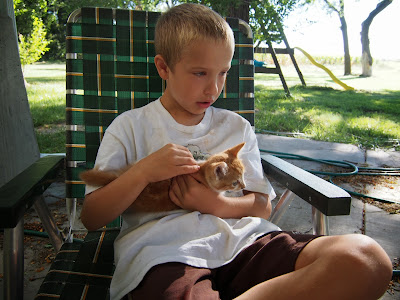
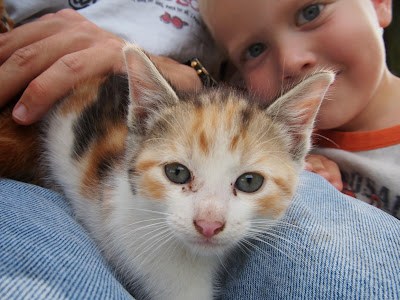
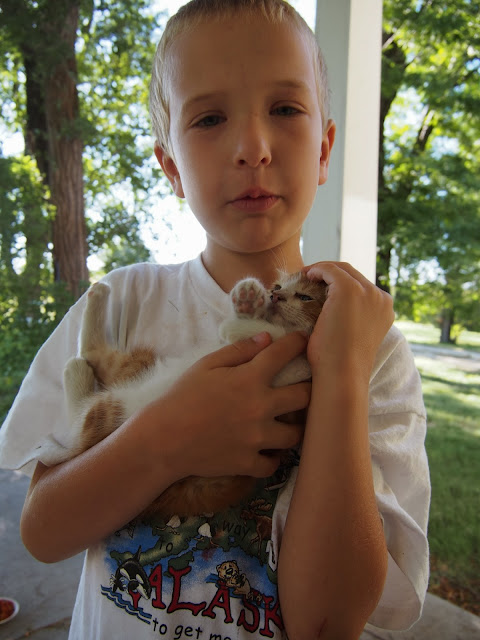
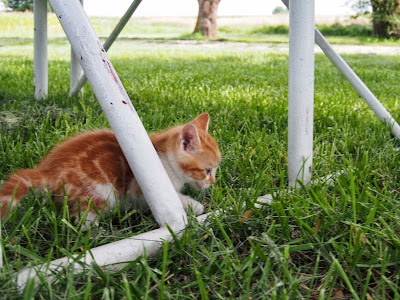
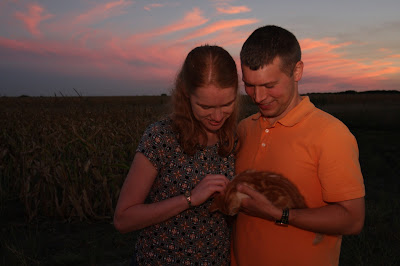
Almost every time he got off the bus for the past month and a half, Jacob started his afternoon in the same way. Before toys, before his trains and his toy bus, before anything indoors, he went for our cats. Here he is, cradling his favorite, Tigger: Laura and I both grew up around cats. We had been talking about kittens, and shortly after we got engaged, one of my relatives offered us some free kittens. We went to his place one evening and selected two of them one calico and one tiger-colored. Since what is now my place will soon be our place, they came to live with me. Our cats were one of the first things we did to prepare for our lives together. Oliver wanted to name them some rather impractical sentence-long names ( The Cat Who Always Likes To Run ), so Laura and I suggested some names from one of their favorite books: Tigger and Roo. They both liked the names, but Oliver thought they should be called Tigger the Digger and Roo the Runner . Never mind that they were just 6 weeks old at the time, and not really old enough to either dig or run. Here s Oliver with Roo, the day after the kittens arrived here. I have always had outside cats, both because I m allergic to cats so I need them to be outside, and because they sometimes literally quiver with joy of being outdoors. Tigger and Roo often chased insects, wrestled with each other, ran up (and slowly came back down) trees, and just loved the outside. Sometimes, I have taken my laptop and wireless headset and work from the back porch. The kittens climb up my jeans, inspect the laptop, and once Roo even fell asleep on my lap at one of those times. Jacob has been particularly attached to Tigger, calling him my very best friend. When Jacob picks him up after school, Tigger often purrs while cradled in Jacob s arms, and Jacob comments that Tigger loves me. Oh dad, he knows I am his friend! The kittens have been growing, and becoming more and more comfortable with their home in the country. Whenever I go outside, it isn t long before there are two energetic kittens near my feet, running back and forth, sometimes being very difficult to avoid stepping on. I call and I see little heads looking at me, from up in a tree, or peeking out from the grain elevator door, or from under the grill. They stare for just a second, and then start running, sometimes comically crashing into something in their haste. Yesterday when I went to give them food, I called and no cats came. I was concerned, and walked around the yard, but at some point either they come or they don t. Yesterday afternoon, just after the bus dropped off Jacob, I discovered Tigger on the ground, motionless. Once Jacob was in the house, I went to investigate, and found Tigger was dead. As I was moving his body, I saw Roo was dead, too. Both apparently from some sort of sudden physical injury a bit mysterious, because neither of them were at a place where they had ever gone before. While all this was happening, I had to also think about how I was going to tell the boys about this. I tried to minimize what he could see, Jacob had caught an unavoidable glimpse of Tigger as we were walking back from the bus, but didn t know exactly what had happened. He waited in the house, and when I came back, asked me if Tigger was dead. I said he was. Jacob started crying, saying, Oh Dad, I am so sad , and reached up for a hug. I picked him up and held him, then sat down on the couch and let him curl up on my lap. I could quite honestly let him know he wasn t alone, telling him I am sad, too. Oliver arrived not long after, and he too was sad, though not as much as Jacob. Both boys pretty soon wanted to see them. I decided this was important for them for closure, and to understand, so while they waited in the house, I went back out to arrange the kittens to hide their faces, the part that looks most unnatural after they die. The boys and I walked out to where I put them, then I carried both of them the last few feet. We stood a little ways back close enough to see who was there, far enough to not get too much detail and they were both sniffling. I tried to put voice to the occasion, saying, Goodbye, Tigger and Roo. We love you. Oliver asked if they could hear us. I said No, but I told them what I felt like anyway. Jacob, through tears, said, Dad, maybe they are in heaven now. We went back inside. Jacob said, Oh dad, I am so sad. This is the saddest day of my life. My heart is breaking. Hearing a 7-year-old say that isn t exactly easy for a dad. Pretty soon he was thinking of sort of comfort activities to do, saying I think I would feel better if we did So they decided to watch a favorite TV program. Jacob asked if Laura knew yet, and when I said no, he got his take-charge voice and said, Dad, you will start the TV show for us. While we are watching, you will send Laura an email to tell her about Tigger and Roo. OK? What could I say, it wasn t a bad idea. Pretty soon both boys were talking and laughing. It was Big Truck Night last night, at a town about half an hour away. It s an annual event we were already planning to attend, where all sorts of Big Trucks firetrucks, school bus, combine, bucket truck, cement truck, etc show up and are open for kids to climb in and explore. It s always a highlight for them. They played and sang happily as we drove, excitedly opened and closed the big door on the school bus and yelled All Aboard! from the top of the combine. We ate dinner, and drove back home. When we got home, Jacob mentioned the cats again, in a sort of matter-of-fact way, and also wanted to make sure he knew Laura had got the message. A person never wakes up expecting to have to dump a bowl of un-eaten cat food, or to give an impromptu cat funeral for little boys. As it was happening, I wished they hadn t been around right then. But in retrospect, I am glad they were. They had been part of life for those kittens, and it is only right that they could be included in being part of death. They got visual closure this way, and will never wonder if the cats are coming back someday. They had a chance to say goodbye. Here is how I remember the kittens.

7 October 2013

Vincent Fourmond: Release 0.7 of ctioga2

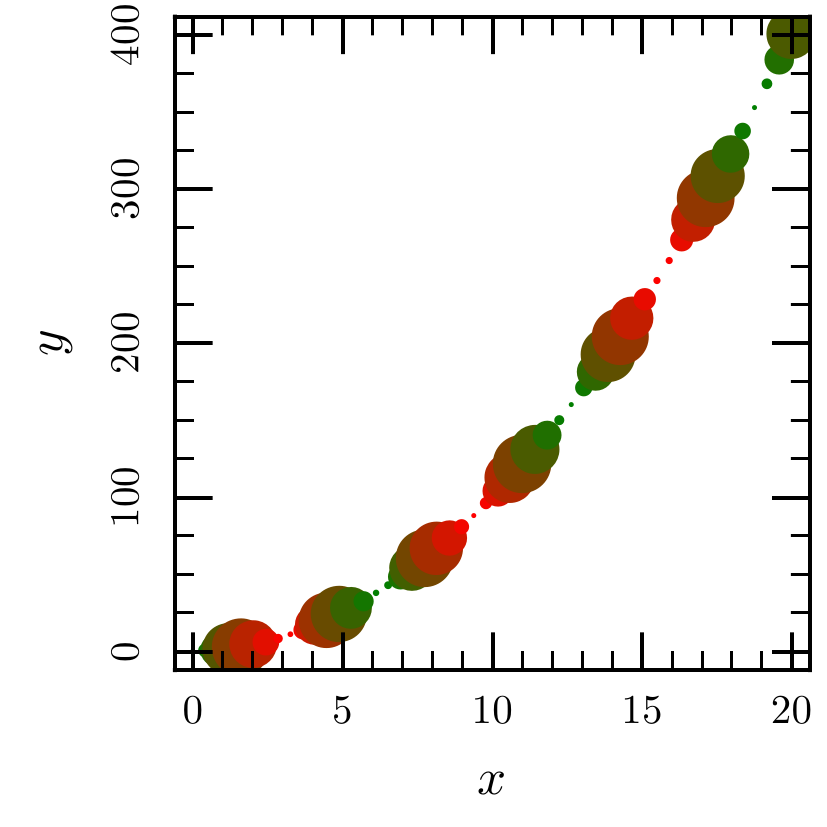
Quite a bit of work has gone into ctioga2 since my last post. Among the most interesting features, ctioga2 now features:
The latter feature proved actually instrumental in a research project under way in my lab (which is why I wrote it in the first place). It is demonstrated in the image above, made using this code.I've also started the gnuplot versus ctioga2 gallery I was speaking about in my last post, where I try to reproduce most of gnuplot's examples using ctioga2; it can be found here. While I don't like so much the look of the gnuplot graphs, and I try to keep the look of ctioga2's as close as possible to that look, it proved invaluable in detecting small bugs, fixing small glitches and providing inspiration for new features.In the meantime, my todo-list for ctioga2 doesn't seem to get any smaller. Let's hope I'll implement them fast enough ! Keep posted...

Michal Čihař: First day of Hackweek

First day of hackweek did not really go as planned. I had to spend too much time on tasks which I did not now I will have to do in advance. I've started with releasing Weblate 1.7. As a part of that I update SUSE Studio images with Weblate. Unfortunately this turned out to be more challenging than usual as with new version the build script always failed but without any obvious error. After some time, I've realized that it just does not show whole output, so the last (and most important) lines are missing. Then it was easy to spot that the problem is in Whoosh version and it's just matter of providing newer version. After fixing the image, I could finally focus on Weblate's issue tracker and resolved few issues and questions. I've also improved some of the in application documentation and links to documentation or other resources. Meanwhile I could also setup translation hosting for monkeysign, happy translating!

Filed under: English SUSE Weblate 0 comments Flattr this!

Lucas Nussbaum: talk at Open World Forum

I attended Open World Forum last week (thanks to Inria for funding my travel). It was a fantastic opportunity to meet many people, and to watch great talks. If I had to single out just one talk, it would clearly be John Sullivan s What do you mean you can t Skype?!. On Saturday, I delivered a talk presenting the Debian project. It was my first DPL-ish talk to the general public, so it still needs some tuning, but I think it went quite well (slides available). Next opportunity to talk about Debian: LORIA, Nancy, France, 2013-10-17 13:30 (iPAC seminar).

6 October 2013

Gregor Herrmann: RC bugs 2013/37-40

not much activity around RC bugs on my side in the last weeks; & the ones I worked on were all in the Debian Perl Group: on an unrelated note: following the discussion on debian-project, I finally revoked my old opengpg key 0x00F3CFE4 which served me well from 1998 until 2009. since then, I've only been using 0x8649AA06 anyway ...

Jon Dowland: Iain Banks

In April this year, Iain Banks announced that he had inoperable cancer. At the time I was reading what became his last Culture novel, "The Hydrogen Sonata". Banks died shortly afterwards in June. I came across this passage in "The Hydrogen Sonata" which struck me as poignant:
Living either never has any point, or is always its own point; being a naturally cheery soul, I lean towards the latter. However, just having done more of it than someone else doesn't really make much difference.
Much belated RIP, Iain Banks.

Russ Allbery: Review: Captain Vorpatril's Alliance

Review: Captain Vorpatril's Alliance, by Lois McMaster Bujold
Series: Vorkosigan #14
Publisher: Baen
Copyright: November 2012
ISBN: 1-4516-3845-0
Format: Kindle
Pages: 432
This is the fourteenth book in the long-running Vorkosigan series (not counting a few side works). It shifts viewpoint characters, following Ivan Vorpatril instead of either Miles or Cordelia, and could be read on its own since the necessary background is at least briefly explained. But it's probably best read in its proper context in the larger series, since otherwise many of the prior events mentioned here won't have much resonance. Ivan Vorpatril, Miles's cousin, has appeared in multiple previous books along with the rest of Miles's extended family, but he's stayed out of the center of the plot. And he clearly likes it that way. Ivan is not at all ambitious, tries to avoid politics, and just wants to live a quiet life (insofar as that's possible in the Barrayan military), sleep with a few women, and stay out of trouble. But given his relations and his job as aide-de-camp to an admiral this doesn't always work. In this book, the not working comes in the form of Byerly, ImpSec (Imperial Security, the Barrayan equivalent of the CIA), and a request to find out more about a woman who seems to be the target of a bounty. Fairly quickly, Ivan finds himself hopelessly entangled in both politics and in someone else's complex life, and is not entirely sure what to do about either. It's been months since I read this book and I'm only now writing a review, in part because I find it hard to know what to say about it. While Ivan doesn't have Miles's manic energy, the tone of this book is very similar to the rest of the Vorkosigan series, as is the plot and most of the characters. Ivan tries a more laid-back approach and doesn't actively seek danger the way that Miles does, but his persistent efforts to do the right thing in the face of unexpected events lead mostly to the same places. There's a bit of humor, a bit of danger, some galactic politics, some scheming, and a slow process of understanding other people better in short, Captain Vorpatril's Alliance is very similar to the thirteen books that proceeded it. This is obviously not a bad thing. If you've read this far in the series, more of the same is probably just fine. I enjoyed the book. Bujold is great at telling stories, the plot mostly moved right along, and I quite liked the two women Ivan meets over the course of the story. But there wasn't much about the story that grabbed me or, I suspect, that I will find particularly memorable. One reason for my somewhat "meh" reaction is that the core of this story is a romance, and while much of that romance is well-done, there is a large segment in the middle of the book where the suspense of the plot derives mostly from one of the two characters refusing to confide in the other. This is Bujold, so this isn't as much of a train wreck as it might be in the hands of another author, and it is for valid plot reasons. But even with those justifications, I never like that plot element. There were about a hundred pages where I wanted to grab Tej and shake some sense into her, which doesn't endear a character to me. And the leads in a romance, at least this sort of romance, should be endearing. I think one reason why Bujold went for that approach to building tension is that there weren't a lot of options available. The basic outlines of what's going to happen are obvious from early in the book and essentially forced by the structure of the series. We know from past books that Ivan is both trustworthy and related to a staggering variety of powerful people, almost all of whom are highly competent and honorable. It's fairly obvious that, as soon as the necessary people trust Ivan and let him and his family solve their problems, all the problems will be solved. It's also fairly obvious how the romances will play out, and that all the new characters will end up a little in awe of how competent and trustworthy all the Barrayans are (a few misdirections aside). Therefore, much of the book, for a long-time reader of the series, involves waiting until those things happen, and meanwhile getting increasingly annoyed at characters who refuse to trust obviously trustworthy people. All that said, I still quite liked the beginning of the book, because Tej and Rish are a wonderful pair and have a great interpersonal dynamic, and the very end of the book once everyone gets past the communication problems and the plot can deliver on its promises. Both together make up for some noticeable sagging in the middle section of the book. Captain Vorpatril's Alliance is not up to the standards of the most memorable books of the series, but it's a solid dose of "more of the same" and provides its money's worth of entertainment. I'm still hoping for more Ekaterin and more fireworks in the next book, though. Rating: 7 out of 10

5 October 2013

Vincent Sanders: If I have a style, I am not aware of it.

I wish I had known about that quote from Michael Graves before now. I would have perhaps had an answer to some recent visitors to makespace.

There are regular scheduled visits to makespace where people can come and view our facilities, and perhaps start the process of becoming a member if they decide they like what they see.

Varnishing a folding chair using a stool as a stand
However, we sometimes get people who just turn up at the door. If a member feels charitable they may choose to give a short tour rather than just turn the person away. I happened to be in one Friday afternoon recently varnishing a folding chair when two such people rang the doorbell. There were few other members about and because watching varnish dry was dull I decided to be helpful and do a quick tour.

I explained that they really ought to return for a scheduled event for a proper tour, gave the obligatory minimal safety briefing, and showed them the workshops and tools. During the tour it was mentioned they were attending a certain local higher education establishment and were interested in makespace as an inexpensive studio.

Before they left I was asked what I was working on. I explained that I had been creating stools and chairs from plywood. At this point the conversation took a somewhat surreal turn, one of them asked, well more demanded, who my principle influence had been in designing with plywood.

When I said that I had mainly worked from a couple of Google image searches they were aghast and became quite belligerent. They both insisted I must have done proper research and my work was obviously influenced by Charles and Ray Eames and Arne Jacobsen and surely I intended to cite my influences in my design documents.

My admission that I had never even heard the names before and had no design documents seemed to lead to a distinctly condescending tone as they explained that all modern plywood design stemmed from a small number of early 20th century designers and any competent designers research would have revealed that.

At this point in proceedings I was becoming a bit put out that my good deed of showing off the workshop had not gone unpunished. I politely explained that I designed simply by generating a requirement in my head, maybe an internet search to see what others had done, measuring real things to get dimensions and then a great deal of trial and error.

I was then abruptly informed that my "design process was completely invalid and there were well established ways to design furniture correctly and therefore my entire design was invalid" and that I was wasting time and material. I thanked them for their opinion and showed them out, safe and well before anyone gets any ideas.

I put the whole incident out of my mind until I finished writing up the final folding chair post the other day. It struck me that perhaps I had been unknowingly influenced by these designers. It was certainly true I had generated ideas from the hundreds of images my searches had revealed.

I did some research and it turns out that from the 1930s to the 1950s there were a string of designers using plywood in novel ways from the butterfly stool by Sori Yanagi through formed curvy chairs by Alvar Aalto and eero saarinen.

While these designers produced some wonderfully iconic and contemporary furniture I think that after reviewing my initial notes that two more modern designers Christian Desile and Leo Salom probably influenced me more directly. Though I did not reference their designs beyond seeing the images along with hundreds of others, certainly nothing was directly copied.

And there in lies an often repeated observation: no one creates anything without being influenced by their environment. The entire creative process of several billion ape descendants (or Golgafrincham telephone sanitisers if you prefer) is based on the simple process of copying, combining and transforming what is around us.

Isaac Newton by Sir Godfrey Kneller [Public domain], via Wikimedia Commons
I must accept that certain individuals at points in history have introduced radical improvements in their field, people like Socrates Galileo Leonardo Newton Einstein. However, even these outstanding examples were enlightened enough to acknowledge those that came before. Newtons quotation "If I have seen further it is by standing on the shoulders of giants" pretty much sums it up.

In my case I am privileged enough to live in a time where my environment has grown to the size of the world thanks to the internet. My influences, and therefore what I create, is that much richer but at the same time it means that my influence on others is similarly diminished.

I have joined the maker community because I want to create. The act of creation teaches me new skills in a physical, practical way and additionally I get to exercise my mind using new techniques or sometimes things I had forgotten I already knew. I view this as an extension of my previous Open Source software work, adding a physical component to a previously purely mental pursuit.

But importantly I like that my creations might provide inspiration for someone else. To improve those chances in the wider world I force myself to follow a few basic rules:
Release
Possibly one of the hardest things for any project. I carefully avoided the word finish here because my experience leads me to the conclusion that I always want to improve my designs.

But it is important to get to a point in a project where you can say "that is good enough to share", this is more common in software but it really applies to any project.

Share
If your aim here is to improve your society with your contribution sharing your designs and information is important. I think there is nothing better than someone else taking one of your designs and using it and perhaps improving on it, remember that is what you probably did in one way or another better to make it less hard for that to happen.

Ensure your design files are appropriately licensed and they are readily accessible. I personally lean towards the more generally accessible open source licences like MIT but the decision is ultimately yours.

Licencing is important, especially in the current copyright happy society. I know it sounds dull and no one takes that seriously, right? Sorry, but yes they do and it is better for you to be clear from the start, especially if there is a software component to your project. Oh one personal plea, use an existing well known licence, the world simply does not need another one!

Write about it
The blog posts about the things I have made sometimes take almost as much time as the creation. The clear recording on my thoughts in written and photographic form often gives me more inspiration for improvements or other projects.

If someone else gets pleasure from the telling then that can only be good. If you do not do this then your voice cannot be heard and you wasted an opportunity to motivate others.

Feedback
If you do manage to get feedback on your creation, read it. You may disagree or not be interested for the current project but the feedback process is important. In software this often manifests as bug reports, in more physical projects this often becomes forum or blog comments.

Just remember that you need a thick skin for this, the most vocal members of any society are the minority with inflammatory opinion, the silent majority are by definition absent but there is still useful feedback out there.

Create again
By this I simply mean that once you are satisfied yourself on a project move on to the next. This may sound a little obvious but once you have some creative momentum it is much easier to keep going project to project than in you leave time between.

Also do not have too many projects ongoing, by all means have a couple so you do not get stuck waiting for materials or workshop time but more than three and four and you will never be able to release any of them.
Those students were perhaps somewhat misguided in how they stated their opinions, but they are correct that in the world in which we find ourselves we are all influenced. Though contrary to received wisdom those influences are more likely to be from the internet and our peers in the global maker society than historical artists.

Steve Kemp: I understand volunterering is hard

The tail end of this week was mostly spoiled by the discovery that libbeanstalkclient-ruby was not included in Wheezy. Apparently it was removed because the maintainer had no time, and there were no reverse dependencies - #650308. Debian maintainers really need to appreciate that no official dependencies doesn't mean a package is unused. Last year I needed to redesign our companies monitoring software, because we ran out of options that scaled well. I came up with the (obvious) solution: I chose beanstalkd for my central queue precisely because it was packaged for Debian, had a client library I could use, and seemed to be a good fit. It was a good fit, a year on and we're still running around 5000 tests every minute with 10 workers. The monitoring tool is called Custodian Custodian, and I think I've mentioned it before here and on the company blog. It looks like we'll need to re-package the Ruby beanstalk client, and distribute it alongside our project now. That's not ideal, but also not a huge amount of work. In summary? Debian you're awesome. But libraries shouldn't be removed unless it can't be helped, because you have more users than you know.

Next.

Previous.