Search Results: "az"

6 December 2007

Gunnar Wolf: Digging into Drupal

As of late, I've shifted quite dramatically my sysadmining/development activities. On the development front, although Perl is still my mother tongue and I maintain many systems I wrote with it (and my main involvement in Debian is through the pkg-perl group, of course), I've been largely switching over to Ruby - both under the Rails framework and doing standalone stuff.But somehthing that's new to me (well, relatively - it has been observed I have been playing with the idea in and out for some more time) is entering this maze of twisty little passages, all alike called Drupal. What can I say? I'm quite surprised by it. It is such a reach CMS, and so twistable for almost-anything, that it still defeats me.I've been asked (ordered? pushed?) to propose a complete plan to replace my Institute's current static-and-butt-ugly-HTML site with something dynamic and manageable, so, of course, this last week has been an intensive Drupal crash-course for me.Drupal itself is quite complex, yes, and I thought I had it mostly mastered for the trivial tasks. But then, I started looking for some I-thought-quite-simple extra thingies - And I started discovering its user-contributed modules. I've been having quite a bit of fun with them, and as I hate messing up my clean and nice installation, I've even set up a Drupal5 modules APT repository for Etch, where I'm putting the modules as I process them.As I'm really not into PHP, and I still lack enough of the Drupal framework understanding to really step forward and become responsable for them, I'm not yet even suggesting packaging them for Debian - but a time might come where I upload them as well ;-)BTW, in case somebody is wandering about this Jaws-to-Drupal scripty I mentioned that other time: It basically works for blog entries (as you can see in my test site - barring some trivial latin1-UTF discrepancies). I have not yet migrated because I'm also trying to migrate my Phoo photo galleries to Acidfree albums... And it's quite a more challenging task than just migrating blog+comments. But soon, I hope - I have a bit more time than in the last weeks to be able to play with it. Anyway, here it is as it is.

Anthony Towns: Asus eeePC

Okay, so any excuse to bring out the Laphroaig is fine by me, but the cute little eeePC is better than most. That it’s cute and popular is all very well, but what really makes my day is this is the first device I’ve seen that both doesn’t hide the fact it’s running Linux, and is available in maintstream stores in Australia. A random review from the Sydney Morning Herald:
You also don’t get Windows. Asus has adopted the free Linux operating system that’s been slowly yet steadily growing in popularity over the past decade. This keeps the cost down and makes better use of its relatively modest hardware, which would creak under the weight of Windows. It does mean not being able to use your favourite Windows software but, fortunately, the Eee PC comes with dozens of programs, including the familiar Firefox web browser and Skype for online phone calls.
That came out on the day the eeePC was released in Australia. Three days later, they did a followup:
Taiwan computer maker Asus might have underestimated the local demand for its diminutive Eee PC, as the $499 laptop is now virtually sold out in Australia.
From that, there’s a brief take on who’s actually buying them:
“We’ve had customers coming in buying two or three units for the family - the mix of customer has been probably novices more than the tech types,” he said.
It’s really good to see that Linux is getting credit in pretty much all those stories, no matter how mainstream. Xandros is pretty rarely mentioned, and I don’t think I’ve seen Debian mentioned yet. But even without the credit, it’s still pretty cool that with the eeePC and Dell’s trysting with Ubuntu, the real in-roads to pre-installed consumer Linux these days are building on Debian. I’d always expected that Red Hat or SuSE or someone with more commercial muscle would get through that door first (they’ve certainly had box sets more readily available!), but apparently elitist, freedom obsessed, techno-geekery actually works better, somehow. At least when there’s a company to put a smiley face in front of it all :) The other interesting thing about choosing Xandros, is that it presumably means the eeePC is covered by Microsoft’s patent protection scheme – which means no baseless threats against eeePC users from Microsoft, but also that Microsoft’s probably getting a cut of whatever Xandros receives from each eeePC sale. Whether you think that’s a problem or not, the result is probably going to be that it’s the thin edge of the wedge: it’s removed Microsoft from blocking a Linux preinstall on consumer hardware, which means we can see that regular people like Linux systems enough that they sell out in days. And that means Linux systems are a fact of life, and if Microsoft try to stop them by making it difficult for you to sell Windows systems, well, that’ll just make it difficult to sell Windows systems – which is another win for Linux. And once you get to the point where the argument for paying off Microsoft doesn’t rely on keeping your OEM deal for Windows, but is just a matter of whether their patents are actually valid… Oh, also nice from the promoting free software angle, is that the first thing you see if you decide to visit Asus’s eeePC site to check the gizmo is the news item:
2007.11.27 ASUSTek is committed to meet the requirements of the GNU General…
Add the fact that an eeePC running a Debian-derivative has access to all the software in the Debian repositories for no cost, and the new government’s planned rebates and investments in IT probably mean that parents can get close to a full refund, and you’re getting pretty close to a choice of spending nothing and getting a popular, reasonably functional and very portable laptop with all the software you could ever want, that just happens to be running Linux, or paying an extra few hundred or thousand dollars to get a Windows laptop, and then probably pirating whatever software you end up needing. In any event, to my mind, that makes 2007 the year of the Linux on the desktop: everything from here is just a simple matter of quantity. What’s next?

Christian Perrier: I'm Indian-da

I think that all Debian developers (including the brand new ones) will be delighted to learn that we not only have 4 indian DD's now, but we have an Indian DPL, at least according to his own words after a few beers. The first two days at FOSS.in have been quite busy. Sam's first talk ("Giving back to the community, how does Debian perform") was really interesting with ideas about a possible place where various distributions' patches to software could be collected and made available to upstream authors. I then had two talks in a row, which I feared a little but went pretty well. The first one was a brand new for me ("Contributing to Debian for dummies"). I tried to enforce the idea that contributing to Debian might be fun and opened to everybody, not only deep hard-core hackers (I funnily took my friend Andrew McMillan as example for hard-core hackers....). To make the talk less boring, I did choose to illustrate the various ideas I was explaining with photos taken from the various Debian-related events I attended last years. So, many of my Debian friends will recognize themselves on my talk slides. I hope you people won't mind being taken as examples (I should maybe have asked your authorization before....in case some of you want to sue me for using your public image). The other talk I has was a quite standard i18n talk. As I don't like doing the same talk over and over, I changed that one slightly to make it more suitable for the local audience, putting focus on localization for languages of India (even doing some of the "famous" bubulle-style maps especially for India). In case you aren't bored with that one, here's the link to slides. The next day features some other projects days. I will put focus on talks from the Indlinux project day. Indlinux is indeed an amazingly active project and the small room was entrely packed with people attending quite technical talks about Indic computing, Text-to-Speech, Indic languages spellchecking and such really specific topics. I also attended a very promozing talk by Dimitri Glezios, in the Fedora project day room, talking about Transifex, a very promising localisation material collecting platform with the interesting ability to be able to push translations back to thei respective upstreams, avoiding one of the major drawbacks of tools such as Rosetta. I'll have to come back on that one. Now for the Main Confeence days....that will be busy, too, for sure ! And I didn't even mention the awful Mozilla party we had yesterday night. Some people will remember that one.

5 December 2007

Holger Levsen: what is going on in Venezuela

Obviously I don't know, but I guess that this article is much closer to the truth than most of the news sites and magazines.

Russell Coker: The Meaning of Godwin s Law

A widely cited unofficial rule on the Internet is known as Godwin’s Law [1]. In it’s original form this rule states that “As an online discussion grows longer, the probability of a comparison involving Nazis or Hitler approaches one“. Mike Godwin noted that “overuse of Nazi and Hitler comparisons should be avoided, because it robs the valid comparisons of their impact“. The purpose of noting and publicising this is to reduce such false comparisons. It’s often used as a rule for conduct in various fora where it’s regarded that if you compare your opponent in a debate to Hitler or unjustly call them a Nazi then the debate is over and you have lost. In more recent times due to successful application of Godwin’s Rule the frequency of inappropriate comparisons has dramatically decreased. This combined with the small number of people on the net who are interested in discussing historical events that happened ~60 years ago (and the even smaller number of people who are interested in learning about them) means that the possibility of robbing valid comparisons of their impact is small. Now a large part of the use of Godwin’s rule is because it’s regarded as an ad-hominem attack that distracts everyone from serious discussion more than most such attacks. To see examples of this you merely have to do a Google search for “Bill Gates” and “Hitler” (currently 597,000 web pages have both those terms). Note that the original reason for avoiding such false comparisons is given to sustain the impact of legitimate comparisons. It is quite legitimate to use the term Nazi when describing anyone who wants to implement mass-murder and slavery on a national scale (or any of the other awful things that the Nazis did), or the propaganda and other mechanisms that the NSDAP used to gain power. It is also legitimate to make historical comparisons, comparing Stalin to Hitler is historically valid (both were awful tyrants that committed a similar range of crimes) - I’m not going to compare them in this post but I merely note that such a comparison is valid (and is the subject of much debate by people who are interested in history). I’ve just had a religious zealot named Elder Dave accuse me of breaching some new version of Godwin’s Law. I believe that my mention of the fact that his religious group (which wants to deny homosexuals the same legal rights as all other people) has some beliefs in common with the Westboro Baptist Church [2] is valid. The Westboro Baptist Church seems to be the leading organisation in the English-speaking world for demanding legislation to discriminate against homosexuals. Anyone else who demands such legislation IS trying to achieve similar aims and should expect this to be noted by everyone who has any knowledge of what is happening in the world. Religious groups are given a lot of freedom to discriminate internally (EG “Priest” is one of the few jobs that can be denied to a qualified woman without any legal recourse). Also I think that most people will agree that it’s acceptable for them to advocate self-repression (EG the book What Some of You Were [3]). But when they try and get legislation enacted to institutionalise such discrimination I believe that they are going too far. As for why the 95% of us who aren’t gay should be bothered about this issue, there’s the famous poem by Martin Niem ller which is known by the line “First they came for the Jews” [4] (actually there are a few versions of the poem some of which don’t mention Jews - check the link for details). Here’s another Wikipedia link for the same poem [5].

Wouter Verhelst: Dear Lazyweb,

I'm looking for a scanner, with the following requirements:
  1. Must work perfectly with Linux. I don't even care about Windows or MacOS.
  2. Will be used for documents, not pictures. As such, resolution does not matter, but ADF would be nice.
  3. I have a pretty good printer, and we have a system running mgetty for faxes, so I'm not looking for a multifunctional thing. I just need to be able to scan from time to time.
  4. Not too expensive.
The problem is that I know splat about scanners in Linux, except that there is this thing called SANE which sometimes seems to help there. I even used it once or twice, but that's about it. Any suggestions?

Sylvain Le Gall: Thinkpad X60s configuration (ipw3945, network-manager, hda-intel...)

I spend quite a long time to fully configure my new Thinkpad X60s laptop. This will be my work computer and i wish to use Debian Etch on it. Since it is for my job, i want to use a stable debian release. The aim of this laptop is to always have something that works -- to keep focus on my job. The configuration was tricky because there is a lot of people reporting that everything works with this laptop, but not a lot of people describing problems they encounter. Here is a list: Sound:
   hda_intel: azx_get_response timeout, switching to polling mode 
   hda_intel: azx_get_response timeout, switching to single_cmd mode 
It prevents to have the sound working. The problem is related to the modem. You need to be sure that the modem is enabled in the BIOS. ipw3945: The WIFI driver of etch doesn't work well. To fix this, you must get the version 1.2.2 of ipw3945-source and rebuild it with module-assistant. I also use firmware-ipw3945 from unstable (v0.7) but I am not sure this is a firmware issue. network-manager disconnects every 10 seconds or so: This bug was pretty annoying. The wifi connection was good with wpasupplicant alone (or at least seems to be OK). With network-manager-gnome i keep getting messages about connection and disconnection every 10 seconds. The solution is to remove everything which is related to bluetooth. This really improves the situation a lot! (i.e. i am not having disconnection messages for at least the time i am writing this blog entry).
 apt-get remove --Purge bluez-utils bluetooth
in file /etc/modprobe.d/myblacklist:
 blacklist bluetooth
and run:
 update-initramfs -u
"linux is an HDD killer": You need to copy /etc/acpi/start.d/90-hdparm.sh from unstable and place it in /etc/acpi/ suspend resume start .d. This prevents an increase of the Load_Cycle_Count. Now the laptop seems stable, the wifi connection is up and running -- let's start working (again).

4 December 2007

Bastian Venthur: Forcing win32-loader to use i386?

Dear Lazyweb, I’m happily using the win32-loader from goodbye-microsoft.com to install Debian/Etch on several Lenovo X61s subnotebooks which don’t have a DVD drive but a running XP preinstalled. The installer correctly detects a 64bit architecture and therefore installs AMD64. Unfortunately I want to run i386 on those machines. Is there a way to force a specific arch for the win32-loader? Edit: Of course I already tried to install Debian from an USB stick on those machines, but the Debian installer refuses to work at the point where it’s unable to find the DVD/CD drive on the subnotebooks without one. I’ve tried netinst and businesscard, none of them worked from USB for me. Any hints?

Evan Prodromou: 13 Frimaire CCXVI

I'm organizing a micro-coworking session here in Montreal for 6 December (15 Frimaire). "Micro-coworking session" is just a fancy way of saying "hanging out together and working at a caf ". Folks will be meeting in the back of Caff ArtJava from about 9AM to about 5PM. More info on the subStation Coworking event page on Upcoming. The event is for people interested/involved in (or supportive of) Station-C, the incipient Montreal coworking facility scheduled to open in February 2008. But everyone's welcome to come by -- heck, we'd have a hard time keeping you away. tag:

Private and public life in the age of Facebook One of the things I find interesting about life on the Internet is the distinction between public and private life. So much of our lives are on-line today; for many of us, the Web is where we make our living, make our friends, enjoy our social life, and plan our off-line activities. But what about those personal activities that don't jibe with our intended professional image? If we have out-of-the-mainstream political or religious views, or unorthodox social activities, how do we keep them to ourselves? How do you talk about things on-line with friends that maybe you don't want your parents or other family to know about -- or vice versa? How do we preserve our reputation in more than one sphere, in situations where those spheres are very different? I think there are a number of strategies for doing this.
  1. Be discreet. In other words, just don't put personal stuff on the Web. Keep up your professional image at all times, and don't use Web sites or tools to make connections in more private ways. This is probably the safest strategy, and the one that most privacy groups and media recommend. But there are some downsides, too. You miss out on the Web's power to enhance your life as a well-rounded human being -- your personal life languishes for the benefit of your professional one. You give up on some important opportunities to connect with other human beings in a deep and meaningful way. Especially if your interests are shared by only a small percent of the human population, it's unlikely you'll run into other people who share them off-line. I also think there's something unhealthy about stifling your personal side for your professional life's benefit.
  2. Use pseudonyms. Another way of being "discrete" -- here, I mean separated into different parts. I think this is one of the most common ways to deal with the problem. Use your "real name" for activities, groups, and opinions that you feel safe presenting to the world at large, and use made-up names or handles for activities you might not feel like discussing at a job interview. This can be very successful, but also nerve-wracking. What parts of life require a "secret identity", and what parts don't? What if one part of your life leaks into another? It can also be tedious to set up, say, two or three different Flickr accounts, two or three Facebook accounts, umpteen blogs, etc. Or, you keep a LinkedIn account for work and a MySpace one for your partying set, and hope that Google doesn't make a link between the two. But you can get sick of managing them, and other people don't know which name or pseudonym to use and when to "out" you to their other friends.
  3. Integrate. By this I mean: let your personal and professional life grow together. Decide what parts of your personal life you're willing to make public, and bring them into your public persona. Parts of your life that you don't feel you can integrate, consider letting go of. I think this can be risky and difficult, but ultimately I think it's the most healthy psychologically for people who spend a lot of time on the Web. Most often, these people either work for themselves and don't have to answer to others, or they work in industries where offbeat or out-of-the-mainstream lifestyles are tolerated or encouraged (or the need for highly-skilled people makes those "quirks" easier to ignore). Or they just gamble that nobody at their work or in their family is really checking (quite often the case).
  4. Wait for better software. I think the main reason that this is a problem is that social software developers aren't very good sociologists. Or, rather, we focus on the software rather than on the social. It would be nice to see the next generation of Web services support the multiple facets of a person's life. I'm an Open Source fanatic, a Web developer, a wikitista, an entrepreneur, a father, a Burner, a Montrealer, a man, a prankster, a partier and a cook -- among many other things. How can social software, or a federation of services, let me reflect these different aspects of my personality to my friends, coworkers, colleagues, relatives and strangers? Could I define finer-grained relationships with others than just "friend", and choose what parts of my life to feature or downplay with each? It's a fascinating design and implementation question, and my hope is that someone will take on the challenge in the future.
I think this is a situation where our society and our software both need to evolve and change. It would be nice -- very nice -- if edgy politics or weirdo culture didn't hurt your chances of advancing in your chosen field. And if friends, family and colleagues could accept us all for who we are, in all our parts. But it will also be nice if software and software usage patterns on the Web let us find a way to adapt to that, too. People have lots of different parts and lots of different personae that they inhabit at different times and in different contexts -- it would be great to match our social software more to that reality. tags:

One-liners Some other things to note:
  • Montr al has had an insane amount of snow in the last few days. I dug out our car for about 90 minutes this morning, and drove for hours in snow-blind traffic. Not an easy time, but boy the city is lovely like this.
  • I'm doing a talk on extending MediaWiki at the PHP Qu bec meeting this Thursday, Dec 6. Meeting info is here.
  • Pictures from Montreal Santarchy are available on Grimmwire's Santarchy Montreal 2007 set. Great group, fun crowd, loooooong night. Oh boy.
  • Speaking of SantaCon, Santarchy in Second Life sounds totally nutso.
  • My server overload problems seem to be getting better. I moved Vinismo to its own server on Amazon Elastic Compute Cloud. I also moved SonaUiki and the Br leurs site to GoDaddy, where I have a ridiculous number of free Web hosting credits. It worked surprisingly well, and GoDaddy supports PmWiki out-of-the-box. Nice! Update: Apparently GoDaddy adds a whole bunch of ads in on their free Web hosting. I didn't notice; I have Adblock Plus installed. Gar. I'll have to move these sites back pronto.
  • My light and convenient Toshiba Port g R200 has been throwing I/O errors. So I gotta get a new hard drive. Good news: the thing's still under warranty (yay!). Bad news: I gotta drive through this miserable weather to a place in St. L onard to get the HD replaced. Boo!
tags:

3 December 2007

Michael Prokop: git[-svn] in 30 minutes

… or something like that… I planned to write a short note about how to start with using git-svn so I can provide a pointer to some of my colleagues. It turned out that git has too many nice features that you should be aware of. :) Hopefully my notes (now being a reference for myself as well, thx to gebi for all the help and feedback) are useful anyway. If you think something (more or less essential, or at least something most of us should be aware of) is missing: please feel free to mention that in the comment section of my blog entry, thanks. Disclaimer: I’m still happy with mercurial for what I - and we at grml in general - use it: linear, but anyway distributed development. git on the other hand provides some really nice features. Rebasing and branching with git is really great - so non-linear development just works. As usual: use the right tool for the right job. git is a bit complicate to use. Not only but especially in the beginning. On the other hand I’m not such a big friend of subversion. If you wanthave to use subversion (Graz University of Technology for example provides a svn service to their students and employees) but prefer to work with git instead you should be aware of git-svn. git-svn gives you bidirectional operation between subversion and git. First of all make sure you have all you might need when working with git. Make sure to use a current version of git (I’m refering to version >=1.5.3). Just execute the following command line on your Debian system to install all relevant packages:
aptitude install \
git-buildpackage git-core git-cvs git-daemon-run \
git-doc git-email git-gui git-load-dirs git-svn \
gitk gitweb qgit
Now let’s start with some general and basic configuration:
# Remove directories from the SVN tree if there
# are no files left behind, configure it globaly:
git config --global svn.rmdir=true
# Want some more global, personal git configuration?
for line in  
  user.name=Michael Prokop 
  user.email=foo@example.invalid 
  color.diff=auto 
  color.diff.new=cyan 
  color.diff.old=magenta 
  color.diff.frag=yellow 
  color.diff.meta=green 
  color.diff.commit=normal 
do
  git config --global $line
done
Check out man git-config for much more details about configuration options. First tip: set ‘g’ as an alias for git so you don’t have to type that much. I’ll write the long version in the following examples so copy/paste works for everyone. Make sure to use the short options of git itself as well: use ‘git co’ for example instead of ‘git checkout’. You can define your own aliases inside git as well - either manually in ~/.gitconfig or running something like:
git config --global alias.st status
Enough pre-configuration for now. It’s time to checkout the SVN repository:
# Check out the SVN repository and set 'svn/' as
# prefix for the branches:
git svn clone -s --prefix=svn/ \
https://svn.tugraz.at/svn/$project foobar && 
cd foobar
# Adjust svn:ignore settings within git:
git svn show-ignore >> .git/info/exclude
# List all branches:
git branch -a
# List all remote branches:
git branch -r
# Rebase your local changes against the
# latest changes in SVN (kind of 'svn up'):
git svn rebase
# Checkout a specific branch:
git checkout $branch
Ok so far? But what do we have to do if we want to work on the upstream source and are allowed to commit/push directly to the repository? Let’s see how to work on that without using branches:
# Hack:
$EDITOR foobar
# Check status
git st[atus]
# List diff:
git diff [foobar]
# Commit it with a commit message using $EDITOR:
git commit -a
# Now commit your changes (that were committed
# previously using git) to SVN, as well as
# automatically updating your working HEAD:
git svn dcommit
But what should we do if we do not have commit rights? Let’s create our own branch and send a patch via mail to upstream:
# Make a new branch:
git checkout -b mikas_demo_patch
# and hack...
$EDITOR
# Commit all changes:
git ci -a -m 'Best patch but worst commit msg ever'
# ... and prepare patch[es]:
git format-patch -s -p -n master
# Now send mail(s) either use git-send-email:
git send-email --to foo@example.invalid *.patch
# ... or if you prefer mutt instead (short zsh syntax):
for f in *.patch ; mutt -H $f
You got a mail from someone else and would like to incorporate changes from the attached patch in your repository? Just store the mail in a seperate mailbox (use save-message in mutt for example, keybinding ’s’ by default), then execute:
# Apply a [series of] patch[es] from a mailbox
git am /path/to/mailbox
Want to work on a seperate branch and rebase your work with upstream?
# First of all make sure to use recent sources...
# So pull when using plain git:
git pull -u
# .. or when using git-svn use:
git svn rebase
# Then create a new branch:
git checkout -b mika
# Hack:
$EDITOR
# Commit:
git ci -a -m 'Best patch but worst commit msg ever'
# Switch to master branch:
git checkout master
# Pull again when using plain git:
git pull -u
# .. or when using git-svn use:
git svn rebase
# Finally switch back
git checkout mika
# Now rebase it with plain git using:
git rebase origin/master
# ... or when using git-svn:
git svn rebase
# Now check out the last 5 commits:
git log -n5
Another branch-session might look like:
git co -b foo
$EDITOR
git ci -a -m 'foo changes'
git co master
git co -b bar
$EDITOR
git ci -a -m 'bar changes''
git co foo
git rebase bar
git log -n5
git st
git branch
Pfuhhh? Right. :) Now it’s time to check out another cool feature: git stash, which is just great when pulling into a dirty tree or when suffering from interrupted workflow. Demo:
git stash
git pull / fetch+rebase
$EDITOR # fix conflicts
git commit -a -m "Fix in a hurry"
git stash apply
git stash clear # unless you want to keep the stash
git reset rocks as well:
# List all recent actions:
git reflog
# Now undo the last action:
git reset --hard HEAD@ 0 
How to get rid of branches?
# Delete a branch. The branch must be fully merged:
git branch -d remove_me_branch
# Delete a branch irrespective of its index status:
git branch -D remove_me_branch
# Delete a remote branch:
git push reponame :branch
Repack a git repository to minimize its disk usage:
git pack-refs --prune
git reflog expire --all
git repack -a -d -f -l
git prune
git rerere gc
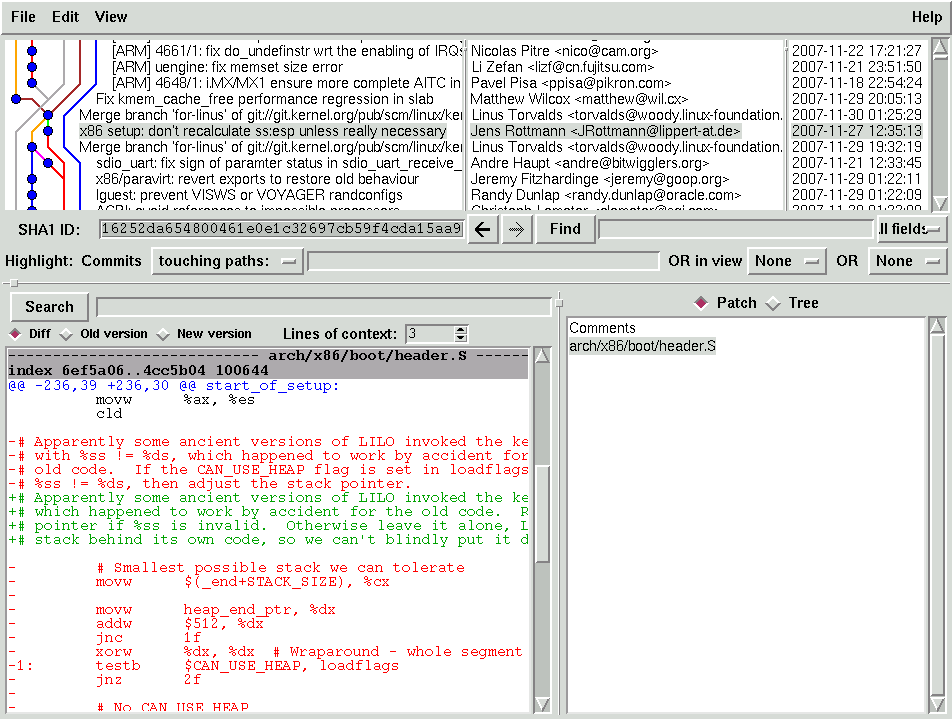
Use git cherry to find commits not merged upstream. Another really cool feature is the interactive rebasing: git rebase –interactive Make sure you are aware of gitk: Screenshot of gitk … and don’t forget to set readable fonts for gitk, like:
[ -r ~/.gitk ]   cat > ~/.gitk << EOF
set mainfont  Arial 10 
set textfont   Courier 10 
set uifont  Arial 10 bold 
EOF
If you prefer a Qt based interface check out qgit. Useful ressources:

Julien Danjou: rebuildd 0.3.0 released

Everything seems to work, so just releasing it. I think it's becoming an amazing tool to do archive rebuild. It just misses a good Web interface. :-(

Miriam Ruiz: Software patents are buggy

Patents are the best way to improve development, and software inventors have just the natural right to their algorithms and designs. Research and Development in industry wouldn’t just work without patent protection, and technology improvements would just stop, right? Well, I’m not so sure of that. Key arguments against software patents, stolen from Pieter Hintjens’ article:

1 December 2007

John Goerzen: Attention Junkmailers

We love to hear from you. I'm sure that's what you're thinking, anyway, as you prepare volumes of paper to send to our mailbox.

But just so you know, let me explain just how much we love the material you send us.

When we get one of your catalogs, it will get added to the junk mail pile. Every so often, I will go through this pile. I will contact the company behind each and every mailing, asking them to remove me from their list and not rent my name further. If I have extra time, I will probably also write that note on your postage-paid envelope and pop it in the mailbox. I will also add your name to my list of companies that send me junk mail, so I can avoid doing business with you in the future. If you have sent me junk mail in the past, rest assured that I will find some creatively enjoyable way of dealing with your refusal to honor my removal request.

After I have processed your piece of artfully-crafted handiwork, possibly trying to sell me pink laptops or a shirt with the word "femail" on it -- whatever that means -- I will deposit your catalog, along with dozens of other similar catalogs, on the kitchen floor.

This is when the real fun begins, because now it's Jacob's turn to process them.

He will usually start by ripping out every page from the catalog. He'll start slowly and carefully, ripping out pages one at a time, savoring the wonderful rrrrriiiiippppp noise as he goes. But then he'll get faster, going for two pages at a time, then more, until finally he just will lunge for paper by the handful to crush, tear, or otherwise mutilate.

After that, there are many things he might do to your fine piece of unsolicited advertising. Perhaps he will enjoy drooling on it -- a satisfying fate for your 4-color catalog, don't you think? Or perhaps he will grab some of your pages, carefully emblazoned with your logo, and tear them into as many tiny bits as he can. Or maybe he will simply gather your work together on the floor, then spin himself around on top of it, scattering the remnants as far and wide as possible, cackling all the while. He may also smear bits of food on them if he ate recently, or perhaps he will simply resume tearing pages apart.

But whatever he does, rest assured that he will treat your catalog with the care and attention it deserves. No catalog will survive intact, and as many pages as possible will be ripped apart and left in bits. He does, after all, have a great attention to detail.

After Jacob is done, we will gather up what remains and put it all in our recycling container.

Oh, and under no circumstances will we actually make a purchase from your catalog.

Here are two pictures of the scene.

img_4160.jpg

Notice the careful concentration in this photo. Obviously he knows that Dell has been ignoring my removal requests for some time, and is taking note to tear their pages into the smallest possible bits.

But it's not all hard work -- processing your catalogs is fun, too.

img_4163.jpg

Adeodato Sim : Attribution in distributed VCS is cool

Among the benefits that distributed version control systems have brought us, I would like to mention a very small one, that may often go unnoticed, but that I think it’s actually pretty cool: attribution. With DVCS, it’s now normal to have each change attributed at VCS level to the person which made the change. For this, normally the author has to publish a branch, or maybe send an “enriched patch” or bundle that contains meta-data, or revision information. If they send a plain diff, though, the VCS may still offer a way to credit them, by putting their name in the “author” field. For both Git and Bazaar, this is done with the --author option for commit.

Rodrigo Gallardo: Nasty microscopic life (?) forms

This week I ought to have posted about how Gunnar and I met somewhere along the Ciclotón and had amazing amounts of fun. But I can’t, because we didn’t, because I was stuck in bed, with a 39C fever, all through Sunday and Monday and half of Tuesday. And weak and tired and with a big, nasty, unsuferable headache the other half of Tuesday and Wednesday and half of yesterday. So, instead, all I can do is apologize to santiago, who nominated me for DM, and damog, who seconded the nomination, and anibal who caught my silly mistake of not mentioning that I (of course) love and accept the DFSG in my response, for being silent and unresponsive. And to the people who reported bugs in my packages and got no response. And to oliver, for whom I was supposed to fix some JavaScript issues yesterday. I hate viruses.

30 November 2007

Daniel Burrows: The Dreaded I-Word

A popular and recurrent topic of conversation on the Internet has the following form:
Is (X) innovative?
I occasionally find myself reading these discussions; they have the same sort of macabre fascination for me that's often ascribed to train wrecks, messy divorces, and Usenet. Of course, the outcome (or rather the lack of one) is always predetermined. The only variable is how many pixels will be mutilated and how many absurd postures will be struck before the dust settles. Why do I say the outcome is predetermined? Because in not one of these discussions does the person posing the question precisely define what innovation is. If the discussion concerned, say, whether an object was blue, or made of concrete, or 5 meters by 6 meters, this would not be a real problem: while any hair can be split, there are commonly accepted definitions of blue, concrete, and meter that are sufficient for an informal discussion. But innovation is not blue, concrete, or meter. Different people have subtly, even radically different views of what constitutes innovation and how to measure it. Hence, any discussion involving more than one person quickly devolves into chaos. One person will say, X is innovative because of such-and-such, and another will reply, X is not innovative because of such-and-such unrelated reason. Both writers are correct by their own definitions of innovation; they are answering different questions, and so they end up talking past one another. Although these discussions never go anywhere, I think it's entertaining and enlightening to catalogue some of the definitions of innovation that the participants use. I've listed some popular definitions below; feel free to email me with more suggestions and I'll update the list. Of course, since people rarely bother to define their terms, most of these meanings have been inferred from the statements people have made about what is and is not innovative. As a result, some of them are fairly absurd and may not accurately reflect the opinions of the speakers, had the speakers stopped to think about what they were saying. Caveat lector. Conventions: Below, personal pronouns such as I and me refer to the speaker. The words product, idea, and technique are used interchangeably and as appropriate to refer to the thing whose innovativeness is in dispute.
  • The idea advanced the state of human knowledge.
  • The idea was an improvement over existing ideas.
  • The idea improved the state of practice within its field.
  • The idea was previously unknown.
  • The idea was previously unknown to its creator.
  • The idea was previously unknown to me.
  • The technique solved a problem thought to be unsolvable.
  • The technique solved a problem with no known solution.
  • The technique solved a problem with no solution known to me.
  • The technique solved a problem with no solution known to its inventor.
  • The product was aesthetically pleasing to me.
  • The product is entirely unlike any other product with which I am familiar.
  • The product is exactly the same as some other product with which I am familiar.
  • The product solved a problem more effectively than existing tools.
  • The product made its creator the wealthiest living human.
  • The product made its creator wealthy.
  • The product made someone wealthy.
  • The product reaped a huge profit for the corporation selling it.
  • The product was bought by many people.
  • The product was used by many people.
  • The product was useful to many people.
  • The product was useful to someone.
  • I bought the product.
  • The product was useful to me.
  • The product was created by (some particular entity, such as Toyota or Apple).
  • The product was not created by (some particular entity).
  • The product is good. (NB: of course good is another ambiguous term with many definitions, one of which appears to be innovative; the fun never stops!)
A Contrarian View This post charitably assumes that the purpose of the discussions I described, and the goal of the participants, is to arrive at a commonly agreed-upon answer to the opening question. In reality, though, most discussions on the Internet, particularly when they involve many anonymous or pseudonymous parties, are just tribal wars. Individuals decide which side to affiliate themselves with, then search for arguments that will tend to support their side or undercut the opposition. Facts and logic are largely irrelevant, except as weapons with which to smack one's opponents, and a dismissive put-down is as good as or better than a reality-based analysis. Actually changing your mind based on the evidence presented shows weakness, and is to be avoided at all costs. If you have to assert that up is down, do it. In this environment, using vague terms appears to be a bonus, since it gives you more wiggle room and opportunities to play gotcha!. If someone responds to your post with facts that rebut you based on the definition you were using, you can pick any other definition and say ...but what about..? Which is why these discussions (in which no-one is actually discussing anything) are both a fascinating window into human nature and a depressing commentary on human nature, and why I keep finding myself reading them.
PS: This post is the first long post that I've used ikiwiki to write. An advantage of my new workflow, where I write posts on the bus and commit them into a local git repository, is that I have a nice block of time to write down random thoughts that have occurred to me on the way to or from work; sometimes I forget what I was going to write over the course of the day, and when I get home I usually get deluged in email and real life. It's always amazing to me how long it takes to write posts when I actually think about what I'm doing. This post has taken me at least an hour to compose, and I think probably more (especially counting the composition I did in my head while, e.g., walking from point A to point B). It's a lot harder -- which means, of course, that it's fun; if I don't get distracted by a coding project, I'll be trying to take advantage of my new workflow to post more often.

loldebian - Can I has a RC bug?: QA i haz...

QA i haz...

submitted by KiBi Top, from left to right: GyrosGeyger, h01lger, Ondrej Bottom, from left to right: zack, waiter, TiCo

Evan Prodromou: 8 Frimaire CCXVI

A few days ago I installed the Flock browser, version 1.0, on my notebook computer. I've been using it as my default browser for that time, and I have to say that I find it very slick and useful. I'd used the early beta versions of Flock and I thought it was a good idea, but I wasn't able to use most of the features. The blog posting tool, for example, doesn't work with my hacked-together WikiBlog system. Also, a lot of my must-have Firefox extensions, like SearchStatus, wouldn't install on Flock. But version 1.0 now installs all my Firefox extensions, and it also has lots of neat features that I find really useful. The feed reader, for example, is very slick, complete, and useful. The integration with social software sites like Facebook and Twitter is amazing, and the People View -- which tracks your friends on different systems -- is huge. The "My World" generated home page has replaced Netvibes for me. All good things. I'm a little disappointed with the narrow range of sites that are integrated into the browser, though. It'd be great to see more and better documentation on writing integration plugins on the Flock Developer site. I'd love to work on ways to make it easier to post to MediaWiki sites, upload files, get notifications, etc. I think getting site owners to make their own Flock plug-ins, or making it easy for users or third parties to do the plug-ins themselves, is going to be key to the success of these features. One other thing I found annoying was the indexer. This is a background task that indexes your browsing history so you can search for stuff you've recently seen ("Where did I read about that new version of JavaScript...?") Although this seems really useful, I found that the indexer was pegging the CPU on my Linux box -- possibly a threading problem? -- and I found the program increasingly unresponsive. Eventually I found the toggle in about:config to turn off the indexer ("flock.service.indexer.enabled"), and once I switched it off my browsing experience has been much less frustrating. I'd like to see Flock succeed -- it's a nice piece of work, and I think it's going down the right path. Getting more contributions from the world Web community will go a long way towards making it more useful for users. tags:

Yo Gamma Gamma Last night I dropped by the SAT for a great games event here in Montreal. Gamma 256 was a fun party, associated with the MIGS game summit. The event showcases submitted games based on a theme -- this year's theme was 256x256 pixel games (or smaller) -- thus the name. There were a ton of Montreal tech people there. The games were fun to play, especially the insanely violent Bloody Zombies, where your chainsaw-wielding alter ego slaughters the undead and then swims in their blood to reach the next level. Great fun, and a good example of Gamma's concentration on art in games. The music was good too -- lots of bleeps and boops and gamety fun. Congratulations to Heather Kelley and Damien DiFede and the rest of the Kokoromi Collective on their great job with this event. I'm already looking forward to next year. tags:

One-liners Some more things going on with me: tags:

29 November 2007

Michal &#268;iha&#345;: Too lazy to manually upload to PPA

As I wrote before, I tried to use Ubuntu Personal Package Archive for distributing up to date Gammu, python-gammu and Wammu packages. For first time I failed because I expected it to behave more like OpenSUSE build service than like Debian archives, but I was wrong, so I have to upload different version to each Ubuntu suite. Well that sounds like a work which should be automated. So I hacked a little shell script, which takes current version from unstable, updates changelog and injects it into my PPA. The hacky script is called deb2ppa. It requires dput to be configured for ppa same way as I have it and maybe has some other tricky dependencies which I do not realize right now. Anyway you can now use current Wammu/Gammu versions even on older Ubuntu releases if you wish :-). (Well you have to wait till it is rebuild, but I hope it will not take much time.)

27 November 2007

Bastian Venthur: Time-lapse-video-with-your-webcam mini HOWTO

I bought me a cheapo webcam the other day and the first thing (meh… actually the second. The first thing I had to do was obviously getting this little piece of plastic working…) I wanted to do was making a time-lapse video of me working on my diploma thesis or something. With a little help from google and the friendly folks at debian-user-german I finally got it working. snapshot.jpg What you need: camserv, wget and mencoder. Assuming you have your webcam working with v4l, camserv will provide snapshots of your cam via http://localhost:9192, so the following script will make a snapshot every second until you kill it:

#!/bin/sh
while [ 1 ]; do
    wget http://localhost:9192 -O  date +%s .jpg -q
    sleep 1s
done

Let it run for several hours and then create the movie with the following script:

#!/bin/sh
mencoder "mf://*.jpg" -mf fps=25 -o output.avi -ovc lavc -lavcopts vcodec=mpeg4:mbd=2:trell=yes:v4mv=yes

Hint: coding, juggling and even sleeping at your desk looks cool in time-lapse - eating or singing your favorite songs while listening to them does not :P I recorded myself for ca 12 hours and the resulting video was like 130 megs large. The result looks pretty funny, but since there was a lot of the not-so-cool-looking eating and singing stuff in there, I’m afraid I can’t even show it to my closest friends ;) Hint for users having problems getting proper images from camserv: I had to change max_frames value to 1 in the [socket] section of /etc/camserv/camserv.cfg to get proper single images via wget. I find the camserv solution to get the images from the webcam rather suboptimal, has anyone a smarter solution? NP: Gianna Nannini - Bello e impossibile

Next.

Previous.