Search Results: "tb"

25 February 2009

Muammar El Khatib: Debian on HP 2133.

I got a HP 2133. I have installed Debian in it, successfully :-) Here, I'll show all the steps I followed in order to install Debian.
First of all, you'll need an USB stick (formatted to FAT16). We need to convert such a device, in a bootable one. For making it, we have to download two files. One of them is boot.img.gz that you can get from http://debian.org/devel/debian-installer/ in the section "other images (netboot, usb stick, floppy, etc)". The other one, is a business card or a netinst image.

When you have downloaded them, we can proceed to make the next:

$ zcat /root/boot.img.gz > /dev/sdbX
(where sdbX should be changed for the correct device for you, maybe dmesg tail when you insert the USB stick will help you).

When you have executed what I have stated above, then you have to copy either the business card or the netinst ISO image (just one of them ;-)). Doing this, our USB stick has become in a bootable device. You cannot copy a complete CD ISO, just netinst or business ones.

[Update] Note: If your system refuses to boot, try this:

# install-mbr /dev/sdb


(where sdb should be changed for the correct device for you, maybe dmesg tail when you insert the USB stick will help you).

Now, you can proceed to boot your HP mini using the USB stick and proceed with the installation process. After installing Debian, I'd suggest you to boot again, in Rescue Mode, to change the file acpi-support which is in /etc/default directory. Look for the line number 92 and set SAVE_VBE_STATE to false. Doing this you will avoid the annoying white screen you get when the system tries to save such a state.

Now, the problem you will face is the ******* resolution. After trying some xorg.conf files, I found one that worked for Debian. You can find it here.

For the wireless card I found this post http://jomcode.com/fadhil/?p=59 which worked pretty nice.

I still have to make the 3d acceleration work, but I haven't had the time to do it. Furthermore, I'll paste this info in http://wiki.debian.org/InstallingDebianOn/HP/HP2133 so that if someone has a HP2133, will be able to contribute or add some more information.

24 February 2009

Russell Coker: Tragedy and Profit

Every time something goes wrong there will be someone who tries to take advantage of the situation. The recent bushfires in Australia that have killed hundreds of people (the count is not known yet) are a good example. Pastor Nalliah of Catch the Fire Ministries [1] claims that it is due to legalising abortion. This is astoundingly wrong. In a more extreme example representatives of the Westboro Baptist Church were planning to visit Australia to launch a protest in support of the bushfires [2]. I have not yet found any news reports about whether they actually visited Australia or protested - it s most likely that they decided not to visit due to the Australian laws being very different to US laws regarding the relative importance of freedom of speech and incitement to violence. Apparently the insane Westboro Baptist Church people (who are best known for GodHatesFags.com and GodHatesAmerica.com) believe that God hates Australia and caused the fires (presumably due to Australia not persecuting homosexuals). Danny Nalliah has permanently damaged his own reputation by acting in a similar way to the Westboro Baptist Church. The reputation of Catch The Fire now depends on how quickly they get a new pastor Please note well that the vast majority of Christians have nothing in common with Westboro or Catch The Fire. I don t recall the last time I met an Australian Christian who was strongly opposed to homosexuality or abortion. Now we do have to try and investigate ways of avoiding future tragedies, and the work to do this needs to begin immediately. John Brumby (the Premier of Victoria) has announced that Victoria will get new strict building codes for fire resistant buildings [3]. There have been many anecdotes of people who claim to have been saved by attaching sprinkler systems to their homes, by building concrete bunkers to hide in while the fire passes, and using other techniques to save their home or save themselves. Some more research on the most effective ways of achieving such goals would be worthwhile, an increase in funding for the CSIRO to investigate the related issues would be a good thing. The article also has an interesting quote As the fallout from the disaster widened, the union representing the nation s 13,000 firefighters warned both the federal and state governments to take global warming seriously to prevent a repeat of last weekend s lethal firestorm . However given that traditionally Australia and the US have been the two nations most opposed to any efforts to mitigate global warming it seems unlikely that anything will change in this regard in a hurry. The attempts to link bushfires to abortion and homosexuality are offensive, but can be ignored in any remotely serious debate about politics. However there are some other groups trying to profit from the tragedy that make claims which are not as ridiculous. On the 9th of February the Australian Green party was compelled to release an official statement from Spokesperson Scott Ludlam, Sarah Hanson-Young, Rachel Siewert, Christine Milne, and Bob Brown following some political discussion about Greens policies [4]. There have been attempts to blame the Greens for the tragedy which were politically motivated, some of which came from groups that traditionally oppose the Greens for other reasons (I m not going to provide the detail - anyone who is really interested can do google searches on the people in question). On the 16th of February Bob Brown (the leader of the Green party) felt obliged to make another media release reiterating the fact that the Greens support prescribed burn-offs to limit the scope of wild fires [5], he also decried the hate mongering that has been occurring in the wake of the disaster. One of the strange memes that seems to be spread by opponents to the Greens is that the Greens are all supposedly from the city and know nothing about the country. To avoid being subject to such attack I feel obliged to note that on one of the bad fire days I visited my parents. I spent the morning with my father and some friends at a park that was not far from the fire area, my friends then returned to their home which was not far from the fire area. I then had lunch with my parents and watched the smoke through the dining room window. After that my friends didn t respond to email for a while and I was concerned that they may have lost their house or maybe suffered injury or death. I didn t know them well enough to feel it appropriate to try a dozen different ways of contacting them (I m sure that many other people were doing so), but I was rather concerned until my wife received an email from them. But I don t base my political beliefs on what I personally observe or my connections to people on the edge of the fire zone. I believe in the Green principles of Peace and Non Violence, Grassroots Democracy, Social and Economic Justice, Ecological Sustainability and the use of science and statistics to determine the best ways of achieving those goals.

Adrian von Bidder: New Toy

Last week, I couldn't resist and bought myself an Acer Aspire One (AOA 150Ab) netbook. It has 1G RAM, 120G HDD, unfortunately needs a fan, and is the model without 3G modem. It comes with Linpus Linux pre-installed. Looks quite nice, but is obviously ultimately the wrong OS ... Besides, it's locked down quite a bit, there's not even an easy way to start a terminal :-) I still have kept it, in a dual-boot configuration, to play around or show to people. Installing Lenny went very well, and to make things more fun I'm running quite a few things from experimental: KDE 4.2, xorg 7.4 (1:7.4~5 right now) and Oo.org 3. And, to get DRI2, also the 2.6.28 kernel from the newer-than-sid repository of the kernel team (2.6.28-2~snapshot.12850, but I hear 2.6.28 has now been uploaded.) While the whole thing is fun to use and didn't make any real problems, there are a few remaining issues (yes, this is a Dear Lazyweb posting, feel free to comment. I'll try to add updates to this article as this progresses): Ok, this has become rather a long list. But at least, as you can see, it's mostly minor issues, and hopefully a few where it's just missing configuration. One other issue is battery life: I see that there should be a large battery available for this thing. If it doesn't cost me as much as the whole netbook again, I'll seriously have to think about this... The 3-cell battery does last about 2.5h (and has, right now, uncovered a little bug where the battery monitoring applet tells me No AC adaptor plugged in, battery capacity: 50%, charging . Whee! I have a perpetuum mobile! I'm gonna be RICH!)

Matt Brown: The government listened!

I was very pleased to wake up this morning to the news that National has delayed the introduction of S92A via an order-in-council. It s a nice short-term victory, but I ll save the champagne until the law is fundamentally rewritten. The most pleasing aspect of the decision is simply that it was made at all. Within two weeks, a small band of protesters were able to harness the power of the Internet to direct international attention and place enough pressure on a Government, whose Prime Minister admitted to not having read the bill prior, that he then took the time to understand the issues and personally announce the delay in implementation of the law. We owe much thanks to the Creative Freedom Foundation for all the effort they put into co-ordinating the protest and ensuring that a single coherent message was presented. Just a little bit of my cynicism and belief that politicians never listen to public opinion outside of election campaigns was chipped away today. The reason I m not breaking out the champagne yet is that we ve only achieved a temporary reprieve in the commencement of the law. While those present at the press conference seem somewhat confident that John Key didn t like what he found in the law and would have repealed it if given the chance, all that has actually been done is delay it in the hopes of an agreement between the TCF and the rights holders (aka big media companies) on how to implement the still fundamentally broken law. The Government has given until late March for that to occur. To put this into a more global context. My happiness as I took the bus to work after reading about the decision to delay the law was short lived as the front page of the local paper declared that Eircom (Ireland s equivalent of Telecom) has voluntarily agreed to block sites such as The Pirate Bay upon request by the media companies (this comes a week after they also announced an agreement to, again voluntarily , implement a 3-strikes S92A style policy). Now, with the biggest ISP in their pocket (so to speak), the media companies have sent threatening letters to the remaining ISPs in the country demanding they implement the same procedure. To me, this illustrates one of the fundamental problems with S92. The concept that an ISP is liable for the conduct of its users, or for policing where on the Internet users should and shouldn t be able to connect to does not belong in our laws. Most ISPs already have provision to disconnect customers for illegal activity in their terms and conditions. If an end-user is doing something illegal, that is an issue between the rights holder and the end-user to take up in the courts just like every other sector of society must do when wronged, at which point the existing ISP terms and conditions can be invoked and access terminated. The big media companies, having decided that it is too expensive/hard/inconvenient to follow standard legal procedures to resolve their grievances are launching multi-pronged attacks to shift the playing field in their favour. In countries like New Zealand, where our politicians yearn for a Free Trade Agreement with America, they use their lobbyists to ensure that S92 style laws are part of the conditions. In other jurisdictions, like Ireland, they use strong-arm, divide and conquer style bully tactics outside of the political and legal process. I don t support copyright infringement. I rely on copyright to protect much of the work I place on the Internet, I want strong laws that protect me when my rights have been infringed. I don t believe that such laws should come at the expense of due process, our legal tradition and the basic principle of fairness! I don t believe that copyright infringement is such a heinous crime that it demands punishments stronger than those we deliver to paedophiles, stalkers or any other class of criminal who uses the Internet to enable their crimes. To me, today s (yesterday s - depending on your timezone) decision is only the first step in clawing New Zealand back from the dangerous path that the big media companies have been leading our law makers down. From here we need to press on and demonstrate to the Government over the next month that even if the TCF and rights holders are able to come up with some sort of workable code of practice, the law is still fundamentally flawed. It is based on premise that we are guilty by accusation. Even if guilt were to be proved by a competent legal body (eg. court or copyright tribunal) we don t need laws placing further liabilites onto ISPs (and remember the definition of ISP under this amendment act includes businesses who provide Internet access to staff, libraries, schools and hospitals) when their existing terms and conditions already prohibit illegal activity. Finally, and most importantly of all, we need to remember that laws exist to serve all sectors of society. Yes, copyright infringement is against the law and rights holders are reasonable in expecting the law to protect their content and allow them to make a fair profit. On the other side of the fence, average New Zealanders are not being unreasonable in their desire to have media available electronically, on demand and non-inhibited by DRM following a legal purchase. The failure of the media businesses to adequately cater to this change in market demand and usage of technology is obviously a contributing factor to the widespread copyright problems that they are facing today. Obviously, I m not condoning copyright infringement simply because the media companies are failing to address demand. Even stupid laws must be obeyed (and the concept of copyright is far from stupid). What I want to see is the Government acknowledging that the problem is not solely with consumers infringing copyright for malicious purposes, and therefore that the solutions do not lie solely in increasing the enforcement and punishments available. Copyright has always been a balancing act between the rights of content producers and consumers. S92 and the act it is contained within are taking us far too far down the road of catering to big business and their outdated business models with far too little concern for the rights of the individual consumer. Despite the many submissions made on this act last year when it was first passing through parliament, there was no comprehensive debate on what copyright means and how it should balance the rights of content producers and consumers in our digital century where copying is a zero-cost, zero-thought activity. Without such a debate we re doomed to continue wasting time arguing over the symptoms of the problem, like S92. So, I m saving my champagne for the day when we as a country address these issues and come up with a fair and workable interpretation of what copyright means today.

23 February 2009

Theodore Ts'o: Reflections on a complaint from a frustrated git user

Last week, Scott James Remnant posted a series of Git Sucks on his blog, starting with this one here, with follow up entries here and here. His problem? To quote Scott, I want to put a branch I have somewhere so somebody else can get it. That s the whole point of distributed revision-control, collaboration. He thought this was a mind-numbingly trivial operation, and was frustrated when it wasn t a one-line command in git. Part of the problem here is that for most git workflows, most people don t actually use git push . That s why it s not covered in the git tutorial (this was a point of frustration for Scott). In fact, in most large projects, the number of people need to use the scm push command is a very small percentage of the developer population, just as very few developers have commit privileges and are allowed to use the svn commit command in a project using Subversion. When you have a centralized repository, only the privileged few will given commit privileges, for obvious security and quality control reasons. Ah, but in a distributed SCM world, things are more democratic anyone can have their own repository, and so everyone can type the commands git commit or bzr commit . While this is true, the number of people who need to be able to publish their own branch is small. After all, the overhead in setting up your own server just so people can pull changes from you is quite large; and if you are just getting started, and only need to submit one or two patches, or even a large series of patches, e-mail is a far more convenient route. This is especially true in the early days of git s development, before web sites such as git.or.cz, github, and gitorious made it much easier for people to publish their own git repository. Even for a large series of changes, tools such as git format-patch and git send-email are very convenient for sending a patch series, and on the receiving side, the maintainer can use git am to apply a patch series sent via e-mail. It turns out that from a maintainer s point of view, reviewing patches via e-mail is often much more convenient. Especially for developers who are just starting out with submitting patches to a project, it s rare that a patch is of sufficiently high quality that it can be applied directly into the repository without needing fixups of one kind or another. The patch might not have the right coding style compared to the surrounding code, or it might be fundamentally buggy because the patch submitter didn t understand the code completely. Indeed, more often than not, when someone submits a patch to me, it is more useful for indicating the location of the bug more than anything else, and I often have to completely rewrite the patch before it enters into the e2fsprogs mainline repository. Given that, publishing a patch that will require modification in a public repository where it is ready to be pulled just doesn t make sense for many entry-level patch submitters. E-mail is in fact less work, and more appropriate for review purposes. It is only when a mid-level to senior developer is trusted to create high quality patches that do not need review that publishing their branch in a pull-ready form really makes sense. And that is fairly rare, and why it is not covered in most entry-level git documentation and tutorials. Unfortunately, many people expect to see the command scm push in a distributed SCM, and since git pull is a commonly used command for beginning git users, they expect that they should use git push as well not realizing that in a distributed SCM, push and pull are not symmetric operations. Therefore, while most git users won t need to use git push , git tutorials and other web pages which are attempting to introduce git to new users probably do need to do a better job explaining why most beginning participants in a project probably don t need their own publically accessible repository that other people can pull from, and which they can push changes for publication. There is one exception to this, of course, and this is a developer who wants to get started using git for a new project which he or she is starting and is the author/maintainer, or someone who is interested in converting their project to git. And this is where bzr has an advantage over git, in that bzr is primarily funded by Canonical, which has a strong interest in pushing an on-line web service, Launchpad. This makes it easier for bzr to have relatively simple recipes for sharing a bzr repository, since the user doesn t need to have access to a server with a public IP address, or need to set up a web or bzr server; they can simply take advantage of Launchpad. Of course, there are web sites which make it easy for people to publish their git repositories; earlier, I had mentioned git.or.cz, github, and gitorious. Currently, the git documentation and tutorials don t mention them since they aren t formally affiliated with the git project (although they are used by many git users and developers and the maintainers of these sites have contributed a large amount of code and documentation to git). This should change, I think. Scott s frustrations which kicked off his git sucks complaints would have been solved if the Git tutorial recommended that the easist ways for someone to publicly publish their repository is via one of these public web sites (although people who want to set up their own server certainly free to do so). Most of these public repositories probably won t have much reason to exist, but they don t do much harm, and who knows? While most of the repositories published at github and gitoriuous will be like the hundreds of thousands of abandoned projects on Sourceforge, one or two of the new projects which someone starts experimenting on at github or gitorious could turn out to be the next Ruby on Rails or Python or Linux. And hopefully, they will allow more developers to be able to experiment with publishing commits on their own repositories, and lessen the frustrations of people like Scott who thought they needed their own repositories; whether or not a public repository is the best way for them to do what they need to do, at least this way they won t get as frustrated about git. :-) Related posts (automatically generated):

  1. Git and hg John Goerzen recently posted about Git, Mercurial and Bzr that...
  2. Batches of patched batches of patches I found the following from the Risks Digest, authored by...

Bernd Zeimetz: awesome calendar widget

One of the things I was missing in my favourite windowmanager awesome was a calendar widget. So I spent some minutes and coded it. Moving the mouse over the time widget will show a naughty popup with the current month, use your mouse buttons (and the shift key) to scroll trough the months. The only annoying thing was to figure out how to change the text of an existing notification: notification.box.widgets[2].text = "new test" is neither easy to figure out nor to use. But here's the code for your rc.lua - in case you want to have a license for it - the code is published as public domain or under the ISC license, what ever you prefer.
function displayMonth(month,year,weekStart)
    local t,wkSt=os.time year=year, month=month+1, day=0 ,weekStart or 1
    local d=os.date("*t",t)
    local mthDays,stDay=d.day,(d.wday-d.day-wkSt+1)%7
    local lines =  
    for x=0,6 do
        lines[x+1] = os.date("%a ",os.time year=2006,month=1,day=x+wkSt )
    end
    lines[8] = "    "
    local writeLine = 1
    while writeLine < (stDay + 1) do
        lines[writeLine] = lines[writeLine] .. "   "
        writeLine = writeLine + 1
    end
    for x=1,mthDays do
        if writeLine == 8 then
            writeLine = 1
        end
        if writeLine == 1 or x == 1 then
            lines[8] = lines[8] .. os.date(" %V",os.time year=year,month=month,day=x )
        end
        if (#(tostring(x)) == 1) then
            x = " " .. x
        end
        lines[writeLine] = lines[writeLine] .. " " .. x
        writeLine = writeLine + 1
    end
    local header = os.date("%B %Y\n",os.time year=year,month=month,day=1 )
    header = string.rep(" ", math.floor((#(lines[1]) - #header) / 2 )) .. header
    return header .. table.concat(lines, '\n')
end
local calendar =  
function switchNaughtyMonth(switchMonths)
    if (#calendar < 3) then return end
    local swMonths = switchMonths or 1
    calendar[1] = calendar[1] + swMonths
    calendar[3].box.widgets[2].text = displayMonth(calendar[1], calendar[2], 2)
end
mytextbox.mouse_enter = function ()
    local month, year = os.date('%m'), os.date('%Y')
    calendar =   month, year, 
                naughty.notify( 
                    text = displayMonth(month, year, 2),
                    timeout = 0, hover_timeout = 0.5,
                    width = 200
                 )
                
end 
mytextbox.mouse_leave = function () naughty.destroy(calendar[3]) end
mytextbox:buttons( 
    button(   , 1, function()
        switchNaughtyMonth(-1)
    end),
    button(   , 3, function()
        switchNaughtyMonth(1)
    end),
    button(   , 4, function()
        switchNaughtyMonth(-1)
    end),
    button(   , 5, function()
        switchNaughtyMonth(1)
    end),
    button(  'Shift'  , 1, function()
        switchNaughtyMonth(-12)
    end),
    button(  'Shift'  , 3, function()
        switchNaughtyMonth(12)
    end),
    button(  'Shift'  , 4, function()
        switchNaughtyMonth(-12)
    end),
    button(  'Shift'  , 5, function()
        switchNaughtyMonth(12)
    end)
 )

Bernd Zeimetz: awesome calendar widget

One of the things I was missing in my favourite windowmanager awesome was a calendar widget. So I spent some minutes and coded it. Moving the mouse over the time widget will show a naughty popup with the current month, use your mouse buttons (and the shift key) to scroll trough the months. The only annoying thing was to figure out how to change the text of an existing notification: notification.box.widgets[2].text = "new test" is neither easy to figure out nor to use. But here's the code for your rc.lua - in case you want to have a license for it - the code is published as public domain or under the ISC license, what ever you prefer. Update: With thanks to a hint from madduck, the naughty popup is now aware of the screen your mouse is pointing to.
function displayMonth(month,year,weekStart)
    local t,wkSt=os.time year=year, month=month+1, day=0 ,weekStart or 1
    local d=os.date("*t",t)
    local mthDays,stDay=d.day,(d.wday-d.day-wkSt+1)%7
    local lines =  
    for x=0,6 do
        lines[x+1] = os.date("%a ",os.time year=2006,month=1,day=x+wkSt )
    end
    lines[8] = "    "
    local writeLine = 1
    while writeLine < (stDay + 1) do
        lines[writeLine] = lines[writeLine] .. "   "
        writeLine = writeLine + 1
    end
    for x=1,mthDays do
        if writeLine == 8 then
            writeLine = 1
        end
        if writeLine == 1 or x == 1 then
            lines[8] = lines[8] .. os.date(" %V",os.time year=year,month=month,day=x )
        end
        if (#(tostring(x)) == 1) then
            x = " " .. x
        end
        lines[writeLine] = lines[writeLine] .. " " .. x
        writeLine = writeLine + 1
    end
    local header = os.date("%B %Y\n",os.time year=year,month=month,day=1 )
    header = string.rep(" ", math.floor((#(lines[1]) - #header) / 2 )) .. header
    return header .. table.concat(lines, '\n')
end
local calendar =  
function switchNaughtyMonth(switchMonths)
    if (#calendar < 3) then return end
    local swMonths = switchMonths or 1
    calendar[1] = calendar[1] + swMonths
    calendar[3].box.widgets[2].text = displayMonth(calendar[1], calendar[2], 2)
end
mytextbox.mouse_enter = function ()
    local month, year = os.date('%m'), os.date('%Y')
    calendar =   month, year, 
                naughty.notify( 
                    text = displayMonth(month, year, 2),
                    timeout = 0, hover_timeout = 0.5,
                    width = 200, screen = mouse.screen
                 )
                
end 
mytextbox.mouse_leave = function () naughty.destroy(calendar[3]) end
mytextbox:buttons( 
    button(   , 1, function()
        switchNaughtyMonth(-1)
    end),
    button(   , 3, function()
        switchNaughtyMonth(1)
    end),
    button(   , 4, function()
        switchNaughtyMonth(-1)
    end),
    button(   , 5, function()
        switchNaughtyMonth(1)
    end),
    button(  'Shift'  , 1, function()
        switchNaughtyMonth(-12)
    end),
    button(  'Shift'  , 3, function()
        switchNaughtyMonth(12)
    end),
    button(  'Shift'  , 4, function()
        switchNaughtyMonth(-12)
    end),
    button(  'Shift'  , 5, function()
        switchNaughtyMonth(12)
    end)
 )

22 February 2009

Antti-Juhani Kaijanaho: grep-dctrl is ten years old

My message Intent to package a Debian control file grepper to WNPP and debian-devel is today a decade old. Apparently, the message predates the invention of the acronym ITP for Intent to Package (the first instance I can find is from May 1999). The changelog reveals that the first upload was on March 1st, 1999. There is unfortunately no record of when the package hit unstable the first time, since dinstall did not send Installed (or even the later Accepted) mails to an archived mailing list at that time. I suppose I might have it in some old private email archive, but more likely it s just gone. Similarly, the first fixed bug (#35527) predates BTS archiving and is now lost. The grep-dctrl program came out of repeated awkward grepping of the dpkg available and status files. Eventually I decided there must be a better way, and failed to find any canned solutions (I was later pointed to sgrep, which didn t look useful enough, and even later to dpkg-awk, but I had already committed to my own solution by then). I wrote a simple C program that processed these files as a sequence of records and did simple substring searches in each record. I rapidly added support for field selection, regular expressions and output field selection. By version 1.3a of March 2000 (which was released with Debian 2.2 potato ), the program was as good as it was going to get with one exception. Make disjunctive searches possible, said my TODO file those days. Conjunctive searches (that is, AND-searches) were possible even then by using more than one grep-dctrl command in a pipeline. Disjunctive (OR) was not possible. The problem was not so much that it would be hard to program (although the program s internal structure wasn t very good, to be honest, making extensive changes difficult), it was more a problem of coming up with a good command line syntax. Another thing that bothered me with the old grep-dctrl was how to implement Ben Armstrong s feature request. Again, the programming part wasn t the problem, the problem was coming up with a good, clean semantics for the feature. It was finally the appearance of ara in 2003 that got me moving again. Ara s author proudly compared eir program to grep-dctrl, claiming that my program did not do disjunctive searches while ara does. Competition being good for the soul, I took it as a challenge. In April 2003 I announced a complete rewrite of grep-dctrl, which was completed in January 2004 (the 2.0 release). The rewrite changed the way the command line was handled even though the usual Unix switch style is still used, the command line is regarded as a language with a parser (first an operator-precedence parser, then a recursive-descent one). The command line is transformed into an interpreted stack-based language which drives the actual grepping. The rewrite also generalised the internal data structures into an internal library which could be used to write other tools. The first such tool was sort-dctrl (introcuded in 2.7, June 2005), which was soon followed by tbl-dctrl (2.8, July 2005). The later appearance of join-dctrl (2.11, August 2007) finally allowed me to close Ben Armstrong s longstanding feature request mentioned above. The unpronounceable part of the names, dctrl , is an abbreviation for Debian control , which I decided to call the file format used by dpkg. Some people call it a RFC-822 format, but that really is a misnomer, since the differences between dctrl and RFC-822 outweigh the mainly superficial similarities (and the historical connection). I did consider calling my program dpkg-grep, but I didn t feel like I had the right to invade the dpkg namespace. The later rename to dctrl-tools reflects the fact that there are now several tools, grep-dctrl being just the oldest. I have several plans for the dctrl-tools suite, but my time and energy are mostly claimed by other responsibilities. The suite is currently team-maintained, but unfortunately the team is not very active. I would love it if I weren t the most active one with my busy schedule! Feel free to pop in on the dctrl-tools-devel mailing list, and to look at the Git repository and the todo list. If you decide to participate, please follow the rules.

21 February 2009

Uwe Hermann: Debian Lenny 5.0 released

Debian Lenny banner Yes, just when you thought the spamming of Planet Debian with "Lenny released" blog posts had finally stopped, here comes another one :-) Let me join the crowd by saying a great "thank you!" to all the people who made this release possible, especially so the release team who organized everything, as well as the thousands of contributors (in one form or another) who helped shape the new release! Personally, I'm eager to try out the new Linux 2.6.28 kernel package in unstable now (which have been uploaded today or so, but haven't yet reached my mirror), since they contain mainline wireless drivers for my One A110 netbook, among many other things. Also, in the next few days I'll probably re-install my NSLU2 ARM box using the latest Lenny installer, following the HOWTOs by Martin Michlmayr (I'll probably write about the experience later). This re-install is long overdue, as I'm currently running the box from an 1GB thumb drive, which works ok, but I'm slowly running out of space. So I'll re-install on a 4 GB (or bigger) thumb drive.

20 February 2009

Wouter Verhelst: New toys

Got myself a new laptop this week. Not that the other one broke down or some such, but it was getting old; and its single-core 1.3Ghz PowerPC was starting to be somewhat slow in comparison to what's available on the market today. Additionally, while it was still functional, there were some issues with wear-out; for instance, sometimes the battery would just fall out while I was walking around with it, or the network cable connection would not fit entirely, and similar minor problems The new one is quite a bargain; 2G of RAM, 2Ghz Core2Duo, one of those newfangled 'n' wireless network interfaces, plenty of diskspace, and other interesting things; and all that for only 600ish. You'd say it's a netbook, but it isn't although I guess the low price of those netbook systems is pulling down the bottom line of these machines. Anyway. After using it for slightly more than a day, I'm quite happy with it. I did have to upgrade a few packages in order to make all the hardware work properly; for instance, kernel 2.6.26 does not yet support the wireless (so I'm running 2.6.28 now), and the X.org in unstable can only get at the screen in vesa mode, which means I'm running the 7.4 X.org packages from experimental. But overall, most of it (that I care about) works flawlessly. With a single exception: I have no audio. The weird thing is, the audio chipset is recognized, and I can play around with alsamixer; but no matter, there is no sound. Which is kindof annoying. It doesn't appear that I'm the only one with this problem (witness this debugging page on the alsa wiki), so I'm sure I'll get there. Eventually. Oh wel. While fetching the laptop, I was told that the NSLU2 which I had on backorder had arrived, so I took that with me, too. Add to that the 160G disk that I'd fetched earlier, and the USB NIC that I also got, and the Thecus N2100 that's still running at my parents' place will soon be moved to my home again and its 500G RAID1 with it. Whee.

Biella Coleman: Debian Geek NYC

A Debian geek s view of NYC

19 February 2009

Julian Andres Klode: Top blog posts


Viewing the statistics for my blog, I have come to some conclusions about what topics people are interested in. First let s take a look at the statistics for 1 year:
Short review: Fedora 10 and Ubuntu 8.10 2,310
A small benchmark: Bazaar, Git, Mercuria 2,112
Fedora 9 & Kernel Mode Setting 1,804
Gentoo destroying earth? 1,126
Filesystems 1,093
Python Speed: x in list vs x in set 1,025
From these statistics, I conclude that most people are interested in reviews of distributions and benchmarks, as well as stuff directly related to the kernel, eg. filesystems. Next would be the review of OpenSolaris and other posts, but they have less than 1000 views and are therefore not included in this post. So if you want to get many visitors, just review 2 distributions, do a benchmark of SCMs, or something like this. If you don t want many visitors, don t write about such topics. Posted in General

Joey Hess: my stereo

Can you tell there's a whole linux machine loaded with hundreds of albums in there? Well, the USB ports on the front panel, and inside the cassete tape deck are a bit of a giveaway, as are all the blinkenlights. Details here. I'm still suprised I got it all squeezed in, put together, and working. Some things fit better than I had any right to expect:
tiny airgap between the QNAP computer and front panel control board

18 February 2009

Russell Coker: Red Hat, Microsoft, and Virtualisation Support

Red Hat has just announced a deal with MS for support of RHEL virtual machines on Windows Server and Windows virtual machines on RHEL [1]. It seems that this deal won t deliver anything before calendar H2 2009 so nothing will immediately happen - but the amount of testing to get these things working correctly is significant. Red Hat has stated that the agreements contain no patent or open source licensing components and the agreements contain no financial clauses, other than industry-standard certification/validation testing fees so it seems that there is nothing controversial in this. Of course that hasn t stopped some people from getting worked up about it. I think that this deal is a good thing. I have some clients who run CentOS and RHEL servers (that I installed and manage) as well as some Windows servers. Some of these clients have made decisions about the Windows servers that concern me (such as not using ECC RAM, RAID, or backups). It seems to me that if I was to use slightly more powerful hardware for the Linux servers I could run Windows virtual machines for those clients, manage all the backups at the block device level (without bothering the Windows sysadmins). This also has the potential to save the client some costs in terms of purchasing hardware and managing it. When this deal with MS produces some results (maybe in 6 months time) I will recommend that some of my clients convert CentOS machines to RHEL to take advantage of it. If my clients take my advice in this regard then it will result in a small increase in revenue and market share for RHEL. So Red Hat s action in this regard seems to be a good business decision for them. If my clients take my advice and allow me to use virtualisation to better protect their critical data that is on Windows servers then it will be a significant benefit for the users.

Kartik Mistry: 3 Years!


* It all started with this sip! At Marriage.. 3 years. Thanks my dear Koki!

John Goerzen: How To Think About Compression, Part 2

Yesterday, I posted part 1 of how to think about compression. If you haven t read it already, take a look now, so this post makes sense. Introduction In the part 1 test, I compressed a 6GB tar file with various tools. This is a good test if you are writing an entire tar file to disk, or if you are writing to tape. For part 2, I will be compressing each individual file contained in that tarball individually. This is a good test if you back up to hard disk and want quick access to your files. Quite a few tools take this approach rdiff-backup, rdup, and backuppc are among them. We can expect performance to be worse both in terms of size and speed for this test. The compressor tool will be executed once per file, instead of once for the entire group of files. This will magnify any startup costs in the tool. It will also reduce compression ratios, because the tools won t have as large a data set to draw on to look for redundancy. To add to that, we have the block size of the filesystem 4K on most Linux systems. Any file s actual disk consumption is always rounded up to the next multiple of 4K. So a 5-byte file takes up the same amount of space as a 3000-byte file. (This behavior is not unique to Linux.) If a compressor can t shrink enough space out of a file to cross at least one 4K barrier, it effectively doesn t save any disk space. On the other hand, in certain situations, saving one byte of data could free 4K of disk space. So, for the results below, I use du to calculate disk usage, which reflects the actual amount of space consumed by files on disk. The Tools Based on comments in part 1, I added tests for lzop and xz to this iteration. I attempted to test pbzip2, but it would have taken 3 days to complete, so it is not included here more on that issue below. The Numbers Let s start with the table, using the same metrics as with part 1:
Tool MB saved Space vs. gzip Time vs. gzip Cost
gzip 3081 100.00% 100.00% 0.41
gzip -1 2908 104.84% 82.34% 0.36
gzip -9 3091 99.72% 141.60% 0.58
bzip2 3173 97.44% 201.87% 0.81
bzip2 -1 3126 98.75% 182.22% 0.74
lzma -1 3280 94.44% 163.31% 0.63
lzma -2 3320 93.33% 217.94% 0.83
xz -1 3270 94.73% 176.52% 0.68
xz -2 3309 93.63% 200.05% 0.76
lzop -1 2508 116.01% 77.49% 0.39
lzop -2 2498 116.30% 76.59% 0.39
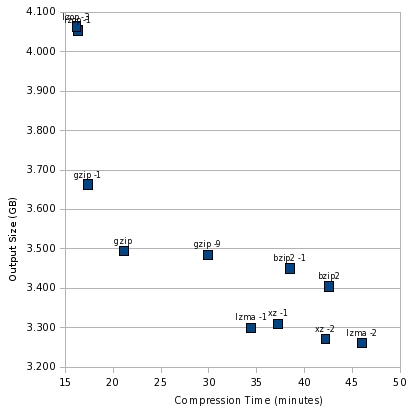
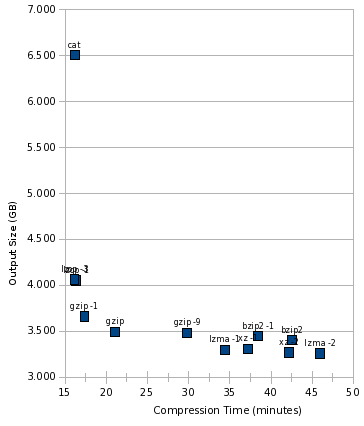
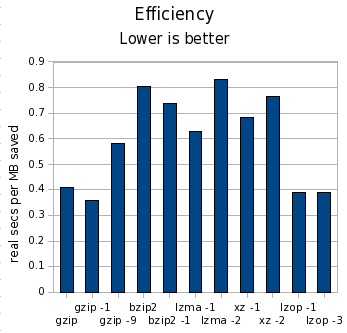
As before, in the MB saved column, higher numbers are better; in all other columns, lower numbers are better. I m using clock seconds here on a dual-core machine. The cost column is clock seconds per MB saved. Let s draw some initial conclusions: The Pretty Charts Now, let s look at an illustration of this. As before, the sweet spot is the lower left, and the worst spot is the upper right. First, let s look at the compression tools themselves: compress2-zoomed At the extremely fast, but not as good compression, end is lzop. gzip is still the balanced performer, bzip2 still looks really bad, and lzma -1 is still the best high-compression performer. Now, let s throw cat into the mix: compress2-big Here s something notable, that this graph makes crystal clear: lzop was just as fast as cat. In other words, it is likely that lzop was faster than the disk, and using lzop compression would be essentially free in terms of time consumed. And finally, look at the cost: compress2-efficiency What happened to pbzip2? I tried the parallel bzip2 implementation just like last time, but it ran extremely slow. Interestingly, pbzip2 < notes.txt > notes.txt.bz2 took 1.002 wall seconds, but pbzip2 notes.txt finished almost instantaneously. This 1-second startup time for pbzip2 was a killer, and the test would have taken more than 3 days to complete. I killed it early and omitted it from my results. Hopefully this bug can be fixed. I didn t expect pbzip2 to help much in this test, and perhaps even to see a slight degradation, but not like THAT. Conclusions As before, the difference in time was far more significant than the difference in space. By compressing files individually, we lost about 400MB (about 7%) space compared to making a tar file and then combining that. My test set contained 270,101 files. gzip continues to be a strong all-purpose contender, posting fast compression time and respectable compression ratios. lzop is a very interesting tool, running as fast as cat and yet turning in reasonable compression though 25% worse than gzip on its default settings. gzip -1 was almost as fast, though, and compressed better. If gzip weren t fast enough with -6, I d be likely to try gzip -1 before using lzop, since the gzip format is far more widely supported, and that s important to me for backups. These results still look troubling for bzip2. lzma -1 continued to turn in far better times and compression ratios that bzip2. Even bzip2 -1 couldn t match the speed of lzma -1, and compressed barely better than gzip. I think bzip2 would be hard-pressed to find a comfortable niche anywhere by now. As before, you can download my spreadsheet with all the numbers behind these charts and the table.

Matt Brown: Blacked Out - no Guilt Upon Accusation

If you re reading this post via the website rather than a feed/planet then you will notice that the site has gone completely black in support of the Creative Freedom Foundation s campaign against S92A of the NZ Copyright Amendment Act which is due to come into effect on 28th February 2009. I ve also joined the wave of people blacking out their avatar on Facebook/Jabber/MSN, etc. S92A introduces Guilt Upon Accusation whereby if you are accused of copyright infringement (downloading music and movies, etc) repeatedly (likely 3 or more times) you are at risk of being disconnected from the Internet by your ISP. The law does not require any proof or substantiation of the accusations and the entire process would occur outside of the courts and the established legal system. Not only does it place every user at risk, the wording is very unclear on exactly what type of organisation is considered an ISP and there is significant concern that schools, businesses, libraries and hospitals will be placed in the difficult position of determining whether their users have broken the law and require disconnection. Opposition to the law is not an attack on copyright, or a statement that we should be free to download all the movies and music that we desire. Those sorts of activities are clearly wrong, and I don t have any issue with copyright holders wanting to enforce their rights when their content is illegally copied. However, disconnecting people upon accusation, with no proof or formal legal process to prove guilt is not the right way to go about it. The fact that the law does not require proof of guilt is only the tip of the iceberg in terms of problems with it. For further background on the problems it causes for ISPs by placing them as the middle-man in copyright disputes you should refer to the following posts: Finally, I think it is worth pointing out that S92A was removed from the proposed Amendment at the select committee stage, but was later reintroduced by Judith Tizard during the final reading of the bill. Mark Harris has an excellent post on the history of the amendment which includes facts such as the official report on the amendment also recommended removing S92A as it was unecessary given existing ISP terms and conditions which forbid illegal activity. The fact that the select committee (based on public submissions) recognised the problems with S92A and removed it, only to have it added back in again at the last stage when we no longer had any say on it really hacks me off and I cant help but feel the influence of the big money American media companies pressuring our politicians to pass a law that they don t really understand the full consequences of. So what is to be done? The Blacked Out campaign, being run by the Creative Freedom Foundation is gathering steam and international attention. Peter Dunne of United Future (who originally voted for the amendment) has declared that the amendment is wrong, and doesn t do what they thought they were voting to do, we need to convince National and the rest of the house of the same. Time is running out for this to happen before the amendment comes into effect on Feb 28th, but there is still time to write to your local MP and sign the petition against S92A Guilt Upon Accusation . The Creative Freedom Foundation site has a nice easy list of what you can do to register your protest.

17 February 2009

Dann Frazier: Adding firmware blobs to install media

Here's a shell script I wrote to stuff non-free firmware bits into an existing lenny installer image. It currently can operate on either a initrd.gz file or an isolinux-based iso image. I've only tested it on a netboot initrd.gz and a netinst iso, but it should work on larger images as well. If you need support for some other media type or architecture, let me know.

MJ Ray: Three Releases: Debian, Co-op and Videos

Three things I really like have released recently:-
  1. Debian GNU/Linux 5.0 ( Lenny ): I installed it on a laptop the weekend before going to a conference and I m really impressed. It installed fairly neatly and was good-looking (gtk installer from USB stick, default desktop task, in case anyone cares). I found one or two small glitches while travelling, which I ll reportbug soon, but they re very minor. Well done to everyone involved in stabilising this release!
  2. The co-operative officially launched its new brand with a 2.5-minute whole-break advert using a Bob Dylan track, both of which are unusual. OK, so I feel it should have been available in a FOSS-friendly format and not done on the same day as announcing a sale of opticians or a big closure, but it s still good to see the co-operative getting big TV exposure.
  3. Videos of Debian at FOSDEM and the Business of Open Source mini-conference at Linux.conf.au were released, which I ll watch soon. The current trend of recording key conferences isn t a substitute for being there in-person, but it s still invaluable and I thank all those involved.

Russell Coker: Lenny Play Machine Online

As Debian/Lenny has been released and the temperatures in my part of the world are no longer insanely hot I have put my SE Linux Play Machine [1] online again. It is running Debian/Lenny and is a Xen DomU on a Debian/Lenny Dom0. To get this working I had to make a few more fixes to the SE Linux policy and will update my Lenny repository (as mentioned in my document on installing SE Linux on Lenny [2]) in the near future. I have reformatted most of the text from the thanks.txt file on my Play Machine and put is online on my documents blog [3]. I have also graphed the logins to my Play Machine using Webalizer [4] with 1KB transfer in the graph meaning one minute of login time. Below is the Perl code I used to convert the output of last -i to what looks like an Apache log file, the program takes a single command-line parameter which indicates the year that the data is from (which is not included in last output) and takes the output of last -i on standard input and gives a web log on standard output. #!/usr/bin/perl my @output; while(<STDIN>)

if(not $_ =~ /^root.*pts/)

next;

$_ =~ s/ +/ /g;
$_ =~ s/^root pts.[0-9]+ //;
chomp $_;
my @arr = split(' ', $_);
my $url = "/";
if($arr[6] =~ /crash/)

$url = "/crash";

my $t = $arr[7];
$t =~ s/[()]//g;
my @times = split(':', $t);
if($times[0] =~ /\+/)

my @hours = split('\+', $times[0]);
$t = $hours[0] * 24 * 60 + $hours[1] * 60 + $times[1];

else

$t = $times[0] * 60 + $times[1];

$t *= 1024;
if($t == 0)

$t = 1;

if(length($arr[3]) == 1)

$arr[3] = "0" . $arr[3];

$output[$#output + 1] = "$arr[0] - - [$arr[3]/$arr[2]/$ARGV[0]:$arr[4]:00 +0000] \"GET $url HTTP/1.0\" 200 $t \"-\"\n";
my $i;
for($i = $#output; $i > -1; $i--)

print $output[$i];

Next.

Previous.