Search Results: "pa"

25 April 2021

Russ Allbery: Review: Learning React

Review: Learning React, by Alex Banks & Eve Porcello
Publisher: O'Reilly
Copyright: June 2020
ISBN: 1-4920-5172-1
Format: Trade paperback
Pages: 287
My first JavaScript project was a React frontend to a REST service. As part of that project, I read two books: JavaScript: The Definitive Guide to learn the language foundation and this book to learn the framework on top of it. This was an unintentional experiment in the ways programming books can approach the topic. I commented in my review of JavaScript: the Definitive Guide that it takes the reference manual approach to the language. Learning React is the exact opposite. It's goal-driven, example-heavy, and has a problem and solution structure. The authors present a sample application, describe some desired new feature or deficiency in it, and then introduce the specific React technique that solves that problem. There is some rewriting of previous examples using more sophisticated techniques, but most chapters introduce new toy applications along with new parts of the React framework. The best part of this book is its narrative momentum, so I think the authors were successful at their primary goal. The first eight chapters of the book (more on the rest of the book in a moment) feel like a whirlwind tour where one concept flows naturally into the next and one's questions while reading about one technique are often answered in the next section. I thought the authors tried too hard in places and overdid the enthusiasm, but it's very readable in a way that I think may appeal to people who normally find programming books dry. Learning React is also firm and definitive about the correct way to use React, which may appeal to readers who only want to learn the preferred way of using the framework. (For example, React class components are mentioned briefly, mostly to tell the reader not to use them, and the rest of the book only uses functional components.) I had two major problems with this book, however. The first is that this breezy, narrative style turns out to be awful when one tries to use it as a reference. I read through most of this book with both enjoyment and curiosity, sat down to write a React component, and immediately struggled to locate the information I needed. Everything felt logically connected when I was focusing on the problems the authors introduced, but as soon as I started from my own problem, the structure of the book fell apart. I had to page through chapters to locate some nugget buried in the text, or re-read sections of the book to piece together which motivating problem my code was most similar to. It was a frustrating experience. This may be a matter of learning style, since this is why I prefer programming books with a reference structure. But be warned that I can't recommend this book as a reference while you're programming, nor does it prepare you to use the official React documentation as a reference. The second problem is less explicable and less defensible. I don't know what happened with O'Reilly's copy-editing for this book, but the code snippets are a train wreck. The Amazon reviews are full of people complaining about typos, syntax errors, omitted code, and glaring logical flaws, and they are entirely correct. It's so bad that I was left wondering if a very early, untested draft of the examples was somehow substituted into the book at the last minute by mistake. I'm not the sort of person who normally types code in from a book, so I don't care about a few typos or obvious misprints as long as the general shape is correct. The general shape was not correct. In a few places, the code is so completely wrong and incomplete that even combined with the surrounding text I was unable to figure out what it was supposed to be. It's possible this is fixed in a later printing (I read the June 2020 printing of the second edition), but otherwise beware. The authors do include a link to a GitHub repository of the code samples, which are significantly different than what's printed in the book, but that repository is incomplete; many of the later chapter examples are only links to JavaScript web sandboxes, which bodes poorly for the longevity of the example code. And then there's chapter nine of this book, which I found entirely baffling. This is a direct quote from the start of the chapter:
This is the least important chapter in this book. At least, that's what we've been told by the React team. They didn't specifically say, "this is the least important chapter, don't write it." They've only issued a series of tweets warning educators and evangelists that much of their work in this area will very soon be outdated. All of this will change.
This chapter is on suspense and error boundaries, with a brief mention of Fiber. I have no idea what I'm supposed to do with this material as a reader who is new to React (and thus presumably the target audience). Should I use this feature? When? Why is this material in the book at all when it's so laden with weird stream-of-consciousness disclaimers? It's a thoroughly odd editorial choice. The testing chapter was similarly disappointing in that it didn't answer any of my concrete questions about testing. My instinct with testing UIs is to break out Selenium and do integration testing with its backend, but the authors are huge fans of unit testing of React applications. Great, I thought, this should be interesting; unit testing seems like a poor fit for UI code because of how artificial the test construction is, but maybe I'm missing some subtlety. Convince me! And then the authors... didn't even attempt to convince me. They just asserted unit testing is great and explained how to write trivial unit tests that serve no useful purpose in a real application. End of chapter. Sigh. I'm not sure what to say about this book. I feel like it has so many serious problems that I should warn everyone away from it, and yet the narrative introduction to React was truly fun to read and got me excited about writing React code. Even though the book largely fell apart as a reference, I still managed to write a working application using it as my primary reference, so it's not all bad. If you like the problem and solution style and want a highly conversational and informal tone (that errs on the side of weird breeziness), this may still be the book for you. Just be aware that the code examples are a trash fire, so if you learn from examples, you're going to have to chase them down via the GitHub repository and hope that they still exist (or get a later edition of the book where this problem has hopefully been corrected). Rating: 6 out of 10

Antoine Beaupr : Lost article ideas

I wrote for LWN for about two years. During that time, I wrote (what seems to me an impressive) 34 articles, but I always had a pile of ideas in the back of my mind. Those are ideas, notes, and scribbles lying around. Some were just completely abandoned because they didn't seem a good fit for LWN. Concretely, I stored those in branches in a git repository, and used the branch name (and, naively, the last commit log) as indicators of the topic. This was the state of affairs when I left:
remotes/private/attic/novena                    822ca2bb add letter i sent to novena, never published
remotes/private/attic/secureboot                de09d82b quick review, add note and graph
remotes/private/attic/wireguard                 5c5340d1 wireguard review, tutorial and comparison with alternatives
remotes/private/backlog/dat                     914c5edf Merge branch 'master' into backlog/dat
remotes/private/backlog/packet                  9b2c6d1a ham radio packet innovations and primer
remotes/private/backlog/performance-tweaks      dcf02676 config notes for http2
remotes/private/backlog/serverless              9fce6484 postponed until kubecon europe
remotes/private/fin/cost-of-hosting             00d8e499 cost-of-hosting article online
remotes/private/fin/kubecon                     f4fd7df2 remove published or spun off articles
remotes/private/fin/kubecon-overview            21fae984 publish kubecon overview article
remotes/private/fin/kubecon2018                 1edc5ec8 add series
remotes/private/fin/netconf                     3f4b7ece publish the netconf articles
remotes/private/fin/netdev                      6ee66559 publish articles from netdev 2.2
remotes/private/fin/pgp-offline                 f841deed pgp offline branch ready for publication
remotes/private/fin/primes                      c7e5b912 publish the ROCA paper
remotes/private/fin/runtimes                    4bee1d70 prepare publication of runtimes articles
remotes/private/fin/token-benchmarks            5a363992 regenerate timestamp automatically
remotes/private/ideas/astropy                   95d53152 astropy or python in astronomy
remotes/private/ideas/avaneya                   20a6d149 crowdfunded blade-runner-themed GPLv3 simcity-like simulator
remotes/private/ideas/backups-benchmarks        fe2f1f13 review of backup software through performance and features
remotes/private/ideas/cumin                     7bed3945 review of the cumin automation tool from WM foundation
remotes/private/ideas/future-of-distros         d086ca0d modern packaging problems and complex apps
remotes/private/ideas/on-dying                  a92ad23f another dying thing
remotes/private/ideas/openpgp-discovery         8f2782f0 openpgp discovery mechanisms (WKD, etc), thanks to jonas meurer
remotes/private/ideas/password-bench            451602c0 bruteforce estimates for various password patterns compared with RSA key sizes
remotes/private/ideas/prometheus-openmetrics    2568dbd6 openmetrics standardizing prom metrics enpoints
remotes/private/ideas/telling-time              f3c24a53 another way of telling time
remotes/private/ideas/wallabako                 4f44c5da talk about wallabako, read-it-later + kobo hacking
remotes/private/stalled/bench-bench-bench       8cef0504 benchmarking http benchmarking tools
remotes/private/stalled/debian-survey-democracy 909bdc98 free software surveys and debian democracy, volunteer vs paid work
Wow, what a mess! Let's see if I can make sense of this:

Attic Those are articles that I thought about, then finally rejected, either because it didn't seem worth it, or my editors rejected it, or I just moved on:
  • novena: the project is ooold now, didn't seem to fit a LWN article. it was basically "how can i build my novena now" and "you guys rock!" it seems like the MNT Reform is the brain child of the Novena now, and I dare say it's even cooler!
  • secureboot: my LWN editors were critical of my approach, and probably rightly so - it's a really complex subject and I was probably out of my depth... it's also out of date now, we did manage secureboot in Debian
  • wireguard: LWN ended up writing extensive coverage, and I was biased against Donenfeld because of conflicts in a previous project

Backlog Those were articles I was planning to write about next.
  • dat: I already had written Sharing and archiving data sets with Dat, but it seems I had more to say... mostly performance issues, beaker, no streaming, limited adoption... to be investigated, I guess?
  • packet: a primer on data communications over ham radio, and the cool new tech that has emerged in the free software world. those are mainly notes about Pat, Direwolf, APRS and so on... just never got around to making sense of it or really using the tech...
  • performance-tweaks: "optimizing websites at the age of http2", the unwritten story of the optimization of this website with HTTP/2 and friends
  • serverless: god. one of the leftover topics at Kubecon, my notes on this were thin, and the actual subject, possibly even thinner... the only lie worse than the cloud is that there's no server at all! concretely, that's a pile of notes about Kubecon which I wanted to sort through. Probably belongs in the attic now.

Fin Those are finished articles, they were published on my website and LWN, but the branches were kept because previous drafts had private notes that should not be published.

Ideas A lot of those branches were actually just an empty commit, with the commitlog being the "pitch", more or less. I'd send that list to my editors, sometimes with a few more links (basically the above), and they would nudge me one way or the other. Sometimes they would actively discourage me to write about something, and I would do it anyways, send them a draft, and they would patiently make me rewrite it until it was a decent article. This was especially hard with the terminal emulator series, which took forever to write and even got my editors upset when they realized I had never installed Fedora (I ended up installing it, and I was proven wrong!)

Stalled Oh, and then there's those: those are either "ideas" or "backlog" that got so far behind that I just moved them out of the way because I was tired of seeing them in my list.
  • stalled/bench-bench-bench benchmarking http benchmarking tools, a horrible mess of links, copy-paste from terminals, and ideas about benchmarking... some of this trickled out into this benchmarking guide at Tor, but not much more than the list of tools
  • stalled/debian-survey-democracy: "free software surveys and Debian democracy, volunteer vs paid work"... A long standing concern of mine is that all Debian work is supposed to be volunteer, and paying explicitly for work inside Debian has traditionally been frowned upon, even leading to serious drama and dissent (remember Dunc-Tank)? back when I was writing for LWN, I was also doing paid work for Debian LTS. I also learned that a lot (most?) Debian Developers were actually being paid by their job to work on Debian. So I was confused by this apparent contradiction, especially given how the LTS project has been mostly accepted, while Dunc-Tank was not... See also this talk at Debconf 16. I had hopes that this study would show the "hunch" people have offered (that most DDs are paid to work on Debian) but it seems to show the reverse (only 36% of DDs, and 18% of all respondents paid). So I am still confused and worried about the sustainability of Debian.

What do you think? So that's all I got. As people might have noticed here, I have much less time to write these days, but if there's any subject in there I should pick, what is the one that you would find most interesting? Oh! and I should mention that you can write to LWN! If you think people should know more about some Linux thing, you can get paid to write for it! Pitch it to the editors, they won't bite. The worst that can happen is that they say "yes" and there goes two years of your life learning to write. Because no, you don't know how to write, no one does. You need an editor to write. That's why this article looks like crap and has a smiley. :)

24 April 2021

Gunnar Wolf: FLISOL Talking about Jitsi

Every year since 2005 there is a very good, big and interesting Latin American gathering of free-software-minded people. Of course, Latin America is a big, big, big place, and it s not like we are the most economically buoyant region to meet in something equiparable to FOSDEM. What we have is a distributed free software conference originally, a distributed Linux install-fest (which I never liked, I am against install-fests), but gradually it morphed into a proper conference: Festival Latinoamericano de Instalaci n de Software Libre (Latin American Free Software Installation Festival) This FLISOL was hosted by the always great and always interesting Rancho Electr nico, our favorite local hacklab, and has many other interesting talks. I like talking about projects where I am involved as a developer but this time I decided to do otherwise: I presented a talk on the Jitsi videoconferencing server. Why? Because of the relevance videoconferences have had over the last year. So, without further ado Here is a video I recorded locally from the talk I gave (MKV), as well as the slides (PDF).

Antoine Beaupr : A dead game clock

Time flies. Back in 2008, I wrote a game clock. Since then, what was first called "chess clock" was renamed to pychessclock and then Gameclock (2008). It shipped with Debian 6 squeeze (2011), 7 wheezy (4.0, 2013, with a new UI), 8 jessie (5.0, 2015, with a code cleanup, translation, go timers), 9 stretch (2017), and 10 buster (2019), phew! Eight years in Debian over 4 releases, not bad! But alas, Debian 11 bullseye (2021) won't ship with Gameclock because both Python 2 and GTK 2 were removed from Debian. I lack the time, interest, and energy to port this program. Even if I could find the time, everyone is on their phone nowadays. So finding the right toolkit would require some serious thinking about how to make a portable program that can run on Linux and Android. I care less about Mac, iOS, and Windows, but, interestingly, it feels it wouldn't be much harder to cover those as well if I hit both Linux and Android (which is already hard enough, paradoxically). (And before you ask, no, Java is not an option for me thanks. If I switch to anything else than Python, it would be Golang or Rust. And I did look at some toolkit options a few years ago, was excited by none.) So there you have it: that is how software dies, I guess. Alternatives include: PS: Monkeysign also suffered the same fate, for what that's worth. Alternatives include caff, GNOME Keysign, and pius. Note that this does not affect the larger Monkeysphere project, which will ship with Debian bullseye.

Joey Hess: here's your shot

The nurse releases my shoulder and drops the needle in a sharps bin, slaps on a smiley bandaid. "And we're done!" Her cheeryness seems genuine but a little strained. There was a long line. "You're all boosted, and here's your vaccine card." Waiting out the 15 minutes in observation, I look at the card.
Moderna COVID-19/22 vaccine booster
3/21/2025              lot #5829126
    NOT A VACCINE PASSPORT  
(Tear at perforated line.)
- - - - - - - - - - - - - - - - - -
Here's your shot at
$$ ONE HUNDRED MILLION $$
       Scratch
       and win
I bite my nails, when I'm not wearing this mask. So I scrub inneffectively at the grainy silver box. Not like the woman across from me, three kids in tow, who's zipping through her sheaf of scratchers. The message on mine becomes clear: 1 month free Amazon Prime Ah well.

23 April 2021

Thomas Goirand: Puppet and OS detection

As you may know, Puppet uses facter to get facts about the machine it is about to configure. That s fine, and a nice concept. One can later use variables in a puppet manifest to do different things depending on what facter tells. For example, the operating system name oh no! This thing is really stupid Here s the code one has to do to be compatible with puppet from version 3 up to 5: if $::lsbdistcodename == undef
# This works around differences between facter versions
if $facts['os']['lsb'] != undef
$distro_codename = $facts['os']['lsb']['distcodename']
else
$distro_codename = $facts['os']['distro']['codename']

else
$distro_codename = downcase($::lsbdistcodename)
Indeed, the global variable $::lsbdistcodename still existed up to Stretch (and is gone in Buster). The global $::facts wasn t an array before (but a hash), so in Jessie, it breaks with the error message facts is not a hash or array when accessing it with os . So, one need the full code above to make this work. It s ok to improve things. It is NOT OK to break os detection. To me it is a very bad practice from upstream Puppet authors. I m publishing this in the hope to avoid others to fall in the same trap as I did.

Matthew Garrett: An accidental bootsplash

Back in 2005 we had Debconf in Helsinki. Earlier in the year I'd ended up invited to Canonical's Ubuntu Down Under event in Sydney, and one of the things we'd tried to design was a reasonable graphical boot environment that could also display status messages. The design constraints were awkward - we wanted it to be entirely in userland (so we didn't need to carry kernel patches), and we didn't want to rely on vesafb[1] (because at the time we needed to reinitialise graphics hardware from userland on suspend/resume[2], and vesa was not super compatible with that). Nothing currently met our requirements, but by the time we'd got to Helsinki there was a general understanding that Paul Sladen was going to implement this.

The Helsinki Debconf ended being an extremely strange event, involving me having to explain to Mark Shuttleworth what the physics of a bomb exploding on a bus were, many people being traumatised by the whole sauna situation, and the whole unfortunate water balloon incident, but it also involved Sladen spending a bunch of time trying to produce an SVG of a London bus as a D-Bus logo and not really writing our hypothetical userland bootsplash program, so on the last night, fueled by Koff that we'd bought by just collecting all the discarded empty bottles and returning them for the deposits, I started writing one.

I knew that Debian was already using graphics mode for installation despite having a textual installer, because they needed to deal with more complex fonts than VGA could manage. Digging into the code, I found that it used BOGL - a graphics library that made use of the VGA framebuffer to draw things. VGA had a pre-allocated memory range for the framebuffer[3], which meant the firmware probably wouldn't map anything else there any hitting those addresses probably wouldn't break anything. This seemed safe.

A few hours later, I had some code that could use BOGL to print status messages to the screen of a machine booted with vga16fb. I woke up some time later, somehow found myself in an airport, and while sitting at the departure gate[4] I spent a while staring at VGA documentation and worked out which magical calls I needed to make to have it behave roughly like a linear framebuffer. Shortly before I got on my flight back to the UK, I had something that could also draw a graphical picture.

Usplash shipped shortly afterwards. We hit various issues - vga16fb produced a 640x480 mode, and some laptops were not inclined to do that without a BIOS call first. 640x400 worked basically everywhere, but meant we had to redraw the art because circles don't work the same way if you change the resolution. My brief "UBUNTU BETA" artwork that was me literally writing "UBUNTU BETA" on an HP TC1100 shortly after I'd got the Wacom screen working did not go down well, and thankfully we had better artwork before release.

But 16 colours is somewhat limiting. SVGALib offered a way to get more colours and better resolution in userland, retaining our prerequisites. Unfortunately it relied on VM86, which doesn't exist in 64-bit mode on Intel systems. I ended up hacking the X.org x86emu into a thunk library that exposed the same API as LRMI, so we could run it without needing VM86. Shockingly, it worked - we had support for 256 colour bootsplashes in any supported resolution on 64 bit systems as well as 32 bit ones.

But by now it was obvious that the future was having the kernel manage graphics support, both in terms of native programming and in supporting suspend/resume. Plymouth is much more fully featured than Usplash ever was, but relies on functionality that simply didn't exist when we started this adventure. There's certainly an argument that we'd have been better off making reasonable kernel modesetting support happen faster, but at this point I had literally no idea how to write decent kernel code and everyone should be happy I kept this to userland.

Anyway. The moral of all of this is that sometimes history works out such that you write some software that a huge number of people run without any idea of who you are, and also that this can happen without you having any fucking idea what you're doing.

Write code. Do crimes.

[1] vesafb relied on either the bootloader or the early stage kernel performing a VBE call to set a mode, and then just drawing directly into that framebuffer. When we were doing GPU reinitialisation in userland we couldn't guarantee that we'd run before the kernel tried to draw stuff into that framebuffer, and there was a risk that that was mapped to something dangerous if the GPU hadn't been reprogrammed into the same state. It turns out that having GPU modesetting in the kernel is a Good Thing.

[2] ACPI didn't guarantee that the firmware would reinitialise the graphics hardware, and as a result most machines didn't. At this point Linux didn't have native support for initialising most graphics hardware, so we fell back to doing it from userland. VBEtool was a terrible hack I wrote to try to re-execute the system's graphics hardware through a range of mechanisms, and it worked in a surprising number of cases.

[3] As long as you were willing to deal with 640x480 in 16 colours

[4] Helsinki-Vantaan had astonishingly comfortable seating for time

comment count unavailable comments

22 April 2021

Dirk Eddelbuettel: drat 0.2.0: Now with docs/

drat user A new release of drat arrived on CRAN today. This is the first release in a few months (with the last release in July of last year) and it (finally) makes the leap to supporting docs/ in the main branch as we are all so tired of the gh-pages branch. We also have new vignettes, new (and very shiny) documentation and refreshed vignettes! drat stands for drat R Archive Template, and helps with easy-to-create and easy-to-use repositories for R packages. Since its inception in early 2015 it has found reasonably widespread adoption among R users because repositories with marked releases is the better way to distribute code. See below for a few custom reference examples. Because for once it really is as your mother told you: Friends don t let friends install random git commit snapshots. Or as we may now add: stay away from semi-random universes snapshots too. Properly rolled-up releases it is. Just how CRAN shows us: a model that has demonstrated for two-plus decades how to do this. And you can too: drat is easy to use, documented by (now) six vignettes and just works. The NEWS file summarises the release as follows:

Changes in drat version 0.2.0 (2021-04-21)
  • A documentation website for the package was added at https://eddelbuettel.github.io/drat/ (Dirk)
  • The continuous integration was switched to using r-ci (Dirk)
  • The docs/ directory of the main repository branch can now be used instead of gh-pages branch (Dirk in #112)
  • A new repository https://github.com/drat-base/drat can now be used to fork an initial drat repository (Dirk)
  • A new vignette Drat Step-by-Step was added (Roman Hornung and Dirk in #117 fixing #115 and #113)
  • The test suite was refactored for docs/ use (Felix Ernst in #118)
  • The minimum R version is now R (>= 3.6) (Dirk fixing #119)
  • The vignettes were switched to minidown (Dirk fixing #116)
  • A new test file was added to ensure NEWS.Rd is always at the current release version.

Courtesy of my CRANberries, there is a comparison to the previous release. More detailed information is on the drat page. If you like this or other open-source work I do, you can now sponsor me at GitHub.

This post by Dirk Eddelbuettel originated on his Thinking inside the box blog. Please report excessive re-aggregation in third-party for-profit settings.

Russell Coker: HP ML350P Gen8

I m playing with a HP Proliant ML350P Gen8 server (part num 646676-011). For HP servers ML means tower (see the ProLiant Wikipedia page for more details [1]). For HP servers the generation indicates how old the server is, Gen8 was announced in 2012 and Gen10 seems to be the current generation. Debian Packages from HP
wget -O /usr/local/hpePublicKey2048_key1.pub https://downloads.linux.hpe.com/SDR/hpePublicKey2048_key1.pub
echo "# HP RAID" >> /etc/apt/sources.list
echo "deb [signed-by=/usr/local/hpePublicKey2048_key1.pub] http://downloads.linux.hpe.com/SDR/downloads/MCP/Debian/ buster/current non-free" >> /etc/apt/sources.list
The above commands will setup the APT repository for Debian/Buster. See the HP Downloads FAQ [2] for more information about their repositories. hponcfg This package contains the hponcfg program that configures ILO (the HP remote management system) from Linux. One noteworthy command is hponcfg -r to reset the ILO, something you should do before selling an old system. ssacli This package contains the ssacli program to configure storage arrays, here are some examples of how to use it:
# list controllers and show slot numbers
ssacli controller all show
# list arrays on controller identified by slot and give array IDs
ssacli controller slot=0 array all show
# show details of one array
ssacli controller slot=0 array A show
# show all disks on one controller
ssacli controller slot=0 physicaldrive all show
# show config of a controller, this gives RAID level etc
ssacli controller slot=0 show config
# delete array B (you can immediately pull the disks from it)
ssacli controller slot=0 array B delete
# create an array type RAID0 with specified drives, do this with one drive per array for BTRFS/ZFS
ssacli controller slot=0 create type=arrayr0 drives=1I:1:1
When a disk is used in JBOD mode just under 33MB will be used at the end of the disk for the RAID metadata. If you have existing disks with a DOS partition table you can put it in a HP array as a JBOD and it will work with all data intact (GPT partition table is more complicated). When all disks are removed from the server the cooling fans run at high speed, this would be annoying if you wanted to have a diskless workstation or server using only external storage. ssaducli This package contains the ssaducli diagnostic utility for storage arrays. The SSD wear gauge report doesn t work for the 2 SSDs I tested it on, maybe it only supports SAS SSDs not SATA SSDs. It doesn t seem to do anything that I need. storcli This package contains both 32bit and 64bit versions of the MegaRAID utility and deletes whichever one doesn t match the installation in the package postinst, so it fails debsums checks etc. The MegaRAID utility is for a different type of RAID controller to the Smart Storage Array (AKA SSA) that the other utilities work with. As an aside it seems that there are multiple types of MegaRAID controller, the management program from the storcli package doesn t work on a Dell server with MegaRAID. They should have made separate 32bit and 64bit versions of this package. Recommendations Here is HP page for downloading firmware updates (including security updates) [3], you have to login first and have a warranty. This is legal but poor service. Dell servers have comparable prices (on the second hand marker) and comparable features but give free firmware updates to everyone. Dell have overall lower quality of Debian packages for supporting utilities, but a wider range of support so generally Dell support seems better in every way. Dell and HP hardware seems of equal quality so overall I think it s best to buy Dell. Suggestions for HP Finding which of the signing keys to use is unreasonably difficult. You should get some HP employees to sign the HP keys used for repositories with their personal keys and then go to LUG meetings and get their personal keys well connected to the web of trust. Then upload the HP keys to the public key repositories. You should also use the same keys for signing all versions of the repositories. Having different keys for the different versions of Debian wastes people s time. Please provide firmware for all users, even if they buy systems second hand. It is in your best interests to have systems used long-term and have them run securely. It is not in your best interests to have older HP servers perform badly. Having all the fans run at maximum speed when power is turned on is a standard server feature. Some servers can throttle the fan when the BIOS is running, it would be nice if HP servers did that. Having ridiculously loud fans until just before GRUB starts is annoying.

Shirish Agarwal: The Great Train Robbery

I had a twitter fight few days back with a gentleman and the article is a result of that fight. Sadly, I do not know the name of the gentleman as he goes via a psuedo name and then again I ve not taken permission from him to quote him in either way. So I will just state the observations I was able to make from the conversations we had. As people who read this blog regularly would know, I am and have been against Railway Privatization which is happening in India. And will be sharing some of the case studies from other countries as to how it panned out for them.

UK Railways
How Privatization Fails : Railways
The Above video is by a gentleman called Shaun who basically shared that privatization as far as UK is concerned is nothing but monopolies and while there are complex reasons for the same, the design of the Railways is such that it will always be a monopoly structure. At the most what you can do is have several monopolies but that is all that can happen. The idea of competition just cannot happen. Even the idea that subsidies will be less or/and trains will run on time is far from fact. Both of these facts have been checked and found to be truthful by fullfact.org. It is and argued that UK is small and perhaps it doesn t have the right conditions. It is probably true but still we do deserve to have a glance at the UK railway map.
UK railway map with operatorsUK railway map with operators
The above map is copyrighted to Map Marketing where you could see it today . As can be seen above most companies had their own specified areas. Now if you had looked at the facts then you would have seen that UK fares have been higher. In fact, an oldish article from Metro (a UK publication) shares the same. In fact, UK nationalized its railways effectively as many large rail operators were running in red. Even Scotland is set to nationalised back in March 2022. Remember this is a country which hasn t seen inflation go upwards of 5% in nearly a decade. The only outlier was 2011 where they indeed breached the 5% mark. So from this, what we see is Private Gains and Private Gains Public Losses perhaps seem fit. But then maybe we didn t use the right example. Perhaps Japan would be better. They have bullet trains while UK is still thinking about it. (HS2).

Japanese Railway Below is the map of Japanese Railway
Railway map of Japan with private ownership courtesy Wikimedia commons
Japan started privatizing its railway in 1987 and to date it has not been fully privatized. And on top of it, amount as much as 24 trillion of the long-term JNR debt was shouldered by the government at the expense of taxpayers of Japan while also reducing almost 1/4th of it employees. To add to it, while some parts of Japanese Railways did make profits, many of them made profits by doing large-scale non-railway business mostly real estate of land adjacent to railway stations. In many cases, it seems this went all the way up to 60% of the revenue. The most profitable has been the Shinkansen though. And while it has been profitable, it has not been without safety scandals over the years, the biggest in recent years was the 2005 Amagasaki derailment. What was interesting to me was the Aftermath, while the Wikipedia page doesn t share much, I had read at the time and probably could be found how a lot of ordinary people stood up to the companies in a country where it is a known fact that most companies are owned by the Yakuza. And this is a country where people are loyal to their corporation or company no matter what. It is a strange culture to west and also here in India where people change jobs on drop of hat, although nowadays we have record unemployment. So perhaps Japan too does not meet our standard as it doesn t do competition with each other but each is a set monopoly in those regions. Also how much subsidy is there or not is not really transparent.

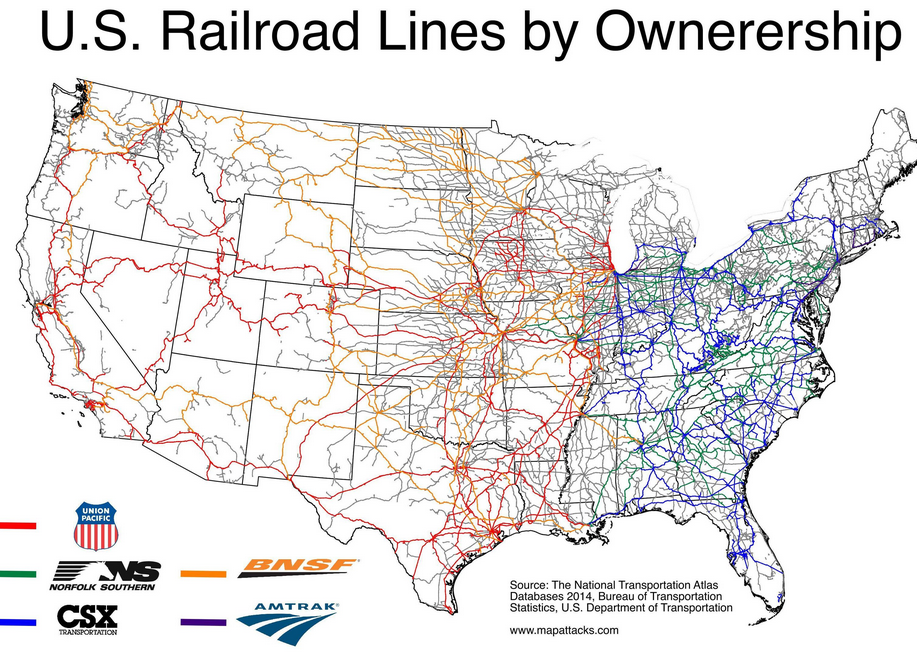
U.S. Railways Last, but not the least I share the U.S. Railway map. This is provided by A Mr. Tom Alison on reddit on channel maporn. As the thread itself is archived and I do not know the gentleman concerned, nor have taken permission for the map, hence sharing the compressed version


U.S. Railway lines with the different owners
Now the U.S. Railways is and has always been peculiar as unlike the above two the U.S. has always been more of a freight network. Probably, much of it has to do that in the 1960 s when oil was cheap, the U.S. made zillions of roadways and romanticized the road trip and has been doing it ever since. Also the creation of low-cost airlines definitely didn t help the railways to have more passenger services, in fact the opposite. There are and have been smaller services and attempts of privatization in both New Zealand and Australia and both have been failures. Please see papers in that regard. My simple point is this, as can be seen above, there have been various attempts at privatization of railways and most of them have been a mixed bag. The only one which comes close to what we think as good is Japanese but that also used a lot of public debt which we don t know what will happen on next. Also for higher-speed train services like a bullet train or whatever, you need to direct, no hair pen bends. In fact, a good talk on the topic is the TBD podcast which while it talks about hyperloop, the same questions is and would be asked if were to do in India. Another thing to be kept in mind is that the Japanese have been exceptional builders and this is because they have been forced to. They live in a seismically active zone which made Fukushima disaster a reality but at the same time, their buildings are earthquake-resistant. Standard Disclaimer The above is a simplified version of things. I could have added in financial accounts but that again has no set pattern. For e.g. some Railways use accrual, some use cash and some use hybrid. I could have also shared in either the guage or electrification but all have slightly different standards, although uniguage is something that all Railways aspire for and electrification is again something that all Railways want although in many cases it just isn t economically feasible.

Indian Railways Indian Railways itself recently made the move from Cash to Accrual couple of years back. In-between for a couple of years, it was hybrid. The sad part is and was you can now never measure against past performance in the old way because it is so different. Hence, whether the Railways will be making a loss or a profit, we would come to know only much later. Also, most accountants don t know the new system well, so it is gonna take more time, how much unknown. Sadly, what GOI did a few years back is merge the Railway budget into the Union Budget. Of course, the excuse they gave is too many pressures of new trains, while the truth is, by doing this, they decreased transparency about the whole thing. For e.g. for the last few years, the only state which had significant work being done is in U.P. (Uttar Pradesh) and a bit in Goa, although that is has been protested time and again. I being from the neighborly state of Maharashtra , and have been there several times. Now it does feels all like a dream, going to Goa :(.

Covid news Now before I jump on the news, I should share the movie Virus (2019) which was made by the talented Aashiq Abu. Even though, am not a Malayalee, I still have enjoyed many of his movies simply because he is a terrific director and Malayalam movies, at least most of them have English subtitles and lot of original content.. Interestingly, unlike the first couple of times when I saw it a couple of years back. The first time I saw it, I couldn t sleep a wink for a week. Even the next time, it was heavy. I had shared the movie with mum, and even she couldn t see it in one go. It is and was that powerful Now maybe because we are headlong in the pandemic, and the madness is all around us. There are two terms that helped me though understand a great deal of what is happening in the movie, the first term was altered sensorium which has been defined here. The other is saturation or to be more precise oxygen saturation . This term has also entered the Indian twitter lexicon quite a bit as India has started running out of oxygen. Just today Delhi High Court did an emergency hearing on the subject late at night. Although there is much to share about the mismanagement of the center, the best piece on the subject has been by Miss Priya Ramani. Yup, the same lady who has won against M.J. Akbar and this is when Mr. Akbar had 100 lawyers for this specific case. It would be interesting to see what happens ahead. There are however few things even she forgot in her piece, For e.g. reverse migration i.e. from urban to rural migration started again. Two articles from different entities sharing a similar outlook.Sadly, the right have no empathy or feeling for either the poor or the sick. Even the labor minister Santosh Gangwar s statement that around 1.04 crores were the only people who walked back home. While there is not much data, however some work/research has been done on migration to cites that the number could be easily 10 times as much. And this was in the lockdown of last year. This year, again the same issue has re-surfaced and migrants learning lessons started leaving cities. And I m ashamed to say I think they are doing the right thing. Most State Governments have not learned lessons nor have they done any work to earn the trust of migrants. This is true of almost all state Governments. Last year, just before the lockdown was announced, me and my friend spent almost 30k getting a cab all the way from Chennai to Pune, how much we paid for the cab, how much we bribed the various people just so we could cross the state borders to return home to our anxious families. Thankfully, unlike the migrants, we were better off although we did make a loss. I probably wouldn t be alive if I were in their situation as many didn t. That number is still in the air undocumented deaths  Vaccine issues Currently, though the issue has been the Vaccine and the pricing of the same. A good article to get a summation of the issues outlined has been shared on Economist. Another article that goes to the heart of the issue is at scroll. To buttress the argument, the SII chairman had shared this few weeks back
Adar Poonawala talking to Vishnu Som on Left, right center, 7th April 2021.
So, a licensee manufacturer wants to make super-profits during the pandemic. And now, as shared above they can very easily do it. Even the quotes given to nearby countries is smaller than the quotes given to Indian states

Prices of AstraZeneca among various states and countries.
The situation around beds, vaccines, oxygen, anything is so dire that people could go to any lengths to save their loved ones. Even if they know if a certain medicine doesn t work. For e.g. Remdesivir, 5 WHO trials have concluded that it doesn t increase mortality. Heck, even AIIMS chief said the same. But both doctors and relatives desperation to cling on hope has made Remdesivir as a black market drug with unoffical prices hovering anywhere between INR 14k/- to INR30k/- per vial. One of the executives of a top firm was also arrested in Gujarat. In Maharashtra, the opposition M.P. came to the rescue of the officials of Bruick pharms in Mumbai. Sadly, this strange affliction to the party in the center is also there in my extended family. At one end, they will heap praise on Mr. Modi, at the same time they can t get wait to get fast out of India. Many of them have settled in horrors of horror Dubai, as it is the best place to do business, get international schools for the young ones at decent prices, cheaper or maybe a tad more than what they paid in Delhi or elsewhere. Being an Agarwal or a Gupta makes it easier to compartmentalize both things. Ease of doing business, 5 days flat to get a business registered, up and running. And the paranoia is still there. They won t talk on the phone about him because they are afraid they may say something which comes back to bite them. As far as their decision to migrate, can t really blame them. If I were 20-25 yeas younger and my mum were in a better shape than she is, we probably would have migrated as well, although would have preferred Europe than anywhere else.

Internet Freedom and Aarogya Setu App.


Internet Freedom had shared the chilling effects of the Aarogya Setu App. This had also been shared by FSCI in the past, and recently had their handle being banned on Twitter. This was also apparent in a legal bail order which the high court judge gave. While I won t go into the merits and demerits of the bail order, it is astounding for the judge to say that the accused, even though he would be on bail install an app. so he can be surveilled. And this is a high court judge, such a sad state of affairs. We seem to be putting up new lows every day when it comes to judicial jurisprudence. One interesting aspect of the whole case was shared by Aishwarya Iyer. She shared a story that she and her team worked on quint which raises questions on the quality of the work done by Delhi Police. This is of course, up to Delhi Police to ascertain the truth of the matter because unless and until they are able to tie in the PMO s office in for a leak or POTUS s office it hardly seems possible. For e.g. the dates when two heads of state can meet each other would be decided by the secretaries of the two. Once the date is known, it would be shared with the press while at the same time some sort of security apparatus would kick in place. It is incumbent, especially on the host to take as much care as he can of the guest. We all remember that World War 1 (the war to end all wars) started due to the murder of Archduke Ferdinand.

As nobody wants that, the best way is to make sure that a political murder doesn t happen on your watch. Now while I won t comment on what it would be, it would be safe to assume that it would be z+ security along with higher readiness. Especially if it as somebody as important as POTUS. Now, it would be quite a reach for Delhi Police to connect the two dates. They either will have to get creative with the dates or some other way. Otherwise, with practically no knowledge in the public domain, they can t work in limbo. In either case, I do hope the case comes up for hearing soon and we see what the Delhi Police says and contends in the High Court about the same. At the very least, it would be irritating for them to talk of the dates unless they can contend some mass conspiracy which involves the PMO (and would bring into question the constant vetting done by the Intelligence dept. of all those who work in PMO). And this whole case is to kind of shelter to the Delhi riots which happened in which majorly the Muslims died but their deaths lay unaccounted till date

Conclusion In Conclusion, I would like to share a bit of humor because right now the atmosphere is humorless, both with authoritarian tendencies of the Central Govt. and the mass mismanagement of public health which they now have left to the state to do as they fit. The peice I am sharing is from arre, one of my goto sites whenever I feel low.

21 April 2021

Enrico Zini: Python output buffering

Here's a little toy program that displays a message like a split-flap display:
#!/usr/bin/python3
import sys
import time
def display(line: str):
    cur = '0' * len(line)
    while True:
        print(cur, end="\r")
        if cur == line:
            break
        time.sleep(0.09)
        cur = "".join(chr(min(ord(c) + 1, ord(oc))) for c, oc in zip(cur, line))
    print()
message = " ".join(sys.argv[1:])
display(message.upper())
This only works if the script's stdout is unbuffered. Pipe the output through cat, and you get a long wait, and then the final string, without the animation. What is happening is that since the output is not going to a terminal, optimizations kick in that buffer the output and send it in bigger chunks, to make processing bulk I/O more efficient. I haven't found a good introductory explanation of buffering in Python's documentation. The details seem to be scattered in the io module documentation and they mostly assume that one is already familiar with concepts like unbuffered, line-buffered or block-buffered. The libc documentation has a good quick introduction that one can read to get up to speed. Controlling buffering in Python In Python, one can force a buffer flush with the flush() method of the output file descriptor, like sys.stdout.flush(), to make sure pending buffered output gets sent. Python's print() function also supports flush=True as an optional argument:
    print(cur, end="\r", flush=True)
If one wants to change the default buffering for a file descriptor, since Python 3.7 there's a convenient reconfigure() method, which can reconfigure line buffering only:
sys.stdout.reconfigure(line_buffering=True)
Otherwise, the technique is to reassign sys.stdout to something that has the behaviour one wants (code from this StackOverflow thread):
import io
# Python 3, open as binary, then wrap in a TextIOWrapper with write-through.
sys.stdout = io.TextIOWrapper(open(sys.stdout.fileno(), 'wb', 0), write_through=True)
If one needs all this to implement a progressbar, one should make sure to have a look at the progressbar module first.

Sven Hoexter: bullseye: doveadm as unprivileged user with dovecot ssl config

The dovecot version which will be released with bullseye seems to require some subtle config adjustment if you I guess one of the common cases is executing doveadm pw e.g. if you use postfixadmin. For myself that manifested in the nginx error log, which I use in combination with php-fpm, as.
2021/04/19 20:22:59 [error] 307467#307467: *13 FastCGI sent in stderr: "PHP message:
Failed to read password from /usr/bin/doveadm pw ... stderr: doveconf: Fatal: 
Error in configuration file /etc/dovecot/conf.d/10-ssl.conf line 12: ssl_cert:
Can't open file /etc/dovecot/private/dovecot.pem: Permission denied
You easily see the same error message if you just execute something like doveadm pw -p test123. The workaround is to move your ssl configuration to a new file which is only readable by root, and create a dummy one which disables ssl, and has a !include_try on the real one. Maybe best explained by showing the modification:
cd /etc/dovecot/conf.d
cp 10-ssl.conf 10-ssl_server
chmod 600 10-ssl_server
echo 'ssl = no' > 10-ssl.conf
echo '!include_try 10-ssl_server' >> 10-ssl.conf
Discussed upstream here.

20 April 2021

Dirk Eddelbuettel: Rblpapi 0.3.11: Several Updates

A new version 0.3.11 of Rblpapi is now arriving at CRAN. It comes two years after the release of version Rblpapit 0.3.10 and brings a few updates and extensions. Rblpapi provides a direct interface between R and the Bloomberg Terminal via the C++ API provided by Bloomberg (but note that a valid Bloomberg license and installation is required). This is the eleventh release since the package first appeared on CRAN in 2016. Changes are detailed below. Special thanks to James, Maxime and Michael for sending us pull requests.

Changes in Rblpapi version 0.3.11 (2021-04-20)
  • Support blpAutoAuthenticate and B-PIPE access, refactor and generalise authentication (James Bell in #285)
  • Deprecate excludeterm (John in #306)
  • Correct example in README.md (Maxime Legrand in #314)
  • Correct bds man page (and code) (Michael Kerber, and John, in #320)
  • Add GitHub Actions continuous integration (Dirk in #323)
  • Remove bashisms detected by R CMD check (Dirk #324)
  • Switch vignette to minidown (Dirk in #331)
  • Switch unit tests framework to tinytest (Dirk in #332)

Courtesy of my CRANberries, there is also a diffstat report for the this release. As always, more detailed information is on the Rblpapi page. Questions, comments etc should go to the issue tickets system at the GitHub repo. If you like this or other open-source work I do, you can now sponsor me at GitHub.

This post by Dirk Eddelbuettel originated on his Thinking inside the box blog. Please report excessive re-aggregation in third-party for-profit settings.

19 April 2021

Ritesh Raj Sarraf: Catching Up Your Sources

I ve mostly had the preference of controlling my data rather than depend on someone else. That s one reason why I still believe email to be my most reliable medium for data storage, one that is not plagued/locked by a single entity. If I had the resources, I d prefer all digital data to be broken down to its simplest form for storage, like email format, and empower the user with it i.e. their data. Yes, there are free services that are indirectly forced upon common users, and many of us get attracted to it. Many of us do not think that the information, which is shared for the free service in return, is of much importance. Which may be fair, depending on the individual, given that they get certain services without paying any direct dime.
New age communication So first, we had email and usenet. As I mentioned above, email was designed with fine intentions. Intentions that make it stand even today, independently. But not everything, back then, was that great either. For example, instant messaging was very closed and centralised then too. Things like: ICQ, MSN, Yahoo Messenger; all were centralized. I wonder if people still have access to their ICQ logs. Not much has chagned in the current day either. We now have domination by: Facebook Messenger, Google Whatever the new marketing term they introdcue, WhatsApp, Telegram, Signal etc. To my knowledge, they are all centralized. Over all this time, I m yet to see a product come up with good (business) intentions, to really empower the end user. In this information age, the most invaluable data is user activity. That s one data everyone is after. If you decline to share that bit of free data in exchange for the free services, mind you, that that free service like Facebook, Google, Instagram, WhatsApp, Truecaller, Twitter; none of it would come to you at all. Try it out. So the reality is that while you may not be valuating the data you offer in exchange correctly, there s a lot that is reaped from it. But still, I think each user has (and should have) the freedom to opt in for these tech giants and give them their personal bit, for free services in return. That is a decent barter deal. And it is a choice that one if free to choose

Retaining my data I m fond of keeping an archive folder in my mailbox. A folder that holds significant events in the form of an email usually, if documented. Over the years, I chose to resort to the email format because I felt it was more reliable in the longer term than any other formats. The next best would be plain text. In my lifetime, I have learnt a lot from the internet; so it is natural that my preference has been with it. Mailing Lists, IRCs, HOWTOs, Guides, Blog posts; all have helped. And over the years, I ve come across hundreds of such content that I d always like to preserve. Now there are multiple ways to preserving data. Like, for example, big tech giants. In most usual cases, your data for your lifetime, should be fine with a tech giant. In some odd scenarios, you may be unlucky if you relied on a service provider that went bankrupt. But seriously, I think users should be fine if they host their data with Microsoft, Google etc; as long as they abide by their policies. There s also the catch of alignment. As the user, you should ensure to align (and transition) with the product offerings of your service provider. Otherwise, what may look constant and always reliable, will vanish in the blink of an eye. I guess Google Plus would be a good example. There was some Google Feed service too. Maybe Google Photos in the near decade future, just like Google Picasa in the previous (or current) decade.

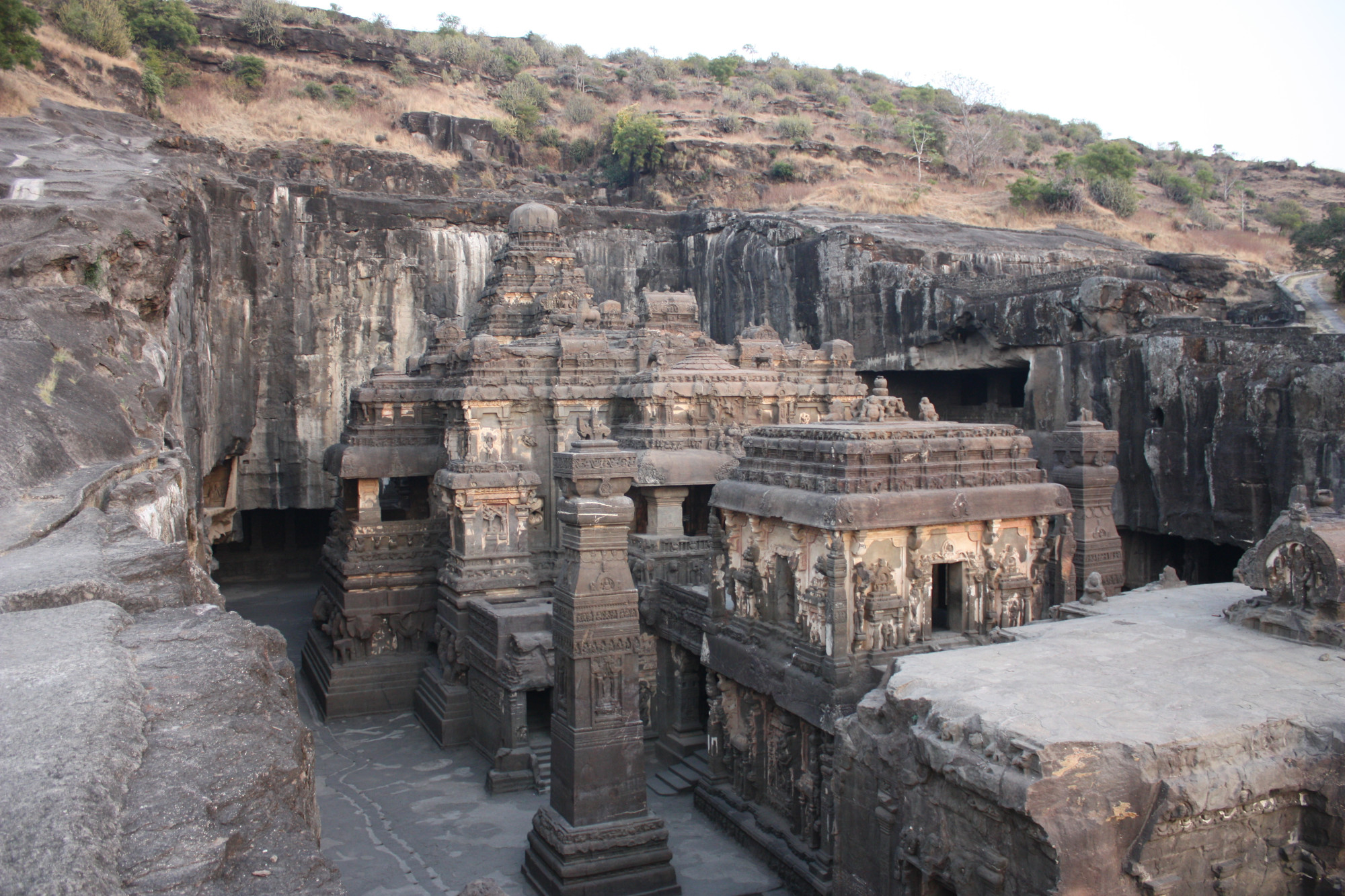
History what is On the topic of retaining information, lets take a small drift. I still admire our ancestors. I don t know what went in their mind when they were documenting events in the form of scriptures, carvings, temples, churches, mosques etc; but one things for sure, they were able to leave a fine means of communication. They are all gone but a large number of those events are evident through the creations that they left. Some of those events have been strong enough that further rulers/invaders have had tough times trying to wipe it out from history. Remember, history is usually not the truth, but the statement to be believed by the teller. And the teller is usually the survivor, or the winner you may call. But still, the information retention techniques were better. I haven t visited, but admire whosoever built the Kailasa Temple, Ellora, without which, we d be made to believe what not by all invaders and rulers of the region. But the majestic standing of the temple, is a fine example of the history and the events that have occured in the past.
Ellora Temple -  The majectic carving believed to be carved out of a single stone
Ellora Temple - The majectic carving believed to be carved out of a single stone
Dominance has the power to rewrite history and unfortunately that s true and it has done its part. It is just that in a mere human s defined lifetime, it is not possible to witness the transtion from current to history, and say that I was there then and I m here now, and this is not the reality. And if not dominance, there s always the other bit, hearsay. With it, you can always put anything up for dispute. Because there s no way one can go back in time and produce a fine evidence. There s also a part about religion. Religion can be highly sentimental. And religion can be a solid way to get an agenda going. For example, in India - a country which today consitutionally is a secular country, there have been multiple attempts to discard the belief, that never ever did the thing called Ramayana exist. That the Rama Setu, nicely reworded as Adam s Bridge by who so ever, is a mere result of science. Now Rama, or Hanumana, or Ravana, or Valmiki, aren t going to come over and prove that that is true or false. So such subjects serve as a solid base to get an agenda going. And probably we ve even succeeded in proving and believing that there was never an event like Ramayana or the Mahabharata. Nor was there ever any empire other than the Moghul or the British Empire. But yes, whosoever made the Ellora Temple or the many many more of such creations, did a fine job of making a dent for the future, to know of what the history possibly could also be.

Enough of the drift So, in my opinion, having events documented is important. It d be nice to have skills documented too so that it can be passed over generations but that s a debatable topic. But events, I believe should be documented. And documented in the best possible ways so that its existence is not diminished. A documentation in the form of certain carvings on a rock is far more better than links and posts shared on Facebook, Twitter, Reddit etc. For one, these are all corporate entities with vested interests and can pretext excuse in the name of compliance and conformance. So, for the helpless state and generation I am in, I felt email was the best possible independent form of data retention in today s age. If I really had the resources, I d not rely on digital age. This age has no guarantee of retaining and recording information in any reliable manner. Instead, it is just mostly junk, which is manipulative and changeable, conditionally.

Email and RSS So for my communication, I like to prefer emails over any other means. That doesn t mean I don t use the current trends. I do. But this blog is mostly about penning my desires. And desire be to have communication over email format. Such is the case that for information useful over the internet, I crave to have it formatted in email for archival. RSS feeds is my most common mode of keeping track of information I care about. Not all that I care for is available in RSS feeds but hey such is life. And adaptability is okay. But my preference is still RSS. So I use RSS feeds through a fine software called feed2imap. A software that fits my bill fairly well. feed2imap is:
  • An rss feed news aggregator
  • Pulls and extracts news feeds in the form of an email
  • Can push the converted email over pop/imap
  • Can convert all image content to email mime attachment
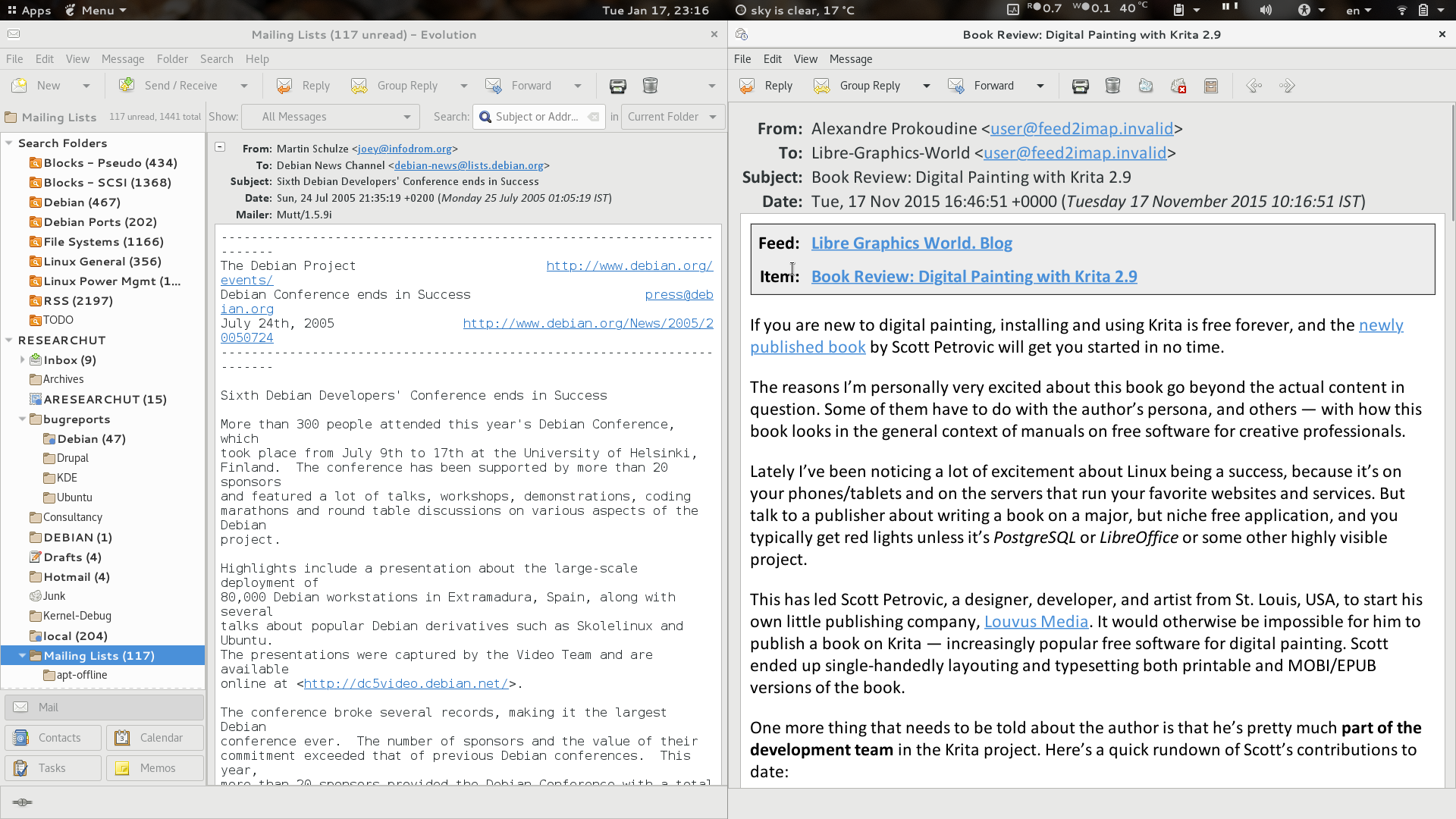
In a gist, it makes the online content available to me offline in the most admired email format In my mail box, in today s day, my preferred email client is Evolution. It does a good job of dealing with such emails (rss feed items). An image example of accessing the rrs feed item through it is below
RSS News Item through Evolution
The good part is that my actual data is always independent of such MUAs. Tomorrow, as technology - trends - economics evolve, something new would come as a replacement but my data would still be mine.

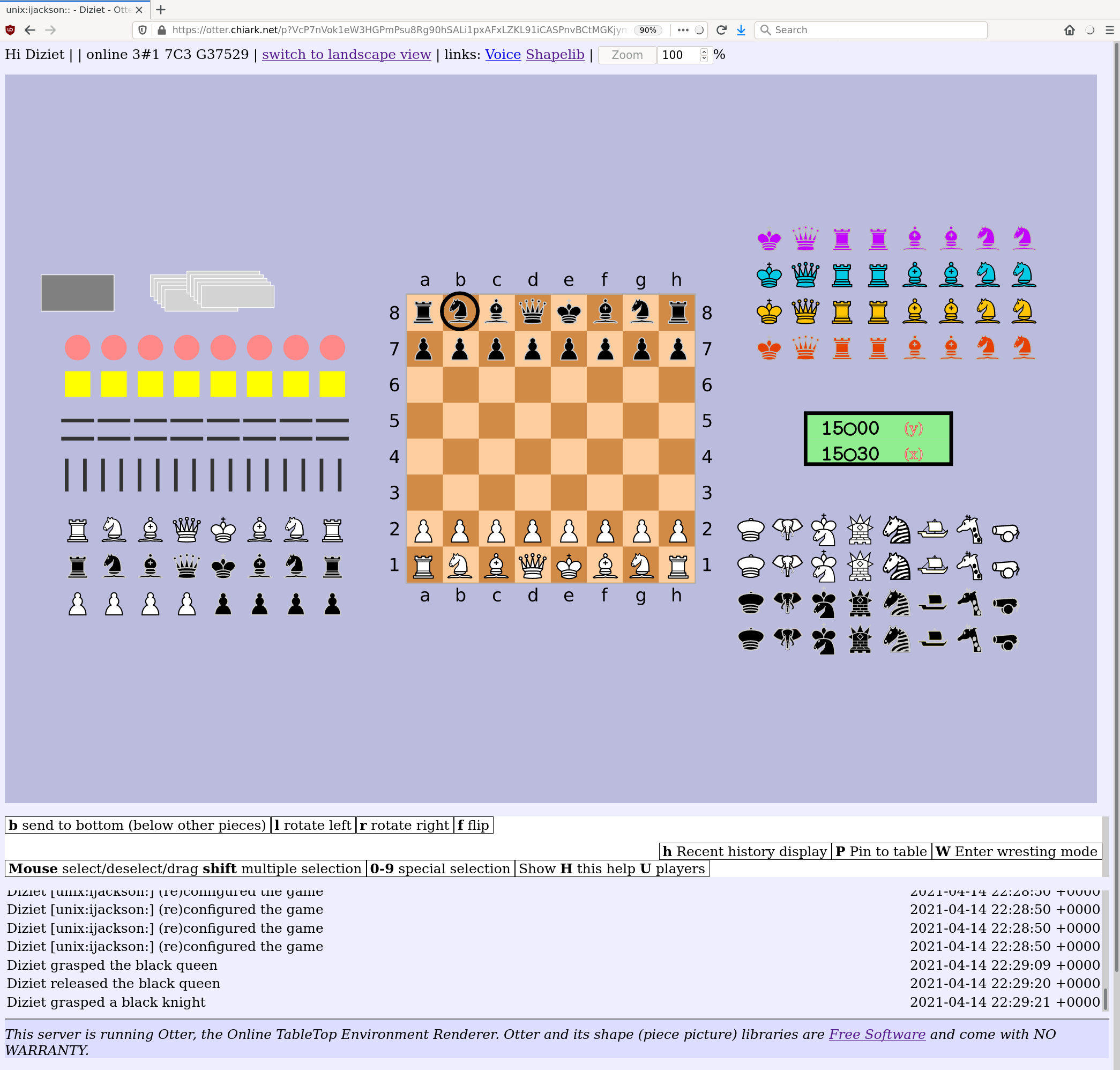
Ian Jackson: Otter - a game server for arbitrary board games

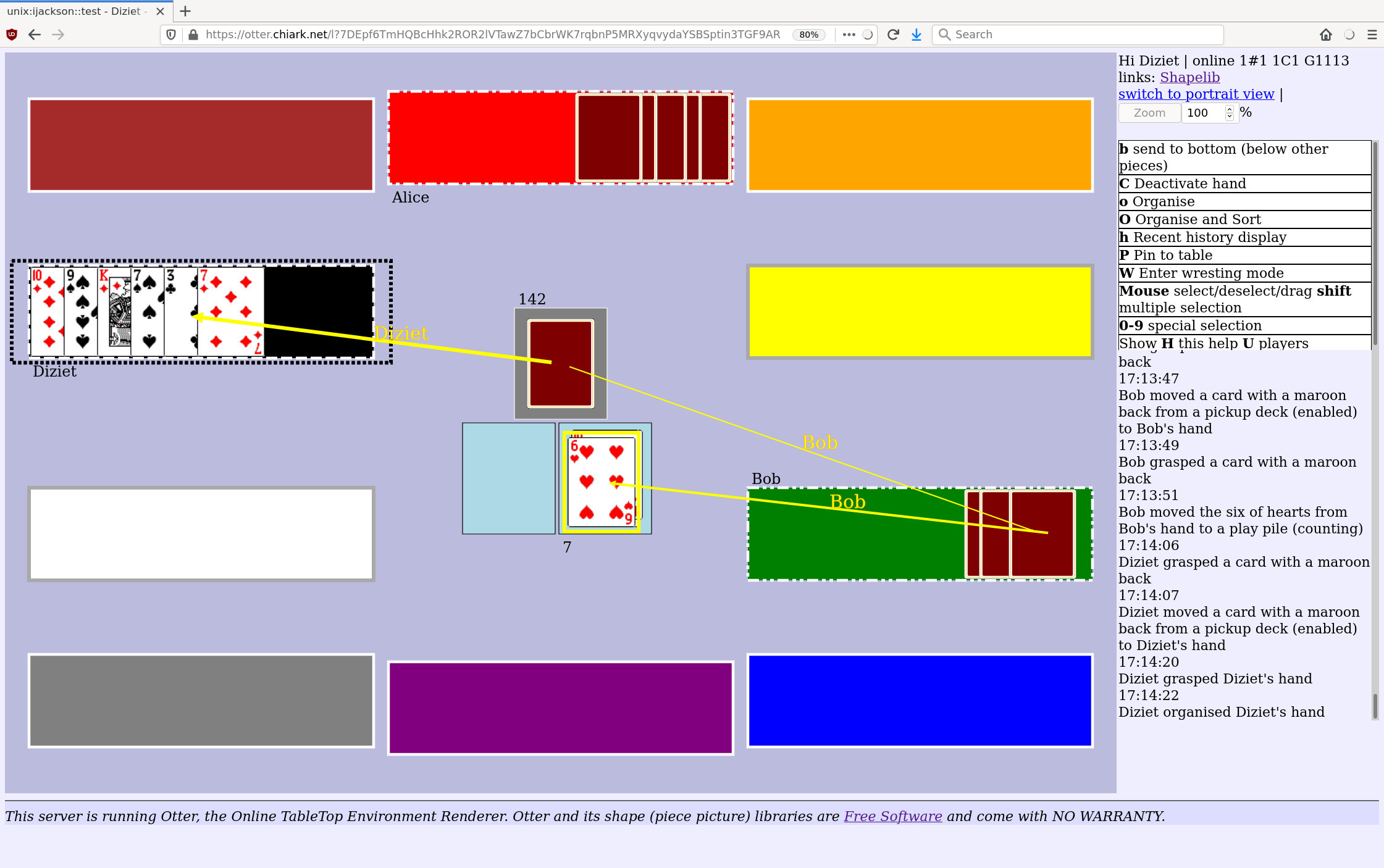
One of the things that I found most vexing about lockdown was that I was unable to play some of my favourite board games. There are online systems for many games, but not all. And online systems cannot support games like Mao where the players make up the rules as we go along. I had an idea for how to solve this problem, and set about implementing it. The result is Otter (the Online Table Top Environment Renderer). We have played a number of fun games of Penultima with it, and have recently branched out into Mao. The Otter is now ready to be released! More about Otter (cribbed shamelessly from the README) Otter, the Online Table Top Environment Renderer, is an online game system. But it is not like most online game systems. It does not know (nor does it need to know) the rules of the game you are playing. Instead, it lets you and your friends play with common tabletop/boardgame elements such as hands of cards, boards, and so on. So it s something like a tabletop simulator (but it does not have any 3D, or a physics engine, or anything like that). This means that with Otter: Installation and usage Otter is fully functional, but the installation and account management arrangements are rather unsophisticated and un-webby. And there is not currently any publicly available instance you can use to try it out. Users on chiark will find an instance there. Other people who who are interested in hosting games (of Penultima or Mao, or other games we might support) will have to find a Unix host or VM to install Otter on, and will probably want help from a Unix sysadmin. Otter is distributed via git, and is available on Salsa, Debian's gitlab instance. There is documentation online. Future plans I have a number of ideas for improvement, which go off in many different directions. Quite high up on my priority list is making it possible for players to upload and share game materials (cards, boards, pieces, and so on), rather than just using the ones which are bundled with Otter itself (or dumping files ad-hoc on the server). This will make it much easier to play new games. One big reason I wrote Otter is that I wanted to liberate boardgame players from the need to implemet their game rules as computer code. The game management and account management is currently done with a command line tool. It would be lovely to improve that, but making a fully-featured management web ui would be a lot of work. Screenshots! (Click for the full size images.)

comment count unavailable comments

18 April 2021

Russell Coker: IMA/EVM Certificates

I ve been experimenting with IMA/EVM. Here is the Sourceforge page for the upstream project [1]. The aim of that project is to check hashes and maybe public key signatures on files before performing read/exec type operations on them. It can be used as the next logical step from booting a signed kernel with TPM. I am a long way from getting that sort of thing going, just getting the kernel to boot and load keys is my current challenge and isn t helped due to the lack of documentation on error messages. This blog post started as a way of documenting the error messages so future people who google errors can get a useful result. I am not trying to document everything, just help people get through some of the first problems. I am using Debian for my work, but some of this will apply to other distributions (particularly the kernel error messages). The Debian distribution has the ima-evm-utils but no other support for IMA/EVM. To get this going in Debian you need to compile your own kernel with IMA support and then boot it with kernel command-line options to enable IMA, in recent kernels that includes lsm=integrity as a mandatory requirement to prevent a kernel Oops after mounting the initrd (there is already a patch to fix this). If you want to just use IMA (not get involved in development) then a good option would be to use RHEL (here is their documentation) [2] or SUSE (here is their documentation) [3]. Note that both RHEL and SUSE use older kernels so their documentation WILL lead you astray if you try and use the latest kernel.org kernel. The Debian initrd I created a script named /etc/initramfs-tools/hooks/keys with the following contents to copy the key(s) from /etc/keys to the initrd where the kernel will load it/them. The kernel configuration determines whether x509_evm.der or x509_ima.der (or maybe both) is loaded. I haven t yet worked out which key is needed when.
#!/bin/bash
mkdir -p $ DESTDIR /etc/keys
cp /etc/keys/* $ DESTDIR /etc/keys
Making the Keys
#!/bin/sh
GENKEY=ima.genkey
cat << __EOF__ >$GENKEY
[ req ]
default_bits = 1024
distinguished_name = req_distinguished_name
prompt = no
string_mask = utf8only
x509_extensions = v3_usr
[ req_distinguished_name ]
O =  hostname 
CN =  whoami  signing key
emailAddress =  whoami @ hostname 
[ v3_usr ]
basicConstraints=critical,CA:FALSE
#basicConstraints=CA:FALSE
keyUsage=digitalSignature
#keyUsage = nonRepudiation, digitalSignature, keyEncipherment
subjectKeyIdentifier=hash
authorityKeyIdentifier=keyid
#authorityKeyIdentifier=keyid,issuer
__EOF__
openssl req -new -nodes -utf8 -sha1 -days 365 -batch -config $GENKEY \
                -out csr_ima.pem -keyout privkey_ima.pem
openssl x509 -req -in csr_ima.pem -days 365 -extfile $GENKEY -extensions v3_usr \
                -CA ~/kern/linux-5.11.14/certs/signing_key.pem -CAkey ~/kern/linux-5.11.14/certs/signing_key.pem -CAcreateserial \
                -outform DER -out x509_evm.der
To get the below result I used the above script to generate a key, it is the /usr/share/doc/ima-evm-utils/examples/ima-genkey.sh script from the ima-evm-utils package but changed to use the key generated from kernel compilation to sign it. You can copy the files in the certs directory from one kernel build tree to another to have the same certificate and use the same initrd configuration. After generating the key I copied x509_evm.der to /etc/keys on the target host and built the initrd before rebooting.
[    1.050321] integrity: Loading X.509 certificate: /etc/keys/x509_evm.der
[    1.092560] integrity: Loaded X.509 cert 'xev: etbe signing key: 99d4fa9051e2c178017180df5fcc6e5dbd8bb606'
Errors Here are some of the kernel error messages I received along with my best interpretation of what they mean. [ 1.062031] integrity: Loading X.509 certificate: /etc/keys/x509_ima.der
[ 1.063689] integrity: Problem loading X.509 certificate -74 Error -74 means -EBADMSG, which means there s something wrong with the certificate file. I have got that from /etc/keys/x509_ima.der not being in der format and I have got it from a der file that contained a key pair that wasn t signed.
[    1.049170] integrity: Loading X.509 certificate: /etc/keys/x509_ima.der
[    1.093092] integrity: Problem loading X.509 certificate -126
Error -126 means -ENOKEY, so the key wasn t in the file or the key wasn t signed by the kernel signing key.
[    1.074759] integrity: Unable to open file: /etc/keys/x509_evm.der (-2)
Error -2 means -ENOENT, so the file wasn t found on the initrd. Note that it does NOT look at the root filesystem. References

Bits from Debian: Debian Project Leader election 2021, Jonathan Carter re-elected.

The voting period and tally of votes for the Debian Project Leader election has just concluded, and the winner is Jonathan Carter! 455 of 1,018 Developers voted using the Condorcet method. More information about the results of the voting are available on the Debian Project Leader Elections 2021 page. Many thanks to Jonathan Carter and Sruthi Chandran for their campaigns, and to our Developers for voting.

17 April 2021

Dirk Eddelbuettel: RcppAPT 0.0.7: Micro Update

A new version of the RcppAPT package interfacing from R to the C++ library behind the awesome apt, apt-get, apt-cache, commands and their cache powering Debian, Ubuntu and the like arrived on CRAN yesterday. This comes a good year after the previous maintenance update for release 0.0.6. RcppAPT allows you to query the (Debian or Ubuntu) package dependency graph at will, with build-dependencies (if you have deb-src entries), reverse dependencies, and all other goodies. See the vignette and examples for illustrations. The maintenance release responds to call for updates from CRAN desiring that make all implicit dependencies on packages markdown and rmarkdown explicit via a Suggests: entry. Two of the many packages I maintain were part of the (large !!) list in the CRAN email, and this is one of them. While making the update, we refreshed two other packaging details.

Changes in version 0.0.7 (2021-04-16)
  • Add rmarkdown to Suggests: as an implicit conditional dependency
  • Switch vignette to minidown and its water framework, add minidown to Suggests as well
  • Update two URLs in the README.md file

Courtesy of my CRANberries, there is also a diffstat report for this release. A bit more information about the package is available here as well as as the GitHub repo. If you like this or other open-source work I do, you can now sponsor me at GitHub.

This post by Dirk Eddelbuettel originated on his Thinking inside the box blog. Please report excessive re-aggregation in third-party for-profit settings.

Chris Lamb: Tour d'Orwell: Wallington

Previously in George Orwell travel posts: Sutton Courtenay, Marrakesh, Hampstead, Paris, Southwold & The River Orwell. Wallington is a small village in Hertfordshire, approximately fifty miles north of London and twenty-five miles from the outskirts of Cambridge. George Orwell lived at No. 2 Kits Lane, better known as 'The Stores', on a mostly-permanent basis from 1936 to 1940, but he would continue to journey up from London on occasional weekends until 1947. His first reference to The Stores can be found in early 1936, where Orwell wrote from Lancashire during research for The Road to Wigan Pier to lament that he would very much like "to do some work again impossible, of course, in the [current] surroundings":
I am arranging to take a cottage at Wallington near Baldock in Herts, rather a pig in a poke because I have never seen it, but I am trusting the friends who have chosen it for me, and it is very cheap, only 7s. 6d. a week [ 20 in 2021].
For those not steeped in English colloquialisms, "a pig in a poke" is an item bought without seeing it in advance. In fact, one general insight that may be drawn from reading Orwell's extant correspondence is just how much he relied on a close network of friends, belying the lazy and hagiographical picture of an independent and solitary figure. (Still, even Orwell cultivated this image at times, such as in a patently autobiographical essay he wrote in 1946. But note the off-hand reference to varicose veins here, for they would shortly re-appear as a symbol of Winston's repressed humanity in Nineteen Eighty-Four.) Nevertheless, the porcine reference in Orwell's idiom is particularly apt, given that he wrote the bulk of Animal Farm at The Stores his 1945 novella, of course, portraying a revolution betrayed by allegorical pigs. Orwell even drew inspiration for his 'fairy story' from Wallington itself, principally by naming the novel's farm 'Manor Farm', just as it is in the village. But the allusion to the purchase of goods is just as appropriate, as Orwell returned The Stores to its former status as the village shop, even going so far as to drill peepholes in a door to keep an Orwellian eye on the jars of sweets. (Unfortunately, we cannot complete a tidy circle of references, as whilst it is certainly Napoleon Animal Farm's substitute for Stalin who is quoted as describing Britain as "a nation of shopkeepers", it was actually the maraisard Bertrand Bar re who first used the phrase). "It isn't what you might call luxurious", he wrote in typical British understatement, but Orwell did warmly emote on his animals. He kept hens in Wallington (perhaps even inspiring the opening line of Animal Farm: "Mr Jones, of the Manor Farm, had locked the hen-houses for the night, but was too drunk to remember to shut the pop-holes.") and a photograph even survives of Orwell feeding his pet goat, Muriel. Orwell's goat was the eponymous inspiration for the white goat in Animal Farm, a decidedly under-analysed character who, to me, serves to represent an intelligentsia that is highly perceptive of the declining political climate but, seemingly content with merely observing it, does not offer any meaningful opposition. Muriel's aesthetic of resistance, particularly in her reporting on the changes made to the Seven Commandments of the farm, thus rehearses the well-meaning (yet functionally ineffective) affinity for 'fact checking' which proliferates today. But I digress. There is a tendency to "read Orwell backwards", so I must point out that Orwell wrote several other works whilst at The Stores as well. This includes his Homage to Catalonia, his aforementioned The Road to Wigan Pier, not to mention countless indispensable reviews and essays as well. Indeed, another result of focusing exclusively on Orwell's last works is that we only encounter his ideas in their highly-refined forms, whilst in reality, it often took many years for concepts to fully mature we first see, for instance, the now-infamous idea of "2 + 2 = 5" in an essay written in 1939. This is important to understand for two reasons. Although the ostentatiously austere Barnhill might have housed the physical labour of its writing, it is refreshing to reflect that the philosophical heavy-lifting of Nineteen Eighty-Four may have been performed in a relatively undistinguished North Hertfordshire village. But perhaps more importantly, it emphasises that Orwell was just a man, and that any of us is fully capable of equally significant insight, with to quote Christopher Hitchens "little except a battered typewriter and a certain resilience."
The red commemorative plaque not only limits Orwell's tenure to the time he was permanently in the village, it omits all reference to his first wife, Eileen O'Shaughnessy, whom he married in the village church in 1936.
Wallington's Manor Farm, the inspiration for the farm in Animal Farm. The lower sign enjoins the public to inform the police "if you see anyone on the [church] roof acting suspiciously". Non-UK-residents may be surprised to learn about the systematic theft of lead.

Steve Kemp: Having fun with CP/M on a Z80 single-board computer.

In the past, I've talked about building a Z80-based computer. I made some progress towards that goal, in the sense that I took the initial (trivial steps) towards making something: But then I stalled, repeatedly, at designing an interface to RAM and ROM, so that it could actually do something useful. Over the lockdown I've been in two minds about getting sucked back down the rabbit-hole, so I compromised. I did a bit of searching on tindie, and similar places, and figured I'd buy a Z80-based single board computer. My requirements were minimal: With those goals there were a bunch of boards to choose from, rc2014 is the standard choice - a well engineered system which uses a common backplane and lets you build mini-boards to add functionality. So first you build the CPU-card, then the RAM card, then the flash-disk card, etc. Over-engineered in one sense, extensible in another. (There are some single-board variants to cut down on soldering overhead, at a cost of less flexibility.) After a while I came across https://8bitstack.co.uk/, which describes a simple board called the the Z80 playground. The advantage of this design is that it loads code from a USB stick, making it easy to transfer files to/from it, without the need for a compact flash card, or similar. The downside is that the system has only 64K RAM, meaning it cannot run CP/M 3, only 2.2. (CP/M 3.x requires more RAM, and a banking/paging system setup to swap between pages.) When the system boots it loads code from an EEPROM, which then fetches the CP/M files from the USB-stick, copies them into RAM and executes them. The memory map can be split so you either have ROM & RAM, or you have just RAM (after the boot the ROM will be switched off). To change the initial stuff you need to reprogram the EEPROM, after that it's just a matter of adding binaries to the stick or transferring them over the serial port. In only a couple of hours I got the basic stuff working as well as I needed: I had some fun with a CP/M emulator to get my hand back in things before the board arrived, and using that I tested my first "real" assembly language program (cls to clear the screen), as well as got the hang of using the wordstar keyboard shortcuts as used within the turbo pascal environment. I have some plans for development: Nothing major, but fun changes that won't be too difficult to implement. Since CP/M 2.x has no concept of sub-directories you end up using drives for everything, I implemented a "search-path" so that when you type "FOO" it will attempt to run "A:FOO.COM" if there is no file matching on the current-drive. That's a nicer user-experience at all. I also wrote some Z80-assembly code to search all drives for an executable, if not found in current drive and not already qualified. Remember CP/M doesn't have a concept of sub-directories) that's actually pretty useful:
  B>LOCATE H*.COM
  P:HELLO   COM
  P:HELLO2  COM
  G:HITCH   COM
  E:HYPHEN  COM
I've also written some other trivial assembly language tools, which was surprisingly relaxing. Especially once I got back into the zen mode of optimizing for size. I forked the upstream repository, mostly to tidy up the contents, rather than because I want to go into my own direction. I'll keep the contents in sync, because there's no point splitting a community even further - I guess there are fewer than 100 of these boards in the wild, probably far far fewer!

Next.

Previous.