Search Results: "nic"

27 March 2014

Aigars Mahinovs: Photo migration from Flickr to Google Plus

I've been with Flickr since 2005 now, posting a lot of my photos there, so that other poeple from the events, that I usually take photos of, could enjoy them. But lately I've become annoyed with it. It is very slow to uplaod to and even worse to get photos out of it - there is no large shiny button to Download a set of photos, like I noticed in G+. So I decided to try and copy my photos over. I am not abandoning or deleting my Flickr account yet, but we'll see. The process was not as simple as I hoped. There is this FlickrToGpluss website tool. It would have been perfect .. if it worked. In that tool you simply log in to both services, check which albums you want to migrate over and at what photo size and that's it - the service will do the migration directly on their servers. It actually feeds Google the URLs of the Flickr photos so the photos don't even go trought the service itself, only metadata does. Unfortunately I hit a couple snags - first of all the migration stopped progressing a few days and ~20 Gb into the process (out of ~40 Gb). And for the photos that were migrated their titles were empty and their file names were set to Flickr descriptions. Among other things that meant that when you downloaded the album as a zip file with all the photots (which was the feature that I was doing this whole thing for) you got photos in almost random order - namely in the order of their sorted titles. Ugh. So I canceled that migration (by revoking priviledges to that app on G+, there is no other way to see or modify progress there) and sat down to make a manual-ish solution. First, I had to get my photos out of Flickr. For that I took Offlickr and ran it in set mode:
./Offlickr.py -i 98848866@N00 -p -s -c 32
The "98848866@N00" is my Flickr ID which I got from this nice service, then -p to download photos (and not just metadata), -s to download all sets and -c 32 to do the download in 32 parallel threads. An important thing to do is to take all you photos that are not in a set in Flickr and add them to a new 'nonset" so that those photos are also picked up here, there is an option under Organize to select all non-set photos. It worked great, but there were a couple tiny issues:
  1. There is a bug in Offlickr that it does not honor pages in Flickr sets, so it only downloads first 500 images in each set, fix for that is in that bug;
  2. It also wanted Python2.6 for some reason, but worked fine with Python2.7
  3. With that number of threads sometimes Flickr actually failed to respond with the photo, serving a 500 error page instead. Offlickr does not check return code and happily daves that HTML page as the photo. To work around that I simply deleted the HTML errors and then ran the same Offlickr command again so that it re-downloads the missing files. Had to repeat that a few times to get all of them:
ack-grep -l -R "504 Gateway Time-out" dst/   xargs rm
After all that I had my photos, all 40 Gb of them on my computer. Should I upload them to G+ now? Not yet! See the photos all had lost their original file names. It turns out Flickr simply throws that little nugget of information away. It is nowhere to be found, neither in metadata or the UI or the Exif of the photos. Also some of my photos had clever descriptions that I did not want to loose or re-enter in G+ and also geolocation information. Flickr does not embed that info into the Exif of the image, instead it is provided separately - Offlickr saves that as an XML file next to each image. So I wrote a simple and hacky script to re-embed that info. It did 3 things:
  1. Embed title of the photo into the Description EXIF tag, so that G+ automatically picks it up as title of the photo;
  2. Embed the GEO location information into the proper EXIF tags, so that G+ picks that up automatically;
  3. Create a new file name based on original picture taken datetime and EXIF Canon FileNumber field (if such exists), so that all photos in an album are sequential.
It uses exiftool for the actual heavy lifting. After all that was finished I tested the result by uploading a few images to G+ and testing that their title is being set correctly, that they have a sane file name and that geo information works. After that I just uploaded them all. I tried figuring out the G+ API (they actually have it) but I was unable to pass the tutorial, so I abandoned it and simply uploaded the photos of each set int their own tab via a browser. That took a few hours. But that is much faster that with Flickr. Like 4 MB/s versus 0.5 MB/s faster. And here is the result. So far I kind of like it. We'll see how it goes after a year or so. Now on to an even more fun problem - I now have ~40 Gb of photos from Flickr/G+ and ~100 Gb of photos locally. Those sets partially intersect. I know for a fact that there are photos in Flickr set that are not in my local set and it is pretty obvoious that there are some the other way round. Now I need to find them. Oh and I cann't use simple hashes, because Exif has changed and so have the file names for most of them. And not to forget that I often take a burst of 3-4 pictures, so there are bound to be a some near-duplicate photos in each set too. This shall be fun :)

Mario Lang: Demonstrating a common m17n a11y problem with a web audio game

There is a rather infamous multilingualisation bug in almost every screen reader I have ever used. As a german native speaker, I usually set my operating system user interface language to german. However, since I do a lot of technical work, I frequently end up on english websites. But if I temporarily switch my speech synthesis language to english, certain user interface elements and key names are not translated! So the screen reader continues to say "Eingabe" or "Leertaste", but with an english accent! I consider this behaviour hilarious, especially in 21st century. To demonstrate how hilarious it actually is, I have made a little browser audio game. Voice snippets have been contributed by my girlfriend. A natural voice is still a lot better than sampled speech synthesizers, and sounds more fun as we think. The idea is simple: Angela will announce a key name, and you are supposed to hit it on the keyboard as fast as possible. After a round of 50 guesses (time to answer will decrease with every guess) a final score will be announced. I usually don't write any JavaScript. I still managed to hack this up (with a little help from Simon) in roughly 2 hours of browsing Stackoverflow. The game is here. The code is on GitHub. If you have any problems getting this to work, please let me know or send a pull request. I'd like to get it working at least on iOS as well (after all, it is the touch device platform with best accessibility support currently), however, I could not get mobile safari to behave. So patches to enable use on touch devices are welcome. It should be simple, just add a few buttons which call the pressed function with the appropriate character as parameter. However, I tried, and something is fishy regarding window.setTimeout since it does not behave the same way as if you use it with Firefox. Oh, and my favourite key name is "Runt Glamour Zoo" :-) Now, this was funny. But it is also very sad. If you play this game, remember that blind and visually impaired computer users really have to cope with such accented pronounciations on a daily basis. We grew used to it, but if I take a step backward, it's really unacceptable that we still have to cope with this daily. And this is the simple part of the bug, since it is only dealing with key labels, which are internal to the system. It gets much worse if you want your screen reader to automatically switch to the correct synthesis language. Language detection is apparently not good enough to be implemented, at least that's what they tell me. And if the document (HTML) specifies a language, it's wrong in more than 50% of the cases. This is a disaster. Come to think of it, that is probably a reason why I prefer braille over speech. With braille, this problem goes away completely.

26 March 2014

Andrew Pollock: [life] Day 57: UnderWater World (now known as Sea Life: Mooloolaba)

My late biological maternal grandmother ("Nana"), remarried late in her life to a long-time friend named Bryce. I was probably an early teenager. He was a nice guy, and I kept in loose contact with him after my Nana passed away. After my Nana passed away, he moved out of the retirement home he'd been living in with my Nana, and in with one of his sons. Sometime before I moved back to Australia, in ailing physical health, he moved from his son's place into Masonic Care's aged-care hostel in Sandgate. He turned 90 last year. Mentally, he's doing pretty good. Physically, he's very wobbly on his legs. He's had a few falls, which was the main catalyst for moving from his son's place to the aged-care hostel. Other than that, he's in pretty good physical health though. I remember the first time I visited him in the hostel. After I left, I wept uncontrollably. Here was a man who was literally just waiting out the rest of his life in a small cupboard of a room. I was appalled at how small the room was, and the fact that he was just sitting around waiting to die really upset me. I've visited him a few times since I've been back. I've taken him over to my parent's place when I've taken Zoe to visit them, just so he gets out. I should say that I'm sure his own family do spend some time with him, so it's not like he's spending all his time rotting in this place, but probably still a fair chunk of it. Growing old sucks. Yesterday, when the weather forecast for today was looking like it was going to be pretty wet and miserable, I decided I'd use the day to take Zoe to Underwater World (which I've since learned has rebranded it self as "Sea Life: Mooloolaba". I had the presence of mind to call up Bryce yesterday to see if he'd like to join us today. We had to pass in his general direction to get up there, so it wasn't particularly out of my way. He informed me that he was now in a wheelchair, which I thought was fine for this excursion. So this morning, after we got ourselves going, we stopped at Sandgate to pick up Bryce, and made it to Underwater World by about 10am. I was a bit leery of the drive, because from home, it was another 30 minutes on top of the drive to Wet and Wild, and 15 minutes on top of the drive to Sea World, so I wasn't sure how Zoe would take that length car trip. It turned out that she took it pretty well. She started getting a bit restless in the last 30 minutes, but it was manageable. I was a little apprehensive about how wrangling Zoe and looking after a frail 90 year old in a wheelchair was going to work out. It turned out it worked out just fine. I could leave Bryce wherever he was, if I had to chase after Zoe, and Zoe quite liked helping push the wheelchair around. Towards the end of the day, when she got tired, I could just pop her in Bryce's lap, and push the pair of them around. It was a really good outing. I have only vague memories of visiting the place in my childhood, and it's become significantly better since then. Zoe really enjoyed going through the glass tunnels under the main ocean exhibit. We did several laps of that. We were fortunate enough to catch the sting ray feeding almost immediately upon arrival, and we also saw the seal show and made the otter feeding. The place was more focused on salt water aquatic life, hence the name, but there was also some freshwater exhibits. I never thought that much of the Monterey Aquarium, much preferring the California Academy of Science's aquariums, especially in terms of drive time accessibility. If you ignore the freshwater/salt water diversity, I think Sea Life is even better than the California Academy of Sciences. We left at about 2pm, and after a lot of hunting around, tracked down the photo they took when we entered, and then drove home closer to 3pm. To my surprise, Zoe didn't fall asleep immediately, but she did fall asleep on the way back to Bryce's place. She woke up to say goodbye to him, and then we drove home, stopping off in the Valley to check my post office box along the way, and arrived back home about 15 minutes before Sarah arrived to pick her up. It ended up being a very full day. Bryce really enjoyed himself, and I felt really happy that I was able to relatively easily brighten up his day. I've resolved to try another such outing again, I just need to figure out what to do. I thought I'd try for a 10km run, but it started to rain at the 4km mark. I was also not feeling particularly confident about lasting the distance, so I decided to just turn it into a 5km run instead.

Neil Williams: LAVA packages for Debian

Packaging LAVA for Debian unstable with notes on other distributions I ve been building packages for LAVA on Debian unstable for several months now and I ve been running LAVA jobs on the laptop and on devices in my home lab and on an ARMv7 arndale too. Current LAVA installations use lava-deployment-tool which has only supported Ubuntu 12.04 LTS Precise Pangolin. There has been a desire in LAVA to move away from a virtual environment, to put configuration files in FHS compliant paths, to use standard distribution packages for dependencies and so to make LAVA available on more platforms than just precise. Packaging opens the door to installing LAVA on Debian, Ubuntu, Fedora and any other recent distribution. Despite LAVA currently being reliant on 12.04 Precise, some of the python dependencies of LAVA have been able to move forward using the virtual environment provided by builtout and pypi. This means that LAVA, as packaged, requires a newer base OS suite than precise for Ubuntu, the minimal base is Saucy Salamander 13.10 and for Debian it would be Jessie (testing) although there is currently a transition ongoing in Debian which means that uwsgi is not in testing and Debian unstable would be needed instead. The work to migrate configuration snippets out of deployment-tool and to ensure that the tarball built using setuptools contains all of the necessary files for the package has already been done. The packaging itself is clean and most of the work is done upstream. There is, as ever, more to do but the packages work smoothly for single install LAVA servers where the dispatcher is on the same machine as the django web frontend. The packages have also migrated to Django1.6, something which is proving difficult with the deployment-tool as it has not kept pace with the changes outside the virtual environment, even if other parts of LAVA have. LAVA will be switching to packages for installation instead of deployment-tool and this will mean changes to how LAVA works outside the Cambridge lab. When the time comes to swich to packaging, the plan is to update deployment-tool so that it no longer updates /srv/lava/ but instead migrates the instance to packages. Main changes
  1. Configuration files move into /etc/
    • Device configuration files /etc/lava-dispatcher/devices/
    • Instance configuration files/etc/lava-server/
  2. Log files move into /var/log/
    • Adding logrotate support no more multi-Gb log files in /srv/lava/
  3. Commitment to keeping the upstream code up to date with dependencies
  4. Support for migrating existing instances, using South.
  5. Packaging helpers
    • add devices over SSH instead of via a combination of web frontend and SSH.
    • Developer builds with easily identifiable version strings, built as packages direct from your git tree.
  6. New frontend
    • Although django1.6 does not change the design of the web frontend at all, LAVA will take the opportunity to apply a bootstrap frontend which has greater support for browsers on a variety of devices, including mobile. This also helps identify a packaged LAVA from a deployment LAVA.
  7. Documentation and regular updates
The Plan LAVA has made regular releases based on a monthly cycle and these will be provided as source tarballs at http://www.linaro.org/downloads/ for distributions to download. The
official monthly release and any intervening updates will be made available for distributions to use for their own packaging. Additionally, Debian packages will be regularly built for use within LAVA and these will be available for those who choose to migrate from Ubuntu Precise to Debian Jessie. LAVA will assist maintainers who want to package LAVA for their distributions and we welcome patches from such maintainers. This can include changes to the developer build support script to automate the process of supporting development outside LAVA. Initially, LAVA will migrate to packaging internally, to prove the process and to smooth out the migration. Other LAVA instances are welcome to follow this migration or wait until the problems have been ironed out. The Issues Build Dependencies For Debian unstable, the list of packages which must be installed on your Debian system to be able to build packages from the lava-server and lava-dispatcher source code trees are:
debhelper (>= 8.0.0) python   python-all   python-dev   python-all-dev 
python-sphinx (>= 1.0.7+dfsg)   python3-sphinx python-mocker 
python-setuptools python-versiontools
(python-versiontools may disappear before the packages are finalised) In addition, to be able to install lava-server, these packages need to be built from tarballs released by Linaro (the list may shorten as changes upstream are applied)
linaro-django-pagination, 
python-django-restricted-resource (>= 0.2.7), 
lava-tool (>= 0.2), lava-utils-interface (>= 1.0), 
linaro-django-xmlrpc (>= 0.4),
python-versiontools (>= 1.8),
python-longerusername,
linaro-dashboard-bundle (>= 1.10.2), 
lava-dispatcher (>= 0.33.3)
lava-coordinator, lava-server-doc
The list for lava-dispatcher is currently:
python-json-schema-validator, lava-tool (>= 0.4), 
lava-utils-interface, linaro-dashboard-bundle (>= 1.10.2), 
The packages available from my experimental repository are using a new packaging branch of lava-server and lava-dispatcher where we are also migrating the CSS to Bootstrap CSS. Installing LAVA on Debian unstable
$ sudo apt-get install emdebian-archive-keyring
Add the link to my experimental repository (amd64, i386, armhf & arm64) to your apt sources, e.g. by creating a file /etc/apt/sources.list.d/lava.list containing:

deb http://people.linaro.org/~neil.williams/lava sid main
Update with the new key

$ sudo apt-get update
It is always best to install postgresql first:

$ sudo apt-get install postgresql
There are then three options for the packages to install (Please be careful with remote worker setup, it is not suitable for important installations at this time.):
  1. Single instance, server and dispatcher with recommended tools
    apt-get install lava
    Installs linaro-image-tools and guestfs tools.
  2. Single instance, server and dispatcher
    apt-get install lava-server
    Installs enough to run LAVA on a single machine, running jobs on boards on the same LAN.
  3. Experimental remote worker support
    apt-get install lava-worker
    Needs a normal lava-server installation to act as the master scheduler but is aimed at supporting a dispatcher and boards which are remote from that master.
The packages do not assume that your apache2.4 setup is identical to that used in other LAVA installations, so the LAVA apache config is installed to /etc/apache2/sites-available/ but is not enabled by default. If you choose to use the packaged apache config, you can simply run:

$ sudo a2ensite lava-server
$ sudo apache2ctl restart
(If this is a fresh apache install, use a2dissite to disable to default configuration before restarting.) Information on creating a superuser, adding devices and administering your LAVA install is provided in the README.Debian file in lava-server:

$ zless /usr/share/doc/lava-server/README.Debian.gz
Provisos and limitations Please be aware that packaged LAVA is still a work-in-progress but do let us know if there are problems. Now is the time to iron out install bugs and other issues as well as to prepare LAVA packages for other distributions. It will be a little while before the packages are ready for upload to Debian I ve got to arrange the download location and upload the dependencies first and some of that work will wait until more work has gone in upstream to consolidate some of the current dependencies.

Mario Lang: Accessible DNS hosting with LuaDNS

I used to host my internet infrastructure at Hurricane Electric. It all started in october 1998 with POP3/SMTP, HTTP and DNS. In the coming years, I began to host all services except DNS on my own. But I kept using he.net for its DNS management interface. It was dead simple, and therefore accessible. All they had was a basic textarea with BIND alike configuration in it. I could log in to their admin interface and change my DNS records as desired. A few years ago, they auto-upgraded my account to their new shiny DNS panel, which, surprise surprise, is no longer accessible with a simple text browser. After a bit of bitching with support, they ended up downgrading my account back to the old functionality, so I was happy again. However, as you might guess, last time I needed to change a DNS record, I found that the DNS panel has been ugpraded yet again and is again no longer accessible to me. So it was time to leave the sinking ship. But I needed to find an accessible DNS hosting service. Not an easy task, given that everyone seems to do more or less the same thing these days.
Git to the rescue! After a bit of web searching it became apparent that most offers these days are not what I want. I want a simple interface without any danger of accessibility issues. In most cases, you can not test the DNS management interface before signup. After a few dead ends, I took a step back and said to myself: "So, what is it that I am actually looking for? If this were a wishlist item, how would I like my workflow to be?" And the answer came immediately: "I want my zonefiles in a git repo!" So I decided to turn my search upside down and search exactly for that. And guess what, I found exactly what I was looking for: LuaDNS. LuaDNS has 5 nameservers in Europe, Asia and North America. As the name implies, it offers a way to write your zone files with Lua. This can be quite helpful for programmatically generating zones. However, it also supports BIND alike zone files, which is what I use. The idea is simple: You create a Git repository on GitHub or BitBucket and let LuaDNS know where it is. A web hook can be setup to automatically trigger zone rebuilds once you push to your repository. So all my accessibility problems around DNS hosting are suddenly completely gone. Once I edited/commited my zone files and pushed to my repository, LuaDNS will automatically pull from the repository and update my zones.
  • I can edit my zones with my editor of choice without having to go through the web.
  • I have history for my DNS changes.
  • I can revert changes easily.
  • Changes can have descriptive commit log entries.
  • All the usual advantages of Git.
And I will never have to fight with an inaccessible web interface again. That said, LuaDNS has a web interface for administering account settings. It works very nice with Lynx. I hope they keep it that way.
Current LuaDNS limitations There are two things I don't particularily like about LuaDNS currently:
  • There are currently no AAAA records for their DNS servers. This is apparently being worked on and is supposed to be fixed somewhere around april 2014. Note that AAAA records are perfectly supported by LuaDNS zone files, it is just that none of the DNS servers they provide to you offers any AAAA records yet. So IPv6-only hosts might have trouble to reach your site if they don't use an IPv4 enabled recursor (a rather rare setup I guess).
  • Due to the way BIND alike zone files work in LuaDNS (SOA records are autogenerated), you can currently not sign your zones. I've been told DNSSEC is on the list of things to work on at LuaDNS, so I am looking forward to see what they will implement.
The team is friendly and was very fast to react on a question via email. Looks good, I'll stay. Now that I think of it, this article might be considered an answer to Steve Kemps question what would you pay for: I'd pay for a VCS based DNS hosting solution that allows me to use DNSSEC, if its web interface were kept clean and simple and therefore accessible. However, I don't mind a free account for low volume usage at all. Especially if that makes it easy to test the service and make sure it works as expected.

25 March 2014

Francesca Ciceri: A crafty roundup: projects from the last months

A quick roundup of things I made during the last months, following tutorials here and there. finished projects for babies 1: a soft bunny more or less based on this one 2: skelly man! You can find pattern and instructions on Chez Beeper Bebe's blog 3: bibs: the embroidered one is based on this pattern by Charlotte Lyons on SouleMama's blog, the other re-uses the same pattern but add a bird applique instead. finished projects for women 1, 4: my first try with the beautiful Weekender Bag ended with something else entirely: apparently, where euclidean geometry principles apply, cutting a piece of fabric 10 cm smaller will result in a bag 10 cm smaller!
Go figure! Fhtang! I'm happy anyway with the final result, but it resembles more a tote bag than a weekender one. I then made also a successful Weekender, but haven't taken a pic yet. If you try that pattern, you may find this blogpost helpful. 2: This is my try at copycatting this model without a pattern and didn't end very well.
However, a couple lessons learned: 3: Blouse with knit-stretchy stuff! (You love me when I speak technical, don't you?)
I did that without pattern, mostly using a similar top I have as inspiration/guide

Petter Reinholdtsen: Public Trusted Timestamping services for everyone

Did you ever need to store logs or other files in a way that would allow it to be used as evidence in court, and needed a way to demonstrate without reasonable doubt that the file had not been changed since it was created? Or, did you ever need to document that a given document was received at some point in time, like some archived document or the answer to an exam, and not changed after it was received? The problem in these settings is to remove the need to trust yourself and your computers, while still being able to prove that a file is the same as it was at some given time in the past. A solution to these problems is to have a trusted third party "stamp" the document and verify that at some given time the document looked a given way. Such notarius service have been around for thousands of years, and its digital equivalent is called a trusted timestamping service. The Internet Engineering Task Force standardised how such service could work a few years ago as RFC 3161. The mechanism is simple. Create a hash of the file in question, send it to a trusted third party which add a time stamp to the hash and sign the result with its private key, and send back the signed hash + timestamp. Both email, FTP and HTTP can be used to request such signature, depending on what is provided by the service used. Anyone with the document and the signature can then verify that the document matches the signature by creating their own hash and checking the signature using the trusted third party public key. There are several commercial services around providing such timestamping. A quick search for "rfc 3161 service" pointed me to at least DigiStamp, Quo Vadis, Global Sign and Global Trust Finder. The system work as long as the private key of the trusted third party is not compromised. But as far as I can tell, there are very few public trusted timestamp services available for everyone. I've been looking for one for a while now. But yesterday I found one over at Deutches Forschungsnetz mentioned in a blog by David M ller. I then found a good recipe on how to use the service over at the University of Greifswald. The OpenSSL library contain both server and tools to use and set up your own signing service. See the ts(1SSL), tsget(1SSL) manual pages for more details. The following shell script demonstrate how to extract a signed timestamp for any file on the disk in a Debian environment:
#!/bin/sh
set -e
url="http://zeitstempel.dfn.de"
caurl="https://pki.pca.dfn.de/global-services-ca/pub/cacert/chain.txt"
reqfile=$(mktemp -t tmp.XXXXXXXXXX.tsq)
resfile=$(mktemp -t tmp.XXXXXXXXXX.tsr)
cafile=chain.txt
if [ ! -f $cafile ] ; then
    wget -O $cafile "$caurl"
fi
openssl ts -query -data "$1" -cert   tee "$reqfile" \
      /usr/lib/ssl/misc/tsget -h "$url" -o "$resfile"
openssl ts -reply -in "$resfile" -text 1>&2
openssl ts -verify -data "$1" -in "$resfile" -CAfile "$cafile" 1>&2
base64 < "$resfile"
rm "$reqfile" "$resfile"
The argument to the script is the file to timestamp, and the output is a base64 encoded version of the signature to STDOUT and details about the signature to STDERR. Note that due to a bug in the tsget script, you might need to modify the included script and remove the last line. Or just write your own HTTP uploader using curl. :) Now you too can prove and verify that files have not been changed. But the Internet need more public trusted timestamp services. Perhaps something for Uninett or my work place the University of Oslo to set up?

24 March 2014

Elena 'valhalla' Grandi: Moving away from google services, step N out of M

For years, I've used a gmail account to subscribe to public mailing lists because it was convenient, it had excellent spam filtering and since the lists were already available on google-indexed public archive I felt that there was no real privacy issue.
I already have a local copy of every message in the account, in case I lose access to it for some random reason, and my real contacts already know and use my other email address(es), so I'm not really worried about continuing to use gmail for this kind of traffic.

When I started contributing to Debian I also used that email address, because I was already subscribed to a few mailing lists under it, and it was going to end up being used on the BTS and other spam-attracting public places like that, but I was less happy with the choice.

Lately, however, gmail's spam filters have started to behave oddly, with lots of false positives including a number of messages from @debian.org addresses, and this basically removes the main reason why I was using gmail in the first place, so I'm seriously considering dropping it also for publicly indicized communications.

My first step, right before leaving for Barcelona was to create a couple other email addresses, one for mailing lists and the other for debian-related work, and add them to my gpg/OpenPGP key, so that any new signature on them from the conf would also include the new UIDs.

If you've received a badly signed message (thanks heirloom mailix for mangling stuff :) ) followed by an hopefully correctly signed one where I was asking you to sign new UIDs, and you were wondering, this is the reason.

Now that the new UIDs have been signed by a few DDs I'm going to start using the new address in Debian: I believe I have changed it everywhere I needed to, except for the maintainer/uploader field for my packages, where it will change on their next uploads.

As for mailing lists, I still don't know how to proceed: I could proceed in a systematic way, but I'm lazy and I will probably just change a few main subscriptions, use the new address for new subscriptions and then migrate the rest a few at a time, unless some other event happens and I'll have to hurriedly migrate everything or risk losing important messages. Even in the latter case, I don't need any information that is only stored on google's servers, so I won't will panic just a bit :)

Now, where did I put that documentation about xmpp servers?

Andrew Pollock: [life] Day 55, Kindergarten, run, Debian

I got up this morning with the intent of knocking out a 10km run. I managed to last 8km today, so it's an improvement, but I don't know what's up with my running fitness at the moment. After that, I pretty much did Debian stuff all day. I managed an upload of dstat and found a potential security bug in another of my packages when I was trying to update it, so I raised that issue with the package's upstream. I also mostly sorted out opening a bank account for my company. I just have to visit the branch in person tomorrow. Sarah had indicated to me that Zoe had slept poorly last night, on top of a big weekend, and that I should probably pick her up in the car, so I drove to Kindergarten expecting to find her fast asleep and not take too kindly to being woken. Instead, she was wide awake, not having napped at all. The highlight of her day was they had some baby chickens at Kindergarten. They had four day-old hatchlings, with more eggs in an incubator. Megan wanted Zoe to have a coffee with her, so we stopped at the local coffee shop, with her Dad and little sister, for a babyccino on the way home. I had a pretty big weekend away, and didn't feel up to doing the grocery shopping yesterday afternoon when I got home, so we went to the supermarket on the way home to do the weekly grocery shop. After we got home, I got stuck into making dinner while Zoe watched TV. My girlfriend came around after work and joined us for dinner, and the three of us had a nice dinner together. Zoe started showing signs of being particularly tired during dinner, and was a bit uncooperative around bath time, but we got through it all, and I managed to get her down to bed a little bit early, and she fell asleep without too much trouble. It's a fairly warm night. Hopefully she'll sleep well.

Russ Allbery: Term::ANSIColor 4.03

This is a fairly small Perl module that provides a more convenient interface to the ANSI color escape sequences. The primary change in this release is interesting for me but not so much for anyone else. It's the first of my core Perl modules that I've converted to Module::Build and to the new Perl test infrastructure that's now maintained in rra-c-util. (Yes, I know that Module::Build is apparently going to be dropped from Perl core, but the package also generates a Makefile.PL for backward compatibility.) Starting with this release, all my subsequent package releases will start using the Lancaster Consensus environment variables to control whether to run non-default tests (namely AUTOMATED_TESTING, RELEASE_TESTING, and AUTHOR_TESTING). Hopefully this won't cause me too many problems. I'm currently setting AUTHOR_TESTING unconditionally, since I really want to see the results of those tests for all my code, but it's possible that will cause me too many problems with other people's code. (It would have been nice if the spec for AUTHOR_TESTING would let you set the value of the variable to the identity of the author whose tests you want run.) I like having all my release tests run by automated testing so that I can identify any problems with the code to conditionally skip them, so I enable all the release tests when AUTOMATED_TESTING is set. This is probably peculiar to me. The other changes in this release are all documentation and test suite fixes. There are no code changes in this release. Thanks to Olivier Mengu and David Steinbrunner for various bug reports. You can get the latest release from the Term::ANSIColor distribution page.

23 March 2014

Gregor Herrmann: RC bugs 2013/49 - 2014/12

since people keep talking to me about my RC bug fixing activities, I thought it might be time again for a short report. to be honest, I mostly stopped my almost daily work at some point in december, partly because the overall number of RC bugs affecting both testing & unstable is quite low (& therefore the number of easy-to-fix bugs), due to the auto-removal policy of the release team (kudos!). but I still kept track about RC bugs I worked on, & here's the list; as you can see, mostly pkg-perl bugs ps: the how-can-i-help package is a nice tool for finding RC bugs in packages you care about. install it if you haven't so far!

Niels Thykier: Upcoming changes to Lintian (in 2.5.22)

The next version of Lintian, 2.5.22, is long overdue mostly because 2.5.21 FTBFS in sid. Besides fixing test failures, 2.5.22 also fixes: Besides bug fixes, we also added a couple of new features/nice changes: We just need to do some final tweaks and get the tag descriptions reviewed before we are ready to release the next version.

22 March 2014

Keith Packard: glamor-core

Core Rendering with Glamor I ve hacked up the intel driver to bypass all of the UXA paths when Glamor is enabled so I m currently running an X server that uses only Glamor for all rendering. There are still too many fall backs, and performance for some operations is not what I d like, but it s entirely usable. It supports DRI3, so I even have GL applications running. Core Rendering Status I ve continued to focus on getting the core X protocol rendering operations complete and correct; those remain a critical part of many X applications and are a poor match for GL. At this point, I ve got accelerated versions of the basic spans functions, filled rectangles, text and copies. GL and Scrolling OpenGL has been on a many-year vendetta against one of the most common 2D accelerated operations copying data within the same object, even when that operation overlaps itself. This used to be the most performance-critical operation in X; it was used for scrolling your terminal windows and when moving windows around on the screen. Reviewing the OpenGL 3.x spec, Eric and I both read the glCopyPixels specification as clearly requiring correct semantics for overlapping copy operations it says that the operation must be equivalent to reading the pixels and then writing the pixels. My CopyArea acceleration thus uses this path for the self-copy case. However, the ARB decided that having a well defined blt operation was too nice to the users, so the current 4.4 specification adds explicit language to assert that this is not well defined anymore (even in the face of the existing language which is pretty darn unambiguous). I suspect we ll end up creating an extension that offers what we need here; applications are unlikely to stop scrolling stuff around, and GPUs (at least Intel) will continue to do what we want. This is the kind of thing that makes GL maddening for 2D graphics the GPU does what we want, and the GL doesn t let us get at it. For implementations not capable of supporting the required semantic, someone will presumably need to write code that creates a temporary copy of the data. PBOs for fall backs For operations which Glamor can t manage, we need to fall back to using a software solution. Direct-to-hardware acceleration architectures do this by simply mapping the underlying GPU object to the CPU. GL doesn t provide this access, and it s probably a good thing as such access needs to be carefully synchronized with GPU access, and attempting to access tiled GPU objects with the CPU require either piles of CPU code to de-tile accesses (ala wfb), or special hardware detilers (like the Intel GTT). However, GL does provide a fairly nice abstraction called pixel buffer objects (PBOs) which work to speed access to GPU data from the CPU. The fallback code allocates a PBO for each relevant X drawable, asks GL to copy pixels in, and then calls fb, with the drawable now referencing the temporary buffer. On the way back out, any potentially modified pixels are copied back through GL and the PBOs are freed. This turns out to be dramatically faster than malloc ing temporary buffers as it allows the GL to allocate memory that it likes, and for it to manage the data upload and buffer destruction asynchronously. Because X pixmaps can contain many X windows (the root pixmap being the most obvious example), they are often significantly larger than the actual rendering target area. As an optimization, the code only copies data from the relevant area of the pixmap, saving considerable time as a result. There s even an interface which further restricts that to a subset of the target drawable which the Composite function uses. Using Scissoring for Clipping The GL scissor operation provides a single clipping rectangle. X provides a list of rectangles to clip to. There are two obvious ways to perform clipping here either perform all clipping in software, or hand each X clipping rectangle in turn to GL and re-execute the entire rendering operation for each rectangle. You d think that the former plan would be the obvious choice; clearly re-executing the entire rendering operation potentially many times is going to take a lot of time in the GPU. However, the reality is that most X drawing occurs under a single clipping rectangle. Accelerating this common case by using the hardware clipper provides enough benefit that we definitely want to use it when it works. We could duplicate all of the rendering paths and perform CPU-based clipping when the number of rectangles was above some threshold, but the additional code complexity isn t obviously worth the effort, given how infrequently it will be used. So I haven t bothered. Most operations look like this:
Allocate VBO space for data
Fill VBO with X primitives
loop over clip rects  
    glScissor()
    glDrawArrays()
 
This obviously out-sources as much of the problem as possible to the GL library, reducing the CPU time spent in glamor to a minimum. A Peek at Some Code With all of these changes in place, drawing something like a list of rectangles becomes a fairly simple piece of code: First, make sure the program we want to use is available and can be used with our GC configuration:
prog = glamor_use_program_fill(pixmap, gc,
                               &glamor_priv->poly_fill_rect_program,
                               &glamor_facet_polyfillrect);
if (!prog)
    goto bail_ctx;
Next, allocate the VBO space and copy all of the X data into it. Note that the data transfer is simply memcpy here that s because we break the X objects apart in the vertex shader using instancing, avoiding the CPU overhead of computing four corner coordinates.
/* Set up the vertex buffers for the points */
v = glamor_get_vbo_space(drawable->pScreen, nrect * (4 * sizeof (GLshort)), &vbo_offset);
glEnableVertexAttribArray(GLAMOR_VERTEX_POS);
glVertexAttribDivisor(GLAMOR_VERTEX_POS, 1);
glVertexAttribPointer(GLAMOR_VERTEX_POS, 4, GL_SHORT, GL_FALSE,
                      4 * sizeof (GLshort), vbo_offset);
memcpy(v, prect, nrect * sizeof (xRectangle));
glamor_put_vbo_space(screen);
Finally, loop over the pixmap tile fragments, and then over the clip list, selecting the drawing target and painting the rectangles:
glEnable(GL_SCISSOR_TEST);
glamor_pixmap_loop(pixmap_priv, box_x, box_y)  
    int nbox = RegionNumRects(gc->pCompositeClip);
    BoxPtr box = RegionRects(gc->pCompositeClip);
    glamor_set_destination_drawable(drawable, box_x, box_y, TRUE, FALSE, prog->matrix_uniform, &off_x, &off_y);
    while (nbox--)  
        glScissor(box->x1 + off_x,
                  box->y1 + off_y,
                  box->x2 - box->x1,
                  box->y2 - box->y1);
        box++;
        glDrawArraysInstanced(GL_TRIANGLE_STRIP, 0, 4, nrect);
     
 
GL texture size limits X pixmaps use 16 bit dimensions for width and height, allowing them to be up to 65536 x 65536 pixels. Because the X coordinate space is signed, only a quarter of this space is actually useful, which makes the useful size of X pixmaps only 32767 x 32767. This is still larger than most GL implementations offer as a maximum texture size though, and while it would be nice to just say we don t allow pixmaps larger than GL textures , the reality is that many applications expect to be able to allocate such pixmaps today, largely to hold the ever increasing size of digital photographs. Glamor has always supported large X pixmaps; it does this by splitting them up into tiles, each of which is no larger than the largest texture supported by the driver. What I ve added to Glamor is some simple macros that walk over the array of tiles, making it easy for the rendering code to support large pixmaps without needing any special case code. Glamor also had some simple testing support you can compile the code to ignore the system-provided maximum texture size and supply your own value. This code had gone stale, and couldn t work as there were parts of the code for which tiling support just doesn t make sense, like the glyph cache, or the X scanout buffer. I fixed things so that you could leave those special cases as solitary large tiles while breaking up all other pixmaps into tiles no larger than 32 pixels square. I hope to remove the single-tile case and leave the code supporting only the multiple-tile case; we have to have the latter code, and so having the single-tile code around simply increases our code size for not obvious benefit. Getting accelerated copies between tiled pixmaps added a new coordinate system to the mix and took a few hours of fussing until it was working. Rebasing Many (many) Times I m sure most of us remember the days before git; changes were often monolithic, and the notion of changing how the changes were made for the sake of clarity never occurred to anyone. It used to be that the final code was the only interesting artifact; how you got there didn t matter to anyone. Things are different today; I probably spend a third of my development time communicating how the code should change with other developers by changing the sequence of patches that are to be applied. In the case of Glamor, I ve now got a set of 28 patches. The first few are fixes outside of the glamor tree that make the rest of the server work better. Then there are a few general glamor infrastructure additions. After that, each core operation is replaced, one a at a time. Finally, a bit of stale code is removed. By sequencing things in a logical fashion, I hope to make review of the code easier, which should mean that people will spend less time trying to figure out what I did and be able to spend more time figuring out if what I did is reasonable and correct. Supporting Older Versions of GL All of the new code uses vertex instancing to move coordinate computation from the CPU to the GPU. I m also pulling textures apart using integer operations. Right now, we should correctly fall back to software for older hardware, but it would probably be nicer to just fall back to simpler GL instead. Unless everyone decides to go buy hardware with new enough GL driver support, someone is going to need to write simplified code paths for glamor. If you ve got such hardware, and are interested in making it work well, please take this as an opportunity to help yourself and others. Near-term Glamor Goals I m pretty sure we ll have the code in good enough shape to merge before the window closes for X server 1.16. Eric is in charge of the glamor tree, so it s up to him when stuff is pulled in. He and Markus Wick have also been generating code and reviewing stuff, but we could always use additional testing and review to make the code as good as possible before the merge window closes. Markus has expressed an interest in working on Glamor as a part of the X.org summer of code this year; there s clearly plenty of work to do here, Eric and I haven t touched the render acceleration stuff at all, and that code could definitely use some updating to use more modern GL features. If that works as well as the core rendering code changes, then we can look forward to a Glamor which offers GPU-limited performance for classic X applications, without requiring GPU-specific drivers for every generation of every chip.

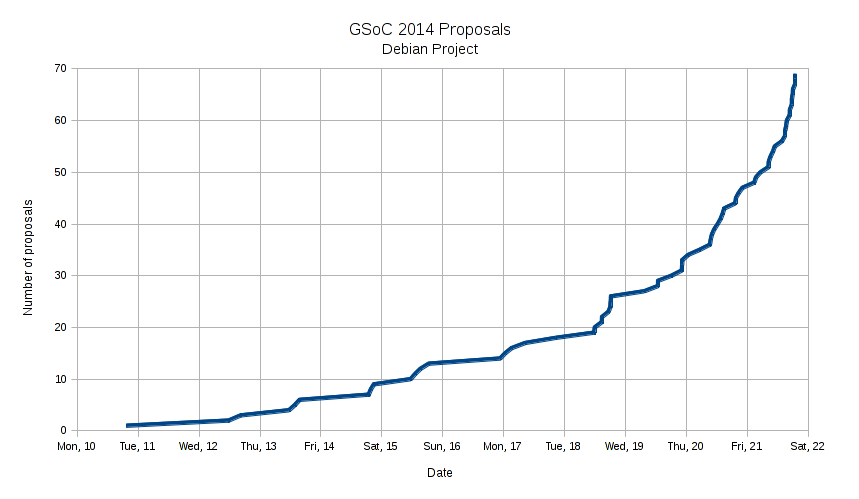
Nicolas Dandrimont: Debian proposals in GSoC 2014

The GSoC student application period is over, and the last two days were pretty interesting. For a few years now, Olly Betts has provided us with a spreadsheet to graph the number of applicants to an organization over time. Here s the graph for Debian this year: Debian GSoC proposals, 2014 edition (Historical graphs: 2013, 2012. Spreadsheet available from Olly s blog) On Wednesday, I was thinking hmm, 30 applicants, this is a slow year . Well, the number of proposals more than doubled in the last two days, to conclude on a whooping 68 applications! The last one was submitted just three seconds before the deadline If you want to take a look at the proposals, head over to the Debian wiki. Time to get on reviewing! The final student acceptances will be published in just less than a month, on April 21st.
21 March 2014

Petter Reinholdtsen: Video DVD reader library / python-dvdvideo - nice free software

Keeping your DVD collection safe from scratches and curious children fingers while still having it available when you want to see a movie is not straight forward. My preferred method at the moment is to store a full copy of the ISO on a hard drive, and use VLC, Popcorn Hour or other useful players to view the resulting file. This way the subtitles and bonus material are still available and using the ISO is just like inserting the original DVD record in the DVD player. Earlier I used dd for taking security copies, but it do not handle DVDs giving read errors (which are quite a few of them). I've also tried using dvdbackup and genisoimage, but these days I use the marvellous python library and program python-dvdvideo written by Bastian Blank. It is in Debian already and the binary package name is python3-dvdvideo. Instead of trying to read every block from the DVD, it parses the file structure and figure out which block on the DVD is actually in used, and only read those blocks from the DVD. This work surprisingly well, and I have been able to almost backup my entire DVD collection using this method. So far, python-dvdvideo have failed on between 10 and 20 DVDs, which is a small fraction of my collection. The most common problem is DVDs using UTF-16 instead of UTF-8 characters, which according to Bastian is against the DVD specification (and seem to cause some players to fail too). A rarer problem is what seem to be inconsistent DVD structures, as the python library claim there is a overlap between objects. An equally rare problem claim some value is out of range. No idea what is going on there. I wish I knew enough about the DVD format to fix these, to ensure my movie collection will stay with me in the future. So, if you need to keep your DVDs safe, back them up using python-dvdvideo. :)

Jeff Licquia: Old Keys Never Die

[en] Encryption is in the news a lot these days for some reason. I ve been doing encryption using the PGP family of encryption systems for quite a while now, but hadn t been paying close attention until a recent reminder landed in my inbox from the Debian project. They warn about 1024D GnuPG keys being weak, which is a fancy way of saying the way all the cool kids created keys back in the late 90s . Including yours truly. Oops! So, it s time to replace my key. I ve uploaded the new one to the key servers and created a transition statement per the guidelines in this fine document, with some changes inspired by others doing the same. The details are in the transition statement, so I won t bore you with long strings of hexadecimal numbers here. The next step is to get signatures for the new key. I ll be at the Linux Foundation Collaboration Summit next week, and would greatly appreciate meeting with people in person to do key signings. If there are any key signing parties happening, please invite! Sorry for everyone who s wondering what I m talking about. We all have secrets to keep, and conversations we wouldn t want spread around; encryption gives you a little more control over that. Plus, encryption lets you authenticate people, which is a fancy way of saying is that you, George? when you get messages from people, and letting them say is that you, Jeff? when you send messages back. If you want to learn more about taking control of your communication, post a comment, email me, or search for PGP , GnuPG , or encryption in your favorite search engine.

Andrew Pollock: [life] Day 52, Trial Ballet class, rain and paint, Science Friday

I woke up at 2am, and then spent over an hour trying to get back to sleep. That was phenomenally annoying. Then at 5am, Zoe's white noise app on her Nexus 7 decided to go a bit wonky (as it does from time to time), which caused her to wake up. I couldn't convince her tablet to behave, so I just let her get in bed with me, but neither of us went back to sleep. I think at about 6am I told her she could turn on the TV so I could try and squeeze in a bit more rest. I managed to forget to put the oats in the Thermomix when I made porridge this morning. It took me a while to figure out why the consistency and colour didn't look quite right when I dished it up. Yep, it was one of those mornings. Zoe had her trial ballet class this morning, at 9:45am in Coorparoo. I managed to get Zoe organised a bit early, so we were the first ones there. It's in a church hall, and has a nice floor, with a mirrored wall and barres on each long wall. Eventually the other girls arrived, there were 5 regulars in total. A good sized class. I had mixed feelings when I discovered that parents weren't normally able to be present in the dance studio to watch the classes. I was today, because it was a trial, but once Zoe starts regular classes, I'll have to wait outside. I'm disappointed I won't be able to watch, but it'll be nice to have 45 minutes to myself. Zoe did really well in the class today. She picked everything up very quickly, and I don't think she'll be negatively impacted by having entered in Term 2. She seemed very comfortable and looked like she enjoyed herself. Not long after we arrived, the heavens opened in a massive downpour, which continued when we had to leave. It was a fair dash back to the car. I'd had plans of a picnic lunch in New Farm Park, but scrapped them on account of the weather. We got home, and had a late morning tea, and then Zoe wanted to play with her Marble Run. After that, we gave Smudge a good brushing and then Zoe wanted to do some craft and painting. I let Zoe set herself up, and it was fun to see what bits and pieces she chose to dig out of the arts and craft bins. She wanted to make another crown for Mummy's boss, but we don't have any crown making stuff at home (yet), so she ended up starting to decorate a wand and gluing a pom pom on a shoe box, before moving on to painting her cardboard box cubby house and rocket. She wanted to start doing some hand painting right around lunch time, but I managed to convince her to do that after lunch. We had some lunch, and then she did a little bit more painting and stickering before her nap. She passed out for her nap very quickly. After her nap, I asked her if she wanted to paint or do science, and without hesitation, she chose science! I delved into the "Weather" chapter of 365 Science Experiments and we did a couple with ice cubes and salt and then she saw one where you stick a balloon over the neck of a glass bottle and put it in hot water and the balloon "inflates", so we did that one as well. We also popped a balloon to simulate thunder. It was all nice and easy, without a lot of preparation required. After that, we did a bit of a clean up and then Zoe watched some of her DVDs from the library while she waited for Sarah to arrive to pick her up. It was a good day today. No meltdowns.

Hideki Yamane: my present situation (from Japan)

Vacation at Oosawa Onsen ( ) for a week was so nice. Just I did is sleep, take a bath (hot spring, of course), eat and drink, oh and also some bug squashing :-)


Write introduction about "APT line setting" at monthy "Software Design" magazine April 2014, and brief introduction about Ubuntu for "Linux Engineer Beginners guide (2nd edition)"


Upgrade debian-mirror.sakura.ne.jp mirror (one of ftp.jp.debian.org hosting site) today, from Squeeze to Wheezy with no trouble so it took just 15 minites - smooth :-)


And... oh, I should back to write next article before editor gets angry. Hurry up! ;)

20 March 2014

Bits from Debian: Debian Project Leader elections 2014

It's again that time of the year for the Debian Project: the elections of its Project Leader! Starting on March 31st, and during the following two weeks, the Debian Developers will vote to choose the person who will guide the project for one year. Among this year's candidates there is the current DPL, Lucas Nussbaum, who admits that "the workload involved in being the DPL is just huge," and motivates his nomination with the need for stability in the project in this release cycle, especially after the difficult decision about the default init system. In his platform, Lucas speaks of technical and social steps to improve the project: from reproducible builds for a more secure archive to a renewed effort to run Debian on new platforms (especially smartphone and tablets); from a more welcoming approach to prospective contributors to an easier collaboration with organizations. The only other candidate left after Gergely Nagy withdrew his nomination, is former Release Manager Neil McGovern. Neil's platform focuses mainly on the need to "ensure that we cater to our users, and there's millions of them. From those running the latest software in unstable, to people who simply want a rock solid core release." In his opinion "the size of Debian is increasing, and will reach a point where we're unable to guarantee basic compatibility with other packages, or the length of time it takes to do so becomes exponentially longer, unless something changes." To fix this problem, Neil proposes the implementation of PPAs (Personal Package Archives), the modernisation of the current build and infrastructure system as well as generally supporting the various teams. The campaigning period will last until March 30th: the candidates are already engaged in debates and discussions on the debian-vote mailing list where they'll reply to questions from users and contributors.

Steve Kemp: Time to mix things up again

I'm currently a contractor, working for/with Dyn, until April the 11th. I need to decide what I'm doing next, if anything. In the meantime here are some diversions:
Some trivial security issues
I noticed and reported two more temporary-file issues insecure temporary file usage in apt-extracttemplates (apt), and libreadline6: Insecure use of temporary files - in _rl_trace. Neither of those are particularly serious, but looking for them took a little time. I recently started re-auditing code, and decided to do three things:
  • Download the source code to every package installed upon this system.
  • Download the source code to all packages matching the pattern ^libpam-, and ^libruby-*.
I've not yet finished slogging through the code, but my expectation will be a few more issues. I'll guess 5-10, given my cynical nature.
NFS-work
I've been tasked with the job of setting up a small cluster running from a shared and writeable NFS-root. This is a fun project which I've done before, PXE-booting a machine and telling it to mount a root filesystem over NFS is pretty straight-forward. The hard part is making that system writeable, such that you can boot and run "apt-get install XX". I've done it in the past using magic filesystems, or tmpfs. Either will work here, so I'm not going to dwell on it.
Another year
I had another birthday, so that was nice. My wife took me to a water-park where we swam like fisheseses, and that tied in nicely with a recent visit to Deep Sea World, where we got to walk through a glass tunnel, beneath a pool FULL OF SHARKS, and other beasties. Beyond that I received another Global Knife, which has now been bloodied, since I managed to slice my finger open chopping mushrooms on Friday. Oops. Currently I'm in that annoying state where I'm slowly getting used to typing with a plaster around the tip of my finger, but knowing that it'll have to come off again and I'll get confused again.
Linux Distribution
I absolutely did not start working on a "linux distribution", because that would be crazy. Do I look like a crazy-person? All I did was play around with GNU Stow, and ponder the idea of using a minimal LibC and GNU Stow to organize things. It went well, but the devil is always in the details. I like the idea of a master-distribution which installs pam, ssh, etc, but then has derivitives for "This is a webserver", "This is a Ruby server", and "This is a database server". Consider it like task-selection, but with higher ambition.
There's probably more I could say; a new kitchen sink (literally) and a new tap have made our kitchen nicer, I've made it past six months of regular gym-based workouts, and I didn't die when I went to the beach in the dark the other night, so that was nice. Umm? Stuff? Have a nice day. Thanks.

Next.

Previous.

