Today ist May, 1st. In about two weeks on May, 15th WhatsApp will put their changed Terms of Service into action and when you don t accept their rules you won t be able to use WhatsApp any longer.
Early this year there was already a strong movement away from WhatsApp towards other solutions. Mainly to Signal, but also some other services like the Fediverse gained some new users. And also XMPP got their fair share of new users.
So, what to do about the WhatsApp ToS change then? Shall we go all to Signal? Surely not. Signal is another vendor lock-in silo. It s centralistic and recent development plans want to implement some crypto payment system. Even Bruce Schneier thinks that this is a bad idea.
Other alternatives often named include Matrix/Element or XMPP. Today, Don di Dislessia in the (german) Fediverse asked about power consumption of the Fediverse incl. Matrix and XMPP and how much renewable energy is being used. Of course this is no easy answer to this question, but I tried my best at least for my own server.
Here are my findings and conclusions
Power
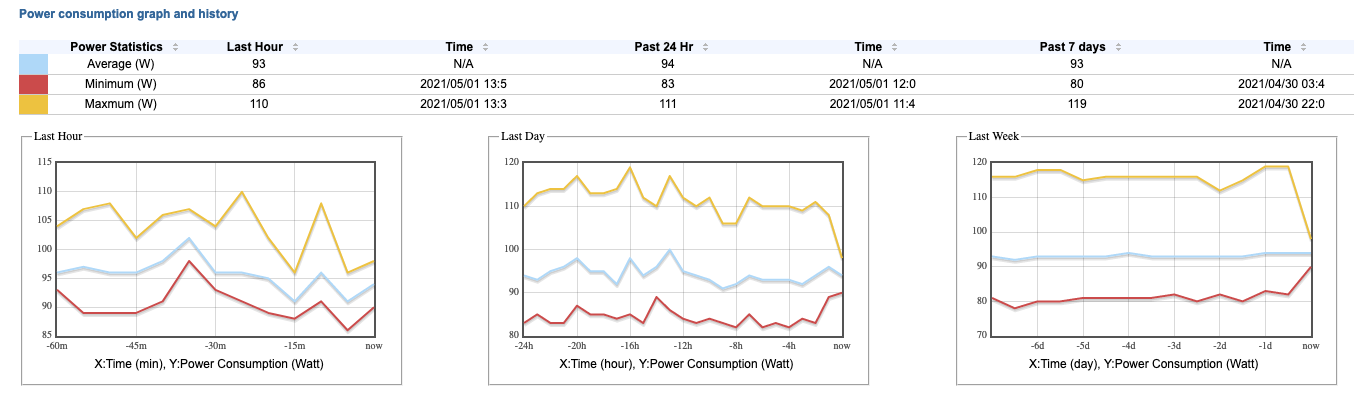
screenshot showing power consumption of server
Currently my server in the colocation is using about 93W in average with 6c Xeon E5-2630L, 128 GB RAM, 4x 2 TB WD Red + 1 Samsung 960pro NVMe. The server is 7 years old. When I started with that server the power consumption was about 75W, but back then there were far less users on the server. So, 20W more over the past year
Users
I m running my Friendica node on Nerdica.net since 2013. Over the years it became one of the largest Friendica servers in the Fediverse, for some time it was the largest one. It has currently like 700 total users and 180 monthly active users. My Mastodon instance on Nerdculture.de has about 1000 total users and about 300 monthly active users.
Since last year I also run a Matrix-Synapse server. Although I invited my family I m in fact the only active user on that server and have joined some channels.
My XMPP server is even older than my Friendica node. For long time I had like maybe 20 users. Now I setup a new website and added some domains like hookipa.net and xmpp.social the user count increased and currently I have like 130 users on those two domains and maybe like 50 monthly active users. Also note that all my Friendica and Mastodon users can use XMPP with their accounts, but won t be counted the same way as on native users on ejabberd, because the auth backend is different.
So, let s assume I do have like 2000 total users and 500 monthly active users.
CPU, Database Sizes and Disk I/O
Let s have a look about how many resources are being used by those users.
Database Sizes:
Friendica (MariaDB): 31 GB for 700 users
Mastodon (PostgreSQL): 15 GB for 1000 users
Matrix-Synapse (PostgreSQL): 5 GB for 1 user
XMPP (PostgreSQL): 0.4 GB for 200 users
CPU times according to xentop:
Webserver VM (Matrix, Friendica & Mastodon): 13410130 s / 130%
XMPP VM: 944275 s / 5.4%
Friendica does use the largest database and causes most disk I/O on NVMe, but it s difficult to differentiate between the load between the web apps on the webserver. So, let s have a quick look on an simple metric:
Number of lines in webserver logfile:
Friendica: 11575 lines
Matrix: 8174 lines
Mastodon: 3212 lines
These metrics correlate to some degree with the database I/O load, at least for Friendica. If you take into account the number of users, things look quite different.
Conclusion
Overall, and my personal impression, is that Matrix is really bad in regards of resource usage. Given that I m the only active user it uses exceptionally many resources. When you also consider that Matrix is using a distributed database for its chat rooms, you can assume that the resource usage is multiplied across the network, making things even worse.
Friendica is using a large database and many disk accesses, but has a fairly large user base, so it seems ok, but of course should be improved.
Mastodon seems to be quite good, considering the database size, the number of log lines and the user count.
XMPP turns out to be the most efficient contestant in this comparison: it uses much less CPU cycles and database disk I/O.
Of course, Mastdon/Friendica are different services than XMPP or Matrix. So, coming back to the initial question about alternatives to WhatsApp, the answer for me is: you should prefer XMPP over Matrix alone for reasons of saving resources and thus reducing power consumption. Less power consumption also means a smaller ecological footprint and fewer CO2 emissions for your communication with your family and friends.
XMPP is surely not the perfect replacement for WhatsApp, but I think it is the best thing to recommend. As said above, I don t think that Signal is an viable option. It s just another proprierary silo with all the problems that come with it. Matrix is a resource hog and not a messenger but a MS Teams replacement. Element as the main Matrix client is laggy and not multi-account/multi-server capable. Other Matrix clients do support multiple accounts but are not as feature-complete as Element. In the end the Matrix ecosystem will suffer from the same issues as XMPP did already a decade ago. But XMPP has learned to deal with it.
Also XMPP is proceeding fast in the last years and it has solved many problems many people are still complaining about. Sure, there still some open issues. The situation on IOS is still not as good as on Android with Conversations, but it is fairly close to it.
There are many efforts to improve XMPP. There is Quicksy IM, which is a service that will use your phone number as Jabber ID/JID and is thus comparable to Signal which uses phone numbers as well as unique identifier. But Quicksy is compatible with XMPP standards. Snikket is another new XMPP ecosystem aiming at smaller groups hosting their own server by simply installing a Docker container and setup some basic SRV records in the DNS. Or there is Mailcow, a Docker based mailserver setup that added XMPP server in their setup as well, so you can have the same mail and XMPP address. Snikket even got EU based funding for implementing XMPP Account Portability which also will improve the decentralization even further. Additionally XMPP helps vaccination in Canada and USA with vaxbot by Monal.
Be smart and use ecofriendly infrastructure.
Here s my (nineteenth) monthly update about the activities I ve done in the F/L/OSS world.
Debian
This was my 28th month of actively contributing to Debian.
I became a DM in late March 2019 and a DD on Christmas 19! \o/
Crazy month, as always. Lots of things happening and lots of moving parts.
Now that I am working on Ubuntu-full time, I barely get much time to do any extra stuff. Then the massive COVID wave that has plunged India had made this month further crazier. More on that later, maybe. IDK.
Anyway, I did some Debian stuff, thanks to Salzburg BSP (more down below). I worked on the following stuff:
Mentoring for newcomers and assisting people in BSP.
Moderation of -project mailing list.
Salzburg BSP 2021
This was my first virtual BSP and the first BSP in Salzburg and it was absolutely amazing!
Many kudos to Bernd Zeimetz for organizing it so smoothly and wonderfully, for real! \o/
We had a bunch of amazing sessions, besides hacking, of course, like:
yoga,
sports,
games, and
datacenter tour -> which was super!
We also had lots of things happening at #debian-bsp-2021-szg and did a lot of work.
Whilst everything we did is available on the pad, I work on the following things:
Debian (E)LTS
Debian Long Term Support (LTS) is a project to extend the lifetime of all Debian stable releases to (at least) 5 years. Debian LTS is not handled by the Debian security team, but by a separate group of volunteers and companies interested in making it a success.
And Debian Extended LTS (ELTS) is its sister project, extending support to the Jessie release (+2 years after LTS support).
This was my nineteenth month as a Debian LTS and tenth month as a Debian ELTS paid contributor.
I was assigned 60.00 hours for LTS and 60.00 hours for ELTS and worked on the following things:
Issued DLA 2639-1, fixing CVE-2020-12460, for opendmarc.
For Debian 9 stretch, these problems have been fixed in version 1.3.2-2+deb9u3.
Uploaded fluidsynth to sid, fixing CVE-2021-28421.
For Debian sid, these problems have been fixed in version 2.1.7-1.1. Thanks to Reiner Herrmann for their work.
Uploaded fluidsynth to buster-pu, fixing CVE-2021-28421.
For Debian sid, these problems have been fixed in version 2.1.7-1.1. Thanks to Reiner Herrmann for their work.
ELTS CVE Fixes and Announcements:
Issued ELA 396-1, fixing CVE-2021-23358, for underscore.
For Debian 8 jessie, these problems have been fixed in version 1.7.0~dfsg-1+deb8u1.
Issued ELA 397-1, fixing CVE-2020-1946, for spamassassin.
For Debian 8 jessie, these problems have been fixed in version 3.4.2-0+deb8u4.
Help issued ELA 401-1, fixing CVE-2021-25329 and CVE-2020-9484, for tomcat7, along with Markus.
For Debian 8 jessie, these problems have been fixed in version 7.0.56-3+really7.0.100-1+deb8u3.
Mark CVE-2021-20297/network-manager as not-affected for jessie.
Mark CVE-2021-22890/curl as not-affected for jessie and stretch.
Mark CVE-2020-7760/codemirror-js as not-affected for jessie.
Mark CVE-2021-25122/tomcat8 as not-affected for jessie.
Mark CVE-2021-XXXX/plinth as no-dsa for stretch.
Mark CVE-2021-29424/libnet-netmask-perl as no-dsa for stretch.
Mark CVE-2021-28374/courier-authlib as fixed in 0.58-3.1 for jessie.
Mark CVE-2021-1252/clamav as not-affected for jessie.
Mark CVE-2021-1404/clamav as not-affected for jessie.
Mark CVE-2020-4051/dojo as no-dsa for jessie.
Mark CVE-2021-29447/wordpress as not-affected for jessie.
Mark CVE-2021-29450/wordpress as not-affected for jessie.
Mark CVE-2019-20920/libjs-handlebars as ignored for stretch and jessie.
Mark CVE-2021-23369/libjs-handlebars as ignored for stretch and jessie.
Mark CVE-2020-4051/dojo as fixed in 1.15.4+dfsg1-1 for sid and bullseye.
Mark CVE-2021-28965/ruby2.7 fixed in 2.7.3-1 for sid.
Mark CVE-2020-12272/opendmarc as postponed for jessie.
Mark CVE-2021-20296, CVE-2021-3475, CVE-2021-3476, CVE-2021-3477, CVE-2021-3478, and CVE-2021-3479, affecting openexr, as no-dsa for jessie and stretch.
Yesterday morning I got a warning call from the Debian quality
control system that
the VLC
bittorrent plugin was due to be removed because of a release
critical bug in one of its dependencies. As you might remember, this
plugin make VLC able to stream videos directly from a bittorrent
source using both torrent files and magnet links, similar to using a
HTTP source. I believe such protocol support is a vital feature in
VLC, allowing efficient streaming from sources such at the almost 7
million movies in the Internet
Archive.
The dependency was the unmaintained
libtorrent-rasterbar
package, and the bug in
question blocked its python library from working properly. As I
did not want Bullseye to release without bittorrent support in VLC, I
set out to check out the status, and track down a fix for the problem.
Luckily the issue had already been identified and fixed upstream,
providing everything needed. All I needed to do was to fetch the
Debian git repository, extract and trim the patch from upstream and
apply it to the Debian package for upload.
The fixed library was uploaded yesterday evening. But that is not
enough to get it into Bullseye, as Debian is currently in package
freeze to prepare for a new next stable release. Only non-critical
packages with
autopkgtest
setup included, in other words able to validate automatically that
the package is working, are allowed to migrate automatically into the
next release at this stage. And the unmaintained libtorrent-rasterbar
lack such testing, and thus needed a manual override. I am happy to
report that such manual override was approved a few minutes ago, thus
increasing significantly the chance of VLC bittorrent streaming being
available out of the box also for Debian/Buster users. A bit too
close shave for my liking, as the Bullseye release is most likely just
a few days away, and this did feel like the package was saved by the
bell. I am so glad the warning email showed up in time for me to
handle the issue, and a big thanks go to the Debian Release team for
the quick feedback on
#debian-release
and their swift
unblocking.
As usual, if you use Bitcoin and want to show your support of my
activities, please send Bitcoin donations to my address
15oWEoG9dUPovwmUL9KWAnYRtNJEkP1u1b.
Here is my monthly update covering what I have been doing in the free software world during April 2021 (previous month):
Reviewed and merged two pull request from Michael K. to my django-slack library which provides a convenient wrapper between projects using the Django web development framework and the Slack chat platform. Michael's pull requests made Python 3.6+ a hard requirement (#102) and to run the tests against Python 3.9 (#103).
Filed a pull request against libsass-python (a Python implementation of the Sass CSS preprocessor) in order to make the build reproducible. (#319)
Reproducible Builds
One of the original promises of open source software is that distributed peer review and transparency of process results in enhanced end-user security. However, whilst anyone may inspect the source code of free and open source software for malicious flaws, almost all software today is distributed as pre-compiled binaries. This allows nefarious third-parties to compromise systems by injecting malicious code into ostensibly secure software during the various compilation and distribution processes.
The motivation behind the Reproducible Builds effort is to ensure no flaws have been introduced during this compilation process by promising identical results are always generated from a given source, thus allowing multiple third-parties to come to a consensus on whether a build was compromised.
The project is proud to be a member project of the Software Freedom Conservancy. Conservancy acts as a corporate umbrella allowing projects to operate as non-profit initiatives without managing their own corporate structure. If you like the work of the Conservancy or the Reproducible Builds project, please consider becoming an official supporter.
This month, I:
Issued DLA 2620-1 to address a cross-site scripting (XSS) vulnerability in python-bleach, a whitelist-based HTML sanitisation library.
Issued DLA 2622-1 and ELA 402-1 as it was discovered that there was a potential directory traversal issue in Django, the popular Python-based web development framework. The vulnerability could have been exploited by maliciously crafted filenames. However, the upload handlers built into Django itself were not affected. (#986447)
Jan-Niklas Sohn discovered that there was an input validation failure in the X.Org display server. Insufficient checks on the lengths of the XInput extension's ChangeFeedbackControl request could have lead to out of bounds memory accesses in the X server. These issues could have led to privilege escalation for authorised clients, particularly on systems where the X server is running as a privileged user. I, therefore, issued both DLA 2627-1 and ELA 405-1 to address this problem.
Frontdesk duties, reviewing others' packages, participating in mailing list discussions, etc., as well as attending our monthly meeting.
You can find out more about the project via the following video:
Having destroyed the third Cherry Stream keyboard in 4 years, I wanted to try
a more substantial keyboard for a change. After some research I decided that I
want a mechanical, wired, tenkeyless keyboard without any fancy LEDs.
At the end I settled for a Keychron C1 with red switches. It meets all
requirements, looks very nice and the price is reasonable.
Surprise!
After the keyboard was delivered, I connected it to my Debian machine and was
unpleasantly surprised to notice that the Function-keys did not work at all.
The keyboard shares the Multimedia keys with the F-keys and you have an fn
key that supposedly switches between the two modes, like you re used to on a
laptop. On Linux, however you cannot access the F-keys at all: pressing fn
+ F1 or F1 makes no difference, you ll always get the Multimedia key.
Switching the keyboard between Windows and Mac mode makes no difference
either, in both modes the F-keys are not accessible.
Apparently Keychron is aware of the problem, because the quick start manual
tells you:
We have a Linux user group on facebook. Please search Keychron Linux
Group on facebook. So you can better experience with our keyboard.
Customer support at its finest!
So at this point you should probably just send the keyboard back, get the
refund and buy a proper one with functioning F-keys.
The fix
Test if this command fixes the issue and enables the Fn + F-key-combos:
# as root:echo2 > /sys/module/hid_apple/parameters/fnmode
Depending on the mode the keyboard is in, you should now be able to use the
F-keys by simply pressing them, and the Multimedia keys by pressing fn +
F-key (or the other way round). To switch the default mode of the F-keys to
Function- or Multimedia-mode, press and hold fn + X + L for 4 seconds.
If everything works as expected, you can make the change permanent by creating
the file /etc/modprobe.d/hid_apple.conf and adding the line:
options hid_apple fnmode=2
This works regardless if the keyboard is in Windows- or Mac-mode, and that
might hint at the problem: in both cases the Linux thinks you re connecting a
Mac keyboard.
The rant
Although the fix was not very hard to find and apply, this experience still
leaves a foul taste. I naively assumed the problem of having a properly
functioning keyboard that simply works when you plug it in, has been
thoroughly solved by 2021.
To make it worse, I assume Keychron must be aware of the problem because the
other Keychron models have the same issue! But instead of fixing it
on their end, they forward you to a facebook community and expect you to
somehow fix it yourself.
So dear Keychron, you do make really beautiful keyboards! But before you
release your next model with the same bug, maybe invest a bit on fixing the
basics? I see that your keyboards support firmware updates for Windows and Mac
maybe you can talk to the folks over at the Linux Vendor Firmware
Service and support Linux as well? Maybe you can even fix this
annoying bug for the keyboards you ve already sold? I found it really cute
that you sent different keycaps for Windows and Mac setups a few
disappointed Linux users might accept an apology in form of a Linux cap
Like each month, have a look at the work funded by Freexian s Debian LTS offering.
Debian project funding
In March, we put aside 3225 EUR to fund Debian projects but sadly nobody picked up anything, so this one of the many reasons Raphael posted as series of blog posts titled Challenging times for Freexian , posted in 4 parts on the last two days of March and the first two of April. [Part one, two, three and four]
So we re still looking forward to receive more projects from various Debian teams! Learn more about the rationale behind this initiative in this article!
Debian LTS contributors
In March, 11 contributors have been paid to work on Debian LTS, their reports are available:
Abhijith PA did 9.0h (out of 9h assigned and 12h from February), thus carrying over 12h to April.
Evolution of the situation
In March we released 28 DLAs and held our second LTS team meeting for 2021 on IRC, with the next public IRC meeting coming up at the end of May.
At that meeting Holger announced that after 2.5 years he wanted to step back from his role helping Rapha l in coordinating/managing the LTS team. We would like to thank Holger for his continuous work on Debian LTS (which goes back to 2014) and are happy to report that we already found a successor which we will introduce in the upcoming April report from Freexian.
Finally, we would like to remark once again that we are constantly looking for new contributors. For a last time, please contact Holger if you are interested!
The security tracker currently lists 42 packages with a known CVE and the dla-needed.txt file has 28 packages needing an update.
We are also pleased to report that we got 4 new sponsors over the last 2 months : thanks to sipgate GmbH, OVH US LLC, Tilburg University and Observatoire des Sciences de l Univers de Grenoble !
Thanks to our sponsors
Sponsors that joined recently are in bold.
The diffoscope maintainers are pleased to announce the release of diffoscope
version 173. This version includes the following changes:
[ Chris Lamb ]
* Add support for showing annotations in PDF files.
  (Closes: reproducible-builds/diffoscope#249)
* Move to assert_diff in test_pdf.py.
[ Zachary T Welch ]
* Difference.__init__: Demote unified_diff argument to a Python "kwarg".
CVE-2021-23336 introduced an API-change. It was hard decision to upload this fix, because it can potentially break
user s code, if they code uses semicolon as separator. Another option is not to fix it at all, leaving the security
issue open. Not the best solution.
Also I have fixed the failing autopkgtest, which was introduced in one of latest CVE fixes. CI-pipelines on salsa.d.o
are helping now to detect such mistakes.
CVE-2019-16935: Escape the server title of DocXMLRPCServer.
CVE-2021-23336 introduced an API-change, same as for python3.5.
But the backporting was much harder because python3->2 is not always easy.
Other LTS-related work
CI-pipelines
I try to setup for all LTS-packages which I touch CI-pipelines on salsa.d.o. Setting up pipelines for
python3.5 and
python2.7 was much harder as for other packages.
Failing autopkgtests and some other issues. Though it takes at the beginning more time to setup, I believe it improves
package quality.
LTS-Meeting
I attended the Debian LTS team Jitsi-meeting.
The Tor Project now has a status page which shows the state of
our major services.
You can check status.torprojet.org for news about major outages
in Tor services, including v3 and v2 onion services, directory
authorities, our website (torproject.org), and the
check.torproject.org tool. The status page also displays outages
related to Tor internal services, like our GitLab instance.
This post documents why we launched
status.torproject.org, how the service was
built, and how it works.
Why a status page
The first step in setting up a service page was to realize we needed
one in the first place. I surveyed internal users at the end of
2020 to see what could be improved, and one of the suggestions that
came up was to "document downtimes of one hour or longer" and
generally improve communications around monitoring. The latter is
still on the sysadmin roadmap, but a status page seemed like a
good solution for the former.
We already have two monitoring tools in the sysadmin team: Icinga
(a fork of Nagios) and Prometheus, with Grafana
dashboards. But those are hard to understand for users. Worse, they
also tend to generate false positives, and don't clearly show users
which issues are critical.
In the end, a manually curated dashboard provides important usability
benefits over an automated system, and all major organisations have
one.
Picking the right tool
It wasn't my first foray in status page design. In another life, I had
setup a status page using a tool called Cachet. That was already
a great improvement over the previous solutions, which were to use
first a wiki and then a blog to post updates. But Cachet is a complex
Laravel app, which also requires a web browser to update. It
generally requires more maintenance than what we'd like, needing silly
things like a SQL database and PHP web server.
So when I found cstate, I was pretty excited. It's basically a
theme for the Hugo static site generator, which means that it's a
set of HTML, CSS, and a sprinkle of Javascript. And being based on
Hugo means that the site is generated from a set of Markdown
files and the result is just plain HTML that can be hosted on any web
server on the planet.
Deployment
At first, I wanted to deploy the site through GitLab CI, but at
that time we didn't have GitLab pages set up. Even though we do have
GitLab pages set up now, it's not (yet) integrated with our
mirroring infrastructure. So, for now, the source is hosted and built
in our legacy git and Jenkins services.
It is nice to have the content hosted in a git repository: sysadmins can just
edit Markdown in the git repository and push to deploy changes, no web browser
required. And it's trivial to setup a local environment to preview changes:
hugo serve --baseUrl=http://localhost/
firefox https://localhost:1313/
Only the sysadmin team and gitolite administrators have access to the
repository, at this stage, but that could be improved if
necessary. Merge requests can also be issued on the GitLab
repository and then pushed by authorized personnel later on,
naturally.
Availability
One of the concerns I have is that the site is hosted inside our normal mirror
infrastructure. Naturally, if an outage occurs there, the site goes down. But
I figured it's a bridge we'll cross when we get there. Because it's so easy to
build the site from scratch, it's actually trivial to host a copy of the site
on any GitLab server, thanks to the .gitlab-ci.yml file shipped (but not
currently used) in the repository. If push comes to shove, we can just publish
the site elsewhere and point DNS there.
And, of course, if DNS fails us, then we're in trouble, but that's the
situation anyway: we can always register a new domain name for the status page
when we need to. It doesn't seem like a priority at the moment.
Comments and feedback are welcome!
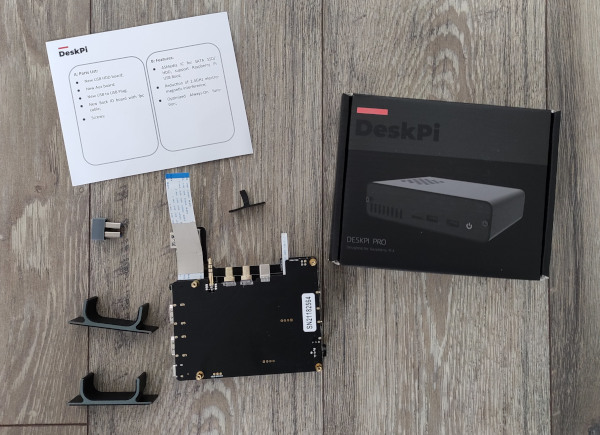
I wrote previously about my DeskPi Pro + 8GB Pi 4 setup. My main complaint at the time was the fact one of the forward facing USB ports broke off early on in my testing. For day to day use that hasn t been a problem, but it did mar the whole experience. Last week I received an unexpected email telling me The new updated PCB Board for your DeskPi order was shipped. . Apparently this was due to problems with identifying SSDs and WiFi/HDMI issues. I wasn t quite sure how much of the internals they d be replacing, so I was pleasantly surprised when it turned out to be most of them; including the PCB with the broken USB port on my device.
They also provided a set of feet allowing for vertical mounting of the device, which was a nice touch.
The USB/SATA bridge chip in use has changed; the original was:
usb 2-1: New USB device found, idVendor=152d, idProduct=0562, bcdDevice= 1.09
usb 2-1: New USB device strings: Mfr=1, Product=2, SerialNumber=3
usb 2-1: Product: RPi_SSD
usb 2-1: Manufacturer: 52Pi
usb 2-1: SerialNumber: DD5641988389F
and the new one is:
usb 2-1: New USB device found, idVendor=174c, idProduct=1153, bcdDevice= 0.01
usb 2-1: New USB device strings: Mfr=2, Product=3, SerialNumber=1
usb 2-1: Product: AS2115
usb 2-1: Manufacturer: ASMedia
usb 2-1: SerialNumber: 00000000000000000000
That s a move from a JMicron 6Gb/s bridge to an ASMedia 3Gb/s bridge. It seems there are compatibility issues with the JMicron that mean the downgrade is the preferred choice. I haven t retried the original SSD I wanted to use (that wasn t detected), but I did wonder if this might have resolved that issue too.
Replacing the PCB was easier than the original install; everything was provided pre-assembled and I just had to unscrew the Pi4 and slot it out, then screw it into the new PCB assembly. Everything booted fine without the need for any configuration tweaks. Nice and dull. I ve tried plugging things into the new USB ports and they seem ok so far as well.
However I also then ended up pulling in a new backports kernel from Debian (upgrading from 5.9 to 5.10) which resulted in a failure to boot. The kernel and initramfs were loaded fine, but no login prompt ever appeared. Some digging led to the discovery that a change in boot ordering meant USB was not being enabled. The solution is to add reset_raspberrypi to the /etc/initramfs-tools/modules file - that way this module is available in the initramfs, the appropriate pre-USB reset can happen and everything works just fine again.
The other niggle with the new kernel was a regular set of errors in the kernel log:
and a set of registers afterwards, roughly every 10s or so. This seems to be fallout from an increase in the core clock due to the VC4 driver now being enabled, the fact I have no SD card in the device and a lack of working card-detect line for the MicroSD slot. There s a GitHub issue but I solved it by removing the sdhci_iproc for now - I m not using the wifi so loss of MMC isn t a problem.
Credit to DeskPi for how they handled this. I didn t have to do anything and didn t even realise anything was happening until I got the email with my tracking number and a description of what they were sending out in it. Delivery took less than a week. This is a great example of how to handle a product issue - no effort required on the part of the customer.
I worked on research on FOSS foundations and published two reports:
Growing Open Source Projects with a Stable Foundation
This primer covers non-technical aspects that the majority of projects will have to consider at some point. It also explains how FOSS foundations can help projects grow and succeed.
This primer explains:
What issues and areas to consider
How other projects and foundations have approached these topics
What FOSS foundations bring to the table
How to choose a FOSS foundation
You can download Growing Open Source Projects with a Stable Foundation.
Research report
The research report describes the findings of the research and aims to help understand the operations and challenges FOSS foundations face.
This report covers topics such as:
Role and activities of foundations
Challenges faced and gaps in the service offerings
Operational aspects, including reasons for starting an org and choice of jurisdiction
Trends, such as the "foundation in a foundation" model
Recommendations for different stakeholders
You can download the research report.
Acknowledgments
This research was sponsored by Ford Foundation and Alfred P. Sloan Foundation. The research was part of their Critical Digital Infrastructure Research initiative, which investigates the role of open source in digital infrastructure.
Swapping caps and control in X11.
The configuration is at /etc/default/keyboard, and both virtual console and X11 use that configuration in Debian.
For systemd users, systemd-localed.service can be used to configure using localectl(1) command, and
Debian systemd has been patched to update /etc/default/keyboard (managed by keyboard-configuration package).
Not sure where I find a documentation for this.
systemd for Debian is patched with
debian/patches/debian/Use-Debian-specific-config-files.patch
to change /etc/X11/xorg.conf.d/00-keyboard.conf to /etc/default/keyboard.
I read this book as part of the Beyond Series Bundle (Books 1-3),
which is what the sidebar information is for.
Noelle is a child of Eden, the rich and technologically powerful city of a
post-apocalyptic world. As the daughter of a councilman, she had
everything she wanted except the opportunity to feel. Eden's religious
elite embrace a doctrine of strict Puritanism: Even hugging one's children
was frowned upon, let alone anything related to sex. Noelle was too
rebellious to settle for that, which is why this book opens with her
banished from Eden, ejected into Sector Four. The sectors are the city
slums, full of gangs and degenerates and violence, only a slight step up
from the horrific farming communes. Luckily for her, she literally
stumbles into one of the lieutenants of the O'Kane gang, who are just as
violent as their reputations but who have surprising sympathy for a
helpless city girl.
My shorthand distinction between romance and erotica is that romance mixes
some sex into the plot and erotica mixes some plot into the sex.
Beyond Shame is erotica, specifically BDSM erotica. The forbidden
sensations that Noelle got kicked out of Eden for pursuing run strongly
towards humiliation, which is tangled up in the shame she was taught to
feel about anything sexual. There is a bit of a plot surrounding the
O'Kanes who take her in, their leader, some political skulduggery that
eventually involves people she knows, and some inter-sector gang warfare,
but it's quite forgettable (and indeed I've already forgotten most of it).
The point of the story is Noelle navigating a relationship with Jasper
(among others) that involves a lot of very graphic sex.
I was of two minds about reviewing this. Erotica is tricky to review,
since to an extent it's not trying to do what most books are doing. The
point is less to tell a coherent story (although that can be a bonus) than
it is to turn the reader on, and what turns the reader on is absurdly
personal and unpredictable. Erotica is arguably more usefully marked with
story codes
(which in this case would be something like MF, MMFF, FF, Mdom, Fdom, bd,
ds, rom, cons, exhib, humil, tattoos) so that the reader has an idea
whether the scenarios in the story are the sort of thing they find hot.
This is particularly true of BDSM erotica, since the point is arousal from
situations that wouldn't work or might be downright horrifying in a
different sort of book. Often the forbidden or taboo nature of the scene
is why it's erotic. For example, in another genre I would complain about
the exaggerated and quite sexist gender roles, where all the men are
hulking cage fighters who want to control the women, but in male-dominant
BDSM erotica that's literally the point.
As you can tell, I wrote a review anyway, primarily because of how I came
to read this book. Kit Rocha (which is a pseudonym for the writing team
of Donna Herren and Bree Bridges) recently published Deal with the
Devil, a book about mercenary librarians in a post-apocalyptic future.
Like every right-thinking person, I immediately wanted to read a book
about mercenary librarians, but discovered that it was set in an existing
universe. I hate not starting at the beginning of things, so even though
there was probably no need to read the earlier books first, I figured out
Beyond Shame was the first in this universe and the bundle of the
first three books was only $2.
If any of you are immediately hooked by mercenary librarians but are
back-story completionists, now you know what you'll be getting into.
That said, there are a few notable things about this book other than it
has a lot of sex. The pivot of the romantic relationship was more
interesting and subtle than most erotica. Noelle desperately wants a man
to do all sorts of forbidden things to her, but she starts the book unable
to explain or analyze why she wants what she wants, and both Jasper and
the story are uncomfortable with that and unwilling to leave it alone.
Noelle builds up a more coherent theory of herself over the course of the
book, and while it's one that's obviously designed to enable lots of
erotic scenes, it's not a bad bit of character development.
Even better is Lex, the partner (sort of) of the leader of the O'Kane gang
and by far the best character in the book. She takes Noelle under her
wing from the start, and while that relationship is sexualized like nearly
everything in this book, it also turns into an interesting female
friendship that I would have also enjoyed in a different genre. I liked
Lex a lot, and the fact she's the protagonist of the next book might keep
me reading.
Beyond Shame also has a lot more female gaze descriptions of the
men than is often the case in male-dominant BDSM. The eye candy is fairly
evenly distributed, although the gender roles are very much not. It even
passes the Bechdel
test, although it is still erotica and nearly all the conversations end
up being about sex partners or sex eventually.
I was less fond of the fact that the men are all dangerous and violent and
the O'Kane leader frequently acts like a controlling, abusive psychopath.
A lot of that was probably the BDSM setup, but it was not my thing. Be
warned that this is the sort of book in which one of the (arguably) good
guys tortures someone to death (albeit off camera).
Recommendations are next to impossible for erotica, so I won't try to give
one. If you want to read the mercenary librarian novel and are dubious
about this one, it sounds like (although I can't confirm) that it's a bit
more on the romance end of things and involves a lot fewer group orgies.
Having read this book, I suspect it was entirely unnecessary to have done
so for back-story. If you are looking for male-dominant BDSM,
Beyond Shame is competently written, has a more thoughtful story
than most, and has a female friendship that I fully enjoyed, which may
raise it above the pack.
Rating: 6 out of 10
In my previous post I wrote about how I'd been running CP/M on a Z80-based single-board computer.
I've been slowly working my way through a bunch of text-based adventure games:
The Hitchhiker's Guide To The Galaxy
Zork 1
Zork 2
Zork 3
Along the way I remembered how much fun I used to have doing this in my early teens, and decided to write my own text-based adventure.
Since I'm not a masochist I figured I'd write something with only three or four locations, and solicited facebook for ideas. Shortly afterwards a "plot" was created and I started work.
I figured that the very last thing I wanted to be doing was to be parsing text-input with Z80 assembly language, so I hacked up a simple adventure game in C. I figured if I could get the design right that would ease the eventual port to assembly.
I had the realization pretty early that using a table-driven approach would be the best way - using structures to contain the name, description, and function-pointers appropriate to each object for example. In my C implementation I have things that look like this:
 name: "generator",
 desc: "A small generator.",
 use: use_generator,
 use_carried: use_generator_carried,
 get_fn: get_generator,
 drop_fn: drop_generator ,
A bit noisy, but simple enough. If an object cannot be picked up, or dropped, the corresponding entries are blank:
 name: "desk",
 desc: "",
 edesc: "The desk looks solid, but old." ,
Here we see something that is special, there's no description so the item isn't displayed when you enter a room, or LOOK. Instead the edesc (extended description) is available when you type EXAMINE DESK.
Anyway over a couple of days I hacked up the C-game, then I started work porting it to Z80 assembly. The implementation changed, the easter-eggs were different, but on the whole the two things are the same.
Certainly 99% of the text was recycled across the two implementations.
Anyway in the unlikely event you've got a craving for a text-based adventure game I present to you:
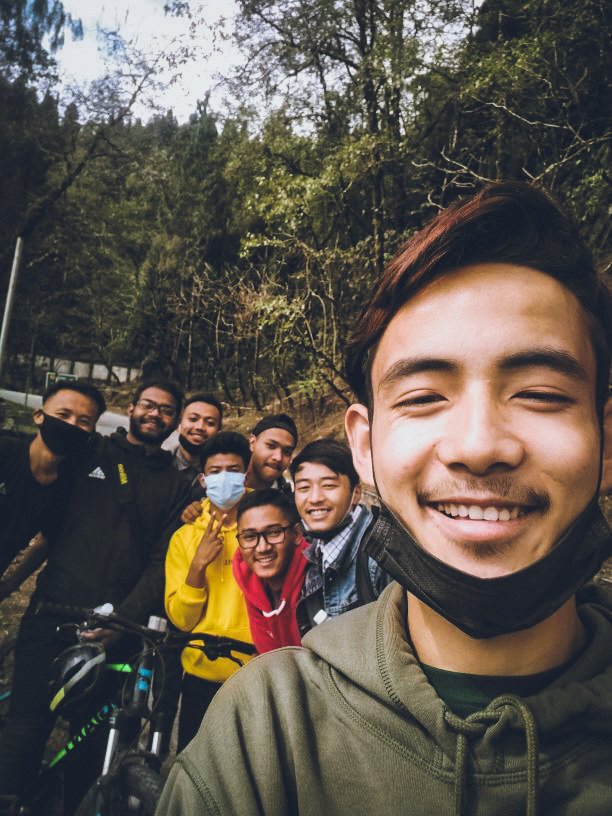
What I loved the most about Sikkim can t be captured on cameras. It can t be taped since it would be intrusive and it can t be replicated because it s unique and impromptu. It could be described, as I attempt to, but more importantly, it s something that you simply have to experience to know.
Now I first heard about this from a friend who claimed he d been offered free rides and Tropicanas by locals after finishing the Ladakh Marathon. And then I found Ronnie s song, whose chorus goes : Dil hai pahadi, thoda anadi. Par duniya ke maya mein phasta nahi (My heart belongs to the mountains. Although a little childish, it doesn t get hindered by materialism). While the song refers his life in Manali, I think this holds true for most Himalayan states.
Maybe it s the pleasant weather, the proximity to nature, the sense of safety from Indian Army being round the corner, independence from material pleasures that aren t available in remote areas or the absence of the pollution, commercialisation, & cutthroat-ness of cities, I don t know, there s just something that makes people in the mountains a lot kinder, more generous, more open and just more alive.
Sikkimese people, are honestly some of the nicest people I ve ever met. The blend of Lepchas, Bhutias and the humility and the truthfulness Buddhism ingrains in its disciples is one that ll make you fall in love with Sikkim (assuming the views, the snow, the fab weather and food, leave you pining for more).
As a product of Indian parenting, I ve always been taught to be wary of the unknown and to stick to the safer, more-travelled path but to be honest, I enjoy bonding with strangers. To me, each person is a storybook waiting to be flipped open with the right questions and the further I get from home, the wilder the stories get. Besides there s something oddly magical about two arbitrary curvilinear lines briefly running parallel until they diverge to move on to their respective paths. And I think our society has been so busy drawing lines and spreading hate that we forget that in the end, we re all just lines on the universe s infinite canvas. So the next time you travel, and you re in a taxi, a hostel, a bar, a supermarket, or on a long walk to a monastery (that you re secretly wishing is open despite a lockdown), strike up a conversation with a stranger. Small-talk can go a long way.
Got a new machine Lenovo ThinkCenter M75s gen2, and installed Debian on it.
I wanted to try out the ryzen CPU.
I haven't used a physical x86-64 Debian desktop machine since I threw away my Athlon 64 machine (dx5150), so that's like 15 years?
Since then my main devices were macbooks and virtual machines (on GCE and Sakura) and raspberry pi.
I got buster installed just fine. Finding the right
keystrokes after boot was challenging because the graphical
UI doesn't say anything. For BIOS set up to disable secure
boot (F1 to enter set up: I wanted to play with kernel) and
finding the keystroke to choose the boot disk (F10 to enter
the dialog; I needed to choose the one labeled USB CD drive
although I put in a USB SD card reader with installer
image).
The installation went fine for console, but getting X up was
tricky, the support for the graphics (Renoir) part of the
chip was added in kernel 5.5. Bullseye was 4.19 and I wasn't
too comfortable with just updating the kernel.
I ended up going for dist-upgrade to Bullseye.
With Bullseye default kernel 5.10, X started without problems.
So far I only tried out Emacs.
I ve finally found the time to improve the GUI of my pet project: cme (aka Config::Model).
Several years ago, I stumbled on a usability problem on the GUI. Some configuration (like OpenSsh or Systemd) feature a lot of configuration parameters. Which means that the GUI displays all these parameters, so finding a specfic parameter might be challenging:
To workaround this problem, I ve added a Filter widget in 2018 which did more or less the job, but it suffered from several bugs which made its behavior confusing.
This is now fixed. The Filter widget is now working in a more consistent way.
In the example below, I ve typed IdentityFile (1) in the Filter widget to show the identityFile used for various hosts (2):
Which is quite good, but some hosts use the default identity file so no value show up in the GUI. You can then click on hide empty value checkbox to show only the hosts that use a specific identity file:
I hope that this new behavior of the Filter box will make this project more useful.
The improved GUI was released with Config::Model::TkUI 1.374. This new version is available on CPAN and on Debian/experimental). It will be released on Debian/unstable once the next Debian version is out.
All the best
found USB scanner (vendor=0x04f9, product=0x021d) at libusb:003:002
I recently upgraded that Linux system to Debian/Testing (which will soon be released as Debian/Bullseye) and scanning broke. The command sane-find-scanner would find the USB connected scanner (with the above output), but scanimage -L didn t.
It turned out that I had to edit /etc/sane.d/dll.d/hplip which had a single uncommented line of hpaio and replace that with brother3 to make SANE load the driver /usr/lib64/sane/libsane-brother3.so from the brscan3 package (which Brother provided from their web site years ago).
I have the following script to do the scanning (which can run as non-root):
#!/bin/bash
set -e
if [ "$1" == "" ]; then
  echo "specify output filename"
  exit 1
fi
TMP=$(mktemp)
scanimage > $TMP
convert $TMP $1
rm $TMP
Final Note
This blog post doesn t describe everything that needs to be done to setup a scanner, I already had part of it setup from 10 years ago. But for anyone who finds this after having trouble, /etc/sane.d/dll.d is one place you should look for important configuration (especially if sane-find-scanner works and scanimage -L fails). Also the Brother drivers are handy to have although I apparently had it working in the past with the hpaio driver from HP (the Brother device emulates a HP device).
 screenshot showing power consumption of server


 Here is my monthly update covering what I have been doing in the free software world during April 2021 (

 Having destroyed the third Cherry Stream keyboard in 4 years, I wanted to try
a more substantial keyboard for a change. After some research I decided that I
want a mechanical, wired, tenkeyless keyboard without any fancy LEDs.
At the end I settled for a


 I wrote previously about my
 They also provided a set of feet allowing for vertical mounting of the device, which was a nice touch.
The USB/SATA bridge chip in use has changed; the original was:
 I worked on research on FOSS foundations and published two reports:
Growing Open Source Projects with a Stable Foundation
This primer covers non-technical aspects that the majority of projects will have to consider at some point. It also explains how FOSS foundations can help projects grow and succeed.
This primer explains:
 Swapping caps and control in X11.
The configuration is at /etc/default/keyboard, and both virtual console and X11 use that configuration in Debian.
For systemd users, systemd-localed.service can be used to configure using localectl(1) command, and
Debian systemd has been patched to update /etc/default/keyboard (managed by keyboard-configuration package).
Not sure where I find a documentation for this.
systemd for Debian is patched with
debian/patches/debian/Use-Debian-specific-config-files.patch
to change /etc/X11/xorg.conf.d/00-keyboard.conf to /etc/default/keyboard.
 In
 What I loved the most about Sikkim can t be captured on cameras. It can t be taped since it would be intrusive and it can t be replicated because it s unique and impromptu. It could be described, as I attempt to, but more importantly, it s something that you simply have to experience to know.
Now I first heard about this from a friend who claimed he d been offered free rides and Tropicanas by locals after finishing the Ladakh Marathon. And then I found


