Search Results: "ean"

15 November 2013

Jo Shields: The directhex! In an Adventure with MIPS

We ve been trying to build Mono on MIPS in Debian for a long time. Just under a decade, in fact. Mono 0.29.99.20040114-3 was the first attempt, back when the Mono source was 10 meg, not today s ~80. It never worked though. Not once. At the end of 2004, 10 upstream versions later, we gave up, and turned off mipsel as a target architecture in the package. When I became a Debian Developer in 2009, one of the first things I did was try again with Mono on various previously unsupported architectures, by running a build on the Debian porterboxes. Supposedly MIPS support was there, as evidenced by all the MIPS-related files in the source tree. But I d try it, and it d fail, and upstream would say works for me . I repeat the process every major release or so, to see what s changed. The breakthrough Spurred by the removal of two bitrotted architectures (IA64 and SPARC), I decided to try again, this time investigating more deeply into the reason for the failures, with the help of upstream developer Alex R nne Petersen. A couple of hours of IRC-driven gdb and test program disassembly later, a seemingly innocent comment flagged something in my brain: 09-07-2013 15:10:11 < alexrp!~zor@baldr.rfw.name: TIL that mul and mult are not the same thing on mips Why is this notable? Well, MIPS processors lack a whole bunch of instructions which are commonly used in assembler. MUL is one of them it s valid MIPS assembler, which is expanded to MULT/MFLO when compiling. Call it a macro, or a mnemonic, or shorthand the preferred term is pseudoinstructions . So what s the issue? 09-07-2013 15:18:27 > directhex: mono isn't trying to use a mul instruction, right? i mean, that instruction doesn't exist as far as the cpu is concerned, it's a macro the compiler does things with See where this is headed? 09-07-2013 15:23:59 > directhex: mini/mini-mips.c:#define USE_MUL 1 /* use mul instead of mult/mflo for multiply */ Argh. See, the thing about MIPS pseudoinstructions is they may be real instructions on a given CPU implementation. Strictly speaking MUL isn t a standard instruction, but a given CPU might have it anyway, to make multiplication a little faster (by using only one instruction, not two, for multiplication). In this case, the Debian MIPS infrastructure is based around ICT Loongson-2E processors which don t have that extension but the upstream Mono developers were building and testing on an extended CPU, never seeing the issue themselves. Flipping that define to 0 (and amending the instruction length setting in another file) fixed the build. Mono was running on MIPS for me for the first time ever. Digging through the history in git showed just how annoying this implementation quirk was. USE_MUL was added in late 2008 replacing a previously used #if 1 . The mult/mflo version of the code existed in the Mono source since the first time the full MIPS port was committed in 2006, but we never saw it. The breakage So, with that patched to work, I added mipsel to the Experimental build of Mono which still failed. The runtime would build fine, but the class library build would fail at random times, with random meaningless stack traces. Unrepeatable. Some kind of race condition. The build would eventually succeed if I hammered make a few times, but that s no good for the Debian build daemons. Back to square one except I had an epiphany yesterday. I have heard more than once that Loongson processors are missing a few instructions. What if one of those was being hit, intermittently? I started doing a search in places that might need to work around that kind of issue, and found this. A patch to binutils in 2009, replacing one no-op instruction with another, when /usr/bin/as is fed the -mfix-loongson2f-nop flag. Turns out NOP is another pseudoinstruction on MIPS. Well, more of an alias. The opcode 0 000000 is Shift Left Logical with 0 registers and 0 data, which is a no-op. But on all but the latest generation of Loongson-2F chips, that opcode can, under heavy load, fail causing inconsistent state in the CPU registers. The flag to as replaces sll 0,0,0 with or $at,$at,0 , which is also a no-op instruction, but doesn t trigger the failure on Loongson-2F chips (and 2E chips, although that s not stated in the documentation). As long as ALL your programs get fed through as , you don t have a problem, since it uses the replacement opcode but what if you use a JITter to generate your own opcodes? Oh fuck, it couldn t be diff --git a/mono/arch/mips/mips-codegen.h b/mono/arch/mips/mips-codegen.h
index dc4df7d..1dbd1c6 100644
--- a/mono/arch/mips/mips-codegen.h
+++ b/mono/arch/mips/mips-codegen.h
@@ -334,7 +334,7 @@ enum
/* misc and coprocessor ops */
#define mips_move(c,dest,src) mips_addu(c,dest,src,mips_zero)
#define mips_dmove(c,dest,src) mips_daddu(c,dest,src,mips_zero)
-#define mips_nop(c) mips_sll(c,0,0,0)
+#define mips_nop(c) mips_or(c,mips_at,mips_at,0)
#define mips_break(c,code) mips_emit32(c, ((code)<<6) 13)
#define mips_mfhi(c,dest) mips_format_r(c,0,0,0,dest,0,16)
#define mips_mflo(c,dest) mips_format_r(c,0,0,0,dest,0,18)
Oh yes it could! Mono was using sll 0,0,0 (the recommended no-op instruction from the MIPS instruction reference manual), causing failures in my tests, because Debian s build and test infrastructure just happens to use defective silicon. And, again, upstream were unable to reproduce a problem because they use better silicon than we do. So what now? Well, last night I uploaded mono_3.2.3+dfsg-3, which includes the above patch to force the replacement no-op instruction. It test built fine on the porterbox, and it should (when the damn experimental buildd gets around to it), just work. Finally. After just under a decade, Mono packages will be available on MIPS in Debian. And after all this time, all we had to change was 4 lines to work around 7 year old Chinese knock-off processors. The edit So, things are finally built. It turns out that despite everything, the replacement NOP opcode is not enough. If you re-read the post to the binutils list, pay close attention to: In theory this is still not enough to fully eliminate possible hangs, but the possiblity is extremely low now and hard to be hit in real code. It s a filthy lie. It s easy to hit the issue in real code: just do a from-source build of the whole Mono class library. With the replacement instruction it builds .NET 2.0, 3.0, 3.5, 4.0, and most of 4.5, before dying in the same way as before an improvement on failing early in the 2.0 build, but not enough. Thankfully, 2 out of the 5 Debian mipsel build servers are not Loongson 2 they re 11 year old Broadcom SWARM developer boards. Not fast but also not broken. Luck smiled on me, and caused my build to go to one of these Broadcom machines. As a result (experimental_mipsel-dchroot)directhex@eder:~$ mono --version head -1
Mono JIT compiler version 3.2.3 (Debian 3.2.3+dfsg-3)
It s been a long time coming.

14 November 2013

Steve Kemp: Meanwhile, behind the facade of this innocent book store

In brief:

Russ Allbery: Review: Water Logic

Review: Water Logic, by Laurie J. Marks
Series: Elemental Logic #3
Publisher: Small Beer Press
Copyright: 2007
ISBN: 1-931520-23-2
Format: Trade paperback
Pages: 332
Water Logic is the third book in the Elemental Logic series, starting with Fire Logic. As with Earth Logic, it's best to read all three books in close temporal proximity, since Water Logic offers little recap of what happened in the previous books and relies on a large cast of characters who are not reintroduced. It's also hard to review without spoilers for the previous books. Earth Logic ended with a monumental shift in Shaftal politics, and half of Water Logic is deeply concerned with the implications of that shift and where Shaftal should go from here. Karis and Zanja are, of course, deeply involved, but much of the political story is told from the perspective of the character introduced in Earth Logic, and from the perspective of another earth blood, Meriseth. Water bloods haven't been seen much so far in the series. Water magic is about repeated patterns and the malleability of time, and the plot of Water Logic eventually entangles Zanja in events far in the past of Shaftal. This proceeds in parallel with more of Marks's excellent analysis of the meaning of war and peace, diplomacy, cooperation, multiculturalism, adaptation, and empathy. The two sides of the book do to some extent reinforce each other, but the connections are tricky and less obvious. Parts of this book are excellent. Wars are complicated and powerful, and don't end easily. The mutual incomprehension and mutual (if intermittant) struggle for understanding between the natives of Shaftal and the Sainnites is beautifully presented. I particularly loved Mariseth's approach throughout the book. Earth bloods are perhaps Marks's best invention, and seeing another (besides Karis) at work, with the same stubborn patience but with different tactics and different levels of power, was a delight. I feel like reading, and thinking about, Seth's decisions makes me a better person. As with the previous books, though, parts of Water Logic are a bit boring, or at least don't seem to coherently move in a conclusive direction. Zanja has long journeys across the landscape as well as several adventures after she's grabbed by water logic that seem only distantly connected to the rest of the story. Marks does pull this mostly together in the end, and I could detect other thematic linkages while mulling the book over after finishing it, but the book feels a bit disjointed while reading it. And there are some elements, such as the cowdogs, that are neat bits of world-building but that seem tossed in just because they're neat and don't feel strongly connected to the plot. The other complaint I have, which would probably have been lessened by reading the books closer together, is that the cast is a bit too large. All of Karis's extended family are, of course, still around, which I found more confusing than helpful. Named and important characters keep popping in and then disappearing, with no introduction and no help for the reader who doesn't remember the exact details of their roles from previous books. It's a bit frustrating, and it makes the book feel a bit cluttered, although it does a great job of showing the dynamics of a large and comfortable family. (Marks shows the dynamics of family webs with multiple adults better than any other fantasy author I know.) Karis is a bit more sidelined in this book, casting her in the role of force of nature, and I think that works well. It took me a bit to warm to Zanja again, but by the end of the book I was greatly enjoying her sections. But the star, for me, is Seth. Even though some of her segments should have been the boring parts of the book, since they were mostly concerned with quitodian issues, they were the parts I wanted to read about. I was very touched by the ending, even if I think a bit too much authorial hand-waving was required. There is material left for a sequel at the end of Water Logic, including a villain who has yet to fully appear, but it's currently not clear whether Air Logic will ever materialize. But, as with Earth Logic, Water Logic provides a satisfying ending and leaves the world in a stable enough place that I didn't feel cheated out of the end of the story. I think Fire Logic remains the strongest book of this series, but Water Logic is very much worth reading if you've read the previous books. Unfortunately, the books apparently didn't sell well, so this book is from a small press instead of Tor. You may have to order it on-line instead of finding it a local bookstore. But the whole series is very much worth reading. It's a refreshingly original take on fantasy and is much more thoughtful about human relationships and politics than most fantasy works. Rating: 7 out of 10

Russ Allbery: C TAP Harness 2.3

This release pushes out some improvements to my TAP library and test harness that I found time to do a while back. I have some other plans, but not much time, so I'm not sure when I'll get to them. Now included in the C TAP library is a test_cleanup_register function that registers a cleanup function called during exit from the test. This function will be passed a boolean argument indicating whether the test succeeded or failed. It was already possible to do this with simple atexit, but now callers can decide whether to delete possibly-interesting trace files based on whether the test was successful. As part of this change, I also refactored and improved everything that happens during test exit, and in the process fixed a bug where lazy plans and test summaries were still displayed even when a test aborted with bail. This release also adds the gcc warn_unused_result attribute to the various TAP library functions (mostly the malloc variations that call bail on failure) where the return value really shouldn't be ignored. You can get the latest release from the C TAP Harness distribution page.

13 November 2013

Andrea Veri: Configuring DNSSEC on your personal domain

Today I ll be working out how to properly configure DNSSEC on a BIND9 installation, I ll also make sure to give you all the needed instructions to properly verify if a specific domain is being correctly covered by DNSSEC itself. In addition to that a few more details will be provided about adding the relevant SSHFP s entries on your DNS zone files to be able to automatically verify the authenticity of your domain when connecting to it with SSH avoiding any possible MITM attack. First of all, let s create the Zone Signing Key (ZSK) which is the key that will be responsible to sign any other record on the zone file which is not a DNSKEY record itself:
dnssec-keygen -a RSASHA1 -b 1024 -n ZONE gnome.org


Note: the dnssec-keygen binary file should be part of bind97 (RHEL 5) or bind (RHEL6) package according to yum whatprovides: RHEL 5:
32:bind97-9.7.0-17.P2.el5_9.2.x86_64 : The Berkeley Internet Name Domain (BIND) DNS (Domain Name System) server
Repo : rhel-x86_64-server-5
Matched from:
Filename : /usr/sbin/dnssec-keygen


RHEL 6:
32:bind-9.8.2-0.17.rc1.el6.3.x86_64 : The Berkeley Internet Name Domain (BIND) DNS (Domain Name System) server
Repo : rhel-x86_64-server-6
Matched from:
Filename : /usr/sbin/dnssec-keygen


Then, create the Key Signing Key (KSK), which will be used to sign all the DNSKEY records:
dnssec-keygen -a RSASHA1 -b 2048 -n ZONE -f KSK gnome.org


Creating the above keys can take several minutes, when done copy the public keys to the zone file this way:
cat Kgnome.org*.key >> gnome.org


When done you can clean out the useless bits from the zone file and just leave the DNSKEY records (which are not commented out as you will notice) An additional and cleaner way of accomplishing the above is to use the INCLUDE rule on the zone file itself as follows:
$INCLUDE /srv/dnssec-keys/Kgnome.org+005+12345.key
$INCLUDE /srv/dnssec-keys/Kgnome.org+005+67890.key


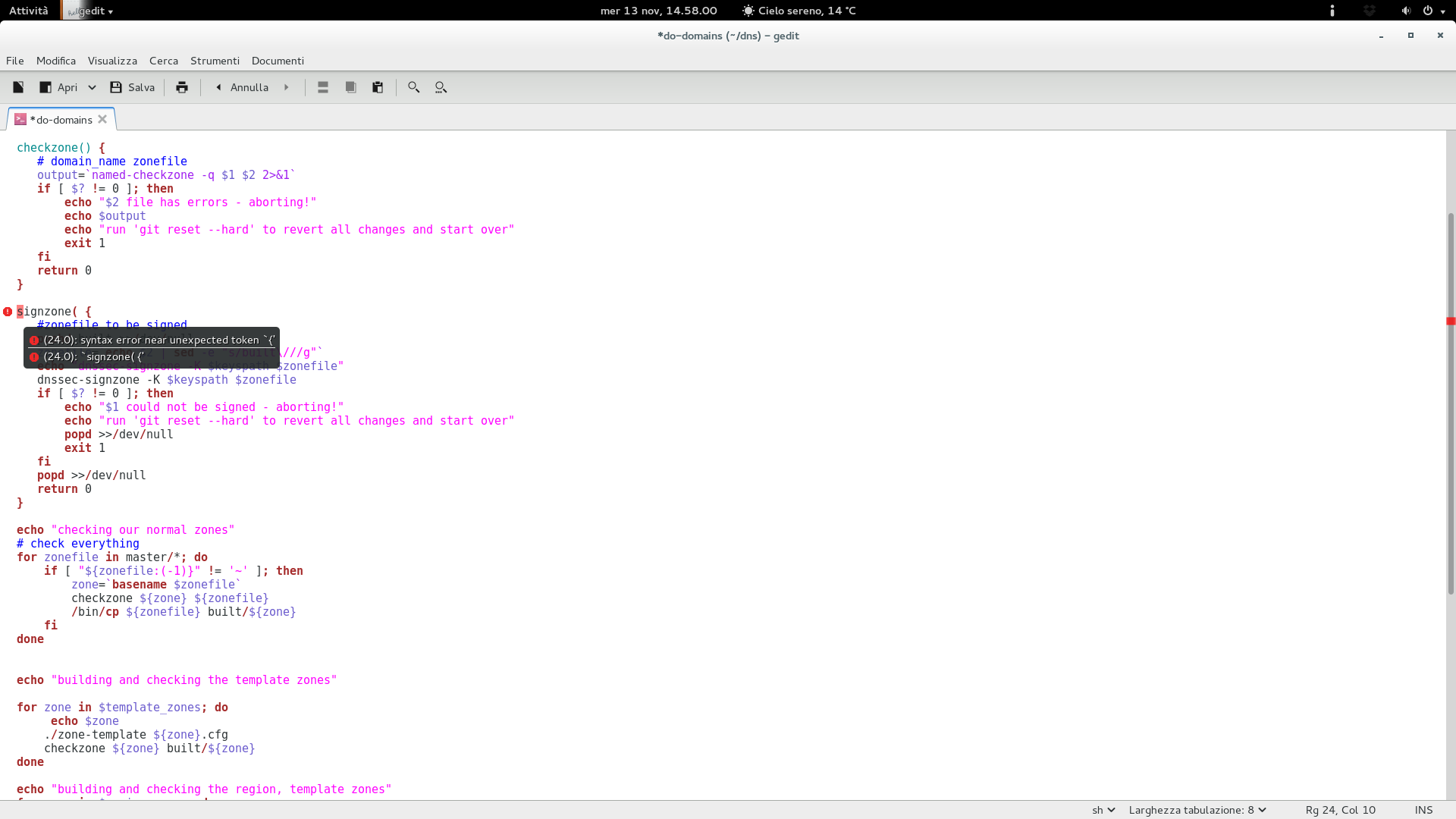
Choosing which method to use is really up to you. Once that is done you can go ahead and sign the zone file. As of myself I m making use of the do-domain script taken from the Fedora Infrastructure Team s repositories. If you are going to use it yourself, make sure to adjust all the relevant variables to match your setup, especially keyspath, region_zones, template_zone, signed_zones and AREA. The do-domain script also checks your zone file through named-checkzone before signing it.
/me while editing the do-domains script with the preview of gnome-code-assistance!

/me while editing the do-domains script with the preview of gnome-code-assistance!

If instead you don t want to use the script above, you can sign the zone file manually in the following way:
dnssec-signzone -K /path/to/your/dnssec/keys -e +3024000 -N INCREMENT gnome.org


By default, the above command will append .signed to the file name, you can modify that behaviour by appending the -f flag to the dnssec-signzone call. The -N INCREMENT will increment the serial number automatically making use of the RFC 1982 arithmetics while the -e flag will extend the zone signature end date from the default 30 days to 35. (this way we can safely run a monthly cron job that will sign the zone file automatically) You can make use of the following script to achieve the above:
#!/bin/sh
SIGNZONE="/usr/sbin/dnssec-signzone"
DNSSEC_KEYS="/srv/dnssec-keys"
NAMEDCHROOT="/var/named/chroot"
ZONEFILES="gnome.org"
cd $NAMEDCHROOT
for ZONE in $ZONEFILES; do
$SIGNZONE -K $DNSSEC_KEYS -e +3024000 -f $ZONE.signed -N INCREMENT $ZONE
done
/sbin/service named reload


Once the zone file has been signed just make sure to include it on named.conf and restart named:
zone "gnome.org"  
file "gnome.org.signed";
 ;


When you re done with that we should be moving ahead adding a DS record for our domain at our domain registrar. My example is taken from the known gandi.net registrar.
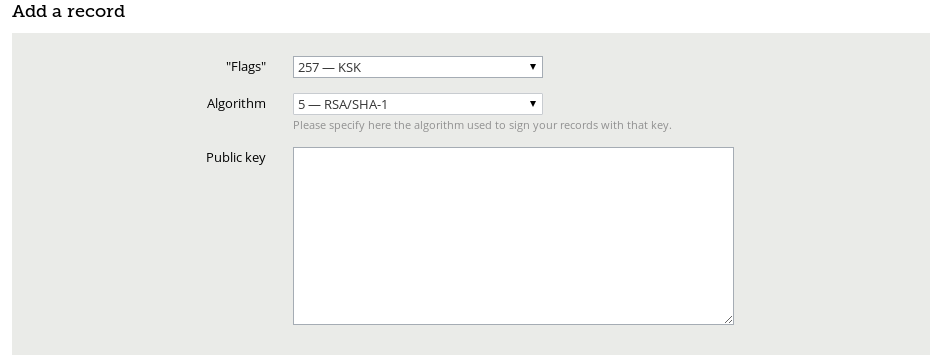
gandi

Gandi s DNSSEC interface

Select KSK (257) and (RSA/SHA-1) on the dropdown list and paste your public key on the box. You will find the public key you need on one of the Kgnome.org*.key files, you should look for the DNSKEY 257 entry as dig DNSKEY gnome.org shows:
;; ANSWER SECTION:
gnome.org. 888 IN DNSKEY 257 3 5 AwEAAbRD7AymDFuKc2iXta7HXZMleMkUMwjOZTsn4f75ZUp0of8TJdlU DtFtqifEBnFcGJU5r+ZVvkBKQ0qDTTjayL54Nz56XGGoIBj6XxbG8Es+ VbZCg0RsetDk5EsxLst0egrvOXga27jbsJ+7Me3D5Xp1bkBnQMrXEXQ9 C43QfO2KUWJVljo1Bii3fTfnHSLRUsbRn8Puz+orK71qxs3G9mgGR6rm n91brkpfmHKr3S9Rbxq8iDRWDPiCaWkI7qfASdFk4TLV0gSVlA3OxyW9 TCkPZStZ5r/WRW2jhUY/kjHERQd4qX5dHAuYrjJSV99P6FfCFXoJ3ty5 s3fl1RZaTo8=


Once that is done you should have a fully covered DNSSEC domain, you can verify that this way:
dig . DNSKEY   grep -Ev '^($ ;)' > root.keys
dig +sigchase +trusted-key=./root.keys gnome.org. A   cat -n


The result:
105 ;; WE HAVE MATERIAL, WE NOW DO VALIDATION
106 ;; VERIFYING DS RRset for org. with DNSKEY:59085: success
107 ;; OK We found DNSKEY (or more) to validate the RRset
108 ;; Ok, find a Trusted Key in the DNSKEY RRset: 19036
109 ;; VERIFYING DNSKEY RRset for . with DNSKEY:19036: success
110
111 ;; Ok this DNSKEY is a Trusted Key, DNSSEC validation is ok: SUCCESS

Bonus content: Adding SSHFP entries for your domain and verifying them You can retrieve the SSHFP entries for a specific host with the following command:
ssh-keygen -r $(hostname --fqdn) -f /etc/ssh/ssh_host_rsa_key.pub


When retrieved just add the SSHFP entry on the zone file for your domain and verify it:
ssh -oVerifyHostKeyDNS=yes -v subdomain.gnome.org


Or directly add the above parameter into your /etc/ssh/ssh_config file this way:
VerifyHostKeyDNS=yes


And run ssh -v subdomain.gnome.org , the result you should receive:
debug1: Server host key: RSA 00:39:fd:1a:a4:2c:6b:28:b8:2e:95:31:c2:90:72:03
debug1: found 1 secure fingerprints in DNS
debug1: matching host key fingerprint found in DNS
debug1: ssh_rsa_verify: signature correct

That s it! Enjoy!

11 November 2013

Simon Josefsson: Using Replicant on Samsung Galaxy S III

For the last half-year I have used CyanogenMod on an Nexus 4 as my main phone. Recently the touch functionality stopped working on parts of the display, and the glass on the back has started to crack. It seems modern phones are not built to last. For comparison, before the N4 I used a Nokia N900 for around 3 years without any hardware damages (in my drawer now, still working). A few weeks ago I started looking for a replacement. My experience with CyanogenMod had been good, but the number of proprietary blobs on the N4 concerned me. Finding something better wasn t easy though, so I m documenting my experience here. My requirements were, briefly, that I wanted a phone that I could buy locally that had a free software community around it that produced a stable environment. I have modest requirements for things I wouldn t give up on: telephony, data connection (3G), email (IMAP+SMTP), chat (XMPP), and a web browser. I like the philosophy and openness around the Firefox OS but the more I have read about it, it seems unlikely that it would deliver what I need today. In particular none of the devices capable of running Firefox OS appealed to me, and the state of email reading seemed unclear. I m sure I ll revisit Firefox OS as an alternative for me in the future.

As I had been happy with CyanogenMod, but concerned about its freeness, it felt natural to move on and test the more free software friendly project Replicant. Replicant only supports a small number of devices. After talking with people in the #replicant IRC channel, it seemed the Samsung S3 would be a decent choice for me. The Samsung S2 would have worked as well, but it cost almost as much as the S3 where I looked. Despite the large number of Samsung S3 devices out there, it seems the prices even for used devices are high (around 2500 SEK in Sweden, ~380 USD). I ended up buying a brand new one for 3200 SEK (~500 USD) which felt expensive, especially after recalling the recent $199 sale for Nexus 4. Noticing that brand new Nexus 4 devices are still over 3000 SEK in Sweden comforted me a bit. I would have preferred a more robust phone, like the CAT B15, but the state of free software OSes on them seem unclear and I wanted something stable. So, enough about the background, let s get started. Building and installing Replicant on the device was straight forward. I followed the Replicant Samsung S3 Build instructions to build my own images. The only issue I had was that I had not set JAVA_HOME and the defaults were bad; make sure to set JAVA_HOME before building. I built everything on my Lenovo X201 running Debian Wheezy, with OpenJDK 6 as the Java implementation. Installing the newly built firmware was easy, I just followed the installation process documentation. I made sure to take a clockworkmod backup to an external SD card before wiping the old system. To get a really clean new device, I also re-formated /sdcard inside clockworkmod; I noticed there were some traces left of the old system there. I spent about one week testing various configurations before settling on something I could use daily. A fair amount of time was spent looking into backup and restore options for Android devices. My idea was that I would take a backup of the apps I ran on the N4 and transfer them to the S3. The Android Debug Bridge (adb) has a backup/restore command, however it (intentionally) ignores apps marked as allowBackup=false which a number of apps has. It doesn t seem possible to override that settings so much for the freedom to backup your own device. I then discovered oandbackup. It can backup your entire system, saving each app (together with associated data) into a separate directory, for simple review and inspection before restore. You can do batch backups and batch restore. I couldn t get it to automatically restore things, though, which would be neat for really automated re-installations (there is an open issue about this feature). After noticing that some apps did not like being moved from the N4 (running Android 4.2) to the S3 (running 4.0), I ended up installing most apps from scratch on a freshly installed Replicant. I use oandbackup to the external SD card so that I can quickly restore my phone. For backup/restore of SMS/MMS and Call Log, I use SMS Backup+ against my own IMAP server. Camera pictures are synced manually using adb when I am connected to my laptop. There is a number of apps that deserve to be mentioned because they are what I use on a daily basis. All of them come via the free software market F-Droid. For email (IMAP/SMTP), I use K-9 Mail which is feature rich but still easy to use. For chat, I use Xabber. I use NewsBlur s free software app to read RSS flows. For two-factor authentication, I use Google Authenticator. I haven t evaluated different PDF viewers, but the first one I tried (APV PDF Viewer) has worked fine so far. Handling a a synchronized address book and calendar deserve its own blog post because it is a challenging topic, but briefly, I m currently using a combination of aCal and DAVdroid. Finally, since Replicant is still work in progress, some words about stability and notes on what doesn t work. This is probably the most interesting part if you are considering running Replicant on an S3 yourself. Overall system stability is flawless, I hadn t had any crash or problem with the fundamental functionality (telephony, 3G, Camera). People have said graphics feels a bit laggy, but I cannot compare with the stock ROM and it doesn t get in the way of daily use. First some notes about non-free aspects:
  • Bluetooth doesn t work by default. After installing /system/vendor/firmware/bcm4334.hcd (MD5 b6207104da0ca4a0b1da66448af7ed4c) pairing and testing with a Bluetooth headset worked fine.
  • Front camera doesn t work by default. After installing /system/vendor/firmware/fimc_is_fw.bin (MD5 52eeaf0889bc9206860075cd9b7f80b9and) and /system/vendor/firmware/setfile.bin (MD5 0e6fdeb378fb154c39fd508ae28eaf2a) it works. The extensions are *.bin but I don t believe this code is executed on the main CPU.
  • GPS doesn t work by default. After installing /system/bin/gpsd (MD5 6757ed2e2a283259e67c62e6b2b9cfef), /system/lib/libsecril-client.so (MD5 a836df0f947d2aa2ef20dcb213317517), /system/lib/hw/gps.exynos4.so (MD5 1ea1d67f297dd52d59d40dbad9b02a0a) it works. This is code that runs on the main CPU, and even more alarming, it embeds a copy of OpenSSL and talks to various online servers for A-GPS, and is thus a likely (and probably not too challenging) attack vector for anyone wanting to remotely exploit any phone.
  • Wifi doesn t work, and I haven t gotten this to work. There is a list of non-free S3 firmware on the Replicant wiki however my stock ROM did not ship with those files. I don t believe any of the blobs run on the main CPU.
  • NFC doesn t work, and I haven t gotten it to work. It seems the infrastructure for NFC is missing in Replicant 4.0, it doesn t even expose the NFC hardware permission capability. This is quite unfortunate for me, since I daily work with YubiKey NEO and would have preferred to replace Google Authenticator with the YubiOATH that uses the NEO for OATH secret storage.
Some other observations:
  • Panorama mode in the Camera crashes; see issue about it.
  • There is a number of smaller graphical issues. I believe these are related to the EGL but haven t understood the details. What I ve noticed are the following issues. The task switcher doesn t show mini screenshots of all running apps (the screenshots are just black). ZXing is not able to QR decode images (I m told this is because Replicant uses a RGB color plane instead of the required YUV color plane). Video playback in the gallery is laggy to the point of being unusable. Video playback on Youtube in the default web browser works in full screen (not laggy), but not embedded in the webpage.
  • MTP has been a bit unreliable, my main laptop is able to import photos, but another laptop (also running Debian Wheezy) just stalls when talking to it. This may be a host issue, I have experience similar issues with a Nexus 7 2nd generation device.
I am quite happy with the setup so far, and I will continue to use it as my primary phone. flattr this!

Matthew Palmer: Timezones are not optional information

In high school, I had a science teacher who would mark your answers wrong if you forgot to include units. What does that mean? , he would write, 17.2 elephants? The point he was trying to get across was that a bare number, without the relevant units, wasn t precise enough to be useful. Also, carrying the units with you helped to cross-check your work if you got a numeric answer, but the units were garbage (seconds per kilogram, for instance, when you were trying to find an acceleration), then you could be pretty sure you d made a mistake somewhere. Fast forward to today, and I m currently working with a database containing a pile of timestamps. Without timezones. Where the timestamps being inserted are in local time. Thankfully, so far, this particular system has always been run in one timezone, so I ve only got one timezone to deal with, but the potential ramifications of systems with different timezones inserting data into this database terrify me. The naive answer is to just store everything in UTC and be done with it. I m not particularly averse to that solution, as long as it s very clear to everyone what s going on. The correct answer, though, I think, is to always keep timezone information with your timestamps otherwise, you ll never know whether it s 0830 in elephants

10 November 2013

Gregor Herrmann: RC bugs 2013/45

here's the list of RC bugs I've worked on during the last week.
  • #713582 src:malaga: "malaga: FTBFS: ld: canvas.o: undefined reference to symbol 'ceil@@GLIBC_2.2.5'"
    add patches from Ubuntu / Matthias Klose, upload to DELAYED/2
  • #713595 src:goocanvas: "goocanvas: FTBFS: ld: demo.o: undefined reference to symbol 'sincos@@GLIBC_2.2.5'"
    add patch from Ubuntu / Matthias Klose, upload to DELAYED/2
  • #713635 src:osm-gps-map: "osm-gps-map: FTBFS: osm-gps-map-widget.c:778:21: error: format '%lld' expects argument of type 'long long int', but argument 4 has type 'goffset' [-Werror=format=]"
    add patch from upstream git, package FTBFS again later
  • #713666 src:gnustep-base: "gnustep-base: FTBFS: GSXML.m:983:38: error: dereferencing pointer to incomplete type"
    add patch from Ubuntu / Benjamin Drung, upload to DELAYED/2
  • #713700 src:gsnmp: "gsnmp: FTBFS: gsnmp.h:27:18: fatal error: gnet.h: No such file or directory"
    apply patch from Ubuntu / Daniel T Chen, upload to DELAYED/2
  • #713701 src:libmatchbox: "libmatchbox: FTBFS: ld: dump-image.o: undefined reference to symbol 'XOpenDisplay'"
    add patches from Ubuntu / Daniel T Chen, upload to DELAYED/2
  • #713708 src:gtkgl2: "gtkgl2: FTBFS: ld: zktor.o: undefined reference to symbol 'atan2@@GLIBC_2.2.5'"
    apply patch from Ubuntu / Daniel T Chen, upload to DELAYED/2
  • #713727 src:xmlroff: "xmlroff: FTBFS: ld: ../libfo/.libs/libfo-0.6.a(fo-datatype.o): undefined reference to symbol 'floor@@GLIBC_2.2.5'"
    apply patch from Ubuntu / Daniel T Chen, upload to DELAYED/2
  • #713728 src:matchbox-panel: "matchbox-panel: FTBFS: ld: mb-applet-menu-launcher.o: undefined reference to symbol 'XInternAtom'"
    update patch to link against more libs, upload to DELAYED/2
  • #724080 src:libgraph-perl: "libgraph-perl: FTBFS: make: *** [clean] Error 1"
    fix clean target in debian/rules, upload to DELAYED/2, then moved to 0-day with maintainer's consent
  • #724085 src:myspell: "myspell: FTBFS: POD errors"
    prepare a patch
  • #724115 src:hunspell: "hunspell: FTBFS: POD error"
    prepare a patch
  • #724142 src:xmltv: "xmltv: FTBFS: Tests failed"
    investigate error
  • #724750 electrum: "electrum fails to launch from terminal"
    add missing dependency, upload to DELAYED/2
  • #726801 biomaj: "biomaj: fails to install with Recommends enabled"
    tag unreproducible, later further analyzed as a java dependency problem by follow DD

Paul Tagliamonte: call for Jessie artwork proposals

(This is a reproduction of the mail sent to -announce for the planet readers) Aloha, hackers, As some of you notice from the slamn default background in wheezy, (BTW;
a round of applause for Adrien Aubourg for creating Joy!) we ask
for contributions to the debian-desktop team in the form of themeing. This is the official call for proposals for the Jessie cycle. Please
look on the wiki (thank you, Valessio Soares de Brito for creating
the page!) So, if you d like (or know someone who d like) to create a desktop look
and feel that will be seen by trillions of people, be sure to send in
your artwork ASAP! Breaking with tradition, I d like to have the re-themed desktop in place
well before freeze, to ensure we have time to properly integrate it. I m picking the arbitrary deadline of Feb 5th (subject to change) for
artwork to be submitted. I know this isn t a lot of time, but we can
iterate as we integrate. The artwork is usually picked based on which theme looks the most:
- Debian (I m not defining this since I think everyone has their own take
of what Debian means to them) - plausible to integrate without patching core software (As much as I love some of the insanely hot looking themes, some
would require heavy GTK+ theming and patching GDM/GNOME.) - clean / well designed (without becoming something that gets annoying to look at a
year down the road - I think Joy does a good job of this)
This year, do keep in mind the Debian logo *is* freely licensed, so feel
free to use it in your theme.

Jelmer Vernooij: Quantified Self

Dear lazyweb, I've been reading about what the rest of the world seems to be calling "quantified self". In essence, it is tracking of personal data like activity, usually with the goal of data-driven decision making. Or to take a less abstract common example: counting the number of steps you take each day to motivate yourself to take more. I wish it'd been given a less annoying woolly name but this one seems to have stuck. There are a couple of interesting devices available that track sleep, activity and overall health. Probably best known are the FitBit and the jazzed-up armband pedometers like the Jawbone UP and the Nike Fuelband. Unfortunately all existing devices seem to integrate with cloud services somehow, rather than giving the user direct access to their data. Apart from the usual privacy concerns, this means that it is hard to do your own data crunching or create a dashboard that contains data from multiple sources. Has anybody found any devices that don't integrate with the cloud and just provide raw data access?

7 November 2013

Matt Zimmerman: Management: a rant

You keep using that word. I do not think it means what you think it means. -Inigo Montoya
Having worked in full-time management positions for some years now, I am increasingly convinced that management is widely misunderstood as a role, as a discipline and as a field, and that this makes a lot of lives more difficult and stressful than necessary. It is the subject of much speculation and misbelief, and I ve chosen a few of my favorite examples to deconstruct here. Misbelief #1: management is what managers do I ve noticed a trend among a certain class of companies, whose employees will tell anyone who will listen that there is no management in their organization, they never plan to have any, and neither should you. I think these statements are respectively a lie, a na ve belief, and a piece of bad advice. Usually, these companies are just a few years old and relatively small, most of the people in the company have been there for less than a year, and the speaker is trying to persuade us what a unique and innovative company they work for because nobody there is a manager . They invariably have not read The Tyranny of Structurelessness. Management is the practice of enabling people to effectively cooperate. A manager is someone whose job is to do that. It s that simple. It usually involves tasks such as sharing information, agreeing on a course of action, dividing up work, and figuring out what to do when there s a problem. They re things that every team needs to do, whether anyone is designated a manager or not. Teams can function without managers, but they can t function properly without management. Someone (or everyone) has to do the work to make cooperation possible. Modern management is a specialized discipline, which draws on a broad range of skills in communication, psychology, empathy, problem-solving, leadership, and more. These skills aren t unique to managers, but it often makes sense to designate certain people to do more of the management work, on behalf of the team. By devoting more of their time and attention to it, they free other members of the team to focus on other tasks. They can act as a coordinator to help the team stay in sync, and by focusing on this job, they may be able to do a better job of it, and acquire a higher level of skill through practice and study. But it remains an inherently collaborative practice. Misbelief #2: management is about telling people what to do There are many different varieties of management, each of which is oriented toward a particular type of team or organization. Factories are managed differently from design studios, large companies are managed differently from small companies, and every team has its own distinct management style which arises from the unique group of people involved. Some managers are specialists in a particular type of management, while others are more generalists. The telling people what to do style of management is called command and control . It s characterized by authority, hierarchy, and strict adherence to protocol. It s widely employed by military organizations, and by the managers we see in television and film. It has some advantages and disadvantages, which I won t discuss here. My point is that it is just one example, but this example is used to represent the general concept of management. Self-organization, where no one in particular is responsible for group decisions, is another, quite different, style of management. Small, self-organizing teams are capable of amazing feats of productivity. They re less difficult to manage because they re comparatively simple, and so simple tools and techniques work well. Everyone can be fully aware of what everyone else is doing, and new information propagates quickly throughout the team. But as the team or organization grows, it will often outgrow this way of working, and needs to adapt. There is no single management approach which works universally well. Misbelief #3: management is a promotion You know the story. When an employee is successful within their area of expertise, someone will eventually offer them a management role as a reward for their good work. This is utter nonsense. Management is not a promotion: it s a career change. It means starting over as a beginner in a new discipline and learning from the ground up. Domain expertise is important, as a manager needs to understand the work of the other people on their team, but it is no longer paramount. The team, the human system, becomes their focus. When organizations fail to provide career advancement within a discipline, people may turn to management as the only way to get promoted , only to discover that they are completely unprepared for this new field, and often their new job when they realize what they ve gotten into. If someone were promoted from a position as a financial analyst to a new job as a biochemist with no training or expertise, we would probably find this bizarre. But this is analogous to what happens to new managers all the time, and has become almost standard practice in many organizations and industries. So what? Management is misunderstood. So are science, engineering, and many other fields. What does it matter?
People leave managers not companies in the end, turnover is mostly a manager issue, - Marcus Buckingham & Curt Coffman, First, Break All the Rules
This mythology leads to massive organizational dysfunction, making it harder for everyone to do their jobs. It virtually guarantees incompetent management, which is a scourge on anyone who is exposed to it. It ruins days, weeks, jobs and careers. It leads talented people to leave companies, and it drives them out of their chosen professions. I recommend that we stop denigrating and ignoring management, and start doing a better job of it.

Russ Allbery: Review: Muse of Fire

Review: Muse of Fire, by John Scalzi
Publisher: Subterranean
Copyright: 2012
Printing: 2013
ISBN: 1-59606-639-3
Format: Kindle
Pages: 28
This is another separately-published short work by Scalzi probably a novelette, although I didn't do a word count. Since it's separately published and has its own ISBN, it gets its own separate review page. At present, it's $1 on the Kindle (and probably elsewhere). I've read a variety of these now, and while the quality of Scalzi's short works varies (as with everyone), I've generally enjoyed them. This is the first one I've read that I really didn't like. The premise is promising enough. Ben Patton is a scientist or engineer of some sort (I don't recall if the story is specific) working on plasma physics for a corporation. He has a nervous tic involving playing with a lighter and an obsession with fire, which his co-workers tolerate (and his boss does not tolerate). The reason for that tic is something he keeps secret: he sees a beautiful woman named Hestia in any flames that he's looking at. For him, she's his muse, and his untouchable obsession. He's mangled one hand trying to touch her. But she appears in fire because she's trapped in hell. There are all sorts of great places Scalzi could have gone with this. Musae and inspiration by themselves are fodder for many stories. The woman's name is Hestia, which is immediately recognizable as the Greek goddess of the hearth and who is extremely important to Greek religious life (although she's definitely not a muse, but I'd even let that pass). That raises more story possibilities around the transition of religion and the effect on worshiped gods, including the way Christian missionaries called "pagan" gods and goddesses devils and indeed did claim they were from hell. There are interesting science and magic crossover possibilities between plasma physics and a muse of fire. And there is, of course, the whole rescue from hell angle, which has generated many a story going back to ancient Greek drama. As you might have guessed from this catalog and my disappointment, Scalzi didn't go any of those directions. He provides some good characterization of the passions and discomfort of Ben's life, shows us the practicalities of his relationship with Hestia, and sets up dramatic tension, all well and good. And then takes the most obvious, least interesting, and least satisfying twist possible. I was getting nervous as I got closer and closer to the end of the story and Scalzi had yet to develop any of the interesting possible directions, but even then I didn't expect the train wreck ending. Even a simplistic "happily ever after" ending would have been preferable. He did catch me by surprise, but only because I wouldn't have expected any author to take that easy of a way out of the story. I can't build up a proper rant while avoiding spoilers, but I will say that Scalzi even manages to walk straight into a rather nasty stereotype in the process. I'm not sure what happened here, but it didn't work, and it's far below the normal standards of Scalzi's work. Such a shame, too, since the setting had so much potential. Avoid. Rating: 4 out of 10

5 November 2013

Russ Allbery: git-pbuilder 1.30

This is a glue script to integrate git-buildpackage with cowbuilder or pbuilder. Guido G nther provided a patch to make it use the correct URL for the backports archive for wheezy and later when setting up a new build chroot. I also updated my email address, since I'm slowly transitioning to using a permanent email address I control for my various software projects. This script really should be rewritten in Python and just become part of the git-buildpackage package rather than having a separate existence, which I will get to in my copious spare time. (I do want to get back to using Python.) In the meantime, if you want to download a separate copy, you can still find the latest version on my scripts page.

Russ Allbery: Review: Asimov's, August 2011

Review: Asimov's Science Fiction, August 2011
Editor: Sheila Williams
Issue: Volume 35, No. 8
ISSN: 1065-2698
Pages: 112
The editorial this issue is about the Dell Magazines Award, so newsy without a lot of content (particularly since we don't get to read the winners). Silverberg's column is much more interesting, focusing on the complex rules of the honor code of the Albanian highlands and pointing out that there's more complexity and strangeness in things we can find on Earth than in a lot of science fiction. Even within the rules of real human cultures. James Patrick Kelly's column this issue is an interesting summary of what graduates of the Clarion writing workshop learned, in their own words. It's a nice barrage of quick writing tips, and an interesting view of what people take away from a writing workshop. The book review column this issue is Peter Heck's normal workman-like job. "The End of the Line" by Robert Silverberg: Someday, I really should read Lord Valentine's Castle. As you might guess from this comment, this is another Majipoor story. This one follows an official who is part of an advance party for the Coronal Lord, the ruler (of sorts). He's decided, as part of those duties, to take the opportunity to learn more about the aboriginal people of Majipoor: the somewhat mysterious metamorphs, or Piurivar. I'm not that familiar with the history of Majipoor, since all I've read is this story and one other, none of the novels. Apparently, knowing that the official in question is named Stiamot will place this story for more familiar readers. For the unfamiliar, such as myself, there's a lot of politics here and what's clearly background for a major event in the world, but as a standalone story it's a bit unsatisfying (and grim). It's not that clear why things had to turn out the way they did, and the characters seem largely without agency. It's well-written, but mostly a story for fans of the series, I think. (6) "Corn Teeth" by Melanie Tem: This is a tight third-person story about a human child raised by alien foster parents, and it's deeply disturbing. Not because of the fostering, which appears wonderful and loving, but because it's a train wreck sort of story: the reader can see the horrible coming and can't do anything about it (and it turns out even worse than one might expect). It's also a story built around failure of communication and failure of empathy, and has a monumentally depressing ending, the kind that leaves scars. I'm sure all of this is entirely intentional; it seems very well-written. But I really didn't want this much horrible misunderstanding and depressing hopelessness in my reading. (2) "Watch Bees" by Philip Brewer: I rather liked this story even if the protagonist is an awful person. The story is set in a future of bioengineered insects and hard economic times, and it features a man who is supposedly working his way from farm to farm to get back home. What he's actually after is more complicated and is closely related to the defense systems that keep intruders off of farms. You might guess some of the rest from the title. It's a story about understanding layered defense systems, and about economic warfare. I didn't care much for any of the characters, but the story is well-plotted and kept me interested in seeing what would happen next. (6) "For I Have Lain Me Down on the Stones of Loneliness and I'll Not Be Back Again" by Michael Swanwick: By Swanwick, so it's a little odd, but I found this story surprisingly moving and ambiguous. It's about an American of Irish descent, a trip to Ireland, and a love affair with a fierce Irish nationalist, all set against an SF background of an Earth conquered by benevolent aliens. It's angry, uncertain, fanatical, and realistic by turns, and left me with profound mixed feelings. I think it does a good job capturing in a brief story the emotional complexities of what it means to give onself to a cause. (7) "We Were Wonder Scouts" by Will Ludwigsen: This is a short and odd story about a variant of the Boy Scouts founded by a man who is a little too obsessed with the paranormal, and an outing in the woods that turns rather creepy. It's a type of story that I'm not very fond of: one that twists the delight of discovery into something dark and mundane. I suppose you could call it horror; it's more horror than fantasy, at least. Anyway, not my thing. (3) "Pairs" by Zachary Jernigan: This story, on the other hand, isn't as dark as it seems like it should be from the setup. Humans have been conquered and enslaved by more powerful alien races, and now human souls are a profitable business. The protagonist is a person who has been embodied in a spaceship, and who works with (and monitors) another largely insane embodied person as they work as couriers, carrying souls to their buyers. But neither of them are as fully under control as they might appear, which is the point of the story. There is no grand tale of redemption, and the price is high, but I found the psychological portrayal oddly satisfying and faintly hopeful, and I was intrigued by the world background. (7) "Paradise is a Walled Garden" by Lisa Goldstein: The cover story, this is by far the best story of the issue. It's steampunk, set in a world where Muslim civilization was not pressed back by Christianity and continues to thrive into the reign of Queen Elizabeth as, among other things, makers of automata. A girl has managed to get herself a job in a British factory by posing as a boy and is the first to sound the alarm when the automata that do most of the work go strangely (and violently) haywire. That leads to her being assigned to the subsequent delegation to Al-Andulus (Muslim Spain, if you're not familiar with that name from history). The protagonist is the best part of this story. She's thoughtful, resourceful, and delights in learning things, something that she's rarely had the opportunity to do. She's also utterly unintimidated. In Al-Andulus, she thrives, despite the contempt of the leader of the expedition and some dangerous intrigues around the source of the anomalous behavior. I won't spoil the ending, but it's a delight, leaving the reader with a lot of hope for her future. I also liked the portrayal of the Muslim world, which is engrossed in its own business and has its own advantages and disadvantages, but is at least open to and focused on learning and technological development. The contrast with the superstitious British delegation is both pointed and historically grounded in Muslim relations with Europe around the point of divergence of Goldstein's world. (8) Rating: 7 out of 10

3 November 2013

Niels Thykier: Breaking the 700 RC bug threshold for Jessie

It looks like we have dropped (or will drop) below 700 RC bugs affecting Jessie today[1]. :) On a related note, I got my eye on libfso-glib + fso-gsmd, samba + -samba4, mono and haskell. By my count, each of the four groups will (once they migrate) bring at least 4 RC bug fixes with them to testing. Besides that, we still have ~97 RC bugs in the autoremoval queue[2], so we could be looking at 600 RC bugs in a week or two. Please keep up the steady flow of RC bug fixes; but also, please make sure your packages will actually migrate. If you need help interpreting the excuses page, do not hesistate to ask I will not bite. If you want to help, please consider having a look at the cleaner or the Release Team -view on the UDD bug tracker. Sadly not everything there contains actionable problems[3]. [1] http://bugs.debian.org/release-critical/ says 700 while the IRC bot in #debian-devel-changes says we are at 692. [2] http://udd.debian.org/bugs.cgi?release=jessie_and_sid&merged=ign&autoremovals=only&fnewerval=7&flastmodval=7&rc=1&sortby=id&sorto=asc dd-list-like: http://udd.debian.org/cgi-bin/autoremovals.cgi [3] E.g. the kfreebsd-8 bugs appear because kfreebsd-8 is listed in Built-Using for d-i, but the package has already been removed from testing. So there is nothing to do with that (except possibly waiting for a new version of d-i).

2 November 2013

Erich Schubert: Numerical precision and "Big Data"

Everybody is trying (or pretending) to be "big data" these days. Yet, I have the impression that there are very few true success stories. People fight with the technology to scale, and have not even arrived at the point of doing detailed analysis - or even meta-analysis, i.e. whether the new solutions actuall perform better than the old "small data" approaches.
In fact, a lot of the "big data" approaches just reason "you can't do it with the existing solutions, so we cannot compare". Which is not exactly true.

In my experiments with large data (not big; it still fits into main memory) is that you have to be quite careful with your methods. Just scaling up existing methods does not always yield the expected results. The larger your data set, the more tiny problem surface that can ruin your computations.
"Big data" is often based on the assumption that just by throwing more data at your problem, your results will automatically become more precise. This is not true. On contrary: the larger your data, the more likely you have some contamination that can ruin everything.
We tend to assume that numerics and such issues have long been resolved. But while there are some solutions, it should be noted that they come at a price: they are slower, have some limitations, and are harder to implement.
Unforunately, they are just about everywhere in data analysis. I'll demonstrate it with a very basic example. Assume we want to compute the mean of the following series: [1e20, 3, -1e20]. Computing the mean, everybody should be able to do this, right? Well, let's agree that the true solution is 1, as the first and last term cancel out. Now let's try some variants:
  • Python, naive: sum([1e10, 3, -1e20])/3 yields 0.0
  • Python, NumPy sum: numpy.sum([1e10, 3, -1e20])/3 yields 0.0
  • Python, NumPy mean: numpy.mean([1e10, 3, -1e20]) yields 0.0
  • Python, less-known function: numpy.fsum([1e10, 3, -1e20])/3 yields 1.0
  • Java, naive: System.out.println( (1e20+3-1e20)/3 ); yields 0.0
  • R, mean: mean( c(1e20,3,-1e20) ) yields 0
  • R, sum: sum( c(1e20,3,-1e20) )/3 yields 0
  • Octave, mean: mean([1e20,3,-1e20]) yields 0
  • Octave, sum: sum([1e20,3,-1e20])/3 yields 0
So what is happening here? All of these functions (except pythons less known math.fsum) use double precision. With double precision, 1e20 + 3 = 1e20, as double can only retain 15-16 digits of precision. To actually get the correct result, you need to keep track of your error using additional doubles.
Now you may argue, this would only happen when having large differences in magnitude. Unfortunately, this is not true. It also surfaces when you have a large number of observations! Again, I'm using python to exemplify (because math.fsum is accurate).
> a = array(range(-1000000,1000001)) * 0.000001
> min(a), max(a), numpy.sum(a), math.fsum(a)
(-1.0, 1.0, -2.3807511517759394e-11, 0.0)
As it can be seen from the math.fsum function, solutions exist. For example Shewchuk's algorithm (which is probably what powers math.fsum). For many cases, Kahan summation will also be sufficient, which essentially gives you twice the precision of doubles.
Note that these issues become even worse once you use subtraction, such as when computing variance. never use the famous E[X^2]-E[X]^2 formula. It's mathematically correct, but when your data is not central (i.e. E[X] is not close to 0, and much smaller than your standard deviation) then you will see all kinds of odd errors, including negative variance; which may then yield NaN standard deviation:
> b = a + 1e15
> numpy.var(a), numpy.var(b)
(0.33333366666666647, 0.33594164452917774)
> mean(a**2)-mean(a)**2, mean(b**2)-mean(b)**2
(0.33333366666666647, -21532835718365184.0)
(as you can see, numpy.var does not use the naive single-pass formula; probably they use the classic straight forward two-pass approach)
So why do we not always use the accurate computations? Well, we use floating point with fixed precision because it is fast. And most of the time, when dealing with well conditioned numbers, it is easily accurate enough. To show the performance difference:
> import timeit
> for f in ["sum(a)", "math.fsum(a)"]:
>     print timeit.timeit(f, setup="import math; a=range(0,1000)")
30.6121790409
202.994441986
So unless we need that extra precision (e.g. because we have messy data with outliers of large magnitude) we might prefer the simpler approach which is roughly 3-6x faster (at least as long as pure CPU performance is concerned. Once I/O gets into play, the difference might just disappear altogether). Which is probably why all but the fsum function show the same inaccuracy: performance. In particular, as in 99% of situations the problems won't arise.

Long story. Short takeaway: When dealing with large data, pay extra attention to the quality of your results. In fact, even do so when handling small data that is dirty and contains outliers and different magnitudes. Don't assume that computer math is exact, floating point arithmetic is not.
Don't just blindly scale up approaches that seemed to work on small data. Analyze them carefully. And last but not least, consider if adding more data will actually give you extra precision.

Robert Collins: Learning is hard

I feel like I m taking a big personal risk writing this, even though I know the internet is large and probably no-one will read this :-) . So, dear reader, please be gentle. As we grow as people, as developers, as professionals some lessons are are hard to learn (e.g. you have to keep trying and trying to learn the task), and some are hard to experience (they might still be hard to learn, but just being there is hard itself ) I want to talk about a particular lesson I started learning in late 2008/early 2009 while I was at Canonical sadly one of those that was hard to experience. At the time I was one of the core developers on Bazaar, and I was feeling pretty happy about our progress, how bzr was developing, features, community etc. There was a bunch of pressure on to succeed in the marketplace, but that was ok, challenges bring out the stubborn in me :) . There was one glitch though we d been having a bunch of contentious code reviews, and my manager (Martin Pool) was chatting to me about them. I was as far as I could tell doing precisely the right thing from a peer review perspective: I was safeguarding the project, preventing changes that didn t fit properly, or that reduced key aspects- performance, usability from landing until they were fixed. However, the folk on the other side of the review were feeling frustrated, that nothing they could do would fix it, and generally very unhappy. Reviews and design discussions would grind to a halt, and they felt I was the cause. [They were right]. And here was the thing I simply couldn t understand the issue. I was doing my job; I wasn t angry at the people submitting code; I wasn t hostile; I wasn t attacking them (but I was being shall we say frank about the work being submitted). I remember saying to Martin one day look, I just don t get it can you show me what I said wrong? and he couldn t. Canonical has a 360 review system every 6 months / year (it changed over time) you review your peers, subordinate(s) and manager(s), and they review you. Imagine my surprise I was used to getting very positive reports with some constructive suggestions when I scored low on a bunch of the inter-personal metrics in the review. Martin explained that it was the reviews thing folk were genuinely unhappy, even as they commended me on my technical merits. Further to that, he said that I really needed to stop worrying about technical improvement and focus on this inter-personal stuff. Two really important things happened around this time. Firstly, Steve Alexander, who was one of my managers-once-removed at the time, reached out to me and suggested I read a book Getting out of the box and that we might have a chat about the issue after I had read it. I did so, and we chatted. That book gave me a language and viewpoint for thinking about the problem. It didn t solve it, but it meant that I got it , which I hadn t before. So then the second thing happened we had a company all hands and I got to chat with Claire Davis (head of HR at Canonical at the time) about what was going on. To this day the sheer embarrassment I felt when she told me that the broad perception of me amongst other teams managers was and I paraphrase a longer, more nuance conversation here technically fantastic but very scary to have on the team will disrupt and cause trouble . So, at this point about 6 months had passed, I knew what I wanted I wanted folk to want to work with me, to find my presence beneficial and positive on both technical and team aspects. I already knew then that what I seek is technical challenges: I crave novelty, new challenges, new problems. Once things become easy, it call all too easily slip into tedium. So at that time my reasoning was somewhat selfish: how was I to get challenges if no-one wanted to work with me except in extremis? I spent the next year working on myself as much as specific projects: learning more and more about how to play well with others. In June 2010 I got a performance review I could be proud of again I was in no way perfect, but I d made massive strides. This journey had also made huge improvements to my personal life a lot of stress between Lynne and I had gone away. Shortly after that I was invited to apply for a new role within Canonical as Technical Architect for Launchpad and Francis Lacoste told me that it was only due to my improved ability to play well with others that I was even considered. I literally could not have done the job 18 months before. I got the job, and I think I did pretty well in fact I was awarded an internal Spotlight on Success award for what we (it was a whole Launchpad team team effort) achieved while I was in that role. So, what did I change/learn? There s just a couple of key changes I needed to make in myself, but a) they aren t sticky: if I get overly tired, ye old terrible Robert can leak out, and b) there s actually a /lot/ of learnable skills in this area, much of which is derived lots of practice and critical self review is a good thing. The main thing I learnt was that I was Selfish. Yes capital S. For instance, in a discussion about adding working tree filter to bzr, I would focus on the impact/risk on me-and-things-I-directly-care-about: would it make my life harder, would it make bzr slower, was there anything that could go wrong. And I would spend only a little time thinking about what the proposer needed: they needed support and assistance making their idea reach the standards the bzr community had agreed on. The net effect of my behaviours was that I was a class A asshole when it came to getting proposals into a code base. The key things I had to change were:
  1. I need to think about the needs of the person I m speaking to *and not my own*. [Thats not to say you should ignore your needs, but you shouldn't dwell on them: if they are critical, your brain will prompt you].
  2. There s always a reason people do things: if it doesn t make sense, ask them! [The crucial conversations books have some useful modelling here on how and why people do things, and on how-and-why conversations and confrontations go bad and how to fix them.]
Ok so this is all interesting and so forth, but why the blog post? Firstly, I want to thank four folk who were particularly instrumental in helping me learn this lesson: Martin, Steve, Claire and of course my wife Lynne I owe you all an unmeasurable debt for your support and assistance. Secondly, I realised today that while I ve apologised one on one to particular folk who I knew I d made life hard for, I d never really made a widespread apology. So here it is: I spent many years as an ass, and while I didn t mean to be one, intent doesn t actually count here actions do. I m sorry for making your life hell in the past, and I hope I m doing better now. Lastly, if I m an ass to you now, I m sorry, I m probably regressing to old habits because I m too tired something I try to avoid, but it s not always possible. Please tell me, and I will go get some sleep then come and apologise to you, and try to do better in future. Less-assily-yrs,
Rob

Russ Allbery: Review: Fantasy & Science Fiction, May/June 2011

Review: Fantasy & Science Fiction, May/June 2011
Editor: Gordon van Gelder
Issue: Volume 120, No. 5 & 6
ISSN: 1095-8258
Pages: 258
The editorial in this issue is about the investigation into the troubling death of long-time contributor F. Gwynplain MacIntyre (which was not his real name). It's disturbing, but to me it underscores one of the things that I love about the Internet: people for whom life isn't working very well can still find an outlet, make friendships, and control how they choose to present themselves to the world on-line. That's something quite valuable, and part of why the pushes for "real names" always gives me pause. Somewhat thematically related, this issue also features a non-fiction essay by Maria E. Alonzo about her investigation of Jesse Francis McComas, her great-uncle but better known to the SF community as one of the founding editors of F&SF and co-editor of the famous classic anthology Adventures in Time and Space. This is mostly a curiosity, but it's fun to read about the sense of triumph in tracking down lost family history. This issue also features a Chris Moriarty book review column, always a plus, as well as a few positive reviews of obscure superhero movies by Kathi Maio (plus the required grumbling about a more mainstream film). "The Final Verse" by Chet Williamson: This is more of a horror story than I would normally like, but I got pulled into the investigation of an old bluegrass song and the guesswork and footwork required to track down where it came from. Williamson does a good job with the tone and first-person narration, and the degree to which the protagonist cares about the song to the exclusion of the horrific happenings of the story blunts the horror. Not quite my thing, but I thought it was well-done and played well with the possible meanings of song lyrics. (6) "Stock Photos" by Robert Reed: This is well-written, like nearly all Reed stories, but it lacked enough clues for the reader for me. It's a very short story about a man who's out mowing his lawn when approached by two strangers who apparently want to take photographs of him for stock image collections. Then things get rather weird, but without any explanation, and the ending lost me completely. Frustrating. (It is partially explained by the later "The Road Ahead" story in this same issue.) (4) "The Black Mountain" by Albert E. Cowdrey: From one of F&SF's most reliable story-tellers to another, and this is a more typical story. Cowdrey offers an abandoned and very strange cathedral for an obscure religion, a conflict over a development project, and some rather creepy results, all told in Cowdrey's entertaining fashion. Some places you just don't mess with. (6) "Agent of Change" by Steven Popkes: Told Dos-Passos-style with news excerpts, web sites, and the transcript of an emergency committee, this story shows the discovery of Godzilla, or something akin to Godzilla, in the Pacific, where it's destroying whaling vessels. I do like this style of storytelling, and here it mixes well with humor and a bit of parody as Popkes shows how each different news outlet puts its own recognizable spin on the story. The story isn't particularly memorable, and it doesn't end so much as just stop, but it was fun. (7) "Fine Green Dust" by Don Webb: This story is dedicated to Neal Barrett, which will give SFF short story readers a warning of weirdness to come. In a near future where global warming as continued to make summers even more miserable, the protagonist happens across a naked woman painted green. The green turns out to be a sun block that claims to assist humans in metamorphosis into animals. Most of the story is the protagonist trying to decide what to think of that, interspersed with staring at his neighbor's naked daughter. It's mildly amusing if you don't think about it too much and don't mind the rather prominent male gaze. (5) "Rampion" by Alexandra Duncan: The novella of the story, this is set in Muslim Spain some time during the long fights between Muslims and Christians in the north. It's told as two parallel stories: one telling the protagonist's first meeting with his love, and the second following him as a blind man, some time later, deciding whether, and how, to re-engage with the world. The style feels like fantasy, but there's very little overt fantasy here, and the story could be read as historical adventure. It's good adventure, though; conventional in construction, but with some romance and some drama and a good ending. (7) "Signs of Life" by Carter Scholz: This is to science fiction what "Rampion" is to fantasy: not really SF in the classic sense, but fiction about the process of science. The protagonist works on gene sequencing and is mildly obsessed with a visualization of junk DNA in an attempt to find patterns in it. Like a lot of fiction about science, it's primarily concerned with office politics, grant funding, and an awful boss. There is a faint touch of the supernatural, but that strand of the story doesn't amount to much. There's a happy ending of sorts, but the story left me with a bad taste in my mouth, and I'd completely forgotten it by the time I sat down to write this review. (4) "Starship Dazzle" by Scott Bradfield: I've never seen much in Bradfield's ongoing series of stories about Dazzle, the talking dog. In this one, he's sent via rocket on a one-way trip into outer space and ends up making a bizarre sort of first contact. Like the other Dazzle stories, it's full of attempts at humor that don't really work for me, even though you'd think I'd be sympathetic to the mocking of our commercialization of everything. The ending is just silly, and not in a good way. (3) "The Old Terrologist's Tale" by S.L. Gilbow: I love the setup for this story. It's set in some sort of far future in which terraforming has become routine, and a group of people are telling each other stories over drinks. The first-person protagonist is a terrologist, someone who designs planets (and the technology is available to do this almost from scratch). The conversation is taking a turn towards the humiliating, with a politician belittling the work of terrologists, when an old terrologist who has been listening quietly starts telling a story about designing worlds, both mundane and dangerously beautiful. Gilbow does a great job here capturing blithe self-importance, the habit of belittling other people's technical work, and revenge via storytelling with a nasty barb. This was my favorite story of the issue. (7) "Altogether Elsewhere, Vast Herds of Reindeer" by Ken Liu: This is a rather odd but quite touching story about mothers, daughters, nature, connection, and uploading. It's set after a singularity, in a time when all humans are uploaded into computers and exploring higher dimensions, digital natives in a much deeper sense than is meant today. But Rene 's mother is an Ancient, from before the singularity and still three-dimensional, and she wants to spend some time with her daughter. That leads to a memorable moment of connection, without pulling Rene entirely out of her father's world. Well done. (7) "The Road Ahead" by Robert Reed: Two Reed stories in one issue! And this one is a sequel to "Stock Photos" from earlier, since apparently I wasn't the only one who found it hopelessly confusing. It provides some backstory and makes a bit more sense of the first story, and that also makes it a more interesting story in its own right. The stock photo concept wasn't entirely a lie, as I had thought it was after the first story. There is analysis, anticipation, and trends behind who the pair take pictures of. But this story explores some internal tension, some conflict between them and some knowledge that the woman has that the man doesn't. And in the process it makes everything creepier, but also more interesting, and provides a hint at a really dark way of viewing the news media. I would say that this salvages "Stock Photos," except that I don't think "Stock Photos" is necessary now that one can read this story. (7) "Music Makers" by Kate Wilhelm: This is another story about investigation of the history of music, mingled with the supernatural, but unlike the story that opened this issue, it's not horror. Rather, it's a gentle and sweet fantasy about the power of music and benevolent ghosts and a community coming together. It's a positive and happy note on which to end the issue. (6) Rating: 6 out of 10

31 October 2013

Daniel Pocock: init systems: what do users want?

The debate about Debian init system replacement continues and many developers have given their opinions. However, what do the users want? What type of features will make it easier for users to adopt and promote Debian and free software in general? Could this even help bring improvements to other distributions too? Some of the possibilities I've previously raised for discussion (and they are not specific to Debian by any means):
  • Better integration with tools for service monitoring (for example, so Nagios can automatically detect all the services on a system and the dependency relationship between them, avoiding any manual configuration of the monitoring system)
  • Better integration with tools for service management (for example, so Nagios can more easily restart a service without having to provide some action script developed by hand)
  • Better support for dependencies in clustering and distributed environments (e.g. Apache on host A should only start after MySQL is running on host B or host C)
  • Support for multiple instances of a service, each with separate configuration files on the same host
Some of the systems up for discussion go some of the way to addressing these types of requirements - none of them go all the way. What other requirements do people have? Should Debian wait a little longer and let the different solutions compete to offer more of these things before any decision is made? My own feeling is that Debian should not commit to something that will involve any loss in current features or support for ports and we should use this opportunity to find the best possible set of features for the future.

30 October 2013

Joey Hess: license monads

This could have been a blog post about toothbrushes for monkeys, which I seem to have dreamed about this morning. But then I was vaguely listening to the FAIFCast in the car, and I came up with something even more esoteric to write about! License monads would allow separating parts of code that are under different licenses, in a rigorous fashion. For example, we might have two functions in different license monads:
foo :: String -> GPL String
bar :: Char -> BSD Char
Perhaps foo needs to use bar to calculate its value. It can only do so if there's a way to lift code in the BSD monad into the GPL monad. Which we can legally write, since the BSD license is upwards-compatable with the GPL:
liftGPL :: BSD a -> GPL a
On the other hand, there should be no way provided to lift the GPL monad into the BSD monad. So bar cannot be written using code from foo, which would violate foo's GPL license. Perhaps the reason I am thinking about this is that the other day I found myself refactoring some code out of the git-annex webapp (which is AGPL licensed) and into the git-annex assistant (which is GPL licensed). Which meant I had to relicense that code. Luckily that was easy to do legally speaking, since I am the only author of the git-annex webapp so far, and own the whole license of it. (Actually, it's only around 3 thousand lines of code, and another thousand of html.) It also turned out to be easy to do the refactoring, technically speaking because looking at the code, I realized I had accidentially written it in the wrong monad; all the functions were in the webapp's Handler monad, but all of them used liftAnnex to actually do their work in the Annex monad. If that had not been the case, I would not have been able to refactor the code, at least not without entirely rewriting it. It's as if I had accidentially written:
foo :: String -> GPL String
foo = mapM (liftGPL . bar)
Which can be generalized to:
foo :: String -> BSD String
foo = mapM bar
I don't think that license monads can be realistically used in the current world, because lawyers and math often don't mix well. Lawyers have, after all, in the past written laws re-defining pi to be 3. Still, license monads are an interesting way to think about things for myself. They capture how my code and licenses are structured and allow me to reason about it on a more granular level than the licences of individual files. (I have a vague feeling someone else may have written about this idea before? Perhaps I should have been blogging about monkey toothbrushes after all...)

Next.

Previous.