C.J. Collier: Finding: Promoting SeaBIOS Cloud Images to UEFI Secure Boot (Proxmox)

Discovery
Legacy cloud templates often lack the partitioning and bootloader
binaries required for UEFI Secure Boot. Attempting to switch such a VM
to OVMF in Proxmox results in not a bootable disk. We discovered that
a surgical promotion is possible by manipulating the block device and
EFI variables from the hypervisor.
The Problem
- Protective MBR Flags: Legacy installers often set
the pmbr_boot flag on the GPT s protective MBR. Strict UEFI
implementations (OVMF) will ignore the GPT if this flag is present.
- Missing ESP: Cloud images often lack a FAT32 EFI
System Partition (ESP).
- Variable Store: A fresh Proxmox
efidisk0 is empty and lacks both the trust certificates
(PK/KEK/db) and the BootOrder entries required for an automated
boot.
The Promotion Rule
To upgrade a SeaBIOS VM to Secure Boot without a full OS reinstall:
1. Surgical Partitioning: Map the disk on the host and
add a FAT32 partition (Type EF00). Clear the
pmbr_boot flag from the MBR. 2. Binary
Preparation: Boot the VM in SeaBIOS mode to install
shim and grub-efi packages. Use
grub2-mkconfig to populate the new ESP. 3. Trust
Injection: Use the virt-fw-vars utility on the
hypervisor to programmatically enroll the Red Hat/Microsoft CA keys and
any custom certificates (e.g., FreeIPA CA) into the VM s
efidisk. 4. Boot Pinning: Explicitly set
the UEFI BootOrder to point to the shimx64.efi
path via virt-fw-vars --append-boot-filepath.
Solution (Example Command
Sequence)
On the Proxmox Host (root):
# Map and Clean MBR
DEV=$(rbd map pool/disk)
parted -s $DEV disk_set pmbr_boot off

# Inject Trust and Boot Path (VM must be stopped)
virt-fw-vars --inplace /dev/rbd/mapped_efidisk \
  --enroll-redhat \
  --add-db <GUID> /path/to/ipa-ca.crt \
  --append-boot-filepath '\EFI\centos\shimx64.efi' \
  --sb
This workflow enables high-integrity Secure Boot environments using
existing SeaBIOS infrastructure templates.
- Protective MBR Flags: Legacy installers often set
thepmbr_bootflag on the GPT s protective MBR. Strict UEFI
implementations (OVMF) will ignore the GPT if this flag is present. - Missing ESP: Cloud images often lack a FAT32 EFI
System Partition (ESP). - Variable Store: A fresh Proxmox
efidisk0is empty and lacks both the trust certificates
(PK/KEK/db) and the BootOrder entries required for an automated
boot.
The Promotion Rule
To upgrade a SeaBIOS VM to Secure Boot without a full OS reinstall:
1. Surgical Partitioning: Map the disk on the host and
add a FAT32 partition (Type EF00). Clear the
pmbr_boot flag from the MBR. 2. Binary
Preparation: Boot the VM in SeaBIOS mode to install
shim and grub-efi packages. Use
grub2-mkconfig to populate the new ESP. 3. Trust
Injection: Use the virt-fw-vars utility on the
hypervisor to programmatically enroll the Red Hat/Microsoft CA keys and
any custom certificates (e.g., FreeIPA CA) into the VM s
efidisk. 4. Boot Pinning: Explicitly set
the UEFI BootOrder to point to the shimx64.efi
path via virt-fw-vars --append-boot-filepath.
Solution (Example Command
Sequence)
On the Proxmox Host (root):
# Map and Clean MBR
DEV=$(rbd map pool/disk)
parted -s $DEV disk_set pmbr_boot off
# Inject Trust and Boot Path (VM must be stopped)
virt-fw-vars --inplace /dev/rbd/mapped_efidisk \
--enroll-redhat \
--add-db <GUID> /path/to/ipa-ca.crt \
--append-boot-filepath '\EFI\centos\shimx64.efi' \
--sb
This workflow enables high-integrity Secure Boot environments using
existing SeaBIOS infrastructure templates.
Sequence) On the Proxmox Host (
root):
# Map and Clean MBR
DEV=$(rbd map pool/disk)
parted -s $DEV disk_set pmbr_boot off
# Inject Trust and Boot Path (VM must be stopped)
virt-fw-vars --inplace /dev/rbd/mapped_efidisk \
--enroll-redhat \
--add-db <GUID> /path/to/ipa-ca.crt \
--append-boot-filepath '\EFI\centos\shimx64.efi' \
--sbexisting SeaBIOS infrastructure templates.
 The




 I finally upgraded my mail server to Debian 13 and, as expected, the Dovecot part was quite a ride.
The configuration syntax changed between Dovecot 2.3 (Debian 12) and Dovecot 2.4 (Debian 13),
so I started first with diffing my configuration against a vanilla Debian 12 one (this setup is slightly old) and then applied the same (logical) changes to a vanilla Debian 13 one.
This mostly went well.
Mostly because my user database is stored in SQL and while the
 The next step, already in January, was mentioning in a fountain-pen
enthusiasts forum that I planned such a test, and asking if people were
interested in having me buy a few samples of more inks when I was
buying my next pen.
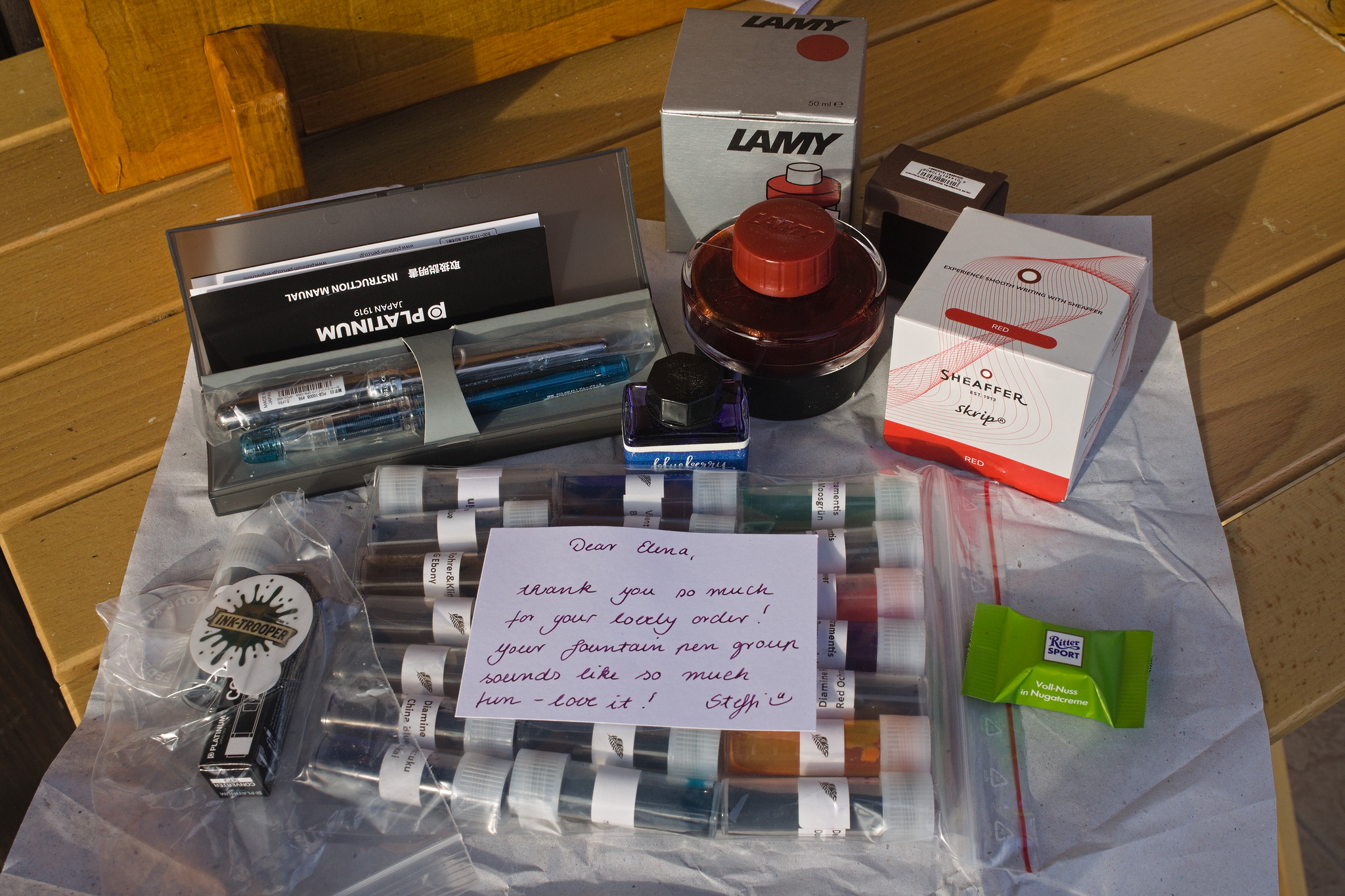
The word enthusiasts is probably a hint of the reason why soon
afterwards I received a package with the pen I had planned to buy, its
converter, and a couple dozens ink samples.
And then a couple envelopes with additional samples of inks that weren t
available on the shops, from said enthusiasts.
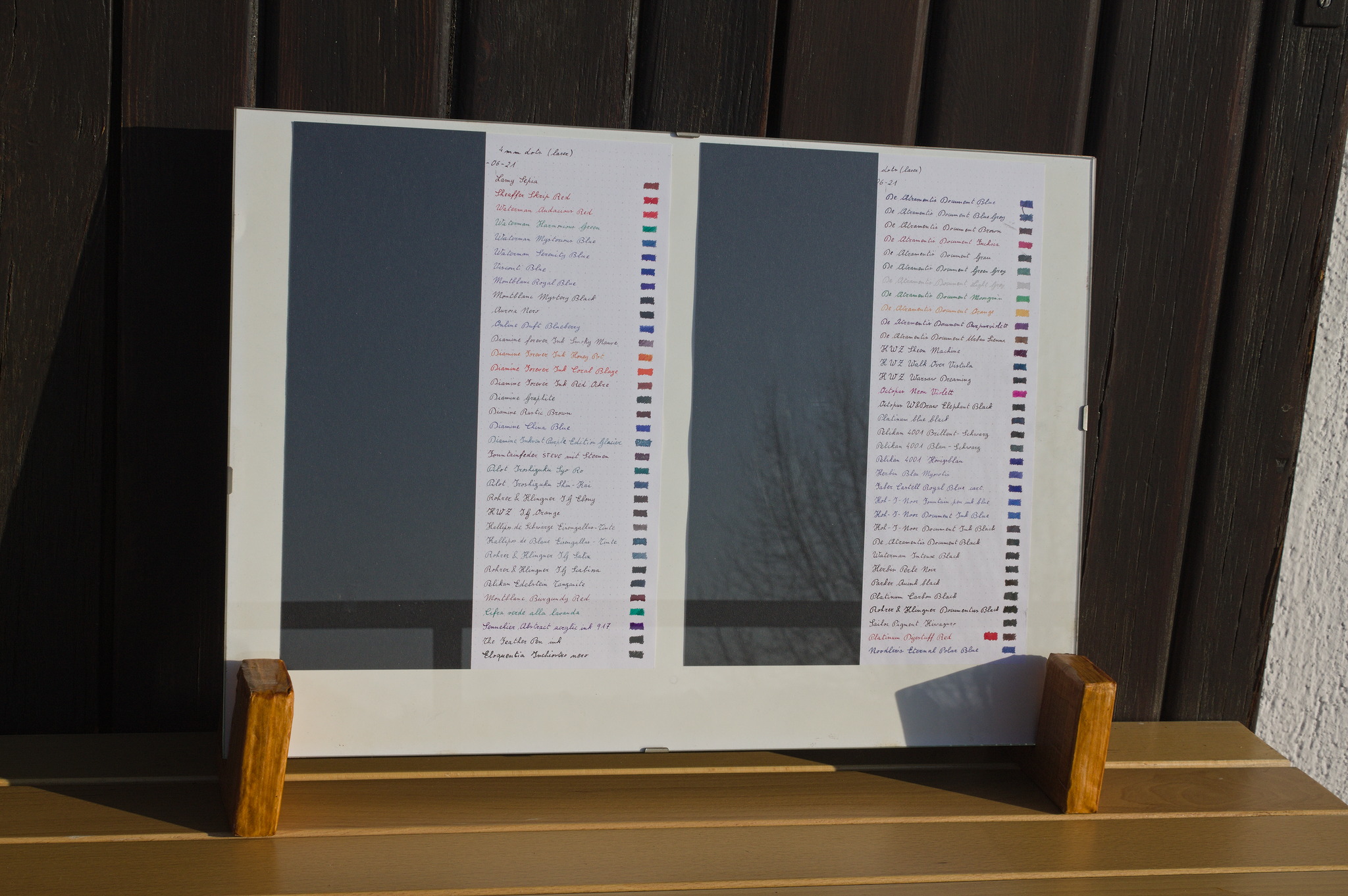
Added to the inks I already had acquired since the last lightfastness
test, it meant that they couldn t all fit in one single page, and thus I
had some room to add some inks I had already tested: some were requests,
and for others I tried to select ones that felt relevant.
Since I m changing the test setup, I ve decided I should probably keep
doing this until I ve tested again all of the inks I still have
available.
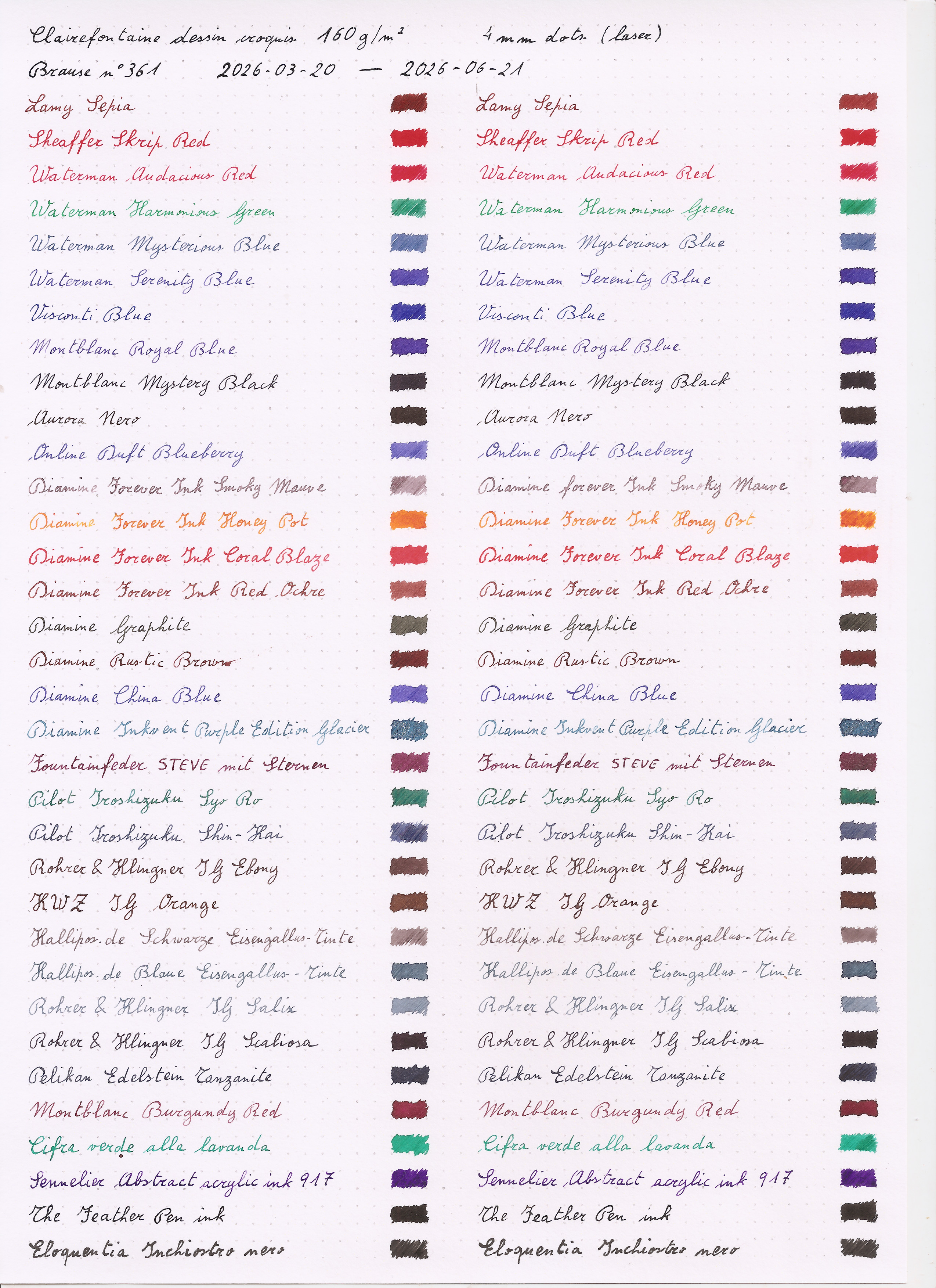
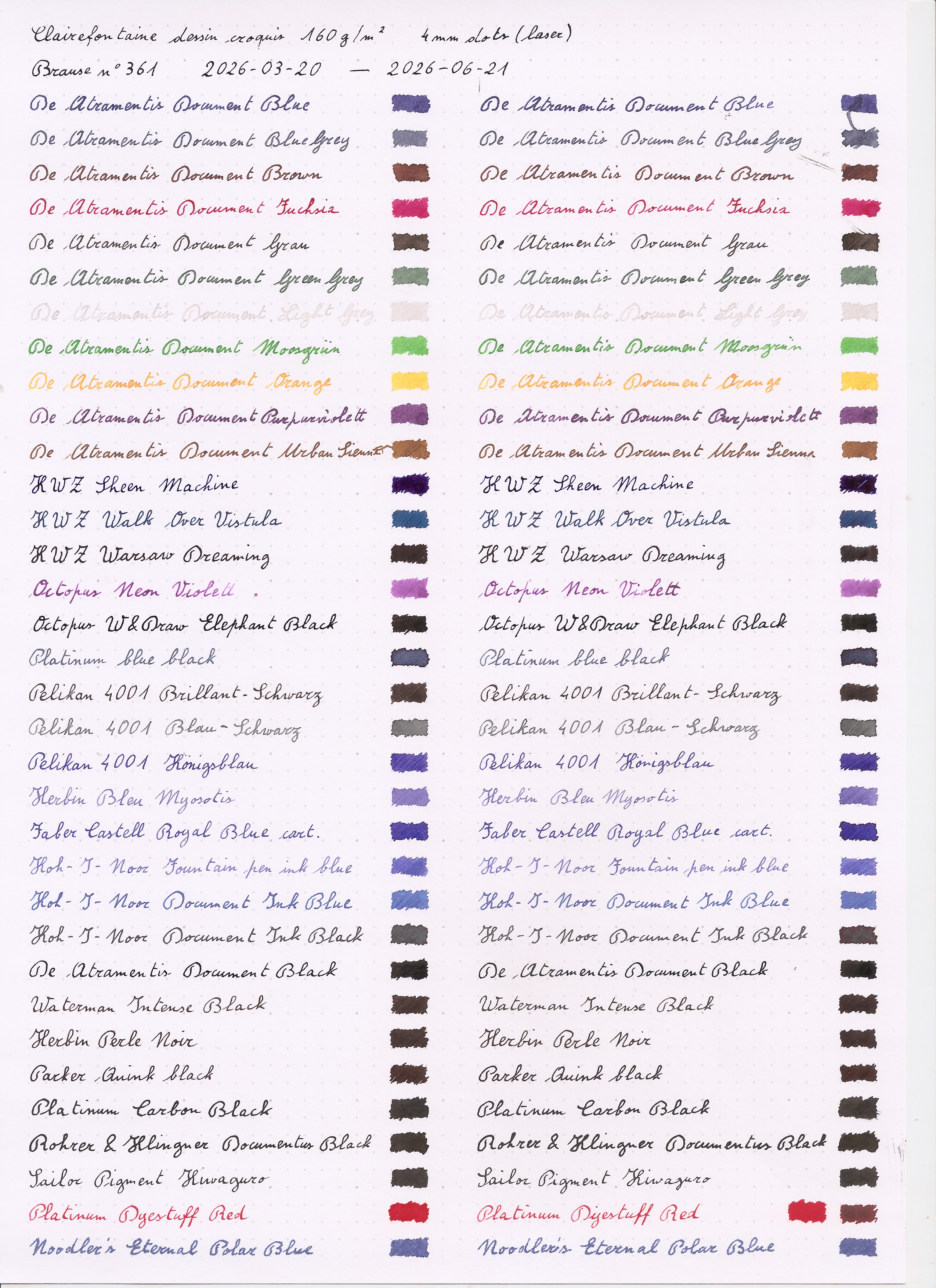 For the paper, I ve used A4 sheets of
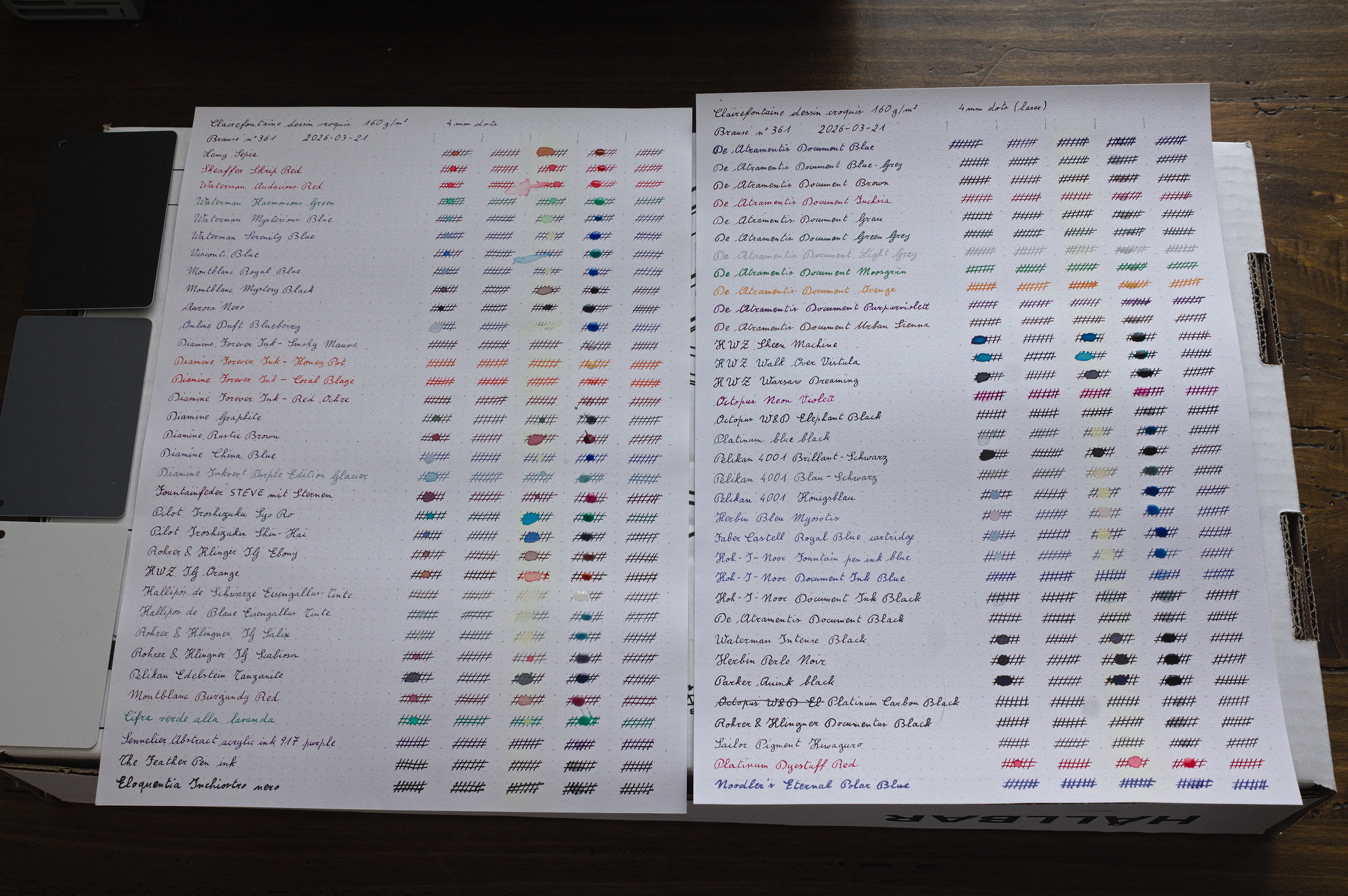 While I was filling the sheet for the lightfastness tests, I decided to
also prepare a second set of sheet, for a liquid resistance drop test.
On each line, beside the name of the ink, I added five sets of crossing
parallel lines, and let everything dry for a few days.
Then I used a syringe to put a drop of a liquid on each set of lines,
waited for it to be absorbed into the paper and to dry, at least
overnight, but sometimes also for a day or two (life happened), and then
looked at the results and did the next test.
The first liquid was water, with the usual wild difference between
washable and permanent inks, and all of the intermediate possibilities.
The second liquid was isopropyl alcohol, and I was surprised to see
that, with very few exceptions, most inks didn t change at all. I
wonder whether that s related to the fact that instead of forming a drop
it was absorbed almost immediately into the paper, and dried in a very
short time.
The third liquid was hydrogen peroxide: beside the individual results I
noticed that its column yellowed visibly; I wonder whether that means
that the paper I used has optical brighteners, and it will also yellow
under the sun: that wouldn t be ideal, but it would also be a surprise,
for paper that is acid free and sold for arts.
The fourth liquid was citric acid, by mixing a bit less than a teaspoon
of citric acid granules in just enough very warm water (heated to 70 C,
i.e. the lowest temperature available on my kettle) to dissolve most of
the acid. I forgot that I had some old PH strips until one hour after
I ve put the drop on the paper, and I don t know whether something had
changed, but when I did remember about them it showed a deep red between
1 and 2. I don t think I can trust those strips too much, however.
This backfired badly: the drop of citric acid never dried out, but
formed a sticky paste that prevented me from scanning the results,
and I m not sure whether I ll do the last test, which was supposed to be
household bleach.
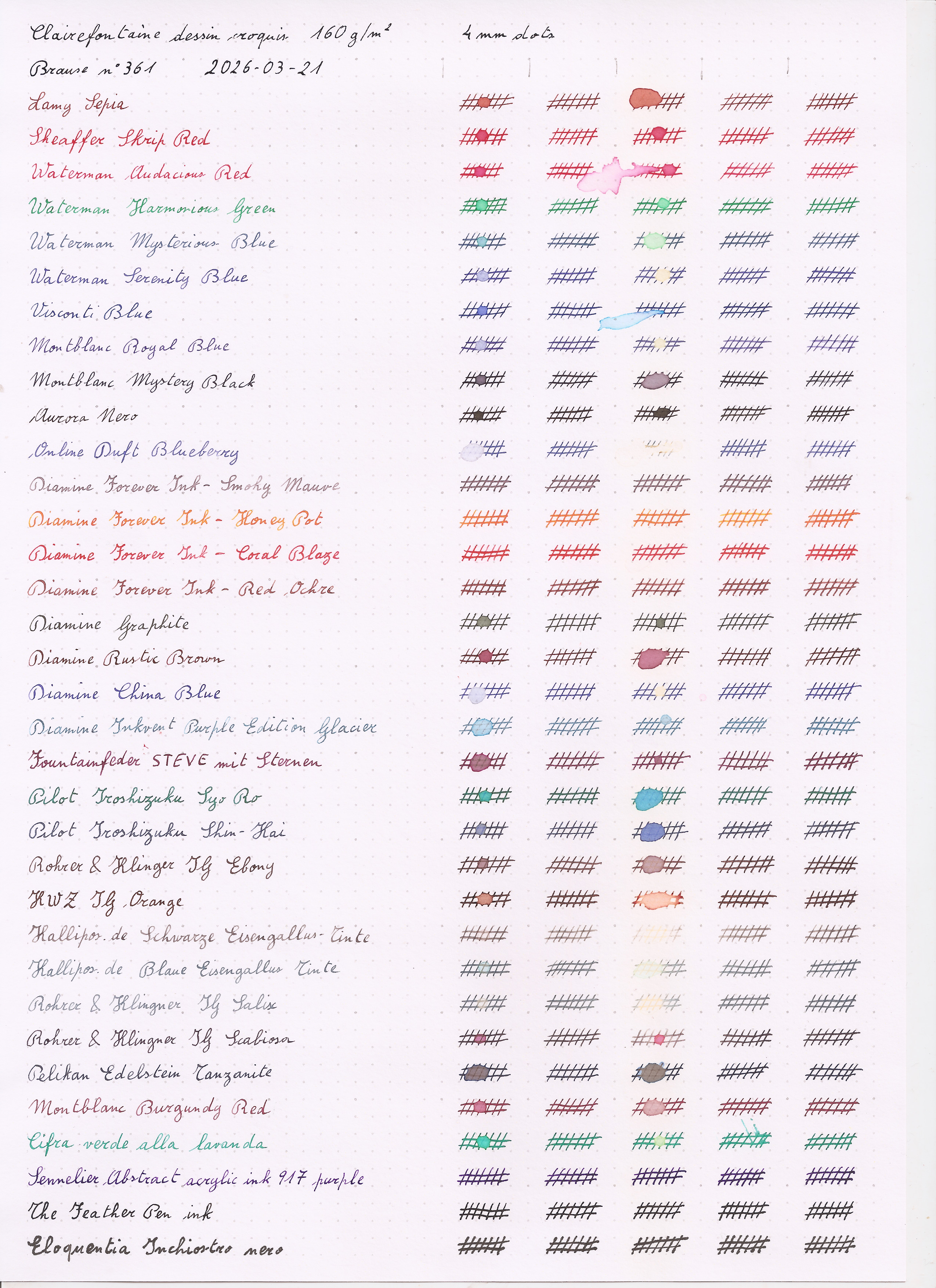
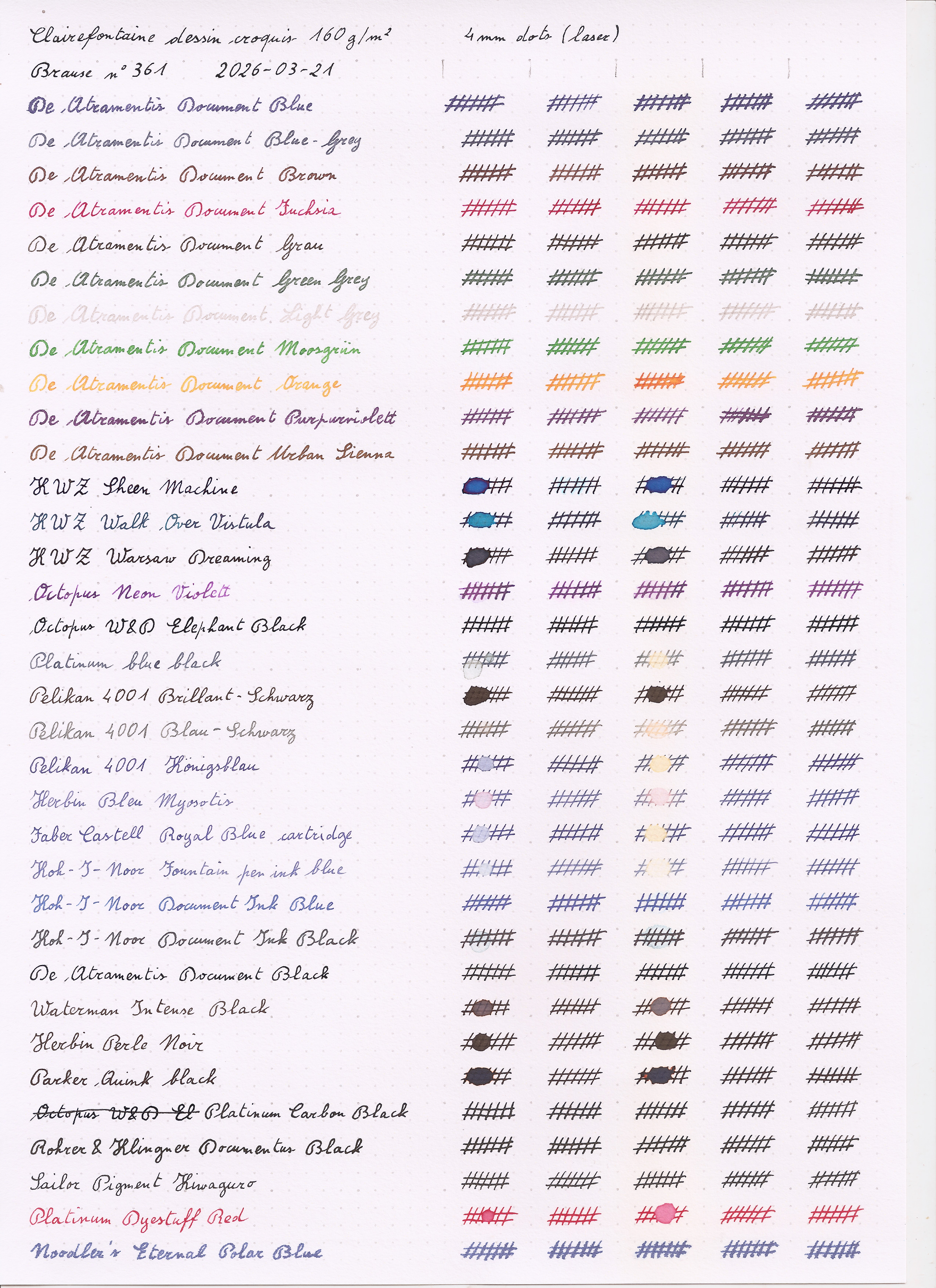 Luckily I had scanned the partial results, and they are shown here.
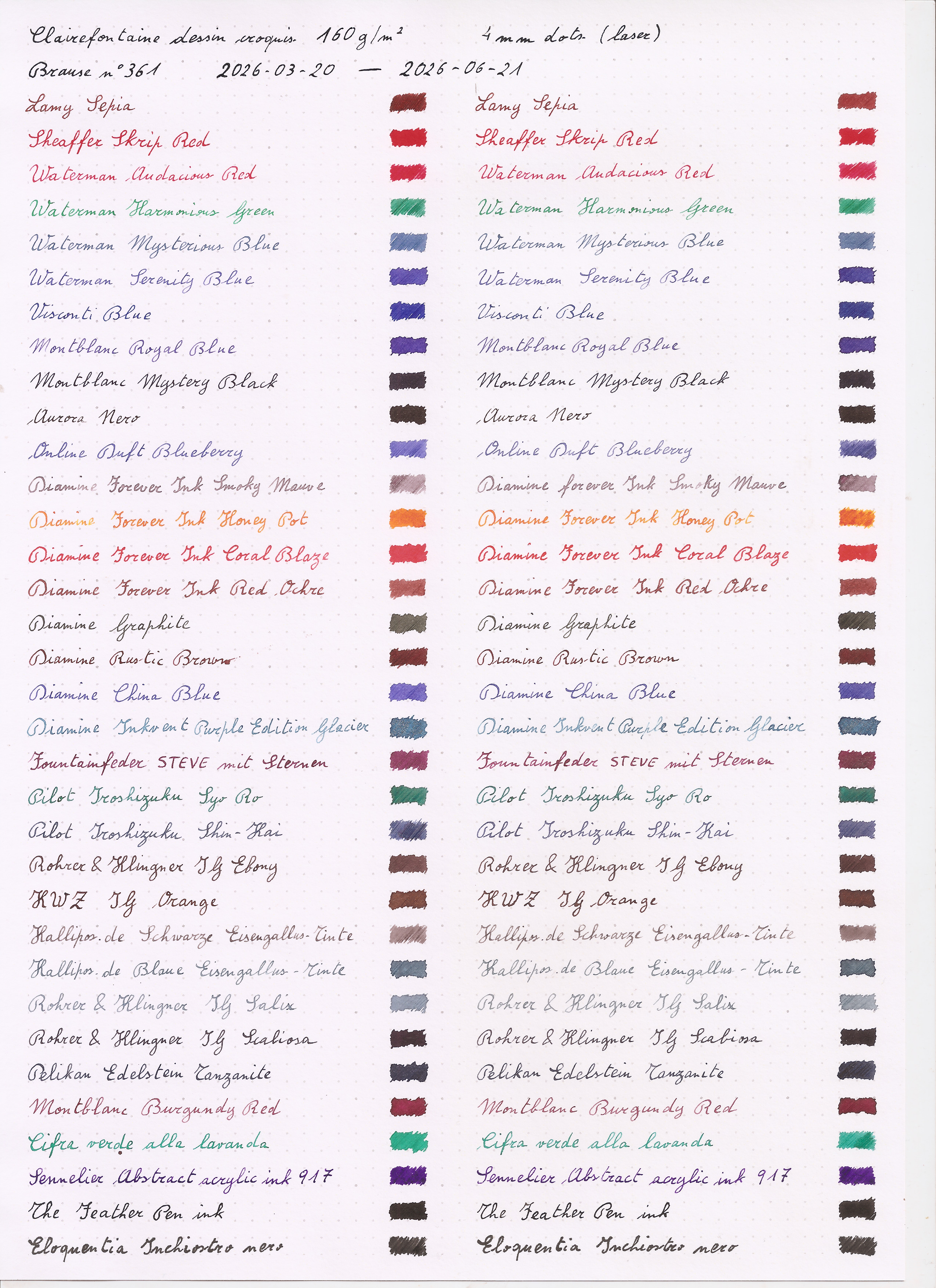
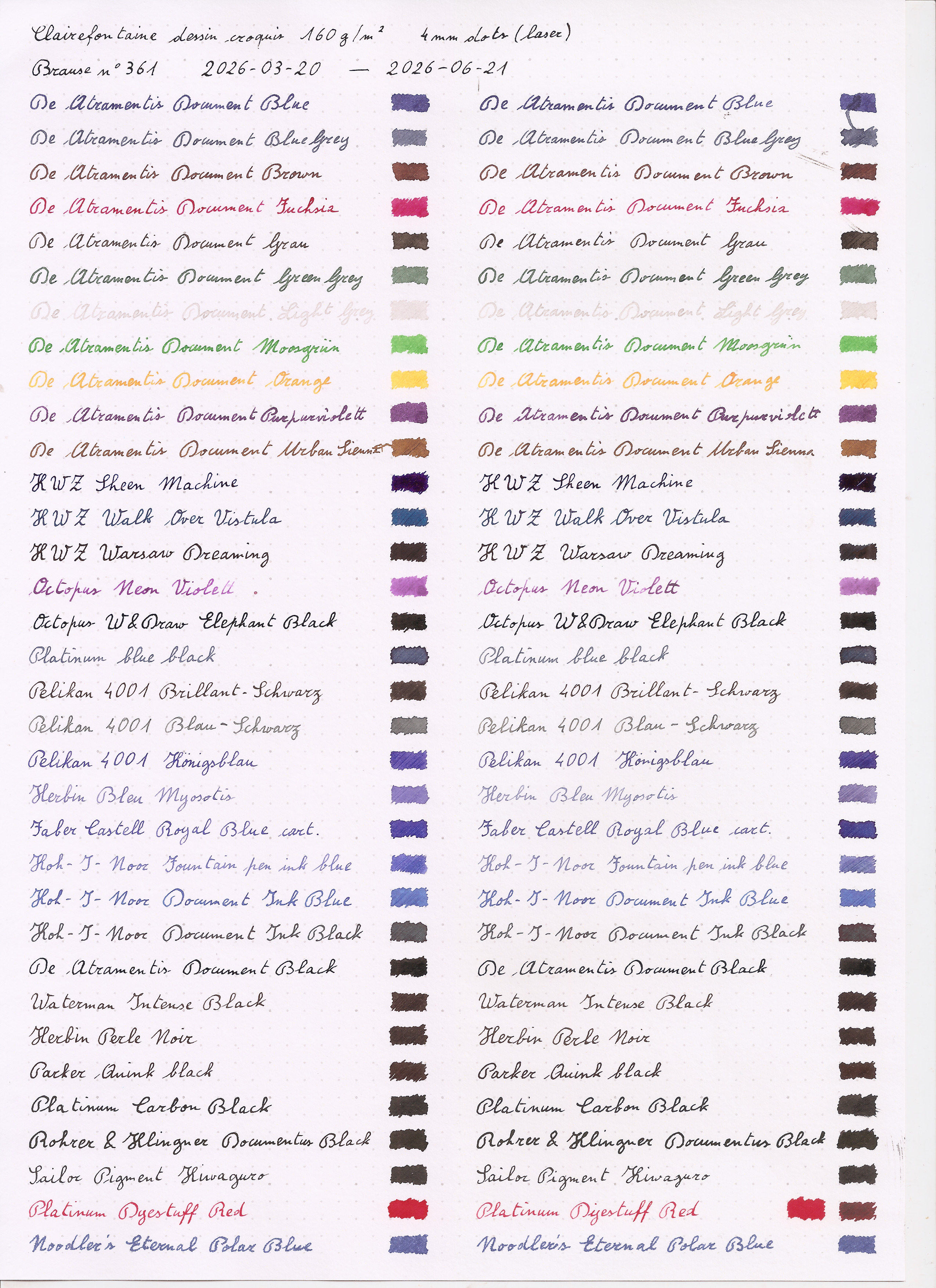 After one full day with plenty of sun, nothing really had changed,
except possibly for a vague hint that the Herbin Bleu Myosotis may have
have been a bit lighter than it started, but it may also have been a
suggestion.
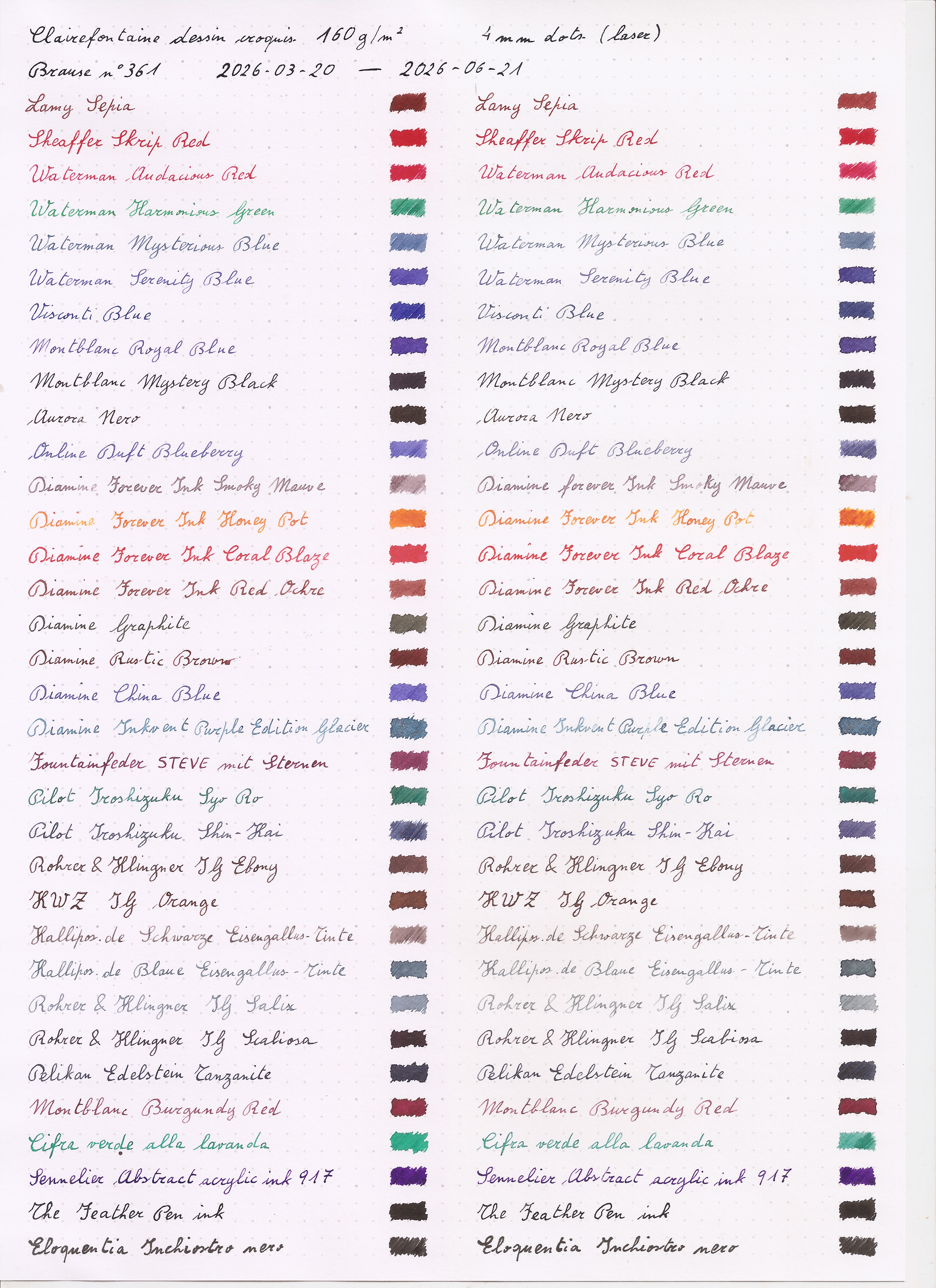
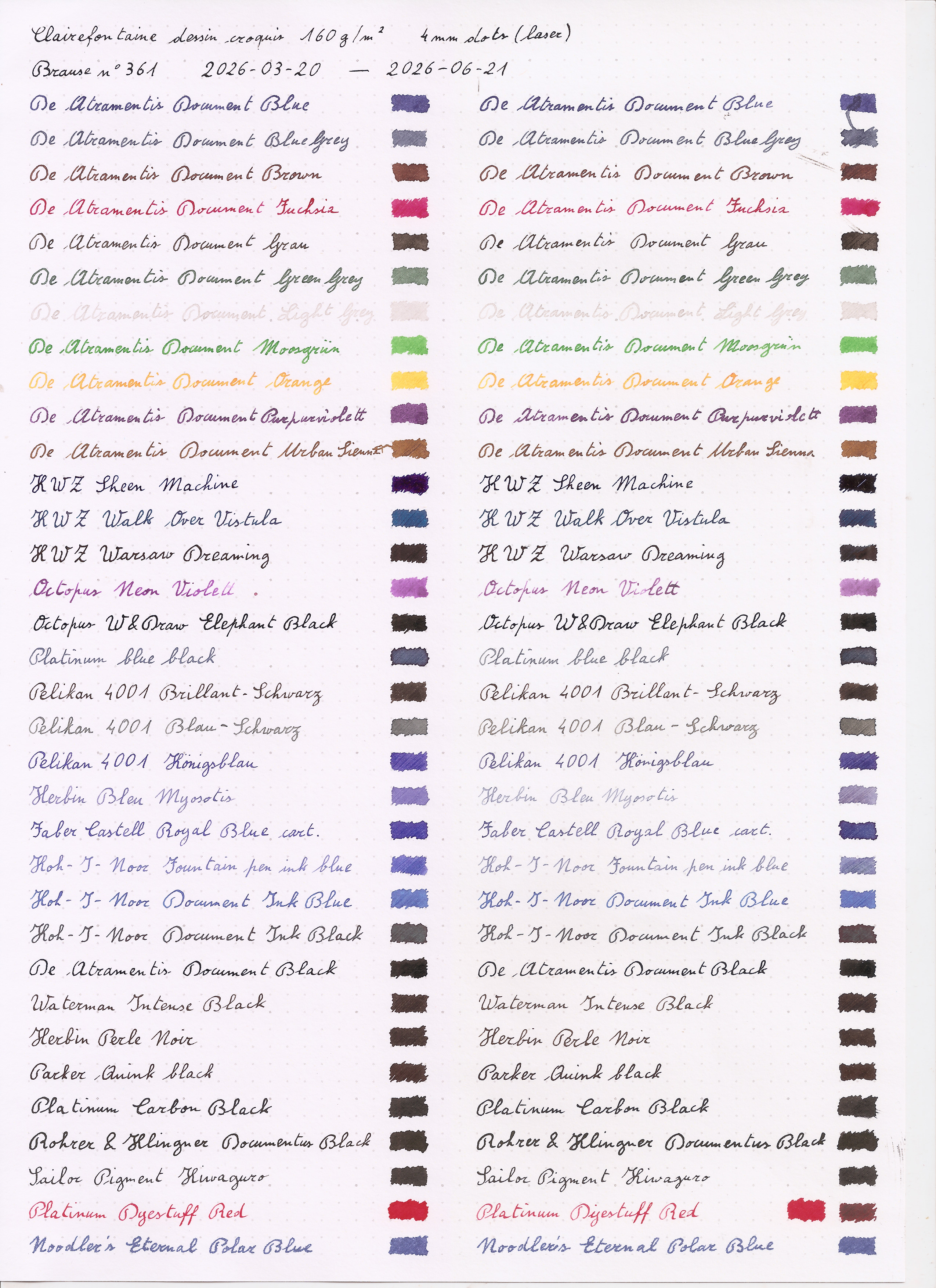 After three days, however, some results started to show, with the most
fugitive inks starting to be visibly changed, becoming either paler or
in some case duller.
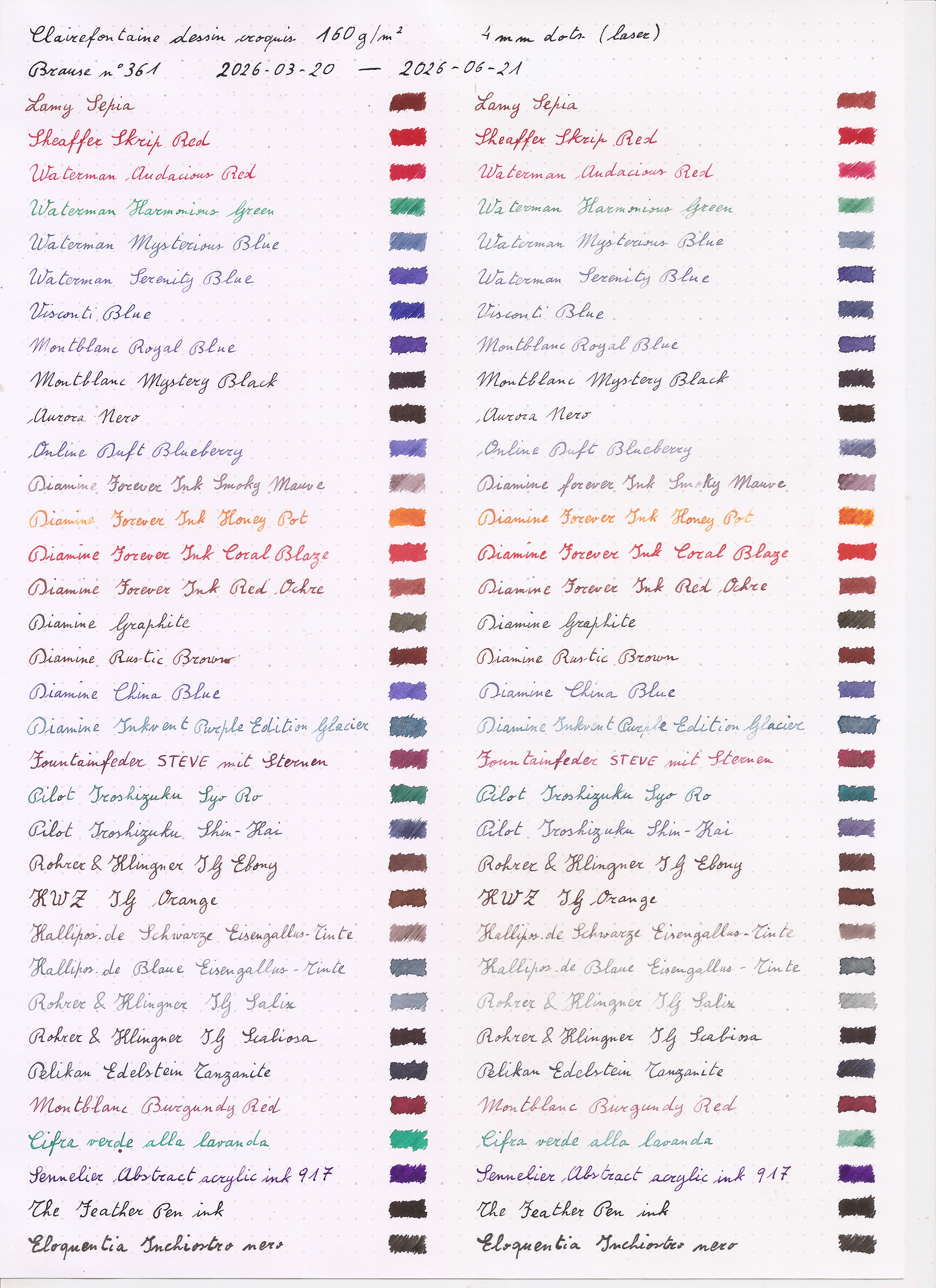
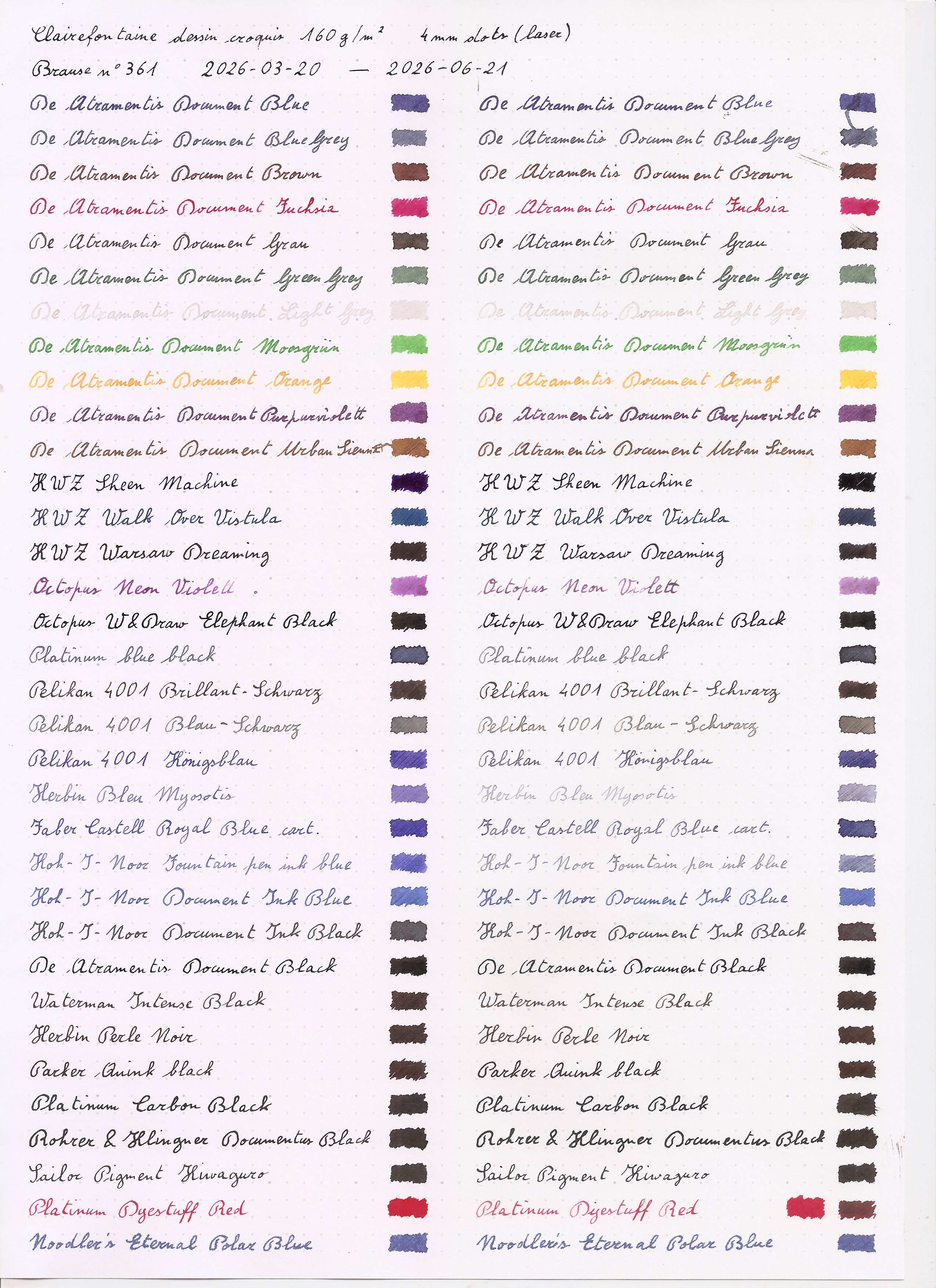 And the full week showed more of that, with a few more inks starting to
show visible change.

 After two weeks the paper had significantly yellowed, something I did
not expect from drawing paper (and which means that I will probably use
a different paper when making similar tests in the future).
As for the inks, there were a couple more inks with visible changes, but
mostly it was more of the same as seen in the previous week.
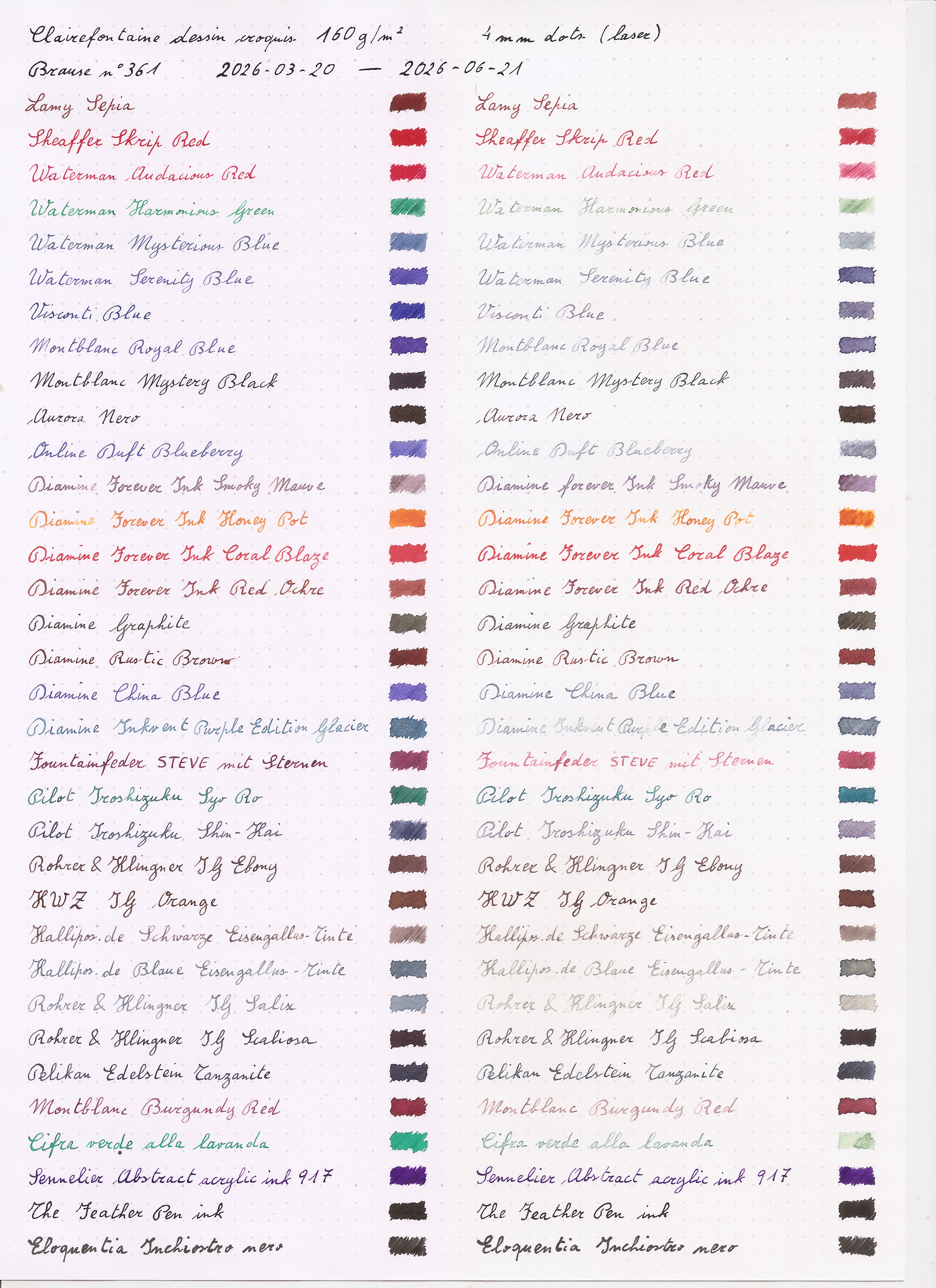
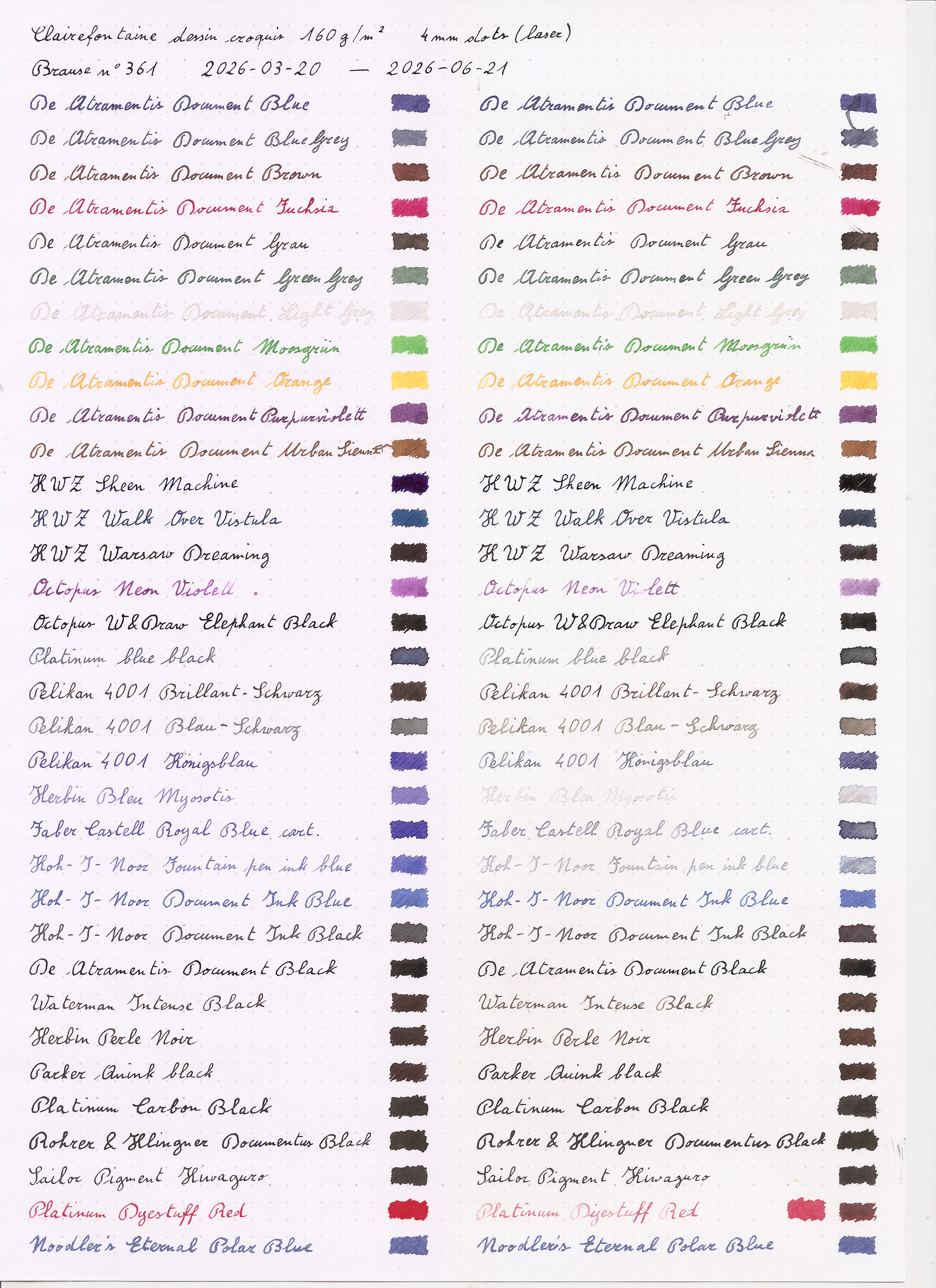 Three weeks started to show changes in the black and most irongall inks, and of course more changes in the even less resistant inks.
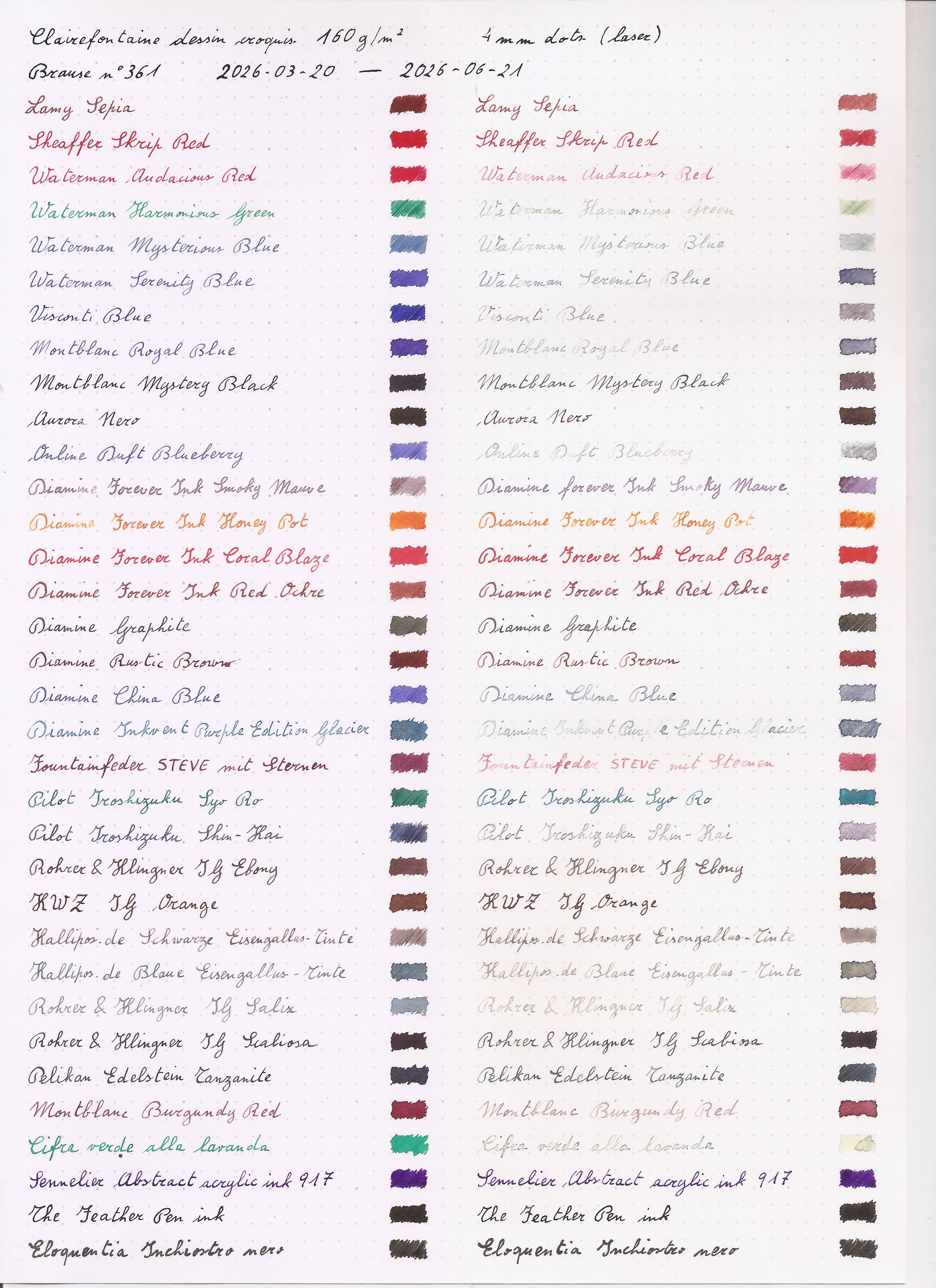
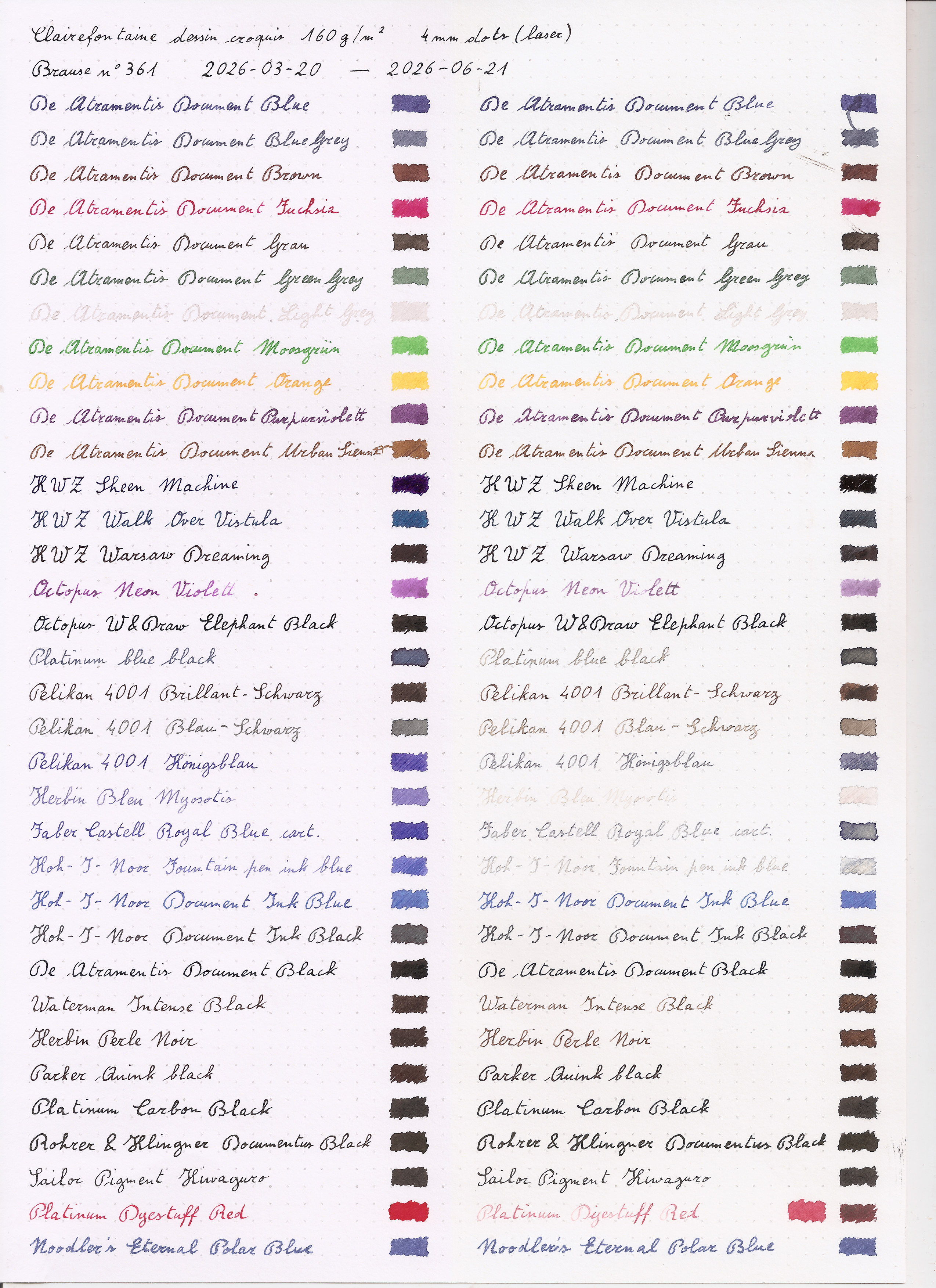 Week four saw a bit more clouds and rain than the first few weeks, and
there weren t big changes, but mostly more of what had already started
to happen earlier.
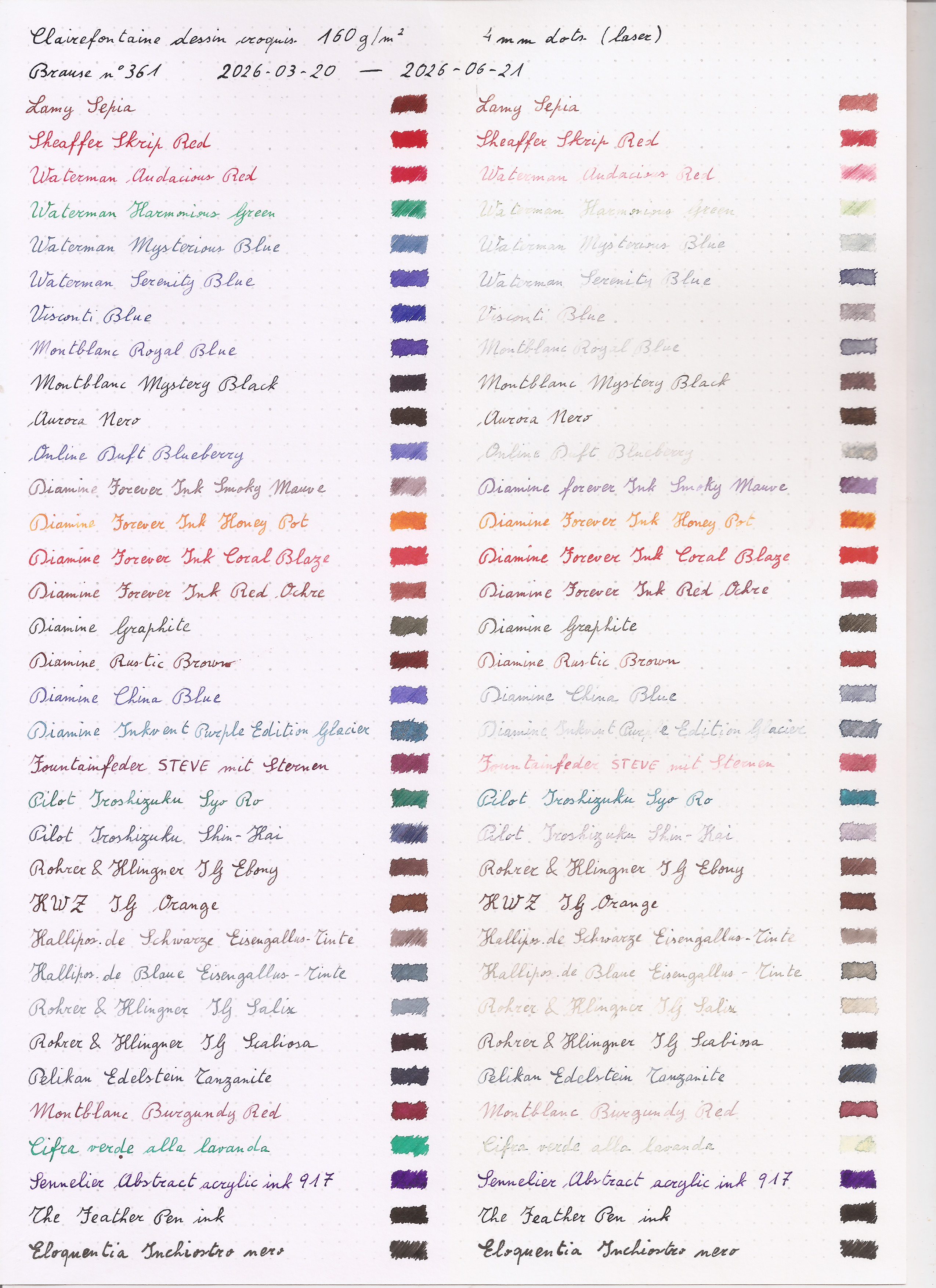
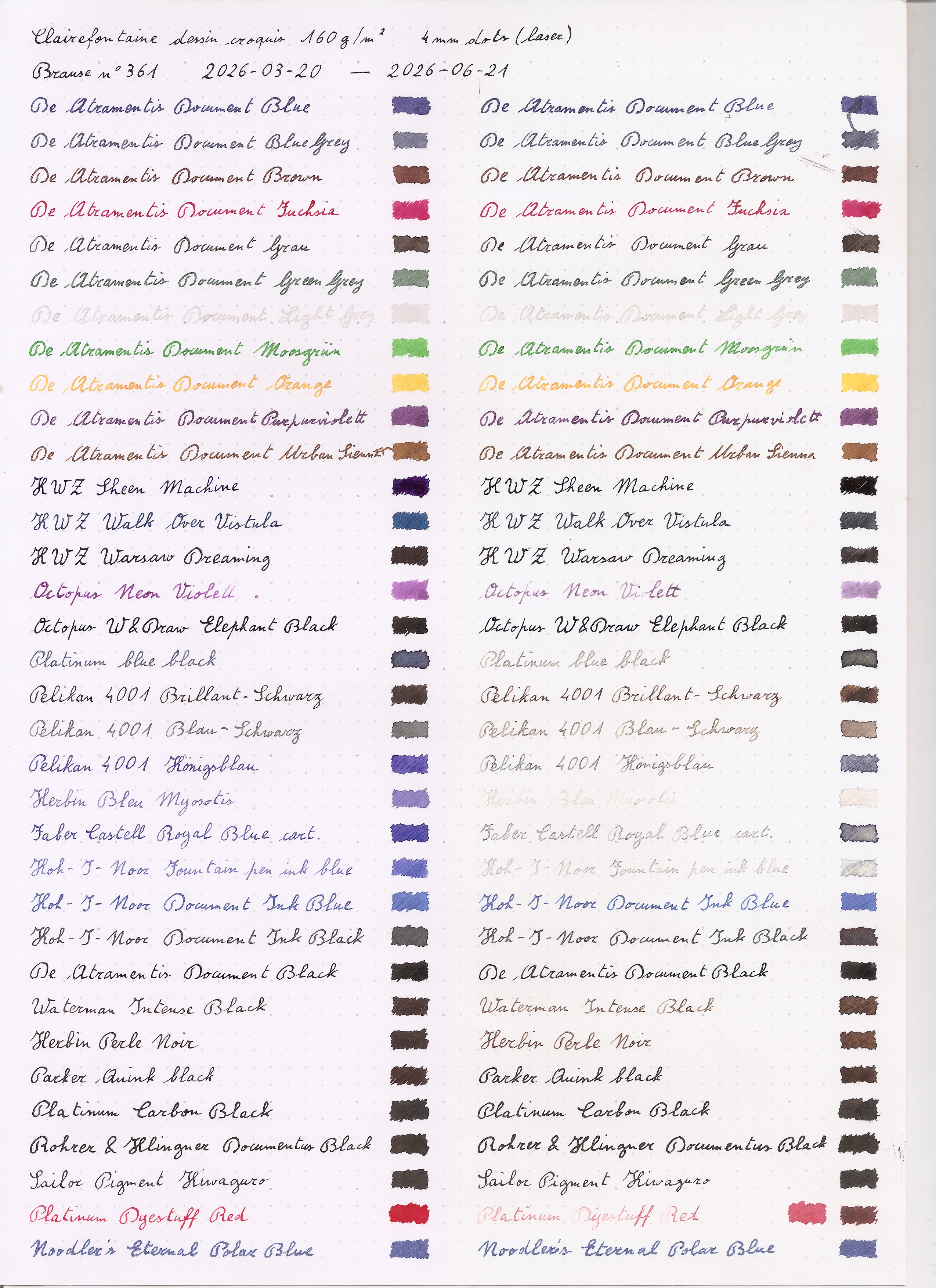 A month didn t change much compared to the four weeks, but I did the
scans for completeness, and from now on I m going to update monthly.
 I was reading

 Huge. Huge. Amazing. It did crash as soon as I tried to actually use the
radio, but after fixing a few dangling bugs in the API surface (and some
assumptions I think some underlying gnuradio driver may be making that I need
to double check in the code), I was able to get a super solid stream of
broadcast fm radio, with gqrx being none the wiser. It thought it was
just talking to the device it knows as
 Nice. I can t wait to try this with the rest of the rtl-sdr based tools I like
having around using my
 A few months ago, in June 2025, I joined