Search Results: "tats"

9 April 2012

Soeren Sonnenburg: Shogun Student Applications Statistics for Google Summer of Code 2012

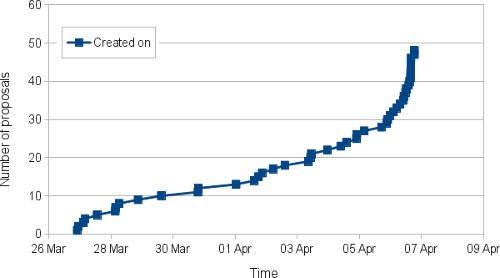
A few weeks have passed since SHOGUN has been accepted for Google Summer of Code 2012. Student application deadline was Easter Friday (April 6) and shogun received 48 proposals from 38 students. Some more detailed stats can be found in the figure below. This is a drastic drop compared with last year (about 60 students submitted 70 proposals). However, this drop can easily be explained: To even apply we required a small patch, which is a big hurdle.
  1. One has to get shogun to compile (possibly only easy under debian; for cygwin/MacOSX you have to invest quite some time to even get all of its dependencies).
  2. One has to become familiar with git, github and learn how to issue a pull request.
  3. And finally understand enough of machine learning, shogun's source code to be able to fix a bug or implement some baseline machine learning method
Nevertheless, about a dozen of proposals didn't come with a patch (even though written on the instructions page that this is required) - an easy reject. In the end the quality of proposals increased a lot and we have many very strong candidates this year. Now we will have to wait to see how many slots we will receive before we can finally start the fun :-)

Christian Perrier: Languages to be deactivated in Debian Installer (take 2)

My last call, a bit alarming about some languages becoming candidates for being deactivated in D-I had some results. A few teams updated at least sublevels 1 and 2 so that their language is "safe". Still, If I follow the policy we chose in D-I, I should deactivate languages that are not complete for what we call "sublevel 1" and "sublevel 2" in code Debian Installer. At this very moment, it means that I would deactivate (stats in parenthesis are those in these sublevels, respectively): That's way too many. So, before I blog everywhere that "Debian is dying" because I have to deactivate 20 languages in the installer...or before I blog that "Ubuntu steals our translators" (which is somehow true now, as half, if not more, of active translators are indeed interested in the Ubuntu installer to be translated, not the Debian one)....do something...or the Ubuntu installer will have 20 less languages..:-)

8 April 2012

Luca Falavigna: Spam review: mass-tagging nominations

If you are one of those brave souls chasing off spam from Debian mailing lists, you will probably get bored of clicking on the Spam radio buttons a lot of times, and will probably look for a quick shortcut. I submitted a patch in bug #640309, but as of today, it has not been applied yet. Waiting for the patch to be applied, I prepared a little Greasemonkey script called Debian Mass Spam that allows to mark every message as Unsure , Ham , Inappropriate , or Spam by clicking the correspondent key on the keyboard: Spam review Just press Z (for Unsure ), X (for Ham ), C (for Inappropriate ), or V (for Spam ), and you will see every radio button to change its status. I tested it on Chromium, Iceweasel (with xul-ext-greasemonkey package) and Epiphany (with epiphany-extensions package), and it seems to work properly. Too many words and no actions so far, go and kill some spam now! ;)

5 April 2012

Dominique Dumont: My activities during Perl/QA hackathon in Paris

Hello Last week-end, I ve participated Perl/QA hackathon in Paris. Here s a short summary of the main activities during this week-end. I was not in the best of shape due to a nasty (biological) bug that wore me down before the hackathon. First of all, I discussed with rjbs about the bunch of debian patches I ve written for Software::License. These patches (and hacks) are used in Debian to provide licenses summaries in Debian::Dpkg::Copyright model to help write Debian copyright files. License management is boring but necessary. cme and Software::License help in making this task slightly less boring. Ricardo kindly suggested some modifications and agreed to include my patches. I implemented these modifications directly during the hackathon. The other tasks during this week-end were (not necessarily in that order): Many thanks to FreeSide who sponsored my travel, to the hackathons organisers and to all the participants for their welcome. All the best

2 April 2012

Julian Andres Klode: Currying in the presence of mutable parameters

In the language introduced yesterday, mutable parameters play the important role of representing the side effects of actions in the type system and thus ensure referential transparency. One of the questions currently unaddressed is how to handle currying in the presence of mutable parameters. In order to visualise this problem, consider a function
    printLn(mutable IO, String line)
If we bind the the first parameter, what should be the type of the function, and especially important how do we get back the mutable parameter? Consider the partially applied form printLn1:
    printLn1(String line)
The mutability parameter would be lost and we could not do any further I/O (and the curried form would appear as a pure function, so a good compiler would not even emit a call to it) An answer might be to put the thing into the result when currying:
    printLn2(String line) -> mutable IO
But how can we explain this? In the end result, do we maybe have to use a signature like:
    printLn(String, mutable in IO io1, mutable out IO io2)
We could then introduce syntax to call that as
    printLn(string, mutable io)
Where as the mutable io argument basically expands to io and io1 for the first call, and for later calls to io1, io2 , and so on. It can also be easily curried by allowing currying to take place on variables not declared as output parameters. We can then curry the function as:
    printLn3(mutable in IO io1, mutable out IO io2)
    printLn4(mutable out IO io2)
If so, we can rename mutable back to unique and make that easier by introducing the unary operator & for two locations, just like Mercury uses ! for it. We could then write calls looking like this:
    printLn("Hello", &io);
    printLn("Hello", io, io1);
How out parameters are explained is a different topic; we could probably say that an out parameter defines a new variable. Another option is to forbid currying of mutable parameters entirely. This would have the advantage of maintaining the somewhat simple one parameter style. The programming language Clean does not provide any special syntactic sugar for having mutable variables. In Clean, the function gets a unique object and returns a unique object (noted by *). For example, the main entry point in a Clean program (with state) looks like this:
    Start:: *World -> *World
In short, the function Start gets a abstract world passed that is unique and at the end returns a new unique world. In Clean syntax, our example function would most likely have the signature:
    printLn :: String *IO -> *IO
You know have to either maintain one additional variable for the new unique object, which gets a bit complicated with time. On the other hand, you can do function composition on this (if you have a function composition operator that preserves uniqueness when available, as should be possible in Clean):
    printTwoLines :: *IO -> *IO
    printTwoLines = (printLn "World") o (printLn "Hello")
Function composition on mutable things however, does not seem like it is needed often enough in a functional programming language with a C syntax. People might also ask why monads are not used instead. Simon L Peyton Jones and Philip Wadler described monadic I/O in their paper Imperative Functional Programming (http://research.microsoft.com/en-us/um/people/simonpj/papers/imperative.ps.Z) in 1993, and it is used in Haskell (the paper was about the implementation in Haskell anyway), one of the world s most popular and successful functional programming languages. While monadic I/O works for the Haskell crowd, and surely some other people, the use of Monads also limits the expressiveness of code, at least as far as I can tell. At least as soon as you want to combine multiple monads, you will have to start lifting stuff from one monad to another (liftIO and friends), or perform all operations in the IO monad, which prevents obvious optimizations (such as parallelizing the creation of two arrays) in short dependencies between actions are more strict than they have to be. For a functional language targeting imperative programmers, the lifting part seems a bit too complicated. One of the big advantages of monads is that they are much easier to implement, as they do not require extensions to the type system and the Hindley-Milner type inference algorithm used by the cool functional programming languages. If you want uniqueness typing however, you need to modify the algorithm or infer the basic types first and then infer uniqueness in a second pass (as Clean seems to do it).
Filed under: General

Gerfried Fuchs: Squeeze RCs's Squashing 2012 #2

This is the third summary of my squeeze RC bug squashing. If you take a look at the bug graph you will notice that the blue line went up a bit over a two week's period. I would like to claim that confirming the samhain RC bug 618728 did cost me the time (I actually gave it the time to finish), but the real reason was that I was looking at other stuff. I came back with a vengeance though, so here is the list of the bugs squashed for squeeze since the last report: Current stats: 119 bugs in 93 days, still got the margin up by five more bugs. :) Enjoy!

/debian permanent link Comments: 0 Flattr this

Niels Thykier: Kudos to Jakub Adam, Miguel Landaeta and James Page

Credit where it is due and I believe it is due for Jakub Adam for packaging eclipse packages. If you use any of the eclipse packages provided the apt repositories for Wheezy or sid, it is very likely you have Jakub Adam to thank for it. I also believe that Miguel Landaeta and James Page deserve praise for their work. Miguel is to thank for the removal of libservlet2.4-java and updating its reverse dependencies not in that order ;-) . James Page, on the other hand, has been introducing and updating a lot of packages, noticeably the jenkins packages. Thank you and keep up the good work.

1 April 2012

Kartik Mistry: Vote

* Vote early, vote often. #DPL2012.

Julian Andres Klode: Functional programming language for Python programmers and friends

Just for you, and this time in the Pythonesque rendering.
module main:
    import std (range)
    import std.io (printf, IO)
    # print the Fahrenheit-Celcius table for fahr = 0, 20, ..., 300
    function main(mutable IO io):
        Int lower = 0    # lower bound
        Int upper = 300  # upper bound
        Int step = 20    # step
        for Int fahr in range(lower, upper, step):
            Double celcius = 5 * (fahr - 32) / 9
            std.io.printf(io, "%3d\t%6.1f\n", fahr, celcius)
It does not really look like it, but this language is purely functional. It represents side effects using unique types. If you declare a mutable parameter, you basically declare a unique input parameter and a unique output parameter. I m also giving you a list implementation
module std.container.list:
    ## The standard singly-linked list type
    type List[E]:
        Nil                     ## empty list
        Node:
            E value             ## current value
            List[E] next        ## remaining list
 

And yes, both languages should be able to be represented using the same abstract syntax tree. The only change is the replacement of the opening curly brace by a colon, the removal of the closing curly bracket and semicolons, the replacement of C-style comments with Python-style comments and the requirement of indentation; oh and the for statement gets a bit lighter as well.
Filed under: General

Julian Andres Klode: [updated] Functional programming language for C programmers and friends

Just for you:
module main  
    import std (range);
    import std.io (printf, IO);
    /* print the Fahrenheit-Celcius table
        for fahr = 0, 20, ..., 300 */
    function main(mutable IO io)  
        Int lower = 0;   // lower bound
        Int upper = 300; // upper bound
        Int step = 20;   // step
        for (Int fahr in range(lower, upper, step))  
            Double celcius = 5 * (fahr - 32) / 9;
            std.io.printf(io, "%3d\t%6.1f\n", fahr, celcius);


It does not really look like it, but this language is purely functional. It represents side effects using unique types. If you declare a mutable parameter, you basically declare a unique input parameter and a unique output parameter. I m also giving you a list implementation
module std.container.list  
    /** The standard singly-linked list type */
    type List[E]  
        Nil;                    /** empty list */
        Node  
            E value;            /** current value */
            List[E] next;       /** remaining list */


Thus are only excerpts from a document with tens of pages and the reference implementation of the standard library. The incomplete working draft for the language is attached: JAK Programming Language Early Working Draft (28 pages). Update: Fixed the link.
Filed under: General

31 March 2012

Christian Perrier: Languages to be deactivated in Debian Installer

If I follow the policy we chose in D-I, I should deactivate languages that are not complete for what we call "sublevel 1" and "sublevel 2" in code Debian Installer. At this very moment, it means that I would deactivate (stats in parenthesis are those in these sublevels, respectively): For several of these, the fix is easy! So, even if you're not the person in charge officially for the said language, please get in touch with me (bubulle@d.o) if you want to complete the translation. For some of these languages, where contact with the translator in charge has apparently been lost, it could be their only chance to stay in wheezy.

29 March 2012

Carl Chenet: Debian developer

I received the email yesterday and was like wow, I m in . I would like to thank: Sorry for the other readers who will find this post boring, but it means a lot to me :)

24 March 2012

Dirk Eddelbuettel: Initial release 0.1.0 of package RcppSMC

Hm, I realized that I announced this on Google+ (via Rcpp) as well as on Twitter, on the r-packages list, wrote a new and simple web page for it, but had not put it on my blog. So here is some catching up. Sequential Monte Carlo / Particle Filter is a (to quote the Wikipedia page I just linked to) sophisticated model estimation technique based on simulation. They are related to both Kalman Filters, and Markov Chain Monte Carlo methods. Adam Johansen has a rather nice set of C++ classes documentated in his 2009 paper in the Journal of Statistical Software (JSS). I started to play with these classes and realized that, once again, this would make perfect sense in an R extension built with the Rcpp package by Romain and myself (and in JSS too). So I put a first prototype onto R-Forge and emailed Adam who, to my pleasant surprise, was quite interested. And a couple of emails, and commits later, we are happy to present a very first release 0.1.0. I wrote a few words on a RcppSMC page on my website where you can find a few more details. But in short, we already have example functions demonstrating the backend classes by reproducing examples from
Johansen (2009)
and his example 5.1 via pfLineartBS() for a linear bootstrap example;
Doucet, Briers and Senecal (2006)
and their (optimal) block-sampling particle filter for a linear Gaussian model (serving as an illustration as the setup does of course have an analytical solution) via the function blockpfGaussianOpt()
Gordon, Salmond and Smith (1993)
and their ubiqitous nonlinear state space model via the function pfNonlinBS().
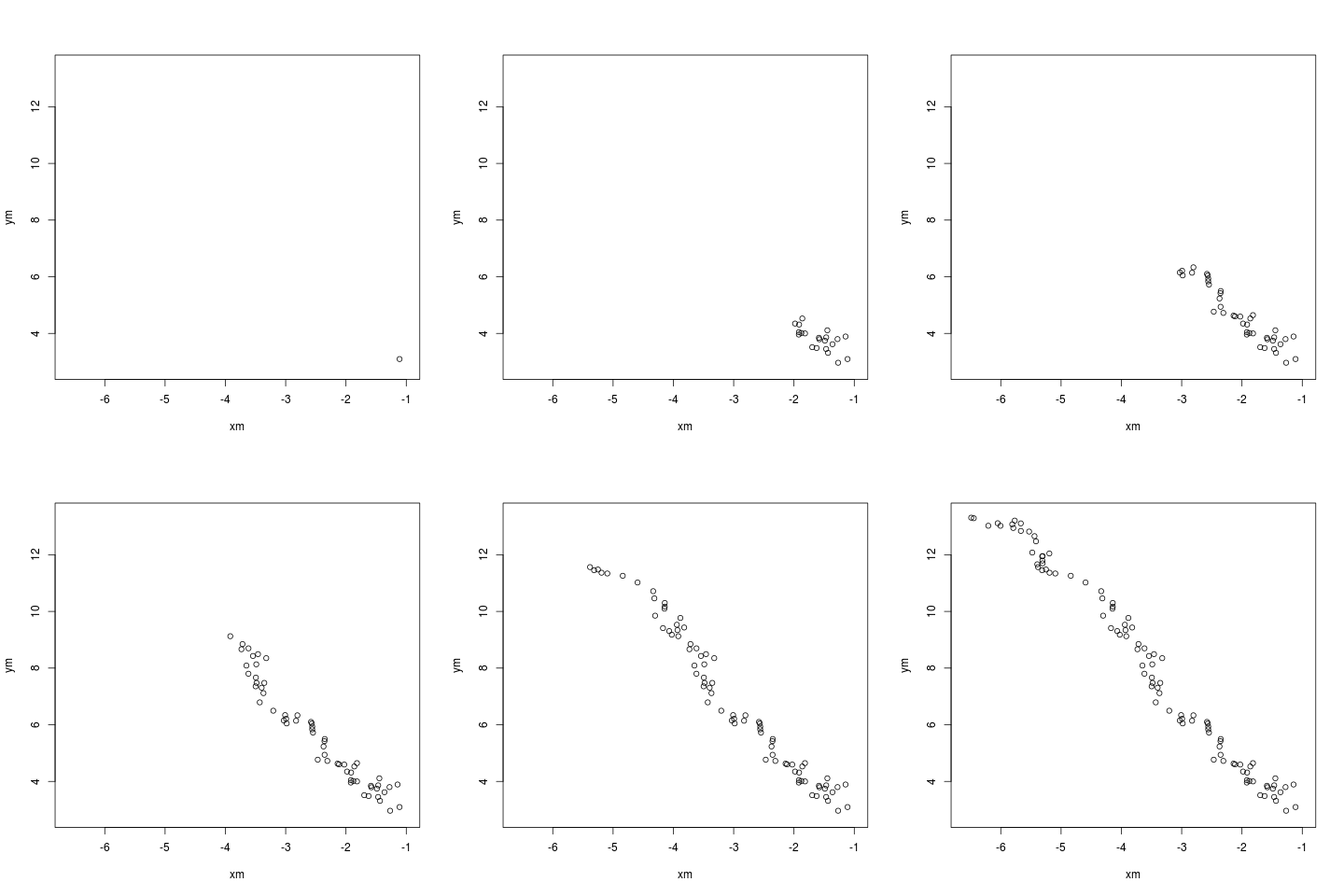
And to illustrate just why Rcpp is so cool for this, here is a little animation of a callback from the C++ code when doing the filtering on Adam's example 5.1. By passing a simple plotting function, written in R, to the C++ code, we can get a plot updated on every iteration. Here I cheated a little and used our old plot function with fixed ranges, the package now uses a more general function: Example of RcppSMC callback to R plot when estimation example 5.1 from Johansen (2009) The animation is of course due to ImageMagick glueing one hundred files into a single animated gif. More information about RcppSMC is on its page, and we intend to add more examples and extensions over time.

16 March 2012

Matt Brown: Kindle Reading Stats

I ve written before about my initial investigations into the Kindle, and I ve learnt much more about the software and how it communicates with the Amazon servers since then, but it all requires detailed technical explanation which I can never seem to find the motivation to write down. Extracting reading data out of the system log files is however comparatively simple. I m a big fan of measurement and data so my motivation and goal for the Kindle log files was to see if I could extract some useful information about my Kindle use and reading patterns. In particular, I m interested in tracking my pace of reading, and how much time I spend reading over time. You ll recall from the previous post that the Kindle keeps a fairly detailed syslog containing many events, including power state changes, and changes in the Booklet software system including opening and closing books and position information. You can eyeball any one of those logfiles and understand what is going on fairly quickly, so the analysis scripts are at the core just a set of regexps to extract the relevant lines and a small bit of logic to link them together and calculate time spent in each state/book. You can find the scripts on Github: https://github.com/mattbnz/kindle-utils Of course, they re not quite that simple. The Kindle doesn t seem to have a proper hardware clock (or mine has a broken hardware clock). My Kindle comes back from every reboot thinking it s either at the epoch or somewhere in the middle of 2010, the time doesn t get corrected until it can find a network connection and ping an Amazon server for an update, so if you have the network disabled it might be many days or weeks of reading before the system time is updated to reality. Once it has a network connection it uses the MCC reported by the 3G modem to infer what timezone it should be in, and switches the system clock to local time. Unfortunately the log entries all look like this:
110703:193542 cvm[7908]: I TimezoneService:MCCChanged:mcc=310,old=GB,new=US:
110703:193542 cvm[7908]: I TimezoneService:TimeZoneChange:offset=-25200,zone=America/Los_Angeles,country=US:
110703:193542 cvm[7908]: I LipcService:EventArrived:source=com.lab126.wan,name=localTimeOffsetChanged,arg0=-25200,arg1=1309689302:
110703:193542 cvm[7908]: I TimezoneService:LTOChanged:time=1309689302000,lto=-25200000:
110703:183542 system: I wancontrol:pc:processing "pppstart"
110703:193542 cvm[7908]: I LipcService:EventArrived:source=com.lab126.wan,name=dataStateChanged,arg0=2,arg1=:
110703:183542 cvm[7908]: I ConnectionService:LipcEventArrived:source=com.lab126.cmd,name=intfPropertiesChanged,arg0=
,arg1=wan:
110703:183542 cvm[7908]: W ConnectionService:UnhandledLipcEvent:event=intfPropertiesChanged:
110703:193542 wifid[2486]: I wmgr:event:handleWpasupNotify(<2>CTRL-EVENT-DISCONNECTED), state=Searching:
110703:113542 wifid[2486]: I spectator:conn-assoc-fail:t=374931.469106, bssid=00:00:00:00:00:00:
110703:113542 wifid[2486]: I sysev:dispatch:code=Conn failed:
110703:183542 cvm[7908]: I LipcService:EventArrived:source=com.lab126.wifid,name=cmConnectionFailed,arg0=Failed to connect to WiFi network,arg1=
:
Notice how there is no timezone information associated with the date/time information on each line. Worse still the different daemons are logging in at least 3 different timezones/DST offsets all interspersed within the same logfile. Argh!! So our simple script that just extracts a few regexps and links them together nearly doubles in size to handle the various time and date convolutions that the logs present. Really, the world should just use UTC everywhere. Life would be so much simpler. The end result is a script that spits out information like:

B000FC1PJI: Quicksilver: Read 1 times. Last Finished: Fri Mar 16 18:30:57 2012
- Tue Feb 21 11:06:24 2012 => Fri Mar 16 18:30:57 2012. Reading time 19 hours, 29 mins (p9 => p914)
... Read 51 books in total. 9 days, 2 hours, 29 mins of reading time
I haven t got to the point of actually calculating reading pace yet, but the necessary data is all there and I find the overall reading time stats interesting enough for now. If you have a jailbroken Kindle, I d love for you to have a play and let me know what you think. You ll probably find logs going back at least 2-3 weeks still on your Kindle to start with, and you can use the fetch-logs script to regularly pull them down to more permanent storage if you desire.

Dominique Dumont: Config::Model and cme to help debian transitions

Hello As maintainer of libwx-scintilla-perl, I had to update the package to update a dependency declation to close bug #662427. The dependency was good enough for the package to work but it blocked the linpng15 transition. This is yet another detail to remember when updating package: whether the dependencies are impacted by a transition. As I m really bad at remembering such details, I ve added the relevant check in the dpkg control source model used by cme. Now running cme check dpkg will warn you if a dependency impacts a transition. And cme fix dpkg will fix you dependency list as resquested by a transition. Well, that holds true for the transition I m aware of. Feel free to contact me if more transition checks are needed. For those who are curious (or want to send me a patch for another transition), here s the actual implementation of these new checks. All the best

14 March 2012

Stefano Zacchiroli: not a catchy headline

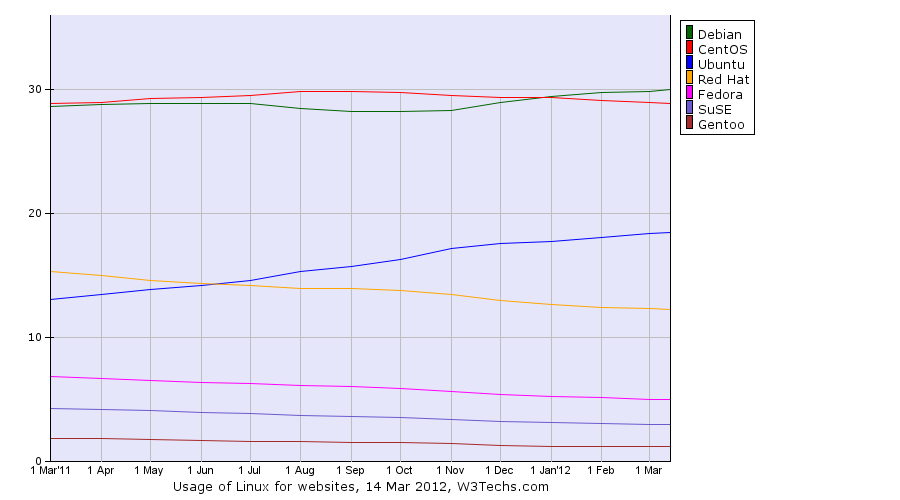
As we're doing trends today, I got curious about Debian. I don't particularly care about popularity contests other than popcon, and Debian choices surely aren't driven by them. But hey, curiosity is curiosity, right? So, here are today's w3techs trends for websites using GNU/Linux, with all lines shown:
Debian: 30%; CentOS: 28,9%; Ubuntu: 18,4%; Red Hat: 12,2%; Fedora: 5%; SuSE: 3%; Gentoo: 1,2%
(As thou shall always read methodologies before stats, here is the technologies overview page.) Debian is the top entrant with 30% of the websites using GNU/Linux. What I find interesting is that Debian has jumped at first place in January 2012, significantly after the release of our current stable release, Squeeze, that dates back to February 2011. It is also interesting to see community distros (Debian and CentOS) starkly ahead of commercially backed distros. That is what I find most fascinating about our projects. Whether that will remain the case or not is, for me, one of the big questions of the decade for the self-determination of Free Software communities.

9 March 2012

Michal &#268;iha&#345;: Weblate 0.4

Yesterday, I've finalized Weblate 0.4. It improved handling of plural strings, added documentation and implemented support for secondary languages. If you ask for 0.3, well I managed to release two versions in the day, but I expect to slow down this pace. Full list of changes for 0.3: Full list of changes for 0.4: You can find more information about Weblate on it's website, the code is hosted on Github. If you are curious how it looks, you can try it out on demo server. You can login there with demo account using demo password or register your own user. Weblate is now also being used https://l10n.cihar.com/ as official translating service for phpMyAdmin, Gammu and others.

Filed under: English Weblate 0 comments Flattr this!

6 March 2012

Kartik Mistry: fonts-* migration

* We ve now done with big transition of Indic fonts from ttf-* naming to fonts-*. Debian-IN-Workers team now maintains around 61 packages. We ve also finished process of moving to Git from SVN along with this. Kudos to Vasudev, Muneeb and AbdulKarim for taking lead, help and pushing me hard for upload and testing. (31 packages upload on Sunday night = 62 times my GPG passphrase, not counting couple of wrong entries ;) )

5 March 2012

Vincent Bernat: Asynchronicity & Net-SNMP AgentX protocol

One of the best way to add SNMP support to an application is the use of AgentX protocol: an application can act as a subagent and handle requests from a master agent using AgentX protocol. The most widespread implementation for such a task is the one from Net-SNMP. TL;DR: An application asynchronously leveraging Net-SNMP AgentX implementation has many opportunities to get stuck when the master agent becomes temporarily unavailable. A mostly efficient workaround is to dedicate a master agent for AgentX and delegate MIB handling to a subagent.

Pinging the master agent Net-SNMP uses an event-based model. It also provides some synchronous functions but they are built on top of the asynchronous ones. It is shipped with its own event loop. Therefore, Net-SNMP AgentX protocol implementation seems a fine choice to add SNMP support to an event-based program, for example in Keepalived, a VRRP daemon and a monitoring daemon for LVS clusters. Unfortunately, an AgentX subagent is expected to check, at a regular interval, if the master agent is alive . This is handled automatically with Net-SNMP implementation as long as you call run_alarms() function which will call agentx_check_session():
/*
 * check a session validity for connectivity to the master agent.  If
 * not functioning, close and start attempts to reopen the session 
 */
void
agentx_check_session(unsigned int clientreg, void *clientarg)
 
    /* [...] */
    DEBUGMSGTL(("agentx/subagent", "checking status of session %p\n", ss));
    if (!agentx_send_ping(ss))  
        snmp_log(LOG_WARNING,
                 "AgentX master agent failed to respond to ping.  Attempting to re-register.\n");
        /*
         * master agent disappeared?  Try and re-register.
         * close first, just to be sure .
         */
        agentx_unregister_callbacks(ss);
        agentx_close_session(ss, AGENTX_CLOSE_TIMEOUT);
        /* [...] */
        if (main_session != NULL)  
            /* [...] */
            main_session = NULL;
            agentx_reopen_session(0, NULL);
         
        else  
            snmp_close(main_session);
            main_session = NULL;
         
      else  
        DEBUGMSGTL(("agentx/subagent", "session %p responded to ping\n",
                    ss));
     
 
This piece of code will end up calling (directly or indirectly) the following functions1 which are using agentx_synch_response():
  • agentx_send_ping()
  • agentx_open_session()
  • agentx_reopen_session()
  • agentx_close_session()
  • agentx_register()
  • agentx_unregister()
  • agentx_register_index()
  • agentx_unregister_index()
  • agentx_add_agentcaps()
  • agentx_remove_agentcaps()
agentx_synch_response() will synchronously wait for an answer from the master agent. Your event-based program will just sit here doing nothing while this happens. For example, keepalived may be unable to send VRRP probes resulting in some serious havoc in your cluster. Functions prefixed by agentx_ are not part of NetSNMP API and could therefore be rewritten to do their work asynchronously. Unfortunately, talk is cheap. Moreover, there exists other deep paths that will block a subagent. For example, the low-level connection to the master agent (using TCP or a Unix socket, but not with UDP) will use a blocking connect() call. It seems quite difficult to fix this. Here are some (partial) workarounds:
  • Call agentx_check_session() less often. The default interval is 15 seconds. Disabling it completely or using a very high value is not advised because this function is the only way to reestablish a connection to the master agent when it is, for example, restarted. Here is how to change the delay to 120 seconds:
    netsnmp_ds_set_int(NETSNMP_DS_APPLICATION_ID,
                       NETSNMP_DS_AGENT_AGENTX_PING_INTERVAL, 120);
    
  • Don t call agentx_check_session() if we know the master agent is alive. For example, if it just sent us a new request, no need to ping it. I have written a patch implementing such a workaround. The ABI is left untouched, therefore, you only need to recompile Net-SNMP libraries.
  • Use a lower timeout and no retry. By default, the timeout for synchronous requests is 1 second and a failed request will be retried 5 times. Because several synchronous functions are used in a row, you may be trapped for as long as 30 seconds with those settings. Here is how2 to disable the retry mechanism and to set the timeout to a very low value:
    static int
    snmp_setup_session_cb(int majorID, int minorID,
                  void *serverarg, void *clientarg)
     
        netsnmp_session *sess = serverarg;
        sess->timeout = ONE_SEC / 3;
        sess->retries = 0;
        return 0;
     
    void some_init_function()
     
        /* [...] */
        snmp_register_callback(SNMP_CALLBACK_LIBRARY,
           SNMP_CALLBACK_SESSION_INIT,
           snmp_setup_session_cb, NULL);
        /* [...] */


Unresponsive master agent Why is the master agent unresponsive? snmpd is also an event-based program and, trust me, there are a lot of places where it will become unresponsive. Here are two examples:
  • When using the pass or the pass_persist directive, Net-SNMP will block until the delegated command outputs a complete line.
    /* var_extensible_pass() in agent/mibgroup/ucd-snmp/pass.c */
    /*
     * valid call.  Exec and get output 
     */
    if ((fd = get_exec_output(passthru)) != -1)  
        file = fdopen(fd, "r");
        if (fgets(buf, sizeof(buf), file) == NULL)  
            fclose(file);
            wait_on_exec(passthru);
            /* [...] */
            continue;
         
        /* [...] */
        fclose(file);
        wait_on_exec(passthru);
        /* [...] */
     
    
  • DISMAN-PING-MIB implementation will just hang while pinging the remote host. If the host is down and you have requested 5 probes with a timeout of 1 second, snmpd will be unresponsive for 5 seconds. A similar problem exists with DISMAN-TRACEROUTE-MIB.

Minimal master agent More and more code is running in the main agent. You cannot expect it to not block. But we could add a minimal master agent to the mix: it will handle only a few MIB modules by itself while most MIB modules will be delagated to a complete agent running as a subagent. Your own subagent will connect to the minimal master agent. Schema showing the use of a minimal master agent It is quite easy to turn snmpd into a subagent: just use -X flag. We should also disable unwanted MIB modules for each agent with -I flag. For the minimal master agent, we only enable some modules. All other modules3 will be served by snmpd acting as a subagent.
$ MODS="snmp_mib,sysORTable,usmConf,usmStats,usmUser,vacm_conf,vacm_context,vacm_vars"
$ snmpd -Lsd -Lf /dev/null -u snmp -g snmp \
>   -C -c /etc/snmp/snmpd.master.conf \
>   -p /var/run/snmpd.master.pid \
>   -I $MODS
$ snmpd -Lsd -Lf /dev/null -u snmp -g snmp \
>   -p /var/run/snmpd.pid -X \
>   -I -$MODS
Access control configuration should be placed in /etc/snmp/snmpd.master.conf, as well as master agentx directive. Other directives (like pass, pass_persist, load, sysname, ) in /etc/snmp/snmpd.conf. The minimal master agent is very unlikely to block and while the ground cause is still here, it is now very much mitigated. You may extend this solution by splicing snmpd into several subagents: one handling safe modules, one handling pass and pass_persist stuff and a last one for unsafe modules (like DISMAN-PING-MIB).

  1. agentx_reopen_session() will call agentx_close_session() and agentx_open_session(). agentx_register() and the following functions will be called by those two functions.
  2. NETSNMP_DS_AGENT_AGENTX_TIMEOUT and NETSNMP_DS_AGENT_AGENTX_RETRIES variables are only used by the master agent, not by a subagent.
  3. Use snmpd -Dmib_init -H to get the list of modules. You may want to add smux module to the master agent.

3 March 2012

Iustin Pop: Laufsporttag Winterthur 2012

Today I went to the Laufsporttag Winthertur, another 11km run. Overall it was a smaller event (about a third of participants) than the Bremgarter Reusslauf; the organisation was OK, but you could see that it was smaller-scale. The big difference was that this was definitely not a flat course; the official course lists 150m gain in altitude, my Garmin recorded 220m (given that it has a barometric altimeter, and that the course was hard, I tend\^Wwant to believe the latter). The course starts with 50m of flat, and then up and up until you're in the woods, at which point it's a one third flat, one third down, one third up course; by the 8th km or so, you start the final descent (back to the starting point), and you simply go down and down for a long while, until the final (about 800m) flat distance. You can see a nice graph of the elevation profile here. I thought that since I'm not used to hills, I will simply go slower, and finish about 10 minutes later. However, I definitely underestimated the competition effect , and how much one can get into the spirit of the race . The end effect was that by the official timer, I finished about 1m30s faster than the previous race. I was so glad that the race was over that I forgot to press 'stop' on my Garmin ; also, it recorded only 10.51km (with the missing 500 meters all occurring in the last 2 km, I wonder what's up with these inconsistent numbers?). The final descent was so long that I managed to do kilometres 9 and 10 (according to the Garmin) at 4:34 each, which is something I definitely can't sustain (for 2km) on flat land. Speaking of the group run, it was nice that from about the 6th km until the end I have run in the same mini-group with two other people; it was helpful to have someone to follow/help you keep the pace (even though I finished last of this mini-group, ha!). This time I also had the heartbeat sensor, and I found out that I averaged about ~13 more bpm than in my training (flat) runs. So that's what running alongside other people does: it makes you push yourself (much) harder. On the cadence part, I was again averaging ~82 (times two), and for the last ~5 minutes I was running constantly at 83. Did I mention I like stats? One thing that surprised me on this hilly race was that most people kept about the same speed on downhill as on the flat parts; I wonder why, for me it seemed easy to go much faster (within the same heart rate). It is harder on the knees, so you have to be careful on how you set the foot down, but not that much that I would keep the same speed. Hmm And speaking of hilly races: one of the brochures I saw at the race was about this race: Glacier 3000 run, a 26km run with a nice 1,900 meters of gained altitude (starts at 1,050m and finishes at 2,950m). Basically, up, up and more up. Nice, but one would have to be quite crazy That's all, thanks for reading!

Next.

Previous.