
Search Results: "tach"

30 July 2016

Sean Whitton: internetcomments

This doesn t appear to cover the other kind of comment-moderation problem: that where overmoderation and attachment to poster identity leads to an environment of stifling conventionalism. Photography communities in particular (e.g. flickr, instagram, 500px) are vulnerable to turning into circlejerks where no-one is willing to say what they mean for fear of appearing the negative nancy (no pun intended) and where high post-count contributors poorly-supported opinions become elevated above said views merits. In such communities the typical discussion is at the level of tepid platitude: good exposure! , nice depth of field! , or cool HDR! . On the other end of the scale there s the imageboard style of community where anonymity is the norm, feedback is uncompromisingly harsh, and uselessly opaque criticism appears such on its face; unsuited to the overly sensitive but hideously valuable to the advancing novice. Ordinary web forums, with tools oriented towards a punitive he said the n-word! delete his account and everything he s posted! persona non grata, in damnatio memoriae! school of moderation, strongly tend to the former.
ksandstr on LWN

23 July 2016

Mateus Bellomo: Send/receive text messages to buddies

Some weeks ago I ve implemented the option to send a text message from telepathy-resiprocate Empathy. At that time I just implemented it at apps/telepathy/TextChannel class which wasn t the ideal. Now, with a better understand of the resip/recon and resip/dum APIs, I was able to move this implementation there. Besides that I also have implemented the option to receive a text message. For that I have done some changes at resip/recon/ConversationManager and resip/recon/UserAgent classes, along some other. The complete changes could be seen at [1]. This branch also holds modifications related to send/receive presence. This is necessary since to send a message to a contact he/she should be online. There is still work to be done specially checking the possible error cases but at least we could see a first prototype working. Follow some images:
textChannel_JitsiAccount logged in with Jitsi
textChannel_EmpathyAccount logged in with Empathy using telepathy-resiprocate
[1] https://github.com/resiprocate/resiprocate/compare/master MateusBellomo:mateus-presence-text

17 July 2016

Valerie Young: Work after DebConf

First week after DebCamp and DebConf! Both were incredible the debian project and it s contributors never fail to impress and delight me. None the less it felt great to have a few quiet, peaceful days of uninterrupted programming. Notes about last week: 1. Finished Mattia s final suggestions for the conversion of the package set pages script to python. Hopefully it will be deployed soon, awaiting final approval  2. Replace the bash code that produced the left navigation on the home page (and most other pages) with the mustache template the python scripts use. Previously, html was constructed and spat out from both a python and shell script now we have a single, DRY mustache template. (At the top of the bash function that produced the navigation html, you will find the comment: this is really quite incomprehensible and should be killed, the solution is to write all html pages with python . Turns out the intermediate solution is to use templates  ) 3. Thought hard about navigation of the test website, and redesigned (by rearranging) links in the left hand navigation. After code review, you will see these changes as well! Things to look forward to include:
A link to the Debian dashboard on the top left of every page (except the package specific pages).
The title of each page (except the package pages) stretches across the whole page (instead of being squashed into the top left).
Hover text has been added to most links in the left navigation.
Links in left navigation have been reordered, and headers added. Once you see the changes, please let me know if you think anything is unintuitive or confusion, everything can be easily changed! 4. Cross suite and architecture navigation enabled for most pages. For most pages, you will be one click away from seeing the same statistics for a different suite or architecture! Whoo! Notes about next week: Last week I got carried away imagining minor improvements that can be made to the test websites UI, and I now have a backlog of ideas I d like to implement. I ve begun editing the script that makes most of the pages with statistics or package list (for example, all packages with notes, or all recently tested packages) to use templates and contain a bit more descriptive text. I d also like to do a some revamping of the package set pages I converted. These addition UI changes will be my first tasks for the coming week since they are fresh on my mind and I m quite excited about them. The following week I d like to get back to extensibility and database issues mentioned previously!

14 July 2016

Norbert Preining: Osamu Dazai No Longer Human

Japanese authors have a tendency to commit suicide, it seems. I have read Ryunosuke Akutagawa ( , at 35), Yukio Mishima ( , at 45), and also Osamu Dazai ( , at 39). Their end often reflects in their writings, and one of these examples is the book I just finished, No Longer Human. Dazai_Osamu-No_Longer_Human Considered as Dazai s master piece, and with Soseki s Kokoro the best selling novels in Japan. The book recounts the life of Oba Yozo, from childhood to the end in a mental hospital. The early years, described in the first chapter ( Memorandum ), are filled with the feeling of differentness, alienation from the rest, and Oba starts his way of living by playing the clown, permanently making jokes. The Second Memorandom spans the time to university, where he drops out, tries to become a painter, indulges in alcohol, smoking and prostitutes, leading to a suicide attempt together with a married woman, but he survived. The first part of the Third Memorandom sees a short recovering due to his relationship with a woman. He stops drinking and works as cartoonist, but in the last part his drinking pal from university times shows up again and they return into an ever increasing vicious drinking. Eventually he is separated from his wife, and confined to a mental hospital. Very depressing to read, but written in a way that one cannot stop reading. The disturbing thing about this book is that, although the main actor conceives many bad actions, we feel somehow attached to him and feel pity for him. It is somehow a exercise how circumstances and small predispositions can make a huge change in our lives. And it warns us that each one of us can easily come to this brink.

12 July 2016

Mateus Bellomo: Get presence from buddies

Now it s also implemented the functionality that allows a user to see his contacts presence. At first week I ve implemented only the Telepathy part of this methods and back then I didn t comprehend that this information would come in the form of a NOTIFY SIP message. I also needed to use the SUBSCRIPTION mechanism properly so the presence server could send me the NOTIFY message. To be able to create those messages was necessary a better understanding of resip/stack, resip/recon and resip/dum API s. Not that I master this libraries now, but at least I m not totally lost anymore =) Looking into this libraries I could see how much work was done by all of resiprocate contributors (and I imagine I don t even saw the tip of the iceberg). There is so many features ready for use that now I think twice before start implementing something. Since I didn t find any reference explicitly showing the contact s status in RFC3863 [1], I got this information by changing a contact presence (in a different machine logged in Jitsi [2]) and looking into the NOTIFY message received at resiprocate. Follow some images about contact s presence at Empathy:
status_OnlineOnline status
status_OfflineOffline status
status_Busy (DND)Busy DND status
status_AwayAway status
status_In a meetingIn a meeting status
status_UnknownUnknow status
[1] https://tools.ietf.org/html/rfc3863 [2] https://jitsi.org/

4 July 2016

Benjamin Mako Hill: Studying the relationship between remixing & learning

With more than 10 million users, the Scratch online community is the largest online community where kids learn to program. Since it was created, a central goal of the community has been to promote remixing the reworking and recombination of existing creative artifacts. As the video above shows, remixing programming projects in the current web-based version of Scratch is as easy is as clicking on the see inside button in a project web-page, and then clicking on the remix button in the web-based code editor. Today, close to 30% of projects on Scratch are remixes. Remixing plays such a central role in Scratch because its designers believed that remixing can play an important role in learning. After all, Scratch was designed first and foremost as a learning community with its roots in the Constructionist framework developed at MIT by Seymour Papert and his colleagues. The design of the Scratch online community was inspired by Papert s vision of a learning community similar to Brazilian Samba schools (Henry Jenkins writes about his experience of Samba schools in the context of Papert s vision here), and a comment Marvin Minsky made in 1984:
Adults worry a lot these days. Especially, they worry about how to make other people learn more about computers. They want to make us all computer-literate. Literacy means both reading and writing, but most books and courses about computers only tell you about writing programs. Worse, they only tell about commands and instructions and programming-language grammar rules. They hardly ever give examples. But real languages are more than words and grammar rules. There s also literature what people use the language for. No one ever learns a language from being told its grammar rules. We always start with stories about things that interest us.
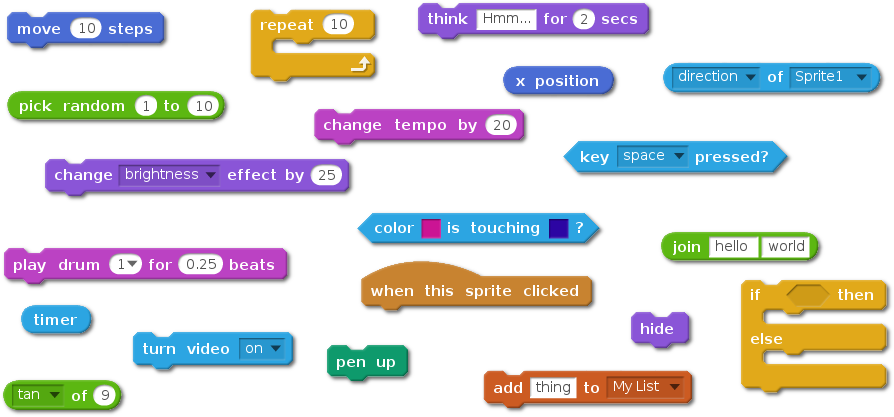
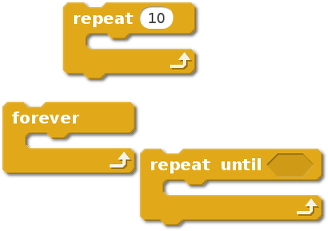
In a new paper titled Remixing as a pathway to Computational Thinking that was recently published at the ACM Conference on Computer Supported Collaborative Work and Social Computing (CSCW) conference, we used a series of quantitative measures of online behavior to try to uncover evidence that might support the theory that remixing in Scratch is positively associated with learning. scratchblocksOf course, because Scratch is an informal environment with no set path for users, no lesson plan, and no quizzes, measuring learning is an open problem. In our study, we built on two different approaches to measure learning in Scratch. The first approach considers the number of distinct types of programming blocks available in Scratch that a user has used over her lifetime in Scratch (there are 120 in total) something that can be thought of as a block repertoire or vocabulary. This measure has been used to model informal learning in Scratch in an earlier study. Using this approach, we hypothesized that users who remix more will have a faster rate of growth for their code vocabulary. Controlling for a number of factors (e.g. age of user, the general level of activity) we found evidence of a small, but positive relationship between the number of remixes a user has shared and her block vocabulary as measured by the unique blocks she used in her non-remix projects. Intriguingly, we also found a strong association between the number of downloads by a user and her vocabulary growth. One interpretation is that this learning might also be associated with less active forms of appropriation, like the process of reading source code described by Minksy. The second approach we used considered specific concepts in programming, such as loops, or event-handling. To measure this, we utilized a mapping of Scratch blocks to key programming concepts found in this paper by Karen Brennan and Mitchel Resnick. For example, in the image below are all the Scratch blocks mapped to the concept of loop . scratchblocksctWe looked at six concepts in total (conditionals, data, events, loops, operators, and parallelism). In each case, we hypothesized that if someone has had never used a given concept before, they would be more likely to use that concept after encountering it while remixing an existing project. Using this second approach, we found that users who had never used a concept were more likely to do so if they had been exposed to the concept through remixing. Although some concepts were more widely used than others, we found a positive relationship between concept use and exposure through remixing for each of the six concepts. We found that this relationship was true even if we ignored obvious examples of cutting and pasting of blocks of code. In all of these models, we found what we believe is evidence of learning through remixing. Of course, there are many limitations in this work. What we found are all positive correlations we do not know if these relationships are causal. Moreover, our measures do not really tell us whether someone has understood the usage of a given block or programming concept.However, even with these limitations, we are excited by the results of our work, and we plan to build on what we have. Our next steps include developing and utilizing better measures of learning, as well as looking at other methods of appropriation like viewing the source code of a project.

This blog post and the paper it describes are collaborative work with Sayamindu Dasgupta, Andr s Monroy-Hern ndez, and William Hale. The paper is released as open access so anyone can read the entire paper here. This blog post was also posted on Sayamindu Dasgupta s blog and on Medium by the MIT Media Lab.

3 July 2016

Petter Reinholdtsen: How to use the Signal app if you only have a land line (ie no mobile phone)

For a while now, I have wanted to test the Signal app, as it is said to provide end to end encrypted communication and several of my friends and family are already using it. As I by choice do not own a mobile phone, this proved to be harder than expected. And I wanted to have the source of the client and know that it was the code used on my machine. But yesterday I managed to get it working. I used the Github source, compared it to the source in the Signal Chrome app available from the Chrome web store, applied patches to use the production Signal servers, started the app and asked for the hidden "register without a smart phone" form. Here is the recipe how I did it. First, I fetched the Signal desktop source from Github, using
git clone https://github.com/WhisperSystems/Signal-Desktop.git
Next, I patched the source to use the production servers, to be able to talk to other Signal users:
cat <<EOF   patch -p0
diff -ur ./js/background.js userdata/Default/Extensions/bikioccmkafdpakkkcpdbppfkghcmihk/0.15.0_0/js/background.js
--- ./js/background.js  2016-06-29 13:43:15.630344628 +0200
+++ userdata/Default/Extensions/bikioccmkafdpakkkcpdbppfkghcmihk/0.15.0_0/js/background.js    2016-06-29 14:06:29.530300934 +0200
@@ -47,8 +47,8 @@
          );
      );
 
-    var SERVER_URL = 'https://textsecure-service-staging.whispersystems.org';
-    var ATTACHMENT_SERVER_URL = 'https://whispersystems-textsecure-attachments-staging.s3.amazonaws.com';
+    var SERVER_URL = 'https://textsecure-service-ca.whispersystems.org:4433';
+    var ATTACHMENT_SERVER_URL = 'https://whispersystems-textsecure-attachments.s3.amazonaws.com';
     var messageReceiver;
     window.getSocketStatus = function()  
         if (messageReceiver)  
diff -ur ./js/expire.js userdata/Default/Extensions/bikioccmkafdpakkkcpdbppfkghcmihk/0.15.0_0/js/expire.js
--- ./js/expire.js      2016-06-29 13:43:15.630344628 +0200
+++ userdata/Default/Extensions/bikioccmkafdpakkkcpdbppfkghcmihk/0.15.0_0/js/expire.js2016-06-29 14:06:29.530300934 +0200
@@ -1,6 +1,6 @@
 ;(function()  
     'use strict';
-    var BUILD_EXPIRATION = 0;
+    var BUILD_EXPIRATION = 1474492690000;
 
     window.extension = window.extension    ;
 
EOF
The first part is changing the servers, and the second is updating an expiration timestamp. This timestamp need to be updated regularly. It is set 90 days in the future by the build process (Gruntfile.js). The value is seconds since 1970 times 1000, as far as I can tell. Based on a tip and good help from the #nuug IRC channel, I wrote a script to launch Signal in Chromium.
#!/bin/sh
cd $(dirname $0)
mkdir -p userdata
exec chromium \
  --proxy-server="socks://localhost:9050" \
  --user-data-dir= pwd /userdata --load-and-launch-app= pwd 
The script start the app and configure Chromium to use the Tor SOCKS5 proxy to make sure those controlling the Signal servers (today Amazon and Whisper Systems) as well as those listening on the lines will have a harder time location my laptop based on the Signal connections if they use source IP address. When the script starts, one need to follow the instructions under "Standalone Registration" in the CONTRIBUTING.md file in the git repository. I right clicked on the Signal window to get up the Chromium debugging tool, visited the 'Console' tab and wrote 'extension.install("standalone")' on the console prompt to get the registration form. Then I entered by land line phone number and pressed 'Call'. 5 seconds later the phone rang and a robot voice repeated the verification code three times. After entering the number into the verification code field in the form, I could start using Signal from my laptop. As far as I can tell, The Signal app will leak who is talking to whom and thus who know who to those controlling the central server, but such leakage is hard to avoid with a centrally controlled server setup. It is something to keep in mind when using Signal - the content of your chats are harder to intercept, but the meta data exposing your contact network is available to people you do not know. So better than many options, but not great. And sadly the usage is connected to my land line, thus allowing those controlling the server to associate it to my home and person. I would prefer it if only those I knew could tell who I was on Signal. There are options avoiding such information leakage, but most of my friends are not using them, so I am stuck with Signal for now.

2 July 2016

Jonathan Carter: So, that was DebCamp16!

Picture: Adrian Frith

University of Cape Town, host location to DebConf 16. Picture: Adrian Frith

What an amazingly quick week that was Our bid to host DebConf in Cape Town was accepted nearly 15 months ago. And before that, the bid itself was a big collective effort from our team. So it s almost surreal that the first half of the two weeks of DebCamp/DebConf is now over. Things have been going really well. The few problems we ve had so far were too small to even mention. It s a few degrees colder than it usually is this time of the year and there s already snow on the mountains, so Cape Town is currently quite chilly.
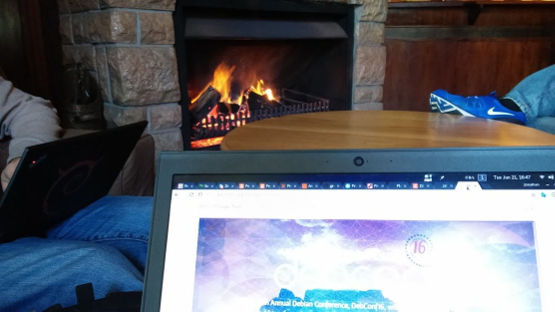
Hacking by the fire at the sports club

Gathering some heat by the fire at the sports club while catching up to the world the day before it all started.

All Kinds of Quality Time I really enjoyed working with the video team last year, but this year there was just 0 time for that. Working on the orga team means dealing with a constant torrent of small tasks, which is good in its own way because you get to deal with a wide variety of Debian people you might not usually get to interact with, but video team problems are more fun and interesting. Next year I hope to do a lot more video work again. If you re at DebConf over the next week, I can highly recommend that you get involved!
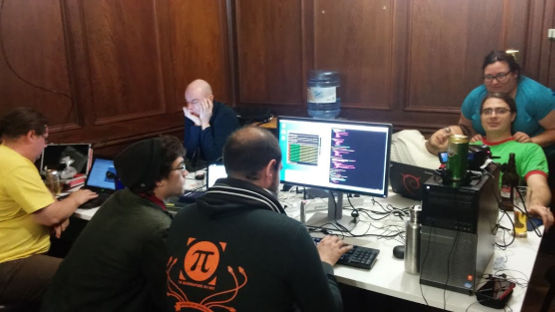
Video team hacking away at problems

Video team members hacking away at problems late at night during DebCamp

The first time I met Debian folk was early in 2004. I worked at the Shuttleworth Foundation as Open Source Technical Co-ordinator at the time, and Mark Shuttleworth had them over for one of the early Ubuntu sprints in Canonical s early days. I was so intimidated by them back then that I could hardly even manage to speak to them. I was already a big free software fan before working there, but little did I even dream to think that I would one day be involved in a project like Ubuntu or Debian. My manager back then encouraged me to go talk to them and get involved and become a Debian Developer and joked that I should become highvoltage@debian.org. I guess that was when the initial seeds got planted and since then I ve met many great people all over the world who have even became friends during UDS, DebConf, BTS and other hackfests where Debianites hang out. It gave me a really nice warm feeling to have all these amazing, talented and really friendly people from all over coming together in this little corner of the world to work together on projects that I think are really important.
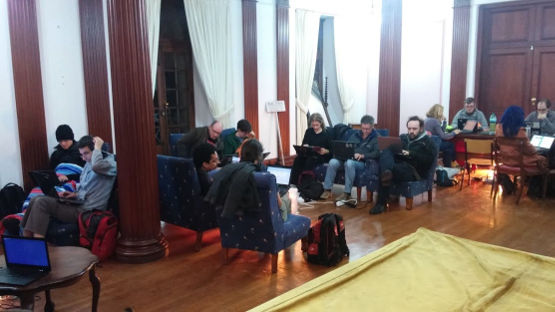
Finding a warm space to work in the Happy Feet hack lab

Finding a warm space to work in the Happy Feet hack lab

Oh the Chicken Back at DebConf12, someone (I don t remember the exact history) brought a rubber chicken to DebConf who was simply called Pollito ( chicken in Spanish). Since then the chicken has grown into somewhat of a mascot for DebConf. Back in 2012 I already imagined that if we would ever host a DebConf, I d make a little of picture book story about Pollito. Last year after DC15, when bringing Pollito over, I created a little story called Pollito s first trip to Africa . I was recovering from flu while putting that together and didn t spend much time on it, but it turned out to be somewhat of a hit. I was surprised to see it in the #debconf topic ever since I posted it :) We gave a tour of the campus on the first and second days and it was quite time consuming and there was no way we could do it every day for the rest of DebCamp, so on the 2nd day I smacked together a new rush job called Pollito s Guide to DC16 . The idea was that newcommers could use it as a visual guide and rely on others who have been there for a while if they get stuck. I wish I had the time to make it a lot nicer, but I think the general idea is good and next year we can have a much nicer one that might not be quite as Pollito focused.

Pollito's Guide to DC16

Pollito s Guide to DC16

Debian Maintainer After all these years, I finally sat down and applied to become a Debian Maintainer, and the application was successful (approved yesterday \o/). Now just for the wait until my key is uploaded to the keyring. I haven t yet had time to properly process this but I think once the DebConf dust settles and I had some time to recover, I will be ecstatic. Some actual DebCampy work Everywhere I go, I see people installing a bunch of GNOME extensions on their Debian GNOME desktops shortly after installation using http://extensions.gnome.org/ (I noticed this even at DebCamp!). A few months ago I thought that it s really about time someone package up some of the really popular ones. So I started to put together some basic packaging for AIMS Desktop around a month ago. During the last few days of DebCamp, things were going well enough with the organisational tasks that I had some time to do some actual packaging work and improve these so that they re ready for upload to the Debian archives. The little DebCamp time I had ended up being my very own little extension fest :) I worked on the following packages which are ready for upload: I worked on the following packages which still need minor work, might be able to get them in uploadable state by the end of DebConf: The actual packaging of GNOME extensions is actually pretty trivial. It s mostly source-only JavaScript with some CSS and translations and maybe some gsettings schemas and dialogs. Or at least, it would be pretty trivial, but many extensions are without licenses, contain embedded code (often JavaScript) from other projects, or have no usable form of upstream tarball, to name a few of the problems. So I ve been contacting the upstream authors of these packages where there have been problems, and for the most part they ve been friendly and pretty quick to address the problems. So that s it, for now. I couldn t possibly sum up the last week and everything that lead up to it in a single blog post. All I can really say is thank you for letting me be a part of this very special project!

1 July 2016

Elena 'valhalla' Grandi: Busy/idle status indicator

Busy/idle status indicator


About one year ago, during my first http://debconf15.debconf.org/, I've felt the need for some way to tell people whether I was busy on my laptop doing stuff that required concentration or just passing some time between talks etc. and available for interruptions, socialization or context switches.

One easily available method of course would have been to ping me on IRC (and then probably go on chatting on it while being in the same room, of course :) ), but I wanted to try something that allowed for less planning and worked even in places with less connectivity.

My first idea was a base laptop sticker with two statuses and then a removable one used to cover the wrong status and point to the correct one, and I still think it would be nice, but having it printed is probably going to be somewhat expensive, so I shelved the project for the time being.

Immagine/foto

Lately, however, I've been playing with hexagonal stickers https://terinjokes.github.io/StickerConstructorSpec/ and decided to design something on this topic, whith the result in the figure above, with the hacking sticker being my first choice, and the concentrating alternative probably useful while surrounded by people who may misunderstand the term hacking .

While idly looking around for sticker printing prices I realized that it didn't necessarly have to be a sticker and started to consider alternatives.

One format I'm trying is inspired by "do not disturb" door signs: I've used some laminating pouches I already had around which are slightly bigger than credit-card format (but credit-card size would also work of course ) and cut a notch so that they can be attached to the open lid of a laptop.

Immagine/fotoImmagine/foto

They seem to fit well on my laptop lid, and apart from a bad tendency to attract every bit of lint in a radius of a few meters the form factor looks good. I'll try to use them at the next conference to see if they actually work for their intended purpose.

SVG sources (and a PDF) are available on my website http://www.trueelena.org/computers/projects/busy_idle_indicator.html under the CC-BY-SA license.

30 June 2016

Steve Kemp: So I've been busy.

The past few days I've been working on my mail client which has resulted in a lot of improvements to drawing, display and correctness. Since then I've been working on adding GPG-support. My naive attempt was to extract the signature, and the appropriate body-part from the message. Write them both to disk then I could validate via:
gpg --verify msg.sig msg
However that failed, and it took me a long to work out why. I downloaded the source to mutt, which can correctly verify an attached-signature, then hacked lib.c to neuter the mutt_unlink function. That left me with a bunch of files inside $TEMPFILE one of which provided the epiphany. A message which is to be validated is indeed written out to disk, just as I would have done, as is the signature. Ignoring the signature the message is interesting:
Content-Type: text/plain; charset=UTF-8
Content-Transfer-Encoding: quoted-printable
On Mon, 27 Jun 2016 08:08:14 +0200
...
--=20
Bob Smith
The reason I'd failed to validate my message-body was because I'd already decoded the text of the MIME-part, and I'd also lost the prefixed two lines "Content-type:.." and Content-Transfer:.... I'm currently trying to work out if it is possible to get access to the RAW MIME-part-text in GMIME. Anyway that learning aside I've made a sleazy hack which just shells out to mimegpg, and this allows me to validate GPG signatures! That's not the solution I'd prefer, but that said it does work, and it works with inline-signed messages as well as messages with application/pgp-signature MIME-parts. Changing the subject now. I wonder how many people read to the end anyway? I've been in Finland for almost a year now. Recently I was looking over websites and I saw that the domain steve.fi was going to expire in a few weeks. So I started obsessively watching it. Today I claimed it. So I'll be slowly moving things from beneath steve.org.uk to use the new home steve.fi. I also setup a mini-portfolio/reference site at http://steve.kemp.fi/ - which was a domain I registered while I was unsure if I could get steve.fi. Finally now is a good time to share more interesting news:

Steve Kemp: So I've been busy.

The past few days I've been working on my mail client which has resulted in a lot of improvements to drawing, display and correctness. Since then I've been working on adding GPG-support. My naive attempt was to extract the signature, and the appropriate body-part from the message. Write them both to disk then I could validate via:
gpg --verify msg.sig msg
However that failed, and it took me a long to work out why. I downloaded the source to mutt, which can correctly verify an attached-signature, then hacked lib.c to neuter the mutt_unlink function. That left me with a bunch of files inside $TEMPFILE one of which provided the epiphany. A message which is to be validated is indeed written out to disk, just as I would have done, as is the signature. Ignoring the signature the message is interesting:
Content-Type: text/plain; charset=UTF-8
Content-Transfer-Encoding: quoted-printable
On Mon, 27 Jun 2016 08:08:14 +0200
...
--=20
Bob Smith
The reason I'd failed to validate my message-body was because I'd already decoded the text of the MIME-part, and I'd also lost the prefixed two lines "Content-type:.." and Content-Transfer:.... I'm currently trying to work out if it is possible to get access to the RAW MIME-part-text in GMIME. Anyway that learning aside I've made a sleazy hack which just shells out to mimegpg, and this allows me to validate GPG signatures! That's not the solution I'd prefer, but that said it does work, and it works with inline-signed messages as well as messages with application/pgp-signature MIME-parts. Changing the subject now. I wonder how many people read to the end anyway? I've been in Finland for almost a year now. Recently I was looking over websites and I saw that the domain steve.fi was going to expire in a few weeks. So I started obsessively watching it. Today I claimed it. So I'll be slowly moving things from beneath steve.org.uk to use the new home steve.fi. I also setup a mini-portfolio/reference site at http://steve.kemp.fi/ - which was a domain I registered while I was unsure if I could get steve.fi. Finally now is a good time to share more interesting news:

Steve Kemp: So I've been busy.

The past few days I've been working on my mail client which has resulted in a lot of improvements to drawing, display and correctness. Since then I've been working on adding GPG-support. My naive attempt was to extract the signature, and the appropriate body-part from the message. Write them both to disk then I could validate via:
gpg --verify msg.sig msg
However that failed, and it took me a long to work out why. I downloaded the source to mutt, which can correctly verify an attached-signature, then hacked lib.c to neuter the mutt_unlink function. That left me with a bunch of files inside $TEMPFILE one of which provided the epiphany. A message which is to be validated is indeed written out to disk, just as I would have done, as is the signature. Ignoring the signature the message is interesting:
Content-Type: text/plain; charset=UTF-8
Content-Transfer-Encoding: quoted-printable
On Mon, 27 Jun 2016 08:08:14 +0200
...
--=20
Bob Smith
The reason I'd failed to validate my message-body was because I'd already decoded the text of the MIME-part, and I'd also lost the prefixed two lines "Content-type:.." and Content-Transfer:.... I'm currently trying to work out if it is possible to get access to the RAW MIME-part-text in GMIME. Anyway that learning aside I've made a sleazy hack which just shells out to mimegpg, and this allows me to validate GPG signatures! That's not the solution I'd prefer, but that said it does work, and it works with inline-signed messages as well as messages with application/pgp-signature MIME-parts. Changing the subject now. I wonder how many people read to the end anyway? I've been in Finland for almost a year now. Recently I was looking over websites and I saw that the domain steve.fi was going to expire in a few weeks. So I started obsessively watching it. Today I claimed it. So I'll be slowly moving things from beneath steve.org.uk to use the new home steve.fi. I also setup a mini-portfolio/reference site at http://steve.kemp.fi/ - which was a domain I registered while I was unsure if I could get steve.fi. Finally now is a good time to share more interesting news:

26 June 2016

Niels Thykier: Anti-declarative packaging top 15 build-helpers inserting maintscripts

Debian packages can run arbitrary code via maintainer scripts (sometimes shortened into maintscripts ) during installation/removal etc. While they certainly have their use cases, their failure modes causes exciting bugs like fails to install or the dreaded fails to remove . They also have other undesirable effects such as: Accordingly, I think we should aim for a more declarative packaging style. To help facilitate this, I have implemented 3 tracking tags in Lintian. With these, we were able to learn that 73.5% of all packages do not have any of these scripts. But I can now also produce a list of helpers that insert the most maintainer script snippets. The current top 15 is:
  1. dhpython with 3775 instances
    • This is an umbrella for all helpers using dh-python s python module, see #827774.
  2. dh_installmenu with 1861 instances
  3. dh_makeshlibs with 1396 remaining instances
  4. dh_installinit with 1224 instances
  5. dh_python2 with 1168 instances
  6. dh_installdebconf with 772 instances
  7. dh_installdeb with 754 instances
    • These are the dpkg-maintscript-helper snippets for rm_conffile , mv_conffile etc. Hopefully in the near future, dpkg will support these directly.
  8. dh_systemd_enable with 447 instances
  9. dh_installemacsen with 179 instances
  10. dh_icons with 165 instances
  11. dh_installtex with 137 instances
  12. dh_apache2 with 117 instances
  13. dh_installudev with 98 instances
  14. dh_installxfonts with 87 instances
  15. dh_systemd_start with 79 instances
With this list, it seems to me that some obvious focus areas would be: Eventually we will also have to dig through all the manual maintainer scripts. But I think we got plenty to start with.:) [1] For some, circular dependencies in itself is an issue. I can certainly appreciate them as being suboptimal, but most of the issues we have are probably caused by insufficient tooling rather than a theoretical issue (that is, if we remove all postinst scripts).
Filed under: Debhelper, Debian, Lintian

21 June 2016

Reproducible builds folks: Reproducible builds: week 60 in Stretch cycle

What happened in the Reproducible Builds effort between June 12th and June 18th 2016: Media coverage GSoC and Outreachy updates Weekly reports by our participants: Toolchain fixes With this upload of texlive-bin we decided to stop keeping our patched fork of as most of the patches for SOURCE_DATE_EPOCH support had been integrated upstream already, and the last one (making FORCE_SOURCE_DATE default to 1) had been refused. So, we are now going to let the archive be rebuilt against unstable's texlive-bin and see how many packages will become unreproducible with this change; once enough data will be collected we will ponder whether FORCE_SOURCE_DATE should be exported by helper tools (such as debhelper) or manually exported by every package that needs it. (For those wondering: we still recommend to follow SOURCE_DATE_EPOCH always and don't recommend other projects to implement FORCE_SOURCE_DATE ) With the drop of texlive-bin we now have only three modified packages in our experimental repository. Reproducible work in other projects Packages fixed The following 12 packages have become reproducible due to changes in their build dependencies: django-floppyforms flask-restful hy jets3t kombu llvm-toolchain-3.8 moap python-bottle python-debtcollector python-django-debug-toolbar python-osprofiler stevedore The following packages have become reproducible after being fixed: Some uploads have fixed some reproducibility issues, but not all of them: Uploads with reproducibility fixes that currently fail to build: Patches submitted that have not made their way to the archive yet: Package reviews 36 reviews have been added, 12 have been updated and 31 have been removed in this week. 17 FTBFS bugs have been reported by Chris Lamb, Santiago Vila and Dominic Hargreaves. diffoscope development Satyam worked on argument completion (#826711) for diffoscope. strip-nondeterminism development Mattia Rizzolo uploaded strip-nondeterminism 0.019-1~bpo8+1 to jessie-backports. reprotest development Ceridwen filed an Intent To Package (ITP) bug for reprotest as #827293. tests.reproducible-builds.org Misc. This week's edition was written by Mattia Rizzolo, Reiner Herrmann, Ed Maste and Holger Levsen and reviewed by a bunch of Reproducible builds folks on IRC.

20 June 2016

Valerie Young: Week 2 on Reproducible Builds

Here is a small update for last week s work: 1. Templates tests.reproducible-builds.org now has a templating system, instead of writing HTML in python files  We are using mustache with pystache. So far, only the html for the package pages have been converted. 2. Navigation improvements on package pages While converting the package pages to using mustache I also rearranged the navigation bar, adding sections and hover text. Navigation improvements inspired by Gerts Wollney s email requests. Please check out the changes and provide feedback: tests.reproducible-builds.org/<your-favorite-package> 3. Began converting script from bash to python Before converting the rest of the site to mustache, I spent a day digging into the last unconverted bash script (all other html producing scripts are python). I ve never written or read that much bash, yet another learning opportunity I have to admit it s a bit less intuitive than python  Up next: Finish converting package set script, create more mustache templates, more site improvements! Then fly to South Africa.

19 June 2016

Elena 'valhalla' Grandi: StickerConstructorSpec compliant swirl

StickerConstructorSpec compliant swirl

This evening I've played around a bit with the Sticker Constructor Specification https://github.com/terinjokes/StickerConstructorSpec and its https://github.com/terinjokes/StickerConstructorSpec/blob/master/assets/hexagonal-sticker_template.svg, and this is the result:

Immagine/fotohttp://social.gl-como.it/photos/valhalla/image/e8ee069635b2823e168c358d2a753f14


Now I just have to:

* find somebody in Europe who prints good stickers and doesn't require illustrator (or other proprietary software) to submit files for non-rectangular shapes
* find out which Debian team I should contact to submit the files so that they can be used by everybody interested.

But neither will happen today, nor probably tomorrow, because lazy O:-)

Edit: now that I'm awake I realized I forgot to thank @Enrico Zini Zini and MadameZou for their help in combining my two proposals in a better design.

Source svg http://social.gl-como.it/attach/3

24 May 2016

Thorsten Alteholz: Debian and the Internet of Things

Everybody is talking about the Internet of Things. Unfortunately there is no sign of it in Debian yet. Besides some smaller packages like sispmctl, usbrelay or the 1-wire support in digitemp and owfs, there is not much software to control devices over a network. With the recent upload of alljoyn-core-1504 this might change. The Alljoyn Framework, where the Alljoyn Core is just one of several modules, lets devices and applications detect each other and communicate with one another over a D-Bus like message bus. The development of the framework has been started by Qualcomm some years ago and is meanwhile managed by the AllSeen Alliance, a nonprofit consortium. The software is licensed under the ISC license. This first upload is just the first step of a long journey. Other modules that compose the framework and already have a released tarball are related to lightning products, gateways to overcome the boundaries of the local network and much more. In the near future it is also planned to have modules that attach Z-Wave-, ZigBee- or Bluetooth-devices to the Alljoyn bus. So all in all, this looks like an exciting task and everybody is invited to help maintaining the software in Debian.

12 May 2016

Ingo Juergensmann: Xen randomly crashing server - part 2

Some weeks ago I blogged about "Xen randomly crashing server". The problem back then was that I couldn't get any information why the server reboots. Using a netconsole was not possible, because netconsole refused to work with the bridge that is used for Xen networking. Luckily my colocation partner rrbone.net connected the second network port of my server to the network so that I could use eth1 instead of the bridged eth0 for netconsole. Today the server crashed several times and I was able to collect some more information than just the screenshots from IPMI/KVM console as shown in my last blog entry (full netconsole output is attached as a file):
May 12 11:56:39 31.172.31.251 [829681.040596] CPU: 0 PID: 0 Comm: swapper/0 Not tainted 3.16.0-4-amd64 #1 Debian 3.16.7-ckt25-2
May 12 11:56:39 31.172.31.251 [829681.040647] Hardware name: Supermicro X9SRE/X9SRE-3F/X9SRi/X9SRi-3F/X9SRE/X9SRE-3F/X9SRi/X9SRi-3F, BIOS 3.0a 01/03/2014
May 12 11:56:39 31.172.31.251 [829681.040701] task: ffffffff8181a460 ti: ffffffff81800000 task.ti: ffffffff81800000
May 12 11:56:39 31.172.31.251 [829681.040749] RIP: e030:[<ffffffff812b7e56>]
May 12 11:56:39 31.172.31.251 [<ffffffff812b7e56>] memcpy+0x6/0x110
May 12 11:56:39 31.172.31.251 [829681.040802] RSP: e02b:ffff880280e03a58 EFLAGS: 00010286
May 12 11:56:39 31.172.31.251 [829681.040834] RAX: ffff88026eec9070 RBX: ffff88023c8f6b00 RCX: 00000000000000ee
May 12 11:56:39 31.172.31.251 [829681.040880] RDX: 00000000000004a0 RSI: ffff88006cd1f000 RDI: ffff88026eec9422
May 12 11:56:39 31.172.31.251 [829681.040927] RBP: ffff880280e03b38 R08: 00000000000006c0 R09: ffff88026eec9062
May 12 11:56:39 31.172.31.251 [829681.040973] R10: 0100000000000000 R11: 00000000af9a2116 R12: ffff88023f440d00
May 12 11:56:39 31.172.31.251 [829681.041020] R13: ffff88006cd1ec66 R14: ffff88025dcf1cc0 R15: 00000000000004a8
May 12 11:56:39 31.172.31.251 [829681.041075] FS: 0000000000000000(0000) GS:ffff880280e00000(0000) knlGS:ffff880280e00000
May 12 11:56:39 31.172.31.251 [829681.041124] CS: e033 DS: 0000 ES: 0000 CR0: 0000000080050033
May 12 11:56:39 31.172.31.251 [829681.041153] CR2: ffff88006cd1f000 CR3: 0000000271ae8000 CR4: 0000000000042660
May 12 11:56:39 31.172.31.251 [829681.041202] Stack:
May 12 11:56:39 31.172.31.251 [829681.041225] ffffffff814d38ff
May 12 11:56:39 31.172.31.251 ffff88025b5fa400
May 12 11:56:39 31.172.31.251 ffff880280e03aa8
May 12 11:56:39 31.172.31.251 9401294600a7012a
May 12 11:56:39 31.172.31.251
May 12 11:56:39 31.172.31.251 [829681.041287] 0100000000000000
May 12 11:56:39 31.172.31.251 ffffffff814a000a
May 12 11:56:39 31.172.31.251 000000008181a460
May 12 11:56:39 31.172.31.251 00000000000080fe
May 12 11:56:39 31.172.31.251
May 12 11:56:39 31.172.31.251 [829681.041346] 1ad902feff7ac40e
May 12 11:56:39 31.172.31.251 ffff88006c5fd980
May 12 11:56:39 31.172.31.251 ffff224afc3e1600
May 12 11:56:39 31.172.31.251 ffff88023f440d00
May 12 11:56:39 31.172.31.251
May 12 11:56:39 31.172.31.251 [829681.041407] Call Trace:
May 12 11:56:39 31.172.31.251 [829681.041435] <IRQ>
May 12 11:56:39 31.172.31.251
May 12 11:56:39 31.172.31.251 [829681.041441]
May 12 11:56:39 31.172.31.251 [<ffffffff814d38ff>] ? ndisc_send_redirect+0x3bf/0x410
May 12 11:56:39 31.172.31.251 [829681.041506] [<ffffffff814a000a>] ? ipmr_device_event+0x7a/0xd0
May 12 11:56:39 31.172.31.251 [829681.041548] [<ffffffff814bc74c>] ? ip6_forward+0x71c/0x850
May 12 11:56:39 31.172.31.251 [829681.041585] [<ffffffff814c9e54>] ? ip6_route_input+0xa4/0xd0
May 12 11:56:39 31.172.31.251 [829681.041621] [<ffffffff8141f1a3>] ? __netif_receive_skb_core+0x543/0x750
May 12 11:56:39 31.172.31.251 [829681.041729] [<ffffffff8141f42f>] ? netif_receive_skb_internal+0x1f/0x80
May 12 11:56:39 31.172.31.251 [829681.041771] [<ffffffffa0585eb2>] ? br_handle_frame_finish+0x1c2/0x3c0 [bridge]
May 12 11:56:39 31.172.31.251 [829681.041821] [<ffffffffa058c757>] ? br_nf_pre_routing_finish_ipv6+0xc7/0x160 [bridge]
May 12 11:56:39 31.172.31.251 [829681.041872] [<ffffffffa058d0e2>] ? br_nf_pre_routing+0x562/0x630 [bridge]
May 12 11:56:39 31.172.31.251 [829681.041907] [<ffffffffa0585cf0>] ? br_handle_local_finish+0x80/0x80 [bridge]
May 12 11:56:39 31.172.31.251 [829681.041955] [<ffffffff8144fb65>] ? nf_iterate+0x65/0xa0
May 12 11:56:39 31.172.31.251 [829681.041987] [<ffffffffa0585cf0>] ? br_handle_local_finish+0x80/0x80 [bridge]
May 12 11:56:39 31.172.31.251 [829681.042035] [<ffffffff8144fc16>] ? nf_hook_slow+0x76/0x130
May 12 11:56:39 31.172.31.251 [829681.042067] [<ffffffffa0585cf0>] ? br_handle_local_finish+0x80/0x80 [bridge]
May 12 11:56:39 31.172.31.251 [829681.042116] [<ffffffffa0586220>] ? br_handle_frame+0x170/0x240 [bridge]
May 12 11:56:39 31.172.31.251 [829681.042148] [<ffffffff8141ee24>] ? __netif_receive_skb_core+0x1c4/0x750
May 12 11:56:39 31.172.31.251 [829681.042185] [<ffffffff81009f9c>] ? xen_clocksource_get_cycles+0x1c/0x20
May 12 11:56:39 31.172.31.251 [829681.042217] [<ffffffff8141f42f>] ? netif_receive_skb_internal+0x1f/0x80
May 12 11:56:39 31.172.31.251 [829681.042251] [<ffffffffa063f50f>] ? xenvif_tx_action+0x49f/0x920 [xen_netback]
May 12 11:56:39 31.172.31.251 [829681.042299] [<ffffffffa06422f8>] ? xenvif_poll+0x28/0x70 [xen_netback]
May 12 11:56:39 31.172.31.251 [829681.042331] [<ffffffff8141f7b0>] ? net_rx_action+0x140/0x240
May 12 11:56:39 31.172.31.251 [829681.042367] [<ffffffff8106c6a1>] ? __do_softirq+0xf1/0x290
May 12 11:56:39 31.172.31.251 [829681.042397] [<ffffffff8106ca75>] ? irq_exit+0x95/0xa0
May 12 11:56:39 31.172.31.251 [829681.042432] [<ffffffff8135a285>] ? xen_evtchn_do_upcall+0x35/0x50
May 12 11:56:39 31.172.31.251 [829681.042469] [<ffffffff8151669e>] ? xen_do_hypervisor_callback+0x1e/0x30
May 12 11:56:39 31.172.31.251 [829681.042499] <EOI>
May 12 11:56:39 31.172.31.251
May 12 11:56:39 31.172.31.251 [829681.042506]
May 12 11:56:39 31.172.31.251 [<ffffffff810013aa>] ? xen_hypercall_sched_op+0xa/0x20
May 12 11:56:39 31.172.31.251 [829681.042561] [<ffffffff810013aa>] ? xen_hypercall_sched_op+0xa/0x20
May 12 11:56:39 31.172.31.251 [829681.042592] [<ffffffff81009e7c>] ? xen_safe_halt+0xc/0x20
May 12 11:56:39 31.172.31.251 [829681.042627] [<ffffffff8101c8c9>] ? default_idle+0x19/0xb0
May 12 11:56:39 31.172.31.251 [829681.042666] [<ffffffff810a83e0>] ? cpu_startup_entry+0x340/0x400
May 12 11:56:39 31.172.31.251 [829681.042705] [<ffffffff81903076>] ? start_kernel+0x497/0x4a2
May 12 11:56:39 31.172.31.251 [829681.042735] [<ffffffff81902a04>] ? set_init_arg+0x4e/0x4e
May 12 11:56:39 31.172.31.251 [829681.042767] [<ffffffff81904f69>] ? xen_start_kernel+0x569/0x573
May 12 11:56:39 31.172.31.251 [829681.042797] Code:
May 12 11:56:39 31.172.31.251 <f3>
May 12 11:56:39 31.172.31.251
May 12 11:56:39 31.172.31.251 [829681.043113] RIP
May 12 11:56:39 31.172.31.251 [<ffffffff812b7e56>] memcpy+0x6/0x110
May 12 11:56:39 31.172.31.251 [829681.043145] RSP <ffff880280e03a58>
May 12 11:56:39 31.172.31.251 [829681.043170] CR2: ffff88006cd1f000
May 12 11:56:39 31.172.31.251 [829681.043488] ---[ end trace 1838cb62fe32daad ]---
May 12 11:56:39 31.172.31.251 [829681.048905] Kernel panic - not syncing: Fatal exception in interrupt
May 12 11:56:39 31.172.31.251 [829681.048978] Kernel Offset: 0x0 from 0xffffffff81000000 (relocation range: 0xffffffff80000000-0xffffffff9fffffff)
I'm not that good at reading this kind of output, but to me it seems that ndisc_send_redirect is at fault. When googling for "ndisc_send_redirect" you can find a patch on lkml.org and Debian bug #804079, both seem to be related to IPv6. When looking at the linux kernel source mentioned in the lkml patch I see that this patch is already applied (line 1510):
if (ha)
ndisc_fill_addr_option(buff, ND_OPT_TARGET_LL_ADDR, ha);
So, when the patch was intended to prevent "leading to data corruption or in the worst case a panic when the skb_put failed" it does not help in my case or in the case of #804079. Any tips are appreciated! PS: I'll contribute to that bug in the BTS, of course!
AttachmentSize
syslog-xen-crash.txt24.27 KB
Kategorie:

10 May 2016

Reproducible builds folks: Reproducible builds: week 54 in Stretch cycle

What happened in the Reproducible Builds effort between May 1st and May 7th 2016: Media coverage There has been a surprising tweet last week: "Props to @FiloSottile for his nifty gvt golang tool. We're using it to get reproducible builds for a Zika & West Nile monitoring project." and to our surprise Kenn confirmed privately that he indeed meant "reproducible builds" as in "bit by bit identical builds". Wow. We're looking forward to learn more details about this; for now we just know that they are doing this for software quality reasons basically. Two of the four GSoC and Outreachy participants for Reproducible builds posted their introductions to Planet Debian: Toolchain fixes and other upstream developments dpkg 1.18.5 was uploaded fixing two bugs relevant to us: This upload made it necessary to rebase our dpkg on the version on sid again, which Niko Tyni and Lunar promptly did. Then a few days later 1.18.6 was released to fix a regression in the previous upload, and Niko promptly updated our patched version again. Following this Niko Tyni found #823428: "dpkg: many packages affected by dpkg-source: error: source package uses only weak checksums". Alexis Bienven e worked on tex related packages and SOURCE_DATE_EPOCH: Emmanuel Bourg uploaded jflex/1.4.3+dfsg-2, which removes timestamps from generated files. Packages fixed The following 285 packages have become reproducible due to changes in their build dependencies (mostly from GCC honouring SOURCE_DATE_EPOCH, see the previous week report): 0ad abiword abcm2ps acedb acpica-unix actiona alliance amarok amideco amsynth anjuta aolserver4-nsmysql aolserver4-nsopenssl aolserver4-nssqlite3 apbs aqsis aria2 ascd ascii2binary atheme-services audacity autodocksuite avis awardeco bacula ballerburg bb berusky berusky2 bindechexascii binkd boinc boost1.58 boost1.60 bwctl cairo-dock cd-hit cenon.app chipw ckermit clp clustalo cmatrix coinor-cbc commons-pool cppformat crashmail crrcsim csvimp cyphesis-cpp dact dar darcs darkradiant dcap dia distcc dolphin-emu drumkv1 dtach dune-localfunctions dvbsnoop dvbstreamer eclib ed2k-hash edfbrowser efax-gtk efax exonerate f-irc fakepop fbb filezilla fityk flasm flightgear fluxbox fmit fossil freedink-dfarc freehdl freemedforms-project freeplayer freeradius fxload gdb-arm-none-eabi geany-plugins geany geda-gaf gfm gif2png giflib gifticlib glaurung glusterfs gnokii gnubiff gnugk goaccess gocr goldencheetah gom gopchop gosmore gpsim gputils grcompiler grisbi gtkpod gvpe hardlink haskell-github hashrat hatari herculesstudio hpcc hypre i2util incron infiniband-diags infon ips iptotal ipv6calc iqtree jabber-muc jama jamnntpd janino jcharts joy2key jpilot jumpnbump jvim kanatest kbuild kchmviewer konclude krename kscope kvpnc latexdiff lcrack leocad libace-perl libcaca libcgicc libdap libdbi-drivers libewf libjlayer-java libkcompactdisc liblscp libmp3spi-java libpwiz librecad libspin-java libuninum libzypp lightdm-gtk-greeter lighttpd linpac lookup lz4 lzop maitreya meshlab mgetty mhwaveedit minbif minc-tools moc mrtrix mscompress msort mudlet multiwatch mysecureshell nifticlib nkf noblenote nqc numactl numad octave-optim omega-rpg open-cobol openmama openmprtl openrpt opensm openvpn openvswitch owx pads parsinsert pcb pd-hcs pd-hexloader pd-hid pd-libdir pear-channels pgn-extract phnxdeco php-amqp php-apcu-bc php-apcu php-solr pidgin-librvp plan plymouth pnscan pocketsphinx polygraph portaudio19 postbooks-updater postbooks powertop previsat progressivemauve puredata-import pycurl qjackctl qmidinet qsampler qsopt-ex qsynth qtractor quassel quelcom quickplot qxgedit ratpoison rlpr robojournal samplv1 sanlock saods9 schism scorched3d scummvm-tools sdlbasic sgrep simh sinfo sip-tester sludge sniffit sox spd speex stimfit swarm-cluster synfig synthv1 syslog-ng tart tessa theseus thunar-vcs-plugin ticcutils tickr tilp2 timbl timblserver tkgate transtermhp tstools tvoe ucarp ultracopier undbx uni2ascii uniutils universalindentgui util-vserver uudeview vfu virtualjaguar vmpk voms voxbo vpcs wipe x264 xcfa xfrisk xmorph xmount xyscan yacas yasm z88dk zeal zsync zynaddsubfx Last week the 1000th bug usertagged "reproducible" was fixed! This means roughly 2 bugs per day since 2015-01-01. Kudos and huge thanks to everyone involved! Please also note: FTBFS packages have not been counted here and there are still 600 open bugs with reproducible patches provided. Please help bringing that number down to 0! The following packages have become reproducible after being fixed: Some uploads have fixed some reproducibility issues, but not all of them: Uploads which fix reproducibility issues, but currently FTBFS: Patches submitted that have not made their way to the archive yet: Package reviews 54 reviews have been added, 6 have been updated and 44 have been removed in this week. 18 FTBFS bugs have been reported by Chris Lamb, James Cowgill and Niko Tyni. diffoscope development Thanks to Mattia, diffoscope 52~bpo8+1 is available in jessie-backports now. tests.reproducible-builds.org Misc. This week's edition was written by Reiner Herrmann, Holger Levsen and Mattia Rizzolo and reviewed by a bunch of Reproducible builds folks on IRC. Mattia also wrote a small ikiwiki macro for this blog to ease linking reproducible issues, packages in the package tracker and bugs in the Debian BTS.

27 April 2016

Joey Hess: my Shuttleworth Foundation flash grant

Six months ago I received a small grant from the Shuttleworth Foundation with no strings attached other than I should write this blog post about it. That was a nice surprise. The main thing that ended up being supported by the grant was work on Propellor, my configuration management system that is configured by writing Haskell code. I made 11 releases of Propellor in the grant period, with some improvements from me, and lots more from other contributors. The biggest feature that I added to Propellor was LetsEncrypt support. More important than features is making Propellor prevent more classes of mistakes, by creative use of the type system. The biggest improvement in this area was type checking the OSes of Propellor properties, so Propellor can reject host configurations that combine eg, Linux-only and FreeBSD-only properties. Turns out that the same groundwork needed for that is also what's needed to get Propellor to do type-level port conflict detection. I have a branch underway that does that, although it's not quite done yet. The grant also funded some of my work on git-annex. My main funding for git-annex doesn't cover development of the git-annex assistant, so the grant filled in that gap, particularly in updating the assistant to support the git-annex v6 repo format. I've very happy to have received this grant, and with the things it enabled me to work on.

Next.

Previous.