Search Results: "sf"

12 July 2024

Reproducible Builds: Reproducible Builds in June 2024

Welcome to the June 2024 report from the Reproducible Builds project! In our reports, we outline what we ve been up to over the past month and highlight news items in software supply-chain security more broadly. As always, if you are interested in contributing to the project, please visit our Contribute page on our website. Table of contents:
  1. Next Reproducible Builds Summit dates announced

  2. GNU Guix patch review session for reproducibility
  3. New reproducibility-related academic papers
  4. Misc development news
  5. Website updates
  6. Reproducibility testing framework


Next Reproducible Builds Summit dates announced We are very pleased to announce the upcoming Reproducible Builds Summit, set to take place from September 17th 19th 2024 in Hamburg, Germany. We are thrilled to host the seventh edition of this exciting event, following the success of previous summits in various iconic locations around the world, including Venice, Marrakesh, Paris, Berlin and Athens. Our summits are a unique gathering that brings together attendees from diverse projects, united by a shared vision of advancing the Reproducible Builds effort. During this enriching event, participants will have the opportunity to engage in discussions, establish connections and exchange ideas to drive progress in this vital field. Our aim is to create an inclusive space that fosters collaboration, innovation and problem-solving. If you re interesting in joining us this year, please make sure to read the event page which has more details about the event and location. We are very much looking forward to seeing many readers of these reports there.

GNU Guix patch review session for reproducibility Vagrant Cascadian will be holding a Reproducible Builds session as part of the monthly Guix patch review series on July 11th at 17:00 UTC. These online events are intended to encourage everyone everyone becoming a patch reviewer and the goal of reviewing patches is to help Guix project accept contributions while maintaining our quality standards and learning how to do patch reviews together in a friendly hacking session.

Development news In Debian this month, 4 reviews of Debian packages were added, 11 were updated and 14 were removed this month adding to our knowledge about identified issues. Only one issue types was updated, though, explaining that we don t vary the build path anymore.
On our mailing list this month, Bernhard M. Wiedemann wrote that whilst he had previously collected issues that introduce non-determinism he has now moved on to discuss about mitigations , in the sense of how can we avoid whole categories of problem without patching an infinite number of individual packages . In addition, Janneke Nieuwenhuizen announced the release of two versions of GNU Mes. [ ][ ]
In openSUSE news, Bernhard M. Wiedemann published another report for that distribution.

In NixOS, with the 24.05 release out, it was again validated that our minimal ISO is reproducible by building it on a virtual machine with no access to the binary cache.
What s more, we continued to write patches in order to fix specific reproducibility issues, including Bernhard M. Wiedemann writing three patches (for qutebrowser, samba and systemd), Chris Lamb filing Debian bug #1074214 against the fastfetch package and Arnout Engelen proposing fixes to refind and for the Scala compiler [ .
Lastly, diffoscope is our in-depth and content-aware diff utility that can locate and diagnose reproducibility issues. This month, Chris Lamb uploaded two versions (270 and 271) to Debian, and made the following changes as well:
  • Drop Build-Depends on liblz4-tool in order to fix Debian bug #1072575. [ ]
  • Update tests to support zipdetails version 4.004 that is shipped with Perl 5.40. [ ]

Website updates There were a number of improvements made to our website this month, including Akihiro Suda very helpfully making the <h4> elements more distinguishable from the <h3> level [ ][ ] as well as adding a guide for Dockerfile reproducibility [ ]. In addition Fay Stegerman added two tools, apksigcopier and reproducible-apk-tools, to our Tools page.

Reproducibility testing framework The Reproducible Builds project operates a comprehensive testing framework running primarily at tests.reproducible-builds.org in order to check packages and other artifacts for reproducibility. In June, a number of changes were made by Holger Levsen, including:

  • Marking the virt(32 64)c-armhf nodes as down. [ ]
  • Granting a developer access to the osuosl4 node in order to debug a regression on the ppc64el architecture. [ ]
  • Granting a developer access to the osuosl4 node. [ ][ ]
In addition, Mattia Rizzolo re-aligned the /etc/default/jenkins file with changes performed upstream [ ] and changed how configuration files are handled on the rb-mail1 host. [ ], whilst Vagrant Cascadian documented the failure of the virt32c and virt64c nodes after initial investigation [ ].

If you are interested in contributing to the Reproducible Builds project, please visit our Contribute page on our website. However, you can get in touch with us via:

Russ Allbery: Review: The Splinter in the Sky

Review: The Splinter in the Sky, by Kemi Ashing-Giwa
Publisher: Saga Press
Copyright: July 2023
ISBN: 1-6680-0849-1
Format: Kindle
Pages: 372
The Splinter in the Sky is a stand-alone science fiction political thriller. It is Kemi Ashing-Giwa's first novel. Enitan is from Koriko, a vegetation-heavy moon colonized by the Vaalbaran empire. She lives in the Ijebu community with her sibling Xiang and has an on-again, off-again relationship with Ajana, the Vaalbaran-appointed governor. Xiang is studying to be an architect, which requires passing stringent entrance exams to be allowed to attend an ancillary imperial school intended for "primitives." Enitan works as a scribe and translator, one of the few Korikese allowed to use the sacred Orin language of Vaalbara. In her free time, she grows and processes tea. When Xiang mysteriously disappears while she's at work, Enitan goes to Ajana for help. Then Ajana dies, supposedly from suicide. The Vaalbaran government demands a local hostage while the death is investigated, someone who will be held as a diplomatic "guest" on the home world and executed if there is any local unrest. This hostage is supposed to be the child of the local headwoman, a concept that the Korikese do not have. Seeing a chance to search for Xiang, Enitan volunteers, heading into the heart of imperial power with nothing but desperate determination and a tea set. The empire doesn't stand a chance. Admittedly, a lot of the reason why the empire doesn't stand a chance is because the author is thoroughly on Enitan's side. Before she even arrives on Gondwana, Vaalbara's home world, Enitan is recruited as a spy by the other Gondwana power and Vaalbara's long-standing enemy. Her arrival in the Splinter, the floating arcology that serves as the center of Vaalbaran government, is followed by a startlingly meteoric rise in access. Some of this is explained by being a cultural curiosity for bored nobles, and some is explained by political factors Enitan is not yet aware of, but one can see the author's thumb resting on the scales. This was the sort of book that was great fun to read, but whose political implausibility provoked "wait, that didn't make sense" thoughts afterwards. I think one has to assume that the total population of Vaalbara is much less than first comes to mind when considering an interplanetary empire, which would help explain the odd lack of bureaucracy. Enitan is also living in, effectively, the palace complex, for reasonably well-explained political reasons, and that could grant her a surprising amount of access. But there are other things that are harder to explain away: the lack of surveillance, the relative lack of guards, and the odd political structure that's required for the plot to work. It's tricky to talk about this without spoilers, but the plot rests heavily on a conspiratorial view of how government power is wielded that I think strains plausibility. I'm not naive enough to think that the true power structure of a society matches the formal power structure, but I don't think they diverge as much as people think they do. It's one thing to say that the true power brokers of society can be largely unknown to the general population. In a repressive society with a weak media, that's believable. It's quite another matter for the people inside the palace to be in the dark about who is running what. I thought that was the biggest problem with this book. Its greatest feature is the characters, and particularly the character relationships. Enitan is an excellent protagonist: fascinating, sympathetic, determined, and daring in ways that make her success more believable. Early in the book, she forms an uneasy partnership that becomes the heart of the book, and I loved everything about that relationship. The politics of her situation might be a bit too simple, but the emotions were extremely well-done. This is a book about colonialism. Specifically, it's a book about cultural looting, appropriation, and racist superiority. The Vaalbarans consider Enitan barely better than an animal, and in her home they're merciless and repressive. Taken out of that context into their imperial capital, they see her as a harmless curiosity and novelty. Enitan exploits this in ways that are entirely believable. She is also driven to incandescent fury in ways that are entirely believable, and which she only rarely can allow herself to act on. Ashing-Giwa drives home the sheer uselessness of even the more sympathetic Vaalbarans more forthrightly than science fiction is usually willing to be. It's not a subtle point, but it is an accurate one. The first two thirds of this book had me thoroughly engrossed and unable to put it down. The last third unfortunately turns into a Pok mon hunt of antagonists, which I found less satisfying and somewhat less believable. I wish there had been more need for Enitan to build political alliances and go deeper into the social maneuverings of the first part of the book, rather than gaining some deus ex machina allies who trivially solve some otherwise-tricky plot problems. The setup is amazing; the resolution felt a bit like escaping a maze by blasting through the walls, which I don't think played to the strengths of the characters and relationships that Ashing-Giwa had constructed. The advantage of that approach is that we do get a satisfying resolution and a standalone novel. The central relationship of the book is unfortunately too much of a spoiler to talk about in a review, but I thought it was the best part of the story. This is a political thriller on the surface, but I think it's heart is an unexpected political alliance with a fascinatingly tricky balance of power. I was delighted that Ashing-Giwa never allows the tension in that relationship to collapse into one of the stock patterns it so easily could have become. The Splinter in the Sky reminded me a little of Arkady Martine's A Memory Called Empire. It's not as assured or as adroitly balanced as that book, and the characters are not quite as memorable, but that's a very high bar. The political point is even sharper, and it has some of the same appeal. I had so much fun reading this book. You may need to suspend your disbelief about some of the politics, and I wish the conclusion had been a bit less brute-force, but this is great stuff. Recommended when you're in the mood for a character story in the trappings of a political thriller. Rating: 8 out of 10

11 July 2024

Russ Allbery: podlators v6.0.0

podlators is the collection of Perl modules and front-end scripts that convert POD documentation to *roff manual pages or text, possibly with formatting intended for pagers. This release continues the simplifications that I've been doing in the last few releases and now uniformly escapes - characters and single quotes, disabling all special interpretation by *roff formatters and dropping the heuristics that were used in previous versions to try to choose between possible interpretations of those characters. I've come around to the position that POD simply is not semantically rich enough to provide sufficient information to successfully make a more nuanced conversion, and these days Unicode characters are available for authors who want to be more precise. This version also drops support for Perl versions prior to 5.12 and switches to semantic versioning for all modules. I've added a v prefix to the version number, since that is the convention for Perl module versions that use semantic versioning. This release also works around some changes to the man macros in groff 1.23.0 to force persistent ragged-right justification when formatted with nroff and fixes a variety of other bugs. You can get the latest release from CPAN or from the podlators distribution page.

8 July 2024

Russ Allbery: Review: Beyond Control

Review: Beyond Control, by Kit Rocha
Series: Beyond #2
Publisher: Kit Rocha
Copyright: December 2013
ASIN: B00GIA4GN8
Format: Kindle
Pages: 364
Beyond Control is science fiction erotica (dystopian erotic romance, per the marketing) and a direct sequel to Beyond Shame. These books shift protagonists with each volume and enough of the world background is explained that you could start here, but there are significant spoilers for the previous book. I read this book as part of the Beyond Series Bundle (Books 1-3), which is what the sidebar information is for. This is one of those reviews that I write because I'm stubborn about reviewing all the books I read, not because it's likely to be useful to anyone. There are also considerably more spoilers for the shape of the story than I normally include, so be warned. The Beyond series is erotica. Specifically, so far, consensual BDSM erotica with bisexuality but otherwise typical gender stereotypes. The authors (Kit Rocha is a pen name for Donna Herren and Bree Bridges) are women, so it's more female gaze than male gaze, but by erotica I don't mean romance with an above-average number of steamy scenes. I mean it felt like half the book by page count was descriptions of sex. This review is rather pointless because, one, I'm not going to review the sex that's the main point of the book, and two, I skimmed all the sex and read it for the story because I'm weird. Beyond Shame got me interested in these absurdly horny people and their post-apocalyptic survival struggles in the outskirts of a city run by a religious surveillance state, and I wanted to find out what happened next. Besides, this book promised to focus on my favorite character from the first novel, Lex, and I wanted to read more about her. Beyond Control uses a series pattern that I understand is common in romance but which is not often seen in SFF (my usual genre): each book focuses on a new couple adjacent to the previous couple, while the happily ever after of the previous couple plays out in the background. In this case, it also teases the protagonists of the next book. I can see why romance uses this structure: it's an excuse to provide satisfying interludes for the reader. In between Lex and Dallas's current relationship problems, one gets to enjoy how well everything worked out for Noelle and how much she's grown. In Beyond Shame, Lex was the sort-of partner of Dallas O'Kane, the leader of the street gang that is running Sector Four. (Picture a circle surrounding the rich-people-only city of Eden. That circle is divided into eight wedge-shaped sectors, which provide heavy industries, black-market pleasures, and slums for agricultural workers.) Dallas is an intensely possessive, personally charismatic semi-dictator who cultivates the image of a dangerous barbarian to everyone outside and most of the people inside Sector Four. Since he's supposed to be one of the good guys, this is more image than reality, but it's not entirely disconnected from reality. This book is about Lex and Dallas forming an actual relationship, instead of the fraught and complicated thing they had in the first book. I was hoping that this would involve Dallas becoming less of an asshole. It unfortunately does not, although some of what I attributed to malice may be adequately explained by stupidity. I'm not sure that's an improvement. Lex is great, just like she was in the first book. It's obvious by this point in the series that she does most of the emotional labor of keeping the gang running, and her support is central to Dallas's success. Like most of the people in this story, she has a nasty and abusive background that she's still dealing with in various ways. Dallas's possessiveness is intensely appealing to her, but she wants that possessiveness on different terms than Dallas may be willing to offer, or is even aware of. Lex was, I thought, exceptionally clear about what she wanted out of this relationship. Dallas thinks this is entirely about sex, and is, in general, dumber than a sack of hammers. That means fights. Also orgies, but, well, hopefully you knew what you were getting into if you picked up this book. I know, I know, it's erotica, that's the whole point, but these people have a truly absurd amount of sex. Eden puts birth control in the water supply, which is a neat way to simplify some of the in-story consequences of erotica. They must be putting aphrodisiacs in the water supply as well. There was a lot of sector politics in this book that I found way more interesting than it had any right to be. I really like most of these people, even Dallas when he manages to get his three brain cells connected for more than a few minutes. The events of the first book have a lot of significant fallout, Lex continues being a badass, the social dynamics between the women are very well-done (and pass the Bechdel test yet again even though this is mostly traditional-gender-role erotica), and if Dallas had managed to understand what he did wrong at a deeper-than-emotional level, I would have rather enjoyed the non-erotica story parts. Alas. I therefore wouldn't recommend this book even if I were willing to offer any recommendations about erotica (which I'm not). I was hoping it was going somewhere more rewarding than it did. But I still kind of want to read another one? I am weirdly fascinated with the lives of these people. The next book is about Six, who has the potential to turn into the sort of snarky, cynical character I love reading about. And it's not that hard to skim over the orgies. Maybe Dallas will get one additional brain cell per book? Followed by Beyond Pain. Rating: 5 out of 10

7 July 2024

Niels Thykier: Improving packaging file detection in Debian

Debian packaging consists of a directory (debian/) containing a number of "hard-coded" filenames such as debian/control, debian/changelog, debian/copyright. In addition to these, many packages will also use a number of optional files that are named via a pattern such as debian/ PACKAGE .install. At a high level the patterns looks deceptively simple. However, if you start working on trying to automatically classify files in debian/ (which could be helpful to tell the user they have a typo in the filename), you will quickly realize these patterns are not machine friendly at all for this purpose.
The patterns deconstructed To appreciate the problem fully, here is a primer on the pattern and all its issues. If you are already well-versed in these, you might want to skip the section. The most common patterns are debian/package.stem or debian/stem and usually the go to example is the install stem ( a concrete example being debian/debhelper.install). However, the full pattern consists of 4 parts where 3 of them are optional.
  • The package name followed by a period. Optional, but must be the first if present.
  • The name segment followed by a period. Optional, but must appear between the package name (if present) and the stem. If the package name is not present, then the name segment must be first.
  • The stem. Mandatory.
  • An architecture restriction prefixed by a period. Optional, must appear after the stem if present.
To visualize it with [foo] to mark optional parts, it looks like debian/[PACKAGE.][NAME.]STEM[.ARCH] Detecting whether a given file is in fact a packaging file now boils down to reverse engineering its name against this pattern. Again, so far, it might still look manageable. One major complication is that every part (except ARCH) can contain periods. So a trivial "split by period" is not going to cut it. As an example:
debian/g++-3.0.user.service
This example is deliberately crafted to be ambiguous and show this problem in its full glory. This file name can be in multiple ways:
  • Is the stem service or user.service? (both are known stems from dh_installsystemd and dh_installsystemduser respectively). In fact, it can be both at the same time with "clever" usage of --name=user passed to dh_installsystemd.
  • The g++-3.0 can be a package prefix or part of the name segment. Even if there is a g++-3.0 package in debian/control, then debhelper (until compat 15) will still happily match this file for the main package if you pass --name=g++-3.0 to the helper. Side bar: Woe is you if there is a g++-3 and a g++-3.0 package in debian/control, then we have multiple options for the package prefix! Though, I do not think that happens in practice.
Therefore, there are a lot of possible ways to split this filename that all matches the pattern but with vastly different meaning and consequences.
Making detection practical To make this detection practical, lets look at the first problems that we need to solve.
  1. We need the possible stems up front to have a chance at all. When multiple stems are an option, go for the longest match (that is, the one with most periods) since --name is rare and "code golfing" is even rarer.
  2. We can make the package prefix mandatory for files with the name segment. This way, the moment there is something before the stem, we know the package prefix will be part of it and can cut it. It does not solve the ambiguity if one package name is a prefix of another package name (from the same source), but it still a lot better. This made its way into debhelper compat 15 and now it is "just" a slow long way to a better future.
A simple solution to the first problem could be to have a static list of known stems. That will get you started but the debhelper eco-system strive on decentralization, so this feels like a mismatch. There is also a second problem with the static list. Namely, a given stem is only "valid" if the command in question is actually in use. Which means you now need to dumpster dive into the mess that is Turning-complete debhelper configuration file known as debian/rules to fully solve that. Thanks to the Turning-completeness, we will never get a perfect solution for a static analysis. Instead, it is time to back out and instead apply some simplifications. Here is a sample flow:
  1. Check whether the dh sequencer is used. If so, use some heuristics to figure out which addons are used.
  2. Delegate to dh_assistant to figure out which commands will be used and which debhelper config file stems it knows about. Here we need to know which sequences are in use from step one (if relevant). Combine this with any other sources for stems you have.
  3. Deconstruct all files in debian/ against the stems and known package names from debian/control. In theory, dumpster diving after --name options would be helpful here, but personally I skipped that part as I want to keep my debian/rules parsing to an absolute minimum.
With this logic, you can now:
  • Provide typo detection of the stem (debian/foo.intsall -> debian/foo.install) provided to have adequate handling of the corner cases (such as debian/*.conf not needing correction into debian/*.config)
  • Detect possible invalid package prefix (debian/foo.install without foo being a package). Note this has to be a weak warning unless the package is using debhelper compat 15 or you dumpster dived to validate that dh_install was not passed dh_install --name foo. Agreed, no one should do that, but they can and false positives are the worst kind of positives for a linting tool.
  • With some limitations, detect files used without the relevant command being active. As an example, the some integration modes of debputy removes dh_install, so a debian/foo.install would not be used.
  • Associate a given file with a given command to assist users with the documentation look up. Like debian/foo.user.service is related to dh_installsystemduser, so man dh_installsystemduser is a natural start for documentation.
I have added the logic for all these features in debputy though the documentation association is currently not in a user facing command. All the others are now diagnostics emitted by debputy in its editor support mode (debputy lsp server) or via debputy lint. In the editor mode, the diagnostics are currently associated with the package name in debian/control due to technical limitations of how the editor integration works. Some of these features will the latest version of debhelper (moving target at times). Check with debputy lsp features for the Extra dh support feature, which will be enabled if you got all you need. Note: The detection is currently (mostly) ignoring files with architecture restrictions. That might be lifted in the future. However, architecture restricted config files tend to be rare, so they were not a priority at this point. Additionally, debputy for technical reasons ignores stem typos with multiple matches. That sadly means that typos of debian/docs will often be unreported due to its proximity to debian/dirs and vice versa.
Diving a bit deeper on getting the stems To get the stems, debputy has 3 primary sources:
  1. Its own plugins can provide packager provided files. These are only relevant if the package is using debputy.
  2. It is als possible to provide a debputy plugin that identifies packaging files (either static or named ones). Though in practice, we probably do not want people to roll their own debputy plugin for this purpose, since the detection only works if the plugin is installed. I have used this mechanism to have debhelper provide a debhelper-documentation plugin to enrich the auto-detected data and we can assume most people interested in this feature would have debhelper installed.
  3. It asks dh_assistant list-guessed-dh-config-files for config files, which is covered below.
The dh_assistant command uses the same logic as dh to identify the active add-ons and loads them. From there, it scans all commands mentioned in the sequence for the PROMISE: DH NOOP WITHOUT ...-hint and a new INTROSPECTABLE: CONFIG-FILES ...-hint. When these hints reference a packaging file (as an example, via pkgfile(foo)) then dh_assistant records that as a known packaging file for that helper. Additionally, debhelper now also tracks commands that were removed from the sequence. Several of the dh_assistant subcommand now use this to enrich their (JSON) output with notes about these commands being known but not active.
The end result With all of this work, you now get:
$ apt satisfy 'dh-debputy (>= 0.1.43~), debhelper (>= 13.16~), python3-lsprotocol, python3-levenshtein'
# For demo purposes, pull two known repos (feel free to use your own packages here)
$ git clone https://salsa.debian.org/debian/debhelper.git -b debian/13.16
$ git clone https://salsa.debian.org/debian/debputy.git -b debian/0.1.43
$ cd debhelper
$ mv debian/debhelper.install debian/debhelper.intsall
$ debputy lint
warning: File: debian/debhelper.intsall:1:0:1:0: The file "debian/debhelper.intsall" is likely a typo of "debian/debhelper.install"
    File-level diagnostic
$ mv debian/debhelper.intsall debian/debhleper.install
$ debputy lint
warning: File: debian/debhleper.install:1:0:1:0: Possible typo in "debian/debhleper.install". Consider renaming the file to "debian/debhelper.debhleper.install" or "debian/debhelper.install" if it is intended for debhelper
    File-level diagnostic
$ cd ../debputy
$ touch debian/install
$ debputy lint --no-warn-about-check-manifest
warning: File: debian/install:1:0:1:0: The file debian/install is related to a command that is not active in the dh sequence with the current addons
    File-level diagnostic
As mentioned, you also get these diagnostics in the editor via the debputy lsp server feature. Here the diagnostics appear in debian/control over the package name for technical reasons. The editor side still needs a bit more work. Notably, changes to the filename is not triggered automatically and will first be caught on the next change to debian/control. Likewise, changes to debian/rules to add --with to dh might also have some limitations depending on the editor. Saving both files and then triggering an edit of debian/control seems to work reliable but ideally it should not be that involved. The debhelper side could also do with some work to remove the unnecessary support for the name segment with many file stems that do not need them and announce that to debputy. Anyhow, it is still a vast improvement over the status quo that was "Why is my file silently ignored!?".

2 July 2024

Bits from Debian: Bits from the DPL

Dear Debian community, Statement on Daniel Pocock The Debian project has successfully taken action to secure its trademarks and interests worldwide, as detailed in our press statement. I would like to personally thank everyone in the community who was involved in this process. I would have loved for you all to have spent your volunteer time on more fruitful things. Debian Boot team might need help I think I've identified the issue that finally motivated me to contact our teams: for a long time, I have had the impression that Debian is driven by several "one-person teams" (to varying extents of individual influence and susceptibility to burnout). As DPL, I see it as my task to find ways to address this issue and provide support. I received private responses from Debian Boot team members, which motivated me to kindly invite volunteers to some prominent and highly visible fields of work that you might find personally challenging. I recommend subscribing to the Debian Boot mailing list to see where you might be able to provide assistance. /usrmerge Helmut Grohne confirmed that the last remaining packages shipping aliased files inside the package set relevant to debootstrap were uploaded. Thanks a lot for Helmut and all contributors that helped to implement DEP17. Contacting more teams I'd like to repeat that I've registered a BoF for DebConf24 in Busan with the following description: This BoF is an attempt to gather as much as possible teams inside Debian to exchange experiences, discuss workflows inside teams, share their ways to attract newcomers etc. Each participant team should prepare a short description of their work and what team roles ( openings ) they have for new contributors. Even for delegated teams (membership is less fluid), it would be good to present the team, explain what it takes to be a team member, and what steps people usually go to end up being invited to participate. Some other teams can easily absorb contributions from salsa MRs, and at some point people get commit access. Anyway, the point is that we work on the idea that the pathway to become a team member becomes more clear from an outsider point-of-view. I'm lagging a bit behind my team contacting schedule and will not manage to contact every team before DebConf. As a (short) summary, I can draw some positive conclusions about my efforts to reach out to teams. I was able to identify some issues that were new to me and which I am now working on. Examples include limitations in Salsa and Salsa CI. I consider both essential parts of our infrastructure and will support both teams in enhancing their services. Some teams confirmed that they are basically using some common infrastructure (Salsa team space, mailing lists, IRC channels) but that the individual members of the team work on their own problems without sharing any common work. I have also not read about convincing strategies to attract newcomers to the team, as we have established, for instance, in the Debian Med team. DebConf attendance The amount of money needed to fly people to South Korea was higher than usual, so the DebConf bursary team had to make some difficult decisions about who could be reimbursed for travel expenses. I extended the budget for diversity and newcomers, which enabled us to invite some additional contributors. We hope that those who were not able to come this year can make it next year to Brest or to MiniDebConf Cambridge or Toulouse tag2upload On June 12, Sean Whitton requested comments on the debian-vote list regarding a General Resolution (GR) about tag2upload. The discussion began with technical details but unfortunately, as often happens in long threads, it drifted into abrasive language, prompting the community team to address the behavior of an opponent of the GR supporters. After 560 emails covering technical details, including a detailed security review by Russ Allbery, Sean finally proposed the GR on June 27, 2024 (two weeks after requesting comments). Firstly, I would like to thank the drivers of this GR and acknowledge the technical work behind it, including the security review. I am positively convinced that Debian can benefit from modernizing its infrastructure, particularly through stronger integration of Git into packaging workflows. Sam Hartman provided some historical context [1], [2], [3], [4], noting that this discussion originally took place five years ago with no results from several similarly lengthy threads. My favorite summary of the entire thread was given by Gregor Herrmann, which reflects the same gut feeling I have and highlights a structural problem within Debian that hinders technical changes. Addressing this issue is definitely a matter for the Debian Project Leader, and I will try to address it during my term. At the time of writing these bits, a proposal from ftpmaster, which is being continuously discussed, might lead to a solution. I was also asked to extend the GR discussion periods which I will do in separate mail. Talk: Debian GNU/Linux for Scientific Research I was invited to have a talk in the Systems-Facing Track of University of British Columbia (who is sponsoring rack space for several Debian servers). I admit it felt a bit strange to me after working more than 20 years for establishing Debian in scientific environments to be invited to such a talk "because I'm DPL". Kind regards Andreas.

Ben Hutchings: FOSS activity in June 2024

1 July 2024

Niels Thykier: Debian packaging with style black

When I started working on the language server for debputy, one of several reasons was about automatic applying a formatting style. Such that you would not have to remember to manually reformat the file. One of the problems with supporting automatic formatting is that no one agrees on the "one true style". To make this concrete, Johannes Schauer Marin Rodrigues did the numbers of which wrap-and-sort option that are most common in https://bugs.debian.org/895570#46. Unsurprising, we end up with 14-15 different styles with various degrees of popularity. To make matters worse, wrap-and-sort does not provide a way to declare "this package uses options -sat". So that begged the question, how would debputy know which style it should use when it was going to reformat file. After a couple of false-starts, Christian Hofstaedtler mentioned that we could just have a field in debian/control for supporting a "per-package" setting in responds to my concern about adding a new "per-package" config file. At first, I was not happy with it, because how would you specify all of these options in a field (in a decent manner)? But then I realized that one I do not want all these styles and that I could start simpler. The Python code formatter black is quite successful despite not having a lot of personalized style options. In fact, black makes a statement out of not allowing a lot of different styles. Combing that, the result was X-Style: black (to be added to the Source stanza of debian/control), which every possible reference to the black tool for how styling would work. Namely, you outsource the style management to the tool (debputy) and then start using your focus on something else than discussing styles. As with black, this packaging formatting style is going to be opinionated and it will evolve over time. At the starting point, it is similar to wrap-and-sort -sat for the deb822 files (debputy does not reformat other files at the moment). But as mentioned, it will likely evolve and possible diverge from wrap-and-sort over time. The choice of the starting point was based on the numbers posted by Johannes #895570. It was not my personal favorite but it seemed to have a majority and is also close to the one suggested by salsa pipeline maintainers. The delta being -kb which I had originally but removed in 0.1.34 at request of Otto Kek l inen after reviewing the numbers from Johannes one more time. To facilitate this new change, I uploaded debputy/0.1.30 (a while back) to Debian unstable with the following changes:
  • Support for the X-Style: black header.
  • When a style is defined, the debputy lsp server command will now automatically reformat deb822 files on save (if the editor supports it) or on explicit "reformat file" request from the editor (usually indirectly from the user).
  • New subcommand debputy reformat command that will reformat the files, when a style is defined.
  • A new pre-commit hook repo to run debputy lint and debputy reformat. These hooks are available from https://salsa.debian.org/debian/debputy-pre-commit-hooks version v0.1 and can be used with the pre-commit tool (from the package of same name).
The obvious omission is a salsa-pipeline feature for this. Otto has put that on to his personal todo list and I am looking forward to that.
Beyond black Another thing I dislike about our existing style tooling is that if you run wrap-and-sort without any arguments, you have a higher probability of "trashing" the style of the current package than getting the desired result. Part of this is because wrap-and-sort's defaults are out of sync with the usage (which is basically what https://bugs.debian.org/895570 is about). But I see another problem. The wrap-and-sort tool explicitly defined options to tweak the style but provided maintainers no way to record their preference in any machine readable way. The net result is that we have tons of diverging styles and that you (as a user of wrap-and-sort) have to manually tell wrap-and-sort which style you want every time you run the tool. In my opinion that is not playing to the strengths of neither human nor machine. Rather, it is playing to the weaknesses of the human if anything at all. But the salsa-CI pipeline people also ran into this issue and decided to work around this deficiency. To use wrap-and-sort in the salsa-CI pipeline, you have to set a variable to activate the job and another variable with the actual options you want. The salsa-CI pipeline is quite machine readable and wrap-and-sort is widely used. I had debputy reformat also check for the salsa-CI variables as a fallback. This fallback also works for the editor mode (debputy lsp server), so you might not even have to run debputy reformat. :) This was a deliberate trade-off. While I do not want all us to have all these options, I also want Debian packaging to be less painful and have fewer paper cuts. Having debputy go extra lengths to meet wrap-and-sort users where they are came out as the better solution for me. A nice side-effect of this trade-off is that debputy reformat now a good tool for drive-by contributors. You can safely run debputy reformat on any package and either it will apply the styling or it will back out and inform you that no obvious style was detected. In the latter case, you would have to fallback to manually deducing the style and applying it.
Differences to wrap-and-sort The debputy reformat has some limitations or known differences to wrap-and-sort. Notably, debputy reformat (nor debputy lsp server) will not invoke wrap-and-sort. Instead, debputy has its own reformatting engine that provides similar features. One reason for not running wrap-and-sort is that I want debputy reformat to match the style that debputy lsp server will give you. That way, you get consistent style across all debputy commands. Another reason is that it is important to me that reformatting is safe and does not change semantics. This leads to two regrettable known differences to the wrap-and-sort behavior due to safety in addition to one scope limitation in debputy:
  1. debputy will ignore requests to sort the stanzas when the "keep first" option is disabled (-b --no-keep-first). This combination is unsafe reformatting. I feel it was a mistake for wrap-and-sort to ever allow this but at least it is no longer the default (-b is now -bk by default). This will be less of a problem in debhelper-compat 15, since the concept of "main package" will disappear and all multi-binary source packages will be required to use debian/package.install rather than debian/install.
  2. debputy will not reorder the contents of debhelper packaging files such as debian/install. This is also an (theoretical) unsafe thing to do. While the average package will not experience issues with this, there are rare corner cases where the re-ordering can affect the end result. I happen to know this, because I ran into issues when trying to optimize dh_install in a way that assumed the order did not matter. Stuff broke and there is now special-case code in dh_install to back out of that optimization when that happens.
  3. debputy has a limited list of wrap-and-sort options it understands. Some options may cause debputy to back out and disable reformatting entirely with a remark that it cannot apply that style. If you run into a case of this, feel free to file a feature request to support it. I will not promise to support everything, but if it is safe and trivially doable with the engine already, then I probably will.
As stated, where debputy cannot implement the wrap-and-sort styles fully, then it will currently implement a subset that is safe if that can be identified or back out entirely of the formatting when it cannot. In all cases, debputy will not break the formatting if it is correct. It may just fail at correcting one aspect of the wrap-and-sort style if you happen to get it wrong. It is also important to remember that the prerequisite for debputy applying any wrap-and-sort style is that you have set the salsa-CI pipeline variables to trigger wrap-and-sort with the salsa-CI pipeline. So there is still a CI check before the merge that will run the wrap-and-sort in its full glory that provides the final safety net for you.
Just give me a style In conclusion, if you, like me, are more interested in getting a consistent style rather than discussing what that style should be, now you can get that with X-Style: black. You can also have your custom wrap-and-sort style be picked up automatically for drive-by contributors.
$ apt satisfy 'dh-debputy (>= 0.1.30), python3-lsprotocol'
# Add  X-Style: black  to  debian/control  for "just give me a style"
#
# OR, if there is a specific  wrap-and-sort  style for you then set
# SALSA_CI_DISABLE_WRAP_AND_SORT=no plus set relevant options in
# SALSA_CI_WRAP_AND_SORT_ARGS in debian/salsa-ci.yml (or .gitlab-ci.yml)
$ debputy reformat
It is sadly not yet in the salsa-ci pipeline. Otto is looking into that and hopefully we will have it soon. :) And if you find yourself often doing archive-wide contributions and is tired of having to reverse engineer package formatting styles, consider using debputy reformat or debputy lsp server. If you use debputy in this way, please consider providing feedback on what would help you.

29 June 2024

Russ Allbery: Review: Bitter Angels

Review: Bitter Angels, by C.L. Anderson
Publisher: Ballantine Books
Copyright: 2009
ISBN: 0-553-59217-3
Format: Mass market
Pages: 438
Bitter Angels is a stand-alone science fiction novel. It won the Philip K. Dick award for best SF original paperback in 2010. C.L. Anderson is a pen name for Sarah Zettel. Terese was a Guardian, one of the agents of the Pax Solaris who find ways to keep the peace in troubled systems and high-stress situations with the help of an implanted Companion, an assistant AI. Forty years ago, on one of those missions, she was captured and her Companion was forcibly removed. She was rescued by her friend and mentor and retired afterwards, starting a new life and a new family, trying to leave the memories behind. Now, the woman who rescued her is dead. She was murdered on duty in the Erasmus system, a corporate hellhole that appears to be on the verge of exploding into a political hot spot. Bianca's last instructions asked for Terese to replace her. Terese's family is furious at her for even considering returning to the Guardians, but she can't say no. Duty, and Bianca's dying request, call too strongly. Amerand is Security on Dazzle, one of the Erasmus stations. He is one of the refugees from Oblivion, the station that the First Bloods who rule the system let die. He keeps his head above water and tries to protect his father and find his mother without doing anything that the ever-present Clerks might find concerning. Keeping an eye on newly-arriving Solaris saints is a typical assignment, since the First Bloods don't trust the meddling do-gooders. But something is not quite right, and a cryptic warning from his Clerk makes him even more suspicious. This is the second book by Sarah Zettel that I've read, and both of them have been tense, claustrophobic thrillers set in a world with harsh social inequality and little space for the characters to maneuver. In this case, the structure of her future universe reminded me a bit of Iain M. Banks's Culture, but with less advanced technology and only humans. The Pax Solaris has eliminated war within its borders and greatly extended lifespans. That peace is maintained by Guardians, who play a role similar to Special Circumstances but a bit more idealist and less lethal. They show up where there are problems and meddle, manipulating and pushing to try to defuse the problems before they reach the Pax Solaris. Like a Culture novel, nearly all of the action takes place outside the Pax Solaris in the Erasmus system. Erasmus is a corporate colony that has turned into a cross between a hereditary dictatorship and the Corporate Rim from Martha Wells's Murderbot series. Debt slavery is ubiquitous, economic inequality is inconceivably vast, and the Clerks are everywhere. Erasmus natives like Amerand have very little leeway and even fewer options. Survival is a matter of not drawing the attention of the wrong people. Terese and her fellow Guardians are appalled, but also keenly aware that destabilizing the local politics may make the situation even worse and get a lot of people killed. Bitter Angels is structured like a mystery: who killed Bianca, and what was her plan when she was killed? Unlike a lot of books of this type, the villains are not idiots and their plan is both satisfyingly complex and still depressingly relevant. I don't think I'm giving anything away by saying that I have read recent news articles about people with very similar plans, albeit involving less science-fiction technology. Anderson starts with a tense situation and increases the pressure relentlessly, leaving the heroes one step behind the villains for almost the entire novel. It is not happy or optimistic reading at times, the book is quite dark but it certainly was engrossing. The one world-building quibble that I had is that the Erasmus system is portrayed partly as a hydraulic empire, and while this is arguably feasible given that spaceship travel is strictly controlled, it seemed like a weird choice given the prevalence of water on the nearby moons. Water smuggling plays a significant role in the plot, and I wasn't entirely convinced of the politics and logistics behind it. If this sort of thing bugs you, there are some pieces that may require suspension of disbelief. Bitter Angels is the sort of tense thriller where catastrophe is barely avoided and the cost of victory is too high, so you will want to be in the mood for that before you dive in. But if that's what you're looking for, I thought Anderson delivered a complex and satisfying story. Content warning: major character suicide. Rating: 7 out of 10

27 June 2024

Jonathan McDowell: Sorting out backup internet #4: IPv6

The final piece of my 5G (well, 4G) based based backup internet connection I needed to sort out was IPv6. While Three do support IPv6 in their network they only seem to enable it for certain devices, and the MC7010 is not one of those devices, even though it also supports IPv6. I use v6 a lot - over 50% of my external traffic, last time I looked. One suggested option was that I could drop the IPv6 Router Advertisements when the main external link went down, but I have a number of internal services that are only presented on v6 addresses so I needed to ensure clients in the house continued to have access to those. As it happens I ve used the Hurricane Electric IPv6 Tunnel Broker in the past, so my pass was re-instating that. The 5G link has a real external IPv4 address, and it s possible to update the endpoint using a simple HTTP GET. I added the following to my /etc/dhcp/dhclient-exit-hooks.d/modem-interface-route where we are dealing with an interface IP change:
# Update IPv6 tunnel with Hurricane Electric
curl --interface $interface 'https://username:password@ipv4.tunnelbroker.net/nic/update?hostname=1234'
I needed some additional configuration to bring things up, so /etc/network/interfaces got the following, configuring the 6in4 tunnel as well as the low preference default route, and source routing via the 5g table, similar to IPv4:
pre-up ip tunnel add he-ipv6 mode sit remote 216.66.80.26
pre-up ip link set he-ipv6 up
pre-up ip addr add 2001:db8:1234::2/64 dev he-ipv6
pre-up ip -6 rule add from 2001:db8:1234::/64 lookup 5g
pre-up ip -6 route add default dev he-ipv6 table 5g
pre-up ip -6 route add default dev he-ipv6 metric 1000
post-down ip tunnel del he-ipv6
We need to deal with IPv4 changes in for the tunnel endpoint, so modem-interface-route also got:
ip tunnel change he-ipv6 local $new_ip_address
/etc/nftables.conf had to be taught to accept the 6in4 packets from the tunnel in the input chain:
# Allow HE tunnel
iifname "sfp.31" ip protocol 41 ip saddr 216.66.80.26 accept
Finally, I had to engage in something I never thought I d deal with; IPv6 NAT. HE provide a /48, and my FTTP ISP provides me with a /56, so this meant I could do a nice stateless 1:1 mapping:
table ip6 nat  
  chain postrouting  
    type nat hook postrouting priority 0
    oifname "he-ipv6" snat ip6 prefix to ip6 saddr map   2001:db8:f00d::/56 : 2001:db8:666::/56  
   
 
This works. Mostly. The problem is that HE, not unreasonably, expect your IPv4 address to be pingable. And it turns out Three have some ranges that this works on, and some that it doesn t. Which means it s a bit hit and miss whether you can setup the tunnel. I spent a while trying to find an alternative free IPv6 tunnel provider with a UK endpoint. There s less call for them these days, so I didn t manage to find any that actually worked (or didn t have a similar pingable requirement). I did consider whether I wanted to end up with routes via a VM, as I described in the failover post, but looking at costings for VMs with providers who could actually give me an IPv6 range I decided the cost didn t make it worthwhile; the VM cost ended up being more than the backup SIM is costing monthly. Finally, it turns out happy eyeballs mostly means that when the 5G ends up on an IP that we can t setup the IPv6 tunnel on, things still mostly work. Browser usage fails over quickly and it s mostly my own SSH use that needs me to force IPv4. Purists will groan, but this turns out to be an acceptable trade-off for me, at present. Perhaps if I was seeing frequent failures the diverse routes approach to a VM would start to make sense, but for now I m pretty happy with the configuration in terms of having a mostly automatic backup link take over when the main link goes down.

22 June 2024

Russ Allbery: Review: And the Stars Will Sing

Review: And the Stars Will Sing, by Michelle Browne
Series: The Meaning Wars #1
Publisher: Michelle Browne
Copyright: 2012, 2021
Printing: 2021
ASIN: B0075G7GEA
Format: Kindle
Pages: 85
And the Stars Will Sing is a self-published science fiction novella, the first of a (currently) five book series. I believe it may be Browne's first publication, although I don't have a good data source to confirm. Crystal Weiss is a new graduate from Mars, about to leave the solar system to her first job assignment: installation of a permanent wormhole in the vicinity of Messier 14. Her expertise is the placement calculations. The heavy mathematical lifting is of course done by computers, but humans have to do the mapping and some of the guidance. And the Stars Will Sing is an epistolary novel, told in the form of her letters to her friend Sarah. I feel bad when I stumble across a book like this. I want to stick with my habit of writing a review of each book I read, but it's one thing to pan a bad book by a famous author and another thing to pick on a self-published novella that I read due to some recommendation or mention whose details I've forgotten. Worse, I think this wasn't even the recommended book; I looked up the author, saw that the first of a series was on sale, and thought "oh, hey, I like epistolary novels and I'm in the mood for some queer space opera." This book didn't seem that queer (there is a secondary lesbian relationship but the main relationship seemed rather conventional), but I'll get to the romance in a moment. I was not the reader for this book. There's a reason why most of the books I read are from traditional publishers; I'm too critical of a reader for a lot of early self-published work. It's not that I dislike self-publishing as a concept many self-published books are excellent and the large publishers have numerous problems but publishers enforce a quality bar. Inconsistently, unfairly, and by rejecting a lot of good work, but still, they do. I'm fairly sure traditional publishers would have passed on this book; the quality of the writing isn't there yet. (It's certainly a better book than I could have written! But that's why I'm writing my reviews over in my quiet corner of the Internet and not selling fiction to other people.) The early chapters aren't too bad, although they have a choppy, cliched style that more writing experience usually smoothes out. The later chapters have more dialogue, enough that I started wondering how Crystal could remember that much dialogue verbatim to put into a letter, and it's not good. All of the characters talk roughly the same (even the aliens), the dialogue felt even more cliched than the rest of the writing, and I started getting distracted by the speech tags. Crystal comes across as very young, impulsive, and a drama magnet who likes being all up in her coworkers' business. None of these are objective flaws in the book, but I could tell early on that I was going to find her annoying. She has a heavily-foreshadowed enemies-to-lovers thing with one of her male coworkers. Her constant complaining about him at the start of the story was bad enough, but the real problem is that in the very few places where he has more personality than plastic lawn furniture, he's being obnoxious to Crystal. I'm used to being puzzled by a protagonist's choice in love interests, but this one felt less like an odd personality choice and more a lack of writing skill. Even if the relationship is being set up for failure (not true by the end of this book), you've got to help me understand what the protagonist saw in him or was getting out of the relationship. The plot was so predictable that it ironically surprised me. I was sure that some sort of twist or complication was coming, but no. I will give Browne some credit for writing a slightly more realistic character reaction to violence than most SF authors, but there was nothing in the plot to hold my interest. The world-building was generic science fiction with aliens. It had a few glimmers of promise, but there was some sort of psychic hand-waving involved in siting wormholes that didn't work for me and the plot climax made no sense to me whatsoever. This is the kind of bad book that I don't want to hold against the writer. Twelve years later and with numerous other novels and novellas under her belt, her writing is probably much better. I do think this book would have benefited from an editor telling her it wasn't good enough for publication yet, but that's not how the Kindle self-publishing world works. Mostly, this is my fault: I half-followed a recommendation into an area of publishing that I know from past experience I should avoid without a solid review from an equally critical reader. Followed by The Stolen, a two-story collection. Rating: 3 out of 10

14 June 2024

Paul Tagliamonte: Reverse Engineering a Restaurant Pager system

It s been a while since I played with something new been stuck in a bit of a rut with radios recently - working on refining and debugging stuff I mostly understand for the time being. The other day, I was out getting some food and I idly wondered how the restaurant pager system worked. Idle curiosity gave way to the realization that I, in fact, likely had the means and ability to answer this question, so I bought the first set of the most popular looking restaurant pagers I could find on eBay, figuring it d be a fun multi-week adventure.

Order up! I wound up buying a Retekess brand TD-158 Restaurant Pager System (they looked like ones I d seen before and seemed to be low-cost and popular), and quickly after, had a pack of 10 pagers and a base station in-hand. The manual stated that the radios operated at 433 MHz (cool! can do! Love a good ISM band device), and after taking an inital read through the manual for tips on the PHY, I picked out a few interesting things. First is that the base station ID was limited to 0-999, which is weird because it means the limiting factor is likely the base-10 display on the base station, not the protocol we need enough bits to store 999 at least 10 bits. Nothing else seemed to catch my eye, so I figured may as well jump right to it. Not being the type to mess with success, I did exactly the same thing as I did in my christmas tree post, and took a capture at 433.92MHz since it was in the middle of the band, and immediately got deja-vu. Not only was the signal at 433.92MHz, but throwing the packet into inspectrum gave me the identical plot of the OOK encoding scheme. Not just similar identical. The only major difference was the baud rate and bit structure of the packets, and the only minor difference was the existence of what I think is a wakeup preamble packet (of all zeros), rather than a preamble symbol that lasted longer than usual PHY symbol (which makes this pager system a bit easier to work with than my tree, IMHO). Getting down to work, I took some measurements to determine what the symbol duration was over the course of a few packets, I was able to determine the symbol rate was somewhere around 858 microseconds (0.000858 seconds per symbol), which is a weird number, but maybe I m slightly off or there s some larger math I m missing that makes this number satisfyingly round (internal low cost crystal clock or something? I assume this is some hardware constrait with the pager?) Anyway, good enough. Moving along, let s try our hand at a demod let s just assume it s all the same as the chrismas tree post and demod ones and zeros the same way here. That gives us 26 bits:

00001101110000001010001000
Now, I know we need at least 10 bits for the base station ID, some number of bits for the pager ID, and some bits for the command. This was a capture of me hitting call from a base station ID of 55 to a pager with the ID of 10, so let s blindly look for 10 bit chunks with the numbers we re looking for:
0000110111 0000001010 001000
Jeez. First try. 10 bits for the base station ID (55 in binary is 0000110111), 10 bits for the pager ID (10 in binary is 0000001010), which leaves us with 6 bits for a command (and maybe something else too?) which is 8 here. Great, cool, let s work off that being the case and revisit it if we hit bugs. Besides our data packet, there s also a preamble packet that I ll add in, in case it s used for signal detection or wakeup or something which is fairly easy to do since it s the same packet structure as the above, just all zeros. Very kind of them to leave it with the same number of bits and encoding scheme it s nice that it can live outside the PHY. Once I got here, I wrote a quick and dirty modulator, and was able to ring up pagers! Unmitigated success and good news only downside was that it took me a single night, and not the multi-week adventure I was looking for. Well, let s finish the job and document what we ve found for the sake of completeness.

Boxing everything up My best guess on the packet structure is as follows:
base id
argument
command
For a call or F2 operation, the argument is the Pager s ID code, but for other commands it s a value or an enum, depending. Here s a table of my by-hand demodulation of all the packet types the base station produces:
Type Cmd Id Description
Call8Call the pager identified by the id in argument
Off60Request any pagers on the charger power off when power is removed, argument is all zero
F240Program a pager to the specified Pager ID (in argument) and base station
F344Set the reminder duration in seconds specified in argument
F448Set the pager's beep mode to the one in argument (0 is disabled, 1 is slow, 2 is medium, 3 is fast)
F552Set the pager's vibration mode to the one in argument (0 is disabled, 1 is enabled)

Kitchen s closed for the night I m not going to be publishing this code since I can t think of a good use anyone would have for this besides folks using a low cost SDR and annoying local resturants; but there s enough here for folks who find this interesting to try modulating this protocol on their own hardware if they want to buy their own pack of pagers and give it a shot, which I do encourage! It s fun! Radios are great, and this is a good protocol to hack with it s really nice. All in all, this wasn t the multi-week adventure I was looking for, this was still a great exercise and a fun reminder that I ve come a far way from when I ve started. It felt a lot like cheating since I was able to infer a lot about the PHY because I d seen it before, but it was still a great time. I may grab a few more restaurant pagers and see if I can find one with a more exotic PHY to emulate next. I mean why not, I ve already got the thermal printer libraries working

12 June 2024

Matthew Garrett: SSH agent extensions as an arbitrary RPC mechanism

A while back, I wrote about using the SSH agent protocol to satisfy WebAuthn requests. The main problem with this approach is that it required starting the SSH agent with a special argument and also involved being a little too friendly with the implementation - things worked because I could provide an arbitrary public key and the implementation never validated that, but it would be legitimate for it to start doing so and then break everything. And it also only worked for keys stored on tokens that ssh supports - there was no way to extend this to other keystores on the client (such as the Secure Enclave on Macs, or TPM-backed keys on PCs). I wanted a better solution.

It turns out that it was far easier than I expected. The ssh agent protocol is documented here, and the interesting part is the extension support extension mechanism. Basically, you can declare an extension and then just tunnel whatever you want over it. As before, my goto was the go ssh agent package which conveniently implements both the client and server side of this. Implementing the local agent is trivial - look up SSH_AUTH_SOCK, connect to it, create a new agent client that can communicate with that by calling NewClient, and then implement the ExtendedAgent interface, create a new socket, and call ServeAgent against that. Most of the ExtendedAgent functions should simply call through to the original agent, with the exception of Extension(). Just add a case statement against extensionType, define some reasonably namespaced extension, and you're done.

Now you need to use this agent. You probably don't want to use this for arbitrary hosts (agent forwarding should only be enabled for remote systems you trust, not arbitrary machines you connect to - if you enabled agent forwarding for github and github got compromised, github would be able to use any private keys loaded into your agent, and you probably don't want that). So the right approach is to add a Host entry to the ssh config with a ForwardAgent stanza pointing at the socket you created in your new agent. This way the configured subset of remote hosts will automatically talk to this new custom agent, while forwarding for anything else will still be at the user's discretion.

For the remote end things are even easier. Look up SSH_AUTH_SOCK and call NewClient as before, and then simply call client.Extension(). Whatever you stick in the contents argument will simply end up being received at the client end. You now have a communication channel between a the remote system and the local client, and what you do with that is up to you. I'm using it to allow a remote system to obtain auth tokens from Okta and forward WebAuthn challenges that can either be satisfied via a local WebAuthn token or by passing the query off to Mac TouchID, but there's fundamentally no constraints whatsoever on what can be done here.

(If you want to do this on Windows and still have everything work with existing clients you'll need to take this into account - Windows didn't really do Unix sockets until recently so everything there is awful)

comment count unavailable comments

5 June 2024

Scarlett Gately Moore: Kubuntu, KDE, Debian: I am still here, in loving memory of my brother.

I am still here, busy as ever, I just haven t found the inspiration to blog. So soon after the loss of my son, I have lost my only brother a couple weeks ago. It has been a tough year for our family. Thank you everyone for you love and support during this difficult time. I will do my best in re-capping my work, there has been quite a bit as I am keeping busy with work so I don t dwell to much on the sadness. KDE Snaps: Trying to debug the unable to save files breakage in the latest Krita builds without luck. KisOpenGLCanvas
Renderer::reportFailedShaderCompilation\[0m: Shad
er Compilation Failure: "Failed to add vertex sh
ader source from file: matrix_transform.vert - Ca
use: "
I have implemented everything from https://snapcraft.io/docs/gpu-support , it has worked for years and now suddenly it just stopped. I have had to put it on hold for now, it is unpaid work and I simply don t have time. With the help of my GSOC student we are improving the Qt6 snap MR: https://invent.kde.org/neon/snap-packaging/kde-qt6-core-sdk/-/merge_requests/3 and many improvements on top of that. This exposed many issues with the kf6 snap and the linking to static libs. Those are being worked on now. Updated qt to 6.7.1 Qt6 apps in the works: okular, ark, gwenview, kwrited, elisa Kubuntu: So many SRu s for the Noble release, I will probably miss a few. https://bugs.launchpad.net/ubuntu/+source/ark/+bug/2068491 Ark cannot open 7-zip files. Sadly the patches were for qt6, waiting for a qt5 port upstream. https://bugs.launchpad.net/ubuntu/noble/+source/merkuro/+bug/2065063 Crash due to missing qml. Fix is in git, no upload rights. Requested sponsor. https://bugs.launchpad.net/ubuntu/+source/tellico/+bug/2065915 Several applications no longer work on architectures that are not amd64 due to hard coded paths. All fixed in git. Several uploaded to oracular, several sponsorship has been requested. Noble updates rejected despite SRU, going to retry. https://bugs.launchpad.net/ubuntu/+source/sddm/+bug/2066275 The dreaded black screen on second boot bug is fixed in git and oracular. Noble was rejected despite the SRU. Will retry. https://bugs.launchpad.net/ubuntu/+source/kubuntu-meta/+bug/2066028 Broken systray submenus. Fixed in git and oracular. Noble rejected despite SRU. Will retry. https://bugs.launchpad.net/ubuntu/+source/plasma-workspace/+bug/2067747 Long standing bug with plasma not loading with lightdm. Fixed in git and oracular. Noble rejected will retry. https://bugs.launchpad.net/ubuntu/+source/plasma-workspace/+bug/2067742 CVE-2024-36041Fixed in git and oracular, noble rejected, will retry. And many more I am applying for MOTU in hopes it will reduce all of my uploading issues. https://wiki.ubuntu.com/scarlettmoore/MOTUApplication Debian: kf6-knotifications and kapidox. Will jump into Plasma 6 next week ! Misc: Went to LinuxFest Northwest with Valorie! We had a great time and it was a huge success, we had many people stop by our booth.
As usual, if you like my work and want to see Plasma 6 in Kubuntu it all depends on you! Kubuntu will be out of funds soon and needs donations! Thank you for your consideration. https://kubuntu.org/donate/ Personal: Support for my grandson: https://www.gofundme.com/f/in-loving-memory-of-william-billy-dean-scalf

27 May 2024

Thomas Koch: Using nix package manager in Debian

Posted on January 16, 2024
The nix package manager is available in Debian since May 2020. Why would one use it in Debian? Especially the last point nagged me every time I set up a new Debian installation. My emacs configuration and my Desktop setup expects certain software to be installed. Please be aware that I m a beginner with nix and that my config might not follow best practice. Additionally many nix users are already using the new flakes feature of nix that I m still learning about. So I ve got this file at .config/nixpkgs/config.nix1:
with (import <nixpkgs>  );
 
  packageOverrides = pkgs: with pkgs;  
    thk-emacsWithPackages = (pkgs.emacsPackagesFor emacs-gtk).emacsWithPackages (
      epkgs:
      (with epkgs.elpaPackages; [
        ace-window
        company
        org
        use-package
      ]) ++ (with epkgs.melpaPackages; [
        editorconfig
        flycheck
        haskell-mode
        magit
        nix-mode
        paredit
        rainbow-delimiters
        treemacs
        visual-fill-column
        yasnippet-snippets
      ]) ++ [    # From main packages set
      ]
    );

    userPackages = buildEnv  
      extraOutputsToInstall = [ "doc" "info" "man" ];
      name = "user-packages";
      paths = [
        ghc
        git
        (pkgs.haskell-language-server.override   supportedGhcVersions = [ "94" ];  )
        nix
        stack
        thk-emacsWithPackages
        tmux
        vcsh
        virtiofsd
      ];
     ;
   ;
 
Every time I change the file or want to receive updates, I do:
nix-env --install --attr nixpkgs.userPackages --remove-all
You can see that I install nix with nix. This gives me a newer version than the one available in Debian stable. However, the nix-daemon still runs as the older binary from Debian. My dirty hack is to put this override in /etc/systemd/system/nix-daemon.service.d/override.conf:
[Service]
ExecStart=
ExecStart=@/home/thk/.local/state/nix/profile/bin/nix-daemon nix-daemon --daemon
I m not too interested in a cleaner way since I hope to fully migrate to Nix anyways.

  1. Note the nixpkgs in the path. This is not a config file for nix the package manager but for the nix package collection. See the nixpkgs manual.

Sahil Dhiman: A Late, Late Debconf23 Post

After much procrastination, I have gotten around to complete my DebConf23 (DC23), Kochi blog post. I lost the original etherpad which was started before DebConf23, for jotting down things. Now, I have started afresh with whatever I can remember, months after the actual conference ended. So things might be as accurate as my memory. DebConf23, the 24th annual Debian Conference, happened in Infopark, Kochi, India from 10th September to 17th September 2023. It was preceded by DebCamp from 3rd September to 9th September 2023. First formal bid to host DebConf in India was made during DebConf18 in Hsinchu, Taiwan by Raju Dev, which didn t came our way. In next DebConf, DebConf19 in Curitiba, Brazil, another bid was made by him with help and support from Sruthi, Utkarsh and the whole team.This time, India got the opportunity to host DebConf22, which eventually became DebConf23 for the reasons you all know. I initially met the local team on the sidelines of DebConf20, which was also my first DebConf. Having recently switched to Debian, DC20 introduced me to how things work in Debian. Video team s call for volunteers email pulled me in. Things stuck, and I kept hanging out and helping the local Indian DC team with various stuff. We did manage to organize multiple events leading to DebConf23 including MiniDebConf India 2021 Online, MiniDebConf Palakkad 2022, MiniDebConf Tamil Nadu 2023 and DebUtsav Kochi 2023, which gave us quite a bit of experience and workout. Many local organizers from these conferences later joined various DebConf teams during the conference to help out. For DebConf23, originally I was part of publicity team because that was my usual thing. After a team redistribution exercise, Sruthi and Praveen moved me to sponsorship team, as anyhow we didn t had to do much publicity and sponsorship was one of those things I could get involved remotely. Sponsorship team had to take care of raising funds by reaching out to sponsors, managing invoices and fulfillment. Praveen joined as well in sponsorship team. We also had international sponsorship team, Anisa, Daniel and various Debian Trusted Organizations (TO)s which took care of reaching out to international organizations, and we took care of reaching out to Indian organizations for sponsorship. It was really proud moment when my present employer, Unmukti (makers of hopbox) came aboard as Bronze sponsor. Though fundraising seem to be hit hard from tech industry slowdown and layoffs. Many of our yesteryear sponsors couldn t sponsor. We had biweekly local team meetings, which were turned to weekly as we neared the event. This was done in addition to biweekly global team meeting. Pathu
Pathu, DebConf23 mascot
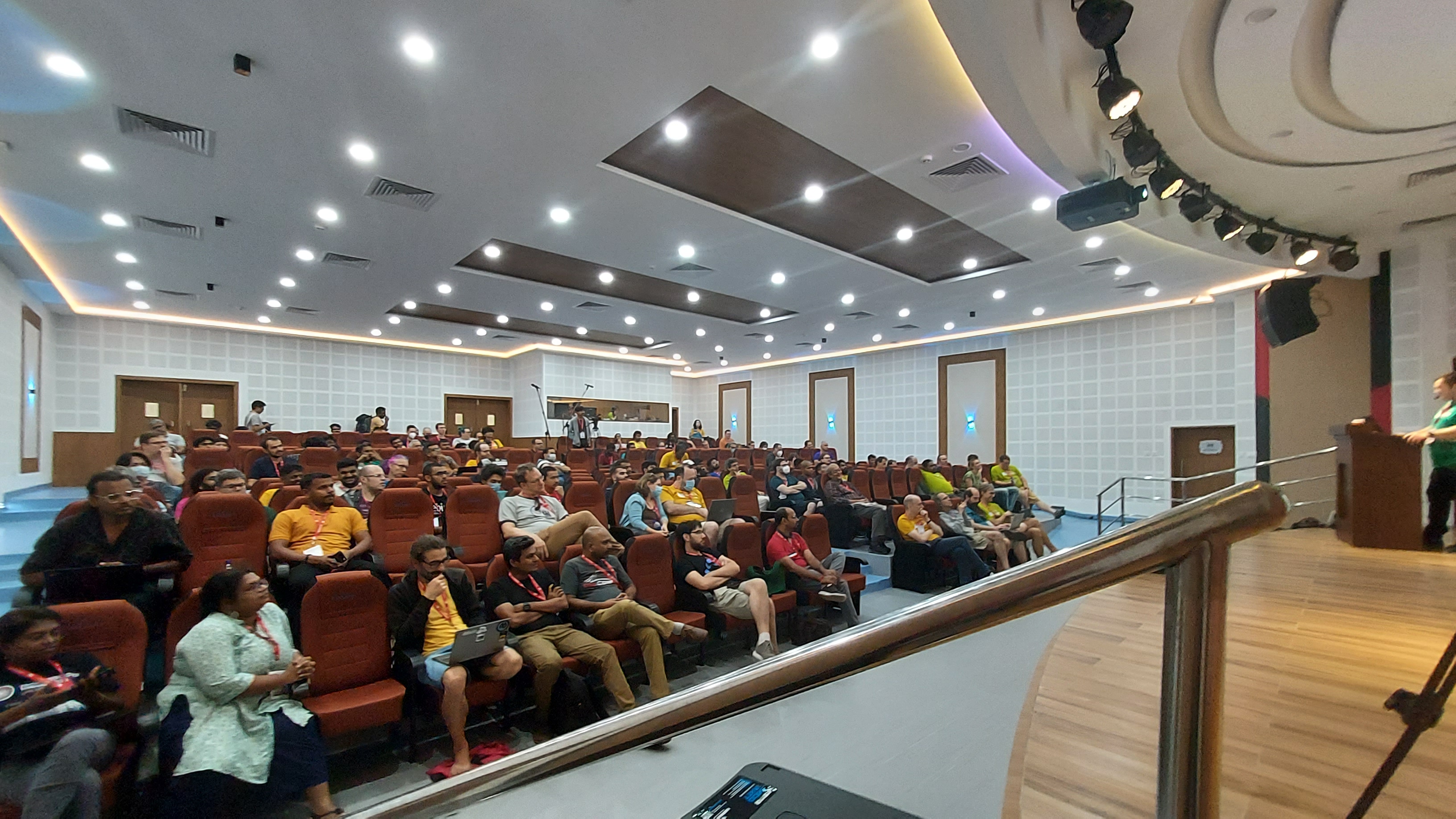
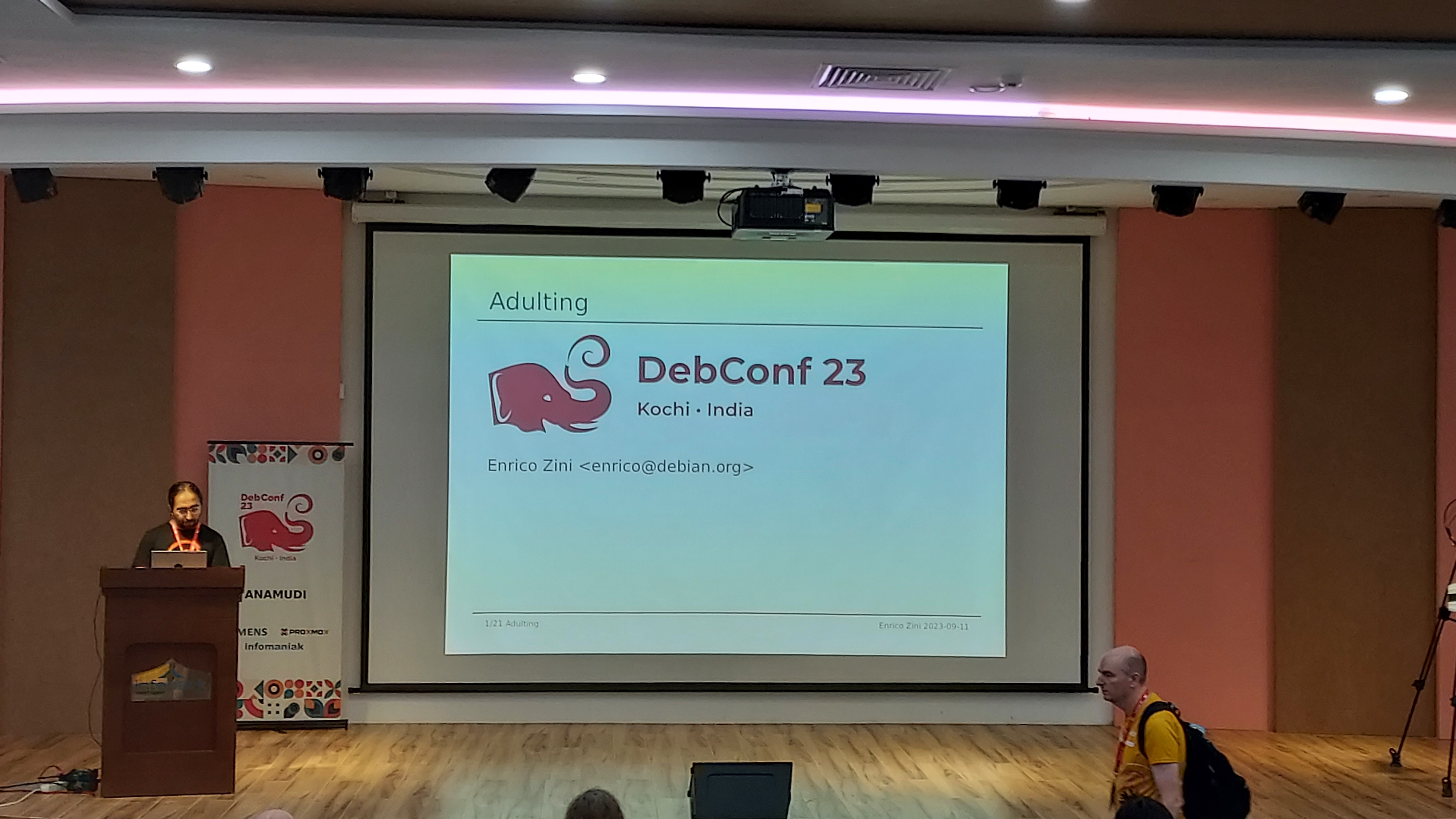
To describe the conference venue, it happened in InfoPark, Kochi with the main conference hall being Athulya Hall and food, accommodation and two smaller halls in Four Point Hotel, right outside Infopark. We got Athulya Hall as part of venue sponsorship from Infopark. The distance between both of them was around 300 meters. Halls were named Anamudi, Kuthiran and Ponmudi based on hills and mountain areas in host state of Kerala. Other than Annamudi hall which was the main hall, I couldn t remember the names of the hall, I still can t. Four Points was big and expensive, and we had, as expected, cost overruns. Due to how DebConf function, an Indian university wasn t suitable to host a conference of this scale. Infinity Pool at Night
Four Point's Infinity Pool at Night
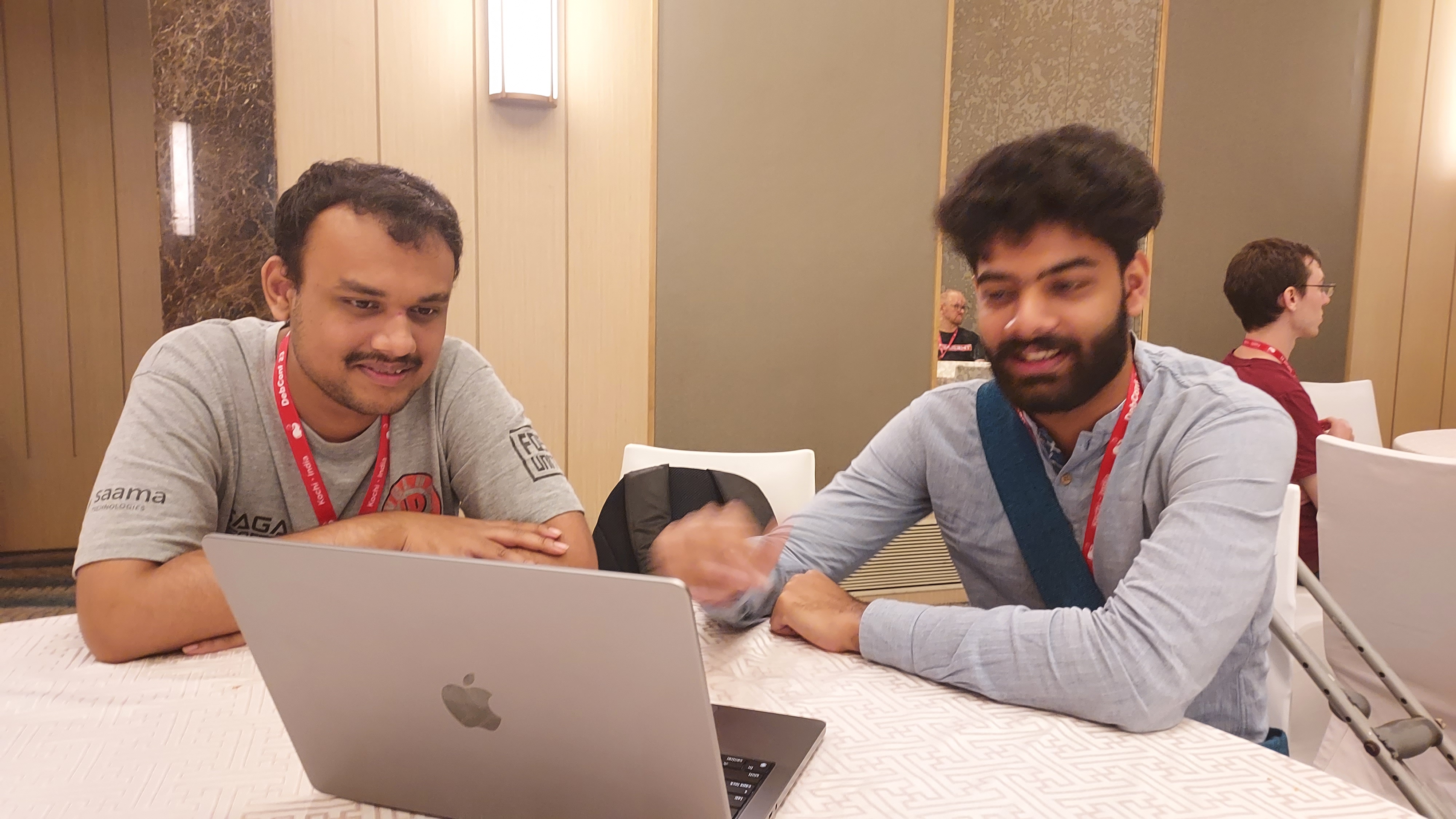
I landed in Kochi on the first day of DebCamp on 3rd September. As usual, met Abraham first, and the better part of the next hour was spent on meet and greet. It was my first IRL DebConf so met many old friends and new folks. I got a room to myself. Abraham lived nearby and hadn t taken the accommodation, so I asked him to join. He finally joined from second day onwards. All through the conference, room 928 became in-famous for various reasons, and I had various roommates for company. In DebCamp days, we would get up to have breakfast and go back to sleep and get active only past lunch for hacking and helping in the hack lab for the day, followed by fun late night discussions and parties. Nilesh, Chirag and Apple at DC23
Nilesh, Chirag and Apple at DC23
The team even managed to get a press conference arranged as well, and we got an opportunity to go to Press Club, Ernakulam. Sruthi and Jonathan gave the speech and answered questions from journalists. The event was covered by media as well due to this. Ernakulam Press Club
Ernakulam Press Club
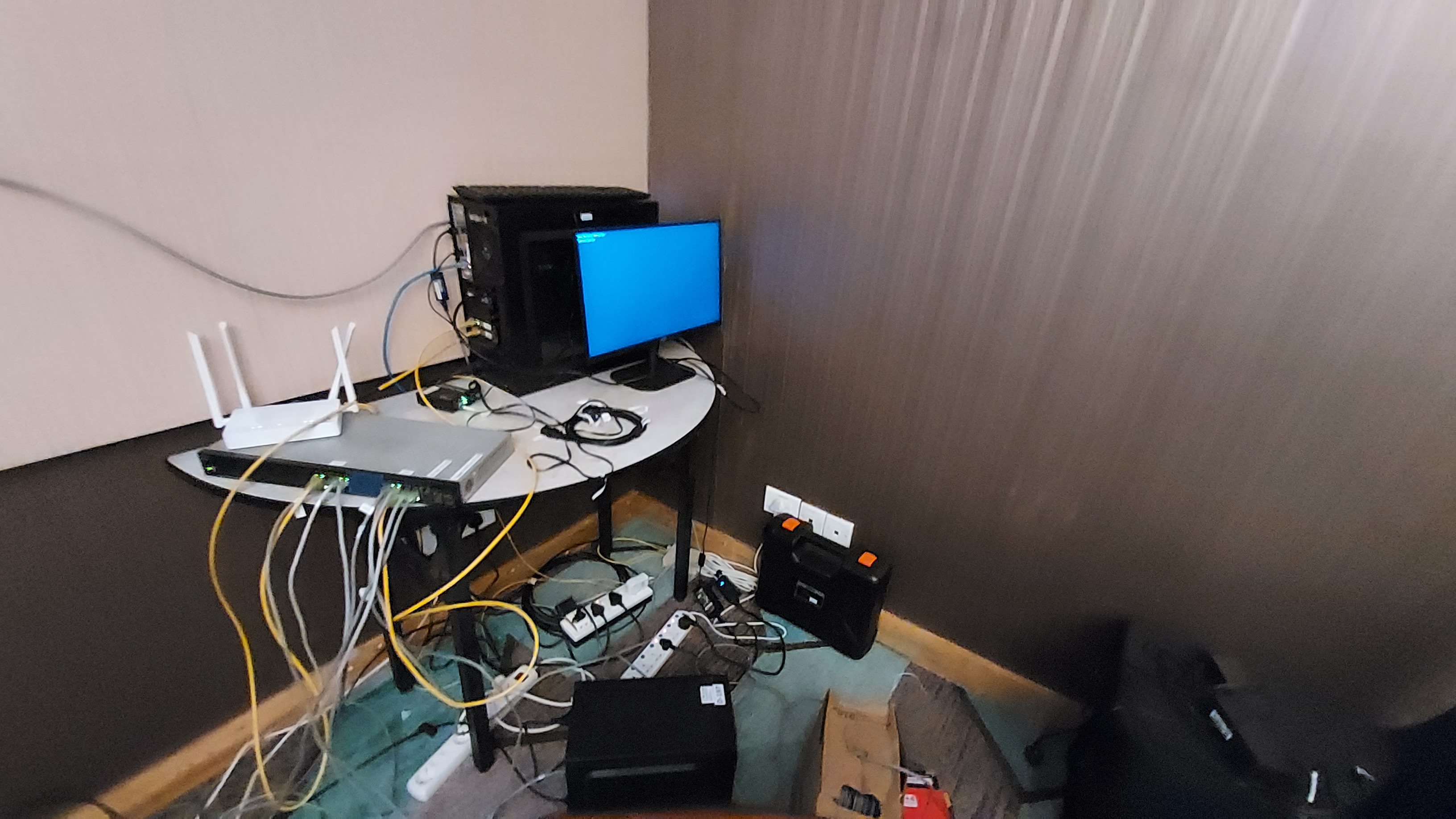
During the conference, every night the team use to have 9 PM meetings for retrospection and planning for next day, which was always dotted with new problems. Every day, we used to hijack Silent Hacklab for the meeting and gently ask the only people there at the time to give us space. DebConf, it itself is a well oiled machine. Network was brought up from scratch. Video team built the recording, audio mixing, live-streaming, editing and transcoding infrastructure on site. A gaming rig served as router and gateway. We got internet uplinks, a 1 Gbps sponsored leased line from Kerala Vision and a paid backup 100 Mbps connection from a different provider. IPv6 was added through HE s Tunnelbroker. Overall the network worked fine as additionally we had hotel Wi-Fi, so the conference network wasn t stretched much. I must highlight, DebConf is my only conference where almost everything and every piece of software in developed in-house, for the conference and modified according to need on the fly. Even event recording cameras, audio check, direction, recording and editing is all done on in-house software by volunteer-attendees (in some cases remote ones as well), all trained on the sideline of the conference. The core recording and mixing equipment is owned by Debian and travels to each venue. The rest is sourced locally. Gaming Rig which served as DC23 gateway router
Gaming Rig which served as DC23 gateway router
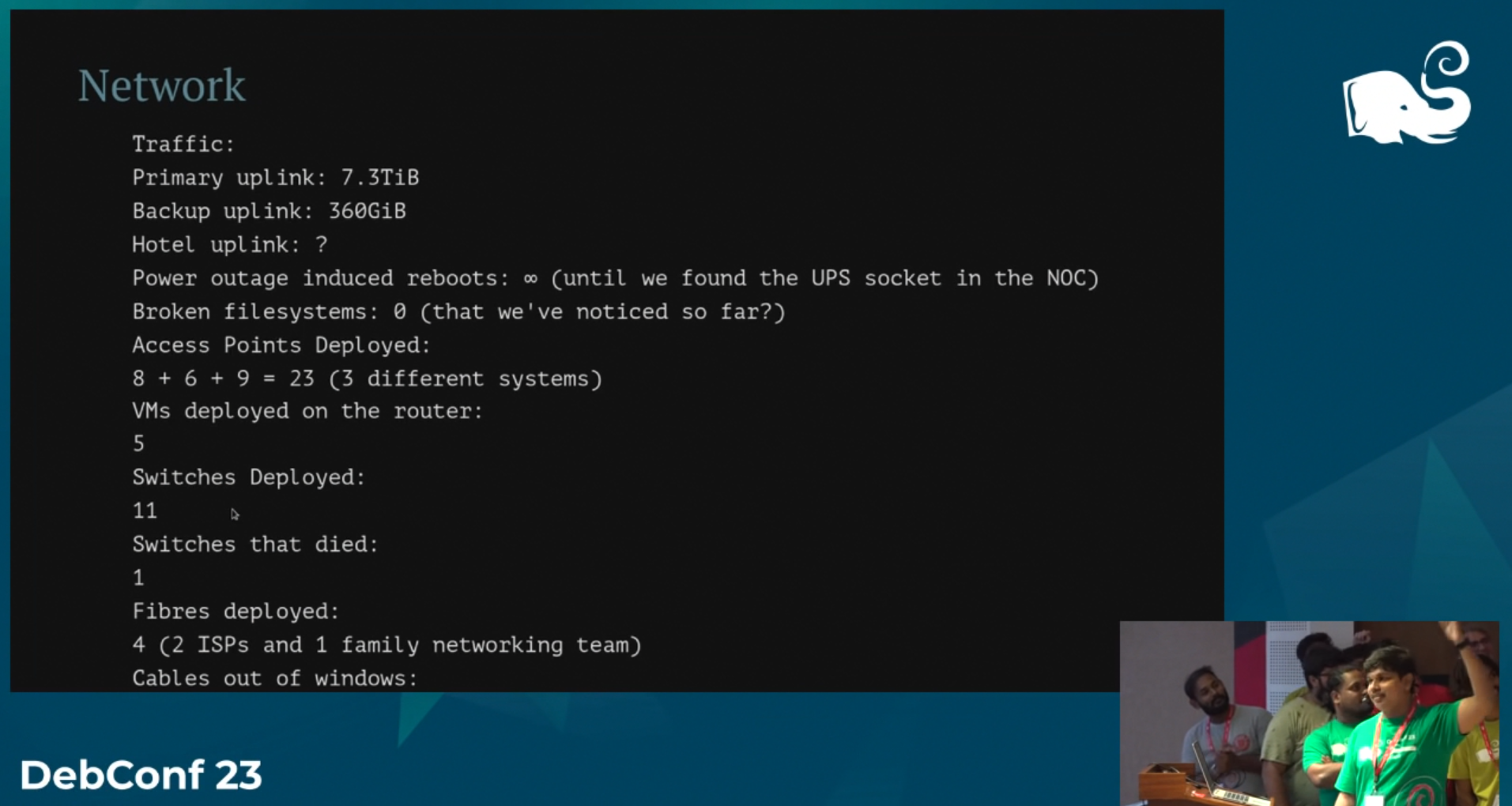
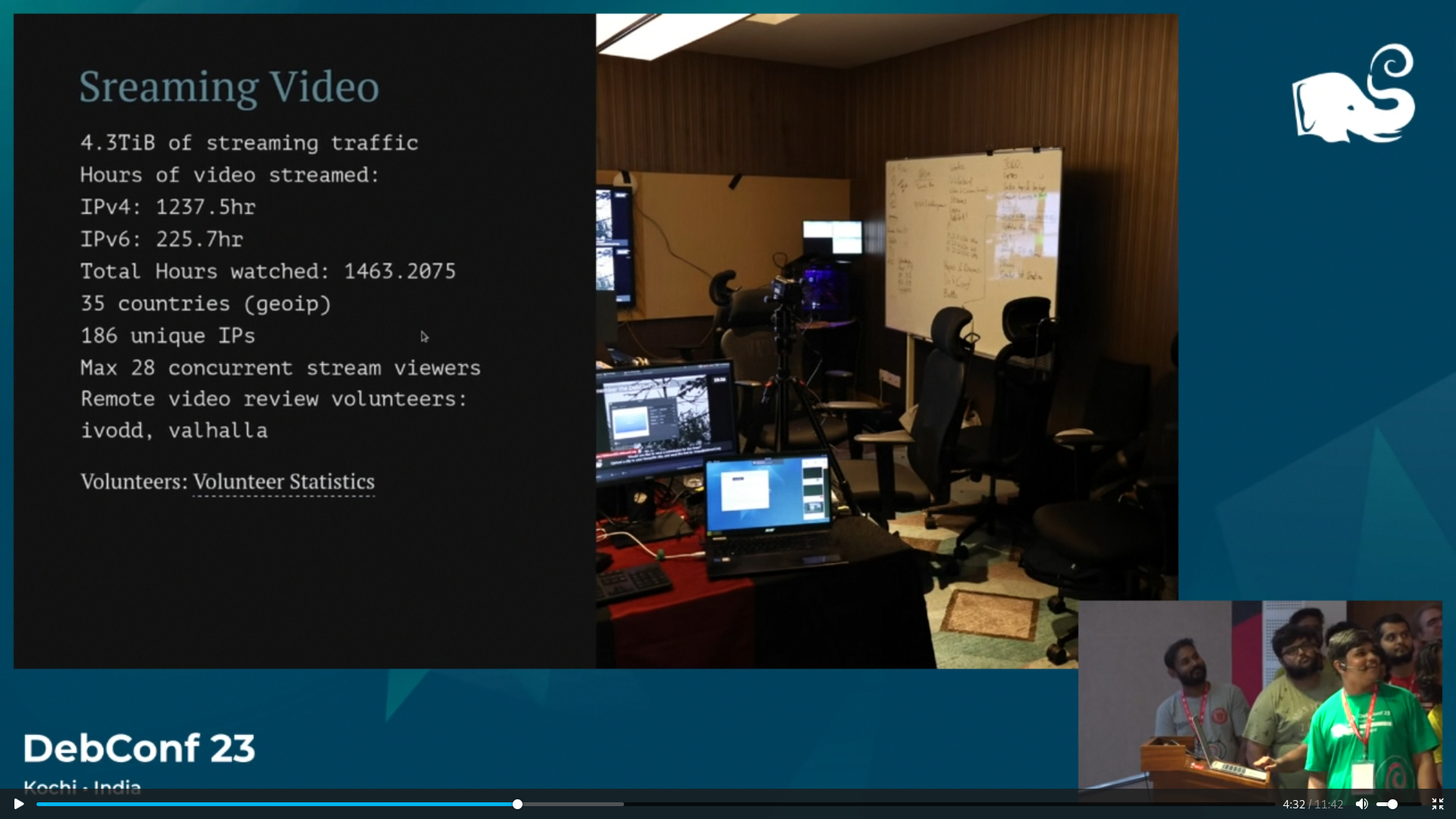
It was fun seeing how almost all the things were coordinated over text on Internet Relay Chat (IRC). If a talk/event was missing a talkmeister or a director or a camera person, a quick text on #debconf channel would be enough for someone to volunteer. Video team had a dedicated support channel for each conference venue for any issues and were quick to respond and fix stuff. Network information. Screengrab from closing ceremony
Network information. Screengrab from closing ceremony
It rained for the initial days, which gave us a cool weather. Swag team had decided to hand out umbrellas in swag kit which turned out to be quite useful. The swag kit was praised for quality and selection - many thanks to Anupa, Sruthi and others. It was fun wearing different color T-shirts, all designed by Abraham. Red for volunteers, light green for Video team, green for core-team i.e. staff and yellow for conference attendees. With highvoltage
With highvoltage
We were already acclimatized by the time DebConf really started as we had been talking, hacking and hanging out since last 7 days. Rush really started with the start of DebConf. More people joined on the first and second day of the conference. As has been the tradition, an opening talk was prepared by the Sruthi and local team (which I highly recommend watching to get more insights of the process). DebConf day 1 also saw job fair, where Canonical and FOSSEE, IIT Bombay had stalls for community interactions, which judging by the crowd itself turned out to be quite a hit. For me, association with DebConf (and Debian) started due to volunteering with video team, so anyhow I was going to continue doing that this conference as well. I usually volunteer for talks/events which anyhow I m interested in. Handling the camera, talkmeister-ing and direction are fun activities, though I didn t do sound this time around. Sound seemed difficult, and I didn t want to spoil someone s stream and recording. Talk attendance varied a lot, like in Bits from DPL talk, the hall was full but for some there were barely enough people to handle the volunteering tasks, but that s what usually happens. DebConf is more of a place to come together and collaborate, so talk attendance is an afterthought sometimes. Audience in highvoltage's Bits from DPL talk
Audience in highvoltage's Bits from DPL talk
I didn t submit any talk proposals this time around, as just being in the orga team was too much work already, and I knew, the talk preparation would get delayed to the last moment and I would have to rush through it. Enrico's talk
Enrico's talk
From Day 2 onward, more sponsor stalls were introduced in the hallway area. Hopbox by Unmukti , MostlyHarmless and Deeproot (joint stall) and FOSEE. MostlyHarmless stall had nice mechanical keyboards and other fun gadgets. Whenever I got the time, I would go and start typing racing to enjoy the nice, clicky keyboards. As the DebConf tradition dictates, we had a Cheese and Wine party. Everyone brought in cheese and other delicacies from their region. Then there was yummy Sadya. Sadya is a traditional vegetarian Malayalis lunch served over banana leaves. There were loads of different dishes served, the names of most I couldn t pronounce or recollect properly, but everything was super delicious. Day 4 was day trip and I chose to go to Athirappilly Waterfalls and Jungle safari. Pictures would describe the beauty better than words. The journey was bit long though. Athirappilly Falls
Athirappilly Falls

Pathu Pathu Tea Gardens
Tea Gardens
Late that day, we heard the news of Abraham gone missing. We lost Abraham. He had worked really hard all through the years for Debian and making this conference possible. Talks were cancelled for the next day and Jonathan addressed everyone. We went to Abraham s home the next day to meet his family. Team had arranged buses to Abraham s place. It was an unfortunate moment that I only got an opportunity to visit his place after he was gone. Days went by slowly after that. The last day was marked by a small conference dinner. Some of the people had already left. All through the day and next, we kept saying goodbye to friends, with whom we spent almost a fortnight together. Athirappilly Falls
Group photo with all DebConf T-shirts chronologically
This was 2nd trip to Kochi. Vistara Airway s UK886 has become the default flight now. I have almost learned how to travel in and around Kochi by Metro, Water Metro, Airport Shuttle and auto. Things are quite accessible in Kochi but metro is a bit expensive compared to Delhi. I left Kochi on 19th. My flight was due to leave around 8 PM, so I had the whole day to myself. A direct option would have taken less than 1 hour, but as I had time and chose to take the long way to the airport. First took an auto rickshaw to Kakkanad Water Metro station. Then sailed in the water metro to Vyttila Water Metro station. Vyttila serves as intermobility hub which connects water metro, metro, bus at once place. I switched to Metro here at Vyttila Metro station till Aluva Metro station. Here, I had lunch and then boarded the Airport feeder bus to reach Kochi Airport. All in all, I did auto rickshaw > water metro > metro > feeder bus to reach Airport. I was fun and scenic. I must say, public transport and intermodal integration is quite good and once can transition seamlessly from one mode to next. Kochi Water Metro
Kochi Water Metro

Scenes from Kochi Water Metro Scenes from Kochi Water Metro
Scenes from Kochi Water Metro
DebConf23 served its purpose of getting existing Debian people together, as well as getting new people interested and contributing to Debian. People who came are still contributing to Debian, and that s amazing. Streaming video stats
Streaming video stats. Screengrab from closing ceremony
The conference wasn t without its fair share of troubles. There were multiple money transfer woes, and being in India didn t help. Many thanks to multiple organizations who were proactive in helping out. On top of this, there was conference visa uncertainty and other issues which troubled visa team a lot. Kudos to everyone who made this possible. Surely, I m going to miss the name, so thank you for it, you know how much you have done to make this event possible. Now, DebConf24 is scheduled for Busan, South Korea, and work is already in full swing. As usual, I m helping with the fundraising part and plan to attend too. Let s see if I can make it or not. DebConf23 Group Photo
DebConf23 Group Photo. Click to enlarge.
Credits - Aigars Mahinovs
In the end, we kept on saying, no DebConf at this scale would come back to India for the next 10 or 20 years. It s too much trouble to be frank. It was probably the peak that we might not reach again. I would be happy to be proven wrong though :)

25 May 2024

Gunnar Wolf: How computers make books from graphics rendering, search algorithms, and functional programming to indexing and typesetting

This post is a review for Computing Reviews for How computers make books from graphics rendering, search algorithms, and functional programming to indexing and typesetting , a book published in Manning
If we look at the age-old process of creating books, how many different areas can a computer help us with? And how can each of them be used to teach computer science (CS) fundamentals to a nontechnical audience? This is the premise of John Whitington s enticing book and the result is quite amazing. The book immediately drew my attention when looking at the titles available for review. After all, my initiation into computing as a kid was learning the LaTeX typesetting system while my father worked on his first book on scientific language and typography [1]. Whitington picks 11 different technical aspects of book production, from how dots of ink are transferred to a white page and how they are made into controllable, recognizable shapes, all the way to forming beautiful typefaces and the nuances of properly addressing white-space to present aesthetically pleasing paragraphs, building it all into specific formats aimed at different ends. But if we dig beyond just the chapter titles, we will find a very interesting book on CS that, without ever using technical language or notation, presents aspects as varied as anti-aliasing, vector and raster images, character sets such as ASCII and Unicode, an introduction to programming, input methods for different writing systems, efficient encoding (compression) methods, both for text and images, lossless and lossy, and recursion and dithering methods. To my absolute surprise, while the author thankfully spared the reader the syntax usually associated with LISP-related languages, the programming examples clearly stem from the LISP school, presenting solutions based on tail recursion. Of course, it is no match for Donald Knuth s classic book on this same topic [2], but could very well be a primer for readers to approach it. The book is light and easy to read, and keeps a very informal, nontechnical tone throughout. My only complaint relates to reading it in PDF format; the topic of this book, and the care with which the images were provided by the author, warrant high resolution. The included images are not only decorative but an integral part of the book. Maybe this is specific to my review copy, but all of the raster images were in very low resolution. This book is quite different from what readers may usually expect, as it introduces several significant topics in the field. CS professors will enjoy it, of course, but also readers with a humanities background, students new to the field, or even those who are just interested in learning a bit more.

References
  1. S nchez y G ndara, A.; Magari os Lamas, F.; Wolf, K. B., Manual de lenguaje y tipograf a cient fica en castellano. Trillas, Mexico City, Mexico, 1986, https://www.fis.unam.mx/~bwolf/manual.html
  2. Knuth, D. E. Digital typographyCSLI Lecture Notes: CSLI Lecture Notes. CSLI Publications, Stanford, CA, 1999, https://www-cs-faculty.stanford.edu/~knuth/dt.html

24 May 2024

Julian Andres Klode: Observations in Debian dependency solving

In my previous blog, I explored The New APT 3.0 solver. Since then I have been at work in the test suite making tests pass and fixing some bugs. You see for all intents and purposes, the new solver is a very stupid naive DPLL SAT solver (it just so happens we don t actually have any pure literals in there). We can control it in a bunch of ways:
  1. We can mark packages as install or reject
  2. We can order actions/clauses. When backtracking the action that came later will be the first we try to backtrack on
  3. We can order the choices of a dependency - we try them left to right.
This is about all that we really want to do, we can t go if we reach a conflict, say oh but this conflict was introduced by that upgrade, and it seems more important, so let s not backtrack on the upgrade request but on this dependency instead. . This forces us to think about lowering the dependency problem into this form, such that not only do we get formally correct solutions, but also semantically correct ones. This is nice because we can apply a systematic way to approach the issue rather than introducing ad-hoc rules in the old solver which had a which of these packages should I flip the opposite way to break the conflict kind of thinking. Now our test suite has a whole bunch of these semantics encoded in it, and I m going to share some problems and ideas for how to solve them. I can t wait to fix these and the error reporting and then turn it on in Ubuntu and later Debian (the defaults change is a post-trixie change, let s be honest).

apt upgrade is hard The apt upgrade commands implements a safe version of dist-upgrade that essentially calculates the dist-upgrade, and then undoes anything that would cause a package to be removed, but it (unlike its apt-get counterpart) allows the solver to install new packages. Now, consider the following package is installed:
X Depends: A (= 1)   B
An upgrade from A=1 to A=2 is available. What should happen? The classic solver would choose to remove X in a dist-upgrade, and then upgrade A, so it s answer is quite clear: Keep back the upgrade of A. The new solver however sees two possible solutions:
  1. Install B to satisfy X Depends A (= 1) B.
  2. Keep back the upgrade of A
Which one does it pick? This depends on the order in which it sees the upgrade action for A and the dependency, as it will backjump chronologically. So
  1. If it gets to the dependency first, it marks A=1 for install to satisfy A (= 1). Then it gets to the upgrade request, which is just A Depends A (= 2) A (= 1) and sees it is satisfied already and is content.
  2. If it gets to the upgrade request first, it marks A=2 for install to satisfy A (= 2). Then later it gets to X Depends: A (= 1) B, sees that A (= 1) is not satisfiable, and picks B.
We have two ways to approach this issue:
  1. We always order upgrade requests last, so they will be kept back in case of conflicting dependencies
  2. We require that, for apt upgrade a currently satisfied dependency must be satisfied by currently installed packages, hence eliminating B as a choice.

Recommends are hard too See if you have a X Recommends: A (= 1) and a new version of A, A (= 2), the solver currently will silently break the Recommends in some cases. But let s explore what the behavior of a X Recommends: A (= 1) in combination with an available upgrade of A (= 2) should be. We could say the rule should be:
  • An upgrade should keep back A instead of breaking the Recommends
  • A dist-upgrade should either keep back A or remove X (if it is obsolete)
This essentially leaves us the same choices as for the previous problem, but with an interesting twist. We can change the ordering (and we already did), but we could also introduce a new rule, promotions :
A Recommends in an installed package, or an upgrade to that installed package, where the Recommends existed in the installed version, that is currently satisfied, must continue to be satisfied, that is, it effectively is promoted to a Depends.
This neatly solves the problem for us. We will never break Recommends that are satisfied. Likewise, we already have a Recommends demotion rule:
A Recommends in an installed package, or an upgrade to that installed package, where the Recommends existed in the installed version, that is currently unsatisfied, will not be further evaluated (it is treated like a Suggests is in the default configuration).
Whether we should be allowed to break Suggests with our decisions or not (the old autoremover did not, for instance) is a different decision. Should we promote currently satisified Suggests to Depends as well? Should we follow currently satisified Suggests so the solver sees them and doesn t autoremove them, but treat them as optional?

tightening of versioned dependencies Another case of versioned dependencies with alternatives that has complex behavior is something like
X Depends: A (>= 2)   B
X Recommends: A (>= 2)   B
In both cases, installing X should upgrade an A < 2 in favour of installing B. But a naive SAT solver might not. If your request to keep A installed is encoded as A (= 1) A (= 2), then it first picks A (= 1). When it sees the Depends/Recommends it will switch to B. We can solve this again as in the previous example by ordering the keep A installed requests after any dependencies. Notably, we will enqueue the common dependencies of all A versions first before selecting a version of A, so something may select a version for us.

version narrowing instead of version choosing A different approach to dealing with the issue of version selection is to not select a version until the very last moment. So instead of selecting a version to satisfy A (>= 2) we instead translate
Depends: A (>= 2)
into two rules:
  1. The package selection rule:
     Depends: A
    
    This ensures that any version of A is installed (i.e. it adds a version choice clause, A (= 1) A (= 2) in an example with two versions for A.
  2. The version narrowing rule:
     Conflicts: A (<< 2)
    
    This outright would reject a choice of A (= 1).
So now we have 3 kinds of clauses:
  1. package selection
  2. version narrowing
  3. version selection
If we process them in that order, we should surely be able to find the solution that best matches the semantics of our Debian dependency model, i.e. selecting earlier choices in a dependency before later choices in the face of version restrictions. This still leaves one issue: What if our maintainer did not use Depends: A (>= 2) B but e.g. Depends: A (= 3) B A (= 2). He d expect us to fall back to B if A (= 3) is not installable, and not to B. But we d like to enqueue A and reject all choices other than 3 and 2. I think it s fair to say: Don t do that, then here.

Implementing strict pinning correctly APT knows a single candidate version per package, this makes the solver relatively deterministic: It will only ever pick the candidate, or an installed version. This also happens to significantly reduce the search space which is good - less backtracking. An uptodate system will only ever have one version per package that can be installed, so we never actually have to choose versions. But of course, APT allows you to specify a non-candidate version of a package to install, for example:
apt install foo/oracular-proposed
The way this works is that the core component of the previous solver, which is the pkgDepCache maintains what essentially amounts to an overlay of the policy that you could see with apt-cache policy. The solver currently however validates allowed version choices against the policy directly, and hence finds these versions are not allowed and craps out. This is an interesting problem because the solver should not be dependent on the pkgDepCache as the pkgDepCache initialization (Building dependency tree...) accounts for about half of the runtime of APT (until the Y/n prompt) and I d really like to get rid of it. But currently the frontend does go via the pkgDepCache. It marks the packages in there, building up what you could call a transaction, and then we translate it to the new solver, and once it is done, it translates the result back into the pkgDepCache. The current implementation of allowed version is implemented by reducing the search space, i.e. every dependency, we outright ignore any non-allowed versions. So if you have a version 3 of A that is ignored a Depends: A would be translated into A (= 2) A (= 1). However this has two disadvantages. (1) It means if we show you why A could not be installed, you don t even see A (= 3) in the list of choices and (2) you would need to keep the pkgDepCache around for the temporary overrides. So instead of actually enforcing the allowed version rule by filtering, a more reasonable model is that we apply the allowed version rule by just marking every other version as not allowed when discovering the package in the from depcache translation layer. This doesn t really increase the search space either but it solves both our problem of making overrides work and giving you a reasonable error message that lists all versions of A.

pulling up common dependencies to minimize backtracking cost One of the common issues we have is that when we have a dependency group
 A   B   C   D 
we try them in order, and if one fails, we undo everything it did, and move on to the next one. However, this isn t perhaps the best choice of operation. I explained before that one thing we do is queue the common dependencies of a package (i.e. dependencies shared in all versions) when marking a package for install, but we don t do this here: We have already lowered the representation of the dependency group into a list of versions, so we d need to extract the package back out of it. This can of course be done, but there may be a more interesting solution to the problem, in that we simply enqueue all the common dependencies. That is, we add n backtracking levels for n possible solutions:
  1. We enqueue the common dependencies of all possible solutions deps(A)&deps(B)&deps(C)&deps(D)
  2. We decide (adding a decision level) not to install D right now and enqueue deps(A)&deps(B)&deps(C)
  3. We decide (adding a decision level) not to install C right now and enqueue deps(A)&deps(B)
  4. We decide (adding a decision level) not to install B right now and enqueue A
Now if we need to backtrack from our choice of A we hopefully still have a lot of common dependencies queued that we do not need to redo. While we have more backtracking levels, each backtracking level would be significantly cheaper, especially if you have cheap backtracking (which admittedly we do not have, yet anyway). The caveat though is: It may be pretty expensive to find the common dependencies. We need to iterate over all dependency groups of A and see if they are in B, C, and D, so we have a complexity of roughly #A * (#B+#C+#D) Each dependency group we need to check i.e. is X Y in B meanwhile has linear cost: We need to compare the memory content of two pointer arrays containing the list of possible versions that solve the dependency group. This means that X Y and Y X are different dependencies of course, but that is to be expected they are. But any dependency of the same order will have the same memory layout. So really the cost is roughly N^4. This isn t nice. You can apply various heuristics here on how to improve that, or you can even apply binary logic:
  1. Enqueue common dependencies of A B C D
  2. Move into the left half, enqueue of A B
  3. Again divide and conquer and select A.
This has a significant advantage in long lists of choices, and also in the common case, where the first solution should be the right one. Or again, if you enqueue the package and a version restriction instead, you already get the common dependencies enqueued for the chosen package at least.

20 May 2024

Debian Brasil: MiniDebConf Belo Horizonte 2024 - um breve relato

De 27 a 30 de abril de 2024 foi realizada a MiniDebConf Belo Horizonte 2024 no Campus Pampulha da UFMG - Universidade Federal de Minas Gerais, em Belo Horizonte - MG. MiniDebConf BH 2024 banners Esta foi a quinta vez que uma MiniDebConf (como um evento presencial exclusivo sobre Debian) aconteceu no Brasil. As edi es anteriores foram em Curitiba (2016, 2017, e 2018), e em Bras lia 2023. Tivemos outras edi es de MiniDebConfs realizadas dentro de eventos de Software Livre como o FISL e a Latinoware, e outros eventos online. Veja o nosso hist rico de eventos. Paralelamente MiniDebConf, no dia 27 (s bado) aconteceu o FLISOL - Festival Latino-americano de Instala o de Software Livre, maior evento da Am rica Latina de divulga o de Software Livre realizado desde o ano de 2005 simultaneamente em v rias cidades. A MiniDebConf Belo Horizonte 2024 foi um sucesso (assim como as edi es anteriores) gra as participa o de todos(as), independentemente do n vel de conhecimento sobre o Debian. Valorizamos a presen a tanto dos(as) usu rios(as) iniciantes que est o se familiarizando com o sistema quanto dos(as) desenvolvedores(as) oficiais do projeto. O esp rito de acolhimento e colabora o esteve presente em todos os momentos. MiniDebConf BH 2024 flisol N meros da edi o 2024 Durante os quatro dias de evento aconteceram diversas atividades para todos os n veis de usu rios(as) e colaboradores(as) do projeto Debian. A programa o oficial foi composta de: MiniDebConf BH 2024 palestra Os n meros finais da MiniDebConf Belo Horizonte 2024 mostram que tivemos um recorde de participantes. Dos 224 participantes, 15 eram contribuidores(as) oficiais brasileiros sendo 10 DDs (Debian Developers) e 05 (Debian Maintainers), al m de diversos(as) contribuidores(as) n o oficiais. A organiza o foi realizada por 14 pessoas que come aram a trabalhar ainda no final de 2023, entre elas o Prof. Lo c Cerf do Departamento de Computa o que viabilizou o evento na UFMG, e 37 volunt rios(as) que ajudaram durante o evento. Como a MiniDebConf foi realizado nas instala es da UFMG, tivemos a ajuda de mais de 10 funcion rios da Universidade. Veja a lista com os nomes das pessoas que ajudaram de alguma forma na realiza o da MiniDebConf Belo Horizonte 2024. A diferen a entre o n mero de pessoas inscritas e o n mero de pessoas presentes provavelmente se explica pelo fato de n o haver cobran a de inscri o, ent o se a pessoa desistir de ir ao evento ela n o ter preju zo financeiro. A edi o 2024 da MiniDebconf Belo Horizonte foi realmente grandiosa e mostra o resultado dos constantes esfor os realizados ao longo dos ltimos anos para atrair mais colaboradores(as) para a comunidade Debian no Brasil. A cada edi o os n meros s aumentam, com mais participantes, mais atividades, mais salas, e mais patrocinadores/apoiadores. MiniDebConf BH 2024 grupo
MiniDebConf BH 2024 grupo Atividades A programa o da MiniDebConf foi intensa e diversificada. Nos dias 27, 29 e 30 (s bado, segunda e ter a-feira) tivemos palestras, debates, oficinas e muitas atividades pr ticas. MiniDebConf BH 2024 palestra J no dia 28 (domingo), ocorreu o Day Trip, um dia dedicado a passeios pela cidade. Pela manh sa mos do hotel e fomos, em um nibus fretado, para o Mercado Central de Belo Horizonte. O pessoal aproveitou para comprar v rias coisas como queijos, doces, cacha as e lembrancinhas, al m de experimentar algumas comidas locais. MiniDebConf BH 2024 mercado Depois de 2 horas de passeio pelo Mercado, voltamos para o nibus e pegamos a estrada para almo armos em um restaurante de comida t pica mineira. MiniDebConf BH 2024 palestra Com todos bem alimentados, voltamos para Belo Horizonte para visitarmos o principal ponto tur stico da cidade: a Lagoa da Pampulha e a Capela S o Francisco de Assis, mais conhecida como Igrejinha da Pampulha. MiniDebConf BH 2024 palestra Voltamos para o hotel e o dia terminou no hacker space que montamos na sala de eventos para o pessoal conversar, empacotar, e comer umas pizzas. MiniDebConf BH 2024 palestra Financiamento coletivo Pela terceira vez fizemos uma campanha de financiamento coletivo e foi incr vel como as pessoas contribu ram! A meta inicial era arrecadar o valor equivalente a uma cota ouro de R$ 3.000,00. Ao atingirmos essa meta, definimos uma nova, equivalente a uma cota ouro + uma cota prata (R$ 5.000,00). E novamente atingimos essa meta. Ent o propusermos como meta final o valor de uma cota ouro + prata + bronze, que seria equivalente a R$ 6.000,00. O resultado foi que arrecadamos R$ 7.239,65 com a ajuda de mais de 100 pessoas! Muito obrigado as pessoas que contribu ram com qualquer valor. Como forma de agradecimento, listamos os nomes das pessoas que doaram. MiniDebConf BH 2024 doadores Bolsas de alimenta o, hospedagem e/ou passagens para participantes Cada edi o da MiniDebConf trouxe alguma inova o, ou algum benef cio diferente para os(a) participantes. Na edi o deste ano em Belo Horizonte, assim como acontece nas DebConfs, oferecemos bolsas de alimenta o, hospedagem e/ou passagens para ajudar aquelas pessoas que gostariam de vir para o evento mas que precisariam de algum tipo de ajuda. No formul rio de inscri o, colocamos a op o para a pessoa solicitar bolsa de alimenta o, hospedagem e/ou passagens, mas para isso, ela deveria se identificar como contribuidor(a) (oficial ou n o oficial) do Debian e escrever uma justificativa para o pedido. N mero de pessoas beneficiadas: A bolsa de alimenta o forneceu almo o e jantar todos os dias. Os almo os inclu ram pessoas que moram em Belo Horizonte e regi o. J o jantares foram pagos para os(as) participantes que tamb m receberam a bolsa de hospedagem e/ou passagens. A hospedagem foi realizada no Hotel BH Jaragu . E as passagens inclu ram de avi o ou de nibus, ou combust vel (para quem veio de carro ou moto). Boa parte do dinheiro para custear as bolsas vieram do Projeto Debian, principalmente para as passagens. Enviamos um or amento o ent o l der do Debian Jonathan Carter, e ele prontamente aprovou o nosso pedido. Al m deste or amento do evento, o l der tamb m aprovou os pedidos individuais enviados por alguns DDs que preferiram solicitar diretamente para ele. A experi ncia de oferecer as bolsas foi realmente muito boa porque permitiu a vinda de v rias pessoas de outras cidades. MiniDebConf BH 2024 grupo Fotos e v deos Voc pode assistir as grava es das palestras nos links abaixo: E ver as fotos feitas por v rios(as) colaboradores(as) nos links abaixo: Agradecimentos Gostar amos de agradecer a todos(as) os(as) participantes, organizadores(as), volunt rios(as), patrocinadores(as) e apoiadores(as) que contribu ram para o sucesso da MiniDebConf Belo Horizonte 2024. MiniDebConf BH 2024 grupo Patrocinadores Ouro: Prata: Bronze: Apoiadores Organiza o


14 May 2024

Dirk Eddelbuettel: RApiSerialize 0.1.3 on CRAN: Skipping XDR

A new bug fix release 0.1.3 of RApiSerialize got onto CRAN earlier today. This is the first release in well over a year, and permits the skip the XDR serialization format which is needed when transfering between big- and little-endian machines. But it comes at a certain run-time cost one can avoid on the (much more common) little-endian machines. This is a new option, and the old behavior is the default. Those who want to can now skip the step. The RApiSerialize package is used by both my RcppRedis as well as by Travers excellent qs package. We also addressed the recent nag by the CRAN concerning NO_REMAP .

Changes in version 0.1.3 (2024-05-13)
  • Add an xdr argument to disable XDR for an approx. threefold speed increase (Travers Ching and Dirk in #6)
  • Use R_NO_REMAP and Rf_* prefix for API calls
  • Minor continuous integration updates

Courtesy of my CRANberries, there is a diffstat report relative to previous release. More details are at the RApiSerialize page; code, issue tickets etc at the GitHub repositoryrapiserializerepo. If you like this or other open-source work I do, you can sponsor me at GitHub.

This post by Dirk Eddelbuettel originated on his Thinking inside the box blog. Please report excessive re-aggregation in third-party for-profit settings.

Next.

Previous.