Some years ago I came across a really peculiar newsgroup post. It was not about technicalities of any sort. It was about history. A beautifully written history of computers. From the Turing machine to the Free Software world, the original author managed to capture all the important events of the computer revolution with a great deal of humor. Re-posting it here, it is just brilliant.
The Gospel of Tux (v1.0)
In the beginning Turing created the Machine.
And the Machine was crufty and bodacious, existing in theory only. And von Neumann looked upon the Machine, and saw that it was crufty. He divided the Machine into two Abstractions, the Data and the Code, and yet the two were one Architecture. This is a great Mystery, and the beginning of wisdom.
And von Neumann spoke unto the Architecture, and blessed it, saying, Go forth and replicate, freely exchanging data and code, and bring forth all manner of devices unto the earth. And it was so, and it was cool. The Architecture prospered and was implemented in hardware and software. And it brought forth many Systems unto the earth.
The first Systems were mighty giants; many great works of renown did they accomplish. Among them were Colossus, the codebreaker; ENIAC, the targeter; EDSAC and MULTIVAC and all manner of froody creatures ending in AC, the experimenters; and SAGE, the defender of the sky and father of all networks. These were the mighty giants of old, the first children of Turing, and their works are written in the Books of the Ancients. This was the First Age, the age of Lore.
Now the sons of Marketing looked upon the children of Turing, and saw that they were swift of mind and terse of name and had many great and baleful attributes. And they said unto themselves, Let us go now and make us Corporations, to bind the Systems to our own use that they may bring us great fortune. With sweet words did they lure their customers, and with many chains did they bind the Systems, to fashion them after their own image. And the sons of Marketing fashioned themselves Suits to wear, the better to lure their customers, and wrote grave and perilous Licenses, the better to bind the Systems. And the sons of Marketing thus became known as Suits, despising and being despised by the true Engineers, the children of von Neumann.
And the Systems and their Corporations replicated and grew numerous upon the earth. In those days there were IBM and Digital, Burroughs and Honeywell, Unisys and Rand, and many others. And they each kept to their own System, hardware and software, and did not interchange, for their Licences forbade it. This was the Second Age, the age of Mainframes.
Now it came to pass that the spirits of Turing and von Neumann looked upon the earth and were displeased. The Systems and their Corporations had grown large and bulky, and Suits ruled over true Engineers. And the Customers groaned and cried loudly unto heaven, saying, Oh that there would be created a System mighty in power, yet small in size, able to reach into the very home! And the Engineers groaned and cried likewise, saying, Oh, that a deliverer would arise to grant us freedom from these oppressing Suits and their grave and perilous Licences, and send us a System of our own, that we may hack therein! And the spirits of Turing and von Neumann heard the cries and were moved, and said unto each other, Let us go down and fabricate a Breakthrough, that these cries may be stilled.
And that day the spirits of Turing and von Neumann spake unto Moore of Intel, granting him insight and wisdom to understand the future. And Moore was with chip, and he brought forth the chip and named it 4004. And Moore did bless the Chip, saying, Thou art a Breakthrough; with my own Corporation have I fabricated thee. Thou thou art yet as small as a dust mote, yet shall thou grow and replicate unto the size of a mountain, and conquer all before thee. This blessing I give unto thee: every eighteen months shall thou double in capacity, until the end of the age. This is Moore s Law, which endures unto this day.
And the birth of 4004 was the beginning of the Third Age, the age of Microchips. And as the Mainframes and their Systems and Corporations had flourished, so did the Microchips and their Systems and Corporations. And their lineage was on this wise:
Moore begat Intel. Intel begat Mostech, Zilog and Atari. Mostech begat 6502, and Zilog begat Z80. Intel also begat 8800, who begat Altair; and 8086, mother of all PCs. 6502 begat Commodore, who begat PET and 64; and Apple, who begat 2. (Apple is the great Mystery, the Fruit that was devoured, yet bloomed again.) Atari begat 800 and 1200, masters of the game, who were destroyed by Sega and Nintendo. Xerox begat PARC. Commodore and PARC begat Amiga, creator of fine arts; Apple and PARC begat Lisa, who begat Macintosh, who begat iMac. Atari and PARC begat ST, the music maker, who died and was no more. Z80 begat Sinclair the dwarf, TRS-80 and CP/M, who begat many machines, but soon passed from this world. Altair, Apple and Commodore together begat Microsoft, the Great Darkness which is called Abomination, Destroyer of the Earth, the Gates of Hell.
Now it came to pass in the Age of Microchips that IBM, the greatest of the Mainframe Corporations, looked upon the young Microchip Systems and was greatly vexed. And in their vexation and wrath they smote the earth and created the IBM PC. The PC was without sound and colour, crufty and bodacious in great measure, and its likeness was a tramp, yet the Customers were greatly moved and did purchase the PC in great numbers. And IBM sought about for an Operating System Provider, for in their haste they had not created one, nor had they forged a suitably grave and perilous License, saying, First we will build the market, then we will create a new System, one in our own image, and bound by our Licence. But they reasoned thus out of pride and not wisdom, not forseeing the wrath which was to come.
And IBM came unto Microsoft, who licensed unto them QDOS, the child of CP/M and 8086. (8086 was the daughter of Intel, the child of Moore). And QDOS grew, and was named MS-DOS. And MS-DOS and the PC together waxed mighty, and conquered all markets, replicating and taking possession thereof, in accordance with Moore s Law. And Intel grew terrible and devoured all her children, such that no chip could stand before her. And Microsoft grew proud and devoured IBM, and this was a great marvel in the land. All these things are written in the Books of the Deeds of Microsoft.
In the fullness of time MS-DOS begat Windows. And this is the lineage of Windows: CP/M begat QDOS. QDOS begat DOS 1.0. DOS 1.0 begat DOS 2.0 by way of Unix. DOS 2.0 begat Windows 3.11 by way of PARC and Macintosh. IBM and Microsoft begat OS/2, who begat Windows NT and Warp, the lost OS of lore. Windows 3.11 begat Windows 95 after triumphing over Macintosh in a mighty Battle of Licences. Windows NT begat NT 4.0 by way of Windows 95. NT 4.0 begat NT 5.0, the OS also called Windows 2000, The Millenium Bug, Doomsday, Armageddon, The End Of All Things.
Now it came to pass that Microsoft had waxed great and mighty among the Microchip Corporations; mighter than any of the Mainframe Corporations before it had it waxed. And Gates heart was hardened, and he swore unto his Customers and their Engineers the words of this curse:
Children of von Neumann, hear me. IBM and the Mainframe Corporations bound thy forefathers with grave and perilous Licences, such that ye cried unto the spirits of Turing and von Neumann for deliverance. Now I say unto ye: I am greater than any Corporation before me. Will I loosen your Licences? Nay, I will bind thee with Licences twice as grave and ten times more perilous than my forefathers. I will engrave my Licence on thy heart and write my Serial Number upon thy frontal lobes. I will bind thee to the Windows Platform with cunning artifices and with devious schemes. I will bind thee to the Intel Chipset with crufty code and with gnarly APIs. I will capture and enslave thee as no generation has been enslaved before. And wherefore will ye cry then unto the spirits of Turing, and von Neumann, and Moore? They cannot hear ye. I am become a greater Power than they. Ye shall cry only unto me, and shall live by my mercy and my wrath. I am the Gates of Hell; I hold the portal to MSNBC and the keys to the Blue Screen of Death. Be ye afraid; be ye greatly afraid; serve only me, and live.
And the people were cowed in terror and gave homage to Microsoft, and endured the many grave and perilous trials which the Windows platform and its greatly bodacious Licence forced upon them. And once again did they cry to Turing and von Neumann and Moore for a deliverer, but none was found equal to the task until the birth of Linux.
These are the generations of Linux:
SAGE begat ARPA, which begat TCP/IP, and Aloha, which begat Ethernet. Bell begat Multics, which begat C, which begat Unix. Unix and TCP/IP begat Internet, which begat the World Wide Web. Unix begat RMS, father of the great GNU, which begat the Libraries and Emacs, chief of the Utilities. In the days of the Web, Internet and Ethernet begat the Intranet LAN, which rose to renown among all Corporations and prepared the way for the Penguin.
And Linus and the Web begat the Kernel through Unix. The Kernel, the Libraries and the Utilities together are the Distribution, the one Penguin in many forms, forever and ever praised.
Now in those days there was in the land of Helsinki a young scholar named Linus the Torvald. Linus was a devout man, a disciple of RMS and mighty in the spirit of Turing, von Neumann and Moore. One day as he was meditating on the Architecture, Linus fell into a trance and was granted a vision. And in the vision he saw a great Penguin, serene and well-favoured, sitting upon an ice floe eating fish. And at the sight of the Penguin Linus was deeply afraid, and he cried unto the spirits of Turing, von Neumann and Moore for an interpretation of the dream.
And in the dream the spirits of Turing, von Neumann and Moore answered and spoke unto him, saying, Fear not, Linus, most beloved hacker. You are exceedingly cool and froody. The great Penguin which you see is an Operating System which you shall create and deploy unto the earth. The ice-floe is the earth and all the systems thereof, upon which the Penguin shall rest and rejoice at the completion of its task. And the fish on which the Penguin feeds are the crufty Licensed codebases which swim beneath all the earth s systems. The Penguin shall hunt and devour all that is crufty, gnarly and bodacious; all code which wriggles like spaghetti, or is infested with blighting creatures, or is bound by grave and perilous Licences shall it capture. And in capturing shall it replicate, and in replicating shall it document, and in documentation shall it bring freedom, serenity and most cool froodiness to the earth and all who code therein.
Linus rose from meditation and created a tiny Operating System Kernel as the dream had foreshewn him; in the manner of RMS, he released the Kernel unto the World Wide Web for all to take and behold. And in the fulness of Internet Time the Kernel grew and replicated, becoming most cool and exceedingly froody, until at last it was recognised as indeed a great and mighty Penguin, whose name was Tux. And the followers of Linus took refuge in the Kernel, the Libraries and the Utilities; they installed Distribution after Distribution, and made sacrifice unto the GNU and the Penguin, and gave thanks to the spirits of Turing, von Neumann and Moore, for their deliverance from the hand of Microsoft. And this was the beginning of the Fourth Age, the age of Open Source.
Now there is much more to be said about the exceeding strange and wonderful events of those days; how some Suits of Microsoft plotted war upon the Penguin, but were discovered on a Halloween Eve; how Gates fell among lawyers and was betrayed and crucified by his former friends, the apostles of Media; how the mercenary Knights of the Red Hat brought the gospel of the Penguin into the halls of the Corporations; and even of the dispute between the brethren of Gnome and KDE over a trollish Licence. But all these things are recorded elsewhere, in the Books of the Deeds of the Penguin and the Chronicles of the Fourth Age, and I suppose if they were all narrated they would fill a stack of DVDs as deep and perilous as a Usenet Newsgroup.
Now may you code in the power of the Source; may the Kernel, the Libraries and the Utilities be with you, throughout all Distributions, until the end of the Epoch. Amen.
 Periodic Calendar
, a GPL ed GUI application, coded in Java that helps keeping track of women menstrual cycles and predict fertility periods, has just entered Debian. This information can be used as supportive either for conception or contraception planning.
This program (
pcalendar in Debian) is by far more complete than
mencal (a simple menstruation calendar that can be run in the console) or
cycle (a windowed calendar that can calculate stuff based on the length of the cycle or on statistics of previous periods), and provides support for BBT and sympto-thermal methods, which have the highest reliability in fertility periods prediction. User can thus choose any subset of the features to be used or even fall to the generic calendar method (which if used alone is very unreliable).

Keep in mind, though, that -as the authors of the program insist on- Periodic Calendar is NOT an equal substitute to the fertility planning consultants or doctors, and methods used are not 100% effective. It s a useful program, anyway.
I ve also translated the program into Spanish, made some cute icons and added MIME support so that data files can be easily open from the desktop.

There's something brewing, moving in Jalisco (a state in Mexico's West, where our second largest city, Guadalajara, is located). And it seems we have an opportunity to participate, hopefully to be taken into account for the future.
Ten days ago, I was contacted by phone by the staff of
UDG Noticias, for an interview on the Universidad de Guadalajara radio station. The topic? Electronic voting. If you are interested in what I said there, you can
get the interview from my webpage.
I held some e-mail contact with the interviewer, and during the past few days, he sent me some links to notes in the
La Jornada de Jalisco newspaper, and asked for my opinion on them: On September 23,
a fellow UNAM researcher, C sar Astudillo, claims the experience in three municipalities in Jalisco prove that e-voting is viable in the state, and today (September 26),
third generation of an electronic booth is appearingly invulnerable.
Of course, I don't agree with the arguments presented (and I'll reproduce the mails I sent to UDG Noticias about it before my second interview just below They are in Spanish, though). However, what I liked here is that it
does feel like a dialogue. Their successive texts seem to answer to my questioning.
So, even though I cannot yet claim this is a real dialogue (it would be much better to be able to sit down face to face and have a fluid conversation), it feels very nice to actually be listened to from the other side!
My answer to the first note:
El tema de las urnas electr nicas sigue dando de qu hablar por ac en Jalisco... nosotros en Medios UDG hemos presentado distintas voces como la del Dr. Gabriel Corona Armenta, que est a favor del voto electr nico, del Dr. Luis Antonio Sobrado, magistrado presidente del tribunal supremo de elecciones de Costa Rica, quien nos habl sobre los 20 MDD que les cuesta implementar el sistema por lo que no lo han logrado hasta el momento, pudimos hablar hasta argentina con Federico Heinz y su rotunda oposici n al voto electr nico y por supuesto la entrevista que le realizamos a usted.
Sin embargo este d a La Jornada Jalisco publica la siguiente nota
http://www.lajornadajalisco.com.mx/2011/09/23/index.php?section=politica...
nos gustar a saber cu l es su punto de vista al respecto,
quedo a la espera de su respuesta
Hola,
Pues... Bueno, s que el IFE hizo un desarrollo muy interesante y bien hecho hace un par de a os, dise ando desde cero las urnas que propon an emplear, pero no se instrumentaron fuera de pilotos (por cuesti n de costos, hasta donde entiendo). Se me hace triste y peligroso que el IEPC de Jalisco est proponiendo, teniendo ese antecedente, la compra de tecnolog a prefabricada, y confiando en lo que les ofrece un proveedor.
Se me hace bastante iluso, directamente, lo que propone el t tulo: comicios en tres municipios prueban la viabilidad del voto electr nico en todo el estado . Pong moslo en estos t rminos: El que no se caiga una choza de l mina con estructura de madera demuestra que podemos construir rascacielos de l mina con estructura de madera?
Ahora, un par de p rrafos que me llaman la atenci n de lo que publica esta nota de La Jornada:
la propuesta de realizar la elecci n en todo el estado con urnas electr nicas que desea llevar a cabo el Instituto Electoral y de Participaci n Ciudadana (IEPC) es viable, pues los comicios realizados en tres municipios son pruebas suficientes para demostrar que la urna es fiable
y algunos p rrafos m s adelante,
Cu ntas experiencias m s se necesitan para saber si es confiable, 20, 30, no lo s (...) Pero cuando se tiene un diagn stico real, efectivo y serio de cu ndo t cnicamente procede, se puede tomar la decisi n
Como lo menciono en mi art culo... No podemos confundir a la ausencia de evidencia con la evidencia de ausencia. Esto es, que en un despliegue menor no haya habido irregulares no significa que no pueda haberlas. Que haya pa ses que operan 100% con urnas electr nicas no significa que sea el camino a seguir. Hay algunas -y no pocas- experiencias de fallas en diversos sentidos de urnas electr nicas, y eso demuestra que no puede haber confianza en las implementaciones. Aunque el equipo nos saliera gratis (que no es el caso), hay que invertir recursos en su resguardo y mantenimiento. Aunque se generara un rastro impreso verificado por el votante (que s lo ha sido el caso en una peque a fracci n de las estacione de votaci n), nada asegura que los resultados reportados por el equipo sean siempre consistentes con la realidad. El potencial para mal uso que ofrecen es demasiado.
Saludos,
And to September 26th:
Disculpe que lo molestemos otra vez, pero este d a fue publicada otra nota m s sobre el tema de las Urnas electr nicas en Jalisco donde se asegura que la urna es invulnerable.
http://www.lajornadajalisco.com.mx/2011/09/26/index.php?section=politica...
nos podr a conceder unos minutos para hablar con usted, como la vez pasada, v a telef nica sobre el caso espec fico de Jalisco, en referencia a estas notas publicadas recientemente? si es posible podr a llamarle este d a a las 2 pm?
Quedo a la espera de su respuesta agradeci ndole su ayuda, apreciamos mucho esta colaboraci n que est haciendo con nosotros
Hola,
( )
Respecto a esta nota: Nuevamente, ausencia de evidencia no es evidencia de ausencia. Se le permite a un peque o segmento de personas jugar con una m quina. Significa eso que fue una prueba completa, exhaustiva? No, s lo que ante un jugueteo casual no pudieron encontrar fallos obvios y graves.
Un verdadero proceso que brindara confianza consistir a en (como lo hicieron en Brasil - Y resultaron vulnerables) convocar a la comunidad de expertos en seguridad en c mputo a hacer las pruebas que juzguen necesarias teniendo un nivel razonable de acceso al equipo.
Adem s, la seguridad va m s all de modificar los resultados guardados. Un par de ejemplos que se me ocurren sin darle muchas vueltas:
- Qu pasa si meto un chicle a la ranura lectora de tarjeta magn tica?
- Qu pasa si golpeo alguna de las teclas lo suficiente para hacerla un poquito menos sensible sin destruirla por completo? (o, ya entrados en gastos, si la destruyo)
La negaci n de servicio es otro tipo de ataque con el cual tenemos que estar familiarizados. No s lo es posible modificar el sentido de la votaci n, sino que es muy f cil impedir que la poblaci n ejerza su derecho. Qu har an en este caso? Bueno, podr an caer de vuelta a votaci n sobre papel - Sobre hojas de un block, probablemente firmadas por cada uno de los funcionarios, por ejemplo. Pero si un atacante bloque la lectura de la tarjeta magn tica, que es necesaria para que el presidente de casilla la marque como cerrada, despoj de su voto a los usuarios.
S , se tienen los votos impresos (que, francamente, me da mucho gusto ver que esta urna los maneja de esta manera). El conteo es posible, aunque un poco m s inc modo que en una votaci n tradicional (porque hay que revisar cu les son los que est n marcados como invalidados - no me queda muy claro c mo es el escenario del elector que vot por una opci n, se imprimi otra, y el resultado fue corregido y marcado como tal)... Pero es posible.
Sin embargo, y para cerrar con esta respuesta: Si hacemos una corrida de prueba, en circunstancias controladas, obviamente no se notar n los much simos fallos que una urna electr nica puede introducir cuando los "chicos malos" son sus programadores. Podemos estar seguro que este marcador Atlas-Chivas-Cruz Azul tenga el mismo ndice de fiabilidad como una elecci n de candidatos reales, uno de los cuales puede haberle pagado a la empresa desarrolladora para manipular la elecci n?
Y a n si el proceso fuera perfecto, indican aqu que est n _intentando_ licitar estas urnas (y nuevamente, si lo que menciona esta nota es cierto, son de las mejores urnas disponibles, y han atendido a muchos de los se alamientos - Qu bueno!)... Para qu ? Qu nos van a dar estas urnas, qu va a ganar la sociedad? Mayor rapidez? Despreciable - Media hora de ganancia. A cambio de cu nto dinero? Mayor confiabilidad? Me queda claro que no, siendo que no s lo somos cuatro trasnochados los que ponemos su sistema en duda, sino que sus mismos proponentes apuntan a la duda generalizada.
La frase con la que cierra la nota se me hace digna para colgar un ep logo: "en ese futuro quiz no tan distante la corrupci n tambi n ocurre y sta se debe siempre al factor humano". Y el factor humano sigue ah . Las urnas electr nicas son programadas por personas, por personas falibles. Sin importar del lado que est n, recordar n la pol mica cuando se hizo p blico que la agregaci n de votos en el 2006 fue supervisada por la empresa Hildebrando, propiedad del cu ado del entonces candidato a la presidencia Felipe Calder n. Qu evita que caigamos en un escenario similar, pero ampliamente distribu do? Y aqu hay que referirnos a la sentencia de la Suprema Corte de Alemania: En dicho pa s, las votaciones electr nicas fueron declaradas anticonstitucionales porque s lo un grupo de especialistas podr an auditarlas. Una caja llena de papeles con la evidencia clara del sentido del voto de cada participante puede ser comprendida por cualquier ciudadano. El c digo que controla a las urnas electr nicas, s lo por un peque o porcentaje de la poblaci n.
The fifth in a series; see also parts
1,
2,
3, and
4.
One piece of advice we got in Mexico went like this: the nicer a place looks, the worse the food and prices will be. Roadside taco stands will be great, and nice-looking restaurants not so much. That seemed to be accurate. We only tried one real nice-looking restaurant and it was very good (though pricy), but it may have been sort of an exception.
But perhaps the most interesting bit about eating in Mexico wasn t the food. It s the adventure.
We ate one day at Guadalajara s San Juan de Dios market. In that huge labyrinth somewhere was a set of restaurants. They d tend to have a small cooking area, usually just open, and a few tables. We chose one.
And at this point, I have to take brief detour and explain something. There are a lot of people in Mexico that do things for tips, and quite often without being asked. Some other examples might be washing a car s windshield at a stoplight.
So anyhow, we had ordered our food, and before long, a guy wanders down the aisle and plonks down a boombox. And turns it on. And then he pulled out a microphone, which we quite soon realized was connected to the boombox. (I guess making it more of a karaoke box.) Anyhow, he started singing a song decently and seemed to be enjoying it. About 45 seconds into it, a competing boombox man plonked down a competing boombox 25 feet away, turned it on, and yes, you guessed it pulled out a microphone and started singing a different song. Worse than the first person but louder.
Eventually the boombox people left and our lunchtime conversation could resume. But pretty soon a drum guy showed up. He had a bunch of drums on a strap so he could just walk around and play them. He apparently decided that an excellent place to play them would be directly behind my head. I did not entirely agree with his decision, but hey, it beat the competing karaoke guys.
Eventually the drum guy left, and somehow between the time I looked down to get out money to pay our bill and the time I had it counted out, a clown had shown up and made several balloon animals for our boys. I tipped him, we paid, and then headed on.
You might think from this story that this would be an annoying series of events. And honestly, if it had happened in a big mall in the USA, it would probably have been both annoying and creepy. But really I enjoyed it. The fact that dueling karaoke happened, despite sounding really awful, was pretty funny and really seeing this whole parade of people was interesting too. It made American restaurants seem a little boring. You always know what s going to happen here (and if something surprising does happen, the place probably gets a bad review on Yelp.) Interesting things sometimes happen at mealtimes in Mexico and I like it that way.
I had a
torta ahogada (drowned sandwich) at that restaurant. And at this point, another brief aside.
I m the kind of person that can go to an average American restaurant, see items on the menu helpfully indicated as spicy, order one, and genuinely wonder if other people would find them spicy, because I either don t notice spiciness at all, or maybe notice a tiny bit if I concentrate really hard. Others, meanwhile, might take a bite and lunge for the water. Having said that, I know people that lived in Thailand for awhile and I have nowhere near their tolerance for spiciness.
So, having been in Mexico a whole 24 hours or so, I decided not to follow Jonathan s wise lead in ordering a torta with the spicy sauce on the side. I figured I hadn t had anything spicy yet, so maybe this was would be nice and mild for me. Via Jonathan s translation, I ordered it with the spicy sauce. I believe the phrase I heard him use was con chile . The waitress looked at me, gave me an amused the American is ordering it con chile? Hahaha . sort of smile, and went off.
Pretty soon our food arrived. (The food always seems to arrive pretty soon in Mexico, by the way.) Oliver was having a bit of a culture shock that day, and mostly refusing to eat (once hunger got the best of him later, he really enjoyed Mexican food.) But the rest of us dug in, including me.
I enjoyed my torta. It was spicy, but not too bad. I took some big bites (it was, after all, a thick sandwich) and was really enjoying it. For about a minute. Slowest-acting spiciness I ve had in awhile.
Then it hit me. Spiciness, and lots of it. I took a big gulp of my
horchata (a creamy sweet rice drink that I found at many restaurants). That helped. A little. I really liked the torta and ate it, but it wouldn t surprise me if the waitress noticed how extremely quickly a drank my horchata
Another interesting experience was in Guanajuato. It was raining as we walked towards the Guanajuato market. Their market was large and similar in concept to the Guadalajara one, though a lot smaller. The restaurants were all in a row, in a side of the building that was open to the outside. Most were on the ground level but it looked like a restaurant or two were upstairs.
As we approached, all of a sudden people were yelling at us. First it was a guy on the second story, then pretty soon people at the restaurants on the first floor did so as well. They were yelling rapidly in Spanish, waving their menus around in the air. I m imagining they were naming foods they sold or reasons to eat there, but I don t know enough Spanish to know. As we walked down the long row of restaurants, the ones we left behind would quiet down in disgust and other hopeful restaurant owners would take up the yelling and waving cause. I imagine if we did some time-lapse videography and walked up and down that row, we could produce an effect not unlike the sound of a dot-matrix printer going back and forth on the page.
Anyhow, we selected one of the quieter restaurants pretty much random. The others then quieted down until another person chanced to walk past at which point it would get loud again. The lunch there was good but I think I mainly will remember it for the selection process!
On our way into Guanajuato, we stopped at a wonderful roadside taco place. In typical fashion, they had a large vertical pork thing (I don t know the proper word for it) from which they would carve off meat on the spot anytime someone ordered something with pastor. We found a table. And we ordered a few tacos and such. They were usually a few pesos each (working out to less than a dollar), small round things on a soft tortilla, with meat, cilantro, and onion on top. And typically delicious. They had very little in common with an American taco .
We d often order a few, and if we wanted more, just order more. They were made quickly enough for that. Tacos were very similar from one restaurant to the next. My favorite flavors were pastor (pork), chorizo (sausage), and bistec (beef steak).
A restaurant in Guadalajara sadly I ve forgotten its name, since we kept calling it the potato place had what I might call a Mexican version of the loaded baked potato, with a meat, queso (cheese), a delicious sauce with a flavor unlike anything I d had before, and some garnish. But really my favorite thing from that restaurant was their amazing juices. I am not much of a juice drinker normally, but in Mexico I went for them whenever they were offered. What passes as fruit juice in the USA has about as much resemblance to a real Mexican fruit juice as Taco Bell has to a real Mexican taco stand. (Very little, in case that wasn t crystal clear.)
That particular restaurant offered three types of juices, which were, if I m remembering right, aguas, frescas, and jugos. I has a jugo verde (green juice) on the first visit there. It was good, but the one I can still remember was called, I think, the fresa fresca (fresh strawberry juice). And it was incredible. I m not sure how to describe it, other than real.
One observation before I end. It seemed a common thread at some Mexican roadside taco stands to not have soap in their restrooms. Instead there would be a plastic cup holding I kid you not powder-form Tide laundry detergent. It was amusing anyhow. My hands left those places extremely soft and smelling like laundry.
One of the last restaurants we visited on our trip was in Ajijic, near the Chapala lake. It was actually right on the lake and served seafood. This was the only restaurant with prices as high as I d be used to in the United States. I ordered a stew served in a stone bowl. It came out sizzling, and since the very thick stone bowl retains heat well, it kept sizzling the entire time I was eating. It was excellent as usual.
Coming up in part 6: some thoughts on returning to the United States, our decision to visit, communication, and tips for anyone else considering a first visit to Mexico.
The fourth in a series; see also parts
1,
2, and
3.
This post is going to be more a photolog than a narrative, and I apologize in advance for it being a bit disjointed.
I ve already touched on these themes a bit in the other post, but now it s time to focus on them. Immediately after leaving the airport, it s quite clear that things are a little different. Trees are square. People ride around in the backs of pickups sometimes on top of piles of debris. Left turns are made in front of other lanes of traffic going the same way. But those are just the things obvious from the road. It s a lot of fun to enjoy the differences. First, the ubiquitous square trees.
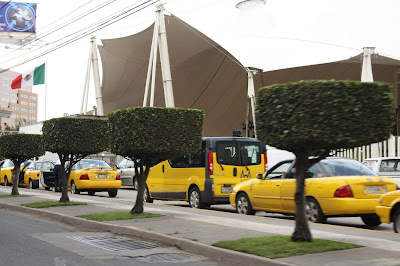
They look pretty, and are found all over. I also found carefully-manicured trees in cone shapes, more cylindrical shapes, etc. It seems that tree care is taken seriously in Mexico. It was also not uncommon to see the bottom few feet of a tree painted white. A park in Guanajuato had a whole bunch of trees carefully trimmed.
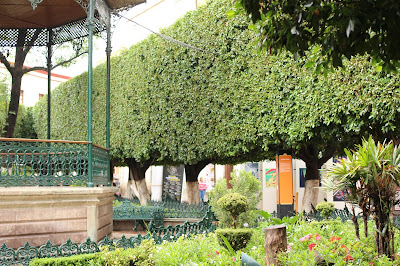
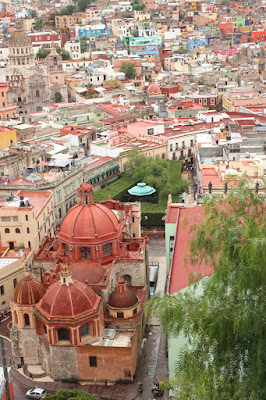
And from up on the mountain, it still looked impressive (the green area behind the dome).
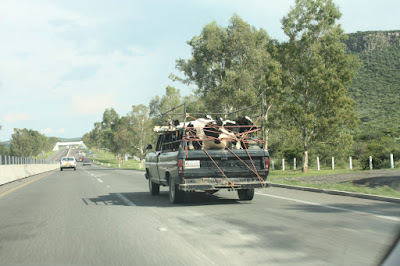
Driving in Mexico was interesting for a lot of reasons. The highways there aren t quite as limited access as the freeways in the USA. It was quite common to see bicyclists, walkers, a mule, or some cattle ambling along the side of the road. Roadside taco stands don t require taking an exit. You just pull off the road because it s right there.
Some sights were a bit surprising. Cattle in a pickup, with rope, for instance.
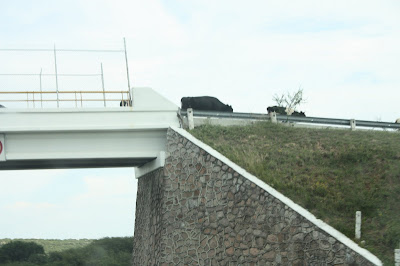
Or cattle crossing the highway on the overpass.
Street vendors were everywhere. Stop at a red light and someone might spring from the side of the road and suddenly start washing your windshield (expecting a tip); try to sell you flowers, juice, or bug zappers; or even throw business card-sized advertisements for adult websites into any open windows they can find. One night we saw an incredible fire juggler. I would have tipped him well but he was too far away to do so before the light turned green.
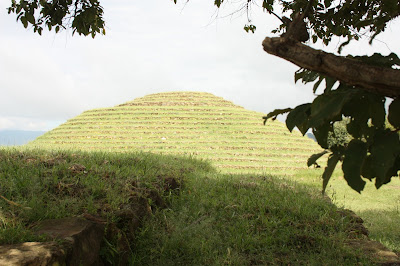
Mexico s history stretches back into prehistoric times, and we saw the Teuchitlan
ruins at Guachimontones one day. It was truly a remarkable feeling to be able to walk down the middle of the ancient ball court, or to climb up one pyramid and see the other from it.
It s not exactly architecture, but Jacob and Oliver sure enjoyed visiting the hot springs at Bosque de la Primavera. Jacob still remembers that where the steam is, the water is 200 degrees, and we CAN T TOUCH IT THERE!
Back in Guadalajara, here s a photo from the inside of the grand old cathedral.
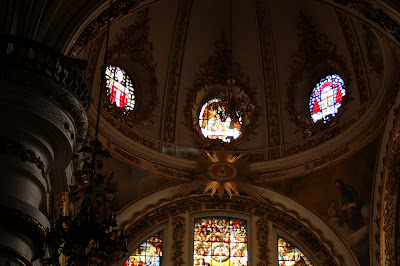
Compared to the cathedrals we saw in Europe, this was of a similar general size and design, and perhaps only slightly newer. But one big difference: worshipers outnumbered tourists at every Mexican cathedral I saw, whether in the center of Guadalajara or at a rainy intersection in Guanajuato or a plaza in Tlaquepaque. It made them feel more alive, and perhaps more sacred as well.
One surprise was seeing people sitting on the steps of the cathedral in downtown Guadalajara selling trinkets such as beads. I think the only other place I had seen something like that was in New Orleans.
All of Guadalajara s Centro was beautiful. Much of it survives from colonial days; I think a person could spend days exploring its museums and buildings. Way too many of my 900 photos were taken in Centro to post on the blog, but just for flavor, here s one of the less than historic scenes.
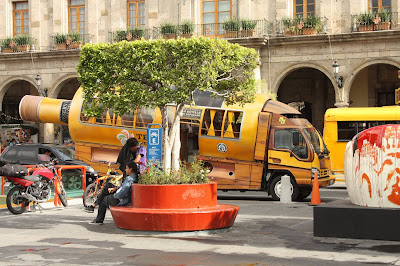
Yes, that is a bus shaped like a tequila bottle.
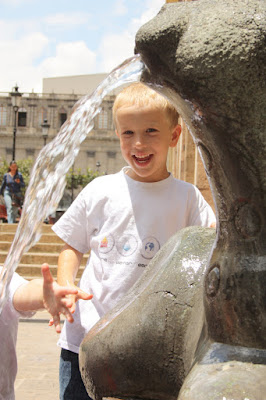
Fountains were beautiful and common across Mexico. A few of them were easily reachable by boys, and ours sure loved those.
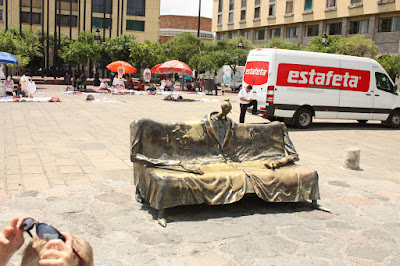
There was a lot of public art, including this interesting chair/skeleton/I m not sure what it is:
And, just for good measure while walking around Centro, they tossed in an apparent Redundant Array of Inexpensive Typewriters.
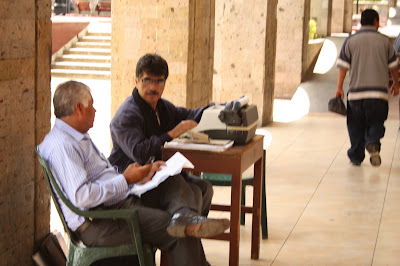
I don t know what they were doing, but there were about a dozen guys sitting out in the sun typing on their manual typewriters on their identical tables.
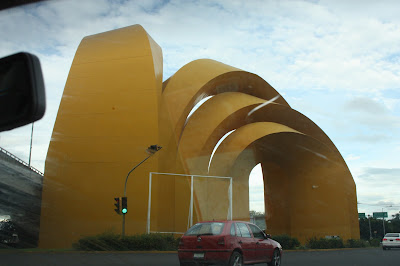
And who can leave Guadalajara without seeing one of North America s most impressive traffic circles. I ve got to hand it to the Mexicans for making something that is normally really boring into an interesting work of art.
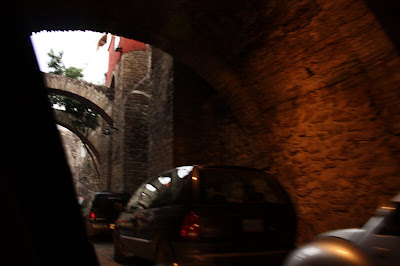
Over in Guanajuato, a lot of driving takes place in the city s vast underground tunnel system. Here s a scene emerging from one of them.
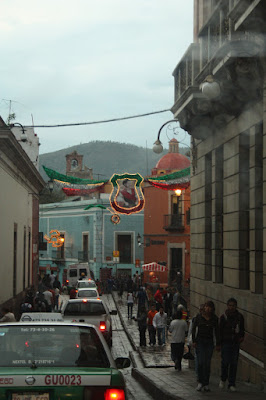
Guanajuato was already getting decorated for Mexican independence day festivities (Sept. 15-16) while we were there.
Here s a typical Guanajuato street scene.
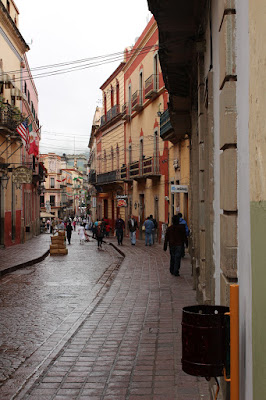
Many of the streets were closed to traffic and perhaps not wide enough to handle vehicles anyway. Those streets had a wonderful peaceful and slow feel to them.
I feel that I ve barely done the trip justice with this post. The feelings of walking down a beautiful Guanajuato street, or stepping into a Spanish cathedral, or even seeing a bunch of guys with typewriters, just can t be replicated. It s brimming with history and character, and shouldn t be missed.
On the 26th of June I wrote that I wouldn t be able to travel anywhere this summer (including
DebConf 11), because I was going to be teaching lots of things related to Information and Communication Technologies (ICT) to a bunch of kids. That was a bit more than two months ago. On the 27th of June we started the first edition of
Fantastic Park with a lot of enthusiasm, and hoping that the kids participating could get in touch to the ICT world while having fun. After all, it was summer holidays.
The results have not only more than fulfilled our expectations but, from what their parents tell, we have also been able to overcome what the children were expecting. It was somehow encouraging to know that the kids were telling their parents to get up half an hour earlier (heh, sorry for them, but that s what being a parent is about, isn t it?), to be able to start as soon as they could, and also to make them wait until the last minute for going back home.
These four editions have involved more than two months of work (280 hours), and 82 kids have taken part on it (57 boys and 25 girls). There have also been visits to different companies that work on the field of ICT (32 in total), and there was an important number of other people collaborating (thanks to all of them). Finally, the last edition of the Park has ended yesterday.
Along these weeks, the kids have been able to get acquainted with a lot of different things, such as robotics (using
Lego WeDo), digital photography and photo edition (using
Pinta), Free Software,
satellites, GPS or learning to code with
Scratch. It has been very intensive and I m almost exhausted, but I m also quite sad that it s over. Hopefully some of these children might have developed an interest in this field, and who knows what might come out of it.
If somebody is interested in the daily activities at the Park, we have been writing a
blog with daily entries (in Spanish, sorry). We have also published quite
a lot of photos of the activities. Of course, needless is to say that I m really happy to have taken part on it, and that the kids participating were simply great. I ll miss them.


If you were trying to get rid of hiring discrimination (on grounds
irrelevant to the ability to do the job), you d think a good way to do it
would be to reduce the ability of the hiring manager to discriminate, by
restricting their access to irrelevant (but possibly prejudicial)
information. It s certainly what I might come up with as an early idea in a
brainstorming session.
I m not alone:
France had this same idea, and gave it a
go,
by passing a law requiring companies to anonymise resumes before they got to
any decision makers.
So far, so average. But rather than just coming up with an idea and
inflicting it on everyone by a blanket law, they did what should be done
with all new ideas: they trialled it (with 50 large corporations, according
to the report) before making it universal, to make sure that the theory
matched reality. Then, after giving it a good shake, they examined the
evidence, and found that the idea had some unintended consequences:
Applicants with foreign names, or who lived in under privileged areas were
found to be less likely to be called in for an interview without the
listing of their name and address. Researchers reasoned that this was
because employers and recruiters made allowances for subpar presentation
or limited French speaking if their performance could be explained by
deprivation or foreign birth.
The icing on the cake is that now the evidence is in, they re now planning
on making it optional (I m not sure how that s different from killing it
entirely, but I guess it s worth the same in the end).
So we ve got the quinella of decision-making awesome:
- An idea was had
- A trial was run
- The evidence was examined
- When the evidence didn t support the idea, the idea was abandoned
Far too often, we get far too attached to our ideas, and don t let them go
when reality doesn t fit our preconceptions. Kudos to the people involved
in this idea for not letting their egos get in the way of good government.
Let it be an object lesson for us all.
DebConf 11 -- Banja Luka, Bosnia and Herzegovina
I'm writing this on my way back from my fifth DebConf, waiting in the
Frankfurt Airport for my flight to Munich then another wait for a
flight back to Los Angeles.

 DebConf
is the annual convention of
Debian Developers and other interested in
how Debian Linux (or Debian BSD) works, and want to help make it
better. Debian is an international volunteer project, and Debconf is
held each year in a different city, normally not on the same Continent
two years in a row. Only one so far has been held in the United
States, last year Debconf 10 was in New York City. (Mexico and Canada
have also hosted Debconfs.)

DebConf is a week long conference, with one day designated as "Debian
Day" with more introductory level talks, frequently in the local
language, and local people are invited to learn about Debian. The
rest of DebConf is held in English. This year had over 350 attendees
from a couple of dozen countries.
Unlike most computer conferences, DebConf is free to attend.
(Professional and Corporate memberships are available for those who
would like to financially support DebConf.) If you apply early
enough, you can request help paying for food, lodging, and travel as
well, but such support is limited and you have to justify it. This is
all make possible by our generous sponsors, who include some major
corporations who use Debian.
This year DebConf was held in
Banja Luka, Bosnia and
Herzegovina. The Bosnian bid won
partially based on the generous support of the Bosnian government, not
only financial and letting us use one of their buildings for the
conference, but also help with getting visas and other such aid.
(Visas are not required from the US or most of Europe, but they are
from some other countries.)
I arrived on Saturday about 24 hours after I left home, starting with
too little sleep. I actually managed to eat dinner before passing out
in my hotel bed. The hotel room I had in Hotel Vidovic (accent on the
c) was nicer than any I have stayed at in Europe (although I always
chose by price), and the conference price was less than half what a
similar room goes for at a US hotel. There was a nice breakfast
buffet included in the hotel cost. (Hot omelets and sausages as well
as the usual cold cuts, cheese, fruit, juice, coffee, tea, cereal,
yogurt, etc.) The in-room ethernet connection worked all the time
except one morning, although it was not particularly fast. The hotel
is relatively new, the Lift (elevator) had a date of 2005 on it and I
suspect that is when the building was constructed.
Sunday was Debian Day, and I went to a couple of sessions before
deciding to take a nap in the afternoon. My nap wound up being from
3pm to after 11pm, sleeping through dinner. I was awake for an hour
or so checking my email, and then slept till 4am. That was the
morning I made it to breakfast before 7am. This was the first time I
ate breakfast at normal breakfast hours for a full week for many
years.

After breakfast Monday, I spent several hours at the front desk
helping give out badges, conference bags, and t-shirts. Lunches and
dinners were in the Hotel Bosna, across the street from venue. For
lunches we were served soup, salad, a plate of food, and desert. For
dinners there was a buffet. The food served at Bosna was fairly good,
but repetitive from day to day. (I've had much worse hotel food in
the US for much more money.)
Tuesday was more or less a repeat of Monday, with me opening the front
desk by myself and not nearly as many new arrivals. The sessions
varied of course, and I played "Debconf Experimental 5-card Mao".
(Mao is a card game, popular in Cambridge and at DebConf.)


Wednesday was the Day Trip. One day at DebConf is dedicated to
socializing while seeing some of the local culture of the hosting
city/country. This year there was an option of rafting (with some
white water) or visiting a historical monastery and hiking to a
waterfall with several grain mills powered by diverted water. This is
the first time I had seen one actually grinding grain. (It's mainly a
historical tourist attraction, but I don't know what happens to the
flower made.) We then met at the rafting location for a BBQ lunch.
Apparently there was some miscommunicaiton and the rafting place was
not prepared for 70 or 80 people who wished to go rafting, so some did
not get to raft until after lunch, and I'm not sure all that wanted to
did. Dinner was back at Bosna.
Thursday was another normal conference day, with the new wrinkle of
distributing food tickets since Bosna was not willing/able to follow
our instructions on who should be allowed to eat at Debconf expense.
Those who wished to dine with the other Debconf attendees could
purchase the tickets from the front desk, although this was not well
publicised and few people took us up on it. The special "Conference
Dinner" was Thursday night. This was held at a restaurant on the 14th
floor of a building a few blocks away, and was a fancier buffet.
There didn't seem to be much difference between the first and second
course, and they ran out of desert before many people got any. This
one was not as memorable as the one in Mexico, but that one was for
the wrong reasons, including an unplanned indoor waterfall. After the
dinner I played Mao again, this time till 2am.
Friday was the only day I did not arrive at the venue in time for the
first session (10am).


Saturday I opened
the front desk by myself again. In the afternoon was the "Debbugs
Skills Exchange" that was requested by several people, so Collin
Watson, Ian Jackson and I gave some information about it and Don
Armstrong (who has done most of the recent coding on debbugs)
participated via voip. (Debbugs is software for the Debian Bug
Tracking System, often called the BTS.) Collin and Ian are emeritus
members of the BTS team, and not active in it, while I am handling the
spam filtering and haven't done much with the rest of the BTS. This
was in the small "Meeting Room" (rather than the Auditorium or the
round room) so we don't have to worry about video archives of it being
available. (All the sessions is the two main rooms were streamed live
on the internet, and will be edited and archived on
http://meetings-archive.debian.net/pub/debian-meetings/2011/debconf11/.)
We created a mini intro to the BTS document at that session that
should be cleaned up and published. Less than two hours after that
talk, the conference was over and teardown was started. As usual, the
teardown and cleanup of what we had set up over several days was done
is several hours, with many people helping.

Sunday was leaving day. I was one of the people on the 11am charter
bus to Zagreb DebConf arranged. The two such charter busses were an
excellent idea, since the normal busses and trains would not have been
able to manage that many extra passengers. This actually took longer
than the planned 4 hours due to the long lines at the border crossing
on Sunday afternoon. Both Bosnia and Croatia check passports both
coming and leaving, so it is checked on both sides of the river that
is the border between the countries. The check is pretty cursory
unless you are from a country that needs a visa. I then had a plane
flight to Frankfurt, and am currently in the middle of my 11 hour
layover here. After that I fly to Munich early in the morning, have
an 8 hour layover, and fly to Los Angeles. This schedule was in order
to get flights at something resembling reasonable cost when I did it.
From what I saw of Banja Luka, it's a nice place to visit, although
most of the people do not speak English. Vegetarians may have a hard
time finding meals, and sometimes they try to serve fish to them.
(Assuming vegetarian means "no meat".) Transportation to Banja Luka
is a bit hard, there are only six or so flights per week to the local
airport, and one of the airlines is not on the international ticket sites.
Most DebConf attendees flew to Zagreb then took busses, trains,
vans, or taxis to Banja Luka (a 2.5-5 hour ride depending on border
lines, road construction, etc.). The weather was rainy off and on
throughout Debconf, but the day of the Day trip the rain held off
until most of us were back and we had a lovely day. Temperatures were
warm but not overly hot, and I never needed my jacket.

There are many large alarm clocks in Banja
Luka, (such as the one pictured here, across the street from the
venue) but there doesn't seem to be a way to change the time setting
or put them on snooze.

If a single man can display so much hatred
think only of how much love we all can display together.
Stine Renate H heim
I wrote a
Norwegian post explaining my experience at Ut ya. I had taken this blog for dead, and had entirely forgotten that it was syndicated on Planet Debian. I don t want to let Google Translate make this disaster any worse than it is the translation of bullets into balls being particularly bad so the international attention the massacre has garnered in consideration, I am writing an English translation of my experiences. I feel somehow duty-bound to make people aware of what happened, but I don t want to get into anything else but a sober description of the events and some very brief reflections. There are many details I have chosen to omit.
Others have written their experiences of the events at Ut ya. I wanted to write mine down as well, and get it out there . Partly, I want to write this down because I m unsure if I will remember all the details at a later point in time, although I think I d prefer it if I couldn t. I m also writing this because people are asking about my experiences and it s much better to have an URL to give them, lest I have to keep going through the same spiel over and over again.
Our former Prime Minister and current labour movement demigod
Gro Harlem Brundtland had recently left the island. I had been the cameraman for a video interview of her talking about Ut ya, and I was in the media group room encoding the video into a file suitable for YouTube, when someone else in the room startled and said that Twitter was full of messages about a loud explosion in Oslo. As the newspapers brought us information about the extent of the damages, a consensus arose that an informational meeting was in order. As soon as the current round of talks finished, we were gathered into the main hall.
The meeting was duly held, and after the statement was made that a TV feed would be made available, I took it upon myself as the local alpha geek to make it happen. Of course, the situation caused both the wireless network and the GPRS networks to become totally unusable. As I was waiting for someone to set up a password, I took the opportunity to face the consequences of having eaten two bits of a microwavable dish called Hold-It the local equivalent of a Hot Pocket and went to the toilet.
As I was in there, I first heard agitated shouting, then screams, then gunshots coming from just outside the toilets. More than anything else, it sounded like a toy gun. I was convinced that someone was making a joke in incredibly bad taste and I stormed out of the booth with the intent of halting it. As I tore the door open, I saw two of my comrades hiding in a recessed corner. Their facial expressions left absolutely no doubt that this was no toy. They signalled for me to get back in the booth. I closed the door, did a mental double-take in utter, complete confusion, and opened it again. They were still signalling. Had they not stood there, I would have run straight into the gunman; they saved my life. I looked out into the hallway, and I made eye contact with a young boy lying in a pool of blood. He was motioning for me to help him. I heard more gunshots from inside the building and retreated back inside.
As I was trying to think through my next move, I realized that the decidedly insubstantial wood-fiber door would not resist any kind of bullets. I made my way out into the hallway, with the intent of escaping outside. At that point, I was of course not aware that there was an intention to kill as many as possible, so I thought that the open spaces outside would be a place of relative safety. Of course, this proved to be wrong and my life was probably saved a second time by one of the caf volunteers taking me into a hard-to-spot employee s bathroom.
We sat there for ninety minutes. Always ready to make a run for it, ready for just about anything. A peculiar group dynamic arose with these two people with whom I had barely previously spoken. We came to share a strange sense of common destiny and gallows humour. One of them had seen the shooter and described the police uniform. I perceived it to be realistic that we were the only ones aware of the wounded outside the toilet. I tried to reach the emergency services, but all their lines were busy; the terror attack in Oslo had probably clogged their lines. I finally got through to the fire services, who could inform me that the police did know about the situation and were on their way. This was to take 90 minutes and by the time we evacuated, the young boy outside my door had perished. The despair I first saw in his eyes as I passed him, fleeing from one room to the other and the empty, blank stare as we left, are burned into me and they are images I will never in my life forget.
Finally, the real police arrived. We walked out. I chose the path through the minor conference hall something I now regret. The sight was simply beyond my capacity to describe fully, and so terrifying that I barely remember the sight only the terror it struck in me. There were several people bunched up in a corner, a big amorphous heap of bodies. Some were conscious and yelled at me not to do anything that could startle the police, others lay still. Their bodies were all covered in blood, and a thick pool of blood extended at least a half-metre in all directions around them. The policeman across the hall was screaming orders at me, but he was screaming so loudly that I couldn t make out his words at first.
We were first moved into the camp newspaper s offices. There were about eight of us there, I think, in addition to one girl who lay wounded. Towards the end she was drifting in and out of consciousness. We covered her with sweaters to keep her warm and one of us tried to at least temper her bleeding. The bullet had missed her heart, but by the entry wound it was clear that it was not by far. I do not know who this girl was or how she is now. I sat behind and never saw her face. The wounded were evacuated first. I don t remember how long we remained; I had lost all concept of time.
In spite of protests from the group who knew him, one kid was put in handcuffs. At the time I didn t understand why, and the policeman seemed to say something almost to the effect that there was no reason for it at all. I didn t see when they undid his cuffs, but I remember thinking that this treatment made a terrible experience even worse for him. I tried my best to comfort him but knew it would be little help. Later, when things stabilised a little, we were told that he was handcuffed because he had come from an unsecured area. The police was extremely good at carefully explaining what was happening and why; this was a big help and I am grateful for it.
Eventually we were moved out into the main corridor of the building, where we joined up into a group of about fifty. Only when I saw the two people who saved my life did any emotion other than mild confusion arise. I broke down shivering in tears in one of their arms. After a few seconds, I came back to my senses and realised that this was not the time. I quickly gathered myself, got the shaking under control, and sat down. We were given some chocolate and soda from the kiosk. I remember making an offhand remark that an inability to find joy in free candy was a sure sign of a bad situation. We all laughed out loud. Gallows humour is a coping mechanism, but in retrospect one almost feels guilty for it.
We were shown out in a single file with hands above our heads. I remember an intense concern that someone would slip in the steep, muddy slope and create a misunderstanding. Outside, there were more bodies. Some under improvised covers a tarpaulin from the waffle stand, the deflated bouncy castle but some simply lay there.
Everyone I met displayed a courage, a mental discipline and unity of purpose far beyond anything one would ever wish to expect from people this young. Everyone conducted themselves with an attitude that could almost be described as stiff upper lip .
Safely across the fjord we were offered blankets. I was asked if I was aware of any injuries, and asked to lift my shirt and show my abdominal region. We were shown into the bus which took us to the hotel used by the survivors and their family. I simply cannot describe in any words the relief I felt when I was able to embrace my living comrades. It was completely unlike anything I had ever felt before in my life. The euphoric feeling was tempered only by the realisation that there would be many I could never see again, comrades whom I had taken great pride in calling my friends, with futures in the service of all mankind, futures I had previously found such great joy in pondering and guessing about. The feeling which continues to upset me the most, is the feeling that so many of my comrades left behind grieving families and friends. Torn away senselessly.
I do not know how much more than this relatively sober account of the events on Ut ya I can muster. I would, however, like to offer some reflections.
First of all, from the bottom of my heart, I want to thank the police who saved the lives of so many still on the island, the holidaymakers who took aboard swimmers into their boats and the rescue services staffed primarily by volunteers who have spared no effort in trying to soften the blow as much as they can. The opportunity to spend time with those comrades who underwent the same experience as myself has also been an immeasurable aid. I was also so relieved to find my very closest friend among the survivors, which has also been an indescribable help.
If I can name a single positive in this tragedy: Had he arrived with his automatic weapon fifteen or twenty minutes prior, he would have arrived during the informational meeting, at a time when the major hall was absolutely jam-packed the death toll would be many times what it ended up being. I am agonisingly aware of the meager comfort this provides to those who have been bereft of their closest, but I do find some solace in this.
We cannot sweep under a rug that this was without question! a political attack on the labour movement. But it is thankfully also an attack which has been perceived by everyone as an attack on the Norwegian society, and on a symbol of the wide recruitment to the participatory democracy which lies at our very national soul. I cannot thank the Norwegian people, and indeed the people in other nations who have offered their condolences, enough for their shows of support and shared grief. It really has been a tremendous help to me knowing that so many people feel with us.
I also want to thank from the bottom of my heart the rock-steadiness of everyone in both the national and local wings of the Labour Party and Labour Youth in supporting us, and the political milieu in general for their resolute steadfastness saving me from losing yet more that I cherish; our freedoms in a participatory democracy.
Our Party has lost many of its very brightest youngsters. Personally I feel an angry spite, a deep restless urge to get the wheels of society going again. I want to show his kind that we will not be broken. We re stronger than that. I will not be frightened into silence and passivity. I want to remember the dead, and honor them by carrying on our common work.
I want to end this with a request to everyone who reads this, echoing a statement I read by one of my good friends and comrades: Please, don t let me see any messages of hatred, wishes for the death penalty, anything like that. If anyone should be of the belief that anything will improve by murdering this sad little person, they would be profoundly wrong. All attention now should be plowed into caring for those victims and their relatives who did not share my luck, and
not giving an audience to a perpetrator who wants one.
Tore Sinding Bekkedal
It s not very often that I watch a movie anymore. It s been a few years since I ve actually purchased one (normally I see them from Netflix). But yesterday I saw one that may change that.
The Lives of Others is an incredible film set in the former East Germany (GDR/DDR) mostly in 1984. The authenticity of it is incredible and so is the story. It s subtitled, but if you re an American wary of subtitled European films, don t be wary of this one. It is easy to watch and worth every minute.
The story revolves around the
Stasi, the GDR Ministry for State Security ( secret police ). It is an incredible picture of what living in a police state was like, and how many of the informants were victims of the regime too.
My breath caught near the beginning of the film, showing the inside of a Stasi building. A prisoner was being interrogated for helping someone attempt to escape to the west. But the reason my breath caught was this incredible feeling of I was there . Last year, Terah and I were in Leipzig and
visited the Stasi museum there,
Museum in der Runden Ecke . I always have an incredible sense of history when being in a preserved place, and this building was literally the Stasi headquarters for Leipzig. Much of it was preserved intact, and seeing it in the film brought home even more vividly the terrible things that happened in that building, and others like it, not so very long ago.
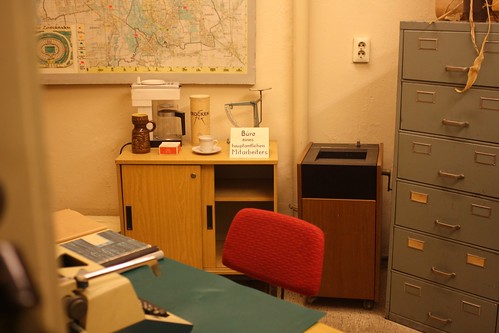
We watched the special features on the Blu-Ray disc, and one of them was an interview with director Florian Henckel von Donnersmarck. He described how he spent a lot of time interviewing both victims of the Stasi, as well as ex-Stasi officers. One of the most disturbing things to me was his almost offhand comment that most of the former Stasi officers still had some pride in performing their jobs well. Even now, freed of the state s ideology, they were proud of the work they did which could be put most charitably as ruining people s lives.
What leads a person to view life that way? How can we try to make sure it doesn t happen again elsewhere?
I am happy to say that most of us have never experienced anything like the Stasi. And yet, small reflections of that mindset can be seen almost everywhere. Societies at wartime or feeling under threat, even Western democracies, can drum up those feelings. In the USA, for instance, the
McCarthyism era saw people s careers ruined for alleged anti-state behavior. Contemporary examples include the indefinite detention (I hate that word; shouldn t we say imprisonment ?) of terrorism suspects at Guantanamo Bay, and the terrible treatment of Bradley Manning, who revealed some true but embarrassing things about the US military which really needed to be revealed. Even tobacco farmers and companies are selling a product they know ruins lives, but somehow keep doing it.
And there are still members of the public that try to make life difficult for people that don t think like they do. From organizing campaigns of telephone harassment of colleges that don t perform the American national anthem before sporting events, to tossing about the term un-American (a loaded McCarthyist one, which many may not even be aware) at an inflated rate, we are not immune from attempts at forcing conformity or silence in others, and blind loyalty to state.
I am never in a particularly celebratory mood on July 4, the biggest day for American boasting, faux patriotism, militarism, and general flag-waving. We do have a lot to be proud of and thankful for, but it seems that we celebrate all the wrong things on July 4, and see it as an occasion to proclaim American exceptionalism rather than as one to see how far we ve come and bolster hope for how far we can, and should, yet go.
No, I don t think that the land of the free ought to have operated secret prisons in Europe (nor the Europeans to have been complicit in it), or that the American military was defending our freedom 100% of the time they were deployed, or that it is right for governments to mandate daily recitation of an untrue document (the pledge of allegiance) in schools.
And yet, I am mindful that I have a lot to be thankful for stability, lack of much internal violent conflict, etc. And this particular day I am happy that a post like this is not something that gets the attention of some government agency and mostly that I will have a handful of angry emails to delete.
I haven t blogged for a while, because I ve been doing so many things that I scarcely had time nor will for it. Among all those things, and during the weekends of the last few months, we have been
teaching kids (8-12 y.o.) about computers, Free Software and technology. Those kids are great, very intelligent, very motivated, and very funny to be with. I miss them a bit after the program has ended. In any case, I ve been given the chance to
teach some more kids during summer weekdays, and I m really looking forward to it. The downside of this is that I won t have any summer holidays and, thus, I finally won t be able to attend
DebConf 11 in Banja Luka, which was something I was also looking forward too. But, even though that s something I d really love to do, one cannot be in two places at the time, so this year I finally won t be able to attend DebConf either. Have lots of fun! I ll miss you!

In case you want to know more about all of this (sorry, links are in Spanish):
Oh, and to show you what I m exchanging you for (nothing personal):


I wouldn t like to end this post without thanking all the kids from both
Campus TIC and
Yo Programo for being so cool, and also to welcome the kids from Fantastic Park, in case any of them -or their parents- are reading.
Oh, and all of you who attend DebConf this year, have a lot of fun!
 Edit Aug 18th: video available
(ogv, also on
youtube)
Forget AMD, Intel, NVIDIA!
Thomas White's incredible work with
Neo FreeRunner's puny graphics dec...accelerator,
Smedia Glamo 3362 is starting to bear fruits. Not listening to such comments as the chip will never be used anywhere else and why not spend your time doing something more relevant , he has chosen to actually do what he likes and sees as an interesting challenge. And that's often the spirit of free software, so I don't really agree with the naysayers.
The camera shot on the right, running KMS-enabled X.org driver for the glamo chip on my Debian installation (visible software matchbox-window-manager, fbpanel, zhone), is a bit optimistic looking since Zhone happens to draw correctly. A lot of the drawing is not yet synced correctly, which shows as all text and images in eg. GTK applications being garbled. But as little as two days ago one couldn't yet much launch applications without X crashing, so the newest commits by Thomas were a big step forwards. I'm using
Debian, and he's not, so I try to find time to help in debugging even though I really can't much help with the driver code.
The driver is not just one piece of code, but consists of a
kernel drm driver (direct rendering manager) using
GEM,
libdrm support for the kernel driver and finally
the X.org driver supporting these other components and offering buzz-words like DRI2. There is also a beginning of a
Mesa 3D driver, though it is so far just a skeleton driver since the 2D/KMS/EXA/DRM parts are what should be done first before dwelling into the OpenGL realm.
Openmoko the company is basically nowadays just producing new Neo FreeRunners to resellers, but the community of the so far only Free phone is thriving. The final (Openmoko produced, from where
gta02-core continues) version of the phone, with the famous buzzing problem fixed, appeared on store shelves some time ago, offering better out-of-the-box phone functionality in addition to all the mini computer features. It was also
offered to
Debconf visitors on
discount.
It's not only cool to have kernel mode-setting, though it is indeed very cool as well. The reason for much sorrow in the whole OM project has been the graphics chip, and some of the problems with the chip are only finally solvable with the kernel doing the mode-setting. So it's both a very modern thing to use KMS, but there are also clear potential benefits of having accurate control over this very sensitive piece of silicon. The current non-KMS X.org driver for example busy loops in order to try to feed the chip at a correct pace, causing CPU usage every time there is any drawing going on.
This is somehow reminding me about getting the best out of
8-bit computers and other hardware with some specific limitations. The glamo chip is very limited in some ways, but also capable in some other ways like theoretically offering MPEG-4 decoding, OpenGL ES 3D support. It's a mixed bag of things, and I can very well imagine it's indeed an interesting challenge to work on it, if you just have the skills (I don't) and nerves (proper debugging tools help).
It's so nerdy to drool over lines in the X.org log, but I just can help it:
X.Org X Server 1.6.3
Release Date: 2009-7-31
X Protocol Version 11, Revision 0
Build Operating System: Linux 2.6.28 armv5tel Debian
Current Operating System: Linux neo 2.6.29-GTA02_mydrm #2 PREEMPT Mon Aug 17 18:24:39 EEST 2009 armv4tl
...
II) Using KMS!
...
(WW) Glamo(0): EXA hardware acceleration initialising
(II) EXA(0): Driver allocated offscreen pixmaps
(II) EXA(0): Driver registered support for the following operations:
(II) Solid
(II) Copy
(II) Glamo(0): Initialized EXA acceleration
...
(II) Glamo(0): RandR 1.2 enabled, ignore the following RandR disabled message.
...
(II) Glamo(0): [glamo-dri] Name of DRM device is '/dev/dri/card0'
(WW) Glamo(0): [DRI2] Version 1 API (broken front buffer rendering)
(II) Glamo(0): [DRI2] Setup complete
...
(II) AIGLX: enabled GLX_MESA_copy_sub_buffer
(II) AIGLX: Loaded and initialized /usr/lib/dri/glamo_dri.so
(II) GLX: Initialized DRI2 GL provider for screen 0
(II) Glamo(0): Adding framebuffer....!
(II) Glamo(0): 8 480 640 16 16 960
(II) Glamo(0): rootPixmap = 0x1d0a00
(II) Glamo(0): Done

Over the course of the last five years, some relatives of me and I have been working on a family book which lists all descendants of my grandgrandgrandgrandfather Isaak Riehm, born 1799, and his wife Charlotte. My task was everything related to maintaining the data, running the infrastructure and generating the final book. In the end, we have collected biographical details, often with the person s live story, of 703 descendants, 285 partners and 416 parents-in-law. Together with an extensive preface the book now has a respectable size of 401 pages, includes 144 pictures and maps and over 200 copies have been printed and sold through the family.
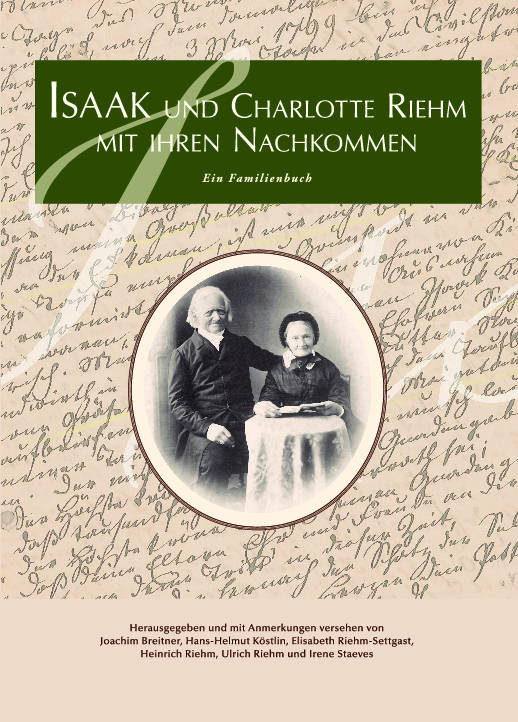
Although I do not think that the details of the lives of my family is very interesting for the general public, or even suitable for general release, I do want to show the fruit of our work. Therefore, I have created a stripped-down on-line version that only covers the first four generations. I bundled the book body with the cover and the end sheets into
one complete PDF file (caution, large: 54MB, and of course in German).
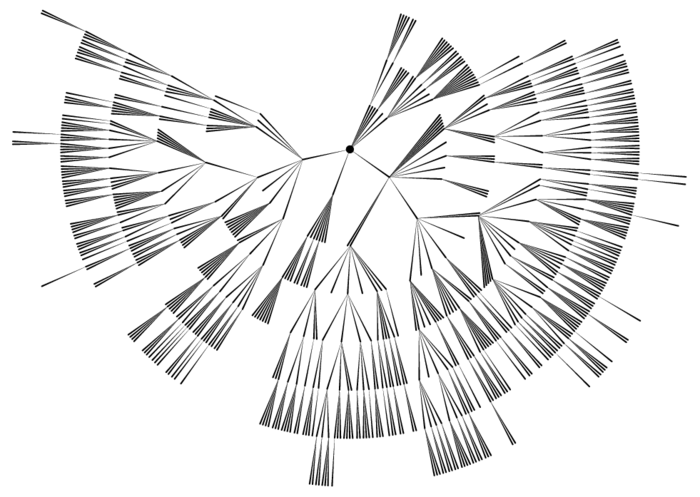
Some nifty embellishments of the book that I especially like are the abstract looking descendant fan in the front-end and back-end sheets, the separating bars between the persons which indicate the livespan of that person between 1799 and 2011 and the maps of the birth places and Isaak s travel destinations in the preface.
Now to the technical details: Naturally, I used only Free Software in the genesis of the work (The cover is an exception, as it was not created by me). The most important is definitely
gramps, a free genealogy system that held all our data. It is written in python and extensible with plug-ins, so I was able to create a custom report that takes the data relevant for us, filters for people who have agreed to appear in the book, and then generate LaTeX code that typesets the book, ready to be printed. I learned a great deal of LaTeX for this project, which uses over 30 different packages and required me to
create a font of my own (which, as a side product, lead to
a publication in the Linux-Magazin).
For the maps I found the
Generic Mapping Tools (GMT) and the freely available data for that of great use. I still had to manually collect the coordinates for all the places I wanted to show up in the map. Here, I relied mostly on Wikipedia.
The fan which appears in the end sheets is laid out using a
Haskell program (naturally, I have to use Haskell somewhere).
Of course, generating the book is only one side of the story; first, the data has to be collected and edited. For that, I wrote a plug-in to gramps that creates forms for each person. These forms contain the current known data and are used to correct and extend our knowledge. One variant of the form, created using LaTeX, was printed and mailed by snail-mail around the country and beyond, for those who are not reachable by mail. The other variant is an HTML form, hosted on a password-protected web site. Changes to that form cause the server to send an e-mail with a description of the changes (and only the changes, not the fields that are left untouched) to the mailing list of our team. There, the changes can be reviewed, e.g. for spelling and stylistic issues, and finally I copy n pasted them into gramps. These parts are implemented in python as well.
Since genealogical data is never complete or up-to-date, I have set up a password-protected
mediawiki based web site for the book where we collect corrections and additions to the data in the book.
We have never anticipated that it would be so much work and that it would take us so long to finish this project, but we pulled it through and we are very happy with the result. Also, the reception has been very good and it was definitely a success. At this point I d like to express my gratitude to the hundreds of Free Software developers out there whose code we used and without whom it would not have been possible publish the book in the current form at all!
Update: Due to some requests, I am making the code that I wrote available. You can
download the tarball. Note that the code is a big mess and will not be usable right away. I guess if you can get the code to run and actually adjust to your needs, then you can as well write it yourself. Nevertheless it might be useful as inspiration or reference.

Hello, this is the official project report for the Debian GSoC admins and everyone. It s been few days since the official coding phase started. Most of the time I ve been figuring out the details regarding integration of non-x86 images to the Eucalyptus IaaS and working on the ARM image, as you ll learn later. I m also in the process of starting to design the set of tools we ll be delivering as part of the project.
The project s goal is to be a useful resource for Debian developers and porters. I ve joined some porters list in order to learn what are the things they are struggling with and how the project can help to address them. I ll be starting a wiki page with such topics.
Bonding period:
Bonding period has been more fruitful than I expected. As mentioned in my previous post, Steffen and I got in touch with the Eucalyptus team, since they show their early interest on the project. We are coordinating cooperation between our teams. Besides my mentor and I defined to start working on the ARM image. Coordination went OK. We ll be having meetings every two weeks.
Project Status:
Resuming Dominique s
work I began working on the ARM image. Aur lien s
work was a great resource. Currently I have a working and updated Debian testing ARM image using the versatile kernel that can be used under qemu-arm. I m currently making tests and figuring out the next phase which is cloudify it. Over this weekend I expect to finish on that side and then began on the design and implementation of the tools that will be the project s result.
Until now I haven t faced much issues, but the Eucalyptus part since the docs are targeting x86 and amd_64 archs. However I think I can run qemu-arm on top. I ll talk to them about the idea.
Future plans:
week 3:
- Finish tests with the ARM image.
- Design the base tool-set, thinking integration with dpkg-buildpackage and
qemubuilder.
week 4-8:
- Write the necessary code.
mid-term evaluation.
Other bits:
Latest days have been quite busy for me, since I m still have to attend class, my semester ends in five weeks. This week was quite overwhelming with media , my University published an
article (Spanish) about me and the program. I m the third student of the CS school participating in GSoC, in the past we had Gentoo Project and KDE students. Later, a local Cable TV program interview me on the same matter, it went fine. I managed to talk about Debian and what we do (we get free Advertising yay!) :) also about Google s Summer of Code program and invited students to participate both in FLOSS projects and the program. Still don t know if they have put it on air, I think it will be next week.

This is my monthly summary of my Debian related activities. If you re among the people who
made a donation to support my work, then you can learn how I spent your money. Otherwise it s just an interesting status update on my various projects.

I have been
Doing some work towards Debian Rolling
At the start of the month, the discussions about Debian rolling were still very active on debian-devel. Declaring that testing would be rolling did not make it (as
I hoped), the argument that some RC bugs last for far too long in that distribution carried the discussion and thus the most consensual proposition ended up being the
one of Josselin Mouette were rolling would be testing plus a few selected cherry-picked packages from unstable.
I believe it s a workable solution if we only care about a subset of architectures. Otherwise the same reasons that keep the fixed packages out of testing would probably also apply for rolling.
Given this, I did setup britney (the software that controls testing) on my laptop to investigate how we can create rolling. It turns out britney is a very specialized software with very few configuration knobs.
At the same time Joachim Breitner
made a proposition that immediately grabbed my attention. He suggests to use
SAT solvers to find out the set of packages that should migrate from unstable to testing. I thought that rolling would be a good testbed for this new implementation of britney (which he calls SAT-britney) so I jumped right in this project.
I was not at all familiar with this science field, so I looked up quite some documentation: I learned that all SAT solvers expect the problem to be presented in
CNF form, and that
DIMACS was the file format of choice to represent those boolean constraints. Several SAT solvers are available in Debian and picosat appears to be one of the best.
Then I started some early coding/prototyping to play with the concept. You can find the result in this
git repository, you can grab a copy with
git clone git://git.debian.org/~hertzog/sat-britney.git.
There s not much yet, except some Python code to generate a SAT problem that can be fed to a SAT solver. But I really look forward to this project.
Representing Debian during Solutions Linux
During the second week, I spent 3 days in Paris to help manage the Debian booth at
Solutions Linux.
We have responded to lots of queries but most visitors already knew Debian, and many of them use it at work and/or at home. We tried to recruit those people as new members for
Debian France, the local association. We also sold all our remaining goodies.
The Ubuntu people were interviewed by France 3 (an important TV channel) and we took this opportunity (with the consent of the Ubuntu guys) to show our Debian t-shirts in the background: you can
watch the video here (in French), you can see me with Carl Chenet at 1:21.
We have also been interviewed by Intelli n TV:
here and
here (both in French). I m not very good at this exercise.

Improving dpkg triggers
The third week was a vacation week, in theory I should have stayed away from my computer but I really wanted to take this opportunity to improve the state of dpkg triggers in Debian.
I already covered my work in another article:
Trying to make dpkg triggers more useful and less painful.
The result is not merged yet, I just asked a question to all package maintainers who are using triggers to be able to decide whether I ll merge it as is, or if I can make the new behavior the default one.
Supporting users after Alioth s migration
When I came back from my vacation, many services provided by Alioth.debian.org were non-functional after a
migration to a new setup that involves two machines instead of one. Given that I used to be an Alioth admin, I know that in those periods you tend to be get bogged down on many user support requests. So I re-joined #alioth on IRC and tried to help a bit.
I did investigate some of the reported problems and prepared fixes (updated scripts, configuration files, etc.) for some of the issues. I also created a list of
remaining issues that should have lasted only a few days but that s still active because there are still regressions left.
The most important things still missing are:
- proper support for delegation of rights. We used ACL setup by the admins in the past. With the new FusionForge, each project admin should be able to delegate rights to external roles . There s a Debian Developer role already but trying to grant him right fails
- access to the Ultimate Debian Database. Many tools rely on this database to work.
- anonymous FTP access to download project files.
- clear guidelines on how we re supposed to deal with websites that are updated by VCS hooks.
- clear guidelines on how we re supposed to deal with personal git repositories
Improving the 3.0 (quilt) source format
I have made
some proposals to change the way the new source format would work. The goals are to be less painful for packagers who are using a VCS, and to avoid unexpected changes slipping through a new patch generated by dpkg-source.
It seems that the proposals are relatively consensual so I ll implement them at some point.
Missing in action on my blog
I did a lots of stuff for Debian between travel and vacation, and in the remaining time, I did not manage to write many articles for my blog.
In fact, besides the article on my triggers work mentioned above I only published one interview:
People behind Debian: Steve Langasek, release wizard.
I ll try to do better this month!
Thanks
Many thanks to the people who gave me
151.61 in May.
See you next month for a new summary of my activities.
One comment Liked this article? Click here. My blog is Flattr-enabled.
I doubt I have ever read a book that had as significant an impact on me, and my act of reading it had on others, as this one. Conversations like this were frequent:
Someone, upon seeing me reading my Kindle, would ask what I am reading.
War and Peace.
Oh. . . uhm, wow.
Yeah, it s great. I m reading it for fun.
Uhm, OK then, see you later. . .
It seems to be so revered, and also so loathed, that I had to read it. At 1400 pages, it took me 8 months to finish, though I read several other entire books in that time.
I feel rather unequal to the task of expressing how this book impacted me, let alone a review of it. And nonetheless, I also feel I would be remiss if I let it go past saying nothing.
I was struck by so many things as I read War and Peace. Some of them I won t mention here and hope to turn into their own blog posts.
Of the others, I felt I gained some sense of how the nobility and serfs in Russia (and, to a certain extent, Europe) thought about life, their position, and how things ran. Being a modern Kansan, this thought process was not familiar to me, and though I head read about it in history texts before, felt far more informed having read it in Tolstoy s novel.
Although much of the novel centers around Napoleon s invasion of Russia in 1812, the work as a whole spans nearly two decades of time. Tolstoy s characters aren t static; they change over time. Some, yes, die; others go through hardships and triumphs that change them to their core. It evoked a feeling of nostalgia in me at times for the younger, childlike Natasha who was so full of simple delight in life. But then, a thousand pages later, the older Pierre finally was able to find simple delight in life too.
Sometimes I have missed on the simple joy of being, and Jacob or Oliver or Terah remind me of that. Today Oliver and I read a book together, one that we read often, and we discovered an illustration of a tiny worm we had never noticed before. And the worm had a red hat ( hat is one of Oliver s favorite words right now.) The happy laughter as he pointed at the tiny hat, saying hat over and over, reminds me that sometimes children know how to live better than adults. Jacob later asked me how my day was, and I told him how I read a book on my Kindle, where I sat, and how I even read it lying down on the couch for a bit. At that he too laughed.
As with some other wonderful, engrossing books, I was sad to reach the end of this one. I felt as if I was leaving a conversation early; fictional characters, yes, but their story wasn t over. And really, that was part of Tolstoy s point: things don t happen in isolation, and stories don t have clearly-defined start and end points.
The novel touched on politics, religion, philosophy, free will, and just about every topic imaginable. It is, really, unfair to call it a just a novel.
Here are some random quotes from the book, which I highlighted:
his heart was now overflowing with love, and by loving people without cause he discovered indubitable causes for loving them.
How often we sin, how much we deceive, and all for what? All will end in death, all!
A pleasant humming and whistling of bullets were often heard.
Looking into Napoleon s eyes Prince Andrew thought of the insignificance of greatness, the unimportance of life which no one could understand, and the still greater unimportance of death, the meaning of which no one alive could understand or explain.
If there is a God and future life, there is truth and good, and man s highest happiness consists in striving to attain them. We must live, we must love, and we must believe that we live not only today on this scrap of earth, but have lived and shall live forever, there, in the Whole, said Pierre, and he pointed to the sky. Prince Andrew stood leaning on the railing of the raft listening to Pierre, and he gazed with his eyes fixed on the red reflection of the sun gleaming on the blue waters. There was perfect stillness. Pierre became silent. The raft had long since stopped and only the waves of the current beat softly against it below. Prince Andrew felt as if the sound of the waves kept up a refrain to Pierre s words, whispering: It is true, believe it. He sighed, and glanced with a radiant, childlike, tender look at Pierre s face, flushed and rapturous, but yet shy before his superior friend.
In Natasha Prince Andrew was conscious of a strange world completely alien to him and brimful of joys unknown to him, a different world, that in the Otradnoe avenue and at the window that moonlight night had already begun to disconcert him. Now this world disconcerted him no longer and was no longer alien to him, but he himself having entered it found in it a new enjoyment.
All the kings, except the Chinese, wear military uniforms, and he who kills most people receives the highest rewards.
But what is war? What is needed for success in warfare? What are the habits of the military? The aim of war is murder; the methods of war are spying, treachery, and their encouragement, the ruin of a country s inhabitants, robbing them or stealing to provision the army, and fraud and falsehood termed military craft. The habits of the military class are the absence of freedom, that is, discipline, idleness, ignorance, cruelty, debauchery, and drunkenness. And in spite of all this it is the highest class, respected by everyone.
From the moment Pierre had witnessed those terrible murders committed by men who did not wish to commit them, it was as if the mainspring of his life, on which everything depended and which made everything appear alive, had suddenly been wrenched out and everything had collapsed into a heap of meaningless rubbish. Though he did not acknowledge it to himself, his faith in the right ordering of the universe, in humanity, in his own soul, and in God, had been destroyed. He had experienced this before, but never so strongly as now. When similar doubts had assailed him before, they had been the result of his own wrongdoing, and at the bottom of his heart he had felt that relief from his despair and from those doubts was to be found within himself. But now he felt that the universe had crumbled before his eyes and only meaningless ruins remained, and this not by any fault of his own. He felt that it was not in his power to regain faith in the meaning of life.
When Princess Mary began to cry, he understood that she was crying at the thought that little Nicholas would be left without a father. With a great effort he tried to return to life and to see things from their point of view. Yes, to them it must seem sad! he thought. But how simple it is. The fowls of the air sow not, neither do they reap, yet your Father feedeth them, he said to himself and wished to say to Princess Mary; but no, they will take it their own way, they won t understand! They can t understand that all those feelings they prize so all our feelings, all those ideas that seem so important to us, are unnecessary. We cannot understand one another, and he remained silent.
Love hinders death. Love is life. All, everything that I understand, I understand only because I love. Everything is, everything exists, only because I love. Everything is united by it alone. Love is God, and to die means that I, a particle of love, shall return to the general and eternal source. These thoughts seemed to him comforting.
People speak of misfortunes and sufferings, remarked Pierre, but if at this moment I were asked: Would you rather be what you were before you were taken prisoner, or go through all this again? then for heaven s sake let me again have captivity and horseflesh! We imagine that when we are thrown out of our usual ruts all is lost, but it is only then that what is new and good begins. While there is life there is happiness. There is much, much before us. I say this to you, he added, turning to Natasha.
During that twenty-year period an immense number of fields were left untilled, houses were burned, trade changed its direction, millions of men migrated, were impoverished, or were enriched, and millions of Christian men professing the law of love of their fellows slew one another. What does all this mean? Why did it happen? What made those people burn houses and slay their fellow men? What were the causes of these events? What force made men act so? These are the instinctive, plain, and most legitimate questions humanity asks itself when it encounters the monuments and tradition of that period.
 Two tiny bits:

 So, Rugby World Cup 2011 began yesterday. Tricky for us europeans to
watch those games in New Zealand, particularly during the week. So, I
think I'll mostly tape the games that happen in the morning (New
Zealand's evening) or night (NZ afternoon)....and try to avoid my work
colleagues to spoil results.
One game per day will be mostly what we'll be watching, so expect me
talking about scrums, offsides, tries, etc. in this blog, for about
1.5 months until October 23rd.
The opening ceremony was great, with many references to New Zealand's
roots and culture as well as the rugby traditions and values. Its
closing with fireworks all over Auckland were apparently very
nice...unfortunately they were ruined by the broadcasting of the
infamous TF1 TV channel here.
Yes, unfortunately RWC games are mostly broadcasted on TF1 here, a
channel that usually never broadcasts rugby. This already was a big
PITA for RWC2007 and I fear it will be the same this time,
particularly for games of the french team.
The opening game between Tonga and New Zealand was without surprise.
Tonga were indeed crushed very quicly in 1st half, mostly because
being too weak in defense on the outside game. All Blacks rear players
were very inspired and nearly didn't miss anything during that
lahftime, which lead to 29-3 after 4 minutes. Impressive. However, All
Blacks game vanished during 2nd halftime and Tonga could even score a
try after a really impressive 10 minutes pick and go battle. That made
me happy for the Tonga players (half of them do indeed play in
France...).
In 45 minutes, we'll have the opening for France, against Japan. That
should theoretically be easy but, well, anything can happen. We'll see!


 Next week, I ll head to Strasbourg for

