Search Results: "robert"

25 October 2008

Ondřej Čertík: Google Mentor Summit I

I flew via Atlanta and had only about an hour to my next flight to San Francisco, so after my last experience, when I went to the immigration, got stuck in the line for more than an hour and then had to run to catch my flight, I decided to try a different strategy this time: first run to the immigration and then walk to my gate. Unfortunately I was sitting near the back of the plane and I got out among the last ones. Fortunately, it was several hundreds meters to the immigration, so I run as fast as I could and I managed to get there as the first one and everything took about 5 minutes. That was just awesome, I finally figured this out.

Jarrod was waiting for me at the airport, went to his place. Here's his cat:


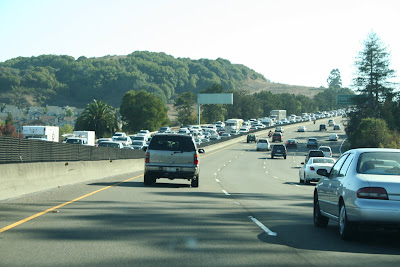
On Friday we did some work and then went to the Golden Gate, the traffic was quite dense:


Alcatraz:


San Francisco:


Then we had a cofee in San Francisco and went to Silicon Valey, Jarrod drove me around a little bit to see SLAC, Stanford campus and other things. In the evening we went to the common pub with other mentors and Google guys, where we for example met with Robert Bradshaw.

Today I am looking forward to meet with all the people I know from mailinglists, Debian and other places.

20 October 2008

Decklin Foster: And yet I swear this oath

There was a lot of political talk last week in the US about this guy "Joe the Plumber". I'm really quite mystified by the (lack of) Democratic response to this one; it seems like a perfect opportunity for the Dems to explain what their ideals actually mean, after years of complete inarticulacy. The Republican party, and conservatives in general, have somehow successfully sold their platform of, as Robert Reich brilliantly put it on the Daily Show last week, "socialism for the rich and capitalism for everyone else", to poor but socially-conservative citizens for quite some time. They've convinced people to vote against their economic self-interest, and cut taxes on the rich instead of themselves. Is voting for policies that directly benefit you less necessarily bad? I don't think so. In many cases, selflessness and altruism are better in the long run. Conservative economic policies speak to a sense of right and wrong that give people a feeling of purpose, and so an incentive to create: this is mine, I made it, you can't take it away. In a theoretical sense, leaving more wealth in the hands of the rich should "trickle down" to society in general, by providing more capital, and thus creating jobs, etc. However, I do not believe that this is why Americans, specifically, tend to support conservative economic policy. The USA has this idea of the "American Dream", pulling yourself up by your bootstraps, if you will, and striking it rich through hard work and character. It's advantageous for conservatives to sell this idea because it makes people think "tax the rich? What if I get rich?", which is a sort of enlightened self-interest, arguably. And it gets poor people to vote for them. What makes this "plumber" thing interesting to me is that is should demonstrate where this approach ought to fall down, logically and emotionally. But it does not. Here is the problem. A working stiff who earns "five figures", such as myself, generally makes that money by going to an employer every day, performing some services for them, and then drawing a paycheck. Where this money comes from is abstracted away (this is the marvelous thing we call "business"). Let's say you want to sell the "American Dream" to this person. They get their paycheck every week, and there's a chunk taken out of it by Uncle Sam. Maybe they're saving up to start a business, or go to college, etc. They sure could do it faster if taxes weren't so high. So you remind them this: when you do strike it rich (since this is America, where anyone can strike it rich), do you want those taxes to be even greater? This story contains a lie of omission, probably the greatest lie ever told in US politics, and one that has almost universally succeeded as far back as I can remember. And that is: when you do make that jump to where our hypothetical Joe is, making just over a quarter-million dollars, that it's not going to look any different. You'll get your paycheck from some abstracted source, just like before, but more will be taken out unless we stop raising taxes on those higher income brackets. There will be some node higher up in the tree for that wealth to "trickle down" from; you could say it's implied, even, that wealth is created at the root and destroyed at the leaves. What's wrong here? Simple: a self-employed plumber does not have a paycheck, except maybe to him/herself for accounting purposes. They collect their income in the form of payments from customers. They don't have an abstraction: they hire more labor and become the abstraction. If their customers have no money, the abstraction leaks, their employees have to be laid off (and then can no longer afford plumbing services themselves). The success of the plumber depends as much on how many people are able to pay them as it does on his costs (such as taxes). We want to make sure those customers can still pay. This is, in theory terms, the idea of demand-side or Keynesian economics. (Not really exactly. I took about two econ courses. But bear with me for a moment.) Now, you can argue demand-side vs. what we would call supply-side economics, which is the idea that no, first you have to stop taxing Joe so he can hire people so they have money to go buy things, for ages. People have made whole careers out of it. I am not here to do that. What I am here to wonder out loud is: why is this argument not happening, now, in our public sphere? Even if only as a small plot point in one Presidential campaign? There are very good arguments for both sides (I agree with the Keynesians, myself), and they should be what this debate is about, not digging up dirt on some guy whose real name, horrors, might not be "Joe" or protests about all those you-know-what poor people getting "government giveaways" that are disturbingly close to racism in my opinion. When I turn on talk radio I hear zombies, unable to string together any thought more complicated than "Democrat == higher taxes on everyone" (which would be depressing even if the claim were true). It begins to get unsettling when you understand your opponent's argument, and yet watch them completely unable to articulate it. When they deal with this by appealing to fear and thought-killing sound bites, it gets alarming. Obama has backpedaled whenever the whole issue has come up. In the last debate, he was saved by merely shutting up and letting out enough rope for McCain to hang himself. Not very inspiring. As a result I hear repetitions of Obama's phrase "spread the wealth around" constantly met on the airwaves with... silence. He won't touch it, and honestly, I can't blame him for not wanting to fan the flames of class warfare with only two more weeks left to stick it out. But I don't understand why, and why a single person on the left hasn't had the faith that this idea can be discussed in our society. I think that, whichever side you are rooting for (and yeah, I am for the Democrats), the Democrats should have won this point readily. Not to belabor the point, but it really amazes me that they have not. It wouldn't have taken much. Here's what you do: go to Wherever, OH with your crack PR team and find several of "Joe the Plumber"s customers. Interview them all. A few of them are, in this economy, going to be really hurting. If you're lucky: Remember that Joe owes taxes to the IRS. Very possibly, someone owes Joe money! That would be a coup. You just put them in front of the media and the whole thing sells itself. Mary needs to make these repairs... if only her tax credit were larger... etc. This would not settle the argument, by any means, especially not for political junkies. But it would begin it. We could talk about policy, whether one way of "spreading" things will result in more wealth to spread than another, instead of red-baiting. I feel a bit ripped off that we haven't even gotten that much. The theory part is pretty much irrelevant to most people; that's fine. But they deserve context. I can only assume that my ("my") party is still either terrified or stupid. I hope winning the Presidency changes that somewhat. That whole right and wrong, purpose, "noble cause" thing, right? Right, guys?

18 October 2008

Martin Michlmayr: Amazing figures on the open source adoption in Finland

I attended Openmind last week, an interesting conference organized by the Finnish Centre for Open Source Solutions (COSS) to bring together open source professionals, community members and academics in Finland. In the session about business aspects of open source, in which I gave a talk about FOSS Governance, Nina Helander and Mikko R nkk presented the preliminary results of the National Software Industry Survey 2008. I found the results incredibly interesting. In particular, they found that 75% of responding firms use open source software in some way. This figure is up from approximately 13% in the year 2000, which is a major increase in just a few years. The study also found that that there was no statistically significant difference of company size when it came to the use of open source. Finally, companies that have open source components in their offering rate themselves as more innovative. Roberto Galoppini, who moderated the session, commented that Finland is where Gartner predicted that companies would be in 3 years. Indeed, I think everyone in the room was pleasantly surprised by the amazing numbers from the survey. We should not forget that the study was with software companies and that the use of open source will certainly be lower in other industries, but nevertheless the study shows that Finland is a leading country when it comes to the adoption of FOSS. (Originally published on FOSSBazaar)

8 October 2008

Rob Taylor: Wizbit ars d

So it seems ars technica picked up on Codethink’s little pet project! Obviously the little amount of info on the wiki isn’t enough for everyone who’s interested and enough has changed since the GUADEC talk that I should write a bit here to clarify what’s going on and where we’re going. First off, we’re currently not using GVFS or FUSE - the core Wizbit component is simply a versioning, distributed object store. The current plan is to later hook up with a metadata service, maybe tracker, and use this to export a FUSE filesystem using the metadata. This core Wizbit service is just a library with its own api, maybe hooking up to gio streams for ease of use from GLib based applications. The current focus of our work is solidifying this store and the synchronization between multiple machines. We’re prototyping its use in Tomboy. Karl is also working on making some of these pretty widgets for navigating history work. We’re not actually using Git underneath, but using our own implementation of concepts from both Git and Bzr. This is for a number of reasons, partially that making a library from git’s code proved more trouble than just reimplementing the concepts (as things like JGit found). Also the nature of the problem is sufficiently different that things like the packed format don’t behave in a suitable way for general file system usage. The work on packing is yet to be started but we’ll probably use Robert Collin’s groupcompress idea from bzr. I promise we’ll make the wiki a bit better when the code’s stabilised a bit!

21 September 2008

Frank S. Thomas: Goddies with bts status and select

Since I was watching Don Armstrong’s talk about Debbugs’ SOAP interface I wanted to use devscripts' bts to get a list of boinc’s top five bug reporter. Finally, this is possible with devscripts (>= 2.10.36):
bts status file:-  bts select source:boinc archive:both  \
    egrep "^originator"   cut -f2-   sort   uniq -ci   sort -n \
    tail -n5
 2 Riccardo Stagni <unriccio@email.it>
 3 Martin Michlmayr <tbm@cyrius.com>
 6 Robert Millan <rmh@aybabtu.com>
 6 Thibaut VARENE <varenet@debian.org>
10 Sandro Tosi <matrixhasu@gmail.com>
Sweet - Thanks Debbugs and Devscripts maintainers!
And congratulations Sandro (or thank you - whatever you find appropriate)!

19 September 2008

Lucas Nussbaum: Looking for cliques in the GPG signatures graph

The strongly connected set of the GPG keys graph contains a bit more than 40000 keys now (yes, that’s a lot of geeks!). I wondered what was the biggest clique (complete subgraph) in that graph, and also of course the biggest clique I was in. It’s easy to grab the whole web of trust there. Finding the maximum clique in a graph is NP-complete, but there are algorithms that work quite well for small instances (and you don’t need to consider all 40000 keys: to be in a clique of n keys, a key must have at least n-1 signatures, so it’s easy to simplify the graph — if you find a clique with 20 keys, you can remove all keys that have less than 19 signatures). My first googling result pointed to Ashay Dharwadker’s solver implementation (which also proves P=NP ;). Googling further allowed me to find the solver provided with the DIMACS benchmarks. It’s clearly not the state of the art, but it was enough in my case (allowed to find the result almost immediately). The biggest clique contains 47 keys. However, it looks like someone had fun, and injected a lot of bogus keys in the keyring. See the clique. So I ignored those keys, and re-ran the solver. And guess what’s the size of the biggest “real” clique? Yes. 42. Here are the winners:
CF3401A9 Elmar Hoffmann
AF260AB1 Florian Zumbiehl
454C864C Moritz Lapp
E6AB2957 Tilman Koschnick
A0ED982D Christian Brueffer
5A35FD42 Christoph Ulrich Scholler
514B3E7C Florian Ernst
AB0CB8C0 Frank Mohr
797EBFAB Enrico Zini
A521F8B5 Manuel Zeise
57E19B02 Thomas Glanzmann
3096372C Michael Fladerer
E63CD6D6 Daniel Hess
A244C858 Torsten Marek
82FB4EAD Timo Weing rtner
1EEF26F4 Christoph Ulrich Scholler
AAE6022E Karlheinz Geyer
EA2D2C41 Mattia Dongili
FCC5040F Stephan Beyer
6B79D401 Giunchedi Filippo
74B11360 Frank Mohr
94C09C7F Peter Palfrader
2274C4DA Andreas Priesz
3B443922 Mathias Rachor
C54BD798 Helmut Grohne
9DE1EEB1 Marc Brockschmidt
41CF0322 Christoph Reeg
218D18D7 Robert Schiele
0DCB0431 Daniel Hess
B84EF12A Mathias Rachor
FD6A8D9D Andreas Madsack
67007C30 Bernd Paysan
9978AF86 Christoph Probst
BD8B050D Roland Rosenfeld
E3DB4EA7 Christian Barth
E263FCD4 Kurt Gramlich
0E6D09CE Mathias Rachor
2A623F72 Christoph Probst
E05C21AF Sebastian Inacker
5D64F870 Martin Zobel-Helas
248AEB73 Rene Engelhard
9C67CD96 Torsten Veller
It’s likely that this happened thanks to a very successful key signing party somewhere in germany (looking at the email addresses). [Update: It was the LinuxTag 2005 KSP.] It might be a nice challenge to beat that clique during next Debconf ;) And the biggest clique I’m in contains 23 keys. Not too bad.

10 September 2008

Dirk Eddelbuettel: RDieHarder 0.1.0 released

I just rolled up version 0.1.0 of RDieHarder, an R package providing an interface between GNU R and the DieHarder battery of tests for random number generators developed by Robert G. Brown. See the the RDieHarder page for some introductory material and links to the talk at UseR! 2007. Version 0.1.0 extends the functionality of the dieharder function quite substantially and catches up to a number of recent changes in DieHarder. In particular: This new version should show up at CRAN and its mirrors in due course, in the meantime sources are also here with more details and links on the here with more details and links on the here with more details and links on the here with more details and links on the RDieHarder page.

8 September 2008

Robert Collins: 9 Sep 2008

Customer service... and vodafone. Something fundamentally missing here. Vodafone's website is slow - 50% of the time you can't even login. 15-20 simple page clicks. Ringing customer service - you get a IVR system that is intensely frustrating. It can't handle simple things like "Your website sucks" (it asks if you want to inquire about iphone 3g's). 10 minutes later and it actually offers a menu. Finally, some way to get through to a human. Having stopped doing paper bills, you have to sign up to this website; several thousand words of legal terms and conditions later - 99% unrelated to paying bills - and you can't configure it to email you, unless it also SMS's you. WTF. Customer service don't know why this is required. And the website doesn't tell you its required, it just refuses to accept the form unless it's ticked. Seriously, someone setup a viable, flexible, mobile provider in australia, with good international roaming - give me a ring.

30 August 2008

Martin F. Krafft: Recovering a lost default route

Tired and under the influence of beer, I tried to remove the currently broken IPv6 default route from my primary mailserver via an SSH connection and accidentally executed instead:
ip r d default
# I meant: ip -6 r d default

Unfortunately, I didn t immediately realise what I had done, and then it was too late. Robert Collins told me that I could have saved the session because even without a default route, packets still reach the machine. Unfortunately, due to Nagle s algorithm, you pretty much only have one shot, so the next time this happens to me (or you), quickly type
ip r a default via <gateway>

into a separate window, then copy and paste it into the SSH session and you may get lucky. Update: one lesson I learnt from this is to add specific routes for at least the IPv6 tunnel peer, and possibly another machine (or two) under my control out there. I now have that in place on all machines I own. NP: The Phoenix Foundation: Pegasus

22 August 2008

Benjamin Mako Hill: Free Software Project Management HOWTO

I took a little time today to make a new release of the Free Software Project Management HOWTO. Nearly eight years after I wrote it, much of the document is out of date or has been replaced with better, more comprehensive write-ups. In particular, I think Karl Fogel's book, Producing Open Source Software says everything insightful I say in the HOWTO, a whole lot clearly -- plus adds a lot I missed. That said, my HOWTO is short and is apparently still useful to folks. I updated it to include links to a new German translation courtesy to Robert F. Schmitt, to fix a bunch of links that time broke, and to address a few obvious mistakes that readers have pointed out. Thinking about the documents' future, I'm happy to release it under Creative Commons BY-SA in addition to GFDL and would love to help out on a wiki book project to merge a few of related efforts into a comprehensive wiki reference work.

8 August 2008

Benjamin Mako Hill: Revealing Errors OSCON Keynote

When I gave a Revealing Errors talk at Lug Radio Live USA, I had the misfortune of being up against Robert Love's talk on Android which many people at the conference wanted to see -- myself included! One person who showed up to my talk anyway was Allison Randall. She was apparently entertained enough to invite me to give a short version of the talk as one of the keynote presentations at OSCON 2008! In the talk, I covered the ideas behind my Revealing Errors project and quickly walked through a few examples that showcase what I'm trying to do. I'm happy with the result: a couple thousand people showed up for the talk despite the fact that it was at 8:45 AM after the biggest "party night" of the conference! For those that missed it for whatever reason, you can watch a video recording that O'Reilly made and that I've embedded below. A larger version of the Flash video as well as a QuickTime version is over on blip.tv and I've created an OGG Theora version for all my freedom loving readers.

2 August 2008

Ben Armstrong: Bits from the Debian Eee PC team, summer 2008

As always, we’re doing lots of interesting and significant things and have more good ideas than we have people to do the work.  If you have an Eee PC or are planning to get one, or are otherwise interested in our work, some of which has uses beyond just the Eee, here are some highlights: Earliest Eee models supported in Lenny Lenny will release with the atl2 ethernet driver and the non-free madwifi-source now works with the earliest Eee models as well, so our patched version is no longer needed.  This means Lenny will work with all of the earliest models of the Eee PC: 701 (2G and 4G surf, 4G, 8G) and 900! All we need now for full support in Lenny is to replace the non-free wireless driver with the free ath5k driver when it is ready. Free drivers Nick Kossifidis has submitted patches on linux-wireless supporting the Eee models currently supported only by the non-free madwifi in ath5k.  This means we’ll soon realize our goal of a completely DFSG free system for the earliest models of the Eee.  By 2.6.27, or at the latest 2.6.28, these models will be supported.  Then we will see about making a patch to support whichever kernel makes it into Lenny. New models Model 901, 1000 and 1000H users are now able to install using the atl1e ethernet driver from eeepc.debian.net.  Support for wireless and other aspects of the new hardware will follow soon.  The debian-kernel team was prompt to add atl1e to 2.6.26 which has just been uploaded to sid.  We hope 2.6.26 makes it into Lenny. Wireless installer Glenn Saberton has been doing an upstanding job adding wireless support to our custom Debian-installer.  We have supported WEP authentication for several releases, now, and a beta version supports WPA.  Glenn is also making progress with these patches upstream so that non-Eee Debian users will benefit from our work. LXDE is in Lenny LXDE has entered Lenny, thanks to Andrew Lee.  It is a quite lightweight desktop environment that is made with the Eee PC in mind. Live images Two flavours of Debian-live USB images are available: a demo of the LXDE desktop and a minimal console-only image for rescue/backup.  The images are still in alpha stage of development.  If you’d like to help, give us a shout.

More interesting things are planned for the future that benefit Debian as a whole.  With a small amount of work patching live-helper, anyone will be able to make a live image that includes a customized Debian-installer. Mobile device initiative This month on debian-devel, there was some interesting discussion about Debian support for the Intel Atom processor and a possible mobile net device initiative.  That’s something we could get behind, if anything comes of it. Wiki translation Robert Epprecht has been keeping the German wiki translation in good shape, but we could always use some more help with any of the translations. New members welcome If you’d like to join us, check out our site at http://wiki.debian.org/DebianEeePC and drop us a note on our list or join our irc channel and talk to us about what you’d like to do.    

31 July 2008

Robert Collins: 1 Aug 2008

Well, advertising for the win right? Was looking up a song I vaguely remembered via youtube, and I noticed that > 30% of the search results are taken up by a single advert for a film (Liam Neeson in Taken, ironically) which sits at the top right, leaving the rest of the column blank. SHEESH

26 July 2008

Philipp Kern: Stable Point Release: Etch 4.0r4 (aka etchnhalf)

Another point release for Etch has been done; now it's the time for the CD team to roll out new images after the next mirror pulse. The official announcements (prepared by Alexander Reichle-Schmehl, thanks!) will follow shortly afterwards. FTP master of the day was Joerg Jaspert, who did his first point release since Woody, as he told us on IRC. We appreciate your work and you spending your time that shortly before going to Argentina. This point release includes the etchnhalf update introducing a new kernel image (based on 2.6.24) and some driver updates. Additionally the infamous openssl hole will be fixed for good, even for new installs. Again I want to present you a list of people who contributed to this release. It cannot be complete as I got the information out of the Changed-by fields of the uploads. From the Release Team we had dann frazier (who drove the important kernel part of etchnhalf), Luk Claes, Neil McGovern, Andreas Barth, Martin Zobel-Helas and me working on it. ;-)

22 July 2008

MJ Ray: LugRadio Live Event Review


LUGRadioLive 2008 by sheilaellen (cc-by-2.0) This weekend, I learnt lots of things while at LugRadio Live in Wolverhampton. One thing was the surprising delay between posting something on this site and it actually appearing in the feed on my mobile phone. Another is that I can’t post to my new blog hosting from my mobile phone, which I’ll debug Real Soon Now. So, this is a bit later than when I first wrote it and it’s now one post instead of seven or so… Thanks to some unexplained delay travelling through Birmingham, I walked into LugRadio Live during the Introduction. The venue was generally pretty good, but the stage obstructed the entrance the acoustics in the atrium only seemed to work for the four gents. No idea what they said: I got past the stage into the audience and it finished almost immediately. For the first talk session, I went to see Rufus Pollock of Open Knowledge Foundation introduce a plan for the Comprehensive Knowledge Archive Network. Seems like a good idea. I’ve tons of questions, but I can’t quite get them into words, I don’t know when I’ll have time for this and I’m not sure they really matter anyway. I think I’ll mention CKAN to some librarians anyway and see what they make of it. I expected Emma Jane Hogbin’s “Form an orderly queue, ladies” to start an argument with the usual chix silliness but I was pleasantly surprised by how reasonable the advice was. In fact, the speaker also criticised the “chix” movements, although it appeared she participates in some women-only clubs, so not a 100% win for equality there. Sadly, much of the talk has been overshadowed in my mind by the memory of a giant furry racoon walking in unexpectedly, so I’ll probably grab the video of the LRL-USA version sometime soon. James Hooker’s talk titled “Taming the dragons — entrepreneurship and VCs” launched venturex as described on his own site already (along with more talk descriptions). It was an interesting demo, but it requires hackers to sell some votes in their companies to Venture Capitalists, which I believe is a bad thing for free software developers to do. We need to look more at a form of social entrepreneurism.</soapbox> I tried to ask a question, but the terrible atrium acoustics did funny things with my not-so-good hearing and I lost my way somewhat. At the end of that talk, I got chatting to an interesting web developer from Leicester who also forsook The Gong-a-Thong Lightbulb Talk Extravaganza and headed up to the Lightning Stage for Robert Collins and the Bzr talk. As well as some glimpses of how it’s changed since forking from tla, it was interesting to see a real (imperfect) demo and a non-Emacs version control GUI. The web interface for casual users to submit patches sounded very interesting and I also learned that some people pronounce “svn” like “Sven”. Most things that Robert thought were benefits sounded like drawbacks to me, so I’ll stay with git for now. Steve Lamb’s Green IT talk was the last presentation I saw. This talk really disappointed me because it seemed to be skewed towards the corporate governance nonsense instead of seeing Green IT as a vital pragmatic step, mentioning points I’d seen put more clearly elsewhere, as well as advertising Vista virtualisation and some panoramic webcam from Microsoft (who employ him) that doesn’t work with any free software, according to a deserved verbal shoe-ing in the Q+A. Only thing I remember that seems useful: charging from USB is more efficient than using wallwarts. Is that right? Finally, the main event: LugRadio Live and Unleashed. It opened with the shock announcement that LRL will continue into 2009, as announced elsewhere already. The rest of the madness will presumably appear online shortly and I don’t remember it well enough to do it justice… A tech conference crossed with a rocking gig by the strangest boyband ever, with a cheerleading racoon and some very cool people. I’ll try to be at LRL 2009. Will you be there? Were you at LRL this last weekend?

12 July 2008

Petr Rockai: fast forward

Lucy left for England yesterday (OK, now it’s two days ago — last Friday). That means that I have unusual amount of free time at my hands, and yet even more things that could be done with it. But I suppose it’s time to update this little blog. It’s probably pointless to enumerate what happened, or what changed. Everything is fine and smooth over here — the wrinkles get worked out over time (with Lucy, without Lucy). Hobbies still take time and I still haven’t given up. My latest determination is to get myself a bassoon for next Christmas. (Now, that will be a year since we got Lucy a Marigaux 901, used, in great condition for a great price, lo and behold, on Austrian ebay. World is so weird sometimes…) And in the land of [LVM], I have finally started the process to merge code to improve LVM’s behaviour in presence of failed storage hardware (physical volumes gone missing). In the land of Adept, well… first things first. FOSSCamp I have visited Prague for the latest Ubuntu- (well, Canonical-) organised event, the FOSSCamp. I have met Johnatan (KUbuntu), Seli (KWin), Lidya (Amarok), Robert (Konsole), Jos (Strigi) and Inge (KOffice). See also Johnatan’s Blog (including a real blurry picture). So back to Adept — I had some hacking time over there in Prague, and I have almost brought Installer and Updater back to life for Adept 3. I unfortunately didn’t have as much time for it since then — but my current free time situation does open up some possibilities. First and foremost, I should really make a text interface to the underlying libraries for myself, maybe with fancy colourful UI, hopefully one that is comfortably close enough to apt-get and still offers advantages. Hmmmm… Intermezzo 1 Now zoom out and zoom in somewhere else, enough of coding matters. Our research group at the University had a (tool) paper accepted for ATVA 2008, meaning that I am not unlikely to visit Seoul, South Korea in October. Another piece of distant world to visit. FOSDEM Now, that reminds me… Since the last time, I have also been in Belgium — to visit FOSDEM — meeting Alasdair (of LVM) and Bart and Pino of Krita and Okular, respectively… although unfortunately, I didn’t spend nearly enough time with Pino… At least we have spend a day walking around Ghent with Bart (and Lucy, who visited Belgium with me, also having friends of her own there). Moreover, I have spent a lot of mostly productive time with Alasdair, discussing LVM2. And Belgium is nice and pretty, although I didn’t really get around to taste any beer. Maybe next time. And Antwerps were nice, too. Photos? Someday. LinuxTag And after that, I have visited Berlin again, for LinuxTag as usual — plus the accompanying LVM discussions, with Milan, Kabi and Mikul (Blek) of the Czech part of the team, and Heinz, John and of course Alasdair for the rest of the world… Also as usual, we walked around, had dinners, discussed non-work stuff, etc… a good event all in all. At LinuxTag, I have briefly seen Lidya again, as well as Ossi (whom I nearly didn’t recognise…) and Aaron who (for a change) didn’t recognise me (but to be fair, I didn’t quite stop by to chat and he’s been busy…) and Sebas, cordial as ever (and always a pleasure to meet)… reminds me of Paris two years ago, too. Intermezzo 2 Less than a month ago, I have finished my first semester of master’s study — two or three more to go (I have completed bachelor’s the semester before). Yes, I am a bachelor of computer science, or something like that, anyway, now. Or so I hope. I did not attend the whatever ceremony and I don’t really have the diploma (or maybe I do, but gods know where it is…). A short note on Debian with best intentions I am now sponsoring Trent Buck’s ?darcs packages, contributing a little on the go (making me wish that alpha buildd would make a little more progress…). With Enrico, we have uploaded new versions of wibble and libept, both of which I think make both of us fairly happy. (Although we again managed to hit a way strange compiler issue (only manifested on arm… what have I done that the gods punish me so?), as documented in Debian bug 487406…) I have packaged dzen2 and taken over haskell-mode (I am losing track of my own packages again — I really need to set up reliable watch files so I don’t miss out too many releases… apparently neither has new upstream versions, so I can sleep peacefully for a little longer). Intermezzo 3 I am not going to DebConf nor Akademy this year. That makes me a little sad, but it’s all my own fault (and laziness). Next time folks, next time. I haven’t seen K vin in aeons and he probably removed me from his memory by now… No matter, I’ll try a little harder next year, promise (oh, how many have I made to date?). Finale Nothing grandiose, just best wishes to everyone, I have to land in bed now it seems, as I am ever so sleepy. (Just So Stories, anyone?) There I go.

11 July 2008

Robert Collins: 11 Jul 2008

What the git vs bzr discussion is about IMO is usability. The following blog post about DTrace on linux talks about the same issue, and I'd like to use Bryan's words: "Over and over again, we made architectural and technical design decisions that would yield an instrumentation framework that would be not just safe, powerful and flexible, but also usable. The subtle bit here is that many of those decisions were not at the surface of the system (where the discussion on the Linux list seems to be currently mired), but in its guts." -> "Over and over again, we made architectural and technical design decisions that would yield a Distributed VCS be not just safe, powerful and flexible, but also usable. The subtle bit here is that many of those decisions were not at the surface of the system (where the discussions going on at the moment seem to be currently mired), but in its guts."

10 July 2008

Robert McQueen: GUADEC, Telepathy and a Party on a Boat

For everyone at GUADEC, there’s a boat party sponsored by Collabora this evening. Our sponsorship was confirmed after the program was printed so it’s listed anonymously, but it’s mostly sponsored by Collabora, of course with huge thanks to Baris and his team for the organisation, and local sponsors for food and discounted beer. The boat leaves from Kabatas at 9pm today (Thursday). It’s actually pretty close to the 3rd anniversary of Collabora’s incorporation, so I think we could call this our birthday party. :D I gave my presentation earlier today about using Telepathy to make collaborative applications. My slides are available, as well as the apps I demoed, which are the python VNC demo based on telepathy-python’s examples, Elliot’s Tic Tac Tube game, and Guillaume and Alban’s quick hack to Empathy and Vinagre to share your desktop over a stream tube. I was followed up by Senko’s presentation (slides also available) which had an overview of the libraries and APIs currently available to embed Telepathy functionality in applications on the desktop. The talks were all recorded so hopefully some videos will turn up on-line too. Speaking about collaborative stuff with Telepathy, we’re really keen to hear from the authors of applications like Abiword, Inkscape, Vinagre, Jokosher, Tomboy, Gobby, etc, to find out how we can help you integrate with Telepathy, what features you need before you can get started, or just try and convince you that it’s a good idea. :) If you’re at GUADEC, come and grab one of the Collaborans or drop by on #telepathy on FreeNode and tell us what you’d like to do and how we can help. Yesterday after the talks on Soylent and the People project, Travis and I met up with the guys behind the People project (Ali Sabil and Johann Prieur) and some of the Online Desktop team (Owen Taylor and Marina Zhurakhinskaya). We sketched out a way of plugging together Telepathy, People, Soylent and the Online Desktop to deal a lot better with meta-contacts on the desktop, providing “first-class” people objects. It all looks pretty promising and hopefully we’ll all find some time to make moves towards our vision. This afternoon at 3:30pm, Olivier is also presenting our work on Farsight 2, which is really cool stuff and should include some exciting demos of the multi-person video conferencing stuff we’ve been doing. More generally, GUADEC is awesome. I’m having a great time in Istanbul (despite it being pretty hot for a pale-faced Brit like me), and enjoying the sights and sounds of such an interesting city and culture. I’ve caught up with many of the usual suspects (like Lennart, who never turns down the chance to turn up at a conference and sample the local bars and clubs), and had some great discussions.

Robert Collins: 10 Jul 2008

I keep running into folk whom I knew of, that use bzr, but I did not know that they use bzr. Right now there is a lot of discussion going on about DVCS in various projects. While I imagine most bzr users just want to get on with their coding (after all thats what bzr is good at :))... it would be fantastic if you could blog that you use it, and folk at GUADEC wear the T-shirt! Also, I'm at GUADEC, and I'm extremely happy to answer questions from anyone, bzr user, git user, or even svn user :)

4 July 2008

Robert Collins: 4 Jul 2008

Well, the gauntlet is down (BTW - desktop power integration. Cool!). The use case Ted talks about is actually quite interesting - we were at UDS last month, waiting on a SVN server that was apparently so slow we could have walked to it and copied stuff onto harddisk more quickly. (Really. No kidding). bzr was idling and blocked on network IO the whole time... kudos for the plugin Ted! For my response, may I present a new index format, (branch url) 70% smaller than bzr's current default, equally fast at most workloads, up to 20 times faster at others. I started this this week, and John jumped in in overlapping time periods, but I think it counts! Note that the perfromance wins are a component improvement - other things we haven't addressed yet can make the index improvements less visible. But several early adopters have told me that they see a 25-30% reduction in 'time bzr log > /dev/null' or other commands. To install: bzr branch http://bazaar.launchpad.net/~lifeless/+junk/bzr-index2 ~/.bazaar/plugins/index2 bzr branch https://bazaar.launchpad.net/~jameinel/+junk/pybloom ~/.bazaar/plugins/pybloom To use: cd <repository you want to experiment on> bzr upgrade --btree-plain (or --btree-rich-root for bzr-svn users). A version of this will be going to trunk soon, and it will be able to upgrade from any repository that you have that uses the plugin as long as you keep the plugin installed.

Next.

Previous.