Search Results: "pere"

17 January 2013

Matthew Garrett: Experiences with depression

I've been lucky in life. I've known several people who've killed themselves, but I've been friendly with them rather than friends with them. Their deaths have saddened me, but haven't left giant gaping holes that I have trouble imagining filling. I've also been lucky in that I'm not especially predisposed towards depression, and even luckier that the one serious episode I had ended well. That luck means I'm not qualified to speak authoritatively on the topic, but this seems like a good time to share. Most of 2002 wasn't great for me. Many of my friends had graduated and moved away. My PhD, which was what I'd spent the past few years of my life working towards, was going horribly wrong. The girl I liked didn't like me. Lots of individual small things that didn't fundamentally matter, but which build up into overall feelings of isolation and failure at life. I was spending an increasing number of days not leaving bed and not talking to people. It wasn't that I couldn't have fun - socialising was still pleasurable, and I didn't actively avoid people, but it was always tempered with the knowledge that this was temporary and I'd be returning to the unhappiness afterwards. I couldn't see any sequence of events that would turn my life around and restore my happiness. This was how life was, and this was how life was going to be. I'd irrevocably fucked up, and this was my future. Looking back, what strikes me is how reasonable this seemed. I could point at specific things that were making me unhappy, and nobody could argue that it was unreasonable to be unhappy about them. There wasn't any point in speaking to people about it, because what would they be able to do except agree that I was justifiably unhappy? I thought about suicide. Not seriously, because overall life still seemed worthwhile, but I could conceive of a level of further unhappiness that would make it seem like the best choice. I don't think it would ever have occured to me to speak to someone about it first. It seemed like it would be the same argument - I'm justifiably unhappy, I already feel like I'm letting my friends down, what could they do other than tell me that my feelings are wrong or make me feel even more guilty? So, when I saw exhortions for people to speak to someone if they felt suicidal, it seemed like they were talking to people who hadn't thought this through as well as me. It felt like I'd thought this all through carefully and rationally and come to a completely logical decision. If changes in circumstances and further consideration made it seem like suicide was the better choice, that would be because it was the better choice. Maybe other people weren't thinking about this as logically as I was. Maybe they'd have their minds changed by speaking to a friend or a professional. I wouldn't. Of course, with hindsight I was rationalising the way I already felt rather than making entirely rational decisions. I could have rationalised myself to death even though there were (in my case) straightforward ways to make my life better. In any case, I've no idea how close I ever got to that point. Things were at their worst in August - by September I had a new job and new house, and things just got better from there. In the end, the friends I was convinced could do nothing for me ended up giving me the opportunity to find gainful employment and made sure I had somewhere to live. Without them, things might have been different. As it was, I spent less than nine months depressed and it was still the most hellish experience of my life. The thought of returning to that state is terrifying. I was lucky. I might not be again. There's no terribly good moral here. If I'd known more about depression beforehand, I might have been able to identify what was happening to me and seek professional help. Other than that, I didn't learn anything about how to avoid or deal with depression. The experience didn't make me a better person. I've no advice for people in the same situation. The only thing I gained from it all was the realisation that if I'd felt any worse and knew that this was what I faced for the rest of my life, death might not have been the worst choice I had. Depression is a huge social problem and we deal with it badly. We refuse to talk about it, and when we do talk about it we mostly limit ourselves to platitudes about how things will get better or placing the blame on depressed people for not wanting to talk to those around them. Sometimes it doesn't get better. Sometimes talking to those around you will make things worse. People need to be aware of what the effects of depression are and get better at identifying it in others, rather than assuming that they'll be able to ask for help themselves. Society as a whole needs to be better at ensuring that professional support is there for people who need it. And, unless we can make massive improvements in our understanding of the causes of depression and effective mechanisms for countering it, we need to accept that it will cost us friends. Let's redirect the anger we feel at their choice to avoid a lifetime of misery into anger at the society that still hasn't done everything it can to help them.

comment count unavailable comments

16 January 2013

Petter Reinholdtsen: What is the most supported MIME type in Debian?

The DEP-11 proposal to add AppStream information to the Debian archive, is a proposal to make it possible for a Desktop application to propose to the user some package to install to gain support for a given MIME type, font, library etc. that is currently missing. With such mechanism in place, it would be possible for the desktop to automatically propose and install leocad if some LDraw file is downloaded by the browser. To get some idea about the current content of the archive, I decided to write a simple program to extract all .desktop files from the Debian archive and look up the claimed MIME support there. The result can be found on the Skolelinux FTP site. Using the collected information, it become possible to answer the question in the title. Here are the 20 most supported MIME types in Debian stable (Squeeze), testing (Wheezy) and unstable (Sid). The complete list is available from the link above. Debian Stable:
  count MIME type
  ----- -----------------------
     32 text/plain
     30 audio/mpeg
     29 image/png
     28 image/jpeg
     27 application/ogg
     26 audio/x-mp3
     25 image/tiff
     25 image/gif
     22 image/bmp
     22 audio/x-wav
     20 audio/x-flac
     19 audio/x-mpegurl
     18 video/x-ms-asf
     18 audio/x-musepack
     18 audio/x-mpeg
     18 application/x-ogg
     17 video/mpeg
     17 audio/x-scpls
     17 audio/ogg
     16 video/x-ms-wmv
Debian Testing:
  count MIME type
  ----- -----------------------
     33 text/plain
     32 image/png
     32 image/jpeg
     29 audio/mpeg
     27 image/gif
     26 image/tiff
     26 application/ogg
     25 audio/x-mp3
     22 image/bmp
     21 audio/x-wav
     19 audio/x-mpegurl
     19 audio/x-mpeg
     18 video/mpeg
     18 audio/x-scpls
     18 audio/x-flac
     18 application/x-ogg
     17 video/x-ms-asf
     17 text/html
     17 audio/x-musepack
     16 image/x-xbitmap
Debian Unstable:
  count MIME type
  ----- -----------------------
     31 text/plain
     31 image/png
     31 image/jpeg
     29 audio/mpeg
     28 application/ogg
     27 image/gif
     26 image/tiff
     26 audio/x-mp3
     23 audio/x-wav
     22 image/bmp
     21 audio/x-flac
     20 audio/x-mpegurl
     19 audio/x-mpeg
     18 video/x-ms-asf
     18 video/mpeg
     18 audio/x-scpls
     18 application/x-ogg
     17 audio/x-musepack
     16 video/x-ms-wmv
     16 video/x-msvideo
I am told that PackageKit can provide an API to access the kind of information mentioned in DEP-11. I have not yet had time to look at it, but hope the PackageKit people in Debian are on top of these issues. Update 2013-01-16 13:35: Updated numbers after discovering a typo in my script.

15 January 2013

Petter Reinholdtsen: Using modalias info to find packages handling my hardware

Yesterday, I wrote about the modalias values provided by the Linux kernel following my hope for better dongle support in Debian. Using this knowledge, I have tested how modalias values attached to package names can be used to map packages to hardware. This allow the system to look up and suggest relevant packages when I plug in some new hardware into my machine, and replace discover and discover-data as the database used to map hardware to packages. I create a modaliases file with entries like the following, containing package name, kernel module name (if relevant, otherwise the package name) and globs matching the relevant hardware modalias.
Package: package-name
Modaliases: module(modaliasglob, modaliasglob, modaliasglob)
It is fairly trivial to write code to find the relevant packages for a given modalias value using this file. An entry like this would suggest the video and picture application cheese for many USB web cameras (interface bus class 0E01):
Package: cheese
Modaliases: cheese(usb:v*p*d*dc*dsc*dp*ic0Eisc01ip*)
An entry like this would suggest the pcmciautils package when a CardBus bridge (bus class 0607) PCI device is present:
Package: pcmciautils
Modaliases: pcmciautils(pci:v*d*sv*sd*bc06sc07i*)
An entry like this would suggest the package colorhug-client when plugging in a ColorHug with USB IDs 04D8:F8DA:
Package: colorhug-client
Modaliases: colorhug-client(usb:v04D8pF8DAd*)
I believe the format is compatible with the format of the Packages file in the Debian archive. Ubuntu already uses their Packages file to store their mappings from packages to hardware. By adding a XB-Modaliases: header in debian/control, any .deb can announce the hardware it support in a way my prototype understand. This allow those publishing packages in an APT source outside the Debian archive as well as those backporting packages to make sure the hardware mapping are included in the package meta information. I've tested such header in the pymissile package, and its modalias mapping is working as it should with my prototype. It even made it to Ubuntu Raring. To test if it was possible to look up supported hardware using only the shell tools available in the Debian installer, I wrote a shell implementation of the lookup code. The idea is to create files for each modalias and let the shell do the matching. Please check out and try the hw-support-lookup shell script. It run without any extra dependencies and fetch the hardware mappings from the Debian archive and the subversion repository where I currently work on my prototype. When I use it on a machine with a yubikey inserted, it suggest to install yubikey-personalization:
% ./hw-support-lookup
yubikey-personalization
%
When I run it on my Thinkpad X40 with a PCMCIA/CardBus slot, it propose to install the pcmciautils package:
% ./hw-support-lookup
pcmciautils
%
If you know of any hardware-package mapping that should be added to my database, please tell me about it. It could be possible to generate several of the mappings between packages and hardware. One source would be to look at packages with kernel modules, ie packages with *.ko files in /lib/modules/, and extract their modalias information. Another would be to look at packages with udev rules, ie packages with files in /lib/udev/rules.d/, and extract their vendor/model information to generate a modalias matching rule. I have not tested any of these to see if it work. If you want to help implementing a system to let us propose what packages to install when new hardware is plugged into a Debian machine, please send me an email or talk to me on #debian-devel.

14 January 2013

Petter Reinholdtsen: Modalias strings - a practical way to map "stuff" to hardware

While looking into how to look up Debian packages based on hardware information, to find the packages that support a given piece of hardware, I refreshed my memory regarding modalias values, and decided to document the details. Here are my findings so far, also available in the Debian Edu subversion repository: Modalias decoded This document try to explain what the different types of modalias values stands for. It is in part based on information from <URL: https://wiki.archlinux.org/index.php/Modalias >, <URL: http://unix.stackexchange.com/questions/26132/how-to-assign-usb-driver-to-device >, <URL: http://code.metager.de/source/history/linux/stable/scripts/mod/file2alias.c > and <URL: http://cvs.savannah.gnu.org/viewvc/dmidecode/dmidecode.c?root=dmidecode&view=markup >. The modalias entries for a given Linux machine can be found using this shell script:
find /sys -name modalias -print0   xargs -0 cat   sort -u
The supported modalias globs for a given kernel module can be found using modinfo:
% /sbin/modinfo psmouse   grep alias:
alias:          serio:ty05pr*id*ex*
alias:          serio:ty01pr*id*ex*
%
PCI subtype A typical PCI entry can look like this. This is an Intel Host Bridge memory controller:
pci:v00008086d00002770sv00001028sd000001ADbc06sc00i00
This represent these values:
 v   00008086  (vendor)
 d   00002770  (device)
 sv  00001028  (subvendor)
 sd  000001AD  (subdevice)
 bc  06        (bus class)
 sc  00        (bus subclass)
 i   00        (interface)
The vendor/device values are the same values outputted from 'lspci -n' as 8086:2770. The bus class/subclass is also shown by lspci as 0600. The 0600 class is a host bridge. Other useful bus values are 0300 (VGA compatible card) and 0200 (Ethernet controller). Not sure how to figure out the interface value, nor what it means. USB subtype Some typical USB entries can look like this. This is an internal USB hub in a laptop:
usb:v1D6Bp0001d0206dc09dsc00dp00ic09isc00ip00
Here is the values included in this alias:
 v    1D6B  (device vendor)
 p    0001  (device product)
 d    0206  (bcddevice)
 dc     09  (device class)
 dsc    00  (device subclass)
 dp     00  (device protocol)
 ic     09  (interface class)
 isc    00  (interface subclass)
 ip     00  (interface protocol)
The 0900 device class/subclass means hub. Some times the relevant class is in the interface class section. For a simple USB web camera, these alias entries show up:
usb:v0AC8p3420d5000dcEFdsc02dp01ic01isc01ip00
usb:v0AC8p3420d5000dcEFdsc02dp01ic01isc02ip00
usb:v0AC8p3420d5000dcEFdsc02dp01ic0Eisc01ip00
usb:v0AC8p3420d5000dcEFdsc02dp01ic0Eisc02ip00
Interface class 0E01 is video control, 0E02 is video streaming (aka camera), 0101 is audio control device and 0102 is audio streaming (aka microphone). Thus this is a camera with microphone included. ACPI subtype The ACPI type is used for several non-PCI/USB stuff. This is an IR receiver in a Thinkpad X40:
acpi:IBM0071:PNP0511:
The values between the colons are IDs. DMI subtype The DMI table contain lots of information about the computer case and model. This is an entry for a IBM Thinkpad X40, fetched from /sys/devices/virtual/dmi/id/modalias:
dmi:bvnIBM:bvr1UETB6WW(1.66):bd06/15/2005:svnIBM:pn2371H4G:pvrThinkPadX40:rvnIBM:rn2371H4G:rvrNotAvailable:cvnIBM:ct10:cvrNotAvailable:
The values present are
 bvn  IBM            (BIOS vendor)
 bvr  1UETB6WW(1.66) (BIOS version)
 bd   06/15/2005     (BIOS date)
 svn  IBM            (system vendor)
 pn   2371H4G        (product name)
 pvr  ThinkPadX40    (product version)
 rvn  IBM            (board vendor)
 rn   2371H4G        (board name)
 rvr  NotAvailable   (board version)
 cvn  IBM            (chassis vendor)
 ct   10             (chassis type)
 cvr  NotAvailable   (chassis version)
The chassis type 10 is Notebook. Other interesting values can be found in the dmidecode source:
  3 Desktop
  4 Low Profile Desktop
  5 Pizza Box
  6 Mini Tower
  7 Tower
  8 Portable
  9 Laptop
 10 Notebook
 11 Hand Held
 12 Docking Station
 13 All In One
 14 Sub Notebook
 15 Space-saving
 16 Lunch Box
 17 Main Server Chassis
 18 Expansion Chassis
 19 Sub Chassis
 20 Bus Expansion Chassis
 21 Peripheral Chassis
 22 RAID Chassis
 23 Rack Mount Chassis
 24 Sealed-case PC
 25 Multi-system
 26 CompactPCI
 27 AdvancedTCA
 28 Blade
 29 Blade Enclosing
The chassis type values are not always accurately set in the DMI table. For example my home server is a tower, but the DMI modalias claim it is a desktop. SerIO subtype This type is used for PS/2 mouse plugs. One example is from my test machine:
serio:ty01pr00id00ex00
The values present are
  ty  01  (type)
  pr  00  (prototype)
  id  00  (id)
  ex  00  (extra)
This type is supported by the psmouse driver. I am not sure what the valid values are. Other subtypes There are heaps of other modalias subtypes according to file2alias.c. There is the rest of the list from that source: amba, ap, bcma, ccw, css, eisa, hid, i2c, ieee1394, input, ipack, isapnp, mdio, of, parisc, pcmcia, platform, scsi, sdio, spi, ssb, vio, virtio, vmbus, x86cpu and zorro. I did not spend time documenting all of these, as they do not seem relevant for my intended use with mapping hardware to packages when new stuff is inserted during run time. Looking up kernel modules using modalias values To check which kernel modules provide support for a given modalias, one can use the following shell script:
  for id in $(find /sys -name modalias -print0   xargs -0 cat   sort -u); do \
    echo "$id" ; \
    /sbin/modprobe --show-depends "$id" sed 's/^/  /' ; \
  done
The output can look like this (only the first few entries as the list is very long on my test machine):
  acpi:ACPI0003:
    insmod /lib/modules/2.6.32-5-686/kernel/drivers/acpi/ac.ko 
  acpi:device:
  FATAL: Module acpi:device: not found.
  acpi:IBM0068:
    insmod /lib/modules/2.6.32-5-686/kernel/drivers/char/nvram.ko 
    insmod /lib/modules/2.6.32-5-686/kernel/drivers/leds/led-class.ko 
    insmod /lib/modules/2.6.32-5-686/kernel/net/rfkill/rfkill.ko 
    insmod /lib/modules/2.6.32-5-686/kernel/drivers/platform/x86/thinkpad_acpi.ko 
  acpi:IBM0071:PNP0511:
    insmod /lib/modules/2.6.32-5-686/kernel/lib/crc-ccitt.ko 
    insmod /lib/modules/2.6.32-5-686/kernel/net/irda/irda.ko 
    insmod /lib/modules/2.6.32-5-686/kernel/drivers/net/irda/nsc-ircc.ko 
  [...]
If you want to help implementing a system to let us propose what packages to install when new hardware is plugged into a Debian machine, please send me an email or talk to me on #debian-devel. Update 2013-01-15: Rewrite "cat $(find ...)" to "find ... -print0 xargs -0 cat" to make sure it handle directories in /sys/ with space in them.

10 January 2013

Petter Reinholdtsen: Moved the pymissile Debian packaging to collab-maint

As part of my investigation on how to improve the support in Debian for hardware dongles, I dug up my old Mark and Spencer USB Rocket Launcher and updated the Debian package pymissile to make sure udev will fix the device permissions when it is plugged in. I also added a "Modaliases" header to test it in the Debian archive and hopefully make the package be proposed by jockey in Ubuntu when a user plug in his rocket launcher. In the process I moved the source to a git repository under collab-maint, to make it easier for any DD to contribute. Upstream is not very active, but the software still work for me even after five years of relative silence. The new git repository is not listed in the uploaded package yet, because I want to test the other changes a bit more before I upload the new version. If you want to check out the new version with a .desktop file included, visit the gitweb view or use "git clone git://anonscm.debian.org/collab-maint/pymissile.git".

9 January 2013

Petter Reinholdtsen: Lets make hardware dongles easier to use in Debian

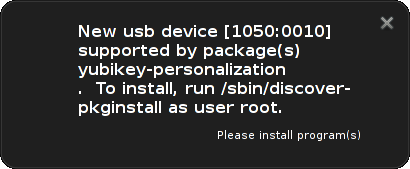
One thing that annoys me with Debian and Linux distributions in general, is that there is a great package management system with the ability to automatically install software packages by downloading them from the distribution mirrors, but no way to get it to automatically install the packages I need to use the hardware I plug into my machine. Even if the package to use it is easily available from the Linux distribution. When I plug in a LEGO Mindstorms NXT, it could suggest to automatically install the python-nxt, nbc and t2n packages I need to talk to it. When I plug in a Yubikey, it could propose the yubikey-personalization package. The information required to do this is available, but no-one have pulled all the pieces together. Some years ago, I proposed to use the discover subsystem to implement this. The idea is fairly simple: I am not sure what the best way to implement this is, but my initial idea was to use dbus events to discover new hardware, the discover database to find packages and PackageKit to install packages. Yesterday, I found time to try to implement this idea, and the draft package is now checked into the Debian Edu subversion repository. In the process, I updated the discover-data package to map the USB ids of LEGO Mindstorms and Yubikey devices to the relevant packages in Debian, and uploaded a new version 2.2013.01.09 to unstable. I also discovered that the current discover package in Debian no longer discovered any USB devices, because /proc/bus/usb/devices is no longer present. I ported it to use libusb as a fall back option to get it working. The fixed package version 2.1.2-6 is now in experimental (didn't upload it to unstable because of the freeze). With this prototype in place, I can insert my Yubikey, and get this desktop notification to show up (only once, the first time it is inserted):

For this prototype to be really useful, some way to automatically install the proposed packages by pressing the "Please install program(s)" button should to be implemented. If this idea seem useful to you, and you want to help make it happen, please help me update the discover-data database with mappings from hardware to Debian packages. Check if 'discover-pkginstall -l' list the package you would like to have installed when a given hardware device is inserted into your computer, and report bugs using reportbug if it isn't. Or, if you know of a better way to provide such mapping, please let me know. This prototype need more work, and there are several questions that should be considered before it is ready for production use. Is dbus the correct way to detect new hardware? At the moment I look for HAL dbus events on the system bus, because that is the events I could see on my Debian Squeeze KDE desktop. Are there better events to use? How should the user be notified? Is the desktop notification mechanism the best option, or should the background daemon raise a popup instead? How should packages be installed? When should they not be installed? If you want to help getting such feature implemented in Debian, please send me an email. :)

2 January 2013

Petter Reinholdtsen: New IRC channel for LEGO designers using Debian

During Christmas, I have worked a bit on the Debian support for LEGO Mindstorm NXT. My son and I have played a bit with my NXT set, and I discovered I had to build all the tools myself because none were already in Debian Squeeze. If Debian support for LEGO is something you care about, please join me on the IRC channel #debian-lego (server irc.debian.org). There is a lot that could be done to improve the Debian support for LEGO designers. For example both CAD software and Mindstorm compilers are missing. :) Update 2012-01-03: A project page including links to Lego related packages is now available.

28 December 2012

Petter Reinholdtsen: A Christmas present for Skolelinux / Debian Edu

I was happy to discover a few days ago that the Skolelinux / Debian Edu project also this year received a Christmas present from Another Agency in Trondheim. NOK 1000,- showed up on our donation account December 24th. I want to express our thanks for this very welcome present. As the Debian Edu / Skolelinux project is very short on funding these days, and thus lack the money to do regular developer gatherings, this donation was most welcome. One developer gathering cost around NOK 15 000,-, so we need quite a lot more to keep the development pace we want. Thus, I hope their example this year is followed by many others. :) The public list of donors can be found on the donation page for the project, which also contain instructions if you want to donate to the project.

25 December 2012

Petter Reinholdtsen: How to backport bitcoin-qt version 0.7.2-2 to Debian Squeeze

Let me start by wishing you all marry Christmas and a happy new year! I hope next year will prove to be a good year. Bitcoin, the digital decentralised "currency" that allow people to transfer bitcoins between each other with minimal overhead, is a very interesting experiment. And as I wrote a few days ago, the bitcoin situation in Debian is about to improve a bit. The new debian source package (version 0.7.2-2) was uploaded yesterday, and is waiting in the NEW queue for one of the ftpmasters to approve the new bitcoin-qt package name. And thanks to the great work of Jonas and the rest of the bitcoin team in Debian, you can easily test the package in Debian Squeeze using the following steps to get a set of working packages:
git clone git://git.debian.org/git/collab-maint/bitcoin
cd bitcoin
DEB_MAINTAINER_MODE=1 DEB_BUILD_OPTIONS=noupnp fakeroot debian/rules clean
DEB_BUILD_OPTIONS=noupnp git-buildpackage --git-ignore-new
You might have to install some build dependencies as well. The list of commands should give you two packages, bitcoind and bitcoin-qt, ready for use in a Squeeze environment. Note that the client will download the complete set of bitcoin "blocks", which need around 5.6 GiB of data on my machine at the moment. Make sure your ~/.bitcoin/ directory have lots of spare room if you want to download all the blocks. The client will warn if the disk is getting full, so there is not really a problem if you got too little room, but you will not be able to get all the features out of the client. As usual, if you use bitcoin and want to show your support of my activities, please send Bitcoin donations to my address 15oWEoG9dUPovwmUL9KWAnYRtNJEkP1u1b.

Russ Allbery: Review: A Paradise Built in Hell

Review: A Paradise Built in Hell, by Rebecca Solnit
Publisher: Penguin
Copyright: 2009
Printing: 2010
ISBN: 0-14-311807-2
Format: Trade paperback
Pages: 319
A Paradise Built in Hell is a book with an agenda. Solnit's goal is to convince the reader that nearly everything we're shown in movies and popular culture about human behavior during disasters is wrong. Not only is destructive mass panic unusual verging on nonexistent, spontaneous cooperation and acts of startling courage and resourcefulness are commonplace. The heroes that we hear about afterwards are more the norm than the exception. Disasters are far more likely to bring out the best in people than the worst. They break down barriers and form spontaneous human communities that survivors remember for a lifetime. Rather than natural disasters leading inevitably to an exacerbating human crisis in the absence of strong authority, Solnit argues that they are an amazing human opportunity, and that the most negative and destructive human behavior during crises is not from untrained victims but from the panic of the elites who are supposedly responsible for protecting the public. I think her analysis and presentation is both deeply appealing and deeply flawed. The flaws involve extrapolation and generalization beyond the applicability of her research, and I'll say more about that in a moment. But the appeal is still surprising and satisfying, and I think there's a lot of truth in this book despite its one-sided presentation. I like to tell people, half-jokingly, that I'm an anarchosyndicalist. It's my political alliegance of the heart: the political structure that I know would never work, but that matches the world I want to live in. (I suspect much of the belief in libertarianism is of this form.) Now I have a book to point people at when they ask what the appeal of anarchosyndicalism is. The sense of spontaneous community, of bonding, of reaching out to other people to do something necessary, together, that Solnit describes here in the aftermath of a disaster matches that vision of a world without imposed economic authority, where people spontaneously collaborate to solve problems. A Paradise Built in Hell is structured by disaster, providing a tour of major disasters and their aftermath interspersed with extended musings on what the human reactions mean and how disaster communities functioned. The major disasters discussed are the 1906 San Francisco earthquake, the Halifax explosion, the 1985 Mexico City earthquake, 9/11, and Hurricane Katrina. Solnit moves through them in chronological order, closing the book with Katrina, which had (at least for me) the most infuriating and uplifting mixes of community bonding and elite panic. But both of those factors are present from the beginning in the 1906 earthquake: spontaneous human organization that (from multiple first-hand accounts) transformed people's lives mixed with a military reaction and elite panic that possibly did more damage to the city than the earthquake did. Elite panic is the dark side of Solnit's celebration of human altruism and spontaneous community organization. The primary picture she paints is of ordinary people responding with great courage and creativity and finding, in their reaction, a transformative experience and a sense of purpose that often becomes the most powerful and positive experience of their life. But this is at odds with a deeply-entrenched elite belief in mass panic, in the necessity of keeping information from the public to suppress their reaction, and in the need to re-establish "order." And with that, Solnit is absolutely scathing, and with some justification. Along with detailed accounts of these major disasters, Solnit also gives the reader a tour of the research literature on disasters, research that has shown that the panic and chaos that is at the center of practically every disaster movie ever made is essentially a myth. Mass panic in disasters is not only rare, it's close to non-existent. As you might expect, the handling of Katrina by both the government and by neighboring white communities is the subject of the harshest attacks. The material on Katrina presented here is enough to make anyone want to throw out the current playbook on how we react to disasters (and lest one think Solnit is unfair, her research matches very closely with other research and journalism on Katrina that I've seen from a wide variety of sources). But Solnit shows that this is a pattern: the combination of our media-driven belief in how people will react to disasters combined with the elite need to re-establish control plays out in many major disasters, and almost always negatively. Even in 9/11, the official response in some cases hampered and undermined an already-effective unofficial response. This is very interesting and has concrete implications for public policy around disasters. But where Solnit moves onto thinner anarchosyndicalist ice is the story that she tells about disasters as dramatic upheavals of the established social order that could point to a revolution in how we interact with each other. Solnit is deeply inspired by human altruism during disasters, and her enthusiasm is somewhat contageous, but it was useful to read this book shortly after Bruce Schneier's Liars and Outliers. I think Solnit, in her understandable eagerness to find a way to extend disaster behavior to general life, does not understand the relationships between what Schneier terms moral, reputational, and institutional pressures. And that's the core of why we need to both enable spontaneous human response in disasters and have organized first responders and supporting infrastructure, and why disaster communities will break down when extended beyond the disaster. When I first mentioned A Paradise Built in Hell to my mother, her first reaction was dubiousness due to her memory of the 1977 New York City blackout. There was a disaster that resulted in widespread looting and destruction, rather than the positive reaction Solnit describes. Solnit does have a cogent argument for why looting is poorly analyzed (we don't, for example, distinguish between breaking into stores to get desperately needed supplies and doing so for personal gain) and should not be a priority in a life-threatening disaster. But it's not completely convincing; in some disasters, particularly ones like the 1977 power outage that were not particularly life-threatening, the looting has been the most destructive part of the disaster. Schneier provides what I think is the missing piece, both to this and to why the wonderful behavior during disasters doesn't last into everyday life. During a life-threatening disaster, moral pressures are massively increased. Nearly all of us have self-images and moral beliefs that provide very strong incentives to help others and collaborate in the face of life-threatening emergencies, incentives that override other motives and lead to the sort of behavior that Solnit celebrates. But moral pressures have inherent limitations. That moral reaction applies most strongly to small groups (such as bands of survivors), and will start to break down as larger society re-establishes itself. And disasters, like a power outage, that are not immediately life-threatening will not provoke the same intensification of moral pressures: we don't have strong moral beliefs and internal stories about staying quietly at home during power outages the way that we do for saving people from burning buildings or pulling them out of rubble. Once larger communities have reformed and that short-term emergency reaction has dissipated, the need for institutional pressures (police, law, and formal authority structures) will return. I wish Solnit had been able to read Schneier's book before writing hers. I think his analysis structure provides a healthy dose of realism and perspective to her desire for a self-organizing communal world, and might have blunted her enthusiastic but somewhat unrealistic hopes for finding some key to a revolution in human organization in the heart of disasters. But if A Paradise Built in Hell is unlikely to lead to a radical change in how we organize societies, it should at least provoke a radical rethinking of some of our unnecessary pessimism about our fellow humans. The evidence is substantial and compelling: crisis brings out the best in people, not the worst, and the ordinary people who happen to be around are capable of becoming some of the most amazing disaster response teams that we can imagine. This has numerous mundane implications for social policy. We should consider simple training for the general public, for example, to strengthen that reaction, should allow for it in legal structures and training of first responders (around looting, for instance), and should do everything we can to kill the destructive myth that people cannot be trusted in disasters or that mass panic will be as much of a threat as the disaster. But the best part of this book is that it provides a concrete, well-documented, and well-defended reason to let go of some of our cynicism and to extend a bit of trust to our fellow humans. There sadly aren't earth-shaking implications for everyday society, but there is a wealth of evidence that shows that we're better people in the crunch than we believe we are, or that we expect of others. And the more that we can embrace the dissolution of boundaries and social hierarchies in the middle of disasters, the more we are likely to be surprised by deep human connection and a sense of shared, focused purpose. Solnit is a bit long-winded with her agenda, but that bright hope has stuck with me. Recommended. Rating: 8 out of 10

23 December 2012

John Goerzen: Glockenklang, Forever

Jacob (and Oliver too, somewhat) has taken quite the interest in Christmas music this year. Perhaps it s singing in the choir at school, or perhaps it s just him getting older, but in any case, Christmas music fascinates him. And no song more than Jingle Bells. I have recordings of it by several artists in different styles, and he has his favorites and often wants to hear them again and again. The other night at supper, he said, Dad, can you sing Jingle Bells in German? Kind of a random question. I normally try to keep books and devices of all sorts away from the table, but my son had just asked me to sing. In German. I don t believe that had ever happened before, so I wasn t going to say no! I got my tablet, pulled up Google, and found some German lyrics. Not exactly a translation, but it fit the tune, so that s what counts. So I started singing, and when I got to the chorus, and sang Oh, Glockenklang, Glockenklang both boys bust up laughing. They thought Glockenklang was a hilarious word, and loved to hear it. Oliver requests I sing Glockenklang every so often now. He has this eager anticipation when he does it, as if he knows I m going to be hilarious so much so that he almost starts laughing before I even say a word. Then yesterday at breakfast, Jacob requested more German songs. I finally got a couple of hymn books (one of which, Gesangbuch mit Noten, really is a German songbook). I sang some songs in German for the boys, while they enjoyed their blueberry crepes. Sadly Stille Nacht and O du fr hliche did not prove as hilarious as Glockenklang, but they got impatient as I looked through the idnex between each song, saying Dad, just sing more German! Don t look at those pages! So I guess it was a hit. I m not sure where this sudden fascination with German music came from, but it appears to be leaving me hungry. While driving around, Oliver requested I sing Glockenklang in the car. I said yes, despite not remembering even one German word to that song except for, well, Glockenklang. So I just filled in with some random German words I do know. Fortunately, they didn t seem to have memorized the rest of it either. The other day, we went to the annual Christmas concert at the local high school. It was perfect for the boys various styles of music, an interesting old auditorium, nobody was going to care if they weren t perfectly quiet, and the price was right, too. The band played first, and both boys sat there, paying great attention, soaking it all in. They loved the cymbal crashes and Jacob seemed to dream of playing the chimes and bells. At one point, I whispered to Jacob that I could feel the timpani on the wood floor in the auditorium, and he tried it, and made his Hmm, I just learned something interesting! reaction. As is tradition, the concert concluded with singing the Hallelujah Chorus and anyone in the audience that wants to sing is invited on stage to join the choir. I remember being in high school for that concert, and after practicing it in school, the great fun of being joined by many powerful voices from the community all around me on the risers. So this time, while my parents stayed with the boys, I was one of the many that went up to join the choir. It was no less thrilling all these years later. Ending with Forever and ever, Hallelujah, Hallelujah. Hallelujah! , and feeling it, right then, put a huge smile on my face.

21 December 2012

Petter Reinholdtsen: A word on bitcoin support in Debian

It has been a while since I wrote about bitcoin, the decentralised peer-to-peer based crypto-currency, and the reason is simply that I have been busy elsewhere. But two days ago, I started looking at the state of bitcoin in Debian again to try to recover my old bitcoin wallet. The package is now maintained by a team of people, and the grunt work had already been done by this team. We owe a huge thank you to all these team members. :) But I was sad to discover that the bitcoin client is missing in Wheezy. It is only available in Sid (and an outdated client from backports). The client had several RC bugs registered in BTS blocking it from entering testing. To try to help the team and improve the situation, I spent some time providing patches and triaging the bug reports. I also had a look at the bitcoin package available from Matt Corallo in a PPA for Ubuntu, and moved the useful pieces from that version into the Debian package. After checking with the main package maintainer Jonas Smedegaard on IRC, I pushed several patches into the collab-maint git repository to improve the package. It now contains fixes for the RC issues (not from me, but fixed by Scott Howard), build rules for a Qt GUI client package, konqueror support for the bitcoin: URI and bash completion setup. As I work on Debian Squeeze, I also created a patch to backport the latest version. Jonas is going to look at it and try to integrate it into the git repository before uploading a new version to unstable. I would very much like bitcoin to succeed, to get rid of the centralized control currently exercised in the monetary system. I find it completely unacceptable that the USA government is collecting transaction data for almost all international money transfers (most are done in USD and transaction logs shipped to the spooks), and that the major credit card companies can block legal money transactions to Wikileaks. But for bitcoin to succeed, more people need to use bitcoins, and more people need to accept bitcoins when they sell products and services. Improving the bitcoin support in Debian is a small step in the right direction, but not enough. Unfortunately the user experience when browsing the web and wanting to pay with bitcoin is still not very good. The bitcoin: URI is a step in the right direction, but need to work in most or every browser in use. Also the bitcoin-qt client is too heavy to fire up to do a quick transaction. I believe there are other clients available, but have not tested them. My experiment with bitcoins showed that at least some of my readers use bitcoin. I received 20.15 BTC so far on the address I provided in my blog two years ago, as can be seen on the blockexplorer service. Thank you everyone for your donation. The blockexplorer service demonstrates quite well that bitcoin is not quite anonymous and untracked. :) I wonder if the number of users have gone up since then. If you use bitcoin and want to show your support of my activity, please send Bitcoin donations to the same address as last time, 15oWEoG9dUPovwmUL9KWAnYRtNJEkP1u1b.

18 December 2012

Petter Reinholdtsen: Ledger - double-entry accounting using text based storage format

A few days ago I came across a blog post from Joey Hess describing ledger and hledger, a text based system for double-entry accounting. I found it interesting, as I am involved with several organizations where accounting is an issue, and I have not really become too friendly with the different web based systems we use. I find it hard to find what I look for in the menus and even harder try to get sensible data out of the systems. Ledger seem different. The accounting data is kept in text files that can be stored in a version control system, and there are at least five different implementations able to read the format. An example entry look like this, and is simple enough that it will be trivial to generate entries based on CVS files fetched from the bank:
2004-05-27 Book Store
      Expenses:Books                 $20.00
      Liabilities:Visa
The concept seemed interesting enough for me to check it out and look for others using it. I found blog posts from Christine Spang, Pete Keen, Andrew Cantino and Ronald Ip describing how they use it, as well as a post from Bradley M. Kuhn at the Software Freedom Conservancy. All seemed like good recommendations fitting my need. The ledger package is available in Debian Squeeze, while the hledger package only is available in Debian Sid. As I use Squeeze, ledger seemed the best choice to get started. To get some real data to test on, I wrote a web scraper for LODO, the accounting system used by the NUUG association, and started to play with the data set. I'm not really deeply into accounting, but I am able to get a simple balance and accounting status for example using the "ledger balance" command. But I will have to gather more experience before I know if the ledger way is a good fit for the organisations I am involved in.

6 December 2012

Petter Reinholdtsen: Scripting the Cerebrum/bofhd user administration system using XML-RPC

Where I work at the University of Oslo, we use the Cerebrum user administration system to maintain users, groups, DNS, DHCP, etc. I've known since the system was written that the server is providing an XML-RPC API, but I have never spent time to try to figure out how to use it, as we always use the bofh command line client at work. Until today. I want to script the updating of DNS and DHCP to make it easier to set up virtual machines. Here are a few notes on how to use it with Python. I started by looking at the source of the Java bofh client, to figure out how it connected to the API server. I also googled for python examples on how to use XML-RPC, and found a simple example in the XML-RPC howto. This simple example code show how to connect, get the list of commands (as a JSON dump), and how to get the information about the user currently logged in:
#!/usr/bin/env python
import getpass
import xmlrpclib
server_url = 'https://cerebrum-uio.uio.no:8000';
username = getpass.getuser()
password = getpass.getpass()
server = xmlrpclib.Server(server_url);
#print server.get_commands(sessionid)
sessionid = server.login(username, password)
print server.run_command(sessionid, "user_info", username)
result = server.logout(sessionid)
print result
Armed with this knowledge I can now move forward and script the DNS and DHCP updates I wanted to do.

4 December 2012

Russ Allbery: Review: The Borrowers

Review: The Borrowers, by Mary Norton
Series: The Borrowers #1
Illustrator: Beth Krush
Illustrator: Joe Krush
Publisher: Sandpiper
Copyright: 1953
Printing: 1986
ISBN: 0-15-204737-9
Format: Trade paperback
Pages: 180
Arrietty is a 14-year-old girl who lives under the clock. Well, actually, she lives under the kitchen floor, but the entrance to her family's passageway is under the clock, from which they get their name. She sleeps in an old cigar box, her living room is wallpapered with strips cut from letters (and decorated with postage stamps), and she keeps a journal in a miniature book that's half the size she is. Arrietty, and her parents Pod and Homily, are Borrowers. The Borrowers is a classic series of children's books by Mary Norton about miniature people who, at least in this first book, live in the walls and take things. Not big things, but all the little things: the blotter paper, the pins, the stray sock, old postage stamps, empty matchboxes, and the occasional thimble. With these things, they build their furniture, their clothes, and their homes, safely hidden in the walls and other secret places, always wary of the "human beans" (as Arrietty's mother tends to call them). That life is, of course, a remarkable simulation of middle-class, class-conscious British life, which is much of the fun. Arrietty's family lives in the home of an elderly woman who's confined to bed, so it's quiet, safe, and driven entirely by routine. They only have to watch out for the maid and the gardener, and they keep regular schedules. That's just the way the Borrowers like it; predictable and quiet. Which is why they get caught entirely by surprise when a boy shows up, recovering from illness in the country, and spots Pod on one of his borrowing runs. This is technically a re-read, but I read the original series so long ago that I barely remembered it. Not that there is all that much to remember, at least in the way of plot. This first book follows one of the standard plots for children's books of this type (although it follows Arrietty as the viewpoint character rather than the more common choice of the boy): boy discovers hidden creatures, hidden creatures are afraid, boy turns out to want to make friends with them, they strike up a friendship, peril nonetheless ensues. If you've read many children's books, you've probably read this before; The Mouse and the Motorcycle is an obvious example (and, in terms of plot, a somewhat better book). Arrietty is a typical protagonist, her parents are silly (and a bit flighty, particularly her mother), and the boy is, disappointingly, almost a non-entity. But you don't read The Borrowers for the plot. The brilliance of this book is in the descriptions of what they use, how they use it, and how they construct their ingenious homes. Norton captures much of the wonder of other miniaturization stories (the movie Honey, I Shrunk the Kids is an obvious example), but takes it one step further into clever and thoughtful repurposing. The book is full of off-hand descriptions of how everyday objects become different everyday objects for miniature people, giving it the same delight that one gets from descriptions of how model railroad dioramas or hand-made doll houses are constructed. The detailed (if busy) illustrations by the Krushes help tremendously with visualization and make the descriptions even more fun. This is very much a children's book based on an exploration of a single great idea, so don't expect too much in the way of plot or deep characterization. It's also not science fiction; there isn't any realistic extrapolation of culture. The Borrowers all behave like perfectly ordinary English people without any further explanation because, of course, that's what they would do. Re-reading it as an adult, I wished there was a bit more meat to it. But the ingenuity is still a delight. It's great fun to spend a couple of hours imagining how one would construct the miniature accouterments of everyday life. Followed by The Borrowers Afield. Rating: 7 out of 10

20 November 2012

Pablo Lorenzzoni: Decision-making by flipping a coin

Yesterday I was discussing in an online board how to break a decision deadlock in life. There are real deadlocks, but I don t think they are very frequent most of the time, doing a pros and cons analysis is enough to decide what to do. Sometimes our judgement is impaired by lack of objectivity or by our inability to see things from a different point of view (it s hard to think straight when everything seems to be falling apart around you); talking to a friend or relative can help in these situations. But there are times when nothing helps. When you are really stuck and nothing seems to break the deadlock. At these times I give it one or two days, sleep on the issue and if I cannot come up with a decision I assume the alternatives are equivalent to me and just flip a coin. Of course, this will do if you can postpone the decision, giving yourself (and your inner self) time to decide on a course-of-action. But is there some way to speed up the process? During the discussion, someone came up with a rather smart quote by Rothstein character in Boardwalk Empire TV series:
Flip a coin. When it s in the air, you ll know what side you re hoping for.
I found it an interesting way to give your inner self an ultimatum: decide or luck will decide instead. I ve never did it like that, for I would not flip a coin unless it s my last resort. Being such a clever psychological idea, I doubted it originated in the TV series itself, so I went on pursue of the original idea. I found a Danish poet and mathematician called Piet Hein, who wrote a poem about it circa 1969:
A PSYCHOLOGICAL TIP Whenever you re called on to make up your mind,
and you re hampered by not having any,
the best way to solve the dilemma, you ll find,
is simply by spinning a penny.
No not so that chance shall decide the affair
while you re passively standing there moping;
but the moment the penny is up in the air,
you suddenly know what you re hoping.
And also, there are a Donald Duck comic called Flip Decision circa 1953 that introduces Flipism philosophy, which supports a rather radical anecdotal variant: make all decisions by flipping a coin. Piet Hein or Rothstein character idea is much better than Flipism, of course. Does anyone knows any older sources of the same idea?

17 November 2012

Petter Reinholdtsen: Why isn't the value of copyright taxed?

While working on a Norwegian translation of the Free Culture by Lawrence Lessig (76% done), which cover the problems with todays copyright law and how it stifles creativity, one idea occurred to me. The idea is to get the tax office to help make more works enter the public domain and also help make it easier to clear rights for using copyrighted works. I mentioned this idea briefly during Yesterdays presentation by John Perry Barlow, and concluded that it was best to put it in writing for a wider audience. The idea is not really based on the argument that copyrighted works are "intellectual property", as the core requirement is that copyrighted work have value for the copyright holder and the tax office like to collect their share from any value controlled by the citizens in a country. I'm sharing the idea here to let others consider it and perhaps shoot it down with a fresh set of arguments. Most valuables are taxed by the government. At least here in Norway, the amount of money you have, the value of our land property, the value of your house, the value of your car, the value of our stocks and other valuables are all added together. If the tax value of these values exceed your debt, you have to pay the tax office some taxes for these values. And copyrighted work have value. It have value for the rights holder, who can earn money selling access to the work. But it is not included in the tax calculations? Why not? If the government want to tax copyrighted works, it would want to maintain a database of all the copyrighted works and who are the rights holders for a given works, to be able to associate the works value to the right citizen or company for tax purposes. If such database exist, it will become a lot easier to find out who to talk to for clearing permissions to use a copyrighted work, which is a very hard operation with todays copyright law. To ensure that copyright holders keep the database up-to-date, it would have to become a requirement to be able to collect money for granting access to copyrighted works that the work is listed in the database with the correct right holder. If copyright causes copyright holders to have to pay more taxes, they will have a small incentive to "disown" their copyright, and let the work enter the public domain. For works with several right holders one of the right holders could state (and get it registered in the database) that she do not need to be consulted when clearing rights to use the work in question and thus will not get any income from that work. Stating this would have to be impossible to revert and stop the tax office from adding the value of that work to the given citizens tax calculation. I assume the copyright law would stay the same, allowing creators to pick a license of their choosing, and also allowing them to put their work directly in the public domain. The existence of such database will make it even easier to clear rights, and if the right holders listed in the database is taxed, this system would increase the amount of works that enter the public domain. The effect would be that the tax office help to make it easier to get rights to use the works that have not yet entered the public domain and help to get more work into the public domain and . Why have such taxing not happened yet? I am sure the tax office would like to tax copyrighted work values if they could.

14 November 2012

Petter Reinholdtsen: Debian Edu interview: Angela Fu

Here is another interview with one of the people in the Debian Edu and Skolelinux community. I am running short on people willing to be interviewed, so if you know about someone I should interview, Please send me an email. After asking for many months, I finally managed to lure another one of the people behind the German "IT-Zukunft Schule" project out from maternity leave to conduct an interview. Give a warm welcome to Angela Fu . :) Who are you, and how do you spend your days? I am a 39-year-old woman living in the very north of Germany near Denmark. I live in a patchwork family with "my man" Mike Gabriel, my two daughters, Mikes daughter and Mikes and my rather newborn son. At the moment - because of our little baby - I am spending most of the day by being a caring and organising mom for all the kids. Besides that I am really involved into and occupied with several inner growth processes: New born souls always bring the whole familiar system into movement and that needs time and focus ;-). We are also in the middle of buying a house and moving to it. In 2013 I will work again in my job in a German foundation for nature conservation. I am doing public relation work there. Besides that - and that is the connection to Skolelinux / Debian Edu - I am working in our own school project "IT-Zukunft Schule" in North Germany. I am responsible for the quality assurance, the customer relationship management and the communication processes in the project. Since 2001 I constantly have been training myself in communication and leadership. Besides that I am a forester, a landscaping gardener and a yoga teacher. How did you get in contact with the Skolelinux / Debian Edu project? I fell in love with Mike ;-). Very soon after getting to know him I was completely enrolled into Free Software. At this time Mike did IT-services for one newly founded school in Kiel. Other schools in Kiel needed concepts for their IT environment. Often when Mike came home from working at the newly founded school I found myself listening to his complaints about several points where the communication with the schools head or the teachers did not work. So we were clear that he would not work for one more school if we did not set up a structure for communication between him, the schools head, the teachers, the students and the parents. Together with our friend and hardware supplier Andreas Buchholz we started to get an overview of free software solutions suitable for schools. One day before Christmas 2010 Mike and I had a date with Kurt Gramlich in G tersloh. As Kurt and I are really interested in building networks of people and in being in communication we dived into Skolelinux and brought it to the first grammar schools in Northern Germany. For information about our school project you can read the interview with Mike Gabriel. What do you see as the advantages of Skolelinux / Debian Edu? First I have to say: I cannot answer this question technically. My answer comes rather from a social point of view. The biggest advantage of Skolelinux / Debian Edu I see is the large and strong international community of Debian Developers in the background which is very alive and connected over mailinglists, blogs and meetings. My constant feeling for the Debian Community is: If something does not work they will somehow fix it. All is well ;-). This is of course a user experience. What I also get as a big advantage of Skolelinux / Debian Edu is that everybody who uses it and works with it can also contribute to it - that includes students, teachers, parents... What do you see as the disadvantages of Skolelinux / Debian Edu? I will answer this question relating to the internal structure of Skolelinux / Debian Edu. What I see as a major disadvantage is that there is a gap between the group of developers for Debian Edu and the people who make the marketing, that means the people that bring Skolelinux to the schools. There is a lack of communication between these two groups and I think that does not really work for Skolelinux / Debian Edu. Further I appreciate that Skolelinux / Debian Edu is known as a do-ocracy. Nevertheless I keep asking myself if at some points a democracy or some kind of hierarchical project structure would be good and helpful. I am also missing some kind of contact between the Skolelinux / Debian Edu communities in Europe or on an international level. I think it would be good if there was more sharing between the different countries using Skolelinux / Debian Edu. Which free software do you use daily? On my laptop I am still using an Ubuntu 10.04 with a Gnome Desktop on. As applications I use Openoffice.org, Gedit, Firefox, Pidgin, LaTeX and GnuCash. For mails I am using Horde. And I am really fond of my N900 running with Maemo. Which strategy do you believe is the right one to use to get schools to use free software? I am really convinced that in our school project "IT-Zukunft Schule" we have developed (and keep developing) a great way to get schools to use Free Software. We have written a detailed concept for that so I cannot explain the whole thing here. But in a nutshell the strategy has three crucial pillars:

4 November 2012

Petter Reinholdtsen: The European Central Bank (ECB) take a look at bitcoin

Slashdot just ran a story about the European Central Bank (ECB) releasing a report (PDF) about virtual currencies and bitcoin. It is interesting to see how a member of the bitcoin community receive the report. As for the future, I suspect the central banks and the governments will outlaw bitcoin if it gain any popularity, to avoid competition. My thoughts go to the W rgl experiment with negative inflation on cash which was such a success that it was terminated by the Austrian National Bank in 1933. A successful alternative would be a threat to the current money system and gain powerful forces to work against it. While checking out the current status of bitcoin, I also discovered that the community already seem to have experienced its first pyramid game / Ponzi scheme. Not very surprising, given how members of "small" communities tend to trust each other. I guess enterprising crocks will try again and again, as they do anywhere wealth is available.

Russ Allbery: Review: Set This House in Order

Review: Set This House in Order, by Matt Ruff
Publisher: Perennial
Copyright: 2003
Printing: 2004
ISBN: 0-06-095485-X
Format: Trade paperback
Pages: 479
A textbook case history would say that Andy Gage has disassociative identity disorder (referred to here as the more common although medically inaccurate "multiple personality disorder" for reasons of clarity and to match casual speech, according to the author). However, that's a completely inadequate description. A better description would be that Andy Gage's body is inhabited by a large set of different personalities, who take turns being in control. The original Andy Gage is dead, shattered by horrific childhood abuse. Aaron became the dominant personality and gave structure to the internal geography of the mind they all share, with the help of extensive counselling. But Aaron was exhausted by being the public face and maintaining control of the shared body. Hence, Andrew. Andrew Gage is the first-person narrator of half of this book. He is twenty-eight, the same age as the body, but he's only existed for two years. He considers Aaron his father, since Aaron called him out of the lake inside their internal metal geography. His purpose is to run the body and be the public face of the family. He is by turns capable and naive, shy on personal experience, but able to get the help of the others. The one heard from most frequently is Adam, a rude and mischevious teenager who also has an uncanny ability to read other people, and who frequently watches through the body's eyes from what the family calls the "pulpit" and gives Andrew advice. Andrew works for Julie Sivik, a woman he met the day he quit his job at a big-box store because he couldn't explain his behavior to his boss without discussing being a multiple. Julie is a wholly impractical, slightly unethical, well-meaning force of chaos who serves as the thread that draws the plot of the book together. She's running a startup on ingenuity and borrowed money that is attempting to create a comprehensive and customizable virtual reality world. She's the one who finds Penny and hires her, in part for her skills, and in part to push Penny and Andrew together. Penny Driver has the same condition as Andrew, but Penny is only vaguely aware of it. The world for her is full of blackouts, lost time, waking up in strange and sometimes horrific situations, and attempting to structure her life based on notes left for herself that she didn't write. When she meets Andrew, she's barely making it through life; thankfully, one of her personalities is remarkably good at computers, and that has been enough to make a living despite the chaos. But Julie is the unintentional catalyst for her losing that job, the best job she's ever had, leaving her with no real alternative but to take the job with Julie's company. There are a few things that are important to say up-front about this book. First, neither I nor the author are actually multiples (or, put another way, neither of us have DID), and writing about atypical mental states is fraught with peril. It's very easy to misrepresent other people's experiences, and multiple personalities in particular are frequent material for dramas of all sorts. There's something people find inherently fascinating about the idea, and it's easy for that fascination to run away with reality and distort the lived experience. I recommend reading Ruff's FAQ about the book, which spells out what his goals are and what approach he took. I did some quick searches and didn't uncover a lot of anger or dislike of the book among either people who have DID or psychiatrists, and it seems true to the descriptions of internal reality I've heard from people who are multiples. But despite being more respectful of real experience than most fictional treatments of DID, this is still a work of fiction written by someone without first-hand experience, and it's worth keeping that in mind. Second, DID is an intensely controversial diagnosis among psychiatrists. There are, generally speaking, two major controversies. One is over whether or not DID can actually be caused by traumatic experiences such as childhood abuse, or whether it is a creation of psychiatrists, a mental model that they've imposed on their patients or convinced their patients to believe. Set This House in Order comes down firmly on the first side of that controversy: that DID can be created by abuse and is not a creation of psychotherapy. (So, I should note, does every multiple that I've ever talked to or read.) Second, there is significant controversy over treatment, with some psychiatrists believing that integration of the personalities into one is the only true treatment, and others believing that multiples can remain stable and functional as multiple personalities. Set This House in Order leans strongly towards the view that multiples can be stable as multiples and that while integration may be appropriate for some, it's not for all. Both of these viewpoints are presented very convincingly by the narrative in the book, and both are consistent with the beliefs of a lot of multiples, but it's worth remembering that these are active and often quite heated controversies and a novel is not evidence. It's good to be aware of both of those points, and to read Put This House in Order as something of a what-if, where much more is clear about DID than is actually clear in our world. But once one has done that, one is in for an excellent book. I loved this book from start to finish. (Well, okay, I felt some surprise at the nature of the ending, but it grew on me after further consideration.) It's simply a brilliant novel, with a little bit of everything: very good characterization, messy love affairs, the satisfying tension of someone overcoming great odds to put themselves together with the help of friends, a startlingly original perspective of the world, some excellent surprises, and some absolutely wonderful characters. Andrew is a good choice of narrator: he brings an earnest calm to a story that could otherwise be quite chaotic and provides a great vantage point for the reader. And I found Penny (and particularly some of her other souls) impossible not to like. Set This House in Order is a tense book in places, and it's a book where people's lives break down before they can get better. It's also a book about rather horrific abuse, and while nearly all of the specifics happen off-stage, imagination fills in some nasty details. But Ruff manages to write it with a structure and with enough calm assurance that I felt just reassured enough without taking away the tension. That's a tricky balance; few books do it better. And the supporting characters are a delight. One might think, with all the complexity happening for both Andrew and Penny, that Ruff wouldn't have room in the narrative for other characters, but one would be wrong. There are very few saints and demons here, just a lot of complex people, with their own problems and their own perspectives, who are generally trying to do the best they can from day to day. There are some clear-cut villains in the past Ruff wisely makes no attempt to add shades of grey to abusers but even there one can see some clear signs of untreated severe mental illness and chaotic lives rather than mustache-twirling pre-meditated villainy. This is, in short, a book full of people, in all their messy complications, which is what makes it so delightful. I'm not going to say anything more about the plot, or even the various personalities, since discovering the direction of the book was so much of the fun. I will say that, despite the subject matter and some of the events, the book is surprisingly gentle. One of the things about it that I loved the most was the emotional tone Ruff gave to being a multiple: the sense of a squabbling but tight-knit family looking out for each other. I can't judge the reality of this impression, but it makes for a wonderful story. Highly recommended. The best book I've read so far this year. Rating: 10 out of 10

Next.

Previous.