Search Results: "nate"

22 March 2025

Luke Faraone: I'm running for the OSI board... maybe

The Open Source Initiative has two classes of board seats: Affiliate seats, and Individual Member seats. In the upcoming election, each affiliate can nominate a candidate, and each affiliate can cast a vote for the Affiliate candidates, but there's only 1 Affiliate seat available. I initially expressed interest in being nominated as an Affiliate candidate via Debian. But since Bradley Kuhn is also running for an Affiliate seat with a similar platform to me, especially with regards to the OSAID, I decided to run as part of an aligned "ticket" as an Individual Member to avoid contention for the 1 Affiliate seat.Bradley and I discussed running on a similar ticket around 8/9pm Pacific, and I submitted my candidacy around 9pm PT on 17 February. I was dismayed when I received the following mail from Nick Vidal:
Dear Luke,

Thank you for your interest in the OSI Board of Directors election. Unfortunately, we are unable to accept your application as it was submitted after the official deadline of Monday Feb 17 at 11:59 pm UTC. To ensure a fair process, we must adhere to the deadline for all candidates.

We appreciate your enthusiasm and encourage you to stay engaged with OSI s mission. We hope you ll consider applying in the future or contributing in other meaningful ways.

Best regards,
OSI Election Teams
Nowhere on the "OSI s board of directors in 2025: details about the elections" page do they list a timezone for closure of nominations; they simply list Monday 17 February. The OSI's contact address is in California, so it seems arbitrary and capricious to retroactively define all of these processes as being governed by UTC.I was not able to participate in the "potential board director" info sessions accordingly, but people who attended heard that the importance of accommodating differing TZ's was discussed during the info session, and that OSI representatives mentioned they try to accommodate TZ's of everyone. This seems in sharp contrast with the above policy. I urge the OSI to reconsider this policy and allow me to stand for an Individual seat in the current cycle. Upd, N.B.: to people writing about this, I use they/them pronouns

Antoine Beaupr : Minor outage at Teksavvy business

This morning, internet was down at home. The last time I had such an issue was in February 2023, when my provider was Oricom. Now I'm with a business service at Teksavvy Internet (TSI), in which I pay 100$ per month for a 250/50 mbps business package, with a static IP address, on which I run, well, everything: email services, this website, etc.

Mitigation

Email The main problem when the service goes down like this for prolonged outages is email. Mail is pretty resilient to failures like this but after some delay (which varies according to the other end), mail starts to drop. I am actually not sure what the various settings are among different providers, but I would assume mail is typically kept for about 24h, so that's our mark. Last time, I setup VMs at Linode and Digital Ocean to deal better with this. I have actually kept those VMs running as DNS servers until now, so that part is already done. I had fantasized about Puppetizing the mail server configuration so that I could quickly spin up mail exchangers on those machines. But now I am realizing that my Puppet server is one of the service that's down, so this would not work, at least not unless the manifests can be applied without a Puppet server (say with puppet apply). Thankfully, my colleague groente did amazing work to refactor our Postfix configuration in Puppet at Tor, and that gave me the motivation to reproduce the setup in the lab. So I have finally Puppetized part of my mail setup at home. That used to be hand-crafted experimental stuff documented in a couple of pages in this wiki, but is now being deployed by Puppet. It's not complete yet: spam filtering (including DKIM checks and graylisting) are not implemented yet, but that's the next step, presumably to do during the next outage. The setup should be deployable with puppet apply, however, and I have refined that mechanism a little bit, with the run script. Heck, it's not even deployed yet. But the hard part / grunt work is done.

Other The outage was "short" enough (5 hours) that I didn't take time to deploy the other mitigations I had deployed in the previous incident. But I'm starting to seriously consider deploying a web (and caching) reverse proxy so that I endure such problems more gracefully.

Side note on proper servics Typically, I tend to think of a properly functioning service as having four things:
  1. backups
  2. documentation
  3. monitoring
  4. automation
  5. high availability
Yes, I miscounted. This is why you have high availability.

Backups Duh. If data is maliciously or accidentally destroyed, you need a copy somewhere. Preferably in a way that malicious joe can't get to. This is harder than you think.

Documentation I have an entire template for this. Essentially, it boils down to using https://diataxis.fr/ and this "audit" guide. For me, the most important parts are:
  • disaster recovery (includes backups, probably)
  • playbook
  • install/upgrade procedures (see automation)
You probably know this is hard, and this is why you're not doing it. Do it anyways, you'll think it sucks, but you'll be really grateful for whatever scraps you wrote when you're in trouble.

Monitoring If you don't have monitoring, you'll know it fails too late, and you won't know it recovers. Consider high availability, work hard to reduce noise, and don't have machine wake people up, that's literally torture and is against the Geneva convention. Consider predictive algorithm to prevent failures, like "add storage within 2 weeks before this disk fills up". This is harder than you think.

Automation Make it easy to redeploy the service elsewhere. Yes, I know you have backups. That is not enough: that typically restores data and while it can also include configuration, you're going to need to change things when you restore, which is what automation (or call it "configuration management" if you will) will do for you anyways. This also means you can do unit tests on your configuration, otherwise you're building legacy. This is probably as hard as you think.

High availability Make it not fail when one part goes down. Eliminate single points of failures. This is easier than you think, except for storage and DNS (which, I guess, means it's harder than you think too).

Assessment In the above 5 items, I check two:
  1. backups
  2. documentation
And barely: I'm not happy about the offsite backups, and my documentation is much better at work than at home (and even there, I have a 15 year backlog to catchup on). I barely have monitoring: Prometheus is scraping parts of the infra, but I don't have any sort of alerting -- by which I don't mean "electrocute myself when something goes wrong", I mean "there's a set of thresholds and conditions that define an outage and I can look at it". Automation is wildly incomplete. My home server is a random collection of old experiments and technologies, ranging from Apache with Perl and CGI scripts to Docker containers running Golang applications. Most of it is not Puppetized (but the ratio is growing). Puppet itself introduces a huge attack vector with kind of catastrophic lateral movement if the Puppet server gets compromised. And, fundamentally, I am not sure I can provide high availability in the lab. I'm just this one guy running my home network, and I'm growing older. I'm thinking more about winding things down than building things now, and that's just really sad, because I feel we're losing (well that escalated quickly).

Resolution In the end, I didn't need any mitigation and the problem fixed itself. I did do quite a bit of cleanup so that feels somewhat good, although I despaired quite a bit at the amount of technical debt I've accumulated in the lab.

Timeline Times are in UTC-4.
  • 6:52: IRC bouncer goes offline
  • 9:20: called TSI support, waited on the line 15 minutes then was told I'd get a call back
  • 9:54: outage apparently detected by TSI
  • 11:00: no response, tried calling back support again
  • 11:10: confirmed bonding router outage, no official ETA but "today", source of the 9:54 timestamp above
  • 12:08: TPA monitoring notices service restored
  • 12:34: call back from TSI; service restored, problem was with the "bonder" configuration on their end, which was "fighting between Montr al and Toronto"

21 March 2025

Jamie McClelland: AI's Actual Impact

Two years after OpenAI launched ChatGPT 3.5, humanity is not on the cusp of extinction and Elon Musk seems more responsible for job loss than any AI agent. However, ask any web administrator and you will learn that large language models are having a significant impact on the world wide web (or, for a less technical account, see Forbes articles on bots). At May First, a membership organization that has been supporting thousands of web site for over 20 years, we have never seen anything like this before.

Now what? So, no, unfortunately, your web site is not suddenly getting really popular. And, you are blessed with a whole new set of strategic decisions. Fortunately, May First has undergone a major infrastructure transition, resulting in centralized logging of all web sites and a fleet of web proxy servers that intercept all web traffic. Centralized logging means we can analyze traffic and identify bots more easily, and a web proxy fleet allows us to more easily implement rules across all web sites. However, even with all of our latest changes and hours upon hours of work to keep out the bots, our members are facing some hard decisions about maintaining an open web. One member of May First provides Google translations of their web site to every language available. But wow, that is now a disaster because instead of having every bot under the sun scrapping all 843 (a made up number) pieces of unique content on their site, the same bots are scraping 843 * (number of available languages) pieces of content on their site. Should they stop providing this translation service in order to ensure people can access their site in the site s primary language? Should web sites turn off their search features that include drop down options of categories to prevent bots from systematically refreshing the search page with every possible combination of search terms? Do we need to alter our calendar software to avoid providing endless links into the future (ok, that is an easy one)?

What s next? Something has to change.
  • Lock down web 2.0. Web 2.0 brought us wonderful dynamic web sites, which Drupal and WordPress and many other pieces of amazing software have supported for over a decade. This is the software that is getting bogged down by bots. Maybe we need to figure out a way to lock down the dynamic aspects of this software to logged in users and provide static content for everyone else?
  • Paywalls and accounts everywhere. There s always been an amazing non-financial reward to providing a web site with high quality movement oriented content for free. It populates the search engines, provides links to inspiring and useful content in moments of crises, and can galvanize movements. But these moments of triumph happen between long periods of hard labor that now seems to mostly feed capitalist AI scumbags. If we add a new set of expenses and labor to keep the sites running for this purpose, how sustainable is that? Will our treasure of free movement content have to move behind paywalls or logins? If we provide logins, will that keep the bots out or just create a small hurdle for them to automate the account creation process? What happens when we can t search for this kind of content via search engines?
  • Cutting deals. What if our movement content providers are forced to cut deals with the AI entrepreneurs to allow the paying scumbags to fund the content creation. Eww. Enough said.
  • Bot detection. Maybe we just need to get better at bot detection? This will surely be an arms race, but would have some good benefits. Bots have also been filling out our forms and populating our databases with spam, testing credit cards against our donation pages, conducting denial of service attacks and all kinds of other irritating acts of vandalism. If we were better at stopping bots automatically it would have a lot of benefits. But what impact would it have on our web sites and the experience of using them? What about good bots (RSS feed readers, payment processors, web hooks, uptime detectors)? Will we cut the legs off any developer trying to automate something?
I m not really sure where this is going, but it seems that the world wide web is about to head in a new direction.

18 March 2025

Dirk Eddelbuettel: RcppArmadillo 14.4.0-1 on CRAN: New Upstream

armadillo image Armadillo is a powerful and expressive C++ template library for linear algebra and scientific computing. It aims towards a good balance between speed and ease of use, has a syntax deliberately close to Matlab, and is useful for algorithm development directly in C++, or quick conversion of research code into production environments. RcppArmadillo integrates this library with the R environment and language and is widely used by (currently) 1234 other packages on CRAN, downloaded 38.8 million times (per the partial logs from the cloud mirrors of CRAN), and the CSDA paper (preprint / vignette) by Conrad and myself has been cited 617 times according to Google Scholar. Conrad released a new minor version 14.4.0 last month. That was preceding by several extensive rounds of reverse-dependency checks covering the 1200+ packages at CRAN. We eventually narrowed the impact down to just eight packages, and I opened issue #462 to manage the transition along with GitHub-only release 14.4.0-0 of RcppArmadillo. Several maintainers responded very promptly and updated within days this is truly appreciated. Yesterday the last package updated at CRAN coinciding nicely with our planned / intended upload to CRAN one month after the release. So this new release, at version -1, is now on CRAN. It brings the usual number of small improvements to Armadillo itself as well as updates to packaging. The changes since the last CRAN release are summarised below.

Changes in RcppArmadillo version 14.4.0-1 (2025-03-17)
  • CRAN release having given a few packages time to catch-up to small upstream change as discussed and managed in #462
  • Updated bibliography, and small edits to sparse matrix vignette
  • Switched continuous integration action to r-ci with implicit bootstrap

Changes in RcppArmadillo version 14.4.0-0 (2025-02-17) (GitHub Only)
  • Upgraded to Armadillo release 14.4.0 (Filtered Espresso)
    • Faster handling of pow() and square() within accu() and sum() expressions
    • Faster sort() and sort_index() for complex matrices
    • Expanded the field class with .reshape() and .resize() member functions
    • More efficient handling of compound expressions by sum(), reshape(), trans()
    • Better detection of vector expressions by pow(), imag(), conj()
  • The package generator helper function now supports additional DESCRIPTIONs
  • This release revealed a need for very minor changes for a handful reverse-dependency packages which will be organized via GitHub issue tracking

Courtesy of my CRANberries, there is a diffstat report relative to previous release. More detailed information is on the RcppArmadillo page. Questions, comments etc should go to the rcpp-devel mailing list off the Rcpp R-Forge page.

This post by Dirk Eddelbuettel originated on his Thinking inside the box blog. If you like this or other open-source work I do, you can sponsor me at GitHub.

17 March 2025

Dirk Eddelbuettel: RcppExamples 0.1.10: New factor Example, Other Updates

A new version 0.1.10 of the RcppExamples package is now on CRAN, and marks the first release in five and half years. RcppExamples provides a handful of short examples detailing by concrete working examples how to set up basic R data structures in C++. It also provides a simple example for packaging with Rcpp. The package provides (generally fairly) simple examples, more (and generally longer) examples are at the Rcpp Gallery. This releases brings a bi-directorial example of factor conversion, updates the Date example, removes the explicitly stated C++ compilation standard (which CRAN now nags about) and brings a number of small fixes and maintenance that accrued since the last release. The NEWS extract follows:

Changes in RcppExamples version 0.1.10 (2025-03-17)
  • Simplified DateExample by removing unused API code
  • Added a new FactorExample with conversion to and from character vectors
  • Updated and modernised continuous integrations multiple times
  • Updated a few documentation links
  • Updated build configuration
  • Updated README.md badges and URLs
  • No longer need to set a C++ compilation standard

Courtesy of my CRANberries, there is also a diffstat report for this release. For questions, suggestions, or issues please use the issue tracker at the GitHub repo.

This post by Dirk Eddelbuettel originated on his Thinking inside the box blog. If you like this or other open-source work I do, you can now sponsor me at GitHub.

Vincent Bernat: Offline PKI using 3 YubiKeys and an ARM single board computer

An offline PKI enhances security by physically isolating the certificate authority from network threats. A YubiKey is a low-cost solution to store a root certificate. You also need an air-gapped environment to operate the root CA.
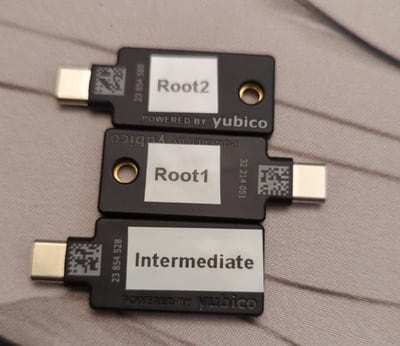
PKI relying on a set of 3 YubiKeys: 2 for the root CA and 1 for the intermediate CA.
Offline PKI backed up by 3 YubiKeys
This post describes an offline PKI system using the following components: It is possible to add more YubiKeys as a backup of the root CA if needed. This is not needed for the intermediate CA as you can generate a new one if the current one gets destroyed.

The software part offline-pki is a small Python application to manage an offline PKI. It relies on yubikey-manager to manage YubiKeys and cryptography for cryptographic operations not executed on the YubiKeys. The application has some opinionated design choices. Notably, the cryptography is hard-coded to use NIST P-384 elliptic curve. The first step is to reset all your YubiKeys:
$ offline-pki yubikey reset
This will reset the connected YubiKey. Are you sure? [y/N]: y
New PIN code:
Repeat for confirmation:
New PUK code:
Repeat for confirmation:
New management key ('.' to generate a random one):
WARNING[pki-yubikey] Using random management key: e8ffdce07a4e3bd5c0d803aa3948a9c36cfb86ed5a2d5cf533e97b088ae9e629
INFO[pki-yubikey]  0: Yubico YubiKey OTP+FIDO+CCID 00 00
INFO[pki-yubikey] SN: 23854514
INFO[yubikit.management] Device config written
INFO[yubikit.piv] PIV application data reset performed
INFO[yubikit.piv] Management key set
INFO[yubikit.piv] New PUK set
INFO[yubikit.piv] New PIN set
INFO[pki-yubikey] YubiKey reset successful!
Then, generate the root CA and create as many copies as you want:
$ offline-pki certificate root --permitted example.com
Management key for Root X:
Plug YubiKey "Root X"...
INFO[pki-yubikey]  0: Yubico YubiKey CCID 00 00
INFO[pki-yubikey] SN: 23854514
INFO[yubikit.piv] Data written to object slot 0x5fc10a
INFO[yubikit.piv] Certificate written to slot 9C (SIGNATURE), compression=True
INFO[yubikit.piv] Private key imported in slot 9C (SIGNATURE) of type ECCP384
Copy root certificate to another YubiKey? [y/N]: y
Plug YubiKey "Root X"...
INFO[pki-yubikey]  0: Yubico YubiKey CCID 00 00
INFO[pki-yubikey] SN: 23854514
INFO[yubikit.piv] Data written to object slot 0x5fc10a
INFO[yubikit.piv] Certificate written to slot 9C (SIGNATURE), compression=True
INFO[yubikit.piv] Private key imported in slot 9C (SIGNATURE) of type ECCP384
Copy root certificate to another YubiKey? [y/N]: n
You can inspect the result:
$ offline-pki yubikey info
INFO[pki-yubikey]  0: Yubico YubiKey CCID 00 00
INFO[pki-yubikey] SN: 23854514
INFO[pki-yubikey] Slot 9C (SIGNATURE):
INFO[pki-yubikey]   Private key type: ECCP384
INFO[pki-yubikey]   Public key:
INFO[pki-yubikey]     Algorithm:  secp384r1
INFO[pki-yubikey]     Issuer:     CN=Root CA
INFO[pki-yubikey]     Subject:    CN=Root CA
INFO[pki-yubikey]     Serial:     1
INFO[pki-yubikey]     Not before: 2024-07-05T18:17:19+00:00
INFO[pki-yubikey]     Not after:  2044-06-30T18:17:19+00:00
INFO[pki-yubikey]     PEM:
-----BEGIN CERTIFICATE-----
MIIBcjCB+aADAgECAgEBMAoGCCqGSM49BAMDMBIxEDAOBgNVBAMMB1Jvb3QgQ0Ew
HhcNMjQwNzA1MTgxNzE5WhcNNDQwNjMwMTgxNzE5WjASMRAwDgYDVQQDDAdSb290
IENBMHYwEAYHKoZIzj0CAQYFK4EEACIDYgAERg3Vir6cpEtB8Vgo5cAyBTkku/4w
kXvhWlYZysz7+YzTcxIInZV6mpw61o8W+XbxZV6H6+3YHsr/IeigkK04/HJPi6+i
zU5WJHeBJMqjj2No54Nsx6ep4OtNBMa/7T9foyMwITAPBgNVHRMBAf8EBTADAQH/
MA4GA1UdDwEB/wQEAwIBhjAKBggqhkjOPQQDAwNoADBlAjEAwYKy/L8leJyiZSnn
xrY8xv8wkB9HL2TEAI6fC7gNc2bsISKFwMkyAwg+mKFKN2w7AjBRCtZKg4DZ2iUo
6c0BTXC9a3/28V5aydZj6rvx0JqbF/Ln5+RQL6wFMLoPIvCIiCU=
-----END CERTIFICATE-----
Then, you can create an intermediate certificate with offline-pki yubikey intermediate and use it to sign certificates by providing a CSR to offline-pki certificate sign. Be careful and inspect the CSR before signing it, as only the subject name can be overridden. Check the documentation for more details. Get the available options using the --help flag.

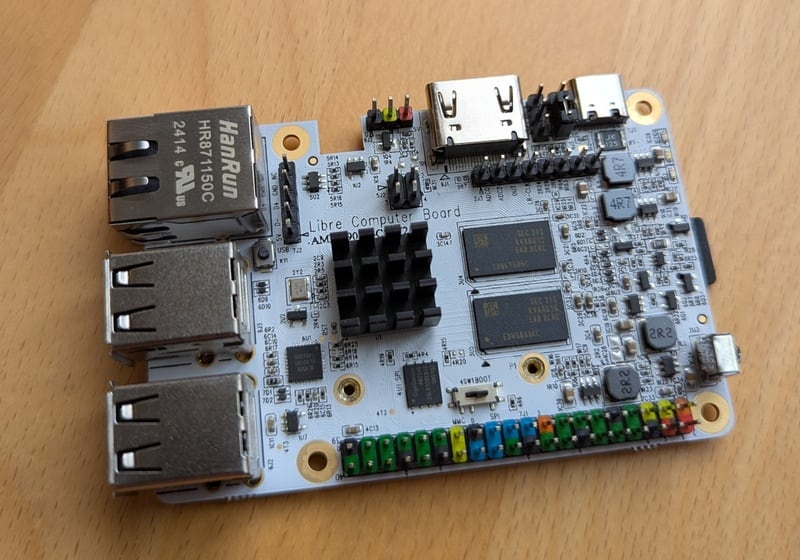
The hardware part To ensure the operations on the root and intermediate CAs are air-gapped, a cost-efficient solution is to use an ARM64 single board computer. The Libre Computer Sweet Potato SBC is a more open alternative to the well-known Raspberry Pi.1
Libre Computer Sweet Potato single board computer relying on the Amlogic S905X SOC
Libre Computer Sweet Potato SBC, powered by the AML-S905X SOC
I interact with it through an USB to TTL UART converter:
$ tio /dev/ttyUSB0
[16:40:44.546] tio v3.7
[16:40:44.546] Press ctrl-t q to quit
[16:40:44.555] Connected to /dev/ttyUSB0
GXL:BL1:9ac50e:bb16dc;FEAT:ADFC318C:0;POC:1;RCY:0;SPI:0;0.0;CHK:0;
TE: 36574
BL2 Built : 15:21:18, Aug 28 2019. gxl g1bf2b53 - luan.yuan@droid15-sz
set vcck to 1120 mv
set vddee to 1000 mv
Board ID = 4
CPU clk: 1200MHz
[ ]

The Nix glue To bring everything together, I am using Nix with a Flake providing:
  • a package for the offline-pki application, with shell completion,
  • a development shell, including an editable version of the offline-pki application,
  • a NixOS module to setup the offline PKI, resetting the system at each boot,
  • a QEMU image for testing, and
  • an SD card image to be used on the Sweet Potato or another ARM64 SBC.
# Execute the application locally
nix run github:vincentbernat/offline-pki -- --help
# Run the application inside a QEMU VM
nix run github:vincentbernat/offline-pki\#qemu
# Build a SD card for the Sweet Potato or for the Raspberry Pi
nix build --system aarch64-linux github:vincentbernat/offline-pki\#sdcard.potato
nix build --system aarch64-linux github:vincentbernat/offline-pki\#sdcard.generic
# Get a development shell with the application
nix develop github:vincentbernat/offline-pki

  1. The key for the root CA is not generated by the YubiKey. Using an air-gapped computer is all the more important. Put it in a safe with the YubiKeys when done!

15 March 2025

Bits from Debian: Debian Med Sprint in Berlin

Debian Med sprint in Berlin on 15 and 16 February The Debian Med team works on software packages that are associated with medicine, pre-clinical research, and life sciences, and makes them available for the Debian distribution. Seven Debian developers and contributors to the team gathered for their annual Sprint, in Berlin, Germany on 15 and 16 February 2025. The purpose of the meeting was to tackle bugs in Debian-Med packages, enhance the quality of the team's packages, and coordinate the efforts of team members overall. This sprint allowed participants to fix dozens of bugs, including release-critical ones. New upstream versions were uploaded, and the participants took some time to modernize some packages. Additionally, they discussed the long-term goals of the team, prepared a forthcoming invited talk for a conference, and enjoyed working together. More details on the event and individual agendas/reports can be found at https://wiki.debian.org/Sprints/2025/DebianMed.

10 March 2025

Joachim Breitner: Extrinsic termination proofs for well-founded recursion in Lean

A few months ago I explained that one reason why this blog has become more quiet is that all my work on Lean is covered elsewhere. This post is an exception, because it is an observation that is (arguably) interesting, but does not lead anywhere, so where else to put it than my own blog Want to share your thoughts about this? Please join the discussion on the Lean community zulip!

Background When defining a function recursively in Lean that has nested recursion, e.g. a recusive call that is in the argument to a higher-order function like List.map, then extra attention used to be necessary so that Lean can see that xs.map applies its argument only elements of the list xs. The usual idiom is to write xs.attach.map instead, where List.attach attaches to the list elements a proof that they are in that list. You can read more about this my Lean blog post on recursive definitions and our new shiny reference manual, look for Example Nested Recursion in Higher-order Functions . To make this step less tedious I taught Lean to automatically rewrite xs.map to xs.attach.map (where suitable) within the construction of well-founded recursion, so that nested recursion just works (issue #5471). We already do such a rewriting to change if c then else to the dependent if h : c then else , but the attach-introduction is much more ambitious (the rewrites are not definitionally equal, there are higher-order arguments etc.) Rewriting the terms in a way that we can still prove the connection later when creating the equational lemmas is hairy at best. Also, we want the whole machinery to be extensible by the user, setting up their own higher order functions to add more facts to the context of the termination proof. I implemented it like this (PR #6744) and it ships with 4.18.0, but in the course of this work I thought about a quite different and maybe better way to do this, and well-founded recursion in general:

A simpler fix Recall that to use WellFounded.fix
WellFounded.fix : (hwf : WellFounded r) (F : (x :  )   ((y :  )   r y x   C y)   C x) (x :  ) : C x
we have to rewrite the functorial of the recursive function, which naturally has type
F : ((y :  )    C y)   ((x :  )   C x)
to the one above, where all recursive calls take the termination proof r y x. This is a fairly hairy operation, mangling the type of matcher s motives and whatnot. Things are simpler for recursive definitions using the new partial_fixpoint machinery, where we use Lean.Order.fix
Lean.Order.fix : [CCPO  ] (F :      ) (hmono : monotone F) :  
so the functorial s type is unmodified (here will be ((x : ) C x)), and everything else is in the propositional side-condition montone F. For this predicate we have a syntax-guided compositional tactic, and it s easily extensible, e.g. by
theorem monotone_mapM (f :         m  ) (xs : List  ) (hmono : monotone f) :
    monotone (fun x => xs.mapM (f x)) 
Once given, we don t care about the content of that proof. In particular proving the unfolding theorem only deals with the unmodified F that closely matches the function definition as written by the user. Much simpler!

Isabelle has it easier Isabelle also supports well-founded recursion, and has great support for nested recursion. And it s much simpler! There, all you have to do to make nested recursion work is to define a congruence lemma of the form, for List.map something like our List.map_congr_left
List.map_congr_left : (h :   a   l, f a = g a) :
    List.map f l = List.map g l
This is because in Isabelle, too, the termination proofs is a side-condition that essentially states the functorial F calls its argument f only on smaller arguments .

Can we have it easy, too? I had wished we could do the same in Lean for a while, but that form of congruence lemma just isn t strong enough for us. But maybe there is a way to do it, using an existential to give a witness that F can alternatively implemented using the more restrictive argument. The following callsOn P F predicate can express that F calls its higher-order argument only on arguments that satisfy the predicate P:
section setup
variable   : Sort u 
variable   :     Sort v 
variable   : Sort w 
def callsOn (P :     Prop) (F : (  y,   y)    ) :=
    (F': (  y, P y     y)    ),   f, F' (fun y _ => f y) = F f
variable (R :         Prop)
variable (F : (  y,   y)   (  x,   x))
local infix:50 "   " => R
def recursesVia : Prop :=   x, callsOn (    x) (fun f => F f x)
noncomputable def fix (wf : WellFounded R) (h : recursesVia R F) : (  x,   x) :=
  wf.fix (fun x => (h x).choose)
def fix_eq (wf : WellFounded R) h x :
    fix R F wf h x = F (fix R F wf h) x := by
  unfold fix
  rw [wf.fix_eq]
  apply (h x).choose_spec
This allows nice compositional lemmas to discharge callsOn predicates:
theorem callsOn_base (y :  ) (hy : P y) :
    callsOn P (fun (f :   x,   x) => f y) := by
  exists fun f => f y hy
  intros; rfl
@[simp]
theorem callsOn_const (x :  ) :
    callsOn P (fun (_ :   x,   x) => x) :=
   fun _ => x, fun _ => rfl 
theorem callsOn_app
      : Sort uu    : Sort ww 
    (F  :  (  y,   y)        ) -- can this also support dependent types?
    (F  :  (  y,   y)    )
    (h  : callsOn P F )
    (h  : callsOn P F ) :
    callsOn P (fun f => F  f (F  f)) := by
  obtain  F ', h  := h 
  obtain  F ', h  := h 
  exists (fun f => F ' f (F ' f))
  intros; simp_all
theorem callsOn_lam
      : Sort uu 
    (F :     (  y,   y)    ) -- can this also support dependent types?
    (h :   x, callsOn P (F x)) :
    callsOn P (fun f x => F x f) := by
  exists (fun f x => (h x).choose f)
  intro f
  ext x
  apply (h x).choose_spec
theorem callsOn_app2
      : Sort uu    : Sort ww 
    (g :          )
    (F  :  (  y,   y)    ) -- can this also support dependent types?
    (F  :  (  y,   y)    )
    (h  : callsOn P F )
    (h  : callsOn P F ) :
    callsOn P (fun f => g (F  f) (F  f)) := by
  apply_rules [callsOn_app, callsOn_const]
With this setup, we can have the following, possibly user-defined, lemma expressing that List.map calls its arguments only on elements of the list:
theorem callsOn_map (  : Type uu) (  : Type ww)
    (P :     Prop) (F : (  y,   y)        ) (xs : List  )
    (h :   x, x   xs   callsOn P (fun f => F f x)) :
    callsOn P (fun f => xs.map (fun x => F f x)) := by
  suffices callsOn P (fun f => xs.attach.map (fun  x, h  => F f x)) by
    simpa
  apply callsOn_app
    apply callsOn_app
      apply callsOn_const
      apply callsOn_lam
      intro  x', hx' 
      dsimp
      exact (h x' hx')
    apply callsOn_const
end setup
So here is the (manual) construction of a nested map for trees:
section examples
structure Tree (  : Type u) where
  val :  
  cs : List (Tree  )
-- essentially
-- def Tree.map (f :      ) : Tree     Tree   :=
--   fun t =>  f t.val, t.cs.map Tree.map )
noncomputable def Tree.map (f :      ) : Tree     Tree   :=
  fix (sizeOf   < sizeOf  ) (fun map t =>  f t.val, t.cs.map map )
    (InvImage.wf (sizeOf  ) WellFoundedRelation.wf) <  by
  intro  v, cs 
  dsimp only
  apply callsOn_app2
    apply callsOn_const
    apply callsOn_map
    intro t' ht'
    apply callsOn_base
    -- ht' : t'   cs -- !
    --   sizeOf t' < sizeOf   val := v, cs := cs  
    decreasing_trivial
end examples
This makes me happy! All details of the construction are now contained in a proof that can proceed by a syntax-driven tactic and that s easily and (likely robustly) extensible by the user. It also means that we can share a lot of code paths (e.g. everything related to equational theorems) between well-founded recursion and partial_fixpoint. I wonder if this construction is really as powerful as our current one, or if there are certain (likely dependently typed) functions where this doesn t fit, but the above is dependent, so it looks good. With this construction, functions defined by well-founded recursion will reduce even worse in the kernel, I assume. This may be a good thing.

The cake is a lie What unfortunately kills this idea, though, is the generation of the functional induction principles, which I believe is not (easily) possible with this construction: The functional induction principle is proved by massaging F to return a proof, but since the extra assumptions (e.g. for ite or List.map) only exist in the termination proof, they are not available in F. Oh wey, how anticlimactic.

PS: Path dependencies Curiously, if we didn t have functional induction at this point yet, then very likely I d change Lean to use this construction, and then we d either not get functional induction, or it would be implemented very differently, maybe a more syntactic approach that would re-prove termination. I guess that s called path dependence.

Thorsten Alteholz: My Debian Activities in February 2025

Debian LTS This was my hundred-twenty-eighth month that I did some work for the Debian LTS initiative, started by Raphael Hertzog at Freexian. During my allocated time I uploaded or worked on: Last but not least I did some days of FD this month and attended the monthly LTS/ELTS meeting. Debian ELTS This month was the seventy-ninth ELTS month. During my allocated time I uploaded or worked on: Last but not least I did some days of FD this month and attended the monthly LTS/ELTS meeting. Debian Printing This month I uploaded new packages or new upstream or bugfix versions of: This work is generously funded by Freexian! Debian Matomo This month I uploaded new packages or new upstream or bugfix versions of: Finally matomo was uploaded. Thanks a lot to Utkarsh Gupta and William Desportes for doing most of the work to make this happen. This work is generously funded by Freexian! Debian Astro Unfortunately I didn t found any time to upload packages.Have you ever heard of poliastro? It was a package to do calculations related to astrodynamics and orbital mechanics? It was archived by upstream end of 2023. I am now trying to revive it under the new name boinor and hope to get it back into Debian over the next months. This is almost the last month that Patrick, our Outreachy intern for the Debian Astro project, is handling his tasks. He is working on automatic updates of the indi 3rd-party driver. Debian IoT Unfortunately I didn t found any time to work on this topic. Debian Mobcom This month I uploaded new packages or new upstream or bugfix versions of: misc Unfortunately I didn t found any time to work on this topic. FTP master This month I accepted 437 and rejected 64 packages. The overall number of packages that got accepted was 445.

9 March 2025

Dirk Eddelbuettel: RcppNLoptExample 0.0.2: Minor Updates

An update to our package RcppNLoptExample arrived on CRAN earlier today marking the first update since the intial release more than four year ago. The nloptr package, created by Jelmer Ypma, has long been providing an excellent R interface to NLopt, a very comprehensive library for nonlinear optimization. In particular, Jelmer carefully exposed the API entry points such that other R packages can rely on NLopt without having to explicitly link to it (as one can rely on R providing sufficient function calling and registration to make this possible by referring back to nloptr which naturally has the linking information and resolution). This package demonstrates this in a simple-to-use Rcpp example package that can serve as a stanza. More recent NLopt versions appear to have changed behaviour a little so that an example we relied upon in simple unit test now converges to a marginally different numerical value, so we adjusted a convergence treshold. Other than that we did a number of the usual small updates to package metadata, to the README.md file, and to continuous integration. The (very short) NEWS entry follows:

Changes in version 0.0.2 (2025-03-09)
  • Updated tolerance in simple test as newer upstream nlopt change behaviour ever so slightly leading to an other spurious failure
  • Numerous small and standard updates to DESCRIPTION, README.md, badges, and continuous integration setup

Courtesy of my CRANberries, there is also a diffstat report for this release. For questions, suggestions, or issues please use the issue tracker at the GitHub repo.

This post by Dirk Eddelbuettel originated on his Thinking inside the box blog. If you like this or other open-source work I do, you can now sponsor me at GitHub.

Niels Thykier: Improving Debian packaging in Kate

The other day, I noted that the emacs integration with debputy stopped working. After debugging for a while, I realized that emacs no longer sent the didOpen notification that is expected of it, which confused debputy. At this point, I was already several hours into the debugging and I noted there was some discussions on debian-devel about emacs and byte compilation not working. So I figured I would shelve the emacs problem for now. But I needed an LSP capable editor and with my vi skills leaving much to be desired, I skipped out on vim-youcompleteme. Instead, I pulled out kate, which I had not been using for years. It had LSP support, so it would fine, right? Well, no. Turns out that debputy LSP support had some assumptions that worked for emacs but not kate. Plus once you start down the rabbit hole, you stumble on things you missed previously.
Getting started First order of business was to tell kate about debputy. Conveniently, kate has a configuration tab for adding language servers in a JSON format right next to the tab where you can see its configuration for built-in LSP (also in JSON format9. So a quick bit of copy-paste magic and that was done. Yesterday, I opened an MR against upstream to have the configuration added (https://invent.kde.org/utilities/kate/-/merge_requests/1748) and they already merged it. Today, I then filed a wishlist against kate in Debian to have the Debian maintainers cherry-pick it, so it works out of the box for Trixie (https://bugs.debian.org/1099876). So far so good.
Inlay hint woes Since July (2024), debputy has support for Inlay hints. They are basically small bits of text that the LSP server can ask the editor to inject into the text to provide hints to the reader. Typically, you see them used to provide typing hints, where the editor or the underlying LSP server has figured out the type of a variable or expression that you did not explicitly type. Another common use case is to inject the parameter name for positional arguments when calling a function, so the user do not have to count the position to figure out which value is passed as which parameter. In debputy, I have been using the Inlay hints to show inherited fields in debian/control. As an example, if you have a definition like:
Source: foo-src
Section: devel
Priority: optional
Package: foo-bin
Architecture: any
Then foo-bin inherits the Section and Priority field since it does not supply its own. Previously, debputy would that by injecting the fields themselves and their value just below the Package field as if you had typed them out directly. The editor always renders Inlay hints distinctly from regular text, so there was no risk of confusion and it made the text look like a valid debian/control file end to end. The result looked something like:
Source: foo-src
Section: devel
Priority: optional
Package: foo-bin
Section: devel
Priority: optional
Architecture: any
With the second instances of Section and Priority being rendered differently than its surrendering (usually faded or colorlessly). Unfortunately, kate did not like injecting Inlay hints with a newline in them, which was needed for this trick. Reading into the LSP specs, it says nothing about multi-line Inlay hints being a thing and I figured I would see this problem again with other editors if I left it be. I ended up changing the Inlay hints to be placed at the end of the Package field and then included surrounding () for better visuals. So now, it looks like:
Source: foo-src
Section: devel
Priority: optional
Package: foo-bin  (Section: devel)  (Priority: optional)
Architecture: any
Unfortunately, it is no longer 1:1 with the underlying syntax which I liked about the previous one. But it works in more editors and is still explicit. I also removed the Inlay hint for the Homepage field. It takes too much space and I have yet to meet someone missing it in the binary stanza. If you have any better ideas for how to render it, feel free to reach out to me.
Spurious completion and hover As I was debugging the Inlay hints, I wanted to do a quick restart of debputy after each fix. Then I would trigger a small change to the document to ensure kate would request an update from debputy to render the Inlay hints with the new code. The full outgoing payloads are sent via the logs to the client, so it was really about minimizing which LSP requests are sent to debputy. Notably, two cases would flood the log:
  • Completion requests. These are triggered by typing anything at all and since I wanted to a change, I could not avoid this. So here it was about making sure there would be nothing to complete, so the result was a small as possible.
  • Hover doc requests. These are triggered by mouse hovering over field, so this was mostly about ensuring my mouse movement did not linger over any field on the way between restarting the LSP server and scrolling the log in kate.
In my infinite wisdom, I chose to make a comment line where I would do the change. I figured it would neuter the completion requests completely and it should not matter if my cursor landed on the comment as there would be no hover docs for comments either. Unfortunately for me, debputy would ignore the fact that it was on a comment line. Instead, it would find the next field after the comment line and try to complete based on that. Normally you do not see this, because the editor correctly identifies that none of the completion suggestions start with a \#, so they are all discarded. But it was pretty annoying for the debugging, so now debputy has been told to explicitly stop these requests early on comment lines.
Hover docs for packages I added a feature in debputy where you can hover over package names in your relationship fields (such as Depends) and debputy will render a small snippet about it based on data from your local APT cache. This doc is then handed to the editor and tagged as markdown provided the editor supports markdown rendering. Both emacs and kate support markdown. However, not all markdown renderings are equal. Notably, emacs's rendering does not reformat the text into paragraphs. In a sense, emacs rendering works a bit like <pre>...</pre> except it does a bit of fancy rendering inside the <pre>...</pre>. On the other hand, kate seems to convert the markdown to HTML and then throw the result into an HTML render engine. Here it is important to remember that not all newlines are equal in markdown. A Foo<newline>Bar is treated as one "paragraph" (<p>...</p>) and the HTML render happily renders this as single line Foo Bar provided there is sufficient width to do so. A couple of extra newlines made wonders for the kate rendering, but I have a feeling this is not going to be the last time the hover docs will need some tweaking for prettification. Feel free to reach out if you spot a weirdly rendered hover doc somewhere.
Making quickfixes available in kate Quickfixes are treated as generic code actions in the LSP specs. Each code action has a "type" (kind in the LSP lingo), which enables the editor to group the actions accordingly or filter by certain types of code actions. The design in the specs leads to the following flow:
  1. The LSP server provides the editor with diagnostics (there are multiple ways to trigger this, so we will keep this part simple).
  2. The editor renders them to the user and the user chooses to interact with one of them.
  3. The interaction makes the editor asks the LSP server, which code actions are available at that location (optionally with filter to only see quickfixes).
  4. The LSP server looks at the provided range and is expected to return the relevant quickfixes here.
This flow is really annoying from a LSP server writer point of view. When you do the diagnostics (in step 1), you tend to already know what the possible quickfixes would be. The LSP spec authors realized this at some point, so there are two features the editor provides to simplify this.
  1. In the editor request for code actions, the editor is expected to provide the diagnostics that they received from the server. Side note: I cannot quite tell if this is optional or required from the spec.
  2. The editor can provide support for remembering a data member in each diagnostic. The server can then store arbitrary information in that member, which they will see again in the code actions request. Again, provided that the editor supports this optional feature.
All the quickfix logic in debputy so far has hinged on both of these two features. As life would have it, kate provides neither of them. Which meant I had to teach debputy to keep track of its diagnostics on its own. The plus side is that makes it easier to support "pull diagnostics" down the line, since it requires a similar feature. Additionally, it also means that quickfixes are now available in more editors. For consistency, debputy logic is now always used rather than relying on the editor support when present. The downside is that I had to spend hours coming up with and debugging a way to find the diagnostics that overlap with the range provided by the editor. The most difficult part was keeping the logic straight and getting the runes correct for it.
Making the quickfixes actually work With all of that, kate would show the quickfixes for diagnostics from debputy and you could use them too. However, they would always apply twice with suboptimal outcome as a result. The LSP spec has multiple ways of defining what need to be changed in response to activating a code action. In debputy, all edits are currently done via the WorkspaceEdit type. It has two ways of defining the changes. Either via changes or documentChanges with documentChanges being the preferred one if both parties support this. I originally read that as I was allowed to provide both and the editor would pick the one it preferred. However, after seeing kate blindly use both when they are present, I reviewed the spec and it does say "The edit should either provide changes or documentChanges", so I think that one is on me. None of the changes in debputy currently require documentChanges, so I went with just using changes for now despite it not being preferred. I cannot figure out the logic of whether an editor supports documentChanges. As I read the notes for this part of the spec, my understanding is that kate does not announce its support for documentChanges but it clearly uses them when present. Therefore, I decided to keep it simple for now until I have time to dig deeper.
Remaining limitations with kate There is one remaining limitation with kate that I have not yet solved. The kate program uses KSyntaxHighlighting for its language detection, which in turn is the basis for which LSP server is assigned to a given document. This engine does not seem to support as complex detection logic as I hoped from it. Concretely, it either works on matching on an extension / a basename (same field for both cases) or mime type. This combined with our habit in Debian to use extension less files like debian/control vs. debian/tests/control or debian/rules or debian/upstream/metadata makes things awkward a best. Concretely, the syntax engine cannot tell debian/control from debian/tests/control as they use the same basename. Fortunately, the syntax is close enough to work for both and debputy is set to use filename based lookups, so this case works well enough. However, for debian/rules and debian/upstream/metadata, my understanding is that if I assign these in the syntax engine as Debian files, these rules will also trigger for any file named foo.rules or bar.metadata. That seems a bit too broad for me, so I have opted out of that for now. The down side is that these files will not work out of the box with kate for now. The current LSP configuration in kate does not recognize makefiles or YAML either. Ideally, we would assign custom languages for the affected Debian files, so we do not steal the ID from other language servers. Notably, kate has a built-in language server for YAML and debputy does nothing for a generic YAML document. However, adding YAML as a supported language for debputy would cause conflict and regressions for users that are already happy with their generic YAML language server from kate. So there are certainly still work to be done. If you are good with KSyntaxHighlighting and know how to solve some of this, I hope you will help me out.
Changes unrelated to kate While I was working on debputy, I also added some other features that I want to mention.
  1. The debputy lint command will now show related context to diagnostic in its terminal report when such information is available and is from the same file as the diagnostic itself (cross file cases are rendered without related information). The related information is typically used to highlight a source of a conflict. As an example, if you use the same field twice in a stanza of debian/control, then debputy will add a diagnostic to the second occurrence. The related information for that diagnostic would provide the position of the first occurrence. This should make it easier to find the source of the conflict in the cases where debputy provides it. Let me know if you are missing it for certain diagnostics.

  2. The diagnostics analysis of debian/control will now identify and flag simple duplicated relations (complex ones like OR relations are ignored for now). Thanks to Matthias Geiger for suggesting the feature and Otto Kek l inen for reporting a false positive that is now fixed.

Closing I am glad I tested with kate to weed out most of these issues in time before the freeze. The Debian freeze will start within a week from now. Since debputy is a part of the toolchain packages it will be frozen from there except for important bug fixes.

8 March 2025

Debian Brasil: MiniDebConf Belo Horizonte 2024 - a brief report

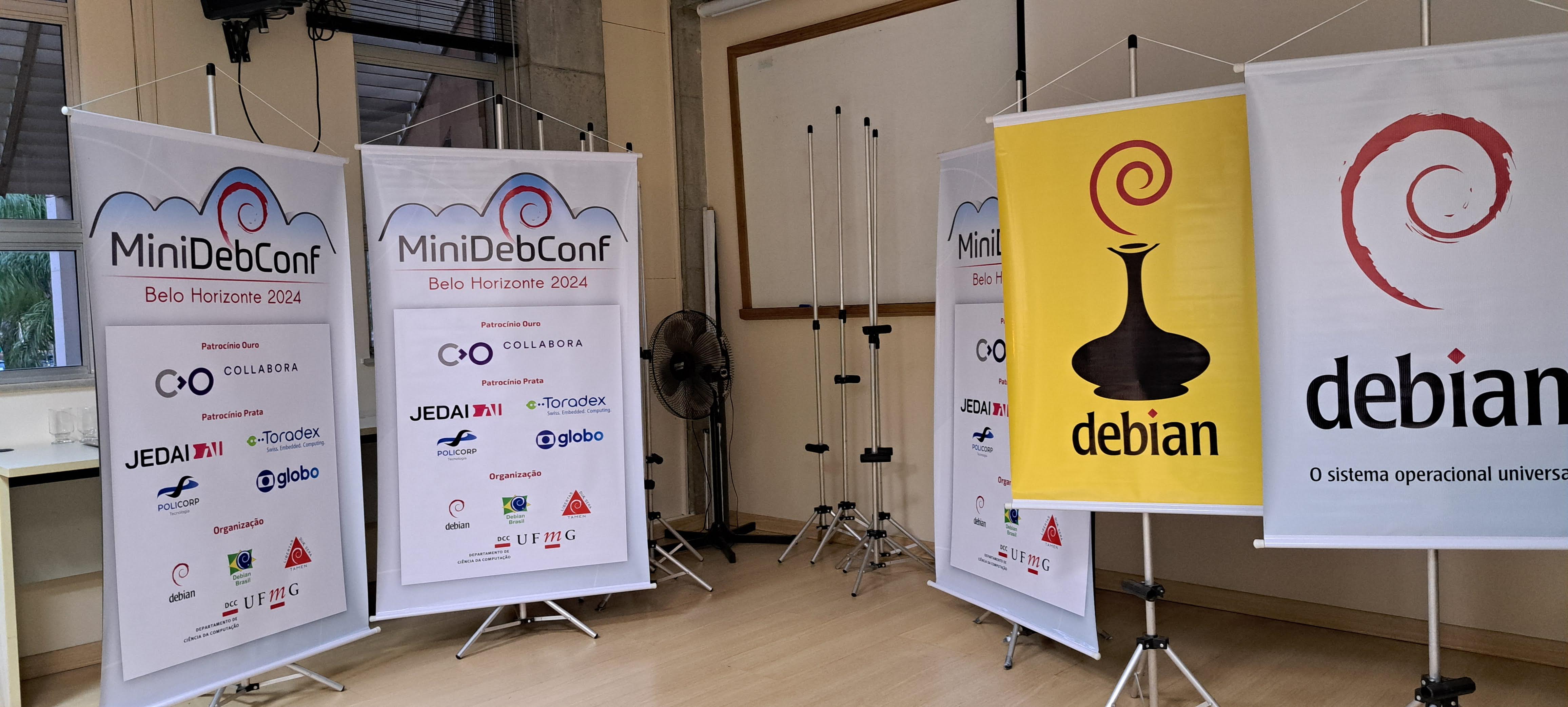
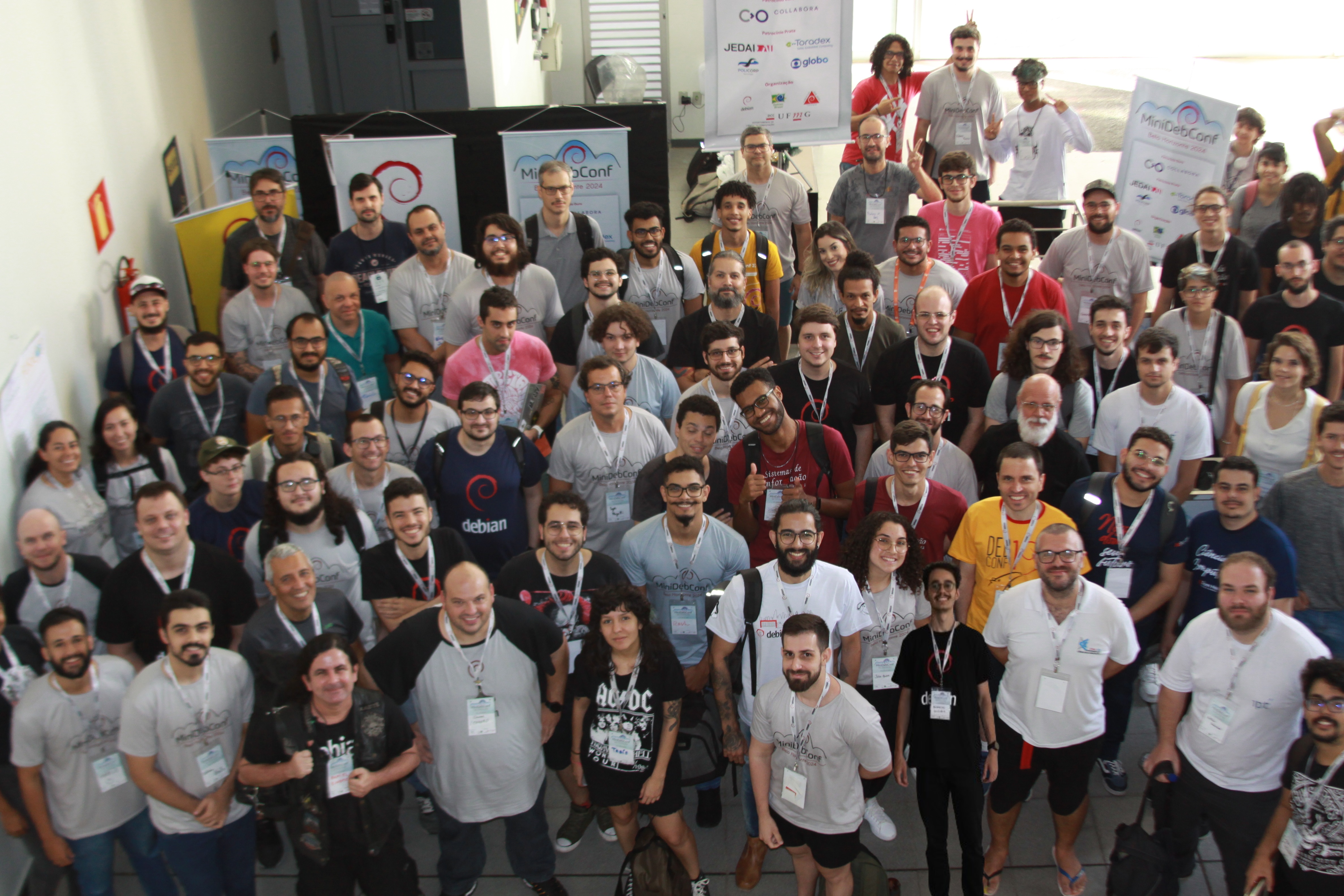
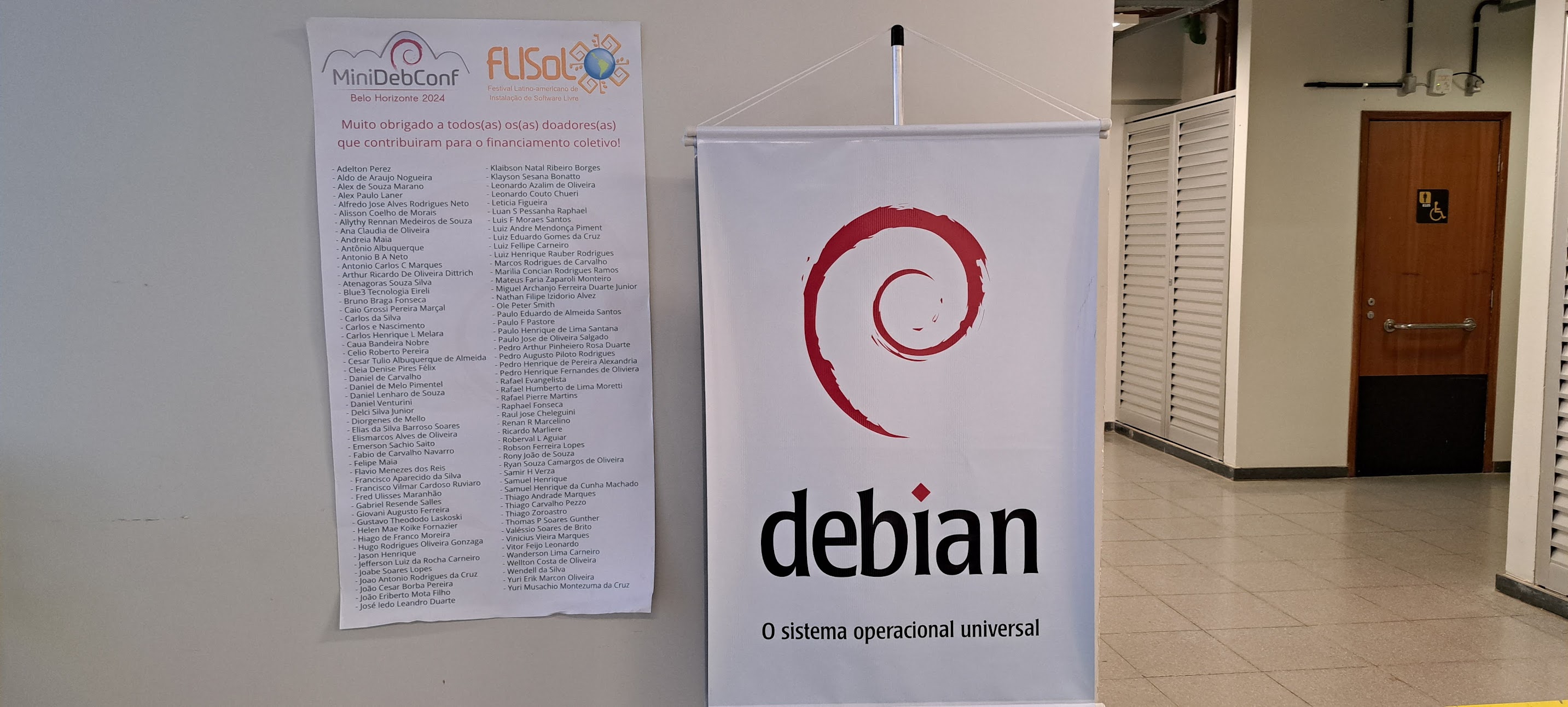
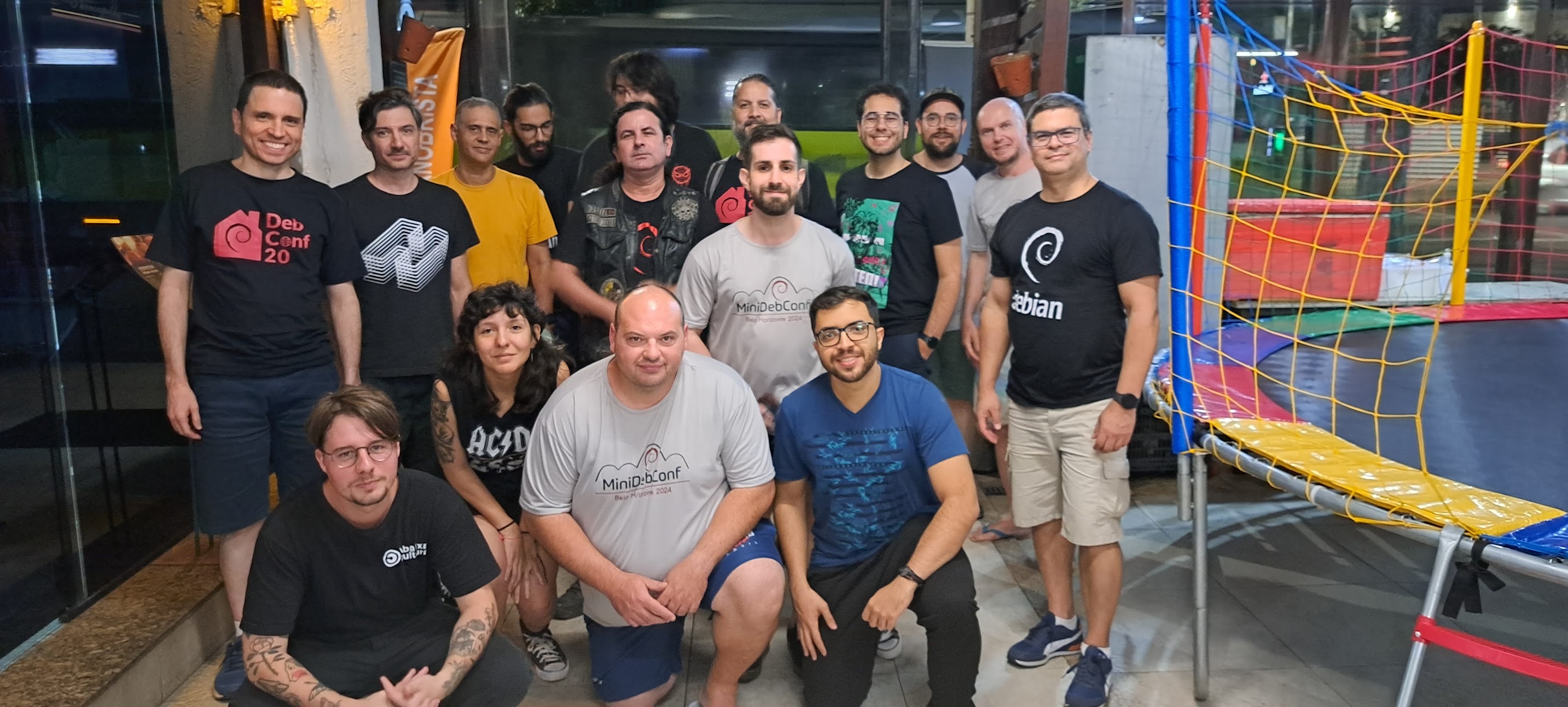
From April 27th to 30th, 2024, MiniDebConf Belo Horizonte 2024 was held at the Pampulha Campus of UFMG - Federal University of Minas Gerais, in Belo Horizonte city. MiniDebConf BH 2024 banners This was the fifth time that a MiniDebConf (as an exclusive in-person event about Debian) took place in Brazil. Previous editions were in Curitiba (2016, 2017, and 2018), and in Bras lia 2023. We had other MiniDebConfs editions held within Free Software events such as FISL and Latinoware, and other online events. See our event history. Parallel to MiniDebConf, on 27th (Saturday) FLISOL - Latin American Free Software Installation Festival took place. It's the largest event in Latin America to promote Free Software, and It has been held since 2005 simultaneously in several cities. MiniDebConf Belo Horizonte 2024 was a success (as were previous editions) thanks to the participation of everyone, regardless of their level of knowledge about Debian. We value the presence of both beginner users who are familiarizing themselves with the system and the official project developers. The spirit of welcome and collaboration was present during all the event. MiniDebConf BH 2024 flisol 2024 edition numbers During the four days of the event, several activities took place for all levels of users and collaborators of the Debian project. The official schedule was composed of: MiniDebConf BH 2024 palestra The final numbers for MiniDebConf Belo Horizonte 2024 show that we had a record number of participants. Of the 224 participants, 15 were official Brazilian contributors, 10 being DDs (Debian Developers) and 05 (Debian Maintainers), in addition to several unofficial contributors. The organization was carried out by 14 people who started working at the end of 2023, including Prof. Lo c Cerf from the Computing Department who made the event possible at UFMG, and 37 volunteers who helped during the event. As MiniDebConf was held at UFMG facilities, we had the help of more than 10 University employees. See the list with the names of people who helped in some way in organizing MiniDebConf Belo Horizonte 2024. The difference between the number of people registered and the number of attendees in the event is probably explained by the fact that there is no registration fee, so if the person decides not to go to the event, they will not suffer financial losses. The 2024 edition of MiniDebconf Belo Horizonte was truly grand and shows the result of the constant efforts made over the last few years to attract more contributors to the Debian community in Brazil. With each edition the numbers only increase, with more attendees, more activities, more rooms, and more sponsors/supporters. MiniDebConf BH 2024 grupo
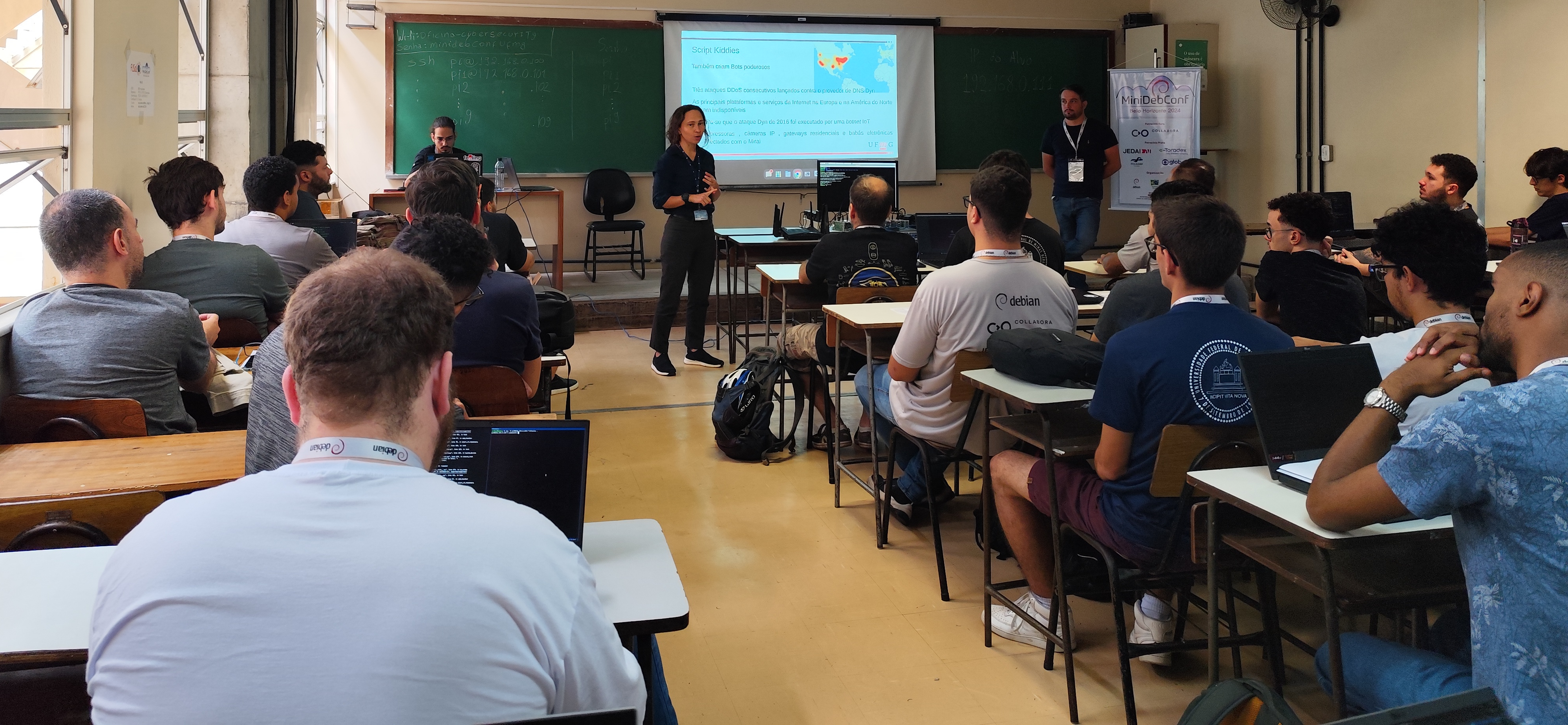
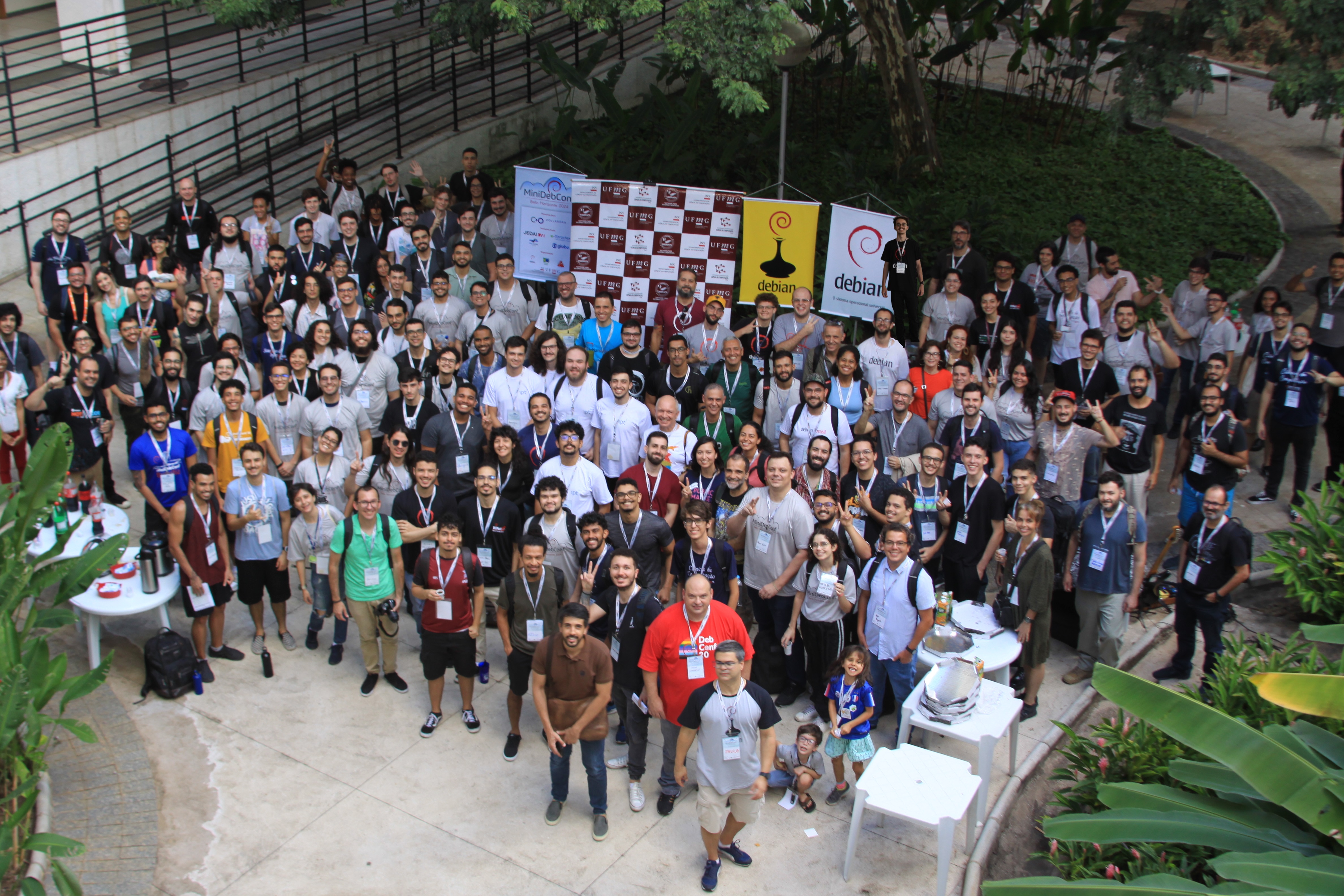
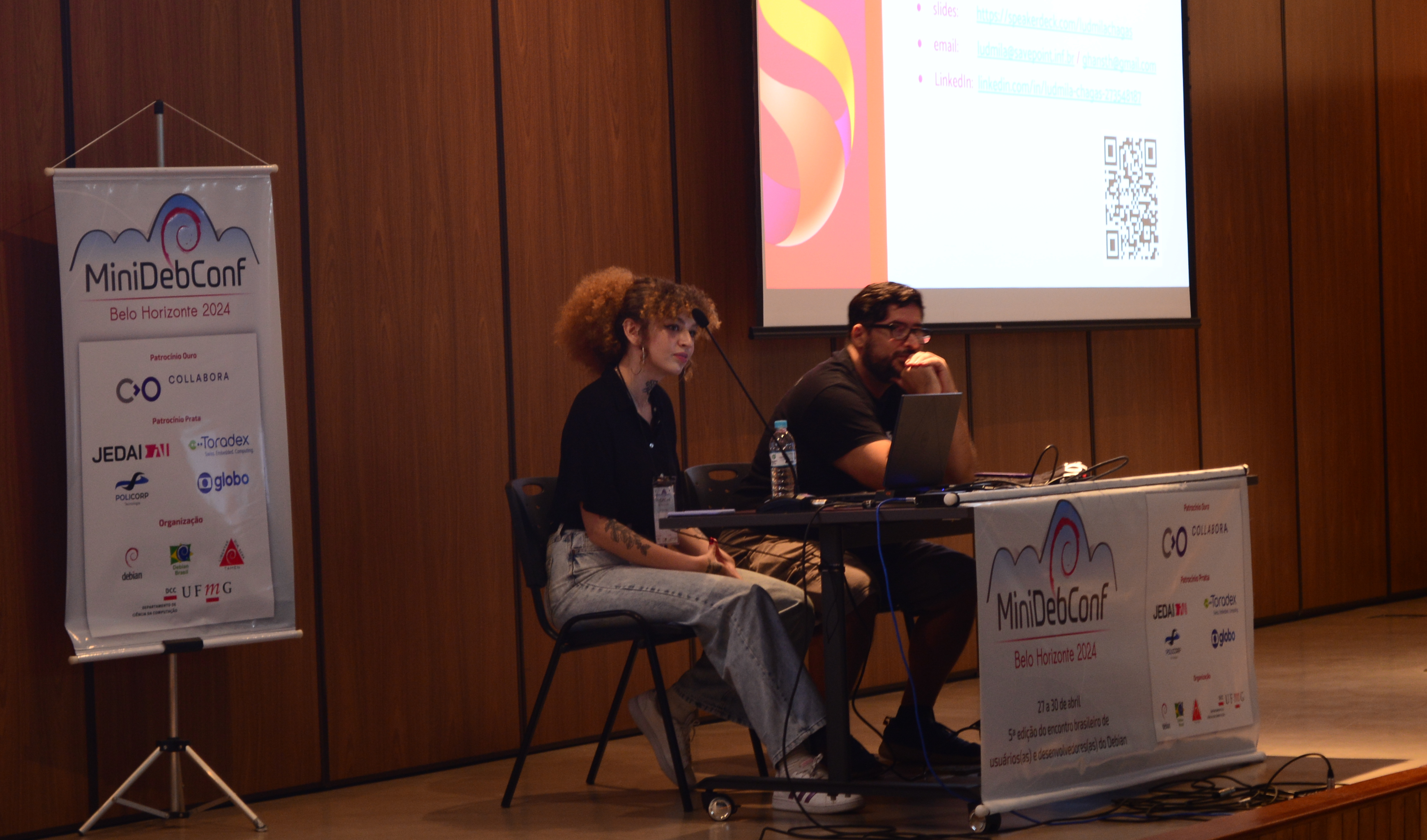
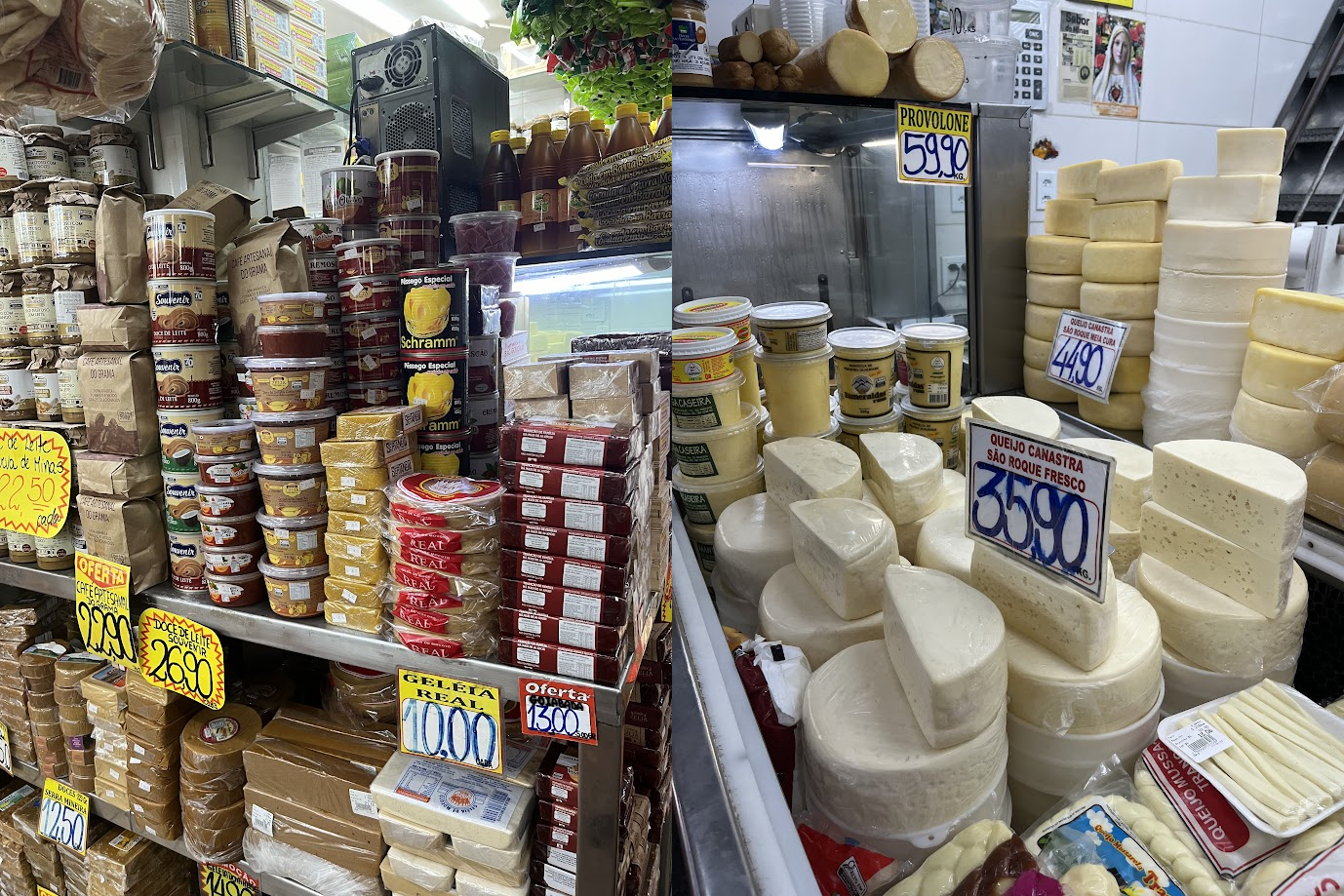
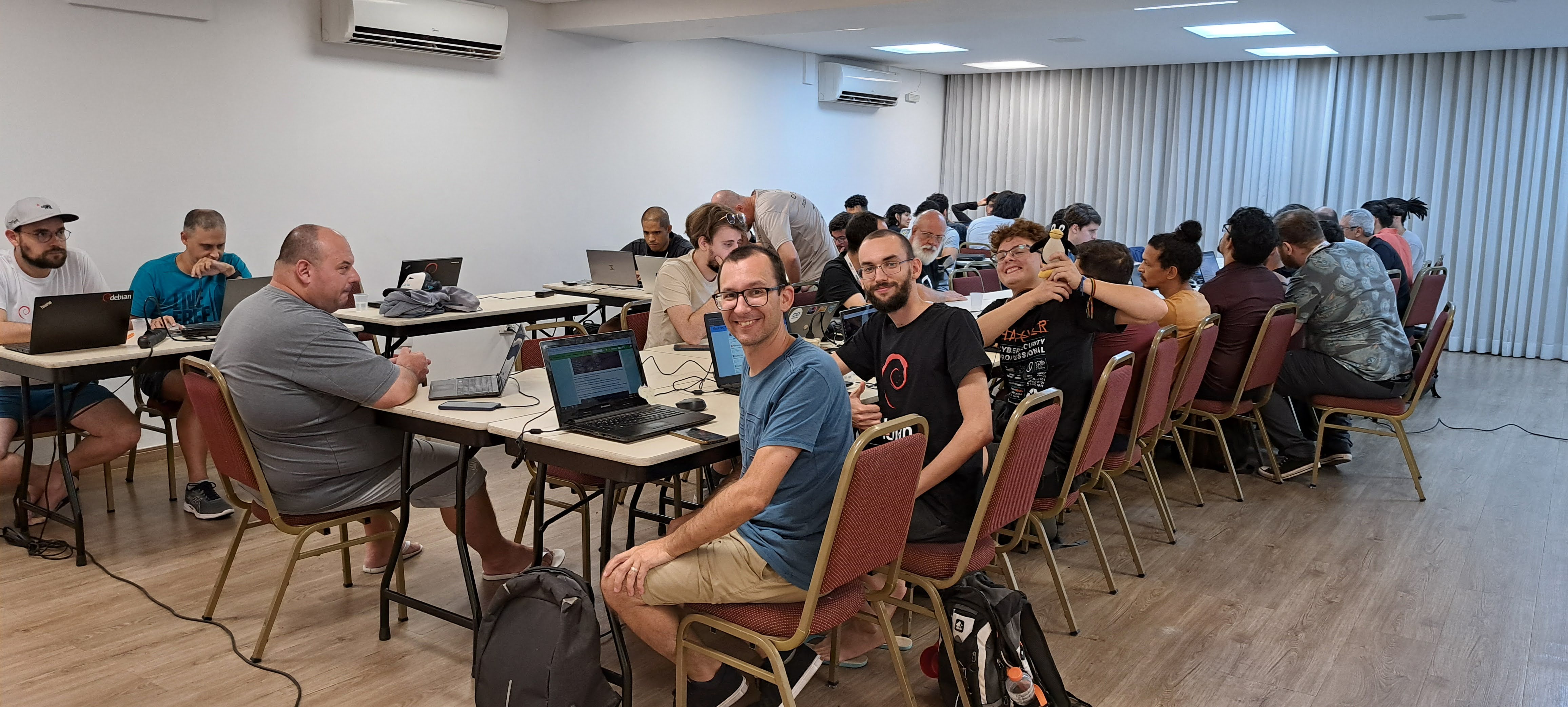
MiniDebConf BH 2024 grupo Activities The MiniDebConf schedule was intense and diverse. On the 27th, 29th and 30th (Saturday, Monday and Tuesday) we had talks, discussions, workshops and many practical activities. MiniDebConf BH 2024 palestra On the 28th (Sunday), the Day Trip took place, a day dedicated to sightseeing around the city. In the morning we left the hotel and went, on a chartered bus, to the Belo Horizonte Central Market. People took the opportunity to buy various things such as cheeses, sweets, cacha as and souvenirs, as well as tasting some local foods. MiniDebConf BH 2024 mercado After a 2-hour tour of the Market, we got back on the bus and hit the road for lunch at a typical Minas Gerais food restaurant. MiniDebConf BH 2024 palestra With everyone well fed, we returned to Belo Horizonte to visit the city's main tourist attraction: Lagoa da Pampulha and Capela S o Francisco de Assis, better known as Igrejinha da Pampulha. MiniDebConf BH 2024 palestra We went back to the hotel and the day ended in the hacker space that we set up in the events room for people to chat, packaging, and eat pizzas. MiniDebConf BH 2024 palestra Crowdfunding For the third time we ran a crowdfunding campaign and it was incredible how people contributed! The initial goal was to raise the amount equivalent to a gold tier of R$ 3,000.00. When we reached this goal, we defined a new one, equivalent to one gold tier + one silver tier (R$ 5,000.00). And again we achieved this goal. So we proposed as a final goal the value of a gold + silver + bronze tiers, which would be equivalent to R$ 6,000.00. The result was that we raised R$7,239.65 (~ USD 1,400) with the help of more than 100 people! Thank you very much to the people who contributed any amount. As a thank you, we list the names of the people who donated. MiniDebConf BH 2024 doadores Food, accommodation and/or travel grants for participants Each edition of MiniDebConf brought some innovation, or some different benefit for the attendees. In this year's edition in Belo Horizonte, as with DebConfs, we offered bursaries for food, accommodation and/or travel to help those people who would like to come to the event but who would need some kind of help. In the registration form, we included the option for the person to request a food, accommodation and/or travel bursary, but to do so, they would have to identify themselves as a contributor (official or unofficial) to Debian and write a justification for the request. Number of people benefited: The food bursary provided lunch and dinner every day. The lunches included attendees who live in Belo Horizonte and the region. Dinners were paid for attendees who also received accommodation and/or travel. The accommodation was held at the BH Jaragu Hotel. And the travels included airplane or bus tickets, or fuel (for those who came by car or motorbike). Much of the money to fund the bursaries came from the Debian Project, mainly for travels. We sent a budget request to the former Debian leader Jonathan Carter, and He promptly approved our request. In addition to this event budget, the leader also approved individual requests sent by some DDs who preferred to request directly from him. The experience of offering the bursaries was really good because it allowed several people to come from other cities. MiniDebConf BH 2024 grupo Photos and videos You can watch recordings of the talks at the links below: Thanks We would like to thank all the attendees, organizers, volunteers, sponsors and supporters who contributed to the success of MiniDebConf Belo Horizonte 2024. MiniDebConf BH 2024 grupo Sponsors Gold: Silver: Bronze: Organizers


Dirk Eddelbuettel: RcppTOML 0.2.3 on CRAN: Compiler Nag, Small Updates

A new (mostly maintenance) release 0.2.3 of RcppTOML is now on CRAN. TOMLis a file format that is most suitable for configurations, as it is meant to be edited by humans but read by computers. It emphasizes strong readability for humans while at the same time supporting strong typing as well as immediate and clear error reports. On small typos you get parse errors, rather than silently corrupted garbage. Much preferable to any and all of XML, JSON or YAML though sadly these may be too ubiquitous now. TOML is frequently being used with the projects such as the Hugo static blog compiler, or the Cargo system of Crates (aka packages ) for the Rust language. This release was tickled by another CRAN request: just like yesterday s and the RcppDate release two days ago, it responds to the esoteric whitespace in literal operator depreceation warning. We alerted upstream too. The short summary of changes follows.

Changes in version 0.2.3 (2025-03-08)
  • Correct the minimum version of Rcpp to 1.0.8 (Walter Somerville)
  • The package now uses Authors@R as mandated by CRAN
  • Updated 'whitespace in literal' issue upsetting clang++-20
  • Continuous integration updates including simpler r-ci setup

Courtesy of my CRANberries, there is also a diffstat report for this release. For questions, suggestions, or issues please use the issue tracker at the GitHub repo.

This post by Dirk Eddelbuettel originated on his Thinking inside the box blog. If you like this or other open-source work I do, you can now sponsor me at GitHub.

7 March 2025

Dirk Eddelbuettel: RcppSimdJson 0.1.13 on CRAN: Compiler Nag, New Upsteam

A new release 0.1.13 of the RcppSimdJson package is now on CRAN. RcppSimdJson wraps the fantastic and genuinely impressive simdjson library by Daniel Lemire and collaborators. Via very clever algorithmic engineering to obtain largely branch-free code, coupled with modern C++ and newer compiler instructions, it results in parsing gigabytes of JSON parsed per second which is quite mindboggling. The best-case performance is faster than CPU speed as use of parallel SIMD instructions and careful branch avoidance can lead to less than one cpu cycle per byte parsed; see the video of the talk by Daniel Lemire at QCon. This release was tickled by another CRAN request: just like yesterday s RcppDate release, it responds to the esoteric whitespace in literal operator depreceation warning. Turns out that upstream simdjson had this fixed a few months ago as the node bindings package ran into it. Other changes include a bit of earlier polish by Daniel, another CRAN mandated update, CI improvements, and a move of two demos to examples/ to avoid having to add half a dozen packages to Suggests: for no real usage gain in the package. The short NEWS entry for this release follows.

Changes in version 0.1.13 (2025-03-07)
  • A call to std::string::erase is now guarded (Daniel)
  • The package now uses Authors@R as mandated by CRAN (Dirk)
  • simdjson was upgraded to version 3.12.2 (Dirk)
  • Continuous integration updated to more compilers and simpler setup
  • Two demos are now in inst/examples to not inflate Suggests

Courtesy of my CRANberries, there is also a diffstat report for this release. For questions, suggestions, or issues please use the issue tracker at the GitHub repo.

This post by Dirk Eddelbuettel originated on his Thinking inside the box blog. If you like this or other open-source work I do, you can now sponsor me at GitHub.

6 March 2025

Dirk Eddelbuettel: RcppDate 0.0.5: Address Minor Compiler Nag

RcppDate wraps the featureful date library written by Howard Hinnant for use with R. This header-only modern C++ library has been in pretty wide-spread use for a while now, and adds to C++11/C++14/C++17 what will is (with minor modifications) the date library in C++20. The RcppDate adds no extra R or C++ code and can therefore be a zero-cost dependency for any other project; yet a number of other projects decided to re-vendor it resulting in less-efficient duplication. Oh well. C est la via. This release sync wuth the (already mostly included) upstream release 3.0.3, and also addresses a new fresh (and mildly esoteric) nag from clang++-20. One upstream PR already addressed this in the files tickled by some CRAN packages, I followed this up with another upstream PR addressing this in a few more occurrences.

Changes in version 0.0.5 (2025-03-06)
  • Updated to upstream version 3.0.3
  • Updated 'whitespace in literal' issue upsetting clang++-20; this is also fixed upstream via two PRs

Courtesy of my CRANberries, there is also a diffstat report for the most recent release. More information is available at the repository or the package page.

This post by Dirk Eddelbuettel originated on his Thinking inside the box blog. If you like this or other open-source work I do, you can sponsor me at GitHub.

5 March 2025

Reproducible Builds: Reproducible Builds in February 2025

Welcome to the second report in 2025 from the Reproducible Builds project. Our monthly reports outline what we ve been up to over the past month, and highlight items of news from elsewhere in the increasingly-important area of software supply-chain security. As usual, however, if you are interested in contributing to the Reproducible Builds project, please visit our Contribute page on our website. Table of contents:
  1. Reproducible Builds at FOSDEM 2025
  2. Reproducible Builds at PyCascades 2025
  3. Does Functional Package Management Enable Reproducible Builds at Scale?
  4. reproduce.debian.net updates
  5. Upstream patches
  6. Distribution work
  7. diffoscope & strip-nondeterminism
  8. Website updates
  9. Reproducibility testing framework

Reproducible Builds at FOSDEM 2025 Similar to last year s event, there was considerable activity regarding Reproducible Builds at FOSDEM 2025, held on on 1st and 2nd February this year in Brussels, Belgium. We count at least four talks related to reproducible builds. (You can also read our news report from last year s event in which Holger Levsen presented in the main track.)
Jelle van der Waa, Holger Levsen and kpcyrd presented in the Distributions track on A Tale of several distros joining forces for a common goal. In this talk, three developers from two different Linux distributions (Arch Linux and Debian), discuss this goal which is, of course, reproducible builds. The presenters discuss both what is shared and different between the two efforts, touching on the history and future challenges alike. The slides of this talk are available to view, as is the full video (30m02s). The talk was also discussed on Hacker News.
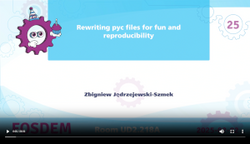
Zbigniew J drzejewski-Szmek presented in the ever-popular Python track a on Rewriting .pyc files for fun and reproducibility, i.e. the bytecode files generated by Python in order to speed up module imports: It s been known for a while that those are not reproducible: on different architectures, the bytecode for exactly the same sources ends up slightly different. The slides of this talk are available, as is the full video (28m32s).
In the Nix and NixOS track, Julien Malka presented on the Saturday asking How reproducible is NixOS: We know that the NixOS ISO image is very close to be perfectly reproducible thanks to reproducible.nixos.org, but there doesn t exist any monitoring of Nixpkgs as a whole. In this talk I ll present the findings of a project that evaluated the reproducibility of Nixpkgs as a whole by mass rebuilding packages from revisions between 2017 and 2023 and comparing the results with the NixOS cache. Unfortunately, no video of the talk is available, but there is a blog and article on the results.
Lastly, Simon Tournier presented in the Open Research track on the confluence of GNU Guix and Software Heritage: Source Code Archiving to the Rescue of Reproducible Deployment. Simon s talk describes design and implementation we came up and reports on the archival coverage for package source code with data collected over five years. It opens to some remaining challenges toward a better open and reproducible research. The slides for the talk are available, as is the full video (23m17s).

Reproducible Builds at PyCascades 2025 Vagrant Cascadian presented at this year s PyCascades conference which was held on February 8th and 9th February in Portland, OR, USA. PyCascades is a regional instance of PyCon held in the Pacific Northwest. Vagrant s talk, entitled Re-Py-Ducible Builds caught the audience s attention with the following abstract:
Crank your Python best practices up to 11 with Reproducible Builds! This talk will explore Reproducible Builds by highlighting issues identified in Python projects, from the simple to the seemingly inscrutable. Reproducible Builds is basically the crazy idea that when you build something, and you build it again, you get the exact same thing or even more important, if someone else builds it, they get the exact same thing too.
More info is available on the talk s page.

Does Functional Package Management Enable Reproducible Builds at Scale? On our mailing list last month, Julien Malka, Stefano Zacchiroli and Th o Zimmermann of T l com Paris in-house research laboratory, the Information Processing and Communications Laboratory (LTCI) announced that they had published an article asking the question: Does Functional Package Management Enable Reproducible Builds at Scale? (PDF). This month, however, Ludovic Court s followed up to the original announcement on our mailing list mentioning, amongst other things, the Guix Data Service and how that it shows the reproducibility of GNU Guix over time, as described in a GNU Guix blog back in March 2024.

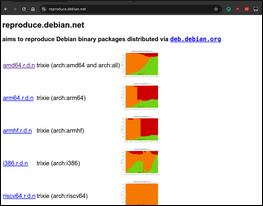
reproduce.debian.net updates The last few months have seen the introduction of reproduce.debian.net. Announced first at the recent Debian MiniDebConf in Toulouse, reproduce.debian.net is an instance of rebuilderd operated by the Reproducible Builds project. Powering this work is rebuilderd, our server which monitors the official package repositories of Linux distributions and attempt to reproduce the observed results there. This month, however, Holger Levsen:
  • Split packages that are not specific to any architecture away from amd64.reproducible.debian.net service into a new all.reproducible.debian.net page.
  • Increased the number of riscv64 nodes to a total of 4, and added a new amd64 node added thanks to our (now 10-year sponsor), IONOS.
  • Discovered an issue in the Debian build service where some new incoming build-dependencies do not end up historically archived.
  • Uploaded the devscripts package, incorporating changes from Jochen Sprickerhof to the debrebuild script specifically to fix the handling the Rules-Requires-Root header in Debian source packages.
  • Uploaded a number of Rust dependencies of rebuilderd (rust-libbz2-rs-sys, rust-actix-web, rust-actix-server, rust-actix-http, rust-actix-server, rust-actix-http, rust-actix-web-codegen and rust-time-tz) after they were prepared by kpcyrd :
Jochen Sprickerhof also updated the sbuild package to:
  • Obey requests from the user/developer for a different temporary directory.
  • Use the root/superuser for some values of Rules-Requires-Root.
  • Don t pass --root-owner-group to old versions of dpkg.
and additionally requested that many Debian packages are rebuilt by the build servers in order to work around bugs found on reproduce.debian.net. [ ][[ ][ ]
Lastly, kpcyrd has also worked towards getting rebuilderd packaged in NixOS, and Jelle van der Waa picked up the existing pull request for Fedora support within in rebuilderd and made it work with the existing Koji rebuilderd script. The server is being packaged for Fedora in an unofficial copr repository and in the official repositories after all the dependencies are packaged.

Upstream patches The Reproducible Builds project detects, dissects and attempts to fix as many currently-unreproducible packages as possible. We endeavour to send all of our patches upstream where appropriate. This month, we wrote a large number of such patches, including:

Distribution work There as been the usual work in various distributions this month, such as: In Debian, 17 reviews of Debian packages were added, 6 were updated and 8 were removed this month adding to our knowledge about identified issues.
Fedora developers Davide Cavalca and Zbigniew J drzejewski-Szmek gave a talk on Reproducible Builds in Fedora (PDF), touching on SRPM-specific issues as well as the current status and future plans.
Thanks to an investment from the Sovereign Tech Agency, the FreeBSD project s work on unprivileged and reproducible builds continued this month. Notable fixes include:
The Yocto Project has been struggling to upgrade to the latest Go and Rust releases due to reproducibility problems in the newer versions. Hongxu Jia tracked down the issue with Go which meant that the project could upgrade from the 1.22 series to 1.24, with the fix being submitted upstream for review (see above). For Rust, however, the project was significantly behind, but has made recent progress after finally identifying the blocking reproducibility issues. At time of writing, the project is at Rust version 1.82, with patches under review for 1.83 and 1.84 and fixes being discussed with the Rust developers. The project hopes to improve the tests for reproducibility in the Rust project itself in order to try and avoid future regressions. Yocto continues to maintain its ability to binary reproduce all of the recipes in OpenEmbedded-Core, regardless of the build host distribution or the current build path.
Finally, Douglas DeMaio published an article on the openSUSE blog on announcing that the Reproducible-openSUSE (RBOS) Project Hits [Significant] Milestone. In particular:
The Reproducible-openSUSE (RBOS) project, which is a proof-of-concept fork of openSUSE, has reached a significant milestone after demonstrating a usable Linux distribution can be built with 100% bit-identical packages.
This news was also announced on our mailing list by Bernhard M. Wiedemann, who also published another report for openSUSE as well.

diffoscope & strip-nondeterminism diffoscope is our in-depth and content-aware diff utility that can locate and diagnose reproducibility issues. This month, Chris Lamb made the following changes, including preparing and uploading versions 288 and 289 to Debian:
  • Add asar to DIFFOSCOPE_FAIL_TESTS_ON_MISSING_TOOLS in order to address Debian bug #1095057) [ ]
  • Catch a CalledProcessError when calling html2text. [ ]
  • Update the minimal Black version. [ ]
Additionally, Vagrant Cascadian updated diffoscope in GNU Guix to version 287 [ ][ ] and 288 [ ][ ] as well as submitted a patch to update to 289 [ ]. Vagrant also fixed an issue that was breaking reprotest on Guix [ ][ ]. strip-nondeterminism is our sister tool to remove specific non-deterministic results from a completed build. This month version 1.14.1-2 was uploaded to Debian unstable by Holger Levsen.

Website updates There were a large number of improvements made to our website this month, including:

Reproducibility testing framework The Reproducible Builds project operates a comprehensive testing framework running primarily at tests.reproducible-builds.org in order to check packages and other artifacts for reproducibility. In January, a number of changes were made by Holger Levsen, including:
  • reproduce.debian.net-related:
    • Add a helper script to manually schedule packages. [ ][ ][ ][ ][ ]
    • Fix a link in the website footer. [ ]
    • Strip the emojis from package names on the manual rebuilder in order to ease copy-and-paste. [ ]
    • On the various statistics pages, provide the number of affected source packages [ ][ ] as well as provide various totals [ ][ ].
    • Fix graph labels for the various architectures [ ][ ] and make them clickable too [ ][ ][ ].
    • Break the displayed HTML in blocks of 256 packages in order to address rendering issues. [ ][ ]
    • Add monitoring jobs for riscv64 archicture nodes and integrate them elsewhere in our infrastructure. [ ][ ]
    • Add riscv64 architecture nodes. [ ][ ][ ][ ][ ]
    • Update much of the documentation. [ ][ ][ ]
    • Make a number of improvements to the layout and style. [ ][ ][ ][ ][ ][ ][ ]
    • Remove direct links to JSON and database backups. [ ]
    • Drop a Blues Brothers reference from frontpage. [ ]
  • Debian-related:
    • Deal with /boot/vmlinuz* being called vmlinux* on the riscv64 architecture. [ ]
    • Add a new ionos17 node. [ ][ ][ ][ ][ ]
    • Install debian-repro-status on all Debian trixie and unstable jobs. [ ]
  • FreeBSD-related:
    • Switch to run latest branch of FreeBSD. [ ]
  • Misc:
    • Fix /etc/cron.d and /etc/logrotate.d permissions for Jenkins nodes. [ ]
    • Add support for riscv64 architecture nodes. [ ][ ]
    • Grant Jochen Sprickerhof access to the o4 node. [ ]
    • Disable the janitor-setup-worker. [ ][ ]
In addition:
  • kpcyrd fixed the /all/api/ API endpoints on reproduce.debian.net by altering the nginx configuration. [ ]
  • James Addison updated reproduce.debian.net to display the so-called bad reasons hyperlink inline [ ] and merged the Categorized issues links into the Reproduced builds column [ ].
  • Jochen Sprickerhof also made some reproduce.debian.net-related changes, adding support for detecting a bug in the mmdebstrap package [ ] as well as updating some documentation [ ].
  • Roland Clobus continued their work on reproducible live images for Debian, making changes related to new clustering of jobs in openQA. [ ]
And finally, both Holger Levsen [ ][ ][ ] and Vagrant Cascadian performed significant node maintenance. [ ][ ][ ][ ][ ]
If you are interested in contributing to the Reproducible Builds project, please visit our Contribute page on our website. However, you can get in touch with us via:

Dirk Eddelbuettel: #46: Adding arm64 to r2u

Welcome to post 46 in the $R^4 series! r2u, introduced less than three years ago in post #37, has become a runaway success. When I last tabulated downloads in early January, we were already at 33 million downloads of binary CRAN packages across the three Ubuntu LTS releases we support. These were exclusively for the amd64 platform of standard (Intel or AMD made) x64_64 cpus. Now we are happy to announce that arm64 support has been added and is available!

Why arm64? The arm64 platform is already popular on (cloud) servers and is being pushed quite actively by the cloud vendors. AWS calls their cpu graviton , GCS calls it axion . General servers call the cpu ampere ; on laptop / desktops it is branded snapdragon or cortex or something else. Apple calls their variant M1, M2, up to M4 by now (and Linux support exists for the brave, it is less straightforward). What these have in common is a generally more favourable power consumed to ops provided ratio. That makes these cheaper to run or rent on cloud providers. And in laptops they tend to last longer on a single charge too. Distributions such as Debian, Ubuntu, Fedora had arm64 for many years. In fact, the CRAN binaries of R, being made as builds at launchpad.net long provided arm64 in Michael s repo, we now also mirror these to CRAN. Similarly, Docker has long supported containers. And last but not least two issue tickets (#40, #55) had asked a while back.

So Why Now? Good question. I still do not own any hardware with it, and I have not (yet?) bothered with the qemu-based emulation layer. The real difference maker was the recent availability of GitHub Actions instances of ubuntu-24.04-arm (and now apparently also for 22.04). So I started some simple experiments which made it clear this was viable.

What Does It Mean for a CRAN Repo? Great question. As is commonly known, of the (currently) 22.1k CRAN packages, a little under 5k are compiled . Why does this matter? Because the Linux distributions know what they are doing. The 17k (give or take) packages that do not contain compiled code can be used as is (!!) on another platform. Debian and Ubuntu call these builds binary: all as they work all platforms as is . The others go by binary: any and will work on any platform for which they have been built. So we are looking at roughly 5k new binaries.

So How Many Are There? As I write this in early March, roughly 4.5k of the 5k. Plus the 17.1k binary: all and we are looking at near complete coverage!

So What Is The Current State? Pretty complete. Compare to the amd64 side of things, we do not (yet ?) have BioConductor support; this may be added. A handful of packages do not compile because their builds seem to assume Linux so must be amd64 and fail over cpu instructions. Similarly, a few packages want to download binary build blobs (my own Rblpapi among them) but none exist for arm64. Such is life. We will try to fix builds as time permits and report build issues to the respective upstream repos. Help in that endeavour would be most welcome. But all the big and slow compiles one may care about (hello duckdb, hello arrow, ) are there. Which is pretty exciting!

How Does One Get Started? In GitHub Actions, just pick ubuntu-24.04-arm as the platform, and use the r-ci or r2u-setup actiions. A first test yaml exists worked (though this last version had the arm64 runner commented out again). (And no, arm64 was not faster than amd64. More tests needed.) For simple tests, Docker. The rocker/r-ubuntu:24.04 container exists for arm64 (see here), and one can add r2u support as is done in this Dockerfile which is used by the builds and available as eddelbuettel/r2u_build:noble. I will add the standard rocker/r2u:24.04 container (or equally rocker/r2u:noble) in a day or two, I had not realised I wasn t making them for arm64. One a real machine such as a cloud instance or a proper instance, just use the standard r2u script for noble aka 24.04 available here. The key lines are the two lines
echo "deb [arch=amd64,arm64] https://r2u.stat.illinois.edu/ubuntu noble main" \
    > /etc/apt/sources.list.d/cranapt.list

# ...

echo "deb [arch=amd64,arm64] https://cloud.r-project.org/bin/linux/ubuntu noble-cran40/" \
     > /etc/apt/sources.list.d/cran_r.list
creating the apt entry and which are now arm64-aware. After that, apt works as usual, and of course r2u works as usual thanks also to bspm so you can just do, say
install.packages(c("tidyverse", "brms", "rstan", "sf", "terra"))
and enjoy the binaries rolling in. So give it a whirl if you have access to such hardware. We look forward to feedback, suggestes, feature requests or bug reports. Let us know how it goes!

This post by Dirk Eddelbuettel originated on his Thinking inside the box blog. If you like this or other open-source work I do, you can now sponsor me at GitHub.

3 March 2025

Bits from Debian: Bits from the DPL

Dear Debian community, this is bits from DPL for February. Ftpmaster team is seeking for new team members In December, Scott Kitterman announced his retirement from the project. I personally regret this, as I vividly remember his invaluable support during the Debian Med sprint at the start of the COVID-19 pandemic. He even took time off to ensure new packages cleared the queue in under 24 hours. I want to take this opportunity to personally thank Scott for his contributions during that sprint and for all his work in Debian. With one fewer FTP assistant, I am concerned about the increased workload on the remaining team. I encourage anyone in the Debian community who is interested to consider reaching out to the FTP masters about joining their team. If you're wondering about the role of the FTP masters, I'd like to share a fellow developer's perspective:
"My read on the FTP masters is:
  • In truth, they are the heart of the project.
  • They know it.
  • They do a fantastic job."
I fully agree and see it as part of my role as DPL to ensure this remains true for Debian's future. If you're looking for a way to support Debian in a critical role where many developers will deeply appreciate your work, consider reaching out to the team. It's a great opportunity for any Debian Developer to contribute to a key part of the project. Project Status: Six Months of Bug of the Day In my Bits from the DPL talk at DebConf24, I announced the Tiny Tasks effort, which I intended to start with a Bug of the Day project. Another idea was an Autopkgtest of the Day, but this has been postponed due to limited time resources-I cannot run both projects in parallel. The original goal was to provide small, time-bound examples for newcomers. To put it bluntly: in terms of attracting new contributors, it has been a failure so far. My offer to explain individual bug-fixing commits in detail, if needed, received no response, and despite my efforts to encourage questions, none were asked. However, the project has several positive aspects: experienced developers actively exchange ideas, collaborate on fixing bugs, assess whether packages are worth fixing or should be removed, and work together to find technical solutions for non-trivial problems. So far, the project has been engaging and rewarding every day, bringing new discoveries and challenges-not just technical, but also social. Fortunately, in the vast majority of cases, I receive positive responses and appreciation from maintainers. Even in the few instances where help was declined, it was encouraging to see that in two cases, maintainers used the ping as motivation to work on their packages themselves. This reflects the dedication and high standards of maintainers, whose work is essential to the project's success. I once used the metaphor that this project is like wandering through a dark basement with a lone flashlight-exploring aimlessly and discovering a wide variety of things that have accumulated over the years. Among them are true marvels with popcon >10,000, ingenious tools, and delightful games that I only recently learned about. There are also some packages whose time may have come to an end-but each of them reflects the dedication and effort of those who maintained them, and that deserves the utmost respect. Leaving aside the challenge of attracting newcomers, what have we achieved since August 1st last year? With some goodwill, you can see a slight impact on the trends.debian.net graphs (thank you Lucas for the graphs), but I would never claim that this project alone is responsible for the progress. What I have also observed is the steady stream of daily uploads to the delayed queue, demonstrating the continuous efforts of many contributors. This ongoing work often remains unseen by most-including myself, if not for my regular check-ins on this list. I would like to extend my sincere thanks to everyone pushing fixes there, contributing to the overall quality and progress of Debian's QA efforts. If you examine the graphs for "Version Control System" and "VCS Hosting" with the goodwill mentioned above, you might notice a positive trend since mid-last year. The "Package Smells" category has also seen reductions in several areas: "no git", "no DEP5 copyright", "compat <9", and "not salsa". I'd also like to acknowledge the NMUers who have been working hard to address the "format != 3.0" issue. Thanks to all their efforts, this specific issue never surfaced in the Bug of the Day effort, but their contributions deserve recognition here. The experience I gathered in this project taught me a lot and inspired me to some followup we should discuss at a Sprint at DebCamp this year. Finally, if any newcomer finds this information interesting, I'd be happy to slow down and patiently explain individual steps as needed. All it takes is asking questions on the Matrix channel to turn this into a "teaching by example" session. By the way, for newcomers who are interested, I used quite a few abbreviations-all of which are explained in the Debian Glossary. Sneak Peek at Upcoming Conferences I will join two conferences in March-feel free to talk to me if you spot me there.
  1. FOSSASIA Summit 2025 (March 13-15, Bangkok, Thailand) Schedule: https://eventyay.com/e/4c0e0c27/schedule
  2. Chemnitzer Linux-Tage (March 22-23, Chemnitz, Germany) Schedule: https://chemnitzer.linux-tage.de/2025/de/programm/vortraege
Both events will have a Debian booth-come say hi! Kind regards Andreas.

21 February 2025

Jonathan Dowland: haskell streaming libraries

For my PhD, my colleagues/collaborators and I built a distributed stream-processing system using Haskell. There are several other Haskell stream-processing systems. How do they compare? First, let's briefly discuss and define streaming in this context. Structure and Interpretation of Computer Programs introduces Streams as an analogue of lists, to support delayed evaluation. In brief, the inductive list type (a list is either an empty list or a head element pre-pended to another list) is replaced with a structure with a head element and a promise which, when evaluated, will generate the tail (which in turn may have a head element and a promise to generate another tail, culminating in the equivalent of an empty list.) Later on SICP also covers lazy evaluation. However, the streaming we're talking about originates in the relational community, rather than the functional one, and is subtly different. It's about building a pipeline of processing that receives and emits data but doesn't need to (indeed, cannot) reference the whole stream (which may be infinite) at once. Haskell streaming systems Now let's go over some Haskell streaming systems. conduit (2011-) Conduit is the oldest of the ones I am reviewing here, but I doubt it's the first in the Haskell ecosystem. If I've made any obvious omissions, please let me know! Conduit provides a new set of types to model streaming data, and a completely new set of functions which are analogues of standard Prelude functions, e.g. sumC in place of sum. It provides its own combinator(s) such as . ( aka fuse) which is like composition but reads left-to-right. The motivation for this is to enable (near?) constant memory usage for processing large streams of data -- presumably versus using a list-based approach and to provide some determinism: the README gives the example of "promptly closing file handles". I think this is another way of saying that it uses strict evaluation, or at least avoids lazy evaluation for some things. Conduit offers interleaved effects: which is to say, IO can be performed mid-stream. Conduit supports distributed operation via Data.Conduit.Network in the conduit-extra package. Michael Snoyman, principal Conduit author, wrote up how to use it here: https://www.yesodweb.com/blog/2014/03/network-conduit-async To write a distributed Conduit application, the application programmer must manually determine the boundaries between the clients/servers and write specific code to connect them. pipes (2012-) The Pipes Tutorial contrasts itself with "Conventional Haskell stream programming": whether that means Conduit or something else, I don't know. Paraphrasing their pitch: Effects, Streaming Composability: pick two. That's the situation they describe for stream programming prior to Pipes. They argue Pipes offers all three. Pipes offers it's own combinators (which read left-to-right) and offers interleaved effects. At this point I can't really see what fundamentally distinguishes Pipes from Conduit. Pipes has some support for distributed operation via the sister library pipes-network. It looks like you must send and receive ByteStrings, which means rolling your own serialisation for other types. As with Conduit, to send or receive over a network, the application programmer must divide their program up into the sub-programs for each node, and add the necessary ingress/egress code. io-streams (2013-) io-streams emphasises simple primitives. Reading and writing is done under the IO Monad, thus, in an effectful (but non-pure) context. The presence or absence of further stream data are signalled by using the Maybe type (Just more data or Nothing: the producer has finished.) It provides a library of functions that shadow the standard Prelude, such as S.fromList, S.mapM, etc. It's not clear to me what the motivation for io-streams is, beyond providing a simple interface. There's no declaration of intent that I can find about (e.g.) constant-memory operation. There's no mention of or support (that I can find) for distributed operation. streaming (2015-) Similar to io-streams, Streaming emphasises providing a simple interface that gels well with traditional Haskell methods. Streaming provides effectful streams (via a Monad -- any Monad?) and a collection of functions for manipulating streams which are designed to closely mimic standard Prelude (and Data.List) functions. Streaming doesn't push its own combinators: the examples provided use $ and read right-to-left. The motivation for Streaming seems to be to avoid memory leaks caused by extracting pure lists from IO with traditional functions like mapM, which require all the list constructors to be evaluated, the list to be completely deconstructed, and then a new list constructed. Like io-streams, the focus of the library is providing a low-level streaming abstraction, and there is no support for distributed operation. streamly (2017-) Streamly appears to have the grand goal of providing a unified programming tool as suited for quick-and-dirty programming tasks (normally the domain of scripting languages) and high-performance work (C, Java, Rust, etc.). Their intended audience appears to be everyone, or at least, not just existing Haskell programmers. See their rationale Streamly offers an interface to permit composing concurrent (note: not distributed) programs via combinators. It relies upon fusing a streaming pipeline to remove intermediate list structure allocations and de-allocations (i.e. de-forestation, similar to GHC rewrite rules) The examples I've seen use standard combinators (e.g. Control.Function.&, which reads left-to-right, and Applicative). Streamly provide benchmarks versus Haskell pure lists, Streaming, Pipes and Conduit: these generally show Streamly several orders of magnitude faster. I'm finding it hard to evaluate Streamly. It's big, and it's focus is wide. It provides shadows of Prelude functions, as many of these libraries do. wrap-up It seems almost like it must be a rite-of-passage to write a streaming system in Haskell. Stones and glass houses, I'm guilty of that too. The focus of the surveyed libraries is mostly on providing a streaming abstraction, normally with an analogous interface to standard Haskell lists. They differ on various philosophical points (whether to abstract away the mechanics behind type synonyms, how much to leverage existing Haskell idioms, etc). A few of the libraries have some rudimentary support for distributed operation, but this is limited to connecting separate nodes together: in some cases serialising data remains the application programmer's job, and in all cases the application programmer must manually carve up their processing according to a fixed idea of what nodes they are deploying to. They all define a fixed-function pipeline.

20 February 2025

Dirk Eddelbuettel: Rcpp now used by 3000 CRAN packages!

3000 Rcpp packages As of today, Rcpp stands at 3001 reverse-dependencies on CRAN. The graph on the left depicts the growth of Rcpp usage (as measured by Depends, Imports and LinkingTo, but excluding Suggests) over time. Rcpp was first released in November 2008. It took seven year years to clear 500 packages in late October 2015 after which usage of R and Rcpp accelerated: 1000 packages in April 2017, 1500 packages in November 2018, 2000 packages in July 2020, and 2500 package in February 2022. The chart extends to the very beginning via manually compiled data from CRANberries and checked with crandb. The core part of the data set is generated semi-automatically when updating a (manually curated) list of packages using Rcpp that is available too. The Rcpp team aims to keep Rcpp as performant and reliable as it has been (and see e.g. here for more details). Last month s 1.0.14 release post is a good example of the ongoing work. A really big shoutout and Thank You! to all users and contributors of Rcpp for help, suggestions, bug reports, documentation or, of course, code.

This post by Dirk Eddelbuettel originated on his Thinking inside the box blog. If you like this or other open-source work I do, you can sponsor me at GitHub.

Next.

Previous.