Search Results: "joey"

31 August 2010

Joey Hess: swarmnation story

Swarmnation is a neat game, but I'm not sure if it's for the reasons its authors intended. It may be interesting mostly because of its bugs. Read on for spoilers and the story that developed from an apparently abstract time waster game. When I first saw the game, I saw a grid of squares moving around. I was obviously one: A (Blue) Square. There seemed to be no pattern to the movements. So, it seemed the game represented random passers-in-the-night on the net, unable to communicate except by dashing back and forth. Then after a few minutes, a geometric shape was highlighted in yellow from out of the mass of squares. Woah! I'd been missing something here. It turned out my display was too small, and I had not noticed that the gameboard scolled over to show a tetris-style "next shape" display. Which the other squares had been busily trying to make before time ran out. Now all their movements made sense. Now with a shared goal, we could communicate. Some of us were trolls and blocked shapes from forming. A few of us became leaders, boldly taking that center position in the hollow-square-with-spot-in-the-middle shape. Most of us herded into place as soon as a shape began to form, and stayed there, frantically hoping our neighbors would also conform and keep property values high. We were playing the game. We were accumulating scores. We split into two groups, both playing the game, and then some of us defected from one group to the other, which seemed to be doing better at making a particular shape, and there was no reason to go back to that first group, I felt strongly that I was part of the second, better, group. Then, as I was getting bored and feeling the neighbors all around stifling, I noticed my square highlighted yellow for a shape that I was not currently part of. Oh, this must be a bug I thought. I hacked around, and got it to happen again. I thought maybe it was just being a bit fuzzy in accepting shapes, but no, it turned out to be more interesting. The game didn't care if we stayed in the shape. Just being part of the shape for an instant was enough. With this realization, whole new ways to play the game opened up. Dash left and right, near a forming shape, and you'll probably, for an instant, be part of it. Hang back and have your fun, spot an instant to plug a hole, and then get out and let someone else also take part. Try to form the same shape in both groups. And so on. So a grid of squares hooked up to keyboards on the net has let me watch the invention of politics, rebel from conformity and hack the system, in an hour? That's what games are about!

25 August 2010

Joey Hess: at the beach

view from the beach house
This year at the beach we're being lazy and instead of camping, have rented a beach house. It's less intense but has its perks. :)
Update: Added an ocracode for this trip:
OBX1.1 P7/3 L7 S67+++(Pawley Island beach house)d++++ U10 T0f0b0 R1t
Bn---b---m--- F+++u+++ SC-s---g3 H++f0i0 V+++s---m0 E++r++++

22 August 2010

Christine Spang: DebConf 10 postmortem and SD talk followup

DebConf launched with a bang the day I arrived by bike I was up until 3am meeting and greeting in the basement lounge of the Carmen Columbia dormitory, where I was staying. No idea how I managed to be so awake for that. The rest of the week alternated between hacking like crazy on code for my talk and spending a lot of time socializing with Debian folks new and old. For the day trip to Coney Island, I joined the dkg-led bike expedition which ended up running to nearly 30 miles, which was a bit more than expected. The fact that this was all in actual dense city really drove home the scale difference between Boston and New York (I'd never been to NYC before this). We took several breaks to lounge around and eat and drink, so it took quite a long time even given the distance. I hadn't planned on seeing the baseball game that was a part of the trip, but I ended up going anyway and it turns out that a bunch of geeks at a minor league game is actually quite a lot of fun! I hope someone else will put some pictures from the bike ride and game online soon, since I didn't really take any myself. This was the first DebConf where I gave a talk, which resulted in me skipping almost all of the other talks, because my talk was on the last day and I reaaally wasn't ready at the start of the conference due to the rest of life being pretty crazy this summer. I missed some things I would have liked to see because of this, but ultimately I think it was worth it. The good news is: it went well! I was nervous until I actually started talking (never given a talk at a conference before), and then it was fine. If you missed it, the talk video is on the web in low and high quality; slides are here. The audience was great there were excellent questions and people were excited and interested in the project. I couldn't have asked for a better reception. After the talk finished I spent some time aisle-chatting with some folks, and totally failed to recognize Joey despite having met him before, because he'd shaved off his hair. DebConf was, like usual, both inspiring and exhausting. I haven't managed to follow up on much that happened during the conference yet. I definitely plan to do so, though, now that real life is calming down again. I'd hate to waste the post-conference buzz about SD. My todo list includes:

19 August 2010

Joey Hess: dogfooding at Branchable

When Lars and I started work on Branchable, the Ikiwiki-based wiki and blog hosting service that we first discussed a year ago, and launched two weeks ago, we didn't know what software to use to build it. Probably, we assumed, we'd need a relational database. (Or maybe Couchdb, we wondered?) To manage the sysadmin jobs of keeping a slew of Ikiwiki sites running, we investigated using Puppet or Chef. (We worried that scaling Puppet or Chef to handle an arbitrary number of ikiwiki sites could be a problem.) For the user interface frontend, we assumed we'd be writing code in some kind of web application framework. Nearly all of that conventional wisdom turned out to be false. Instead, all the frontend code for Branchable runs as part of Ikiwiki. www.branchable.com is just another Branchable site, though one with some custom plugins that can make other sites and display a user's control panel. Other plugins handle things like the DNS setup interface. Those plugins are part of the first public site hosted on Branchable, ikiwiki-hosting.branchable.com. That wiki's git repository holds all the code, as well as the wiki for documentation and bug tracking. Also included in ikiwiki-hosting are some backend programs, like ikisite, which handles the high-level site management (creation, deletion, branching, etc), and is what we used instead of Chef. (Though we may use Chef for server deployment later.) Rather than use a relational database, we did out own little noSQL thing, by using a special, locked-down wiki as our database. That wiki is so special-purpose that it is not even accessible via the web! But it's managed by Branchable just like any other site. Deciding to not use a database was a watershed moment, because at that point we were fully dogfooding everything for Branchable. It's worked out well so far, possibly because our database needs are minimal. We have over a dozen other Ikiwiki sites in Branchable that we use either internally, or for other special purposes. Like this parked site that is branched every day to refresh sandbox.branchable.com. So, no database, no Puppet, lots of dogfooding. Did we use a web app framework? Not really. The closest we came is when developing Branchable highlighted that Ikiwiki needed a more user-friendly openid login interface, so I went off and adapted one, and of course added it into Ikiwiki proper. And that uses the JQuery framework. (I might write sometime about all the other Ikiwiki improvements that Branchable spurred.) We've done a lot of eating our own dogfood at Branchable, but I think it's all been pragmatic, not due to Not Invented Here syndrome. And the result is that Branchable is increasingly flexible in what its sites can do, and runs on a very simple architecture, with no odd special-cases for database servers, etc. It's just a bunch of Ikiwiki sites that work together. Leaves on tree

Joey Hess: local rsync accelerator

This LWN article is perhaps a bit confused, but it does point out a truth: On modern hardware, with fast, local storage, and large, often static files, rsync is often unncessarily slow. That's probably true to some extent when using rsync across a LAN, but it's especially true when using it to copy files locally. rsync runs as a client/server pair, and both processes MD5 checksum the files as they are being transferred. That's nice, but it's slow too. Funny thing about rsync is that probably 50% of uses of it don't involve the core feature that it was written to provide: Updating files by transferring differences. Which, other than ensuring data validity, is the only reason it needs slow checksums. Instead, rsync is often chosen because of all the other awesome features that were glommed onto it over the past several decades. Compared with rsync, cp is pretty laughable -- it can't even exclude files from being copied by patterns. And unlike rsync, cp command lines are not often developed by repeated trial and error -- cp does not recover well from being ctrl-c'd in the middle, while rsync does. These kinds of things make a lot of us reach for rsync first, even if the situation does not involve incremental file changes. In most any situation, one of rsync's 120-some options is sure to be just what you need... So lots of scripts use rsync to synchronise directories, but the amount of speedup obtained by using the rsync algorithm is often low. (Correction: rsync turns off the delta-transfer algorythm by default for local to local transfers. It still does md5 checksums however.) Since rsync is reasonably fast, we generally don't care that it does these checksums that probably on average slow it down. But if larger files, like videos, are involved, this starts to change.. When rsync is run on a typical home NAS, with a slow (arm) CPU, the picture changes entirely -- now the checksum overhead is unbearable, while the IO overhead is minimal. So, here's local-rsync. It takes all the same options as rsync, with the caveat that SOURCE and DEST must be the first two options, and must be local directories.
% local-rsync huge/ /media/usb/huge/ -a -v --exclude '*~' --delete --max-delete=100
It speeds up rsync in these types of situations, by querying it to find what files need to be updated, and updating them the brute force way, with cp. At the end, rsync is run, to take care of the non-brute force stuff (like deletions and file permissions). On a fast CPU, local-rsync will probably speed up rsync of large, static files by a factor of 2. On a slow CPU, local-rsync is so fast, and rsync so slow, that I have not bothered to benchmark. :) This is just a hack (easily replaced by a --no-checksum option in rsync, of course). But I think it illustrates some interesting things about how a program's underlying assumptions about its environment can change over time, and how free software programs can accrete value until the original differentiating reason for their existence is not the most important thing about them anymore.

18 August 2010

Jonathan Wiltshire: Home, James

Since I didn t actually come home from Debconf, but instead took a further week s holiday and lazed around by the beach, I haven t sat down to write anything about it yet. Most importantly, I should say thank you to Joey Hess, Steve McIntyre and Stefano Zacchiroli for arranging the Debconf Newbies programme, without which I would have been stuck at work watching the videos again (though this does have the advantage of seeing three talks at once). Every year I am astounded at the generosity of certain companies who sponsor the conference, since I ve experienced for myself the difficulty of trying to put a corporate price on free software even more so to specifically sponsor newbies, who by definition probably aren t as active in ways that interest sponsors than more established developers. Right up to the day I flew I was nervous (as in any social situation) at meeting so many new people in one go, on my own, and long way from home after all, it s not really easy to back out and go home after that But in fact, everybody I met was warm and friendly, and very supportive in all sorts of ways. I got to see and hear many talks; in the first two days alone: And of course social events, like Cheese and Wine, Keysigning (handy for putting faces to names), many nights in the third hacklab, a day trip to Coney Island, a privileged viewing of the most nerdy organ in the world, and a trip up the Empire State building: The campus was ideally suited to such a conference, and apart from the mugginess we had excellent weather. I discovered that I rather enjoy watching baseball and that one should repeat the application of sunblock after paddling. But what I enjoyed most of all was being in the same area as so many eminent Debian people, and being so inspired by them to be even more involved technically and socially. I hope to see you all again soon!
Comments<script type="text/javascript"> var flattr_wp_ver = '0.9.11'; var flattr_uid = '32970'; var flattr_url = 'http://www.jwiltshire.org.uk/content'; var flattr_lng = 'en_GB'; var flattr_cat = 'text'; var flattr_tag = 'blog,wordpress,rss,feed'; var flattr_btn = 'large'; var flattr_tle = 'jwiltshire.org.uk'; var flattr_dsc = 'The public face of jwiltshire'; </script> <script src="http://api.flattr.com/button/load.js?v=0.2" type="text/javascript"></script> flattr this!

17 August 2010

Joey Hess: old house

An old house, theoretically empty, but still filled with the cruft of its history. Here an old classroom-style pencil sharpener mounted on a wall. In a kitchen cabinet, a plastic bag of dried fish of unknown provenance. Old books. Somewhere, a moldering, out of tune piano. How does this make you feel? Maybe depressed, or urgently needing to wipe it all clean and repaint? Myself, as long as the previous inhabitants are people whose heads I don't mind getting into, I like this environment. I will carve out my own part of it, clean and reorganise that, but generally leave the rest as-is.
It's weird that, if we were talking not about houses, but software, I'd probably bulldoze it down, compost it, grow trees from it, and start over.
This house has the added complication of a solar power system that has accreted broken parts and workarounds over the years. So far I don't understand the original design, let alone what it developed into! I'm spending a few days here now just to try to learn how it behaves -- how long can I run my laptop and forgetfully leave lights on before the battery bank reaches unsafe levels? Am I even measuring the level of the right battery bank? (Why does this incoming solar power display still read 21, in the middle of the night?) I haven't been in this situation since spring of 2001. And then I only had to contend with no running water, and dialup. Now I also have to deal with limited power. Interesting times.

14 August 2010

Biella Coleman: Debconf 10: the comfort of the familiar with the thrill of the new

P1050820 Debconf10 has come and gone and its effects are still with me. This is not so surprising as this year I was not only a participant but on the local team. When we first started to hold in person meetings, I was a totally overwhelmed knowing that with each passing month, the demands on my time would grow and then explode. Then I got news that I landed a year long fellowship that would relieve me of all teaching for the 2010-2011 year and was able to breathe a little and enjoy what I don t get to do all that often in my academic job: work collectively. As Debcamp started, I was not sure whether I would enjoy the conference given that I had to pay attention to the nuts and bolts of the conference. I got my answer the first day as folks started to pour in hack lab. Due to the pressure cooker nature of my job, I did not attend the last two Debconfs. Seeing friends that I only see during these fairly intense weeks stirred up a lot of inside of me. It felt really good to be back . This was also my first Debcamp, and now I understand why people enjoy it so much. It gives you a chance to meet new folks instead of gravitating to those you already know and still get some work done. It also allows the orga team to hammer out some final details and test run some stuff before the swarm descends into the venue. One of the things I enjoyed the most during the week were the take out dinners. Logistically it was a bit of nightmare but it aligned very much with the culinary culture of NY and we had some nice outdoor picnics on the Columbia campus and one in Riverside Park. The pace picked up a lot during Debconf, which we kicked off with Debian Day. We managed to get a lot of NYC folks it was one of the best attended Debian Days. One of the highlights was Gale Brewer s talk. She is a public servant in the full sense of the word, dedicating thirty years of her life to this job and really understands what technology can and cannot due for New Yorkers. It was very inspirational talk. Aside from a few moments, such as the day trip and the wine and cheese party (btw, party does not capture the quantity of cheese featured and consumed ), Debconf itself has already become a bit of a blur, it all happened so quickly and under sleep deprived conditions. Nearly every vessel of time was filled, overflowing, at times bursting. I enjoyed a number of the talks Eben Moglen s, Joey Hess s CUT proposal, Marga s talk on Making Debian Rule, Zack s Bits from the DPL, the derivates BOF, and others. I also enjoyed preparing and moderating the welcome talk, which is not yet online (only the last bit is and the sound is distorted so I sound like a mouse). My sense is that the relationship between Ubuntu and Debian is improving, which is important. We need alliances and allies, not foes in the world of F/OSS (watch Eben s talk to get a sense of why this is so). I mostly ate on campus but managed two African based dinners with friends (Ethiopian and Senegalese) and only wished we had a little more time to talk. The late nights in the Carman lounge were pretty epic, if somewhat collegiate and during the end, hot and humid. Here are a few of the pictures I managed to take. I love Debconf for it so perfectly conjoins the comfort of the familiar with the thrill of the new. For those who experience it in its full intensity, it can be an artistic moment, at least in the way described by the poet John Keats: The excellence of every Art is its intensity, capable of making all disagreeables evaporate, from their being in close relationship with Beauty . . . And now, I am, of course, totally beat :-)

13 August 2010

Joey Hess: DebConf10 report: Eben Moglen

Long before I took the train up to New York for DebConf10, I was sure that Eben Moglen's talk, the followup to his earlier, excellent "Freedom in the Cloud", would be a highlight of the conference. Even though it was scheduled for an ugly 9 am slot the morning after that other certain highlight, the wine and cheese party. I was not disappointed. The amazing DebConf video team has already put up the video of "How We Can Be the Silver Lining of the Cloud". Embedded below for those with html5. If you watch one video from DebConf, this should be it. <video controls="controls" src="http://meetings-archive.debian.net/pub/debian-meetings/2010/debconf10/high/1252_How_We_Can_Be_the_Silver_Lining_of_the_Cloud.ogv"></video> (Note that the audio stops cutting in and out after he switches mics a few minutes in.) In this talk, Eben goes far past the earlier "Freedom in the Cloud" talk, changing the focus from scraping Facebook, to laying down a concrete, detailed vision of the "FreedomBox", and how it could be a game changer. After the first standing ovation I can remember at a DebConf, given to the first speaker in a suit I can remember at a DebConf, many of us ended up in this huddle in the hall. Which turned into an impromptu BoF in a nearby room, which led to this wiki page, which was followed by seemingly everyone buzzing about it for the rest of the conference, and a second BoF that probably exceeded its room's occupancy limit. Which led to ... ??
I will spend the next several months trying to find other things we can do to help make this suddenly happen. And believe me, to the rest of the world, this will happen very suddenly. We will disrupt a lot of games we would like to have disrupted.
-- Eben Moglen


My thoughts:

12 August 2010

Joey Hess: Flattr stats

Following up on my Flattr FOSS post, the most interesting thing about having my projects on Flattr has been watching their relative popularities in the control panel. It looks something like this, which is done using javascript, so you might need to follow the link to my blog to see it properly. I've been watching debhelper and moreutils keep pace with each other. This is interesting, because moreutils has been highlighted by Flattr FOSS, and debhelper has not. Still, the general level of interest in moreutils continues to suprise me -- and some more utils are lined up to go into it soon! Popcon tells me that alien still has more users than anything except for debhelper; easily 5 to 10 times the users of moreutils or pristine-tar. So alien's low numbers in Flattr are also surprising. I think it might be explained by more developer types than user types following Flattr FOSS right now. Perhaps it will change now that Flattr does not need invites to sign up?

Rapha&#235;l Hertzog: How to make 110.28 EUR in one month with free software and Flattr

Flattr FOSS Logo
  1. Create an account on Flattr.com (mine is here);
  2. Submit the URL of your free software project to the Flattr directory with a good description and the proper tags (here s my entry for dpkg);
  3. Add a Flattr button on your website (I put one on wiki.debian.org/Teams/Dpkg);
  4. Inform your users and reach out to free software users using Flattr by registering your project in Flattr FOSS.
And I m not alone, Joey Hess made 25 EUR in one week only. And right now only 30K people are using Flattr. I expect this number to increase significantly now that invites are no longer required to open a Flattr account (see the announce on Flattr s blog). It s time to spread the word about Flattr FOSS! Flattr this Share/Bookmark 8 comments Support my work

8 August 2010

Joey Hess: bye bye, ny ny

view of Manhatten, Statue of Liberty, and Ellis Island from helicopter
In a few hours I will be catching the train for home. It's been a great DebConf, and a thrilling visit to New York. I'm especially happy with how well my CUT BoF went, and that we launched Branchable. As usual, DebConf is inspiring. I'm leaving with a scary new todo list:
my foot at 1000 feet

6 August 2010

Steve McIntyre: DebConf in New York

Nearly at the end of the week already - time flies! As always, it's been a great event. The orga folks have done a wonderful job, and New York is a cool place. Well, rather more of a hot place at the moment with the weather... :-) The highlight for me, as always, has been meeting up with people during the conference. Old friends like Lars, Joey, Marga, Bdale (and many more than I can mention here!). And finally getting to say hi to people whom I feel I know well from their blogs via Planet, and their Debian work that I benefit from every day. It was great to see John Goerzen at the baseball on Wednesday night and thank him in person for his offlineimap development. Even if I didn't recognise him directly, but via the photos of his two sons that he's been posting over the last few years *grin*
5 August 2010

Joey Hess: announcing Branchable

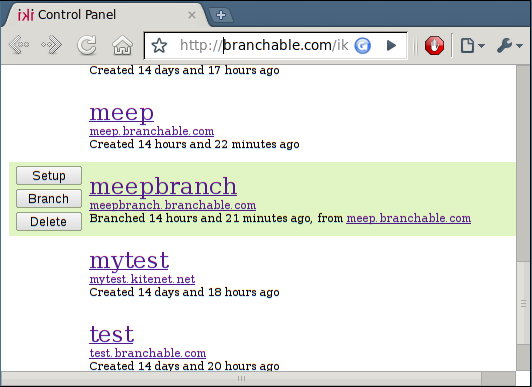
Time to introduce what I've been working on for these past too many months.. Branchable is an Ikiwiki hosting site, making it very easy to create blogs and wikis. The name "Branchable" was chosen because with its git backend, and ikiwiki-hosting frontend, sites hosted there can be easily branched by their owner (or by anyone, if the owner allows). branched site in control panel The ability to take your data and configuration and go home, as well as everything being free software, means Branchable follows the vision of the Franklin Street Statement on Freedom and Network Services, like identi.ca and last.fm. This is very important to me and to my cofounder, Lars Wirzenius. Branchable has a one month free trial, so if you've been meaning to do something with Ikiwiki, I hope you'll sign up. Also, we are offering free hosting for Free Software projects that sign up while Branchable is in beta.

4 August 2010

Joey Hess: DebConf10 in the neghborhood

I took the train from Charlottesville to New York on Saturday. With this year's DebConf in the USA, I finally have a chance to experience the conference from a local perspective, without jetlag, or a language barrier. I'm still working on that. Part of me thinks I am in a foreign country here. :) Actually, the neighboorhood around Columbia University is one I have ties to. Here is my Mom's old apartment, a few short blocks from the main DebConf venue. And here is family friend Ruth Shereff's memorial garden in the Broadway median. DebConf has been outstanding, and very exhausting. Lars and I have been spending a lot of time here putting the final touches on something to be announced soon.

1 August 2010

Rapha&#235;l Hertzog: First Flattr FOSS Suggestions

Flattr FLOSS LogoThe Flattr FOSS project is quite young so very few free software are currently listed in the dedicated directories. It s still advocacy time: if there are free software that you d like to flattr, please tell them and point them to Flattr FOSS. It s too early for any conclusion, but the feedback from users is good and it looks like that people using flattr to support free software are more generous than the average flattr user. You re great people! :-) Anyway, it s time for me to give a few suggestions of projects to flattr.
  1. My first recommendation is Project Hamster, it s a time-tracking application for GNOME but it has come a long way thanks to the work of Toms Bau is. I use everyday and it rocks.
  2. My second recommendation is verallt, it s a Firefox extension that allows usage of Flattr even in places where it was not designed to be used: forums, mailing list archives, etc. The persons using Flattr just put [Flattr=20693] in their signature and the Firefox extension automatically replaces this text with a real Flattr button ready to be clicked. Thanks to Paul Da Silva for the nice idea and the first implementation!
  3. My third recommendation is Mustard, it s a StatusNet client for the Android platform. More concretely you can install it on your Android phone to send updates to identi.ca while traveling. I have no Android phone but Mustard seems to be popular among owners of such phones!
  4. My fourth recommendation is moreutils from Joey Hess. It s set of unix (command line) tools that nobody else thought of writing when unix was young (according to Joey himself). They are all very useful, I use more or less regularly isutf8 (verify if a file is UTF-8 compliant), combine (logical operations on lines of two files), pee (send standard input to two programs, very useful in git hooks when you want to run two programs that both consume the same data), sponge (ever tried grep -v foo file >file and lost your data? now you can use grep -v foo file sponge file ). And Joey is a long time Debian developer who has truly shaped Debian, he s behind several major Debian projects (debconf, debian-installer, debhelper, ). Big kudos to him!
  5. My last recommendation is to flattr Andreas Gohr for his work as dokuwiki lead developer. There s no flattr button on dokuwiki s website but you ll find some in Andreas blog, just pick a dokuwiki related article like this one: Dokuwiki Birthday Bughunting Weekend. Dokuwiki is a simple wiki that works without any database (the pages are stored in flat files) and it s even commonly used to setup simple websites thanks to the numerous themes available.
Okay, that s it for this month. I ll try to keep a broad panel of software (desktop, command line, mobile, web, etc.). Since I have promoted a GNOME desktop application, I would like to be able to promote a KDE or XFCE application next month but I did not discover any KDE/XFCE project using Flattr do you know any? Please share in the comments if you find some. Also I wonder if you have decided of a flattr strategy Personally I m likely to flattr my favorites projects/persons each month and to flattr a few other occasionally as I discover them. What s your own strategy? Flattr this Share/Bookmark 4 comments Support my work

25 July 2010

Joey Hess: git source packages: take 2

My patches to convert the 3.0 (git) source format to use git bundles have landed in dpkg's git repository and will be in dpkg 1.15.8. I think this second attempt at 3.0 (git) has worked out much better than the first. (Though the first was a pretty good success overall, since it also led all the other 3.0 formats eventually. ;) Perhaps the intervening years of git experience helped. The code is much simpler, with none of the ad-hoc hacks from the first version. The resulting git bundles can be manually cloned using git-bundle(1) where dpkg-source is not available. There are two handy new features that can be controlled by debian/source/options. git-ref can be used to limit the branches/tags/etc that are included in the source package. And git-depth can cause a shallow clone of specified depth to be created and bundled.
dpkg-source: info: using options from debhelper/debian/source/options: --git-ref=gitsrc --git-ref=master --git-depth=10
dpkg-source: info: using source format  3.0 (git)'
dpkg-source: info: creating shallow clone with depth 10
dpkg-source: info: bundling: gitsrc master
A demo source package is here.
joey@gnu:~/tmp/t>dget http://kitenet.net/~joey/tmp/debhelper_7.9.4.dsc
...
dpkg-source: info: extracting debhelper in debhelper-7.9.4
dpkg-source: info: cloning debhelper_7.9.4.git
dpkg-source: info: setting up shallow clone
joey@gnu:~/tmp/t>ls -l
total 392
drwxr-xr-x 10 joey joey   4096 Jul 25 13:58 debhelper-7.9.4/
-rw-r--r--  1 joey joey   1779 Jul 25 13:58 debhelper_7.9.4.dsc
-rw-r--r--  1 joey joey 388859 Jul 25 13:58 debhelper_7.9.4.git
-rw-r--r--  1 joey joey    738 Jul 25 13:58 debhelper_7.9.4.gitshallow
joey@gnu:~/tmp/t>cd debhelper-7.9.4 
joey@gnu:~/tmp/t/debhelper-7.9.4>git branch -a
* gitsrc
  remotes/origin/HEAD -> origin/gitsrc
  remotes/origin/gitsrc
  remotes/origin/master
Notice that the branch I was in when I built the package is preserved, and the 19 revisions included in the shallow clone (10 per branch) take up very little space of course. This particular git source package turned out 30k larger than the tar.gz. I am considering adding two other features: I hope the next step will be for git source packages to be accepted in the Debian archive.

23 July 2010

Joey Hess: Flattr FOSS

Raphael's Flattr FOSS is a good idea: Make it really easy for users to pay tips for free software and maybe users who otherwise wouldn't express their appreciation will. I've added Flattr buttons for a few of my Free Software packages. Am interested to see how it works out.
Flattr this
Regarding Flattr itself, I have always wanted a way to easily micropay artists, coders, etc online. Especially musicians like Mosaik! The way it splits your monthly payment amoung everyone you've Flattr'd that month is smart; it takes money out of the picture when deciding whether to click on a Flattr button. I think it would be more honest, though, if rather than taking 10% of everything (which would be just absurd and indefensible if this were used on a large scale, and whiffs faintly of pyramid scheme even now), Flattr took one share of your monthly payment (as if you automatically Flattr'd them each month). That would provide even more incentive to Flattr lots of other things. And if lots of people were Flattring lots of things, Flattr would still make plenty of money.

30 June 2010

Joey Hess: Osmos

I love this game. Love that it's so abstract and beautiful and meditative. Love how it plays with fractal scale. Am I a planet or a unicelled organism? Love that this basic game idea could have been written at any point since Spacewar (1961), and could be said to be recycling ideas from everything from that to Pac Man ... but instead seems entirely new, pure, and fresh. Love that I can be playing it and it makes me think about things right out of a Greg Egan novel. Like about how it's most efficient for conciousness to be slow and not care about the passage of time. So you don't have to waste much mass on delta-v. Until carnivorous life enters the picture. Then you have to be bold, and fast. Love that it has a linux port. Love that it's hard. A screenshot can't do it justice -- the video on its site gives a better idea.

Next.

Previous.