Search Results: "jmtd"

21 May 2009

Jon Dowland: weird referrals from planet debian

Whenever I write a log post that gets published at Planet Debian, shortly afterwards I get various hits for the URL of the log post with either "_hide" or "_show" suffixed. Looking at the p.d.o source, this is due to document.write( "<a href="#" id="http://jmtd.net/log/six_silicates/_hide"... I'm not sure why google is treating the id attribute of an anchor as something worth crawling. Is this a google bug? Does anyone else experience this? Does anyone have any idea how we might get it to stop (whilst still indexing real pages, of course :))?

18 May 2009

Jon Dowland: separated at birth

The Cure's 1982 album "Pornography" and the Horrors' 2009 album "Primary Colours", the title of which alone reminded me of the Cure song "Primary". I haven't heard "Primary Colours" yet but it comes recommended.

Jon Dowland: six silicates

More in music news, KiloWatts has released a new, donationware album "Six Silicates": http://kilowattsmusic.com/six/

13 May 2009

Jon Dowland: The Revolution Business

My copy of Charles Stross's The Revolution Business, (book 5/6 in the "Merchant Princes" saga) arrived today. I'm currently half way through Iron Sunrise. I will have to put one of them aside for a while, but which one...

24 April 2009

Jon Dowland: my first attempt at hacking on Linux: a story

I have a little job that runs on my web server and tells me what URIs people have tried to fetch over the last 24 hours which were not successful. One of these URIs was for a page that used to contain my first ever Linux device driver. That device driver is now obsolete and so there was little point in tracking down the code and putting it back in place, but I did think there was a story to tell, so today I wrote down what happened with this driver at the URI. Thanks to the magic of ikiwiki's "inline" directive, here it is in the log: This is a story about my first real attempt to contribute to the Linux kernel. The Davicom DM9601 is a cheap USB NIC that I picked up on ebay at some point in late 2006. Suprisingly, at the time, there was no driver for it in the Linux kernel. I'd had some experience hacking on the kernel whilst working for IBM and I've always wanted to get more involved, so I thought this would be a good opportunity. I searched around and managed to find a vendor-written driver for the 2.4.x kernel series, but nothing newer. I felt that the best approach would be to start porting this driver to 2.6, improving it along the way. I got to work, and after several hours I had something that would compile against 2.6 series headers, at least, so I put my progress online and wrote a short log post about it (dm9601). A really invaluable resource whilst doing this was LWN.net's "Porting device drivers to the 2.6 kernel". Once I had the code up there, kernel hacker Arnd Bergmann got in touch with me. He said, quite frankly, that my driver had a long way to go, but that he would be willing to help mentor me and guide me in improving it so that it would make it into mainline. This was fantastic news: this is exactly what people need when trying to get up to speed with the customs of something as complex as the kernel development community. Arnd sent me a long list of things I needed to fix. Whilst I had my code online I had several other people get in touch with me and provide things like device IDs for their NICs that they needed to add in order to get it to work for their hardware. Several weeks later, after implementing a good chunk of Arnd's suggestions, I had a driver that worked, at least a little bit, with 2.6, so I got back in touch with Arnd. Bad news, for me at least: Peter Korsgaard, another kernel hacker, had implemented a dm9601 driver from scratch over a weekend. Apparently he was at a friend's house, his friend had this device, he noticed there wasn't a driver in the kernel already and sat down to write it as a fun project. From scratch. In one weekend. This was a bit of a blow. I couldn't imagine having the skill and knowledge required to be able to pump out a driver like that, but I knew the first step on the road was what I was doing, and that road was now closed. I couldn't really blame Peter, I could only really feel quite jealous at his prowess, so that was the end of that. His driver was much leaner, much tidier, fitted the kernel programming style properly, and was thus accepted. However, for my hardware at least, it didn't actually work, and he didn't have access to the device after that one weekend, so he wasn't in a position to fix it. This situation lasted about 4 months from 2007-02-23, when Peter's driver was accepted, until about 2007-06-27 with this patch. From this whole experience, I did manage to get one small patch into the kernel: one which added the device IDs for my NIC and those of the people who had got in touch with me.

Jon Dowland: pdf tools.mwdn

21 April 2009

Jon Dowland: xorg.confless x and two monitors

This new xorg.conf-less X is a great idea, but now I have to add all the sections back in order to define "Virtual" and get monitor-spanning. Or maybe I'm missing another xrandr trick.

15 April 2009

Jon Dowland: debian holiday

I've been largely offline for the last few weeks as I've just bought a flat. This means I haven't been able to do much Debian work. Although I am now back online, I have a lot of other things to be catching up on, so I've decided to to take a break from Debian stuff until 15th May. I will still do some bug work (reporting and following up) and if I somehow find the time I may well do some Debian work regardless. I just feel that having an explicit break (rather than an implicit or imposed one) will make me feel a little bit more in control of things, and hopefully when I return I will have some new positive energy.

7 April 2009

Jon Dowland: zte mf622

I'm currently waiting for my ADSL to be setup and so I've borrowed my mum's "three" 3G mobile broadband USB dongle. The device is a "ZTE MF622" and getting this working in Linux apparently used to be a bit of a nightmare. However, with Debian Lenny and 2.6.26-1-amd64 it is trivial: you plug it in, it appears as a USB mass storage device; wait a little bit and it disappears and comes back as some USB serial devices. You can then chat to /dev/ttyUSB0 (or whatever the first ttyUSB device belonging to the dongle is). There's a working wvdial configuration at http://ubuntuforums.org/archive/index.php/t-665332.html, reproduced here for convenience:
[Dialer Defaults]
Init2 = ATZ
Init3 = ATQ0 V1 E1 S0=0 &C1 &D2 +FCLASS=0
Stupid Mode = 1
Modem Type = Analog Modem
ISDN = 0
Phone = *99#
Modem = /dev/ttyUSB0
Username = user
Dial Command = ATDT
Password = pass
Baud = 460800
IF you don't want to use wvdial there are bare ppp scripts at http://hillj.co.uk/2008/01/31/how-to-get-online-with-three-mobile-uk-and-linux-ubuntu/, although I haven't tested these. Whilst researching this I stumbled across several examples of more extreme ways of getting the initial switchover to work, including http://blog.ufsoft.org/zte-mf622-usb-modem-under-linux#extended which includes a udev snippet that forcefully calls rmmod and modprobe. This will totally fail if you are using usb-storage or usb-serial for anything else, which is probably not the case for the majority of people trying to get this to work at the time they are trying, but there are several examples out there of people complaining that their USB has failed since trying these instructions. We are often accused of having a problem of missing documentation in the free software world. I'm wondering if this is one example of where we have bad, damaging documentation. How can we deal with that? Incidentally, for those whose devices won't automatically switch over to the serial device, there's a program usb-modeswitch (currently in sid) that can do the job for you. There are apparently hacks in the usb-storage Linux kernel module that special-case the switchover for some Huawei devices. I couldn't find anything in there for the ZTE device.

31 March 2009

Jon Dowland: nspluginwrapper

I installed nspluginwrapper on my laptop. It's a 32bit x86 machine and I'm using Adobe's flash 10 plugin. The crashes were getting really stupid. nspluginwrapper has totally cured the problem (at least, my browser hasn't crashed since) and the browser also feels a lot snappier. I will have to try this on my 64 bit work and home desktops.

Jon Dowland: first flat

I have just completed purchase of my first flat! I'm now in the process of sorting it out so I can move in. I may well be offline for a bit as a result.

Jon Dowland: nspluginwrapper.mwdn

28 March 2009

Chris Lamb: Orphaning the Gnome BTS Applet

As I haven't used Gnome in over a year, I'm orphaning my Debian BTS Applet (original blog post). After the original release it was forked for Launchpad and there were even plans for OpenSUSE fork. Jon Dowland also released his debgtd tool which isn't Gnome-specific and somewhat more useful for developers, although actual development has stalled with patches pending. I would be willing to sponsor uploads if a non-Debian Developer was to adopt it.

18 March 2009

Jon Dowland: crypted lvm question

On my primary desktop machine at home, I have several volumes encrypted using dm-crypt/luks and mounted as part of my login thanks to pam-mount. On one hard drive is my main home directory and some small supplementary filesystems. On another hard drive I have several crypted volumes used for backing up my home partition but also other devices. This setup is largely transparent to me: all of the filesystems are individually unlocked and mounted as part of my login. It is however a bit messy to have so many small crypted filesystems (using the same passphrase) and the login is delayed a fair while too. What would be preferable would be to have one encrypted volume that was unlocked by my PAM keyphrase but which provided several sub-volumes which were mounted individually and had separate sizes, etc. It might be possible to achieve this by having the volume exported by dm-crypt be itself a LVM physical volume. Does this sound sane to anyone? Is there a better way to achieve the same thing? I could remove the first volume group and have a disk partition feed directly into dm-crypt but I would lose some flexibility (there are some things I backup but don't encrypt, such as my music collection, and now and then I need a large scratchpad). I'm not sure how well putting a VG ontop of a LV for a different VG would work, I'm also not sure how happy the LVM code would be with a VG appearing and disappearing (In practise, I log in once a month or so, so it wouldn't happen that often).
16 March 2009

Jon Dowland: rsi

I am currently suffering from a form of repetitive strain injury in my hands and arms, which I think is related to a cold I've got at the moment. There are a number of people who I have promised correspondence with recently; also a number of discussions I've taken part in (e.g. device access via group membership on debian-devel; doom-related virtual packages on debian-policy) which I haven't followed up on for a while. Just a note to say sorry for dropping off the face of the earth, I'll be back as soon as I can!

12 March 2009

Jon Dowland: interzone

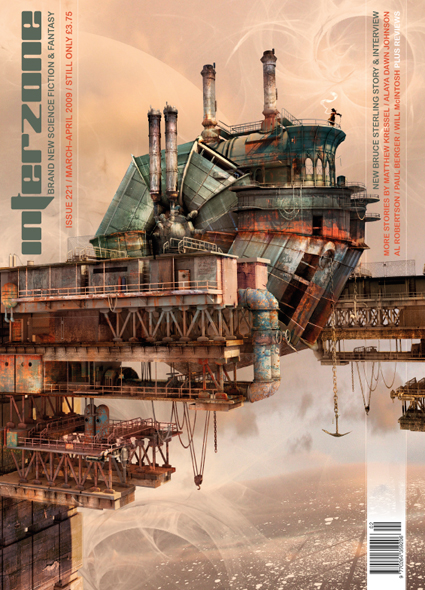
The next issue of Interzone, a british SF magazine, is due out soon. The issue features a story and interview with Bruce Sterling, plus a review of his new novel the Caryatids (which Cory Doctorow said was his pick for best book of 2009, already). The cover for this issue looks fantastic: modern covers seem to be placing most of the focus on the artwork and placing the graphics and text to suite each cover art individually. I've been reading IZ for several years after having seen it mentioned several times as the source of stories in SF anthologies and highly recommend that people who enjoy reading SF give it a try.

Jon Dowland: iz221cover.jpg

10 March 2009

Jon Dowland: iphone google reader

Quick tip: you can access the iPhone-tailored version of Google Reader from any computer, using the URL http://google.com/reader/i/. I quite like using it from a regular desktop machine.

4 March 2009

Jon Dowland: ubuntu netbook mockup.png

3 March 2009

Jon Dowland: sorting out backups

I'm busy re-working how I handle backups of my personal files. A very useful recent discussion on some available features and technologies is at Theodore T'so's blog: http://thunk.org/tytso/blog/2009/01/12/wanted-incremental-backup-solutions-that-use-a-database/. From that post I discovered a package 'archfs' which provides a FUSE-powered filesystem view of an rdiff-backup history. I found a stale ITP for this package and have adopted it, so keep your eyes out for that. Looking at how I am going to approach things, I think the Debian package of anacron might need some work. I'm planning on looking at the issues there a bit more closely and feeding back to the maintainer when I do.

Next.

Previous.