Search Results: "hertzog"

21 April 2011

Raphaël Hertzog: People behind Debian: Meike Reichle, member of Debian Women

Meike Reichle is a Debian developer since 2008 but has been involved for longer than that, in particular in Debian Women. She s a great speaker and shared her experience in a Debconf talk. She s also part of the Debian publicity team and managed the live coverage of the last release on identi.ca. Enough introduction, learn more about her by reading the interview. My questions are in bold, the rest is by Meike. Who are you? My name is Meike Reichle, I am a studied information scientist and work as a project manager at Pengutronix, an embedded Linux company probably best known for their ARM kernel work. I live in Germany, more exactly in Lower Saxony, but I was originally born and raised in Swabia. Although I moved here ten years ago I still have a rather strong Swabian cultural identity. (Among other things I pride myself on having introduced a number of fellow DDs to the true promise that are real hand-made Sp tzle ;-) ) I am married to Alexander Reichle-Schmehl, we ll have our third wedding anniversary this summer. Apart from Debian most of my spare time is used for all kinds of crafts and DIY activities. Making things with my hands always gives me a great sense of accomplishment. My Free software history is summed up pretty quickly. Like most women of my age I wasn t introduced to computers until well into my teens. I didn t have a computer of my own until I started studying at the university in 2001. From there on things developed rather quickly: Working on the University s Unix terminals got me hooked on *nixes, so I got me one of those Linuxes everyone talked about. I tried a couple of different distributions, ended up with Debian around 2004, started contributing in 2005, and finally became a full DD what a nice coincidence! exactly this day (Apr 18th) three years ago. You re part of Debian Women. How is the project going? I have the feeling that the number of women involved in Debian has not significantly increased. The amount of women active within Debian is a tricky thing to judge. Here s a quick example why: When the DPL was elected in 2004 there were 911 Debian Developers eligible to vote, 4 of them were female. Shortly after, during DebConf4, debian-women was founded. When the current DPL was reelected last month, there were again 911 Debian Developers eligible to vote, but this time 13 of them were women. You can look at these numbers and say The number of female DDs has more than tripled, what a success! Or you can pull out your calculator and it will tell you that in terms of ratio this puts us from a measly 0.4% to an only slightly less measly 1.4% ratio of female DDs. This still is pardon my language a bloody shame, but sadly also pretty close to the average ratio of women in Free Software. So, while I do think that the debian-women project did already have a significant impact on the Debian project as a whole, I don t think it has achieved its goals yet. Not for a long time. There s still a lot to be done but unfortunately the debian-women project has somewhat run out of steam at the moment. The seven years of its existence divide quite equally into the first half, which was very active and saw great results, and the second half, which was very slow and much more passive. In my impression debian-women is currently undergoing a rather bumpy generational change. On the one hand a lot of the original members, including myself, have reduced their involvement. Speaking for myself this is caused by shift of interests as much as general weariness. On the other hand there are only very few women following up. This development is also reflected quite harshly in DD numbers: If I don t misjudge any first names (and I desperately hope I do!) for the last three years not a single woman has joined Debian as a developer! After the great start debian-women has had, this is a very painful thing to see! That said, things don t look all bad. There is a number of women maintaining packages without being DDs and there s also at least one woman currently in NM, so there s hope this standstill won t last very much longer. But still, the fact remains that debian-women is suffering from a rather serious recruitment problem and I hope that this interview might actually help to spur some new or not yet active members into action. The aim of debian-women is far from achieved and now that its initial members are receding its time for new members to step up and take initiative. What should Debian do to be more attractive to women ? I think the general atmosphere has improved, we re less tolerant with rude behaviour, the usual tone on mailing lists has improved. Yet it doesn t seem to be enough. If there was a female DD for every time I answered that question First of all, I agree, Debian as a community has improved tremendously! Our general tone is much more friendly and cooperative and there is now a much better awareness of the impression we give to outsiders and newcomers. Now on to the difficult part: The question what should be done to get more women into Free Software has been around almost as long as Free Software exists, and it has been answered very well by a lot of people: Twenty years ago Ellen Spertus wrote Why are There so Few Female Computer Scientists? and most of it still holds true. Almost ten years ago Val Henson (now Aurora) wrote HOWTO Encourage Women in Linux and that also is still pretty accurate. In 2006 Floss Pols undertook extensive research to find out why there were so few women in Open Source and Free Software and how that could be changed. They also came up with a very good set of recommendations. All of these texts highlight different aspects of that question and all of them have very good points. I personally have, over the years, arrived at a rather sociological, not to say holistic point of view. In fact I answered the exact same question a few days ago, and the answer I gave then was this: After ~10 years of women in tech advocacy I d say the ultimate and final measure to get more women into Free Software is by finally achieving a truly equal society and at the same time dramatically improving child care support in almost any country. I ve come to the conclusion that what really holds women back in practice is not so much a lack of skill or interest but a simple lack of opportunity. For most of us Free Software is what we do in our spare time and that s something that women, even today, have considerably less of than men. Even in couples where both partners work full-time it is still mostly the woman who does the majority of the housework and child care duties. In most cultures men have a perceived right to their leisure time that does not to the same degree exist for women. That is one major reason, the other is instilled modesty, which has kind of become my personal arch-enemy by now. I ve talked to so many girls and women at all sorts of events about why they won t take up Computer Science studies or join a Free Software project and the answer I hear most often is that they do not consider themselves good enough in one or another aspect. Sometimes they will doubt their technical skills, sometimes their language skills, sometimes their stamina. Needless to say these girls and women were not any less qualified than the people already active in Free Software. So, yes, in the short and medium term making Debian a more welcoming and friendly place is the way to go. As many others pointed out already this will not only benefit prospective contributors but the community as a whole: those new to it as well as those who ve been in it for a long time. In the long term however what we need is empowerment! Women who are just as confident about their skills as men and are not discouraged by uncooperative environments. This is of course something that is culturally deep-rooted and can only happen in a very large time frame. So, for the moment the way to go in my view is accessibility: a cooperative atmosphere, a code of conduct, comprehensive documentation not only of technical aspects but also of structures and processes. The other thing we need to do is to have as many already active women as possible attend as many Linux/Debian/Free Software/Whatever events as possible. In my experience it happens quite often that other women see these women, feel very inspired by them, get to talk to them and then a few days later show up on some mailing list or IRC channel. From what I ve seen personal contact still beats any other kind of recruiting measures. You re a Debian developer but you re also married with a Debian developer (Alexander Reichle-Schmehl). Did you meet because of Debian? If not, who introduced Debian to the other one? :-) We did in fact meet because of Debian. More specifically during our booth shift at the Debian booth at LinuxTag 2005, where I did a talk on the debian-women project and Alex organised the DebianDay. After that our relationship developed pretty much along our Debian activities: After our initial meeting we talked a lot on #debian.de, when Alex went to DebConf5 and I didn t we noticed that we kind of missed each other. The first gift he ever gave me was a Debconf5 shirt and a box Finnish chocolates (I still have one of them today. :) ) Our first secret kiss was at ApacheCon 2005, where we were both staffing the Debian booth (kudos to abe for pretending not to notice). We then became an official couple at Berlinux 2005 where we were both staffing the Debian booth and giving talks on packaging and user motivation. Our first real relationship stress test was when we both joined the DebConf6 orga team. It was a stressful time, but we passed it with flying colours! About a year later we announced our engagement via planet.debian.org. Our wedding was a veritable MiniDebConf, one of the best gifts we got was a Debian cookbook including the favourite recipes of DDs from around the world. By now we ve both finished university and work full-time jobs, so we don t do as many talks and attend as many Debian events as we used to. Instead we now mainly focus on press and publicity work, which is quite practical to work on as a pair. It s actually rather funny that way, Alex and I get confused with each other quite often, since we have almost the same name, often pick up on each other s E-Mail conversations and are most often quoted by our function rather than by name. Because of we have kind of merged into this virtual Debian Press Person in the perception of many of our contacts. You also have another hat : Debian Press Officer. What is this about? What would you suggest to people who would like get involved in that domain? Debian press work is mainly about providing an official and coordinated point of contact to anyone wanting information from or about Debian. The press team answers all sorts of inquiries (the most popular one is is of course always the next release date) and makes sure all important events and developments within Debian receive the attention and recognition they deserve. Debian is a diverse project where every sort of contributor is free to voice his or her opinion in any way. We don t have NDAs or prescribed terminology. That s one of the things I love about Debian but also something that makes us difficult to handle for conventional media. They want official statements, in generally understandable terms, at appointed times. That s what the press team takes care of. Almost all of the press work is done in the publicity team, which coordinates using IRC, Mail and SVN. The publicity team also publishes the Debian Project News, which are very popular among our users and developers. Press work is also an area of work that offers lots of possibilities for non-technical contribution. http://wiki.debian.org/Teams/Publicity lists a number of possibilities for contribution and, like most Debian Teams, we d be more than grateful to get some more helping hands and happy to introduce interested newcomers to our work. What s the biggest problem of Debian? In my view: Overwork. Debian has thousands of contributors but still a lot of the main work rests on very few shoulders. We need more contributors, especially, but not only in the key teams. In order to get more people we need to do some marketing which is very hard for us, since we are very proud of our independence and have a strong focus on purely technical aspects rather than aiming for popularity. However, with the current amount of Open Source and Free Software projects to join we find ourselves not only in a contest on technical excellence but also a sort of popularity contest that is about perception rather than hard facts. This popularity contest is difficult for Debian and currently costs us quite a bunch of very capable people. Do you have wishes for Debian Wheezy? My answer to that is a non-technical one: I think Debian is currently very under-appreciated, we do a lot of great work and maybe even more importantly we do a lot of important work for Software Freedom, sometimes even at the cost of our above-mentioned popularity. I hope people will appreciate that more again in the future. Is there someone in Debian that you admire for their contributions? Over the years I have made a lot of friends within the Debian community, some have even become family. That makes it somewhat hard to single out individual people. I think what I admire most is continuous commitment. I am very impressed by those among us who have kept up a high level of commitment over many years and at the same time managed to bring that in line with a fulfilled personal/family life. That s something that I hope I ll also be able to achieve in the years to come.
Thank you to Meike for the time spent answering my questions. I hope you enjoyed reading her answers as I did. Subscribe to my newsletter to get my monthly summary of the Debian/Ubuntu news and to not miss further interviews. You can also follow along on Identi.ca, Twitter and Facebook.

2 comments Liked this article? Click here. My blog is Flattr-enabled.

18 April 2011

Raphaël Hertzog: Status update of GNOME 3 in Debian experimental

Last week s post generated a lot of interest so I will make a small update to keep you posted on the status of GNOME 3 in Debian experimental. Experimental is not for everybody But first let me reiterate this: GNOME 3 is in Debian experimental because it s a work in progress. You should not install it if you can t live with problems and glitches. Beware: once you upgraded to GNOME 3 it will be next to impossible to go back to GNOME 2.32 (you can try it, but it s not officially supported by Debian). Even with the fallback mode, you won t get the same experience than what you had with GNOME 2.32. Many applets are not yet ported to the newest gnome-panel API. So do not upgrade to it if you re not ready to deal with the consequences. It will come to Debian unstable and to Debian testing over time and it should be in a better shape at this point. Good progress made Most of the important modules have been updated to 3.0. You can see the progress here. The exception is gdm, it still needs to be updated, the login screen looks quite ugly right now when using GNOME 3. Frequently Asked Questions and Common Problems Why do links always open in epiphany instead of iceweasel? You need to upgrade to the latest version on libglib2.0-0, gvfs and gnome-control-center in experimental. Then you can customize the default application used in the control center (under System Information > Default applications ). You might need to switch to iceweasel 4.0 in experimental to have iceweasel appear in the list of browsers. Or you can edit ~/.local/share/applications/mimeapps.list and put x-scheme-handler/http=iceweasel.desktop;epiphany.desktop; in the Added Associations section (replace the corresponding line if it already exists and lists epiphany only). The theme looks ugly, and various icons are missing. Ensure that you have installed the latest version of gnome-themes-standard, gnome-icon-theme and gnome-icon-theme-symbolic. The network icon in the Shell does not work. Ensure you have upgraded both network-manager-gnome and network-manager to the experimental version. Some applications do not start at all. If an application loads GTK2 and GTK3, it exits immediately with a clear message on the standard error output (Gtk-ERROR **: GTK+ 2.x symbols detected. Using GTK+ 2.x and GTK+ 3 in the same process is not supported.). It usually means that one of the library used by that application uses a different version of GTK+ than the application itself. You should report those problems to the Debian bug tracking system if you find any. Some people also reported failures of all GTK+ applications while using the Oxygen themes. Switching to another theme should help. BTW, the default theme in GNOME 3 is called Adwaita. Where are my icons on the desktop? They are gone, it s by design. But you can reenable them with gsettings set org.gnome.desktop.background show-desktop-icons true and starting nautilus (if it s not already running). (Thanks to bronte for the information) Why do I see all applications twice in the shell? The package menu-xdg generates a desktop file from the Debian menu information, those are in a menu entry that is hidden by default in the old GNOME menu. Gnome Shell doesn t respect those settings and displays all .desktop files. Remove menu-xdg and you will get a cleaner list of applications. APT pinning file for the brave Since last week, we got APT 0.8.14 in unstable and it supports pattern matching for package name in pinning files. So I can give you a shorter and more complete pinning file thanks to this:

Package: *gnome* libglib2.0* *vte* *pulse* *peas* libgtk* *gjs* *gconf* *gstreamer* alacarte *brasero* cheese ekiga empathy* gdm3 gcalctool baobab *gucharmap* gvfs* hamster-applet *nautilus* seahorse* sound-juicer *totem* remmina vino gksu xdg-user-dirs-gtk dmz-cursor-theme eog epiphany* evince* evolution* file-roller gedit* metacity *mutter* yelp* rhythmbox* banshee* system-config-printer transmission-* tomboy network-manager* libnm-* update-notifier shotwell liferea *software-properties* libunique-3.0-0 libseed-gtk3-0 libnotify* libpanel-applet-4-0 libgdata11 libcamel* libcanberra* libchamplain* libebackend* libebook* libecal* libedata* libegroupwise* libevent* gir1.2-*
Pin: release experimental
Pin-Priority: 500
Package: *
Pin: release experimental
Pin-Priority: 150
Putting the file above in /etc/apt/preferences.d/gnome and having experimental enabled in /etc/apt/sources.list should be enough to enable apt-get dist-upgrade to upgrade to GNOME 3 in experimental. But if you have packages depending on libimobiledevice1, you might have to wait until #620065 is properly fixed so that libimobiledevice2 is co-installable with libimobiledevice1. Update: integrated the explanation to reenable the desktop icons thanks to bronte s comment.

15 comments Liked this article? Click here. My blog is Flattr-enabled.

11 April 2011

Raphaël Hertzog: Journey of a new GNOME 3 Debian packager

With all the buzz around GNOME 3, I really wanted to try it out for real on my main laptop. It usually runs Debian Unstable but that s not enough in this case, GNOME 3 is not fully packaged yet and it s only in experimental for now. I asked Josselin Mouette (of the pkg-gnome team) when he expected it to be available and he could not really answer because there s lots of work left. Instead Roland Mas gently answered me Sooner if you help . :-) First steps as a GNOME packager This is pretty common in free software and for once I followed the advice, I spent most of sunday helping out with GNOME 3 packaging. I have no prior experience with GNOME packaging but I m fairly proficient in Debian packaging in general so when I showed up on #debian-gnome (irc.debian.org) on sunday morning, Josselin quickly added me to the team on alioth.debian.org. Still being a pkg-gnome rookie, I started by reading the documentation on pkg-gnome.alioth.debian.org. This is enough to know where to find the code in the SVN repository, and how to do releases, but it doesn t contain much information about what you need to know to be a good GNOME packager. It would have been great to have some words on introspection and what it changes in terms of packaging for instance. Josselin suggested me to start with one of the modules that was not yet updated at all (most packages have a pre-release version usually 2.91 in experimental, but some are still at 2.30). Packages updated and problems encountered (You can skip this section if you re not into GNOME packaging) So I picked up totem. I quickly updated totem-pl-parser as a required build-dependency and made my first mistake by uploading it to unstable (it turns out it s not a problem for this specific package). Totem itself was more complicated even if some preliminary work was already in the subversion repository. It introduces a new library which required a new package and I spent a long time debugging why the package would not build in a minimalistic build environment. Indeed while the package was building fine in my experimental chroot, I took care to build my test packages like the auto-builders would do with sbuild (in sid environment + the required build-dependencies from experimental) and there it was failing. In fact it turns out pkg-config was failing because libquvi-dev was missing (and it was required by totem-pl-parser.pc) but this did not leave any error message in config.log. Next, I decided to take care of gnome-screensaver as it was not working for me (I could not unlock the screen once it was activated). When built in my experimental chroot, it was fine but when built in the minimalistic environment it was failing. Turns out /usr/lib/gnome-screensaver/gnome-screensaver-dialog was loading both libgtk2 and libgtk3 at the same time and was crashing. It s not linked against libgtk2 but it was linked against the unstable version of libgnomekbdui which is still using libgtk2. Bumping the build-dependency on libgnomekbd-dev fixed the problem. In the evening, I took care of mutter and gnome-shell, and did some preliminary work on gnome-menus. Help is still welcome There s still lots of work to do, you re welcome to do like me and join to help. Come on #debian-gnome on irc.debian.org, read the documentation and try to update a package (and ask questions when you don t know). Installation of GNOME 3 from Debian experimental You can also try GNOME 3 on your Debian machine, but at this point I would advise to do it only if you re ready to invest some time in understanding the remaining problems. It s difficult to cherry-pick just the required packages from experimental, I tried it and at the start I ended up with a bad user experience (important packages like gnome-themes-standard or gnome-icon-theme not installed/updated and similar issues). To help you out with this, here s a file that you can put in /etc/apt/preferences.d/gnome to allow APT to upgrade the most important GNOME 3 packages from experimental:
Package: gnome gnome-desktop-environment gnome-core alacarte brasero cheese ekiga empathy gdm3 gcalctool gconf-editor gnome-backgrounds gnome-bluetooth gnome-media gnome-netstatus-applet gnome-nettool gnome-system-monitor gnome-system-tools gnome-user-share baobab gnome-dictionary gnome-screenshot gnome-search-tool gnome-system-log gstreamer0.10-tools gucharmap gvfs-bin hamster-applet nautilus-sendto seahorse seahorse-plugins sound-juicer totem-plugins remmina vino gksu xdg-user-dirs-gtk gnome-shell gnome-panel dmz-cursor-theme eog epiphany-browser evince evolution evolution-data-server file-roller gedit gnome-about gnome-applets gnome-control-center gnome-disk-utility gnome-icon-theme gnome-keyring gnome-menus gnome-panel gnome-power-manager gnome-screensaver gnome-session gnome-settings-daemon gnome-terminal gnome-themes gnome-user-guide gvfs gvfs-backends metacity mutter nautilus policykit-1-gnome totem yelp gnome-themes-extras gnome-games libpam-gnome-keyring rhythmbox-plugins banshee rhythmbox-plugin-cdrecorder system-config-printer totem-mozilla epiphany-extensions gedit-plugins evolution-plugins evolution-exchange evolution-webcal gnome-codec-install transmission-gtk avahi-daemon tomboy network-manager-gnome gnome-games-extra-data gnome-office update-notifier shotwell liferea epiphany-browser-data empathy-common nautilus-sendto-empathy brasero-common
Pin: release experimental
Pin-Priority: 500
Package: *
Pin: release experimental
Pin-Priority: 150
The list might not be exhaustive and sometimes you will have to give supplementary hints to apt for the upgrade to succeed, but it s better than nothing. I hope you find this useful. I m enjoying my shiny new GNOME 3 desktop and it s off for a good start. My main complaint is that hamster-applet (time tracker) has not yet been integrated in the shell.

21 comments Liked this article? Click here. My blog is Flattr-enabled.

7 April 2011

Raphaël Hertzog: People behind Debian: Adam D. Barratt, release manager

Adam D. Barratt is a Debian developer since 2008, in just a few years he got heavily involved to the point of being now Release manager , a high responsibility role within the community. He worked hard with the other members of the release team to make Squeeze happen. You could expect the release managers to have some rest after a big release, but it s not really the case. With the long freeze, loads of transitions have accumulated and they are now busy to get all those updated packages in the new testing (wheezy). Despite this Adam took some time to answer my questions. He shares with us his impression on the Squeeze release, his opinion on time-based freezes (regular/predictable freeze) and much more. Read on. My questions are in bold, the rest is by Adam. Who are you? I m a 31 year old software developer and part-time sysadmin for a software and IT services company based in the south of England. I have no children, no pets and a long-suffering partner who puts up with me spending far too much time tinkering with things and people making fun of her Macbook during Debconf. As well as being on the release team, I m a member of the maintainer teams for devscripts and lintian. Can you describe your journey in Debian and in the release team? I was introduced to Debian as part of an infrastructure upgrade at work, moving from a set of Red Hat and Solaris-based systems. As part of that, we submitted some bugs for issues we found during the upgrade and for small patches we included in some software to add extra functionality we wanted. From that starting point I became more interested in Debian in general and began following some of the mailing lists and IRC channels. When Julian Gilbey asked for help with the maintenance of devscripts, I submitted some patches for some of the outstanding bug reports and was invited to join the team which was being created to handle maintenance for the package. One of the then Release Managers was also on the team and asked if I d be interested in working on a couple of updates they wanted to the scripts which generate the proposed-updates overview pages. I added the new functionality which was merged in to the live scripts and a little while later I was invited to join the team, shortly before Debconf 9. As most readers will be aware, we unfortunately reached a point during last year where we didn t have anyone filling the Release Manager role. During that period, I became more active in handling transitions and requests for updates to stable and as time went on more people started to suggest that I should put myself forward for the position, or refer to me as already being RM. I procrastinated over the decision for some time but after discussions during Debconf 10 I came round to the idea that we should have the RM role filled again and agreed to take it on, together with Neil. The rest, as they say How much time do you usually spend working for the release team ? I ve been trying to work out how to usefully answer this question. My initial answer was approximately two hours each day , but the longer I thought about it the more I started debating exactly what I should include under the umbrella of release work; after some to-and-fro I ve decided to stick with my initial answer. During periods when Debian is frozen and particularly in the lead up to the release that time commitment increases significantly, particularly over weekends. I m reliably informed that at that point the correct answer to the question is too much time . :-) What s your own retrospective of the Squeeze release? What went well and what needs to be improved? Overall, I believe the release went well and that we should all be proud of the Squeeze release. The parts of the release cycle which highlighted the need for improvement all share, imo, a single root cause communication, particularly around freeze-related plans. We worked hard during the freeze itself to improve our communication with the rest of the project and want to continue in that vein during the Wheezy cycle. One thing that I personally found quite difficult at times before the freeze was keeping track of the transitions which were still waiting for a place in the queue; it s also something that we could improve on at this early stage of the Wheezy cycle. In order to help us keep a clear overview of requests for transitions, stable updates and binNMUs, it would be helpful if they could be filed as appropriately user-tagged bugs. This not only allows us to easily get an overview of the status of requests from the BTS but also aids transparency by allowing anyone else to do so; as a useful additional feature, it means that we can use the BTS s blocking functionality to indicate reasons why a request cannot be fulfilled right now. Are you in favor of time based freeze? I think there s merit in having a time frame that we can work towards in order to achieve the goals which we set ourselves for the release, as individual maintainers, maintenance teams and a project. I do have concerns that even with such a time frame in place there will still be uploads made very close to the proposed freeze point and transitions which may be unfinished, for example because of an unforeseen entanglement with or reliance on the transition of another package. One thing I m interested in is how exact and specific that time frame should be and the balance between predictability and being able to achieve everything we want for a great release; this is something we can cover in the debate on this subject which I know many people have strong opinions about. What are your plans for Debian Wheezy? The Wheezy to-do list I started before the final Squeeze release begins multiarch, multiarch, multiarch . It looks like we re finally going to get that achieved during this release cycle, thanks to a great deal of hard work from various people. I m also interested in seeing the C.UTF-8 locale standardised throughout Debian and continuing to work on our tools and processes to make tracking of transitions and stable updates simpler (or at least appearing to be so :-) and more transparent. With my package maintenance hats on, I d like to help ensure that both devscripts and lintian are able to keep pace with changes in the development landscape in Debian (e.g. more useful package diffing for source format v3 packages) and continue to be tools that are an integral part of package development in Debian. Some people (including me) would like a rolling distribution constantly usable by end-users. Do you think that the release process currently geared towards producing stable can be accommodated to support this? I m not yet convinced that the concept of a rolling, constantly usable distribution can be easily integrated in to the workflow that exists around preparing stable releases in Debian. The testing distribution was created as, and continues to be used as, a tool to enable the release team to create the next stable release that it happens to be something that people can use every day for much of the time is mostly a happy side-effect of the fact that we don t gratuitously break it, but is by no means guaranteed to be the case early in the release cycle or during large, disruptive, transitions. It s been suggested that testing and rolling could be basically the same for most of the cycle, with rolling then continuing to be updated when testing is frozen. This would essentially mean an extra suite which is only used for a few months every couple of years or so, which is one of the things that testing was intended to avoid (i.e. the old frozen suite) and seems like a lot of overhead to introduce in order to reduce disruption to some users during the freeze. The early part of the release cycle also tends to include a number of larger transitions which often require packages to either be removed from testing or broken as part of migrating the transition, if they are not able to be successfully updated in time. What s the biggest problem of Debian? The thing that I ve been noticing myself becoming frustrated by recently is a tendency to debate the minor details of proposals, rather than concentrating on getting the key points right to begin with. Clearly for some projects such as multiarch the details may be as important as the big picture, but in most cases the people working on a development should be allowed to look after the smaller details themselves. That s not meant to imply that feedback from other parts of the project should not be welcomed, simply that if we consider Debian to be a do-ocracy then we need to permit people the freedom to do . Is there someone in Debian that you admire for their contributions? All previous release managers, for making the job look much easier than it seems when you re in the hot seat . :-) Outside of the release team, Joey Hess for his contributions to various parts of the Debian development environment over the years, such as debhelper and debian-installer, and Colin Watson for his enviable willingness to tackle a wide variety of different projects within Debian.
Thank you to Adam for the time spent answering my questions. I hope you enjoyed reading his answers as I did. Subscribe to my newsletter to get my monthly summary of the Debian/Ubuntu news and to not miss further interviews. You can also follow along on Identi.ca, Twitter and Facebook.

No comment Liked this article? Click here. My blog is Flattr-enabled.

3 April 2011

Raphaël Hertzog: March 2011 wrap up

Since I m soliciting donations to support my Debian work, the least I can do is explain what I do. You can thus expect to see an article like this one every month. Multi-Arch work I updated the code to use another layout for the control files stored in /var/lib/dpkg/info/. Instead of using a sub-directory per architecture (arch/package.type), we decided to use package:arch.type but only for packages which are Multi-Arch: same. dpkg is taking care to rename the files the first time it is executed with write rights and then updates /var/lib/dpkg/info/format to remember that the upgrade has been done and that we can rely on the new structure. I filed a few bugs on packages that are improperly accessing those internal files instead of using the appropriate dpkg-query interface. I sent a heads-up mail on -devel to make other people aware of those problems in the hope to discover most of them as early as possible. After that, the work stalled because Guillem went away for 2 weeks and thus stopped his review of my work. I hope he will quickly resume the review and that we will get something final this month. With the arrival of dpkg 1.16.0, it s now possible to start converting libraries to multi-arch even if full multi-arch support has not yet landed in dpkg proper. See http://wiki.debian.org/Multiarch/Bootstrapping for the detailed plan. If you re curious about Multi-Arch, you might want to read this article of Steve Langasek as well. Bug triage for dpkg in launchpad At the start of the month, there was close to 500 bugs reported against the dpkg package in Launchpad. Unfortunately most of it is noise many of the reported bugs are misfiled, they show an upgrade problem of a random package and that upgrade problem confuses update-manager which tries to configure an already configured package. This generates a second error that apport attributes to dpkg and the resulting bug report is thus filed on dpkg. There are literally hundreds of those that have to be reclassified. Michael Vogt and Brian Murray did some triaging, and I also spend quite some hours on this task. It s a bit frustrating as I tend to mark many reports Incomplete because there s no way they can be acted upon and many of them are so old that the reporter is unlikely to be able to provide supplementary information. But in the middle of this noise, there are some useful bug reports, like LP#739179 which enabled me to fix a regression even before it reached Debian Unstable (because Ubuntu runs a snapshot of dpkg with multiarch support). I subscribed to the Launchpad bugs for dpkg via the Debian Package Tracking System (thanks to the derivatives-bugs keyword) and will try to keep up with the incoming reports. Misc dpkg work The ftpmasters came up with a request for a new field (see 619131) in source packages. After a quick discussion and a round of review on debian-policy@l.d.o, I implemented the new Package-List field. This should allow the ftpmasters to save some time in NEW processing, but we deferred the change for the next dpkg version (1.16.1) to ponder a bit more on the design of the field. I also fixed a bunch of bugs (#619541, #605719, #598922, #616096) and merged a patch of Mark Hymers to recognize the new Built-Using field. Developers-reference work The review process for changes to the developers-reference is not working as it should. And I suffered from it while trying to integrate the patch I wrote for the Developer duties chapter (see #548867). We purposely changed the maintainer field from debian-doc to debian-policy in the hope to have more reviews of suggested changes and to seek some sort of consensus before committing anything. But we don t get more reviews and deciding to commit a patch is now even harder than it was (except for trivial stuff where personal opinions can t interfere). In my case, I only got the feedback of Charles Plessy which was very mixed to say the least. I tried to improve my patch based on what he expressed but I also clearly disagreed with some of his assertions and was convinced that my wording was in line with the dominant point of view within Debian. We tried to involve the release team in the discussion because most of what I documented was about helping making stable release happen, but nobody of the team answered. Instead of letting the situation (and my patch) rot, I solicited feedback from the DPL and from another developers-reference editor to see whether my patch was an improvement or not. After some more time, I went ahead and committed it. It was not pleasant for anyone. I don t know how we can improve this. Contrary to the policy, the developers-reference is a document that is not normative, I believe the result is better when we put some soul into it. But it s a real challenge when you seek a consensus and that the interest in reviewing changes is so low. DVD shop listed on debian.org In February, I launched a DVD shop whose benefits are used to fund my Debian work. Shortly after the launch I used the official form to be added to the official listing of Debian CD vendors and offered a few suggestions to deal with vendors who are selling unofficial images (with firmware in my case). A few weeks later, I got no answers: neither for my request nor for my suggestions, I mailed the cdvendors@debian.org team directly asking for a status update and quickly got an answer suggesting that Simon Paillard usually does the work and can t process the backlog due to some injury. At this point no concerns had been raised about adding me to the list. To save some time and some work for the team, I added myself to the list since I had commit rights and I informed them that I did it, so that they can review it. Shortly after I did that, Martin Zobel Helas objected to my addition. I cleared some misunderstandings but the discussion also lead to some changes to please everybody: the listing now indicates that some images are unofficial and I have prepared a special landing page for people coming from the Debian website through this listing. Debian column on OMG! Ubuntu I have always been a firm believer that it s important for Debian to reach out to the widest public with its message of freedom. Thus when Benjamin Humphrey contacted the debian-publicity team to find volunteers to write a Debian column on OMG! Ubuntu, I immediately jumped in. I wrote 4 articles over there. The tone is very different from my articles on my blog and I like that duality. Check out Debian is dying! Oh my word!, Debian or Ubuntu, which is the best place to contribute?, Are you contributing your share? and Ubuntu s CTO reveals DEX: an effort to close the gap with Debian. It s a great win-win situation, OMG! Ubuntu benefits from my articles, Debian s values are relayed further, and OMG! Ubuntu s large audience also helps me develop my own blog. Work on my book I had lots of paperwork to do this month (annual accounting stuff for my company) and I did not have as much time as I hoped for my book. Still I have a updated a few more chapters of my French book and I certainly hope to complete the update during April. This means that the work on the English translation could start in may. Work on my blog Just like for my book, it has been relatively difficult for me to cope with my policy of two articles every week. But I still managed to get quite some good stuff out. I interviewed Christian Perrier (Debian s translation coordinator) and also Bdale Garbee (chair of Debian s technical committee). I finished my series of Debian Cleanup Tips with 2 supplementary articles: The removal of firmware is causing troubles to quite some users so I wrote an article explaining how to deal with the problem. A regular reader also asked me to write an article about Jigdo, I executed myself because it was a good idea and that he has been very nice with me: Download ISO images of Debian CD/DVD at light speed with Jigdo. Last but not least, I shared my package maintainer pledge which inspired my developers-reference patch (see discussion above). Thanks Many thanks to all the people who showed their appreciation of my work. The 324.37 EUR that you gave me in February represented 2 days and a half of my time that I have spent working on the above projects. See you next month for a new summary of my activities.

2 comments Liked this article? Click here. My blog is Flattr-enabled.

29 March 2011

Steve Langasek: Multiarch Monomania

So the other day, I was able to do this in an Ubuntu natty amd64 chroot for the first time.
# cat > /etc/apt/apt.conf.d/multiarch-me
APT::Architectures   "amd64"; "i386";  ;
^D
# cat >> /etc/dpkg/dpkg.cfg
foreign-architecture i386
^D
# apt-get update
# apt-get install flashplugin-installer:i386
Reading package lists... Done
Building dependency tree       
Reading state information... Done
[...]
The following NEW packages will be installed:
  flashplugin-installer:i386 flashplugin-nonfree:i386 gcc-4.5-base:i386
  libatk1.0-0:i386 libavahi-client3:i386 libavahi-common-data:i386
  libavahi-common3:i386 libc6:i386 libcairo2:i386 libcomerr2:i386
  libcups2:i386 libdatrie1:i386 libdbus-1-3:i386 libdrm2:i386
  libegl1-mesa:i386 libexpat1:i386 libfontconfig1:i386 libfreetype6:i386
  libgcc1:i386 libgcrypt11:i386 libgdk-pixbuf2.0-0:i386 libgl1-mesa-glx:i386
  libglib2.0-0:i386 libgnutls26:i386 libgpg-error0:i386 libgssapi-krb5-2:i386
  libgtk2.0-0:i386 libgtk2.0-common libice6:i386 libjasper1:i386
  libjpeg62:i386 libk5crypto3:i386 libkeyutils1:i386 libkrb5-3:i386
  libkrb5support0:i386 libnspr4:i386 libnspr4-0d:i386 libnss3:i386
  libnss3-1d:i386 libpango1.0-0:i386 libpcre3:i386 libpixman-1-0:i386
  libpng12-0:i386 libselinux1:i386 libsm6:i386 libsqlite3-0:i386
  libstdc++6:i386 libtasn1-3:i386 libthai-data libthai0:i386 libtiff4:i386
  libudev0:i386 libuuid1:i386 libx11-6:i386 libx11-data libx11-xcb1:i386
  libxau6:i386 libxcb-dri2-0:i386 libxcb-render0:i386 libxcb-shape0:i386
  libxcb-shm0:i386 libxcb-xfixes0:i386 libxcb1:i386 libxcomposite1:i386
  libxcursor1:i386 libxdamage1:i386 libxdmcp6:i386 libxext6:i386
  libxfixes3:i386 libxft2:i386 libxi6:i386 libxinerama1:i386 libxrandr2:i386
  libxrender1:i386 libxt6:i386 libxxf86vm1:i386 x11-common zlib1g:i386
0 upgraded, 78 newly installed, 0 to remove and 3 not upgraded.
Need to get 15.1 MB/15.6 MB of archives.
After this operation, 48.9 MB of additional disk space will be used.
Do you want to continue [Y/n]?
It is a truly heady experience, after so many years of talking about the need to properly support multiarch in Debian and Ubuntu, to see support for cross-installation of packages come to fruition. If you've talked to me any time in the past couple of weeks and noticed it's a little hard to get me to change the subject, well, that's why. Many who have grown accustomed to Debian and Ubuntu's lack of support for installing i386 packages on amd64 (or vice versa) may wonder what the fuss is about. (Whereas others who are well versed in distributions such as Red Hat and SuSE may laugh and wonder what took us so long...) So maybe a few words of explanation are in order. If you've ever installed ia32-libs on an amd64 machine anywhere; if you've ever noticed a bug where ia32-libs didn't work right because of wrong system paths, or had to file a request for another library to be added to ia32-libs because it wasn't included in the set of libraries Debian decided to package up in this grotesque, all-in-one 32-bit compatibility bundle; if you've ever decided not to install a 64-bit OS on your perfectly 64-bit-capable hardware because of concern that you wouldn't be able to run $random32-bitonly_application; multiarch is for you. If you've gotten stuck maintaining a lib32foo "biarch" package in Debian due to popular demand, multiarch is definitely for you. :) If you've ever cross-compiled software for a different Debian architecture than the one you were running, multiarch is for you. If you've ever wanted to run binaries for a different architecture under emulation, and found it awkward to set up the library dependencies, multiarch is for you, too. Because although the .deb world may be a little late to the party, we're also naturally taking things much further than anyone's done with rpm. Multiarch won't just give you the ability to install 32-bit libs on 64-bit systems; it'll give you the ability to install libs for any known architecture on any system. And a whole lot of pain just falls out of the equation in the process. A cross-compiling environment looks the same as a native-compiling environment. An emulated system looks the same as a native system. We can start to seriously consider cross-grading systems from one architecture to another. And all this is happening now. The groundwork is there in Ubuntu natty. Wheezy will be the release that brings multiarch to Debian. When dpkg 1.16.0 is uploaded to unstable real soon now, the bootstrapping will begin. I am immensely grateful to everyone who's helped make multiarch a reality - to Tollef, Matt and others for seeding the vision; Aurelien, Matthias and Arthur for their work to ready the toolchain; David and Michael for the apt implementation; Guillem and Raphael for the dpkg implementation, and Linaro's support to help make this possible; and the many other developers who've helped to refine this design over the years in numerous other BoFs, sessions and mailing list threads. I'm excited to find out what the Debian community will do with multiarch now that it's upon us. Christian, maybe you should start a pool for how long it will take before all the libraries shipped in ia32-libs have been converted to multiarch and we can drop ia32-libs from the archive?

28 March 2011

Raphaël Hertzog: People behind Debian: Bdale Garbee, chair of the technical committee

Bdale is a long-time Free Software believer, he has been contributing even before Debian existed in the prehistoric era of free software. :-) Anyone who went to a big Free Software conference has seen one of his colorful t-shirts. Or maybe you have heard the story where he got his beard shaved by Linus Torvalds to raise funds to protect the Tasmanian Devil. More seriously Bdale has played and continue to play a number of important roles in the Debian community. He also represents one of the biggest corporate sponsors (both for DebConf and for the servers that Debian owns): Hewlett Packard. My questions are in bold, the rest is by Bdale. Who are you? I made my first personal contribution of source code to what we now call Free Software in 1979. I started with HP in 1986 and for nearly a decade have served the company as Chief Technologist for Open Source & Linux. I am president of Software in the Public Interest, which is the umbrella organization providing legal and financial existence for Debian in the USA. I also represent users, developers, and Debian interests on a number of boards including at the Linux Foundation and the Freedombox Foundation. I m happily married with two children. Many people in Debian have met some or all of my family. They all joined me for Debconf in Edinburgh, and my daughter Elizabeth also attended in Caceres and New York. I joined Debian in 1994. I ve been responsible for a number of packages essential to our base system continuously since that time. But I ve also contributed to the project in many other ways over the years. I ran the first server that was fully dedicated to Debian. Ideas of mine influenced the development of project infrastructure, from the early design of our mirror network to structuring the archive around a package pool . I started or made significant early contributions to 5 ports of Debian to non-i386 architectures. I served as Debian Project Leader (DPL) in 2002-2003, was acting Secretary for a while, and have served on the Technical Committee for a number of years. Over the years, I ve also had some interesting hobbies. I helped design, build, and program pieces of various amateur radio satellites. I enjoy making physical things, and have many tools for working in wood and metals. My son and I are very active in the world of high power model rockets. And with my partner (and fellow Debian developer!) Keith Packard I m now running a small business making and selling open hardware and open source avionics for hobby rockets. You can read more about that at http://altusmetrum.org. You re the chair of the Debian technical committee. Can you quickly explain the role of this committee? I think many people assume the Technical Committee has a larger role in Debian than it really does. Section 6 of Debian s constitution defines the official role of the Technical Committee. Most importantly, the committee exists as a last resort place to resolve technical conflicts between Debian developers that they are unable to resolve by themselves. Most of the power in Debian is left in the hands of individual developers, who are usually able to collaborate with each other to make good technical decisions. So the Technical Committee s resolution process has only rarely been needed, which I think is a very good thing. From my point of view, the technical committee is not working. In many cases, the committee does not take any (timely) decision and just waits until the underlying situation has evolved to a point where the intervention of the committee is no longer needed. Do you agree with this and how can you explain it? I think it s very important for all of us to remember that everyone working on Debian does so voluntarily, and people who volunteer their time generally deserve a measure of respect and appreciation for their efforts. No issue is brought to the Technical Committee unless resolving it is expected to be really difficult, or at least contentious. And often, the issues brought to the committee have been as much or more about personality than technology. That makes some of them really hard to solve. So I do not agree that the technical committee is not working. It seems to me that the decisions that bog down and take a long time are the ones where arguments start out or become emotional instead of technical. In this context, if committee members can help lead public and private discussions in a way that causes a situation to evolve to the point where a decision is no longer needed, that may be healthier for the project in the long term than a quick vote that satisfies some contributors at the expense of others. The last important change that was made to try to revive the committee was the addition of two new members (Don Armstrong and Russ Allbery). Is there anything else that could be tried? The biggest improvement I could personally wish for is something people sending issues to the committee can help with. As the ultimate technical decision making body for a project whose output is mostly software, the more a request can be put in terms of a decision about source code, the easier it will be for us to make a decision. That won t always be possible, but when we re forced to try and dream up alternatives and then figure out whether anyone would actually be willing to write the code to implement those alternatives, the process takes a lot longer than choosing between competing patch sets or deciding whether a patch should be included. Besides your role in the technical committee, you have held the role of mediator/facilitator/advisor on numerous occasions. Because you re an old wise bearded guy who travels a lot and knows many Debian contributors I would like to thank you for all this work that few people notice. Are there been times where this has been a real burden for you? Thank you for mentioning this. I ve put a lot of my heart into Debian over the years, largely because it s a project and a community that continues to amaze and inspire me. I feel fortunate to have been able to meet and work on Debian with so many outstanding people from around the world. Many are now my friends, with all the silly and serious things being a friend implies. I ve been asked for and have given advice many times. I ve helped celebrate birthdays, marriages, new jobs, and the arrival of children. Sadly, I have also found myself having to try and find the right words to mark the loss of some of these friends The only time any of this feels like a burden is when there s some important problem that many people care about, that I m working behind the scenes to help fix, but can t really talk about publicly without causing more harm than good. It s distressing to have people think you don t care or aren t helping, when really you re doing everything you possibly can just not in a publicly visible way. Of course I understand that this is an impossible situation. If you can t see what s happening, there s no way to know if something is happening or not. That s why I advocate doing as much as possible in Debian, and SPI, and everywhere else I contribute in as open a way as possible. You have been Debian Project Leader and you promoted the vision of Debian as the Universal Operating System. What does universal mean for you? The biggest thing to me at the time was the idea that Debian could be anything. Those who chose to work on Debian would ultimately determine what Debian became. I also wanted to make sure we thought about as broad a set of potential users and collaborators as possible. But this vision provided a framework for pursuing a whole range of worthwhile increases in Debian s scope of utility, some of which I articulated in my DPL platforms, some others put forward. Internationalization, porting to more supported architectures, our inclusive and evolving approaches to accepting new developers and new packages, and so forth. I think this vision has served us well, and it pleases me that it has stayed a part of our collective thinking for so long. We re again in Debian s electoral period, what do you think of the work done by the current DPL? I m very happy with what I ve observed of Stefano s activities during his first year as DPL. He has an obvious enthusiasm for Debian, communicates well both in one to one interactions and in front of a crowd, and I think represents Debian very well. It is interesting that he s running unopposed for re-election this year. I choose to interpret that as evidence he s doing a good job, the project is running well, and nobody feels the need to try and take the job away From him. I m glad he s willing to continue in this role for another year. What s the most important thing that Debian should achieve in the wheezy timeframe? I don t yet have a very crisp personal wish-list for wheezy. But I would certainly like to see multiarch support finally completed! I m also very interested to see what comes from the CUT work. You have been an early supporter of multiarch , a project to allow easy installation of foreign architecture packages. It s on good track for Wheezy. Do you think it s an important milestone? My original motivation for requesting multiarch support was to enable support for 32-bit x86 binaries on ia64 Itanium systems, in the time leading up to the sarge release. I ended up creating the ia32-libs package, which I m not proud of. The emergence of 64-bit extensions to x86 (the amd64 architecture) made this a much broader issue. Today, I run a 64 bit kernel and a 32 bit user space on my notebook. There are problems with just moving entirely to 64 bit but I would like to be able to run some applications that work with large data sets in full 64 bit mode!
Thank you to Bdale Garbee for the time spent answering my questions. I hope you enjoyed reading his answers as I did. Subscribe to my newsletter to get my monthly summary of the Debian/Ubuntu news and to not miss further interviews. You can also follow along on Identi.ca, Twitter and Facebook.

4 comments Liked this article? Click here. My blog is Flattr-enabled.

22 March 2011

Raphaël Hertzog: Download ISO images of Debian CD/DVD at light speed with Jigdo

Debian CD/DVD ISO images are huge files (4.7 GB for a DVD). It can take a long time to download if your connection with the server is not very fast. Jigdo can help you download them much more quickly if you have a high-speed connection to a normal Debian mirror. If your download rate from your usual Debian mirror is not better than the download rate from the closest Debian CD mirror, then you should download your images straight from the Debian CD mirror. Otherwise read on and learn how you can save lots of time. Jigdo is based on a simple idea: the CD images contain mainly thousands of .deb files (and source files too) that are already available on all Debian mirrors. So instead of downloading the ISO image in its entirety, you could reconstruct it with all the files that it contains, that you would download from your usual Debian mirror. Thus when you download a .jigdo file, you only download a little text file (compressed with gzip) that contains enough information to reconstruct the complete image: The tool that we will use to regenerate the ISO images is called jigdo-lite, it s available on Windows if you don t have any Debian system yet. Otherwise just install the jigdo-file Debian package. We just need the URL of a .jigdo file (get one from the Debian CD page) and we pass it to jidgo-lite on the command line. It asks for a path of Files to scan : if we have an older version of the same CD image, we can indicate a path where it is mounted and it will avoid redownloading the files that we already have, otherwise just press Enter. Then it asks for the Debian mirror to use and by default suggests the one used in /etc/apt/sources.list. Again pressing Enter is usually enough. You can even use --noask to avoid the prompts.
$ jigdo-lite http://cdimage.debian.org/cdimage/release/6.0.1/multi-arch/jigdo-dvd/debian-6.0.1-i386-amd64-source-DVD-1.jigdo
Jigsaw Download "lite"
Copyright (C) 2001-2005     jigdo@
Richard Atterer             atterer.net
Getting mirror information from /etc/apt/sources.list
Downloading .jigdo file
--2011-03-22 09:08:11--  http://[2001:6b0:e:2018::163]/cdimage/release/6.0.1/multi-arch/jigdo-dvd/debian-6.0.1-i386-amd64-source-DVD-1.jigdo
[...]
-----------------------------------------------------------------
Images offered by  http://cdimage.debian.org/cdimage/release/6.0.1/multi-arch/jigdo-dvd/debian-6.0.1-i386-amd64-source-DVD-1.jigdo':
  1: 'Debian GNU/Linux 6.0.1 "Squeeze" - Official Multi-architecture i386/amd64/source DVD #1 20110319-14:55 (20110319)' (debian-6.0.1-i386-amd64-source-DVD-1.iso)
Further information about  debian-6.0.1-i386-amd64-source-DVD-1.iso':
Generated on Sat, 19 Mar 2011 15:11:27 +0000
-----------------------------------------------------------------
If you already have a previous version of the CD you are
downloading, jigdo can re-use files on the old CD that are also
present in the new image, and you do not need to download them
again. Mount the old CD ROM and enter the path it is mounted under
(e.g.  /mnt/cdrom').
Alternatively, just press enter if you want to start downloading
the remaining files.
Files to scan: 
-----------------------------------------------------------------
The jigdo file refers to files stored on Debian mirrors. Please
choose a Debian mirror as follows: Either enter a complete URL
pointing to a mirror (in the form
 ftp://ftp.debian.org/debian/'), or enter any regular expression
for searching through the list of mirrors: Try a two-letter
country code such as  de', or a country name like  United
States', or a server name like  sunsite'.
Debian mirror [http://ftp.fr.debian.org/debian]: 
Downloading .template file
--2011-03-22 09:12:41--  http://cdimage.debian.org/cdimage/release/6.0.1/multi-arch/jigdo-dvd/debian-6.0.1-i386-amd64-source-DVD-1.template
[...]
Successfully created  debian-6.0.1-i386-amd64-source-DVD-1.iso'
-----------------------------------------------------------------
Finished!
The fact that you got this far is a strong indication that  debian-6.0.1-i386-amd64-source-DVD-1.iso'
was generated correctly. I will perform an additional, final check,
which you can interrupt safely with Ctrl-C if you do not want to wait.
OK: Checksums match, image is good!
And you re done, you have successfully downloaded an official Debian DVD with jigdo-lite. You can head over to the Debian CD page and find out the URL of the .jigdo files for the latest stable release. One last thing, Bluray images are only available with Jigdo because they are so huge that keeping complete ISO images would be a waste of disk resources of the CD images server (and its mirrors). Of course, if downloading ISO images and burning CD/DVD is not for you, you can always order some professionally printed CD/DVD. You will even help Debian by doing this.
If you want to read more articles like this one, click here to subscribe to my free newsletter. You can also follow me on Identi.ca, Twitter and Facebook.

6 comments Liked this article? Click here. My blog is Flattr-enabled.

18 March 2011

Adnan Hodzic: Debian CUT, a new rolling release?

This post is also available on/was written for OMG! Ubuntu

It looks like 2011 started well for Debian. The project won awards in two out of seven categories at the Linux New Media Awards 2011 ( Best Open Source Server Distribution and Outstanding Contribution to Open Source/Linux/Free Software ). Just recently Internet.com declared Debian the most influential distribution ever, stating that ~63% of all distributions now being developed come ultimately from Debian. However, my intention for this article is not solely to praise Debian for its recent awards, but rather to focus on a new project, Debian CUT. Don t be surprised if you haven t heard about CUT; it seems most Debian community hasn t either. Then again, maybe it s because it is only labelled as unofficial/development so far.
A bit of history One of the greatest criticisms of Debian is that its release cycles are too long. Debian stable release is seen as often as Ubuntu s LTS release. As a server solution this doesn t present a problem at all, it can even seen as a pro. However, for desktop use and for your average Joe who needs to have the latest software and is unable to get it, this may well present a problem. Of course he can always turn to backports to get what he needs but by the time you have finished reading this very sentence, Joe has already moved to Ubuntu. For those who are completely unaware how things work within Debian, let me try to shed some light. Debian has 3 main branches: Unstable , is a branch used mainly by developers, where the latest changes to the software they are working on are made. Usually, after approximately 10 days this software is pushed to testing , branch which is going to become next Debian stable release. For comparison, in the process of a new Ubuntu release at one point in this process, changes from testing/unstable are frozen where Ubuntu fixes bugs until they are ready to release new Ubuntu release. Debian s testing branch is said by some to be more stable then most of the stable distributions out there. Last but not least is stable branch, which follows the (in)famous mantra it s released when it s ready , although last two releases have been released in a more timely manner. Okay, so what is Debian CUT? The idea stretches back more then 2 years, to Joey Hess proposing the idea of Constantly Usable Testing . For users/developers who can t wait ~2 years to see new Debian release, they usually turn to Debian testing branch. To clarify, testing images are released weekly, but most of us in Debian don t recommend you jump to testing by installing it from weekly image, but rather by upgrading from stable. To make the situation even worse, these builds frequently don t work due to all the changes that have been pushed from unstable. But this is where Constantly Usable Testing idea comes in, where the installer is always installable and you re already using what s going to be next stable release. You wouldn t have to worry about whether the next update is going to break your system, but would get regular security updates, while the big updates would come in shape of new testing snapshot versions. Frequency of release of these snapshots is ought to be on monthly basis, so you can plan on seeing the next release on April 6th (exactly one month after the current release, provided of course if there are no showstopper bugs). To sum it all up, you wouldn t have to wait ~2 years before new Stable release shows up, nor (in case you have already switched to testing) would you have to worry whether your next update will break your system. You would get your updates in form of timely (ie: monthly) snapshots until it s time for major milestone which would turn out to be new Debian release. Even though this might be long term goal, in these early stages no one can guarantees this. Rolling release? The simplest way to explain this concept is that there are two types of Linux distributions: one with milestone version numbers and other where new updates keep coming through their rolling release cycles. Some of the rolling distributions are Gentoo and Arch Linux, while on the other side you have RedHat and Suse. Novell announced that OpenSuse is moving to rolling release with project codename Tumbleweed. It s also worth mentioning that Debian already has its rolling counters and perfect examples are: LMDE and aptosid. It is a way to continuously develop software, a way that best fits Debian as a platform where software is continuously developed. Especially because most of its greatest values could get lost with the release of that big stable version . Perfect case of that could be the almost drop of Chromium in Squeeze. Another great example could be Android, which is criticised most for its versioning. Companies are refusing to release new Android versions to their current phones, because they want you to buy new phone with latest Android version, even though your current one is perfectly capable of running latest Android. Personally, I m sure the future will reveal that rolling releases are the future, towards which all Linux platforms should be heading. Perhaps the definition of rolling releases I gave earlier is why I believe this project has such bright future ahead of it. Debian would be somewhat of a hybrid of this definition, it would be rolling release until it s time to mark a big milestone with a version number, and before you know it, we re rolling again. Unofficial Debian Monthly Testing Snapshot Release (version 2011.03 final) Michael Gilbert took on a big responsibility, trying experimentally to prove the feasibility of such a project. He has released a first wheezy snapshot installer (versioned 2011.03) as a test for the development community to try out and evaluate. Please read official announcement along with download links. While you can use this snapshot to have constantly working installer, after it is installed you could move to testing altogether if you wish. Conclusion As I have already mentioned, this project is still in the development/experimental stage, which makes all of this its very conception. Also, apart from rumors of Ubuntu becoming rolling release, if Ubuntu is to get its rolling release this how it s going to get it Smile If you d like to find out more about Debian CUT, I suggest you read Raphael Hertzog s article A constantly usable testing distribution for Debian , and watch the video of Joey Hess CUT BoF on DebConf10 in NYC. Of course, if you d like to get involved into this project, please use the project s mailing list. If you have any comments, please do share, as I d be happy to answer any of your questions.

14 March 2011

Raphaël Hertzog: Missing firmware in Debian? Learn how to deal with the problem

You know it already, since Debian 6.0 non-free firmware are no longer provided by a standard Debian installation. This will cause some troubles to users who need them. I m thus going to do a small overview on the topic and teach you what you need to know to deal with the problem. What are firmware and how are they used? From the user s point of view, a firmware is just some data that is needed by some piece of hardware in order to function properly. The driver for that hardware typically loads the firmware on the device as part of its initialization. In the Linux kernel, the drivers are all using a standardized interface (request_firmware) to retrieve the firmware before sending it to the device. Thanks to this standardization, it s possible to either embed the firmware in the kernel or to have it request the firmware from user-space when needed. Debian (like most distributions) has selected the latter option. Thus when the kernel needs a firmware, it sends out a request to user-space. udev is getting the request with the name of the firmware, and in its default configuration (see /lib/udev/rules.d/80-drivers.rules) it executes /lib/udev/firmware.agent in response. Where are firmware stored? firmware.agent is a simple shell script that tries to locate a firmware before sending it back to the kernel through a sysfs entry. It looks into the following directories: Firmware provided by packages are thus usually in /lib/firmware and you can use /usr/local/lib/firmware for manually installed firmware. How do I know whether I need a firmware? First of, you can notice messages from the kernel telling you that it tried to load a firmware but it failed. They look like this:
e100: eth0: e100_request_firmware: Failed to load firmware "e100/d101m_ucode.bin": -2
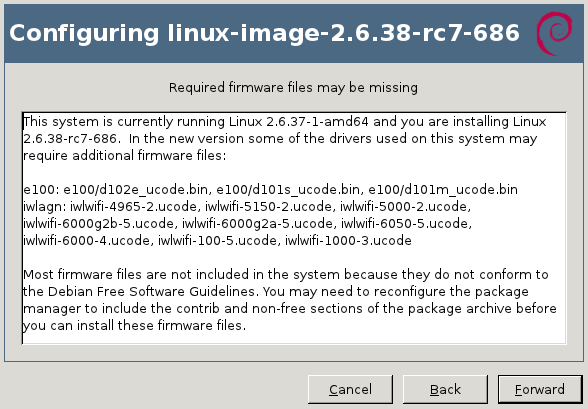
But you might be informed sooner. When you install a new version of the Linux kernel with the official Debian packages, the post-installation script will go through all loaded modules (those listed by lsmod) and it will verify whether this module as provided by the newly installed kernel might require firmware files. This information can be retrieved with modinfo:
$ modinfo -F firmware /lib/modules/2.6.32-5-amd64/kernel/drivers/net/e100.ko
e100/d102e_ucode.bin
e100/d101s_ucode.bin
e100/d101m_ucode.bin
If one (or more) of those firmware is (are) not yet available on the system, you will get a warning message similar to this one:
update-initramfs will also generate a similar warning on the terminal:

update-initramfs: Generating /boot/initrd.img-2.6.32-5-amd64
W: Possible missing firmware /lib/firmware/e100/d102e_ucode.bin for module e100
W: Possible missing firmware /lib/firmware/e100/d101s_ucode.bin for module e100
W: Possible missing firmware /lib/firmware/e100/d101m_ucode.bin for module e100
The Debian installer also detects when you have hardware that might require a missing firmware file. You have the option to supply the missing files on a USB stick (either directly or through the corresponding package). How do I find and install the missing firmware? Now that you have the name of the firmware file that you want, it s relatively easy to identify the package that provides the required file. You can use apt-cache search <filename> because the firmware packages embed the list of firmware files in their description. You can also use apt-file (provided by the package of the same name) or the web interface at packages.debian.org.
$ apt-cache search d101m_ucode.bin
firmware-linux-nonfree - Binary firmware for various drivers in the Linux kernel
$ apt-file search d101m_ucode.bin
firmware-linux-nonfree: /lib/firmware/e100/d101m_ucode.bin
If the above commands return nothing, you probably need to enable the non-free repository in your /etc/apt/sources.list (you can also enable it within synaptic). And you also want to run sudo apt-file update to have the latest information. Now you can install the right package, in the example above it was firmware-linux-nonfree. How do I install all firmware just to be sure I don t miss any? There s no meta-package depending on all firmware packages so there s no easy answer to this question. Furthermore not all firmware packages respect the naming convention firmware-* (there s for example zd1211-firmware). So your best bet is to look up all the packages with a generic search like this one:
$ apt-file --package-only search /lib/firmware/
atmel-firmware
[...]
And then install them all. Are there DVD or CD images with non-free firmware? Yes. Debian provides an unofficial netinst image for i386/amd64/powerpc with the non-free firmware, you can find it here: http://cdimage.debian.org/cdimage/unofficial/non-free/cd-including-firmware/. I provide complete DVD sets with firmware, and Multi-Arch CD/DVD with firmware, it s over there in my DVD shop: http://raphaelhertzog.com/go/debian-cd/ (i386/amd64 only) When using those installation discs, the Debian-installer will be able to find the required firmware immediately. There s no need for you to provide them on a USB stick. Other questions? I think I covered the most important things you have to know about firmware on Debian. But should you still have a question, feel free to share it in the comments so that I can improve this article.
Click here to subscribe to my free newsletter and get my monthly analysis on what s going on in Debian and Ubuntu. Or just follow along via the RSS feed, Identi.ca, Twitter or Facebook.

6 comments Liked this article? Click here. My blog is Flattr-enabled.

13 March 2011

Lars Wirzenius: DPL elections: candidate counts

Out of curiosity, and because it is Sunday morning and I have a cold and can't get my brain to do anything tricky, I counted the number of candidates in each year's DPL elections.

Year Count Names
1999 4 Joseph Carter, Ben Collins, Wichert Akkerman, Richard Braakman
2000 4 Ben Collins, Wichert Akkerman, Joel Klecker, Matthew Vernon
2001 4 Branden Robinson, Anand Kumria, Ben Collins, Bdale Garbee
2002 3 Branden Robinson, Rapha l Hertzog, Bdale Garbee
2003 4 Moshe Zadka, Bdale Garbee, Branden Robinson, Martin Michlmayr
2004 3 Martin Michlmayr, Gergely Nagy, Branden Robinson
2005 6 Matthew Garrett, Andreas Schuldei, Angus Lees, Anthony Towns, Jonathan Walther, Branden Robinson
2006 7 Jeroen van Wolffelaar, Ari Pollak, Steve McIntyre, Anthony Towns, Andreas Schuldei, Jonathan (Ted) Walther, Bill Allombert
2007 8 Wouter Verhelst, Aigars Mahinovs, Gustavo Franco, Sam Hocevar, Steve McIntyre, Rapha l Hertzog, Anthony Towns, Simon Richter
2008 3 Marc Brockschmidt, Rapha l Hertzog, Steve McIntyre
2009 2 Stefano Zacchiroli, Steve McIntyre
2010 4 Stefano Zacchiroli, Wouter Verhelst, Charles Plessy, Margarita Manterola
2011 1 Stefano Zacchiroli (no vote yet)
Winner indicate by boldface. I expect Zack to win over "None Of The Above", so I went ahead and boldfaced him already, even if there has not been a vote for this year. Median number of candidates is 4.

10 March 2011

Rapha&#235;l Hertzog: My Debian package maintainer pledge

When coming back from DebConf9, I wrote this pledge:
As a package maintainer, I will do my best to help the Debian project release a stable version of our operating system. In particular, I will work together with the release team and I will keep all packages associated to my name free of release critical bugs. To this effect, if I m not registered as being busy or in vacation, I will start working on my release critical bugs as soon as possible (in less than 1 week in common cases). If I can t deal with them in a timely fashion, I will state it clearly in the associated bug reports, tag them help and invite other contributors either to provide a patch or to do a non-maintainer upload. If I do not manage to handle release critical bugs in the above described way, or if I almost never deal with any of my RC bugs by myself, I will:
  • not refuse help and even propose co-maintenance to good contributors
  • recognize my failure and actively try to find a new maintainer and/or co-maintainers
  • not complain if the quality assurance team decides to orphan the package
I recognize that my work is not limited to unstable. I will also work with the stable release team and the security team to provide updated packages for the stable and/or testing distribution when some issues deserve it. I am aware of the limits of my skills and my available time and I will avoid packaging software that I would not be able to maintain properly.
It tries to sum up the minimal expectations that Debian should have towards the package maintainers. I tried first to get this pledge integrated into the NM/DM process but the discussion concluded that it would be best to document this in the developers-reference. There s already a chapter called Debian Developer s Duties where this can nicely fit. I submitted this as a wishlist request for the developers-reference soon after and it s still open. Now I went to the next step and prepared a patch that restructures the chapter about developer duties. See #548867 for details.
Follow me on Identi.ca, Twitter and Facebook. Or subscribe to this blog by RSS or by email.

4 comments Liked this article? Click here. My blog is Flattr-enabled.

3 March 2011

Rapha&#235;l Hertzog: People behind Debian: Christian Perrier, translation coordinator

Christian is a figure of Debian, not only because of the tremendous coordination work that he does within the translation project, but also because he s very involved at the social level. He s probably in the top 5 of the persons who attended most often the Debian conference. Christian is a friend (thanks for hosting me so many times when I come to Paris for Debian related events) and I m glad that he accepted to be interviewed. He likes to speak and that shows in the length of his answers :-) but you ll be traveling the world while reading him. My questions are in bold, the rest is by Christian. Who are you? I am a French citizen (which is easy to guess unless you correct my usual mistakes in what follows). I m immensely proud of being married for nearly 26 years with Elizabeth (who deserves a statue from Debian for being so patient with my passion and my dedication to the project). I m also the proud father of 3 wonderful kids , aged 19 to 23. I work as team manager in the Networks and Computers Division of Onera the French Aerospace lab , a public research institute about Aeronautics, Space and Defense. My team provides computer management services for research divisions of Onera, with a specific focus put on individual computing. I entered the world of free software as one of the very first users of Linux in France. Back in the early 1990 s, I happened (though the BBS users communities) to be a friend of several early adopters of Linux and/or BSD386/FreeBSD/NetBSD in France. More specifically, I discovered Linux thanks with my friend Ren Cougnenc (all my free software talks are dedicated to Ren , who passed away in 1996). You re not a programmer, not even a packager. How did you come to Debian? I m definitely not a programmer and I never studied computing (I graduated in Materials Science and worked in that area for a few years after my PhD). However, my daily work always involved computing (I redesigned the creep testing laboratory and its acquisition system all by myself during my thesis research work). An my hobbies often involved playing with home computers, always trying to learn about something new. So, first learning about a new operating system then trying to figure out how to become involved in its development was quite a logical choice. Debian is my distro of choice since it exists. I used Slackware on work machines for a while, but my home server, kheops, first ran Debian 1.1 when I stopped running a BBS on an MS-DOS machine to host a news server. That was back in October 1996. I then happened to be a user, and more specifically a user of genealogy software, also participating very actively in Usenet from this home computer and server, that was running this Debian thing. So, progressively, I joined mailing lists and, being a passionate person, I tried to figure out how I could bring my own little contribution to all this. This is why I became a packager (yes, I am one!) by taking over the geneweb package, which I was using to publish my genealogy research. I applied as DD in January 2001, then got my account in July 2001. My first upload to the Debian archive occurred on August 22nd 2001: that was of course geneweb, which I still maintain. Quite quickly, I became involved in the work on French localization. I have always been a strong supporter of localized software (I even translated a few BBS software back in the early 90 s) as one of the way to bring the power and richness of free software to more users. Localization work lead me to work on the early version of Debian Installer, during those 2003-2005 years where the development of D-I was an incredibly motivating and challenging task, lead by Joey Hess and his inspiring ideas. From user to contributor to leader, I suddenly discovered, around 2004, that I became the coordinator of D-I i18n (internationalization) without even noticing :-) You re the main translation coordinator in Debian. What plans and goals have you set for Debian Wheezy? As always: paint the world in red. Indeed, this is my goal for years. I would like our favorite distro to be able to be used by anyone in the world, whether she speaks English, Northern Sami, Wolof, Uyghur or Secwepemcts n. As a matter of symbol, I use the installer for this. My stance is that one should be able to even install Debian in one s own language. So, for about 7 years, I use D-I as a way to attract new localization contributors. This progress is represented on this page where the world is gradually painted in red as long as the installer supports more languages release after release. The map above tries to illustrate this by painting in red countries when the most spoken language in the country is supported in Debian Installer. However, that map does not give enough reward to many great efforts made to support very different kind of languages. Not only various national languages, but also very different ones: all regional languages of Spain, many of the most spoken languages in India, minority languages such as Uyghur for which an effort is starting, Northern Sami because it is taught in a few schools in Norway, etc., etc. Still, the map gives a good idea of what I would like to see better supported: languages from Africa, several languages in Central Asia. And, as a very very personal goal, I m eagerly waiting for support of Tibetan in Debian Installer, the same way we support its sister language, Dzongkha from Bhutan. For this to happen, we have to make contribution to localization as easy as possible. The very distributed nature of Debian development makes this a challenge, as material to translate (D-I components, debconf screens, native packages, packages descriptions, website, documentation) is very widely spread. A goal, for years, is to set a centralized place where translators could work easily without even knowing about SVN/GIT/BZR or having to report bugs to send their work. The point, however, would be to have this without making compromises on translation quality. So, with peer review, use of thesaurus and translation memory and all such techniques. Tools for this exist: we, for instance, worked with the developers of Pootle to help making it able to cope with the huge amount of material in Debian (think about packages descriptions translations). However, as of now, the glue between such tools and the raw material (that often lies in packages) didn t come. So, currently, translation work in Debian requires a great knowledge of how things are organized, where is the material, how it can be possible to make contribution reach packages, etc. And, as I m technically unable to fulfill the goal of building the infrastructure, I m fulfilling that role of spreading out the knowledge. This is how I can define my coordinator role. Ubuntu uses a web-based tool to make it easy to contribute translations directly in Launchpad. At some point you asked Canonical to make it free software. Launchpad has been freed in the mean time. Have you (re)considered using it? Why not? After all, it more or less fills in the needs I just described. I still don t really figure out how we could have all Debian material gathered in Rosetta/Launchpad .and also how Debian packagers could easily get localized material back from the framework without changing their development processes. I have always tried to stay neutral wrt Ubuntu. As many people now in Debian, I feel like we have reached a good way to achieve our mutual development. When it comes at localization work, the early days where the everything in Rosetta and translates who wants stanza did a lot of harm to several upstream localization projects is, I think, way over. Many people who currently contribute to D-I localization were indeed sent to me by Ubuntu contributors .and by localizing D-I, apt, debconf, package descriptions, etc., they re doing translation work for Ubuntu as well as for Debian. Let s say I m a Debian user and I want to help translate Debian in my language. I can spend 1 hour per week on this activity. What should I do to start? Several language teams use Debian mailing lists to coordinate their work. If you re lucky enough to be a speaker of one of these languages, try joining debian-l10n-<yourlanguage> and follow what s happening there. Don t try to immediately jump in some translation work. First, participate to peer reviews: comment on others translations. Learn about the team s processes, jargon and habits. Then, progressively, start working on a few translations: you may want to start with translations of debconf templates: they are short, often easy to do. That s perfect if you have few time. If no language team exists for your language, try joining debian-i18n and ask about existing effort for your language. I may be able to point you to individuals working on Debian translations (very often along with other free software translation efforts). If I am not, then you have just been named coordinator for your language :-) I may even ask you if you want to work on translating the Debian Installer. What s the biggest problem of Debian? We have no problems, we only have solutions :-) We are maybe facing a growth problem for a few years. Despite the increased welcoming aspects of our processes (Debian Maintainers), Debian is having hard times in growing. The overall number of active contributors is probably stagnating for quite a while. I m still amazed, however, to see how we can cope with that and still be able to release over the years. So, after all, this is maybe not a problem :-) Many people would point communication problems here. I don t. I think that communication inside the Debian project is working fairly well now. Our famous flame wars do of course still happen from time to time, but what large free software project doesn t have flame wars? In many areas, we indeed improved communication very significantly. I want to take as an example the way the release of squeeze has been managed. I think that the release team did, even more this time, a very significant and visible effort to communicate with the entire project. And the release of squeeze has been a great success in that matter. So, there s nearly nothing that frustrates me in Debian. Even when a random developer breaks my beloved 100% completeness of French translations, I m not frustrated for more than 2 minutes. You re known in the Debian community as the organizer of the Cheese & Wine Party during DebConf. Can you tell us what this is about? This is an interesting story about how things build themselves in Debian. It all started in July 2005, before DebConf 5 in Helsinki. Denis Barbier, Nicolas Fran ois and myself agreed to bring at Debconf a few pieces of French cheese as well as 1 or 2 bottles of French wine and share them with some friends. Thus, we settled an informal meeting in the French room where we invited some fellows: from memory, Benjamin Mako Hill, Hannah Wallach, Matt Zimmermann and Moray Allan. All of us fond of smelly cheese, great wine plus some extra p t home-made by Denis in Toulouse. It finally happened that, by word of mouth, a few dozens of other people slowly joined in that French room and turned the whole thing into an improvized party that more or less lasted for the entire night. The tradition was later firmly settled in 2006, first in Debconf 6 in Mexico where I challenged the French DDs to bring as many great cheese as possible, then during the Debian i18n meeting in Extremadura (Sept 2006) where we reached the highest amount of cheese per participant ever. I think that the Creofonte building in Casar de C ceres hasn t fully recovered from it and is still smelling cheese 5 years after. This party later became a real tradition for DebConf, growing over and over each year. I see it as a wonderful way to illustrate the diversity we have in Debian, as well as the mutual enrichment we always felt during DebConfs. My only regret about it is that it became so big over the years that organizing it is always a challenge and I more and more feel pressure to make it successful. However, over the years, I always found incredible help by DebConf participants (including my own son, last year a moment of sharing which we will both remember for years, i think). And, really, in 2010, standing up on a chair, shouting (because the microphone wasn t working) to thank everybody, was the most emotional moment I had at Debconf 10. Is there someone in Debian that you admire for their contributions? So many people. So, just like it happens in many awards ceremonies, I will be very verbose to thank people, sorry in advance for this. The name that comes first is Joey Hess. Joey is someone who has a unique way to perceive what improvements are good for Debian and a very precise and meticulous way to design these improvements. Think about debconf. It is designed for so long now and still reaching its very specific goal. So well designed that it is the entire basis for Joey s other achievement: designing D-I. Moreover, I not only admire Joey for his technical work, but also for his interaction with others. He is not he loudest person around, he doesn t have to .just giving his point in discussion and, guess what? Most of the time, he s right. Someone I would like to name here, also, is Colin Watson. Colin is also someone I worked with for years (the D-I effect, again ) and, here again, the very clever way he works on technical improvements as well as his very friendly way to interact with others just make it. And, how about you, Rapha l? :-) I m really admirative of the way you work on promoting technical work on Debian. Your natural ability to explain things (as good in English as it is in French) and your motivation to share your knowledge are a great benefit for the project. Not to mention the technical achievements you made with Guillem on dpkg of course! Another person I d like to name here is Steve Langasek. We both maintain samba packages for years and collaboration with him has always been a pleasure. Just like Colin, Steve is IMHO a model to follow when it comes at people who work for Canonical while continuing their involvment in Debian. And, indeed, Steve is so patient with my mistakes and stupid questions in samba packaging that he deserves a statue. We re now reaching the end of the year where Stefano Zacchiroli was the Debian Project Leader. And, no offense intended to people who were DPL before him (all of them being people I consider to be friends of mine), I think he did the best term ever. Zack is wonderful in sharing his enthusiasm about Debian and has a unique way to do it. Up to the very end of his term, he has always been working on various aspects of the project and my only hope is that he ll run again (however, I would very well understand that he wants to go back to his hacking activities!). Hat off, Zack!I again have several other people to name in this Bubulle hall of Fame : Don Armstrong, for his constant work on improving Debian BTS, Margarita Manterola as one of the best successes of Debian Women (and the most geeky honeymoon ever), Denis Barbier and Nicolas Fran ois because i18n need really skilled people, Cyril Brulebois and Julien Cristau who kept X.org packaging alive in lenny and squeeze, Otavio Salvador who never gave up on D-I even when we were so few to care about it. I would like to make a special mention for Frans Pop. His loss in 2010 has been a shock for many of us, and particularly me. Frans and I had a similar history in Debian, both mostly working on so-called non technical duties. Frans has been the best release manager for D-I (no offense intended, at all, to Joey or Otavio .I know that both of them share this feeling with me). His very high involvment in his work and the very meticulous way he was doing it lead to great achievements in the installer. The Installation Guide work was also a model and indeed a great example of non technical work that requires as many skills as more classical technical work. So, and even though he was sometimes so picky and, I have to admit, annoying, that explains why I m still feeling sad and, in some way, guilty about Frans loss. One of my goals for wheezy is indeed to complete some things Frans left unachieved. I just found one in bug #564441: I will make this work reach the archive, benefit our users and I know that Frans would have liked that.
Thank you to Christian for the time spent answering my questions. I hope you enjoyed reading his answers as I did. Subscribe to my newsletter to get my monthly summary of the Debian/Ubuntu news and to not miss further interviews. You can also follow along on Identi.ca, Twitter and Facebook.

7 comments Liked this article? Click here. My blog is Flattr-enabled.

1 March 2011

Rapha&#235;l Hertzog: 5 Free Software To Support With Flattr

Flattr FOSS LogoAnother month and thus another issue of Flattr FOSS. Time flies but Flattr s usage seems to remain relatively strong. I was fearing that people get bored after some time but that does not seem be to the case, my Flattr income does not really drop (it doesn t take off either ;-) ). I get a bit less for dpkg than at the start but a bit more for my blog. Enough babbling, let s go straight to the 5 projects to flattr this month:
  1. Linux Mint (Flattr link) is a Linux distribution based on Debian and Ubuntu that targets home desktop users. I have never tried it (I m too much of an hardcore Debianer) but I ve read several good reviews saying that it works well out of the box with good multimedia support. If you try it out, be sure to pick Linux Mint Debian Edition (LMDE). :-)
  2. Network Block Device (NBD) user-space support tools (Flattr link) is the set of tools to setup a block device whose content is really on a remote server. It requires support of NBD in the kernel of course. The user space tools are maintained by Debian developer Wouter Verhelst.
  3. Tahoe LAFS (Flattr link) is a filesystem that implements a cloud storage. The data are distributed across multiple servers in such a way that it can continue to work even if one of the servers fails.
  4. Gajim (Flattr link) is a full featured and easy to use Jabber client. If you don t need support of multiple instant messaging protocols, this Jabber client might be a good fit for you.
  5. Aur lien Gateau (Flattr link) is a KDE developer who takes one day per week off his work to work on KDE. He seeks support from the community to compensate for the loss of revenue. Much like me, he has a support page with a complete history of the amount of donations received. I can only sympathize with people who try to live true to their passion good luck Aur lien!
This article is part of the Flattr FOSS project.

5 comments Liked this article? Click here. My blog is Flattr-enabled.

26 February 2011

Rapha&#235;l Hertzog: February 2011 wrap up

February has been again a busy month for me. Here s a quick summary of what I did: Multi-Arch work I have spent many days implementing and refining dpkg s Multi-Arch support with Guillem Jover (dpkg co-maintainer) and Steve Langasek (beta-tester of my code ;-) ). Early testers can try what s in my latest pu/multiarch/snapshot/* branch in my personal git repository. A Debian DVD shop I m always exploring new options to fund my Debian work (besides direct donations) and this month with the Debian Squeeze release I saw an opportunity in selling Debian DVD. Nobody provides DVD with included firmwares and quite a few people would like to avoid the SpaceFun theme. So I built unofficial Debian DVDs that integrate firmware and that install a system with the old theme (MoreBlue Orbit). Click here to learn more about my unofficial DVDs. On my blog In my People behind Debian series, I interviewed Mike Hommey (Iceweasel maintainer) and Maximiliam Attems (member of the kernel team). I started a Debian Cleanup Tip series and already published 4 installments: For contributors, I wrote two articles: the first gives a set of (suggested) best practices for sponsoring Debian packages and adapted my article as a patch for the Developers Reference. In the second article, I shared some personal advice for people who are considering participating on Debian mailing list: 7 mistakes to avoid when participating to Debian mailing lists.
Click here to subscribe to my free newsletter and get my monthly analysis on what s going on in Debian and Ubuntu. Or just follow along via the RSS feed, Identi.ca, Twitter or Facebook.

No comment Liked this article? Click here. My blog is Flattr-enabled.

24 February 2011

Rapha&#235;l Hertzog: 7 mistakes to avoid when participating to Debian mailing lists

You re eager to start contributing to Debian, your first action is to subscribe to some high-profile mailing lists (like debian-devel and debian-project) to get a feel of the community. You read the mails for a few days and then you find out that you could participate to the discussions, it s a simple first step after all. True enough. That said, it s not as easy as it looks like. There are many mistakes that you should avoid:

  1. Don t fall in the trap where your mailing list participation is your sole contribution to Debian. If you want people to give credit to your messages, you should already be doing something else for Debian.
  2. Don t participate more than once a day to a given thread. There are many people subscribed, you should leave room for other people to express their point of view. You can always follow up one day after and reply to several messages at once if you believe you still have something new to add to the discussion.
  3. Don t reply to off-topic threads. Someone asked a simple question and someone else pointed out that his message was off-topic. Don t reply, or if you really need to, do it on the correct list or with a private response.
  4. Don t ask questions unless it s useful to bring the discussion forward. Development lists are not here to fill the gaps in your knowledge. We already have debian-mentors for this. Furthermore there s no better way to learn than to find yourself the answers to your questions. :-)
  5. Don t believe your opinion is so important. We re all very opinionated and discussions that consist only of contradicting opinions tend to go nowhere. Thus don t give your opinion unless you can back it up with new facts or another experience.
  6. Don t participate to all threads. There are surely some topics where you are more knowledgeable than others, participate where you add the most value and leave the others threads to the other experts (and learn by reading them).
  7. Don t hide your identity. In Debian we like to know each other. Use your real name and not some anonymous nickname. You need to be able to stand up behind your words, otherwise you re not credible.
I have myself been guilty of several of those when I started I invite you to follow my recommendations to ensure our mailing lists remain pleasant to read and an effective discussion place.
You should follow me on Identi.ca, Twitter and Facebook. Or subscribe to this blog by RSS or by email.

4 comments Liked this article? Click here. My blog is Flattr-enabled.

21 February 2011

Steve Langasek: How you can help with multiarch today

Paul Wise called attention recently to the fact that there's renewed activity around multiarch in the face of the squeeze release. Although I fervently wish we could have gotten multiarch support into squeeze, it's better late than never; and real progress is being made now, thanks mostly to the efforts of wonderful package management experts like Raphael Hertzog, Guillem Jover, and David Kalnischkies. Don't believe it's finally coming? Here's some output from my amd64 multiarch chroot:
$ dpkg -l '*:i386'
Desired=Unknown/Install/Remove/Purge/Hold
  Status=Not/Inst/Conf-files/Unpacked/halF-conf/Half-inst/trig-aWait/Trig-pend
 / Err?=(none)/Reinst-required (Status,Err: uppercase=bad)
 / Name           Version        Description
+++-==============-==============-============================================
ii  gcc-4.5-base   4.5.2-3ubuntu2 The GNU Compiler Collection (base package)
ii  libc6          2.13-0ubuntu1+ Embedded GNU C Library: Shared libraries
ii  libdb4.8       4.8.30-5multia Berkeley v4.8 Database Libraries [runtime]
ii  libgcc1        1:4.5.2-3ubunt GCC support library
in  libpam-modules <none>         (no description available)
ii  libpam0g       1.1.2-2ubuntu1 Pluggable Authentication Modules library
ii  libselinux1    2.0.96-1multia SELinux runtime shared libraries
ii  libstdc++6     4.5.2-3ubuntu2 The GNU Standard C++ Library v3
iU  libuuid1       2.17.2-9.1ubun Universally Unique ID library
ii  selinux-utils  2.0.96-1multia SELinux utility programs
ii  zlib1g         1:1.2.3.4.dfsg compression library - runtime
If you're as excited about this making its way into Debian as I am, you might be wondering what you can do to help. That's great, because I'd love to tell you! Perhaps you happen to maintain a package that provides executables; and perhaps other packages depend on your package exclusively to use those executables; and perhaps some of those packages depending on your package are shared libraries. If all of the above is true, please consider declaring this package to be Multi-Arch: foreign as defined here. Note: it is very important that you not use this on any package that will provide architecture-dependent interfaces to its reverse-dependencies. So if you're shipping both shared libraries and executables in the same binary package, don't do this. But if your package does fit this description, this is one part of multiarch that you can safely start implementing today. This will go a long way towards getting the system ready to handle multiarch libraries when they land. My own efforts to help with getting Multi-Arch: foreign packages documented in the archive are trackable here.

17 February 2011

Rapha&#235;l Hertzog: People behind Debian: Maximilian Attems, member of the kernel team

Maximilian, along with the other members of the Debian kernel team, has the overwhelming job of maintaining the Linux kernel in Debian. It s one of the largest package and certainly one where dealing with bug reports is really difficult as most of them are hardware-specific, and thus difficult to reproduce. He s very enthusiastic and energetic, and does not fear criticizing when something doesn t please him. You ll see. My questions are in bold, the rest is by Maximilian. Who are you? My name is Maximilian Attems. I am a theoretical physicist in my last year of PhD at the Technical University of Vienna. My main research area is the early phase of a Quark-Gluon Plasma as produced in heavy ion collisions at the LHC at CERN. I am developing simulations that take weeks on the Vienna Scientific Cluster (in the TOP 500 list). The rest of the lab is much less fancy and boils down to straight intel boxes without any binary blobs or external drivers (although lately we add radeon graphics for decent free 3D). Mathematica and Maple are the rare exceptions to the many dev tools of Debian (LaTeX, editors, git, IDE s, Open MPI, ..) found at the institute, as those are unfortunately yet unmatched in Free Software for symbolic computations. The lab mostly runs a combination of Debian stable (testing starting from freeze) for desktops and oldstable/stable for servers. Debian is in use for more than 10 years. So people in the institute know some ups and downs of the project. Newcomers like my room neighbors are always surprised how functional a free Debian Desktop is. :) What s your biggest achievement within Debian? Building lots and lots of kernels together with an growing uptake of the officially released linux images. I joined the Debian kernel team shortly after Herbert Xu departed. I had been upstream Maintainer of the linux-2.6 janitor project for almost a year brewing hundreds of small cleanups with quilt in a tree named kjt for early linux-2.6. In Debian we had lots of fun in sorting out the troubles that the long 2.5 freeze had imposed: Meaning we were sitting on a huge diverging monolithic semi-good patchset. It was great fun to prepare 2.6.8 for Sarge with a huge team enthusiastic in shipping something real close to mainline (You have to imagine that back then you had no stable or longterm release nor any useful free tools like git. This involved passing patches around, hand editing them and seeing what the result does.) From the Sarge install reports a common pattern emerged that the current Debian early userspace was causing lots of boot failures. This motivated me to develop an alternative using the new upstream initramfs features. So I got involved in early userspace. Thanks to large and active development team initramfs-tools got a nice ecosystem. It still tries to be as generic and flexible as possible and thus gains many nice features. Also H. Peter Anvin (hpa) gave me the official co-maintenance of klibc. klibc saw uptake and good patches from Google in the last 2 years. I am proud that the early userspace is working out fairly well these days, meaning you can shuffle discs around and see your box boot. Later on we focused on 2.6.18 for Etch, which turned out to a be good release and picked up by several other distributions. Only very much later we would see such a sync again. With 2.6.26 for Lenny we got somehow unlucky as we just missed the new longterm release by one release. We also pushed for another update very late (during freeze) in the release cycle, which turned out to semi-work as too much things depend on linux-2.6. For Squeeze 2.6.32 got picked thanks to discussions at Portland Linux Plumbers and it turned out to be a good release picked up by many distributions and external patchsets. The long-term support is going very well. Greg KH is doing a great job in collecting various needed fixes for it. Somehow we had hoped that the Squeeze freeze would start sooner and that the freeze duration would be shorter, since we were ready for a release starting from the actual freeze on. The only real big bastard on the cool 2.6.32 sync is Red Hat. Red Hat Enterprise 6.0 is shipping the linux-2.6 2.6.32 in obfuscated form. They released their linux-2.6 as one big tarball clashing with the spirit of the GPL. One can only mildly guess from the changelog which patches get applied. This is in sharp contrast to any previous Red Hat release and has not yet generated the sharp and snide comments in press it deserves. Red Hat should really step back and not make such stupid management moves. Next to them even the semi-maintained Oracle Unbreakable 2.6.32 branch looks better: It is git fetchable. What are your plans and those of the kernel team for Debian Wheezy? Since 2.6.32 many of the used patches landed upstream or are on the way (speakup, Kbuild Debian specific targets, ..). The proper vfs based unionfs is something we d be looking forward. We haven t yet picked the next upstream release we will base Wheezy on, so currently we can happily jump to the most recent ones. There are plans for better interaction with Debian Installer thanks to generating our udebs properly in linux-2.6 source itself. Also we are looking forward to using git as tool of maintenance. We d hope that this will also allow for even better cross distribution collaboration. Concerning early userspace I plan to release an initramfs-tools with more generic userspace for the default case and finally also a klibc only for embedded or tuning cases. What do you like most in Debian? For one thing I do like the 2 year release cycle. It is not too long to have completely outdated software and on the other hand it gives enough time to really see huge progress from release to release. Also at my institute the software is is recent enough without too much admin overhead. For servers the three years support are a bit short, but on the manageable side. I do enjoy a lot the testing distribution. For my personal use it is very stable and thus I mainly run testing on my desktop and work boxes. (Occasionally mixing in things from sid for unbreaking transition or newer security fixes). Debian is independent and not a commercial entity. I think this is its main force and even more important these days. I enjoy using the Debian platform a lot at work thus in return this motivates me to contribute to Debian itself. I also like the fact that we strive for technical correctness. Is there some recurrent problem that hinders the progress of Debian? The New Maintainer process is a strange way to discourage people to contribute to Debian. It is particularly bureaucratic and a huge waste of time both for the applicant and his manager. It should be completely thrown overboard. One needs a more scalable approach for trust and credibility that also enhances the technical knowledge for coding and packaging of the applicant. NM is currently set in stone as any outside critics is automatically rejected. Young and energetic people are crucial for Debian and the long-term viability of the project, this is the reason why I d consider the New Maintainer process as Debian s biggest problem. Note from Rapha l Hertzog: I must say I do not share this point of view on the New Maintainer process, I have witnessed lots of improvements lately thanks to the addition of the Debian Maintainer status, and to the fact that a good history of contribution can easily subsume the annoying Tasks & Skills questionnaire. Another thing I miss is professional graphics input both for the desktop theme and the website. I know that effort has been done there lately and it is good to see movement there, but the end result is still lacking. Another trouble of Debian is its marketing capabilities. It should learn to better sell itself. It is the distribution users want to run and use not the rebranded copies of itself with lock-in sugar . Debian is about choice and it offers plenty of it: it is a great default Desktop. Linus Torvalds doesn t find Debian (and/or Ubuntu) a good platform to hack on the kernel. Do you know why and what can we do about this? The Fedora linux-2.6 receives contributions from several Red Hat employed upstream sub-Maintainers. Thus it typically carries huge patches which are not yet upstream. As a consequence eventual userland troubles get revealed quite quickly and are often seen there first. The cutting edge nature of Fedora rawhide is appealing for many developers. The usual Debian package division of library development files and the library itself is traditionally an entry barrier for dev on Debian. Debian got pretty easily usable these days, although we could and should again improve a lot more in this sector. Personally I think that Linus hasn t tried Debian for years. I have the feeling that the implication of the Debian Kernel team in LKML has been on the rise. Is that true and how do you explain this? Ben Hutchings is the Nr.1 contributor for 2.6.33. He also is top listed as author of patches on stable 2.6.32. Debian is not listed as organization as many send their linux-2.6 patches from their corporate or personal email address and thus it won t be attributed to Debian. There is currently no means to see how many patches get forwarded for the stable tree, but I certainly forwarded more then fifty patches. I was very happy when Greg KH personally thanked me in the 2.6.32.12 release. In the Squeeze kernel, the firmwares have been stripped and moved into separate packages in the non-free section. What should a user do to ensure his system keeps working? There is a debconf warning on linux-2.6 installation. It is quite clear that the free linux-2.6 can t depend on the firmware of the non-free archive (also there is no strict dependency there technically). On the terminal you d also see warnings by update-initramfs on the initramfs generation for drivers included in the initramfs. The debconf warning lists the filename(s) of the missing firmware(s). One can then apt-cache search for the firmware package name and install it via the non-free repository. The check runs against the current loaded modules. The match is not 100% accurate for special cases as the one where the device might be handled well by this driver without firmware, but is accurate enough to warrant the warning. The set of virtualization technologies that the official Debian kernel supports seems to change regularly. Which of the currently available options would you recommend to users who want to build on something that will last? KVM has been a smooth ride from day zero. It almost got included instantly upstream. The uptake it has is great as it sees both dev from Intel and AMD. Together with libvirt it s management is easy. Also the performance of virtio is very good. The linux containers are the thing we are looking forward for enhanced chroots in the Wheezy schedule. They are also manageable by libvirt. Xen being the bad outside boy has an incredible shrinking patchset, thus is fair to expect to see it for Wheezy and beyond. For many it may come a bit late, but for old hardware without relevant CPU it is there. Many tend to overstate the importance of the virtualization tech. I d be much more looking forward to the better Desktop support in newer linux-2.6. The Desktop is important for linux and something that is in heavy use. The much better graphics support of the radeon and nouveau drivers: The performance optimizations thanks to dcache scalability work and the neat automatic task-grouping for the CPU scheduler are very promising features for the usability of the linux desktop. Another nice to have feature is the online defrag of ext4 and its faster mkfs. Even cooler would be better scalability in ext4 (This side seems to have seen not enough effort lately). Is there someone in Debian that you admire for their contributions? Hans Peter Anvin and Ted Tso are a huge source of deep linux-2.6 knowledge and personal wisdom. I do enjoy all sorts of interactions with them. Christoph Hellwig with Matthew Wilcox and also William Irwin for setting up the Debian kernel Team. Several Debian leaders including the previous and the current one for their engagement, which very often happens behind the scene. The Debian Gnome Team work is great, also the interactions have always been always easy and a pleasure. Martin Michlmayr and previously Thiemo Seufer do an incredible job in porting Debian on funny and interesting ARM and MIPS boxes. Debian has a lot of upcoming potential on this area. I m looking forward to other young enthusiastic people in that area. Colin Watson is bridging Debian and Ubuntu, which is an immense task. Michael Prokop bases on Debian an excellent recovery boot CD: http://www.grml.org. I d be happy if any Debian Developer would work as carefully coding and working.
Thank you to Maximilian for the time spent answering my questions. I hope you enjoyed reading his answers as I did. Subscribe to my newsletter to get my monthly summary of the Debian/Ubuntu news and to not miss further interviews. You can also follow along on Identi.ca, Twitter and Facebook.

One comment Liked this article? Click here. My blog is Flattr-enabled.

14 February 2011

Rapha&#235;l Hertzog: Debian Cleanup Tip #3: get rid of third-party packages

Last week, we learned how to get rid of obsolete packages. This time, we re going to learn how to bring back your computer to a state close to a pure Ubuntu/Debian installation. Thanks to the power of APT, it s easy to add new external repositories and install supplementary software. Unfortunately some of those are not very well maintained. They might contain crappy packages or they might simply not be updated. An external package which was initially working well, can become a burden on system maintenance because it will be interfering with regular updates (for example by requiring a package that should be removed in newer versions of the system). So my goal for today is to teach you how to identify the packages on your system that are not coming from Debian or Ubuntu. So that you can go through them from time to time and keep only those that you really need. Obsolete packages are a subset of those, but I ll leave them alone. We took care of them last week. Each (well-formed) APT repository comes with a Release file describing it (example). They provide some values that can be used by APT to identify packages contained in the repository. All official Debian repositories are documented with Origin=Debian (and Origin=Ubuntu for Ubuntu). You can verify the origin value associated to each repository (if any) in the output of apt-cache policy:
[...]
 500 http://ftp.debian.org/debian/ lenny/main i386 Packages
     release v=5.0.8,o=Debian,a=stable,n=lenny,l=Debian,c=main
     origin ftp.debian.org
[...]
From there on, we can simply ask aptitude to compute a list of packages which are both installed and not available in an official Debian repository:
$ aptitude search '?narrow(?installed, !?origin(Debian))!?obsolete'
or
$ aptitude search '~S ~i !~ODebian !~o'
You can replace search with purge or remove if you want to get rid of all the packages listed. But you re more likely to want to remove only a subset of carefully chosen packages you re probably still using some of the software that you installed from external repositories. With synaptic, you can also browse the content of each repository. Click on the Origin button and you have a list of repositories. You can go through the non-Debian repositories and look which packages are installed and up-to-date. But you can do better, you can create a custom view. Click on the menu entry Settings > Filter . Click on New to create a new filter and name it External packages . Unselect everything in the Status tab and keep only Installed . Go in the Properties tab and here add a new entry Origin Excludes ftp.debian.org . In fact you must replace ftp.debian.org with the hostname of your Debian/Ubuntu mirror. The one that appears on the origin line in the output of apt-cache policy (see the excerpt quoted above in this article). Note that the term Origin is used to refer to two different things, a field in the release file but also the name of the host for an APT repository. It s a bit confusing if you don t pay attention. Close the filters window with OK. You now have a new listing of External packages under the Custom Filters screen. You can see which packages are installed and up-to-date and decide whether you really want to keep it. If the package is also provided by Debian/Ubuntu and you want to go back to the version provided by your distribution, you can use the Package > Force version menu entry.
Click here to subscribe to my free newsletter and get my monthly analysis on what s going on in Debian and Ubuntu. Or just follow along via the RSS feed, Identi.ca, Twitter or Facebook.

8 comments Liked this article? Click here. My blog is Flattr-enabled.

10 February 2011

Rapha&#235;l Hertzog: Best practices when sponsoring Debian packages

Sponsoring a package means uploading a package for someone else (usually a new contributor starting out as package maintainer). This is an activity reserved to Debian Developer who are supposed to be knowledgeable about packaging. This article tries to document the process to ensure the sponsor is doing a reasonably good job according to Debian s standards. Sponsoring a package in the Debian archive is not a trivial matter. It means that you verified the packaging and that it is of the level of quality that Debian strives to have. Let s have a look to what you can and should do when you re sponsoring a package. Sponsoring the initial upload Sponsoring a brand new package into Debian requires a thorough review of the Debian packaging. Building the package and testing the software is definitely not enough! You should open every file in the debian directory and look out for potential problems. Here s a checklist that you can use to perform the audit: If the audit did not reveal any problem, you can upload the package. But remember that even if you re not the maintainer, the sponsor is still responsible of what he uploaded to Debian. That s why you re encouraged to keep up with the package through the Package Tracking System. Sponsoring an update of an existing package You will usually assume that the package has already gone through a full review. So instead of doing it again, you will carefully analyze the difference between the current version and the new version prepared by the maintainer. If you have not done the initial review yourself, you might still want to have a more deeper look just in case the initial reviewer was sloppy. To be able to analyze the difference you need both versions. Download the current version of the source package (with apt-get source) and rebuild it (or download the current binary packages with aptitude download). Download the source package to sponsor (usually with dget). Read the new changelog entry, it should tell you what to expect during the review. The main tool you will use is debdiff, you can run it with two source packages (.dsc files), or two binary packages, or two .changes files (it will then compare all the binary packages listed in the .changes). If you compare the source packages (excluding upstream files in the case of a new upstream version, for example by filtering the output of debdiff with filterdiff -i '*/debian/*'), you must understand all the changes you see and they should be properly documented in the Debian changelog. If everything is fine, build the package and compare the binary packages to verify that the changes on the source package have no unexpected consequences (like some files dropped by mistake, missing dependencies, etc.). You might want to check out the Package Tracking System to verify if the maintainer has not missed something important. Maybe there are translations updates sitting in the BTS that could have been integrated. Maybe the package has been NMUed and the maintainer forgot to integrate the changes from the NMU in his package. Maybe there s a release critical bug that he has left unhandled and that s blocking migration to testing. Whatever. If you find something that she could have done (better), it s time to tell her so that she can improve for next time. And so that she has a better understanding of her responsibilities. If you have found no problem, upload the new version. Otherwise ask the maintainer to provide you a fixed version.
This article will be repurposed to enhance the Debian Developers Reference, hopefully leading to a fix for the wishlist bug #453313. Click here and help me fix more of those. You re also welcome to suggest improvements in the comments. Are there other checks that you re always doing? Do you have some handy tip to make it easier to review a package?

7 comments Liked this article? Click here. My blog is Flattr-enabled.

Next.

Previous.